


Chromatic aberration

Encyclopedia
.jpg)
In optics
Optics
Optics is the branch of physics which involves the behavior and properties of light, including its interactions with matter and the construction of instruments that use or detect it. Optics usually describes the behavior of visible, ultraviolet, and infrared light...
, chromatic aberration (CA, also called achromatism or chromatic distortion) is a type of distortion
Distortion
A distortion is the alteration of the original shape of an object, image, sound, waveform or other form of information or representation. Distortion is usually unwanted, and often many methods are employed to minimize it in practice...
in which there is a failure of a lens
Lens (optics)
A lens is an optical device with perfect or approximate axial symmetry which transmits and refracts light, converging or diverging the beam. A simple lens consists of a single optical element...
to focus
Focus (optics)
In geometrical optics, a focus, also called an image point, is the point where light rays originating from a point on the object converge. Although the focus is conceptually a point, physically the focus has a spatial extent, called the blur circle. This non-ideal focusing may be caused by...
all color
Color
Color or colour is the visual perceptual property corresponding in humans to the categories called red, green, blue and others. Color derives from the spectrum of light interacting in the eye with the spectral sensitivities of the light receptors...
s to the same convergence point. It occurs because lenses have a different refractive index
Refractive index
In optics the refractive index or index of refraction of a substance or medium is a measure of the speed of light in that medium. It is expressed as a ratio of the speed of light in vacuum relative to that in the considered medium....
for different wavelengths of light
Light
Light or visible light is electromagnetic radiation that is visible to the human eye, and is responsible for the sense of sight. Visible light has wavelength in a range from about 380 nanometres to about 740 nm, with a frequency range of about 405 THz to 790 THz...
(the dispersion
Dispersion (optics)
In optics, dispersion is the phenomenon in which the phase velocity of a wave depends on its frequency, or alternatively when the group velocity depends on the frequency.Media having such a property are termed dispersive media...
of the lens). The refractive index decreases with increasing wavelength.
Chromatic aberration
Aberration in optical systems
Aberrations are departures of the performance of an optical system from the predictions of paraxial optics. Aberration leads to blurring of the image produced by an image-forming optical system. It occurs when light from one point of an object after transmission through the system does not converge...
manifests itself as "fringes" of color along boundaries that separate dark and bright parts of the image, because each color in the optical spectrum cannot be focused at a single common point. Since the focal length
Focal length
The focal length of an optical system is a measure of how strongly the system converges or diverges light. For an optical system in air, it is the distance over which initially collimated rays are brought to a focus...
f of a lens is dependent on the refractive index n, different wavelengths of light will be focused on different positions.
Types
There are two types of chromatic aberration, axial (longitudinal), and transverse (lateral). Axial aberration occurs when different wavelengths of light are focused at different distances from the lens, i.e. different points on the optical axis (focus shift). Transverse aberration occurs when different wavelengths are focused at different positions in the focal plane (because the magnificationMagnification
Magnification is the process of enlarging something only in appearance, not in physical size. This enlargement is quantified by a calculated number also called "magnification"...
and/or distortion of the lens also varies with wavelength; indicated in graphs as (change in) focus length). The acronym LCA is used, but ambiguous, and may refer to either longitudinal or lateral CA; for clarity, this article uses "axial" (shift in the direction of the optical axis) and "transverse" (shift perpendicular to the optical axis, in the plane of the sensor or film).
These two types have different characteristics, and may occur together. Axial CA occurs throughout the image, and is reduced by stopping down (this increases depth of field, so though the different wavelength focus at different distances, they are still in acceptable focus). Transverse CA does not occur in the center, and increases towards the edge, but is not affected by stopping down.
In digital sensors, axial CA results in the red and blue planes being defocused (assuming that the green plane is in focus), which is relatively difficult to remedy in post-processing, while transverse CA results in the red, green, and blue planes being at different magnifications (magnification changing along radii, as in geometric distortion), and can be corrected by scaling the planes appropriately so they line up.
Minimization
In the earliest uses of lenses, chromatic aberration was reduced by increasing the focal length of the lens where possible. For example, this could result in extremely long telescopes such as the very long aerial telescopeAerial telescope
An aerial telescope is a type of very-long-focal-length refracting telescope built in the second half of the 17th century that did not use a tube. Instead, the objective was mounted on a pole, tree, tower, building or other structure on a swivel ball-joint. The observer stood on the ground and held...
s of the 17th century. Isaac Newton
Isaac Newton
Sir Isaac Newton PRS was an English physicist, mathematician, astronomer, natural philosopher, alchemist, and theologian, who has been "considered by many to be the greatest and most influential scientist who ever lived."...
's theories about white light
White Light
White Light may refer to:*Light with the color white*White Light , a 1980 novel by Rudy Rucke*White Light , 1971 album*White Light , 2010 album...
being composed of a spectrum
Spectrum
A spectrum is a condition that is not limited to a specific set of values but can vary infinitely within a continuum. The word saw its first scientific use within the field of optics to describe the rainbow of colors in visible light when separated using a prism; it has since been applied by...
of colors led him to the conclusion that uneven refraction of light caused chromatic aberration (leading him to build the first reflecting telescope
Reflecting telescope
A reflecting telescope is an optical telescope which uses a single or combination of curved mirrors that reflect light and form an image. The reflecting telescope was invented in the 17th century as an alternative to the refracting telescope which, at that time, was a design that suffered from...
, his Newtonian telescope
Newtonian telescope
The Newtonian telescope is a type of reflecting telescope invented by the British scientist Sir Isaac Newton , using a concave primary mirror and a flat diagonal secondary mirror. Newton’s first reflecting telescope was completed in 1668 and is the earliest known functional reflecting telescope...
, in 1668).
There exists a point called the circle of least confusion, where chromatic aberration can be minimized. It can be further minimized by using an achromatic lens
Achromatic lens
An achromatic lens or achromat is a lens that is designed to limit the effects of chromatic and spherical aberration. Achromatic lenses are corrected to bring two wavelengths into focus in the same plane....
or achromat, in which materials with differing dispersion are assembled together to form a compound lens. The most common type is an achromatic doublet
Doublet (lens)
In optics, a doublet is a type of lens made up of two simple lenses paired together. Such an arrangement allows more optical surfaces, thicknesses, and formulations, especially as the space between lenses may be considered an "element." With additional degrees of freedom, optical designers have...
, with elements made of crown
Crown glass (optics)
Crown glass is type of optical glass used in lenses and other optical components. It has relatively low refractive index and low dispersion...
and flint glass
Flint glass
Flint glass is optical glass that has relatively high refractive index and low Abbe number. Flint glasses are arbitrarily defined as having an Abbe number of 50 to 55 or less. The currently known flint glasses have refractive indices ranging between 1.45 and 2.00...
. This reduces the amount of chromatic aberration over a certain range of wavelengths, though it does not produce perfect correction. By combining more than two lenses of different composition, the degree of correction can be further increased, as seen in an apochromatic lens or apochromat. Note that "achromat" and "apochromat" refer to the type of correction (2 or 3 wavelengths correctly focused), not the degree (how defocused the other wavelengths are), and an achromat made with sufficiently low dispersion glass can yield significantly better correction than an achromat made with more conventional glass. Similarly, the benefit of apochromats is not simply that they focus 3 wavelengths sharply, but that their error on other wavelength is also quite small.
Many types of glass
Glass
Glass is an amorphous solid material. Glasses are typically brittle and optically transparent.The most familiar type of glass, used for centuries in windows and drinking vessels, is soda-lime glass, composed of about 75% silica plus Na2O, CaO, and several minor additives...
have been developed to reduce chromatic aberration. These are low dispersion glass
Low dispersion glass
Low dispersion glass is a type of glass with low dispersion. Crown glass is an example of a relatively inexpensive low-dispersion glass....
, most notably, glasses containing fluorite
Fluorite
Fluorite is a halide mineral composed of calcium fluoride, CaF2. It is an isometric mineral with a cubic habit, though octahedral and more complex isometric forms are not uncommon...
. These hybridized glasses have a very low level of optical dispersion; only two compiled lenses made of these substances can yield a high level of correction.
The use of achromats was an important step in the development of the optical microscope
Microscope
A microscope is an instrument used to see objects that are too small for the naked eye. The science of investigating small objects using such an instrument is called microscopy...
and in telescopes.
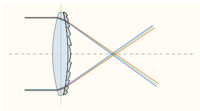
An alternative to achromatic doublets is the use of diffractive optical elements. Diffractive optical elements have complementary dispersion characteristics to that of optical glasses and plastics. In the visible part of the spectrum, diffractives have an Abbe number
Abbe number
In physics and optics, the Abbe number, also known as the V-number or constringence of a transparent material, is a measure of the material's dispersion in relation to the refractive index...
of −3.5. Diffractive optical elements can be fabricated using diamond turning
Diamond turning
Diamond turning is a process of mechanical machining of precision elements using lathes or derivative machine tools equipped with natural or synthetic diamond-tipped tool bits...
techniques.
 |
 |
|
 |
Mathematics of chromatic aberration minimization
For a doublet consisting of two thin lenses in contact, the Abbe numberAbbe number
In physics and optics, the Abbe number, also known as the V-number or constringence of a transparent material, is a measure of the material's dispersion in relation to the refractive index...
of the lens materials is used to calculate the correct focal length of the lenses to ensure correction of chromatic aberration. If the focal lengths of the two lenses for light at the yellow Fraunhofer
Fraunhofer lines
In physics and optics, the Fraunhofer lines are a set of spectral lines named for the German physicist Joseph von Fraunhofer . The lines were originally observed as dark features in the optical spectrum of the Sun....
D-line (589.2 nm) are f1 and f2, then best correction occurs for the condition:

where V1 and V2 are the Abbe numbers of the materials of the first and second lenses, respectively. Since Abbe numbers are positive, one of the focal lengths must be negative, i.e., a diverging lens, for the condition to be met.
The overall focal length of the doublet f is given by the standard formula for thin lenses in contact:

and the above condition ensures this will be the focal length of the doublet for light at the blue and red Fraunhofer F and C lines (486.1 nm and 656.3 nm respectively). The focal length for light at other visible wavelengths will be similar but not exactly equal to this.
Chromatic aberration is used during an eye test to ensure that a correct lens power has been selected. The patient is confronted with red and green images and asked which is sharper. If the prescription is right, then the cornea, lens and prescribed lens will focus the red and green wavelengths just in front, and behind the retina, appearing of equal sharpness. If the lens is too powerful or weak, then one will focus on the retina, and the other will be much more blurred in comparison.
Image processing to reduce the appearance of lateral chromatic aberration
In some circumstances it is possible to correct some of the effects of chromatic aberration in digital post-processing. However in real-world circumstances, chromatic aberration results in permanent loss of some image detail. Detailed knowledge of the optical system used to produce the image can allow for some useful correction. In an ideal situation, post-processing to remove or correct lateral chromatic aberration would involve scaling the fringed color channels, or subtracting some of a scaled versions of the fringed channels, so that all channels spatially overlap each other correctly in the final image.As chromatic aberration is complex (due to its relationship to focal length, etc.) some camera manufacturers employ lens-specific chromatic aberration appearance minimization techniques. All Nikon DSLRs with CMOS sensors and all Panasonic Lumix DSLRs, additionally some Nikon and Panasonic compact cameras, do such processing automatically in camera for JPEG
JPEG
In computing, JPEG . The degree of compression can be adjusted, allowing a selectable tradeoff between storage size and image quality. JPEG typically achieves 10:1 compression with little perceptible loss in image quality....
images. Nikon DSLRs additionally store correction-data in RAW-files for use by Nikon Capture, View NX and some other RAW tools. Due to the Canon EF lens mount
Canon EF lens mount
Introduced in 1987, the EF lens mount is the standard lens mount on the Canon EOS family of SLR film and digital cameras. EF stands for "Electro-Focus": automatic focusing on EF lenses is handled by a dedicated electric motor built into the lens...
all-electronic lens communication and coupling system, the Canon's Digital Photo Professional software has one of the most advanced chromatic aberration appearance minimization (also vignetting and distortion handling) systems that uses lens model-specific focusing distance, focal length and aperture information stored in the Canon RAW (CR2) files. Third party software tools such as PTLens are also capable of performing complex chromatic aberration appearance minimization with their large database of cameras and lens.
In reality, even a theoretically perfect post-processing based chromatic aberration reduction-removal-correction systems do not increase image detail as a lens that is optically well corrected for chromatic aberration would for the following reasons:
- Rescaling is only applicable to lateral chromatic aberration but there is also longitudinal chromatic aberration
- Rescaling individual color channels result in a loss of resolution from the original image
- Most camera sensors only capture a few and discrete (e.g., RGB) color channels but chromatic aberration is not discreet and occurs across the light spectrum
- The dyes used in the digital camera sensors for capturing color are not very efficient so cross-channel color contamination is unavoidable and causes, for example, the chromatic aberration in the red channel to also be blended in to the green channel along with any green chromatic aberration.
The above are closely related to the specific scene that is captured so no amount of programming and knowledge of the capturing equipment (e.g., camera and lens data) can overcome these limitations.
Photography

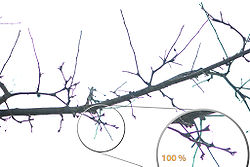
Purple fringing
In photography, and particularly in digital photography, purple fringing is the term for an out-of-focus purple or magenta "ghost" image on a photograph...
" is commonly used in photography
Photography
Photography is the art, science and practice of creating durable images by recording light or other electromagnetic radiation, either electronically by means of an image sensor or chemically by means of a light-sensitive material such as photographic film...
, although not all purple fringing can be attributed to chromatic aberration.
Similar colored fringing around highlights may also be caused by lens flare
Lens flare
Lens flare is the light scattered in lens systems through generally unwanted image formation mechanisms, such as internal reflection and scattering from material inhomogeneities in the lens. These mechanisms differ from the intended image formation mechanism that depends on refraction of the image...
. Colored fringing around highlights or dark regions may be due to the receptors for different colors having differing dynamic range
Dynamic range
Dynamic range, abbreviated DR or DNR, is the ratio between the largest and smallest possible values of a changeable quantity, such as in sound and light. It is measured as a ratio, or as a base-10 or base-2 logarithmic value.-Dynamic range and human perception:The human senses of sight and...
or sensitivity
Film speed
Film speed is the measure of a photographic film's sensitivity to light, determined by sensitometry and measured on various numerical scales, the most recent being the ISO system....
-- therefore preserving detail in one or two color channels, while "blowing out" or failing to register, in the other channel or channels. On digital cameras, the particular demosaicing
Demosaicing
A demosaicing algorithm is a digital image process used to reconstruct a full color image from the incomplete color samples output from an image sensor overlaid with a color filter array...
algorithm is likely to affect the apparent degree of this problem. Another cause of this fringing is chromatic aberration in the very small microlens
Microlens
A microlens is a small lens, generally with a diameter less than a millimetre and often as small as 10 micrometres . The small sizes of the lenses means that a simple design can give good optical quality but sometimes unwanted effects arise due to optical diffraction at the small features...
es used to collect more light for each CCD pixel; since these lenses are tuned to correctly focus green light, the incorrect focusing of red and blue results in purple fringing around highlights. This is a uniform problem across the frame, and is more of a problem in CCD's with a very small pixel pitch such as those used in compact cameras. Some cameras, such as the Panasonic Lumix
Lumix
Lumix is Panasonic's brand of digital cameras, ranging from pocket point-and-shoot models to digital SLRs.Compact digital camera DMC-LC5 and DMC-F7 were the first products of the Lumix series released in 2001. They are equipped with Leica lenses....
series and newer Nikon
Nikon
, also known as just Nikon, is a multinational corporation headquartered in Tokyo, Japan, specializing in optics and imaging. Its products include cameras, binoculars, microscopes, measurement instruments, and the steppers used in the photolithography steps of semiconductor fabrication, of which...
DSLRs, feature a processing step specifically designed to remove it.
On photographs taken using a digital camera, very small highlights may frequently appear to have chromatic aberration where in fact the effect is because the highlight image is too small to stimulate all three color pixels, and so is recorded with an incorrect color. This may not occur with all types of digital camera sensor. Again, the de-mosaicing algorithm may affect the apparent degree of the problem.
Black-and-white photography
Chromatic aberration also affects black-and-white photography. Although there are no colors in the photograph, chromatic aberration will blur the image. It can be reduced by using a narrow-band color filter, or by converting a single color channel to black and white. This will, however, require longer exposure. (This is only true with panchromatic black-and-white film, since orthochromaticOrthochromatic
- Orthochromatic photography :Orthochromatic photography refers to a photographic emulsion that is sensitive to only blue and green light, and thus can be processed with a red safelight. The increased blue sensitivity causes blue objects to appear lighter and red ones darker...
film is already sensitive to only a limited spectrum.)
See also
- Aberration in optical systemsAberration in optical systemsAberrations are departures of the performance of an optical system from the predictions of paraxial optics. Aberration leads to blurring of the image produced by an image-forming optical system. It occurs when light from one point of an object after transmission through the system does not converge...
- Achromatic lensAchromatic lensAn achromatic lens or achromat is a lens that is designed to limit the effects of chromatic and spherical aberration. Achromatic lenses are corrected to bring two wavelengths into focus in the same plane....
– A fix for chromatic aberration - Achromatic telescopeAchromatic telescopeThe achromatic telescope is a refracting telescope that uses an achromatic lens to correct for chromatic aberration.-How it works:When an image passes through a lens, the light is refracted at different angles for different wavelengths. This produces focal lengths that are dependent on the color of...
- Apochromatic lens
- Cooke tripletCooke tripletThe Cooke triplet is a photographic lens designed and patented in 1893 by Dennis Taylor who was employed as chief engineer by T. Cooke & Sons of York...
- SuperachromatSuperachromatThe superachromat or superachromatic lens was first conceived and developed by Max Herzberger as the ultimately well-corrected lens. The color shift curve of a superachromat is a quartic, meaning that in theory four separate colors can be brought to focus in the same plane, while simultaneously...
- Theory of ColoursTheory of ColoursTheory of Colours is a work by Johann Wolfgang von Goethe about the poet's views on the nature of colours and how these are perceived by man, published in 1810...