

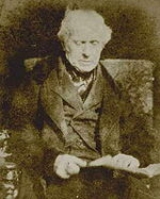
David Brewster

Encyclopedia
Sir David Brewster KH PRSE FRS FSA(Scot) FSSA MICE (11 December 1781 – 10 February 1868) was a Scottish
physicist, mathematician, astronomer, inventor, writer and university principal
.
, Roxburghshire
to Margaret Key (1753–1790) and James Brewster (c. 1735–1815), the rector of Jedburgh Grammar School
and a teacher of high reputation. David was the third of six children, two daughters and four sons: James (1777–1847), minister at Craig, Ferryden; David; David; George (1784–1855), minister at Scoonie, Fife; and Patrick (1788–1859), minister at the abbey church, Paisley.
At the age of 12, David was sent to the University of Edinburgh
(graduating MA in 1800), being intended for the clergy. He was licensed a minister of the Church of Scotland, but only preached from the pulpit on one occasion. He had already shown a strong inclination for natural science
, and this had been fostered by his intimacy with a "self-taught philosopher
, astronomer
and mathematician
," as Sir Walter Scott
called him, of great local fame—James Veitch of Inchbonny
—a man who was particularly skillful in making telescope
s.
 Though Brewster duly finished his theological
studies and was licensed to preach, his other interests distracted him from the duties of his profession. In 1799 fellow-student Henry Brougham persuaded him to study the diffraction
of light
. The results of his investigations were communicated from time to time in papers to the Philosophical Transactions of London
and other scientific journals. The fact that other scientists – notably Etienne Louis Malus and Augustin Fresnel – were pursuing the same investigations contemporaneously in France
does not invalidate Brewster's claim to independent discovery, even though in one or two cases the priority must be assigned to others. A lesser-known classmate of his, Thomas Dick
, also went on to become a popular astronomical writer.
The most important subjects of his inquiries can be enumerated under the following five headings:
In this line of investigation, the prime importance belongs to the discovery of
These discoveries were promptly recognized. As early as 1807 the degree of LL.D. was conferred upon Brewster by Marischal College
, Aberdeen; in 1815 he was made a member of the Royal Society of London
, and received the Copley medal
; in 1818 he received the Rumford Medal
of the society; and in 1816 the French Institute awarded him one-half of the prize of three thousand francs for the two most important discoveries in physical science made in Europe during the two preceding years. In 1821, he was made a foreign member of the Royal Swedish Academy of Sciences
.
Among the non-scientific public, his fame spread more effectually by his invention in about 1815 of the kaleidoscope
, for which there was a great demand in both the United Kingdom, France
, and the United States
. As a reflection of this fame, Brewster portrait was later printed in some cigar boxes. Brewster chose renowned achromatic lens
developer Philip Carpenter
as the sole manufacturer of the kaleidoscope in 1817. Although Brewster patented kaleidoscope in 1817 (GB 4136), a copy of the prototype was shown to London opticians and copied before the patent was granted. As a consequence, kaleidoscope became produced in large numbers, but yielded no direct financial benefits to Brewster. It proved to be a massive success with two hundred thousand kaleidoscopes sold in London
and Paris
in just three months.
An instrument of more significance, the stereoscope, which – though of much later date (1849) – along with the kaleidoscope did more than anything else to popularize his name, was not as has often been asserted the invention of Brewster. Sir Charles Wheatstone
discovered its principle and applied it as early as 1838 to the construction of a cumbersome but effective instrument, in which the binocular pictures were made to combine by means of mirror
s. Brewster's contribution was the suggestion to use prisms
for uniting the dissimilar pictures; and accordingly the lenticular stereoscope may fairly be said to be his invention.
A much more valuable and practical result of Brewster's optical researches was the improvement of the British lighthouse
system. Although Fresnel, who had also the satisfaction of being the first to put it into operation, perfected the dioptric apparatus independently, Brewster was active earlier in the field than Fresnel, describing the dioptric apparatus in 1812. Brewster pressed its adoption on those in authority at least as early as 1820, two years before Fresnel suggested it, and it was finally introduced into lighthouses mainly through Brewster's persistent efforts.
Although Brewster's own discoveries were important, they were not his only service to science. He began writing in 1799 as a regular contributor to the Edinburgh Magazine, of which he acted as editor at the age of twenty. In 1807, he undertook the editorship of the newly projected Edinburgh Encyclopaedia, of which the first part appeared in 1808, and the last not until 1830. The work was strongest in the scientific department, and many of its most valuable articles were from the pen of the editor. At a later period he was one of the leading contributors to the Encyclopædia Britannica
(seventh and eighth editions) writing, among others, the articles on electricity
, hydrodynamics, magnetism
, microscope
, optics
, stereoscope, and voltaic electricity.
In 1819 Brewster undertook further editorial work by establishing, in conjunction with Robert Jameson
(1774–1854), the Edinburgh Philosophical Journal, which took the place of the Edinburgh magazine. The first ten volumes (1819–1824) were published under the joint editorship of Brewster and Jameson, the remaining four volumes (1825–1826) being edited by Jameson alone. After parting company with Jameson, Brewster started the Edinburgh Journal of Science in 1824, 16 volumes of which appeared under his editorship during the years 1824–1832, with very many articles from his own pen.
He contributed around three hundred papers to the transactions of various learned societies, and few of his contemporaries wrote as much for the various reviews. In the North British Review alone seventy-five articles of his appeared. A list of his larger separate works will be found below. Special mention, however, must be made of the most important of them all: his biography of Sir Isaac Newton
. In 1831 he published a short popular account of the philosopher's life in Murray's Family Library; but it was not until 1855 that he was able to issue the much fuller Memoirs of the Life, Writings and Discoveries of Sir Isaac Newton, a work which embodied the results of more than 20 years' investigation of original manuscripts and other available sources.
Brewster's position as editor brought him into frequent contact with the most eminent scientific men, and he was naturally among the first to recognize the benefit that would accrue from regular communication among those in the field of science. In a review of Charles Babbage
's book Decline of Science in England in John Murray's Quarterly Review
, he suggested the creation of "an association of our nobility, clergy, gentry and philosophers". This was taken up by various Declinarians and found speedy realization in the British Association for the Advancement of Science
. Its first meeting was held at York
in 1831; and Brewster, along with Babbage and Sir John F. W. Herschel
, had the chief part in shaping its constitution.
In the same year in which the British Association held its first meeting, Brewster received the honour of knighthood and the decoration of the Royal Guelphic Order
. In 1838, he was appointed principal of the united colleges of St Salvator and St Leonard, University of St Andrews
. In 1849, he acted as president of the British Association and was elected one of the eight foreign associates of the Institute of France in succession to J. J. Berzelius
; and ten years later, he accepted the office of principal of the University of Edinburgh, the duties of which he discharged until within a few months of his death.
Of a high-strung and nervous temperament, Brewster was somewhat irritable in matters of controversy; but he was repeatedly subjected to serious provocation. He was a man of highly honourable and fervently religious character. In estimating his place among scientific discoverers, the chief thing to be borne in mind is that his genius was not characteristically mathematical. His method was empirical, and the laws that he established were generally the result of repeated experiment. To the ultimate explanation of the phenomena with which he dealt he contributed nothing, and it is noteworthy although he did not maintain to the end of his life the corpuscular theory he never explicitly adopted the wave theory of light. Few would dispute the verdict of James D. Forbes, an editor of the eighth edition of the Encyclopædia Britannica
: "His scientific glory is different in kind from that of Young
and Fresnel; but the discoverer of the law of polarization of biaxial crystals, of optical mineralogy, and of double refraction by compression, will always occupy a foremost rank in the intellectual history of the age." In addition to the various works of Brewster already mentioned, the following may be added: Notes and Introduction to Carlyle's translation of Legendre's Elements of Geometry (1824); Treatise on Optics (1831); Letters on Natural Magic, addressed to Sir Walter Scott (1832); The Martyrs of Science, or the Lives of Galileo, Tycho Brahe, and Kepler (1841); More Worlds than One (1854).
poems. They married on 31 July 1810 in Edinburgh and had four sons and a daughter:
Brewster married second time in Nice, on 26 (or 27) March 1857, to Jane Kirk Purnell (b. 1827), the second daughter of Thomas Purnell of Scarborough. Brewster died in 1868, and was buried at Melrose Abbey
, next to his first wife and second son. The physics building at Heriot Watt University is named in his honour.
Scotland
Scotland is a country that is part of the United Kingdom. Occupying the northern third of the island of Great Britain, it shares a border with England to the south and is bounded by the North Sea to the east, the Atlantic Ocean to the north and west, and the North Channel and Irish Sea to the...
physicist, mathematician, astronomer, inventor, writer and university principal
Principal (academia)
The Principal is the chief executive and the chief academic officer of a university or college in certain parts of the Commonwealth.-Canada:...
.
Early life
David Brewster was born at the Canongate in JedburghJedburgh
Jedburgh is a town and former royal burgh in the Scottish Borders and historically in Roxburghshire.-Location:Jedburgh lies on the Jed Water, a tributary of the River Teviot, it is only ten miles from the border with England and is dominated by the substantial ruins of Jedburgh Abbey...
, Roxburghshire
Roxburghshire
Roxburghshire or the County of Roxburgh is a registration county of Scotland. It borders Dumfries to the west, Selkirk to the north-west, and Berwick to the north. To the south-east it borders Cumbria and Northumberland in England.It was named after the Royal Burgh of Roxburgh...
to Margaret Key (1753–1790) and James Brewster (c. 1735–1815), the rector of Jedburgh Grammar School
Jedburgh Grammar School
Jedburgh Grammar School is a state secondary school in Jedburgh, Scotland, with around 440 pupils, 40 teaching staff, and 15 non-teaching staff.-Architecture:...
and a teacher of high reputation. David was the third of six children, two daughters and four sons: James (1777–1847), minister at Craig, Ferryden; David; David; George (1784–1855), minister at Scoonie, Fife; and Patrick (1788–1859), minister at the abbey church, Paisley.
At the age of 12, David was sent to the University of Edinburgh
University of Edinburgh
The University of Edinburgh, founded in 1583, is a public research university located in Edinburgh, the capital of Scotland, and a UNESCO World Heritage Site. The university is deeply embedded in the fabric of the city, with many of the buildings in the historic Old Town belonging to the university...
(graduating MA in 1800), being intended for the clergy. He was licensed a minister of the Church of Scotland, but only preached from the pulpit on one occasion. He had already shown a strong inclination for natural science
Natural science
The natural sciences are branches of science that seek to elucidate the rules that govern the natural world by using empirical and scientific methods...
, and this had been fostered by his intimacy with a "self-taught philosopher
Philosophy
Philosophy is the study of general and fundamental problems, such as those connected with existence, knowledge, values, reason, mind, and language. Philosophy is distinguished from other ways of addressing such problems by its critical, generally systematic approach and its reliance on rational...
, astronomer
Astronomy
Astronomy is a natural science that deals with the study of celestial objects and phenomena that originate outside the atmosphere of Earth...
and mathematician
Mathematics
Mathematics is the study of quantity, space, structure, and change. Mathematicians seek out patterns and formulate new conjectures. Mathematicians resolve the truth or falsity of conjectures by mathematical proofs, which are arguments sufficient to convince other mathematicians of their validity...
," as Sir Walter Scott
Walter Scott
Sir Walter Scott, 1st Baronet was a Scottish historical novelist, playwright, and poet, popular throughout much of the world during his time....
called him, of great local fame—James Veitch of Inchbonny
Jedburgh
Jedburgh is a town and former royal burgh in the Scottish Borders and historically in Roxburghshire.-Location:Jedburgh lies on the Jed Water, a tributary of the River Teviot, it is only ten miles from the border with England and is dominated by the substantial ruins of Jedburgh Abbey...
—a man who was particularly skillful in making telescope
Telescope
A telescope is an instrument that aids in the observation of remote objects by collecting electromagnetic radiation . The first known practical telescopes were invented in the Netherlands at the beginning of the 1600s , using glass lenses...
s.
Career
Theology
Theology is the systematic and rational study of religion and its influences and of the nature of religious truths, or the learned profession acquired by completing specialized training in religious studies, usually at a university or school of divinity or seminary.-Definition:Augustine of Hippo...
studies and was licensed to preach, his other interests distracted him from the duties of his profession. In 1799 fellow-student Henry Brougham persuaded him to study the diffraction
Diffraction
Diffraction refers to various phenomena which occur when a wave encounters an obstacle. Italian scientist Francesco Maria Grimaldi coined the word "diffraction" and was the first to record accurate observations of the phenomenon in 1665...
of light
Light
Light or visible light is electromagnetic radiation that is visible to the human eye, and is responsible for the sense of sight. Visible light has wavelength in a range from about 380 nanometres to about 740 nm, with a frequency range of about 405 THz to 790 THz...
. The results of his investigations were communicated from time to time in papers to the Philosophical Transactions of London
London
London is the capital city of :England and the :United Kingdom, the largest metropolitan area in the United Kingdom, and the largest urban zone in the European Union by most measures. Located on the River Thames, London has been a major settlement for two millennia, its history going back to its...
and other scientific journals. The fact that other scientists – notably Etienne Louis Malus and Augustin Fresnel – were pursuing the same investigations contemporaneously in France
France
The French Republic , The French Republic , The French Republic , (commonly known as France , is a unitary semi-presidential republic in Western Europe with several overseas territories and islands located on other continents and in the Indian, Pacific, and Atlantic oceans. Metropolitan France...
does not invalidate Brewster's claim to independent discovery, even though in one or two cases the priority must be assigned to others. A lesser-known classmate of his, Thomas Dick
Thomas Dick
Reverend Thomas Dick , was a Scottish church minister, science teacher and writer, known for his works on astronomy and practical philosophy, combining science and Christianity, and defusing the tension between the two.-Early life:Thomas was brought up in the strict tenets of the presbyterian...
, also went on to become a popular astronomical writer.
The most important subjects of his inquiries can be enumerated under the following five headings:
- The laws of light polarization by reflectionReflection (physics)Reflection is the change in direction of a wavefront at an interface between two differentmedia so that the wavefront returns into the medium from which it originated. Common examples include the reflection of light, sound and water waves...
and refractionRefractionRefraction is the change in direction of a wave due to a change in its speed. It is essentially a surface phenomenon . The phenomenon is mainly in governance to the law of conservation of energy. The proper explanation would be that due to change of medium, the phase velocity of the wave is changed...
, and other quantitative laws of phenomena; - The discovery of the polarizing structure induced by heatHeatIn physics and thermodynamics, heat is energy transferred from one body, region, or thermodynamic system to another due to thermal contact or thermal radiation when the systems are at different temperatures. It is often described as one of the fundamental processes of energy transfer between...
and pressurePressurePressure is the force per unit area applied in a direction perpendicular to the surface of an object. Gauge pressure is the pressure relative to the local atmospheric or ambient pressure.- Definition :...
; - The discovery of crystals with two axes of double refraction, and many of the laws of their phenomena, including the connection between optical structure and crystalline forms;
- The laws of metalMetalA metal , is an element, compound, or alloy that is a good conductor of both electricity and heat. Metals are usually malleable and shiny, that is they reflect most of incident light...
lic reflection; - Experiments on the absorption of light.
In this line of investigation, the prime importance belongs to the discovery of
- the connection between the refractive index and the polarizing angle;
- biaxial crystals, and
- the production of double refraction by irregular heating.
These discoveries were promptly recognized. As early as 1807 the degree of LL.D. was conferred upon Brewster by Marischal College
Marischal College
Marischal College is a building and former university in the centre of the city of Aberdeen in north-east Scotland. The building is owned by the University of Aberdeen and used for ceremonial events...
, Aberdeen; in 1815 he was made a member of the Royal Society of London
Royal Society
The Royal Society of London for Improving Natural Knowledge, known simply as the Royal Society, is a learned society for science, and is possibly the oldest such society in existence. Founded in November 1660, it was granted a Royal Charter by King Charles II as the "Royal Society of London"...
, and received the Copley medal
Copley Medal
The Copley Medal is an award given by the Royal Society of London for "outstanding achievements in research in any branch of science, and alternates between the physical sciences and the biological sciences"...
; in 1818 he received the Rumford Medal
Rumford Medal
The Rumford Medal is awarded by the Royal Society every alternating year for "an outstandingly important recent discovery in the field of thermal or optical properties of matter made by a scientist working in Europe". First awarded in 1800, it was created after a 1796 donation of $5000 by the...
of the society; and in 1816 the French Institute awarded him one-half of the prize of three thousand francs for the two most important discoveries in physical science made in Europe during the two preceding years. In 1821, he was made a foreign member of the Royal Swedish Academy of Sciences
Royal Swedish Academy of Sciences
The Royal Swedish Academy of Sciences or Kungliga Vetenskapsakademien is one of the Royal Academies of Sweden. The Academy is an independent, non-governmental scientific organization which acts to promote the sciences, primarily the natural sciences and mathematics.The Academy was founded on 2...
.
Among the non-scientific public, his fame spread more effectually by his invention in about 1815 of the kaleidoscope
Kaleidoscope
A kaleidoscope is a circle of mirrors containing loose, colored objects such as beads or pebbles and bits of glass. As the viewer looks into one end, light entering the other end creates a colorful pattern, due to the reflection off the mirrors...
, for which there was a great demand in both the United Kingdom, France
France
The French Republic , The French Republic , The French Republic , (commonly known as France , is a unitary semi-presidential republic in Western Europe with several overseas territories and islands located on other continents and in the Indian, Pacific, and Atlantic oceans. Metropolitan France...
, and the United States
United States
The United States of America is a federal constitutional republic comprising fifty states and a federal district...
. As a reflection of this fame, Brewster portrait was later printed in some cigar boxes. Brewster chose renowned achromatic lens
Achromatic lens
An achromatic lens or achromat is a lens that is designed to limit the effects of chromatic and spherical aberration. Achromatic lenses are corrected to bring two wavelengths into focus in the same plane....
developer Philip Carpenter
Carpenter and Westley
Carpenter and Westley were a British optical, mathematical and scientific instrument makers between 1808 and 1914. The company was founded by Philip Carpenter and, after his death, was continued by his sister Mary Carpenter alongside former apprentice William Westley...
as the sole manufacturer of the kaleidoscope in 1817. Although Brewster patented kaleidoscope in 1817 (GB 4136), a copy of the prototype was shown to London opticians and copied before the patent was granted. As a consequence, kaleidoscope became produced in large numbers, but yielded no direct financial benefits to Brewster. It proved to be a massive success with two hundred thousand kaleidoscopes sold in London
London
London is the capital city of :England and the :United Kingdom, the largest metropolitan area in the United Kingdom, and the largest urban zone in the European Union by most measures. Located on the River Thames, London has been a major settlement for two millennia, its history going back to its...
and Paris
Paris
Paris is the capital and largest city in France, situated on the river Seine, in northern France, at the heart of the Île-de-France region...
in just three months.
An instrument of more significance, the stereoscope, which – though of much later date (1849) – along with the kaleidoscope did more than anything else to popularize his name, was not as has often been asserted the invention of Brewster. Sir Charles Wheatstone
Charles Wheatstone
Sir Charles Wheatstone FRS , was an English scientist and inventor of many scientific breakthroughs of the Victorian era, including the English concertina, the stereoscope , and the Playfair cipher...
discovered its principle and applied it as early as 1838 to the construction of a cumbersome but effective instrument, in which the binocular pictures were made to combine by means of mirror
Mirror
A mirror is an object that reflects light or sound in a way that preserves much of its original quality prior to its contact with the mirror. Some mirrors also filter out some wavelengths, while preserving other wavelengths in the reflection...
s. Brewster's contribution was the suggestion to use prisms
Prism (optics)
In optics, a prism is a transparent optical element with flat, polished surfaces that refract light. The exact angles between the surfaces depend on the application. The traditional geometrical shape is that of a triangular prism with a triangular base and rectangular sides, and in colloquial use...
for uniting the dissimilar pictures; and accordingly the lenticular stereoscope may fairly be said to be his invention.
A much more valuable and practical result of Brewster's optical researches was the improvement of the British lighthouse
Lighthouse
A lighthouse is a tower, building, or other type of structure designed to emit light from a system of lamps and lenses or, in older times, from a fire, and used as an aid to navigation for maritime pilots at sea or on inland waterways....
system. Although Fresnel, who had also the satisfaction of being the first to put it into operation, perfected the dioptric apparatus independently, Brewster was active earlier in the field than Fresnel, describing the dioptric apparatus in 1812. Brewster pressed its adoption on those in authority at least as early as 1820, two years before Fresnel suggested it, and it was finally introduced into lighthouses mainly through Brewster's persistent efforts.
Although Brewster's own discoveries were important, they were not his only service to science. He began writing in 1799 as a regular contributor to the Edinburgh Magazine, of which he acted as editor at the age of twenty. In 1807, he undertook the editorship of the newly projected Edinburgh Encyclopaedia, of which the first part appeared in 1808, and the last not until 1830. The work was strongest in the scientific department, and many of its most valuable articles were from the pen of the editor. At a later period he was one of the leading contributors to the Encyclopædia Britannica
Encyclopædia Britannica
The Encyclopædia Britannica , published by Encyclopædia Britannica, Inc., is a general knowledge English-language encyclopaedia that is available in print, as a DVD, and on the Internet. It is written and continuously updated by about 100 full-time editors and more than 4,000 expert...
(seventh and eighth editions) writing, among others, the articles on electricity
Electricity
Electricity is a general term encompassing a variety of phenomena resulting from the presence and flow of electric charge. These include many easily recognizable phenomena, such as lightning, static electricity, and the flow of electrical current in an electrical wire...
, hydrodynamics, magnetism
Magnetism
Magnetism is a property of materials that respond at an atomic or subatomic level to an applied magnetic field. Ferromagnetism is the strongest and most familiar type of magnetism. It is responsible for the behavior of permanent magnets, which produce their own persistent magnetic fields, as well...
, microscope
Microscope
A microscope is an instrument used to see objects that are too small for the naked eye. The science of investigating small objects using such an instrument is called microscopy...
, optics
Optics
Optics is the branch of physics which involves the behavior and properties of light, including its interactions with matter and the construction of instruments that use or detect it. Optics usually describes the behavior of visible, ultraviolet, and infrared light...
, stereoscope, and voltaic electricity.
In 1819 Brewster undertook further editorial work by establishing, in conjunction with Robert Jameson
Robert Jameson
thumb|Robert JamesonProfessor Robert Jameson, FRS FRSE was a Scottish naturalist and mineralogist.As Regius Professor at the University of Edinburgh for fifty years, Jameson is notable for his advanced scholarship in natural history, his superb museum collection, and for his tuition of Charles...
(1774–1854), the Edinburgh Philosophical Journal, which took the place of the Edinburgh magazine. The first ten volumes (1819–1824) were published under the joint editorship of Brewster and Jameson, the remaining four volumes (1825–1826) being edited by Jameson alone. After parting company with Jameson, Brewster started the Edinburgh Journal of Science in 1824, 16 volumes of which appeared under his editorship during the years 1824–1832, with very many articles from his own pen.
He contributed around three hundred papers to the transactions of various learned societies, and few of his contemporaries wrote as much for the various reviews. In the North British Review alone seventy-five articles of his appeared. A list of his larger separate works will be found below. Special mention, however, must be made of the most important of them all: his biography of Sir Isaac Newton
Isaac Newton
Sir Isaac Newton PRS was an English physicist, mathematician, astronomer, natural philosopher, alchemist, and theologian, who has been "considered by many to be the greatest and most influential scientist who ever lived."...
. In 1831 he published a short popular account of the philosopher's life in Murray's Family Library; but it was not until 1855 that he was able to issue the much fuller Memoirs of the Life, Writings and Discoveries of Sir Isaac Newton, a work which embodied the results of more than 20 years' investigation of original manuscripts and other available sources.
Brewster's position as editor brought him into frequent contact with the most eminent scientific men, and he was naturally among the first to recognize the benefit that would accrue from regular communication among those in the field of science. In a review of Charles Babbage
Charles Babbage
Charles Babbage, FRS was an English mathematician, philosopher, inventor and mechanical engineer who originated the concept of a programmable computer...
's book Decline of Science in England in John Murray's Quarterly Review
Quarterly Review
The Quarterly Review was a literary and political periodical founded in March 1809 by the well known London publishing house John Murray. It ceased publication in 1967.-Early years:...
, he suggested the creation of "an association of our nobility, clergy, gentry and philosophers". This was taken up by various Declinarians and found speedy realization in the British Association for the Advancement of Science
British Association for the Advancement of Science
frame|right|"The BA" logoThe British Association for the Advancement of Science or the British Science Association, formerly known as the BA, is a learned society with the object of promoting science, directing general attention to scientific matters, and facilitating interaction between...
. Its first meeting was held at York
York
York is a walled city, situated at the confluence of the Rivers Ouse and Foss in North Yorkshire, England. The city has a rich heritage and has provided the backdrop to major political events throughout much of its two millennia of existence...
in 1831; and Brewster, along with Babbage and Sir John F. W. Herschel
John Herschel
Sir John Frederick William Herschel, 1st Baronet KH, FRS ,was an English mathematician, astronomer, chemist, and experimental photographer/inventor, who in some years also did valuable botanical work...
, had the chief part in shaping its constitution.
In the same year in which the British Association held its first meeting, Brewster received the honour of knighthood and the decoration of the Royal Guelphic Order
Royal Guelphic Order
The Royal Guelphic Order, sometimes also referred to as the Hanoverian Guelphic Order, is a Hanoverian order of chivalry instituted on 28 April 1815 by the Prince Regent . It has not been conferred by the British Crown since the death of King William IV in 1837, when the personal union of the...
. In 1838, he was appointed principal of the united colleges of St Salvator and St Leonard, University of St Andrews
University of St Andrews
The University of St Andrews, informally referred to as "St Andrews", is the oldest university in Scotland and the third oldest in the English-speaking world after Oxford and Cambridge. The university is situated in the town of St Andrews, Fife, on the east coast of Scotland. It was founded between...
. In 1849, he acted as president of the British Association and was elected one of the eight foreign associates of the Institute of France in succession to J. J. Berzelius
Jöns Jakob Berzelius
Jöns Jacob Berzelius was a Swedish chemist. He worked out the modern technique of chemical formula notation, and is together with John Dalton, Antoine Lavoisier, and Robert Boyle considered a father of modern chemistry...
; and ten years later, he accepted the office of principal of the University of Edinburgh, the duties of which he discharged until within a few months of his death.
Of a high-strung and nervous temperament, Brewster was somewhat irritable in matters of controversy; but he was repeatedly subjected to serious provocation. He was a man of highly honourable and fervently religious character. In estimating his place among scientific discoverers, the chief thing to be borne in mind is that his genius was not characteristically mathematical. His method was empirical, and the laws that he established were generally the result of repeated experiment. To the ultimate explanation of the phenomena with which he dealt he contributed nothing, and it is noteworthy although he did not maintain to the end of his life the corpuscular theory he never explicitly adopted the wave theory of light. Few would dispute the verdict of James D. Forbes, an editor of the eighth edition of the Encyclopædia Britannica
Encyclopædia Britannica
The Encyclopædia Britannica , published by Encyclopædia Britannica, Inc., is a general knowledge English-language encyclopaedia that is available in print, as a DVD, and on the Internet. It is written and continuously updated by about 100 full-time editors and more than 4,000 expert...
: "His scientific glory is different in kind from that of Young
Thomas Young (scientist)
Thomas Young was an English polymath. He is famous for having partly deciphered Egyptian hieroglyphics before Jean-François Champollion eventually expanded on his work...
and Fresnel; but the discoverer of the law of polarization of biaxial crystals, of optical mineralogy, and of double refraction by compression, will always occupy a foremost rank in the intellectual history of the age." In addition to the various works of Brewster already mentioned, the following may be added: Notes and Introduction to Carlyle's translation of Legendre's Elements of Geometry (1824); Treatise on Optics (1831); Letters on Natural Magic, addressed to Sir Walter Scott (1832); The Martyrs of Science, or the Lives of Galileo, Tycho Brahe, and Kepler (1841); More Worlds than One (1854).
Family
Brewster married twice. His first wife, Juliet Macpherson (c. 1776–1850), was a daughter of James Macpherson (1736–1796), a probable translator of OssianOssian
Ossian is the narrator and supposed author of a cycle of poems which the Scottish poet James Macpherson claimed to have translated from ancient sources in the Scots Gaelic. He is based on Oisín, son of Finn or Fionn mac Cumhaill, anglicised to Finn McCool, a character from Irish mythology...
poems. They married on 31 July 1810 in Edinburgh and had four sons and a daughter:
- James (1812–)
- Charles Macpherson (1813-1828), drowned.
- David Edward Brewster (17 August 1815 –) became a military officer (Lieutenant Colonel) serving in India.
- Henry Craigie (1816–) became a photographer.
- Margaret Maria Gordon (1823–1907) wrote a book on Brewster, which is considered the most comprehensive description of his
Brewster married second time in Nice, on 26 (or 27) March 1857, to Jane Kirk Purnell (b. 1827), the second daughter of Thomas Purnell of Scarborough. Brewster died in 1868, and was buried at Melrose Abbey
Melrose Abbey
Melrose Abbey is a Gothic-style abbey in Melrose, Scotland. It was founded in 1136 by Cistercian monks, on the request of King David I of Scotland. It was headed by the Abbot or Commendator of Melrose. Today the abbey is maintained by Historic Scotland...
, next to his first wife and second son. The physics building at Heriot Watt University is named in his honour.
Further reading
- Brewster, David (1854). The Creed of the Philosopher and the Hope of the Christian. Murray (reissued by Cambridge University PressCambridge University PressCambridge University Press is the publishing business of the University of Cambridge. Granted letters patent by Henry VIII in 1534, it is the world's oldest publishing house, and the second largest university press in the world...
, 2009; ISBN 9781108004169) PDF copy
External links
- Sir David Brewster -- a short biography
- The Brewster Kaleidoscope Society
- Internet Archive Downloadable works by David Brewster