

The Clouds

Encyclopedia
The Clouds is a comedy written by the celebrated playwright Aristophanes
lampooning intellectual fashions in classical Athens
. It was originally produced at the City Dionysia
in 423 BC
and it was not well received, coming last of the three plays competing at the festival that year. It was revised between 420-417 BC and thereafter it was circulated in manuscript form. No copy of the original production survives and scholarly analysis indicates that the revised version is an incomplete form of Old Comedy. This incompleteness however is not obvious in translations and modern performances. The Clouds can be considered not only the world's first extant 'comedy of ideas' but also a brilliant and successful example of that genre. The play gained notoriety for its caricature of the philosopher Socrates
ever since its mention in Plato
's Apology
as a factor contributing to the old man's trial and execution.
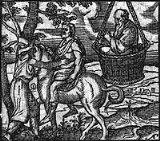
Detailed summary: The play begins with Strepsiades suddenly sitting up in bed while his son, Pheidippides, remains blissfully asleep in the bed next to him. Strepsiades complains to the audience that he is too worried about household debts to get any sleep – his wife (the pampered product of an aristocratic clan) has encouraged their son's expensive interest in horses. Strepsiades, having thought up a plan to get out of debt, wakes the youth gently and pleads with him to do something for him. Pheidippides at first agrees to do as he's asked then changes his mind when he learns that his father wants to enroll him in The Thinkery, a school for nerds and intellectual bums that no self-respecting, athletic young man dares to be seen with. Strepsiades explains that students of The Thinkery learn how to turn inferior arguments into winning arguments and this is the only way he can beat their aggrieved creditors in court. Pheidippides however will not be persuaded and Strepsiades decides to enroll himself in The Thinkery in spite of his advanced age. There he meets a student who tells him about some of the recent discoveries made by Socrates, the head of The Thinkery, including a new unit of measurement for ascertaining the distance jumped by a flea (a flea's foot, created from a minuscule imprint in wax), the exact cause of the buzzing noise made by a gnat (its arse resembles a trumpet) and a new use for a large pair of compasses (as a kind of fishing-hook for stealing cloaks from pegs over the gymnasium wall). Impressed, Stepsiades begs to be introduced to the man behind these discoveries. The wish is soon granted: Socrates appears overhead, wafted in a basket at the end of a rope, the better to observe the Sun and other meteorological phenomena. The philosopher descends and quickly begins the induction ceremony for the new elderly student, the highlight of which is a parade of the Clouds, the patron goddesses of thinkers and other layabouts. The Clouds arrive singing majestically of the regions whence they arose and of the land they have now come to visit, loveliest in all Greece. Introduced to them as a new devotee, Strepsiades begs them to make him the best orator in Greece by a hundred miles. They reply with the promise of a brilliant future. Socrates leads him into the dingy Thinkery for his first lesson and The Clouds step forward to address the audience.
Putting aside their cloud-like costumes, The Chorus declares that this is the author's cleverest play and that it cost him the greatest effort. It reproaches the audience for the play's failure at the festival, where it was beaten by the works of inferior authors, and it praises the author for originality and for his courage in lampooning influential politicians such as Cleon
. The Chorus then resumes its appearance as clouds, promising divine favours if the audience punishes Cleon for corruption and rebuking Athenians for messing about with the calendar, since this has put Athens out of step with the moon.
Socrates returns to the stage in a huff, protesting against the ineptitude of his new elderly student. He summons Strepsiades outside and attempts further lessons, including a form of meditative incubation in which the old man lies under a blanket while thoughts are supposed to arise in his mind naturally. The incubation results in Strepsiades masturbating under the blanket and finally Socrates refuses to have anything more to do with him. The Clouds advise him to find someone younger to do the learning for him. His son, Pheidippides, subsequently yields to threats by Strepsiades and reluctantly returns with him to the Thinkery, where they encounter the personified arguments Superior and Inferior, associates of Socrates. Superior Argument and Inferior Argument debate with each other over which of them can offer the best education. Superior Argument sides with Justice and the gods, offering to prepare Pheidippides for an earnest life of discipline, typical of men who respect the old ways; Inferior Argument, denying the existence of Justice, offers to prepare him for a life of ease and pleasure, typical of men who know how to talk their way out of trouble. At the end of the debate, a quick survey of the audience reveals that buggers - people schooled by Inferior Arguments - have got into the most powerful positions in Athens. Superior Argument accepts his inevitable defeat, Inferior Argument leads Pheidippides into the Thinkery for a life-changing education and Strepsiades goes home happy. The Clouds step forward to address the audience a second time, demanding to be awarded first place in the festival competition, in return for which they promise good rains - otherwise they'll destroy crops, smash roofs and spoil weddings.
The story resumes with Strepsiades returning to The Thinkery to fetch his son. A new Pheidippides emerges, startlingly transformed into the pale nerd and intellectual bum that he had once feared to become. Rejoicing in the prospect of talking their way out of financial trouble, Stepsiades leads the youth home for celebrations, just moments before the first of their aggrieved creditors arrives with a witness to summon him to court. Strepsiades comes back on stage, confronts the creditor and dismisses him contemptuously. A second creditor arrives and receives the same treatment before Strepsiades returns indoors to continue the celebrations. The Clouds sing ominously of a looming debacle and Strepsiades again comes back on stage, now in distress, complaining of a beating that his new son has just given him in a dispute over the celebrations. Pheidippides emerges coolly and insolently debates with his father a father's right to beat his son and a son's right to beat his father. He ends by threatening to beat his mother also, whereupon Strepsiades flies into a rage against The Thinkery, blaming Socrates for his latest troubles. He leads his slaves, armed with torches and mattocks, in a frenzied attack on the disreputable school. The alarmed students are pursued offstage and the Chorus, with nothing to celebrate, quietly departs.
and the need for peace with Sparta. The Spartans had recently stopped their annual invasions of Attica
after the Athenians had taken Spartan hostages in the Battle of Sphacteria
in 425 and this, coupled with a defeat suffered by the Athenians at the Battle of Delium
in 424, had provided the right conditions for a truce. Thus the original production of The Clouds in 423 BC came at a time when Athens was looking forward to a period of peace. Cleon
, the populist leader of the pro-war faction in Athens, was a target in all Aristophanes' early plays and his attempts to prosecute Aristophanes for slander in 426 had merely added fuel to the fire. Aristophanes however had singled Cleon out for special treatment in his previous play The Knights
in 424 and there are relatively few references to him in The Clouds.
Freed from political and war-time issues, Aristophanes focuses in The Clouds on a broader issue that underlies many conflicts depicted in his plays - the issue of Old versus New, or the battle of ideas. The scientific speculations of Ionia
n thinkers such as Thales
in the sixth century were becoming commonplace knowledge in Aristophanes' time and this had led, for instance, to a growing belief that civilized society was not a gift from the gods but rather had developed gradually from primitive man's animal-like existence. Around the time that The Clouds was produced, Democritus
at Abdera was developing an atomistic theory of the cosmos and Hippocrates
at Cos was establishing an empirical and science-like approach to medicine. Anaxagoras
, whose works were studied by Socrates, was living in Athens when Aristophanes was a youth. Anaxagoras enjoyed the patronage of influential figures such as Pericles
, but oligarchic elements also had political advocates and Anaxagoras was charged with impiety and expelled from Athens around 437 BC.
The battle of ideas had led to some unlikely friendships that cut across personal and class differences, such as between the socially alert Pericles and the unworldly Anaxagoras, and between the handsome aristocrat, Alcibiades
, and the ugly plebeian, Socrates
. Socrates moreover had distinguished himself from the crowd by his heroism in the retreat from the battle of Delium and this might have further singled him out for ridicule among his comrades. He was forty-five years old and in good physical shape when The Clouds was produced yet he had a face that lent itself easily to caricature by mask-makers and possibly that was a contributing reason for the frequent characterization of him by comic poets. In fact one of the plays that defeated The Clouds in 423 was called Connus, written by Ameipsias, and it too lampooned Socrates. There is a famous story, as reported for example by Aelian, according to which Socrates cheerfully rose from his seat during the performance of The Clouds and stood in silent answer to the whispers among foreigners in the festival audience: "Who is Socrates?"
' play Andromache for example was possibly performed in Argos just before The Clouds appeared at the City Dionysia) yet comic poets in Aristophanes' time wrote specifically for local audiences and their plays were studded with topical jokes that only a local audience could understand. The following places and personalities are mentioned in The Clouds and they are explained and listed in various editions of the play.
).
Socrates is presented in The Clouds as a petty thief, a fraud and a sophist with a specious interest in physical speculations. However, it is still possible to recognize in him the distinctive individual defined in Plato's dialogues. The practice of ascetism (as for example idealized by the Chorus in lines 412-19), disciplined, introverted thinking (as described by the Chorus in lines 700-6) and conversational dialectic (as described by Socrates in lines 489-90) appear to be caricatures of Socratic behaviours later described more sympathetically by Plato. The Aristophanic Socrates is much more interested in physical speculations than is Plato's Socrates yet it is possible that the real Socrates did take a strong interest in such speculations during his development as a philosopher and there is some support for this in Plato's dialogue Phaedo 96A.
It has been argued that Aristophanes caricatured a 'pre-Socratic' Socrates and that the philosopher depicted by Plato was a more mature thinker who had been influenced by such criticism. Conversely, it is possible that Aristophanes' caricature of the philosopher merely reflects his own ignorance of philosophy. According to yet another view, The Clouds can best be understood in relation to Plato's works, as evidence of an historic rivalry between poetic and philosophical modes of thought.
The revised play is an incomplete form of Old Comedy. Old Comedy conventionally limits the number of actors to three or four yet there are already three actors on stage when Superior and Inferior enter the action and there is no song at that point that would allow for a change of costume. The play is unusually serious for an Old Comedy and possibly this was the reason why the original play failed at the City Dionysia. As a result of this seriousness, there is no celebratory song in the exodus, and this also is an uncharacteristic omission. A typical Aristophanic Chorus, even if it starts out as hostile to the protagonist, is hardly more than the protagonist's cheer squad by the end of the play. In The Clouds however, the Chorus appears sympathetic at first but emerges as a virtual antagonist by the end of the play.
The play adapts the following elements Old Comedy in a variety of novel ways.
Aristophanes
Aristophanes , son of Philippus, of the deme Cydathenaus, was a comic playwright of ancient Athens. Eleven of his forty plays survive virtually complete...
lampooning intellectual fashions in classical Athens
Classical Athens
The city of Athens during the classical period of Ancient Greece was a notable polis of Attica, Greece, leading the Delian League in the Peloponnesian War against Sparta and the Peloponnesian League. Athenian democracy was established in 508 BC under Cleisthenes following the tyranny of Hippias...
. It was originally produced at the City Dionysia
Dionysia
The Dionysia[p] was a large festival in ancient Athens in honor of the god Dionysus, the central events of which were the theatrical performances of dramatic tragedies and, from 487 BC, comedies. It was the second-most important festival after the Panathenaia...
in 423 BC
423 BC
Year 423 BC was a year of the pre-Julian Roman calendar. At the time, it was known as the Year of the Consulship of Atratinus and Ambustus...
and it was not well received, coming last of the three plays competing at the festival that year. It was revised between 420-417 BC and thereafter it was circulated in manuscript form. No copy of the original production survives and scholarly analysis indicates that the revised version is an incomplete form of Old Comedy. This incompleteness however is not obvious in translations and modern performances. The Clouds can be considered not only the world's first extant 'comedy of ideas' but also a brilliant and successful example of that genre. The play gained notoriety for its caricature of the philosopher Socrates
Socrates
Socrates was a classical Greek Athenian philosopher. Credited as one of the founders of Western philosophy, he is an enigmatic figure known chiefly through the accounts of later classical writers, especially the writings of his students Plato and Xenophon, and the plays of his contemporary ...
ever since its mention in Plato
Plato
Plato , was a Classical Greek philosopher, mathematician, student of Socrates, writer of philosophical dialogues, and founder of the Academy in Athens, the first institution of higher learning in the Western world. Along with his mentor, Socrates, and his student, Aristotle, Plato helped to lay the...
's Apology
Apology (Plato)
The Apology of Socrates is Plato's version of the speech given by Socrates as he unsuccessfully defended himself in 399 BC against the charges of "corrupting the young, and by not believing in the gods in whom the city believes, but in other daimonia that are novel"...
as a factor contributing to the old man's trial and execution.
Plot
Short summary: Faced with legal action for non-payment of debts, Strepsiades, an elderly Athenian, enrolls his son in The Thinkery (the "Phrontisterion") so that he might learn the rhetorical skills necessary to defeat their creditors in court. The son thereby learns cynical disrespect for social mores and contempt for authority and he subsequently beats his father up during a domestic argument, in return for which Strepsiades sets The Thinkery on fire.Detailed summary: The play begins with Strepsiades suddenly sitting up in bed while his son, Pheidippides, remains blissfully asleep in the bed next to him. Strepsiades complains to the audience that he is too worried about household debts to get any sleep – his wife (the pampered product of an aristocratic clan) has encouraged their son's expensive interest in horses. Strepsiades, having thought up a plan to get out of debt, wakes the youth gently and pleads with him to do something for him. Pheidippides at first agrees to do as he's asked then changes his mind when he learns that his father wants to enroll him in The Thinkery, a school for nerds and intellectual bums that no self-respecting, athletic young man dares to be seen with. Strepsiades explains that students of The Thinkery learn how to turn inferior arguments into winning arguments and this is the only way he can beat their aggrieved creditors in court. Pheidippides however will not be persuaded and Strepsiades decides to enroll himself in The Thinkery in spite of his advanced age. There he meets a student who tells him about some of the recent discoveries made by Socrates, the head of The Thinkery, including a new unit of measurement for ascertaining the distance jumped by a flea (a flea's foot, created from a minuscule imprint in wax), the exact cause of the buzzing noise made by a gnat (its arse resembles a trumpet) and a new use for a large pair of compasses (as a kind of fishing-hook for stealing cloaks from pegs over the gymnasium wall). Impressed, Stepsiades begs to be introduced to the man behind these discoveries. The wish is soon granted: Socrates appears overhead, wafted in a basket at the end of a rope, the better to observe the Sun and other meteorological phenomena. The philosopher descends and quickly begins the induction ceremony for the new elderly student, the highlight of which is a parade of the Clouds, the patron goddesses of thinkers and other layabouts. The Clouds arrive singing majestically of the regions whence they arose and of the land they have now come to visit, loveliest in all Greece. Introduced to them as a new devotee, Strepsiades begs them to make him the best orator in Greece by a hundred miles. They reply with the promise of a brilliant future. Socrates leads him into the dingy Thinkery for his first lesson and The Clouds step forward to address the audience.
Putting aside their cloud-like costumes, The Chorus declares that this is the author's cleverest play and that it cost him the greatest effort. It reproaches the audience for the play's failure at the festival, where it was beaten by the works of inferior authors, and it praises the author for originality and for his courage in lampooning influential politicians such as Cleon
Cleon
Cleon was an Athenian statesman and a Strategos during the Peloponnesian War. He was the first prominent representative of the commercial class in Athenian politics, although he was an aristocrat himself...
. The Chorus then resumes its appearance as clouds, promising divine favours if the audience punishes Cleon for corruption and rebuking Athenians for messing about with the calendar, since this has put Athens out of step with the moon.
Socrates returns to the stage in a huff, protesting against the ineptitude of his new elderly student. He summons Strepsiades outside and attempts further lessons, including a form of meditative incubation in which the old man lies under a blanket while thoughts are supposed to arise in his mind naturally. The incubation results in Strepsiades masturbating under the blanket and finally Socrates refuses to have anything more to do with him. The Clouds advise him to find someone younger to do the learning for him. His son, Pheidippides, subsequently yields to threats by Strepsiades and reluctantly returns with him to the Thinkery, where they encounter the personified arguments Superior and Inferior, associates of Socrates. Superior Argument and Inferior Argument debate with each other over which of them can offer the best education. Superior Argument sides with Justice and the gods, offering to prepare Pheidippides for an earnest life of discipline, typical of men who respect the old ways; Inferior Argument, denying the existence of Justice, offers to prepare him for a life of ease and pleasure, typical of men who know how to talk their way out of trouble. At the end of the debate, a quick survey of the audience reveals that buggers - people schooled by Inferior Arguments - have got into the most powerful positions in Athens. Superior Argument accepts his inevitable defeat, Inferior Argument leads Pheidippides into the Thinkery for a life-changing education and Strepsiades goes home happy. The Clouds step forward to address the audience a second time, demanding to be awarded first place in the festival competition, in return for which they promise good rains - otherwise they'll destroy crops, smash roofs and spoil weddings.
The story resumes with Strepsiades returning to The Thinkery to fetch his son. A new Pheidippides emerges, startlingly transformed into the pale nerd and intellectual bum that he had once feared to become. Rejoicing in the prospect of talking their way out of financial trouble, Stepsiades leads the youth home for celebrations, just moments before the first of their aggrieved creditors arrives with a witness to summon him to court. Strepsiades comes back on stage, confronts the creditor and dismisses him contemptuously. A second creditor arrives and receives the same treatment before Strepsiades returns indoors to continue the celebrations. The Clouds sing ominously of a looming debacle and Strepsiades again comes back on stage, now in distress, complaining of a beating that his new son has just given him in a dispute over the celebrations. Pheidippides emerges coolly and insolently debates with his father a father's right to beat his son and a son's right to beat his father. He ends by threatening to beat his mother also, whereupon Strepsiades flies into a rage against The Thinkery, blaming Socrates for his latest troubles. He leads his slaves, armed with torches and mattocks, in a frenzied attack on the disreputable school. The alarmed students are pursued offstage and the Chorus, with nothing to celebrate, quietly departs.
Historical background
The Clouds represents a departure from the main themes of Aristophanes' early plays - Athenian politics, the Peloponnesian WarPeloponnesian War
The Peloponnesian War, 431 to 404 BC, was an ancient Greek war fought by Athens and its empire against the Peloponnesian League led by Sparta. Historians have traditionally divided the war into three phases...
and the need for peace with Sparta. The Spartans had recently stopped their annual invasions of Attica
Attica
Attica is a historical region of Greece, containing Athens, the current capital of Greece. The historical region is centered on the Attic peninsula, which projects into the Aegean Sea...
after the Athenians had taken Spartan hostages in the Battle of Sphacteria
Battle of Sphacteria
The Battle of Sphacteria was a land battle of the Peloponnesian War, fought in 425 BC between Athens and Sparta. Following the Battle of Pylos and subsequent peace negotiations, which failed, a number of Spartans were stranded on the island of Sphacteria...
in 425 and this, coupled with a defeat suffered by the Athenians at the Battle of Delium
Battle of Delium
The Battle of Delium or of Delion took place in 424 BC between the Athenians and the Boeotians, and ended with the siege of Delium in the following weeks.-Prelude:...
in 424, had provided the right conditions for a truce. Thus the original production of The Clouds in 423 BC came at a time when Athens was looking forward to a period of peace. Cleon
Cleon
Cleon was an Athenian statesman and a Strategos during the Peloponnesian War. He was the first prominent representative of the commercial class in Athenian politics, although he was an aristocrat himself...
, the populist leader of the pro-war faction in Athens, was a target in all Aristophanes' early plays and his attempts to prosecute Aristophanes for slander in 426 had merely added fuel to the fire. Aristophanes however had singled Cleon out for special treatment in his previous play The Knights
The Knights
The Knights was the fourth play written by Aristophanes, the master of an ancient form of drama known as Old Comedy. The play is a satire on the social and political life of classical Athens during the Peloponnesian War and in this respect it is typical of all the dramatist's early plays...
in 424 and there are relatively few references to him in The Clouds.
Freed from political and war-time issues, Aristophanes focuses in The Clouds on a broader issue that underlies many conflicts depicted in his plays - the issue of Old versus New, or the battle of ideas. The scientific speculations of Ionia
Ionia
Ionia is an ancient region of central coastal Anatolia in present-day Turkey, the region nearest İzmir, which was historically Smyrna. It consisted of the northernmost territories of the Ionian League of Greek settlements...
n thinkers such as Thales
Thales
Thales of Miletus was a pre-Socratic Greek philosopher from Miletus in Asia Minor, and one of the Seven Sages of Greece. Many, most notably Aristotle, regard him as the first philosopher in the Greek tradition...
in the sixth century were becoming commonplace knowledge in Aristophanes' time and this had led, for instance, to a growing belief that civilized society was not a gift from the gods but rather had developed gradually from primitive man's animal-like existence. Around the time that The Clouds was produced, Democritus
Democritus
Democritus was an Ancient Greek philosopher born in Abdera, Thrace, Greece. He was an influential pre-Socratic philosopher and pupil of Leucippus, who formulated an atomic theory for the cosmos....
at Abdera was developing an atomistic theory of the cosmos and Hippocrates
Hippocrates
Hippocrates of Cos or Hippokrates of Kos was an ancient Greek physician of the Age of Pericles , and is considered one of the most outstanding figures in the history of medicine...
at Cos was establishing an empirical and science-like approach to medicine. Anaxagoras
Anaxagoras
Anaxagoras was a Pre-Socratic Greek philosopher. Born in Clazomenae in Asia Minor, Anaxagoras was the first philosopher to bring philosophy from Ionia to Athens. He attempted to give a scientific account of eclipses, meteors, rainbows, and the sun, which he described as a fiery mass larger than...
, whose works were studied by Socrates, was living in Athens when Aristophanes was a youth. Anaxagoras enjoyed the patronage of influential figures such as Pericles
Pericles
Pericles was a prominent and influential statesman, orator, and general of Athens during the city's Golden Age—specifically, the time between the Persian and Peloponnesian wars...
, but oligarchic elements also had political advocates and Anaxagoras was charged with impiety and expelled from Athens around 437 BC.
The battle of ideas had led to some unlikely friendships that cut across personal and class differences, such as between the socially alert Pericles and the unworldly Anaxagoras, and between the handsome aristocrat, Alcibiades
Alcibiades
Alcibiades, son of Clinias, from the deme of Scambonidae , was a prominent Athenian statesman, orator, and general. He was the last famous member of his mother's aristocratic family, the Alcmaeonidae, which fell from prominence after the Peloponnesian War...
, and the ugly plebeian, Socrates
Socrates
Socrates was a classical Greek Athenian philosopher. Credited as one of the founders of Western philosophy, he is an enigmatic figure known chiefly through the accounts of later classical writers, especially the writings of his students Plato and Xenophon, and the plays of his contemporary ...
. Socrates moreover had distinguished himself from the crowd by his heroism in the retreat from the battle of Delium and this might have further singled him out for ridicule among his comrades. He was forty-five years old and in good physical shape when The Clouds was produced yet he had a face that lent itself easily to caricature by mask-makers and possibly that was a contributing reason for the frequent characterization of him by comic poets. In fact one of the plays that defeated The Clouds in 423 was called Connus, written by Ameipsias, and it too lampooned Socrates. There is a famous story, as reported for example by Aelian, according to which Socrates cheerfully rose from his seat during the performance of The Clouds and stood in silent answer to the whispers among foreigners in the festival audience: "Who is Socrates?"
Places and People in The Clouds
At one point in The Clouds, the Chorus declares that the author chose Athens for the first performance of the play, implying that he could have produced it somewhere else (line 523). In fact, the Chorus is joking. Tragic poets sometimes produced their plays in other cities (EuripidesEuripides
Euripides was one of the three great tragedians of classical Athens, the other two being Aeschylus and Sophocles. Some ancient scholars attributed ninety-five plays to him but according to the Suda it was ninety-two at most...
' play Andromache for example was possibly performed in Argos just before The Clouds appeared at the City Dionysia) yet comic poets in Aristophanes' time wrote specifically for local audiences and their plays were studded with topical jokes that only a local audience could understand. The following places and personalities are mentioned in The Clouds and they are explained and listed in various editions of the play.
-
- Places
- CicynnaDemeIn Ancient Greece, a deme or demos was a subdivision of Attica, the region of Greece surrounding Athens. Demes as simple subdivisions of land in the countryside seem to have existed in the 6th century BC and earlier, but did not acquire particular significance until the reforms of Cleisthenes in...
(or Kikynna): A deme belonging to the tribe Acamantis. It is Strepsiades' deme (line 134) and he looks for it incredulously on a map in The Thinkery (210). - SphettusDemeIn Ancient Greece, a deme or demos was a subdivision of Attica, the region of Greece surrounding Athens. Demes as simple subdivisions of land in the countryside seem to have existed in the 6th century BC and earlier, but did not acquire particular significance until the reforms of Cleisthenes in...
: Another deme belonging to the Acamantis tribe. It is said to be the deme of ChaerephonChaerephonChaerephon , of the Athenian deme Sphettus, was a loyal friend and follower of Socrates. He is known only through brief descriptions by classical writers and was "an unusual man by all accounts", though a man of loyal democratic values.-Life:...
(line 156) and it is mentioned also in Wealth II - PylosPylosPylos , historically known under its Italian name Navarino, is a town and a former municipality in Messenia, Peloponnese, Greece. Since the 2011 local government reform it is part of the municipality Pylos-Nestoras, of which it is the seat and a municipal unit. It was the capital of the former...
: A locale associated with the Battle of SphacteriaBattle of SphacteriaThe Battle of Sphacteria was a land battle of the Peloponnesian War, fought in 425 BC between Athens and Sparta. Following the Battle of Pylos and subsequent peace negotiations, which failed, a number of Spartans were stranded on the island of Sphacteria...
, in which Athenians captured many Spartan hoplites. The students of The Thinkery resemble the Spartan captives (line 186). Pylos is frequently mentioned in other plays. - AtticaAtticaAttica is a historical region of Greece, containing Athens, the current capital of Greece. The historical region is centered on the Attic peninsula, which projects into the Aegean Sea...
: The country around Athens. It appears on a map in The Thinkery (line 209) and it is home to the Attic look - the arch look of a trouble-maker who pretends to be the victim (1176). Attica is rarely mentioned by name in the surviving plays. - Euboia: A long island adjacent to Attica. It had revolted from Athenian control in 446 BC and it had been 'laid out' (flattened as in a map) by an Athenian army that included Strepsiades (line 211). The island is mentioned also in The Wasps.
- ByzantiumByzantiumByzantium was an ancient Greek city, founded by Greek colonists from Megara in 667 BC and named after their king Byzas . The name Byzantium is a Latinization of the original name Byzantion...
: A Greek colony that used iron coinage. It is mentioned only because of a pun on 'nomisma'/'nomos' - currency/custom (line 249). It is mentioned again in The Wasps. - NileNileThe Nile is a major north-flowing river in North Africa, generally regarded as the longest river in the world. It is long. It runs through the ten countries of Sudan, South Sudan, Burundi, Rwanda, Democratic Republic of the Congo, Tanzania, Kenya, Ethiopia, Uganda and Egypt.The Nile has two major...
, MaiotisMaeotian marshesIn the geography of Antiquity the Maeotian marshes lay where the Don River emptied into the Maeotian Lake near Tanais. The marshes served as a check to the westward migration of nomad peoples from the steppe of Central Asia.The area was named after the Maeotae who lived around the Maeotian Lake....
, MimasErythraeErythrae or Erythrai later Litri, was one of the twelve Ionian cities of Asia Minor, situated 22 km north-east of the port of Cyssus , on a small peninsula stretching into the Bay of Erythrae, at an equal distance from the mountains Mimas and Corycus, and directly opposite the island of Chios...
: A river, marsh and mountain respectively. They are mentioned by Socrates as the kind of places from which the Clouds might set out for Athens (lines 272-3). The Nile is mentioned again in Thesmophoriazusae. - ParnesParnithaMount Parnitha is a densely forested mountain range north of Athens, the highest on the peninsula of Attica, with an elevation of 1,413 m and a summit known as Karavola...
: A mountain north of Athens. Socrates instructs Strepsiades to look towards the mountain for the arriving clouds (line 323) but in fact the mountain cannot be seen from the Theatre of Dionysus. - Thurioi: A colony founded by Athens between 446-443 BC. Its foundation had inspired numerous oracle-mongers and these are included among the clients of the Clouds (line 332).
- SounionSounionCape Sounion is a promontory located SSE of Athens, at the southernmost tip of the Attica peninsula in Greece.Cape Sounion is noted as the site of ruins of an ancient...
: A promontory associated with the cult of Poseidon. It is sometimes struck by thunderbolts and this is proof that the cosmos are governed by material causes (line 401). Sounion is mentioned in two other plays. - The cave of TrophoniusTrophoniusTrophonius or Trophonios was a Greek hero or daimon or god - it was never certain which one - with a rich mythological tradition and an oracular cult at Lebadaea in Boeotia....
: The site of a terrifying Boeotian cult to the hero Trophonius. Stepsiades dreads entering The Thinkery just as if it were this cave (line 508) - CynthiaDelosThe island of Delos , isolated in the centre of the roughly circular ring of islands called the Cyclades, near Mykonos, is one of the most important mythological, historical and archaeological sites in Greece...
or Mount Cynthus: A rocky height on Delos associated with the cult of Apollo. It is mentioned by the Clouds in an invocation to Apollo (line 596). - EphesusEphesusEphesus was an ancient Greek city, and later a major Roman city, on the west coast of Asia Minor, near present-day Selçuk, Izmir Province, Turkey. It was one of the twelve cities of the Ionian League during the Classical Greek era...
: The site of a cult of Artemis (Diana of the Ephesians) whose devotees included LydiansLydiansThe Lydians were the inhabitants of Lydia, a region in western Anatolia, who spoke the distinctive Lydian language, an Indo-European language of the Anatolian group....
. Ephesus and the Lydians are mentioned by the Clouds in an invocation to Artemis (line 598). - Parnassus: A mountain associated with the cult of DionysusDionysusDionysus was the god of the grape harvest, winemaking and wine, of ritual madness and ecstasy in Greek mythology. His name in Linear B tablets shows he was worshipped from c. 1500—1100 BC by Mycenean Greeks: other traces of Dionysian-type cult have been found in ancient Minoan Crete...
(as practised by the Maenads) overlooking DelphiDelphiDelphi is both an archaeological site and a modern town in Greece on the south-western spur of Mount Parnassus in the valley of Phocis.In Greek mythology, Delphi was the site of the Delphic oracle, the most important oracle in the classical Greek world, and a major site for the worship of the god...
, one of the most sacred sites in ancient Greece. It is mentioned by the Clouds in an invocation to Dionysus (line 603). The mountain is mentioned also in The Frogs and there are references to the town and people of Delphi in The Wasps and The Birds. - ThessalyThessalyThessaly is a traditional geographical region and an administrative region of Greece, comprising most of the ancient region of the same name. Before the Greek Dark Ages, Thessaly was known as Aeolia, and appears thus in Homer's Odyssey....
: A region whose women were popularly associated with witchcraft. Strepsiades thinks of buying a Thessalian slave who could postpone the monthly settlement of accounts by bewitching the moon for him (line 749). Thessaly is mentioned in two other plays. - MarathonMarathon, GreeceMarathon is a town in Greece, the site of the battle of Marathon in 490 BC, in which the heavily outnumbered Athenian army defeated the Persians. The tumulus or burial mound for the 192 Athenian dead that was erected near the battlefield remains a feature of the coastal plain...
: The site of Athens' historic victory against the Persians. The generation of Athenians responsible for that victory were men educated in the Superior way (line 986). There are patriotic mentions of Marathon in several plays. - AcademyPlatonic AcademyThe Academy was founded by Plato in ca. 387 BC in Athens. Aristotle studied there for twenty years before founding his own school, the Lyceum. The Academy persisted throughout the Hellenistic period as a skeptical school, until coming to an end after the death of Philo of Larissa in 83 BC...
: The site of a public park and gymnasium just outside Athens (later famous as the site of Plato's school). A student trained in the Superior way would exercise there among the sacred olives (line 1005). - Baths of HeraclesHeraclesHeracles ,born Alcaeus or Alcides , was a divine hero in Greek mythology, the son of Zeus and Alcmene, foster son of Amphitryon and great-grandson of Perseus...
: Natural springs of warm water were named after Heracles, who had received them as a gift from HephaestusHephaestusHephaestus was a Greek god whose Roman equivalent was Vulcan. He is the son of Zeus and Hera, the King and Queen of the Gods - or else, according to some accounts, of Hera alone. He was the god of technology, blacksmiths, craftsmen, artisans, sculptors, metals, metallurgy, fire and volcanoes...
. They are mentioned by Inferior as proof that men who indulge in such luxuries are manly (line 1051). - EgyptEgyptEgypt , officially the Arab Republic of Egypt, Arabic: , is a country mainly in North Africa, with the Sinai Peninsula forming a land bridge in Southwest Asia. Egypt is thus a transcontinental country, and a major power in Africa, the Mediterranean Basin, the Middle East and the Muslim world...
: A land notoriously subject to unseasonable annual flooding by the Nile. According to the Clouds, any judge who fails to award victory to this play might wish to have been born in Egypt after they've finished with him (line 1130). Egypt is a curiosity referred to in several plays.
- Cicynna
- Foreigners and foreign influences
- Persians: A dominant force in Asia, they were popularly associated with despotism and with luxurious indolence. Thus women's shoes in Athens were known as 'Persian', contrary to men's shoes, which were known as LaconiaLaconiaLaconia , also known as Lacedaemonia, is one of the regional units of Greece. It is part of the region of Peloponnese. It is situated in the southeastern part of the Peloponnese peninsula. Its administrative capital is Sparti...
n. Socrates makes some Persian shoes for a flea in an effort to measure the length of a flea's foot (line 151). There are references to Persians and their influence in other plays. - ThalesThalesThales of Miletus was a pre-Socratic Greek philosopher from Miletus in Asia Minor, and one of the Seven Sages of Greece. Many, most notably Aristotle, regard him as the first philosopher in the Greek tradition...
: A 6th century Ionian philosopher from MiletusMiletusMiletus was an ancient Greek city on the western coast of Anatolia , near the mouth of the Maeander River in ancient Caria...
. He is a mere nobody compared to Socrates (line 180). His name appears also in The Birds. - ProdicusProdicusProdicus of Ceos was a Greek philosopher, and part of the first generation of Sophists. He came to Athens as ambassador from Ceos, and became known as a speaker and a teacher. Plato treats him with greater respect than the other sophists, and in several of the Platonic dialogues Socrates appears...
: A contemporary sophist and natural philosopher from Ceos but resident in Athens. The Clouds respect him for his wisdom (line 361). He is mentioned also in The Birds. - HerodotusHerodotusHerodotus was an ancient Greek historian who was born in Halicarnassus, Caria and lived in the 5th century BC . He has been called the "Father of History", and was the first historian known to collect his materials systematically, test their accuracy to a certain extent and arrange them in a...
: A contemporary historian from HalicarnassusHalicarnassusHalicarnassus was an ancient Greek city at the site of modern Bodrum in Turkey. It was located in southwest Caria on a picturesque, advantageous site on the Ceramic Gulf. The city was famous for the tomb of Mausolus, the origin of the word mausoleum, built between 353 BC and 350 BC, and...
famous for his exotic accounts of various nations and their customs, which many Athenians found hilarious. A word used to denote a very old-fashioned individual (bekkeselene!, line 398) might have been an allusion by Aristophanes to Herodotus' account of an experiment by the Egyptian Pharaoh to determine humanity's original language, which Pharaoh concluded to be Phrygian on the grounds that the Phrygian word for bread (bekkos) was the first word spoken by some infants who had never been taught to speak. There are also comic allusions to Herodotus in The AcharniansThe AcharniansThe Acharnians is the third play - and the earliest of the eleven surviving plays - by the great Athenian playwright Aristophanes. It was produced in 425 BCE on behalf of the young dramatist by an associate, Callistratus, and it won first place at the Lenaia festival...
. - CorinthCorinthCorinth is a city and former municipality in Corinthia, Peloponnese, Greece. Since the 2011 local government reform it is part of the municipality Corinth, of which it is the seat and a municipal unit...
ians: Allies of the Spartans and ancient rivals of the Athenians in trade. A half pun identifies them with bugs (coreis) when Strepsiades complains that he has been bitten by Corinthians (line 710). There are many references in the other plays to Corinth and its citizens. - DiagorasDiagoras of MelosDiagoras "the Atheist" of Melos was a Greek poet and sophist of the 5th century BCE. Throughout antiquity he was regarded as an atheist. With the exception of this one point, there is little information concerning his life and beliefs. He spoke out against the Greek religion, and criticized the...
: An free-thinker from Melos and a resident of Athens, popularly believed to be an atheist. The Melian is used as an epithet for Socrates (line 830) apparently on the grounds that he is an atheist like Diagoras. Diagoras is mentioned in two other plays.
- Persians: A dominant force in Asia, they were popularly associated with despotism and with luxurious indolence. Thus women's shoes in Athens were known as 'Persian', contrary to men's shoes, which were known as Laconia
- Religious, historic and mythical identities
- Coisura: A mostly legendary figure and a byword for luxury. Strepsiades regards her as a symbol of his own wife (lines 48, 800). Coisura is mentioned earlier in The Acharnians.
- Colias: An epithet of AphroditeAphroditeAphrodite is the Greek goddess of love, beauty, pleasure, and procreation.Her Roman equivalent is the goddess .Historically, her cult in Greece was imported from, or influenced by, the cult of Astarte in Phoenicia....
, who had a sanctuary of that name at Anaphlystus, on the coast near Sounion. Strepsiades compares his wife to Colias and to the Genetullidae, women's goddesses who shared the Anaphlystus sanctuary (line 52). Colias and the Genetullidae are mentioned also in Lysistrata and the latter once more in Thesmophoriazusae. - AthamasAthamasThe king of Orchomenus in Greek mythology, Athamas , was married first to the goddess Nephele with whom he had the twins Phrixus or Frixos and Helle. He later divorced Nephele and married Ino, daughter of Cadmus. With Ino, he had two children: Learches and Melicertes...
: A legendary king of Boeotia and the subject of two plays by SophoclesSophoclesSophocles is one of three ancient Greek tragedians whose plays have survived. His first plays were written later than those of Aeschylus, and earlier than or contemporary with those of Euripides...
, in one of which he is depicted as a sacrificial victim at the altar of Zeus. Strepsiades fears that his induction into The Thinkery will turn him into another Athamas (line 257). - CecropsCecrops ICecrops was a mythical king of Athens who is said to have reigned for fifty-six years. The name is not of Greek origin according to Strabo, or it might mean 'face with a tail': it is said that, born from the earth itself, he had his top half shaped like a man and the bottom half in serpent or...
: A legendary king of Athens. He is mentioned by the Clouds as they arrive in Athens (line 301) and there are references to him in the other plays. - Typhoeus: A hundred-headed giant. Stepsiades mentions him when describing clouds in exaggerated terms loosely borrowed from dithyrambic poets (line 336). There is another mention in The Knights.
- Eleusinian MysteriesEleusinian MysteriesThe Eleusinian Mysteries were initiation ceremonies held every year for the cult of Demeter and Persephone based at Eleusis in ancient Greece. Of all the mysteries celebrated in ancient times, these were held to be the ones of greatest importance...
: An Athenian cult of Demeter with secret rites promising eternal life to initiates. The Clouds refer to the mysteries without naming them (lines 302-4). - Panathenaia: A yearly festival celebrating Athena's birth. Strepsiades compares the noise of thunder to the sound made in his stomach by festival soup (line 386) and Superior objects to feeble performances of the Pyrrhic dance that he has witnessed at the festival lately (988). The Panathenaia is mentioned by name in two other plays.
- KroniaKroniaIn Athens, on the twelfth day of the month of Hekatombaion, a festival called Kronia was held in honour of Cronus, a god of agriculture, and to celebrate the harvest....
: A humble festival leading up to the Panathenaia. Socrates accuses Strepsiades of smelling of this festival i.e. being old-fashioned (line 398). - Diasia: A winter festival. Strepsiades was barbecuing meat for relatives at this festival when a bladder exploded like lightning (line 408) and he once bought a toy cart for Pheidippides during the festivities (864).
- ElectraElectraIn Greek mythology, Electra was an Argive princess and daughter of King Agamemnon and Queen Clytemnestra. She and her brother Orestes plotted revenge against their mother Clytemnestra and stepfather Aegisthus for the murder of their father Agamemnon...
: A mythical figure spurned by her own mother. This play resembles her i.e. it was spurned by the original audience (line 534). - MemnonMemnon (mythology)In Greek mythology, Memnon was an Ethiopian king and son of Tithonus and Eos. As a warrior he was considered to be almost Achilles' equal in skill. During the Trojan War, he brought an army to Troy's defense. The death of Memnon echoes that of Hector, another defender of Troy whom Achilles also...
and SarpedonSarpedonIn Greek mythology, Sarpedon referred to at least three different people.-Son of Zeus and Europa:The first Sarpedon was a son of Zeus and Europa, and brother to Minos and Rhadamanthys. He was raised by the king Asterion and then, banished by Minos, his rival in love for the young Miletus, he...
: Mythical heroes. Their deaths are mourned by the gods on days that are marked for festivals by the revised Athenian calendar (line 622). Memnon is mentioned again in The Frogs. - TelephusTelephusA Greek mythological figure, Telephus or Telephos Telephus was one of the Heraclidae, the sons of Heracles, who were venerated as founders of cities...
: A legendary Mysian king and the subject of a controversial play by EuripidesEuripidesEuripides was one of the three great tragedians of classical Athens, the other two being Aeschylus and Sophocles. Some ancient scholars attributed ninety-five plays to him but according to the Suda it was ninety-two at most...
in which he appeared as a beggar. Superior compares Inferior to a beggar-like Telephus (line 922). Aristophanes lampoons the Euripidean play in The AcharniansThe AcharniansThe Acharnians is the third play - and the earliest of the eleven surviving plays - by the great Athenian playwright Aristophanes. It was produced in 425 BCE on behalf of the young dramatist by an associate, Callistratus, and it won first place at the Lenaia festival...
and ThesmophoriazusaeThesmophoriazusaeThesmophoriazusae is one of eleven surviving plays by the master of Old Comedy, the Athenian playwright Aristophanes. It was first produced in 411 BC, probably at the City Dionysia...
. Telephus is mentioned also in The Frogs. - Dipolieia: A sober festival in honour of Zeus Polieus featuring a sacrificial rite called Bouphonia. Inferior accuses Superior of resembling this festival and of being full of Bouphonia i.e. he is old fashioned (lines 984-5). The Dipolieia is mentioned also in PeacePeace (play)Peace is an Athenian Old Comedy written and produced by the Greek playwright Aristophanes. It won second prize at the City Dionysia where it was staged just a few days before the ratification of the Peace of Nicias , which promised to end the ten year old Peloponnesian War...
. - Tritogeneia: An epithet for Athena. Superior considers a poor performance of the pyrrhic dance to be an insult to Tritogeneia (line 989). The epithet is used also in Knights and Lysistrata.
- IapetusIapetus (mythology)In Greek mythology, Iapetus , also Iapetos or Japetus , was a Titan, the son of Uranus and Gaia, and father of Atlas, Prometheus, Epimetheus, and Menoetius and through Prometheus, Epimetheus and Atlas an ancestor of the human race...
: A Titan and brother of Cronos. Young men sometimes use his name as an epithet for their fathers i.e. their fathers are old-fashioned (line 998). - PeleusPeleusIn Greek mythology, Pēleus was a hero whose myth was already known to the hearers of Homer in the late 8th century BCE. Peleus was the son of Aeacus, king of the island of Aegina, and Endeïs, the oread of Mount Pelion in Thessaly; he was the father of Achilles...
: A mythical hero who was banished to the wilderness after being falsely accused of adultery and who was given a knife by Hephaestus as protection from wild beasts. Superior cites the gift of the knife as an example of the rewards that come with virtue (lines 1063). Superior also mentions his subsequent marriage to ThetisThetisSilver-footed Thetis , disposer or "placer" , is encountered in Greek mythology mostly as a sea nymph or known as the goddess of water, one of the fifty Nereids, daughters of the ancient one of the seas with shape-shifting abilities who survives in the historical vestiges of most later Greek myths...
as another reward for virtue (1067). Peleus is mentioned again in The Frogs. - SolonSolonSolon was an Athenian statesman, lawmaker, and poet. He is remembered particularly for his efforts to legislate against political, economic and moral decline in archaic Athens...
: A lawgiver often credited with establishing Athenian democracy. The educated Pheidippides demonstrates how Solon's intentions can be interpreted so as to subvert his laws (line 1187). Solon is also named in The Birds. - Protenthai: Officials responsible for preparing food for the ApaturiaApaturiaApaturia were Ancient Greek festivals held annually by all the Ionian towns, except Ephesus and Colophon. At Athens the Apaturia took place on the 11th, 12th and 13th days of the month Pyanepsion , on which occasion the various phratries, or clans, of Attica met to discuss their affairs.The name...
festivals. They are suspected of sampling the food (line 1198).
- Athenians
- MegaclesMegaclesMegacles was the name of several notable men of ancient Athens:1. Megacles was possibly a legendary Archon of Athens from 922 BC to 892 BC....
: An illustrious name denoting various aristocrats in Athenian history. Strepsiades' aristocratic wife can number more than one Megacles in her family tree (lines 46, 70, 124, 815). - ChaerephonChaerephonChaerephon , of the Athenian deme Sphettus, was a loyal friend and follower of Socrates. He is known only through brief descriptions by classical writers and was "an unusual man by all accounts", though a man of loyal democratic values.-Life:...
: A loyal friend and disciple of Socrates, well known for his pallor. He is mentioned by name several times within the play (lines 144, 156, 503, 831, 1465) and some editors include him as a character at the end of the play - a speaking role otherwise denoted in the dramatis personae as 'student'. He is referred to also in The WaspsThe WaspsThe Wasps is the fourth in chronological order of the eleven surviving plays by Aristophanes, the master of an ancient genre of drama called 'Old Comedy'. It was produced at the Lenaia festival in 422 BC, a time when Athens was enjoying a brief respite from The Peloponnesian War following a one...
and The BirdsThe Birds (film)The Birds is a 1963 horror film directed by Alfred Hitchcock based on the 1952 short story "The Birds" by Daphne du Maurier. It depicts Bodega Bay, California which is, suddenly and for unexplained reasons, the subject of a series of widespread and violent bird attacks over the course of a few...
. - Leogoras: A wealthy aristocrat, father of the orator AndocidesAndocidesAndocides or Andokides was a logographer in Ancient Greece. He was one of the ten Attic orators included in the "Alexandrian Canon" compiled by Aristophanes of Byzantium and Aristarchus of Samothrace in the third century BCE.He was implicated during the Peloponnesian War in the mutilation of the...
and related by marriage to Pericles. He bred pheasants (or horses) that Pheidippides wouldn't trade his self-respect for (line 109). He is named also in The Wasps. - PericlesPericlesPericles was a prominent and influential statesman, orator, and general of Athens during the city's Golden Age—specifically, the time between the Persian and Peloponnesian wars...
: The dominant politician in pre-war Athens who once famously bribed a Spartan general to avoid battle and subsequently accounted for the bribe as "lost according to need". Strepsiades recalls how Pericles flattened Boeotia (line 213) and he accounts for the theft of his shoes at The Thinkery in Periclean terms as "lost according to need" (859). Pericles is mentioned in three other plays. - Hieronymus, son of Xenophantus: A notoriously hairy guy. The Clouds imitate him when they seem to resemble centaurs (line 349). His long hair made him appear invisible in an earlier play The Acharnians.
- Simon: He was well known to his contemporaries as a thief of public money and a perjuror (lines 351, 399), otherwise obscure.
- CleonymusCleonymusCleonymus was a political ally of Cleon and an Athenian general. In 424 BC, Cleonymus had dropped his shield in battle and fled and was branded a coward. This act is often used to comic effect by Aristophanes.-References:...
: A conspicuous figure in Athens, he had recently lost his shield in the retreat from Delium. The Clouds imitate him when they seem to resemble timid deer (line 353), he is a perjuror (400) and his name should be declined like a feminine noun (673-80). He is frequently the target of jokes. - CleisthenesCleisthenes (son of Sibyrtius)Cleisthenes was a prominent Athenian delegate during the Peloponnesian War . The comedian Aristophanes uses him frequently as the butt of jokes and as a character in his plays, as he was apparently well-known in Athens for being effeminate and/or homosexual...
: A notoriously effete man. The Clouds imitate him when they seem to resemble women (line 355). He appears as a character in The Acharnians and ThesmophoriazusaeThesmophoriazusaeThesmophoriazusae is one of eleven surviving plays by the master of Old Comedy, the Athenian playwright Aristophanes. It was first produced in 411 BC, probably at the City Dionysia...
and he is also mentioned in other plays. - Theorus: An associate of Cleon. He is another man who should be struck by thunderbolts for perjury (line 400). He is named in another three plays.
- CleonCleonCleon was an Athenian statesman and a Strategos during the Peloponnesian War. He was the first prominent representative of the commercial class in Athenian politics, although he was an aristocrat himself...
: The populist leader of the pro-war faction. He was at the height of his power when Aristophanes attacked him in his plays (line 549), meteorological omens had warned Athens not to trust him and the gods will favour Athens once more after he is punished for corruption (581-91). He was the antagonist in The Knights, where he was represented as a Paphlagonian slave, and he is often mentioned in other early plays. - Hyperbolus: A colleague of Cleon and eventually his successor as populist leader of Athens. He and his mother are an easy target for inferior dramatists (lines 551-58), the wind blew off his chaplet when he represented Athens at the Amphictyonic LeagueAmphictyonic LeagueIn the Archaic period of ancient Greece, an amphictyony , a "league of neighbors", or Amphictyonic League was an ancient association of Greek tribes formed in the dim past, before the rise of the Greek polis...
, he paid a fortune to learn how to speak properly (876) and he made much more than that through wickedness (1065). He is ridiculed in other plays also. - Sostrate: A common female name used here only to demonstrate the comic potential of a rational approach to grammar (line 678). The name occurs in other plays.
- Philoxenus, Amynias, Melesias: Athenians whose manhood was open to question. Traditional grammar does not always identify the gender of such names and this might be appropriate in their case (line 686). Philoxenus was notoriously effete and he is mentioned again in Wasps. Amynias became a general in the year that The Clouds was performed and comic poets at about this time lampooned him for his effeminacy, pretensions and financial problems. He too is mentioned again in The Wasps.
- Pandeletus: Unknown individual, possibly a politician and a sycophantSycophantSycophancy means:# Obsequious flattery; servility.# The character or characteristic of a sycophant.Alternative phrases are often used such as:-Etymology:...
. According to Superior, Inferior feeds on scraps belonging to Pandeletus. - Hippocrates: Probably the general reported by ThucydidesThucydidesThucydides was a Greek historian and author from Alimos. His History of the Peloponnesian War recounts the 5th century BC war between Sparta and Athens to the year 411 BC...
to have died in the Battle of Delium, his sons are mocked in comedy as simpletons. According to Inferior, any student of Superior ends up resembling the sons of Hippocrates (line 1001). - Antimachus: A man of this name had been Aristophanes' choregus in 427-6 BC and he was mocked in The Acharnians for a lack of generosity. According to Superior, students of Inferior turn out to be buggers like Antimachus (line 1022).
- Megacles
- Poets
- EupolisEupolisEupolis was an Athenian poet of the Old Comedy, who flourished during the time of the Peloponnesian War.-Biography:Nothing whatsoever is known of his personal history. There are few sources on when he first appeared on the stage...
: A major comic poet and a rival of Aristophanes. The Chorus accuses him of stealing material for his play Maricas from Aristophanes' The Knights and from Phrynichus' Andromeda (lines 553-6). Phrynichus, the comic poet, is mentioned again in The Frogs. Eupolis in fact produced Maricas in 421 BC, two years after The Clouds was produced (see The Clouds and Old Comedy). - HermippusHermippusHermippus was the one-eyed Athenian writer of the Old Comedy who flourished during the Peloponnesian War. He was the son of Lysis, and the brother of the comic poet Myrtilus. He was younger than Telecleides and older than Eupolis and Aristophanes. According to the Suda, he wrote forty plays, and...
: Another comic poet, victorious at the City Dionysia in 436. His play The Breadsellers is typical of the works of inferior poets who attack easy targets (line 557). - StesichorusStesichorusStesichorus was the first great poet of the Greek West. He is best known for telling epic stories in lyric metres but he is also famous for some ancient traditions about his life, such as his opposition to the tyrant Phalaris, and the blindness he is said to have incurred and cured by composing...
: A renowned poet from Sicily. He is not mentioned in this play but he is possibly the author of a quoted description of Athena as a sacker of cities (line 967). He is later quoted in PeacePeace (play)Peace is an Athenian Old Comedy written and produced by the Greek playwright Aristophanes. It won second prize at the City Dionysia where it was staged just a few days before the ratification of the Peace of Nicias , which promised to end the ten year old Peloponnesian War...
. - Phrynis: A Mytilenean citharode who won a prize at the Panathenaea in 456 BC. He is condemned by Superior as a corruptor of music (line 971).
- Ceceides: A dithyrambic poet. According to Inferior, he is typical of Superior's old-fashioned tastes (line 985).
- HomerHomerIn the Western classical tradition Homer , is the author of the Iliad and the Odyssey, and is revered as the greatest ancient Greek epic poet. These epics lie at the beginning of the Western canon of literature, and have had an enormous influence on the history of literature.When he lived is...
: The great bard. He denoted the wise counsellor, NestorNestor (mythology)In Greek mythology, Nestor of Gerenia was the son of Neleus and Chloris and the King of Pylos. He became king after Heracles killed Neleus and all of Nestor's siblings...
, as agoretes (IliadIliadThe Iliad is an epic poem in dactylic hexameters, traditionally attributed to Homer. Set during the Trojan War, the ten-year siege of the city of Troy by a coalition of Greek states, it tells of the battles and events during the weeks of a quarrel between King Agamemnon and the warrior Achilles...
i.248 and iv.293). According to Inferior, this is proof that it is alright to loiter in the agoraAgoraThe Agora was an open "place of assembly" in ancient Greek city-states. Early in Greek history , free-born male land-owners who were citizens would gather in the Agora for military duty or to hear statements of the ruling king or council. Later, the Agora also served as a marketplace where...
(line 1056) though in fact it merely demonstrates a change in the word's significance. Homer is named in three other plays. - EuripidesEuripidesEuripides was one of the three great tragedians of classical Athens, the other two being Aeschylus and Sophocles. Some ancient scholars attributed ninety-five plays to him but according to the Suda it was ninety-two at most...
: A renowned tragic poet and a controversial figure in his own time. Laments from one of his plays are parodied by Strepsiades (lines 718-9 and 1165-6). Pheidippides considers him the cleverest of poets (1377), he particularly enjoys his depiction of incest in Aiolus and he quotes from Alcestis in defense of his right to beat his father (1415). Euripides is frequently the butt of jokes in Aristophanes' plays and he appears as a ludicrous character in The Acharnians, Thesmophoriazusae and The Frogs. - CarcinusCarcinus (writer)Carcinus was an Ancient Greek tragedian, and was a member of a family including Xenocles and his grandfather Carcinus of Agrigentum. He received a prize for only one out of his one hundred and sixty plays, many of them composed at the court of Dionysius II of Syracuse...
: A naval commander in 431 BC and a tragic poet. One of his sons, XenoclesXenoclesXenocles or Zenocles was an Ancient Greek tragedian.There were two Athenian tragic poets of this name, one the grandfather of the other...
, was also a tragic poet, good enough to defeat Euripides at the City Dionysia in 415. Strepsiades imagines he can hear a lament from one of Carcinus' daemonsDaemon (mythology)The words dæmon and daimôn are Latinized spellings of the Greek "δαίμων", a reference to the daemons of Ancient Greek religion and mythology, as well as later Hellenistic religion and philosophy...
(line 1261) though it is unclear if this refers to a character from one of Carcinus' plays or if it refers to Xenocles in tragic mode. Lines from one of their plays are subsequently parodied in the lament of the second creditor (lines 1264-5). Carcinus' sons appeared as dancers in The WaspsThe WaspsThe Wasps is the fourth in chronological order of the eleven surviving plays by Aristophanes, the master of an ancient genre of drama called 'Old Comedy'. It was produced at the Lenaia festival in 422 BC, a time when Athens was enjoying a brief respite from The Peloponnesian War following a one...
and their dancing skills were subsequently mocked in PeacePeace (play)Peace is an Athenian Old Comedy written and produced by the Greek playwright Aristophanes. It won second prize at the City Dionysia where it was staged just a few days before the ratification of the Peace of Nicias , which promised to end the ten year old Peloponnesian War...
. - SimonidesSimonides* Simonides of Ceos, , a lyric poet* Semonides of Amorgos, an iambic poet* Flavius Simonides Agrippa, son of Roman Jewish Historian Josephus* Constantine Simonides, 19th-century forger of 'ancient' manuscripts...
: A renowned poet. Strepsiades asked Pheidippides to recite verses from his poem The Ram (line 1356) but Pheidipiides dislikes his poetry (1362). Simonides is mentioned also in Peace and The Birds. - AeschylusAeschylusAeschylus was the first of the three ancient Greek tragedians whose work has survived, the others being Sophocles and Euripides, and is often described as the father of tragedy. His name derives from the Greek word aiskhos , meaning "shame"...
: A renowned tragic poet. Strepsiades likes his poetry but Pheidippides thinks it is full of smoke (line 1366). Aeschylus is a character in The Frogs and he is mentioned in other plays.
- Eupolis
- Places
Discussion
As mentioned in the article introduction, Plato appears to have considered The Clouds a contributing factor in Socrates' trial and execution in 399 BCE. There is some support for his opinion even in the modern age. Aristophanes' plays however were generally unsuccessful in shaping public attitudes on important questions, as evidenced by their ineffectual opposition to the Peloponnesian War and to populists such as Cleon. Moreover the trial of Socrates followed Athens' traumatic defeat by Sparta, many years after the performance of the play, when suspicions about the philosopher were fuelled by public animosity towards his disgraced associates (such as AlcibiadesAlcibiades
Alcibiades, son of Clinias, from the deme of Scambonidae , was a prominent Athenian statesman, orator, and general. He was the last famous member of his mother's aristocratic family, the Alcmaeonidae, which fell from prominence after the Peloponnesian War...
).
Socrates is presented in The Clouds as a petty thief, a fraud and a sophist with a specious interest in physical speculations. However, it is still possible to recognize in him the distinctive individual defined in Plato's dialogues. The practice of ascetism (as for example idealized by the Chorus in lines 412-19), disciplined, introverted thinking (as described by the Chorus in lines 700-6) and conversational dialectic (as described by Socrates in lines 489-90) appear to be caricatures of Socratic behaviours later described more sympathetically by Plato. The Aristophanic Socrates is much more interested in physical speculations than is Plato's Socrates yet it is possible that the real Socrates did take a strong interest in such speculations during his development as a philosopher and there is some support for this in Plato's dialogue Phaedo 96A.
It has been argued that Aristophanes caricatured a 'pre-Socratic' Socrates and that the philosopher depicted by Plato was a more mature thinker who had been influenced by such criticism. Conversely, it is possible that Aristophanes' caricature of the philosopher merely reflects his own ignorance of philosophy. According to yet another view, The Clouds can best be understood in relation to Plato's works, as evidence of an historic rivalry between poetic and philosophical modes of thought.
The Clouds and Old Comedy
During the parabasis proper (518-62), the Chorus reveals that the original play was badly received when it was produced. References in the same parabasis to a play by Eupolis called Maricas (produced in 421) and criticism of the populist politician Hyperbolus (ostracized in 416) indicate that the second version of The Clouds was probably composed somewhere between 421-16 BC. The parabasis also includes an appeal to the audience to prosecute Cleon for corruption. Since Cleon died in 422 it can be assumed that this appeal was retained from the original production in 423 and thus the extant play must be a partial revision of the original play.The revised play is an incomplete form of Old Comedy. Old Comedy conventionally limits the number of actors to three or four yet there are already three actors on stage when Superior and Inferior enter the action and there is no song at that point that would allow for a change of costume. The play is unusually serious for an Old Comedy and possibly this was the reason why the original play failed at the City Dionysia. As a result of this seriousness, there is no celebratory song in the exodus, and this also is an uncharacteristic omission. A typical Aristophanic Chorus, even if it starts out as hostile to the protagonist, is hardly more than the protagonist's cheer squad by the end of the play. In The Clouds however, the Chorus appears sympathetic at first but emerges as a virtual antagonist by the end of the play.
The play adapts the following elements Old Comedy in a variety of novel ways.
- Parodos: The arrival of the Chorus in this play is unusual in that the singing begins offstage some time before the Chorus appears. It is possible that the concealed Chorus was not fully audible to the audience and this might have been a factor in the original play's failure. Moreover the majestic opening song is more typical of tragedy than comedy.
- Parabasis: The parabasis proper (lines 518-62) is composed in eupolidean tetrameter rather than the conventional anapestic tetrameter. Aristophanes does not use eupolideans in any other of his extant plays. The first parabasis (510-626) is otherwise conventional. However the second parabasis (1113–30) is in a shortened form, comprising an epirrhema in trochaic tetrameter but without the songs and the antepirrhema needed for a conventional, symmetrical scene.
- Agon: The play has two agons. The first is between Superior and Inferior (949-1104). Superior's arguments are in conventional anapestic tetrameter but Inferior presents his case in iambic tetrameters, a variation that Aristophanes reserves for arguments that are not to be taken seriously. A similar distinction between anapestic and iambic arguments is made in the agons in The KnightsThe KnightsThe Knights was the fourth play written by Aristophanes, the master of an ancient form of drama known as Old Comedy. The play is a satire on the social and political life of classical Athens during the Peloponnesian War and in this respect it is typical of all the dramatist's early plays...
and The FrogsThe FrogsThe Frogs is a comedy written by the Ancient Greek playwright Aristophanes. It was performed at the Lenaia, one of the Festivals of Dionysus, in 405 BC, and received first place.-Plot:...
. The second agon in The Clouds is between Strepsiades and his son (1345–1451) and it is in iambic tetrameter for both speakers. - Episodes: Informal dialogue between characters is conventionally in iambic trimeter. However the scene introducing Superior and Inferior is conducted in short lines of anapestic rhythm (889-948). Later, in the agon between Strepsiades and his son, a line of dialogue in iambic trimeter (1415) - adapted from Euripides play Alcestis - is inserted into a speech in iambic tetrameter, a transition that seems uncharacteristically clumsy.
Translations
- William James Hickie, 1853 - prose, full text
- Benjamin B. Rogers, 1924 - verse
- Arthur S. Way, 1934 - verse
- Robert Henning Webb, 1960 - verse
- William ArrowsmithWilliam ArrowsmithWilliam Ayres Arrowsmith was an American classicist, academic, and translator.-Life:Born in Orange, New Jersey, the son of Walter Weed Arrowsmith and Dorothy Arrowsmith, William grew up in Wellesley, Massachusetts...
, 1962 - prose and verse - Thomas G. WestThomas G. WestThomas G. West is Professor of Politics at Hillsdale College, beginning in the Fall of 2011.West previously taught at the University of Dallas from 1974 to 2011....
& Grace Starry West, 1984 - prose - Peter MeineckPeter MeineckPeter Meineck is the Artistic Director and founder of Aquila Theatre. Peter is also a clinical professor of Classics at New York University...
, 1998 - prose - 2000, Charles Connaghan (prose), John Curtis Franklin (metrical translation of choral lyrics) http://www.kingmixers.com/Clouds.html http://www.rometheatre.com/productions07summer01.html
- Ian Johnston, 2003 - verse
- Edward Tomlinson, Simon R B Andrews & Alexandra Outhwaite 2007 - prose and verse (for Kaloi k'AgathoiKaloi k'AgathoiKaloi k'Agathoi is a theatre company specialising in Classical drama. It is based in Herefordshire and operates throughout the UK. The company stages original adaptations of Ancient Greek plays, and has developed an educational programme to promote and foster the teaching of Classical dramatic...
) - Theodoridis, George,2007 -prose, full text http://bacchicstage.wordpress.com/
- Michael A. Tueller, 2011 - prose
Performances
- The Oxford University Dramatic SocietyOxford University Dramatic SocietyThe Oxford University Dramatic Society is the principal funding body and provider of theatrical services to the many independent student productions put on by students in Oxford, England...
staged it in the original Greek in 1905, with C.W.MercerDornford YatesDornford Yates was the pseudonym of the British novelist, Cecil William Mercer , whose novels and short stories, some humorous , some thrillers , were best-sellers in the 21-year interwar period between the First and Second world wars.The pen name, Dornford Yates, first in print in 1910, resulted...
as Strepsiades and Compton MackenzieCompton MackenzieSir Compton Mackenzie, OBE was a writer and a Scottish nationalist.-Background:Compton Mackenzie was born in West Hartlepool, England, into a theatrical family of Mackenzies, but many of whose members used Compton as their stage surname, starting with his grandfather Henry Compton, a well-known...
as Pheidippides. - The Genesius Guild of Rock Island, IllinoisRock Island, IllinoisRock Island is the county seat of Rock Island County, Illinois, United States. The population was 40,884 at the 2010 census. Located on the Mississippi River, it is one of the Quad Cities, along with neighboring Moline, East Moline, and the Iowa cities of Davenport and Bettendorf. The Quad Cities...
has staged many modernized productions of The Clouds, which include jokes involving current events and local politics. The adaptations are currently authored by Genesius Guild founder, Don Wooten. - Nottingham New Theatre staged an adaptation of the play from 17–20 March 2009. It was directed by Michael Moore; with Alexander MacGillivray as Strepsiades, Lucy Preston as Pheidippides and Topher Collins as Socrates.
External links
- The Clouds translated by Ian Johnston
- The Clouds: A Study Guide
- John Curtis Franklin - Aristophanes Clouds Essay
- On Satire in Aristophanes's The Clouds has a very good analysis of The Clouds and on satire in general.(Includes full version of the text with commentaries)