

Late 2000s recession

Encyclopedia
The late-2000s recession, sometimes referred to as the Great Recession or Lesser Depression or Long Recession, is a severe ongoing global economic problem that began in December 2007 and took a particularly sharp downward turn in September 2008. The Great Recession has affected the entire world economy
, with higher detriment in some countries than others. It is a major global recession
characterized by various systemic imbalances and was sparked by the outbreak of the late-2000s financial crisis
.
There are two senses
of the word "recession": a less precise sense, referring broadly to "a period of reduced economic activity", and the scientific sense used most often in economics
, which is defined operationally
, referring specifically to the contraction phase of a business cycle
, with two or more consecutive quarters of negative GDP growth. By the economic-science definition of the word "recession
", the Great Recession ended in the U.S. in June or July 2009. However, in the broader, layperson sense of the word, many people use the term to refer to the ongoing hardship (in the same way that the term "Great Depression
" is also popularly used). In the U.S., for example, persistent high unemployment
remains
, along with low consumer confidence, the continuing decline in home values and increase in foreclosures and personal bankruptcies
, an escalating federal debt crisis
, inflation
, and rising gas and food prices. In fact, a 2011 poll found that more than half of all Americans think the U.S. is still in recession or even depression, despite official data that shows a historically modest recovery.
(the official arbiter of U.S. recessions) the recession began in December 2007. The financial crisis is linked to reckless lending practices by financial institutions and the growing trend of securitization
of real estate mortgages in the United States
. The US mortgage-backed securities, which had risks that were hard to assess, were marketed around the world. A more broad based credit boom fed a global speculative bubble in real estate
and equities, which served to reinforce the risky lending practices. The precarious financial situation was made more difficult by a sharp increase in oil and food prices
. The emergence of Sub-prime loan
losses in 2007 began the crisis and exposed other risky loans and over-inflated asset prices. With loan losses mounting and the fall of Lehman Brothers
on September 15, 2008, a major panic broke out on the inter-bank loan market. As share and housing prices declined, many large and well established investment and commercial
banks in the United States and Europe
suffered huge losses and even faced bankruptcy, resulting in massive public financial assistance.
A global recession
has resulted in a sharp drop in international trade
, rising unemployment
and slumping commodity prices. In December 2008, the National Bureau of Economic Research
(NBER) declared that the United States had been in recession since December 2007. Several economists have predicted that recovery may not appear until 2011 and that the recession will be the worst since the Great Depression
of the 1930s. Paul Krugman
, who won the Nobel Memorial Prize in Economics, once commented on this as seemingly the beginning of "a second Great Depression." The conditions leading up to the crisis, characterized by an exorbitant rise in asset prices and associated boom in economic demand, are considered a result of the extended period of easily available credit and inadequate regulation and oversight.
The recession has renewed interest in Keynesian economic ideas
on how to combat recessionary conditions. Fiscal
and monetary policies
have been significantly eased to stem the recession and financial risks. Economists advise that the stimulus should be withdrawn as soon as the economies recover enough to "chart a path to sustainable growth".
, Wynne Godley
, Fred Harrison
, Michael Hudson
, Eric Janszen
, Steve Keen
, Jakob Brøchner Madsen & Jens Kjaer Sørensen, Kurt Richebächer
, Nouriel Roubini
, Peter Schiff
and Robert Shiller
.
Among the various imbalances in which the U.S. monetary policy contributed by excessive money creation
, leading to negative household savings and a huge U.S. trade deficit, dollar volatility and public deficits, a focus can be made on the following ones:
 The decade of the 2000s saw a global explosion in prices, focused especially in commodities and housing
, marking an end to the commodities recession of 1980–2000. In 2008, the prices of many commodities, notably oil and food, rose so high as to cause genuine economic damage, threatening stagflation
and a reversal of globalization
.
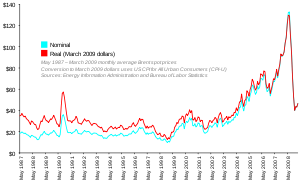
In January 2008, oil prices surpassed $100 a barrel for the first time, the first of many price milestones to be passed in the course of the year. In July 2008, oil peaked at $147.30 a barrel and a gallon of gasoline
was more than $4 across most of the U.S.A. The economic contraction in the fourth quarter of 2008 caused a dramatic drop in demand and prices fell below $35 a barrel at the end of the year. The high of 2008 may have been part of broader pattern of spiking instability in the price of oil over the preceding decade This pattern of spiking instability in oil price may be a product of Peak Oil
. There is concern that if the economy was to improve, oil prices might return to pre-recession levels.
The food and fuel crises were both discussed at the 34th G8 summit
in July 2008.
Sulfuric acid
(an important chemical commodity used in processes such as steel processing, copper production and bioethanol production) increased in price 3.5-fold in less than 1 year while producers of sodium hydroxide have declared force majeure
due to flooding, precipitating similarly steep price increases.
In the second half of 2008, the prices of most commodities fell dramatically on expectations of diminished demand in a world recession.
, United Kingdom, United Arab Emirates
, Italy
, Australia
, New Zealand, Ireland
, Spain
, France
, Poland
, South Africa
, Israel
, Greece
, Bulgaria
, Croatia
, Norway
, Singapore
, South Korea
, Sweden
, Finland
, Argentina
, Baltic states
, India
, Romania
, Russia
, Ukraine
and China
. U.S. Federal Reserve Chairman Alan Greenspan
said in mid-2005 that "at a minimum, there's a little 'froth' (in the U.S. housing market) ... it's hard not to see that there are a lot of local bubbles". The Economist
magazine, writing at the same time, went further, saying "the worldwide rise in house prices is the biggest bubble in history". Real estate bubbles are (by definition of the word "bubble") followed by a price decrease (also known as a housing price crash) that can result in many owners holding negative equity
(a mortgage
debt higher than the current value of the property).
In mid-2007, International Monetary Fund
(IMF) data indicated that inflation was highest in the oil-exporting countries, largely due to the unsterilized growth of foreign exchange reserves
, the term "unsterilized" referring to a lack of monetary policy operations that could offset such a foreign exchange intervention in order to maintain a country's monetary policy target. However, inflation was also growing in countries classified by the IMF as "non-oil-exporting LDCs" (Least Developed Countries
) and "Developing Asia", on account of the rise in oil and food prices.
Inflation was also increasing in the developed countries
, but remained low compared to the developing world.
On October 15, 2008, Anthony Faiola, Ellen Nakashima, and Jill Drew wrote a lengthy article in The Washington Post
titled, "What Went Wrong". In their investigation, the authors claim that former Federal Reserve Board Chairman Alan Greenspan
, Treasury Secretary Robert Rubin, and SEC Chairman Arthur Levitt vehemently opposed any regulation of financial instruments
known as derivatives
. They further claim that Greenspan actively sought to undermine the office of the Commodity Futures Trading Commission
, specifically under the leadership of Brooksley E. Born, when the Commission sought to initiate regulation of derivatives. Ultimately, it was the collapse of a specific kind of derivative, the mortgage-backed security
, that triggered the economic crisis of 2008.
While Greenspan's role as Chairman of the Federal Reserve
has been widely discussed (the main point of controversy remains the lowering of Federal funds rate
at only 1% for more than a year which, according to the Austrian School
of economics, allowed huge amounts of "easy" credit-based money to be injected into the financial system and thus create an unsustainable economic boom) there is also the argument that Greenspan's actions in the years 2002–2004 were actually motivated by the need to take the U.S. economy out of the early 2000s recession
caused by the bursting of the dot-com bubble
— although by doing so he did not help avert the crisis, but only postpone it.
Some economists - those of the Austrian school and those predicting the recession such as Steve Keen - claim that the ultimate point of origin of the great financial crisis of 2007–2010 can be traced back to an extremely indebted US economy. The collapse of the real estate market in 2006 was the close point of origin of the crisis. The failure rates of subprime mortgages were the first symptom of a credit boom turned to bust and of a real estate shock. But large default rates on subprime mortgages cannot account for the severity of the crisis. Rather, low-quality mortgages acted as an accelerant to the fire that spread through the entire financial system. The latter had become fragile as a result of several factors that are unique to this crisis: the transfer of assets from the balance sheets of banks to the markets, the creation of complex and opaque assets, the failure of ratings agencies to properly assess the risk of such assets, and the application of fair value accounting. To these novel factors, one must add the now standard failure of regulators and supervisors in spotting and correcting the emerging weaknesses.
Robert Reich
believes the amount of debt in the US economy can be traced to economic inequality, where middle class wages remain stagnant while wealth concentrates at the top, and households "pull equity from their homes and overload on debt to maintain living standards."
contraction on record:
Business Week in March 2009 stated that global political instability is rising fast due to the global financial crisis and is creating new challenges that need managing. The Associated Press reported in March 2009 that: United States "Director of National Intelligence Dennis Blair has said the economic weakness could lead to political instability in many developing nations." Even some developed countries are seeing political instability. NPR reports that David Gordon, a former intelligence officer who now leads research at the Eurasia Group, said: "Many, if not most, of the big countries out there have room to accommodate economic downturns without having large-scale political instability if we're in a recession of normal length. If you're in a much longer-run downturn, then all bets are off."
Globally, mass protest movements have arisen in many countries as a response to the economic crisis. Additionally, in some countries, riots and even open revolts have occurred in relation to the economic crisis.
For example, the Arab Spring
revolts taking place in the Arab world since December 18, 2010 were ostensibly sparked by the self-immolation of an unemployed Tunisian man named Mohamed Bouazizi
who was prevented from even selling produce from a cart. This act, combined with general discontentment about high unemployment, food inflation, corruption, lack of freedom of speech
and other forms of political freedom, and poor living conditions led to the most dramatic wave of social and political unrest in Tunisia in three decades, resulted in scores of deaths and injuries, and an eventual regime change in Tunisia. To date, there have been revolutions in Tunisia
and Egypt
; a civil war in Libya
; civil uprisings in Bahrain
, Syria
, and Yemen
; major protests in Algeria
, Iraq
, Jordan
, Morocco
, and Oman
, as well as on the borders of Israel
; and minor protests in Kuwait
, Lebanon
, Mauritania, Saudi Arabia, Sudan
, and Western Sahara.
In January of 2009 the government leaders of Iceland were forced to call elections two years early after the people of Iceland staged mass protests and clashed with the police due to the government's handling of the economy. Hundreds of thousands protested in France against President Sarkozy's economic policies. Prompted by the financial crisis in Latvia, the opposition and trade unions there organized a rally against the cabinet of premier Ivars Godmanis. The rally gathered some 10-20 thousand people. In the evening the rally turned into a Riot
. The crowd moved to the building of the parliament and attempted to force their way into it, but were repelled by the state's police. In late February many Greeks took part in a massive general strike because of the economic situation and they shut down schools, airports, and many other services in Greece. Police and protesters clashed in Lithuania where people protesting the economic conditions were shot by rubber bullets. In addition to various levels of unrest in Europe, Asian countries have also seen various degrees of protest. Communists and others rallied in Moscow to protest the Russian government's economic plans. Protests have also occurred in China as demands from the west for exports have been dramatically reduced and unemployment has increased. Beyond these initial protests, the protest movement has grown and continued in 2011.
, the United States, and the European Union
. Bailouts of failing or threatened businesses were carried out or discussed in the USA, the EU, and India. In the final quarter of 2008, the financial crisis saw the G-20 group of major economies assume a new significance as a focus of economic and financial crisis management.
(FDIC) program. Part of the announcements included temporary exceptions to section 23A and 23B (Regulation W), allowing financial groups to more easily share funds within their group. The exceptions would expire on January 30, 2009, unless extended by the Federal Reserve Board. The Securities and Exchange Commission announced termination of short-selling of 799 financial stocks, as well as action against naked short selling
, as part of its reaction to the mortgage crisis.
included a provision which changed the definition of Qualified Default Investments (QDI) for retirement plans from stable value investments, money market funds, and cash investments to investments which expose an individual to appropriate levels of stock and bond risk based on the years left to retirement. The Act required that Plan Sponsors move the assets of individuals who had never actively elected their investments and had their contributions in the default investment option. This meant that individuals who had defaulted into a cash fund with little fluctuation or growth would soon have their account balances moved to much more aggressive investments.
Starting in early 2008, most US employer-sponsored plans sent notices to their employees informing them that the plan default investment was changing from a cash/stable option to something new, such as a retirement date fund which had significant market exposure. Most participants ignored these notices until September and October, when the market crash was on every news station and media outlet. It was then that participants called their 401(k)
and retirement plan providers and discovered losses in excess of 30% in some cases. Call centers for 401(k) providers experienced record call volume and wait times, as millions of inexperienced investors struggled to understand how their investments had been changed so fundamentally without their explicit consent, and reacted in a panic by liquidating everything with any stock or bond exposure, locking in huge losses in their accounts.
Due to the speculation and uncertainty in the market, discussion forums filled with questions about whether or not to liquidate assets and financial gurus were swamped with questions about the right steps to take to protect what remained of their retirement accounts. During the third quarter of 2008, over $72 billion left mutual fund investments that invested in stocks or bonds and rushed into Stable Value investments in the month of October. Against the advice of financial experts, and ignoring historical data illustrating that long-term balanced investing has produced positive returns in all types of markets, investors with decades to retirement instead sold their holdings during one of the largest drops in stock market history.
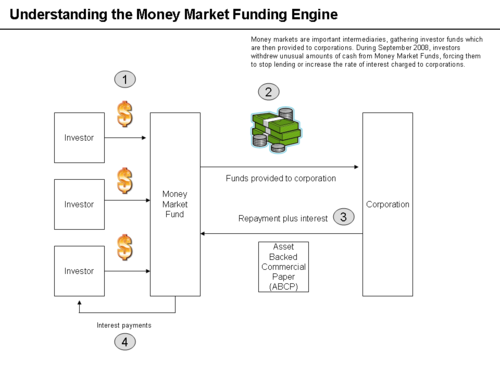 During the week ending September 19, 2008, money market
mutual funds had begun to experience significant withdrawals of funds by investors. This created a significant risk because money market funds are integral to the ongoing financing of corporations of all types. Individual investors lend money to money market funds, which then provide the funds to corporations in exchange for corporate short-term securities called asset-backed commercial paper (ABCP). However, a potential bank run
had begun on certain money market funds. If this situation had worsened, the ability of major corporations to secure needed short-term financing through ABCP issuance would have been significantly affected. To assist with liquidity throughout the system, the US Treasury and Federal Reserve Bank announced that banks could obtain funds via the Federal Reserve's Discount Window using ABCP as collateral.
– * Part of a coordinated global rate cut of 50 basis point by main central banks.
– See more detailed US federal discount rate chart:
and President George W. Bush
proposed legislation for the government to purchase up to US$700 billion of "troubled mortgage-related assets"
from financial firms in hopes of improving confidence in the mortgage-backed securities markets and the financial firms participating in it. Discussion, hearings and meetings among legislative leaders and the administration later made clear that the proposal would undergo significant change before it could be approved by Congress. On October 1, a revised compromise version was approved by the Senate with a 74–25 vote. The bill, HR1424
was passed by the House on October 3, 2008 and signed into law. The first half of the bailout money was primarily used to buy preferred stock in banks instead of troubled mortgage assets.
In January 2009, the Obama administration announced a stimulus plan to revive the economy
with the intention to create or save more than 3.6 million jobs in two years. The cost of this initial recovery plan was estimated at 825 billion dollars (5.8% of GDP). The plan included 365.5 billion dollars to be spent on major policy and reform of the health system, 275 billion (through tax rebates) to be redistributed to households and firms, notably those investing in renewable energy
, 94 billion to be dedicated to social assistance for the unemployed and families, 87 billion of direct assistance to states to help them finance health expenditures of Medicaid
, and finally 13 billion spent to improve access to digital technologies. The administration also attributed of 13.4 billion dollars aid to automobile manufacturers General Motors
and Chrysler
, but this plan is not included in the stimulus plan.
These plans are meant to abate further economic contraction, however, with the present economic conditions differing from past recessions, in, that, many tenets of the American economy such as manufacturing, textiles, and technological development have been outsourced to other countries. Public works
projects associated with the economic recovery plan outlined by the Obama Administration have been degraded by the lack of road and bridge development projects that were highly abundant in the Great Depression but are now mostly constructed and are mostly in need of maintenance. Regulations to establish market stability and confidence have been neglected in the Obama plan and have yet to be incorporated.
to $300 billion. Because there appeared to be a shortage of U.S. dollars in Europe at that time, the Federal Reserve also announced it would increase its swap facilities with foreign central banks from $290 billion to $620 billion.
As of December 24, 2008, the Federal Reserve had used its independent authority to spend $1.2 trillion on purchasing various financial assets and making emergency loans to address the financial crisis, above and beyond the $700 billion authorized by Congress from the federal budget. This includes emergency loans to banks, credit card companies, and general businesses, temporary swaps of treasury bills for mortgage-backed securities, the sale of Bear Stearns
, and the bailouts of American International Group
(AIG), Fannie Mae and Freddie Mac, and Citigroup
.
injected nearly $1.5 billion into the banking system, nearly three times as much as the market's estimated requirement. The Reserve Bank of India
added almost $1.32 billion, through a refinance operation, its biggest in at least a month. On November 9, 2008 the 2008 Chinese economic stimulus plan
is a RMB¥ 4 trillion ($586 billion) stimulus package announced by the central government of the People's Republic of China in its biggest move to stop the global financial crisis from hitting the world's second largest economy. A statement on the government's website said the State Council had approved a plan to invest 4 trillion yuan ($586 billion) in infrastructure and social welfare by the end of 2010. The stimulus package will be invested in key areas such as housing, rural infrastructure, transportation, health and education, environment, industry, disaster rebuilding, income-building, tax cuts, and finance.
China's export driven economy is starting to feel the impact of the economic slowdown in the United States and Europe, and the government has already cut key interest rates three times in less than two months in a bid to spur economic expansion. On November 28, 2008, the Ministry of Finance of the People's Republic of China
and the State Administration of Taxation
jointly announced a rise in export tax rebate rates on some labor-intensive goods. These additional tax rebates will take place on December 1, 2008.
The stimulus package was welcomed by world leaders and analysts as larger than expected and a sign that by boosting its own economy, China is helping to stabilize the global economy. News of the announcement of the stimulus package sent markets up across the world.
However, Marc Faber
January 16 said that China according to him was in recession.
In Taiwan, the central bank on September 16, 2008 said it would cut its required reserve ratios for the first time in eight years. The central bank added $3.59 billion into the foreign-currency interbank market the same day. Bank of Japan pumped $29.3 billion into the financial system on September 17, 2008 and the Reserve Bank of Australia added $3.45 billion the same day.
In developing and emerging economies, responses to the global crisis mainly consisted in low-rates monetary policy (Asia
and the Middle East
mainly) coupled with the depreciation of the currency against the dollar. There were also stimulus plans in some Asian countries, in the Middle East and in Argentina. In Asia, plans generally amounted to 1 to 3% of GDP, with the notable exception of China
, which announced a plan accounting for 16% of GDP (6% of GDP per year).
to be implemented at the European level by the countries. At the beginning of 2009, the UK and Spain completed their initial plans, while Germany announced a new plan.
On September 29, 2008 the Belgian, Luxembourg and Dutch authorities partially nationalized Fortis
. The German government bailed out Hypo Real Estate
.
On 8 October 2008 the British Government announced a bank rescue package
of around £500 billion ($850 billion at the time). The plan comprises three parts. The first £200 billion would be made in regard to the banks in liquidity stack. The second part will consist of the state government increasing the capital market within the banks. Along with this, £50 billion will be made available if the banks needed it, finally the government will write away any eligible lending between the British banks with a limit to £250 billion.
In early December German Finance Minister Peer Steinbrück indicated a lack of belief in a "Great Rescue Plan" and reluctance to spend more money addressing the crisis. In March 2009, The European Union Presidency confirmed that the EU was at the time strongly resisting the US pressure to increase European budget deficits.
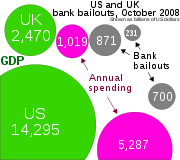 Most political responses to the economic and financial crisis has been taken, as seen above, by individual nations. Some coordination took place at the European level, but the need to cooperate at the global level has led leaders to activate the G-20 major economies
entity. A first summit dedicated to the crisis took place, at the Heads of state level in November 2008 (2008 G-20 Washington summit
).
The G-20 countries
met in a summit held on November 2008 in Washington
to address the economic crisis. Apart from proposals on international financial regulation, they pledged to take measures to support their economy and to coordinate them, and refused any resort to protectionism.
Another G-20 summit
was held in London on April 2009. Finance ministers and central banks leaders of the G-20 met in Horsham on March to prepare the summit, and pledged to restore global growth as soon as possible. They decided to coordinate their actions and to stimulate demand and employment. They also pledged to fight against all forms of protectionism
and to maintain trade and foreign investments. They also committed to maintain the supply of credit by providing more liquidity and recapitalizing the banking system, and to implement rapidly the stimulus plans. As for central bankers, they pledged to maintain low-rates policies as long as necessary. Finally, the leaders decided to help emerging and developing countries, through a strengthening of the IMF.
is the only member of the European Union
to have avoided a decline in GDP, meaning that in 2009 Poland has created the most GDP growth in the EU. As of December 2009 the Polish economy had not entered recession nor even contracted, while its IMF 2010 GDP growth forecast of 1.9 per cent is expected to be upgraded. Analysts have identified several causes: Extremely low levels of bank lending and a relatively very small mortgage market; the relatively recent dismantling of EU trade barriers and the resulting surge in demand for Polish goods since 2004; the receipt of direct EU funding since 2004; lack of over-dependence on a single export sector; a tradition of government fiscal responsibility; a relatively large internal market; the free-floating Polish zloty; low labour costs attracting continued foreign direct investment; economic difficulties at the start of the decade which prompted austerity measures in advance of the world crisis.
While China
, India
and Iran
have experienced slowing growth, they have not entered recession.
South Korea
narrowly avoided technical recession in the first quarter of 2009. The International Energy Agency
stated in mid September that South Korea could be the only large OECD country to avoid recession for the whole of 2009. It was the only developed economy to expand in the first half of 2009. On October 6, Australia
became the first G20 country to raise its main interest rate, with the Reserve Bank of Australia
deciding to move rates up to 3.25% from 3.00%.
Australia has avoided a technical recession after experiencing only one quarter of negative growth in the fourth quarter of 2008, with GDP returning to positive in the first quarter of 2009.
was the first to raise interest rates after the global recession began. It increased rates in August 2009.
Followed by Norges Bank of Norway
, the Reserve Bank of Australia
in March 2010 and the Reserve Bank of India
on 18 March 2010.
Denmark went into recession in the first quarter of 2008, but came out again in the second quarter. Iceland fell into an economic depression in 2008 following the collapse of its banking system. (see 2008–2011 Icelandic financial crisis)
The following countries went into recession in the second quarter of 2008: Estonia, Latvia, Ireland and New Zealand.
The following countries/territories went into recession in the third quarter of 2008: Japan, Sweden, Hong Kong, Singapore, Italy, Turkey and Germany. As a whole the fifteen nations in the European Union that use the euro went into recession in the third quarter, and the United Kingdom. In addition, the European Union, the G7, and the OECD all experienced negative growth in the third quarter.
The following countries/territories went into technical recession in the fourth quarter of 2008: United States, Switzerland, Spain, and Taiwan.
South Korea "miraculously" avoided recession with GDP returning positive at a 0.1% expansion in the first quarter of 2009.
Of the seven largest economies in the world by GDP, only China and France avoided a recession in 2008. France experienced a 0.3% contraction in Q2 and 0.1% growth in Q3 of 2008. In the year to the third quarter of 2008 China grew by 9%. This is interesting as China has until recently considered 8% GDP growth to be required simply to create enough jobs for rural people moving to urban centres. This figure may more accurately be considered to be 5–7% now that the main growth in working population is receding. Growth of between 5%–8% could well have the type of effect in China that a recession has elsewhere. Ukraine went into technical depression in January 2009 with a nominal annualized GDP growth of −20%.
The recession in Japan intensified in the fourth quarter of 2008 with a nominal annualized GDP growth of −12.7%, and deepened further in the first quarter of 2009 with a nominal annualized GDP growth of −15.2%.
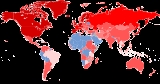
Major economies affected by the recession.
said in an interview that he felt that if banks began lending more freely, allowing the financial markets to return to normal, the recession could end during 2009. In that same interview, Bernanke said Green shoots
of economic revival are already evident. On February 18, 2009, the US Federal Reserve cut their economic forecast of 2009, expecting the US output to shrink between 0.5% and 1.5%, down from its forecast in October 2008 of output between +1.1% (growth) and −0.2% (contraction).
The EU commission in Brussels updated their earlier predictions on January 19, 2009, expecting Germany to contract −2.25% and −1.8% on average for the 27 EU countries. According to new forecasts by Deutsche Bank
(end of November 2008), the economy of Germany will contract by more than 4% in 2009.
On November 3, 2008, according to all newspapers, the European Commission
in Brussels predicted for 2009 only an extremely low increase by 0.1% of the GDP, for the countries of the Euro zone (France, Germany, Italy, etc.). They also predicted negative numbers for the UK (−1.0%), Ireland, Spain, and other countries of the EU. Three days later, the IMF at Washington, D.C., predicted for 2009 a worldwide decrease, −0.3%, of the same number, on average over the developed economies (−0.7% for the US, and −0.8% for Germany).
On April 22, 2009, the German ministers of finance and that of economy, in a common press conference, corrected again their numbers for 2009 downwards: this time the "prognosis" for Germany was a decrease of the GDP of at least −5%, in agreement with a recent prediction of the IMF.
On June 11, 2009, the World Bank Group
predicted for 2009 for the first time a global contraction of the economic power, precisely by −3%.
said that there was a chance that certain countries may not implement the proper policies to avoid feedback mechanisms that could eventually turn the recession into a depression. "The free-fall in the global economy may be starting to abate, with a recovery emerging in 2010, but this depends crucially on the right policies being adopted today." The IMF pointed out that unlike the Great Depression, this recession was synchronized by global integration of markets. Such synchronized recessions were explained to last longer than typical economic downturns and have slower recoveries.
The chief economist of the IMF, Dr. Olivier Blanchard
, stated that the percentage of workers laid off for long stints has been rising with each downturn for decades but the figures have surged this time. "Long-term unemployment is alarmingly high: in the US, half the unemployed have been out of work for over six months, something we have not seen since the Great Depression." The IMF also stated that a link between rising inequality within Western economies and deflating demand may exist. The last time that the wealth gap reached such skewed extremes was in 1928-1929.
have been made, there remain large differences between the two events. The consensus among economists in March 2009 was that a depression was not likely to occur. UCLA Anderson
Forecast director Edward Leamer said on March 25, 2009 that there had not been any major predictions at that time which resembled a second Great Depression:
Differences explicitly pointed out between the recession and the Great Depression include the facts that over the 79 years between 1929 and 2008, great changes occurred in economic philosophy and policy, the stock market had not fallen as far as it did in 1932 or 1982, the 10-year price-to-earnings ratio of stocks was not as low as in the '30s or '80s, inflation-adjusted U.S. housing prices in March 2009 were higher than any time since 1890 (including the housing booms of the 1970s and '80s), the recession of the early '30s lasted over three-and-a-half years, and during the 1930s the supply of money (currency plus demand deposits) fell by 25% (where as in 2008 and 2009 the Fed "has taken an ultraloose credit stance"). Furthermore, the unemployment rate in 2008 and early 2009 and the rate at which it rose was comparable to most of the recessions occurring after World War II
, and was dwarfed by the 25% unemployment rate peak of the Great Depression.
Nobel Prize winning economist Paul Krugman
predicted a series of depressions in his Return to Depression Economics (2000), based on "failures on the demand side of the economy." On January 5, 2009, he wrote that "preventing depressions isn't that easy after all" and that "the economy is still in free fall." In March 2009, Krugman explained that a major difference in this situation is that the causes of this financial crisis were from the shadow banking system
. "The crisis hasn't involved problems with deregulated institutions that took new risks... Instead, it involved risks taken by institutions that were never regulated in the first place."
On November 15, 2008, author and Southern Methodist University
economics professor Ravi Batra
said he is "afraid the global financial debacle will turn into a steep recession and be the worst since the Great Depression, even worse than the painful slump of 1980–1982 that afflicted the whole world". In 1978, Batra's book The Downfall of Capitalism and Communism
was published. His first major prediction came true with the collapse of Soviet Communism in 1990. His second major prediction for a financial crisis to engulf the capitalist system
seems to be unfolding since 2007 with increasing attention being paid to his work.
On February 22, 2009, NYU economics professor Nouriel Roubini
said that the crisis was the worst since the Great Depression, and that without cooperation between political parties and foreign countries, and if poor fiscal policy decisions (such as support of zombie banks) are pursued, the situation "could become as bad as the Great Depression." On April 27, 2009, Roubini expressed a more upbeat assessment by noting that "the bottom of the economy [will be seen] toward the beginning or middle of next year."
On April 6, 2009 Vernon L. Smith
and Steven Gjerstad offered the hypothesis "that a financial crisis that originates in consumer debt, especially consumer debt concentrated at the low end of the wealth and income distribution, can be transmitted quickly and forcefully into the financial system. It appears that we're witnessing the second great consumer debt crash, the end of a massive consumption binge."
In his final press conference as president, George W. Bush
claimed that in September 2008 his chief economic advisors had said that the economic situation could at some point become worse than the Great Depression.
A tent city
in Sacramento
, California
was described as "images, hauntingly reminiscent of the iconic photos of the 1930s and the Great Depression" and "evocative Depression-era images."
reported that the economy had reached a standstill, with 0% growth, during the second quarter of that year.On 24 October, statistics for the third quarter of the year showed the first contraction in the national economy for 16 years.With further contraction in the final quarter of 2008, the recession was officially declared on 23 January 2009.
On 10 February 2009, Ed Balls
, Secretary of State for Children, Schools and Families
of the United Kingdom
, said that "I think that this is a financial crisis more extreme and more serious than that of the 1930s and we all remember how the politics of that era were shaped by the economy." On 24 January 2009, Edmund Conway, Economics Editor for The Daily Telegraph
, had written that "The plight facing Britain is uncannily similar to the 1930s, since prices of many assets – from shares to house prices – are falling at record rates [in Britain], but the value of the debt against which they are held remains unchanged."
On 23 October 2009, it was reported that the British economy had contracted for six successive quarters - the longest run of contraction since quarterly figures were first recorded in 1955.The end of the recession was declared on 26 January 2010, when it was reported that the economy had grown by 0.1% in the final quarter of 2009.
Fears of a double-dip recession were sparked on 25 January 2011 when it was reported that the economy had contracted by 0.5% during the final quarter of 2010 following a full year of growth, although this was largely blamed on the severe weather which affected the nation in late November and almost all of December.These fears were eased on 27 April 2011 when it was reported that the economy had grown by 0.5% in the first quarter of 2011,and then on 26 July 2011 when 0.2% growth was reported for the second quarter of the year. On 01 November 2011, it was reported that the UK economy had grown by 0.5% during the third quarter of the year.
entered into an economic depression
in 2009. The ESRI (Economic and Social Research Institute) predict an economic contraction of 14% by 2010, however this number may have already been exceeded with GDP
dropping 7.1% quarter on quarter during the fourth quarter of 2008, and a possible greater contraction in the first quarter of 2009 with the fall in all OECD countries with the exception of France exceeding the drop of the previous quarter. Unemployment is up 8.75% to 11.4%. Government borrowing and the financial bailout and Nationalisation of one of Ireland's banks which were loaded with debt due to the Irish property bubble
.
The United States entered into recession in December 2007 when job losses began. Unemployment increased drastically starting in September 2008 following the bankruptcy of Lehman Brothers
. In March 2009, U-3 unemployment had risen to 8.5%. In March 2009, statistician John Williams argued that "measurement changes implemented over the years make it impossible to compare the current unemployment rate with that seen during the Great Depression". By December 2010, the official U.S. unemployment rate had increased to 9.8%.
Poll indicated that economists thought the probability of another recession was at 31%, up from 25% the month before. In their article “On the Possibilities to Forecast the Current Crisis and its Second Wave” Askar Akaev, Viktor Sadovnichiy
, and Andrey Korotayev
published a forecast of a second wave of the crisis.
World economy
The world economy, or global economy, generally refers to the economy, which is based on economies of all of the world's countries, national economies. Also global economy can be seen as the economy of global society and national economies – as economies of local societies, making the global one....
, with higher detriment in some countries than others. It is a major global recession
Global recession
A global recession is a period of global economic slowdown. The International Monetary Fund takes many factors into account when defining a global recession, but it states that global economic growth of 3 percent or less is "equivalent to a global recession".By this measure, four periods since...
characterized by various systemic imbalances and was sparked by the outbreak of the late-2000s financial crisis
Late-2000s financial crisis
The late-2000s financial crisis is considered by many economists to be the worst financial crisis since the Great Depression of the 1930s...
.
There are two senses
Word sense
In linguistics, a word sense is one of the meanings of a word.For example a dictionary may have over 50 different meanings of the word , each of these having a different meaning based on the context of the word usage in a sentence...
of the word "recession": a less precise sense, referring broadly to "a period of reduced economic activity", and the scientific sense used most often in economics
Economics
Economics is the social science that analyzes the production, distribution, and consumption of goods and services. The term economics comes from the Ancient Greek from + , hence "rules of the house"...
, which is defined operationally
Operational definition
An operational definition defines something in terms of the specific process or set of validation tests used to determine its presence and quantity. That is, one defines something in terms of the operations that count as measuring it. The term was coined by Percy Williams Bridgman and is a part of...
, referring specifically to the contraction phase of a business cycle
Business cycle
The term business cycle refers to economy-wide fluctuations in production or economic activity over several months or years...
, with two or more consecutive quarters of negative GDP growth. By the economic-science definition of the word "recession
Recession
In economics, a recession is a business cycle contraction, a general slowdown in economic activity. During recessions, many macroeconomic indicators vary in a similar way...
", the Great Recession ended in the U.S. in June or July 2009. However, in the broader, layperson sense of the word, many people use the term to refer to the ongoing hardship (in the same way that the term "Great Depression
Great Depression
The Great Depression was a severe worldwide economic depression in the decade preceding World War II. The timing of the Great Depression varied across nations, but in most countries it started in about 1929 and lasted until the late 1930s or early 1940s...
" is also popularly used). In the U.S., for example, persistent high unemployment
Unemployment
Unemployment , as defined by the International Labour Organization, occurs when people are without jobs and they have actively sought work within the past four weeks...
remains
99ers
99ers is a colloquial term for unemployed people in the United States, mostly citizens, who have exhausted all of their unemployment benefits, including all unemployment extensions. As a result of the American Recovery and Reinvestment Act passed by Congress in February 2009, many unemployed...
, along with low consumer confidence, the continuing decline in home values and increase in foreclosures and personal bankruptcies
United States housing bubble
The United States housing bubble is an economic bubble affecting many parts of the United States housing market in over half of American states. Housing prices peaked in early 2006, started to decline in 2006 and 2007, and may not yet have hit bottom as of 2011. On December 30, 2008 the...
, an escalating federal debt crisis
United States public debt
The United States public debt is the money borrowed by the federal government of the United States at any one time through the issue of securities by the Treasury and other federal government agencies...
, inflation
Inflation
In economics, inflation is a rise in the general level of prices of goods and services in an economy over a period of time.When the general price level rises, each unit of currency buys fewer goods and services. Consequently, inflation also reflects an erosion in the purchasing power of money – a...
, and rising gas and food prices. In fact, a 2011 poll found that more than half of all Americans think the U.S. is still in recession or even depression, despite official data that shows a historically modest recovery.
Overview
According to the U.S. National Bureau of Economic ResearchNational Bureau of Economic Research
The National Bureau of Economic Research is an American private nonprofit research organization "committed to undertaking and disseminating unbiased economic research among public policymakers, business professionals, and the academic community." The NBER is well known for providing start and end...
(the official arbiter of U.S. recessions) the recession began in December 2007. The financial crisis is linked to reckless lending practices by financial institutions and the growing trend of securitization
Securitization
Securitization is the financial practice of pooling various types of contractual debt such as residential mortgages, commercial mortgages, auto loans or credit card debt obligations and selling said consolidated debt as bonds, pass-through securities, or Collateralized mortgage obligation , to...
of real estate mortgages in the United States
United States
The United States of America is a federal constitutional republic comprising fifty states and a federal district...
. The US mortgage-backed securities, which had risks that were hard to assess, were marketed around the world. A more broad based credit boom fed a global speculative bubble in real estate
Real estate bubble
A real estate bubble or property bubble is a type of economic bubble that occurs periodically in local or global real estate markets...
and equities, which served to reinforce the risky lending practices. The precarious financial situation was made more difficult by a sharp increase in oil and food prices
2007–2008 world food price crisis
World food prices increased dramatically in 2007 and the 1st and 2nd quarter of 2008 creating a global crisis and causing political and economical instability and social unrest in both poor and developed nations. Systemic causes for the worldwide increases in food prices continue to be the subject...
. The emergence of Sub-prime loan
Subprime lending
In finance, subprime lending means making loans to people who may have difficulty maintaining the repayment schedule...
losses in 2007 began the crisis and exposed other risky loans and over-inflated asset prices. With loan losses mounting and the fall of Lehman Brothers
Lehman Brothers
Lehman Brothers Holdings Inc. was a global financial services firm. Before declaring bankruptcy in 2008, Lehman was the fourth largest investment bank in the USA , doing business in investment banking, equity and fixed-income sales and trading Lehman Brothers Holdings Inc. (former NYSE ticker...
on September 15, 2008, a major panic broke out on the inter-bank loan market. As share and housing prices declined, many large and well established investment and commercial
Commercial bank
After the implementation of the Glass–Steagall Act, the U.S. Congress required that banks engage only in banking activities, whereas investment banks were limited to capital market activities. As the two no longer have to be under separate ownership under U.S...
banks in the United States and Europe
Europe
Europe is, by convention, one of the world's seven continents. Comprising the westernmost peninsula of Eurasia, Europe is generally 'divided' from Asia to its east by the watershed divides of the Ural and Caucasus Mountains, the Ural River, the Caspian and Black Seas, and the waterways connecting...
suffered huge losses and even faced bankruptcy, resulting in massive public financial assistance.
A global recession
Global recession
A global recession is a period of global economic slowdown. The International Monetary Fund takes many factors into account when defining a global recession, but it states that global economic growth of 3 percent or less is "equivalent to a global recession".By this measure, four periods since...
has resulted in a sharp drop in international trade
International trade
International trade is the exchange of capital, goods, and services across international borders or territories. In most countries, such trade represents a significant share of gross domestic product...
, rising unemployment
Unemployment
Unemployment , as defined by the International Labour Organization, occurs when people are without jobs and they have actively sought work within the past four weeks...
and slumping commodity prices. In December 2008, the National Bureau of Economic Research
National Bureau of Economic Research
The National Bureau of Economic Research is an American private nonprofit research organization "committed to undertaking and disseminating unbiased economic research among public policymakers, business professionals, and the academic community." The NBER is well known for providing start and end...
(NBER) declared that the United States had been in recession since December 2007. Several economists have predicted that recovery may not appear until 2011 and that the recession will be the worst since the Great Depression
Great Depression
The Great Depression was a severe worldwide economic depression in the decade preceding World War II. The timing of the Great Depression varied across nations, but in most countries it started in about 1929 and lasted until the late 1930s or early 1940s...
of the 1930s. Paul Krugman
Paul Krugman
Paul Robin Krugman is an American economist, professor of Economics and International Affairs at the Woodrow Wilson School of Public and International Affairs at Princeton University, Centenary Professor at the London School of Economics, and an op-ed columnist for The New York Times...
, who won the Nobel Memorial Prize in Economics, once commented on this as seemingly the beginning of "a second Great Depression." The conditions leading up to the crisis, characterized by an exorbitant rise in asset prices and associated boom in economic demand, are considered a result of the extended period of easily available credit and inadequate regulation and oversight.
The recession has renewed interest in Keynesian economic ideas
2008–2009 Keynesian resurgence
In 2008 and 2009, there was a resurgence of interest in Keynesian economics among policy makers in the world's industrialized economies. This has included discussions and implementation of economic policies in accordance with the recommendations made by John Maynard Keynes in response to the Great...
on how to combat recessionary conditions. Fiscal
Fiscal policy
In economics and political science, fiscal policy is the use of government expenditure and revenue collection to influence the economy....
and monetary policies
Monetary policy
Monetary policy is the process by which the monetary authority of a country controls the supply of money, often targeting a rate of interest for the purpose of promoting economic growth and stability. The official goals usually include relatively stable prices and low unemployment...
have been significantly eased to stem the recession and financial risks. Economists advise that the stimulus should be withdrawn as soon as the economies recover enough to "chart a path to sustainable growth".
Pre-recession economic imbalances
The onset of the economic crisis took most people by surprise. A 2009 paper identifies twelve economists and commentators who, between 2000 and 2006, predicted a recession based on the collapse of the then-booming housing market in the U.S: Dean BakerDean Baker
Dean Baker is an American macroeconomist and co-founder of the Center for Economic and Policy Research, with Mark Weisbrot. He previously was a senior economist at the Economic Policy Institute and an assistant professor of economics at Bucknell University. He has a Ph.D...
, Wynne Godley
Wynne Godley
Wynne Godley was an economist famous for his pessimism toward the British economy and his criticism of the British government....
, Fred Harrison
Fred Harrison (author)
Fred Harrison is a British author, economic commentator and corporate policy advisor, notable for his stances on land reform and belief that an over reliance on land, property and mortgage weakens economic structures and makes companies vulnerable to economic collapse...
, Michael Hudson
Michael Hudson (economist)
Michael Hudson is research professor of economics at University of Missouri, Kansas City and a research associate at the Levy Economics Institute of Bard College...
, Eric Janszen
Eric Janszen
Eric Janszen is an economic commentator and former venture capitalist. He founded the financial advisory company iTulip.Janszen wrote an analysis of economic bubbles in a 2008 Harper's Magazine article predicting a future alternative energy bubble bursting in the mid 2010s...
, Steve Keen
Steve Keen
Steve Keen is a Professor in economics and finance at the University of Western Sydney. He classes himself as a post-Keynesian, criticizing both modern neoclassical economics and Marxian economics as inconsistent, unscientific and empirically unsupported...
, Jakob Brøchner Madsen & Jens Kjaer Sørensen, Kurt Richebächer
Kurt Richebächer
Dr. Kurt Richebächer was an international banker and economist. He considered himself a follower of the Austrian School of Economics and was best known for his newsletter, "The Richebächer Letter," which at various times also circulated as "Currencies & Credit Markets."Dr...
, Nouriel Roubini
Nouriel Roubini
Nouriel Roubini is an American economist. He claims to have predicted both the collapse of the United States housing market and the worldwide recession which started in 2008. He teaches at New York University's Stern School of Business and is the chairman of Roubini Global Economics, an economic...
, Peter Schiff
Peter Schiff
Peter David Schiff is an American investment broker, author and financial commentator. Schiff is CEO and chief global strategist of Euro Pacific Capital Inc., a broker-dealer based in Westport, Connecticut and CEO of Euro Pacific Precious Metals, LLC, a gold and silver dealer based in New York...
and Robert Shiller
Robert Shiller
Robert James "Bob" Shiller is an American economist, academic, and best-selling author. He currently serves as the Arthur M. Okun Professor of Economics at Yale University and is a Fellow at the Yale International Center for Finance, Yale School of Management...
.
Among the various imbalances in which the U.S. monetary policy contributed by excessive money creation
Money creation
In economics, money creation is the process by which the money supply of a country or a monetary region is increased due to some reason. There are two principal stages of money creation. First, the central bank introduces new money into the economy by purchasing financial assets or lending money...
, leading to negative household savings and a huge U.S. trade deficit, dollar volatility and public deficits, a focus can be made on the following ones:
Commodity boom
House
A house is a building or structure that has the ability to be occupied for dwelling by human beings or other creatures. The term house includes many kinds of different dwellings ranging from rudimentary huts of nomadic tribes to free standing individual structures...
, marking an end to the commodities recession of 1980–2000. In 2008, the prices of many commodities, notably oil and food, rose so high as to cause genuine economic damage, threatening stagflation
Stagflation
In economics, stagflation is a situation in which the inflation rate is high and the economic growth rate slows down and unemployment remains steadily high...
and a reversal of globalization
Globalization
Globalization refers to the increasingly global relationships of culture, people and economic activity. Most often, it refers to economics: the global distribution of the production of goods and services, through reduction of barriers to international trade such as tariffs, export fees, and import...
.
In January 2008, oil prices surpassed $100 a barrel for the first time, the first of many price milestones to be passed in the course of the year. In July 2008, oil peaked at $147.30 a barrel and a gallon of gasoline
Gasoline
Gasoline , or petrol , is a toxic, translucent, petroleum-derived liquid that is primarily used as a fuel in internal combustion engines. It consists mostly of organic compounds obtained by the fractional distillation of petroleum, enhanced with a variety of additives. Some gasolines also contain...
was more than $4 across most of the U.S.A. The economic contraction in the fourth quarter of 2008 caused a dramatic drop in demand and prices fell below $35 a barrel at the end of the year. The high of 2008 may have been part of broader pattern of spiking instability in the price of oil over the preceding decade This pattern of spiking instability in oil price may be a product of Peak Oil
Peak oil
Peak oil is the point in time when the maximum rate of global petroleum extraction is reached, after which the rate of production enters terminal decline. This concept is based on the observed production rates of individual oil wells, projected reserves and the combined production rate of a field...
. There is concern that if the economy was to improve, oil prices might return to pre-recession levels.
The food and fuel crises were both discussed at the 34th G8 summit
34th G8 summit
The 34th G8 summit took place in on the northern island of Hokkaidō, Japan from July 7–9, 2008. The locations of previous summits to have been hosted by Japan include: Tokyo ; and Nago, Okinawa . The G8 Summit has evolved beyond being a gathering of world political leaders...
in July 2008.
Sulfuric acid
Sulfuric acid
Sulfuric acid is a strong mineral acid with the molecular formula . Its historical name is oil of vitriol. Pure sulfuric acid is a highly corrosive, colorless, viscous liquid. The salts of sulfuric acid are called sulfates...
(an important chemical commodity used in processes such as steel processing, copper production and bioethanol production) increased in price 3.5-fold in less than 1 year while producers of sodium hydroxide have declared force majeure
Force majeure
Force majeure or vis major "superior force", also known as cas fortuit or casus fortuitus "chance occurrence, unavoidable accident", is a common clause in contracts that essentially frees both parties from liability or obligation when an extraordinary event or circumstance beyond the control of...
due to flooding, precipitating similarly steep price increases.
In the second half of 2008, the prices of most commodities fell dramatically on expectations of diminished demand in a world recession.
Housing bubble
By 2007, real estate bubbles were still under way in many parts of the world, especially in the United StatesUnited States housing bubble
The United States housing bubble is an economic bubble affecting many parts of the United States housing market in over half of American states. Housing prices peaked in early 2006, started to decline in 2006 and 2007, and may not yet have hit bottom as of 2011. On December 30, 2008 the...
, United Kingdom, United Arab Emirates
United Arab Emirates
The United Arab Emirates, abbreviated as the UAE, or shortened to "the Emirates", is a state situated in the southeast of the Arabian Peninsula in Western Asia on the Persian Gulf, bordering Oman, and Saudi Arabia, and sharing sea borders with Iraq, Kuwait, Bahrain, Qatar, and Iran.The UAE is a...
, Italy
Italy
Italy , officially the Italian Republic languages]] under the European Charter for Regional or Minority Languages. In each of these, Italy's official name is as follows:;;;;;;;;), is a unitary parliamentary republic in South-Central Europe. To the north it borders France, Switzerland, Austria and...
, Australia
Australia
Australia , officially the Commonwealth of Australia, is a country in the Southern Hemisphere comprising the mainland of the Australian continent, the island of Tasmania, and numerous smaller islands in the Indian and Pacific Oceans. It is the world's sixth-largest country by total area...
, New Zealand, Ireland
Irish property bubble
The property bubble in the Republic of Ireland began in 2000 and peaked in 2006, as with many other western European countries, with a combination of increased speculative construction and rapidly rising prices....
, Spain
Spanish property bubble
The Spanish property bubble refers to the massive growth of real state prices observed, in various stages, from 1985 up to 2008 in Spain. The housing burst can be clearly divided in three periods: 1985-1991, in which the price nearly tripled, 1992-1996, in which the price remained somewhat stable,...
, France
France
The French Republic , The French Republic , The French Republic , (commonly known as France , is a unitary semi-presidential republic in Western Europe with several overseas territories and islands located on other continents and in the Indian, Pacific, and Atlantic oceans. Metropolitan France...
, Poland
Polish property bubble
Over the span of years 2002-2008 real estate prices in Poland have increased drastically. Between June 2006 and June 2007 alone the average price of a square metre in Warsaw rose from 6,683 PLN to 9,540 PLN .According to a major Polish newspaper, Gazeta Wyborcza, the average monthly salary in...
, South Africa
South Africa
The Republic of South Africa is a country in southern Africa. Located at the southern tip of Africa, it is divided into nine provinces, with of coastline on the Atlantic and Indian oceans...
, Israel
Israel
The State of Israel is a parliamentary republic located in the Middle East, along the eastern shore of the Mediterranean Sea...
, Greece
Greece
Greece , officially the Hellenic Republic , and historically Hellas or the Republic of Greece in English, is a country in southeastern Europe....
, Bulgaria
Bulgaria
Bulgaria , officially the Republic of Bulgaria , is a parliamentary democracy within a unitary constitutional republic in Southeast Europe. The country borders Romania to the north, Serbia and Macedonia to the west, Greece and Turkey to the south, as well as the Black Sea to the east...
, Croatia
Croatia
Croatia , officially the Republic of Croatia , is a unitary democratic parliamentary republic in Europe at the crossroads of the Mitteleuropa, the Balkans, and the Mediterranean. Its capital and largest city is Zagreb. The country is divided into 20 counties and the city of Zagreb. Croatia covers ...
, Norway
Norway
Norway , officially the Kingdom of Norway, is a Nordic unitary constitutional monarchy whose territory comprises the western portion of the Scandinavian Peninsula, Jan Mayen, and the Arctic archipelago of Svalbard and Bouvet Island. Norway has a total area of and a population of about 4.9 million...
, Singapore
Singapore
Singapore , officially the Republic of Singapore, is a Southeast Asian city-state off the southern tip of the Malay Peninsula, north of the equator. An island country made up of 63 islands, it is separated from Malaysia by the Straits of Johor to its north and from Indonesia's Riau Islands by the...
, South Korea
South Korea
The Republic of Korea , , is a sovereign state in East Asia, located on the southern portion of the Korean Peninsula. It is neighbored by the People's Republic of China to the west, Japan to the east, North Korea to the north, and the East China Sea and Republic of China to the south...
, Sweden
Sweden
Sweden , officially the Kingdom of Sweden , is a Nordic country on the Scandinavian Peninsula in Northern Europe. Sweden borders with Norway and Finland and is connected to Denmark by a bridge-tunnel across the Öresund....
, Finland
Finland
Finland , officially the Republic of Finland, is a Nordic country situated in the Fennoscandian region of Northern Europe. It is bordered by Sweden in the west, Norway in the north and Russia in the east, while Estonia lies to its south across the Gulf of Finland.Around 5.4 million people reside...
, Argentina
Argentina
Argentina , officially the Argentine Republic , is the second largest country in South America by land area, after Brazil. It is constituted as a federation of 23 provinces and an autonomous city, Buenos Aires...
, Baltic states
Baltic states
The term Baltic states refers to the Baltic territories which gained independence from the Russian Empire in the wake of World War I: primarily the contiguous trio of Estonia, Latvia, Lithuania ; Finland also fell within the scope of the term after initially gaining independence in the 1920s.The...
, India
India
India , officially the Republic of India , is a country in South Asia. It is the seventh-largest country by geographical area, the second-most populous country with over 1.2 billion people, and the most populous democracy in the world...
, Romania
Romania
Romania is a country located at the crossroads of Central and Southeastern Europe, on the Lower Danube, within and outside the Carpathian arch, bordering on the Black Sea...
, Russia
Russia
Russia or , officially known as both Russia and the Russian Federation , is a country in northern Eurasia. It is a federal semi-presidential republic, comprising 83 federal subjects...
, Ukraine
Ukraine
Ukraine is a country in Eastern Europe. It has an area of 603,628 km², making it the second largest contiguous country on the European continent, after Russia...
and China
China
Chinese civilization may refer to:* China for more general discussion of the country.* Chinese culture* Greater China, the transnational community of ethnic Chinese.* History of China* Sinosphere, the area historically affected by Chinese culture...
. U.S. Federal Reserve Chairman Alan Greenspan
Alan Greenspan
Alan Greenspan is an American economist who served as Chairman of the Federal Reserve of the United States from 1987 to 2006. He currently works as a private advisor and provides consulting for firms through his company, Greenspan Associates LLC...
said in mid-2005 that "at a minimum, there's a little 'froth' (in the U.S. housing market) ... it's hard not to see that there are a lot of local bubbles". The Economist
The Economist
The Economist is an English-language weekly news and international affairs publication owned by The Economist Newspaper Ltd. and edited in offices in the City of Westminster, London, England. Continuous publication began under founder James Wilson in September 1843...
magazine, writing at the same time, went further, saying "the worldwide rise in house prices is the biggest bubble in history". Real estate bubbles are (by definition of the word "bubble") followed by a price decrease (also known as a housing price crash) that can result in many owners holding negative equity
Negative equity
Negative equity occurs when the value of an asset used to secure a loan is less than the outstanding balance on the loan. In the United States, assets with negative equity are often referred to as being "underwater", and loans and borrowers with negative equity are said to be "upside down".People...
(a mortgage
Mortgage loan
A mortgage loan is a loan secured by real property through the use of a mortgage note which evidences the existence of the loan and the encumbrance of that realty through the granting of a mortgage which secures the loan...
debt higher than the current value of the property).
Inflation
In February 2008, Reuters reported that global inflation was at historic levels, and that domestic inflation was at 10–20 year highs for many nations. "Excess money supply around the globe, monetary easing by the Fed to tame financial crisis, growth surge supported by easy monetary policy in Asia, speculation in commodities, agricultural failure, rising cost of imports from China and rising demand of food and commodities in the fast growing emerging markets," have been named as possible reasons for the inflation.In mid-2007, International Monetary Fund
International Monetary Fund
The International Monetary Fund is an organization of 187 countries, working to foster global monetary cooperation, secure financial stability, facilitate international trade, promote high employment and sustainable economic growth, and reduce poverty around the world...
(IMF) data indicated that inflation was highest in the oil-exporting countries, largely due to the unsterilized growth of foreign exchange reserves
Foreign exchange reserves
Foreign-exchange reserves in a strict sense are 'only' the foreign currency deposits and bonds held by central banks and monetary authorities. However, the term in popular usage commonly includes foreign exchange and gold, Special Drawing Rights and International Monetary Fund reserve positions...
, the term "unsterilized" referring to a lack of monetary policy operations that could offset such a foreign exchange intervention in order to maintain a country's monetary policy target. However, inflation was also growing in countries classified by the IMF as "non-oil-exporting LDCs" (Least Developed Countries
Least Developed Countries
Least developed country is the name given to a country which, according to the United Nations, exhibits the lowest indicators of socioeconomic development, with the lowest Human Development Index ratings of all countries in the world...
) and "Developing Asia", on account of the rise in oil and food prices.
Inflation was also increasing in the developed countries
Developed country
A developed country is a country that has a high level of development according to some criteria. Which criteria, and which countries are classified as being developed, is a contentious issue...
, but remained low compared to the developing world.
Causes
Debate over origins
The central debate about the origin has been focused on the respective parts played by the public monetary policy (in the US notably) and by private financial institutions practices. In the U.S., mortgage funding was unusually decentralized, opaque, and competitive, and it is believed that competition between lenders for revenue and market share contributed to declining underwriting standards and risky lending.On October 15, 2008, Anthony Faiola, Ellen Nakashima, and Jill Drew wrote a lengthy article in The Washington Post
The Washington Post
The Washington Post is Washington, D.C.'s largest newspaper and its oldest still-existing paper, founded in 1877. Located in the capital of the United States, The Post has a particular emphasis on national politics. D.C., Maryland, and Virginia editions are printed for daily circulation...
titled, "What Went Wrong". In their investigation, the authors claim that former Federal Reserve Board Chairman Alan Greenspan
Alan Greenspan
Alan Greenspan is an American economist who served as Chairman of the Federal Reserve of the United States from 1987 to 2006. He currently works as a private advisor and provides consulting for firms through his company, Greenspan Associates LLC...
, Treasury Secretary Robert Rubin, and SEC Chairman Arthur Levitt vehemently opposed any regulation of financial instruments
Financial instruments
A financial instrument is a tradable asset of any kind, either cash; evidence of an ownership interest in an entity; or a contractual right to receive, or deliver, cash or another financial instrument....
known as derivatives
Derivative (finance)
A derivative instrument is a contract between two parties that specifies conditions—in particular, dates and the resulting values of the underlying variables—under which payments, or payoffs, are to be made between the parties.Under U.S...
. They further claim that Greenspan actively sought to undermine the office of the Commodity Futures Trading Commission
Commodity Futures Trading Commission
The U.S. Commodity Futures Trading Commission is an independent agency of the United States government that regulates futures and option markets....
, specifically under the leadership of Brooksley E. Born, when the Commission sought to initiate regulation of derivatives. Ultimately, it was the collapse of a specific kind of derivative, the mortgage-backed security
Mortgage-backed security
A mortgage-backed security is an asset-backed security that represents a claim on the cash flows from mortgage loans through a process known as securitization.-Securitization:...
, that triggered the economic crisis of 2008.
While Greenspan's role as Chairman of the Federal Reserve
Chairman of the Federal Reserve
The Chairman of the Board of Governors of the Federal Reserve System is the head of the central banking system of the United States. Known colloquially as "Chairman of the Fed," or in market circles "Fed Chairman" or "Fed Chief"...
has been widely discussed (the main point of controversy remains the lowering of Federal funds rate
Federal funds rate
In the United States, the federal funds rate is the interest rate at which depository institutions actively trade balances held at the Federal Reserve, called federal funds, with each other, usually overnight, on an uncollateralized basis. Institutions with surplus balances in their accounts lend...
at only 1% for more than a year which, according to the Austrian School
Austrian School
The Austrian School of economics is a heterodox school of economic thought. It advocates methodological individualism in interpreting economic developments , the theory that money is non-neutral, the theory that the capital structure of economies consists of heterogeneous goods that have...
of economics, allowed huge amounts of "easy" credit-based money to be injected into the financial system and thus create an unsustainable economic boom) there is also the argument that Greenspan's actions in the years 2002–2004 were actually motivated by the need to take the U.S. economy out of the early 2000s recession
Early 2000s recession
The early 2000s recession was a decline in economic activity which occurred mainly in developed countries. The recession affected the European Union mostly during 2000 and 2001 and the United States mostly in 2002 and 2003. The UK, Canada and Australia avoided the recession for the most part, while...
caused by the bursting of the dot-com bubble
Dot-com bubble
The dot-com bubble was a speculative bubble covering roughly 1995–2000 during which stock markets in industrialized nations saw their equity value rise rapidly from growth in the more...
— although by doing so he did not help avert the crisis, but only postpone it.
Some economists - those of the Austrian school and those predicting the recession such as Steve Keen - claim that the ultimate point of origin of the great financial crisis of 2007–2010 can be traced back to an extremely indebted US economy. The collapse of the real estate market in 2006 was the close point of origin of the crisis. The failure rates of subprime mortgages were the first symptom of a credit boom turned to bust and of a real estate shock. But large default rates on subprime mortgages cannot account for the severity of the crisis. Rather, low-quality mortgages acted as an accelerant to the fire that spread through the entire financial system. The latter had become fragile as a result of several factors that are unique to this crisis: the transfer of assets from the balance sheets of banks to the markets, the creation of complex and opaque assets, the failure of ratings agencies to properly assess the risk of such assets, and the application of fair value accounting. To these novel factors, one must add the now standard failure of regulators and supervisors in spotting and correcting the emerging weaknesses.
Robert Reich
Robert Reich
Robert Bernard Reich is an American political economist, professor, author, and political commentator. He served in the administrations of Presidents Gerald Ford and Jimmy Carter and was Secretary of Labor under President Bill Clinton from 1993 to 1997....
believes the amount of debt in the US economy can be traced to economic inequality, where middle class wages remain stagnant while wealth concentrates at the top, and households "pull equity from their homes and overload on debt to maintain living standards."
Overview
The late-2000s recession is shaping up to be the worst post-World War IIWorld War II
World War II, or the Second World War , was a global conflict lasting from 1939 to 1945, involving most of the world's nations—including all of the great powers—eventually forming two opposing military alliances: the Allies and the Axis...
contraction on record:
- Real gross domestic product (GDP) began contracting in the third quarter of 2008, and by early 2009 was falling at an annualized pace not seen since the 1950s.
- Capital investment, which was in decline year-on-year since the final quarter of 2006, matched the 1957–58 post war record in the first quarter of 2009. The pace of collapse in residential investment picked up speed in the first quarter of 2009, dropping 23.2% year-on-year, nearly four percentage points faster than in the previous quarter.
- US Domestic demand, in decline for five straight quarters, is still three months shy of the 1974–75 record, but the pace – down 2.6% per quarter vs. 1.9% in the earlier period – is a record-breaker already.
- A report in 2009 by Bloomberg states that $14.5 trillion of value of global companies has been erased since the crisis began.
Political instability related to the economic crisis
Beginning February 26, 2009 an Economic Intelligence Briefing was added to the daily intelligence briefings prepared for the President of the United States. This addition reflects the assessment of United States intelligence agencies that the global financial crisis presents a serious threat to international stability.Business Week in March 2009 stated that global political instability is rising fast due to the global financial crisis and is creating new challenges that need managing. The Associated Press reported in March 2009 that: United States "Director of National Intelligence Dennis Blair has said the economic weakness could lead to political instability in many developing nations." Even some developed countries are seeing political instability. NPR reports that David Gordon, a former intelligence officer who now leads research at the Eurasia Group, said: "Many, if not most, of the big countries out there have room to accommodate economic downturns without having large-scale political instability if we're in a recession of normal length. If you're in a much longer-run downturn, then all bets are off."
Globally, mass protest movements have arisen in many countries as a response to the economic crisis. Additionally, in some countries, riots and even open revolts have occurred in relation to the economic crisis.
For example, the Arab Spring
Arab Spring
The Arab Spring , otherwise known as the Arab Awakening, is a revolutionary wave of demonstrations and protests occurring in the Arab world that began on Saturday, 18 December 2010...
revolts taking place in the Arab world since December 18, 2010 were ostensibly sparked by the self-immolation of an unemployed Tunisian man named Mohamed Bouazizi
Mohamed Bouazizi
Mohamed Bouazizi was a Tunisian street vendor who set himself on fire on 17 December 2010, in protest of the confiscation of his wares and the harassment and humiliation that he reported was inflicted on him by a municipal official and her aides...
who was prevented from even selling produce from a cart. This act, combined with general discontentment about high unemployment, food inflation, corruption, lack of freedom of speech
Freedom of speech
Freedom of speech is the freedom to speak freely without censorship. The term freedom of expression is sometimes used synonymously, but includes any act of seeking, receiving and imparting information or ideas, regardless of the medium used...
and other forms of political freedom, and poor living conditions led to the most dramatic wave of social and political unrest in Tunisia in three decades, resulted in scores of deaths and injuries, and an eventual regime change in Tunisia. To date, there have been revolutions in Tunisia
Tunisian revolution
The Tunisian Revolution is an intensive campaign of civil resistance, including a series of street demonstrations taking place in Tunisia. The events began in December 2010 and led to the ousting of longtime President Zine El Abidine Ben Ali in January 2011...
and Egypt
2011 Egyptian revolution
The 2011 Egyptian revolution took place following a popular uprising that began on Tuesday, 25 January 2011 and is still continuing as of November 2011. The uprising was mainly a campaign of non-violent civil resistance, which featured a series of demonstrations, marches, acts of civil...
; a civil war in Libya
2011 Libyan civil war
The 2011 Libyan civil war was an armed conflict in the North African state of Libya, fought between forces loyal to Colonel Muammar Gaddafi and those seeking to oust his government. The war was preceded by protests in Benghazi beginning on 15 February 2011, which led to clashes with security...
; civil uprisings in Bahrain
2011 Bahraini uprising
The 2011 Bahraini uprising, sometimes called the February 14 Revolution is a series of demonstrations, amounting to a sustained campaign of civil resistance, in the Persian Gulf country of Bahrain...
, Syria
2011 Syrian uprising
The 2011 Syrian uprising is an ongoing internal conflict occurring in Syria. Protests started on 26 January 2011, and escalated into an uprising by 15 March 2011...
, and Yemen
2011 Yemeni uprising
The 2011 Yemen Uprising followed the initial stages of the Tunisian Revolution and occurred simultaneously with the Egyptian Revolution and other mass protests in the Middle East in early 2011. In its early phase, protests in Yemen were initially against unemployment, economic conditions and...
; major protests in Algeria
2010–2011 Algerian protests
The 2010–2011 Algerian protests are a continuing series of protests taking place throughout Algeria from 28 December 2010 onwards, part of similar protests across the Middle East and North Africa. Causes cited by the protestors include unemployment, the lack of housing, food-price inflation,...
, Iraq
2011 Iraqi protests
The 2011 Iraqi protests came in the wake of the Tunisian revolution and Egyptian uprising. It has resulted in at least thirty-five deaths, including at least twenty-nine on the 25 February "Day of Rage"....
, Jordan
2011 Jordanian protests
The 2011 Jordanian protests are a series of protests occurring in Jordan in 2011, which resulted in the firing of the cabinet ministers of the government.Food inflation and salaries were a cause for resentment in the country....
, Morocco
2011 Moroccan protests
The 2011 Moroccan protests are a series of demonstrations across Morocco and the Moroccan-controlled Western Saharan territory which began on 20 February 2011 and are influenced by other protests in the region.-Origin:...
, and Oman
2011 Omani protests
The 2011 Omani protests were a series of protests in the Gulf country of Oman. They were a part of the revolutionary wave popularly known as the Arab Spring. It's the first protest to be ended among the Arab Spring....
, as well as on the borders of Israel
2011 Israeli border demonstrations
The 2011 Israeli border demonstrations started on 15 May 2011, to commemorate what the Palestinians observe as Nakba Day. Various groups of people attempted to approach or breach Israel's borders from the Gaza Strip, West Bank, Lebanon, Syria, Egypt and Jordan. At least a dozen people were killed...
; and minor protests in Kuwait
2011 Kuwaiti protests
The 2011 Kuwaiti protests are an ongoing series of demonstrations for government reforms in the Persian Gulf emirate of Kuwait. On 28 November 2011, the government of Kuwait resigned in response to the protests, making Kuwait one of several countries affected by the Arab Spring to experience major...
, Lebanon
2011 Lebanese protests
The 2011 Lebanese protests have been seen as influenced by the Arab Spring. The main protests focused on calls for political reform especially against confessionalism in Lebanon.- Political system :...
, Mauritania, Saudi Arabia, Sudan
2011 Sudanese protests
The 2011 Sudanese protests came in the wake of the 2010–2011 Middle East and North Africa protests. Unlike other Arab countries, popular uprisings in Sudan have managed to topple the government, twice, in 1964 and 1985.-Background:...
, and Western Sahara.
In January of 2009 the government leaders of Iceland were forced to call elections two years early after the people of Iceland staged mass protests and clashed with the police due to the government's handling of the economy. Hundreds of thousands protested in France against President Sarkozy's economic policies. Prompted by the financial crisis in Latvia, the opposition and trade unions there organized a rally against the cabinet of premier Ivars Godmanis. The rally gathered some 10-20 thousand people. In the evening the rally turned into a Riot
2009 Riga riot
2009 Riga riot was a civil unrest in Riga, Latvia on January 13, 2009.The opposition and trade unions organized a rally requesting dissolution of the parliament. The rally gathered some 10-20 thousand people....
. The crowd moved to the building of the parliament and attempted to force their way into it, but were repelled by the state's police. In late February many Greeks took part in a massive general strike because of the economic situation and they shut down schools, airports, and many other services in Greece. Police and protesters clashed in Lithuania where people protesting the economic conditions were shot by rubber bullets. In addition to various levels of unrest in Europe, Asian countries have also seen various degrees of protest. Communists and others rallied in Moscow to protest the Russian government's economic plans. Protests have also occurred in China as demands from the west for exports have been dramatically reduced and unemployment has increased. Beyond these initial protests, the protest movement has grown and continued in 2011.
Policy responses
The financial phase of the crisis led to emergency interventions in many national financial systems. As the crisis developed into genuine recession in many major economies, economic stimulus meant to revive economic growth became the most common policy tool. After having implemented rescue plans for the banking system, major developed and emerging countries announced plans to relieve their economies. In particular, economic stimulus plans were announced in China2008 Chinese economic stimulus plan
The 2008–2009 Chinese economic stimulus plan is a RMB¥ 4 trillion stimulus package announced by the central government of the People's Republic of China on 9 November 2008 as an attempt to minimize the impact of the global financial crisis on the world's second largest economy...
, the United States, and the European Union
2008 European Union stimulus plan
On 26 November 2008, the European Commission proposed a European stimulus plan amounting to 200 billion euros to cope with the effects of the global financial crisis on the economies of the members countries...
. Bailouts of failing or threatened businesses were carried out or discussed in the USA, the EU, and India. In the final quarter of 2008, the financial crisis saw the G-20 group of major economies assume a new significance as a focus of economic and financial crisis management.
IMF recommendation
The IMF stated in September 2010 that the financial crisis would not end without a major decrease in unemployment as hundreds of millions of people were unemployed worldwide. The IMF urged governments to expand social safety nets and to generate job creation even as they are under pressure to cut spending. Governments should also invest in skills training for the unemployed and even governments of countries like Greece with major debt risk should first focus on long-term economic recovery by creating jobs.United States policy responses
The Federal Reserve, Treasury, and Securities and Exchange Commission took several steps on September 19 to intervene in the crisis. To stop the potential run on money market mutual funds, the Treasury also announced on September 19 a new $50 billion program to insure the investments, similar to the Federal Deposit Insurance CorporationFederal Deposit Insurance Corporation
The Federal Deposit Insurance Corporation is a United States government corporation created by the Glass–Steagall Act of 1933. It provides deposit insurance, which guarantees the safety of deposits in member banks, currently up to $250,000 per depositor per bank. , the FDIC insures deposits at...
(FDIC) program. Part of the announcements included temporary exceptions to section 23A and 23B (Regulation W), allowing financial groups to more easily share funds within their group. The exceptions would expire on January 30, 2009, unless extended by the Federal Reserve Board. The Securities and Exchange Commission announced termination of short-selling of 799 financial stocks, as well as action against naked short selling
Naked short selling
Naked short selling, or naked shorting, is the practice of short-selling a financial instrument without first borrowing the security or ensuring that the security can be borrowed, as is conventionally done in a short sale. When the seller does not obtain the shares within the required time frame,...
, as part of its reaction to the mortgage crisis.
Market volatility within US 401(k) and retirement plans
The US Pension Protection Act of 2006Pension Protection Act of 2006
The Pension Protection Act of 2006 , 120 Stat. 780, was signed into law by U.S. President George W. Bush on August 17, 2006.-Pension reform:...
included a provision which changed the definition of Qualified Default Investments (QDI) for retirement plans from stable value investments, money market funds, and cash investments to investments which expose an individual to appropriate levels of stock and bond risk based on the years left to retirement. The Act required that Plan Sponsors move the assets of individuals who had never actively elected their investments and had their contributions in the default investment option. This meant that individuals who had defaulted into a cash fund with little fluctuation or growth would soon have their account balances moved to much more aggressive investments.
Starting in early 2008, most US employer-sponsored plans sent notices to their employees informing them that the plan default investment was changing from a cash/stable option to something new, such as a retirement date fund which had significant market exposure. Most participants ignored these notices until September and October, when the market crash was on every news station and media outlet. It was then that participants called their 401(k)
401(k)
A 401 is a type of retirement savings account in the United States, which takes its name from subsection of the Internal Revenue Code . A contributor can begin to withdraw funds after reaching the age of 59 1/2 years...
and retirement plan providers and discovered losses in excess of 30% in some cases. Call centers for 401(k) providers experienced record call volume and wait times, as millions of inexperienced investors struggled to understand how their investments had been changed so fundamentally without their explicit consent, and reacted in a panic by liquidating everything with any stock or bond exposure, locking in huge losses in their accounts.
Due to the speculation and uncertainty in the market, discussion forums filled with questions about whether or not to liquidate assets and financial gurus were swamped with questions about the right steps to take to protect what remained of their retirement accounts. During the third quarter of 2008, over $72 billion left mutual fund investments that invested in stocks or bonds and rushed into Stable Value investments in the month of October. Against the advice of financial experts, and ignoring historical data illustrating that long-term balanced investing has produced positive returns in all types of markets, investors with decades to retirement instead sold their holdings during one of the largest drops in stock market history.
Loans to banks for asset-backed commercial paper
Money market
The money market is a component of the financial markets for assets involved in short-term borrowing and lending with original maturities of one year or shorter time frames. Trading in the money markets involves Treasury bills, commercial paper, bankers' acceptances, certificates of deposit,...
mutual funds had begun to experience significant withdrawals of funds by investors. This created a significant risk because money market funds are integral to the ongoing financing of corporations of all types. Individual investors lend money to money market funds, which then provide the funds to corporations in exchange for corporate short-term securities called asset-backed commercial paper (ABCP). However, a potential bank run
Bank run
A bank run occurs when a large number of bank customers withdraw their deposits because they believe the bank is, or might become, insolvent...
had begun on certain money market funds. If this situation had worsened, the ability of major corporations to secure needed short-term financing through ABCP issuance would have been significantly affected. To assist with liquidity throughout the system, the US Treasury and Federal Reserve Bank announced that banks could obtain funds via the Federal Reserve's Discount Window using ABCP as collateral.
Federal Reserve lowers interest rates
| Federal reserve rates changes (Just data after January 1, 2008 ) | |||||
| Date Calendar date A date in a calendar is a reference to a particular day represented within a calendar system. The calendar date allows the specific day to be identified. The number of days between two dates may be calculated. For example, "24 " is ten days after "14 " in the Gregorian calendar. The date of a... | Discount rate Discount rate The discount rate can mean*an interest rate a central bank charges depository institutions that borrow reserves from it, for example for the use of the Federal Reserve's discount window.... | Discount rate Discount rate The discount rate can mean*an interest rate a central bank charges depository institutions that borrow reserves from it, for example for the use of the Federal Reserve's discount window.... | Discount rate Discount rate The discount rate can mean*an interest rate a central bank charges depository institutions that borrow reserves from it, for example for the use of the Federal Reserve's discount window.... | Fed funds | Fed funds rate |
|---|---|---|---|---|---|
| Primary | Secondary | ||||
| rate change | new interest rate | new interest rate | rate change | new interest rate | |
| October 8, 2008* | -0.50% | 1.75% | 2.25% | -0.50% | 1.50% |
| April 30, 2008 | -0.25% | 2.25% | 2.75% | -0.25% | 2.00% |
| March 18, 2008 | -0.75% | 2.50% | 3.00% | -0.75% | 2.25% |
| March 16, 2008 | -0.25% | 3.25% | 3.75% | ||
| January 30, 2008 | -0.50% | 3.50% | 4.00% | -0.50% | 3.00% |
| January 22, 2008 | -0.75% | 4.00% | 4.50% | -0.75% | 3.50% |
– * Part of a coordinated global rate cut of 50 basis point by main central banks.
– See more detailed US federal discount rate chart:
Legislation
The Secretary of the United States Treasury, Henry PaulsonHenry Paulson
Henry Merritt "Hank" Paulson, Jr. is an American banker who served as the 74th United States Secretary of the Treasury. He previously served as the Chairman and Chief Executive Officer of Goldman Sachs.-Early life and family:...
and President George W. Bush
George W. Bush
George Walker Bush is an American politician who served as the 43rd President of the United States, from 2001 to 2009. Before that, he was the 46th Governor of Texas, having served from 1995 to 2000....
proposed legislation for the government to purchase up to US$700 billion of "troubled mortgage-related assets"
Troubled Assets Relief Program
The Troubled Asset Relief Program is a program of the United States government to purchase assets and equity from financial institutions to strengthen its financial sector that was signed into law by U.S. President George W. Bush on October 3, 2008...
from financial firms in hopes of improving confidence in the mortgage-backed securities markets and the financial firms participating in it. Discussion, hearings and meetings among legislative leaders and the administration later made clear that the proposal would undergo significant change before it could be approved by Congress. On October 1, a revised compromise version was approved by the Senate with a 74–25 vote. The bill, HR1424
Public Law 110-343
Public Law 110-343 is an Act of Congress signed into law by U.S. President George W. Bush, which was designed to mitigate the growing financial crisis of 2007–2010 by giving relief to so-called "Troubled Assets."...
was passed by the House on October 3, 2008 and signed into law. The first half of the bailout money was primarily used to buy preferred stock in banks instead of troubled mortgage assets.
In January 2009, the Obama administration announced a stimulus plan to revive the economy
American Recovery and Reinvestment Act of 2009
The American Recovery and Reinvestment Act of 2009, abbreviated ARRA and commonly referred to as the Stimulus or The Recovery Act, is an economic stimulus package enacted by the 111th United States Congress in February 2009 and signed into law on February 17, 2009, by President Barack Obama.To...
with the intention to create or save more than 3.6 million jobs in two years. The cost of this initial recovery plan was estimated at 825 billion dollars (5.8% of GDP). The plan included 365.5 billion dollars to be spent on major policy and reform of the health system, 275 billion (through tax rebates) to be redistributed to households and firms, notably those investing in renewable energy
Renewable energy
Renewable energy is energy which comes from natural resources such as sunlight, wind, rain, tides, and geothermal heat, which are renewable . About 16% of global final energy consumption comes from renewables, with 10% coming from traditional biomass, which is mainly used for heating, and 3.4% from...
, 94 billion to be dedicated to social assistance for the unemployed and families, 87 billion of direct assistance to states to help them finance health expenditures of Medicaid
Medicaid
Medicaid is the United States health program for certain people and families with low incomes and resources. It is a means-tested program that is jointly funded by the state and federal governments, and is managed by the states. People served by Medicaid are U.S. citizens or legal permanent...
, and finally 13 billion spent to improve access to digital technologies. The administration also attributed of 13.4 billion dollars aid to automobile manufacturers General Motors
General Motors
General Motors Company , commonly known as GM, formerly incorporated as General Motors Corporation, is an American multinational automotive corporation headquartered in Detroit, Michigan and the world's second-largest automaker in 2010...
and Chrysler
Chrysler
Chrysler Group LLC is a multinational automaker headquartered in Auburn Hills, Michigan, USA. Chrysler was first organized as the Chrysler Corporation in 1925....
, but this plan is not included in the stimulus plan.
These plans are meant to abate further economic contraction, however, with the present economic conditions differing from past recessions, in, that, many tenets of the American economy such as manufacturing, textiles, and technological development have been outsourced to other countries. Public works
Public works
Public works are a broad category of projects, financed and constructed by the government, for recreational, employment, and health and safety uses in the greater community...
projects associated with the economic recovery plan outlined by the Obama Administration have been degraded by the lack of road and bridge development projects that were highly abundant in the Great Depression but are now mostly constructed and are mostly in need of maintenance. Regulations to establish market stability and confidence have been neglected in the Obama plan and have yet to be incorporated.
Federal Reserve response
In an effort to increase available funds for commercial banks and lower the fed funds rate, on September 29, 2008 the U.S. Federal Reserve announced plans to double its Term Auction FacilityTerm auction facility
The Term Auction Facility is a temporary program managed by the United States Federal Reserve designed to "address elevated pressures in short-term funding markets." Under the program the Fed auctions collateralized loans with terms of 28 and 84 days to depository institutions that are "in...
to $300 billion. Because there appeared to be a shortage of U.S. dollars in Europe at that time, the Federal Reserve also announced it would increase its swap facilities with foreign central banks from $290 billion to $620 billion.
As of December 24, 2008, the Federal Reserve had used its independent authority to spend $1.2 trillion on purchasing various financial assets and making emergency loans to address the financial crisis, above and beyond the $700 billion authorized by Congress from the federal budget. This includes emergency loans to banks, credit card companies, and general businesses, temporary swaps of treasury bills for mortgage-backed securities, the sale of Bear Stearns
Bear Stearns
The Bear Stearns Companies, Inc. based in New York City, was a global investment bank and securities trading and brokerage, until its sale to JPMorgan Chase in 2008 during the global financial crisis and recession...
, and the bailouts of American International Group
American International Group
American International Group, Inc. or AIG is an American multinational insurance corporation. Its corporate headquarters is located in the American International Building in New York City. The British headquarters office is on Fenchurch Street in London, continental Europe operations are based in...
(AIG), Fannie Mae and Freddie Mac, and Citigroup
Citigroup
Citigroup Inc. or Citi is an American multinational financial services corporation headquartered in Manhattan, New York City, New York, United States. Citigroup was formed from one of the world's largest mergers in history by combining the banking giant Citicorp and financial conglomerate...
.
Asia-Pacific policy responses
On September 15, 2008 China cut its interest rate for the first time since 2002. Indonesia reduced its overnight repo rate, at which commercial banks can borrow overnight funds from the central bank, by two percentage points to 10.25 percent. The Reserve Bank of AustraliaReserve Bank of Australia
The Reserve Bank of Australia came into being on 14 January 1960 as Australia's central bank and banknote issuing authority, when the Reserve Bank Act 1959 removed the central banking functions from the Commonwealth Bank to it....
injected nearly $1.5 billion into the banking system, nearly three times as much as the market's estimated requirement. The Reserve Bank of India
Reserve Bank of India
The Reserve Bank of India is the central banking institution of India and controls the monetary policy of the rupee as well as US$300.21 billion of currency reserves. The institution was established on 1 April 1935 during the British Raj in accordance with the provisions of the Reserve Bank of...
added almost $1.32 billion, through a refinance operation, its biggest in at least a month. On November 9, 2008 the 2008 Chinese economic stimulus plan
2008 Chinese economic stimulus plan
The 2008–2009 Chinese economic stimulus plan is a RMB¥ 4 trillion stimulus package announced by the central government of the People's Republic of China on 9 November 2008 as an attempt to minimize the impact of the global financial crisis on the world's second largest economy...
is a RMB¥ 4 trillion ($586 billion) stimulus package announced by the central government of the People's Republic of China in its biggest move to stop the global financial crisis from hitting the world's second largest economy. A statement on the government's website said the State Council had approved a plan to invest 4 trillion yuan ($586 billion) in infrastructure and social welfare by the end of 2010. The stimulus package will be invested in key areas such as housing, rural infrastructure, transportation, health and education, environment, industry, disaster rebuilding, income-building, tax cuts, and finance.
China's export driven economy is starting to feel the impact of the economic slowdown in the United States and Europe, and the government has already cut key interest rates three times in less than two months in a bid to spur economic expansion. On November 28, 2008, the Ministry of Finance of the People's Republic of China
Ministry of Finance of the People's Republic of China
The Ministry of Finance of the People's Republic of China is the national executive agency of the Central People's Government which administers macroeconomic policies and the national annual budget. It also handles fiscal policy, economic regulations and government expenditure for the state.The...
and the State Administration of Taxation
State Administration of Taxation
The State Administration of Taxation is a ministerial-level department within the government of the People's Republic of China...
jointly announced a rise in export tax rebate rates on some labor-intensive goods. These additional tax rebates will take place on December 1, 2008.
The stimulus package was welcomed by world leaders and analysts as larger than expected and a sign that by boosting its own economy, China is helping to stabilize the global economy. News of the announcement of the stimulus package sent markets up across the world.
However, Marc Faber
Marc Faber
-Background:Faber was born in Zürich and schooled in Geneva, Switzerland, where he raced for the Swiss National Ski Team. He studied Economics at the University of Zurich and, at the age of 24, obtained a Ph.D. degree in Economics magna cum laude...
January 16 said that China according to him was in recession.
In Taiwan, the central bank on September 16, 2008 said it would cut its required reserve ratios for the first time in eight years. The central bank added $3.59 billion into the foreign-currency interbank market the same day. Bank of Japan pumped $29.3 billion into the financial system on September 17, 2008 and the Reserve Bank of Australia added $3.45 billion the same day.
In developing and emerging economies, responses to the global crisis mainly consisted in low-rates monetary policy (Asia
Asia
Asia is the world's largest and most populous continent, located primarily in the eastern and northern hemispheres. It covers 8.7% of the Earth's total surface area and with approximately 3.879 billion people, it hosts 60% of the world's current human population...
and the Middle East
Middle East
The Middle East is a region that encompasses Western Asia and Northern Africa. It is often used as a synonym for Near East, in opposition to Far East...
mainly) coupled with the depreciation of the currency against the dollar. There were also stimulus plans in some Asian countries, in the Middle East and in Argentina. In Asia, plans generally amounted to 1 to 3% of GDP, with the notable exception of China
2008 Chinese economic stimulus plan
The 2008–2009 Chinese economic stimulus plan is a RMB¥ 4 trillion stimulus package announced by the central government of the People's Republic of China on 9 November 2008 as an attempt to minimize the impact of the global financial crisis on the world's second largest economy...
, which announced a plan accounting for 16% of GDP (6% of GDP per year).
European policy responses
Until September 2008, European policy measures were limited to a small number of countries (Spain and Italy). In both countries, the measures were dedicated to households (tax rebates) reform of the taxation system to support specific sectors such as housing. The European Commission proposed a €200 billion stimulus plan2008 European Union stimulus plan
On 26 November 2008, the European Commission proposed a European stimulus plan amounting to 200 billion euros to cope with the effects of the global financial crisis on the economies of the members countries...
to be implemented at the European level by the countries. At the beginning of 2009, the UK and Spain completed their initial plans, while Germany announced a new plan.
On September 29, 2008 the Belgian, Luxembourg and Dutch authorities partially nationalized Fortis
Fortis (finance)
Fortis N.V./S.A. was a company active in insurance, banking and investment management. In 2007 it was the 20th largest business in the world by revenue but after encountering severe problems in the financial crisis of 2008, most of the company was sold in parts, with only insurance activities...
. The German government bailed out Hypo Real Estate
Hypo Real Estate
The Hypo Real Estate Holding AG is a holding company based in Munich, Germany which comprises a number of real estate financing banks. The company's activities span three sectors of the real estate market: commercial property, infrastructure and public finance, and capital markets and asset...
.
On 8 October 2008 the British Government announced a bank rescue package
2008 United Kingdom bank rescue package
A bank rescue package totalling some £500 billion was announced by the British government on 8 October 2008, as a response to the ongoing global financial crisis. After two unsteady weeks at the end of September, the first week of October had seen major falls in the stock market and severe worries...
of around £500 billion ($850 billion at the time). The plan comprises three parts. The first £200 billion would be made in regard to the banks in liquidity stack. The second part will consist of the state government increasing the capital market within the banks. Along with this, £50 billion will be made available if the banks needed it, finally the government will write away any eligible lending between the British banks with a limit to £250 billion.
In early December German Finance Minister Peer Steinbrück indicated a lack of belief in a "Great Rescue Plan" and reluctance to spend more money addressing the crisis. In March 2009, The European Union Presidency confirmed that the EU was at the time strongly resisting the US pressure to increase European budget deficits.
Global responses
G-20 major economies
The Group of Twenty Finance Ministers and Central Bank Governors is a group of finance ministers and central bank governors from 20 major economies: 19 countries plus the European Union, which is represented by the President of the European Council and by the European Central Bank...
entity. A first summit dedicated to the crisis took place, at the Heads of state level in November 2008 (2008 G-20 Washington summit
2008 G-20 Washington summit
The 2008 G-20 Washington Summit on Financial Markets and the World Economy took place on November 14–15, 2008, in Washington, D.C., United States. It achieved general agreement amongst the G-20 on how to cooperate in key areas so as to strengthen economic growth, deal with the financial...
).
The G-20 countries
G-20 major economies
The Group of Twenty Finance Ministers and Central Bank Governors is a group of finance ministers and central bank governors from 20 major economies: 19 countries plus the European Union, which is represented by the President of the European Council and by the European Central Bank...
met in a summit held on November 2008 in Washington
2008 G-20 Washington summit
The 2008 G-20 Washington Summit on Financial Markets and the World Economy took place on November 14–15, 2008, in Washington, D.C., United States. It achieved general agreement amongst the G-20 on how to cooperate in key areas so as to strengthen economic growth, deal with the financial...
to address the economic crisis. Apart from proposals on international financial regulation, they pledged to take measures to support their economy and to coordinate them, and refused any resort to protectionism.
Another G-20 summit
2009 G-20 London summit
The 2009 G-20 London Summit is the second meeting of the G-20 heads of state in discussion of financial markets and the world economy, which was held in London on 2 April 2009 at the ExCeL Exhibition Centre. It followed the first G-20 Leaders Summit on Financial Markets and the World Economy, which...
was held in London on April 2009. Finance ministers and central banks leaders of the G-20 met in Horsham on March to prepare the summit, and pledged to restore global growth as soon as possible. They decided to coordinate their actions and to stimulate demand and employment. They also pledged to fight against all forms of protectionism
Protectionism
Protectionism is the economic policy of restraining trade between states through methods such as tariffs on imported goods, restrictive quotas, and a variety of other government regulations designed to allow "fair competition" between imports and goods and services produced domestically.This...
and to maintain trade and foreign investments. They also committed to maintain the supply of credit by providing more liquidity and recapitalizing the banking system, and to implement rapidly the stimulus plans. As for central bankers, they pledged to maintain low-rates policies as long as necessary. Finally, the leaders decided to help emerging and developing countries, through a strengthening of the IMF.
Countries maintaining growth or technically avoiding recession
PolandPoland
Poland , officially the Republic of Poland , is a country in Central Europe bordered by Germany to the west; the Czech Republic and Slovakia to the south; Ukraine, Belarus and Lithuania to the east; and the Baltic Sea and Kaliningrad Oblast, a Russian exclave, to the north...
is the only member of the European Union
European Union
The European Union is an economic and political union of 27 independent member states which are located primarily in Europe. The EU traces its origins from the European Coal and Steel Community and the European Economic Community , formed by six countries in 1958...
to have avoided a decline in GDP, meaning that in 2009 Poland has created the most GDP growth in the EU. As of December 2009 the Polish economy had not entered recession nor even contracted, while its IMF 2010 GDP growth forecast of 1.9 per cent is expected to be upgraded. Analysts have identified several causes: Extremely low levels of bank lending and a relatively very small mortgage market; the relatively recent dismantling of EU trade barriers and the resulting surge in demand for Polish goods since 2004; the receipt of direct EU funding since 2004; lack of over-dependence on a single export sector; a tradition of government fiscal responsibility; a relatively large internal market; the free-floating Polish zloty; low labour costs attracting continued foreign direct investment; economic difficulties at the start of the decade which prompted austerity measures in advance of the world crisis.
While China
China
Chinese civilization may refer to:* China for more general discussion of the country.* Chinese culture* Greater China, the transnational community of ethnic Chinese.* History of China* Sinosphere, the area historically affected by Chinese culture...
, India
India
India , officially the Republic of India , is a country in South Asia. It is the seventh-largest country by geographical area, the second-most populous country with over 1.2 billion people, and the most populous democracy in the world...
and Iran
Iran
Iran , officially the Islamic Republic of Iran , is a country in Southern and Western Asia. The name "Iran" has been in use natively since the Sassanian era and came into use internationally in 1935, before which the country was known to the Western world as Persia...
have experienced slowing growth, they have not entered recession.
South Korea
South Korea
The Republic of Korea , , is a sovereign state in East Asia, located on the southern portion of the Korean Peninsula. It is neighbored by the People's Republic of China to the west, Japan to the east, North Korea to the north, and the East China Sea and Republic of China to the south...
narrowly avoided technical recession in the first quarter of 2009. The International Energy Agency
International Energy Agency
The International Energy Agency is a Paris-based autonomous intergovernmental organization established in the framework of the Organisation for Economic Co-operation and Development in 1974 in the wake of the 1973 oil crisis...
stated in mid September that South Korea could be the only large OECD country to avoid recession for the whole of 2009. It was the only developed economy to expand in the first half of 2009. On October 6, Australia
Australia
Australia , officially the Commonwealth of Australia, is a country in the Southern Hemisphere comprising the mainland of the Australian continent, the island of Tasmania, and numerous smaller islands in the Indian and Pacific Oceans. It is the world's sixth-largest country by total area...
became the first G20 country to raise its main interest rate, with the Reserve Bank of Australia
Reserve Bank of Australia
The Reserve Bank of Australia came into being on 14 January 1960 as Australia's central bank and banknote issuing authority, when the Reserve Bank Act 1959 removed the central banking functions from the Commonwealth Bank to it....
deciding to move rates up to 3.25% from 3.00%.
Australia has avoided a technical recession after experiencing only one quarter of negative growth in the fourth quarter of 2008, with GDP returning to positive in the first quarter of 2009.
Raising interest rates
The Bank of IsraelBank of Israel
The Bank of Israel is the central bank of Israel. It is located in Kiryat HaMemshala in Israel's capital city of Jerusalem, with a branch office in Tel Aviv. The current governor is Stanley Fischer.-History:...
was the first to raise interest rates after the global recession began. It increased rates in August 2009.
Followed by Norges Bank of Norway
Norway
Norway , officially the Kingdom of Norway, is a Nordic unitary constitutional monarchy whose territory comprises the western portion of the Scandinavian Peninsula, Jan Mayen, and the Arctic archipelago of Svalbard and Bouvet Island. Norway has a total area of and a population of about 4.9 million...
, the Reserve Bank of Australia
Reserve Bank of Australia
The Reserve Bank of Australia came into being on 14 January 1960 as Australia's central bank and banknote issuing authority, when the Reserve Bank Act 1959 removed the central banking functions from the Commonwealth Bank to it....
in March 2010 and the Reserve Bank of India
Reserve Bank of India
The Reserve Bank of India is the central banking institution of India and controls the monetary policy of the rupee as well as US$300.21 billion of currency reserves. The institution was established on 1 April 1935 during the British Raj in accordance with the provisions of the Reserve Bank of...
on 18 March 2010.
Countries in economic recession or depression
Many countries experienced recession in 2008. The countries/territories currently in a technical recession are Estonia, Latvia, Ireland, New Zealand, Japan, Hong Kong, Singapore, Italy, Russia and Germany.Denmark went into recession in the first quarter of 2008, but came out again in the second quarter. Iceland fell into an economic depression in 2008 following the collapse of its banking system. (see 2008–2011 Icelandic financial crisis)
The following countries went into recession in the second quarter of 2008: Estonia, Latvia, Ireland and New Zealand.
The following countries/territories went into recession in the third quarter of 2008: Japan, Sweden, Hong Kong, Singapore, Italy, Turkey and Germany. As a whole the fifteen nations in the European Union that use the euro went into recession in the third quarter, and the United Kingdom. In addition, the European Union, the G7, and the OECD all experienced negative growth in the third quarter.
The following countries/territories went into technical recession in the fourth quarter of 2008: United States, Switzerland, Spain, and Taiwan.
South Korea "miraculously" avoided recession with GDP returning positive at a 0.1% expansion in the first quarter of 2009.
Of the seven largest economies in the world by GDP, only China and France avoided a recession in 2008. France experienced a 0.3% contraction in Q2 and 0.1% growth in Q3 of 2008. In the year to the third quarter of 2008 China grew by 9%. This is interesting as China has until recently considered 8% GDP growth to be required simply to create enough jobs for rural people moving to urban centres. This figure may more accurately be considered to be 5–7% now that the main growth in working population is receding. Growth of between 5%–8% could well have the type of effect in China that a recession has elsewhere. Ukraine went into technical depression in January 2009 with a nominal annualized GDP growth of −20%.
The recession in Japan intensified in the fourth quarter of 2008 with a nominal annualized GDP growth of −12.7%, and deepened further in the first quarter of 2009 with a nominal annualized GDP growth of −15.2%.
Major economies affected by the recession.
| class="wikitable sortable" style="margin-left:auto;margin-right:auto;text-align: right"> | Country | Total GDP loss | Recession length (number of quarters) |
|---|---|---|---|
 Poland Poland |
-0.40% | 1 | |
 Australia Australia |
-1.00% | 1 | |
 Israel Israel |
-1.21% | 2 | |
 Argentina Argentina |
-1.69% | 2 | |
 South Africa South Africa |
-2.65% | 3 | |
 Cyprus Cyprus |
-2.85% | 4 | |
 Switzerland Switzerland |
-3.25% | 4 | |
 Canada Canada |
-3.36% | 6 | |
 Malta Malta |
-3.37% | 4 | |
 Norway Norway |
-3.44% | 11 | |
 New Zealand New Zealand |
-3.45% | 5 | |
 Portugal Portugal |
-3.68% | 4 | |
 Early Modern France Early Modern France |
-3.87% | 4 | |
 Chile Chile |
-4.11% | 4 | |
 United States United States |
-4.14% | 6 | |
 Belgium Belgium |
-4.23% | 3 | |
 South Korea South Korea |
-4.58% | 2 | |
 Spain Spain |
-4.89% | 7 | |
 Czech Republic Czech Republic |
-4.94% | 3 | |
 Netherlands Netherlands |
-5.29% | 5 | |
 Austria Austria |
-5.44% | 4 | |
 Brazil Brazil |
-6.14% | 2 | |
 United Kingdom United Kingdom |
-6.15% | 6 | |
 Germany Germany |
-6.62% | 4 | |
 Italy Italy |
-6.76% | 7 | |
 Kingdom of Bulgaria Kingdom of Bulgaria |
-7.05% | 5 | |
 Independent State of Croatia Independent State of Croatia |
-7.41% | 8 | |
 Sweden Sweden |
-7.43% | 7 | |
 Slovakia Slovakia |
-7.62% | 1 | |
 Denmark Denmark |
-8.06% | 6 | |
 Hungary Hungary |
-8.32% | 6 | |
 Luxembourg Luxembourg |
-8.34% | 5 | |
 Mexico Mexico |
-8.47% | 4 | |
 Greece Greece |
-8.95% | 9 | |
 Slovenia Slovenia |
-9.71% | 3 | |
 Finland Finland |
-9.96% | 4 | |
 Kingdom of Romania Kingdom of Romania |
-10.00% | 9 | |
| -10.05% | 4 | ||
 Russia Russia |
-10.86% | 4 | |
 Republic of Ireland Republic of Ireland |
-12.24% | 13 | |
 Turkey Turkey |
-12.82% | 4 | |
 Iceland Iceland |
-15.07% | 11 | |
 Lithuania Lithuania |
-16.95% | 6 | |
 Estonia Estonia |
-20.33% | 7 | |
 Latvia Latvia |
-25.14% | 8 | |

Official forecasts
On March 2009, U.S. Fed Chairman Ben BernankeBen Bernanke
Ben Shalom Bernanke is an American economist, and the current Chairman of the Federal Reserve, the central bank of the United States. During his tenure as Chairman, Bernanke has overseen the response of the Federal Reserve to late-2000s financial crisis....
said in an interview that he felt that if banks began lending more freely, allowing the financial markets to return to normal, the recession could end during 2009. In that same interview, Bernanke said Green shoots
Green shoots
Green shoots is a term used colloquially and propagandistically to indicate signs of economic recovery during an economic downturn. It was first used in this sense by Norman Lamont, the then Chancellor of the Exchequer of the United Kingdom, during the 1991 Recession. At the time, Chancellor Lamont...
of economic revival are already evident. On February 18, 2009, the US Federal Reserve cut their economic forecast of 2009, expecting the US output to shrink between 0.5% and 1.5%, down from its forecast in October 2008 of output between +1.1% (growth) and −0.2% (contraction).
The EU commission in Brussels updated their earlier predictions on January 19, 2009, expecting Germany to contract −2.25% and −1.8% on average for the 27 EU countries. According to new forecasts by Deutsche Bank
Deutsche Bank
Deutsche Bank AG is a global financial service company with its headquarters in Frankfurt, Germany. It employs more than 100,000 people in over 70 countries, and has a large presence in Europe, the Americas, Asia Pacific and the emerging markets...
(end of November 2008), the economy of Germany will contract by more than 4% in 2009.
On November 3, 2008, according to all newspapers, the European Commission
European Commission
The European Commission is the executive body of the European Union. The body is responsible for proposing legislation, implementing decisions, upholding the Union's treaties and the general day-to-day running of the Union....
in Brussels predicted for 2009 only an extremely low increase by 0.1% of the GDP, for the countries of the Euro zone (France, Germany, Italy, etc.). They also predicted negative numbers for the UK (−1.0%), Ireland, Spain, and other countries of the EU. Three days later, the IMF at Washington, D.C., predicted for 2009 a worldwide decrease, −0.3%, of the same number, on average over the developed economies (−0.7% for the US, and −0.8% for Germany).
On April 22, 2009, the German ministers of finance and that of economy, in a common press conference, corrected again their numbers for 2009 downwards: this time the "prognosis" for Germany was a decrease of the GDP of at least −5%, in agreement with a recent prediction of the IMF.
On June 11, 2009, the World Bank Group
World Bank Group
The World Bank Group is a family of five international organizations that makes leveraged loans, generally to poor countries.The Bank came into formal existence on 27 December 1945 following international ratification of the Bretton Woods agreements, which emerged from the United Nations Monetary...
predicted for 2009 for the first time a global contraction of the economic power, precisely by −3%.
Comparisons with the Great Depression
On April 17, 2009, head of the IMF Dominique Strauss-KahnDominique Strauss-Kahn
Dominique Gaston André Strauss-Kahn , often referred to in the media, and by himself, as DSK, is a French economist, lawyer, politician, and member of the French Socialist Party...
said that there was a chance that certain countries may not implement the proper policies to avoid feedback mechanisms that could eventually turn the recession into a depression. "The free-fall in the global economy may be starting to abate, with a recovery emerging in 2010, but this depends crucially on the right policies being adopted today." The IMF pointed out that unlike the Great Depression, this recession was synchronized by global integration of markets. Such synchronized recessions were explained to last longer than typical economic downturns and have slower recoveries.
The chief economist of the IMF, Dr. Olivier Blanchard
Olivier Blanchard
Olivier Jean Blanchard is currently the chief economist at the International Monetary Fund, a post he has held since September 1, 2008. He is also the Class of 1941 Professor of Economics at MIT, though he is currently on leave. Blanchard is one of the most cited economists in the world, according...
, stated that the percentage of workers laid off for long stints has been rising with each downturn for decades but the figures have surged this time. "Long-term unemployment is alarmingly high: in the US, half the unemployed have been out of work for over six months, something we have not seen since the Great Depression." The IMF also stated that a link between rising inequality within Western economies and deflating demand may exist. The last time that the wealth gap reached such skewed extremes was in 1928-1929.
In the United States
Although some casual comparisons between the late-2000s recession and the Great DepressionGreat Depression
The Great Depression was a severe worldwide economic depression in the decade preceding World War II. The timing of the Great Depression varied across nations, but in most countries it started in about 1929 and lasted until the late 1930s or early 1940s...
have been made, there remain large differences between the two events. The consensus among economists in March 2009 was that a depression was not likely to occur. UCLA Anderson
UCLA Anderson
The UCLA Anderson School of Management is one of eleven professional schools at the University of California, Los Angeles. The school offers MBA and Ph.D. degrees.-History:...
Forecast director Edward Leamer said on March 25, 2009 that there had not been any major predictions at that time which resembled a second Great Depression:
"We've frightened consumers to the point where they imagine there is a good prospect of a Great Depression. That certainly is not in the prospect. No reputable forecaster is producing anything like a Great Depression."
Differences explicitly pointed out between the recession and the Great Depression include the facts that over the 79 years between 1929 and 2008, great changes occurred in economic philosophy and policy, the stock market had not fallen as far as it did in 1932 or 1982, the 10-year price-to-earnings ratio of stocks was not as low as in the '30s or '80s, inflation-adjusted U.S. housing prices in March 2009 were higher than any time since 1890 (including the housing booms of the 1970s and '80s), the recession of the early '30s lasted over three-and-a-half years, and during the 1930s the supply of money (currency plus demand deposits) fell by 25% (where as in 2008 and 2009 the Fed "has taken an ultraloose credit stance"). Furthermore, the unemployment rate in 2008 and early 2009 and the rate at which it rose was comparable to most of the recessions occurring after World War II
World War II
World War II, or the Second World War , was a global conflict lasting from 1939 to 1945, involving most of the world's nations—including all of the great powers—eventually forming two opposing military alliances: the Allies and the Axis...
, and was dwarfed by the 25% unemployment rate peak of the Great Depression.
Nobel Prize winning economist Paul Krugman
Paul Krugman
Paul Robin Krugman is an American economist, professor of Economics and International Affairs at the Woodrow Wilson School of Public and International Affairs at Princeton University, Centenary Professor at the London School of Economics, and an op-ed columnist for The New York Times...
predicted a series of depressions in his Return to Depression Economics (2000), based on "failures on the demand side of the economy." On January 5, 2009, he wrote that "preventing depressions isn't that easy after all" and that "the economy is still in free fall." In March 2009, Krugman explained that a major difference in this situation is that the causes of this financial crisis were from the shadow banking system
Shadow banking system
The shadow banking system is the infrastructure and practices which support financial transactions that occur beyond the reach of existing state sanctioned monitoring and regulation. It includes entities such as hedge funds, money market funds and Structured investment vehicles...
. "The crisis hasn't involved problems with deregulated institutions that took new risks... Instead, it involved risks taken by institutions that were never regulated in the first place."
On November 15, 2008, author and Southern Methodist University
Southern Methodist University
Southern Methodist University is a private university in Dallas, Texas, United States. Founded in 1911 by the Methodist Episcopal Church, South, SMU operates campuses in Dallas, Plano, and Taos, New Mexico. SMU is owned by the South Central Jurisdiction of the United Methodist Church...
economics professor Ravi Batra
Ravi Batra
Raveendra Nath "Ravi" Batra is an Indian-American economist, author, and professor at Southern Methodist University. Batra is the author of six international bestsellers, two of which appeared on The New York Times Best Seller list...
said he is "afraid the global financial debacle will turn into a steep recession and be the worst since the Great Depression, even worse than the painful slump of 1980–1982 that afflicted the whole world". In 1978, Batra's book The Downfall of Capitalism and Communism
The Downfall of Capitalism and Communism
The Downfall of Capitalism and Communism is a major work by Ravi Batra in the field of historical evolution, published in 1978. The book's full title is The Downfall of Capitalism and Communism: A New Study of History...
was published. His first major prediction came true with the collapse of Soviet Communism in 1990. His second major prediction for a financial crisis to engulf the capitalist system
Capitalism
Capitalism is an economic system that became dominant in the Western world following the demise of feudalism. There is no consensus on the precise definition nor on how the term should be used as a historical category...
seems to be unfolding since 2007 with increasing attention being paid to his work.
On February 22, 2009, NYU economics professor Nouriel Roubini
Nouriel Roubini
Nouriel Roubini is an American economist. He claims to have predicted both the collapse of the United States housing market and the worldwide recession which started in 2008. He teaches at New York University's Stern School of Business and is the chairman of Roubini Global Economics, an economic...
said that the crisis was the worst since the Great Depression, and that without cooperation between political parties and foreign countries, and if poor fiscal policy decisions (such as support of zombie banks) are pursued, the situation "could become as bad as the Great Depression." On April 27, 2009, Roubini expressed a more upbeat assessment by noting that "the bottom of the economy [will be seen] toward the beginning or middle of next year."
On April 6, 2009 Vernon L. Smith
Vernon L. Smith
Vernon Lomax Smith is professor of economics at Chapman University's Argyros School of Business and Economics and School of Law in Orange, California, a research scholar at George Mason University Interdisciplinary Center for Economic Science, and a Fellow of the Mercatus Center, all in Arlington,...
and Steven Gjerstad offered the hypothesis "that a financial crisis that originates in consumer debt, especially consumer debt concentrated at the low end of the wealth and income distribution, can be transmitted quickly and forcefully into the financial system. It appears that we're witnessing the second great consumer debt crash, the end of a massive consumption binge."
In his final press conference as president, George W. Bush
George W. Bush
George Walker Bush is an American politician who served as the 43rd President of the United States, from 2001 to 2009. Before that, he was the 46th Governor of Texas, having served from 1995 to 2000....
claimed that in September 2008 his chief economic advisors had said that the economic situation could at some point become worse than the Great Depression.
A tent city
Tent City
A tent city is a temporary housing facility made using tents. Informal tent cities may be set up without authorization by homeless people or protesters. As well, state governments or military organizations set up tent cities to house refugees, evacuees, or soldiers...
in Sacramento
Sacramento
Sacramento is the capital of the state of California, in the United States of America.Sacramento may also refer to:- United States :*Sacramento County, California*Sacramento, Kentucky*Sacramento – San Joaquin River Delta...
, California
California
California is a state located on the West Coast of the United States. It is by far the most populous U.S. state, and the third-largest by land area...
was described as "images, hauntingly reminiscent of the iconic photos of the 1930s and the Great Depression" and "evocative Depression-era images."
In the United Kingdom
On 22 August 2008, the Office for National StatisticsOffice for National Statistics
The Office for National Statistics is the executive office of the UK Statistics Authority, a non-ministerial department which reports directly to the Parliament of the United Kingdom.- Overview :...
reported that the economy had reached a standstill, with 0% growth, during the second quarter of that year.On 24 October, statistics for the third quarter of the year showed the first contraction in the national economy for 16 years.With further contraction in the final quarter of 2008, the recession was officially declared on 23 January 2009.
On 10 February 2009, Ed Balls
Ed Balls
Edward Michael Balls, known as Ed Balls, is a British Labour politician, who has been a Member of Parliament since 2005, currently for Morley and Outwood, and is the current Shadow Chancellor of the Exchequer....
, Secretary of State for Children, Schools and Families
Secretary of State for Children, Schools and Families
The Secretary of State for Children, Schools and Families is a Cabinet minister in the United Kingdom. The post was created on 28 June 2007 after the disbanding of the Department for Education and Skills by Gordon Brown. The first Secretary of State was Ed Balls, a former treasury aide to Brown...
of the United Kingdom
United Kingdom
The United Kingdom of Great Britain and Northern IrelandIn the United Kingdom and Dependencies, other languages have been officially recognised as legitimate autochthonous languages under the European Charter for Regional or Minority Languages...
, said that "I think that this is a financial crisis more extreme and more serious than that of the 1930s and we all remember how the politics of that era were shaped by the economy." On 24 January 2009, Edmund Conway, Economics Editor for The Daily Telegraph
The Daily Telegraph
The Daily Telegraph is a daily morning broadsheet newspaper distributed throughout the United Kingdom and internationally. The newspaper was founded by Arthur B...
, had written that "The plight facing Britain is uncannily similar to the 1930s, since prices of many assets – from shares to house prices – are falling at record rates [in Britain], but the value of the debt against which they are held remains unchanged."
On 23 October 2009, it was reported that the British economy had contracted for six successive quarters - the longest run of contraction since quarterly figures were first recorded in 1955.The end of the recession was declared on 26 January 2010, when it was reported that the economy had grown by 0.1% in the final quarter of 2009.
Fears of a double-dip recession were sparked on 25 January 2011 when it was reported that the economy had contracted by 0.5% during the final quarter of 2010 following a full year of growth, although this was largely blamed on the severe weather which affected the nation in late November and almost all of December.These fears were eased on 27 April 2011 when it was reported that the economy had grown by 0.5% in the first quarter of 2011,and then on 26 July 2011 when 0.2% growth was reported for the second quarter of the year. On 01 November 2011, it was reported that the UK economy had grown by 0.5% during the third quarter of the year.
In Ireland
IrelandRepublic of Ireland
Ireland , described as the Republic of Ireland , is a sovereign state in Europe occupying approximately five-sixths of the island of the same name. Its capital is Dublin. Ireland, which had a population of 4.58 million in 2011, is a constitutional republic governed as a parliamentary democracy,...
entered into an economic depression
Depression (economics)
In economics, a depression is a sustained, long-term downturn in economic activity in one or more economies. It is a more severe downturn than a recession, which is seen by some economists as part of the modern business cycle....
in 2009. The ESRI (Economic and Social Research Institute) predict an economic contraction of 14% by 2010, however this number may have already been exceeded with GDP
Gross domestic product
Gross domestic product refers to the market value of all final goods and services produced within a country in a given period. GDP per capita is often considered an indicator of a country's standard of living....
dropping 7.1% quarter on quarter during the fourth quarter of 2008, and a possible greater contraction in the first quarter of 2009 with the fall in all OECD countries with the exception of France exceeding the drop of the previous quarter. Unemployment is up 8.75% to 11.4%. Government borrowing and the financial bailout and Nationalisation of one of Ireland's banks which were loaded with debt due to the Irish property bubble
Irish property bubble
The property bubble in the Republic of Ireland began in 2000 and peaked in 2006, as with many other western European countries, with a combination of increased speculative construction and rapidly rising prices....
.
Job losses and unemployment rates
Many jobs have been lost worldwide following the onset of a recession in 2007. So far, the job losses have been demonstrably less than during the Great Depression of the 1930s, when US unemployment peaked at 25% of the labour force.The United States entered into recession in December 2007 when job losses began. Unemployment increased drastically starting in September 2008 following the bankruptcy of Lehman Brothers
Lehman Brothers
Lehman Brothers Holdings Inc. was a global financial services firm. Before declaring bankruptcy in 2008, Lehman was the fourth largest investment bank in the USA , doing business in investment banking, equity and fixed-income sales and trading Lehman Brothers Holdings Inc. (former NYSE ticker...
. In March 2009, U-3 unemployment had risen to 8.5%. In March 2009, statistician John Williams argued that "measurement changes implemented over the years make it impossible to compare the current unemployment rate with that seen during the Great Depression". By December 2010, the official U.S. unemployment rate had increased to 9.8%.
Second Wave of Recession?
A September 14, 2011 ReutersReuters
Reuters is a news agency headquartered in New York City. Until 2008 the Reuters news agency formed part of a British independent company, Reuters Group plc, which was also a provider of financial market data...
Poll indicated that economists thought the probability of another recession was at 31%, up from 25% the month before. In their article “On the Possibilities to Forecast the Current Crisis and its Second Wave” Askar Akaev, Viktor Sadovnichiy
Viktor Sadovnichiy
Viktor Antonovich Sadovnichiy is a Russian mathematician, winner of the 1989 USSR State Prize. Since 1992 he has been the rector of Moscow State University.-Biography:...
, and Andrey Korotayev
Andrey Korotayev
Andrey Korotayev is an anthropologist, economic historian, and sociologist, with major contributions to world-systems theory, cross-cultural studies, Near Eastern history, and mathematical modeling of social and economic macrodynamics.Education and career=Born in Moscow, Andrey Korotayev attended...
published a forecast of a second wave of the crisis.
Further reading
- Cohan, William D.William D. CohanWilliam D. Cohan is a contributing editor at Fortune, and award-winning former investigative newspaper reporter based in Raleigh, North Carolina, who worked on Wall Street for seventeen years. He spent six years at Lazard Frères in New York and later became a managing director at JP Morgan Chase....
, The Last Tycoons. The Secret History of Lazard Frères & Co.. New York, Broadway Books (Doubleday), 2007. ISBN 9780385521772 - Cohan, William D.William D. CohanWilliam D. Cohan is a contributing editor at Fortune, and award-winning former investigative newspaper reporter based in Raleigh, North Carolina, who worked on Wall Street for seventeen years. He spent six years at Lazard Frères in New York and later became a managing director at JP Morgan Chase....
, House of Cards: A Tale of Hubris and Wretched Excess on Wall Street, [a novel]. New York, Doubleday, 2009. ISBN 9780385528269 - Fengbo Zhang: 1.Perspective on the United States Sub-prime Mortgage Crisis , 2.Accurately Forecasting Trends of the Financial Crisis , 3.Stop Arguing about Socialism versus Capitalism .
- Funnell, Warwick N. In government we trust: market failure and the delusions of privatisation / Warwick Funnell, Robert Jupe and Jane Andrew. Sydney: University of New South Wales Press, 2009. ISBN 9780868409665 (pbk.)
- Harman, ChrisChris HarmanChris Harman was a British journalist and political activist, and a member of the Central Committee of the Socialist Workers Party...
Zombie Capitalism: Global Crisis and the Relevance of Marx / London: Bookmarks Publications 2009. ISBN 9781905192533 - Paulson, Hank, On the Brink. London, Headline, 2010. ISBN 9780755360543
- Read, Colin. Global financial meltdown: how we can avoid the next economic crisis / Colin Read. New York: Palgrave Macmillan, c2009. ISBN 9780230222182
- Woods, Thomas E.Thomas WoodsThomas E. "Tom" Woods, Jr. is an American historian, economist, political analyst, and New York Times-bestselling author. He has written extensively on the subjects of American history, contemporary politics, and economic theory...
MeltdownMeltdown (book)Meltdown is a 2009 book on the global financial crisis of 2007–2010 by historian Thomas Woods, with a foreword by Rep. Ron Paul. Woods is a follower of the Austrian School of economics and believes in allowing the market to freely compete in currency, which he believes would lead to mostly...
: A Free-Market Look at Why the Stock Market Collapsed, the Economy Tanked, and Government Bailouts Will Make Things Worse / Washington DC: Regnery PublishingRegnery PublishingRegnery Publishing in Washington, D.C., is a publisher which specializes in conservative books characterized on their website as "contrary to those of 'mainstream' publishers in New York." Since 1993, Regnery Publishing has been a division of Eagle Publishing, which also owns the weekly magazine...
2009. ISBN 1596985879 - Posner, Richard A., "The Crisis of Capitalist Democracy" (Harvard University Press), 2010. ISBN 0674055748
External links
- Tracking the Global Recession accurate and useful information from the Federal Reserve Bank of St. Louis
- Federal Reserve Bank of St. Louis, "What Caused the Crisis", collection of papers
- Economic Crisis and Stimulus from UCB Libraries GovPubs
- Stimulus Watch – U.S. government responses to the financial and economic crisis
- Global Outlook, Uri DadushUri DadushUri Dadush is a senior associate and the director of the "International Economics Program" at the Carnegie Endowment for International Peace. His work currently focuses mainly on the economic implications of the Arab Spring, and on the Euro crisis...
, "International Economics BulletinInternational Economics BulletinThe International economics Bulletin is a bi-monthly publication published by the Carnegie Endowment for International Peace. Edited by Uri Dadush, the publication draws on the expertise of Carnegie's global centers to provide a view of the economic crisis and its political implications.The...
", June 2009. - Global Recession ongoing coverage from BBC NewsBBC NewsBBC News is the department of the British Broadcasting Corporation responsible for the gathering and broadcasting of news and current affairs. The department is the world's largest broadcast news organisation and generates about 120 hours of radio and television output each day, as well as online...
- Global Recession ongoing coverage from The GuardianThe GuardianThe Guardian, formerly known as The Manchester Guardian , is a British national daily newspaper in the Berliner format...
- ILO Job Crisis Observatory
- UN DESA - Financial and economic crisis
- Financial Transmission of the Crisis: What’s the Lesson? Shimelse Ali, Uri DadushUri DadushUri Dadush is a senior associate and the director of the "International Economics Program" at the Carnegie Endowment for International Peace. His work currently focuses mainly on the economic implications of the Arab Spring, and on the Euro crisis...
, Lauren Falcao, "International Economics BulletinInternational Economics BulletinThe International economics Bulletin is a bi-monthly publication published by the Carnegie Endowment for International Peace. Edited by Uri Dadush, the publication draws on the expertise of Carnegie's global centers to provide a view of the economic crisis and its political implications.The...
, June 2009. - A Spectral Analysis of World GDP Dynamics: Kondratieff Waves, Kuznets Swings, Juglar and Kitchin Cycles in Global Economic Development, and the 2008–2009 Economic Crisis.
- The Second Wave of the Global Crisis? On mathematical analyses of some dynamic series