
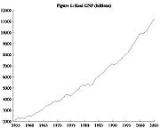
The term
business cycle (or
economic cycle) refers to economy-wide fluctuations in production or economic activity over several months or years. These fluctuations occur around a long-term growth trend, and typically involve shifts over time between periods of relatively rapid economic growth (an
expansionAn economic expansion is an increase in the level of economic activity, and of the goods and services available in the market place. It is a period of economic growth as measured by a rise in real GDP.The explanation of such fluctuations in aggregate economic activity is one of the primary...
or boom), and periods of relative stagnation or decline (a contraction or
recessionIn economics, a recession is a business cycle contraction, a general slowdown in economic activity. During recessions, many macroeconomic indicators vary in a similar way...
).
Business cycles are usually measured by considering the growth rate of real
gross domestic productGross domestic product refers to the market value of all final goods and services produced within a country in a given period. GDP per capita is often considered an indicator of a country's standard of living....
. Despite being termed cycles, these fluctuations in economic activity do not follow a mechanical or predictable periodic pattern.
Theory
The first systematic exposition of periodic economic crises, in opposition to the existing theory of
economic equilibriumIn economics, economic equilibrium is a state of the world where economic forces are balanced and in the absence of external influences the values of economic variables will not change. It is the point at which quantity demanded and quantity supplied are equal...
, was the 1819
Nouveaux Principes d'économie politique by
Jean Charles Léonard de SismondiJean Charles Léonard de Sismondi , whose real name was Simonde, was a writer born at Geneva. He is best known for his works on French and Italian history, and his economic ideas.-Early life:...
. Prior to that point
classical economicsClassical economics is widely regarded as the first modern school of economic thought. Its major developers include Adam Smith, Jean-Baptiste Say, David Ricardo, Thomas Malthus and John Stuart Mill....
had either denied the existence of business cycles, blamed them on external factors, notably war, or only studied the long term. Sismondi found vindication in the
Panic of 1825The Panic of 1825 was a stock market crash that started in the Bank of England arising in part out of speculative investments in Latin America, including the imaginary country of Poyais...
, which was the first unarguably internal economic crisis, occurring in peacetime. Sismondi and his contemporary
Robert OwenRobert Owen was a Welsh social reformer and one of the founders of utopian socialism and the cooperative movement.Owen's philosophy was based on three intellectual pillars:...
, who expressed similar but less systematic thoughts in 1817
Report to the Committee of the Association for the Relief of the Manufacturing Poor, both identified the cause of economic cycles as
overproductionIn economics, overproduction, oversupply or excess of supply refers to excess of supply over demand of products being offered to the market...
and
underconsumptionIn underconsumption theory in economics, recessions and stagnation arise due to inadequate consumer demand relative to the amount produced. The theory has been replaced since the 1930s by Keynesian economics and the theory of aggregate demand, both of which were influenced by...
, caused in particular by wealth inequality. They advocated government intervention and
socialismSocialism is an economic system characterized by social ownership of the means of production and cooperative management of the economy; or a political philosophy advocating such a system. "Social ownership" may refer to any one of, or a combination of, the following: cooperative enterprises,...
, respectively, as the solution. This work did not generate interest among classical economists, though underconsumption theory developed as a heterodox branch in economics until being systematized in
Keynesian economicsKeynesian economics is a school of macroeconomic thought based on the ideas of 20th-century English economist John Maynard Keynes.Keynesian economics argues that private sector decisions sometimes lead to inefficient macroeconomic outcomes and, therefore, advocates active policy responses by the...
in the 1930s.
Sismondi's theory of periodic crises was developed into a theory of alternating
cycles by
Charles DunoyerBarthélemy-Charles-Pierre-Joseph Dunoyer de Segonzac was a French liberal economist....
, and similar theories, showing signs of influence by Sismondi, were developed by
Johann Karl RodbertusJohann Karl Rodbertus , also known as Karl Rodbertus-Jagetzow, was a German economist and socialist from Greifswald...
. Periodic crises in capitalism formed the basis of the theory of
Karl MarxKarl Heinrich Marx was a German philosopher, economist, sociologist, historian, journalist, and revolutionary socialist. His ideas played a significant role in the development of social science and the socialist political movement...
, who further claimed that these crises were increasing in severity and, on the basis of which, he predicted a
communist revolutionA communist revolution is a proletarian revolution inspired by the ideas of Marxism that aims to replace capitalism with communism, typically with socialism as an intermediate stage...
. He devoted hundreds of pages of
Das KapitalDas Kapital, Kritik der politischen Ökonomie , by Karl Marx, is a critical analysis of capitalism as political economy, meant to reveal the economic laws of the capitalist mode of production, and how it was the precursor of the socialist mode of production.- Themes :In Capital: Critique of...
to crises.
Classification by periods
In 1860, French economist
Clement JuglarClément Juglar was a French doctor and statistician.-Juglar Cycles:He was one of the first to develop an economic theory of business cycles. He identified the 7-11 year fixed investment cycle that is now associated with his name...
identified the presence of economic cycles 8 to 11 years long, although he was cautious not to claim any rigid regularity. Later, Austrian economist
Joseph SchumpeterJoseph Alois Schumpeter was an Austrian-Hungarian-American economist and political scientist. He popularized the term "creative destruction" in economics.-Life:...
argued that a Juglar cycle has four stages: (i) expansion (increase in production and prices, low interests rates); (ii) crisis (stock exchanges crash and multiple bankruptcies of firms occur); (iii) recession (drops in prices and in output, high interests rates); (iv) recovery (stocks recover because of the fall in prices and incomes). In this model, recovery and prosperity are associated with increases in productivity, consumer confidence,
aggregate demandIn macroeconomics, aggregate demand is the total demand for final goods and services in the economy at a given time and price level. It is the amount of goods and services in the economy that will be purchased at all possible price levels. This is the demand for the gross domestic product of a...
, and prices.
In the mid-20th century, Schumpeter and others proposed a typology of business cycles according to their periodicity, so that a number of particular cycles were named after their discoverers or proposers:
- the Kitchin inventory cycle
Kitchin cycle is a short business cycle of about 40 months discovered in the 1920s by Joseph Kitchin.This cycle is believed to be accounted for by time lags in information movements affecting the decision making of commercial firms. Firms react to the improvement of commercial situation through the...
of 3–5 years (after Joseph KitchinJoseph Kitchin was a British businessman and statistician. Analysing American and English interest rates and other data, Kitchin found evidence for a short business cycle of about 40 months....
);
- the Juglar
Clément Juglar was a French doctor and statistician.-Juglar Cycles:He was one of the first to develop an economic theory of business cycles. He identified the 7-11 year fixed investment cycle that is now associated with his name...
fixed investmentFixed investment in economics refers to investment in fixed capital, i.e., tangible capital goods , or to the replacement of depreciated capital goods which have been scrapped....
cycle of 7–11 years (often identified as 'the' business cycle);
- the Kuznets infrastructural investment cycle
Kuznets swing is a claimed medium-range economic wave with a period of 15–25 years found in 1930 by Simon Kuznets. Kuznets connected these waves with demographic processes, in particular with immigrant inflows/outflows and the changes in construction intensity that they caused, that is why he...
of 15–25 years (after Simon KuznetsSimon Smith Kuznets was a Russian American economist at the Wharton School of the University of Pennsylvania who won the 1971 Nobel Memorial Prize in Economic Sciences "for his empirically founded interpretation of economic growth which has led to new and deepened insight into the economic and...
);
- the Kondratiev wave
Kondratiev waves are described as sinusoidal-like cycles in the modern capitalist world economy...
or long technological cycle of 45–60 years (after Nikolai KondratievNikolai Dmitriyevich Kondratiev , Russian: Николай Дмитриевич Кондратьев , was a Russian economist, who was a proponent of the New Economic Policy in the Soviet Union....
).
Interest in these different typologies of cycles has waned since the development of modern
macroeconomicsMacroeconomics is a branch of economics dealing with the performance, structure, behavior, and decision-making of the whole economy. This includes a national, regional, or global economy...
, which gives little support to the idea of regular periodic cycles.
Occurrence
There were frequent crises in Europe and America in the 19th and first half of the 20th century, specifically the period 1815–1939, starting from the end of the
Napoleonic warsThe Napoleonic Wars were a series of wars declared against Napoleon's French Empire by opposing coalitions that ran from 1803 to 1815. As a continuation of the wars sparked by the French Revolution of 1789, they revolutionised European armies and played out on an unprecedented scale, mainly due to...
in 1815, which was immediately followed by the
Post-Napoleonic depressionThe post-Napoleonic depression refers to a post-war economic depression experienced by European countries following the end of the Napoleonic wars....
in the United Kingdom (1815–30), and culminating in the
Great DepressionThe Great Depression was a severe worldwide economic depression in the decade preceding World War II. The timing of the Great Depression varied across nations, but in most countries it started in about 1929 and lasted until the late 1930s or early 1940s...
of 1929–39, which led into
World War IIWorld War II, or the Second World War , was a global conflict lasting from 1939 to 1945, involving most of the world's nations—including all of the great powers—eventually forming two opposing military alliances: the Allies and the Axis...
. See Financial crisis: 19th century for listing and details. The first of these crises not associated with a war was the
Panic of 1825The Panic of 1825 was a stock market crash that started in the Bank of England arising in part out of speculative investments in Latin America, including the imaginary country of Poyais...
.
Business cycles in the OECD after World War II were generally more restrained than the earlier business cycles, particularly during the Golden Age of Capitalism (1945/50–1970s), and the period 1945–2008 did not experience a global downturn until the Late-2000s recession. Economic stabilization policy using
fiscal policyIn economics and political science, fiscal policy is the use of government expenditure and revenue collection to influence the economy....
and
monetary policyMonetary policy is the process by which the monetary authority of a country controls the supply of money, often targeting a rate of interest for the purpose of promoting economic growth and stability. The official goals usually include relatively stable prices and low unemployment...
appeared to have dampened the worst excesses of business cycles, and automatic stabilization due to the aspects of the
governmentGovernment refers to the legislators, administrators, and arbitrators in the administrative bureaucracy who control a state at a given time, and to the system of government by which they are organized...
's
budgetA budget is a financial plan and a list of all planned expenses and revenues. It is a plan for saving, borrowing and spending. A budget is an important concept in microeconomics, which uses a budget line to illustrate the trade-offs between two or more goods...
also helped mitigate the cycle even without conscious action by policy-makers.
In this period the economic cycle – at least the problem of depressions – was twice declared dead; first in the late 1960s, when
Phillips curveIn economics, the Phillips curve is a historical inverse relationship between the rate of unemployment and the rate of inflation in an economy. Stated simply, the lower the unemployment in an economy, the higher the rate of inflation...
was seen as being able to steer the economy – which was followed by
stagflationIn economics, stagflation is a situation in which the inflation rate is high and the economic growth rate slows down and unemployment remains steadily high...
in the 1970s, which discredited the theory, secondly in the early 2000s, following the stability and growth in the 1980s and 1990s in what came to be known as
The Great ModerationIn economics, the Great Moderation refers to a reduction in the volatility of business cycle fluctuations starting in the mid-1980s, believed to have been caused by institutional and structural changes in developed nations in the later part of the twentieth century...
– which was followed by the Late-2000s recession. Notably, in 2003,
Robert LucasRobert Emerson Lucas, Jr. is an American economist at the University of Chicago. He received the Nobel Prize in Economics in 1995 and is consistently indexed among the top 10 economists in the Research Papers in Economics rankings. He is married to economist Nancy Stokey.He received his B.A. in...
, in his presidential address to the
American Economic AssociationThe American Economic Association, or AEA, is a learned society in the field of economics, headquartered in Nashville, Tennessee. It publishes one of the most prestigious academic journals in economics: the American Economic Review...
, declared that the "central problem of depression-prevention [has] been solved, for all practical purposes."
Note however that various regions have experienced prolonged
depressionsIn economics, a depression is a sustained, long-term downturn in economic activity in one or more economies. It is a more severe downturn than a recession, which is seen by some economists as part of the modern business cycle....
, most dramatically the economic crisis in former
Eastern BlocThe term Eastern Bloc or Communist Bloc refers to the former communist states of Eastern and Central Europe, generally the Soviet Union and the countries of the Warsaw Pact...
countries following the end of the
Soviet UnionThe Soviet Union , officially the Union of Soviet Socialist Republics , was a constitutionally socialist state that existed in Eurasia between 1922 and 1991....
in 1991; for several of these countries the period 1989–2010 has been an ongoing depression, with real income still lower than in 1989.
Identifying
In 1946, economists Arthur F. Burns and Wesley C. Mitchell provided the now standard definition of business cycles in their book
Measuring Business Cycles:
According to A. F. Burns:
In the
United StatesThe United States of America is a federal constitutional republic comprising fifty states and a federal district...
, it is generally accepted that the
National Bureau of Economic ResearchThe National Bureau of Economic Research is an American private nonprofit research organization "committed to undertaking and disseminating unbiased economic research among public policymakers, business professionals, and the academic community." The NBER is well known for providing start and end...
(NBER) is the final arbiter of the dates of the peaks and troughs of the business cycle. An expansion is the period from a trough to a peak, and a recession as the period from a peak to a trough. The NBER identifies a recession as "a significant decline in economic activity spread across the economy, lasting more than a few months, normally visible in real GDP, real income, employment, industrial production".
Spectral analysis of business cycles
Recent research employing
spectral analysisSpectral analysis or Spectrum analysis may refer to:* Spectrum analysis in chemistry and physics, a method of analyzing the chemical properties of matter from bands in their visible spectrum...
has confirmed the presence of
Kondratiev waveKondratiev waves are described as sinusoidal-like cycles in the modern capitalist world economy...
s in the world GDP dynamics at an acceptable level of statistical significance. Korotayev
et al. also detected shorter business cycles, dating the Kuznets to about 17 years and calling it the third harmonic of the Kondratiev, meaning that there are three Kuznets cycles per Kondratiev.
Cycles or fluctuations?
In recent years economic theory has moved towards the study of
economic fluctuation rather than a 'business cycle' – though some economists use the phrase 'business cycle' as a convenient shorthand. For
Milton FriedmanMilton Friedman was an American economist, statistician, academic, and author who taught at the University of Chicago for more than three decades...
calling the business cycle a "cycle" is a
misnomerA misnomer is a term which suggests an interpretation that is known to be untrue. Such incorrect terms sometimes derive their names because of the form, action, or origin of the subject becoming named popularly or widely referenced—long before their true natures were known.- Sources of misnomers...
, because of its non-cyclical nature. Friedman believed that for the most part, excluding very large supply shocks, business declines are more of a monetary phenomenon.
Rational expectationsRational expectations is a hypothesis in economics which states that agents' predictions of the future value of economically relevant variables are not systematically wrong in that all errors are random. An alternative formulation is that rational expectations are model-consistent expectations, in...
theory leads to the efficient-market hypothesis, which states that no deterministic cycle can persist because it would consistently create
arbitrageIn economics and finance, arbitrage is the practice of taking advantage of a price difference between two or more markets: striking a combination of matching deals that capitalize upon the imbalance, the profit being the difference between the market prices...
opportunities. Much economic theory also holds that the economy is usually at or close to
equilibriumIn economics, economic equilibrium is a state of the world where economic forces are balanced and in the absence of external influences the values of economic variables will not change. It is the point at which quantity demanded and quantity supplied are equal...
. These views led to the formulation of the idea that observed economic fluctuations can be modeled as shocks to a system.
In the tradition of
SlutskyEvgeny "Eugen" Evgenievich Slutsky was a Russian/Soviet mathematical statistician, economist and political economist.-Slutsky's work in economics:...
, business cycles can be viewed as the result of
stochasticStochastic refers to systems whose behaviour is intrinsically non-deterministic. A stochastic process is one whose behavior is non-deterministic, in that a system's subsequent state is determined both by the process's predictable actions and by a random element. However, according to M. Kac and E...
shocks that on aggregate form a
moving averageIn statistics, a moving average, also called rolling average, rolling mean or running average, is a type of finite impulse response filter used to analyze a set of data points by creating a series of averages of different subsets of the full data set.Given a series of numbers and a fixed subset...
series. However, the recent research employing
spectral analysisSpectral analysis or Spectrum analysis may refer to:* Spectrum analysis in chemistry and physics, a method of analyzing the chemical properties of matter from bands in their visible spectrum...
has confirmed the presence of business (Juglar) cycles in the world GDP dynamics at an acceptable level of statistical significance.
Explanations
The explanation of fluctuations in aggregate economic activity is one of the primary concerns of
macroeconomicsMacroeconomics is a branch of economics dealing with the performance, structure, behavior, and decision-making of the whole economy. This includes a national, regional, or global economy...
. The main framework for explaining such fluctuations is
Keynesian economicsKeynesian economics is a school of macroeconomic thought based on the ideas of 20th-century English economist John Maynard Keynes.Keynesian economics argues that private sector decisions sometimes lead to inefficient macroeconomic outcomes and, therefore, advocates active policy responses by the...
. In the
KeynesianKeynesian economics is a school of macroeconomic thought based on the ideas of 20th-century English economist John Maynard Keynes.Keynesian economics argues that private sector decisions sometimes lead to inefficient macroeconomic outcomes and, therefore, advocates active policy responses by the...
view, business cycles reflect the possibility that the economy may reach short-run equilibrium at levels below or above
full employmentIn macroeconomics, full employment is a condition of the national economy, where all or nearly all persons willing and able to work at the prevailing wages and working conditions are able to do so....
. If the economy is operating with less than full employment, i.e., with high
unemploymentUnemployment , as defined by the International Labour Organization, occurs when people are without jobs and they have actively sought work within the past four weeks...
, Keynesian theory states that monetary policy and fiscal policy can have a positive role to play in smoothing the fluctuations of the business cycle.
There are a number of alternative heterodox economic theories of business cycles, largely associated with particular schools or theorists. There are also some divisions and alternative theories within
mainstream economicsMainstream economics is a loose term used to refer to widely-accepted economics as taught in prominent universities and in contrast to heterodox economics...
, notably
real business cycle theoryReal business cycle theory are a class of macroeconomic models in which business cycle fluctuations to a large extent can be accounted for by real shocks. Unlike other leading theories of the business cycle, RBC theory sees recessions and periods of economic growth as the efficient response to...
and credit-based explanations such as
debt deflationDebt deflation is a theory of economic cycles, which holds that recessions and depressions are due to the overall level of debt shrinking : the credit cycle is the cause of the economic cycle....
and the financial instability hypothesis.
Exogenous vs. endogenous
Within mainstream economics, the debate over external (exogenous) versus internal (endogenous) being the causes of the economic cycles, with the classical school (now neo-classical) arguing for exogenous causes and the underconsumptionist (now Keynesian) school arguing for endogenous causes. These may also broadly be classed as "supply-side" and "demand-side" explanations: supply-side explanations may be styled, following
Say's lawSay's law, or the law of market, is an economic principle of classical economics named after the French businessman and economist Jean-Baptiste Say , who stated that "products are paid for with products" and "a glut can take place only when there are too many means of production applied to one kind...
, as arguing that "
supply creates its own demand"Supply creates its own demand" is the formulation of Say's law by John Maynard Keynes, and is considered by him one of the defining characteristics of classical economics...
", while demand-side explanations argue that
effective demandIn economics, effective demand in a market is the demand for a product or service which occurs when purchasers are constrained in a different market. It contrasts with notional demand, which is the demand that occurs when purchasers are not constrained in any other market...
may fall short of supply, yielding a recession or depression.
This debate has important policy consequences: proponents of exogenous causes of crises such as neoclassicals largely argue for minimal government policy or regulation (laissez faire), as absent these external shocks, the market functions, while proponents of endogenous causes of crises such as Keynesians largely argue for larger government policy and regulation, as absent regulation, the market will move from crisis to crisis. This division is not absolute – some classicals (including Say) argued for government policy to mitigate the damage of economic cycles, despite believing in external causes, while
Austrian SchoolThe Austrian School of economics is a heterodox school of economic thought. It advocates methodological individualism in interpreting economic developments , the theory that money is non-neutral, the theory that the capital structure of economies consists of heterogeneous goods that have...
economists argue against government involvement as only worsening crises, despite believing in internal causes.
The view of the economic cycle as caused exogenously dates to
Say's lawSay's law, or the law of market, is an economic principle of classical economics named after the French businessman and economist Jean-Baptiste Say , who stated that "products are paid for with products" and "a glut can take place only when there are too many means of production applied to one kind...
, and much debate on endogeneity or exogeneity of causes of the economic cycle is framed in terms of refuting or supporting Say's law; this is also referred to as the "
general glutIn macroeconomics, a general glut is when supply exceeds demand, specifically, when there is more production in all fields of production in comparison with what resources are available to consume said production....
" debate.
Until the
Keynesian revolutionThe Keynesian Revolution was a fundamental reworking of economic theory concerning the factors determining employment levels in the overall economy. The revolution was set against the then orthodox economic framework: neoclassical economics....
in mainstream economics in the wake of the
Great DepressionThe Great Depression was a severe worldwide economic depression in the decade preceding World War II. The timing of the Great Depression varied across nations, but in most countries it started in about 1929 and lasted until the late 1930s or early 1940s...
, classical and neoclassical explanations (exogenous causes) were the mainstream explanation of economic cycles; following the Keynesian revolution, neoclassical macroeconomics was largely rejected. There has been some resurgence of neoclassical approaches in the form of real business cycle (RBC) theory. The debate between Keynesians and neo-classical advocates was reawakened following the recession of 2007.
Mainstream economists working in the
neoclassicalNeoclassical economics is a term variously used for approaches to economics focusing on the determination of prices, outputs, and income distributions in markets through supply and demand, often mediated through a hypothesized maximization of utility by income-constrained individuals and of profits...
tradition, as opposed to the Keynesian tradition, have usually viewed the departures of the harmonic working of the market economy as due to exogenous influences, such as the State or its regulations, labor unions, business monopolies, or shocks due to technology or natural causes.
Contrarily, in the heterodox tradition of
Jean Charles Léonard de SismondiJean Charles Léonard de Sismondi , whose real name was Simonde, was a writer born at Geneva. He is best known for his works on French and Italian history, and his economic ideas.-Early life:...
,
Clement JuglarClément Juglar was a French doctor and statistician.-Juglar Cycles:He was one of the first to develop an economic theory of business cycles. He identified the 7-11 year fixed investment cycle that is now associated with his name...
, and
MarxCrisis theory is generally associated with Marxian economics. In this context crisis refers to what is called, even currently and outside Marxian theory in many European countries a "conjuncture" or especially sharp bust cycle of the regular boom and bust pattern of what Marxists term "chaotic"...
the recurrent upturns and downturns of the market system are an endogenous characteristic of it.
The 19th century school of Underconsumptionism also posited endogenous causes for the business cycle, notably the
paradox of thriftThe paradox of thrift is a paradox of economics, popularized by John Maynard Keynes, though it had been stated as early as 1714 in The Fable of the Bees, and similar sentiments date to antiquity...
, and today this previously heterodox school has entered the mainstream in the form of
Keynesian economicsKeynesian economics is a school of macroeconomic thought based on the ideas of 20th-century English economist John Maynard Keynes.Keynesian economics argues that private sector decisions sometimes lead to inefficient macroeconomic outcomes and, therefore, advocates active policy responses by the...
via the
Keynesian revolutionThe Keynesian Revolution was a fundamental reworking of economic theory concerning the factors determining employment levels in the overall economy. The revolution was set against the then orthodox economic framework: neoclassical economics....
.
Keynesian
According to
Keynesian economicsKeynesian economics is a school of macroeconomic thought based on the ideas of 20th-century English economist John Maynard Keynes.Keynesian economics argues that private sector decisions sometimes lead to inefficient macroeconomic outcomes and, therefore, advocates active policy responses by the...
, fluctuations in
aggregate demandIn macroeconomics, aggregate demand is the total demand for final goods and services in the economy at a given time and price level. It is the amount of goods and services in the economy that will be purchased at all possible price levels. This is the demand for the gross domestic product of a...
cause the economy to come to short run equilibrium at levels that are different from the full employment rate of output. These fluctuations express themselves as the observed business cycles. Keynesian models do not necessarily imply periodic business cycles. However, simple Keynesian models involving the interaction of the Keynesian multiplier and accelerator give rise to cyclical responses to initial shocks.
Paul SamuelsonPaul Anthony Samuelson was an American economist, and the first American to win the Nobel Memorial Prize in Economic Sciences. The Swedish Royal Academies stated, when awarding the prize, that he "has done more than any other contemporary economist to raise the level of scientific analysis in...
's "oscillator model" is supposed to account for business cycles thanks to the multiplier and the accelerator. The amplitude of the variations in economic output depends on the level of the investment, for investment determines the level of aggregate output (multiplier), and is determined by aggregate demand (accelerator).
In the Keynesian tradition,
Richard GoodwinRichard M. Goodwin was an American mathematician and economist. He was born in Indiana.Goodwin received his BA and PhD at Harvard, and he taught there from 1942 until 1950. He taught at the University of Cambridge until 1979 and the University of Siena until 1984.Goodwin worked on the interaction...
accounts for cycles in output by the distribution of income between business profits and workers wages. The fluctuations in wages are almost the same as in the level of employment (wage cycle lags one period behind the employment cycle), for when the economy is at high employment, workers are able to demand rises in wages, whereas in periods of high unemployment, wages tend to fall. According to Goodwin, when unemployment and business profits rise, the output rises.
Credit/debt cycle
One alternative theory is that the primary cause of economic cycles is due to the
credit cycleThe credit cycle is the expansion and contraction of access to credit over the course of the business cycle. Some economists, including Barry Eichengreen, Hyman Minsky, and other Post-Keynesian economists, and some members of the Austrian school, regard credit cycles as the fundamental process...
: the net expansion of credit (increase in private credit, equivalently debt, as a percentage of GDP) yields economic expansions, while the net contraction causes recessions, and if it persists, depressions. In particular, the bursting of speculative bubbles is seen as the proximate cause of depressions, and this theory places finance and banks at the center of the business cycle.
A primary theory in this vein is the
debt deflationDebt deflation is a theory of economic cycles, which holds that recessions and depressions are due to the overall level of debt shrinking : the credit cycle is the cause of the economic cycle....
theory of
Irving FisherIrving Fisher was an American economist, inventor, and health campaigner, and one of the earliest American neoclassical economists, though his later work on debt deflation often regarded as belonging instead to the Post-Keynesian school.Fisher made important contributions to utility theory and...
, which he proposed to explain the
Great DepressionThe Great Depression was a severe worldwide economic depression in the decade preceding World War II. The timing of the Great Depression varied across nations, but in most countries it started in about 1929 and lasted until the late 1930s or early 1940s...
. A more recent complementary theory is the Financial Instability Hypothesis of
Hyman MinskyHyman Philip Minsky was an American economist and professor of economics at Washington University in St. Louis. His research attempted to provide an understanding and explanation of the characteristics of financial crises...
, and the credit theory of economic cycles is often associated with
Post-Keynesian economicsPost Keynesian economics is a school of economic thought with its origins in The General Theory of John Maynard Keynes, although its subsequent development was influenced to a large degree by Michał Kalecki, Joan Robinson, Nicholas Kaldor and Paul Davidson...
such as
Steve KeenSteve Keen is a Professor in economics and finance at the University of Western Sydney. He classes himself as a post-Keynesian, criticizing both modern neoclassical economics and Marxian economics as inconsistent, unscientific and empirically unsupported...
.
Post-KeynesianPost Keynesian economics is a school of economic thought with its origins in The General Theory of John Maynard Keynes, although its subsequent development was influenced to a large degree by Michał Kalecki, Joan Robinson, Nicholas Kaldor and Paul Davidson...
economist
Hyman MinskyHyman Philip Minsky was an American economist and professor of economics at Washington University in St. Louis. His research attempted to provide an understanding and explanation of the characteristics of financial crises...
has proposed a explanation of cycles founded on fluctuations in credit, interest rates and financial frailty, called the Financial Instability Hypothesis. In an expansion period, interest rates are low and companies easily borrow money from banks to invest. Banks are not reluctant to grant them loans, because expanding economic activity allows business increasing cash flows and therefore they will be able to easily pay back the loans. This process leads to firms becoming excessively indebted, so that they stop investing, and the economy goes into recession.
While credit causes have not been a primary theory of the economic cycle within the mainstream, they have gained occasional mention, such as , cited approvingly by .
Real business cycle theory
Within mainstream economics, Keynesian views have been challenged by real business cycle models in which fluctuations are due to technology shocks. This theory is most associated with
Finn E. KydlandFinn Erling Kydland is a Norwegian economist. He is currently the Henley Professor of Economics at the University of California, Santa Barbara. He also holds the Richard P...
and
Edward C. PrescottEdward Christian Prescott is an American economist. He received the Nobel Memorial Prize in Economics in 2004, sharing the award with Finn E. Kydland, "for their contributions to dynamic macroeconomics: the time consistency of economic policy and the driving forces behind business cycles"...
, and more generally the Chicago school of economics (freshwater economics). They consider that economic crisis and fluctuations cannot stem from a monetary shock, only from an external shock, such as an innovation.
There were great increases in
productivityProductivity improving technologies date back to antiquity, with rather slow progress until the late Middle Ages. Technological progress was aided by literacy and the diffusion of knowledge that accelerated after the spinning wheel spread to Western Europe in the 13th century...
, industrial production and real per capita product throughout period from 1870–1890 that included the
Long DepressionThe Long Depression was a worldwide economic crisis, felt most heavily in Europe and the United States, which had been experiencing strong economic growth fueled by the Second Industrial Revolution in the decade following the American Civil War. At the time, the episode was labeled the Great...
and two other recessions. See:Long depression#Myth of the Long Depression There were also significant increases in productivity in the years leading up to the Great Depression. Both the Long and Great Depressions were characterized by overcapacity and market saturation.
Over the period since the Industrial Revolution, technological progress has had a much larger effect on the economy than any fluctuations in credit or debt, the primary exception being the Great Depression, which caused a multi-year steep economic decline. The effect of technological progress can be seen by the purchasing power of an average hour's work, which has grown from $3 in 1900 to $22 in 1990, measured in 2010 dollars. There were similar increases in real wages during the 19th century. See:
Productivity improving technologies (historical)Productivity improving technologies date back to antiquity, with rather slow progress until the late Middle Ages. Technological progress was aided by literacy and the diffusion of knowledge that accelerated after the spinning wheel spread to Western Europe in the 13th century...
A table of innovations and long cycles can be seen at: Kondratiev wave#Modern modifications of Kondratiev theory
Carlota Perez blames "financial capital" for excess speculation, which she claims is likely to occur in the "frenzy" stage of a new technology, such as the 1998–2000 computer, internet, dot.com mania and bust. Perez also says excess speculation is likely to occur in the mature phase of a technological age.
RBC theory has been categorically rejected by a number of mainstream economists in the Keynesian tradition, such as and
Paul KrugmanPaul Robin Krugman is an American economist, professor of Economics and International Affairs at the Woodrow Wilson School of Public and International Affairs at Princeton University, Centenary Professor at the London School of Economics, and an op-ed columnist for The New York Times...
.
Politically-based business cycle
Another set of models tries to derive the business cycle from political decisions. The partisan business cycle suggests that cycles result from the successive elections of administrations with different policy regimes. Regime A adopts expansionary policies, resulting in growth and inflation, but is voted out of office when inflation becomes unacceptably high. The replacement, Regime B, adopts contractionary policies reducing inflation and growth, and the downwards swing of the cycle. It is voted out of office when unemployment is too high, being replaced by Party A.
The political business cycle is an alternative theory stating that when an administration of any hue is elected, it initially adopts a contractionary policy to reduce inflation and gain a reputation for economic competence. It then adopts an expansionary policy in the lead up to the next election, hoping to achieve simultaneously low inflation and unemployment on election day.
The political business cycle theory is strongly linked to the name of Michał Kalecki who argued that no democratic government under capitalism would allow the persistence of
full employmentIn macroeconomics, full employment is a condition of the national economy, where all or nearly all persons willing and able to work at the prevailing wages and working conditions are able to do so....
[This sentence is confusing, and the reference given does not support this statement. Please clarify and correct the reference], so that recessions would be caused by
political decisions. Persistent full employment would mean increasing workers' bargaining power to raise wages and to avoid doing unpaid labor, potentially hurting profitability. (He did not see this theory as applying under
fascismFascism is a radical authoritarian nationalist political ideology. Fascists seek to rejuvenate their nation based on commitment to the national community as an organic entity, in which individuals are bound together in national identity by suprapersonal connections of ancestry, culture, and blood...
, which would use direct force to destroy labor's power.) In recent years, proponents of the "electoral business cycle" theory have argued that incumbent politicians encourage prosperity before elections in order to ensure re-election—and make the citizens pay for it with recessions afterwards.
Marxist economics
For Marx the economy based on production of commodities to be sold in the market is intrinsically prone to crisis. In the
heterodox"Heterodox economics" refers to approaches or to schools of economic thought that are considered outside of "mainstream economics". Mainstream economists sometimes assert that it has little or no influence on the vast majority of academic economists in the English speaking world. "Mainstream...
Marxian view profit is the major engine of the market economy, but business (capital) profitability has a
tendency to fallThe tendency of the rate of profit to fall is a hypothesis in economics and political economy, most famously expounded by Karl Marx in chapter 13 of Das Kapital Vol. 3. It was generally accepted in the 19th century...
that recurrently creates crises, in which mass unemployment occurs, businesses fail, remaining capital is centralized and concentrated and profitability is recovered. In the long run these crises tend to be more severe and the system will eventually fail. Some Marxist authors such as
Rosa LuxemburgRosa Luxemburg was a Marxist theorist, philosopher, economist and activist of Polish Jewish descent who became a naturalized German citizen...
viewed the lack of purchasing power of workers as a cause of a tendency of supply to be larger than demand, creating crisis, in a model that has similarities with the Keynesian one. Indeed a number of modern authors have tried to combine Marx's and Keynes's views. Others have contrarily emphasized basic differences between the Marxian and the Keynesian perspective: while Keynes saw capitalism as a system worth maintaining and susceptible to efficient regulation, Marx viewed capitalism as a historically doomed system that cannot be put under societal control.
Austrian school
Economists of the
heterodox"Heterodox economics" refers to approaches or to schools of economic thought that are considered outside of "mainstream economics". Mainstream economists sometimes assert that it has little or no influence on the vast majority of academic economists in the English speaking world. "Mainstream...
Austrian schoolThe Austrian School of economics is a heterodox school of economic thought. It advocates methodological individualism in interpreting economic developments , the theory that money is non-neutral, the theory that the capital structure of economies consists of heterogeneous goods that have...
argue that business cycles are primarily caused by excessive creation of bank credit – or
fiduciary media – which is encouraged by central banks when they set interest rates too low, especially when combined with the practice of fractional reserve banking. The expansion of the money supply causes a "boom" in which resources are misallocated due to falsified interest rate signals, which then leads to the "bust" as the market self-corrects, the
malinvestmentMalinvestment is a concept developed by the Austrian School of economic thought, that refers to investments of firms being badly allocated due to what they assert to be an artificially low cost of credit and an unsustainable increase in money supply, often blamed on a central bank.This concept is...
s are liquidated, and the money supply contracts.
One of the primary critiques of Austrian business cycle theory is the observation that the United States suffered recurrent economic crises in the 19th century, most notably the
Panic of 1873The Panic of 1873 triggered a severe international economic depression in both Europe and the United States that lasted until 1879, and even longer in some countries. The depression was known as the Great Depression until the 1930s, but is now known as the Long Depression...
, prior to the establishment of a U.S. central bank in 1913. Adherents, such as the historian
Thomas WoodsThomas E. "Tom" Woods, Jr. is an American historian, economist, political analyst, and New York Times-bestselling author. He has written extensively on the subjects of American history, contemporary politics, and economic theory...
argue that these earlier financial crises were prompted by government and bankers' efforts to expand credit despite restraints imposed by the prevailing gold standard, and are thus consistent with Austrian Business Cycle Theory.
Georgism
Henry GeorgeHenry George was an American writer, politician and political economist, who was the most influential proponent of the land value tax, also known as the "single tax" on land...
identifies land price fluctuations as the primary cause of most business cycles. The theory is generally ignored in most of today's discussions of the subject despite the fact that the two great economic contractions of the last 100 years (1929–1933 and 2008–??) both involved speculative real estate bubbles.
George observed that one of the factors that is absolutely necessary for all production —
landIn economics, land comprises all naturally occurring resources whose supply is inherently fixed. Examples are any and all particular geographical locations, mineral deposits, and even geostationary orbit locations and portions of the electromagnetic spectrum. Natural resources are fundamental to...
— has an inherent tendency to rise in price on an exponential basis as the economy grows. The reason for this is that the quantity of land (the stock of locations and natural resources) is fixed, while its quality is improved due to improvements such as transportation infrastructures and economic development of the surroundings. Investors see this tendency as the economy grows and they buy land ahead of the boom areas, withholding it from use in order to take advantage of its increased value in the future. Because housing and commercial real estate provide collateral for a large portion of lending, there is a tendency for real estate prices to rise faster than the rate of inflation in business cycle upswings.
Speculation in land concentrates profits in landholders and diverts economic resources to speculation in land, squeezing profits away from production that has to occur on this land.
In effect, land speculation creates a built-in supply shock, that squeezes the economy just as economic output increases. This is a systemic retardation of the economy, placing a sharp brake on further economic expansion. This shock to the economy occurs as long as there is land speculation, creating an underlying tendency toward inflation and recession late in the growth phase of the business cycle. Land speculation, according to George, is always the cause of economic downturns. There are any number of contributing causes; things like oil price shocks, consumer confidence crises, international trade fluctuations, natural disasters — but none of these things creates the underlying weakness.
Land speculation slows the economy in two ways. It increases production costs by making land in general more expensive (shifting the AS curve upward) as well as decreasing productivity by denying access to the best locations, shifting the AS curve to the left and lowering "potential output".
The recent housing bubble offers some validation to George's theory and has created great distortions around the world. In the U.S. the bubble caused extreme regional differences in land prices, creating uncompetitive business conditions due to higher wages and taxes. State (CA, IL) and local governments in many of these high cost areas are suffering large budget shortfalls as businesses close or relocate to low cost areas such as the Atlanta, GA region, which has low land prices and was a leader in economic growth for the last several decades.
The Wisconsin Business School publishes an on line database with building cost and land values for 46 U.S. metro areas.
Mitigating
Most social indicators (mental health, crimes, suicides) worsen during economic recessions. As periods of economic stagnation are painful for the many who lose their jobs, there is often political pressure for governments to mitigate recessions. Since the 1940s, following the
Keynesian revolutionThe Keynesian Revolution was a fundamental reworking of economic theory concerning the factors determining employment levels in the overall economy. The revolution was set against the then orthodox economic framework: neoclassical economics....
, most governments of developed nations have seen the mitigation of the business cycle as part of the responsibility of government, under the rubric of stabilization policy.
Since in the Keynesian view, recessions are caused by inadequate aggregate demand, when a recession occurs the government should increase the amount of aggregate demand and bring the economy back into equilibrium. This the government can do in two ways, firstly by increasing the money supply (expansionary
monetary policyMonetary policy is the process by which the monetary authority of a country controls the supply of money, often targeting a rate of interest for the purpose of promoting economic growth and stability. The official goals usually include relatively stable prices and low unemployment...
) and secondly by increasing government spending or cutting taxes (expansionary fiscal policy).
By contrast, some economists, notably New classical economist
Robert LucasRobert Emerson Lucas, Jr. is an American economist at the University of Chicago. He received the Nobel Prize in Economics in 1995 and is consistently indexed among the top 10 economists in the Research Papers in Economics rankings. He is married to economist Nancy Stokey.He received his B.A. in...
, argue that the
welfare cost of business cyclesIn macroeconomics, the welfare cost of business cycles refers to the decrease in social welfare, if any, caused by business cycle fluctuations....
are very small to negligible, and that governments should focus on long-term growth instead of stabilization.
However, even according to Keynesian theory, managing
economic policyEconomic policy refers to the actions that governments take in the economic field. It covers the systems for setting interest rates and government budget as well as the labor market, national ownership, and many other areas of government interventions into the economy.Such policies are often...
to smooth out the cycle is a difficult task in a society with a complex economy. Some theorists, notably those who believe in
Marxian economicsMarxian economics refers to economic theories on the functioning of capitalism based on the works of Karl Marx. Adherents of Marxian economics, particularly in academia, distinguish it from Marxism as a political ideology and sociological theory, arguing that Marx's approach to understanding the...
, believe that this difficulty is insurmountable.
Karl MarxKarl Heinrich Marx was a German philosopher, economist, sociologist, historian, journalist, and revolutionary socialist. His ideas played a significant role in the development of social science and the socialist political movement...
claimed that recurrent business cycle crises were an inevitable result of the operations of the
capitalistic systemCapitalism is an economic system that became dominant in the Western world following the demise of feudalism. There is no consensus on the precise definition nor on how the term should be used as a historical category...
. In this view, all that the government can do is to change the
timing of economic crises. The crisis could also show up in a different
form, for example as severe
inflationIn economics, inflation is a rise in the general level of prices of goods and services in an economy over a period of time.When the general price level rises, each unit of currency buys fewer goods and services. Consequently, inflation also reflects an erosion in the purchasing power of money – a...
or a steadily increasing
government deficitDeficit spending is the amount by which a government, private company, or individual's spending exceeds income over a particular period of time, also called simply "deficit," or "budget deficit," the opposite of budget surplus....
. Worse, by delaying a crisis, government policy is seen as making it
more dramatic and thus more painful.
Additionally, since the 1960s
neoclassical economistsNeoclassical economics is a term variously used for approaches to economics focusing on the determination of prices, outputs, and income distributions in markets through supply and demand, often mediated through a hypothesized maximization of utility by income-constrained individuals and of profits...
have played down the ability of Keynesian policies to manage an economy. Since the 1960s, economists like Nobel Laureates
Milton FriedmanMilton Friedman was an American economist, statistician, academic, and author who taught at the University of Chicago for more than three decades...
and
Edmund PhelpsEdmund Strother Phelps, Jr. is an American economist and the winner of the 2006 Bank of Sweden Prize in Economic Sciences in Memory of Alfred Nobel. Early in his career he became renowned for his research at Yale's Cowles Foundation in the first half of the 1960s on the sources of economic growth...
have made ground in their arguments that inflationary expectations negate the
Phillips curveIn economics, the Phillips curve is a historical inverse relationship between the rate of unemployment and the rate of inflation in an economy. Stated simply, the lower the unemployment in an economy, the higher the rate of inflation...
in the long run. The
stagflationIn economics, stagflation is a situation in which the inflation rate is high and the economic growth rate slows down and unemployment remains steadily high...
of the 1970s provided striking support for their theories, defying the simple Keynesian prediction that recessions and
inflationIn economics, inflation is a rise in the general level of prices of goods and services in an economy over a period of time.When the general price level rises, each unit of currency buys fewer goods and services. Consequently, inflation also reflects an erosion in the purchasing power of money – a...
cannot occur together. Friedman has gone so far as to argue that all the
central bankA central bank, reserve bank, or monetary authority is a public institution that usually issues the currency, regulates the money supply, and controls the interest rates in a country. Central banks often also oversee the commercial banking system of their respective countries...
of a country should do is to avoid making large mistakes, as he believes they did by contracting the money supply very rapidly in the face of the
Wall Street Crash of 1929The Wall Street Crash of 1929 , also known as the Great Crash, and the Stock Market Crash of 1929, was the most devastating stock market crash in the history of the United States, taking into consideration the full extent and duration of its fallout...
, in which they made what would have been a recession into the
Great DepressionThe Great Depression was a severe worldwide economic depression in the decade preceding World War II. The timing of the Great Depression varied across nations, but in most countries it started in about 1929 and lasted until the late 1930s or early 1940s...
.
See also
- Dynamic stochastic general equilibrium
Dynamic stochastic general equilibrium modeling is a branch of applied general equilibrium theory that is influential in contemporary macroeconomics...
- Welfare cost of business cycles
In macroeconomics, the welfare cost of business cycles refers to the decrease in social welfare, if any, caused by business cycle fluctuations....
- World-systems approach
- Information revolution
- Innovation saturation
Innovation Saturation was introduced by American economist and historian Tom Osenton in his 2004 book The Death of Demand: Finding Growth in a Saturated Global Economy . Innovation Saturation is a business cycle theory that posits that every company experiences two major growth trends during its...
- Market trend
A market trend is a putative tendency of a financial market to move in a particular direction over time. These trends are classified as secular for long time frames, primary for medium time frames, and secondary for short time frames...
- Skyscraper Index
The Skyscraper Index is a concept put forward in January 1999 by Andrew Lawrence, research director at Dresdner Kleinwort Wasserstein, which showed that the world's tallest buildings have risen on the eve of economic downturns...
- Inventory investment over the business cycle