
All Topics  
Dot-com bubble


   Email Print
   Bookmark   Link


Dot-com bubble


The "dot-com bubble" (or sometimes the "I.T. bubble") was a speculative bubble
Economic bubble

An economic bubble is ?trade in high volumes at prices that are considerably at variance with Intrinsic value ?.While some economists deny that bubbles occur, the cause of bubbles remains a challenge to those who are convinced that asset prices often deviate strongly from intrinsic values....
 covering roughly 1995–2001 (with a climax on March 10, 2000 with the NASDAQ
NASDAQ

The NASDAQ is an United States stock exchange. It is the largest Electronic trading screen-based Stock trading market in the United States....
 peaking at 5132.52) during which stock markets in Western nations
Western world

The term Western world, the West or the Occident can have multiple meanings dependent on its context . Accordingly, the basic definition of what constitutes "the West" varies, expanding and contracting over time, in relation to various historical circumstances....
 saw their value increase rapidly from growth in the new Internet sector
Quaternary sector of industry

The quaternary sector of the economy is an extension of the three-sector hypothesis of industrial evolution. It principally concerns the intellectual services: information generation, information sharing, consultation, education and research and development....
 and related fields. The period was marked by the founding (and, in many cases, spectacular failure) of a group of new Internet
Internet

The Internet is a global network of interconnected computers, enabling users to share information along multiple channels. Typically, a computer that connects to the Internet can access information from a vast array of available server and other computers by moving information from them to the computer's local memory....
-based companies commonly referred to as dot-coms
Dot-com company

A dot-com company, or simply a dot-com , is a company that does most of its business on the Internet, usually through a website that uses the popular Generic top-level domain, ".com" ....
.


Discussion
Ask a question about 'Dot-com bubble'
Start a new discussion about 'Dot-com bubble'
Answer questions from other users
Full Discussion Forum


Recent Posts


Encyclopedia


The "dot-com bubble" (or sometimes the "I.T. bubble") was a speculative bubble
Economic bubble

An economic bubble is ?trade in high volumes at prices that are considerably at variance with Intrinsic value ?.While some economists deny that bubbles occur, the cause of bubbles remains a challenge to those who are convinced that asset prices often deviate strongly from intrinsic values....
 covering roughly 1995–2001 (with a climax on March 10, 2000 with the NASDAQ
NASDAQ

The NASDAQ is an United States stock exchange. It is the largest Electronic trading screen-based Stock trading market in the United States....
 peaking at 5132.52) during which stock markets in Western nations
Western world

The term Western world, the West or the Occident can have multiple meanings dependent on its context . Accordingly, the basic definition of what constitutes "the West" varies, expanding and contracting over time, in relation to various historical circumstances....
 saw their value increase rapidly from growth in the new Internet sector
Quaternary sector of industry

The quaternary sector of the economy is an extension of the three-sector hypothesis of industrial evolution. It principally concerns the intellectual services: information generation, information sharing, consultation, education and research and development....
 and related fields. The period was marked by the founding (and, in many cases, spectacular failure) of a group of new Internet
Internet

The Internet is a global network of interconnected computers, enabling users to share information along multiple channels. Typically, a computer that connects to the Internet can access information from a vast array of available server and other computers by moving information from them to the computer's local memory....
-based companies commonly referred to as dot-coms
Dot-com company

A dot-com company, or simply a dot-com , is a company that does most of its business on the Internet, usually through a website that uses the popular Generic top-level domain, ".com" ....
. A combination of rapidly increasing stock prices, individual speculation
Speculation

Speculation is the assumption of the risk of loss, in return for the uncertain possibility of a reward. Only if one may safely say that a particular position involves no risk may one say, strictly speaking, that such a position represents an "investment." Financial speculation involves the trade, and short-selling of stocks, bond , commodity...
 in stocks, and widely available venture capital
Venture capital

Venture capital is a type of private equity capital typically provided to early-stage, high-potential, Growth investing companies in the interest of generating a return through an eventual realization event such as an IPO or mergers and acquisitions of the company....
 created an exuberant environment in which many of these businesses dismissed standard business model
Business model

A business model is a framework for creating economic, social, and/or other forms of value. The term business model is thus used for a broad range of informal and formal descriptions to represent core aspects of a business, including purpose, offerings, strategies, infrastructure, organizational structures, trading practices, and operat...
s, focusing on increasing market share
Market share

Market share, in strategic management and marketing, is the percentage or proportion of the total available market or market segment that is being serviced by a company....
 at the expense of the bottom line
Bottom Line

The Bottom Line was an intimate music venue in New York City's Greenwich Village, at 15 West Fourth Street between Broadway and Washington Square Park....
.

The growth of the bubble


The venture capitalists saw record-setting rises in stock valuations of dot-com
Dot-com company

A dot-com company, or simply a dot-com , is a company that does most of its business on the Internet, usually through a website that uses the popular Generic top-level domain, ".com" ....
 companies, and therefore moved faster and with less caution than usual, choosing to mitigate the risk by starting many contenders and letting the market decide which would succeed. The low interest rates in 1998–99 helped increase the start-up capital amounts. Although a number of these new entrepreneurs had realistic plans and administrative ability, many more of them lacked these characteristics but were able to sell their ideas to investors because of the novelty of the dot-com concept.

A canonical "dot-com" company's business model
Business model

A business model is a framework for creating economic, social, and/or other forms of value. The term business model is thus used for a broad range of informal and formal descriptions to represent core aspects of a business, including purpose, offerings, strategies, infrastructure, organizational structures, trading practices, and operat...
 relied on harnessing network effect
Network effect

In economics and business, a network effect is the effect that one user of a good or Service has on the value of that product to other people....
s by operating at a sustained net loss to build market share
Market share

Market share, in strategic management and marketing, is the percentage or proportion of the total available market or market segment that is being serviced by a company....
 (or mind share
Mind share

Mind share, or the development of consumer awareness or popularity, is one of the main objectives of advertising and promotion. When people think of examples of a product type or category, they usually think of a limited number of brand names....
). These companies expected that they could build enough brand awareness to charge profitable rates for their services later. The motto "get big fast" reflected this strategy. During the loss period the companies relied on venture capital
Venture capital

Venture capital is a type of private equity capital typically provided to early-stage, high-potential, Growth investing companies in the interest of generating a return through an eventual realization event such as an IPO or mergers and acquisitions of the company....
 and especially initial public offering
Initial public offering

Initial public offering , also referred to simply as a "public offering" or "flotation," is when a company issues common stock or Share to the public for the first time....
s of stock to pay their expenses. The novelty of these stocks, combined with the difficulty of valuing the companies, sent many stocks to dizzying heights and made the initial controllers of the company wildly rich on paper.

Historically, the dot-com boom can be seen as similar to a number of other technology-inspired booms of the past including railroads in the 1840s, automobiles and radio in the 1920s, transistor electronics
Transistor

In electronics, a transistor is a semiconductor device commonly used to Electronic amplifier or switch Electronics signals. A transistor is made of a solid piece of a semiconductor material, with at least three terminals for connection to an external circuit....
 in the 1950s, computer time-sharing
Time-sharing

Time-sharing refers to sharing a computing resource among many users by Computer multitasking. Its introduction in the 1960s, and emergence as the prominent model of computing in the 1970s, represents a major historical shift in the history of computing....
 in the 1960s, and home computers and biotechnology
Biotechnology

Biotechnology is technology based on biology, especially when used in agriculture, food science, and medicine. United Nations Convention on Biological Diversity defines biotechnology as:...
 in the early 1980s in accordance with the Japanese economic meltdown.

Soaring stocks

In financial markets a stock market bubble
Stock market bubble

A stock market bubble is a type of economic bubble taking place in stock markets when price of stocks rise and become overvalued by any measure of stock valuation....
 is a self-perpetuating rise or boom in the share prices of stocks of a particular industry. The term may be used with certainty only in retrospect when share prices have since crashed. A bubble occurs when speculators note the fast increase in value and decide to buy in anticipation of further rises, rather than because the shares are undervalued. Typically many companies thus become grossly overvalued. When the bubble "bursts," the share prices fall dramatically, and many companies go out of business.

The dot-com model was inherently flawed: a vast number of companies all had the same business plan of monopolizing
Monopoly

In economics, a monopoly exists when a specific individual or enterprise has sufficient control over a particular product or service to determine significantly the terms on which other individuals shall have access to it....
 their respective sectors through network effects, and it was clear that even if the plan was sound, there could only be at most one network-effects winner in each sector, and therefore that most companies with this business plan would fail. In fact, many sectors could not support even one company powered entirely by network effects.

In spite of this, however, a few company founders made vast fortunes when their companies were bought out at an early stage in the dot-com stock market bubble. These early successes made the bubble even more buoyant. An unprecedented amount of personal investing occurred during the boom, and the press reported the phenomenon of people quitting their jobs to become full-time day traders
Day trading

Day trading refers to the practice of buying and selling financial instruments within the same trading day such that all positions are usually closed before the market close of the trading day....
.

Free spending

According to dot-com theory, an Internet company's survival depended on expanding its customer base as rapidly as possible, even if it produced large annual losses. For instance, Google and Amazon did not see any profit in their first years. Amazon was spending on expanding customer base and letting people know that it existed and Google was busy spending on creating more powerful machine capacity to serve its expanding search engine. The phrase "Get large or get lost" was the wisdom of the day. At the height of the boom, it was possible for a promising dot-com to make an initial public offering
Initial public offering

Initial public offering , also referred to simply as a "public offering" or "flotation," is when a company issues common stock or Share to the public for the first time....
 (IPO) of its stock and raise a substantial amount of money even though it had never made a profit — or, in some cases, earned any revenue whatsoever. In such a situation, a company's lifespan was measured by its burn rate
Burn rate

Burn rate is a synonymous term for negative cash flow. It is a measure for how fast a company will use up its shareholder capital. If the shareholder capital is exhausted, the company will either have to start making a profit, find additional funding, or close down....
: that is, the rate at which a non-profitable company lacking a viable business model
Business model

A business model is a framework for creating economic, social, and/or other forms of value. The term business model is thus used for a broad range of informal and formal descriptions to represent core aspects of a business, including purpose, offerings, strategies, infrastructure, organizational structures, trading practices, and operat...
 ran through its capital served as the metric.

Public awareness campaigns were one way that dot-coms sought to grow their customer base. These included television ads, print ads, and targeting of professional sporting events. Many dot-coms named themselves with onomatopoeic
Onomatopoeia

Onomatopoeia is a word or a grouping of words that imitates the sound it is describing, such as animal noises like "oink" or "meow", or suggesting its source object, such as "boom", "zoom", "click", "bunk", "clang", "buzz", "zap", or "bang"....
 nonsense words that they hoped would be memorable and not easily confused with a competitor. Super Bowl XXXIV
Super Bowl XXXIV

Super Bowl XXXIV featured the National Football Conference champion St. Louis Rams and the American Football Conference champion Tennessee Titans in an American football game to decide the National Football League champion for the 1999 NFL season....
 in January 2000 featured seventeen dot-com companies that each paid over two million dollars for a thirty-second spot. By contrast, in January 2001, just three dot-coms bought advertising spots during Super Bowl XXXV
Super Bowl XXXV

Super Bowl XXXV was played on January 28, 2001 at Raymond James Stadium in Tampa, Florida to decide the National Football League champion following the 2000 NFL season....
. In a similar vein, CBS-backed iWon.com
IWon

IWon.com is a free casual game site and web portal that offers the chance to win cash and prizes through activities such as clicking through links or playing online games....
 gave away ten million dollars to a lucky contestant on an April 15, 2000, half-hour primetime special that was broadcast on CBS.

Not surprisingly, the "growth over profits" mentality and the aura of "new economy
New Economy

The New Economy was an evolution of developed countries from an industrial/manufacturing-based wealth producing economy into a service sector asset based economy from globalization and currency manipulation by governments and their central banks....
" invincibility led some companies to engage in lavish internal spending, such as elaborate business facilities and luxury vacations for employees. Executives and employees who were paid with stock options in lieu of cash became instant millionaires when the company made its initial public offering; many invested their new wealth into yet more dot-coms.

Cities all over the United States sought to become the "next Silicon Valley" by building network-enabled office space to attract Internet entrepreneurs. Communication providers, convinced that the future economy would require ubiquitous broadband access, went deeply into debt to improve their networks with high-speed equipment and fiber optic cables. Companies that produced network equipment, such as Cisco Systems
Cisco Systems

Cisco Systems, Inc. is a multinational corporation with more than 66,000 employees and annual revenue of United States dollar39 billion as of 2008....
, profited greatly from these projects.

Similarly, in Europe the vast amounts of cash the mobile
Mobile phone

A mobile phone is a long-range, electronic device used for mobile voice or data communication over a network of specialized base stations known as cell sites....
 operators spent on 3G
3G

3G is the third generation of tele standards and technology for mobile networking, superseding 2.5G. It is based on the International Telecommunication Union family of standards under the IMT-2000....
 licences in Germany
Germany

Germany , officially the Federal Republic of Germany , is a country in Central Europe. It is bordered to the north by the North Sea, Denmark, and the Baltic Sea; to the east by Poland and the Czech Republic; to the south by Austria and Switzerland; and to the west by France, Luxembourg, Belgium, and the Netherlands....
, Italy
Italy

Italy , officially the Italian Republic , is a country located on the Italian Peninsula in Southern Europe and on the two largest islands in the Mediterranean Sea, Sicily and Sardinia....
, and the United Kingdom
United Kingdom

The United Kingdom of Great Britain and Northern Ireland, commonly known as the United Kingdom , the UK or Britain,is a sovereign state located off the northwestern coast of continental Europe....
, for example, led them into deep debt. The investments were far out of proportion to both their current and projected cash flow
Cash flow

Cash flow is the balance of the amounts of cash being received and paid by a business during a defined period of time, sometimes tied to a specific project....
, but this was not publicly acknowledged until as late as 2001 and 2002. Due to the highly networked nature of the IT
Information technology

Information technology , as defined by the Information Technology Association of America , is "the study, design, development, implementation, support or management of computer-based information systems, particularly software applications and computer hardware." IT deals with the use of electronic computers and computer software to data conv...
 (information-technology) industry, this quickly led to problems for small companies dependent on contracts from operators.

The "Bubble Bursts"

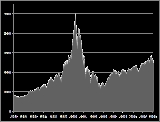
Over 1999 and early 2000, the Federal Reserve had increased interest rates six times, and the runaway economy was beginning to lose speed. The dot-com bubble burst, numerically, on March 10, 2000, when the technology heavy NASDAQ
NASDAQ

The NASDAQ is an United States stock exchange. It is the largest Electronic trading screen-based Stock trading market in the United States....
 Composite index peaked at 5,048.62 (intra-day peak 5,132.52), more than double its value just a year before. The NASDAQ fell slightly after that, but this was attributed to correction by most market analysts; the actual reversal and subsequent bear market may have been triggered by the adverse findings of fact in the United States v. Microsoft case which was being heard in federal court
United States federal courts

The United States federal courts comprises the Judiciary of government organized under the United States Constitution and Law of the United States of the federal government of the United States....
. The findings, which declared Microsoft
Microsoft

Microsoft Corporation is a multinational corporation computer technology corporation that develops, manufactures, licenses, and supports a wide range of computer software products for computing devices....
 a monopoly
Monopoly

In economics, a monopoly exists when a specific individual or enterprise has sufficient control over a particular product or service to determine significantly the terms on which other individuals shall have access to it....
, were widely expected in the weeks before their release on April 3.

One possible cause for the collapse of the NASDAQ (and all dotcoms) was massive, multi-billion dollar sell orders for major bellwether high tech stocks (Cisco
Cisco Systems

Cisco Systems, Inc. is a multinational corporation with more than 66,000 employees and annual revenue of United States dollar39 billion as of 2008....
, IBM
IBM

International Business Machines Corporation, abbreviated IBM and nicknamed "Big Blue" , is a multinational corporation computer technology and consulting corporation headquartered in Armonk, New York, New York, United States....
, Dell
Dell

Dell, Inc. is a multinational corporation technology corporation that develops, manufactures, sells, and supports personal computers and other computer-related products....
, etc.) that happened by chance to be processed simultaneously on the Monday morning following the March 10 weekend. This selling resulted in the NASDAQ opening roughly four percentage points lower on Monday March 13 from 5,038 to 4,879—the greatest percentage 'pre-market' selloff for the entire year.

The massive initial batch of sell orders processed on Monday, March 13 triggered a chain reaction of selling that fed on itself as investors, funds, and institutions liquidated positions. In just six days the NASDAQ had lost nearly nine percent, falling from roughly 5,050 on March 10 to 4,580 on March 15.

Another reason may have been accelerated business spending in preparation for the Y2K
Year 2000 problem

The Year 2000 problem was a notable computer bug resulting from the practice in early computer program design of representing the year with two digits....
 switchover. Once New Year had passed without incident, businesses found themselves with all the equipment they needed for some time, and business spending quickly declined. This correlates quite closely to the peak of U.S. stock markets. The Dow Jones
Dow Jones Industrial Average

The Dow Jones Industrial Average is one of several stock market index, created by nineteenth-century The Wall Street Journal editor and Dow Jones & Company co-founder Charles Dow....
 peaked on January 14, 2000 (closed at 11,722.98, with an intra-day peak of 11,750.28 and theoretical peak of 11,908.50) and the broader S&P 500
S&P 500

The S&P 500 is a market value-weighted index published since 1957 of the prices of 500 market capitalization common stocks actively traded in the United States....
 on March 24, 2000 (closed at 1,527.46, with an intra-day peak of 1,553.11); while, even more dramatically the UK's FTSE 100 Index
FTSE 100 Index

The FTSE 100 Index is a share index of the 100 most highly market capitalisation UK company listed on the London Stock Exchange. The index began on 3 January 1984 with a base level of 1000; the highest value reached to date is 6950.6, on 30 December 1999....
 peaked at 6,950.60 on the last day of trading in 1999 (December 30). Hiring freezes, layoffs, and consolidations followed in several industries, especially in the dot-com sector.

The bursting of the bubble may also have been related to the poor results of Internet retailers following the 1999 Christmas season. This was the first unequivocal and public evidence that the "Get Rich Quick" Internet strategy was flawed for most companies. These retailers' results were made public in March when annual and quarterly reports of public firms were released.

By 2001 the bubble was deflating at full speed. A majority of the dot-coms ceased trading after burning through their venture capital
Venture capital

Venture capital is a type of private equity capital typically provided to early-stage, high-potential, Growth investing companies in the interest of generating a return through an eventual realization event such as an IPO or mergers and acquisitions of the company....
, many having never made a net profit. Investors often jokingly referred to these failed dot-coms as either "dot-bombs" or "dot-compost".

Aftermath

On January 11, 2000, America Online, a favorite of dot-com investors and pioneer of dial-up Internet access, acquired Time Warner
Time Warner

Time Warner Inc. is the world's third largest media and entertainment Conglomerate by market capitalization , headquartered in the Time Warner Center in New York City....
, the world's largest media company. Within two years, boardroom disagreements drove out both of the CEO
Chief executive officer

A chief executive officer or chief executive is typically the highest-ranking Corporate title or Administration in charge of total management of a corporation, company, non-profit organization, or government agency, reporting to the board of directors....
s who made the deal, and in October 2003 AOL Time Warner dropped "AOL" from its name, a symbol of the dominance of old industry during periods of technological growth.

Several communication companies, burdened with unredeemable debts from their expansion projects, sold their assets for cash or filed for bankruptcy
Bankruptcy

Bankruptcy is a legally declared inability or impairment of ability of an individual or organization to pay its creditors. Creditors may file a bankruptcy petition against a debtor in an effort to recoup a portion of what they are owed or initiate a restructuring....
. WorldCom
Worldcom

Worldcom may refer to:* MCI Inc.* Worldcom Public Relations GroupExternal References:...
, the largest of these, was found to have used illegal accounting practices
Accounting scandals

Accounting scandals, or corporate accounting scandals are political scandals and corporate abuses which arise with the disclosure of misdeeds by trusted executives of large public corporations....
 to overstate its profits by billions of dollars. The company's stock crashed when these irregularities were revealed, and within days it filed the second largest corporate bankruptcy in U.S. history. Other examples include NorthPoint Communications
NorthPoint Communications

NorthPoint Communications was a CLEC , focused on data transmission rather than voice. Its business plan involved leasing copper telephone lines from local phone companies, then selling them at wholesale prices to internet service providers, which in turn sold business and residential DSL service....
, Global Crossing
Global Crossing

Global Crossing Limited is a telecommunications company that provides computer networking services worldwide. It maintains a large backbone and offers peering, VPN, leased lines, audio and video conferencing, long distance telephone, managed services, dialup, colocation and VoIP, to customers ranging from individuals to large enterprises and...
, JDS Uniphase
JDS Uniphase

JDSU is a company that designs and manufactures products for optical communications products, communications test and measurement equipment, lasers, optical solutions for authentication and decorative applications, and other custom optics....
, XO Communications
XO Communications

XO Communications is a United States telecommunications firm and one of the largest Competitive Local Exchange Carrier in the country. It is owned by XO Holdings, Inc ....
, and Covad Communications. Demand for the new high-speed infrastructure never materialized, and it became dark fiber
Dark fiber

In fiber optic communications, dark fiber or unlit fiber refers to unused fiber optic, available for use.The term was originally used when talking about the potential network capacity of telecommunication infrastructure, but now also refers to the increasingly common practice of leasing fiber optic cables from a network service provi...
, impacting companies such as Nortel
Nortel

Nortel Networks Corporation , formerly known as Northern Telecom Limited and sometimes known simply as Nortel, is a Multinational corporation telecommunications equipment manufacturing headquartered in Toronto, Ontario, Canada....
, Cisco
Cisco

Cisco may refer to:Companies:* Cisco Systems, a computer networking company* Certis CISCO, corporatised entity of the former Commercial and Industrial Security Corporation in Singapore....
 and Corning, whose stock plunged from a high of $113 to a low of $1.

Many dot-coms ran out of capital and were acquired or liquidated
Liquidation

In law, liquidation refers to the process by which a company is brought to an end, and the assets and property of the company redistributed. Liquidation can also be referred to as winding-up or dissolution , although dissolution technically refers to the last stage of liquidation....
; the domain names were picked up by old-economy competitors or domain name investors. Several companies and their executives were accused or convicted of fraud
Fraud

In the broadest sense, a fraud is a deception made for personal gain or to damage another individual. The specific legal definition varies by legal jurisdiction....
 for misusing shareholders' money, and the U.S. Securities and Exchange Commission fined top investment firms like Citigroup
Citigroup

Citigroup Inc., doing business as Citi, is a major United States financial services company based in New York City. Citigroup was formed from one of the world's largest mergers in history by combining the banking giant Citicorp and financial conglomerate Travelers Group on April 7, 1998....
 and Merrill Lynch
Merrill Lynch

Merrill Lynch & Co., Inc. is a global financial services firm which was acquired by Bank of America. This article describes both the historical Merrill Lynch and its ongoing operations as a subsidiary of the bank....
 millions of dollars for misleading investors. Various supporting industries, such as advertising and shipping, scaled back their operations as demand for their services fell. A few large dot-com companies, such as Amazon.com
Amazon.com

Amazon.com, Inc. is an American electronic commerce company in Seattle, Washington. It is America's largest online retailer, with nearly three times the internet sales revenue of runner up Staples, Inc....
 and eBay
EBay

eBay Inc. is an United States Internet company that manages eBay.com, an online auction and shopping website in which people and businesses buy and sell goods and services worldwide....
, survived the turmoil and appear assured of long-term survival.

The dot-com bubble crash wiped out $5 trillion in market value
Market capitalization

Market capitalization/capitalisation is a measurement of corporate or economic wealth equal to the share price times the number of shares outstanding of a public company....
 of technology companies from March 2000 to October 2002.

Recent research suggests, however, that as many as 50% of the dot-coms survived through 2004, reflecting two facts: the destruction of public market wealth did not necessarily correspond to firm closings, and second, that most of the dot-coms were small players who were able to weather the financial markets storm.

Nevertheless, laid-off technology experts, such as computer programmers, found a glutted job market. In the U.S., International outsourcing
Offshoring

Offshoring describes the relocation by a company of a business process from one country to another -- typically an operational process, such as manufacturing, or supporting processes, such as accounting....
 and the recently allowed increase of skilled visa "guest workers" (e.g., those participating in the U.S. H-1B visa
H-1B visa

The H-1B is a non-immigrant United States visas under the Immigration & Nationality Act, section 101. It allows U.S. employers to temporarily employ foreign workers in specialty occupations....
 program) exacerbated the situation. University degree programs for computer-related careers saw a noticeable drop in new students. Anecdotes of unemployed programmers going back to school to become accountants or lawyers were common.

Some believe the crash of the dot-com bubble contributed to the housing bubble
United States housing bubble

The United States housing bubble is an economic bubble affecting many parts of the United States real estate, including areas of California, Florida, Nevada, Arizona, Oregon, Colorado, Michigan, the BosWash, and the Southwestern United States markets....
 in the U.S. Yale economist Robert Shiller
Robert Shiller

Robert James "Bob" Shiller is an United States economist, academic, and best-selling author. He currently serves as the Arthur M. Okun Professor of Economics at Yale University and is a Fellow at the Yale International Center for Finance, Yale School of Management....
 said in 2005, “Once stocks fell, real estate became the primary outlet for the speculative frenzy that the stock market had unleashed. Where else could plungers apply their newly acquired trading talents? The materialistic display of the big house also has become a salve to bruised egos of disappointed stock investors. These days, the only thing that comes close to real estate as a national obsession is poker
Poker

Poker is a family of card game that share betting rules and usually List of poker hands. Poker games differ in how the cards are dealt, how hands may be formed, whether the high or low hand wins the pot in a showdown , limits on bets and how many rounds of betting are allowed....
.”

List of companies significant to the bubble

For discussion and a list of dot-com companies outside the scope of the dot-com bubble, see Dot-com company
Dot-com company

A dot-com company, or simply a dot-com , is a company that does most of its business on the Internet, usually through a website that uses the popular Generic top-level domain, ".com" ....
.


  • About.com
    About.com

    About.com is an online source for original information and advice,and was among the top 15 US Websites . It is written in English, and is aimed primarily at North Americans....
  • Alcatel (France)
  • AltaVista
    AltaVista

    AltaVista is an Internet search engine company , and that company's search engine product....
  • Ameritrade, now TD Ameritrade
  • Angelfire
    Angelfire

    Angelfire is an Internet venture offering free space for web sites. Angelfire also offered an online email service but this ceased operation in January 2002....
    , established in 1995, later purchased by Lycos
  • AOL
    AOL

    AOL LLC is an United States global Internet services and media company operated by Time Warner and was headquartered in Loudoun County, Virginia until late April 2008 when it was moved to new offices at 770 Broadway in New York City....
  • Amazon
    Amazon.com

    Amazon.com, Inc. is an American electronic commerce company in Seattle, Washington. It is America's largest online retailer, with nearly three times the internet sales revenue of runner up Staples, Inc....
  • Beyond.com
  • Boo.com
    Boo.com

    Boo.com was a United Kingdom Internet company founded by Swedes Ernst Malmsten, Kajsa Leander and Patrik Hedelin that famously went bust following the dot-com boom of the late 1990s....
    , spent $188 million in just six months in an attempt create a global online fashion store. Went bankrupt in May 2000.
  • Boxman AB, Pan-European online retailer of home entertainment with ambition of becoming the European amazon.com. Bankrupt in November 2000.
  • BulgariNet
  • CDNOW
    CDNOW

    CDNOW.com was among the first successful global online retailers. The company was founded in February 1994 by twin brothers Jason Olim and Matthew Olim of Ambler, Pennsylvania....
    , now owned by Amazon.com
  • Chemdex
  • Cisco Systems
    Cisco Systems

    Cisco Systems, Inc. is a multinational corporation with more than 66,000 employees and annual revenue of United States dollar39 billion as of 2008....
    , the most prominent network equipment manufacturer at the time
  • CMGI
    CMGI

    ModusLink Global Solutions, formerly CMGI Inc., is an United States technology and venture capital company, headquartered in Waltham, Massachusetts....
  • CNET
    CNET

    CNET Networks, Inc. was a mass media corporation based in San Francisco, California, United States. The company was co-founded in 1993 by Halsey Minor and Shelby Bonnie....
  • Cyberian Outpost
    Cyberian Outpost

    Cyberian Outpost was an online vendor of discount computer hardware and software, and was one of the first successful online retailers. CybOut was founded in 1994 by Darryl Peck and announced its IPO in 1998 ....
    , established in 1994, one of the first successful online retailers
  • Dell
    Dell

    Dell, Inc. is a multinational corporation technology corporation that develops, manufactures, sells, and supports personal computers and other computer-related products....
  • DoubleClick
    DoubleClick

    DoubleClick is a company that develops and provides Internet ad serving services. Its clients include agencies, marketers and publishers who service customers like Microsoft, General Motors, Coca-Cola, Motorola, L'Or?al, Palm, Inc., Visa Inc....
  • eBay
    EBay

    eBay Inc. is an United States Internet company that manages eBay.com, an online auction and shopping website in which people and businesses buy and sell goods and services worldwide....
  • e.Digital Corporation
    E.Digital Corporation

    e. Digital Corporation is a public company based in San Diego, California. Founded in 1988 as Norris Communicatons, it is one of the publicly traded companies started by inventor/entrepreneur Elwood "Woody" Norris....
    , (EDIG): OTCBB stock that went from closing price of $2.91 on 12/31/99 to intraday high of $24.50 on 1/24/00. It quickly retraced and has traded below $0.29 since 2006.
  • Enron
    Enron

    Enron Creditors Recovery Corporation was an American energy company based in Houston, Texas, Texas. Before its bankruptcy in late 2001, Enron employed approximately 22,000 and was one of the world's leading electricity, natural gas, pulp and paper, and communications companies, with claimed revenues of nearly $101 billion in 2000....
    , through EnronOnline
  • eToys
    EToys.com

    eToys.com is a retail website that sells toys via the Internet. It was established by a startup company of the same name during the dotcom boom, but the company went bankrupt towards the end of the boom, after which the site went through a number of changes of ownership, and was acquired by Toys "R" Us in February 2009....
    : share price went from the $80 reached during its IPO in May 1999 to less than $1 when it declared bankruptcy in February 2001.
  • E*TRADE
    E*TRADE

    E-Trade Financial Corporation is a financial services company based in New York City, United States. The company name is often rendered E*Trade....
  • Excite
    Excite

    Excite is an Internet Web portal, and as one of the "Dot-com companys" of the 1990s , it was once one of the most recognized brands on the Internet....
     - purchased by the ISP @Home Network
    @Home Network

    @Home Network was a high-speed Cable modem Internet service provider from 1996 to 2002. It was founded by Milo Medin, cable companies Tele-Communications Inc., Comcast, and Cox Communications, and William Randolph Hearst III, who was their first CEO, as a joint venture to produce high-speed cable Internet service through two-way television c...
    s on January 19, 1999 for $6.7 billion and changed the name to Excite@Home Networks
  • Exodus Communications
    Exodus Communications

    Exodus Communications was an Internet hosting service and Internet service provider to dot-com company. It went broke, along with its customers, during the bursting of the dot-com bubble....
  • Flooz.com
    Flooz.com

    Flooz.com was a dot-com venture, now defunct, based in New York City that went online in February 1999, promoted by comic actress Whoopi Goldberg in a series of television advertisements....
  • France Telecom
    France Télécom

    France T?l?com is the main telecommunication company in France and one of the largest in the world. It currently employs about 191,000 people and has nearly 159 million customers worldwide ....
  • Freeinternet.com
    Freei

    Freei was a free Internet Service Provider from 1998-2000. In 2000, FreeInternet.com was acquired by United Online, Inc. . In 2008, United Online re-launched FreeInternet.com as a Web site dedicated to free and discounted retail offers....
     - Filed for bankruptcy in October 2000, soon after cancelling its IPO. At the time Freeinternet.com was the fifth largest ISP
    Internet service provider

    An Internet service provider is a company that offers its customers access to the Internet. The ISP connects to its customers using a data transmission technology appropriate for delivering Internet Protocol datagrams, such as dial-up, DSL, cable modem or dedicated high-speed interconnects....
     in the United States
    United States

    The United States of America is a Federal government constitutional republic comprising U.S. state and a federal district. The country is situated mostly in central North America, where its Contiguous United States and Washington, D.C., the Capital districts and territories, lie between the Pacific Ocean and Atlantic Oceans, Borders of the U...
    , with 3.2 million users. Famous for its mascot Baby Bob
    Baby Bob

    Baby Bob was a sitcom that aired on CBS as a midseason replacement in 2002 in television. It centered around the Spencer family, and the parents and grandparents who learn that their six-month-old son, Bob, can talk....
    , the company lost $19 million in 1999 on revenues of less than $1 million.
  • GeoCities
    GeoCities

    Yahoo! GeoCities is a web hosting service founded by David Bohnett and John Rezner in late 1994 as Beverly Hills Internet .In its original form, site users selected a "city" in which to place their web pages....
    , purchased by Yahoo! for $3.57 billion in January 1999
  • GovWorks.com - the doomed dot-com featured in the documentary film
    Documentary film

    Documentary film is a broad category of visual expression that is based on the attempt, in one fashion or another, to "document" reality. Although "documentary film" originally referred to movies shot on film stock, it has subsequently expanded to include video and new media productions that can be either direct-to-video or made for a televis...
     Startup.com
    Startup.com

    Startup.com is a 2001 in film documentary film that chronicles the dot-com start-up phenomenon and its eventual end. The film follows e-commerce website govWorks.com and its founders Kaleil Isaza Tuzman and Tom Herman from 1999-2000 as the dot-com bubble was bursting....
  • Hotmail
    Hotmail

    Windows Live Hotmail, formerly known as MSN Hotmail and commonly referred to simply as Hotmail, is a free webmail service operated by Microsoft as part of its Windows Live group....
     - founder Sabeer Bhatia
    Sabeer Bhatia

    Sabeer Bhatia is the co-founder of Hotmail and an entrepreneur....
     sold the company to Microsoft
    Microsoft

    Microsoft Corporation is a multinational corporation computer technology corporation that develops, manufactures, licenses, and supports a wide range of computer software products for computing devices....
     for $400 million; at that time Hotmail had 9 million members.
  • i-drive
    I-drive

    i-drive was an online storage service founded by entrepreneur Jeff Bonforte in December 1997. It enabled creation of online space that acted as a virtual drive for 'sideloading' ? storing files such as MP3s collected on the World Wide Web without downloading them....
  • Inktomi
    Inktomi

    Inktomi Corporation was a California company that provided software for Internet service providers. It was founded in 1996 by UC Berkeley professor Eric Brewer and graduate student Paul Gauthier ....
     - stock peaked at $241 a share (split adjusted) in March 2000. The company was sold to Yahoo!
    Yahoo!

    Yahoo! Inc. is an United States public company corporation with headquarters in Sunnyvale, California, , and provides Internet services worldwide....
     in 2002 for $1.63 a share.
  • K-tel
    K-tel

    K-tel International is an "As seen on TV " company, which is most noted for its compilation music albums, such as "The Super Hits" series, "The Dynamic Hits" series and "The Number One Hits" series....
     - In 1998, the company's stock shot from about $3 in April to around $34 in early May but eventually declined to pennies by 1999.
  • Internet Capital Group
  • InfoSpace
    InfoSpace

    Infospace , a Dot-com company pioneer, provides metasearch engine and private-label web search engine services for consumers and businesses..InfoSpace's flagship metasearch sites is Dogpile; its other consumer brands are WebCrawler, MetaCrawler, and WebFetch....
     - In March 2000 this stock reached a price $1,305 per share, but by April 2001 its price had crashed down to $22 a share.
  • Kozmo.com
    Kozmo.com

    Kozmo.com was a venture-capital-driven online company that promised free one-hour delivery of anything from DVD rentals to Starbucks coffee in the United States....
    , shut down in April 2001, featured in the documentary film
    Documentary film

    Documentary film is a broad category of visual expression that is based on the attempt, in one fashion or another, to "document" reality. Although "documentary film" originally referred to movies shot on film stock, it has subsequently expanded to include video and new media productions that can be either direct-to-video or made for a televis...
     e-Dreams
    E-Dreams

    e-Dreams is a 2001 United States documentary film directed by Wonsuk Chin, portraying the rise and fall of Kozmo.com, an online convenience store that utilized bike mesengers to deliver goods ordered online within an hour....
  • Kibu.com, shut down in October 2000
  • Lastminute.com
    Lastminute.com

    lastminute.com is an online travel agency and e-tailer founded by Martha Lane Fox and Brent Hoberman in 1998 that became an icon of the UK internet boom of the late 1990s, floating at the peak of the dot com bubble....
     whose IPO on the London Stock Exchange was at the peak of the bubble
  • The Learning Company
    The Learning Company

    The Learning Company is an United States educational software company, founded in 1980. The company produced a grade-based system similar to Knowledge Adventure's JumpStart series....
    , bought by Mattel
    Mattel

    Mattel Inc. is the world's largest toy importing company based on revenue. The products it produces include Barbie dolls, Hot Wheels and Matchbox cars, American Girl dolls, board games, and, in the early 1980s, video game consoles....
     in 1999 for $3.5 billion, sold for $27.3 million in 2000
  • Lycos
    Lycos

    Lycos is a Web search engine and web portal with broadband entertainment content....
    , founded in 1995, bought by Terra Networks in 2000 for $12.5 billion, then sold to Daum Communications in 2004 for $95 million
  • mortgage.com, formerly 1st Mortgage Network spun off Mortgage Systems International (MSI). ABN Amro Mortgage Group purchased the domain, and moved National Lending Center from Ann Arbor Michigan to take over the lease in the "White Elephant" building in Sunrise Florida. ABN Amro Mortgage Group has been since purchased by CitiMortgage Group in March 2007.
  • NetApp
  • Netscape
    Netscape

    Netscape Communications is a United States computer services company, best known for its web browser. The browser was once dominant in terms of Usage share of web browsers, but lost most of that share to Internet Explorer during the browser wars....
  • Network Solutions
    Network Solutions

    Network Solutions, LLC is a technology company which was founded in 1979. The Domain name registry business has become the most important division of the company....
    , the key domain name registrar
    Domain name registrar

    A domain name registrar is a company, accredited by the Internet Corporation for Assigned Names and Numbers or by a national ccTLD authority, to register Internet domain names....
     for WWW names at the time
  • Nortel Networks, a prominent Canadian
    Canada

    Canada is a country occupying most of northern North America, extending from the Atlantic Ocean in the east to the Pacific Ocean in the west and northward into the Arctic Ocean....
     company whose shares fell from C$124 to $0.47. On Jan 14-09 it filed for bankruptcy protection, and stocks fell 75% in after-hour trading to 0.075$ a share.
  • Palm, Inc - the company's shares went from $95.06 in March 1st 2000 to $6.05 in June 2001.
  • PayPal
    PayPal

    PayPal is an e-commerce business allowing payments and money transfers to be made through the Internet. PayPal serves as an electronic alternative to traditional paper methods such as Cheque and money orders....
    , now a subsidiary of eBay
  • Pets.com
    Pets.com

    Pets.com is a former dot-com company that ceased operations in November 2000. Today it is considered a leading icon of the dot-com bubble of the early 2000s....
    , whose sock puppet mascot has been regarded as an icon in the Dot-com era.
  • Priceline.com
    Priceline.com

    Priceline.com is company that operates a commercial website that helps users obtain discount rates for travel-related items such as airline tickets and hotel stays....
  • Sun Microsystems
    Sun Microsystems

    Sun Microsystems, Inc. is a multinational corporation vendor of computers, computer components, computer software, and information technology services, founded on February 24, 1982....
    , a contributor to Internet technologies; used the corporate slogan "We Put The Dot In Dot Com"
  • Telefonica
    Telefónica

    Telef?nica, S.A., is a Spain Telephone company. Operating globally, it is one of the largest fixed-line and mobile telecommunications companies in the world: List of mobile network operators in terms of number of clients only behind China Mobile and Vodafone, and in the top five in market value....
     (Spain)
  • Thawte
    Thawte

    Thawte Consulting is a certificate authority for X.509 certificates. Thawte, , was founded in 1995 by Mark Shuttleworth in South Africa and is the second largest public CA on the Internet....
    , purchased by VeriSign for $575 million in 1999
  • theGlobe.com
    TheGlobe.com

    theGlobe.com was an startup founded in 1994 by Cornell University students Stephan Paternot and Todd Krizelman. A social networking service, theGlobe.com made headlines by going public on November 13, 1998 and posting the largest first day gain of any Initial Public Offering in history up to that date....
    , set a record for one-day share price gain (606%) on its IPO, hitting $97; shares now trade for less than a cent
  • Think Tools AG
    Think Tools AG

    Think Tools AG was a Swiss IT company that characterized the dot com bubble in Europe.The company was founded by the philosopher Albrecht von M?ller as a consultancy company in 1993....
    , one of the most extreme symptoms of the bubble in Europe: market valuation of CHF 2.5 billion in March 2000, no prospects of having a substantial product (investor deception), followed by a collapse.
  • Travelocity
    Travelocity

    Travelocity is an online travel agency. Travelocity is a wholly owned subsidiary of Sabre Holdings Corporation, which was a publicly traded company until taken private company by Silver Lake Partners and Texas Pacific Group in March 2007....
  • Tripod.com
    Tripod.com

    Tripod.com is a web hosting service now owned by Lycos. Originally a company aimed at offering services to college students and young adults, it was one of several sites trying to build Virtual community during the dot-com bubble....
  • VeriSign
    VeriSign

    VeriSign, Inc. is an United States company based in Mountain View, California that operates a diverse array of network infrastructure, including two of the Internet's thirteen root nameservers, the generic top-level domains for .com and .net, one of the largest Signaling System 7 signaling networks in North America, and the RFID directory fo...
    , which went from a high of $258.50 in March 2000 to a low of $65.38 in December 2000
  • Webvan
    Webvan

    File:Webvan.jpgWebvan was an dot-com "credit and delivery" grocery business that went bankrupt in 2001. It was headquartered in Foster City, California, USA, near Silicon Valley....
    : This grocery delivery service spent too much on infrastructure (close to $1 billion) before it had even turned a profit. Went bankrupt in 2001.
  • WorldCom
    Worldcom

    Worldcom may refer to:* MCI Inc.* Worldcom Public Relations GroupExternal References:...
    , at one time controlled a majority of U.S. Internet backbone, through acquisition of UUNet
    UUNET

    UUNET was one of the largest Internet Service Provider and one of the nine Tier 1 networks. It was based in Northern Virginia and was the first commercial Internet service provider....
     and MCI
    MCI Inc.

    MCI, Inc. is an United States telecommunications company that is headquartered in Ashburn, Virginia. The corporation was the result of the merger of WorldCom and MCI Communications, and used the name MCI WorldCom followed by WorldCom before taking its final name on April 14, 2003 as part of the corporation's emergence f...
    ; acquired by Verizon after financial scandal
  • Xcelera.com, a Swedish
    Sweden

    Sweden , officially the Kingdom of Sweden , is a Nordic countries on the Scandinavian Peninsula in Northern Europe. Sweden has land borders with Norway to the west and Finland to the northeast, and it is connected to Denmark by the ?resund Bridge in the south....
     investor in start-up technology firms.
  • Yahoo!
    Yahoo!

    Yahoo! Inc. is an United States public company corporation with headquarters in Sunnyvale, California, , and provides Internet services worldwide....
    : Went from high of $128 at the peak of bubble to $4 at the end of the bubble.


See also


Terminology

  • Bankruptcy
    Bankruptcy

    Bankruptcy is a legally declared inability or impairment of ability of an individual or organization to pay its creditors. Creditors may file a bankruptcy petition against a debtor in an effort to recoup a portion of what they are owed or initiate a restructuring....
  • Digital Revolution
  • E-commerce
  • Irrational exuberance
  • The Long Tail
    The Long Tail

    The phrase The Long Tail was first coined by Chris Anderson in an October 2004 Wired magazine article to describe the niche strategy of businesses, such as Amazon.com or Netflix, that sell a large number of unique items, each in relatively small quantities....
  • The South Sea Company
    The South Sea Company

    The South Sea Company was a Kingdom of Great Britain joint stock company that traded in South America during the 18th century. Founded in 1711, the company was granted a monopoly to trade in Spain's Spanish colonization of the Americas as part of a treaty during the War of Spanish Succession....
  • Stock market boom
  • Spin-off
    Spin-off

    A spin-off is a new organization or entity formed by a split from a larger one, such as a television series based on a pre-existing one, or a new company formed from a university research group or business incubator....
  • Stock market bubble
    Stock market bubble

    A stock market bubble is a type of economic bubble taking place in stock markets when price of stocks rise and become overvalued by any measure of stock valuation....
  • Tulip mania
    Tulip mania

    Tulip mania or tulipomania was a period in the Dutch Golden Age during which contract prices for bulbs of the newly-introduced tulip reached extraordinarily high levels and then suddenly collapsed....
  • Techno-utopianism
    Techno-utopianism

    Technological utopianism refers to any ideology based on the belief that advances in science and technology will eventually bring about a utopia, or at least help to fulfill one or another utopian ideal....
  • Technology hype
  • Web 2.0
    Web 2.0

    The term "Web 2.0" refers to a perceived second generation of web development and web design, that aims to facilitate communication, secure information sharing, interoperability, and collaboration on the World Wide Web....
  • Dark Fiber
    Dark fiber

    In fiber optic communications, dark fiber or unlit fiber refers to unused fiber optic, available for use.The term was originally used when talking about the potential network capacity of telecommunication infrastructure, but now also refers to the increasingly common practice of leasing fiber optic cables from a network service provi...

Media

  • e-Dreams
    E-Dreams

    e-Dreams is a 2001 United States documentary film directed by Wonsuk Chin, portraying the rise and fall of Kozmo.com, an online convenience store that utilized bike mesengers to deliver goods ordered online within an hour....
  • SatireWire
    SatireWire

    From 1999 to 2002, SatireWire was one of the most popular news satire websites on the Internet. Based in Connecticut and founded by Andrew Marlatt, the site aimed its satire at politics, business, the Mass media, and current events, and spawned Marlatt's 2002 book Economy of Errors , which was a parody of the rise and fall of the Internet...
  • Startup.com
    Startup.com

    Startup.com is a 2001 in film documentary film that chronicles the dot-com start-up phenomenon and its eventual end. The film follows e-commerce website govWorks.com and its founders Kaleil Isaza Tuzman and Tom Herman from 1999-2000 as the dot-com bubble was bursting....


Venture Capital


Further reading

  • Cassidy, John. Dot.con: How America Lost its Mind and Its Money in the Internet Era (2002)
  • Daisey, Mike. 21 Dog Years Free Press. ISBN 0-7432-2580-5.
  • Goldfarb, Brent D., Kirsch, David and Miller, David A., "Was There Too Little Entry During the Dot Com Era?" (April 24, 2006). Robert H. Smith School Research Paper No. RHS 06-029 Available at SSRN: http://ssrn.com/abstract=899100
  • Kindleberger, Charles P., Manias, Panics, and Crashes: A History of Financial Crises (Wiley, 2005, 5th edition)
  • Kuo, David dot.bomb: My Days and Nights at an Internet Goliath ISBN 0-316-60005-9 (2001)
  • Lowenstein, Roger. Origins of the Crash: The Great Bubble and Its Undoing. (Penguin Books, 2004) ISBN 0-14-303467-7
  • Wolff, Michael
    Michael Wolff (journalist)

    Michael Wolff is an United States journalist, specializing in writing about the Media in New York City. Wolff is a frequent magazine article writer....
    . Burn Rate: How I Survived the Gold Rush Years on the Internet
    Burn Rate (book)

    Burn Rate: How I Survived the Gold Rush Years on the Internet, by Michael Wolff is the account of Wolff's Dot-com company company, Wolff New Media, in 1997....


External links

  • - CNet's list of ten most notable failed dot-com companies
  • Silicon Follies (ISBN 0-7434-1121-8) - Dot-com lifestyles
  • - documentary of a failing company.
  • - BBC article, 13 March 2001.