
All Topics  
Firecracker

 
Firecracker

   Email Print
   Bookmark   Link


Firecracker


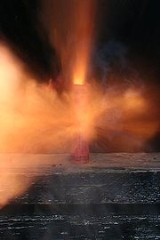
A firecracker (also known as a cracker, noise maker, banger or bunger) is a small explosive device primarily designed to produce a large amount of noise, especially in the form of a loud bang; any visual effect is incidental to this goal. They have fuses, and are wrapped in a heavy paper casing, to contain the explosive compound. Firecrackers, along with fireworks
Fireworks

A firework is classified as a low explosive material pyrotechnics device used primarily for aesthetic and entertainment purposes. The most common use of a firework is as part of a fireworks display....
 originated in China
China

China is a Culture of China, an ancient civilization, and, depending on perspective, a national or multinational entity extending over a large area in East Asia....
.

crackers are commonly used in celebration of holidays or festivals, such as Shab-e-Barat In Pakistan, Halloween
Halloween

Halloween is a holiday celebrated on October 31. It has roots in the Celtic mythology of Samhain and the Christian holy day of All Saints. It is largely a Secularity celebration, but some Christians and Paganism have expressed strong feelings about its religious overtones....
, Independence Day
Independence Day (United States)

In the United States, Independence Day, commonly known as the Fourth of July, is a federal holiday commemorating the adoption of the United States Declaration of Independence on July 4, 1776, declaring independence from the Kingdom of Great Britain....
 in the United States of America, Diwali
Diwali

Diwali is a significant festival in Hinduism, Sikhism, Buddhism, and Jainism, and an official holiday in India. Adherents of these religions celebrate Diwali as the Festival of Lights....
 in India
India

India, officially the Republic of India , is a country in South Asia. It is the List of countries and outlying territories by total area country by geographical area, the List of countries by population country, and the most populous liberal democracy in the world....
, Hari Raya in Malaysia
Malaysia

Malaysia is a federation that consists of States of Malaysia in Southeast Asia with a total landmass of . The capital city is Kuala Lumpur, while Putrajaya is the seat of the federal government....
, and especially the celebration of Chinese New Year
Chinese New Year

Chinese New Year or Spring Festival is the most important of the traditional Chinese holidays. It is often called the Lunar New Year, especially by people in mainland China and Taiwan....
 by Chinese communities around the world and Spanish Fallas.


Discussion
Ask a question about 'Firecracker'
Start a new discussion about 'Firecracker'
Answer questions from other users
Full Discussion Forum


Encyclopedia


A firecracker (also known as a cracker, noise maker, banger or bunger) is a small explosive device primarily designed to produce a large amount of noise, especially in the form of a loud bang; any visual effect is incidental to this goal. They have fuses, and are wrapped in a heavy paper casing, to contain the explosive compound. Firecrackers, along with fireworks
Fireworks

A firework is classified as a low explosive material pyrotechnics device used primarily for aesthetic and entertainment purposes. The most common use of a firework is as part of a fireworks display....
 originated in China
China

China is a Culture of China, an ancient civilization, and, depending on perspective, a national or multinational entity extending over a large area in East Asia....
.

Culture

Lewes Bonfire, Lbbs, Banger Blitz
Firecrackers are commonly used in celebration of holidays or festivals, such as Shab-e-Barat In Pakistan, Halloween
Halloween

Halloween is a holiday celebrated on October 31. It has roots in the Celtic mythology of Samhain and the Christian holy day of All Saints. It is largely a Secularity celebration, but some Christians and Paganism have expressed strong feelings about its religious overtones....
, Independence Day
Independence Day (United States)

In the United States, Independence Day, commonly known as the Fourth of July, is a federal holiday commemorating the adoption of the United States Declaration of Independence on July 4, 1776, declaring independence from the Kingdom of Great Britain....
 in the United States of America, Diwali
Diwali

Diwali is a significant festival in Hinduism, Sikhism, Buddhism, and Jainism, and an official holiday in India. Adherents of these religions celebrate Diwali as the Festival of Lights....
 in India
India

India, officially the Republic of India , is a country in South Asia. It is the List of countries and outlying territories by total area country by geographical area, the List of countries by population country, and the most populous liberal democracy in the world....
, Hari Raya in Malaysia
Malaysia

Malaysia is a federation that consists of States of Malaysia in Southeast Asia with a total landmass of . The capital city is Kuala Lumpur, while Putrajaya is the seat of the federal government....
, and especially the celebration of Chinese New Year
Chinese New Year

Chinese New Year or Spring Festival is the most important of the traditional Chinese holidays. It is often called the Lunar New Year, especially by people in mainland China and Taiwan....
 by Chinese communities around the world and Spanish Fallas. Firecrackers were also used by the Vietnamese during their T?t
T?t

T?t Nguy?n ??n , more commonly known by its shortened name T?t, is the most important and popular Holidays in Vietnam and festival in Vietnam....
 festival especially at midnight Giao Th?a (New Year's Eve).

Legality of firecrackers

Firecrackers, as well as other types of explosives, in United States are subject to various laws, depending on location. Firecrackers themselves are not considered illegal contraband material. It is the sale, possession, and use of firecrackers that are subject to laws. Some states or local governments require a permit to legally sell, possess, or use firecrackers; sometimes with different permits for different actions, e.g., a permit required to sell, with a separate permit required to use. Prior to December 6, 1976, the legal limit in the United States for firecrackers was a maximum of 2 grains of blackpowder (130 mg); after this date, the legal limit in the United States was reduced to 50 mg (0.77 grains) of flash powder.

Virtually all firecrackers are scientifically classed as "low explosives" which burn through deflagration
Deflagration

Deflagration is a technical term describing subsonic combustion that usually propagates through thermal conductivity . Most "fire" found in daily life, from flames to explosions, is technically deflagration....
, as opposed to "high explosives" such as dynamite
Dynamite

Dynamite is an Explosive material based on the explosive potential of nitroglycerin, initially using diatomaceous earth or another absorbent substance such as sawdust as an adsorbent....
 and ANFO
ANFO

ANFO is a widely used explosive mixture. The oil used is most often Heating oil, or diesel fuel, but sometimes kerosene, coal dust, or even molasses....
 which actually produce a supersonic
Supersonic

The term supersonic is used to define a speed that is over the speed of sound . At a typical temperature like 21 ?C , the threshold value required for an object to be traveling at a supersonic speed is approximately 344 metre per second, ....
 detonation
Detonation

Detonation is a process of combustion in which a supersonic shock wave is propagated through a fluid due to an energy release in a reaction zone....
 wave. Some legal definitions nevertheless define banned firecrackers (such as the M-80
M-80 (explosive)

M-80s are a class of large firecrackers, sometimes called Salute . M-80s were originally made in the early 20th century by the Military of the United States to simulate bombs; later, they were manufactured as fireworks....
 in the United States
United States

The United States of America is a Federal government constitutional republic comprising U.S. state and a federal district. The country is situated mostly in central North America, where its Contiguous United States and Washington, D.C., the Capital districts and territories, lie between the Pacific Ocean and Atlantic Oceans, Borders of the U...
) as "Class B Explosives" which requires their storage in an explosives magazine and an ATF high explosives license for their manufacture.

The legal status of firecrackers typically stems from their notable effect on noise pollution
Noise pollution

Noise pollution is displeasing human-, animal- or machine-created sound that disrupts the activity or balance of human or animal life. A common form of noise pollution is from transportation, principally motor vehicles....
 as well as the issue of their safety
Safety

Safety is the state of being "safe" , the condition of being protected against physical, social, spiritual, financial, political, emotional, occupational, psychological, educational or other types or consequences of failure, damage, error, accidents, harm or any other event which could be considered non-desirable....
, especially when used by children. Devices which are designed to explode at ground level are seen as more dangerous than those with a prolonged burn time and/or an aerial explosion. Proponents of firecracker sales sometimes question the consistency of these laws, pointing out that legal fireworks can also be dangerous due to the risk of high-temperature burns
Burn (injury)

A burn is a type of injury that may be caused by heat, Temperature, electricity, chemicals, light, radiation, or friction. Burns can be highly variable in terms of the tissue affected, the severity, and resultant complications....
 (as in the case of sparklers), and that projectile fireworks intended for aerial use can often legally incorporate a noise making explosive device as a last stage.

In Malaysia
Malaysia

Malaysia is a federation that consists of States of Malaysia in Southeast Asia with a total landmass of . The capital city is Kuala Lumpur, while Putrajaya is the seat of the federal government....
, playing with firecrackers is now illegal as stated from Malaysian Explosive Act which was revised in 1991 as a result of the increasing injuries among children (especially Malay) during Hari Raya festive season. Ironically, the injury cases caused by playing firecrackers continue to increase every year since Malay children turned to home-made firecrackers such as bamboo cannon
Bamboo cannon

Meriam buluh or bamboo cannon is a type of home-made firecracker which is popular during the Hari Raya festive season in Malaysia, and during the New Year's day celebration in the Philippines....
s as alternatives to commercial fireworks.

In the Republic of Ireland
Republic of Ireland

Ireland is an Island country in north-western Europe. The modern Sovereignty state occupies about five-sixths of the island of Ireland, which was partitioned by the British on 3 May 1921....
, firecrackers (commonly called "bangers") are illegal, but they are easily smuggled across the border with Northern Ireland
Northern Ireland

conventional_long_name = Northern Ireland|native_name= Tuaisceart ?ireannNorlin Airlann|motto =|image_map = Europe location N-IRL2.png...
 in the weeks leading up to Hallowe'en.

In Sweden
Sweden

Sweden , officially the Kingdom of Sweden , is a Nordic countries on the Scandinavian Peninsula in Northern Europe. Sweden has land borders with Norway to the west and Finland to the northeast, and it is connected to Denmark by the ?resund Bridge in the south....
, firecrackers became completely illegal December 1st, 2000.

In Singapore
Singapore

Singapore , officially the Republic of Singapore, is an island country microstate located at the southern tip of the Malay Peninsula. It lies 137 kilometres north of the equator, south of the Malaysian state of Johor and north of Indonesia's Riau Islands....
, a partial ban on firecrackers was imposed in March 1970 after a fire killed six people and injured 68. This was extended to a total ban in August 1972, after an explosion that killed two people and an attack on two police officers attempting to stop a group from letting off firecrackers in February 1972. However, in 2003, the government
Government of Singapore

File:Singov top 02.pngThe Government of Singapore is formed by the political party which gains a simple majority in the general elections held in Singapore at least once every five years....
 allowed firecrackers to be set off during the festive season. At the Chinese New Year light-up in Chinatown
Chinatown, Singapore

Singapore's Chinatown is an Culture of Singapore featuring distinctly Chinese culture cultural elements and a historically concentrated overseas Chinese....
, at the stroke of midnight on the first day of the Lunar New Year, firecrackers are set off under controlled conditions by the Singapore Tourism Board
Singapore Tourism Board

The Singapore Tourism Board is a Statutory boards of the Singapore Government under the Ministry of Trade and Industry of Singapore, tasked to promote the country's tourism industry....
. Other occasions where firecrackers are allowed to be set off are determined by the tourism board
Singapore Tourism Board

The Singapore Tourism Board is a Statutory boards of the Singapore Government under the Ministry of Trade and Industry of Singapore, tasked to promote the country's tourism industry....
 or other government organizations. However, they are not allowed to be commercially sold.

Some firecrackers are legal but restrictions are in place regarding the amount of powder they contain. Some examples are: Wolf Pack FireCrackers, Black Cat FireCrackers, China Town FireCrackers, Hydro FireCrackers, and the Wolf Pack Cannon Ball FireCrackers.

It is obvious that the increased reports of injuries in modern time correlate closely with the use of modern powders for bigger, brighter explosions in firecrackers, and consequently, much more dangerous to the unwary users. (see below : Traditional Chinese firecrackers (AKA Mandarin firecrackers-Mandarin crackers produced a dimmer, less brilliant flash when they exploded). For thousand of years, firecrackers with original black powder had negligible injurious potential. Regrettably, the relentless push of marketing and competition ultimately resulted in a powerful explosive dangerous product, and the thus complete ban of the use of firecrackers by the general public in many countries. Other common excuses the governments cited for banning firecrackers use by the public includes air pollution and waste of money are false and politically motivated. Government-sanctioned public displays of fireworks cost millions of dollars, and the resultant level of air pollution contribution is not much different from the spread-out use of the public during the festive periods. Perhaps, they can justify the ban on the argument that they save money for all by using the tax payers' money already contributed, instead of the lay public burning money out of their pockets.

Novelty noise makers


  • The "party popper" is a plastic tube with a small explosive charge wrapped around a fuse which when pulled causes a loud bang and ejects streamers or confetti.
  • The "snapper" is a few grains of sand covered in AgONC (impact-sensitive silver fulminate) held inside a bit of tissue. When thrown on the ground the AgONC reacts to the impact causing a small bang.


In general Novelty Noise Makers are not true firecrackers/fireworks because of the lack of danger or flame, and are legal in many places where fireworks and firecrackers are illegal.

Firecracker brands, packs and labels

Early (pre-1920s) Chinese firecrackers (AKA Mandarin firecrackers) were typically 1/2-inch to 2-inches long, and approximately 1/4-inch in diameter, and were charged with black powder. Mandarin crackers produced a less loud, duller thud when they exploded, compared to modern flash light crackers (which utilize a different explosive composition known as flash powder
Flash powder

Flash powder is pyrotechnic composition, a mixture of oxidizer and metallic fuel which burns quickly and if confined will produce a loud report....
). Mandarin crackers produced a dimmer, less brilliant flash when they exploded also. Individual Mandarin crackers were most often braided into "strings" of varying lengths, which, when set afire, would explode in rapid sequence. Generally, the strings (sometimes containing as many as several thousand crackers) would be hung from an overhead line or high hook before being ignited. Most Mandarin crackers were coloured all red and did not generally have designs or logos decorating their exterior surface (AKA a "shell wraps"). Occasionally a few yellow and green Mandarin crackers were created and would be braided into the predominantly all red strings, to symbolized the emperor and the ruling class, while the numerous red crackers symbolized the common man.

Once flash powder, which produces a significantly sharper and brighter bang, replaced black powder as a firecracker's explosive charge (in approx. 1924) manufacturers began competing to gain the purchasing loyalty of the consuming public (i.e., mainly boys 8-16 years of age). Literally thousands of brands were created during the flash light cracker's heyday period from the 1920s through the early 1970s. Only a small percentage of brands lasted more than a year or two. Nowadays, collectors actively seek out examples of the various labels which contained the brand name and image associated with that brand.

Until very recently (i.e., mid 1980s) firecracker production was a low-tech process. They were entirely handmade, beginning with the operation of rolling thin tubes. Once the firecracker tubes were rolled by hand (most commonly from newspaper) and labelled, and then filled with powder, their ends were crimped and fuses inserted... all by hand. These finished firecrackers were usually braided into "strings" and sold in packs which came in many sizes... from the very small (called "penny packs" containing as few as 4 to 6 firecrackers) to the most common size packs (containing 16 and 20 crackers per pack), to larger packs (containing 24, 30, 32, 40, 50, 60, 72, 90, 100 and 120 firecrackers), to huge "belts" and "rolls" (firecracker packages which contained strings of several hundred to several thousand crackers each). Firecracker packages were typically wrapped in colourful and translucent glassine
Glassine

File:Glassine-276541485 d2efaa4c1a b.jpgGlassine is a very thin and smooth type of paper which is air resistance and water resistance. It is generally translucent unless dyes are added to color the paper or make it Opacity ....
 paper, as well as clear cellophane. Glassine was the most popular, however.

The final packaging operation involved applying a branded pack label on each and every pack and then bundling quantities of finished packs into larger wholesale lots called "bricks" which contained an average of 80 packs each (varying according to the size of the packs being bundled. For example, packs of 32 crackers might only have 40 packs to the brick, compared to packs of 16 or 20 which would have 80 packs to the brick.

Collecting

Some fireworks enthusiasts like to collect firecrackers or firecracker labels. Below is a scale to grade the condition of firecrackers, as this is an important factor used in determining their level of collectability.

Condition-Grading Scale (G/S)

  • 10 (Mint) Factory fresh condition, looks as if just made
  • 9 (Excellent) Close to Mint, with possible minor flaws or wear
  • 8 (Very Good) Minor flaws and wear with possible fading
  • 7 (Good) Acceptable but with noticeable flaws, wear or fading
  • 6 (Fair) Acceptable only as a representation, has distracting flaws, wear, fading
  • 5 (Poor) Unacceptable Condition with extreme flaws, wear or fading


(Flaws may include: Tears, rips, holes, missing pieces, water damaged, powder damaged, price or writing on label, factory stained or blurred graphics, crooked & offset labels, taped, repaired, etc.)

Classifications

  • Class 1 (Pre-1950) "Made in China" is printed on the pack or label. No cautions or warnings will appear. Some Class 1 Packs and Labels may say "Made in Hong Kong" or "Made in Canton".
  • Class 2 (1950-1954) "Made in Macau" is now printed on the pack or label. Still no cautions or warnings will appear on the Pack or Label. Some Class 2 Packs and Labels may say "Made in Portuguese Macau".
  • Class 3 (1955-1968) "Made in Macau" again is printed on these packs and labels They are distinguished by a small box with the words "ICC" or "ICC Class C" on them. Once again no cautions or warnings.
  • Class 4 (1969-1972) "Made in Macau" once again is printed plus the "ICC" or "ICC Class C" designation on them but it will also have the words "Caution: Explosive" with the warning; "Lay on Ground, Light fuse get away. Use under Adult Supervision"
  • Class 5 (1973-1976) "DOT Class C" Common Fireworks is now printed on the Pack or label also with the "Caution: Explosive" etc. Warning on them. Class 5 may say "Made or Repacked in Macau" but usually "Made In China" .
  • Class 6 (1977-1994) Similar to Class 5 "DOT Class C" with the addition of the words "Contains less than 50mg. Flash Powder". It also has the "Caution: Explosive" etc.. Warning. Class 6 will have "Made in China" printed on them.
  • Class 7 (1995-present) These firecrackers are those currently being made today. Packs and labels of this class have the words "UN 0336 1.4G Consumer Fireworks" Now "Warning: Explosive" etc.. appears, again "Made in China".


There are a few exceptions to the aforementioned guidelines, some Firecrackers in class 5, 6, & 7 may say "Made in China" like Class 1, but have the cautions/warnings, etc. Firecrackers larger than 1 1/2", or made for other countries may not conform to the above guidelines).

See also

  • Block Buster firework
  • Salute (pyrotechnics)
    Salute (pyrotechnics)

    In pyrotechnics a salute is a device primarily designed to make a loud report , rather than have a visual effect. Most salutes will also have a very bright flash and may have titanium added for a cloud of sparks The salute may be fired on the ground or launched from a mortar as a shell ....
  • Squib
    Squib

    Squib may refer to:*Squib , a small explosive*Squib load, a firearms malfunction in which a bullet becomes lodged in the barrel*Squib , a short article that is intended to ignite thinking and discourse...
  • Superstring (fireworks)
    Superstring (fireworks)

    A superstring, also known as a cracker wall, is a name commonly given to an immense bundle of firecrackers, usually numbering in the hundreds of thousands, which are often a central fixture at fireworks conventions....


External links