


Electronic Road Pricing

Encyclopedia
Electronic toll collection
Electronic toll collection , an adaptation of military "identification friend or foe" technology, aims to eliminate the delay on toll roads by collecting tolls electronically. It is thus a technological implementation of a road pricing concept...
scheme adopted in Singapore
Singapore
Singapore , officially the Republic of Singapore, is a Southeast Asian city-state off the southern tip of the Malay Peninsula, north of the equator. An island country made up of 63 islands, it is separated from Malaysia by the Straits of Johor to its north and from Indonesia's Riau Islands by the...
to manage traffic by road pricing
Road pricing
Road pricing is an economic concept regarding the various direct charges applied for the use of roads. The road charges includes fuel taxes, licence fees, parking taxes, tolls, and congestion charges, including those which may vary by time of day, by the specific road, or by the specific vehicle...
, and as a usage-based taxation mechanism to complement the purchase-based Certificate of Entitlement
Certificate of Entitlement
The Certificate of Entitlement , instituted by the government of Singapore since May 1990, is a program designed to limit car ownership and hence the number of vehicles on the country's roads...
system. The ERP was implemented by the Land Transport Authority
Land Transport Authority
The Land Transport Authority is a statutory board under the Ministry of Transport of the Singapore Government.-History:...
in September 1998 to replace the Singapore Area Licensing Scheme
Singapore Area Licensing Scheme
The Singapore Area Licensing Scheme , introduced in 1975, charged drivers entering downtown Singapore, and thereby aimed to manage traffic demand. This was the first urban traffic congestion pricing scheme to be successfully implemented in the world...
after successfully stress-testing the system with vehicles running at high speed. Singapore was the first city in the world to implement an electronic road toll collection system for purposes of congestion pricing
Congestion pricing
Congestion pricing or congestion charges is a system of surcharging users of a transport network in periods of peak demand to reduce traffic congestion. Examples include some toll-like road pricing fees, and higher peak charges for utilities, public transport and slots in canals and airports...
.
The system
The scheme consists of ERP gantries located at all roads linking into Singapore's central business districtCentral business district
A central business district is the commercial and often geographic heart of a city. In North America this part of a city is commonly referred to as "downtown" or "city center"...
- areas within the Central Area
Central Area
In Singapore, the Central Area or Central Business District contains the core financial and commercial districts, including eleven urban planning areas, namely Downtown Core, Marina East, Marina South, Museum, Newton, Orchard, Outram, River Valley, Rochor, Singapore River and Straits View as...
such as the Downtown Core
Downtown Core
The Downtown Core is a 266-hectare urban planning area in the south of the city-state of Singapore. The Downtown Core surrounds the mouth of the Singapore River and southeastern portion of its watershed, and is part of the Central Area, Singapore's central business district...
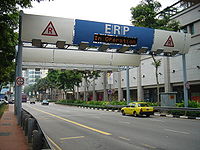
. They are also located along the expressways and arterial roads with heavy traffic to discourage usage during peak hours. The gantry system is actually a system of sensors on 2 gantries, one in front of the other. Cameras are also attached to the gantries to capture the rear license plate numbers of vehicles. Currently, there are 80 ERP gantries in Singapore. New gantries are implemented where congestion is severe, like expressways and other roads.
A device known as an In-vehicle Unit (IU) is affixed on the lower right corner of the front windscreen within sight of the driver, in which a stored-value card
Stored-value card
A stored-value card refers to monetary value on a card not in an externally recorded account and differs from prepaid cards where money is on deposit with the issuer similar to a debit card...
, the CashCard, is inserted for payment of the road usage charges. The second generation IU accepts Contactless NETS CashCard and EZ-Link
EZ-Link
The EZ-Link card is a contactless smart card based on the Sony FeliCa smartcard technology and used for the payment of public transportation fares in Singapore, with limited use in the small payments retail sector...
. The cost of an IU is S$150. It is mandatory for all Singapore-registered vehicles to be fitted with an IU if they wish to use the priced roads.
Mitsubishi Heavy Industries Ltd
Mitsubishi Heavy Industries
, or MHI, is a Japanese company. It is one of the core companies of Mitsubishi Group.-History:In 1870 Yataro Iwasaki, the founder of Mitsubishi took a lease of Government-owned Nagasaki Shipyard. He named it Nagasaki Shipyard & Machinery Works, and started the shipbuilding business on a full scale...
sold the IU technology to Singapore, and the project was spearheaded by a Consortium comprising Philips Singapore Pte Ltd, Mitsubishi Heavy Industries Ltd, Miyoshi Electronic Corporation and CEI Systems and Engineering (now known as CSE Global Ltd) in 1995 through an open tender.
When a vehicle equipped with an IU passes under an ERP gantry, a road usage charge is deducted from the CashCard in the IU. Sensors installed on the gantries communicate with the IU via a dedicated short-range communication system, and the deducted amount is displayed to the driver on an LCD screen of the IU.
The charge passing through a gantry depends on the location and time, the peak hour being the most expensive. Examples include a trip from Woodlands to Raffles Place via Yishun - CTE - CBD will cost about $15 during peak as the driver will pass about 5 gantries whereas during lunchtime, it cost about S$2. Foreigners driving foreign-registered cars on priced roads, during the ERP operating hours, could choose to either rent an IU or pay a daily flat fee of S$5 when leaving Singapore.
If a vehicle owner does not have sufficient value in their CashCard (or EZ-Link) when passing through an ERP, the owner receives a fine by post within two weeks. The violator must pay the ERP charges plus a $10 administration fee within two weeks of the notice. Online payment is allowed; listing just the Vehicle Registration Number is required. Otherwise, a penalty of S$70 is issued by registered post to the vehicle owner, which rises to S$1000, or one month in jail, if not settled within 30 days.
Improvements and adaptations
According to a paper presented in the World Roads Conference 2006, the Land Transport AuthorityLand Transport Authority
The Land Transport Authority is a statutory board under the Ministry of Transport of the Singapore Government.-History:...
has been testing a system based on the Global Positioning System
Global Positioning System
The Global Positioning System is a space-based global navigation satellite system that provides location and time information in all weather, anywhere on or near the Earth, where there is an unobstructed line of sight to four or more GPS satellites...
that may eventually replace the current Electronic Road Pricing system. The proposed system overcomes the inflexibility of having physical gantries, which "are not so flexible when it comes to re-locating them".
A lightweight version of this same technology is implemented for use on parking
Parking
Parking is the act of stopping a vehicle and leaving it unoccupied for more than a brief time. Parking on one or both sides of a road is commonly permitted, though often with restrictions...
, known as the Electronic Parking System (EPS). It has since been adopted in favour by several carpark operators, superseding the use of autopay tickets or parking coupons. These systems have also typically switched to charging by the minute.
Impact
The ERP system, although understandably unpopular among most road users, has helped to tweak road usage patterns since its implementation. The LTA reported that road traffic decreased by nearly 25,000 vehicles during peak hours, with average road speeds increasing by about 20%. Within the restricted zone itself, traffic has gone down by about 13% during ERP operational hours, with vehicle numbers dropping from 270,000 to 235,000. It has been observed that car-pooling has increased, while the hours of peak vehicular traffic has also gradually eased and spread into off-peak hours, suggesting a more productive use of road space. In addition, it has been noted that average road speeds for expressways and major roads remained the same, despite rising traffic volumes over the years.The system has its share of problems. Road users pointed out that the implementation of an ERP gantry along any road simply moves the traffic somewhere else, potentially causing traffic bottlenecks along smaller roads. For example, the ERP gantry along the Central Expressway
Central Expressway, Singapore
The Central Expressway in Singapore is the major highway connecting the city centre of Singapore with the northern residential parts of the island, including Toa Payoh, Bishan and Ang Mo Kio and further onwards to the Seletar Expressway and the Tampines Expressway.-History:The first stage of the...
(CTE) has been said to have caused traffic to increase substantially in north-south trunk roads, such as along the Thomson Road
Thomson Road, Singapore
Thomson Road is a major trunk road linking Singapore's central business district with the northern suburban areas. Taking its name from John Turnbull Thomson, a Scotsman who was the Government Surveyor and Chief Engineer of the Straits Settlements from 1841 to 1853 and who helped build many roads...
and Serangoon Road
Serangoon Road
Serangoon Road is a road from Little India to Boon Keng of Singapore . There is another road, from Woodsville Interchange to Sengkang called Upper Serangoon Road.Another way is via Jalan Besar and Bendemeer Road....
corridors. The rising traffic prompted the LTA to add a gantry along Thomson Road, while Upper Serangoon Road's capacity was increased somewhat with the building of a new viaduct
Viaduct
A viaduct is a bridge composed of several small spans. The term viaduct is derived from the Latin via for road and ducere to lead something. However, the Ancient Romans did not use that term per se; it is a modern derivation from an analogy with aqueduct. Like the Roman aqueducts, many early...
. Similarly, the ERP gantry on the East Coast Parkway
East Coast Parkway
The East Coast Parkway is an expressway that runs along the southeastern coast of Singapore. The expressway is approximately in length, and connects Singapore Changi Airport in the east to the Benjamin Sheares Bridge in the south of the main island before it links with the Ayer Rajah Expressway...
's west-bound carriageway was said to have led to increased traffic on Geylang Road
Geylang Road
Geylang Road is a major trunk road linking Singapore's central business district with the eastern suburban areas. Deriving its name from the area of Geylang where the road cuts through, it is fronted on both sides by low-rise shophouses protected statutorily from urban redevelopment in keeping...
and Nicoll Highway
Nicoll Highway
Nicoll Highway is a major arterial road in Singapore which links Kallang to the city. En route, it passes through the areas of Kallang, Kampong Glam and Marina Centre....
, where ERP gantries were also placed subsequently. This "chasing after the jam" phenomena has led the general public to question its effectiveness.
While ERP gantries on major roads and expressways have usually been implemented on the carriageway which is city-bound, major traffic congestion on the north-bound carriageway of the CTE has led to the LTA considering its implementation there, a suggestion which has been met with protests by motorists who questioned the need to pay for the time they take to go home. The LTA, sensing the displeasure, attempted to alleviate the situation by widening the road between the Pan Island Expressway
Pan Island Expressway
The Pan Island Expressway is the oldest and longest of Singapore's expressways. Currently, it is also Singapore's longest road. It extends along the length of the island, connecting Tuas in the west to Singapore Changi Airport in the east. Its length is .-Construction:Construction of the PIE...
(PIE) and Braddell Road in 2003, in response to public feedback which frequently attributed the jams to this congested stretch. In addition, the LTA expressed hopes that the North East MRT Line
North East MRT Line
The North East MRT Line is the third Mass Rapid Transit line in Singapore and the world's second longest fully underground, automated and driverless, rapid transit line after Singapore's Circle MRT Line. The line is 20 km long with 16 stations and operated by SBS Transit. Travelling from one end...
would help provide an alternative form of transport for north-eastern residents, who usually use the CTE to reach the city. The pending completion of the Kallang-Paya Lebar Expressway
Kallang-Paya Lebar Expressway
The Kallang–Paya Lebar Expressway is the third newest of Singapore's network of expressways. The southern section of the expressway opened first, on 26 October 2007 with the remaining section fully opened on 20 September 2008....
in 2008 has also been cited as a solution to the almost nightly jams. There were also suggestions for the CTE to be further widened, including the construction of a viaduct, which the LTA rejected citing its infeasibility. When the jams continued to persist, the LTA finally made an announcement on 30 May 2005 that a new ERP gantry would be set up on the northbound stretch between the PIE and Braddell Road from 1 August 2005.
Latest developments
In an effort to improve the pricing mechanism and to introduce real-time variable pricingVariable pricing
Most firms use a fixed price policy. That is, they examine the situation, determine an appropriate price, and leave the price fixed at that amount until the situation changes, at which point they go through the process again...
, Singapore’s Land Transport Authority
Land Transport Authority
The Land Transport Authority is a statutory board under the Ministry of Transport of the Singapore Government.-History:...
, together with IBM
IBM
International Business Machines Corporation or IBM is an American multinational technology and consulting corporation headquartered in Armonk, New York, United States. IBM manufactures and sells computer hardware and software, and it offers infrastructure, hosting and consulting services in areas...
, ran a pilot from December 2006 to April 2007, with a traffic estimation and prediction tool
Traffic estimation and prediction system
Traffic estimation and prediction systems have the potential to improve traffic conditions and reduce travel delays by facilitating better utilization of available capacity. These systems exploit currently available and emerging computer, communication, and control technologies to monitor, manage,...
(TrEPS), which uses historical traffic data and real-time feeds with flow conditions from several sources, in order to predict the levels of congestion up to an hour in advance. By accurate estimating prevailing and emerging traffic conditions, this technology is expected to allow variable pricing
Variable pricing
Most firms use a fixed price policy. That is, they examine the situation, determine an appropriate price, and leave the price fixed at that amount until the situation changes, at which point they go through the process again...
, together with improved overall traffic management, including the provision of information in advanced to alert drivers about conditions ahead, and the prices being charged at that moment.
This new system integrates with the various LTA's traffic management
Transportation Demand Management
Transportation demand management, traffic demand management or travel demand management is the application of strategies and policies to reduce travel demand , or to redistribute this demand in space or in time.In transport as in any network, managing demand can be a cost-effective alternative to...
existing systems, such as the Green Link Determining System (GLIDE), TrafficScan, Expressway Monitoring Advisory System (EMAS), Junction Electronic Eyes (J-Eyes), and the Electronic Road Pricing system. The pilot results were successful, showing overall prediction results above 85 percent of accuracy. Furthermore, when more data was available, during peak hours, average accuracy raised near or above 90 percent from 10 minutes up to 60 minutes predictions in the future.
The latest expressway in Singapore is Kallang-Paya Lebar Expressway (KPE) and it has 16 ERP gantries. There are currently 76 gantries in operation as of 24th May 2011.
Similar systems in other metropolitan areas
In Toronto, Ontario, Canada an electronic road pricing system is used on Highway 407 to collect tolls electronically and billed to the owner of the car by taking a picture of its license plate.Despite the local public controversy, the ERP system attracted the attention of transport planners and managers in other metropolitan areas, particularly those in Europe
Europe
Europe is, by convention, one of the world's seven continents. Comprising the westernmost peninsula of Eurasia, Europe is generally 'divided' from Asia to its east by the watershed divides of the Ural and Caucasus Mountains, the Ural River, the Caspian and Black Seas, and the waterways connecting...
and the United States
United States
The United States of America is a federal constitutional republic comprising fifty states and a federal district...
. For example, the London Congestion Charge
London congestion charge
The London congestion charge is a fee charged for some categories of motor vehicle to travel at certain times within the Congestion Charge Zone , a traffic area in London. The charge aims to reduce congestion, and raise investment funds for London's transport system...
was introduced on 17 February 2003, after London officials visited Singapore to study the ERP system, and used it as a reference for the London system. London's charge area was expanded in 2007.
The Stockholm congestion tax
Stockholm congestion tax
The Stockholm congestion tax , also found referred to as the Stockholm congestion charge, is a congestion pricing system implemented as a tax levied on most vehicles entering and exiting central Stockholm, Sweden...
is also a congestion pricing
Congestion pricing
Congestion pricing or congestion charges is a system of surcharging users of a transport network in periods of peak demand to reduce traffic congestion. Examples include some toll-like road pricing fees, and higher peak charges for utilities, public transport and slots in canals and airports...
system implemented as a tax
Tax
To tax is to impose a financial charge or other levy upon a taxpayer by a state or the functional equivalent of a state such that failure to pay is punishable by law. Taxes are also imposed by many subnational entities...
which is levied on most vehicles entering and exiting central Stockholm
Stockholm
Stockholm is the capital and the largest city of Sweden and constitutes the most populated urban area in Scandinavia. Stockholm is the most populous city in Sweden, with a population of 851,155 in the municipality , 1.37 million in the urban area , and around 2.1 million in the metropolitan area...
, Sweden
Sweden
Sweden , officially the Kingdom of Sweden , is a Nordic country on the Scandinavian Peninsula in Northern Europe. Sweden borders with Norway and Finland and is connected to Denmark by a bridge-tunnel across the Öresund....
. The congestion tax was implemented on a permanent basis on August 1, 2007, after a seven-month trial period was held between January 3, 2006 and July 31, 2006.
In 2007, Dubai
Dubai
Dubai is a city and emirate in the United Arab Emirates . The emirate is located south of the Persian Gulf on the Arabian Peninsula and has the largest population with the second-largest land territory by area of all the emirates, after Abu Dhabi...
, at the United Arab Emirates
United Arab Emirates
The United Arab Emirates, abbreviated as the UAE, or shortened to "the Emirates", is a state situated in the southeast of the Arabian Peninsula in Western Asia on the Persian Gulf, bordering Oman, and Saudi Arabia, and sharing sea borders with Iraq, Kuwait, Bahrain, Qatar, and Iran.The UAE is a...
, implemented a corridor congestion pricing scheme called Salik
Salik (road toll)
Salik is the name given to the electronic toll road system in Dubai, United Arab Emirates. The system has been by some residents of the city state for being an added expense for them. However, in general the system has been well received as a further way of attempting to reduce the serious...
which works on similar principles. Since January 2008, Milan
Milan
Milan is the second-largest city in Italy and the capital city of the region of Lombardy and of the province of Milan. The city proper has a population of about 1.3 million, while its urban area, roughly coinciding with its administrative province and the bordering Province of Monza and Brianza ,...
introduced a traffic charge
Congestion pricing
Congestion pricing or congestion charges is a system of surcharging users of a transport network in periods of peak demand to reduce traffic congestion. Examples include some toll-like road pricing fees, and higher peak charges for utilities, public transport and slots in canals and airports...
scheme as a one-year trial, called Ecopass
Ecopass
The Ecopass program is a traffic pollution charge implemented in Milan, Italy, as an urban toll for some motorists traveling within a designated traffic restricted zone or ZTL , corresponding to the central Cerchia dei Bastioni area and encircling around . The Ecopass was implemented as a one-year...
, and exempts high emission standard vehicles and some alternate fuel vehicles.
In other cities, similar systems have failed to see the green light for various reasons. For example, Hong Kong
Hong Kong
Hong Kong is one of two Special Administrative Regions of the People's Republic of China , the other being Macau. A city-state situated on China's south coast and enclosed by the Pearl River Delta and South China Sea, it is renowned for its expansive skyline and deep natural harbour...
first conducted a pilot test on its Electronic Road Pricing
Electronic Road Pricing (Hong Kong)
The Hong Kong Electronic Road Pricing is an electronic toll collection scheme first proposed in Hong Kong as early as in the 1980s to manage traffic by congestion pricing...
system between 1983 and 1985 with positive results. However, public opposition against the move stalled its implementation. New studies conducted in the 1990s and the opposition towards further reclamation
Land reclamation
Land reclamation, usually known as reclamation, is the process to create new land from sea or riverbeds. The land reclaimed is known as reclamation ground or landfill.- Habitation :...
of the Victoria Harbour
Victoria Harbour
Victoria Harbour is a natural landform harbour situated between Hong Kong Island and the Kowloon Peninsula in Hong Kong. The harbour's deep, sheltered waters and strategic location on the South China Sea were instrumental in Hong Kong's establishment as a British colony and its subsequent...
recently has led to advocates of the ERP as a possible alternative for road management.
Modern Influences
Singapore'sSingapore
Singapore , officially the Republic of Singapore, is a Southeast Asian city-state off the southern tip of the Malay Peninsula, north of the equator. An island country made up of 63 islands, it is separated from Malaysia by the Straits of Johor to its north and from Indonesia's Riau Islands by the...
ERP system has inspired Jack Neo
Jack Neo
Jack Neo Chee Keong , PBM, credited as Jack Neo on screen, is a Chinese Singaporean film and television actor, host and director...
to write a film. In Money No Enough 2
Money No Enough 2
Money No Enough 2 is a Singaporean film written and directed by Jack Neo and produced by Neo Studios, Mediacorp Raintree Pictures and Scorpio EastPictures....
(钱不够用2), the movie's starting had shown ERP gantries placed all around the island
Island
An island or isle is any piece of sub-continental land that is surrounded by water. Very small islands such as emergent land features on atolls can be called islets, cays or keys. An island in a river or lake may be called an eyot , or holm...
, making the people finally protest, and they somehow had thrown ERP gantries into a river. Also, the film had severe criticism about ERP, mentioning that other Heads of States
Head of State
A head of state is the individual that serves as the chief public representative of a monarchy, republic, federation, commonwealth or other kind of state. His or her role generally includes legitimizing the state and exercising the political powers, functions, and duties granted to the head of...
get taxes in a peacable manner, while the Singaporean government "sucks in" the money.
See also
- Road PricingRoad pricingRoad pricing is an economic concept regarding the various direct charges applied for the use of roads. The road charges includes fuel taxes, licence fees, parking taxes, tolls, and congestion charges, including those which may vary by time of day, by the specific road, or by the specific vehicle...
- Congestion pricingCongestion pricingCongestion pricing or congestion charges is a system of surcharging users of a transport network in periods of peak demand to reduce traffic congestion. Examples include some toll-like road pricing fees, and higher peak charges for utilities, public transport and slots in canals and airports...
- Electronic toll collectionElectronic toll collectionElectronic toll collection , an adaptation of military "identification friend or foe" technology, aims to eliminate the delay on toll roads by collecting tolls electronically. It is thus a technological implementation of a road pricing concept...
- Hong Kong Electronic Road PricingElectronic Road Pricing (Hong Kong)The Hong Kong Electronic Road Pricing is an electronic toll collection scheme first proposed in Hong Kong as early as in the 1980s to manage traffic by congestion pricing...
- Intelligent Transportation Systems
- Singapore Area Licensing SchemeSingapore Area Licensing SchemeThe Singapore Area Licensing Scheme , introduced in 1975, charged drivers entering downtown Singapore, and thereby aimed to manage traffic demand. This was the first urban traffic congestion pricing scheme to be successfully implemented in the world...
- London Congestion ChargeLondon congestion chargeThe London congestion charge is a fee charged for some categories of motor vehicle to travel at certain times within the Congestion Charge Zone , a traffic area in London. The charge aims to reduce congestion, and raise investment funds for London's transport system...
- Milan EcopassEcopassThe Ecopass program is a traffic pollution charge implemented in Milan, Italy, as an urban toll for some motorists traveling within a designated traffic restricted zone or ZTL , corresponding to the central Cerchia dei Bastioni area and encircling around . The Ecopass was implemented as a one-year...
- New York congestion pricingNew York congestion pricingNew York congestion pricing was a proposed traffic congestion fee for vehicles traveling into or within the Manhattan central business district of New York City...
- San Francisco congestion pricingSan Francisco congestion pricingSan Francisco congestion pricing is a proposed traffic congestion user fee for vehicles traveling into the most congested areas of the city of San Francisco at certain periods of peak demand. The charge would be combined with other traffic reduction projects...
- Stockholm congestion taxStockholm congestion taxThe Stockholm congestion tax , also found referred to as the Stockholm congestion charge, is a congestion pricing system implemented as a tax levied on most vehicles entering and exiting central Stockholm, Sweden...
- PAYDPAYDUsage based insurance, also known as pay as you drive and mile-based auto insurance is a type of automobile insurance whereby the costs of motor insurance are dependent upon type of vehicle used, measured against Time, Distance and Place....
External links
- Land Transport Authority (Singapore): ERP
- Integrated public transport in Singapore and Hong Kong, James Luk and Piotr Olszewski, Dec 2003
- Schematic drawing of ERP system using pair of 2 gantries and 5 step detection sequence http://www.worldbank.org/transport/utsr/budapest/mar1am/breitanx.pdf
- TripSum.com (By Efxsoft Solutions): 1st online ERP / Fuel / Taxi fare calculator to check and calculate ERP amount needed for a motorist's driving trip in Singapore
- ERP current rate and timing(Singapore)