


Chinese Indonesian

Encyclopedia
Chinese Indonesians, also called the Indonesian Chinese, are an overseas Chinese
group whose ancestors emigrated from China to Indonesia
, formerly a colony of the Netherlands known as the Dutch East Indies
. Maritime trade drove early Chinese migration into the Malay Archipelago
, and the population grew rapidly through the colonial period when workers were contracted from their home provinces in southern China. Indonesia's 2000 census reported more than 2.4 million self identified ethnic Chinese citizens, or 1.2 percent of the country's population at the time. This figure is disputed because it is impossible to determine the exact number of Chinese Indonesians, in some cases because of fear from being identified as one in the years following anti-Chinese violence in 1998. Some sources estimate that the population may be two to three times its reported size.
Historically, Chinese Indonesians were viewed as foreign orientals
and struggled to enter the colonial and national sociopolitical scene, despite successes in their economic endeavors. Evidence of discrimination against Chinese Indonesians
can be found throughout the history of Indonesia, although more recent government policies have attempted to redress this. Resentment of ethnic Chinese economic aptitude grew in the 1950s as native Indonesian merchants felt they could not remain competitive. In some cases, government action only propagated the stereotype that conglomerate
s owned by the ethnic Chinese were corrupt. Although economic collapse from the 1997 Asian financial crisis severely disrupted their business activities, Chinese Indonesians gained newfound political and social freedoms as a result of policy reform efforts.
Development of local Chinese society and culture was based upon three main pillars: clan associations, ethnic media, and Chinese language schools. These flourished during the period of Chinese nationalism
in the final years of China's Qing Dynasty
and through the Second Sino-Japanese War
; however, differences in the object of nationalist sentiments brought about a split in the population, with one group supporting political reforms in mainland China while others sought improved status in local politics. Under the government of the New Order
(1967–1998) the pillars of ethnic Chinese identity were dismantled in favor of assimilation
policies as a solution to the "Chinese Problem". Patterns of assimilation and ethnic interaction can be found in Indonesia's literature, architecture, and cuisine.
The Chinese Indonesian population of Java
accounts for nearly half of the group's national population. Although they are generally more urbanized
than Indonesia's indigenous population
, significant rural and agricultural
communities also exist throughout the provinces. Declining fertility rates have resulted in an upward shift in the population pyramid
as the median age increases. Additionally emigration has contributed to a shrinking population, with communities emerging in more industrialized nations in the second half of the 20th century. Some participated in repatriation
programs to the People's Republic of China
, while others emigrated to Western countries to escape anti-Chinese sentiment. Among the overseas residents, their identities are noticeably more Indonesian than Chinese.
asserts that scholars studying ethnic Chinese emigrants often refer to the group as a "monolithic entity": the overseas Chinese
. Such treatment also persisted in Indonesia with a majority of the population referring to them as , (both meaning "Chinese people"), or .The latter two terms are derived from the Hokkien
dialect. Sociologist Mely G. Tan
argued that these terms "only apply to those who are alien, not of mixed ancestry, and who initially do not plan to stay in Indonesia permanently" . She also noted that the terms ( in older orthography) and () carry a derogatory meaning to earlier generations of immigrants, especially those living on the island of Java. noted this connotation appears to have faded in later generations. Current ethnographic
literature describe them as Chinese Indonesians. They were previously described as the Indonesian Chinese, but there has been a shift in terminology as the old description emphasizes the group's Chinese origins, while the more recent one its Indonesian integration. Aimee Dawis, citing prominent scholar Leo Suryadinata
, believes the shift is "necessary to debunk the stereotype that they are an exclusive group" and also "promotes a sense of nationalism" among them.
Ethnic Chinese in the 1930 Dutch East Indies census were categorized as foreign orientals, and registered separately from the indigenous population. Citizenship was conferred upon the ethnic Chinese through a 1946 citizenship act after Indonesia became independent, and it was further reaffirmed in 1949 and 1958. However, they often encountered obstacles regarding the legality of their citizenship. Chinese Indonesians were required to produce an Indonesian Citizenship Certificate (, SBKRI) when conducting business with government officials. Without the SBKRI they were not able to make passport
s and identity cards (, KTP); register birth, death, and marriage certificates; or register a business license. The requirement for its use was abolished in 1996 through a presidential instruction which was reaffirmed in 1999, but media sources reported that local authorities were still demanding the SBKRI from Chinese Indonesians after the instructions went into effect.
Other terms used for identifying sectors of the community include and . The former, used to describe those born locally, is derived from the root Indonesian
word ("child") and thus means "child of the land". The latter is derived from Javanese
, meaning "new" or "pure", and is used to describe the foreign born and new immigrants. There is also a significant number of Chinese Indonesians living in the People's Republic of China and Hong Kong
who are considered part of the population of "returned overseas Chinese" . In order to identify the varying sectors of Chinese Indonesian society, Tan contends they must be differentiated according to nationality into those who are citizens of the host country and those who are resident aliens
, then further broken down according to their cultural orientation and social identification.
was the arrival of Mongol
forces under Kublai Khan
that culminated in the invasion of Java
in 1293. The Mongols introduced Chinese technology to the island, particularly shipbuilding
and coinage. Their intervention also hastened the decline of the classical kingdoms and precipitated the rise of the Majapahit empire. Some Chinese and Portuguese sources indicate that Chinese traders were the first to arrive on Ternate
and Tidore
in the Maluku Islands
to buy clove
s, but they were later driven out by Javanese traders as Majapahit expanded.
Chinese Muslim traders from the eastern coast of China arrived at the coastal towns of Indonesia and Malaysia in the early 15th century. They were led by the mariner Zheng He
, who led several expeditions to southeastern Asia between 1405 and 1430. In the book The Overall Survey of the Ocean's Shores , his translator Ma Huan documented the activities of the Chinese Muslims in the archipelago and the legacy left by Zheng He and his men. These traders settled along the northern coast of Java
, but there is no further documentation of their settlements beyond the 16th century. The Chinese Muslims were likely to have been absorbed into the majority Muslim population. Between 1450 and 1520, the Ming Dynasty
's interest in southeastern Asia reached a low point and trade, both legal and illegal, rarely reached the archipelago. The Portuguese also made no mention of any resident Chinese minority population when they arrived in Indonesia in the early 16th century. Trade from the north was re-established when China legalized private trade in 1567 and began licensing 50 junk
s a year. Several years later silver
began flowing into the region, from Japan, Mexico, and Europe, and trade flourished once again. Distinct Chinese colonies emerged in hundreds of ports throughout southeastern Asia, including the pepper port of Banten
.
in some inland areas. The Dutch contracted many of them as skilled artisans in the construction of Batavia
on the northwestern coast of Java. The new harbor was selected as the new headquarters of the Dutch East India Company
(, VOC) in 1609 by Jan Pieterszoon Coen
. It soon grew into a major hub for trade with China and India. Batavia became home to the largest Chinese community in the archipelago and remains so today, though the city has been renamed as Jakarta
. Coen and other early Governors-Generals
promoted the entry of Chinese immigrants to new settlements "for the benefit of those places and for the purpose of gathering spices like clove
s, nutmeg
, and mace". The port's Chinese population of 300–400 in 1619 had grown to at least 10,000 by 1740.
Most of those who settled in the archipelago had already severed their ties with the mainland and welcomed favorable treatment and protection under the Dutch. Some became "revenue farmers", middlemen within the corporate structure of the VOC, tasked with collecting export–import duties, managing land sales, and managing the harvest of natural resources. Following the 1740 Batavia massacre
the Dutch attempted to place a quota on the number of Chinese who could enter the Indies. Amoy
was designated as the only immigration port to the archipelago, and ships were limited to a specified number of crew and passengers depending on size. This quota was adjusted at times to meet demand for overseas workers, such as in July 1802 when sugar mills near Batavia were in need of workers.
When the VOC was nationalized on 31 December 1799, the freedoms the Chinese experienced under the corporation were taken away by the Dutch government. Among them was the Chinese monopoly on the salt trade which had been granted by the VOC administration. An 1816 regulation introduced a requirement for the indigenous population and Chinese traveling within the territory to obtain a travel permit. Those who did not carry a permit risked being arrested by security officers. The Governor-General also introduced a resolution in 1825 which forbade "foreign Asians in Java such as Malays, Buginese
and Chinese" from living within the same neighborhood as the native population. Following the costly Java War
(1825–1830) the Dutch introduced a new agrarian and cultivation system that required farmers to "yield up a portion of their fields and cultivate crops suitable for the European market". Compulsory cultivation restored the economy of the colony, but ended the system of revenue farms established under the VOC.
The Chinese were perceived as temporary residents
and encountered difficulties in obtaining land rights. Europeans were prioritized in the choice of plantation
areas, while colonial officials believed the remaining plots must be protected and preserved for the indigenous population. Short-term and renewable lease
s were later introduced as a temporary measure, but many Chinese remained on these lands upon expiration of their contracts and became squatters
. In the second half of the 19th century the colonial government began experimenting with the idea of an "Ethical Policy" to protect the indigenous population, casting the Chinese as the "foremost enemy of the state". Under the new policy the administration increased restrictions on Chinese economic activities, which they believed exploited the native population.
Chinese settlement in the archipelago was not limited to Java. In western Borneo
the Chinese established their first major mining settlement in 1760 and ousted Dutch settlers and the local Malay princes, including establishing their own republic
. By 1819 they came into conflict with the new Dutch government and were seen as "incompatible" with its objectives, yet indispensable for the development of the region. The Bangka–Belitung Islands also became examples of major settlements in rural areas. Although only 28 Chinese were recorded on the islands in 1851, by 1915 the population had risen to nearly 40,000 and robust fishing and tobacco industries had developed. Coolie
s brought into the region after the end of the 19th century were mostly hired from the Straits Settlements
due to recruiting obstacles that existed in China.
visited southeast Asia in 1900 and later that year the socio-religious organization Tiong Hoa Hwe Koan , also known as the Chinese Association, was founded. Their goal was to urge ethnic Chinese in the Indies to support the revolutionary movement in China. In its effort to build Chinese-speaking schools the association argued that the teaching of English and Chinese languages should be prioritized over Dutch, in order to provide themselves with the means of taking "a two or three-day voyage (Java–Singapore
) into a wider world where they can move freely" and overcome restrictions of their activities. Several years later the Dutch authorities abandoned its segregation policies, abolished travel permits for the ethnic Chinese, and allowed them to freely move throughout the colony. The 1911 Xinhai Revolution
and the 1912 founding of the Republic of China
coincided with a growing Chinese-nationalist movement within the Indies.
Until 1908 there was no recognizable nationalist movement
among the indigenous population; however, Dutch authorities feared that nationalist sentiments would spread with the growth of ethnically mixed associations, known as kongsi
. In 1911 some Javanese members of the Kong Sing association in Surakarta
broke away and clashed with the ethnic Chinese. This incident led to the creation of Sarekat Islam
, the first organized popular nationalist movement in the Indies. Indigenous groups saw the Chinese nationalist sentiment as "haughty" which led to antagonism between the two sides. The anti-Chinese sentiment spread throughout Java in 1918 and led to mass violence being carried out by members of Sarekat Islam on the ethnic Chinese in Kudus
. Following this incident the left-wing
Chinese nationalist daily Sin Po called on both sides to work together to improve living conditions because it considered most ethnic Chinese, like most of the indigenous population, to be poor.
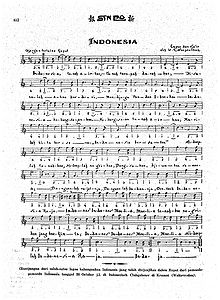 Sin Po first went into print in 1910 and began gaining momentum as the leading advocate of Chinese political nationalism in 1917. The ethnic Chinese who followed its stream of thought refused any involvement with local institutions and would only participate in politics relating to mainland China. A second stream was later formed by wealthy ethnic Chinese who were Dutch-educated. This Dutch-oriented group wished for increased participation in local politics, Dutch education for the ethnic Chinese, and the furthering of ethnic Chinese economic standing within the colonial economy. Championed by the Volksraad
's sole ethnic Chinese representative Kan Hok Hoei, this movement gained momentum and reached its peak with the Chung Hwa Congress of 1927 and the 1928 formation of the Chung Hwa Hui party, which elected Kan as its president. The editor-in-chief of the Madjallah Panorama news magazine criticized Sin Po for misguiding the ethnic Chinese by pressuring them into a Chinese-nationalist stance.
In 1932 pro-Indonesian counterparts founded the to support absorption of the ethnic Chinese into the Javanese population and support the call for self-government
of Indonesia. Members of this group were primarily . This division resurfaced at the end of the period of Japanese occupation
(1942–1945). Under the occupation ethnic Chinese communities were attacked by Japanese forces, in part because of a suspicion that they contained sympathizers of the Kuomintang
as a consequence of the Second Sino-Japanese War
. When the Dutch returned, following the end of World War II
, the chaos caused by advancing forces and retreating revolutionaries also saw radical Muslim groups attack ethnic Chinese communities.
Although revolutionary leaders were sympathetic toward the ethnic Chinese, they were unable to stop the sporadic violence. Those who were affected fled from the rural areas to Dutch controlled cities, a move many Indonesians saw as proof of pro-Dutch sentiments. There was evidence, however, that Chinese Indonesians were represented and participated in independence efforts. Four members of the Committee for the Investigation of the Preparation for Indonesian Independence (, BPUPKI) and one member on the Preparatory Committee for Indonesian Independence (, PPKI) had names that were clearly Chinese.
retreated to Taiwan, allowing the Communist Party of China
to take control of mainland China. Most Chinese Indonesians considered a communist China less attractive than a newly independent Indonesia, but their loyalties were questioned. Ethnic Chinese born in the Dutch East Indies whose parents were domiciled
under Dutch administration were regarded as citizens of the new state according to the principle of jus soli
, or "right of the soil". However, Chinese law considered a person as a Chinese citizen according to the principle of jus sanguinis
, or right of blood. This meant that all Indonesian citizens of Chinese descent were also claimed as citizens by the People's Republic of China. After several attempts by both governments to resolve this issue, Indonesia and China signed a Dual Nationality Treaty
on the sidelines of the 1955 Asian–African Conference in Bandung
. One of its provisions was the ability to renounce Chinese citizenship for those who wished to solely remain Indonesian citizens.
As many as 390,000 ethnic Chinese, two-thirds of those with rightful claims to Indonesian citizenship, renounced their Chinese status when the treaty came into effect in 1962. On the other hand, an estimated 60,000 ethnic Chinese students left for the People's Republic of China in the 1950s and early 1960s. The first wave of students were almost entirely educated in Chinese-language schools, but were not able to find opportunities for tertiary education
in Indonesia. Seeking high quality scientific professions, they entered China with high hopes for their future and that of the mainland. Subsequent migrations occurred in 1960 as part of a repatriation program and in 1965–1966 following a series of anti-communist violence that also drew anger toward the ethnic Chinese. As many as 80 percent of the original students who entered the mainland eventually became refugees in Hong Kong. Under the programs of China's Cultural Revolution
(1966–1976), the returned overseas Chinese were questioned for their loyalty and targeted because of their foreign connections. As most had grown up in an urban environment they were sent to the countryside, told to "rebel against their own class background", and eventually lost contact with their families. They were attacked as "imperialists", "capitalists", "spies", "half-breeds", and "foreign devils".
In 1959, following the introduction of soft-authoritarian
rule through Guided Democracy, the Indonesian government and military began placing restrictions on alien
residence and trade. These regulations culminated in the enactment of Presidential Regulation 10 in November 1959, banning retail services by non-indigenous persons in rural areas. Ethnic Chinese, Arab, and Dutch businessmen were specifically targeted during its enforcement in order to provide a more favorable market for indigenous businesses. This move was met with protests from the Chinese government and some circles of Indonesian society. Javanese writer Pramoedya Ananta Toer
later criticized the policies in his 1961 book Hoakiau di Indonesia. An integrationist
movement, led by the Chinese Indonesian political party Baperki (), began to gather interest in 1963, including that of President Sukarno
. However, a series of attacks on ethnic Chinese communities in West Java
in May proved it to be short-lived, despite the government's condemnation of the violence. When Baperki was branded a communist organization in 1965 the ethnic Chinese were implicated by association. As many as 500,000 people died in the anti-communist massacres of 1965–1966, the single most bloody event of violence in Indonesia's history.
government of General Suharto came into power in 1966–1967, it introduced a political system based only on the Pancasila (five principles) ideology. In order to prevent the ideological battles that occurred during Sukarno's presidency from resurfacing, Suharto's "Pancasila democracy" sought a depoliticized system where discussions of forming a cohesive ethnic Chinese identity was no longer allowed. A government committee was formed in 1967 to examine various aspects of the "Chinese Problem" () and agreed that forced emigration
of whole communities was not a solution: "The challenge was to take advantage of their economic aptitude whilst eliminating their perceived economic dominance." The semi-governmental Institute for the Promotion of National Unity (, LPKB) was formed to advise the government on facilitating assimilation of Chinese Indonesians. This process was done through highlighting the differences between the ethnic Chinese and the indigenous pribumi
, rather than seeking similarities. Expressions of Chinese culture through language, religion, and traditional festivals were banned and the ethnic Chinese were encouraged to adopt Indonesian-sounding names.
During the 1970s and 1980s Suharto and his government brought in Chinese Indonesian businesses to participate in the economic development programs of the New Order, while keeping them highly vulnerable in order to strengthen the central authority and restrict political freedoms. Patron-client relationships, mainly through the exchange of money for security, became an accepted norm among the ethnic Chinese as they maintained a social contract through which they could claim a sense of belonging in the country. A minority of the economic elite of Indonesian society, who may or may not be ethnic Chinese, secured relationships with Suharto's family members and members of the military for protection, while small business owners relied on local law enforcement officials for protection. Stereotypes of the wealthy minority became accepted as generalized facts, but they failed to acknowledge that these businessmen are small in number compared to the small traders and shop owners. In a 1989 interview conducted by scholar Adam Schwarz for his book A Nation in Waiting: Indonesia's Search for Stability, an interviewee stated that, "to most Indonesians, the word 'Chinese' is synonymous with corruption". The economic role of the ethnic Chinese was contradictory because it did not translate to acceptance of their status in the greater society. They were politically weak and often faced social harassment.
Anti-Chinese sentiment gathered intensity through the 1990s and major riots broke out in Situbondo
(October 1996), Tasikmalaya
(December 1996), and Rengasdengklok (January 1997). President Suharto had gathered the most powerful businessmen—mostly Chinese Indonesians—in a nationally televised 1990 meeting at his private ranch, calling on them to contribute 25 percent of their shares to cooperative
s. Commentators described the spectacle as "good theatre", as it only served to reinforce resentment and suspicion of the ethnic Chinese among the indigenous population.
When Suharto entered his seventh term as president, following an uncontested election on 10 March 1998, Indonesian students began a series of major demonstrations in protest of the New Order regime which continued for weeks and culminated in the shootings of four students
by security forces at Trisakti University
in May. The incident sparked major violence in several cities during 12–15 May. Property and businesses owned by Chinese Indonesians were targeted by mobs and over 100 women were sexually assaulted
. In the absence of security forces, large groups of men, women, and children looted and burned the numerous shopping mall
s in major cities. In Jakarta and Surakarta
over 1,000 people died inside their shopping malls. Tens of thousands of ethnic Chinese fled the country following these events and bankers estimated that US$
20 billion of capital had left the country in 1997–1999 to overseas destinations such as Singapore, Hong Kong, and the United States
.
meeting in Cairo
, which took place during the riots. The reform government formed by his successor Bacharuddin Jusuf Habibie began a campaign to rebuild the confidence of Chinese Indonesians who had fled the country, particularly businessmen. Along with one of his envoys James Riady
, son of financial magnate Mochtar Riady
, Habibie appealed to Chinese Indonesians seeking refuge throughout East Asia, Australia, and North America to return and promised security from various government ministries as well as other political figures, such as Abdurrahman Wahid
and Amien Rais
. Despite Habibie's efforts he was met with skepticism because of remarks he made, as Vice President and later as President, which suggested that the message was insincere. One special envoy described Chinese Indonesians as the key to restoring "badly needed" capital and economic activity, prioritizing businessmen as the target of their pleas. Others, including economist Kwik Kian Gie
, saw the government's efforts as perpetuating the myth of Chinese economic domination rather than affirming the ethnic Chinese identity.
Symbolic reforms to Chinese Indonesian rights under Habibie's administration were made through two Presidential Instructions. The first abolished the use of the terms "pribumi" and "non-pribumi" in official government documents and business. The second abolished the ban on the study of Mandarin Chinese and reaffirmed a 1996 instruction which abolished the use of the SBKRI to identify citizens of Chinese descent. Habibie established a task force to investigate the May 1998 violence, although his government later dismissed its findings. As an additional legal gesture Indonesia ratified the 1965 Convention on the Elimination of All Forms of Racial Discrimination
on 25 May 1999. In 2000 the newly elected President Wahid abolished the ban on public displays of Chinese culture and allowed Chinese traditions to be practised freely, without the need of a permit. Two years later President Megawati Sukarnoputri
declared that the Chinese New Year
() would be marked as a national holiday
from 2003. In addition to Habibie's directive on the term "pribumi", the legislature passed a new citizenship law in 2006 defining the word asli ("indigenous") in the Constitution
as a natural born person, allowing Chinese Indonesians to be eligible to run for president. The law further stipulates that children of foreigners born in Indonesia are eligible to apply for Indonesian citizenship.
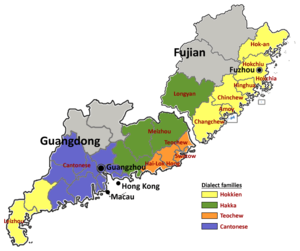
groups of what are now the Fujian
and Guangdong
provinces in southern China, known for their regional diversity. The Han Chinese form the largest ethnic group in the world with large numbers living in Southeast Asia
. Nearly all Chinese Indonesians are either patrilineal
descendants of these early immigrants, or new immigrants born in mainland China.
As the first group of Chinese people to settle in large numbers, the Hokkien
of southern Fujian became the dominant immigrant group until the middle of the 19th century. Their maritime-mercantile culture comes from their trade occupations whilst in Indonesia. Descendants of Hokkiens are the dominant group in eastern Indonesia, Central
and East Java
, and the western coast of Sumatra
. Teochews
, southern neighbors of the Hokkien, are found throughout the eastern coast of Sumatra, in the Riau Archipelago
, and in western Borneo. They were preferred as plantation laborers in Sumatra but have become traders in regions where the Hokkien are not well represented.
The Hakka
, unlike the Hokkien and the Teochew, originate from the mountainous inland regions of Guangdong and do not have a maritime culture. Due to the unproductive terrain of their home region, the Hakka emigrated out of economic necessity in several waves from 1850 to 1930 and were the poorest of the Chinese immigrant groups. Although they initially populated the mining centers of western Borneo and Bangka Island
, Hakkas became attracted to the rapid growth of Batavia and West Java
in the late 19th century.
Cantonese people
, like the Hakka, were well known throughout Southeast Asia as mineworkers. Their migration in the 19th century was largely directed toward the tin
mines of Bangka, off the east coast of Sumatra. Notable traditionally as skilled artisans, the Cantonese benefited from close contact with Europeans in Guangdong and Hong Kong by learning about machinery and industrial success. They migrated to Java about the same time as the Hakka, but for different reasons. In Indonesia's cities they became artisans, machine workers, and owners of small businesses such as restaurants and hotel-keeping services. The Cantonese are evenly dispersed throughout the archipelago and number far less than the Hokkien or the Hakka. Consequently their roles are of secondary importance in the Chinese communities.
Prior estimates on the exact number of Chinese Indonesians relied on the 1930 Dutch East Indies census, which collected direct information on ethnicity. This census reported 1.23 million self-identified ethnic Chinese living in the colony, representing 2.03 percent of the total population, and was perceived to be an accurate account of the group's population. Ethnic information would not be collected again until the 2000 census and so was deduced from other census data, such as language spoken and religious affiliation, during the intermediate years. In an early survey of the Chinese Indonesian minority, anthropologist G. William Skinner
estimated that between 2.3 million (2.4 percent) and 2.6 million (2.7 percent) lived in Indonesia in 1961. Former foreign minister Adam Malik
provided a figure of 5 million in a report published in the Harian Indonesia daily in 1973. Many media and academic sources subsequently estimated between 4 and 5 percent of the total population as ethnic Chinese regardless of the year. Estimates within the past decade have placed the figure between 6 and 7 million, and the Overseas Compatriot Affairs Commission
of the Republic of China estimated a population as high as 7.67 million in 2006.
Approximately one-fifth of Chinese Indonesians lived in the capital city of Jakarta
, located on the island of Java. When the island's other provinces—Banten
, West Java, Central Java, Yogyakarta, and East Java—are included, this population accounted for nearly half (45.92 percent) of all Chinese Indonesians. Outside of Java, the provinces of West Kalimantan
, North Sumatra
, Riau, the Bangka–Belitung Islands, and South Sumatra
accounted for an additional 45.16 percent of the population. The Bangka–Belitung Islands had the highest local concentration of ethnic Chinese (11.75 percent of the province's population), followed by West Kalimantan (9.62 percent), Jakarta (5.83 percent), Riau (4.11 percent), and North Sumatra (3.07 percent). In each of the remaining provinces, Chinese Indonesians account for 1 percent or less of the provincial population. Most Chinese Indonesians in North Sumatra lived in the provincial capital of Medan
, but they constituted only a small percentage because of the relatively large population of the province. Bangka–Belitung, West Kalimantan, and Riau are grouped around the hub of ethnic Chinese economic activity in Singapore
and, with the exception of Bangka–Belitung, these settlements existed long before Singapore's founding in 1819.
The ethnic Chinese population grew by an average of 4.3 percent annually between 1920 and 1930. It then slowed due to the effects of the Great Depression
and many areas experienced a net emigration. Falling growth rates were also attributed to a significant decrease in the number of Chinese immigrants admitted into Indonesia since the 1950s. The population is relatively old according to the 2000 census, having the lowest percentage of population under 14 years old nationwide and the second highest percentage of population over 65. Their population pyramid
had a narrow base with a rapid increase until the 15–19 age group, indicating a rapid decline in total fertility rate
s. This was evidenced by a decline in the absolute number of births since 1980. In Jakarta and West Java the population peak occurred in the 20–24 age group, indicating that the decline in fertility rates began as early as 1975. The upper portion of the pyramid exhibited a smooth decline with increasing population age. It is estimated that 60.7 percent of the Chinese Indonesian population in 2000 constitute the generation which experienced political and social pressures under the New Order government. With a life expectancy of 75 years, those who spent their formative years prior to this regime will completely disappear by 2032.
's The Australian People encyclopedia estimated that half of over 30,000 Indonesians living in Australia
in the late 1990s are ethnic Chinese, and they have since merged with other Chinese communities. In New Zealand
, many migrants reside in the suburbs of Auckland
after some 1,500 sought asylum from the 1998 upheaval, of which two-thirds were granted residency. Australian scholar Charles Coppel
believes they also constitute a large majority of returned overseas Chinese living in Hong Kong. Though it is impossible to accurately count this number, news sources provided estimates ranging from 100,000 to 150,000. Of the 57,000 Indonesians living in the United States in 2000, one-third were estimated to be ethnic Chinese. Locally knowledgeable migrants in Southern California
estimate that 60 percent of Indonesian American
s living in the area are of Chinese descent. Their families usually resided in Indonesia for several generations and may have intermarried with "pribumi". In Canada, only a minority of the emigrant Chinese Indonesian community speak a Chinese dialect. Although families are interested in rediscovering their ethnic traditions, the Canadian-born children are often reluctant to learn either Indonesian or Chinese languages.
structure in the "totok" community follows the patrilineal
, patrilocal
, and patriarchal
traditions of Chinese society, a practice which has lost emphasis in "peranakan" familial relationships. Instead, kinship patterns in indigenized families incorporated elements of matrilocal, matrilineal
, and matrifocal
traditions found in Javanese society. Within this community, both sons and daughters can inherit the family fortune, including ancestral tablets and ashes. Political, social, and economic authority in "peranakan" families is more evenly distributed between the two genders than in "totok" families. Kin terms do not distinguish between maternal and paternal relatives, and polygyny
is strongly frowned upon. Western influence in "peranakan" society is evidenced by the high proportion of childless couples. Those who did have children also had fewer of them than "totok" couples.
Despite their break from traditional kinship patterns, "peranakan" families are closer to some traditional Chinese values than the "totok". Because the indigenized population have lost much of the connection to their ancestral homes in the coastal provinces of China, they are less affected by the modernization patterns of the 20th century which has transformed the region. The "peranakan" have a stricter attitude toward divorce, though the separation rates among families in both segments are generally lower than other ethnic groups. Arranged marriages are more common in "peranakan" families, whose relationships tend to be more nepotistic
. Secularization among the "totok" meant that their counterparts carry out ancestral rituals to a higher degree, and "peranakan" youth tend to be more religious. Through education provided by high quality Catholic and Protestant schools, these youth are much more likely to convert to Christianity.
In the 21st century the conceptual differences of the two groups are slowly becoming outdated, with some families showing a mixture of characteristics from both cultures. Interracial marriage
and cultural assimilation often prevent the formation a precise definition of Chinese Indonesians in line with any simple racial criterion. Use of a Chinese surname
, in some form or circumstance, is generally a sign of cultural self-identification as ethnic Chinese or alignment with a Chinese social system.
, which is based on the idea that one's existence is influenced by the connection to others, implying the importance of business connections. In the first decade following Indonesian independence, their business standing strengthened after being limited only to small businesses in the colonial period. By the 1950s virtually all retail stores
in Indonesia were owned by ethnic Chinese entrepreneurs, whose businesses ranged from selling groceries
to construction material. Discontentment soon grew among indigenous merchants who felt they could not compete with ethnic Chinese businesses. Under pressure from indigenous merchants the government enacted the Benteng program and Presidential Regulation 10 of 1959, which imposed restrictions on ethnic Chinese importers and rural retailers. Ethnic Chinese businesses persisted, due to their integration into larger networks throughout Southeast Asia, and their dominance continued despite continuous state and private efforts to encourage the growth of indigenous capital
.
Government policies shifted dramatically after 1965 and became more favorable toward economic expansion. In an effort to rehabilitate the economy, the government turned to those possessing the capability to invest and expand corporate activity. Ethnic Chinese capitalists, called the , were strengthened by the military, which emerged as the dominant political force after 1965. Indigenous businessmen once again demanded greater investment support from the government in the 1970s, but each legislation fell short of reducing ethnic Chinese dominance. In a 1995 study published by the East Asia Analytical Unit of Australia's Department of Foreign Affairs and Trade
, approximately 73 percent of the market capitalization
value of publicly listed companies
(excluding foreign and state-owned companies) were owned by Chinese Indonesians. Additionally, they owned 68 percent of the top 300 conglomerates
and nine of the top ten private sector groups at the end of 1993. This figure propagated the general belief that ethnic Chinese—then estimated at 3 percent of the population—controlled 70 percent of the economy. Amid disputes surrounding the accuracy of this figure, it was evident that a wealth disparity
existed along ethnic boundaries. The image of an economically powerful ethnic Chinese community was further fostered by the government through its inability to dissociate itself from the patronage
networks. The Hokchia group dominated the ethnic Chinese business scene during the Suharto government, with other groups emerging after 1998.
The top five conglomerates in Indonesia prior to the 1997 Asian financial crisis—the Salim Group
, Astra International
, the Sinar Mas Group
, Gudang Garam, and the Lippo Group
—were all owned by ethnic Chinese, with annual sales totaling Rp
112 trillion (US$47 billion). When the crisis finally hit the country, the rupiah's plunge severely disrupted corporate operations. Numerous conglomerates collapsed after losing a majority of their assets. Over the next several years, other conglomerates struggled to repay international and domestic debts. Reforms introduced following 1998 were meant to steer the economy away from oligarchic
arrangements established under the New Order; however, plans for reform proved too optimistic. When President B. J. Habibie announced in a 19 July 1998 interview with The Washington Post
that Indonesia was not dependent on ethnic Chinese businessmen, the rupiah's value plunged 5 percent.Habibie said in the interview, "If the Chinese community doesn't come back because they don't trust their own country and society, I cannot force [them], nobody can force them. [...] Do you really think that we will then die? Their place will be taken over by others." This unexpected reaction prompted immediate changes in policies, and Habibie soon began enticing conglomerates for their support in the reform plans. Most were initially fearful of democratization, but the process of social demarginalization meant that the ethnic Chinese were regarded as equal members of society for the first time in the nation's history. Increased regional autonomy allowed surviving conglomerates to explore new opportunities in the outer provinces, and economic reforms created a freer market.
effort by the indigenized ethnic Chinese community, a new pan-Chinese movement emerged with the goal of seeking a unified Chinese political identity. The movement later split in the 1920s when "peranakan" elites resisted the leadership of the "totok" in the nationalist movement, and the two groups developed their own objectives. When it became apparent that unification was being achieved on "totok" terms, "peranakan" leaders chose to align their community with the Dutch, who had abandoned the segregation policies in 1908. The two communities once again found common ground in opposition against the invading Japanese when the occupying forces treated all Chinese groups with contempt.
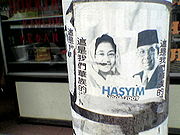 The issue of nationality, following independence, politicized the ethnic Chinese and led to the formation of Baperki in 1954, as the first and largest Chinese Indonesian political party or mass organization. Baperki and its majority "peranakan" membership led the opposition against a draft law which would have restricted the number of ethnic Chinese who could gain Indonesian citizenship. This movement was met by the Islamic Masyumi Party
in 1956 when it called for the implementation of affirmative action
for indigenous businesses. During the 1955 legislative election
, Baperki received 178,887 votes and gained a seat on the People's Representative Council
(DPR). Later that year two Baperki candidates were also elected
to the Constitutional Assembly.
Ethnic-based political parties were banned under the government of President Suharto, leaving only the three indigenous-dominated parties of Golkar
, the United Development Party
(PPP), and the Indonesian Democratic Party
(PDI). The depoliticizing of Indonesian society confined ethnic Chinese activities to the economic sector. Chinese Indonesian critics of the regime were mostly "peranakan" and projected themselves as Indonesians, leaving the ethnic Chinese with no leaders to represent them. On the eve of the 1999 legislative election
, after Suharto's resignation, the news magazine Tempo conducted a survey of likely Chinese Indonesian voters on their political party of choice for the election. Although respondents were able to choose more than one party, 70 percent favored the Indonesian Democratic Party – Struggle (PDI–P), whose image of a nationalist party was considered favorable toward the ethnic Chinese. The party also benefited from the presence of economist Kwik Kian Gie
, who was well respected by both ethnic Chinese and non-ethnic-Chinese voters.
New ethnic political parties such as the Chinese Indonesian Reform Party (, PARTI) and the Indonesian Bhinneka Tunggal Ika Party (, PBI) failed to garner much support in the 1999 election. Despite this result the number of Chinese Indonesian candidates standing in national election increased from fewer than 50 in 1999 to almost 150 in 2004. Of the 58 candidates of Chinese descent who ran for office as representatives from Jakarta in the 2009 legislative election
, two won seats.
 Three major Chinese speech groups are represented in Indonesia: Hokkien
, Hakka, and Cantonese. In addition to these, the Teochew speak a dialect that is mutually intelligible
with Hokkien. Distinctions between the two, however, are accentuated outside of their regions of origin. There were an estimated 2 million native speaker
s of various Chinese dialects in 1982: 700,000 speakers of the Min Nan
language family (including Hokkien and the Teochew dialect); 640,000 Hakka speakers; 460,000 Mandarin speakers; 180,000 Cantonese speakers; and 20,000 speakers of the Min Dong
language family (including Xinghua
). Additionally, an estimated 20,000 spoke varieties of the Indonesian language
.
Many Indonesians, including the ethnic Chinese, believe in the existence of a dialect of Malay language
, Chinese Malay, known locally as or . The growth of "peranakan" literature in the second half of the 19th century gave rise to such a variant, popularized through silat
(martial arts) stories translated from Chinese or written in Malay and Indonesian. However, scholars argue it is different from the mixture of spoken Javanese
and Malay that is perceived to be "spoken exclusively by ethnic Chinese".Indonesian scholar Dede Oetomo
believed "the term 'Chinese Malay' is really a misnomer. There may be a continuity between 'Chinese Malay' and modern Indonesian
, especially because the former was also used in the written discourse of members of ethnic groups besides the Chinese in the colonial period and well into the postindependence era" .
Academic literature discussing Chinese Malay commonly note that ethnic Chinese do not speak the same dialect of Malay throughout the archipelago. Furthermore, although the Dutch colonial government first introduced the Malay orthography
in 1901, Chinese newspapers did not follow this standard until after independence. Because of these factors, the ethnic Chinese play a "significant role" in the development of the modern Indonesian language as the largest group during the colonial period to communicate in a variety of Malay dialects.
". One debate took place in the media in 2003, discussing the Chinese "mu yu" and the Indonesian "guo yu" . Nostalgia
is a common theme in the Chinese-language press in the period immediately following Suharto's government. The rise of China's political and economic standing at the turn of the 21st century became an impetus for their attempt to attract younger readers who seek to rediscover their cultural roots.
During the first three decades of the 20th century, ethnic Chinese owned "the overwhelming majority, if not all," of the movie theater
s in cities throughout the Dutch East Indies. Films from China were being imported by the 1920s, and a film industry began to emerge in 1928 with the arrival of the three Wong brothers from Shanghai
—their films would dominate the market through the 1930s. These earliest films almost exclusively focused on the ethnic Chinese community, with only a few examining inter-ethnic relations
as a main theme. The later ban on the public use of Chinese language meant that imported films and television programs were required to be dubbed in English with subtitle
s in Indonesian. When martial arts serials began appearing on national television in 1988, they were dubbed in Indonesian. One exception was the showing of films from Hong Kong in Chinese—limited to ethnic Chinese districts and their surroundings—because of an agreement between importers and the film censor board.
, Catholicism, Protestantism
, Hinduism
, Buddhism
, and Confucianism
. A 2006 civil registration law does not allow Indonesians to identify themselves as a member of any other religion on their identity cards.
According to the 2000 census data, almost 90 percent of Chinese Indonesians were Buddhist or Christian (Catholic and Protestant). Conversion from the "Chinese religion
" to Christianity often occurs in the younger generations. It is not uncommon to find families with Christian children where their parents still adhere to the traditional religion. The first wave of conversions occurred in the 1950s and 1960s, in response to intolerance of Chinese culture, and the number of ethnic Chinese Catholics during this period increased by more than 400 percent. The second wave followed after the government withdrew Confucianism's status as a recognized religion in the 1970s. It was estimated in 2006 that 70 percent of the ethnic Chinese population was Christian with active proselytism
from international churches. Demographer Aris Ananta reported in 2008 that "anecdotal evidence suggests that more Buddhist Chinese have become Christians as they increased their standards of education".
In a country where nearly 90 percent of the population are Muslims, the ethnic Chinese Muslims form a small minority of the ethnic Chinese population. The 2000 census counted 5.41 percent of Chinese Indonesians were followers of Islam. Associations such as the Organization of Chinese Muslims of Indonesia (, PITI) had been in existence in the late 19th century. PITI was re-established in 1963 as a modern organization, but occasionally experienced periods of inactivity. Confucians were included in the category of other religions in 2000 and accounted for 3.91 percent of the Chinese Indonesian population. The Supreme Council for Confucian Religion in Indonesia (, MATAKIN) estimated that 95 percent of Confucians are ethnic Chinese. Although the government has restored Confucianism's status as a recognized religion, many local authorities do not abide by it and have refused to allow ethnic Chinese from listing it as a religion on their identity cards. Local officials remained largely unaware that the civil registration law legally allowed citizens to leave the religion section on their identity cards blank.
, study halls, and houses. Cities during the colonial period were divided into three racial districts: European, oriental (Chinese, Arabs, and other Asians), and indigenous. There were usually no physical boundaries among the zones, except for rivers, walls, or roads in some cases. Such legal boundaries promoted high growths in urban density
within each zone, especially in the Chinese quarters, often leading to poor environmental conditions.
Early settlers did not adhere to traditional architectural practices when constructing houses, but instead adapted to living conditions in Indonesia. Although the earliest houses are no longer standing, they were likely built from wood or bamboo with thatched roofs
, resembling indigenous houses found throughout Sumatra, Borneo, and Java. More permanent constructions replaced these settlements in the 19th century. Segregation policies under the Dutch forbade the use of European architectural styles by non-European ethnic groups. The ethnic Chinese and other foreign and indigenous groups lived according to their own cultures. Chinese houses along the north coast of Java were renovated to include Chinese ornamentation. As racial segregation eased at the turn of the 20th century, the ethnic Chinese who had lost their identity embraced European culture and began removing ethnic ornaments from their buildings. Government policies prohibiting the public display of Chinese culture during the New Order also accelerated the transition toward local and Western architecture.
Chinese culinary culture is particularly evident in Indonesian cuisine through the Hokkien, Hakka, and Cantonese loanword
s used for various dishes. Words beginning with signify the presence of meat, e.g. ("meat bun
"); words ending with signify vegetables, e.g. ("Chinese white cabbage
"). Most of these loanwords for food dishes and their ingredients are Hokkien in origin and are used throughout the Indonesian language and vernacular
speech of large cities. Because they have become an integral part of the local language, many Indonesians and ethnic Chinese do not recognize their Hokkien origins. Some food and ingredients are part of the daily diet of both the indigenous and ethnic Chinese populations as side dishes to accompany rice, the staple food
of most of the country. Among ethnic Chinese families, whether they are strongly Chinese oriented or already acculturated, pork
is often the preferred meat. Its consumption has, however, decreased in recent years due to a recognition of its contribution to health hazards such as high cholesterol levels
and heart disease.
In a 1997 restaurant listing, published by the English-language daily The Jakarta Post
, which largely caters to expatriate
s and middle class Indonesians, at least 80 locations within the city can be considered Chinese out of the 10-page list. Additionally, major hotels generally operate one or two Chinese restaurants, and many more can be found in large shopping centers. Upscale Chinese restaurants in Jakarta, where the urban character of the ethnic Chinese is well established, can be found serving delicacies such as shark fin soup
and bird's nest soup
. Food with healing properties, including traditional Chinese medicine
, are in high demand.
Overseas Chinese
Overseas Chinese are people of Chinese birth or descent who live outside the Greater China Area . People of partial Chinese ancestry living outside the Greater China Area may also consider themselves Overseas Chinese....
group whose ancestors emigrated from China to Indonesia
Indonesia
Indonesia , officially the Republic of Indonesia , is a country in Southeast Asia and Oceania. Indonesia is an archipelago comprising approximately 13,000 islands. It has 33 provinces with over 238 million people, and is the world's fourth most populous country. Indonesia is a republic, with an...
, formerly a colony of the Netherlands known as the Dutch East Indies
Dutch East Indies
The Dutch East Indies was a Dutch colony that became modern Indonesia following World War II. It was formed from the nationalised colonies of the Dutch East India Company, which came under the administration of the Netherlands government in 1800....
. Maritime trade drove early Chinese migration into the Malay Archipelago
Malay Archipelago
The Malay Archipelago refers to the archipelago between mainland Southeastern Asia and Australia. The name was derived from the anachronistic concept of a Malay race....
, and the population grew rapidly through the colonial period when workers were contracted from their home provinces in southern China. Indonesia's 2000 census reported more than 2.4 million self identified ethnic Chinese citizens, or 1.2 percent of the country's population at the time. This figure is disputed because it is impossible to determine the exact number of Chinese Indonesians, in some cases because of fear from being identified as one in the years following anti-Chinese violence in 1998. Some sources estimate that the population may be two to three times its reported size.
Historically, Chinese Indonesians were viewed as foreign orientals
Orient
The Orient means "the East." It is a traditional designation for anything that belongs to the Eastern world or the Far East, in relation to Europe. In English it is a metonym that means various parts of Asia.- Derivation :...
and struggled to enter the colonial and national sociopolitical scene, despite successes in their economic endeavors. Evidence of discrimination against Chinese Indonesians
Discrimination against Chinese Indonesians
Discrimination against people of Chinese descent in Indonesia has been recorded since at least 1740, when the Dutch Colonial Government killed up to 10,000 people of Chinese descent during the Chinezenmoord. In the period since then, discrimination and violence have been recorded both foreign and...
can be found throughout the history of Indonesia, although more recent government policies have attempted to redress this. Resentment of ethnic Chinese economic aptitude grew in the 1950s as native Indonesian merchants felt they could not remain competitive. In some cases, government action only propagated the stereotype that conglomerate
Conglomerate (company)
A conglomerate is a combination of two or more corporations engaged in entirely different businesses that fall under one corporate structure , usually involving a parent company and several subsidiaries. Often, a conglomerate is a multi-industry company...
s owned by the ethnic Chinese were corrupt. Although economic collapse from the 1997 Asian financial crisis severely disrupted their business activities, Chinese Indonesians gained newfound political and social freedoms as a result of policy reform efforts.
Development of local Chinese society and culture was based upon three main pillars: clan associations, ethnic media, and Chinese language schools. These flourished during the period of Chinese nationalism
Chinese nationalism
Chinese nationalism , sometimes synonymous with Chinese patriotism refers to cultural, historiographical, and political theories, movements and beliefs that assert the idea of a cohesive, unified Chinese people and culture in a unified country known as China...
in the final years of China's Qing Dynasty
Qing Dynasty
The Qing Dynasty was the last dynasty of China, ruling from 1644 to 1912 with a brief, abortive restoration in 1917. It was preceded by the Ming Dynasty and followed by the Republic of China....
and through the Second Sino-Japanese War
Second Sino-Japanese War
The Second Sino-Japanese War was a military conflict fought primarily between the Republic of China and the Empire of Japan. From 1937 to 1941, China fought Japan with some economic help from Germany , the Soviet Union and the United States...
; however, differences in the object of nationalist sentiments brought about a split in the population, with one group supporting political reforms in mainland China while others sought improved status in local politics. Under the government of the New Order
New Order (Indonesia)
The New Order is the term coined by former Indonesian President Suharto to characterize his regime as he came to power in 1966. Suharto used this term to contrast his rule with that of his predecessor, Sukarno...
(1967–1998) the pillars of ethnic Chinese identity were dismantled in favor of assimilation
Cultural assimilation
Cultural assimilation is a socio-political response to demographic multi-ethnicity that supports or promotes the assimilation of ethnic minorities into the dominant culture. The term assimilation is often used with regard to immigrants and various ethnic groups who have settled in a new land. New...
policies as a solution to the "Chinese Problem". Patterns of assimilation and ethnic interaction can be found in Indonesia's literature, architecture, and cuisine.
The Chinese Indonesian population of Java
Java
Java is an island of Indonesia. With a population of 135 million , it is the world's most populous island, and one of the most densely populated regions in the world. It is home to 60% of Indonesia's population. The Indonesian capital city, Jakarta, is in west Java...
accounts for nearly half of the group's national population. Although they are generally more urbanized
Urbanization
Urbanization, urbanisation or urban drift is the physical growth of urban areas as a result of global change. The United Nations projected that half of the world's population would live in urban areas at the end of 2008....
than Indonesia's indigenous population
Indigenous peoples
Indigenous peoples are ethnic groups that are defined as indigenous according to one of the various definitions of the term, there is no universally accepted definition but most of which carry connotations of being the "original inhabitants" of a territory....
, significant rural and agricultural
Agriculture
Agriculture is the cultivation of animals, plants, fungi and other life forms for food, fiber, and other products used to sustain life. Agriculture was the key implement in the rise of sedentary human civilization, whereby farming of domesticated species created food surpluses that nurtured the...
communities also exist throughout the provinces. Declining fertility rates have resulted in an upward shift in the population pyramid
Population pyramid
A population pyramid, also called an age structure diagram, is a graphical illustration that shows the distribution of various age groups in a population , which forms the shape of a pyramid when the population is growing...
as the median age increases. Additionally emigration has contributed to a shrinking population, with communities emerging in more industrialized nations in the second half of the 20th century. Some participated in repatriation
Repatriation
Repatriation is the process of returning a person back to one's place of origin or citizenship. This includes the process of returning refugees or soldiers to their place of origin following a war...
programs to the People's Republic of China
People's Republic of China
China , officially the People's Republic of China , is the most populous country in the world, with over 1.3 billion citizens. Located in East Asia, the country covers approximately 9.6 million square kilometres...
, while others emigrated to Western countries to escape anti-Chinese sentiment. Among the overseas residents, their identities are noticeably more Indonesian than Chinese.
Identity
Sociologist Mely G. TanMely G. Tan
Mely Tan Giok Lan , professionally known as Mely G. Tan, is a Chinese Indonesian sociologist. Tan obtained her bachelor's degree from the University of Indonesia, later receiving a scholarship to study at Cornell University...
asserts that scholars studying ethnic Chinese emigrants often refer to the group as a "monolithic entity": the overseas Chinese
Overseas Chinese
Overseas Chinese are people of Chinese birth or descent who live outside the Greater China Area . People of partial Chinese ancestry living outside the Greater China Area may also consider themselves Overseas Chinese....
. Such treatment also persisted in Indonesia with a majority of the population referring to them as , (both meaning "Chinese people"), or .The latter two terms are derived from the Hokkien
Hokkien
Hokkien is a Hokkien word corresponding to Standard Chinese "Fujian". It may refer to:* Hokkien dialect, a dialect of Min Nan Chinese spoken in Southern Fujian , Taiwan, South-east Asia, and elsewhere....
dialect. Sociologist Mely G. Tan
Mely G. Tan
Mely Tan Giok Lan , professionally known as Mely G. Tan, is a Chinese Indonesian sociologist. Tan obtained her bachelor's degree from the University of Indonesia, later receiving a scholarship to study at Cornell University...
argued that these terms "only apply to those who are alien, not of mixed ancestry, and who initially do not plan to stay in Indonesia permanently" . She also noted that the terms ( in older orthography) and () carry a derogatory meaning to earlier generations of immigrants, especially those living on the island of Java. noted this connotation appears to have faded in later generations. Current ethnographic
Ethnography
Ethnography is a qualitative method aimed to learn and understand cultural phenomena which reflect the knowledge and system of meanings guiding the life of a cultural group...
literature describe them as Chinese Indonesians. They were previously described as the Indonesian Chinese, but there has been a shift in terminology as the old description emphasizes the group's Chinese origins, while the more recent one its Indonesian integration. Aimee Dawis, citing prominent scholar Leo Suryadinata
Leo Suryadinata
Leo Suryadinata , is a Chinese Indonesian sinologist.-Biography:...
, believes the shift is "necessary to debunk the stereotype that they are an exclusive group" and also "promotes a sense of nationalism" among them.
Ethnic Chinese in the 1930 Dutch East Indies census were categorized as foreign orientals, and registered separately from the indigenous population. Citizenship was conferred upon the ethnic Chinese through a 1946 citizenship act after Indonesia became independent, and it was further reaffirmed in 1949 and 1958. However, they often encountered obstacles regarding the legality of their citizenship. Chinese Indonesians were required to produce an Indonesian Citizenship Certificate (, SBKRI) when conducting business with government officials. Without the SBKRI they were not able to make passport
Passport
A passport is a document, issued by a national government, which certifies, for the purpose of international travel, the identity and nationality of its holder. The elements of identity are name, date of birth, sex, and place of birth....
s and identity cards (, KTP); register birth, death, and marriage certificates; or register a business license. The requirement for its use was abolished in 1996 through a presidential instruction which was reaffirmed in 1999, but media sources reported that local authorities were still demanding the SBKRI from Chinese Indonesians after the instructions went into effect.
Other terms used for identifying sectors of the community include and . The former, used to describe those born locally, is derived from the root Indonesian
Indonesian language
Indonesian is the official language of Indonesia. Indonesian is a normative form of the Riau Islands dialect of Malay, an Austronesian language which has been used as a lingua franca in the Indonesian archipelago for centuries....
word ("child") and thus means "child of the land". The latter is derived from Javanese
Javanese language
Javanese language is the language of the Javanese people from the central and eastern parts of the island of Java, in Indonesia. In addition, there are also some pockets of Javanese speakers in the northern coast of western Java...
, meaning "new" or "pure", and is used to describe the foreign born and new immigrants. There is also a significant number of Chinese Indonesians living in the People's Republic of China and Hong Kong
Hong Kong
Hong Kong is one of two Special Administrative Regions of the People's Republic of China , the other being Macau. A city-state situated on China's south coast and enclosed by the Pearl River Delta and South China Sea, it is renowned for its expansive skyline and deep natural harbour...
who are considered part of the population of "returned overseas Chinese" . In order to identify the varying sectors of Chinese Indonesian society, Tan contends they must be differentiated according to nationality into those who are citizens of the host country and those who are resident aliens
Alien (law)
In law, an alien is a person in a country who is not a citizen of that country.-Categorization:Types of "alien" persons are:*An alien who is legally permitted to remain in a country which is foreign to him or her. On specified terms, this kind of alien may be called a legal alien of that country...
, then further broken down according to their cultural orientation and social identification.
Early interactions
The first recorded movement of people from China into the Malay ArchipelagoMalay Archipelago
The Malay Archipelago refers to the archipelago between mainland Southeastern Asia and Australia. The name was derived from the anachronistic concept of a Malay race....
was the arrival of Mongol
Mongol Empire
The Mongol Empire , initially named as Greater Mongol State was a great empire during the 13th and 14th centuries...
forces under Kublai Khan
Kublai Khan
Kublai Khan , born Kublai and also known by the temple name Shizu , was the fifth Great Khan of the Mongol Empire from 1260 to 1294 and the founder of the Yuan Dynasty in China...
that culminated in the invasion of Java
Mongol invasion of Java
In 1293, Kublai Khan, the Great Khan of the Mongol Empire and the founder of the Yuan Dynasty, sent a large invasion fleet to Java with 20,000 to 30,000 soldiers...
in 1293. The Mongols introduced Chinese technology to the island, particularly shipbuilding
Shipbuilding
Shipbuilding is the construction of ships and floating vessels. It normally takes place in a specialized facility known as a shipyard. Shipbuilders, also called shipwrights, follow a specialized occupation that traces its roots to before recorded history.Shipbuilding and ship repairs, both...
and coinage. Their intervention also hastened the decline of the classical kingdoms and precipitated the rise of the Majapahit empire. Some Chinese and Portuguese sources indicate that Chinese traders were the first to arrive on Ternate
Ternate
Ternate is an island in the Maluku Islands of eastern Indonesia. It is located off the west coast of the larger island of Halmahera, the center of the powerful former Sultanate of Ternate....
and Tidore
Tidore
Tidore is a city, island, and archipelago in the Maluku Islands of eastern Indonesia, west of the larger island of Halmahera. In the pre-colonial era, the kingdom of Tidore was a major regional political and economic power, and a fierce rival of nearby Ternate, just to the north.-Geography:Tidor...
in the Maluku Islands
Maluku Islands
The Maluku Islands are an archipelago that is part of Indonesia, and part of the larger Maritime Southeast Asia region. Tectonically they are located on the Halmahera Plate within the Molucca Sea Collision Zone...
to buy clove
Clove
Cloves are the aromatic dried flower buds of a tree in the family Myrtaceae. Cloves are native to the Maluku islands in Indonesia and used as a spice in cuisines all over the world...
s, but they were later driven out by Javanese traders as Majapahit expanded.
Chinese Muslim traders from the eastern coast of China arrived at the coastal towns of Indonesia and Malaysia in the early 15th century. They were led by the mariner Zheng He
Zheng He
Zheng He , also known as Ma Sanbao and Hajji Mahmud Shamsuddin was a Hui-Chinese mariner, explorer, diplomat and fleet admiral, who commanded voyages to Southeast Asia, South Asia, the Middle East, and East Africa, collectively referred to as the Voyages of Zheng He or Voyages of Cheng Ho from...
, who led several expeditions to southeastern Asia between 1405 and 1430. In the book The Overall Survey of the Ocean's Shores , his translator Ma Huan documented the activities of the Chinese Muslims in the archipelago and the legacy left by Zheng He and his men. These traders settled along the northern coast of Java
Java
Java is an island of Indonesia. With a population of 135 million , it is the world's most populous island, and one of the most densely populated regions in the world. It is home to 60% of Indonesia's population. The Indonesian capital city, Jakarta, is in west Java...
, but there is no further documentation of their settlements beyond the 16th century. The Chinese Muslims were likely to have been absorbed into the majority Muslim population. Between 1450 and 1520, the Ming Dynasty
Ming Dynasty
The Ming Dynasty, also Empire of the Great Ming, was the ruling dynasty of China from 1368 to 1644, following the collapse of the Mongol-led Yuan Dynasty. The Ming, "one of the greatest eras of orderly government and social stability in human history", was the last dynasty in China ruled by ethnic...
's interest in southeastern Asia reached a low point and trade, both legal and illegal, rarely reached the archipelago. The Portuguese also made no mention of any resident Chinese minority population when they arrived in Indonesia in the early 16th century. Trade from the north was re-established when China legalized private trade in 1567 and began licensing 50 junk
Junk (ship)
A junk is an ancient Chinese sailing vessel design still in use today. Junks were developed during the Han Dynasty and were used as sea-going vessels as early as the 2nd century AD. They evolved in the later dynasties, and were used throughout Asia for extensive ocean voyages...
s a year. Several years later silver
Silver
Silver is a metallic chemical element with the chemical symbol Ag and atomic number 47. A soft, white, lustrous transition metal, it has the highest electrical conductivity of any element and the highest thermal conductivity of any metal...
began flowing into the region, from Japan, Mexico, and Europe, and trade flourished once again. Distinct Chinese colonies emerged in hundreds of ports throughout southeastern Asia, including the pepper port of Banten
Banten
Banten is a province of Indonesia in Java. Formerly part of the Province of West Java, it was made a separate province in 2000.The administrative center is Serang. Preliminary results from the 2010 census counted some 10.6 million people.-Geography:...
.
Colonial attitudes (1600–1900)
By the time the Dutch arrived in the early 17th century, major Chinese settlements were already in existence along the northern coast of Java. Most were traders and merchants, but they also practiced agricultureAgriculture
Agriculture is the cultivation of animals, plants, fungi and other life forms for food, fiber, and other products used to sustain life. Agriculture was the key implement in the rise of sedentary human civilization, whereby farming of domesticated species created food surpluses that nurtured the...
in some inland areas. The Dutch contracted many of them as skilled artisans in the construction of Batavia
History of Jakarta
The history of Jakarta begins with its first recorded mention as a Hindu port settlement in the 4th century. Ever since, the city had been variously claimed by the Indianized kingdom of Tarumanegara, Hindu Kingdom of Sunda, Muslim Sultanate of Banten, Dutch East Indies, Empire of Japan, and finally...
on the northwestern coast of Java. The new harbor was selected as the new headquarters of the Dutch East India Company
Dutch East India Company
The Dutch East India Company was a chartered company established in 1602, when the States-General of the Netherlands granted it a 21-year monopoly to carry out colonial activities in Asia...
(, VOC) in 1609 by Jan Pieterszoon Coen
Jan Pieterszoon Coen
Jan Pieterszoon Coen was a officer of the Dutch East India Company in the early seventeenth century, holding two terms as its Governor-General of the Dutch East Indies....
. It soon grew into a major hub for trade with China and India. Batavia became home to the largest Chinese community in the archipelago and remains so today, though the city has been renamed as Jakarta
Jakarta
Jakarta is the capital and largest city of Indonesia. Officially known as the Special Capital Territory of Jakarta, it is located on the northwest coast of Java, has an area of , and a population of 9,580,000. Jakarta is the country's economic, cultural and political centre...
. Coen and other early Governors-Generals
Governor-General of the Dutch East Indies
The Governor-General of the Dutch East Indies represented the Dutch rule in the Dutch East Indies between 1610 and Dutch recognition of the independence of Indonesia in 1949.The first Governors-General were appointed by the Dutch East India Company...
promoted the entry of Chinese immigrants to new settlements "for the benefit of those places and for the purpose of gathering spices like clove
Clove
Cloves are the aromatic dried flower buds of a tree in the family Myrtaceae. Cloves are native to the Maluku islands in Indonesia and used as a spice in cuisines all over the world...
s, nutmeg
Nutmeg
The nutmeg tree is any of several species of trees in genus Myristica. The most important commercial species is Myristica fragrans, an evergreen tree indigenous to the Banda Islands in the Moluccas of Indonesia...
, and mace". The port's Chinese population of 300–400 in 1619 had grown to at least 10,000 by 1740.
Most of those who settled in the archipelago had already severed their ties with the mainland and welcomed favorable treatment and protection under the Dutch. Some became "revenue farmers", middlemen within the corporate structure of the VOC, tasked with collecting export–import duties, managing land sales, and managing the harvest of natural resources. Following the 1740 Batavia massacre
1740 Batavia massacre
The 1740 Batavia massacre was a pogrom against ethnic Chinese living in the port city of Batavia, the Dutch East Indies , that occurred between 9 and 22 October 1740....
the Dutch attempted to place a quota on the number of Chinese who could enter the Indies. Amoy
Xiamen
Xiamen , also known as Amoy , is a major city on the southeast coast of the People's Republic of China. It is administered as a sub-provincial city of Fujian province with an area of and population of 3.53 million...
was designated as the only immigration port to the archipelago, and ships were limited to a specified number of crew and passengers depending on size. This quota was adjusted at times to meet demand for overseas workers, such as in July 1802 when sugar mills near Batavia were in need of workers.
When the VOC was nationalized on 31 December 1799, the freedoms the Chinese experienced under the corporation were taken away by the Dutch government. Among them was the Chinese monopoly on the salt trade which had been granted by the VOC administration. An 1816 regulation introduced a requirement for the indigenous population and Chinese traveling within the territory to obtain a travel permit. Those who did not carry a permit risked being arrested by security officers. The Governor-General also introduced a resolution in 1825 which forbade "foreign Asians in Java such as Malays, Buginese
Bugis
The Bugis are the most numerous of the three major linguistic and ethnic groups of South Sulawesi, the southwestern province of Sulawesi, Indonesia's third largest island. Although many Bugis live in the large port cities of Makassar and Parepare, the majority are farmers who grow wet rice on the...
and Chinese" from living within the same neighborhood as the native population. Following the costly Java War
Java War
The Java War or Diponegoro War was fought in Java between 1825 and 1830. It started as a rebellion led by Prince Diponegoro. The proximate cause was the Dutch decision to build a road across a piece of his property that contained his parents' tomb...
(1825–1830) the Dutch introduced a new agrarian and cultivation system that required farmers to "yield up a portion of their fields and cultivate crops suitable for the European market". Compulsory cultivation restored the economy of the colony, but ended the system of revenue farms established under the VOC.
The Chinese were perceived as temporary residents
Alien (law)
In law, an alien is a person in a country who is not a citizen of that country.-Categorization:Types of "alien" persons are:*An alien who is legally permitted to remain in a country which is foreign to him or her. On specified terms, this kind of alien may be called a legal alien of that country...
and encountered difficulties in obtaining land rights. Europeans were prioritized in the choice of plantation
Plantation
A plantation is a long artificially established forest, farm or estate, where crops are grown for sale, often in distant markets rather than for local on-site consumption...
areas, while colonial officials believed the remaining plots must be protected and preserved for the indigenous population. Short-term and renewable lease
Lease
A lease is a contractual arrangement calling for the lessee to pay the lessor for use of an asset. A rental agreement is a lease in which the asset is tangible property...
s were later introduced as a temporary measure, but many Chinese remained on these lands upon expiration of their contracts and became squatters
Squatting
Squatting consists of occupying an abandoned or unoccupied space or building, usually residential, that the squatter does not own, rent or otherwise have permission to use....
. In the second half of the 19th century the colonial government began experimenting with the idea of an "Ethical Policy" to protect the indigenous population, casting the Chinese as the "foremost enemy of the state". Under the new policy the administration increased restrictions on Chinese economic activities, which they believed exploited the native population.
Chinese settlement in the archipelago was not limited to Java. In western Borneo
Borneo
Borneo is the third largest island in the world and is located north of Java Island, Indonesia, at the geographic centre of Maritime Southeast Asia....
the Chinese established their first major mining settlement in 1760 and ousted Dutch settlers and the local Malay princes, including establishing their own republic
Lanfang Republic
The Lanfang Republic was a Chinese state in West Kalimantan in Indonesia that was established by a Hakka Chinese named Low Lan Pak in 1777, until it was ended by Dutch occupation in 1884 .The sultans of...
. By 1819 they came into conflict with the new Dutch government and were seen as "incompatible" with its objectives, yet indispensable for the development of the region. The Bangka–Belitung Islands also became examples of major settlements in rural areas. Although only 28 Chinese were recorded on the islands in 1851, by 1915 the population had risen to nearly 40,000 and robust fishing and tobacco industries had developed. Coolie
Coolie
Historically, a coolie was a manual labourer or slave from Asia, particularly China, India, and the Phillipines during the 19th century and early 20th century...
s brought into the region after the end of the 19th century were mostly hired from the Straits Settlements
Straits Settlements
The Straits Settlements were a group of British territories located in Southeast Asia.Originally established in 1826 as part of the territories controlled by the British East India Company, the Straits Settlements came under direct British control as a crown colony on 1 April 1867...
due to recruiting obstacles that existed in China.
Divided nationalism (1900–1949)
The Chinese revolutionary figure Sun Yat-senSun Yat-sen
Sun Yat-sen was a Chinese doctor, revolutionary and political leader. As the foremost pioneer of Nationalist China, Sun is frequently referred to as the "Father of the Nation" , a view agreed upon by both the People's Republic of China and the Republic of China...
visited southeast Asia in 1900 and later that year the socio-religious organization Tiong Hoa Hwe Koan , also known as the Chinese Association, was founded. Their goal was to urge ethnic Chinese in the Indies to support the revolutionary movement in China. In its effort to build Chinese-speaking schools the association argued that the teaching of English and Chinese languages should be prioritized over Dutch, in order to provide themselves with the means of taking "a two or three-day voyage (Java–Singapore
Singapore
Singapore , officially the Republic of Singapore, is a Southeast Asian city-state off the southern tip of the Malay Peninsula, north of the equator. An island country made up of 63 islands, it is separated from Malaysia by the Straits of Johor to its north and from Indonesia's Riau Islands by the...
) into a wider world where they can move freely" and overcome restrictions of their activities. Several years later the Dutch authorities abandoned its segregation policies, abolished travel permits for the ethnic Chinese, and allowed them to freely move throughout the colony. The 1911 Xinhai Revolution
Xinhai Revolution
The Xinhai Revolution or Hsinhai Revolution, also known as Revolution of 1911 or the Chinese Revolution, was a revolution that overthrew China's last imperial dynasty, the Qing , and established the Republic of China...
and the 1912 founding of the Republic of China
Republic of China
The Republic of China , commonly known as Taiwan , is a unitary sovereign state located in East Asia. Originally based in mainland China, the Republic of China currently governs the island of Taiwan , which forms over 99% of its current territory, as well as Penghu, Kinmen, Matsu and other minor...
coincided with a growing Chinese-nationalist movement within the Indies.
Until 1908 there was no recognizable nationalist movement
Nationalism
Nationalism is a political ideology that involves a strong identification of a group of individuals with a political entity defined in national terms, i.e. a nation. In the 'modernist' image of the nation, it is nationalism that creates national identity. There are various definitions for what...
among the indigenous population; however, Dutch authorities feared that nationalist sentiments would spread with the growth of ethnically mixed associations, known as kongsi
Kongsi
Kongsi or "clan halls", are benevolent organizations of popular origin found among overseas Chinese communities for individuals with the same surname. This type of social practice arose, it is held, several centuries ago in China...
. In 1911 some Javanese members of the Kong Sing association in Surakarta
Surakarta
Surakarta, also called Solo or Sala, is a city in Central Java, Indonesia of more than 520,061 people with a population density of 11,811.5 people/km2. The 44 km2 city adjoins Karanganyar Regency and Boyolali Regency to the north, Karanganyar Regency and Sukoharjo Regency to the east and...
broke away and clashed with the ethnic Chinese. This incident led to the creation of Sarekat Islam
Sarekat Islam
Sarekat Islam, formerly Sarekat Dagang Islam, was a Javanese batik traders's cooperative in Indonesia.Sarekat Dagang Islam was founded by Haji Samanhudi, a businessman in Surakarta, in 1905 or 1912. His business was trading in batik, the traditional cloth made in Java...
, the first organized popular nationalist movement in the Indies. Indigenous groups saw the Chinese nationalist sentiment as "haughty" which led to antagonism between the two sides. The anti-Chinese sentiment spread throughout Java in 1918 and led to mass violence being carried out by members of Sarekat Islam on the ethnic Chinese in Kudus
Kudus
Kudus is a regency in Central Java province in Indonesia. Its capital is Kudus. It is located east of Semarang, capital of Central Java.-History:...
. Following this incident the left-wing
Left-wing nationalism
Left-wing nationalism describes a form of nationalism officially based upon equality, popular sovereignty, and national self-determination. It has its origins in the Jacobinism of the French Revolution. Left-wing nationalism typically espouses anti-imperialism...
Chinese nationalist daily Sin Po called on both sides to work together to improve living conditions because it considered most ethnic Chinese, like most of the indigenous population, to be poor.
Volksraad (Dutch East Indies)
A People's Council for the Dutch East Indies was provided for by law in 1916. But was procrastinated until the actual installation of the Council in 1918. It was a hesitant and slow attempt at democratisation of the Dutch East Indies. The power of the Volksraad was limited as it only had advisory...
's sole ethnic Chinese representative Kan Hok Hoei, this movement gained momentum and reached its peak with the Chung Hwa Congress of 1927 and the 1928 formation of the Chung Hwa Hui party, which elected Kan as its president. The editor-in-chief of the Madjallah Panorama news magazine criticized Sin Po for misguiding the ethnic Chinese by pressuring them into a Chinese-nationalist stance.
In 1932 pro-Indonesian counterparts founded the to support absorption of the ethnic Chinese into the Javanese population and support the call for self-government
Self-determination
Self-determination is the principle in international law that nations have the right to freely choose their sovereignty and international political status with no external compulsion or external interference...
of Indonesia. Members of this group were primarily . This division resurfaced at the end of the period of Japanese occupation
Japanese Occupation of Indonesia
The Japanese Empire occupied Indonesia, known then as the Dutch East Indies, during World War II from March 1942 until after the end of War in 1945...
(1942–1945). Under the occupation ethnic Chinese communities were attacked by Japanese forces, in part because of a suspicion that they contained sympathizers of the Kuomintang
Kuomintang
The Kuomintang of China , sometimes romanized as Guomindang via the Pinyin transcription system or GMD for short, and translated as the Chinese Nationalist Party is a founding and ruling political party of the Republic of China . Its guiding ideology is the Three Principles of the People, espoused...
as a consequence of the Second Sino-Japanese War
Second Sino-Japanese War
The Second Sino-Japanese War was a military conflict fought primarily between the Republic of China and the Empire of Japan. From 1937 to 1941, China fought Japan with some economic help from Germany , the Soviet Union and the United States...
. When the Dutch returned, following the end of World War II
World War II
World War II, or the Second World War , was a global conflict lasting from 1939 to 1945, involving most of the world's nations—including all of the great powers—eventually forming two opposing military alliances: the Allies and the Axis...
, the chaos caused by advancing forces and retreating revolutionaries also saw radical Muslim groups attack ethnic Chinese communities.
Although revolutionary leaders were sympathetic toward the ethnic Chinese, they were unable to stop the sporadic violence. Those who were affected fled from the rural areas to Dutch controlled cities, a move many Indonesians saw as proof of pro-Dutch sentiments. There was evidence, however, that Chinese Indonesians were represented and participated in independence efforts. Four members of the Committee for the Investigation of the Preparation for Indonesian Independence (, BPUPKI) and one member on the Preparatory Committee for Indonesian Independence (, PPKI) had names that were clearly Chinese.
Loyalty in question (1950–1966)
The Netherlands relinquished its territorial claims in the archipelago (with the exception of West Papua) following the 1949 Round Table Conference, which is the same year that the KuomintangKuomintang
The Kuomintang of China , sometimes romanized as Guomindang via the Pinyin transcription system or GMD for short, and translated as the Chinese Nationalist Party is a founding and ruling political party of the Republic of China . Its guiding ideology is the Three Principles of the People, espoused...
retreated to Taiwan, allowing the Communist Party of China
Communist Party of China
The Communist Party of China , also known as the Chinese Communist Party , is the founding and ruling political party of the People's Republic of China...
to take control of mainland China. Most Chinese Indonesians considered a communist China less attractive than a newly independent Indonesia, but their loyalties were questioned. Ethnic Chinese born in the Dutch East Indies whose parents were domiciled
Domicile (law)
In law, domicile is the status or attribution of being a permanent resident in a particular jurisdiction. A person can remain domiciled in a jurisdiction even after they have left it, if they have maintained sufficient links with that jurisdiction or have not displayed an intention to leave...
under Dutch administration were regarded as citizens of the new state according to the principle of jus soli
Jus soli
Jus soli , also known as birthright citizenship, is a right by which nationality or citizenship can be recognized to any individual born in the territory of the related state...
, or "right of the soil". However, Chinese law considered a person as a Chinese citizen according to the principle of jus sanguinis
Jus sanguinis
Ius sanguinis is a social policy by which citizenship is not determined by place of birth, but by having a parent who are citizens of the nation...
, or right of blood. This meant that all Indonesian citizens of Chinese descent were also claimed as citizens by the People's Republic of China. After several attempts by both governments to resolve this issue, Indonesia and China signed a Dual Nationality Treaty
Sino-Indonesian Dual Nationality Treaty
The Sino-Indonesian Dual Nationality Treaty was a bilateral agreement between the People's Republic of China and the Republic of Indonesia on the issue of the dual nationality of Chinese Indonesians. It was signed by Zhou Enlai, Premier and Foreign Minister of China, and Sunario, Foreign Minister...
on the sidelines of the 1955 Asian–African Conference in Bandung
Bandung
Bandung is the capital of West Java province in Indonesia, and the country's third largest city, and 2nd largest metropolitan area in Indonesia, with a population of 7.4 million in 2007. Located 768 metres above sea level, approximately 140 km southeast of Jakarta, Bandung has cooler...
. One of its provisions was the ability to renounce Chinese citizenship for those who wished to solely remain Indonesian citizens.
As many as 390,000 ethnic Chinese, two-thirds of those with rightful claims to Indonesian citizenship, renounced their Chinese status when the treaty came into effect in 1962. On the other hand, an estimated 60,000 ethnic Chinese students left for the People's Republic of China in the 1950s and early 1960s. The first wave of students were almost entirely educated in Chinese-language schools, but were not able to find opportunities for tertiary education
Tertiary education
Tertiary education, also referred to as third stage, third level, and post-secondary education, is the educational level following the completion of a school providing a secondary education, such as a high school, secondary school, university-preparatory school...
in Indonesia. Seeking high quality scientific professions, they entered China with high hopes for their future and that of the mainland. Subsequent migrations occurred in 1960 as part of a repatriation program and in 1965–1966 following a series of anti-communist violence that also drew anger toward the ethnic Chinese. As many as 80 percent of the original students who entered the mainland eventually became refugees in Hong Kong. Under the programs of China's Cultural Revolution
Cultural Revolution
The Great Proletarian Cultural Revolution, commonly known as the Cultural Revolution , was a socio-political movement that took place in the People's Republic of China from 1966 through 1976...
(1966–1976), the returned overseas Chinese were questioned for their loyalty and targeted because of their foreign connections. As most had grown up in an urban environment they were sent to the countryside, told to "rebel against their own class background", and eventually lost contact with their families. They were attacked as "imperialists", "capitalists", "spies", "half-breeds", and "foreign devils".
In 1959, following the introduction of soft-authoritarian
Authoritarianism
Authoritarianism is a form of social organization characterized by submission to authority. It is usually opposed to individualism and democracy...
rule through Guided Democracy, the Indonesian government and military began placing restrictions on alien
Alien (law)
In law, an alien is a person in a country who is not a citizen of that country.-Categorization:Types of "alien" persons are:*An alien who is legally permitted to remain in a country which is foreign to him or her. On specified terms, this kind of alien may be called a legal alien of that country...
residence and trade. These regulations culminated in the enactment of Presidential Regulation 10 in November 1959, banning retail services by non-indigenous persons in rural areas. Ethnic Chinese, Arab, and Dutch businessmen were specifically targeted during its enforcement in order to provide a more favorable market for indigenous businesses. This move was met with protests from the Chinese government and some circles of Indonesian society. Javanese writer Pramoedya Ananta Toer
Pramoedya Ananta Toer
Pramoedya Ananta Toer was an Indonesian author of novels, short stories, essays, polemic and histories of his homeland and its people...
later criticized the policies in his 1961 book Hoakiau di Indonesia. An integrationist
Racial integration
Racial integration, or simply integration includes desegregation . In addition to desegregation, integration includes goals such as leveling barriers to association, creating equal opportunity regardless of race, and the development of a culture that draws on diverse traditions, rather than merely...
movement, led by the Chinese Indonesian political party Baperki (), began to gather interest in 1963, including that of President Sukarno
Sukarno
Sukarno, born Kusno Sosrodihardjo was the first President of Indonesia.Sukarno was the leader of his country's struggle for independence from the Netherlands and was Indonesia's first President from 1945 to 1967...
. However, a series of attacks on ethnic Chinese communities in West Java
West Java
West Java , with a population of over 43 million, is the most populous and most densely populated province of Indonesia. Located on the island of Java, it is slightly smaller in area than densely populated Taiwan, but with nearly double the population...
in May proved it to be short-lived, despite the government's condemnation of the violence. When Baperki was branded a communist organization in 1965 the ethnic Chinese were implicated by association. As many as 500,000 people died in the anti-communist massacres of 1965–1966, the single most bloody event of violence in Indonesia's history.
Managing the "Chinese Problem" (1967–1998)
When the New OrderNew Order (Indonesia)
The New Order is the term coined by former Indonesian President Suharto to characterize his regime as he came to power in 1966. Suharto used this term to contrast his rule with that of his predecessor, Sukarno...
government of General Suharto came into power in 1966–1967, it introduced a political system based only on the Pancasila (five principles) ideology. In order to prevent the ideological battles that occurred during Sukarno's presidency from resurfacing, Suharto's "Pancasila democracy" sought a depoliticized system where discussions of forming a cohesive ethnic Chinese identity was no longer allowed. A government committee was formed in 1967 to examine various aspects of the "Chinese Problem" () and agreed that forced emigration
Emigration
Emigration is the act of leaving one's country or region to settle in another. It is the same as immigration but from the perspective of the country of origin. Human movement before the establishment of political boundaries or within one state is termed migration. There are many reasons why people...
of whole communities was not a solution: "The challenge was to take advantage of their economic aptitude whilst eliminating their perceived economic dominance." The semi-governmental Institute for the Promotion of National Unity (, LPKB) was formed to advise the government on facilitating assimilation of Chinese Indonesians. This process was done through highlighting the differences between the ethnic Chinese and the indigenous pribumi
Pribumi
Native Indonesians are also known as Pribumi, literally meaning "sons of the soil", is a term that refers to a population group in Indonesia that shares a similar sociocultural heritage...
, rather than seeking similarities. Expressions of Chinese culture through language, religion, and traditional festivals were banned and the ethnic Chinese were encouraged to adopt Indonesian-sounding names.
During the 1970s and 1980s Suharto and his government brought in Chinese Indonesian businesses to participate in the economic development programs of the New Order, while keeping them highly vulnerable in order to strengthen the central authority and restrict political freedoms. Patron-client relationships, mainly through the exchange of money for security, became an accepted norm among the ethnic Chinese as they maintained a social contract through which they could claim a sense of belonging in the country. A minority of the economic elite of Indonesian society, who may or may not be ethnic Chinese, secured relationships with Suharto's family members and members of the military for protection, while small business owners relied on local law enforcement officials for protection. Stereotypes of the wealthy minority became accepted as generalized facts, but they failed to acknowledge that these businessmen are small in number compared to the small traders and shop owners. In a 1989 interview conducted by scholar Adam Schwarz for his book A Nation in Waiting: Indonesia's Search for Stability, an interviewee stated that, "to most Indonesians, the word 'Chinese' is synonymous with corruption". The economic role of the ethnic Chinese was contradictory because it did not translate to acceptance of their status in the greater society. They were politically weak and often faced social harassment.
Anti-Chinese sentiment gathered intensity through the 1990s and major riots broke out in Situbondo
Situbondo
Situbondo is a regency of East Java, Indonesia....
(October 1996), Tasikmalaya
Tasikmalaya
Tasikmalaya is a city in southeastern West Java, Indonesia, between Bandung and Purwokerto on the southerly of the two major road routes across Java...
(December 1996), and Rengasdengklok (January 1997). President Suharto had gathered the most powerful businessmen—mostly Chinese Indonesians—in a nationally televised 1990 meeting at his private ranch, calling on them to contribute 25 percent of their shares to cooperative
Cooperative
A cooperative is a business organization owned and operated by a group of individuals for their mutual benefit...
s. Commentators described the spectacle as "good theatre", as it only served to reinforce resentment and suspicion of the ethnic Chinese among the indigenous population.
When Suharto entered his seventh term as president, following an uncontested election on 10 March 1998, Indonesian students began a series of major demonstrations in protest of the New Order regime which continued for weeks and culminated in the shootings of four students
Trisakti shootings
The Trisakti shootings occurred at Trisakti University, Jakarta, Indonesia on 12 May 1998. At a demonstration asking for president Suharto's resignation, soldiers opened fire on unarmed protestors. Four students, Elang Mulia Lesmana, Heri Hertanto, Hafidin Royan, and Hendriawan Sie, were killed;...
by security forces at Trisakti University
Trisakti University
Trisakti University is a private university in Jakarta, Indonesia. Founded on 29 November 1965, the university has more than 30,000 students.It has several campuses and nine faculties:*Faculty of Law*Faculty of Medical Sciences*Faculty of Dentistry...
in May. The incident sparked major violence in several cities during 12–15 May. Property and businesses owned by Chinese Indonesians were targeted by mobs and over 100 women were sexually assaulted
Sexual assault
Sexual assault is an assault of a sexual nature on another person, or any sexual act committed without consent. Although sexual assaults most frequently are by a man on a woman, it may involve any combination of two or more men, women and children....
. In the absence of security forces, large groups of men, women, and children looted and burned the numerous shopping mall
Shopping mall
A shopping mall, shopping centre, shopping arcade, shopping precinct or simply mall is one or more buildings forming a complex of shops representing merchandisers, with interconnecting walkways enabling visitors to easily walk from unit to unit, along with a parking area — a modern, indoor version...
s in major cities. In Jakarta and Surakarta
Surakarta
Surakarta, also called Solo or Sala, is a city in Central Java, Indonesia of more than 520,061 people with a population density of 11,811.5 people/km2. The 44 km2 city adjoins Karanganyar Regency and Boyolali Regency to the north, Karanganyar Regency and Sukoharjo Regency to the east and...
over 1,000 people died inside their shopping malls. Tens of thousands of ethnic Chinese fled the country following these events and bankers estimated that US$
United States dollar
The United States dollar , also referred to as the American dollar, is the official currency of the United States of America. It is divided into 100 smaller units called cents or pennies....
20 billion of capital had left the country in 1997–1999 to overseas destinations such as Singapore, Hong Kong, and the United States
United States
The United States of America is a federal constitutional republic comprising fifty states and a federal district...
.
Social policy reforms (1999–present)
Suharto unexpectedly resigned on 21 May 1998, one week after he returned from a Group of 15Group of 15
The Group of 15 was established at the Ninth Non-Aligned Movement Summit Meeting in Belgrade, Yugoslavia in September 1989.This informal forum was set up to foster cooperation and provide input for other international groups, such as the World Trade Organization and the Group of Eight...
meeting in Cairo
Cairo
Cairo , is the capital of Egypt and the largest city in the Arab world and Africa, and the 16th largest metropolitan area in the world. Nicknamed "The City of a Thousand Minarets" for its preponderance of Islamic architecture, Cairo has long been a centre of the region's political and cultural life...
, which took place during the riots. The reform government formed by his successor Bacharuddin Jusuf Habibie began a campaign to rebuild the confidence of Chinese Indonesians who had fled the country, particularly businessmen. Along with one of his envoys James Riady
James Riady
James Riady is the deputy chairman of the Lippo Group, a major Indonesian conglomerate. He is a Chinese Indonesian, and also the son of Mochtar Riady, founder of the group. The group has recently signed an agreement with Khazanah of Malaysia to relinquish its majority stake in Lippo Bank...
, son of financial magnate Mochtar Riady
Mochtar Riady
Mochtar Riady is an ethnic Chinese financial magnate in Southeast Asia. He is the founder and CEO of Lippo Group. He is also the chairman of the Asian Bankers Association. Born on 12 May 1929, in Malang, East Java, Mochtar is known to have a cold hand at transforming the fortunes of financial...
, Habibie appealed to Chinese Indonesians seeking refuge throughout East Asia, Australia, and North America to return and promised security from various government ministries as well as other political figures, such as Abdurrahman Wahid
Abdurrahman Wahid
Abdurrahman Wahid, born Abdurrahman Addakhil , colloquially known as , was an Indonesian Muslim religious and political leader who served as the President of Indonesia from 1999 to 2001...
and Amien Rais
Amien Rais
Amien Rais is a prominent Indonesian politician who led and inspired the reform movement that forced the resignation of President Suharto in 1998. Amien Rais was the leader of Muhammadiyah, one of the two biggest Muslim organizations in Indonesia, from 1995 to 2000...
. Despite Habibie's efforts he was met with skepticism because of remarks he made, as Vice President and later as President, which suggested that the message was insincere. One special envoy described Chinese Indonesians as the key to restoring "badly needed" capital and economic activity, prioritizing businessmen as the target of their pleas. Others, including economist Kwik Kian Gie
Kwik Kian Gie
Kwik Kian Gie was the Indonesian Coordinating Minister of Economics and Finance from 1999–2000, and Minister of National Development Planning from 2001-2004....
, saw the government's efforts as perpetuating the myth of Chinese economic domination rather than affirming the ethnic Chinese identity.
Symbolic reforms to Chinese Indonesian rights under Habibie's administration were made through two Presidential Instructions. The first abolished the use of the terms "pribumi" and "non-pribumi" in official government documents and business. The second abolished the ban on the study of Mandarin Chinese and reaffirmed a 1996 instruction which abolished the use of the SBKRI to identify citizens of Chinese descent. Habibie established a task force to investigate the May 1998 violence, although his government later dismissed its findings. As an additional legal gesture Indonesia ratified the 1965 Convention on the Elimination of All Forms of Racial Discrimination
Convention on the Elimination of All Forms of Racial Discrimination
The International Convention on the Elimination of All Forms of Racial Discrimination is a United Nations convention. A second-generation human rights instrument, the Convention commits its members to the elimination of racial discrimination and the promotion of understanding among all races...
on 25 May 1999. In 2000 the newly elected President Wahid abolished the ban on public displays of Chinese culture and allowed Chinese traditions to be practised freely, without the need of a permit. Two years later President Megawati Sukarnoputri
Megawati Sukarnoputri
In this Indonesian name, the name "Sukarnoputri" is a patronymic, not a family name, and the person should be referred to by the given name "Megawati"....
declared that the Chinese New Year
Chinese New Year
Chinese New Year – often called Chinese Lunar New Year although it actually is lunisolar – is the most important of the traditional Chinese holidays. It is an all East and South-East-Asia celebration...
() would be marked as a national holiday
Public holidays in Indonesia
The following table indicates declared Indonesian government national holidays for the year 2012 only—cultural variants also provide opportunity for holidays tied to local events. Beside official holiday, there are the so-called "libur bersama" or "cuti bersama", or joint leave declared nationwide...
from 2003. In addition to Habibie's directive on the term "pribumi", the legislature passed a new citizenship law in 2006 defining the word asli ("indigenous") in the Constitution
Constitution of Indonesia
The Constitution of Indonesia is the basis for the government of the Indonesia.The constitution was written in June, July and August 1945, when Indonesia was emerging from Japanese control at the end of World War II...
as a natural born person, allowing Chinese Indonesians to be eligible to run for president. The law further stipulates that children of foreigners born in Indonesia are eligible to apply for Indonesian citizenship.
Origins
Chinese immigrants to the Indonesian archipelago almost entirely originated from ethnic HanHan Chinese
Han Chinese are an ethnic group native to China and are the largest single ethnic group in the world.Han Chinese constitute about 92% of the population of the People's Republic of China , 98% of the population of the Republic of China , 78% of the population of Singapore, and about 20% of the...
groups of what are now the Fujian
Fujian
' , formerly romanised as Fukien or Huguing or Foukien, is a province on the southeast coast of mainland China. Fujian is bordered by Zhejiang to the north, Jiangxi to the west, and Guangdong to the south. Taiwan lies to the east, across the Taiwan Strait...
and Guangdong
Guangdong
Guangdong is a province on the South China Sea coast of the People's Republic of China. The province was previously often written with the alternative English name Kwangtung Province...
provinces in southern China, known for their regional diversity. The Han Chinese form the largest ethnic group in the world with large numbers living in Southeast Asia
Southeast Asia
Southeast Asia, South-East Asia, South East Asia or Southeastern Asia is a subregion of Asia, consisting of the countries that are geographically south of China, east of India, west of New Guinea and north of Australia. The region lies on the intersection of geological plates, with heavy seismic...
. Nearly all Chinese Indonesians are either patrilineal
Patrilineality
Patrilineality is a system in which one belongs to one's father's lineage. It generally involves the inheritance of property, names or titles through the male line as well....
descendants of these early immigrants, or new immigrants born in mainland China.
As the first group of Chinese people to settle in large numbers, the Hokkien
Hoklo people
The Hoklo people are Han Chinese people whose traditional Ancestral homes are in southern Fujian of South China...
of southern Fujian became the dominant immigrant group until the middle of the 19th century. Their maritime-mercantile culture comes from their trade occupations whilst in Indonesia. Descendants of Hokkiens are the dominant group in eastern Indonesia, Central
Central Java
Central Java is a province of Indonesia. The administrative capital is Semarang. It is one of six provinces on the island of Java.This province is the province of high Human Development in Indonesia and its Points Development Index countries is equivalent to Lebanon. The province of Central Java...
and East Java
East Java
East Java is a province of Indonesia. It is located on the eastern part of the island of Java and includes neighboring Madura and islands to its east and to its north East Java is a province of Indonesia. It is located on the eastern part of the island of Java and includes neighboring Madura and...
, and the western coast of Sumatra
Sumatra
Sumatra is an island in western Indonesia, westernmost of the Sunda Islands. It is the largest island entirely in Indonesia , and the sixth largest island in the world at 473,481 km2 with a population of 50,365,538...
. Teochews
Teochew people
The Chaozhou people are Han people, native to the Chaoshan region of eastern Guangdong province of China who speak the Teochew dialect. Today, most Teochew people live outside China in Southeast Asia especially in Singapore, Thailand, and Malaysia. They can also be found almost anywhere in the...
, southern neighbors of the Hokkien, are found throughout the eastern coast of Sumatra, in the Riau Archipelago
Riau Archipelago
Not to be confused with Riau Islands Province, a province of Indonesia.The Riau Archipelago is the core group of islands within the Riau Islands Province in Indonesia, and located south of Singapore...
, and in western Borneo. They were preferred as plantation laborers in Sumatra but have become traders in regions where the Hokkien are not well represented.
The Hakka
Hakka people
The Hakka , sometimes Hakka Han, are Han Chinese who speak the Hakka language and have links to the provincial areas of Guangdong, Jiangxi, Guangxi, Sichuan, Hunan and Fujian in China....
, unlike the Hokkien and the Teochew, originate from the mountainous inland regions of Guangdong and do not have a maritime culture. Due to the unproductive terrain of their home region, the Hakka emigrated out of economic necessity in several waves from 1850 to 1930 and were the poorest of the Chinese immigrant groups. Although they initially populated the mining centers of western Borneo and Bangka Island
Bangka Island
Bangka is an island lying east of Sumatra, Indonesia. Population 626,955. Area: c.4,600 sq mi .There is an additional small island named Pulau Bangka in northern Sulawesi, Indonesia.-Geography:...
, Hakkas became attracted to the rapid growth of Batavia and West Java
West Java
West Java , with a population of over 43 million, is the most populous and most densely populated province of Indonesia. Located on the island of Java, it is slightly smaller in area than densely populated Taiwan, but with nearly double the population...
in the late 19th century.
Cantonese people
Cantonese people
The Cantonese people are Han people whose ancestral homes are in Guangdong, China. The term "Cantonese people" would then be synonymous with the Bun Dei sub-ethnic group, and is sometimes known as Gwong Fu Jan for this narrower definition...
, like the Hakka, were well known throughout Southeast Asia as mineworkers. Their migration in the 19th century was largely directed toward the tin
Tin
Tin is a chemical element with the symbol Sn and atomic number 50. It is a main group metal in group 14 of the periodic table. Tin shows chemical similarity to both neighboring group 14 elements, germanium and lead and has two possible oxidation states, +2 and the slightly more stable +4...
mines of Bangka, off the east coast of Sumatra. Notable traditionally as skilled artisans, the Cantonese benefited from close contact with Europeans in Guangdong and Hong Kong by learning about machinery and industrial success. They migrated to Java about the same time as the Hakka, but for different reasons. In Indonesia's cities they became artisans, machine workers, and owners of small businesses such as restaurants and hotel-keeping services. The Cantonese are evenly dispersed throughout the archipelago and number far less than the Hokkien or the Hakka. Consequently their roles are of secondary importance in the Chinese communities.
Demographics
Indonesia's 2000 census reported 2,411,503 citizens (1.20 percent of the total population) as ethnic Chinese. used the 31 published volumes of data on the 2000 census and reported 1,738,936 ethnic Chinese citizens, but this figure did not include their population in 19 provinces. Space restrictions in the census publication limited the ethnic groups listed for each province to the eight largest. improved upon this figure by calculating directly from the raw census data. An additional 93,717 (0.05 percent) ethnic Chinese were reported as foreign citizens, mostly those of the People's Republic of China and Republic of China, who may not be able to pay the cost of becoming an Indonesian citizen. Because the census employed the method of self-identification, those who refused to identify themselves as ethnic Chinese, or had assumed the identity of other ethnic groups, were recorded as non-Chinese. It is also likely that some did not identify themselves for fear of repercussions in the wake of anti-Chinese violence in 1998. According to data collected from the 2005 Intercensal Population Survey, the population slightly decreased to an estimated 2.31 million. The decline was attributed to falling fertility rates, an outflow of Chinese Indonesians to foreign countries, a growing segment of the population who did not consider themselves as ethnic Chinese, and possible underestimation because the data set was collected as a survey rather than a formal census.Prior estimates on the exact number of Chinese Indonesians relied on the 1930 Dutch East Indies census, which collected direct information on ethnicity. This census reported 1.23 million self-identified ethnic Chinese living in the colony, representing 2.03 percent of the total population, and was perceived to be an accurate account of the group's population. Ethnic information would not be collected again until the 2000 census and so was deduced from other census data, such as language spoken and religious affiliation, during the intermediate years. In an early survey of the Chinese Indonesian minority, anthropologist G. William Skinner
G. William Skinner
George William Skinner was a leading American anthropologist and scholar of China. Skinner was a leading proponent of the spatial approach to Chinese history, as explained in his Presidential Address to the Association for Asian Studies in 1984...
estimated that between 2.3 million (2.4 percent) and 2.6 million (2.7 percent) lived in Indonesia in 1961. Former foreign minister Adam Malik
Adam Malik
Adam Malik Batubara was Indonesia's third vice president, a senior diplomat, and one of the pioneers of Indonesian journalism.-Early life:...
provided a figure of 5 million in a report published in the Harian Indonesia daily in 1973. Many media and academic sources subsequently estimated between 4 and 5 percent of the total population as ethnic Chinese regardless of the year. Estimates within the past decade have placed the figure between 6 and 7 million, and the Overseas Compatriot Affairs Commission
Overseas Compatriot Affairs Commission
The Overseas Compatriot Affairs Commission is a cabinet-level commission of the Executive Yuan of the Republic of China . Its main objective is to serve as a cultural, education, economic, and informational exchanges organization between Taiwan and overseas Chinese...
of the Republic of China estimated a population as high as 7.67 million in 2006.
Approximately one-fifth of Chinese Indonesians lived in the capital city of Jakarta
Jakarta
Jakarta is the capital and largest city of Indonesia. Officially known as the Special Capital Territory of Jakarta, it is located on the northwest coast of Java, has an area of , and a population of 9,580,000. Jakarta is the country's economic, cultural and political centre...
, located on the island of Java. When the island's other provinces—Banten
Banten
Banten is a province of Indonesia in Java. Formerly part of the Province of West Java, it was made a separate province in 2000.The administrative center is Serang. Preliminary results from the 2010 census counted some 10.6 million people.-Geography:...
, West Java, Central Java, Yogyakarta, and East Java—are included, this population accounted for nearly half (45.92 percent) of all Chinese Indonesians. Outside of Java, the provinces of West Kalimantan
West Kalimantan
West Kalimantan is a province of Indonesia. It is one of four Indonesian provinces in Kalimantan, the Indonesian part of the island of Borneo. Its capital city Pontianak is located right on the Equator....
, North Sumatra
North Sumatra
North Sumatra is a province of Indonesia on the Sumatra island. Its capital is Medan. It is the most populous Indonesian province outside of Java. It is slightly larger than Sri Lanka in area.- Geography and population :...
, Riau, the Bangka–Belitung Islands, and South Sumatra
South Sumatra
South Sumatra is a province of Indonesia.-Geography:It is on the island of Sumatra, and borders the provinces of Lampung to the south, Bengkulu to the west, and Jambi to the north...
accounted for an additional 45.16 percent of the population. The Bangka–Belitung Islands had the highest local concentration of ethnic Chinese (11.75 percent of the province's population), followed by West Kalimantan (9.62 percent), Jakarta (5.83 percent), Riau (4.11 percent), and North Sumatra (3.07 percent). In each of the remaining provinces, Chinese Indonesians account for 1 percent or less of the provincial population. Most Chinese Indonesians in North Sumatra lived in the provincial capital of Medan
Medan
- Demography :The city is Indonesia's fourth most populous after Jakarta, Surabaya, and Bandung, and Indonesia's largest city outside of Java island. Much of the population lies outside its city limits, especially in Deli Serdang....
, but they constituted only a small percentage because of the relatively large population of the province. Bangka–Belitung, West Kalimantan, and Riau are grouped around the hub of ethnic Chinese economic activity in Singapore
Singapore
Singapore , officially the Republic of Singapore, is a Southeast Asian city-state off the southern tip of the Malay Peninsula, north of the equator. An island country made up of 63 islands, it is separated from Malaysia by the Straits of Johor to its north and from Indonesia's Riau Islands by the...
and, with the exception of Bangka–Belitung, these settlements existed long before Singapore's founding in 1819.
The ethnic Chinese population grew by an average of 4.3 percent annually between 1920 and 1930. It then slowed due to the effects of the Great Depression
Great Depression
The Great Depression was a severe worldwide economic depression in the decade preceding World War II. The timing of the Great Depression varied across nations, but in most countries it started in about 1929 and lasted until the late 1930s or early 1940s...
and many areas experienced a net emigration. Falling growth rates were also attributed to a significant decrease in the number of Chinese immigrants admitted into Indonesia since the 1950s. The population is relatively old according to the 2000 census, having the lowest percentage of population under 14 years old nationwide and the second highest percentage of population over 65. Their population pyramid
Population pyramid
A population pyramid, also called an age structure diagram, is a graphical illustration that shows the distribution of various age groups in a population , which forms the shape of a pyramid when the population is growing...
had a narrow base with a rapid increase until the 15–19 age group, indicating a rapid decline in total fertility rate
Total Fertility Rate
The total fertility rate of a population is the average number of children that would be born to a woman over her lifetime if she were to experience the exact current age-specific fertility rates through her lifetime, and she...
s. This was evidenced by a decline in the absolute number of births since 1980. In Jakarta and West Java the population peak occurred in the 20–24 age group, indicating that the decline in fertility rates began as early as 1975. The upper portion of the pyramid exhibited a smooth decline with increasing population age. It is estimated that 60.7 percent of the Chinese Indonesian population in 2000 constitute the generation which experienced political and social pressures under the New Order government. With a life expectancy of 75 years, those who spent their formative years prior to this regime will completely disappear by 2032.
Emigrant communities
New migrants began moving from Indonesia and other Southeast Asian countries to more industrialized regions around the world in the second half of the 20th century. Although these migrants possess a Chinese heritage, they often were not identified as such. There have been several independent estimates made on the Chinese Indonesian population living in other countries. James JuppJames Jupp
James Jupp AM is a British-Australian political scientist and author. He is Director of the Centre for Immigration and Multicultural Studies in the Research School of Social Sciences at the Australian National University and an Adjunct Professor of the RMIT University in Melbourne...
's The Australian People encyclopedia estimated that half of over 30,000 Indonesians living in Australia
Australia
Australia , officially the Commonwealth of Australia, is a country in the Southern Hemisphere comprising the mainland of the Australian continent, the island of Tasmania, and numerous smaller islands in the Indian and Pacific Oceans. It is the world's sixth-largest country by total area...
in the late 1990s are ethnic Chinese, and they have since merged with other Chinese communities. In New Zealand
New Zealand
New Zealand is an island country in the south-western Pacific Ocean comprising two main landmasses and numerous smaller islands. The country is situated some east of Australia across the Tasman Sea, and roughly south of the Pacific island nations of New Caledonia, Fiji, and Tonga...
, many migrants reside in the suburbs of Auckland
Auckland
The Auckland metropolitan area , in the North Island of New Zealand, is the largest and most populous urban area in the country with residents, percent of the country's population. Auckland also has the largest Polynesian population of any city in the world...
after some 1,500 sought asylum from the 1998 upheaval, of which two-thirds were granted residency. Australian scholar Charles Coppel
Charles Coppel
Charles Antony Coppel is an Australian political scientist and former barrister.Coppel became a barrister for five years after completing his degree in law from the University of Melbourne. He received his doctorate in political science from Monash University in 1975 with a dissertation titled...
believes they also constitute a large majority of returned overseas Chinese living in Hong Kong. Though it is impossible to accurately count this number, news sources provided estimates ranging from 100,000 to 150,000. Of the 57,000 Indonesians living in the United States in 2000, one-third were estimated to be ethnic Chinese. Locally knowledgeable migrants in Southern California
Southern California
Southern California is a megaregion, or megapolitan area, in the southern area of the U.S. state of California. Large urban areas include Greater Los Angeles and Greater San Diego. The urban area stretches along the coast from Ventura through the Southland and Inland Empire to San Diego...
estimate that 60 percent of Indonesian American
Indonesian American
Indonesian Americans comprise immigrants from the multiethnic country of Indonesia to the United States, and their U.S.-born descendants. As of the 2000 United States Census, they were the 15th largest group of Asian Americans...
s living in the area are of Chinese descent. Their families usually resided in Indonesia for several generations and may have intermarried with "pribumi". In Canada, only a minority of the emigrant Chinese Indonesian community speak a Chinese dialect. Although families are interested in rediscovering their ethnic traditions, the Canadian-born children are often reluctant to learn either Indonesian or Chinese languages.
Society
Scholars studying Chinese Indonesians often distinguish members of the group according to their racial and sociocultural background: the "totok" and the "peranakan". The two terms were initially used to racially distinguish the pure-blooded Chinese from those with mixed ancestry. A secondary meaning to the terms later arose that meant the "totok" were born in China, and anyone born in Indonesia is considered "peranakan". cited a presentation by Charles Coppel at the 29th International Congress of Orientalists for information on the initial usage of the two terms. further noted that is an Indonesian term specifically for foreign-born immigrants but is extended to include the descendants oriented toward their country of origin. , on the other hand, means "children of the Indies". Segmentation within "totok" communities occurs through division in speech groups, a pattern that has become less apparent since the turn of the 20th century. Among the indigenized "peranakan" segmentation occurs through social class, which is graded according to education and family standing rather than wealth.Gender and kinship
KinshipKinship
Kinship is a relationship between any entities that share a genealogical origin, through either biological, cultural, or historical descent. And descent groups, lineages, etc. are treated in their own subsections....
structure in the "totok" community follows the patrilineal
Patrilineality
Patrilineality is a system in which one belongs to one's father's lineage. It generally involves the inheritance of property, names or titles through the male line as well....
, patrilocal
Patrilocal residence
In social anthropology, patrilocal residence or patrilocality is a term referring to the social system in which a married couple resides with or near the husband's parents. The concept of location may extend to a larger area such as a village, town, or clan area...
, and patriarchal
Patriarchy
Patriarchy is a social system in which the role of the male as the primary authority figure is central to social organization, and where fathers hold authority over women, children, and property. It implies the institutions of male rule and privilege, and entails female subordination...
traditions of Chinese society, a practice which has lost emphasis in "peranakan" familial relationships. Instead, kinship patterns in indigenized families incorporated elements of matrilocal, matrilineal
Matrilineality
Matrilineality is a system in which descent is traced through the mother and maternal ancestors. Matrilineality is also a societal system in which one belongs to one's matriline or mother's lineage, which can involve the inheritance of property and/or titles.A matriline is a line of descent from a...
, and matrifocal
Matriarchy
A matriarchy is a society in which females, especially mothers, have the central roles of political leadership and moral authority. It is also sometimes called a gynocratic or gynocentric society....
traditions found in Javanese society. Within this community, both sons and daughters can inherit the family fortune, including ancestral tablets and ashes. Political, social, and economic authority in "peranakan" families is more evenly distributed between the two genders than in "totok" families. Kin terms do not distinguish between maternal and paternal relatives, and polygyny
Polygyny
Polygyny is a form of marriage in which a man has two or more wives at the same time. In countries where the practice is illegal, the man is referred to as a bigamist or a polygamist...
is strongly frowned upon. Western influence in "peranakan" society is evidenced by the high proportion of childless couples. Those who did have children also had fewer of them than "totok" couples.
Despite their break from traditional kinship patterns, "peranakan" families are closer to some traditional Chinese values than the "totok". Because the indigenized population have lost much of the connection to their ancestral homes in the coastal provinces of China, they are less affected by the modernization patterns of the 20th century which has transformed the region. The "peranakan" have a stricter attitude toward divorce, though the separation rates among families in both segments are generally lower than other ethnic groups. Arranged marriages are more common in "peranakan" families, whose relationships tend to be more nepotistic
Nepotism
Nepotism is favoritism granted to relatives regardless of merit. The word nepotism is from the Latin word nepos, nepotis , from which modern Romanian nepot and Italian nipote, "nephew" or "grandchild" are also descended....
. Secularization among the "totok" meant that their counterparts carry out ancestral rituals to a higher degree, and "peranakan" youth tend to be more religious. Through education provided by high quality Catholic and Protestant schools, these youth are much more likely to convert to Christianity.
In the 21st century the conceptual differences of the two groups are slowly becoming outdated, with some families showing a mixture of characteristics from both cultures. Interracial marriage
Interracial marriage
Interracial marriage occurs when two people of differing racial groups marry. This is a form of exogamy and can be seen in the broader context of miscegenation .-Legality of interracial marriage:In the Western world certain jurisdictions have had regulations...
and cultural assimilation often prevent the formation a precise definition of Chinese Indonesians in line with any simple racial criterion. Use of a Chinese surname
Chinese surname
Chinese family names have been historically used by Han Chinese and Sinicized Chinese ethnic groups in mainland China, Taiwan, Hong Kong, and among overseas Chinese communities. In ancient times two types of surnames, family names and clan names , existed.The colloquial expressions laobaixing...
, in some form or circumstance, is generally a sign of cultural self-identification as ethnic Chinese or alignment with a Chinese social system.
Economic aptitude
Members of the "totok" community are more inclined to be entrepreneurs and adhere to the practice of guanxiGuanxi
Guanxi describes the basic dynamic in personalized networks of influence, and is a central idea in Chinese society. In Western media, the pinyin romanization of this Chinese word is becoming more widely used instead of the two common translations—"connections" and "relationships"—as neither of...
, which is based on the idea that one's existence is influenced by the connection to others, implying the importance of business connections. In the first decade following Indonesian independence, their business standing strengthened after being limited only to small businesses in the colonial period. By the 1950s virtually all retail stores
Retailing
Retail consists of the sale of physical goods or merchandise from a fixed location, such as a department store, boutique or kiosk, or by mail, in small or individual lots for direct consumption by the purchaser. Retailing may include subordinated services, such as delivery. Purchasers may be...
in Indonesia were owned by ethnic Chinese entrepreneurs, whose businesses ranged from selling groceries
Grocery store
A grocery store is a store that retails food. A grocer, the owner of a grocery store, stocks different kinds of foods from assorted places and cultures, and sells these "groceries" to customers. Large grocery stores that stock products other than food, such as clothing or household items, are...
to construction material. Discontentment soon grew among indigenous merchants who felt they could not compete with ethnic Chinese businesses. Under pressure from indigenous merchants the government enacted the Benteng program and Presidential Regulation 10 of 1959, which imposed restrictions on ethnic Chinese importers and rural retailers. Ethnic Chinese businesses persisted, due to their integration into larger networks throughout Southeast Asia, and their dominance continued despite continuous state and private efforts to encourage the growth of indigenous capital
Capital (economics)
In economics, capital, capital goods, or real capital refers to already-produced durable goods used in production of goods or services. The capital goods are not significantly consumed, though they may depreciate in the production process...
.
Government policies shifted dramatically after 1965 and became more favorable toward economic expansion. In an effort to rehabilitate the economy, the government turned to those possessing the capability to invest and expand corporate activity. Ethnic Chinese capitalists, called the , were strengthened by the military, which emerged as the dominant political force after 1965. Indigenous businessmen once again demanded greater investment support from the government in the 1970s, but each legislation fell short of reducing ethnic Chinese dominance. In a 1995 study published by the East Asia Analytical Unit of Australia's Department of Foreign Affairs and Trade
Department of Foreign Affairs and Trade (Australia)
The Department of Foreign Affairs and Trade is a department of the government of Australia charged with advancing the interests of Australia and its citizens internationally...
, approximately 73 percent of the market capitalization
Market capitalization
Market capitalization is a measurement of the value of the ownership interest that shareholders hold in a business enterprise. It is equal to the share price times the number of shares outstanding of a publicly traded company...
value of publicly listed companies
Public company
This is not the same as a Government-owned corporation.A public company or publicly traded company is a limited liability company that offers its securities for sale to the general public, typically through a stock exchange, or through market makers operating in over the counter markets...
(excluding foreign and state-owned companies) were owned by Chinese Indonesians. Additionally, they owned 68 percent of the top 300 conglomerates
Conglomerate (company)
A conglomerate is a combination of two or more corporations engaged in entirely different businesses that fall under one corporate structure , usually involving a parent company and several subsidiaries. Often, a conglomerate is a multi-industry company...
and nine of the top ten private sector groups at the end of 1993. This figure propagated the general belief that ethnic Chinese—then estimated at 3 percent of the population—controlled 70 percent of the economy. Amid disputes surrounding the accuracy of this figure, it was evident that a wealth disparity
Income inequality metrics
The concept of inequality is distinct from that of poverty and fairness. Income inequality metrics or income distribution metrics are used by social scientists to measure the distribution of income, and economic inequality among the participants in a particular economy, such as that of a specific...
existed along ethnic boundaries. The image of an economically powerful ethnic Chinese community was further fostered by the government through its inability to dissociate itself from the patronage
Patronage
Patronage is the support, encouragement, privilege, or financial aid that an organization or individual bestows to another. In the history of art, arts patronage refers to the support that kings or popes have provided to musicians, painters, and sculptors...
networks. The Hokchia group dominated the ethnic Chinese business scene during the Suharto government, with other groups emerging after 1998.
The top five conglomerates in Indonesia prior to the 1997 Asian financial crisis—the Salim Group
Salim Group
The Salim Group is Indonesia's biggest conglomerate with assets including Indofood Sukses Makmur, the world's largest instant noodle producer, and Bogasari, a large flour-milling operation...
, Astra International
Astra International
Astra International was founded in 1957, based on a small trading business operated by brothers Tjia Kian Tie and William Soeryadjaya. The family had begun its trading activities by the 1940s, initially operated as a distributor of fruit juices and other agricultural and grocery goods, before...
, the Sinar Mas Group
Sinar Mas Group
Sinar Mas Group is one of the largest conglomerates in Indonesia. It was formed in 1962. It has many subsidiaries including Asia Pulp & Paper and palm oil producer PT SMART....
, Gudang Garam, and the Lippo Group
Lippo Group
The Lippo Group is a major Indonesian conglomerate founded by Mochtar Riady. The Lippo Group began with Bank Lippo, later using this as a platform for regional property development projects. These projects, throughout Indonesia and China, are akin to Irvine, California's development...
—were all owned by ethnic Chinese, with annual sales totaling Rp
Indonesian rupiah
The rupiah is the official currency of Indonesia. Issued and controlled by the Bank of Indonesia, the ISO 4217 currency code for the Indonesian rupiah is IDR. Informally, Indonesians also use the word "perak" in referring to rupiah...
112 trillion (US$47 billion). When the crisis finally hit the country, the rupiah's plunge severely disrupted corporate operations. Numerous conglomerates collapsed after losing a majority of their assets. Over the next several years, other conglomerates struggled to repay international and domestic debts. Reforms introduced following 1998 were meant to steer the economy away from oligarchic
Oligarchy
Oligarchy is a form of power structure in which power effectively rests with an elite class distinguished by royalty, wealth, family ties, commercial, and/or military legitimacy...
arrangements established under the New Order; however, plans for reform proved too optimistic. When President B. J. Habibie announced in a 19 July 1998 interview with The Washington Post
The Washington Post
The Washington Post is Washington, D.C.'s largest newspaper and its oldest still-existing paper, founded in 1877. Located in the capital of the United States, The Post has a particular emphasis on national politics. D.C., Maryland, and Virginia editions are printed for daily circulation...
that Indonesia was not dependent on ethnic Chinese businessmen, the rupiah's value plunged 5 percent.Habibie said in the interview, "If the Chinese community doesn't come back because they don't trust their own country and society, I cannot force [them], nobody can force them. [...] Do you really think that we will then die? Their place will be taken over by others." This unexpected reaction prompted immediate changes in policies, and Habibie soon began enticing conglomerates for their support in the reform plans. Most were initially fearful of democratization, but the process of social demarginalization meant that the ethnic Chinese were regarded as equal members of society for the first time in the nation's history. Increased regional autonomy allowed surviving conglomerates to explore new opportunities in the outer provinces, and economic reforms created a freer market.
Political activity
Between the 18th and early 20th centuries, ethnic Chinese communities were dominated by the "peranakan" presence. This period was followed by the growth of "totok" society. As part of a resinicizationSinicization
Sinicization, Sinicisation or Sinification, is the linguistic assimilation or cultural assimilation of terms and concepts of the language and culture of China...
effort by the indigenized ethnic Chinese community, a new pan-Chinese movement emerged with the goal of seeking a unified Chinese political identity. The movement later split in the 1920s when "peranakan" elites resisted the leadership of the "totok" in the nationalist movement, and the two groups developed their own objectives. When it became apparent that unification was being achieved on "totok" terms, "peranakan" leaders chose to align their community with the Dutch, who had abandoned the segregation policies in 1908. The two communities once again found common ground in opposition against the invading Japanese when the occupying forces treated all Chinese groups with contempt.
Masyumi Party
Masyumi Party was a major Islamic political party in Indonesia during the Liberal Democracy Era in Indonesia. It was banned in 1960 by President Sukarno for supporting the PRRI rebellion.-History:...
in 1956 when it called for the implementation of affirmative action
Affirmative action
Affirmative action refers to policies that take factors including "race, color, religion, gender, sexual orientation or national origin" into consideration in order to benefit an underrepresented group, usually as a means to counter the effects of a history of discrimination.-Origins:The term...
for indigenous businesses. During the 1955 legislative election
Indonesian legislative election, 1955
Indonesia's first parliamentary general election was held on 29 September 1955. The candidates were seeking to be elected to the 257-seat People's Representative Council, which would replace the existing provisional legislature...
, Baperki received 178,887 votes and gained a seat on the People's Representative Council
People's Representative Council
The People's Representative Council , sometimes referred to as the House of Representatives, is one of two elected national legislative assemblies in Indonesia....
(DPR). Later that year two Baperki candidates were also elected
Indonesian Constituent Assembly election, 1955
Constitutional Assembly elections were held in Indonesia on 15 December 1955. The Indonesian Provisional Constitution of 1950 had provided for the establishment of a democratically elected Constitutional Assembly to draw up a permanent constitution. In April 1953 the legislature passed the election...
to the Constitutional Assembly.
Ethnic-based political parties were banned under the government of President Suharto, leaving only the three indigenous-dominated parties of Golkar
Golkar
The Party of the Functional Groups is a political party in Indonesia. It is also known as Sekber Golkar . It was the ruling party during Suharto's regime...
, the United Development Party
United Development Party
The United Development Party , sometimes translated as Development Unity Party is a political party in Indonesia. It is an islamic party and currently led by Suryadharma Ali.-Origins:...
(PPP), and the Indonesian Democratic Party
Indonesian Democratic Party
The Indonesian Democratic Party was one of the two state-approved parties during the New Order era of the late 20th-century in Indonesia.-Origins:...
(PDI). The depoliticizing of Indonesian society confined ethnic Chinese activities to the economic sector. Chinese Indonesian critics of the regime were mostly "peranakan" and projected themselves as Indonesians, leaving the ethnic Chinese with no leaders to represent them. On the eve of the 1999 legislative election
Indonesian legislative election, 1999
The Indonesian legislative election, 1999, held on June 7, 1999, was the first election since the end of the New Order and the first free election in Indonesia since 1955. With the ending of restrictions on political activity following the fall of Suharto, a total of 48 parties contested the 462...
, after Suharto's resignation, the news magazine Tempo conducted a survey of likely Chinese Indonesian voters on their political party of choice for the election. Although respondents were able to choose more than one party, 70 percent favored the Indonesian Democratic Party – Struggle (PDI–P), whose image of a nationalist party was considered favorable toward the ethnic Chinese. The party also benefited from the presence of economist Kwik Kian Gie
Kwik Kian Gie
Kwik Kian Gie was the Indonesian Coordinating Minister of Economics and Finance from 1999–2000, and Minister of National Development Planning from 2001-2004....
, who was well respected by both ethnic Chinese and non-ethnic-Chinese voters.
New ethnic political parties such as the Chinese Indonesian Reform Party (, PARTI) and the Indonesian Bhinneka Tunggal Ika Party (, PBI) failed to garner much support in the 1999 election. Despite this result the number of Chinese Indonesian candidates standing in national election increased from fewer than 50 in 1999 to almost 150 in 2004. Of the 58 candidates of Chinese descent who ran for office as representatives from Jakarta in the 2009 legislative election
Indonesian legislative election, 2009
Legislative elections were held in Indonesia on 9 April 2009 for 132 seats of the Regional Representative Council and 560 seats of the People's Representative Council . A total of 38 parties met the requirements to be allowed to participate in the national elections, with a further six contesting...
, two won seats.
Language
Hokkien
Hokkien is a Hokkien word corresponding to Standard Chinese "Fujian". It may refer to:* Hokkien dialect, a dialect of Min Nan Chinese spoken in Southern Fujian , Taiwan, South-east Asia, and elsewhere....
, Hakka, and Cantonese. In addition to these, the Teochew speak a dialect that is mutually intelligible
Mutual intelligibility
In linguistics, mutual intelligibility is recognized as a relationship between languages or dialects in which speakers of different but related languages can readily understand each other without intentional study or extraordinary effort...
with Hokkien. Distinctions between the two, however, are accentuated outside of their regions of origin. There were an estimated 2 million native speaker
Native Speaker
Native Speaker is Chang-Rae Lee’s first novel. In Native Speaker, he creates a man named Henry Park who tries to assimilate into American society and become a “native speaker.”-Plot summary:...
s of various Chinese dialects in 1982: 700,000 speakers of the Min Nan
Min Nan
The Southern Min languages, or Min Nan , are a family of Chinese languages spoken in southern Fujian, eastern Guangdong, Hainan, Taiwan, and southern Zhejiang provinces of China, and by descendants of emigrants from these areas in diaspora....
language family (including Hokkien and the Teochew dialect); 640,000 Hakka speakers; 460,000 Mandarin speakers; 180,000 Cantonese speakers; and 20,000 speakers of the Min Dong
Min Dong
The Eastern Min language, or Min Dong is the language mainly spoken in the eastern part of Fujian Province in China, in and near Fuzhou and Ningde. Fuzhou is the province's capital and largest city...
language family (including Xinghua
Puxian Min
Pu–Xian or Puxian Min , also known as Xinghua, is a branch of Min Chinese.Puxian is a word combination of two place names of Putian City and Xianyou County ....
). Additionally, an estimated 20,000 spoke varieties of the Indonesian language
Indonesian language
Indonesian is the official language of Indonesia. Indonesian is a normative form of the Riau Islands dialect of Malay, an Austronesian language which has been used as a lingua franca in the Indonesian archipelago for centuries....
.
Many Indonesians, including the ethnic Chinese, believe in the existence of a dialect of Malay language
Malay language
Malay is a major language of the Austronesian family. It is the official language of Malaysia , Indonesia , Brunei and Singapore...
, Chinese Malay, known locally as or . The growth of "peranakan" literature in the second half of the 19th century gave rise to such a variant, popularized through silat
Silat
Silat Melayu is a blanket term for the types of silat created in peninsular Southeast Asia, particularly Malaysia, Thailand, Brunei and Singapore. The silat tradition has deep roots in Malay culture and can trace its origin to the dawn of Malay civilization, 2000 years ago...
(martial arts) stories translated from Chinese or written in Malay and Indonesian. However, scholars argue it is different from the mixture of spoken Javanese
Javanese language
Javanese language is the language of the Javanese people from the central and eastern parts of the island of Java, in Indonesia. In addition, there are also some pockets of Javanese speakers in the northern coast of western Java...
and Malay that is perceived to be "spoken exclusively by ethnic Chinese".Indonesian scholar Dede Oetomo
Dede Oetomo
Dede Oetomo is a leading activist for LGBT rights in Indonesia. He founded Lambda Indonesia, the first LGBT rights organization in the country, later renamed Gaya Nusantara. Oetomo was a lecturer of political science at Airlangga University between 1984 and 2003.-References:...
believed "the term 'Chinese Malay' is really a misnomer. There may be a continuity between 'Chinese Malay' and modern Indonesian
Indonesian language
Indonesian is the official language of Indonesia. Indonesian is a normative form of the Riau Islands dialect of Malay, an Austronesian language which has been used as a lingua franca in the Indonesian archipelago for centuries....
, especially because the former was also used in the written discourse of members of ethnic groups besides the Chinese in the colonial period and well into the postindependence era" .
Academic literature discussing Chinese Malay commonly note that ethnic Chinese do not speak the same dialect of Malay throughout the archipelago. Furthermore, although the Dutch colonial government first introduced the Malay orthography
Orthography
The orthography of a language specifies a standardized way of using a specific writing system to write the language. Where more than one writing system is used for a language, for example Kurdish, Uyghur, Serbian or Inuktitut, there can be more than one orthography...
in 1901, Chinese newspapers did not follow this standard until after independence. Because of these factors, the ethnic Chinese play a "significant role" in the development of the modern Indonesian language as the largest group during the colonial period to communicate in a variety of Malay dialects.
Literature
Chinese cultural influences can be seen in local Chinese Malay literature, which dates back to the late 19th century. One of the earliest and most comprehensive works on this subject, Claudine Salmon's 1981 book Literature in Malay by the Chinese of Indonesia: A Provisional Annotated Bibliography, lists over 3,000 works. Samples of this literature were also published in a six-volume collection titled ("Chinese Malay Literature and the Indonesian Nation").Media
All Chinese-language publications were prohibited under the assimilation policy of the Suharto period, with the exception of the government-controlled daily newspaper Harian Indonesia. The lifting of the Chinese-language ban after 1998 prompted the older generation of Chinese Indonesians to promote its use to the younger generation, believing they "will be influenced by the virtues of Chinese culture and Confucian valuesConfucianism
Confucianism is a Chinese ethical and philosophical system developed from the teachings of the Chinese philosopher Confucius . Confucianism originated as an "ethical-sociopolitical teaching" during the Spring and Autumn Period, but later developed metaphysical and cosmological elements in the Han...
". One debate took place in the media in 2003, discussing the Chinese "mu yu" and the Indonesian "guo yu" . Nostalgia
Nostalgia
The term nostalgia describes a yearning for the past, often in idealized form.The word is a learned formation of a Greek compound, consisting of , meaning "returning home", a Homeric word, and , meaning "pain, ache"...
is a common theme in the Chinese-language press in the period immediately following Suharto's government. The rise of China's political and economic standing at the turn of the 21st century became an impetus for their attempt to attract younger readers who seek to rediscover their cultural roots.
During the first three decades of the 20th century, ethnic Chinese owned "the overwhelming majority, if not all," of the movie theater
Movie theater
A movie theater, cinema, movie house, picture theater, film theater is a venue, usually a building, for viewing motion pictures ....
s in cities throughout the Dutch East Indies. Films from China were being imported by the 1920s, and a film industry began to emerge in 1928 with the arrival of the three Wong brothers from Shanghai
Shanghai
Shanghai is the largest city by population in China and the largest city proper in the world. It is one of the four province-level municipalities in the People's Republic of China, with a total population of over 23 million as of 2010...
—their films would dominate the market through the 1930s. These earliest films almost exclusively focused on the ethnic Chinese community, with only a few examining inter-ethnic relations
Miscegenation
Miscegenation is the mixing of different racial groups through marriage, cohabitation, sexual relations, and procreation....
as a main theme. The later ban on the public use of Chinese language meant that imported films and television programs were required to be dubbed in English with subtitle
Subtitle (captioning)
Subtitles are textual versions of the dialog in films and television programs, usually displayed at the bottom of the screen. They can either be a form of written translation of a dialog in a foreign language, or a written rendering of the dialog in the same language, with or without added...
s in Indonesian. When martial arts serials began appearing on national television in 1988, they were dubbed in Indonesian. One exception was the showing of films from Hong Kong in Chinese—limited to ethnic Chinese districts and their surroundings—because of an agreement between importers and the film censor board.
Religion
Scholarly work devoted to the religious life of the ethnic Chinese of Southeast Asia is largely absent. The 1977 French book ("The Chinese of Jakarta: Temples and Collective Life") is the only major study to assess ethnic Chinese religious life in Indonesia. The Ministry of Religious Affairs grants official status to six religions: IslamIslam in Indonesia
Islam is the dominant religion in Indonesia, which also has a larger Muslim population than any other country in the world, with approximately 202.9 million identified as Muslim as of 2009....
, Catholicism, Protestantism
Protestantism in Indonesia
Protestantism is one of the six approved religions in the country, the others being Islam, Roman Catholicism, Hinduism, Buddhism, and Confucianism.. According to CIA statistic, in 2000 5.7% of the population of Indonesia are Protestant...
, Hinduism
Hinduism in Indonesia
Hinduism in Indonesia, also known by its formal Indonesian name Agama Hindu Dharma, refers to Hinduism as practised in Indonesia. According to the 2000 census Hindus consisted 1.79% of the total population with 88.05% in Bali and 5.89% in Central Kalimantan...
, Buddhism
Buddhism in Indonesia
Buddhism in Indonesia has a long history, with a considerable range of relics dated from its earlier years in Indonesia. Buddhism is recognized as one of six official religions in Indonesia, along with Islam, Christianity , Hinduism and Confucianism.According to the 2000 national census, roughly...
, and Confucianism
Confucianism in Indonesia
Established in 1955, the Supreme Council for Confucian Religion in Indonesia , is a religious organization to promote the development of the teaching of Confucius.-History:...
. A 2006 civil registration law does not allow Indonesians to identify themselves as a member of any other religion on their identity cards.
According to the 2000 census data, almost 90 percent of Chinese Indonesians were Buddhist or Christian (Catholic and Protestant). Conversion from the "Chinese religion
Chinese folk religion
Chinese folk religion or Shenism , which is a term of considerable debate, are labels used to describe the collection of ethnic religious traditions which have been a main belief system in China and among Han Chinese ethnic groups for most of the civilization's history until today...
" to Christianity often occurs in the younger generations. It is not uncommon to find families with Christian children where their parents still adhere to the traditional religion. The first wave of conversions occurred in the 1950s and 1960s, in response to intolerance of Chinese culture, and the number of ethnic Chinese Catholics during this period increased by more than 400 percent. The second wave followed after the government withdrew Confucianism's status as a recognized religion in the 1970s. It was estimated in 2006 that 70 percent of the ethnic Chinese population was Christian with active proselytism
Proselytism
Proselytizing is the act of attempting to convert people to another opinion and, particularly, another religion. The word proselytize is derived ultimately from the Greek language prefix προσ- and the verb ἔρχομαι in the form of προσήλυτος...
from international churches. Demographer Aris Ananta reported in 2008 that "anecdotal evidence suggests that more Buddhist Chinese have become Christians as they increased their standards of education".
In a country where nearly 90 percent of the population are Muslims, the ethnic Chinese Muslims form a small minority of the ethnic Chinese population. The 2000 census counted 5.41 percent of Chinese Indonesians were followers of Islam. Associations such as the Organization of Chinese Muslims of Indonesia (, PITI) had been in existence in the late 19th century. PITI was re-established in 1963 as a modern organization, but occasionally experienced periods of inactivity. Confucians were included in the category of other religions in 2000 and accounted for 3.91 percent of the Chinese Indonesian population. The Supreme Council for Confucian Religion in Indonesia (, MATAKIN) estimated that 95 percent of Confucians are ethnic Chinese. Although the government has restored Confucianism's status as a recognized religion, many local authorities do not abide by it and have refused to allow ethnic Chinese from listing it as a religion on their identity cards. Local officials remained largely unaware that the civil registration law legally allowed citizens to leave the religion section on their identity cards blank.
Architecture
Various forms of Chinese architecture exist throughout Indonesia with marked differences between urban and rural areas and among the different islands. Architectural developments by the Chinese in Southeast Asia differ from those in mainland China. By blending local and European (Dutch) design patterns, numerous variations of fusion styles emerged. Chinese architecture in Indonesia manifested in three forms: religious templesTemple (Chinese)
A Chinese temple can refer to any temple which is used for the practice of Chinese folk religion, a conglomeration of China's three main religions: Buddhism, Taoism, and Confucianism...
, study halls, and houses. Cities during the colonial period were divided into three racial districts: European, oriental (Chinese, Arabs, and other Asians), and indigenous. There were usually no physical boundaries among the zones, except for rivers, walls, or roads in some cases. Such legal boundaries promoted high growths in urban density
Urban density
Urban density is a term used in urban planning and urban design to refer to the number of people inhabiting a given urbanized area. As such it is to be distinguished from other measures of population density. Urban density is considered an important factor in understanding how cities function...
within each zone, especially in the Chinese quarters, often leading to poor environmental conditions.
Early settlers did not adhere to traditional architectural practices when constructing houses, but instead adapted to living conditions in Indonesia. Although the earliest houses are no longer standing, they were likely built from wood or bamboo with thatched roofs
Thatching
Thatching is the craft of building a roof with dry vegetation such as straw, water reed, sedge , rushes, or heather, layering the vegetation so as to shed water away from the inner roof. It is a very old roofing method and has been used in both tropical and temperate climates...
, resembling indigenous houses found throughout Sumatra, Borneo, and Java. More permanent constructions replaced these settlements in the 19th century. Segregation policies under the Dutch forbade the use of European architectural styles by non-European ethnic groups. The ethnic Chinese and other foreign and indigenous groups lived according to their own cultures. Chinese houses along the north coast of Java were renovated to include Chinese ornamentation. As racial segregation eased at the turn of the 20th century, the ethnic Chinese who had lost their identity embraced European culture and began removing ethnic ornaments from their buildings. Government policies prohibiting the public display of Chinese culture during the New Order also accelerated the transition toward local and Western architecture.
Cuisine
| Loanword | English name |
|---|---|
| egg noodles with meat | |
| rice noodles Char kway teow Char kway teow, literally "stir-fried ricecake strips", is a popular noodle dish in Malaysia, Indonesia, Brunei and Singapore. The dish was typically prepared at hawker stalls especially in Penang, Malaysia.It is made from flat rice noodles of approximately 1 cm or... |
|
| Chinese vermicelli Cellophane noodles Cellophane noodles are a type of transparent noodle made from starch , and water.They are generally sold in dried form, boiled to reconstitute, then used in soups, stir fried dishes,... |
|
| and | cuttlefish Cuttlefish Cuttlefish are marine animals of the order Sepiida. They belong to the class Cephalopoda . Despite their name, cuttlefish are not fish but molluscs.... |
| radish Radish The radish is an edible root vegetable of the Brassicaceae family that was domesticated in Europe, in pre-Roman times. They are grown and consumed throughout the world. Radishes have numerous varieties, varying in size, color and duration of required cultivation time... or turnip Turnip The turnip or white turnip is a root vegetable commonly grown in temperate climates worldwide for its white, bulbous taproot. Small, tender varieties are grown for human consumption, while larger varieties are grown as feed for livestock... |
|
| melon Melon thumb|200px|Various types of melonsThis list of melons includes members of the plant family Cucurbitaceae with edible, fleshy fruit e.g. gourds or cucurbits. The word "melon" can refer to either the plant or specifically to the fruit... seed |
|
| Source: | |
Chinese culinary culture is particularly evident in Indonesian cuisine through the Hokkien, Hakka, and Cantonese loanword
Loanword
A loanword is a word borrowed from a donor language and incorporated into a recipient language. By contrast, a calque or loan translation is a related concept where the meaning or idiom is borrowed rather than the lexical item itself. The word loanword is itself a calque of the German Lehnwort,...
s used for various dishes. Words beginning with signify the presence of meat, e.g. ("meat bun
Baozi
A bāozi or simply known as bao, bau, humbow, nunu, bausak, pow or pau is a type of steamed, filled bun or bread-like item in various Chinese cuisines, as there is much variation as to the fillings and the preparations...
"); words ending with signify vegetables, e.g. ("Chinese white cabbage
Chinese cabbage
Chinese cabbage can refer to two distinct varieties of Chinese leaf vegetables used often in Chinese cuisine. These vegetables are both related to the Western cabbage, and are of the same species as the common turnip...
"). Most of these loanwords for food dishes and their ingredients are Hokkien in origin and are used throughout the Indonesian language and vernacular
Vernacular
A vernacular is the native language or native dialect of a specific population, as opposed to a language of wider communication that is not native to the population, such as a national language or lingua franca.- Etymology :The term is not a recent one...
speech of large cities. Because they have become an integral part of the local language, many Indonesians and ethnic Chinese do not recognize their Hokkien origins. Some food and ingredients are part of the daily diet of both the indigenous and ethnic Chinese populations as side dishes to accompany rice, the staple food
Staple food
A staple food is one that is eaten regularly and in such quantities that it constitutes a dominant portion of a diet, and that supplies a high proportion of energy and nutrient needs. Most people live on a diet based on one or more staples...
of most of the country. Among ethnic Chinese families, whether they are strongly Chinese oriented or already acculturated, pork
Pork
Pork is the culinary name for meat from the domestic pig , which is eaten in many countries. It is one of the most commonly consumed meats worldwide, with evidence of pig husbandry dating back to 5000 BC....
is often the preferred meat. Its consumption has, however, decreased in recent years due to a recognition of its contribution to health hazards such as high cholesterol levels
Hypercholesterolemia
Hypercholesterolemia is the presence of high levels of cholesterol in the blood. It is not a disease but a metabolic derangement that can be caused by many diseases, notably cardiovascular disease...
and heart disease.
In a 1997 restaurant listing, published by the English-language daily The Jakarta Post
The Jakarta Post
The Jakarta Post is a daily English language newspaper in Indonesia. The paper is owned by PT Bina Media Tenggara, and the head office is in the nation's capital, Jakarta....
, which largely caters to expatriate
Expatriate
An expatriate is a person temporarily or permanently residing in a country and culture other than that of the person's upbringing...
s and middle class Indonesians, at least 80 locations within the city can be considered Chinese out of the 10-page list. Additionally, major hotels generally operate one or two Chinese restaurants, and many more can be found in large shopping centers. Upscale Chinese restaurants in Jakarta, where the urban character of the ethnic Chinese is well established, can be found serving delicacies such as shark fin soup
Shark fin soup
Shark fin soup is a popular soup item of Chinese cuisine usually served at special occasions such as weddings and banquets, or as a luxury item in Chinese culture. The shark fins provide texture while the taste comes from the other soup ingredients.There is controversy over the practice of shark...
and bird's nest soup
Bird's nest soup
Bird's nest soup is a delicacy in Chinese cuisine. A few species of swift, the cave swifts, are renowned for building the saliva nests used to produce the unique texture of this soup....
. Food with healing properties, including traditional Chinese medicine
Traditional Chinese medicine
Traditional Chinese Medicine refers to a broad range of medicine practices sharing common theoretical concepts which have been developed in China and are based on a tradition of more than 2,000 years, including various forms of herbal medicine, acupuncture, massage , exercise , and dietary therapy...
, are in high demand.
See also
- People's Republic of China – Indonesia relationsPeople's Republic of China – Indonesia relationsChina-Indonesia relations refer to the foreign relations between China and Indonesia.- Political relations :China and Indonesia established diplomatic relations on April 13, 1950, which was suspended on October 30, 1967 due to the occurrence of the September 30 event of 1965.The bilateral relations...
- PeranakanPeranakanPeranakan Chinese and Baba-Nyonya are terms used for the descendants of late 15th and 16th-century Chinese immigrants to the Indonesian archipelago of Nusantara during the Colonial era....
, a survey of ethnic Chinese in the greater Malay Archipelago - DAAI MandarinDAAI MandarinDAAI Mandarin is a Mandarin program that has been aired on DAAI TV Indonesia since August, 2008.The program was created to offer news and information to Mandarin speaking Chinese people living in Indonesia. It is on the 59th UHF Channel...
a MandarinMandarin-Officials:* Mandarin , a bureaucrat of Imperial China , Vietnam, and by analogy, any senior government bureaucrat-Language:...
learning device program.
External links
- Anti Discrimination Movement (, GANDI)
- Chinese Indonesian Association (, INTI)
- Indonesian Chinese Social Association (, PSMTI)