

Futsal

Encyclopedia
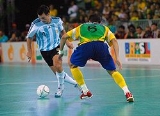
Futsal is a variant of association football that is played on a smaller pitch and mainly played indoors. Its name is a portmanteau of the Portuguese
futebol de salão
and the Spanish
fútbol de salón (colloquially fútbol sala), which can be translated as "hall football" or "indoor football". During the sport's second world championships held in Madrid in 1985, the name fútbol Sala was used. Since then, all other names have been officially and internationally changed to futsal.
Futsal is played between two teams each with five players, one of whom is the goalkeeper
. Unlimited substitutions are permitted. Unlike some other forms of indoor football
, the game is played on a hard court surface delimited by lines; walls or boards are not used. Futsal is also played with a smaller ball with less bounce than a regular football. The rules create an emphasis on improvisation, creativity and technique as well as ball control and passing in small spaces.
and FIFUSA over the administration of fútbol, FIFUSA coined the word fut-sal in 1985. The United States Futsal Federation, was the first National Association to call itself "FUTSAL" (September 3, 1986- USA, California-Art of Incorporation) after taking the hyphen out of the name used by FIFUSA and had FIFA incorporate the name FUTSAL in Article 27 of its status in 1989.
FIFA
took control of the World Championships in 1989. Under new rules made by FIFA, the technical aspects of the game for players and spectators were improved. The linesmen were replaced with a second referee, and there were unlimited substitutions. It also introduced a size 4 football, which was weighted to reduce bounce by 30% compared to a conventional ball, which enabled faster play and, for the first time, scoring goals with the head.
 FIFA's relationships with its member associations allowed more countries to gain knowledge and resources about futsal. FIFA soon began to administer its own indoor football games, hosting its first FIFA Indoor Soccer World Championship in 1989 in Rotterdam
, Netherlands
. In 1992, it was the FIFA Five-a-Side World Championship (Hong Kong
), and, since 1996, it has been called the FIFA Futsal World Championship
. Thanks to the increase of the number of nations that participated in the FIFA Futsal World Championships held in 2000, Brazil's dominance in the competition was ended by Spain.
In 2004, members of PANAFUTSAL (La Confederación Panamericana de Futsal, The Pan-American Futsal Confederation) formed AMF (Asociación Mundial de Fútbol de Salón, World Futsal Association), an international futsal governing body independent of FIFA. Both FIFA and AMF continue to administer the game.
the official rules of their respective versions of futsal. Like football
, futsal has laws that define all aspects of the game, including what may be changed to suit local competitions and leagues. There are seventeen laws in the Futsal Laws of the Game.
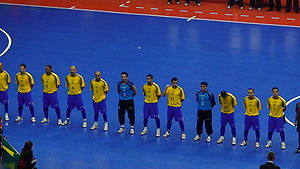 There are five players on each team, one of whom is the goalkeeper. The maximum number of substitutes allowed is seven, with unlimited substitutions during the match. Substitutes can come on even when the ball is in play. If a team has fewer than three players in the team, the match is abandoned.
The kit
is made up of a jersey or shirt with sleeves, shorts, socks, shinguards made out of rubber or plastic, and shoes with rubber soles. The goalkeeper is allowed to wear long trousers and a different coloured kit, to distinguish himself from the other players in the team and the referee. Jewellery is not allowed, as are other items that could be dangerous to the player wearing the effects or to other active participants.
The match is controlled by a referee, who enforces the Laws of the Game, and the first referee is the only one who can abandon the match because of interference from outside the pitch. This referee is also assisted by a second referee. The decisions made by the referees are final and can only be changed if the referees think it is necessary and play has not restarted. There is also a third referee and a timekeeper, who are provided with equipment to keep a record of fouls in the match. In the event of injury to the referee or second referee, the third referee will replace the second referee.
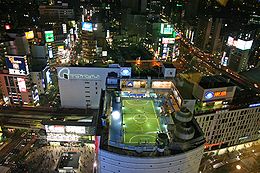 In front of each goal is an area known as the penalty area. This area is created by drawing quarter-circles with a 6 m (7 yd) radius from the goal line, centred on the goalposts. The upper part of each quarter-circle is then joined by a 3.16 m (3.46 yd) line running parallel to the goal line between the goalposts. The line marking the edge of the penalty area is known as the penalty area line. The penalty area marks where the goalkeeper is allowed to touch the ball with his hands. The penalty mark is six metres from the goal line when it reaches the middle of the goalposts. The second penalty mark is 10 metres (11 yd) from the goal line when it reaches the middle of the goalposts. A penalty kick from the penalty spot is awarded if a player commits a foul inside the penalty area. The second penalty spot is used if a player commits his team's sixth foul in the opposing team's half or in his own half in the area bordered by the halfway line and an imaginary line parallel to the halfway line passing through the second penalty mark; the free kick
is taken from the second penalty mark.
In some competitions, the game cannot end in a draw, so away goals, extra time and penalties are the three methods for determining the winner after a match has been drawn. Away goals mean that if the team's score is level after playing one home and one away game, the goals scored in the away match count as double. Extra time consists of two periods of five minutes. If no winner is produced after these methods, five penalties are taken, and the team that has scored the most wins. If it is not decided after five penalties, it continues to go on with one extra penalty to each team at a time until one of them has scored more goals than the other. Unlike extra time, the goals scored in a penalty shoot-out do not count towards the goals scored throughout the match.
If the ball goes over the goal line or touchline, hits the ceiling, or the play is stopped by the referee, the ball is out of play. If it hits the ceiling of an indoor arena, play is restarted with a kick-in to the opponents of the team that last touched the ball, under the place where it hit the ceiling.
An indirect free kick is awarded to the opposing team if a goalkeeper clears the ball but then touches it with his hands before anyone else, if he controls the ball with his hands when it has been kicked to him by a teammate, or if he touches or controls the ball with his hands or feet in his own half for more than four seconds.
An indirect free kick is also awarded to the opposing team if a player plays in a dangerous manner, deliberately obstructs an opponent, prevents the goalkeeper from throwing the ball with his hands or anything else for which play is stopped to caution or dismiss a player. The indirect free kick is taken from the place where the infringement occurred.
Yellow and red cards are both used in futsal. The yellow card is to caution players over their actions, and, if they get two, they are given a red card, which means they are sent off the field. A yellow card is shown if a player shows unsporting behaviour, dissent, persistent infringement of the Laws of the Game, delaying the restart of play, failing to respect the distance of the player from the ball when play is being restarted, infringement of substitution procedure or entering, re-entering and leaving the pitch without the referee's permission. A player is shown the red card and sent off if they engage in serious foul play, violent conduct, spitting at another person, or denying the opposing team a goal by handling the ball (except the goalkeeper inside his penalty area). Also punishable with a red card is denying an opponent moving towards the player's goal a goalscoring opportunity by committing an offence punishable by a free kick or a penalty kick and using offensive, insulting or abusive language or gestures. A player who has been sent off must leave the vicinity of the pitch. A substitute player is permitted to come on two minutes after a teammate has been sent off, unless a goal is scored before the end of the two minutes. If a team of five players scores against a team of fewer than five players, another player can be added to the team with fewer than five players. If the teams are equal when the goal is scored or if the team with fewer players scores, both teams remain with the same number of players.
As of November 26, 2011, the top 25 teams according to a ranking based partly on the ELO system and partly on a form-based system are:
http://www.futsalonline.co.uk/mersey-futsal-155.html
Portuguese language
Portuguese is a Romance language that arose in the medieval Kingdom of Galicia, nowadays Galicia and Northern Portugal. The southern part of the Kingdom of Galicia became independent as the County of Portugal in 1095...
futebol de salão
Futebol de Salão
Futebol de Salão is a Portuguese word that, in spite of meaning futsal in its original language, has come to be used in English to designate a slightly modified version of the FIFA-sanctioned five-a-side football...
and the Spanish
Spanish language
Spanish , also known as Castilian , is a Romance language in the Ibero-Romance group that evolved from several languages and dialects in central-northern Iberia around the 9th century and gradually spread with the expansion of the Kingdom of Castile into central and southern Iberia during the...
fútbol de salón (colloquially fútbol sala), which can be translated as "hall football" or "indoor football". During the sport's second world championships held in Madrid in 1985, the name fútbol Sala was used. Since then, all other names have been officially and internationally changed to futsal.
Futsal is played between two teams each with five players, one of whom is the goalkeeper
Goalkeeper
In many team sports which involve scoring goals, a goalkeeper is a designated player charged with directly preventing the opposing team from scoring by intercepting shots at goal...
. Unlimited substitutions are permitted. Unlike some other forms of indoor football
Indoor soccer
Indoor soccer or arena soccer, or six-a-side football in the United Kingdom, is a game derived from association football adapted for play in an indoor arena such as a turf-covered hockey arena or skating rink. The most important difference in play is that the indoor field is surrounded by a wall...
, the game is played on a hard court surface delimited by lines; walls or boards are not used. Futsal is also played with a smaller ball with less bounce than a regular football. The rules create an emphasis on improvisation, creativity and technique as well as ball control and passing in small spaces.
History
Futsal started in Montevideo, Uruguay, in 1930, when Juan Carlos Ceriani created a version of football for competition in YMCAs. In Brazil, this version developed on the streets of São Paulo, and, eventually, a rule book was published. The sport began to spread across South America, and its popularity ensured that a governing body was formed under the name of FIFUSA (Federación Internacional de Fútbol de Salón) in 1971, along with the World Championships. The first World Championships were held in Río de Janeiro, with hosts Brazil crowned champions ahead of Paraguay. Even more countries participated in the second World Championships held in Las Vegas in early 2000s. Due to a dispute between FIFAFIFA
The Fédération Internationale de Football Association , commonly known by the acronym FIFA , is the international governing body of :association football, futsal and beach football. Its headquarters are located in Zurich, Switzerland, and its president is Sepp Blatter, who is in his fourth...
and FIFUSA over the administration of fútbol, FIFUSA coined the word fut-sal in 1985. The United States Futsal Federation, was the first National Association to call itself "FUTSAL" (September 3, 1986- USA, California-Art of Incorporation) after taking the hyphen out of the name used by FIFUSA and had FIFA incorporate the name FUTSAL in Article 27 of its status in 1989.
FIFA
FIFA
The Fédération Internationale de Football Association , commonly known by the acronym FIFA , is the international governing body of :association football, futsal and beach football. Its headquarters are located in Zurich, Switzerland, and its president is Sepp Blatter, who is in his fourth...
took control of the World Championships in 1989. Under new rules made by FIFA, the technical aspects of the game for players and spectators were improved. The linesmen were replaced with a second referee, and there were unlimited substitutions. It also introduced a size 4 football, which was weighted to reduce bounce by 30% compared to a conventional ball, which enabled faster play and, for the first time, scoring goals with the head.
Rotterdam
Rotterdam is the second-largest city in the Netherlands and one of the largest ports in the world. Starting as a dam on the Rotte river, Rotterdam has grown into a major international commercial centre...
, Netherlands
Netherlands
The Netherlands is a constituent country of the Kingdom of the Netherlands, located mainly in North-West Europe and with several islands in the Caribbean. Mainland Netherlands borders the North Sea to the north and west, Belgium to the south, and Germany to the east, and shares maritime borders...
. In 1992, it was the FIFA Five-a-Side World Championship (Hong Kong
Hong Kong
Hong Kong is one of two Special Administrative Regions of the People's Republic of China , the other being Macau. A city-state situated on China's south coast and enclosed by the Pearl River Delta and South China Sea, it is renowned for its expansive skyline and deep natural harbour...
), and, since 1996, it has been called the FIFA Futsal World Championship
FIFA Futsal World Championship
The FIFA Futsal World Cup is the international championship for futsal, an indoor version of association football.The world championship tournament is held every four years, on the even year between two FIFA World Cups. The first event was held in 1989, the year FIFA became the world governing body...
. Thanks to the increase of the number of nations that participated in the FIFA Futsal World Championships held in 2000, Brazil's dominance in the competition was ended by Spain.
In 2004, members of PANAFUTSAL (La Confederación Panamericana de Futsal, The Pan-American Futsal Confederation) formed AMF (Asociación Mundial de Fútbol de Salón, World Futsal Association), an international futsal governing body independent of FIFA. Both FIFA and AMF continue to administer the game.
Rules
As international governing bodies of futsal, FIFA and AMF are responsible for maintaining and promulgatingPromulgation
Promulgation is the act of formally proclaiming or declaring a new statutory or administrative law after its enactment. In some jurisdictions this additional step is necessary before the law can take effect....
the official rules of their respective versions of futsal. Like football
Football (soccer)
Association football, more commonly known as football or soccer, is a sport played between two teams of eleven players with a spherical ball...
, futsal has laws that define all aspects of the game, including what may be changed to suit local competitions and leagues. There are seventeen laws in the Futsal Laws of the Game.
Players, equipment and officials
The kit
Kit
-Animals:* kit, a young ferret* a short form of kitten, a young cat* Kit fox, a relatively common North American fox* Kit, a group of domestic pigeons trained to perform together in competitions-Companies and organisations:...
is made up of a jersey or shirt with sleeves, shorts, socks, shinguards made out of rubber or plastic, and shoes with rubber soles. The goalkeeper is allowed to wear long trousers and a different coloured kit, to distinguish himself from the other players in the team and the referee. Jewellery is not allowed, as are other items that could be dangerous to the player wearing the effects or to other active participants.
The match is controlled by a referee, who enforces the Laws of the Game, and the first referee is the only one who can abandon the match because of interference from outside the pitch. This referee is also assisted by a second referee. The decisions made by the referees are final and can only be changed if the referees think it is necessary and play has not restarted. There is also a third referee and a timekeeper, who are provided with equipment to keep a record of fouls in the match. In the event of injury to the referee or second referee, the third referee will replace the second referee.
The pitch
The pitch is made up of wood or artificial material, Yinghui Court, or similar surface, although any flat, smooth and non-abrasive material may be used. The length of the pitch is in the range of 38–42 m, and the width is in the range of 20–25 m in international matches. For other matches, it can be 25–42 m in length, while the width can be 16–25 m, as long as the length of the longer boundary lines (touchlines) are greater than the shorter boundaries where the goals are placed (goal lines). The ceiling must be at least 4 m (4 yd) high. A rectangular goal is positioned at the middle of each goal line. The inner edges of the vertical goal posts must be 3 m (3 yd) apart, and the lower edge of the horizontal crossbar supported xx by the goal posts must be 2 m (2.2 yd) above the ground. Nets made of hemp, jute or nylon are attached to the back of the goalposts and crossbar. The lower part of the nets is attached to curved tubing or another suitable means of support. The depth of the goal is 80 cm at the top and 1 m at the bottom.Direct free kick
A direct free kick is a method of restarting play in a game of association football following a foul. Unlike an indirect free kick, a goal may be scored directly against the opposing side without the ball having first touched another player.-Award:...
is taken from the second penalty mark.
Duration and tie-breaking methods
A standard match consists of two equal periods of 20 minutes. The length of either half is extended to allow penalty kicks to be taken or a direct free kick to be taken against a team that has committed more than five fouls. The interval between the two halves cannot exceed 15 minutes.In some competitions, the game cannot end in a draw, so away goals, extra time and penalties are the three methods for determining the winner after a match has been drawn. Away goals mean that if the team's score is level after playing one home and one away game, the goals scored in the away match count as double. Extra time consists of two periods of five minutes. If no winner is produced after these methods, five penalties are taken, and the team that has scored the most wins. If it is not decided after five penalties, it continues to go on with one extra penalty to each team at a time until one of them has scored more goals than the other. Unlike extra time, the goals scored in a penalty shoot-out do not count towards the goals scored throughout the match.
The start and restart of play
At the beginning of the match, a coin toss is used to decide who will start the match. A kick-off is used to signal the start of play and is also used at the start of the second half and any periods of extra time. It is also used after a goal has been scored, with the other team starting the play. After a temporary stoppage for any reason not mentioned in the Laws of the Game, the referee will drop the ball where the play was stopped, provided that, prior to the stoppage, the ball was in play and had not crossed either the touch lines or goal lines.If the ball goes over the goal line or touchline, hits the ceiling, or the play is stopped by the referee, the ball is out of play. If it hits the ceiling of an indoor arena, play is restarted with a kick-in to the opponents of the team that last touched the ball, under the place where it hit the ceiling.
Misconduct
A direct free kick can be awarded to the opposing team if a player succeeds or attempts to kick or trip an opponent, jumps, charges or pushes an opponent, or strikes or attempts to strike an opponent. Holding, touching or spitting at an opponent are offenses that are worthy of a direct free kick, as are sliding in to play the ball while an opponent is playing it or carrying, striking or throwing the ball (except the goalkeeper). These are all accumulated fouls. The direct free kick is taken where the infringement occurred, unless it is awarded to the defending team in their penalty area, in which case the free kick may be taken from anywhere inside the penalty area. A penalty kick is awarded if a player commits one of the fouls that are worthy of a direct free kick inside his own penalty area. The position of the ball does not matter as long as it is in play.An indirect free kick is awarded to the opposing team if a goalkeeper clears the ball but then touches it with his hands before anyone else, if he controls the ball with his hands when it has been kicked to him by a teammate, or if he touches or controls the ball with his hands or feet in his own half for more than four seconds.
An indirect free kick is also awarded to the opposing team if a player plays in a dangerous manner, deliberately obstructs an opponent, prevents the goalkeeper from throwing the ball with his hands or anything else for which play is stopped to caution or dismiss a player. The indirect free kick is taken from the place where the infringement occurred.
Yellow and red cards are both used in futsal. The yellow card is to caution players over their actions, and, if they get two, they are given a red card, which means they are sent off the field. A yellow card is shown if a player shows unsporting behaviour, dissent, persistent infringement of the Laws of the Game, delaying the restart of play, failing to respect the distance of the player from the ball when play is being restarted, infringement of substitution procedure or entering, re-entering and leaving the pitch without the referee's permission. A player is shown the red card and sent off if they engage in serious foul play, violent conduct, spitting at another person, or denying the opposing team a goal by handling the ball (except the goalkeeper inside his penalty area). Also punishable with a red card is denying an opponent moving towards the player's goal a goalscoring opportunity by committing an offence punishable by a free kick or a penalty kick and using offensive, insulting or abusive language or gestures. A player who has been sent off must leave the vicinity of the pitch. A substitute player is permitted to come on two minutes after a teammate has been sent off, unless a goal is scored before the end of the two minutes. If a team of five players scores against a team of fewer than five players, another player can be added to the team with fewer than five players. If the teams are equal when the goal is scored or if the team with fewer players scores, both teams remain with the same number of players.
Men's ranking
As of November 21, 2011, the top 25 teams according to the ELO-based rankings are:| # | Team | Points |
|---|---|---|
| 1 | 1978 | |
| 2 | 1965 | |
| 3 | 1744 | |
| 4 | 1682 | |
| 5 | 1652 | |
| 6 | 1597 | |
| 7 | 1549 | |
| 8 | 1477 | |
| 9 | 1396 | |
| 10 | 1383 | |
| 11 | 1358 | |
| 12 | 1348 | |
| 13 | 1346 | |
| 14 | 1326 | |
| 15 | 1320 | |
| 16 | 1317 | |
| 17 | 1310 | |
| 18 | 1309 | |
| 19 | 1280 | |
| 20 | 1274 | |
| 21 | 1272 | |
| 22 | 1258 | |
| 23 | 1251 | |
| 24 | 1248 | |
| 25 | 1237 |
As of November 26, 2011, the top 25 teams according to a ranking based partly on the ELO system and partly on a form-based system are:
| # | Team | Points |
|---|---|---|
| 1 | 2364 | |
| 2 | 2324 | |
| 3 | 2257 | |
| 4 | 2256 | |
| 5 | 2245 | |
| 6 | 2220 | |
| 7 | 2192 | |
| 8 | 2136 | |
| 9 | 2120 | |
| 10 | 2099 | |
| 11 | 2090 | |
| 12 | 2079 | |
| 13 | 2072 | |
| 14 | 2070 | |
| 15 | 2066 | |
| 16 | 2061 | |
| 17 | 2059 | |
| 18 | 2048 | |
| 19 | 2037 | |
| 20 | 2034 | |
| 21 | 2013 | |
| 22 | 2005 | |
| 23 | 1975 | |
| 24 | 1972 | |
| 25 | 1949 |
Women's ranking
As of November 21, 2011, according to a ranking based partly on the ELO system and partly on a form-based system, the top 10 teams are:| # | Team | Points |
|---|---|---|
| 1 | 2275 | |
| 2 | 2173 | |
| 3 | 2110 | |
| 4 | 2009 | |
| 5 | 1980 | |
| 6 | 1872 | |
| 7 | 1853 | |
| 8 | 1851 | |
| 9 | 1827 | |
| 10 | 1810 |
International
| Competition | Year | City | Country | Winner  |
Runner-Up  |
3rd  |
4th |
|---|---|---|---|---|---|---|---|
| FIFA Futsal World Cups | 1989 1989 FIFA Futsal World Championship The 1989 FIFA Futsal World Cup was held in the Netherlands and won by Brazil. Laszlo Zsadanyi of Hungary was top scorer with 7 goals.-Group A:-----Group B:-----Group C:-----Group D:-Group A:-----Group B:-Final round:... |
Rotterdam Rotterdam Rotterdam is the second-largest city in the Netherlands and one of the largest ports in the world. Starting as a dam on the Rotte river, Rotterdam has grown into a major international commercial centre... |
Netherlands Netherlands The Netherlands is a constituent country of the Kingdom of the Netherlands, located mainly in North-West Europe and with several islands in the Caribbean. Mainland Netherlands borders the North Sea to the north and west, Belgium to the south, and Germany to the east, and shares maritime borders... |
||||
| 1992 1992 FIFA Futsal World Championship The 1992 edition of the FIFA Futsal World Championship was held in Hong Kong. It was the second world championship held under the aegis of football's world governing body.- Qualified nations :- Venues :- Squads :... |
Hong Kong Hong Kong Hong Kong is one of two Special Administrative Regions of the People's Republic of China , the other being Macau. A city-state situated on China's south coast and enclosed by the Pearl River Delta and South China Sea, it is renowned for its expansive skyline and deep natural harbour... |
China People's Republic of China China , officially the People's Republic of China , is the most populous country in the world, with over 1.3 billion citizens. Located in East Asia, the country covers approximately 9.6 million square kilometres... |
|||||
| 1996 1996 FIFA Futsal World Championship The 1996 edition of the FIFA Futsal World Championship was held in Spain. It was the third world championship held under the aegis of football's world governing body.- Venues :- Group A :--------- Group B :--------... |
Barcelona Barcelona Barcelona is the second largest city in Spain after Madrid, and the capital of Catalonia, with a population of 1,621,537 within its administrative limits on a land area of... |
Spain Spain Spain , officially the Kingdom of Spain languages]] under the European Charter for Regional or Minority Languages. In each of these, Spain's official name is as follows:;;;;;;), is a country and member state of the European Union located in southwestern Europe on the Iberian Peninsula... |
|||||
| 2000 2000 FIFA Futsal World Championship The 2000 edition of the FIFA Futsal World Championship was held between November 18 and December 3 in Guatemala. It was the 4th World Championship held under the aegis of football's world governing body.... |
Guatemala City Guatemala City Guatemala City , is the capital and largest city of the Republic of Guatemala and Central America... |
Guatemala Guatemala Guatemala is a country in Central America bordered by Mexico to the north and west, the Pacific Ocean to the southwest, Belize to the northeast, the Caribbean to the east, and Honduras and El Salvador to the southeast... |
|||||
| 2004 | Taipei City Taipei Taipei City is the capital of the Republic of China and the central city of the largest metropolitan area of Taiwan. Situated at the northern tip of the island, Taipei is located on the Tamsui River, and is about 25 km southwest of Keelung, its port on the Pacific Ocean... |
Chinese Taipei Chinese Taipei Chinese Taipei is the designated name used by the Republic of China , commonly known as Taiwan, to participate in some international organizations and almost all sporting events, such as the Olympics, Paralympics, Asian Games and Asian Para Games... |
|||||
| 2008 2008 FIFA Futsal World Cup The 2008 edition of the FIFA Futsal World Cup was held in Brazil from September 30 to October 19. It was the sixth World Championship held under the aegis of football's world governing body. The venues were Nilson Nelson Gymnasium in Brasília and Ginásio do Maracanãzinho in Rio de Janeiro. The... |
Rio de Janeiro Rio de Janeiro Rio de Janeiro , commonly referred to simply as Rio, is the capital city of the State of Rio de Janeiro, the second largest city of Brazil, and the third largest metropolitan area and agglomeration in South America, boasting approximately 6.3 million people within the city proper, making it the 6th... |
Brazil Brazil Brazil , officially the Federative Republic of Brazil , is the largest country in South America. It is the world's fifth largest country, both by geographical area and by population with over 192 million people... |
|||||
| 2012 2012 FIFA Futsal World Cup The 2012 FIFA Futsal World Cup will be the 7th FIFA Futsal World Cup, an international futsal tournament that is expected to take place 2-18 November 2012 in Thailand... |
Bangkok Bangkok Bangkok is the capital and largest urban area city in Thailand. It is known in Thai as Krung Thep Maha Nakhon or simply Krung Thep , meaning "city of angels." The full name of Bangkok is Krung Thep Mahanakhon Amon Rattanakosin Mahintharayutthaya Mahadilok Phop Noppharat Ratchathani Burirom... |
Thailand Thailand Thailand , officially the Kingdom of Thailand , formerly known as Siam , is a country located at the centre of the Indochina peninsula and Southeast Asia. It is bordered to the north by Burma and Laos, to the east by Laos and Cambodia, to the south by the Gulf of Thailand and Malaysia, and to the... |
|||||
| Al-Fateh Confederations Futsal Cup Al-Fateh Confederations Futsal Cup Al-Fateh Confederations Futsal Cup is a futsal tournament for national teams. It is contested by the winners of each of the six confederation championships .-Results:-Ranking:... |
2009 2009 Al-Fateh Confederations Futsal Cup The 2009 Al-Fateh Confederations Futsal Cup being the first Confederations Cup was held in Libya from 6 October to 11 October 2009. The draw was held on the 4th of October 2009 in Tripoli, After Spain withdraw on the 3rd of October it has been decided to be a 1 group competition... |
Tripoli Tripoli Tripoli is the capital and largest city in Libya. It is also known as Western Tripoli , to distinguish it from Tripoli, Lebanon. It is affectionately called The Mermaid of the Mediterranean , describing its turquoise waters and its whitewashed buildings. Tripoli is a Greek name that means "Three... |
Libya Libya Libya is an African country in the Maghreb region of North Africa bordered by the Mediterranean Sea to the north, Egypt to the east, Sudan to the southeast, Chad and Niger to the south, and Algeria and Tunisia to the west.... |
||||
| Mediterranean Futsal Cup Mediterranean Futsal Cup Mediterranean Futsal Cup is a futsal tournament for national teams from the countries form the Mediterranean sea.-Results:-Ranking:... |
2010 2010 Mediterranean Futsal Cup The Mediterranean Futsal Cup was an international futsal competition, this was the first edition of the competition.-Participating:The following 16 teams, shown with final pre-tournament rankings. AFC CAF UEFA -Draw pots:*Pot 1... |
Tripoli Tripoli Tripoli is the capital and largest city in Libya. It is also known as Western Tripoli , to distinguish it from Tripoli, Lebanon. It is affectionately called The Mermaid of the Mediterranean , describing its turquoise waters and its whitewashed buildings. Tripoli is a Greek name that means "Three... |
Libya Libya Libya is an African country in the Maghreb region of North Africa bordered by the Mediterranean Sea to the north, Egypt to the east, Sudan to the southeast, Chad and Niger to the south, and Algeria and Tunisia to the west.... |
||||
| Pan American Games Futsal at the Pan American Games Futsal at the Pan American Games was only held at the 2007 Pan American Games Rio de Janeiro, in 2007. The sport is not scheduled to be held at the 2011 Pan American Games, but is back in the Toronto 2015 Pan American Games.- Results :-References:... |
2007 Futsal at the 2007 Pan American Games Futsal at the 2007 Pan American Games took place at the Rio Centro Complex in a temporary facility. It was the first time the sport was played in a Pan American Games, mainly because Brazil hosted the games, and it is very popular there.... |
Rio de Janeiro Rio de Janeiro Rio de Janeiro , commonly referred to simply as Rio, is the capital city of the State of Rio de Janeiro, the second largest city of Brazil, and the third largest metropolitan area and agglomeration in South America, boasting approximately 6.3 million people within the city proper, making it the 6th... |
Brazil Brazil Brazil , officially the Federative Republic of Brazil , is the largest country in South America. It is the world's fifth largest country, both by geographical area and by population with over 192 million people... |
||||
| Futsal Mundialito Futsal Mundialito The Futsal Mundialito is a futsal competition of the same kind of the FIFA Futsal World Cup but with invited nations. It was first held in 1994.-Results:... |
1994 | Milano | Italy Italy Italy , officially the Italian Republic languages]] under the European Charter for Regional or Minority Languages. In each of these, Italy's official name is as follows:;;;;;;;;), is a unitary parliamentary republic in South-Central Europe. To the north it borders France, Switzerland, Austria and... |
||||
| 1995 | Rio de Janeiro Rio de Janeiro Rio de Janeiro , commonly referred to simply as Rio, is the capital city of the State of Rio de Janeiro, the second largest city of Brazil, and the third largest metropolitan area and agglomeration in South America, boasting approximately 6.3 million people within the city proper, making it the 6th... |
Brazil Brazil Brazil , officially the Federative Republic of Brazil , is the largest country in South America. It is the world's fifth largest country, both by geographical area and by population with over 192 million people... |
|||||
| 1996 | Rio de Janeiro Rio de Janeiro Rio de Janeiro , commonly referred to simply as Rio, is the capital city of the State of Rio de Janeiro, the second largest city of Brazil, and the third largest metropolitan area and agglomeration in South America, boasting approximately 6.3 million people within the city proper, making it the 6th... |
Brazil Brazil Brazil , officially the Federative Republic of Brazil , is the largest country in South America. It is the world's fifth largest country, both by geographical area and by population with over 192 million people... |
|||||
| 1998 | Rio de Janeiro Rio de Janeiro Rio de Janeiro , commonly referred to simply as Rio, is the capital city of the State of Rio de Janeiro, the second largest city of Brazil, and the third largest metropolitan area and agglomeration in South America, boasting approximately 6.3 million people within the city proper, making it the 6th... |
Brazil Brazil Brazil , officially the Federative Republic of Brazil , is the largest country in South America. It is the world's fifth largest country, both by geographical area and by population with over 192 million people... |
|||||
| 2001 | Joinville Joinville Joinville is a city in Santa Catarina State, in the Southern Region of Brazil. Joinville is Santa Catarina's largest city. In 2010, its population has reached approximately 520,000, many of whom are of German descent.... |
Brazil Brazil Brazil , officially the Federative Republic of Brazil , is the largest country in South America. It is the world's fifth largest country, both by geographical area and by population with over 192 million people... |
|||||
| 2002 | Reggio Calabria Reggio Calabria Reggio di Calabria , commonly known as Reggio Calabria or Reggio, is the biggest city and the most populated comune of Calabria, southern Italy, and is the capital of the Province of Reggio Calabria and seat of the Council of Calabrian government.Reggio is located on the "toe" of the Italian... |
Italy Italy Italy , officially the Italian Republic languages]] under the European Charter for Regional or Minority Languages. In each of these, Italy's official name is as follows:;;;;;;;;), is a unitary parliamentary republic in South-Central Europe. To the north it borders France, Switzerland, Austria and... |
|||||
| 2006 | Algarve | Portugal Portugal Portugal , officially the Portuguese Republic is a country situated in southwestern Europe on the Iberian Peninsula. Portugal is the westernmost country of Europe, and is bordered by the Atlantic Ocean to the West and South and by Spain to the North and East. The Atlantic archipelagos of the... |
|||||
| 2007 2007 Futsal Mundialito 2007 Futsal Mundialito is an international friendly championship in futsal. The tournament was held in Algarve, Portugal from 4 to 8 of July 2007... |
Algarve | Portugal Portugal Portugal , officially the Portuguese Republic is a country situated in southwestern Europe on the Iberian Peninsula. Portugal is the westernmost country of Europe, and is bordered by the Atlantic Ocean to the West and South and by Spain to the North and East. The Atlantic archipelagos of the... |
|||||
| 2008 2008 Futsal Mundialito 2008 Futsal Mundialito is an international friendly championship in futsal. The tournament was held in Algarve, Portugal from 2 to 6 of July 2008... |
Algarve | Portugal Portugal Portugal , officially the Portuguese Republic is a country situated in southwestern Europe on the Iberian Peninsula. Portugal is the westernmost country of Europe, and is bordered by the Atlantic Ocean to the West and South and by Spain to the North and East. The Atlantic archipelagos of the... |
|||||
| Grand Prix de Futsal Grand Prix de Futsal The Grand Prix de Futsal is an international futsal competition of the same kind of the FIFA Futsal World Championship but with invited nations and held annually in Brazil. It was first held in 2005.-Competition format:... |
2005 2005 Grand Prix de Futsal 16/09/2005Grand Prix das Américas 200520-24/9/2005Brusque/Santa Catarina -Group A Standing: 1. Brazil ---------------------------2-2-0-0-12—1--6 2. Uruguay --------------------------2-0-1-1--1--5--1 3. Venezuela ------------------------2-0-1-1--0--7--1... |
Brusque Brusque Futebol Clube Brusque Futebol Clube, usually known just as Brusque, is a football club from Brusque, Santa Catarina, Brazil, founded on October 12, 1987... |
Brazil Brazil Brazil , officially the Federative Republic of Brazil , is the largest country in South America. It is the world's fifth largest country, both by geographical area and by population with over 192 million people... |
||||
| 2006 2006 Grand Prix de Futsal The Grand Prix de Futsal is an international futsal competition of the same kind of the FIFA Futsal World Championship but with invited nations and held annually in Brazil.-Venue:*Caxias do Sul/Rio Grande do Sul... |
Caxias do Sul Caxias do Sul Caxias do Sul is a city in Rio Grande do Sul, Southern Brazil, situated in the state's mountainous Serra Gaúcha region. Coordinates: 29°10′0″ S, 51°11′0″ W.... |
Brazil Brazil Brazil , officially the Federative Republic of Brazil , is the largest country in South America. It is the world's fifth largest country, both by geographical area and by population with over 192 million people... |
|||||
| 2007 2007 Grand Prix de Futsal The 2007 Grand Prix de Futsal was an International Futsal Tournament that took place between 20th and 27th October, 2007, in Santa Caterina, Brazil, in three locations:*Joinville *Lages... |
Joinville Joinville Joinville is a city in Santa Catarina State, in the Southern Region of Brazil. Joinville is Santa Catarina's largest city. In 2010, its population has reached approximately 520,000, many of whom are of German descent.... & Lages Lages Lages, formerly Lajens, is a Brazilian town located in the central part of the state of Santa Catarina, in the region known in Portuguese as "Planalto Serrano".... & Jaragua do Sul |
Brazil Brazil Brazil , officially the Federative Republic of Brazil , is the largest country in South America. It is the world's fifth largest country, both by geographical area and by population with over 192 million people... with sex |
|||||
| 2008 2008 Grand Prix de Futsal 20/05/2008Grand Prix 2008Grand Prix 2008International Futsal Tournament4th EditionFortaleza 31/05-08/06/2008Halls:Ginásio Paulo SarasateGinásio da Universidade de Fortaleza Draw: 29/05/2008 at 19.30... |
Fortaleza Fortaleza Fortaleza is the state capital of Ceará, located in Northeastern Brazil. With a population close to 2.5 million , Fortaleza is the 5th largest city in Brazil. It has an area of and one of the highest demographic densities in the country... |
Brazil Brazil Brazil , officially the Federative Republic of Brazil , is the largest country in South America. It is the world's fifth largest country, both by geographical area and by population with over 192 million people... |
|||||
| 2009 2009 Grand Prix de Futsal -Classification 1st–8th:-Winner:... |
Anápolis Anápolis Anápolis is the third largest city in the State of Goiás in Brazil. It lies in the center of a rich agricultural region and has become a leader in food processing and pharmaceutical plants.-Location and population:... & Goiânia Goiânia -Climate:The city has a tropical wet and dry climate with an average temperature of . There's a wet season, from October to April, and a dry one, from May to September. Annual rainfall is around 1,520 mm.... |
Brazil Brazil Brazil , officially the Federative Republic of Brazil , is the largest country in South America. It is the world's fifth largest country, both by geographical area and by population with over 192 million people... |
|||||
| 2010 2010 Grand Prix de Futsal The Grand Prix de Futsal was an international futsal competition of the same kind of the FIFA Futsal World Championship but with invited nations and held annually in Brazil... |
Anápolis Anápolis Anápolis is the third largest city in the State of Goiás in Brazil. It lies in the center of a rich agricultural region and has become a leader in food processing and pharmaceutical plants.-Location and population:... |
Brazil Brazil Brazil , officially the Federative Republic of Brazil , is the largest country in South America. It is the world's fifth largest country, both by geographical area and by population with over 192 million people... |
|||||
| 2011 2011 Grand Prix de Futsal The Grand Prix de Futsal is an international futsal competition of the same kind as the FIFA Futsal World Cup but with invited nations and held annually in Brazil... |
Manaus Manaus Manaus is a city in Brazil, the capital of the state of Amazonas. It is situated at the confluence of the Negro and Solimões rivers. It is the most populous city of Amazonas, according to the statistics of Brazilian Institute of Geography and Statistics, and is a popular ecotourist destination.... |
Brazil Brazil Brazil , officially the Federative Republic of Brazil , is the largest country in South America. It is the world's fifth largest country, both by geographical area and by population with over 192 million people... |
|||||
| Arab Futsal Championship Arab Futsal Championship The Arab Futsal Championship is a futsal competition for Arab nations. It was first held in 1998.-Results:-Ranking:-External links:*... |
1998 1998 Arab Futsal Championship The 1998 Arab Futsal Championship took place in Cairo, Egypt from 6 December to 12 December 1998.Mauritania were originally invited, but declined and were replaced by Palestine.- Group 1:Matches-Group 2:Matches-Semifinals:... |
Cairo Cairo Cairo , is the capital of Egypt and the largest city in the Arab world and Africa, and the 16th largest metropolitan area in the world. Nicknamed "The City of a Thousand Minarets" for its preponderance of Islamic architecture, Cairo has long been a centre of the region's political and cultural life... |
Egypt Egypt Egypt , officially the Arab Republic of Egypt, Arabic: , is a country mainly in North Africa, with the Sinai Peninsula forming a land bridge in Southwest Asia. Egypt is thus a transcontinental country, and a major power in Africa, the Mediterranean Basin, the Middle East and the Muslim world... |
||||
| 2005 2005 Arab Futsal Championship The 2005 Arab Futsal Championship took place in Cairo, Egypt from 19 July to 24 July 2005.- Group 1:Matches-Group 2:Matches-Semifinals:-3rd Place:-Final:-Sources:**... |
Cairo Cairo Cairo , is the capital of Egypt and the largest city in the Arab world and Africa, and the 16th largest metropolitan area in the world. Nicknamed "The City of a Thousand Minarets" for its preponderance of Islamic architecture, Cairo has long been a centre of the region's political and cultural life... |
Egypt Egypt Egypt , officially the Arab Republic of Egypt, Arabic: , is a country mainly in North Africa, with the Sinai Peninsula forming a land bridge in Southwest Asia. Egypt is thus a transcontinental country, and a major power in Africa, the Mediterranean Basin, the Middle East and the Muslim world... |
|||||
| 2007 2007 Arab Futsal Championship The 2007 Arab Futsal Championship is the 3rd Championship and it took place in Tripoli, Libya from January 10 to January 20, 2007.-Group stage:-Matches:-Honors:*Best Player: Morad Bokare - *Best Goalkeeper: Mohammed Al-Sharif -... |
Tripoli Tripoli Tripoli is the capital and largest city in Libya. It is also known as Western Tripoli , to distinguish it from Tripoli, Lebanon. It is affectionately called The Mermaid of the Mediterranean , describing its turquoise waters and its whitewashed buildings. Tripoli is a Greek name that means "Three... |
Libya Libya Libya is an African country in the Maghreb region of North Africa bordered by the Mediterranean Sea to the north, Egypt to the east, Sudan to the southeast, Chad and Niger to the south, and Algeria and Tunisia to the west.... |
|||||
| 2008 2008 Arab Futsal Championship The Egyptian city of Port Said was the host of the fourth edition of the Arab Futsal Championship between December 23rd and 29th 2008.Ten teams took part, with Yemen making their futsal debut, and Syria making their competitive futsal debut after having previously played only 2 friendly matches... |
Port Said Port Said Port Said is a city that lies in north east Egypt extending about 30 km along the coast of the Mediterranean Sea, north of the Suez Canal, with an approximate population of 603,787... |
Egypt Egypt Egypt , officially the Arab Republic of Egypt, Arabic: , is a country mainly in North Africa, with the Sinai Peninsula forming a land bridge in Southwest Asia. Egypt is thus a transcontinental country, and a major power in Africa, the Mediterranean Basin, the Middle East and the Muslim world... |
Continental (major)
| Continental | Year | Country | Winner |
Runner-Up |
3rd |
4th |
|---|---|---|---|---|---|---|
| Africa (CAF) African Futsal Championship The African Futsal Championship is the main national futsal competition of the Confederation of African Football nations. It was first held in 1996 and has been played every four years.-Results:-Ranking:... |
1996 1996 African Futsal Championship The 1996 African Futsal Championship took place in Cairo, Egypt from September 25 to September 30 1996. tournament served as a qualifying tournament for the 1996 FIFA Futsal World Cup in Spain.-Matches:-Standings:-Honors:... |
Egypt Egypt Egypt , officially the Arab Republic of Egypt, Arabic: , is a country mainly in North Africa, with the Sinai Peninsula forming a land bridge in Southwest Asia. Egypt is thus a transcontinental country, and a major power in Africa, the Mediterranean Basin, the Middle East and the Muslim world... |
||||
| 2000 2000 African Futsal Championship The 2000 African Futsal Championship took place in Cairo, Egypt from April 16 to April 21 2000. tournament served as a qualifying tournament for the 2000 FIFA Futsal World Cup in Guatemala.-Matches:-Standings:-Honors:... |
Egypt Egypt Egypt , officially the Arab Republic of Egypt, Arabic: , is a country mainly in North Africa, with the Sinai Peninsula forming a land bridge in Southwest Asia. Egypt is thus a transcontinental country, and a major power in Africa, the Mediterranean Basin, the Middle East and the Muslim world... |
|||||
| 2004 | Egypt Egypt Egypt , officially the Arab Republic of Egypt, Arabic: , is a country mainly in North Africa, with the Sinai Peninsula forming a land bridge in Southwest Asia. Egypt is thus a transcontinental country, and a major power in Africa, the Mediterranean Basin, the Middle East and the Muslim world... |
|||||
| 2008 2008 African Futsal Championship The 2008 African Futsal Championship took place in Tripoli, Libya from 21 March to 30 March 2008. The tournament served as a qualifying tournament for the 2008 FIFA Futsal World Cup in Brazil.... |
Libya Libya Libya is an African country in the Maghreb region of North Africa bordered by the Mediterranean Sea to the north, Egypt to the east, Sudan to the southeast, Chad and Niger to the south, and Algeria and Tunisia to the west.... |
|||||
| Asia (AFC) AFC Futsal Championship The AFC Futsal Championship is the main national futsal competition of the Asian Football Confederation nations. It was first held in 1999 and has been played annually... |
1999 1999 AFC Futsal Championship The 1999 AFC Futsal Championship was held in Kuala Lumpur, Malaysia from 5 March to 10 March 1999.- Draw :- Group A:-------------------------------------Group B:---------------------Knockout stage:-Semifinals:----... |
Malaysia | ||||
| 2000 2000 AFC Futsal Championship The 2000 AFC Futsal Championship was held in Bangkok, Thailand from 5 May to 12 May 2000. The tournament acted as a qualifying tournament for the 2000 FIFA Futsal World Championship in Guatemala.- Draw :- Group A:------------------------... |
Thailand Thailand Thailand , officially the Kingdom of Thailand , formerly known as Siam , is a country located at the centre of the Indochina peninsula and Southeast Asia. It is bordered to the north by Burma and Laos, to the east by Laos and Cambodia, to the south by the Gulf of Thailand and Malaysia, and to the... |
|||||
| 2001 2001 AFC Futsal Championship The 2001 AFC Futsal Championship was held in Tehran, Iran from 14 July to 20 July 2001.- Draw :- Group A:-------------------------------------Group B:-------------------------------------Group C:--------... |
Iran Iran Iran , officially the Islamic Republic of Iran , is a country in Southern and Western Asia. The name "Iran" has been in use natively since the Sassanian era and came into use internationally in 1935, before which the country was known to the Western world as Persia... |
|||||
| 2002 2002 AFC Futsal Championship The 2002 AFC Futsal Championship was held in Jakarta, Indonesia from 22 October to 30 October 2002.- Draw :- Group A:-------------------------------------Group B:---------------------Group C:----------------... |
Indonesia Indonesia Indonesia , officially the Republic of Indonesia , is a country in Southeast Asia and Oceania. Indonesia is an archipelago comprising approximately 13,000 islands. It has 33 provinces with over 238 million people, and is the world's fourth most populous country. Indonesia is a republic, with an... |
|||||
| 2003 2003 AFC Futsal Championship The 2003 AFC Futsal Championship was held in Tehran and Karaj, Iran from 27 July to 5 August 2003.- Draw :- Group A:---------------------Group B:---------------------Group C:---------------------Group D:----... |
Iran Iran Iran , officially the Islamic Republic of Iran , is a country in Southern and Western Asia. The name "Iran" has been in use natively since the Sassanian era and came into use internationally in 1935, before which the country was known to the Western world as Persia... |
|||||
| 2004 2004 AFC Futsal Championship The 2004 AFC Futsal Championship was held in Macau, China from 16 April to 25 April 2004.- Draw :- Group A:-------------------------------------Group B:---------------------Group C:--------------------... |
Macau Macau Macau , also spelled Macao , is, along with Hong Kong, one of the two special administrative regions of the People's Republic of China... |
|||||
| 2005 2005 AFC Futsal Championship The 2005 AFC Futsal Championship was held in Ho Chi Min City, Vietnam from 22 May to 4 June 2005.- Draw :- Group A :--------------------- Group B :--------------------- Group C :--------------------- Group D :... |
Vietnam Vietnam Vietnam – sometimes spelled Viet Nam , officially the Socialist Republic of Vietnam – is the easternmost country on the Indochina Peninsula in Southeast Asia. It is bordered by China to the north, Laos to the northwest, Cambodia to the southwest, and the South China Sea –... |
|
||||
| 2006 2006 AFC Futsal Championship The 2006 AFC Futsal Championship was held in Tashkent, Uzbekistan from 21 May to 27 May 2006.- Draw :The draw for the 2006 AFC Futsal Championship was held on 27 April 2006 in Tashkent, Uzbekistan.- Group A :--------------------- Group B :... |
Uzbekistan Uzbekistan Uzbekistan , officially the Republic of Uzbekistan is a doubly landlocked country in Central Asia and one of the six independent Turkic states. It shares borders with Kazakhstan to the west and to the north, Kyrgyzstan and Tajikistan to the east, and Afghanistan and Turkmenistan to the south.... |
|||||
| 2007 2007 AFC Futsal Championship The 2007 AFC Futsal Championship was held in Osaka and Amagasaki, Japan from 13 May to 19 May 2007.- Draw :The draw for the 2007 AFC Futsal Championship was held on 11 April 2007 in Tokyo, Japan.- Group A :--------------------- Group B :... |
Japan Japan Japan is an island nation in East Asia. Located in the Pacific Ocean, it lies to the east of the Sea of Japan, China, North Korea, South Korea and Russia, stretching from the Sea of Okhotsk in the north to the East China Sea and Taiwan in the south... |
|||||
| 2008 2008 AFC Futsal Championship The 2008 AFC Futsal Championship was held in Bangkok, Thailand from 11 May to 18 May 2008. The tournament acted as a qualifying tournament for the 2008 FIFA Futsal World Cup in Brazil.- Draw :... |
Thailand Thailand Thailand , officially the Kingdom of Thailand , formerly known as Siam , is a country located at the centre of the Indochina peninsula and Southeast Asia. It is bordered to the north by Burma and Laos, to the east by Laos and Cambodia, to the south by the Gulf of Thailand and Malaysia, and to the... |
|||||
| 2010 2010 AFC Futsal Championship The 2010 AFC Futsal Championship was held in Tashkent, Uzbekistan from 23 May to 30 May 2010.- Draw :The draw for the 2010 AFC Futsal Championship was held on 20 March 2010 in Tashkent, Uzbekistan.-Group A:---------------------Group B:... |
Uzbekistan Uzbekistan Uzbekistan , officially the Republic of Uzbekistan is a doubly landlocked country in Central Asia and one of the six independent Turkic states. It shares borders with Kazakhstan to the west and to the north, Kyrgyzstan and Tajikistan to the east, and Afghanistan and Turkmenistan to the south.... |
|||||
| Europe (UEFA) UEFA Futsal Championship The UEFA Futsal Championship is the main futsal competition of the men's national futsal teams governed by UEFA .-Statistics:-Performance by nations:-External links:... |
1996 1996 UEFA Futsal Championship The 1996 UEFA Futsal Championship was the 1st official edition of the UEFA-governed European Championship for national futsal teams. It was held in Spain, between January 8 and January 14, 1996, in one venue located in the city of Córdoba.-Qualified teams:... |
Spain Spain Spain , officially the Kingdom of Spain languages]] under the European Charter for Regional or Minority Languages. In each of these, Spain's official name is as follows:;;;;;;), is a country and member state of the European Union located in southwestern Europe on the Iberian Peninsula... |
||||
| 1999 1999 UEFA Futsal Championship The 1999 UEFA Futsal Championship was the 2nd official edition of the UEFA-governed European Championship for national futsal teams. It was held in Spain, between 22 February and 28 February, 1999, in one venue located in the city of Granada.-Qualified teams:... |
Spain Spain Spain , officially the Kingdom of Spain languages]] under the European Charter for Regional or Minority Languages. In each of these, Spain's official name is as follows:;;;;;;), is a country and member state of the European Union located in southwestern Europe on the Iberian Peninsula... |
|||||
| 2001 2001 UEFA Futsal Championship The 2001 UEFA Futsal Championship was the 3rd official edition of the UEFA-governed European Championship for national futsal teams. It was held in Russia, between 22 February and 28 February 2001, in one venue located in the city of Moscow.-Qualified teams:... |
Russia Russia Russia or , officially known as both Russia and the Russian Federation , is a country in northern Eurasia. It is a federal semi-presidential republic, comprising 83 federal subjects... |
|||||
| 2003 2003 UEFA Futsal Championship The 2003 UEFA Futsal Championship was the 4th official edition of the UEFA-governed European Championship for national futsal teams. It was held in Italy, between 17 February and 24 February, 2003, in two venues located in Aversa & Caserta.-Qualified teams:... |
Italy Italy Italy , officially the Italian Republic languages]] under the European Charter for Regional or Minority Languages. In each of these, Italy's official name is as follows:;;;;;;;;), is a unitary parliamentary republic in South-Central Europe. To the north it borders France, Switzerland, Austria and... |
|||||
| 2005 2005 UEFA Futsal Championship The 2005 UEFA Futsal Championship was the 5th official edition of the UEFA-governed European Championship for national futsal teams. It was held in Ostrava, Czech Republic, between 14 February and 20 February 2005. Recent world champions Spain regained their European title with victory over rivals... |
Czech Republic Czech Republic The Czech Republic is a landlocked country in Central Europe. The country is bordered by Poland to the northeast, Slovakia to the east, Austria to the south, and Germany to the west and northwest.... |
|||||
| 2007 2007 UEFA Futsal Championship The 2007 UEFA Futsal Championship was the fifth official edition of the UEFA-governed European Championship for national futsal teams. It was held in Portugal, between November 16 and November 25, 2007, in two venues located in Porto's Greater Metropolitan Area — Gondomar and Santo Tirso... |
Portugal Portugal Portugal , officially the Portuguese Republic is a country situated in southwestern Europe on the Iberian Peninsula. Portugal is the westernmost country of Europe, and is bordered by the Atlantic Ocean to the West and South and by Spain to the North and East. The Atlantic archipelagos of the... |
|||||
| 2010 2010 UEFA Futsal Championship The 2010 UEFA Futsal Championship was the sixth official edition of the UEFA-governed European Championship for national futsal teams. It was hosted by Hungary, between January 19 and January 30, 2010, in two venues located in Budapest and Debrecen... |
Hungary Hungary Hungary , officially the Republic of Hungary , is a landlocked country in Central Europe. It is situated in the Carpathian Basin and is bordered by Slovakia to the north, Ukraine and Romania to the east, Serbia and Croatia to the south, Slovenia to the southwest and Austria to the west. The... |
|||||
| 2012 2012 UEFA Futsal Championship The 2012 UEFA Futsal Championship is the 8th official edition of the UEFA European Championship for national futsal teams. It is hosted by Croatia, and is played in February 2012. 12 teams will compete for the title, with 11 teams gain entries from qualification rounds. Croatia gain automatic entry... |
Croatia Croatia Croatia , officially the Republic of Croatia , is a unitary democratic parliamentary republic in Europe at the crossroads of the Mitteleuropa, the Balkans, and the Mediterranean. Its capital and largest city is Zagreb. The country is divided into 20 counties and the city of Zagreb. Croatia covers ... |
|||||
| North American and Central American(CONCACAF) | 1996 | Guatemala Guatemala Guatemala is a country in Central America bordered by Mexico to the north and west, the Pacific Ocean to the southwest, Belize to the northeast, the Caribbean to the east, and Honduras and El Salvador to the southeast... |
||||
| 2000 | Costa Rica Costa Rica Costa Rica , officially the Republic of Costa Rica is a multilingual, multiethnic and multicultural country in Central America, bordered by Nicaragua to the north, Panama to the southeast, the Pacific Ocean to the west and the Caribbean Sea to the east.... |
|||||
| 2004 | Costa Rica Costa Rica Costa Rica , officially the Republic of Costa Rica is a multilingual, multiethnic and multicultural country in Central America, bordered by Nicaragua to the north, Panama to the southeast, the Pacific Ocean to the west and the Caribbean Sea to the east.... |
|||||
| 2008 | Guatemala Guatemala Guatemala is a country in Central America bordered by Mexico to the north and west, the Pacific Ocean to the southwest, Belize to the northeast, the Caribbean to the east, and Honduras and El Salvador to the southeast... |
|||||
| Oceanian (OFC) Oceanian Futsal Championship The Oceanian Futsal Championship is the main national futsal competition of the Oceania Football Confederation nations. It was first held in 1992.The competition was initially held every four years. From 2008 onwards, however, it became an annual tournament.... |
1992 | Australia Australia Australia , officially the Commonwealth of Australia, is a country in the Southern Hemisphere comprising the mainland of the Australian continent, the island of Tasmania, and numerous smaller islands in the Indian and Pacific Oceans. It is the world's sixth-largest country by total area... |
||||
| 1996 | Vanuatu Vanuatu Vanuatu , officially the Republic of Vanuatu , is an island nation located in the South Pacific Ocean. The archipelago, which is of volcanic origin, is some east of northern Australia, northeast of New Caledonia, west of Fiji, and southeast of the Solomon Islands, near New Guinea.Vanuatu was... |
|||||
| 1999 | Vanuatu Vanuatu Vanuatu , officially the Republic of Vanuatu , is an island nation located in the South Pacific Ocean. The archipelago, which is of volcanic origin, is some east of northern Australia, northeast of New Caledonia, west of Fiji, and southeast of the Solomon Islands, near New Guinea.Vanuatu was... |
|||||
| 2004 2004 Oceanian Futsal Championship The 2004 OFC Futsal Championship was the fourth edition of the main international futsal tournament of the Oceanian region. It took place in Canberra, Australia from 25 to 29 July 2004.... |
Australia Australia Australia , officially the Commonwealth of Australia, is a country in the Southern Hemisphere comprising the mainland of the Australian continent, the island of Tasmania, and numerous smaller islands in the Indian and Pacific Oceans. It is the world's sixth-largest country by total area... |
|||||
| 2008 2008 Oceanian Futsal Championship The 2008 OFC Futsal Championship was the fifth edition of the main international futsal tournament of the Oceanian region. It took place in Suva, Fiji from 8 June to 14 June 2008.... |
Fiji Fiji Fiji , officially the Republic of Fiji , is an island nation in Melanesia in the South Pacific Ocean about northeast of New Zealand's North Island... |
|||||
| 2009 2009 Oceanian Futsal Championship The 2009 OFC Futsal Championship was the sixth edition of the main international futsal tournament of the Oceanian region. It took place from July 7 to July 11, 2009, and was hosted by Fiji, which had also hosted the previous edition... |
Fiji Fiji Fiji , officially the Republic of Fiji , is an island nation in Melanesia in the South Pacific Ocean about northeast of New Zealand's North Island... |
|||||
| 2010 2010 Oceanian Futsal Championship The 2010 OFC Futsal Championship was the seventh edition of the main international futsal tournament of the Oceanian region. It took place from August 8 to August 14, 2010, and was hosted by Fiji, which had also hosted the two previous editions.... |
Fiji Fiji Fiji , officially the Republic of Fiji , is an island nation in Melanesia in the South Pacific Ocean about northeast of New Zealand's North Island... |
|||||
| 2011 | Fiji Fiji Fiji , officially the Republic of Fiji , is an island nation in Melanesia in the South Pacific Ocean about northeast of New Zealand's North Island... |
|||||
| South American (CONMEBOL) | 1992 | Brazil Brazil Brazil , officially the Federative Republic of Brazil , is the largest country in South America. It is the world's fifth largest country, both by geographical area and by population with over 192 million people... |
||||
| 1995 | Brazil Brazil Brazil , officially the Federative Republic of Brazil , is the largest country in South America. It is the world's fifth largest country, both by geographical area and by population with over 192 million people... |
|||||
| 1996 | Brazil Brazil Brazil , officially the Federative Republic of Brazil , is the largest country in South America. It is the world's fifth largest country, both by geographical area and by population with over 192 million people... |
|||||
| 1997 | Brazil Brazil Brazil , officially the Federative Republic of Brazil , is the largest country in South America. It is the world's fifth largest country, both by geographical area and by population with over 192 million people... |
|||||
| 1998 | Brazil Brazil Brazil , officially the Federative Republic of Brazil , is the largest country in South America. It is the world's fifth largest country, both by geographical area and by population with over 192 million people... |
|||||
| 1999 | Brazil Brazil Brazil , officially the Federative Republic of Brazil , is the largest country in South America. It is the world's fifth largest country, both by geographical area and by population with over 192 million people... |
|||||
| 2000 | Brazil Brazil Brazil , officially the Federative Republic of Brazil , is the largest country in South America. It is the world's fifth largest country, both by geographical area and by population with over 192 million people... |
|||||
| 2003 | Paraguay Paraguay Paraguay , officially the Republic of Paraguay , is a landlocked country in South America. It is bordered by Argentina to the south and southwest, Brazil to the east and northeast, and Bolivia to the northwest. Paraguay lies on both banks of the Paraguay River, which runs through the center of the... |
|||||
| 2008 2008 Copa América - FIFA Futsal The 2008 CONMEBOL Futsal Championship was the 20th edition of the main international futsal tournament of the South America region. It took place in Montevideo, Uruguay from 23 June to 28 June 2008.... |
Uruguay Uruguay Uruguay ,officially the Oriental Republic of Uruguay,sometimes the Eastern Republic of Uruguay; ) is a country in the southeastern part of South America. It is home to some 3.5 million people, of whom 1.8 million live in the capital Montevideo and its metropolitan area... |
|||||
| 2011 | Argentina Argentina Argentina , officially the Argentine Republic , is the second largest country in South America by land area, after Brazil. It is constituted as a federation of 23 provinces and an autonomous city, Buenos Aires... |
Asia
- Asian Indoor Games Futsal ChampionshipAsian Indoor Games Futsal ChampionshipThe Futsal at the Asian Indoor Games is a futsal competition of the Asian Indoor Games. It was first held in 2005.-Men:-Women:-Medal table:-Men:-Women:-References:*, FutsalPlanet.com...
- ASEAN Futsal ChampionshipASEAN Futsal ChampionshipThe AFF Futsal Championship or ASEAN Futsal Championship is an international futsal competition of the Southeast Asian nations and is sanctioned by the ASEAN Football Federation . It was first held in 2001 which took place every two years only until 2005, when it became an annual competition.-...
- West Asian Futsal ChampionshipWest Asian Futsal ChampionshipThe WAFF Futsal Championship is a futsal competition organised by the West Asian Football Federation.-Men's Futsal Tournaments:- Total Wins :- External links :**- See also :*West Asian Football Federation Championship...
Clubs
- Futsal Intercontinental Clubs Cup
- UEFA Futsal CupUEFA Futsal CupThe UEFA Futsal Cup is an annual futsal competition for European club teams. It was founded in 2001–02, replacing the Futsal European Clubs Championship, a former competition never recognized as official, despite their 15 editions. The final of the 1st edition was disputed as a single game in...
- South American Club Futsal Championship
- AFC Futsal Club ChampionshipAFC Futsal Club ChampionshipThe AFC Futsal Club Championship is the current annual Asian futsal club competition hosted by Asian Football Confederation .One Futsal Club side each from Australia, China, Iran, Iraq, Japan, Kyrgyzstan, Lebanon, Qatar, Thailand and Uzbekistan will take part in the July 4-12 tournament at a venue...
International
| Competition | Year | Host | Winner |
Runner-Up |
3rd |
4th |
|---|---|---|---|---|---|---|
| Women's Futsal World Cup | 2010 2010 Futsal Women's World Cup The 2010 edition of the Women's Futsal World Cup was held in Spain from December 6 to December 11. It was the 1st World Cup held under FIFA futsal rules. The venues were José Caballero in Alcobendas and Jorge Garbajosa in Torrejon de Ardoz.-Venues:... |
Spain Spain Spain , officially the Kingdom of Spain languages]] under the European Charter for Regional or Minority Languages. In each of these, Spain's official name is as follows:;;;;;;), is a country and member state of the European Union located in southwestern Europe on the Iberian Peninsula... |
& | |||
Continental
| Continental | Year | Host | Winner |
Runner-Up |
3rd |
4th |
|---|---|---|---|---|---|---|
| South American South American Women's Futsal Championship -Results:-Total Wins:... |
2005 | Brazil Brazil Brazil , officially the Federative Republic of Brazil , is the largest country in South America. It is the world's fifth largest country, both by geographical area and by population with over 192 million people... |
||||
| 2007 | Ecuador Ecuador Ecuador , officially the Republic of Ecuador is a representative democratic republic in South America, bordered by Colombia on the north, Peru on the east and south, and by the Pacific Ocean to the west. It is one of only two countries in South America, along with Chile, that do not have a border... |
International
| Competition | Year | City | Country | Winner |
Runner-Up |
3rd |
4th |
|---|---|---|---|---|---|---|---|
| FIFUSA World Futsal Championships | 1982 | São Paulo São Paulo São Paulo is the largest city in Brazil, the largest city in the southern hemisphere and South America, and the world's seventh largest city by population. The metropolis is anchor to the São Paulo metropolitan area, ranked as the second-most populous metropolitan area in the Americas and among... |
Brazil Brazil Brazil , officially the Federative Republic of Brazil , is the largest country in South America. It is the world's fifth largest country, both by geographical area and by population with over 192 million people... |
||||
| 1985 | Madrid Madrid Madrid is the capital and largest city of Spain. The population of the city is roughly 3.3 million and the entire population of the Madrid metropolitan area is calculated to be 6.271 million. It is the third largest city in the European Union, after London and Berlin, and its metropolitan... |
Spain Spain Spain , officially the Kingdom of Spain languages]] under the European Charter for Regional or Minority Languages. In each of these, Spain's official name is as follows:;;;;;;), is a country and member state of the European Union located in southwestern Europe on the Iberian Peninsula... |
|||||
| 1988 | Melbourne Melbourne Melbourne is the capital and most populous city in the state of Victoria, and the second most populous city in Australia. The Melbourne City Centre is the hub of the greater metropolitan area and the Census statistical division—of which "Melbourne" is the common name. As of June 2009, the greater... |
Australia Australia Australia , officially the Commonwealth of Australia, is a country in the Southern Hemisphere comprising the mainland of the Australian continent, the island of Tasmania, and numerous smaller islands in the Indian and Pacific Oceans. It is the world's sixth-largest country by total area... |
|||||
| 1991 | Italy Italy Italy , officially the Italian Republic languages]] under the European Charter for Regional or Minority Languages. In each of these, Italy's official name is as follows:;;;;;;;;), is a unitary parliamentary republic in South-Central Europe. To the north it borders France, Switzerland, Austria and... |
||||||
| 1994 | Argentina Argentina Argentina , officially the Argentine Republic , is the second largest country in South America by land area, after Brazil. It is constituted as a federation of 23 provinces and an autonomous city, Buenos Aires... |
||||||
| 1997 | Mexico Mexico The United Mexican States , commonly known as Mexico , is a federal constitutional republic in North America. It is bordered on the north by the United States; on the south and west by the Pacific Ocean; on the southeast by Guatemala, Belize, and the Caribbean Sea; and on the east by the Gulf of... |
||||||
| 2000 | Bolivia Bolivia Bolivia officially known as Plurinational State of Bolivia , is a landlocked country in central South America. It is the poorest country in South America... |
||||||
| AMF World Futsal Championships | 2003 | Asunción Asunción Asunción is the capital and largest city of Paraguay.The "Ciudad de Asunción" is an autonomous capital district not part of any department. The metropolitan area, called Gran Asunción, includes the cities of San Lorenzo, Fernando de la Mora, Lambaré, Luque, Mariano Roque Alonso, Ñemby, San... |
Paraguay Paraguay Paraguay , officially the Republic of Paraguay , is a landlocked country in South America. It is bordered by Argentina to the south and southwest, Brazil to the east and northeast, and Bolivia to the northwest. Paraguay lies on both banks of the Paraguay River, which runs through the center of the... |
||||
| 2007 | Mendoza Mendoza, Argentina Mendoza is the capital city of Mendoza Province, in Argentina. It is located in the northern-central part of the province, in a region of foothills and high plains, on the eastern side of the Andes. As of the , Mendoza's population was 110,993... |
Argentina Argentina Argentina , officially the Argentine Republic , is the second largest country in South America by land area, after Brazil. It is constituted as a federation of 23 provinces and an autonomous city, Buenos Aires... |
|||||
| 2011 | Bogotá Bogotá Bogotá, Distrito Capital , from 1991 to 2000 called Santa Fé de Bogotá, is the capital, and largest city, of Colombia. It is also designated by the national constitution as the capital of the department of Cundinamarca, even though the city of Bogotá now comprises an independent Capital district... |
Colombia Colombia Colombia, officially the Republic of Colombia , is a unitary constitutional republic comprising thirty-two departments. The country is located in northwestern South America, bordered to the east by Venezuela and Brazil; to the south by Ecuador and Peru; to the north by the Caribbean Sea; to the... |
Continental (major)
| Continental | Year | Country | Winner |
Runner-Up |
3rd |
4th |
|---|---|---|---|---|---|---|
| Europe (UEFS) | 1989 | Spain Spain Spain , officially the Kingdom of Spain languages]] under the European Charter for Regional or Minority Languages. In each of these, Spain's official name is as follows:;;;;;;), is a country and member state of the European Union located in southwestern Europe on the Iberian Peninsula... |
||||
| 1990 | Portugal Portugal Portugal , officially the Portuguese Republic is a country situated in southwestern Europe on the Iberian Peninsula. Portugal is the westernmost country of Europe, and is bordered by the Atlantic Ocean to the West and South and by Spain to the North and East. The Atlantic archipelagos of the... |
|||||
| 1992 | Portugal Portugal Portugal , officially the Portuguese Republic is a country situated in southwestern Europe on the Iberian Peninsula. Portugal is the westernmost country of Europe, and is bordered by the Atlantic Ocean to the West and South and by Spain to the North and East. The Atlantic archipelagos of the... |
|||||
| 1995 | Morocco Morocco Morocco , officially the Kingdom of Morocco , is a country located in North Africa. It has a population of more than 32 million and an area of 710,850 km², and also primarily administers the disputed region of the Western Sahara... |
|||||
| 1998 | Slovakia Slovakia The Slovak Republic is a landlocked state in Central Europe. It has a population of over five million and an area of about . Slovakia is bordered by the Czech Republic and Austria to the west, Poland to the north, Ukraine to the east and Hungary to the south... |
|||||
| 2004 | Belarus Belarus Belarus , officially the Republic of Belarus, is a landlocked country in Eastern Europe, bordered clockwise by Russia to the northeast, Ukraine to the south, Poland to the west, and Lithuania and Latvia to the northwest. Its capital is Minsk; other major cities include Brest, Grodno , Gomel ,... |
|||||
| 2006 | Catalonia Catalonia Catalonia is an autonomous community in northeastern Spain, with the official status of a "nationality" of Spain. Catalonia comprises four provinces: Barcelona, Girona, Lleida, and Tarragona. Its capital and largest city is Barcelona. Catalonia covers an area of 32,114 km² and has an... |
|||||
| 2008 | Belgium Belgium Belgium , officially the Kingdom of Belgium, is a federal state in Western Europe. It is a founding member of the European Union and hosts the EU's headquarters, and those of several other major international organisations such as NATO.Belgium is also a member of, or affiliated to, many... |
|||||
| 2010 2010 UEFS Futsal Men's Championship The 2010 UEFS Futsal Men's Championship is the 9th men's UEFS futsal championship, held in Kaliningrad and Gusev from April 3 to 8, with 11 national teams.-Teams:-Group A:-----Group B:-----Group C:-----Group D:... |
Russia Russia Russia or , officially known as both Russia and the Russian Federation , is a country in northern Eurasia. It is a federal semi-presidential republic, comprising 83 federal subjects... |
|||||
| South American | ||||||
| 1964 | Paraguay Paraguay Paraguay , officially the Republic of Paraguay , is a landlocked country in South America. It is bordered by Argentina to the south and southwest, Brazil to the east and northeast, and Bolivia to the northwest. Paraguay lies on both banks of the Paraguay River, which runs through the center of the... |
|||||
| 1969 | Paraguay Paraguay Paraguay , officially the Republic of Paraguay , is a landlocked country in South America. It is bordered by Argentina to the south and southwest, Brazil to the east and northeast, and Bolivia to the northwest. Paraguay lies on both banks of the Paraguay River, which runs through the center of the... |
|||||
| 1971 | Brazil Brazil Brazil , officially the Federative Republic of Brazil , is the largest country in South America. It is the world's fifth largest country, both by geographical area and by population with over 192 million people... |
|||||
| 1973 | Uruguay Uruguay Uruguay ,officially the Oriental Republic of Uruguay,sometimes the Eastern Republic of Uruguay; ) is a country in the southeastern part of South America. It is home to some 3.5 million people, of whom 1.8 million live in the capital Montevideo and its metropolitan area... |
|||||
| 1975 | Argentina Argentina Argentina , officially the Argentine Republic , is the second largest country in South America by land area, after Brazil. It is constituted as a federation of 23 provinces and an autonomous city, Buenos Aires... |
|||||
| 1976 | Uruguay Uruguay Uruguay ,officially the Oriental Republic of Uruguay,sometimes the Eastern Republic of Uruguay; ) is a country in the southeastern part of South America. It is home to some 3.5 million people, of whom 1.8 million live in the capital Montevideo and its metropolitan area... |
|||||
| 1977 | Brazil Brazil Brazil , officially the Federative Republic of Brazil , is the largest country in South America. It is the world's fifth largest country, both by geographical area and by population with over 192 million people... |
|||||
| 1979 | Colombia Colombia Colombia, officially the Republic of Colombia , is a unitary constitutional republic comprising thirty-two departments. The country is located in northwestern South America, bordered to the east by Venezuela and Brazil; to the south by Ecuador and Peru; to the north by the Caribbean Sea; to the... |
|||||
| 1983 | Uruguay Uruguay Uruguay ,officially the Oriental Republic of Uruguay,sometimes the Eastern Republic of Uruguay; ) is a country in the southeastern part of South America. It is home to some 3.5 million people, of whom 1.8 million live in the capital Montevideo and its metropolitan area... |
|||||
| 1986 | Argentina Argentina Argentina , officially the Argentine Republic , is the second largest country in South America by land area, after Brazil. It is constituted as a federation of 23 provinces and an autonomous city, Buenos Aires... |
|||||
| 1989 | Brazil Brazil Brazil , officially the Federative Republic of Brazil , is the largest country in South America. It is the world's fifth largest country, both by geographical area and by population with over 192 million people... |
International
| Competition | Year | Host | Winner |
Runner-Up |
3rd |
4th |
|---|---|---|---|---|---|---|
| AMF World Futsal Championships | 2008 | Catalonia Catalonia Catalonia is an autonomous community in northeastern Spain, with the official status of a "nationality" of Spain. Catalonia comprises four provinces: Barcelona, Girona, Lleida, and Tarragona. Its capital and largest city is Barcelona. Catalonia covers an area of 32,114 km² and has an... |
Continental
| Continental | Year | Host | Winner |
Runner-Up |
3rd |
4th |
|---|---|---|---|---|---|---|
| Europe (UEFS) UEFS Futsal Women's Championship The UEFS Futsal European Women's Championships or Eurofutsal is the championship for futsal national teams in Europe, held first in 2001 and played every 3 years until 2007 and every 2 years since then.-Summaries:- External links :*... |
2001 | Russia Russia Russia or , officially known as both Russia and the Russian Federation , is a country in northern Eurasia. It is a federal semi-presidential republic, comprising 83 federal subjects... |
||||
| 2004 | Russia Russia Russia or , officially known as both Russia and the Russian Federation , is a country in northern Eurasia. It is a federal semi-presidential republic, comprising 83 federal subjects... |
|||||
| 2007 2007 UEFS Futsal Women's Championship The 2007 UEFS Futsal Women's Championship was the 3rd women's UEFS futsal championship, held in Luhačovice .There were 5 teams in competition: Czech Republic, Lithuania, Russia, Slovakia and Ukraine.... |
Czech Republic Czech Republic The Czech Republic is a landlocked country in Central Europe. The country is bordered by Poland to the northeast, Slovakia to the east, Austria to the south, and Germany to the west and northwest.... |
|||||
| 2009 2009 UEFS Futsal Women's Championship The 2009 UEFS Futsal Women's Championship was the 4th women's UEFS futsal championship, held in Paczków .Belgium withdrew meaning only seven teams were the in competition.-Teams:-Group A:---------Group B:--------... |
Poland Poland Poland , officially the Republic of Poland , is a country in Central Europe bordered by Germany to the west; the Czech Republic and Slovakia to the south; Ukraine, Belarus and Lithuania to the east; and the Baltic Sea and Kaliningrad Oblast, a Russian exclave, to the north... |
Clubs
- Futsal 5 A-Side Australia (FFAA) Interstate Club ChampionshipFutsal 5 A-Side Australia (FFAA) Interstate Club ChampionshipThe Inaugural Futsal 5 A-Side Australia Interstate Club Championship was run in 2006 at the Coniston Indoor Soccer Centre. It was initially just club teams from New South Wales and Victoria that participated. Since then it has grown to see club teams from all over Australian States and...
- AMF Club World Cup
- UEFS European Champions Cup
- UEFS Cup
- UEFS Veteran European Champions Cup
- UEFS Women's European Champions Cup
- UEFS Women's Cup
See also
- Futsal in AustraliaFutsal in AustraliaIn Australia, Futsal is conducted under the auspices of the National Futsal Commission of Football Federation Australia and State/Territory based futsal associations.Australia has played in all five FIFA Futsal World Cups.-History:...
- Futsal in BrazilFutsal in BrazilFutsal in Brazil is governed by the Brazilian Futsal Confederation. Although it is not the most popular sport in the country, it is widely practiced.-History:...
- Futsal in IranFutsal in IranFutsal in Iran is conducted under the aegis of the Futsal Commission of the Islamic Republic of Iran Football Federation. Futsal is a popular and growing sport in the country....
- Futsal in LibyaFutsal in LibyaFutsal in Libya is governed by the Libyan Football Federation. And its one of the most popular sport in the country, it is widely practiced.* Libya had never reached the finals of a FIFA Futsal World Cup until they did so for the first time in 2008. However, the North Africans are considered...
- Futsal in NorwayFutsal in NorwayIn Norway, the 5-a-side indoor football version Futsal is one of the most growing sports.-Organization:The actual administration of leagues/series is divided between:#The Football Association of Norway – member of UEFA/FIFA...
- Futsal in PortugalFutsal in PortugalThe Portuguese futsal league is divided into divisions. The top teams play in the 1a Divisão. In each division, a team plays all other teams twice, once at home and once away and 1a Divisão the final phase is played under the playoff system....
- Futsal in SpainFutsal in SpainThe Spanish futsal league is divided into divisions. The top teams play in the División de Honor . In each division, a team plays all other teams twice, once at home and once away....
- Futsal in SwedenFutsal in SwedenThe origins of futsal in Sweden date back to 2001. At that time, some indoor football enthusiasts contacted the Swedish Football Association and asked them for advice on how to play indoor soccer more seriously with futsal. Also at that time, there was a proposal from the SvFF development group...
- Futsal in the United Kingdom (EnglandFutsal in EnglandFutsal is a growing sport in England.England has a national team run by The Football Association. The team was formed in 2003 and England were one of the last major sporting nations in Europe to have a national team....
• Northern Ireland • ScotlandFutsal in ScotlandFutsal in Scotland has been played in Perth since 1997. There are now three divisions with 20 teams and over 200 players playing every week. In 2005 the Scottish Futsal League joined up with the Futsal Premier League to help promote Futsal across the UK. In 2008 the Scottish Futsal League parted...
• Wales)
External links
- Modalidades
- FA Sponsored Indoor Futsal Arenas
- Futsal World Ranking
- The Roon Ba Futsal World Rankings (Men & Women)
- Futsal in Australia and New Zealand
- Futsal in Canada
- Futsal in Northern Ireland
- US Youth and Adult Futsal
- Futsal League in Florida, USA FIFA Rules.
- Futsal in the United States
- How Futsal differs from UK-style five-a-sides
- Futsal Leagues in Essex
- Futsal in Sweden
- Futsal in Poland
- Futsal in Bristol,UK
- Indonesian Importir Futsal Grass,ID
http://www.futsalonline.co.uk/mersey-futsal-155.html