


Soekarno-Hatta International Airport

Encyclopedia
Soekarno–Hatta International Airport , popularly abbreviated SHIA or Soetta is the main airport
serving the greater Jakarta
area on the island of Java
, Indonesia. The airport is named after the first President of Indonesia, Soekarno, and the first vice-president, Mohammad Hatta
. The airport is often called Cengkareng
by Indonesians. The airport's IATA code, CGK, originates from the name of the Cengkareng locality, a district situated to the northwest of the city.
Located about 20 km west of Jakarta
, in Tangerang
, Banten
, Soekarno–Hatta airport began to operate in 1985, replacing the former Kemayoran Airport
(domestic flights) in Central Jakarta
, and Halim Perdanakusuma International Airport
in East Jakarta
. Kemayoran Airport has since transformed into public areas. Halim Perdanakusuma is still operating, serving mostly VVIP, charters and military flights. Terminal 2 was opened in 1992 and Terminal 3 was opened in 2009, but in 2010 total passengers reached 43.7 million surpassed all the capacities of 3 terminals of 38 million passengers.
In May 2008, ForbesTraveller.com recognized Soekarno–Hatta International Airport as the 6th most punctual airport in the world with 86.3% of its flights departing on time, while 72.3% arriving ontime.
In December 2009, ForbesTraveller.com recognized Soekarno–Hatta International Airport as the 2nd most punctual airport in the world with 89.2% of its flights departing on time, and 84.2% arriving ontime. In 2010, the airport is the 16th busiest in the world.
expressed this concern.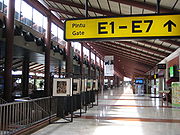 In the early 1970s, with the help of USAID, eight potential locations were analyzed for a new international airport, namely: Kemayoran, Malaka, Babakan, Jonggol, Halim, Curug, South Tangerang and North Tangerang. Finally, the North Tangerang airspace was chosen; it was also noted that Jonggol could be used as an alternative airfield. Meanwhile, as an interim step, the Indonesian government upgraded the Halim Perdanakusumah airfield for use for passenger services. The old Kemayoran site was closed in 1985, and the land was later used for commercial and housing purposes.
Between 1974 and 1975, a Canadian
consultant consortium, consisting of Aviation Planning Services Ltd., ACRESS International Ltd., and Searle Wilbee Rowland (SWR), won a bid for the new airport feasibility project. The feasibility study started on 20 February 1974 with a total cost of 1 million Canadian dollars. The one-year project proceeded with an Indonesian partner represented by PT Konavi. By the end of March 1975, the study revealed a plan to build three inline runways, a perforated road, three international terminal buildings, three domestic buildings and one building for Hajj
flights. Three stores for the domestic terminals would be built between 1975 and 1981 with a cost of US$ 465 million and one domestic terminal including an apron from 1982–1985 with a cost of US$ 126 million. A new terminal project, named the Jakarta International Airport Cengkareng (code: JIA-C), began.
The airport was designed by Paul Andreu
, a French architect who also designed Paris-Charles de Gaulle Airport. One of the major characteristics of Soekarno–Hatta airport is the incorporation of the local vernacular architecture into the design, and the presence of tropical gardens between the waiting lounges. These unique characteristics earned the airport the 1995 Aga Khan Award for Architecture
.
{| class="wikitable" style="width: 70% ; font-size: 85%; border: #999 solid 1px; text-align: lcenter; margin-bottom: 0; margin: 1em auto 1em auto"
! colspan="5" style="background: #8B8589;"| Phases of Soekarno–Hatta International Airport Project
|- style="font-weight:bold; background-color:#D3D3D3"
{|class="wikitable"
|-
!Phase!!Year!!Description!!Status
|-
|Phase 1||1985||Built Terminal 1 that can handle 9 million passengers per annum||Finished
|-
|Phase 2||1992||Built Terminal 2 that can handle 18 million passengers per annum||Finished
|-
|rowspan="2"|Phase 3||2008||Built Terminal 3 phase 1 that can handle 22 million passengers per annum||Finished
|-
|Not fixed||Fully built Terminal 3 that can handle 38 million passengers per annum||In progress
|-
|Phase 4||2020-||To build Terminal 4||Pending
|-
|}
flights and transnational migrant laborers. There is a masterplan to make 5 passenger terminals + 1 hajj
terminal and 4 runways. In 2012 the airport will be connected to Manggarai Station (future Jakarta central station) by a railway. To finance the expansion and maintenance the available assets, the airport is collecting an airport tax
of IDR 150,000 (approx US$16.50) for each international passenger and IDR 40,000 for each domestic passenger.
PT Angkasa Pura II will spend Rp.11.7 trillion ($1.36 billion) to change the airport into a 'world class' airport which will be called 'aerotropolis' by 2014. In the first stage Terminal-3 will be expanded and thereafter Terminal-1 and Terminal-2 will be integrated with green walls and the airport will have a convention hall, shopping center, hotel, playground, recreational facilities and parking area for 20,000 vehicles.
January 2011: After finish of constructing one or two runways, renovating and enlarging the existing three terminals and building of a fourth, state-owned airport management firm Angkasa Pura II
plans to build new airport in Cilegon, Banten, 80 kilometers from Jakarta or in Karawang, West Java, 70 kilometers from Jakarta. Both have toll-road access to Jakarta.
(5th busiest in Asia) and has surpassed Singapore Changi Airport
. Growth of passenger traffic was more than 15 percent a year by mostly domestic passengers.
The table below was based on data from the Airport Council International organization. These statistics are from the movements of passengers, freight and aircraft in CGK.
{| class="wikitable"
! Year !! Passenger
Movements !! Air-freight
(tons) !! Aircraft
Movements
|-
| 2001 || 11,818,047 || 281,765 || 123,540
|-
| 2002 || 14,830,994 || 306,252 || 144,765
|-
| 2003 || 19,702,902 || 310,131 || 186,695
|-
| 2004 || 26,083,267 || 322,582 || 233,501
|-
| 2005 || 27,947,482 || 336,113 || 241,846
|-
| 2006 || 30,863,806 || 384,050 || 250,303
|-
| 2007 || 32,458,946 || 473,593 || 248,482
|-
| 2008 || 32,172,114 || 465,799 || 248,482
|-
| 2009 || 37,143,719 || 538,314 || 287,868
|-
| 2010 || 43,704,000 || 633,391 || 338,711
|}
Soekarno–Hatta International Airport has 205 check-in counters, 36 baggage carousels and 45 gates. Each sub-terminal has 25 check-in counters, 5 baggage carousels and 7 gates. but in terminal 3 has 30 check-in counters, 6 baggage carousels and 3 gates
and Merpati Nusantara Airlines
as they operate their domestic flights in Terminal 2. This terminal has 3 sub-terminal. Each sub-terminal has 25 check-in counters, 5 baggage carousels and 7 gates. It has the capacity of handling 9 million passengers per annum.
The gates in Terminal 1 has alphabet prefix of A, B and C. The gates are A1-A7, B1-B7 and C1-C7.
The gates in Terminal 2 has alphabet prefix of D, E and F. The gates are D1-D7, E1-E7 and F1-F7.
On November 28, 2011 Garuda Indonesia and Angkasa Pura II has made a memorandum of understanding of managing Terminal 2E and 2F which will be used solely by Garuda Indonesia to anticipate ASEAN Open Sky Policy in 2015.
Terminal 2E will be used as International Terminal and Terminal 2F for Domestic Terminal. Garuda Indonesia said that it will share the using of its International Terminal with other Sky Team members which Garuda Indonesia will effectively join with Sky team in early 2013. Predicted domestic transfer passengers will take only 30 minutes and international transfer passengers not more than 45 minutes. Currently Sky Team has 12 members, but not all of them has flown to Indonesia.
 The first phase of terminal 3, consisting of the first of the five planned piers, was opened on April 15, 2009. The terminal adopts a different design from terminals 1 and 2, using an eco-friendy and modern concept (see rendering here). It currently houses low cost carrier, Indonesia AirAsia
, AirAsia
for its domestic and international flights.Terminal 3 has 30 Check in Counters, 6 Baggage Carousels and 3 Gates
Each of the planned 5 piers will have a capacity of 4 million passengers per year. Terminal 3 is expected to expand the capacity of Soekarno–Hatta International Airport, from 18 million passengers per annum, to 38 million.
In the newest masterplan, the airport will have 2 phases of development. Phase 1 development is to build the Terminal 3 and lengthen Runway 2 to 4,000 m. Phase 2 development is to build Terminal 4 and the third runway (4,000 m). A new elevated train that will connect the airport to the city is also included in the phase 1 development.
Provided with complimentary wi-fi
and filtered-water drinking fountains, Terminal 3 has officially open for its international flights on November 17, 2011. Since November 15, 2011 Indonesia AirAsia
has used Terminal 3 as new base for international flights together with AirAsia domestic and international flights, so transfer between them will be in minimum hassled.
and Garuda Indonesia headquarter. ACS was founded in 1973 as a provider of catering services to airlines Garuda Indonesia. ACS now serves 18 domestic and international airlines, including Garuda Indonesia
, Qantas
, Cathay Pacific
, Singapore Airlines
, Air China
, Emirates, Saudi Arabia
and Qatar Airways
, also serve meals to the aircraft charter services, VVIP and special flights, such as Hajj.
(Garuda Maintenance Facility).
They comprise 480,000 m2 of built-up structures, including three hangars, a spares warehouse, workshops, utility buildings, ground support equipment building, chemical stores, engine test cell and management offices. In addition, GMF AeroAsia
has an apron capable of handling up to 50 aircraft, taxiways, a run-up bay and a waste treatment area taking up a 1,150,000 m2 area.
Hangar 1 was built in 1991 designed for Boeing 747
s, has two full docks and is 22,000 m2. Hangar 2 is 23,000 m2 and has 3 aircraft bays. It can perform minor A and B checks. It can hold up to one narrow body and one wide body jet. Hangar 3 is 23,000 m2. It normally holds up to 3 Narrow-body aircraft
, but can be reconfigured to hold up to one wide body and one narrowbody. It has 7 bays with 4 full docks. It has 6 roof-mounted cranes and has one bay designed for MD11's, DC10's, and wide Airbus aircraft.
. There are 18 hole in this golf area.
Jasa Angkasa Semesta (JAS) Lounge, available for first and business class passengers of Cathay Pacific, Qantas, Lufthansa, EVA Air
, Saudi Arabian Airlines
and Singapore Airlines. Pura Indah Lounge, available for first and business class passengers of Singapore Airlines, KLM, Malaysia Airlines
, Emirates Airline
, Cathay Pacific and China Airlines
.
The new Garuda Indonesia lounge is available for GA's business class passengers only, as well as GECC cardholder.
The other lounges that support by some company like PT Indosat
, PT Mandara Jasindo Sena, PT Telkomsel
and PT XL Axiata.
, Garuda Indonesia Management Building, located within the Garuda Indonesia City Center. Angkasa Pura
II's head office is on the airport property.
) to 7 p.m. Buses stop to pick up passengers at departure areas in all terminals. All buses use the Prof. Dr. Sedyatmo Toll Road
. Travel time to and from the centre of Jakarta to the Gambir railway station takes around 70 minutes (sometimes longer), depending on traffic. Buses to the airport leave from the various terminals in central Jakarta (Gambir
) and surrounding areas as shown below.
{| style="text-align:left; font-size:95%; border:1px solid black"
! Service !! Destination !! Fare !! Interval !! Notes !!
|-
! colspan="3" style="background-color:cyan;color:black; height:35px" | Soekarno-Hatta Airport Bus
|-
| style="background-color:orange;color:white;text-align:center;font-weight:bold" | Primajasa ||Bandung
(Batununggal Indah)||IDR 75,000||30 minutes ||
|-
| style="background-color:blue;color:white;text-align:center;font-weight:bold" |Damri||Bekasi
(Kayuringin)||IDR 30,000||15–30 minutes||
|-
| style="background-color:blue;color:white;text-align:center;font-weight:bold" | Damri ||Blok M
(Plaza Blok M)||IDR 20,000||15–30 minutes||
|-
| style="background-color:blue;color:white;text-align:center;font-weight:bold" | Damri||Bogor
(Botani Square)||IDR 35,000||15–30 minutes||
|-
| style="background-color:blue;color:white;text-align:center;font-weight:bold" | Damri||Cikarang
(Plaza Cikarang Jababeka)||IDR 35,000||1 hour||
|-
| style="background-color:blue;color:white;text-align:center;font-weight:bold" | Damri||Gambir
||IDR 20,000||15–30 minutes||
|-
| style="background-color:blue;color:white;text-align:center;font-weight:bold" | Damri||Kampung Rambutan||IDR 20,000||15–30 minutes ||
|-
| style="background-color:blue;color:white;text-align:center;font-weight:bold" | Damri||Kemayoran
||IDR 20,000||1 hour||
|-
| style="background-color:blue;color:white;text-align:center;font-weight:bold" | Damri||Kota Harapan Indah||IDR 30,000||1 hour||
|-
| style="background-color:blue;color:white;text-align:center;font-weight:bold" | Damri||Lebak Bulus||IDR 20,000||15–30 minutes||
|-
| style="background-color:blue;color:white;text-align:center;font-weight:bold" | Damri||Mangga Dua||IDR 20,000||30 minutes||
|-
| style="background-color:blue;color:white;text-align:center;font-weight:bold" | Damri||Pasar Minggu
||IDR 20,000||15–30 minutes||
|-
| style="background-color:blue;color:white;text-align:center;font-weight:bold" | Damri||Rawamangun||IDR 20,000||15–30 minutes||
|-
| style="background-color:blue;color:white;text-align:center;font-weight:bold" | Damri||Serang
||IDR 30,000||1 hour||
|-
| style="background-color:blue;color:white;text-align:center;font-weight:bold" | Damri||Tanjung Priok
||IDR 20,000||15–30 minutes||
|-
|}
. There is extensive car parking, including long-stay facilities, at the airport. Car rentals are also available.
with cost Rp.2.25 trillion ($263.2 million) for the track between Tanah tinggi and the Airport (the rest of the track has been exist) and predicted will finish at 2014. The track as commuter line will connect Manggarai station, Sudirman, Tanah Abang, Duri, Grogol, Kalideres, Tanah Tinggi and Soekarno Hatta International Airport. Besides it, the government also offer a 33-kilometer express line between Manggarai station and the airport via Angke and Pluit
to investor as Public Private Partnership (PPP).
subdistricts.
The expansion plan has been rejected by Tangerang Municipal Government due to residents living around the airport don't get a chance to earn income for their family. The local government offered another location such as in Balaraja
, but Angkasa Pura II corporate secretary said that building a new airport would not be an easy task, as it requires thorough study.
Due to lack of space to make the third runway at Soekarno-Hatta International Airport, the government plans to build a new airport in 2013 around Cikarang
and Karawang
. The airport would be integrated with the planned Cilamaya International Seaport in Karawang. Feasibility study is still running and will be completed at the end of 2011 or early 2012.
Airport
An airport is a location where aircraft such as fixed-wing aircraft, helicopters, and blimps take off and land. Aircraft may be stored or maintained at an airport...
serving the greater Jakarta
Jakarta
Jakarta is the capital and largest city of Indonesia. Officially known as the Special Capital Territory of Jakarta, it is located on the northwest coast of Java, has an area of , and a population of 9,580,000. Jakarta is the country's economic, cultural and political centre...
area on the island of Java
Java
Java is an island of Indonesia. With a population of 135 million , it is the world's most populous island, and one of the most densely populated regions in the world. It is home to 60% of Indonesia's population. The Indonesian capital city, Jakarta, is in west Java...
, Indonesia. The airport is named after the first President of Indonesia, Soekarno, and the first vice-president, Mohammad Hatta
Mohammad Hatta
was born in Bukittinggi, West Sumatra, Dutch East Indies . He was Indonesia's first vice president, later also serving as the country's Prime Minister. Known as "The Proclamator", he and a number of Indonesians, including the first president of Indonesia, Sukarno, fought for the independence of...
. The airport is often called Cengkareng
Cengkareng
Cengkareng is a subdistrict of West Jakarta, Jakarta, Indonesia. Soekarno-Hatta International Airport, the largest airport in Indonesia and the headquarters of Garuda Indonesia, is located just to the west of Cengkareng...
by Indonesians. The airport's IATA code, CGK, originates from the name of the Cengkareng locality, a district situated to the northwest of the city.
Located about 20 km west of Jakarta
Jakarta
Jakarta is the capital and largest city of Indonesia. Officially known as the Special Capital Territory of Jakarta, it is located on the northwest coast of Java, has an area of , and a population of 9,580,000. Jakarta is the country's economic, cultural and political centre...
, in Tangerang
Tangerang
Tangerang is a city in the Province of Banten, Indonesia. It is located about 25 km west of Jakarta. It is the third largest urban center in the Jabotabek region after Jakarta and Bekasi. It has an area of 164.54 km² and an official intercensal estimated population of 1,537,244 for 2005...
, Banten
Banten
Banten is a province of Indonesia in Java. Formerly part of the Province of West Java, it was made a separate province in 2000.The administrative center is Serang. Preliminary results from the 2010 census counted some 10.6 million people.-Geography:...
, Soekarno–Hatta airport began to operate in 1985, replacing the former Kemayoran Airport
Kemayoran Airport
Kemayoran Airport, also spelled Kemajoran Airport, was the principal airport for Jakarta, Indonesia, from 8 July 1940 until March 31, 1985, when it was replaced by Soekarno-Hatta International Airport...
(domestic flights) in Central Jakarta
Central Jakarta
Central Jakarta is one of the five cities which form Jakarta, Indonesia. It had 898,883 inhabitants at the 2010 Census.Central Jakarta is the smallest in area and population of the five cities of Jakarta. It is the administrative and political center of Jakarta and Indonesia...
, and Halim Perdanakusuma International Airport
Halim Perdanakusuma International Airport
-Accidents and Incidents:*On 24 June 1982, British Airways Flight 009, a Boeing 747-200 flew through a cloud of volcanic ash thrown up by the eruption of Mount Galunggung, causing the failure of all four engines. The crew diverted the aircraft to Jakarta and it landed safely.-References:* -External...
in East Jakarta
East Jakarta
East Jakarta is a city within Jakarta Special District, Indonesia. It had a population of 2,687,027 at the 2010, making it the most populous of the five cities within Jakarta....
. Kemayoran Airport has since transformed into public areas. Halim Perdanakusuma is still operating, serving mostly VVIP, charters and military flights. Terminal 2 was opened in 1992 and Terminal 3 was opened in 2009, but in 2010 total passengers reached 43.7 million surpassed all the capacities of 3 terminals of 38 million passengers.
In May 2008, ForbesTraveller.com recognized Soekarno–Hatta International Airport as the 6th most punctual airport in the world with 86.3% of its flights departing on time, while 72.3% arriving ontime.
In December 2009, ForbesTraveller.com recognized Soekarno–Hatta International Airport as the 2nd most punctual airport in the world with 89.2% of its flights departing on time, and 84.2% arriving ontime. In 2010, the airport is the 16th busiest in the world.
History
Between 1928 and 1985, the Kemayoran Airfield, used for domestic flights, was considered unsatisfactory because it was too close to the major Halim Perdanakusuma Indonesian military airport. The civil airspace in the area became narrow, while air traffic increased rapidly, posing problems for international air traffic. In 1969, a Senior Communication Officers meeting in BangkokBangkok
Bangkok is the capital and largest urban area city in Thailand. It is known in Thai as Krung Thep Maha Nakhon or simply Krung Thep , meaning "city of angels." The full name of Bangkok is Krung Thep Mahanakhon Amon Rattanakosin Mahintharayutthaya Mahadilok Phop Noppharat Ratchathani Burirom...
expressed this concern.
Between 1974 and 1975, a Canadian
Canada
Canada is a North American country consisting of ten provinces and three territories. Located in the northern part of the continent, it extends from the Atlantic Ocean in the east to the Pacific Ocean in the west, and northward into the Arctic Ocean...
consultant consortium, consisting of Aviation Planning Services Ltd., ACRESS International Ltd., and Searle Wilbee Rowland (SWR), won a bid for the new airport feasibility project. The feasibility study started on 20 February 1974 with a total cost of 1 million Canadian dollars. The one-year project proceeded with an Indonesian partner represented by PT Konavi. By the end of March 1975, the study revealed a plan to build three inline runways, a perforated road, three international terminal buildings, three domestic buildings and one building for Hajj
Hajj
The Hajj is the pilgrimage to Mecca, Saudi Arabia. It is one of the largest pilgrimages in the world, and is the fifth pillar of Islam, a religious duty that must be carried out at least once in their lifetime by every able-bodied Muslim who can afford to do so...
flights. Three stores for the domestic terminals would be built between 1975 and 1981 with a cost of US$ 465 million and one domestic terminal including an apron from 1982–1985 with a cost of US$ 126 million. A new terminal project, named the Jakarta International Airport Cengkareng (code: JIA-C), began.
The airport was designed by Paul Andreu
Paul Andreu
Paul Andreu is a renowned French architect. He is best known for having planned numerous airports worldwide, notably Ninoy Aquino International Airport , Soekarno-Hatta International Airport , Shanghai Pudong International Airport Abu Dhabi International Airport, Dubai International Airport,...
, a French architect who also designed Paris-Charles de Gaulle Airport. One of the major characteristics of Soekarno–Hatta airport is the incorporation of the local vernacular architecture into the design, and the presence of tropical gardens between the waiting lounges. These unique characteristics earned the airport the 1995 Aga Khan Award for Architecture
Aga Khan Award for Architecture
The Aga Khan Award for Architecture is an architectural prize established by Aga Khan IV in 1977. It aims to identify and reward architectural concepts that successfully address the needs and aspirations of Islamic societies in the fields of contemporary design, social housing, community...
.
Project phases
- 1975–1977
- To dispense the land and also set up the province border was time needed. Schiphol airport (Amsterdam) was asked for opinion which according to them is rather expensive and over design. The cost raised up high because of using decentralization system. The Centralization system was a suitable one.
- The Team decided on a decentralization system like the one used at Orly West Airfield, Lyon Satolas, Langen-Hagen-Hanover and Kansas City Airport module system was adopted because it is simple and effective.
- 12 November 1976
- The building project tender was won by the French Aeroport de Paris.
- 18 May 1977
- The Final contract design was agreed on by the Indonesian government and Aeroport de Paris with a fixed cost of about 22,323,203 French francs and Rp. 177,156,000 equivalent to 2,100,000 francs. The work was scheduled to take 18 months. The government appointed PT. Konavi as the local partner.
- The result was:
- 2 inline runways including taxiways
- Perforate roads: 1 at the east, another at the west for airport services. The west was closed to public use.
- 3 terminals which can accommodate 3 million passengers per year.
- 1 module for international flights and 2 for domestic.
- An airport inside a garden was selected as an image.
- 20 May 1980
- A four year contract was signed. Sainraptet Brice, SAE, Colas together with PT. Waskita Karya as the developer. Ir. Karno BarkahKarno BarkahKarno Barkah is an Indonesian aviation pioneer and recipient of the prestigious French Légion d'honneur....
MSc. was appointed the JIA-C Project Director, responsible for the airport's construction.
- A four year contract was signed. Sainraptet Brice, SAE, Colas together with PT. Waskita Karya as the developer. Ir. Karno Barkah
- 1 December 1980
- The Indonesian government signed a contract for Rp. 384,8 billion with developers. The structure cost would be: Rp. 140,450,513,000 from APBN (national budget), 1,223,457 francs donated by France and US$ 15,898,251 from the USA.
- 1 December 1984
- The airport structure was complete.
- 1 May 1985
- The second terminal was started and launched on 11 May 1992.
{| class="wikitable" style="width: 70% ; font-size: 85%; border: #999 solid 1px; text-align: lcenter; margin-bottom: 0; margin: 1em auto 1em auto"
! colspan="5" style="background: #8B8589;"| Phases of Soekarno–Hatta International Airport Project
|- style="font-weight:bold; background-color:#D3D3D3"
{|class="wikitable"
|-
!Phase!!Year!!Description!!Status
|-
|Phase 1||1985||Built Terminal 1 that can handle 9 million passengers per annum||Finished
|-
|Phase 2||1992||Built Terminal 2 that can handle 18 million passengers per annum||Finished
|-
|rowspan="2"|Phase 3||2008||Built Terminal 3 phase 1 that can handle 22 million passengers per annum||Finished
|-
|Not fixed||Fully built Terminal 3 that can handle 38 million passengers per annum||In progress
|-
|Phase 4||2020-||To build Terminal 4||Pending
|-
|}
Plans
Angkasa Pura II is currently planning to build a new terminal with modern design features. Terminal 3 is being built for low-cost airlines, and already serves hajjHajj
The Hajj is the pilgrimage to Mecca, Saudi Arabia. It is one of the largest pilgrimages in the world, and is the fifth pillar of Islam, a religious duty that must be carried out at least once in their lifetime by every able-bodied Muslim who can afford to do so...
flights and transnational migrant laborers. There is a masterplan to make 5 passenger terminals + 1 hajj
Hajj
The Hajj is the pilgrimage to Mecca, Saudi Arabia. It is one of the largest pilgrimages in the world, and is the fifth pillar of Islam, a religious duty that must be carried out at least once in their lifetime by every able-bodied Muslim who can afford to do so...
terminal and 4 runways. In 2012 the airport will be connected to Manggarai Station (future Jakarta central station) by a railway. To finance the expansion and maintenance the available assets, the airport is collecting an airport tax
Airport Improvement Fee
An Airport Improvement Fee or Embarkation Fee or Airport Tax or Service charge or Service fee is an additional fee charged to departing and connecting passengers at an airport. It is levied by government or an airport management corporation and the proceeds are usually intended for funding of major...
of IDR 150,000 (approx US$16.50) for each international passenger and IDR 40,000 for each domestic passenger.
PT Angkasa Pura II will spend Rp.11.7 trillion ($1.36 billion) to change the airport into a 'world class' airport which will be called 'aerotropolis' by 2014. In the first stage Terminal-3 will be expanded and thereafter Terminal-1 and Terminal-2 will be integrated with green walls and the airport will have a convention hall, shopping center, hotel, playground, recreational facilities and parking area for 20,000 vehicles.
January 2011: After finish of constructing one or two runways, renovating and enlarging the existing three terminals and building of a fourth, state-owned airport management firm Angkasa Pura II
Angkasa Pura
PT. Angkasa Pura is a state enterprise of the Indonesian Department of Transport that is responsible for the management of airports and air traffic services in Indonesia. PT. Angkasa Pura is made up of two parts: PT Angkasa Pura I & PT Angkasa Pura II.Angkasa Pura I has its head office in Jakarta...
plans to build new airport in Cilegon, Banten, 80 kilometers from Jakarta or in Karawang, West Java, 70 kilometers from Jakarta. Both have toll-road access to Jakarta.
Volume of passengers
In 2010, Soekarno-Hatta was ranked 16th amongst the world's busiest airports by passenger trafficWorld's busiest airports by passenger traffic
The world's busiest airports by passenger traffic are measured by number of total passengers . One passenger is described as someone who arrives in, departs from, or transfers through the airport on a given day...
(5th busiest in Asia) and has surpassed Singapore Changi Airport
Singapore Changi Airport
Singapore Changi Airport , Changi International Airport, or simply Changi Airport, is the main airport in Singapore. A major aviation hub in Southeast Asia, it is about north-east from the commercial centre in Changi, on a site....
. Growth of passenger traffic was more than 15 percent a year by mostly domestic passengers.
The table below was based on data from the Airport Council International organization. These statistics are from the movements of passengers, freight and aircraft in CGK.
{| class="wikitable"
! Year !! Passenger
Movements !! Air-freight
(tons) !! Aircraft
Movements
|-
| 2001 || 11,818,047 || 281,765 || 123,540
|-
| 2002 || 14,830,994 || 306,252 || 144,765
|-
| 2003 || 19,702,902 || 310,131 || 186,695
|-
| 2004 || 26,083,267 || 322,582 || 233,501
|-
| 2005 || 27,947,482 || 336,113 || 241,846
|-
| 2006 || 30,863,806 || 384,050 || 250,303
|-
| 2007 || 32,458,946 || 473,593 || 248,482
|-
| 2008 || 32,172,114 || 465,799 || 248,482
|-
| 2009 || 37,143,719 || 538,314 || 287,868
|-
| 2010 || 43,704,000 || 633,391 || 338,711
|}
Terminals
The land area of the airport is 18 km². It has two independent parallel runways separated 2,400 m connected by two cross taxiways. There are three main terminal buildings: Terminal 1 (domestic flights only). Terminal 2 (international flights and Garuda Airlines domestic flights). Terminal 3, Pier 1 (domestic flights only).Soekarno–Hatta International Airport has 205 check-in counters, 36 baggage carousels and 45 gates. Each sub-terminal has 25 check-in counters, 5 baggage carousels and 7 gates. but in terminal 3 has 30 check-in counters, 6 baggage carousels and 3 gates
Terminal 1
Terminal 1 is the first terminal of Soekarno–Hatta International Airport. It was finished on 1985. It is located on the opposite of Terminal 2 which is on the south site. It operates domestic flights except Garuda IndonesiaGaruda Indonesia
PT Garuda Indonesia Tbk , publicly known as Garuda Indonesia, is the flag carrier of Indonesia. It is named after the mystical giant bird Garuda of Hinduism and Buddhist mythology. It is headquartered at Soekarno-Hatta International Airport in Tangerang, near Jakarta, the capital city of Indonesia...
and Merpati Nusantara Airlines
Merpati Nusantara Airlines
Merpati Nusantara Airlines is a commuter airline based in Central Jakarta, Jakarta, Indonesia. It is a major domestic airline operating scheduled services to more than 25 destinations in Indonesia, as well as scheduled international services to East Timor and Malaysia. Its main base is...
as they operate their domestic flights in Terminal 2. This terminal has 3 sub-terminal. Each sub-terminal has 25 check-in counters, 5 baggage carousels and 7 gates. It has the capacity of handling 9 million passengers per annum.
The gates in Terminal 1 has alphabet prefix of A, B and C. The gates are A1-A7, B1-B7 and C1-C7.
Terminal 2
Terminal 2 is the second terminal of Soekarno–Hatta International Airport. It was finished on 1992. It is located on the opposite of Terminal 1 which is on the north site. Terminal 2 has 3 sub-terminals. Each sub-terminal has 25 check-in counters, 5 baggage carousels and 7 gates. It has the capacity of handling 9 million passengers per annum.The gates in Terminal 2 has alphabet prefix of D, E and F. The gates are D1-D7, E1-E7 and F1-F7.
On November 28, 2011 Garuda Indonesia and Angkasa Pura II has made a memorandum of understanding of managing Terminal 2E and 2F which will be used solely by Garuda Indonesia to anticipate ASEAN Open Sky Policy in 2015.
Terminal 2E will be used as International Terminal and Terminal 2F for Domestic Terminal. Garuda Indonesia said that it will share the using of its International Terminal with other Sky Team members which Garuda Indonesia will effectively join with Sky team in early 2013. Predicted domestic transfer passengers will take only 30 minutes and international transfer passengers not more than 45 minutes. Currently Sky Team has 12 members, but not all of them has flown to Indonesia.
Terminal 3

Indonesia AirAsia
PT. Indonesia AirAsia is a low-cost airline based in Jakarta, Indonesia. It operates scheduled domestic, international services and is an Indonesian associate carrier of Malaysian low-fare airline AirAsia. Its main base is Soekarno-Hatta International Airport, Jakarta...
, AirAsia
AirAsia
AirAsia Berhad is a Malaysian-based low-cost airline. AirAsia is Asia's largest low-fare, no-frills airline and a pioneer of low-cost travel in Asia. AirAsia group operates scheduled domestic and international flights to over 400 destinations spanning 25 countries. Its main hub is the Low-Cost...
for its domestic and international flights.Terminal 3 has 30 Check in Counters, 6 Baggage Carousels and 3 Gates
Each of the planned 5 piers will have a capacity of 4 million passengers per year. Terminal 3 is expected to expand the capacity of Soekarno–Hatta International Airport, from 18 million passengers per annum, to 38 million.
In the newest masterplan, the airport will have 2 phases of development. Phase 1 development is to build the Terminal 3 and lengthen Runway 2 to 4,000 m. Phase 2 development is to build Terminal 4 and the third runway (4,000 m). A new elevated train that will connect the airport to the city is also included in the phase 1 development.
Provided with complimentary wi-fi
Wi-Fi
Wi-Fi or Wifi, is a mechanism for wirelessly connecting electronic devices. A device enabled with Wi-Fi, such as a personal computer, video game console, smartphone, or digital audio player, can connect to the Internet via a wireless network access point. An access point has a range of about 20...
and filtered-water drinking fountains, Terminal 3 has officially open for its international flights on November 17, 2011. Since November 15, 2011 Indonesia AirAsia
Indonesia AirAsia
PT. Indonesia AirAsia is a low-cost airline based in Jakarta, Indonesia. It operates scheduled domestic, international services and is an Indonesian associate carrier of Malaysian low-fare airline AirAsia. Its main base is Soekarno-Hatta International Airport, Jakarta...
has used Terminal 3 as new base for international flights together with AirAsia domestic and international flights, so transfer between them will be in minimum hassled.
Terminal 4
Terminal 4 is on the opposite of Terminal 3, east of Terminal 1 which is still on the south site. It will be on phase 4 or Phase 2 Development when opening in 2014 and in the future Airport.Airlines and destinations
The following airlines operate from (Jakarta) Soekarno–Hatta International Airport:Passenger terminals
Freight terminal
Airport facilities
The airport was designed to resemble a traditional Rumah Joglo Javanese house. The approach has been emphasised by the inclusion of well-maintained gardens located near all boarding areas.Aircraft catering
Aircraft catering at Soekarno–Hatta International Airport supported by Aerowisata Catering Services (ACS). Located near GMF AeroAsiaGMF AeroAsia
GMF AeroAsia is an international company that employs 2,500 employees based in Jakarta, Indonesia. It services airplanes of many types and is one of the largest aircraft maintenance facility in Asia.-Before 2000 :...
and Garuda Indonesia headquarter. ACS was founded in 1973 as a provider of catering services to airlines Garuda Indonesia. ACS now serves 18 domestic and international airlines, including Garuda Indonesia
Garuda Indonesia
PT Garuda Indonesia Tbk , publicly known as Garuda Indonesia, is the flag carrier of Indonesia. It is named after the mystical giant bird Garuda of Hinduism and Buddhist mythology. It is headquartered at Soekarno-Hatta International Airport in Tangerang, near Jakarta, the capital city of Indonesia...
, Qantas
Qantas
Qantas Airways Limited is the flag carrier of Australia. The name was originally "QANTAS", an initialism for "Queensland and Northern Territory Aerial Services". Nicknamed "The Flying Kangaroo", the airline is based in Sydney, with its main hub at Sydney Airport...
, Cathay Pacific
Cathay Pacific
Cathay Pacific is the flag carrier of Hong Kong, with its head office and main hub located at Hong Kong International Airport, although the airline's registered office is on the 33rd floor of One Pacific Place...
, Singapore Airlines
Singapore Airlines
Singapore Airlines Limited is the flag carrier airline of Singapore. Singapore Airlines operates a hub at Changi Airport and has a strong presence in the Southeast Asia, East Asia, South Asia, and "Kangaroo Route" markets...
, Air China
Air China
Air China is the flag carrier and one of the major airlines of the People's Republic of China. Based in Beijing Capital International Airport, Air China is the world's 10th largest airline by fleet size. The airline ranked behind its main competitors China Southern Airlines and China Eastern...
, Emirates, Saudi Arabia
Saudi Arabia
The Kingdom of Saudi Arabia , commonly known in British English as Saudi Arabia and in Arabic as as-Sa‘ūdiyyah , is the largest state in Western Asia by land area, constituting the bulk of the Arabian Peninsula, and the second-largest in the Arab World...
and Qatar Airways
Qatar Airways
Qatar Airways Company Q.C.S.C. , operating as Qatar Airways, is the flag carrier of Qatar. Headquartered in the Qatar Airways Tower in Doha, it operates a hub-and-spoke network, linking over 100 international destinations from its base in Doha, using a fleet of over 100 aircraft...
, also serve meals to the aircraft charter services, VVIP and special flights, such as Hajj.
Aircraft maintenance
Facilities to maintenance aircraft in Soekarno–Hatta International Airport supported by GMF AeroAsiaGMF AeroAsia
GMF AeroAsia is an international company that employs 2,500 employees based in Jakarta, Indonesia. It services airplanes of many types and is one of the largest aircraft maintenance facility in Asia.-Before 2000 :...
(Garuda Maintenance Facility).
They comprise 480,000 m2 of built-up structures, including three hangars, a spares warehouse, workshops, utility buildings, ground support equipment building, chemical stores, engine test cell and management offices. In addition, GMF AeroAsia
GMF AeroAsia
GMF AeroAsia is an international company that employs 2,500 employees based in Jakarta, Indonesia. It services airplanes of many types and is one of the largest aircraft maintenance facility in Asia.-Before 2000 :...
has an apron capable of handling up to 50 aircraft, taxiways, a run-up bay and a waste treatment area taking up a 1,150,000 m2 area.
Hangar 1 was built in 1991 designed for Boeing 747
Boeing 747
The Boeing 747 is a wide-body commercial airliner and cargo transport, often referred to by its original nickname, Jumbo Jet, or Queen of the Skies. It is among the world's most recognizable aircraft, and was the first wide-body ever produced...
s, has two full docks and is 22,000 m2. Hangar 2 is 23,000 m2 and has 3 aircraft bays. It can perform minor A and B checks. It can hold up to one narrow body and one wide body jet. Hangar 3 is 23,000 m2. It normally holds up to 3 Narrow-body aircraft
Narrow-body aircraft
A narrow-body aircraft is an airliner with a fuselage aircraft cabin width typically of 3 to 4 metres , and airline seat arranged 2 to 6 abreast along a single aisle...
, but can be reconfigured to hold up to one wide body and one narrowbody. It has 7 bays with 4 full docks. It has 6 roof-mounted cranes and has one bay designed for MD11's, DC10's, and wide Airbus aircraft.
Golf area
Golf area in Soekarno–Hatta International Airport supported by "Cengkareng Golf Club". Golf area has been open since 1999. Located on the left side airport main gate after Sheraton Bandara Hotel. Cengkareng Golf Club is set within the 102 hectares area of Soewarna Business Park at Soekarno Hatta International Airport. In 2005 and 2008 this golf area was used for Indonesia Open, which was a part of the PGA European TourPGA European Tour
The PGA European Tour is an organization which operates the three leading men's professional golf tours in Europe: the elite European Tour, the European Seniors Tour and the developmental Challenge Tour. Its headquarters are at Wentworth Club in Virginia Water, Surrey, England...
. There are 18 hole in this golf area.
Airport hotel
Soekarno–Hatta International Airport has two hotels managed by the Sheraton Airport Hotel and the Jakarta Airport Hotel. The Sheraton Airport Hotel, which is located on the left side of the main exit road from the airport, has 4 floors with 220 guest rooms. The Jakarta Airport Hotel is located on the upper floor of Terminal 2 and provides useful standard accommodation for airport transit accommodation. The hotel entrance is located at the meeting point (mid-point) of terminal 2E. This hotel has 82 guest rooms.Lounges
There are four first and business Lounges at the Transit Lounge in the departure area.Jasa Angkasa Semesta (JAS) Lounge, available for first and business class passengers of Cathay Pacific, Qantas, Lufthansa, EVA Air
EVA Air
EVA Airways Corporation "; ) is an airline based at Taiwan Taoyuan International Airport near Taipei, Taiwan, operating passenger and dedicated cargo services to over 40 international destinations in Asia, Australia, Europe and North America. EVA Air is largely privately owned and flies a fully...
, Saudi Arabian Airlines
Saudi Arabian Airlines
Saudi Arabian Airlines is the flag carrier airline of Saudi Arabia, based in Jeddah. It operates domestic and international scheduled flights to over 90 destinations in the Middle East, Africa, Asia, Europe and North America...
and Singapore Airlines. Pura Indah Lounge, available for first and business class passengers of Singapore Airlines, KLM, Malaysia Airlines
Malaysia Airlines
Malaysian Airline System Berhad , DBA Malaysia Airlines , is the government-owned flag carrier of Malaysia. Malaysia Airlines operates flights from its home base, Kuala Lumpur International Airport, and its eastern hub in Kota Kinabalu. It has its headquarters on the grounds of Sultan Abdul Aziz...
, Emirates Airline
Emirates Airline
Emirates is the airline based in the Emirate of Dubai part of the United Arab Emirates . Based at Dubai International Airport it is the largest airline in the Middle East, operating over 2,400 flights per week, from its hub at Terminal 3, to 111 cities in 62 countries across six continents...
, Cathay Pacific and China Airlines
China Airlines
China Airlines is both the flag carrier and the largest airline of Republic of China . Although not directly state-owned, the airline is owned by China Airlines Group, which is owned by the China Aviation Development Foundation...
.
The new Garuda Indonesia lounge is available for GA's business class passengers only, as well as GECC cardholder.
The other lounges that support by some company like PT Indosat
Indosat
PT Indosat Tbk., formerly known as PT Indonesian Satellite Corporation Tbk. is a provider of telecommunication services in Indonesia. It is the third largest telecommunication company for mobile services in Indonesia after defeat by XL Axiata...
, PT Mandara Jasindo Sena, PT Telkomsel
Telkomsel
Telkomsel is a brand name of a GSM and UMTS Mobile phone network operator which is operating in Indonesia. It was found in 1995, and is a subsidiary of Telkom Indonesia....
and PT XL Axiata.
Shopping area
There are shopping areas available in all terminals at Soekarna-Hatta International Airport. Duty free shops, souvenir shops, restaurants and a cafeteria can be found there. There is a new "Shopping Arcade" located in terminal 1C. There are no shops in the arrival parts of the terminals.Other facilities
The airport contains the head office of Garuda IndonesiaGaruda Indonesia
PT Garuda Indonesia Tbk , publicly known as Garuda Indonesia, is the flag carrier of Indonesia. It is named after the mystical giant bird Garuda of Hinduism and Buddhist mythology. It is headquartered at Soekarno-Hatta International Airport in Tangerang, near Jakarta, the capital city of Indonesia...
, Garuda Indonesia Management Building, located within the Garuda Indonesia City Center. Angkasa Pura
Angkasa Pura
PT. Angkasa Pura is a state enterprise of the Indonesian Department of Transport that is responsible for the management of airports and air traffic services in Indonesia. PT. Angkasa Pura is made up of two parts: PT Angkasa Pura I & PT Angkasa Pura II.Angkasa Pura I has its head office in Jakarta...
II's head office is on the airport property.
Ground transportation
There is a range of transport options available for access to the airport: local airport terminal shuttles, buses, taxi services of various kinds, cars, and (potentially) a rail link. It is agreed amongst Indonesian authorities that services are sometimes unsatisfactory. Efforts to improve services have led to a noticeable lift in standards in recent years.Inter-terminal shuttle transportation
Soekarno–Hatta International Airport provides a free shuttle bus which connects Terminal 1, 2 and 3Buses
Several bus companies provide useful services to various destination from CGK. Currently the airport is served by two bus operators, Damri , Primajasa and CIPAGANTI. Information about buses and other transport is available at various points throughout arrival terminals. Damri buses operate from 4 a.m. (Western Indonesia Standard TimeTime in Indonesia
The Indonesian archipelago geographically stretches across four time zones from UTC+7 in Banda Aceh to UTC+9 in Western Papua. However, The Indonesian government only recognizes three time zones in its territory: Western Indonesian Time—seven hours in advance of Greenwich Mean Time ,...
) to 7 p.m. Buses stop to pick up passengers at departure areas in all terminals. All buses use the Prof. Dr. Sedyatmo Toll Road
Prof. Dr. Sedyatmo Toll Road
Prof. Dr. Sedyatmo Toll Road, or Airport Toll Road is a toll road in Northern Jakarta who connecting the Soekarno-Hatta International Airport with the city of Jakarta. The toll road was completed on 1985. The operator of this toll road is PT Jasa Marga....
. Travel time to and from the centre of Jakarta to the Gambir railway station takes around 70 minutes (sometimes longer), depending on traffic. Buses to the airport leave from the various terminals in central Jakarta (Gambir
Gambir
Gambir is a subdistrict of Central Jakarta, Jakarta, Indonesia. It is characterized by many historic buildings from the colonial era. Gambir Subdistrict is the location of many political and administrative center of Jakarta and Indonesia...
) and surrounding areas as shown below.
{| style="text-align:left; font-size:95%; border:1px solid black"
! Service !! Destination !! Fare !! Interval !! Notes !!
|-
! colspan="3" style="background-color:cyan;color:black; height:35px" | Soekarno-Hatta Airport Bus
|-
| style="background-color:orange;color:white;text-align:center;font-weight:bold" | Primajasa ||Bandung
Bandung
Bandung is the capital of West Java province in Indonesia, and the country's third largest city, and 2nd largest metropolitan area in Indonesia, with a population of 7.4 million in 2007. Located 768 metres above sea level, approximately 140 km southeast of Jakarta, Bandung has cooler...
(Batununggal Indah)||IDR 75,000||30 minutes ||
|-
| style="background-color:blue;color:white;text-align:center;font-weight:bold" |Damri||Bekasi
Bekasi
Bekasi is a city in West Java, Indonesia, located on the eastern border of Jakarta in the Jabodetabek metropolitan region. To the south is Bogor Regency, east is Bekasi Regency....
(Kayuringin)||IDR 30,000||15–30 minutes||
|-
| style="background-color:blue;color:white;text-align:center;font-weight:bold" | Damri ||Blok M
Blok M
Blok M is a business and shopping quarter located in Kebayoran Baru, South Jakarta, Indonesia. It runs east from Iskandarsyah street to Bulungan street in the west. North from Falatehan street to Melawai street in the south. The development is less modern than some of the developments near Kota,...
(Plaza Blok M)||IDR 20,000||15–30 minutes||
|-
| style="background-color:blue;color:white;text-align:center;font-weight:bold" | Damri||Bogor
Bogor
Bogor is a city on the island of Java in the West Java province of Indonesia. The city is located in the center of the Bogor Regency , 60 kilometers south of the Indonesian capital Jakarta...
(Botani Square)||IDR 35,000||15–30 minutes||
|-
| style="background-color:blue;color:white;text-align:center;font-weight:bold" | Damri||Cikarang
Cikarang
Cikarang is the capital of Bekasi Regency, West Java in Indonesia. Jababeka is the biggest industrial estate in Southeast Asia. Property projects have also been built in Cikarang, such as Lippo Cikarang, Cikarang Baru, and Kota Delta Mas. The last one is the office complex of Bekasi.-Cikarang Dry...
(Plaza Cikarang Jababeka)||IDR 35,000||1 hour||
|-
| style="background-color:blue;color:white;text-align:center;font-weight:bold" | Damri||Gambir
Gambir
Gambir is a subdistrict of Central Jakarta, Jakarta, Indonesia. It is characterized by many historic buildings from the colonial era. Gambir Subdistrict is the location of many political and administrative center of Jakarta and Indonesia...
||IDR 20,000||15–30 minutes||
|-
| style="background-color:blue;color:white;text-align:center;font-weight:bold" | Damri||Kampung Rambutan||IDR 20,000||15–30 minutes ||
|-
| style="background-color:blue;color:white;text-align:center;font-weight:bold" | Damri||Kemayoran
Kemayoran
Kemayoran is a subdistrict of Central Jakarta, Jakarta, Indonesia. Kemayoran is roughly bounded by Landas Pacu Barat and Landas Pacu Timur road to the north, Letjend Suprapto Road to the south, and a canal along the Sunter Raya road to the northeast...
||IDR 20,000||1 hour||
|-
| style="background-color:blue;color:white;text-align:center;font-weight:bold" | Damri||Kota Harapan Indah||IDR 30,000||1 hour||
|-
| style="background-color:blue;color:white;text-align:center;font-weight:bold" | Damri||Lebak Bulus||IDR 20,000||15–30 minutes||
|-
| style="background-color:blue;color:white;text-align:center;font-weight:bold" | Damri||Mangga Dua||IDR 20,000||30 minutes||
|-
| style="background-color:blue;color:white;text-align:center;font-weight:bold" | Damri||Pasar Minggu
Pasar Minggu
right|thumb|Pasar Minggus fruit marketPasar Minggu is a subdistrict of South Jakarta, Jakarta, Indonesia. The area is known for its traditional sunday market, famous for the fruit market. Historically, Pasar Minggu is a fruit cultivation area developed by the Dutch government during the colonial...
||IDR 20,000||15–30 minutes||
|-
| style="background-color:blue;color:white;text-align:center;font-weight:bold" | Damri||Rawamangun||IDR 20,000||15–30 minutes||
|-
| style="background-color:blue;color:white;text-align:center;font-weight:bold" | Damri||Serang
Serang
Serang is a regency of Banten province, Indonesia. The administrative center of the regency and the capital of the province is the independent municipality of Serang...
||IDR 30,000||1 hour||
|-
| style="background-color:blue;color:white;text-align:center;font-weight:bold" | Damri||Tanjung Priok
Tanjung Priok
Tanjung Priok is a subdistrict of North Jakarta, Jakarta, Indonesia. It hosts the western part of the city's main harbour, the Port of Tanjung Priok...
||IDR 20,000||15–30 minutes||
|-
|}
Taxis and other services
Various taxi and shuttle services are provided by numerous service providers. Prices vary considerably depending on the service users choose (bus, shuttle services, ordinary taxis, executive taxis, and so on). Executive taxis (cost: around $US 25 to the centre of Jakarta) may be hired at the counters situated immediately outside of the exit doors from the terminals while other services are available just a short walk further on. There are signs and booking arrangements for other services, including various ordinary taxi cabs (metered cost: depends on distance, but around $US 12 to the centre of Jakarta).Cars
Soekarno–Hatta is connected to Jakarta's city center via the Prof. Dr. Sedyatmo Toll RoadProf. Dr. Sedyatmo Toll Road
Prof. Dr. Sedyatmo Toll Road, or Airport Toll Road is a toll road in Northern Jakarta who connecting the Soekarno-Hatta International Airport with the city of Jakarta. The toll road was completed on 1985. The operator of this toll road is PT Jasa Marga....
. There is extensive car parking, including long-stay facilities, at the airport. Car rentals are also available.
Rail
In July 2011, the government has assigned PT Kereta Api to establish a railway that connect Manggarai station to the Airport via TangerangTangerang
Tangerang is a city in the Province of Banten, Indonesia. It is located about 25 km west of Jakarta. It is the third largest urban center in the Jabotabek region after Jakarta and Bekasi. It has an area of 164.54 km² and an official intercensal estimated population of 1,537,244 for 2005...
with cost Rp.2.25 trillion ($263.2 million) for the track between Tanah tinggi and the Airport (the rest of the track has been exist) and predicted will finish at 2014. The track as commuter line will connect Manggarai station, Sudirman, Tanah Abang, Duri, Grogol, Kalideres, Tanah Tinggi and Soekarno Hatta International Airport. Besides it, the government also offer a 33-kilometer express line between Manggarai station and the airport via Angke and Pluit
Pluit
Pluit is an administrative village of Penjaringan, North Jakarta that is predominantly residential such as De Paradiso Apartment. Most of the inhabitants are of Chinese origin. They run many Chinese restaurants in nearby Muara Karang...
to investor as Public Private Partnership (PPP).
Plans
April 2011: To anticipate a surge of passenger numbers, at least a ten percent increase each year, the government is preparing to lay down runway number 3. This was targeted to be completed in 2017. The expansion will use about 1,000 hectares from 10 villages in the Teluk Naga and KosambiKosambi
Kosambi may refer to:*Kosambi, India, an old city and Buddhist pilgrimage site.*Kosambi, Tangerang, a subdistrict of Tangerang Regency, Banten, Indonesia*Kosambi, Jakarta, an administrative village of Cengkareng, West Jakarta, Indonesia...
subdistricts.
The expansion plan has been rejected by Tangerang Municipal Government due to residents living around the airport don't get a chance to earn income for their family. The local government offered another location such as in Balaraja
Balaraja
Balaraja is a town in the province of Banten, Java, Indonesia. The population is 130,200....
, but Angkasa Pura II corporate secretary said that building a new airport would not be an easy task, as it requires thorough study.
Due to lack of space to make the third runway at Soekarno-Hatta International Airport, the government plans to build a new airport in 2013 around Cikarang
Cikarang
Cikarang is the capital of Bekasi Regency, West Java in Indonesia. Jababeka is the biggest industrial estate in Southeast Asia. Property projects have also been built in Cikarang, such as Lippo Cikarang, Cikarang Baru, and Kota Delta Mas. The last one is the office complex of Bekasi.-Cikarang Dry...
and Karawang
Karawang
Karawang is the capital of the Karawang Regency of West Java, Indonesia. It is located 32 miles east of Jakarta. Karawang has a population of 2,150,610 ....
. The airport would be integrated with the planned Cilamaya International Seaport in Karawang. Feasibility study is still running and will be completed at the end of 2011 or early 2012.