


Medina del Campo

Encyclopedia
Medina del Campo is a town located in the middle of the Spanish Meseta Central, in the province of Valladolid, Castile-Leon autonomous region, 45 km from Valladolid
. It is the capital of a farming area, far away from the great economic centres.
s during the 15th century and 16th century. The main purpose of the early fairs was banking, wool and textile sales, the book market and an enormous variety of goods and trades. As the population grew, the town was developed towards the plain of Zapardiel brook. Since then, the Padilla Street became the business centre of Medina.
Between the 17th century and the 19th century decline set in; but the town took off again at the end of the 19th century, thanks to the arrival of the railway, the opening of the military district (the quarter of Marques de la Ensenada), and the opening of the hydrothermal establishment of Las Salinas. Also adding to the growth were the strong commercial sector, such as the furniture trade or the opening of shops on Sundays (which is not customary in Spain), and finally proximity of quality wines with the Denominación de Origen
of Rueda
.
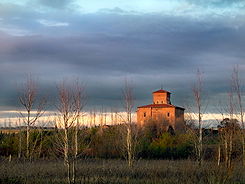 Almost all the buildings of artistic interest date from the 16th century; examples are the country house known as Casa Blanca, the Palacio de Dueñas (Don Rodrigo de Dueñas Manor House) and the Hospital of Simón Ruiz. These buildings were promoted by rich merchant bankers who prospered thanks to the General Fair
of the Spanish Kingdom held in Medina del Campo during the 15th and 16th centuries. The Museum of the Fairs was created to exhibit items connected to this open market, and it is a popular visitor attraction.
The word "Medina" which means "city" in Arabic (. Medina del Campo was founded on the hill called La Mota in the 11th century, in the same place where the Castle is, and remains of a wall still survive. At the moment, the Mota hill is a suburban area, however in the Middle Ages it was the town centre.
In addition, this hill has archaeological remains such as a stronghold, a medieval village and a Celt
ic walled settlement dated from 4th century BC (Iron Age
).
Castle of La Mota
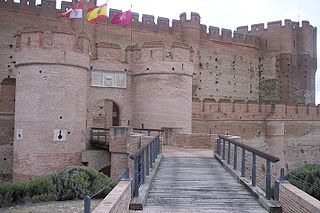 The word Mota refers to an artificial mountain built to defend the castle better. The Mota fortress had a military function and it also was a royal dungeon
, among its most notorious prisoners being Cesare Borgia
. The castle was built between the 12th century and 15th century. It has a moat
with its own drawbridge
(today fixed), an outer curtain wall
(for artillery
), an inner curtain wall (with arrow slits for archers and guards) surrounding a large courtyard
(with a chapel), and a great square tower (which is the Keep
).
The castle was abandoned and collapsed, but was restored after the Spanish Civil War
(1936–1939). It was the first monumental building in Medina designated as a Heritage Site (Bien de interés cultural).
was a very important building around the town to protect the people from attacks. The walls date from the 11th century, and they were enlarged three times, as the population was growing. At present, there are only remains.
, which no longer exists. Probably, its entrance hall was the meeting point of the council
.
The oldest part of the church is of Mudéjar
–Gothic
style; but was renovated several times. The greater chapel has large dimensions, with Gothic ribbed vault roof and an interesting altarpiece
dated from the 16th century.
In the choir, which is in the west facade, we can admire the magnificent baroque
organ, dated from the 18th century, a recently restored masterpiece.
in 1500 in Renaissance
style. Later, in the reign of Philip II
, it was used for the sale of meat to the population. It is the only historic building of this type in the world still used for its original purpose.
); but earlier was named "Rúa Nueva" (New Road). Padilla Street was the downtown
area where numerous banks and jewellery shops settled, and actually some of them still mains.
Whereas the financiers settled in Padilla Street, the other merchants were distributed in the Main Square according to Ordenanzas de Feriantes (Lodging Ordinances).
(Queen of Castile
), 26 November 1504 (for this reason it is also called Palacio Testamentario, Testamentary Palace).
The Palace was started in the 14th century and was enlarged both by Don Fernando de Antequera (Lord of Medina del Campo and, afterwards, King of Aragon
), as well as by the Reyes Católicos. It was restored three times, in 1601, 1603 and 1673. It was at one time much larger than the present-day building.
(San Antolín), is in Gothic
, Renaissance
and Baroque
styles. It was constructed between the 16th century and the 18th century. The nave
and the aisle
s are of Late Gothic style, with numerous chapels, such as the Chapel of the Virgen del Pópolo, with a balcony
, which was used to celebrate the mass for all the market traders lodged in the Main Square. The Collegiate Church of Medina was restored in 2004.
Most of the land is dry, so, the most important crops are cereals. However, viticulture is important too in the north of the municipality
The local patron feast San Antolín (Saint Antoninus of Pamiers) is held on 2 September. The celebrations revolve around the religious ceremonies and, above all, around the bullfighting
.
The encierros (Running of the Bulls) are very typical of Medina (they let the fighting bulls loose throughout the fields and along the streets of the city, leading them up to the bullring
). Also emblematic are the Dodges, in Spanish so-called cortes, in which people go towards the bull and, just when the beast attacks, try to avoid them.
, France
, since 1994 Zug
, Western Sahara
, since 2008.
Valladolid
Valladolid is a historic city and municipality in north-central Spain, situated at the confluence of the Pisuerga and Esgueva rivers, and located within three wine-making regions: Ribera del Duero, Rueda and Cigales...
. It is the capital of a farming area, far away from the great economic centres.
History
Medina del Campo gained much importance for its FairFair
A fair or fayre is a gathering of people to display or trade produce or other goods, to parade or display animals and often to enjoy associated carnival or funfair entertainment. It is normally of the essence of a fair that it is temporary; some last only an afternoon while others may ten weeks. ...
s during the 15th century and 16th century. The main purpose of the early fairs was banking, wool and textile sales, the book market and an enormous variety of goods and trades. As the population grew, the town was developed towards the plain of Zapardiel brook. Since then, the Padilla Street became the business centre of Medina.
Between the 17th century and the 19th century decline set in; but the town took off again at the end of the 19th century, thanks to the arrival of the railway, the opening of the military district (the quarter of Marques de la Ensenada), and the opening of the hydrothermal establishment of Las Salinas. Also adding to the growth were the strong commercial sector, such as the furniture trade or the opening of shops on Sundays (which is not customary in Spain), and finally proximity of quality wines with the Denominación de Origen
Denominación de Origen
Denominación de Origen is part of a regulatory classification system primarily for Spanish wines but also for other foodstuffs like honey, meats and condiments. In wines it parallels the hierarchical system of France and Italy although Rioja and Sherry preceded the full system...
of Rueda
Rueda (DO)
Rueda is a Spanish Denominación de Origen for wines located in the Community of Castile and León. It comprises 72 municipalities, of which 53 are in the province of Valladolid, 17 are in the north of the province of Segovia, and 2 are in the north of the province of Ávila...
.
Main sights
Fair
A fair or fayre is a gathering of people to display or trade produce or other goods, to parade or display animals and often to enjoy associated carnival or funfair entertainment. It is normally of the essence of a fair that it is temporary; some last only an afternoon while others may ten weeks. ...
of the Spanish Kingdom held in Medina del Campo during the 15th and 16th centuries. The Museum of the Fairs was created to exhibit items connected to this open market, and it is a popular visitor attraction.
The word "Medina" which means "city" in Arabic (. Medina del Campo was founded on the hill called La Mota in the 11th century, in the same place where the Castle is, and remains of a wall still survive. At the moment, the Mota hill is a suburban area, however in the Middle Ages it was the town centre.
In addition, this hill has archaeological remains such as a stronghold, a medieval village and a Celt
Celt
The Celts were a diverse group of tribal societies in Iron Age and Roman-era Europe who spoke Celtic languages.The earliest archaeological culture commonly accepted as Celtic, or rather Proto-Celtic, was the central European Hallstatt culture , named for the rich grave finds in Hallstatt, Austria....
ic walled settlement dated from 4th century BC (Iron Age
Iron Age
The Iron Age is the archaeological period generally occurring after the Bronze Age, marked by the prevalent use of iron. The early period of the age is characterized by the widespread use of iron or steel. The adoption of such material coincided with other changes in society, including differing...
).
Castle of La MotaCastle of La Motathumb|250px|Side view.The Castle of the La Mota or Castillo de La Mota is a reconstructed medieval fortress, located in the town of Medina del Campo, province of Valladolid, Spain. It is so named because of its location on an elevated hill, a mota, from where it dominates the town and surrounding...
Dungeon
A dungeon is a room or cell in which prisoners are held, especially underground. Dungeons are generally associated with medieval castles, though their association with torture probably belongs more to the Renaissance period...
, among its most notorious prisoners being Cesare Borgia
Cesare Borgia
Cesare Borgia , Duke of Valentinois, was an Italian condottiero, nobleman, politician, and cardinal. He was the son of Pope Alexander VI and his long-term mistress Vannozza dei Cattanei. He was the brother of Lucrezia Borgia; Giovanni Borgia , Duke of Gandia; and Gioffre Borgia , Prince of Squillace...
. The castle was built between the 12th century and 15th century. It has a moat
Moat
A moat is a deep, broad ditch, either dry or filled with water, that surrounds a castle, other building or town, historically to provide it with a preliminary line of defence. In some places moats evolved into more extensive water defences, including natural or artificial lakes, dams and sluices...
with its own drawbridge
Drawbridge
A drawbridge is a type of movable bridge typically associated with the entrance of a castle surrounded by a moat. The term is often used to describe all different types of movable bridges, like bascule bridges and lift bridges.-Castle drawbridges:...
(today fixed), an outer curtain wall

Curtain wall (fortification)
A curtain wall is a defensive wall between two bastions of a castle or fortress.In earlier designs of castle the curtain walls were often built to a considerable height and were fronted by a ditch or moat to make assault difficult....
(for artillery
Artillery
Originally applied to any group of infantry primarily armed with projectile weapons, artillery has over time become limited in meaning to refer only to those engines of war that operate by projection of munitions far beyond the range of effect of personal weapons...
), an inner curtain wall (with arrow slits for archers and guards) surrounding a large courtyard
Courtyard
A court or courtyard is an enclosed area, often a space enclosed by a building that is open to the sky. These areas in inns and public buildings were often the primary meeting places for some purposes, leading to the other meanings of court....
(with a chapel), and a great square tower (which is the Keep


Keep
A keep is a type of fortified tower built within castles during the Middle Ages by European nobility. Scholars have debated the scope of the word keep, but usually consider it to refer to large towers in castles that were fortified residences, used as a refuge of last resort should the rest of the...
).
The castle was abandoned and collapsed, but was restored after the Spanish Civil War
Spanish Civil War
The Spanish Civil WarAlso known as The Crusade among Nationalists, the Fourth Carlist War among Carlists, and The Rebellion or Uprising among Republicans. was a major conflict fought in Spain from 17 July 1936 to 1 April 1939...
(1936–1939). It was the first monumental building in Medina designated as a Heritage Site (Bien de interés cultural).
Walls
Medina was a walled village, and its strongholdFortification
Fortifications are military constructions and buildings designed for defence in warfare and military bases. Humans have constructed defensive works for many thousands of years, in a variety of increasingly complex designs...
was a very important building around the town to protect the people from attacks. The walls date from the 11th century, and they were enlarged three times, as the population was growing. At present, there are only remains.
St. Michael's Church
This church was built beside the wall gate of the old town, opposite the original city hallCity hall
In local government, a city hall, town hall or a municipal building or civic centre, is the chief administrative building of a city...
, which no longer exists. Probably, its entrance hall was the meeting point of the council
City council
A city council or town council is the legislative body that governs a city, town, municipality or local government area.-Australia & NZ:Because of the differences in legislation between the States, the exact definition of a City Council varies...
.
The oldest part of the church is of Mudéjar
Mudéjar
Mudéjar is the name given to individual Moors or Muslims of Al-Andalus who remained in Iberia after the Christian Reconquista but were not converted to Christianity...
–Gothic
Gothic architecture
Gothic architecture is a style of architecture that flourished during the high and late medieval period. It evolved from Romanesque architecture and was succeeded by Renaissance architecture....
style; but was renovated several times. The greater chapel has large dimensions, with Gothic ribbed vault roof and an interesting altarpiece
Altarpiece
An altarpiece is a picture or relief representing a religious subject and suspended in a frame behind the altar of a church. The altarpiece is often made up of two or more separate panels created using a technique known as panel painting. It is then called a diptych, triptych or polyptych for two,...
dated from the 16th century.
In the choir, which is in the west facade, we can admire the magnificent baroque
Baroque
The Baroque is a period and the style that used exaggerated motion and clear, easily interpreted detail to produce drama, tension, exuberance, and grandeur in sculpture, painting, literature, dance, and music...
organ, dated from the 18th century, a recently restored masterpiece.
Las Reales Carnicerías
This is an ancient market-hall, in Spanish called Mercado de Abastos, on the left bank of the Zapardiel brook, was built under the Catholic MonarchsCatholic Monarchs
The Catholic Monarchs is the collective title used in history for Queen Isabella I of Castile and King Ferdinand II of Aragon. They were both from the House of Trastámara and were second cousins, being both descended from John I of Castile; they were given a papal dispensation to deal with...
in 1500 in Renaissance
Renaissance
The Renaissance was a cultural movement that spanned roughly the 14th to the 17th century, beginning in Italy in the Late Middle Ages and later spreading to the rest of Europe. The term is also used more loosely to refer to the historical era, but since the changes of the Renaissance were not...
style. Later, in the reign of Philip II
Philip II of Spain
Philip II was King of Spain, Portugal, Naples, Sicily, and, while married to Mary I, King of England and Ireland. He was lord of the Seventeen Provinces from 1556 until 1581, holding various titles for the individual territories such as duke or count....
, it was used for the sale of meat to the population. It is the only historic building of this type in the world still used for its original purpose.
La Calle Padilla (Padilla Street)
This lane connects the Main Square with St. Michael's Bridge (also called Puente de las Cadenas). This street was named in honour of Don Juan de Padilla, a communard leader of the Castilians in the 16th century (see Castilian War of the CommunitiesCastilian War of the Communities
The Revolt of the Comuneros was an uprising by citizens of Castile against the rule of Charles V and his administration between 1520 and 1521. At its height, the rebels controlled the heart of Castile, ruling the cities of Valladolid, Tordesillas, and Toledo.The revolt occurred in the wake of...
); but earlier was named "Rúa Nueva" (New Road). Padilla Street was the downtown
Downtown
Downtown is a term primarily used in North America by English speakers to refer to a city's core or central business district ....
area where numerous banks and jewellery shops settled, and actually some of them still mains.
Whereas the financiers settled in Padilla Street, the other merchants were distributed in the Main Square according to Ordenanzas de Feriantes (Lodging Ordinances).
La Casa del Peso (The House of Pounds)
This building stands in the Main Square and is built over five elegant arcades with long balcony. It was established in 17th Century in order to keep the "Peso Real" (Royal Weight) and to guarantee the official weights and measures.Royal Palace
This mansion was the residence of the royal family in the time of Fairs. In this palace many historical incidents happened during the 14th and 15th Centuries. The most important episode was the will and death of Isabel la CatólicaIsabella I of Castile
Isabella I was Queen of Castile and León. She and her husband Ferdinand II of Aragon brought stability to both kingdoms that became the basis for the unification of Spain. Later the two laid the foundations for the political unification of Spain under their grandson, Charles V, Holy Roman Emperor...
(Queen of Castile
Crown of Castile
The Crown of Castile was a medieval and modern state in the Iberian Peninsula that formed in 1230 as a result of the third and definitive union of the crowns and parliaments of the kingdoms of Castile and León upon the accession of the then King Ferdinand III of Castile to the vacant Leonese throne...
), 26 November 1504 (for this reason it is also called Palacio Testamentario, Testamentary Palace).
The Palace was started in the 14th century and was enlarged both by Don Fernando de Antequera (Lord of Medina del Campo and, afterwards, King of Aragon
Aragon
Aragon is a modern autonomous community in Spain, coextensive with the medieval Kingdom of Aragon. Located in northeastern Spain, the Aragonese autonomous community comprises three provinces : Huesca, Zaragoza, and Teruel. Its capital is Zaragoza...
), as well as by the Reyes Católicos. It was restored three times, in 1601, 1603 and 1673. It was at one time much larger than the present-day building.
Collegiate Church of San Antolín
This church, dedicated to St. Antoninus of PamiersAntoninus of Pamiers
Saint Antoninus of Pamiers was an early Christian missionary and martyr, called the "Apostle of the Rouergue". His life is dated to the first, second, fourth, and fifth century by various sources, since he often confused with various other venerated Antonini. Today he is revered as the patron...
(San Antolín), is in Gothic
Gothic architecture
Gothic architecture is a style of architecture that flourished during the high and late medieval period. It evolved from Romanesque architecture and was succeeded by Renaissance architecture....
, Renaissance
Renaissance
The Renaissance was a cultural movement that spanned roughly the 14th to the 17th century, beginning in Italy in the Late Middle Ages and later spreading to the rest of Europe. The term is also used more loosely to refer to the historical era, but since the changes of the Renaissance were not...
and Baroque
Baroque
The Baroque is a period and the style that used exaggerated motion and clear, easily interpreted detail to produce drama, tension, exuberance, and grandeur in sculpture, painting, literature, dance, and music...
styles. It was constructed between the 16th century and the 18th century. The nave
Nave
In Romanesque and Gothic Christian abbey, cathedral basilica and church architecture, the nave is the central approach to the high altar, the main body of the church. "Nave" was probably suggested by the keel shape of its vaulting...
and the aisle
Aisle
An aisle is, in general, a space for walking with rows of seats on both sides or with rows of seats on one side and a wall on the other...
s are of Late Gothic style, with numerous chapels, such as the Chapel of the Virgen del Pópolo, with a balcony
Balcony
Balcony , a platform projecting from the wall of a building, supported by columns or console brackets, and enclosed with a balustrade.-Types:The traditional Maltese balcony is a wooden closed balcony projecting from a...
, which was used to celebrate the mass for all the market traders lodged in the Main Square. The Collegiate Church of Medina was restored in 2004.
Economy
The main activities of the industrial sector are furniture (example Castill Confort), metal (for instance, MADE S.A., or Ferroaleaciones Españolas SA) the food industry (like Productos Casado and others). As for the service sector, it has a special place in the history of Medina, due to the tradition of Fairs. Today, many services are offered in the town such as administrative (private and public ones), or trade activities that are gathered in the historical centre of the town.Most of the land is dry, so, the most important crops are cereals. However, viticulture is important too in the north of the municipality
Events
The Holy Week ahs been officially declared a Tourist Attraction, because of the artistic value of his religious images and the documented antiquity of its processions. The Film Festival Week has been, for 19 years, an appointment for the producers of Short-Films of the whole world. There is also a Sports Week in spring, one rooted Half-Marathon and a tennis tournament. It is famous for the Greyhound Races National Championship, which consists of hare-coursing.The local patron feast San Antolín (Saint Antoninus of Pamiers) is held on 2 September. The celebrations revolve around the religious ceremonies and, above all, around the bullfighting
Bullfighting
Bullfighting is a traditional spectacle of Spain, Portugal, southern France and some Latin American countries , in which one or more bulls are baited in a bullring for sport and entertainment...
.
The encierros (Running of the Bulls) are very typical of Medina (they let the fighting bulls loose throughout the fields and along the streets of the city, leading them up to the bullring
Bullring
A bullring is an arena where bullfighting is performed. Bullrings are often associated with Spain, but they can also be found in neighboring countries and the New World...
). Also emblematic are the Dodges, in Spanish so-called cortes, in which people go towards the bull and, just when the beast attacks, try to avoid them.
Twin towns
MontmorillonMontmorillon
Montmorillon is a commune in the Vienne department in the Poitou-Charentes region in western France.The clay mineral montmorillonite was named after Montmorillon after its discovery there in 1847.-External links:*...
, France
France
The French Republic , The French Republic , The French Republic , (commonly known as France , is a unitary semi-presidential republic in Western Europe with several overseas territories and islands located on other continents and in the Indian, Pacific, and Atlantic oceans. Metropolitan France...
, since 1994 Zug
Zug, Western Sahara
Zug is located in the far south-east of Western Sahara. The only erg or sand sea in Western Sahara is located nearby, where it runs from south-west to north-east from Mauritania into Western Sahara and back into Mauritania, where the border forms a right angle. Zug is located in the part of Western...
, Western Sahara
Western Sahara
Western Sahara is a disputed territory in North Africa, bordered by Morocco to the north, Algeria to the northeast, Mauritania to the east and south, and the Atlantic Ocean to the west. Its surface area amounts to . It is one of the most sparsely populated territories in the world, mainly...
, since 2008.
External links
- MedinaPatasarriba - A site with daily news about the town.
- Tourism Office of Medina del Campo (in English)