Han van Meegeren

Encyclopedia
Han van Meegeren (10 October 1889 in Deventer
, Overijssel
– 30 December 1947 in Amsterdam
), born Henricus Antonius van Meegeren, was a Dutch painter
and portrait
ist, and is considered to be one of the most ingenious art forgers of the 20th century.
As a child, van Meegeren developed an enthusiasm for the marvelous colours used by painters of the Dutch Golden Age
, and later set out to become an artist himself. When art critics decried his work as tired and derivative, van Meegeren felt that they had destroyed his career. Thereupon, he decided to prove his talent to the critics by forging paintings of some of the world's most famous artists, including Frans Hals
, Pieter de Hooch
, Gerard ter Borch
and Johannes Vermeer
. He so well replicated the styles and colours of the artists that the best art critics and experts of the time regarded his paintings as genuine and sometimes exquisite. His most successful forgery was Supper at Emmaus, created in 1937 while living in the south of France. This painting was hailed by some of the world’s foremost art experts as the finest Vermeer they had ever seen.
During World War II
, wealthy Dutchmen, wanting to prevent a sellout of Dutch art
to Adolf Hitler
and the Nazi Party, avidly bought van Meegeren's forgeries. Nevertheless, a falsified "Vermeer" ended up in the possession of Reichsmarschall
Hermann Göring
. Following the war, the forgery was discovered in Göring's possession, and van Meegeren was arrested 29 May 1945 as a collaborator
, as officials believed that he had sold Dutch cultural property
to the Nazis. This would have been an act of treason, the punishment for which was death, so van Meegeren fearfully confessed to the forgery. On 12 November 1947, after a brief but highly publicized trial, he was convicted of falsification and fraud charges, and was sentenced to a modest punishment of one year in prison. He never served his sentence, however; before he could be incarcerated, he suffered a heart attack and died on 30 December 1947. It is estimated that van Meegeren duped buyers, including the government of the Netherlands, out of the equivalent of more than thirty million dollars in today's money.
Roman Catholic parents in the provincial city town of Deventer
. He was the son of Augusta Louisa Henrietta Camps and Hendrikus Johannes van Meegeren, a French and history teacher at the Kweekschool (training college for schoolmasters) in the city of Deventer.
Early on, Han felt neglected and misunderstood by his father, as the elder van Meegeren strictly forbade his artistic development, and constantly derided him. He was often forced by his father to write a hundred times the phrase "I know nothing, I am nothing, I am capable of nothing." While attending the Higher Burger School, he met teacher and painter Bartus Korteling (1853–1930), who would become his mentor. Korteling had been inspired by Johannes Vermeer and showed the young van Meegeren how Vermeer had manufactured and mixed his colours. Korteling had rejected the Impressionist movement and other modern trends, as decadent, degenerate art
, and his strong personal influence probably later led van Meegeren to rebuff contemporary styles and paint exclusively in the style of the Dutch Golden Age
.
 Van Meegeren's father did not share his son’s love of art, and instead, encouraged Han to study architecture
. In 1907, van Meegeren, compelled by his father's demands, left home to study at the Technische Hogeschool
(Delft Technical College), as it was called in those days, in Delft
, the hometown of Johannes Vermeer. He received drawing and painting lessons as well. He easily passed his preliminary examinations, but because he did not wish to become an architect, he never took the Ingenieurs (final) examination. He nevertheless proved to be an apt architect, and in fact designed the clubhouse for his rowing club
DDS in Delft (see image). This building still exists.
In 1913, van Meegeren gave up his architecture studies and concentrated on drawing and painting at the art school in The Hague
. On 8 January 1913, he received the prestigious Gold Medal from the Technical University in Delft, for his Study of the Interior of the Church of Saint Lawrence (Laurenskerk) in Rotterdam. The award was given every five years to an art student who created the best work, and was accompanied by a gold medal.
On 18 April 1912, van Meegeren married a fellow art student, Anna de Voogt, who was expecting their first child. The couple went to live with Anna’s grandmother in Rijswijk. Their son Jacques Henri Emil was born on 26 August 1912 in Rijswijk, Jacques van Meegeren
would also become a painter; he died on 26 October 1977 in Amsterdam
.
 In the summer of 1914, van Meegeren moved his family to Scheveningen. That year, he completed the diploma examination at the Royal Academy of Art
in The Hague. The diploma would allow him to teach, and soon he took a position as the assistant to Professor Gips, the Professor of Drawing and Art History, for the small monthly salary of 75 guldens. In March 1915, his daughter Pauline (later called Inez) was born. To supplement his income, Han would sketch posters and paint pictures (generally Christmas card
s, still-life, landscapes, and portraits) for the commercial art
trade. Many of these paintings are quite valuable today.
Van Meegeren showed his first paintings publicly in The Hague, where they were exhibited from April to May 1917 at the Kunstzaal Pictura. In December 1919, he was accepted as a select member to the Haagse Kunstkring, an exclusive society of writers and painters, who met weekly on the premises of the Ridderzaal
. In his studio at The Hague, opposite the Royal Palace Huis ten Bosch
, van Meegeren would paint the tame Roe Deer
belonging to Princess Juliana
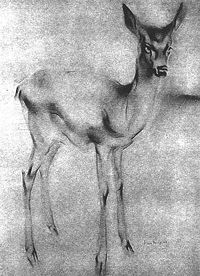
. He made many sketches and drawings of the deer and in 1921, painted Hertje (The fawn), which became quite popular in the Netherlands. He undertook numerous journeys to Belgium
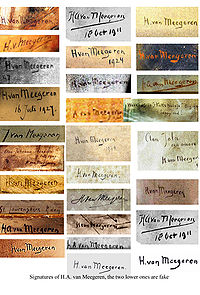
, France, Italy and England, and acquired a name for himself as a talented portraitist. He earned stately fees through commissions from English and American socialites who spent their winter vacations on the Côte d'Azur. His clients were impressed by his understanding of the 17th century techniques of the Dutch masters. Throughout his life, van Meegeren would paint pictures to which he would sign his own signature, which differed greatly from the marks he used on his forgeries.
By all accounts, infidelity was responsible for the breakup of van Meegeren’s marriage to Anna de Voogt; they were divorced on 19 July 1923. Anna left with the children and moved to Paris
, where from time to time, van Meegeren would visit his children. He now dedicated himself to portrait
ure and began producing forgeries to increase his income.
In 1928, he was remarried, in Woerden
, to the raffish actress Johanna Theresia Oerlemans (also known under her stage name Jo van Walraven), with whom he had been living for the past three years. Jo had previously been married to art critic
and journalist Dr. C H. de Boer (Karel de Boer), and she brought their daughter, Viola, into the van Meegeren household.
began to draw the reproach of Dutch art critics, who were, at that time, more interested in the Cubist, Surrealist, and other movements. It was said that van Meegeren’s gift was in imitation and that, outside of copying other artists' work, his talent was limited. One critic wrote that he was "A gifted technician who has made a sort of composite facsimile of the Renaissance school, he has every virtue except originality." In response to these comments, van Meegeren published a series of aggressive articles in the monthly magazine De Kemphaan (“The Game Cock”). Between April 1928 and March 1930, and together with journalist Jan Ubink, he raged against the art community, and in the process, lost any sympathy with the critics.
Van Meegeren felt that his genius had been misjudged, and set out to prove to the art critics that he could not only copy the style of the Dutch masters in his paintings, but produce a work of art so magnificent that it would rival the works of master painters. He moved with Jo to the South of France and began preparations for this ultimate forgery, which took him six years, from 1932 to 1937. In a series of early exercises, he forged works by Frans Hals
, Pieter de Hooch
, Gerard ter Borch
, and Johannes Vermeer
. Finally he chose to forge a painting by Vermeer as his masterpiece. Vermeer had not been particularly well-known until the beginning of the twentieth century; his works were both scarce — only about 35 had survived — and extremely valuable.
Van Meegeren delved into the biographies of the old masters, studying their lives, occupations, trademark techniques and catalogues. In October 1932, the famous art connoisseur and Rembrandt expert Dr. Abraham Bredius
published an article about a recently discovered Vermeer which he described as a painting of a Man and Woman at a Spinet. The painting was later sold to Amsterdam banker Dr. Fritz Mannheimer.
with his wife. There he rented a furnished mansion called “Primavera” and set out to define the chemical and technical procedures that would be necessary to create his perfect forgeries. He bought authentic 17th century canvas and mixed his own paints from raw materials (such as lapis lazuli
, white lead
, indigo
, and cinnabar
) using old formulas to ensure that they were authentic. In addition, he used badger-hair paintbrushes, similar to those Vermeer was known to have used. He came up with a scheme of using phenol formaldehyde to cause the paints to harden after application, making the paintings appear as if they were 300 years old. After completing a painting, van Meegeren would bake it at 100 °C (212 °F) to 120 °C (248 °F) to harden the paint, and then roll it over a cylinder to increase the cracks. Later, he would wash the painting in black India ink
to fill in the cracks.
 It took van Meegeren six years to work out his techniques, and when he was done, he was pleased with his work, on both artistic and deceptive levels. Two of these trial paintings were “Vermeers”: Lady Reading Music, after Vermeer’s Woman in Blue Reading a Letter
at the Rijksmuseum
in Amsterdam, and Lady Playing Music, after Vermeer’s Woman with a Lute near a Window hanging in the Metropolitan Museum of Art
in New York City
. Van Meegeren did not sell these paintings; both are now at the Rijksmuseum
.
Following a journey to the 1936 Summer Olympics
in Berlin
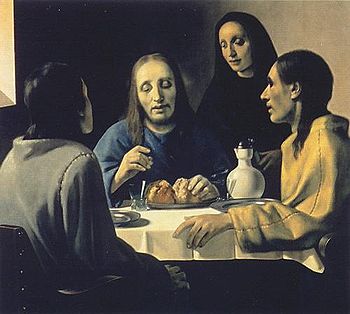
, van Meegeren painted The Supper at Emmaus, using the ultramarine blues and yellows preferred by Johannes Vermeer and other Dutch Golden Age painters. After learning that the experts assumed Vermeer had studied in Italy, van Meegeren used The Supper at Emmaus by Michelangelo Merisi da Caravaggio, located at Italy’s Pinacoteca di Brera, as a model for his next work. He had always wanted to walk in the steps of the masters, and he felt that his forgery was a fine work in its own right. He gave the work to his friend, the attorney C. A. Boon, telling him it was a genuine Vermeer, and asked him to show it to Dr. Abraham Bredius who was living nearby in Monaco
. Bredius examined the forgery in September 1937, and despite some initial doubts, he accepted it as a genuine Vermeer and praised it highly.
The painting was purchased by The Rembrandt Society for 520,000 guilders ($300,000 or about $4 million today.) with the aid of a wealthy shipowner Willem van der Vorm and donated to the Museum Boijmans Van Beuningen
in Rotterdam
. In 1938, the piece was highlighted in a special exhibition at the Rotterdam museum along with 450 Dutch masterpieces dating from 1400–1800. In the "Magazine for [the] History of Art", A. Feulner wrote that "In the rather isolated area, in which the Vermeer picture hung, it was as quiet as in a chapel. The feeling of the consecration overflows on the visitors, although the picture has no ties to ritual or church."
In the summer of 1938, van Meegeren moved to Nice
. Using the proceeds from the sale of The Supper at Emmaus, he bought a 12-bedroom estate at Les Arènes de Cimiez
. On the walls of the estate hung several genuine Old Masters. Two of his better forgeries were made here, Interior with Cardplayers and Interior with Drinkers, both displaying the signature of Pieter de Hooch
. During his time in Nice, he painted his Last Supper I in the style of Vermeer.
In September 1939, as the Second World War threatened, he returned to the Netherlands. He remained at a hotel in Amsterdam for several months and in 1940 moved to the village of Laren
. Throughout 1941, van Meegeren issued his designs, which he published in 1942 as Han van Meegeren: Teekeningen I (Drawings nr I) a large and luxurious book. During this time, he created several forgeries, including The Head of Christ, The Last Supper II, The Blessing of Jacob, The Adulteress and The Washing of the Feet, all in the manner of Vermeer. On 18 December 1943, he divorced his wife, but this was only a formality; the couple remained together, but a large share of his capital was transferred to her accounts as a safeguard against the uncertainties of the war.
In December 1943, the van Meegerens moved to Amsterdam, where they took up residence in the exclusive Keizersgracht 321. His forgeries had earned him between 5.5 to 7.5 million guilders (or about $25–30 million today). He used this money to purchase a large amount of real estate, jewelry and works of art, and to further his luxurious lifestyle. In a 1946 interview, he told Marie Louise Doudart de la Grée that he owned 52 houses and 15 country houses around Laren, among them grachtenhuizen, beautiful mansions along the famous Amsterdam canals.
-laced sleeping pills. Fortunately for van Meegeren, there were no genuine Vermeers available for comparison, since most museum collections were in protective storage as a prevention against war damage. Miedl later sold it to Reichsmarschall
Hermann Göring
for 1.65 million guilders ($625,000 or $7 million today.)
Göring showcased the Vermeer forgery at his residence in Carinhall
(about 65 kilometers north of Berlin
). On 25 August 1943, Göring hid his collection of looted
artwork, including Christ with the Adulteress, in an Austria
n salt mine, along with 6,750 other pieces of artwork looted by the Nazis. On 17 May 1945, Allied forces entered the salt mine, where Captain Harry Anderson discovered the previously unknown "Vermeer".
In May 1945, the Allied forces questioned banker and art dealer Alois Miedl regarding the newly discovered Vermeer. Based on Miedl's confession, the painting was traced back to van Meegeren. On 29 May 1945, he was arrested and charged with fraud and aiding and abetting the enemy. He was remanded to Weteringschans prison. As an alleged Nazi collaborator
and plunderer
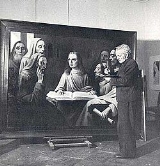
of Dutch cultural property the authorities threatened van Meegeren with extensive prison time. Faced with these bleak choices, and after spending three days in jail, he confessed to forging paintings attributed to Vermeer and Pieter de Hooch. He exclaimed, "The painting in Göring’s hands is not, as you assume, a Vermeer of Delft, but a Van Meegeren! I painted the picture!" It took some time to verify this and for several months he was detained in the Headquarters of the Military Command at Herengracht 468 in Amsterdam. Between July and about November/December 1945, and in the presence of reporters and court-appointed witnesses, he painted his last forgery, Jesus among the Doctors, also called Young Christ in the Temple. After the trial painting was finished, he was transferred to the fortress prison Blauwkapel. Van Meegeren was released from prison in January or February 1946.
The court commissioned an international group of experts to address the authenticity
of van Meegeren's paintings. The commission included curators, professors and doctors from the Netherlands, Belgium
, and England and was led by the director of the chemical laboratory at the Royal Museums of Fine Arts of Belgium
, Dr. Paul Coremans. The commission examined the eight Vermeer and Frans Hals
paintings which van Meegeren had identified as forgeries. With the help of the commission, Dr. Coremans was able to determine the chemical composition of van Meegeren’s paints. He found that van Meegeren had prepared the paints by mixing them with the plastic bonding agent Albertol, a phenolformaldehyde resin
. A bottle with exactly that ingredient had been found in van Meegeren's studio. This chemical component was introduced and manufactured in the 20th century, proving that the “Vermeers” and “Frans Halses” examined by the commission were in fact made by van Meegeren. The commission's other findings suggested that the dust in the craquelure
was too homogeneous to be of natural origin. The matter found in the craquelure appeared to come from India ink, which had accumulated even in areas that natural dirt or dust would never have reached. The paint had become so hard that not only alcohol but also strong acids and bases did not attack the surface, a clear indication that the surface had not been formed in a natural manner. The craquelure on the surface did not always match that in the ground layer, which with a natural craquelure would certainly have been the case. Thus, the test results obtained by the commission appeared to confirm that the works were forgeries created by van Meegeren, but their authenticity would continue to be debated by some of the experts until 1967 and 1977, when new investigative techniques were used to analyze the paintings (see below).
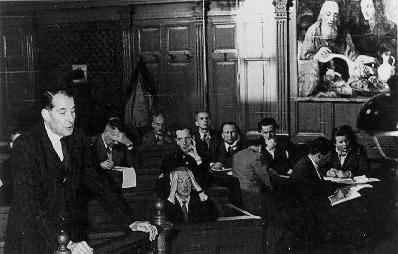
On 12 November 1947, the Fourth Chamber of the Amsterdam Regional Court found Han van Meegeren guilty of forgery and fraud, and sentenced him to a minimal one year in prison. While waiting to be removed to prison, van Meegeren returned to his house at 321 Keizersgracht, where his health continued to decline. During this last month of his life, he strolled freely around his neighborhood.
On 26 November 1947, the last day to appeal the ruling, van Meegeren suffered a heart attack
and was rushed to the Valeriuskliniek hospital in Amsterdam. While at the hospital, he suffered a second heart attack on 29 December. He was pronounced dead at 5:00 pm on 30 December 1947, at the age of 58. His family and several hundred of his friends attended his funeral at the Driehuis Westerveld Crematorium chapel. In 1948, his urn was buried in the general cemetery in the village of Diepenveen
(municipality of Deventer).
 After his death, the court ruled that van Meegeren’s estate be auctioned and the proceeds from his property and the sale of his counterfeits be used to refund the buyers of his works and to pay income taxes on the sale of his paintings. In December 1945, van Meegeren had filed for bankruptcy
. On 5 and 6 September 1950, the furniture and other possessions in his Amsterdam house at Keizersgracht 321 were auctioned by order of the court, along with 738 other pieces of furniture and works of art, including numerous paintings by old and new masters from his private collection. The house was auctioned separately on 4 September. Together with the house, estimated to be worth 65,000 guilders, the proceeds of the sale amounted to 123,000 guilders. Van Meegeren’s unsigned The Last Supper I was bought for 2,300 guilders, while Jesus among the Doctors (which van Meegeren had painted while in detention) sold for 3,000 guilders (about $800 or about $7,000 today.) Today the painting hangs in a Johannesburg
church. The sale of the entire estate amounted to 242,000 guilders ($60,000, or about $500,000 today).
Throughout his trial and bankruptcy, van Meegeren maintained that his second wife, Jo, had nothing to do with the creation and sale of his forgeries. A large part of his considerable wealth had been transferred to her when they were divorced during the war and the money would have been confiscated if she had been ruled to be an accomplice. To all authors, journalists and biographers, van Meegeren told the same story: "Jo didn’t know", and apparently most believed him. Some biographers believe, however, that Jo must have known the truth. Her involvement was never proven and she was able to keep her substantial capital. Jo outlived her husband by many years, always in great luxury, until her death at the age of 91.
in Pittsburgh
examined several of the “Vermeers” in their collection. Under the direction of Dr. Robert Feller and Dr. Bernard Keisch, the examination confirmed that several of their paintings were in fact created using materials invented in the 20th century. They concluded that the “Vermeers” in their possession were modern and could thus be van Meegeren forgeries. This confirmed the findings of the 1946 Coremans commission, and refuted the claims made by M. Jean Decoen. The test results, obtained by the Carnegie Mellon team are summarized below.
Han van Meegeren knew that white lead was used during Vermeer’s time, but of course he had to obtain his stocks through the modern colour trade, which had changed significantly since the 17th century. During Vermeer’s time, Dutch lead was mined from deposits located in the Low Countries; however, by the 19th century, most lead was imported from Australia and the Americas
. Thus, modern white lead differs greatly from the white lead Vermeer would have used, both in the isotope
composition of the lead and in the content of trace elements found in the ores. Dutch white lead was extracted from ores containing high levels of trace elements of silver
and antimony
. In contrast, the modern white lead used by van Meegeren contained neither silver nor antimony, as those elements are now separated from the lead during the modern smelting
process.
Forgeries in which modern lead or white lead pigment has been used can be recognized by using a technique called Pb(Lead)-210-Dating. Pb-210 is a naturally occurring radioactive element that is part of the uranium-238
Radioactive decay series
, and has a half life of 22.3 years. To determine the amount of Pb-210, the alpha radiation emitted by another element, polonium-210 (Po-210), is measured. Thus it is possible to estimate the age of a painting, within a few years' span, by extrapolating the Pb-210 content present in the paint used to create the painting.
The white lead in the painting The Supper at Emmaus had polonium-210 values of 8.5±1.4 and radium-226 (part of the uranium-238 radioactive decay series) values of 0.8±0.3. In contrast, the white lead found in Dutch paintings from 1600–1660 had polonium-210 values of 0.23±0.27 and radium-226 values of 0.40±0.47.
In 1977, another investigation was undertaken by the States forensic labs of the Netherlands, using up-to-date techniques including gas chromatography, to confirm formally the origin of six van Meegeren forgeries, including the Emmaus and the Last Supper that had been alleged to be genuine Vermeers. The conclusions of the 1946 commission were again reaffirmed and upheld by the Dutch judiciary system.
In July 2011, the BBC TV programme, Fake or Fortune, investigated a copy of Dirck van Baburen
's The Procuress owned by the Courtauld Institute. Opinion had been divided as to whether it was a 17th century studio work or a van Meegeren fake. The programme used chemical analysis of the paint to show that it contained Bakelite and thus confirmed that the painting was a 20th century fake.
 Van Meegeren played different roles, some of which were shrouded in fraudulent intentions, as he sought to fulfill his goal of besting his critics. Early on Han’s father may have foreseen his path, as his father once told him, "You are a cheat and always will be." On the other hand, his brothers and sisters perceived him as loyal, generous and affectionate, and he was always loving and helpful to his own children. The question “what was his character” cannot be answered unequivocally. Indeed, recent works question many of the existing assumptions about van Meegeren and the motivations for his career in forgery. With Han van Meegeren, everything was double-edged and his character presents itself as fragments rather than unity.
After van Meegeren was released, he continued to paint, signing his works with his own name. His new-found popularity ensured quick sale of his new paintings, often selling at prices that were many times higher than before he had been unmasked as a forger. Van Meegeren also told the news media that "he had an offer from a Manhattan gallery to come to the U.S. and paint portraits "in the 17th century manner" at $6,000 a throw."
A Dutch opinion poll conducted in October 1947 placed Han van Meegeren’s popularity second in the nation, behind only the Prime Minister's
. The Dutch people viewed van Meegeren as a cunning trickster, who had successfully fooled the Dutch art experts, and more importantly, Hermann Göring himself. In fact, according to a contemporary account, when Göring was informed that his “Vermeer” was actually a forgery, "[Göring] looked as if for the first time he had discovered there was evil in the world". Han van Meegeren remains one of the most ingenious art counterfeiters of the 20th century. After his trial, however, he declared, "My triumph as a counterfeiter was my defeat as [a] creative artist."
Posthumously, van Meegeren's forgeries have been shown in exhibitions around the world, including exhibitions in Amsterdam (1952), Basel
(1953), Zurich
(1953), Haarlem
in the Kunsthandlung de Boer (1958), London
(1961), Rotterdam
(1971), Minneapolis (1973), Essen
(1976–1977), Berlin
(1977), Slot Zeist (1985), New York
(1987), Berkeley, CA (1990), Munich
(1991), Rotterdam (1996), The Hague (1996) and more recently at the Haagse Kunstkring, The Hague (2004) and Stockholm
(2004), and have thus been made broadly accessible to the public.
, including works in the style of Frans Hals and the school of Hals, Pieter de Hooch, and Gerard ter Borch
. In interviews with journalists, regarding discussions with his father Jacques van Meegeren suggested his father had created a number of other forgeries. Some of these paintings include:
Among his original works is his famous Deer, pictured above. Other works include his prize-winning St. Laurens Cathedral; a Portrait of the actress Jo Oerlemans (his second wife) ; his Night Club from the Roaring Twenties; the cheerful watercolor A Summer Day on the Beach and many others.
Later on, however, his son Jacques van Meegeren
started to fake his father’s work. He made paintings in his father’s style – although of much lower quality – and was able to place a perfect signature on these imitations. Many fakes – both by Jacques and by others – are still on the market. They can be recognized by their low pictorial quality, but are not always regarded as such. As a result they have given a bad name to van Meegeren’s oeuvre. For more information, see the section titled "Fake van Meegerens" in the article about Jacques van Meegeren.
Source
Han van Meegeren biographies
Novels about or inspired by Han van Meegeren
Films about or inspired by Han van Meegeren
Plays inspired by Han van Meegeren
Deventer
Deventer is a municipality and city in the Salland region of the Dutch province of Overijssel. Deventer is largely situated on the east bank of the river IJssel, but also has a small part of its territory on the west bank. In 2005 the municipality of Bathmen Deventer is a municipality and city in...
, Overijssel
Overijssel
Overijssel is a province of the Netherlands in the central eastern part of the country. The region has a NUTS classification of NL21. The province's name means "Lands across river IJssel". The capital city of Overijssel is Zwolle and the largest city is Enschede...
– 30 December 1947 in Amsterdam
Amsterdam
Amsterdam is the largest city and the capital of the Netherlands. The current position of Amsterdam as capital city of the Kingdom of the Netherlands is governed by the constitution of August 24, 1815 and its successors. Amsterdam has a population of 783,364 within city limits, an urban population...
), born Henricus Antonius van Meegeren, was a Dutch painter
Painting
Painting is the practice of applying paint, pigment, color or other medium to a surface . The application of the medium is commonly applied to the base with a brush but other objects can be used. In art, the term painting describes both the act and the result of the action. However, painting is...
and portrait
Portrait
thumb|250px|right|Portrait of [[Thomas Jefferson]] by [[Rembrandt Peale]], 1805. [[New-York Historical Society]].A portrait is a painting, photograph, sculpture, or other artistic representation of a person, in which the face and its expression is predominant. The intent is to display the likeness,...
ist, and is considered to be one of the most ingenious art forgers of the 20th century.
As a child, van Meegeren developed an enthusiasm for the marvelous colours used by painters of the Dutch Golden Age
Dutch Golden Age
The Golden Age was a period in Dutch history, roughly spanning the 17th century, in which Dutch trade, science, military and art were among the most acclaimed in the world. The first half is characterised by the Eighty Years' War till 1648...
, and later set out to become an artist himself. When art critics decried his work as tired and derivative, van Meegeren felt that they had destroyed his career. Thereupon, he decided to prove his talent to the critics by forging paintings of some of the world's most famous artists, including Frans Hals
Frans Hals
Frans Hals was a Dutch Golden Age painter. He is notable for his loose painterly brushwork, and helped introduce this lively style of painting into Dutch art. Hals was also instrumental in the evolution of 17th century group portraiture.-Biography:Hals was born in 1580 or 1581, in Antwerp...
, Pieter de Hooch
Pieter de Hooch
Pieter de Hooch was a genre painter during the Dutch Golden Age. He was a contemporary of Dutch Master Jan Vermeer, with whom his work shared themes and style.-Biography:...
, Gerard ter Borch
Gerard ter Borch
Gerard ter Borch was a Dutch genre painter, who lived in the Dutch Golden Age.-Biography:Gerard ter Borch was born in December 1617 in Zwolle in the province of Overijssel in the Dutch Republic....
and Johannes Vermeer
Johannes Vermeer
Johannes, Jan or Johan Vermeer was a Dutch painter who specialized in exquisite, domestic interior scenes of middle class life. Vermeer was a moderately successful provincial genre painter in his lifetime...
. He so well replicated the styles and colours of the artists that the best art critics and experts of the time regarded his paintings as genuine and sometimes exquisite. His most successful forgery was Supper at Emmaus, created in 1937 while living in the south of France. This painting was hailed by some of the world’s foremost art experts as the finest Vermeer they had ever seen.
During World War II
World War II
World War II, or the Second World War , was a global conflict lasting from 1939 to 1945, involving most of the world's nations—including all of the great powers—eventually forming two opposing military alliances: the Allies and the Axis...
, wealthy Dutchmen, wanting to prevent a sellout of Dutch art
Dutch art
Dutch art describes the history of visual arts in the Netherlands, after the United Provinces separated from Flanders. Earlier painting in the area is covered in Early Netherlandish painting and Renaissance art.-Golden Age:...
to Adolf Hitler
Adolf Hitler
Adolf Hitler was an Austrian-born German politician and the leader of the National Socialist German Workers Party , commonly referred to as the Nazi Party). He was Chancellor of Germany from 1933 to 1945, and head of state from 1934 to 1945...
and the Nazi Party, avidly bought van Meegeren's forgeries. Nevertheless, a falsified "Vermeer" ended up in the possession of Reichsmarschall
Reichsmarschall
Reichsmarschall literally in ; was the highest rank in the armed forces of Nazi Germany during World War II after the position of Supreme Commander held by Adolf Hitler....
Hermann Göring
Hermann Göring
Hermann Wilhelm Göring, was a German politician, military leader, and a leading member of the Nazi Party. He was a veteran of World War I as an ace fighter pilot, and a recipient of the coveted Pour le Mérite, also known as "The Blue Max"...
. Following the war, the forgery was discovered in Göring's possession, and van Meegeren was arrested 29 May 1945 as a collaborator
Collaboration during World War II
Within nations occupied by the Axis Powers, some citizens, driven by nationalism, ethnic hatred, anti-communism, anti-Semitism or opportunism, knowingly engaged in collaboration with the Axis Powers during World War II...
, as officials believed that he had sold Dutch cultural property
Culture of the Netherlands
Dutch culture, or the culture of the Netherlands, is diverse, reflecting regional differences as well as the foreign influences thanks to the merchant and exploring spirit of the Dutch and the influx of immigrants...
to the Nazis. This would have been an act of treason, the punishment for which was death, so van Meegeren fearfully confessed to the forgery. On 12 November 1947, after a brief but highly publicized trial, he was convicted of falsification and fraud charges, and was sentenced to a modest punishment of one year in prison. He never served his sentence, however; before he could be incarcerated, he suffered a heart attack and died on 30 December 1947. It is estimated that van Meegeren duped buyers, including the government of the Netherlands, out of the equivalent of more than thirty million dollars in today's money.
Early years
Han (a diminutive version of Henri or Henricus) van Meegeren was born in 1889 as the third of five children of middle-classMiddle class
The middle class is any class of people in the middle of a societal hierarchy. In Weberian socio-economic terms, the middle class is the broad group of people in contemporary society who fall socio-economically between the working class and upper class....
Roman Catholic parents in the provincial city town of Deventer
Deventer
Deventer is a municipality and city in the Salland region of the Dutch province of Overijssel. Deventer is largely situated on the east bank of the river IJssel, but also has a small part of its territory on the west bank. In 2005 the municipality of Bathmen Deventer is a municipality and city in...
. He was the son of Augusta Louisa Henrietta Camps and Hendrikus Johannes van Meegeren, a French and history teacher at the Kweekschool (training college for schoolmasters) in the city of Deventer.
Early on, Han felt neglected and misunderstood by his father, as the elder van Meegeren strictly forbade his artistic development, and constantly derided him. He was often forced by his father to write a hundred times the phrase "I know nothing, I am nothing, I am capable of nothing." While attending the Higher Burger School, he met teacher and painter Bartus Korteling (1853–1930), who would become his mentor. Korteling had been inspired by Johannes Vermeer and showed the young van Meegeren how Vermeer had manufactured and mixed his colours. Korteling had rejected the Impressionist movement and other modern trends, as decadent, degenerate art
Degenerate art
Degenerate art is the English translation of the German entartete Kunst, a term adopted by the Nazi regime in Germany to describe virtually all modern art. Such art was banned on the grounds that it was un-German or Jewish Bolshevist in nature, and those identified as degenerate artists were...
, and his strong personal influence probably later led van Meegeren to rebuff contemporary styles and paint exclusively in the style of the Dutch Golden Age
Dutch Golden Age
The Golden Age was a period in Dutch history, roughly spanning the 17th century, in which Dutch trade, science, military and art were among the most acclaimed in the world. The first half is characterised by the Eighty Years' War till 1648...
.
Architecture
Architecture is both the process and product of planning, designing and construction. Architectural works, in the material form of buildings, are often perceived as cultural and political symbols and as works of art...
. In 1907, van Meegeren, compelled by his father's demands, left home to study at the Technische Hogeschool
Delft University of Technology
Delft University of Technology , also known as TU Delft, is the largest and oldest Dutch public technical university, located in Delft, Netherlands...
(Delft Technical College), as it was called in those days, in Delft
Delft
Delft is a city and municipality in the province of South Holland , the Netherlands. It is located between Rotterdam and The Hague....
, the hometown of Johannes Vermeer. He received drawing and painting lessons as well. He easily passed his preliminary examinations, but because he did not wish to become an architect, he never took the Ingenieurs (final) examination. He nevertheless proved to be an apt architect, and in fact designed the clubhouse for his rowing club
Rowing club
A rowing club is a club for people interested in the sport of Rowing. Rowing clubs are usually located near a body of water, whether natural or artificial, that is large enough for manoeuvering of the shells . Clubs usually have racks to store boats and a dock to put them in the water...
DDS in Delft (see image). This building still exists.
In 1913, van Meegeren gave up his architecture studies and concentrated on drawing and painting at the art school in The Hague
The Hague
The Hague is the capital city of the province of South Holland in the Netherlands. With a population of 500,000 inhabitants , it is the third largest city of the Netherlands, after Amsterdam and Rotterdam...
. On 8 January 1913, he received the prestigious Gold Medal from the Technical University in Delft, for his Study of the Interior of the Church of Saint Lawrence (Laurenskerk) in Rotterdam. The award was given every five years to an art student who created the best work, and was accompanied by a gold medal.
On 18 April 1912, van Meegeren married a fellow art student, Anna de Voogt, who was expecting their first child. The couple went to live with Anna’s grandmother in Rijswijk. Their son Jacques Henri Emil was born on 26 August 1912 in Rijswijk, Jacques van Meegeren
Jacques van Meegeren
Jacques van Meegeren , born Jacques Henri Emil van Meegeren, was a Dutch Illustrator and painter.He is also considered to be a forger of the work of his father Han van Meegeren...
would also become a painter; he died on 26 October 1977 in Amsterdam
Amsterdam
Amsterdam is the largest city and the capital of the Netherlands. The current position of Amsterdam as capital city of the Kingdom of the Netherlands is governed by the constitution of August 24, 1815 and its successors. Amsterdam has a population of 783,364 within city limits, an urban population...
.
Career as a legitimate painter
Royal Academy of Art (The Hague)
The Royal Academy of Art, The Hague is an art academy in the Netherlands. It is the oldest art academy in Europe. Known in Dutch as "Koninklijke Academie van Beeldende Kunsten, Den Haag" it was founded on 29 September 1682 when its predecessor, the Haagsche Teekenakademie was dissolved.- External...
in The Hague. The diploma would allow him to teach, and soon he took a position as the assistant to Professor Gips, the Professor of Drawing and Art History, for the small monthly salary of 75 guldens. In March 1915, his daughter Pauline (later called Inez) was born. To supplement his income, Han would sketch posters and paint pictures (generally Christmas card
Christmas card
A Christmas card is a greeting card sent as part of the traditional celebration of Christmas in order to convey between people a range of sentiments related to the Christmas and holiday season. Christmas cards are usually exchanged during the weeks preceding Christmas Day by many people in Western...
s, still-life, landscapes, and portraits) for the commercial art
Commercial art
Commercial art is historically a subsector of creative services, referring to art created for commercial purposes, primarily advertising. The term has become increasingly anachronistic in favor of more contemporary terms such as graphic design and advertising art.Commercial art traditionally...
trade. Many of these paintings are quite valuable today.
Van Meegeren showed his first paintings publicly in The Hague, where they were exhibited from April to May 1917 at the Kunstzaal Pictura. In December 1919, he was accepted as a select member to the Haagse Kunstkring, an exclusive society of writers and painters, who met weekly on the premises of the Ridderzaal
Binnenhof
The Binnenhof , is a complex of buildings in The Hague. It has been the location of meetings of the Staten-Generaal, the Dutch parliament, since 1446, and has been the centre of Dutch politics for many centuries....
. In his studio at The Hague, opposite the Royal Palace Huis ten Bosch
Huis ten Bosch
Huis ten Bosch is one of the three official residences of the Dutch Royal Family, located in The Hague in the Netherlands. It has been home to Queen Beatrix since 1981. The other Royal palace in The Hague, Noordeinde Palace, is used for work-related purposes...
, van Meegeren would paint the tame Roe Deer
Roe Deer
The European Roe Deer , also known as the Western Roe Deer, chevreuil or just Roe Deer, is a Eurasian species of deer. It is relatively small, reddish and grey-brown, and well-adapted to cold environments. Roe Deer are widespread in Western Europe, from the Mediterranean to Scandinavia, and from...
belonging to Princess Juliana
Juliana of the Netherlands
Juliana was the Queen regnant of the Kingdom of the Netherlands between 1948 and 1980. She was the only child of Queen Wilhelmina and Prince Henry...
. He made many sketches and drawings of the deer and in 1921, painted Hertje (The fawn), which became quite popular in the Netherlands. He undertook numerous journeys to Belgium
Belgium
Belgium , officially the Kingdom of Belgium, is a federal state in Western Europe. It is a founding member of the European Union and hosts the EU's headquarters, and those of several other major international organisations such as NATO.Belgium is also a member of, or affiliated to, many...
, France, Italy and England, and acquired a name for himself as a talented portraitist. He earned stately fees through commissions from English and American socialites who spent their winter vacations on the Côte d'Azur. His clients were impressed by his understanding of the 17th century techniques of the Dutch masters. Throughout his life, van Meegeren would paint pictures to which he would sign his own signature, which differed greatly from the marks he used on his forgeries.
By all accounts, infidelity was responsible for the breakup of van Meegeren’s marriage to Anna de Voogt; they were divorced on 19 July 1923. Anna left with the children and moved to Paris
Paris
Paris is the capital and largest city in France, situated on the river Seine, in northern France, at the heart of the Île-de-France region...
, where from time to time, van Meegeren would visit his children. He now dedicated himself to portrait
Portrait
thumb|250px|right|Portrait of [[Thomas Jefferson]] by [[Rembrandt Peale]], 1805. [[New-York Historical Society]].A portrait is a painting, photograph, sculpture, or other artistic representation of a person, in which the face and its expression is predominant. The intent is to display the likeness,...
ure and began producing forgeries to increase his income.
In 1928, he was remarried, in Woerden
Woerden
Woerden is a municipality and a city in the central Netherlands. Due to its central location between Amsterdam, Rotterdam, The Hague and Utrecht, and the fact that it has excellent rail and road connections to those cities, it is a popular town for commuters who work in those cities.-Population...
, to the raffish actress Johanna Theresia Oerlemans (also known under her stage name Jo van Walraven), with whom he had been living for the past three years. Jo had previously been married to art critic
Art critic
An art critic is a person who specializes in evaluating art. Their written critiques, or reviews, are published in newspapers, magazines, books and on web sites...
and journalist Dr. C H. de Boer (Karel de Boer), and she brought their daughter, Viola, into the van Meegeren household.
The forgeries
In the Netherlands, Han van Meegeren had become a well-known painter. Hertje (1921) and Straatzangers (1928) were particularly popular. His first legitimate copies were painted in 1923 – his Laughing Cavalier and Happy Smoker – both in the style of Frans Hals. By 1928, the similarity of van Meegeren’s paintings to those of the old mastersOld Master
"Old Master" is a term for a European painter of skill who worked before about 1800, or a painting by such an artist. An "old master print" is an original print made by an artist in the same period...
began to draw the reproach of Dutch art critics, who were, at that time, more interested in the Cubist, Surrealist, and other movements. It was said that van Meegeren’s gift was in imitation and that, outside of copying other artists' work, his talent was limited. One critic wrote that he was "A gifted technician who has made a sort of composite facsimile of the Renaissance school, he has every virtue except originality." In response to these comments, van Meegeren published a series of aggressive articles in the monthly magazine De Kemphaan (“The Game Cock”). Between April 1928 and March 1930, and together with journalist Jan Ubink, he raged against the art community, and in the process, lost any sympathy with the critics.
Van Meegeren felt that his genius had been misjudged, and set out to prove to the art critics that he could not only copy the style of the Dutch masters in his paintings, but produce a work of art so magnificent that it would rival the works of master painters. He moved with Jo to the South of France and began preparations for this ultimate forgery, which took him six years, from 1932 to 1937. In a series of early exercises, he forged works by Frans Hals
Frans Hals
Frans Hals was a Dutch Golden Age painter. He is notable for his loose painterly brushwork, and helped introduce this lively style of painting into Dutch art. Hals was also instrumental in the evolution of 17th century group portraiture.-Biography:Hals was born in 1580 or 1581, in Antwerp...
, Pieter de Hooch
Pieter de Hooch
Pieter de Hooch was a genre painter during the Dutch Golden Age. He was a contemporary of Dutch Master Jan Vermeer, with whom his work shared themes and style.-Biography:...
, Gerard ter Borch
Gerard ter Borch
Gerard ter Borch was a Dutch genre painter, who lived in the Dutch Golden Age.-Biography:Gerard ter Borch was born in December 1617 in Zwolle in the province of Overijssel in the Dutch Republic....
, and Johannes Vermeer
Johannes Vermeer
Johannes, Jan or Johan Vermeer was a Dutch painter who specialized in exquisite, domestic interior scenes of middle class life. Vermeer was a moderately successful provincial genre painter in his lifetime...
. Finally he chose to forge a painting by Vermeer as his masterpiece. Vermeer had not been particularly well-known until the beginning of the twentieth century; his works were both scarce — only about 35 had survived — and extremely valuable.
Van Meegeren delved into the biographies of the old masters, studying their lives, occupations, trademark techniques and catalogues. In October 1932, the famous art connoisseur and Rembrandt expert Dr. Abraham Bredius
Abraham Bredius
Abraham Bredius , was a Dutch art collector, art historian and museum curator.-Life:He travelled widely visiting various art collections in his youth, and worked at the Dutch Museum for History and Art before becoming director from 1889 to 1909 of the Mauritshuis...
published an article about a recently discovered Vermeer which he described as a painting of a Man and Woman at a Spinet. The painting was later sold to Amsterdam banker Dr. Fritz Mannheimer.
Inventing the "perfect forgery"
In 1932, van Meegeren moved to the village of Roquebrune-Cap-MartinRoquebrune-Cap-Martin
Roquebrune-Cap-Martin is a commune in the Alpes-Maritimes department in southeastern France between Monaco and Menton. The name was changed from Roquebrune to differentiate the town from Roquebrune-sur-Argens in the neighboring Var Department.-History:In pre-Roman times the area was settled by the...
with his wife. There he rented a furnished mansion called “Primavera” and set out to define the chemical and technical procedures that would be necessary to create his perfect forgeries. He bought authentic 17th century canvas and mixed his own paints from raw materials (such as lapis lazuli
Lapis lazuli
Lapis lazuli is a relatively rare semi-precious stone that has been prized since antiquity for its intense blue color....
, white lead
White lead
White lead is the chemical compound 2·Pb2. It was formerly used as an ingredient for lead paint and a cosmetic called Venetian Ceruse, because its opaque quality made it a good pigment. However, it tended to cause lead poisoning, and its use has been banned in most countries.White lead has been...
, indigo
Indigo
Indigo is a color named after the purple dye derived from the plant Indigofera tinctoria and related species. The color is placed on the electromagnetic spectrum between about 420 and 450 nm in wavelength, placing it between blue and violet...
, and cinnabar
Cinnabar
Cinnabar or cinnabarite , is the common ore of mercury.-Word origin:The name comes from κινναβαρι , a Greek word most likely applied by Theophrastus to several distinct substances...
) using old formulas to ensure that they were authentic. In addition, he used badger-hair paintbrushes, similar to those Vermeer was known to have used. He came up with a scheme of using phenol formaldehyde to cause the paints to harden after application, making the paintings appear as if they were 300 years old. After completing a painting, van Meegeren would bake it at 100 °C (212 °F) to 120 °C (248 °F) to harden the paint, and then roll it over a cylinder to increase the cracks. Later, he would wash the painting in black India ink
India ink
India ink is a simple black ink once widely used for writing and printing and now more commonly used for drawing, especially when inking comic books and comic strips.-Composition:...
to fill in the cracks.
Woman in Blue Reading a Letter
Woman in Blue Reading a Letter is a painting by the Dutch painter Johannes Vermeer. Part of the collection of the Rijksmuseum Amsterdam since 1885, it was the first Vermeer acquired by the museum.-Composition:...
at the Rijksmuseum
Rijksmuseum
The Rijksmuseum Amsterdam or simply Rijksmuseum is a Dutch national museum in Amsterdam, located on the Museumplein. The museum is dedicated to arts, crafts, and history. It has a large collection of paintings from the Dutch Golden Age and a substantial collection of Asian art...
in Amsterdam, and Lady Playing Music, after Vermeer’s Woman with a Lute near a Window hanging in the Metropolitan Museum of Art
Metropolitan Museum of Art
The Metropolitan Museum of Art is a renowned art museum in New York City. Its permanent collection contains more than two million works, divided into nineteen curatorial departments. The main building, located on the eastern edge of Central Park along Manhattan's Museum Mile, is one of the...
in New York City
New York City
New York is the most populous city in the United States and the center of the New York Metropolitan Area, one of the most populous metropolitan areas in the world. New York exerts a significant impact upon global commerce, finance, media, art, fashion, research, technology, education, and...
. Van Meegeren did not sell these paintings; both are now at the Rijksmuseum
Rijksmuseum
The Rijksmuseum Amsterdam or simply Rijksmuseum is a Dutch national museum in Amsterdam, located on the Museumplein. The museum is dedicated to arts, crafts, and history. It has a large collection of paintings from the Dutch Golden Age and a substantial collection of Asian art...
.
Following a journey to the 1936 Summer Olympics
1936 Summer Olympics
The 1936 Summer Olympics, officially known as the Games of the XI Olympiad, was an international multi-sport event which was held in 1936 in Berlin, Germany. Berlin won the bid to host the Games over Barcelona, Spain on April 26, 1931, at the 29th IOC Session in Barcelona...
in Berlin
Berlin
Berlin is the capital city of Germany and is one of the 16 states of Germany. With a population of 3.45 million people, Berlin is Germany's largest city. It is the second most populous city proper and the seventh most populous urban area in the European Union...
, van Meegeren painted The Supper at Emmaus, using the ultramarine blues and yellows preferred by Johannes Vermeer and other Dutch Golden Age painters. After learning that the experts assumed Vermeer had studied in Italy, van Meegeren used The Supper at Emmaus by Michelangelo Merisi da Caravaggio, located at Italy’s Pinacoteca di Brera, as a model for his next work. He had always wanted to walk in the steps of the masters, and he felt that his forgery was a fine work in its own right. He gave the work to his friend, the attorney C. A. Boon, telling him it was a genuine Vermeer, and asked him to show it to Dr. Abraham Bredius who was living nearby in Monaco
Monaco
Monaco , officially the Principality of Monaco , is a sovereign city state on the French Riviera. It is bordered on three sides by its neighbour, France, and its centre is about from Italy. Its area is with a population of 35,986 as of 2011 and is the most densely populated country in the...
. Bredius examined the forgery in September 1937, and despite some initial doubts, he accepted it as a genuine Vermeer and praised it highly.
The painting was purchased by The Rembrandt Society for 520,000 guilders ($300,000 or about $4 million today.) with the aid of a wealthy shipowner Willem van der Vorm and donated to the Museum Boijmans Van Beuningen
Museum Boijmans Van Beuningen
The Museum Boijmans Van Beuningen is the main art museum in Rotterdam, the Netherlands. The museum began in 1847 with the collection of Frans Jacob Otto Boijmans . Much of the museum's original collection was destroyed in a disastrous 1864 fire...
in Rotterdam
Rotterdam
Rotterdam is the second-largest city in the Netherlands and one of the largest ports in the world. Starting as a dam on the Rotte river, Rotterdam has grown into a major international commercial centre...
. In 1938, the piece was highlighted in a special exhibition at the Rotterdam museum along with 450 Dutch masterpieces dating from 1400–1800. In the "Magazine for [the] History of Art", A. Feulner wrote that "In the rather isolated area, in which the Vermeer picture hung, it was as quiet as in a chapel. The feeling of the consecration overflows on the visitors, although the picture has no ties to ritual or church."
In the summer of 1938, van Meegeren moved to Nice
Nice
Nice is the fifth most populous city in France, after Paris, Marseille, Lyon and Toulouse, with a population of 348,721 within its administrative limits on a land area of . The urban area of Nice extends beyond the administrative city limits with a population of more than 955,000 on an area of...
. Using the proceeds from the sale of The Supper at Emmaus, he bought a 12-bedroom estate at Les Arènes de Cimiez
Cimiez
Cimiez is a neighborhood in Nice, southern France. The area contains the Musée Matisse and the ruins of Cemenelum, capital of the Ancient Roman province Alpes Maritimae on the Ligurian coast...
. On the walls of the estate hung several genuine Old Masters. Two of his better forgeries were made here, Interior with Cardplayers and Interior with Drinkers, both displaying the signature of Pieter de Hooch
Pieter de Hooch
Pieter de Hooch was a genre painter during the Dutch Golden Age. He was a contemporary of Dutch Master Jan Vermeer, with whom his work shared themes and style.-Biography:...
. During his time in Nice, he painted his Last Supper I in the style of Vermeer.
In September 1939, as the Second World War threatened, he returned to the Netherlands. He remained at a hotel in Amsterdam for several months and in 1940 moved to the village of Laren
Laren
is a municipality and a town in the Netherlands, in the province of North Holland. Located in the region called 't Gooi, it is the oldest town in that area. It is one of the richest towns in the Netherlands, along with its neighbour Blaricum...
. Throughout 1941, van Meegeren issued his designs, which he published in 1942 as Han van Meegeren: Teekeningen I (Drawings nr I) a large and luxurious book. During this time, he created several forgeries, including The Head of Christ, The Last Supper II, The Blessing of Jacob, The Adulteress and The Washing of the Feet, all in the manner of Vermeer. On 18 December 1943, he divorced his wife, but this was only a formality; the couple remained together, but a large share of his capital was transferred to her accounts as a safeguard against the uncertainties of the war.
In December 1943, the van Meegerens moved to Amsterdam, where they took up residence in the exclusive Keizersgracht 321. His forgeries had earned him between 5.5 to 7.5 million guilders (or about $25–30 million today). He used this money to purchase a large amount of real estate, jewelry and works of art, and to further his luxurious lifestyle. In a 1946 interview, he told Marie Louise Doudart de la Grée that he owned 52 houses and 15 country houses around Laren, among them grachtenhuizen, beautiful mansions along the famous Amsterdam canals.
The forger fools Hermann Göring
During the German occupation of the Netherlands, one of van Meegeren’s agents sold a Vermeer forgery, Christ with the Adulteress, to Nazi banker and art dealer Alois Miedl in 1942. Experts could probably have identified it as a forgery; as van Meegeren's health declined, so did the quality of work. He chain-smoked, drank heavily and became addicted to morphineMorphine
Morphine is a potent opiate analgesic medication and is considered to be the prototypical opioid. It was first isolated in 1804 by Friedrich Sertürner, first distributed by same in 1817, and first commercially sold by Merck in 1827, which at the time was a single small chemists' shop. It was more...
-laced sleeping pills. Fortunately for van Meegeren, there were no genuine Vermeers available for comparison, since most museum collections were in protective storage as a prevention against war damage. Miedl later sold it to Reichsmarschall
Reichsmarschall
Reichsmarschall literally in ; was the highest rank in the armed forces of Nazi Germany during World War II after the position of Supreme Commander held by Adolf Hitler....
Hermann Göring
Hermann Göring
Hermann Wilhelm Göring, was a German politician, military leader, and a leading member of the Nazi Party. He was a veteran of World War I as an ace fighter pilot, and a recipient of the coveted Pour le Mérite, also known as "The Blue Max"...
for 1.65 million guilders ($625,000 or $7 million today.)
Göring showcased the Vermeer forgery at his residence in Carinhall
Carinhall
Carinhall was the country residence of Hermann Göring, built on a large hunting estate northeast of Berlin in the Schorfheide forest between the Großdöllner See and the Wuckersee in the north of Brandenburg....
(about 65 kilometers north of Berlin
Berlin
Berlin is the capital city of Germany and is one of the 16 states of Germany. With a population of 3.45 million people, Berlin is Germany's largest city. It is the second most populous city proper and the seventh most populous urban area in the European Union...
). On 25 August 1943, Göring hid his collection of looted
Looting
Looting —also referred to as sacking, plundering, despoiling, despoliation, and pillaging—is the indiscriminate taking of goods by force as part of a military or political victory, or during a catastrophe, such as during war, natural disaster, or rioting...
artwork, including Christ with the Adulteress, in an Austria
Austria
Austria , officially the Republic of Austria , is a landlocked country of roughly 8.4 million people in Central Europe. It is bordered by the Czech Republic and Germany to the north, Slovakia and Hungary to the east, Slovenia and Italy to the south, and Switzerland and Liechtenstein to the...
n salt mine, along with 6,750 other pieces of artwork looted by the Nazis. On 17 May 1945, Allied forces entered the salt mine, where Captain Harry Anderson discovered the previously unknown "Vermeer".
In May 1945, the Allied forces questioned banker and art dealer Alois Miedl regarding the newly discovered Vermeer. Based on Miedl's confession, the painting was traced back to van Meegeren. On 29 May 1945, he was arrested and charged with fraud and aiding and abetting the enemy. He was remanded to Weteringschans prison. As an alleged Nazi collaborator
Pursuit of Nazi collaborators
The pursuit of Nazi collaborators refers to the post-World War II pursuit and apprehension of individuals who were not citizens of the Third Reich at the outbreak of World War II and collaborated with the Nazi regime during the war...
and plunderer
Nazi plunder
Nazi plunder refers to art theft and other items stolen as a result of the organized looting of European countries during the time of the Third Reich by agents acting on behalf of the ruling Nazi Party of Germany. Plundering occurred from 1933 until the end of World War II, particularly by military...
of Dutch cultural property the authorities threatened van Meegeren with extensive prison time. Faced with these bleak choices, and after spending three days in jail, he confessed to forging paintings attributed to Vermeer and Pieter de Hooch. He exclaimed, "The painting in Göring’s hands is not, as you assume, a Vermeer of Delft, but a Van Meegeren! I painted the picture!" It took some time to verify this and for several months he was detained in the Headquarters of the Military Command at Herengracht 468 in Amsterdam. Between July and about November/December 1945, and in the presence of reporters and court-appointed witnesses, he painted his last forgery, Jesus among the Doctors, also called Young Christ in the Temple. After the trial painting was finished, he was transferred to the fortress prison Blauwkapel. Van Meegeren was released from prison in January or February 1946.
Trial, sentence and death
The trial of Han van Meegeren began on 29 October 1947 in Room 4 of the Regional Court in Amsterdam. The collaboration charges had been dropped, since the expert panel had found that the "Vermeer" sold to Hermann Göring had been a forgery and was, therefore, not the cultural property of the Netherlands. The public prosecutor, H. A. Wassenbergh, brought charges of forgery and fraud and demanded a sentence of two years in prison.The court commissioned an international group of experts to address the authenticity
Authenticity in art
Authenticity in art has a variety of meanings related to different ways in which a work of art or an artistic performance may be considered authentic.Denis Dutton distinguishes between nominal authenticity and expressive authenticity....
of van Meegeren's paintings. The commission included curators, professors and doctors from the Netherlands, Belgium
Belgium
Belgium , officially the Kingdom of Belgium, is a federal state in Western Europe. It is a founding member of the European Union and hosts the EU's headquarters, and those of several other major international organisations such as NATO.Belgium is also a member of, or affiliated to, many...
, and England and was led by the director of the chemical laboratory at the Royal Museums of Fine Arts of Belgium
Royal Museums of Fine Arts of Belgium
The Royal Museums of Fine Arts of Belgium , is one of the most famous museums in Belgium.-The museum:...
, Dr. Paul Coremans. The commission examined the eight Vermeer and Frans Hals
Frans Hals
Frans Hals was a Dutch Golden Age painter. He is notable for his loose painterly brushwork, and helped introduce this lively style of painting into Dutch art. Hals was also instrumental in the evolution of 17th century group portraiture.-Biography:Hals was born in 1580 or 1581, in Antwerp...
paintings which van Meegeren had identified as forgeries. With the help of the commission, Dr. Coremans was able to determine the chemical composition of van Meegeren’s paints. He found that van Meegeren had prepared the paints by mixing them with the plastic bonding agent Albertol, a phenolformaldehyde resin
Phenol formaldehyde resin
Phenol formaldehyde resins include synthetic thermosetting resins such as obtained by the reaction of phenols with formaldehyde. Sometimes the precursors include other aldehydes or other phenol. Phenolic resins are mainly used in the production of circuit boards...
. A bottle with exactly that ingredient had been found in van Meegeren's studio. This chemical component was introduced and manufactured in the 20th century, proving that the “Vermeers” and “Frans Halses” examined by the commission were in fact made by van Meegeren. The commission's other findings suggested that the dust in the craquelure
Craquelure
In art, craquelure is the fine pattern of dense "cracking" formed on the surface of paintings, in particular due to the aging of paints. It is often used to determine the age of paintings and to detect art forgery, as craquelure is a hard-to-forge signature of authenticity.-Authentic:Authentic...
was too homogeneous to be of natural origin. The matter found in the craquelure appeared to come from India ink, which had accumulated even in areas that natural dirt or dust would never have reached. The paint had become so hard that not only alcohol but also strong acids and bases did not attack the surface, a clear indication that the surface had not been formed in a natural manner. The craquelure on the surface did not always match that in the ground layer, which with a natural craquelure would certainly have been the case. Thus, the test results obtained by the commission appeared to confirm that the works were forgeries created by van Meegeren, but their authenticity would continue to be debated by some of the experts until 1967 and 1977, when new investigative techniques were used to analyze the paintings (see below).
On 12 November 1947, the Fourth Chamber of the Amsterdam Regional Court found Han van Meegeren guilty of forgery and fraud, and sentenced him to a minimal one year in prison. While waiting to be removed to prison, van Meegeren returned to his house at 321 Keizersgracht, where his health continued to decline. During this last month of his life, he strolled freely around his neighborhood.
On 26 November 1947, the last day to appeal the ruling, van Meegeren suffered a heart attack
Myocardial infarction
Myocardial infarction or acute myocardial infarction , commonly known as a heart attack, results from the interruption of blood supply to a part of the heart, causing heart cells to die...
and was rushed to the Valeriuskliniek hospital in Amsterdam. While at the hospital, he suffered a second heart attack on 29 December. He was pronounced dead at 5:00 pm on 30 December 1947, at the age of 58. His family and several hundred of his friends attended his funeral at the Driehuis Westerveld Crematorium chapel. In 1948, his urn was buried in the general cemetery in the village of Diepenveen
Diepenveen
Diepenveen is a village in the Dutch province of Overijssel. It is located in the municipality of Deventer, about 4 km north of the city centre.Diepenveen was a separate municipality until 1999, when it became a part of Deventer....
(municipality of Deventer).
Aftermath
Bankruptcy
Bankruptcy is a legal status of an insolvent person or an organisation, that is, one that cannot repay the debts owed to creditors. In most jurisdictions bankruptcy is imposed by a court order, often initiated by the debtor....
. On 5 and 6 September 1950, the furniture and other possessions in his Amsterdam house at Keizersgracht 321 were auctioned by order of the court, along with 738 other pieces of furniture and works of art, including numerous paintings by old and new masters from his private collection. The house was auctioned separately on 4 September. Together with the house, estimated to be worth 65,000 guilders, the proceeds of the sale amounted to 123,000 guilders. Van Meegeren’s unsigned The Last Supper I was bought for 2,300 guilders, while Jesus among the Doctors (which van Meegeren had painted while in detention) sold for 3,000 guilders (about $800 or about $7,000 today.) Today the painting hangs in a Johannesburg
Johannesburg
Johannesburg also known as Jozi, Jo'burg or Egoli, is the largest city in South Africa, by population. Johannesburg is the provincial capital of Gauteng, the wealthiest province in South Africa, having the largest economy of any metropolitan region in Sub-Saharan Africa...
church. The sale of the entire estate amounted to 242,000 guilders ($60,000, or about $500,000 today).
Throughout his trial and bankruptcy, van Meegeren maintained that his second wife, Jo, had nothing to do with the creation and sale of his forgeries. A large part of his considerable wealth had been transferred to her when they were divorced during the war and the money would have been confiscated if she had been ruled to be an accomplice. To all authors, journalists and biographers, van Meegeren told the same story: "Jo didn’t know", and apparently most believed him. Some biographers believe, however, that Jo must have known the truth. Her involvement was never proven and she was able to keep her substantial capital. Jo outlived her husband by many years, always in great luxury, until her death at the age of 91.
M. Jean Decoen's objection
M. Jean Decoen, a Brussels art expert and restorer, stated in his 1951 book that he believed The Supper at Emmaus and The Last Supper II to be genuine Vermeers. Decoen went on to state that conclusions of Dr. Paul Coreman’s panel of experts were wrong and that the paintings should again be examined. The buyer of The Last Supper II, Interior with Drinkers, and The Head of Christ, Daniel George van Beuningen, demanded that Dr. Paul Coremans publicly admit that he had erred in his analysis. When Coremans refused, van Beuningen sued him, alleging that Coremans’ wrongful branding of The Last Supper II diminished the value of his “Vermeer” and asking for compensation of £500,000 (about $1.3 million or about $10 million today).) The trial was set for 2 June 1955, but was delayed owing to van Beuningen's death on 29 May 1955. Approximately seven months later, the court heard the case on behalf of van Beuningen's heirs. The court found in favour of Coremans, and the findings of his commission were upheld.Further investigations
In 1967, the Artists Material Center at Carnegie Mellon UniversityCarnegie Mellon University
Carnegie Mellon University is a private research university in Pittsburgh, Pennsylvania, United States....
in Pittsburgh
Pittsburgh, Pennsylvania
Pittsburgh is the second-largest city in the US Commonwealth of Pennsylvania and the county seat of Allegheny County. Regionally, it anchors the largest urban area of Appalachia and the Ohio River Valley, and nationally, it is the 22nd-largest urban area in the United States...
examined several of the “Vermeers” in their collection. Under the direction of Dr. Robert Feller and Dr. Bernard Keisch, the examination confirmed that several of their paintings were in fact created using materials invented in the 20th century. They concluded that the “Vermeers” in their possession were modern and could thus be van Meegeren forgeries. This confirmed the findings of the 1946 Coremans commission, and refuted the claims made by M. Jean Decoen. The test results, obtained by the Carnegie Mellon team are summarized below.
Han van Meegeren knew that white lead was used during Vermeer’s time, but of course he had to obtain his stocks through the modern colour trade, which had changed significantly since the 17th century. During Vermeer’s time, Dutch lead was mined from deposits located in the Low Countries; however, by the 19th century, most lead was imported from Australia and the Americas
Americas
The Americas, or America , are lands in the Western hemisphere, also known as the New World. In English, the plural form the Americas is often used to refer to the landmasses of North America and South America with their associated islands and regions, while the singular form America is primarily...
. Thus, modern white lead differs greatly from the white lead Vermeer would have used, both in the isotope
Isotope
Isotopes are variants of atoms of a particular chemical element, which have differing numbers of neutrons. Atoms of a particular element by definition must contain the same number of protons but may have a distinct number of neutrons which differs from atom to atom, without changing the designation...
composition of the lead and in the content of trace elements found in the ores. Dutch white lead was extracted from ores containing high levels of trace elements of silver
Silver
Silver is a metallic chemical element with the chemical symbol Ag and atomic number 47. A soft, white, lustrous transition metal, it has the highest electrical conductivity of any element and the highest thermal conductivity of any metal...
and antimony
Antimony
Antimony is a toxic chemical element with the symbol Sb and an atomic number of 51. A lustrous grey metalloid, it is found in nature mainly as the sulfide mineral stibnite...
. In contrast, the modern white lead used by van Meegeren contained neither silver nor antimony, as those elements are now separated from the lead during the modern smelting
Smelting
Smelting is a form of extractive metallurgy; its main use is to produce a metal from its ore. This includes iron extraction from iron ore, and copper extraction and other base metals from their ores...
process.
Forgeries in which modern lead or white lead pigment has been used can be recognized by using a technique called Pb(Lead)-210-Dating. Pb-210 is a naturally occurring radioactive element that is part of the uranium-238
Uranium-238
Uranium-238 is the most common isotope of uranium found in nature. It is not fissile, but is a fertile material: it can capture a slow neutron and after two beta decays become fissile plutonium-239...
Radioactive decay series
Decay chain
In nuclear science, the decay chain refers to the radioactive decay of different discrete radioactive decay products as a chained series of transformations...
, and has a half life of 22.3 years. To determine the amount of Pb-210, the alpha radiation emitted by another element, polonium-210 (Po-210), is measured. Thus it is possible to estimate the age of a painting, within a few years' span, by extrapolating the Pb-210 content present in the paint used to create the painting.
The white lead in the painting The Supper at Emmaus had polonium-210 values of 8.5±1.4 and radium-226 (part of the uranium-238 radioactive decay series) values of 0.8±0.3. In contrast, the white lead found in Dutch paintings from 1600–1660 had polonium-210 values of 0.23±0.27 and radium-226 values of 0.40±0.47.
In 1977, another investigation was undertaken by the States forensic labs of the Netherlands, using up-to-date techniques including gas chromatography, to confirm formally the origin of six van Meegeren forgeries, including the Emmaus and the Last Supper that had been alleged to be genuine Vermeers. The conclusions of the 1946 commission were again reaffirmed and upheld by the Dutch judiciary system.
In July 2011, the BBC TV programme, Fake or Fortune, investigated a copy of Dirck van Baburen
Dirck van Baburen
Dirck Jaspersz. van Baburen was a Dutch painter associated with the Utrecht Caravaggisti.-Biography:Dirck van Baburen was probably born in Wijk bij Duurstede, but his family moved to Utrecht when he was still young. He was also known as Teodoer van Baburen and Theodor Baburen...
's The Procuress owned by the Courtauld Institute. Opinion had been divided as to whether it was a 17th century studio work or a van Meegeren fake. The programme used chemical analysis of the paint to show that it contained Bakelite and thus confirmed that the painting was a 20th century fake.
Legacy
After van Meegeren was released, he continued to paint, signing his works with his own name. His new-found popularity ensured quick sale of his new paintings, often selling at prices that were many times higher than before he had been unmasked as a forger. Van Meegeren also told the news media that "he had an offer from a Manhattan gallery to come to the U.S. and paint portraits "in the 17th century manner" at $6,000 a throw."
A Dutch opinion poll conducted in October 1947 placed Han van Meegeren’s popularity second in the nation, behind only the Prime Minister's
Prime Minister of the Netherlands
The Prime Minister of the Netherlands is the chairman of the Council of Ministers of the Netherlands. He is the de facto head of government of the Netherlands and coordinates the policy of the government...
. The Dutch people viewed van Meegeren as a cunning trickster, who had successfully fooled the Dutch art experts, and more importantly, Hermann Göring himself. In fact, according to a contemporary account, when Göring was informed that his “Vermeer” was actually a forgery, "[Göring] looked as if for the first time he had discovered there was evil in the world". Han van Meegeren remains one of the most ingenious art counterfeiters of the 20th century. After his trial, however, he declared, "My triumph as a counterfeiter was my defeat as [a] creative artist."
Known forgeries
List of known forgeries by Han van Meegeren:- A counterpart to Laughing CavalierLaughing CavalierThe Laughing Cavalier is a famous portrait by the Dutch Golden Age painter Frans Hals in the Wallace Collection in London, which has been described as "one of the most brilliant of all Baroque portraits"...
after Frans Hals (1923) once the subject of a scandal in The Hague in 1923, its present whereabouts are unknown. - The Happy Smoker after Frans Hals (1923) hangs in the Groninger MuseumGroninger MuseumThe Groninger Museum is a museum of modern and contemporary art in Groningen, Netherlands.-Background:Although not as well known as other Dutch institutions of fine art, the Groninger Museum was founded in 1894...
in the Netherlands - Man and Woman at a Spinet 1932 (sold to Amsterdam banker, Dr. Fritz Mannheimer)
- Lady Reading Music 1935–1936 (unsold, on display at the Rijksmuseum.)
- Lady Playing Music 1935–1936 (unsold, on display at the Rijksmuseum.)
- Portrait of a Man 1935–1936 in the style of Gerard ter Borch (unsold, on display at the Rijksmuseum.)
- Woman Drinking 1935–1936 (unsold, on display at the Rijksmuseum.)
- The Supper at Emmaus, 1936–1937 (sold to the Boymans for 520,000 – 550,000 guldens, about $300,000 or $4 Million today)
- Interior with Drinkers 1937–1938 (sold to D G. van Beuningen for 219,000 – 220,000 guldens about $120,000 or $1.6 million today)
- The Last Supper I, 1938–1939
- Interior with Cardplayers 1938 - 1939 (sold to W. van der Vorm for 219,000 – 220,000 guldens $120,000 or $1.6 million today)
- The Head of Christ, 1940–1941 (sold to D G. van Beuningen for 400,000 – 475,000 guldens about $225,000 or $3.25 million today)
- The Last Supper II, 1940–1942 (sold to D G. van Beuningen for 1,600,000 guldens about $600,000 or $7 million today)
- The Blessing of Jacob 1941–1942 (sold to W. van der Vorm for 1,270,000 guldens about $500,000 or $5.75 million today)
- Christ with the Adulteress 1941–1942 (sold to Hermann Göring for 1,650,000 guldens about $624,000 or $6.75 million today)
- The Washing of the Feet 1941–1943 (sold to the Netherlands state for 1,250,000 – 1,300,000 guldens about $500,000 or $5.3 million today, on display at the Rijksmuseum.)
- Jesus among the Doctors September 1945 (sold at auction for 3,000 guldens, about $800 or $7,000 today)
- The Procuress given to the Courtauld Institute as a fake in 1960 and confirmed as such by chemical analysis in 2011.
Posthumously, van Meegeren's forgeries have been shown in exhibitions around the world, including exhibitions in Amsterdam (1952), Basel
Basel
Basel or Basle In the national languages of Switzerland the city is also known as Bâle , Basilea and Basilea is Switzerland's third most populous city with about 166,000 inhabitants. Located where the Swiss, French and German borders meet, Basel also has suburbs in France and Germany...
(1953), Zurich
Zürich
Zurich is the largest city in Switzerland and the capital of the canton of Zurich. It is located in central Switzerland at the northwestern tip of Lake Zurich...
(1953), Haarlem
Haarlem
Haarlem is a municipality and a city in the Netherlands. It is the capital of the province of North Holland, the northern half of Holland, which at one time was the most powerful of the seven provinces of the Dutch Republic...
in the Kunsthandlung de Boer (1958), London
London
London is the capital city of :England and the :United Kingdom, the largest metropolitan area in the United Kingdom, and the largest urban zone in the European Union by most measures. Located on the River Thames, London has been a major settlement for two millennia, its history going back to its...
(1961), Rotterdam
Rotterdam
Rotterdam is the second-largest city in the Netherlands and one of the largest ports in the world. Starting as a dam on the Rotte river, Rotterdam has grown into a major international commercial centre...
(1971), Minneapolis (1973), Essen
Essen
- Origin of the name :In German-speaking countries, the name of the city Essen often causes confusion as to its origins, because it is commonly known as the German infinitive of the verb for the act of eating, and/or the German noun for food. Although scholars still dispute the interpretation of...
(1976–1977), Berlin
Berlin
Berlin is the capital city of Germany and is one of the 16 states of Germany. With a population of 3.45 million people, Berlin is Germany's largest city. It is the second most populous city proper and the seventh most populous urban area in the European Union...
(1977), Slot Zeist (1985), New York
New York
New York is a state in the Northeastern region of the United States. It is the nation's third most populous state. New York is bordered by New Jersey and Pennsylvania to the south, and by Connecticut, Massachusetts and Vermont to the east...
(1987), Berkeley, CA (1990), Munich
Munich
Munich The city's motto is "" . Before 2006, it was "Weltstadt mit Herz" . Its native name, , is derived from the Old High German Munichen, meaning "by the monks' place". The city's name derives from the monks of the Benedictine order who founded the city; hence the monk depicted on the city's coat...
(1991), Rotterdam (1996), The Hague (1996) and more recently at the Haagse Kunstkring, The Hague (2004) and Stockholm
Stockholm
Stockholm is the capital and the largest city of Sweden and constitutes the most populated urban area in Scandinavia. Stockholm is the most populous city in Sweden, with a population of 851,155 in the municipality , 1.37 million in the urban area , and around 2.1 million in the metropolitan area...
(2004), and have thus been made broadly accessible to the public.
Potential forgeries
It is possible that other fakes hang in art collections all over the world, probably in the style of 17th-century Dutch mastersDutch School (painting)
The Dutch School were painters in the Netherlands from the early Renaissance to the Baroque. It includes Early Netherlandish and Dutch Renaissance artists active in the northern Low Countries and, later, Dutch Golden Age painting in the United Provinces.Many painters, sculptors and architects of...
, including works in the style of Frans Hals and the school of Hals, Pieter de Hooch, and Gerard ter Borch
Gerard ter Borch
Gerard ter Borch was a Dutch genre painter, who lived in the Dutch Golden Age.-Biography:Gerard ter Borch was born in December 1617 in Zwolle in the province of Overijssel in the Dutch Republic....
. In interviews with journalists, regarding discussions with his father Jacques van Meegeren suggested his father had created a number of other forgeries. Some of these paintings include:
- Boy with a Little Dog and The Rommelpotspeler after Frans Hals. The Frans Hals catalogue by Frans L. M. Dony mentions four paintings by this name attributed to Frans Hals or the "school of Frans Hals", one of these could easily be by van Meegeren.
- A counterpart to Vermeer’s Girl with a Pearl EarringGirl with a Pearl EarringGirl with a Pearl Earring is a painting by Johannes Vermeer.Girl With a Pearl Earring may also refer to:* Girl with a Pearl Earring , by Tracy Chevalier* Girl with a Pearl Earring...
. A painting called Smiling Girl hangs in the National Gallery of ArtNational Gallery of ArtThe National Gallery of Art and its Sculpture Garden is a national art museum, located on the National Mall between 3rd and 9th Streets at Constitution Avenue NW, in Washington, DC...
in Washington, D.C. (bequest Andrew W. MellonAndrew W. MellonAndrew William Mellon was an American banker, industrialist, philanthropist, art collector and Secretary of the Treasury from March 4, 1921 until February 12, 1932.-Early life:...
) that could fit with Jacques’ description and has been recognized by the museum as a fake. It was attributed to Theo van Wijngaarden, friend and partner of van Meegeren, but may have been painted by van Meegeren. - Lady with a Blue Hat after Vermeer which was sold to Baron Heinrich ThyssenHeinrich, Baron Thyssen-Bornemisza de KászonHeinrich Thyssen , since June 22, 1907 Heinrich Freiherr Thyssen-Bornemisza de Kászon et Impérfalva, was a German-Hungarian entrepreneur and art collector.-Biography:...
in 1930. Its present whereabouts are unknown.
Original artwork
Van Meegeren was a prolific artist, and produced thousands of original paintings in a number of diverse styles. This wide range in painting and drawing styles often irritated art critics. Some of his typical works are classical still lifes in convincing 17th century manner, Impressionistic paintings of people frolicking on lakes or beaches, jocular drawings where the subject is drawn with rather odd features, Surrealistic paintings with combined fore- and backgrounds. Van Meegeren's portraits, however, are probably his finest works.Among his original works is his famous Deer, pictured above. Other works include his prize-winning St. Laurens Cathedral; a Portrait of the actress Jo Oerlemans (his second wife) ; his Night Club from the Roaring Twenties; the cheerful watercolor A Summer Day on the Beach and many others.


The forger forged
Van Meegeren’s own work rose in price after he had become famous and it consequently became worthwhile to fake his paintings as well. Existing paintings obtained a signature “H. van Meegeren”, or new pictures were made in his style and falsely signed. When van Meegeren saw a fake like that, he ironically remarked that he would have adopted them if they had been good enough, but regrettably he had not yet seen one.Later on, however, his son Jacques van Meegeren
Jacques van Meegeren
Jacques van Meegeren , born Jacques Henri Emil van Meegeren, was a Dutch Illustrator and painter.He is also considered to be a forger of the work of his father Han van Meegeren...
started to fake his father’s work. He made paintings in his father’s style – although of much lower quality – and was able to place a perfect signature on these imitations. Many fakes – both by Jacques and by others – are still on the market. They can be recognized by their low pictorial quality, but are not always regarded as such. As a result they have given a bad name to van Meegeren’s oeuvre. For more information, see the section titled "Fake van Meegerens" in the article about Jacques van Meegeren.
Further reading
List of Works- Kreuger, Frederik H.Frederik H. KreugerFrederik Hendrik Kreuger , is a Dutch high voltage scientist and inventor, lives in Delft, Holland, and is professor emeritus of the Delft University of Technology. He is also a professional author of technical literature, nonfiction books, thrillers and a decisive biography of the master forger...
(2010). Van Meegeren Revisited & List of Works, Erasmus Books Amsterdam, ISBN 978-90-5959-060-1
Source
- Arend Hendrik Huussen Jr.: Henricus (Han) Antonius van Meegeren (1889 - 1945). Documenten betreffende zijn leven en strafproces. (Cahiers uit het noorden 20), Zoetermeer, Huussen 2009.
- Arend Hendrik Huussen Jr.: Henricus (Han) Antonius van Meegeren (1889 - 1945). Documenten, supplement. (Cahiers uit het noorden 21), Zoetermeer, Huussen 2010.
Han van Meegeren biographies
- Baesjou, Jan (1956). The Vermeer forgeries: The story of Han van Meegeren. G. Bles. A biography/novel based on the author's conversations with van Meegeren's second wife.
- Brandhof, Marijke van den (1979): Een vroege Vermeer uit 1937: Achtergronden van leven en werken van de schilder/vervalser Han van Meegeren. Utrecht: Spectrum, 1979. The only scholarly biography of van Meegeren. An English-language summary is offered by Werness (1983).
- Godley, John Raymond Lord KilbrackenJohn Godley, 3rd Baron KilbrackenJohn Raymond Godley, 3rd Baron Kilbracken, DSC was a British-born, later Irish-resident peer, wartime naval pilot, journalist, author and farmer. He was the son of the 2nd Baron Kilbracken; his grandfather, Arthur Godley, 1st Baron Kilbracken, was William Ewart Gladstone's private secretary...
(1967). Van Meegeren: A case history. London: Thomas Nelson and Sons, Ltd. 1967, New York: Charles Scribner's Sons. The standard English-language account, based on the author's literature research and conversations with van Meegeren's son and daughter. Interestingly, this "novel" ("romanzo") itself is a sort of forgery. As Henry Keazor in the German newspaper Frankfurter Rundschau could show in 2005 (see: "Gefälscht!", April 12, 2005, No. 84, Forum Humanwissenschaften, p. 16), Guarnieri has copied large parts of his book (sometime word by word) from Lord Kilbracken´s 1967-biography. Since Guarnieri´s brother Giovanni works as a translator (see http://www.translatorscafe.com/cafe/MegaBBS/thread-view.asp?threadid=281&start=1), Luigi easily could have had the English text translated into the Italian. Keazor shows that Guarnieri tried to cover his tracks by not referring to the book by Kilbracken – he only mentions (p. 212) his earlier and different book (Master Art Forger. The story of Han van Meegeren, New York 1951) which, however, was published under Kilbracken´s civil name "John Godley". - Isheden, Per-Inge (2007). van Meegeren—konstförfalskarnas konung [van Meegeren—king of art forgeries]. Kvällsstunden: Hemmets och familjens veckotidning 69(38), 3, 23. (In Swedish, with side-by-side examples of originals and van Meegeren's forgeries.)
- Kreuger, Frederik H.Frederik H. KreugerFrederik Hendrik Kreuger , is a Dutch high voltage scientist and inventor, lives in Delft, Holland, and is professor emeritus of the Delft University of Technology. He is also a professional author of technical literature, nonfiction books, thrillers and a decisive biography of the master forger...
(2007). A New Vermeer: Life and Work of Han van Meegeren. Quantes Publishers, Rijswijk 2007. ISBN 978-90-5959-047-2 - Lopez, JonathanJonathan LopezJonathan Lopez is an American writer and art historian. Born in 1969 in New York City, he was educated there and at Harvard. He writes a monthly column for Art & Antiques called "Talking Pictures" and is a frequent contributor to London-based Apollo: The International Magazine of the Arts...
(2008). The Man Who Made Vermeers: Unvarnishing the Legend of Master Forger Han van Meegeren. New York: Houghton Mifflin Harcourt, ISBN 0151013411. Includes details about van Meegeren's right-wing political sympathies. - Moiseiwitsch, Maurice (1964). The Van Meegeren mystery; a biographical study. London: A. Barker.
- Wynne, Frank (2006). I was Vermeer: the rise and fall of the twentieth century's greatest forger. New York: Bloomsbury. ISBN 978-1-58234-593-2.
Novels about or inspired by Han van Meegeren
Films about or inspired by Han van Meegeren
- Peter GreenawayPeter GreenawayPeter Greenaway, CBE is a British film director. His films are noted for the distinct influence of Renaissance and Baroque painting, and Flemish painting in particular...
's A Zed & Two NoughtsA Zed & Two NoughtsElements of Michael Nyman's score invoke the "Dies Irae" section from Heinrich Ignaz Biber's Requiem ex F con terza minore. The Angelfish Decay/Swan Rot/L'Escargot theme was originally written for Childs Play, a dance work commissioned by Lucinda Childs. Performance of the soundtrack is credited...
(1985). In this film actor Gerard Thoolen plays "Van Meegeren", a surgeonSurgeonIn medicine, a surgeon is a specialist in surgery. Surgery is a broad category of invasive medical treatment that involves the cutting of a body, whether human or animal, for a specific reason such as the removal of diseased tissue or to repair a tear or breakage...
and painterPaintingPainting is the practice of applying paint, pigment, color or other medium to a surface . The application of the medium is commonly applied to the base with a brush but other objects can be used. In art, the term painting describes both the act and the result of the action. However, painting is...
modeled after Han van Meegeren. - Jan Botermans and Gustav Maguel (1951). Van Meegeren’s false Vermeers [Film]. (See Sepp Schueller, p. 57.)
Plays inspired by Han van Meegeren
- Bruce J. Robinson(2007). Another Vermeer [Play]. Produced by the Abingdon Theatre Company of New York City
- Ian Walker (playwright)Ian Walker (playwright)Ian Walker is an African-American playwright, stage actor, designer, producer, director, and advocate for the arts.- Life :Ian Walker is the son of George Walker , the first African-American to win the Pulitzer Prize in Music, and music historian Helen Walker-Hill. He is co-founder of the Second...
. Ghost in the Light [Play]. Produced by Second Wind Productions of San Francisco. - David Jon Wiener. "The Master Forger" [Play]. Produced by Octad-One Productions Lakeside, CA and The Tabard Theatre London, England.
External links
- The Meegeren website with many examples of van Meegeren's own paintings, as well as updated information regarding his personal and professional life, compiled by Frederik H. Kreuger.
- HanVanMeegeren.info: a private collection including biography, all his forgeries, articles and literature
- Most of his forgeries
- Pictures in the Rijksmuseum Amsterdam
- Photo from van Meegeren’s trial
- Van Meegeren's fake Vermeers on Arttube (Museum Boijmans)