
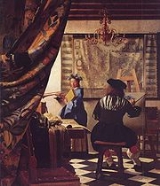
Johannes,
Jan or
Johan Vermeer (baptized on 31 October 1632 as
Johannis, and buried in the same city under the name Jan on 16 December 1675) was a
DutchThe Dutch people are the dominant ethnic group of the Netherlands.Dutch people, or descendants of Dutch people, are also found in migrant communities world wide, notably in Canada, Australia, South Africa, New Zealand and the United States....
Baroque painter who specialized in exquisite, domestic interior scenes of middle class life. Vermeer was a moderately successful provincial
genre painterGenre works, also called genre scenes or genre views, are pictorial representations in any of various media that represent scenes or events from everyday life, such as markets, domestic settings, interiors, parties, inn scenes, and street scenes. Such representations may be realistic, imagined, or...
in his lifetime. He seems never to have been particularly wealthy, leaving his wife and children in debt at his death, perhaps because he produced relatively few paintings.
Vermeer worked slowly and with great care, using bright colours, sometimes expensive
pigmentA pigment is a material that changes the color of reflected or transmitted light as the result of wavelength-selective absorption. This physical process differs from fluorescence, phosphorescence, and other forms of luminescence, in which a material emits light.Many materials selectively absorb...
s, with a preference for
cornflower blueCornflower blue, a shade of azure, is a shade of light blue with relatively little green compared to blue.Cornflowers are among the few "blue" flowers that are truly blue, most "blue" flowers being a darker blue-purple....
and
yellowYellow is the color evoked by light that stimulates both the L and M cone cells of the retina about equally, with no significant stimulation of the S cone cells. Light with a wavelength of 570–580 nm is yellow, as is light with a suitable mixture of somewhat longer and shorter wavelengths...
. He is particularly renowned for his masterly treatment and use of
lightLight is electromagnetic radiation, particularly radiation of a wavelength that is visible to the human eye ....
in his work.
Recognized during his lifetime in
DelftSee also: Delft, Cape Town, Delft IslandDelft is a city and municipality in the province of South Holland , the Netherlands...
and
The HagueThe Hague is the third largest city in the Netherlands after Amsterdam and Rotterdam, with a population of 485,818 and an area of approximately 100 km²...
, his modest celebrity gave way to obscurity after his death; he was barely mentioned in
Arnold HoubrakenArnold Houbraken was a Dutch painter and writer from Dordrecht, now remembered mainly as a biographer of artists from the Dutch Golden Age. He had ten children. His son Jacobus Houbraken was an engraver of portraits and book illustrations, including books by his father...
's major source book on 17th century Dutch painting (
Grand Theatre of Dutch Painters and Women Artists), and was thus omitted from subsequent surveys of Dutch art for nearly two centuries.
In the 19th century Vermeer was rediscovered by
Gustav Friedrich WaagenGustav Friedrich Waagen was a German art historian.Waagen was born in Hamburg, the son of a painter and nephew of the poet Ludwig Tieck. Having passed through the college of Hirschberg, he volunteered for service in the Napoleonic campaign of 1813-1814, and on his return attended the lectures at...
and Thoré Bürger, who published an essay attributing sixty-six pictures to him, (although only thirty-five paintings are firmly attributed to him today). Since that time Vermeer's reputation has grown, and he is now acknowledged as one of the greatest
painters of the Dutch Golden Age"Dutch Masters" redirects here; for the cigar, see Dutch Masters .Dutch Golden Age painting is the painting of the Dutch Golden Age, a period in Dutch history generally spanning the 17th century, during and after the later part of the Eighty Years War for Dutch independence...
.
Life
Relatively little is known about Vermeer's life. He seems to have been exclusively devoted to his art, living out his life in the city of Delft. The only sources of information are some registers, a few official documents and comments by other artists; it was for this reason that Thoré Bürger named him "The Sphinx of Delft".
Youth
On , Johannes was baptized in the Reformed Church. His father, Reijnier Janszoon, was a middle-class worker of
silkSilk is a natural protein fiber, some forms of which can be woven into textiles. The best-known type of silk is obtained from cocoons made by the larvae of the mulberry silkworm Bombyx mori reared in captivity...
or caffa (a mixture of silk and cotton or wool).
[His name was Reijnier or Reynier Janszoon, always written in Dutch as Jansz. or Jansz; this was his patronym. As there was another Reijnier Jansz at that time in Delft, it seemed necessary to use the Pseudonym]A pseudonym is a fictitious name used by a person, or sometimes, a group.Pseudonyms are often used to hide an individual's real identity, as with writers' pen names, graffiti artists, resistance fighters' or terrorists' noms de guerre and computer hackers' handles. Actors, musicians, and other...
"Vos", meaning Fox. From 1640 onward he had changed his alias to Vermeer. As an apprentice in Amsterdam Reijnier lived in the fashionable Sint Antoniebreestraat, then a street with many resident painters. In 1615 he married Digna Baltus, and in 1620 Reijner and his wife had a daughter, who was baptized as Gertruy.
[In 1647 Gertruy, Vermeer's only sister, married a frame maker. She kept on working at the inn helping her parents, serving drinks and making beds.] In 1625 Reijnier was involved in a fight, and the soldier died from his wounds five months later. Around the same time Reijnier started to deal in paintings, but in 1631 he leased an inn called
"The Flying Fox". In 1641 he bought a larger inn at the market square, named after the Belgian town "
MechelenMechelen is a Dutch-speaking city and municipality in the province of Antwerp, Flanders, Belgium...
". The acquisition of the inn constituted a considerable financial burden. When Vermeer's father died in 1652, Vermeer replaced him as a merchant of paintings.
Marriage and family
In 1653 Johannes Reijniersz Vermeer married a
CatholicThe Catholic Church, also known as the Roman Catholic Church, is the world's largest Christian church. With more than a billion members, over half of all Christians and more than one-sixth of the world's population, the Catholic Church is a communion of the Western, or Latin Rite Church, and...
girl named Catherina Bolnes. The blessing took place in a nearby and quiet village
SchipluidenSchipluiden is a village in the western Netherlands, in the province of South Holland. It is the seat of the council of the municipality of Midden-Delfland....
.
[In the 17th century it was common for the upper classes to marry outside the city walls, maybe for romantic reasons, or most likely, to avoid criticism because of their religious beliefs.] For the groom it was a good match. His mother-in-law,
Maria ThinsMaria Thins was the mother-in-law of Johannes Vermeer and a member of the Gouda Thins family .-Life:...
, was significantly wealthier than he, and it was probably she who insisted Vermeer convert to
CatholicismCatholicism is a broad term for the body of the Catholic faith, its theologies and doctrines, its liturgical, ethical, spiritual, and behavioral characteristics, as well as a religious people as a whole...
before the marriage on April 5.
[Catholicism]Catholicism is a broad term for the body of the Catholic faith, its theologies and doctrines, its liturgical, ethical, spiritual, and behavioral characteristics, as well as a religious people as a whole...
was not a forbidden religion, but tolerated in the Dutch RepublicThe Republic of the Seven United Netherlands was a European republic between 1581 and 1795, in about the same location as the modern Kingdom of the Netherlands,...
, due to the Dutch RevoltThe Dutch Revolt or the Revolt of the Netherlands , was the partially successful revolt of the Seventeen Provinces in the Low Countries against the Spanish Empire. It led to the formation of the independent Dutch state of the Netherlands and marked the beginning of the Eighty Years' War...
. Services were held in hidden churches (so-called SchuilkerkIn the Netherlands, a schuilkerk is a kind of church that is not recognisable as a church from the outside of the building. They were built in large numbers during the time of the Dutch Republic for use by Roman Catholics, Remonstrants, Lutherans and Mennonites...
) and Catholics were restrained in their careers, unable to get high ranking jobs in city administration or the national government. After 1648 some people were tired of the religious wars and returned to the Catholic church. Some scholars doubt that Vermeer became Catholic, but one of his paintings,
The Allegory of Catholic Faith, made between 1670 and 1672, reflects the belief in the
EucharistThe Eucharist, also called Holy Communion, Sacrament of the Table, the Blessed Sacrament, or The Lord's Supper and other names, is a Christian sacrament or ordinance, generally considered to be a commemoration of the Last Supper, the final meal that Jesus Christ shared with his disciples before his...
. Liedtke suggests it was made for a Catholic patron, or for a
schuilkerkIn the Netherlands, a schuilkerk is a kind of church that is not recognisable as a church from the outside of the building. They were built in large numbers during the time of the Dutch Republic for use by Roman Catholics, Remonstrants, Lutherans and Mennonites...
, a hidden church.
At some point the couple moved in with Catherina's mother, who lived in a rather spacious house at Oude Langendijk, almost next to a hidden Jesuit church
[A roman-catholic chapel is found nowadays at this spot]. Here Vermeer lived for the rest of his life, producing paintings in the front room on the second floor. His wife gave birth to 14 children: four of whom were buried before being baptized, but were registered as "child of Johan Vermeer".
[When Catherina Bolnes was buried in 1688, she was registered as the "widow of Johan Vermeer". In the seventeenth century Johannes was a popular name and spelling was not consistent. The name could be spelled in the Dutch (Johan or Johannes), French (Joan), Italian (Giovanni), Greek (Johannis), or other style depending on background, education or family tradition.] From wills written by relatives, ten names are known: Maria, Elisabeth, Cornelia, Aleydis, Beatrix, Johannes, Gertruyd, Franciscus, Catharina, and Ignatius. Quite a few have a name with a religious connotation and it is very likely that the youngest,
IgnatiusIgnatius can refer to:-Saints:*Ignatius of Antioch, early Christian bishop*Íñigo or Ignatius of Oña, Castilian abbot*Ignatius of Loyola, Catholic saint and founder of the Society of Jesus...
, was named after the founder of the Jesuit order.
[As the parish registers of the Delft Catholic church do not exist anymore, it is impossible to prove but very likely that his children were baptized in a hidden church.]
Career
It is not certain where Vermeer was apprenticed as a painter, nor with whom, but it is generally believed that he studied in his home town. While Vermeer owned some paintings or drawings by
Carel FabritiusCarel Fabritius was a Dutch painter and one of Rembrandt's most gifted pupils.-Biography:...
it was suggested that Fabritius was his teacher. The local authority,
Leonaert BramerLeonaert/Leonard Bramer alias Nestelghat was a Dutch painter, best known for probably being one of the teachers of Johannes Vermeer, although there is no similarity between their work. Bramer's dark and exotic style is unlike Vermeer's style...
, acted as a friend but their style of painting is rather different. Liedtke suggests Vermeer taught himself and had information from one of his father's connections. Some scholars think Vermeer was trained under the Catholic painter
Abraham BloemaertAbraham Bloemaert , was a Dutch painter and printmaker in etching and engraving. He was one of the "Haarlem Mannerists" from about 1585, but in the new century altered his style to fit new Baroque trends....
. Vermeer worked in a similar style as some of the Utrecht Carravagists. In Delft Vermeer probably competed with Pieter de Hoogh and
Nicolaes MaesNicolaes Maes, also known as Nicolaes Maas was a Dutch Baroque painter of genre and portraits....
who produced genre works in a similar style.
On , Vermeer became a member of the Guild of Saint Luke, a trade association for painters. The guild's records make clear Vermeer did not pay the usual admission fee. It was a year of
plaguePlague is a deadly infectious disease caused by the enterobacteria Yersinia pestis . Plague is a zoonotic, primarily carried by rodents and spread to humans via fleas. Plague is notorious throughout history, due to the unrivaled scale of death and devastation it brought...
,
warThe First Anglo–Dutch War was the first of the four Anglo–Dutch Wars. It was fought entirely at sea between the navies of the Commonwealth of England and the United Provinces of the Netherlands...
and economic crisis; not only Vermeer's financial circumstances were difficult. In 1654, the city of Delft suffered the terrible explosion known as the Delft Thunderclap that destroyed a large section of the city. In 1657 he might have found a patron in the local art collector
Pieter van RuijvenPieter Claesz. van Ruijven is known as Johannes Vermeer's patron. In 1657, he lent Vermeer 200 guilders. It is not known if he had any trade or profession. Like his father, he worked for the city institution, the Camer van Charitate .In 1653, he married Maria de Knuijt. The couple had one daughter...
, who lent him some money. In 1662 Vermeer was elected head of the guild and was reelected in 1663, 1670, and 1671, evidence that he (like Bramer) was considered an established craftsman among his peers. Vermeer worked slowly, probably producing three paintings a year, and on order. When
Balthasar de MonconysBalthasar de Monconys was a French diplomat, physician and a magistrate, who left a diary.Moncony, brought up in Lyon by the Jesuits and a good Catholic, had an interest in the Jesuit missions in infidel territory. He travelled to Portugal, England, Germany, Italy and the Netherlands...
visited him in 1663 to see some of his work, the diplomat and the two French clergymen who accompanied him were sent to
Hendrick van BuytenHendrick van Buyten was a baker in Delft. He is famous because of his connection to Johannes Vermeer. In August 1663 he owned a painting by Vermeer when he was visited by Balthasar de Monconys. Van Buyten told the diplomat, accompanied by two friends, he had paid 600 guilders for the painting...
, a baker.
In 1672 a severe economic downturn (the "
Year of DisasterThe rampjaar was the year 1672 in Dutch history. In that year,the Republic of the Seven United Provinces was attacked by England, France, and the prince-electors Bernhard von Galen, bishop of Münster and Maximilian Henry of Bavaria, the bishop of Cologne...
") struck the Netherlands, after Louis XIV and a French army invaded the
Dutch RepublicThe Republic of the Seven United Netherlands was a European republic between 1581 and 1795, in about the same location as the modern Kingdom of the Netherlands,...
from the south (known as the
Franco-Dutch WarThe Franco-Dutch War, often called simply the Dutch War was a war fought by the Kingdom of France, the Swedish Empire, the Bishopric of Münster, the Archbishopric of Cologne and the Kingdom of England against the Dutch Republic, which was later joined by Holy Roman Emperor, Brandenburg and Spain...
). Not only the
FrenchEarly Modern France is the early modern period of French history from the end of the 15th century to the end of the 18th century...
burned and robbed country estates. During the
Third Anglo-Dutch WarThe Third Anglo–Dutch War or Third Dutch War was a military conflict between England and the Dutch Republic lasting from 1672 to 1674. It was part of the larger Franco-Dutch War...
an English fleet, and two allied German bishops attacked the country from the east, tried to destroy the countries
hegemonyHegemony is the preponderance of power, and the construction of consent from the powerless through cultural values.-In politics:...
. Many people panicked; courts, theaters, shops and schools were closed, and five years passed before circumstances improved. In the Summer of 1675 Vermeer borrowed money in Amsterdam, using his mother-in-law as a
lienIn law, a lien is a form of security interest granted over an item of property to secure the payment of a debt or performance of some other obligation...
.
In December 1675 Vermeer fell into a
frenzyPhrenitis was employed in ancient Greece by Hippocrates and his followers. It refers to acute inflammation of mind and body, not in a theoretical but in a descriptive sense. Its presumed seat was never anatomically or conceptually well determined...
and suddenly died, within a day and a half. Catharina Bolnes attributed her husband's death to the stress of financial pressures. The collapse of the art market damaged Vermeer's business as both a painter and an art dealer. She, having to raise 11 children, asked the High Court to allow her a break in paying the creditors. The Dutch microscopist Antonie van Leeuwenhoek, who worked for the city council as a
surveyorSurveying or land surveying is the technique and science of accurately determining the terrestrial or three-dimensional space position of points and the distances and angles between them...
, was appointed
trusteeTrustee is a legal term for a holder of property on behalf of a beneficiary. A trust can be set up either to benefit particular persons, or for any charitable purposes : typical examples are a will trust for the testator's children and family, a pension trust , and a charitable trust...
. The house, with eight rooms on the first floor, was filled with paintings, drawings, clothes, chairs and beds. In his
atelierAn atelier is an artist's studio or workroom.Atelier may also refer to:* The Atelier Method of art instruction* The Atelier series of video games...
there were
rummage not worthy being itemized, two chairs, two painter's easels, three palettes, ten canvases, a desk, an oak pull table and a small wooden cupboard with drawers. Nineteen of Vermeer's paintings were bequeathed to Catherina and her mother, and the widow sold two other paintings to the
Hendrick van BuytenHendrick van Buyten was a baker in Delft. He is famous because of his connection to Johannes Vermeer. In August 1663 he owned a painting by Vermeer when he was visited by Balthasar de Monconys. Van Buyten told the diplomat, accompanied by two friends, he had paid 600 guilders for the painting...
in order to pay off quite a debt.
Vermeer had been a respected artist in Delft, but he was almost unknown outside his home town. The fact that a local patron,
Pieter van RuijvenPieter Claesz. van Ruijven is known as Johannes Vermeer's patron. In 1657, he lent Vermeer 200 guilders. It is not known if he had any trade or profession. Like his father, he worked for the city institution, the Camer van Charitate .In 1653, he married Maria de Knuijt. The couple had one daughter...
, purchased much of his output reduced the possibility of his fame spreading.
[Van Ruijven's son-in-law Jacob Dissius owned 21 paintings by Vermeer, listed in his heritage in 1695. These paintings were sold the year after in Amsterdam in a much studied auction, published by Gerard Hoet.] Vermeer never had any pupils; his relatively short life, the demands of separate careers, and his extraordinary precision as a painter all help to explain his limited oeuvre.
Style
Vermeer produced transparent colours by applying paint to the canvas in loosely granular layers, a technique called
pointilléPointillé is a decorative technique in which patterns are formed on a surface by a means of punched dots. The technique is similar to embossing or engraving but is done manually and does not cut into the surface being decorated...
(not to be confused with
pointillismPointillism is a style of painting in which small distinct dots of colour create the impression of a wide selection of other colors and blending. Aside from color "mixing" phenomena, there is the simpler graphic phenomenon of depicted imagery emerging from disparate points...
). No drawings have been positively attributed to Vermeer, and his paintings offer few clues to preparatory methods.
David HockneyDavid Hockney, CH, RA, is an English painter, draughtsman, printmaker, stage designer and photographer, who is based in Bridlington, Yorkshire, although he also maintains a base in London...
, among other historians and advocates of the
Hockney-Falco thesisThe Hockney–Falco thesis is a controversial theory of art history, advanced by artist David Hockney and physicist Charles M. Falco, suggesting that advances in realism and accuracy in the history of Western art since the Renaissance were primarily the result of optical aids such as the camera...
, has speculated that Vermeer used a
camera obscuraThe camera obscura is an optical device that projects an image of its surroundings on a screen. It is used in drawing and for entertainment, and was one of the inventions that led to photography. The device consists of a box or room with a hole in one side...
to achieve precise positioning in his compositions, and this view seems to be supported by certain light and
perspectivePerspective may mean:Literally, in visual topics:* Perspective , the way in which objects appear to the eye.* Perspective , representing the effects of visual perspective in drawingsMetaphorically, in relation to cognitive topics:...
effects which would result from the use of such lenses and not the naked eye alone. The extent of Vermeer's dependence upon the camera obscura is disputed by historians.
There is no other seventeenth century artist who early in his career employed, in the most lavish way, the exorbitantly expensive pigment
lapis lazuliLapis lazuli is a relatively rare, semi-precious stone that has been prized since antiquity for its intense blue color....
, or natural
ultramarineUltramarine is a blue pigment consisting primarily of a double silicate of aluminium and sodium with some sulfides or sulfates, and occurring in nature as a proximate component of lapis lazuli...
. Vermeer not only used this in elements that are naturally of this colour; the earth colours
umber250px|thumb|Raw umberUmber is a natural brown clay pigment which contains iron and manganese oxides. The colour becomes more intense when calcined , and the resulting pigment is called burnt umber. Its name derives from the Latin word umbra and was originally extracted in Umbria, a mountainous...
and
ochreOchre or Ocher is term for both a golden-yellow or light yellow brown color and for a form of earth pigment which produces the color. The pigment can also be used to create a reddish tint known as Red ochre. The more rarely used terms Purple ochre and Brown ochre also exist for variant hues...
should be understood as warm light within a painting's strongly-lit interior, which reflects its multiple colours onto the wall. In this way, he created a world more perfect than any he had witnessed. This working method most probably was inspired by Vermeer’s understanding of
Leonardo’sLeonardo di ser Piero da Vinci was an Italian polymath, scientist, mathematician, engineer, inventor, anatomist, painter, sculptor, architect, botanist, musician and writer....
observations that the surface of every object partakes of the colour of the adjacent object. This means that no object is ever seen entirely in its natural colour.
A comparable but even more remarkable, yet effectual, use of natural ultramarine is in
The Girl with a Wineglass. The shadows of the red satin dress are
underpaintedIn art, an underpainting is an initial layer of paint applied to a ground, which serves as a base for subsequent layers of paint. Underpaintings are often monochromatic and help to define colour values for later painting...
in natural ultramarine, and, owing to this underlying blue paint layer, the red lake and
vermilionVermilion, sometimes spelled vermillion, when found naturally occurring, is an opaque orangish red pigment, used since antiquity, originally derived from the powdered mineral cinnabar. Chemically, the pigment is mercuric sulfide, HgS, and like many mercury compounds it is toxic...
mixture applied over it acquires a slightly purple, cool and crisp appearance that is most powerful.
Even after Vermeer’s supposed financial breakdown following the so-called rampjaar (year of disaster) in 1672, he continued to employ natural ultramarine generously, such as in
Lady Seated at a Virginal. This could suggest that Vermeer was supplied with materials by a collector, and would coincide with John Michael Montias’ theory of Pieter Claesz van Ruijven being Vermeer’s patron.
Vermeer painted mostly domestic interior scenes. His works are largely genre pieces and portraits, with the exception of two cityscapes and two
allegoriesAllegory is a figurative mode of representation conveying a meaning other than the literal. An allegory is a device that can be presented in literary form, such as a poem or novel, or in visual form, such as in painting or sculpture...
. His subjects offer a cross-section of seventeenth century Dutch society, ranging from the portrayal of a simple milkmaid at work, to the luxury and splendour of rich notables and merchantmen in their roomy houses. Besides these subjects, religious, poetical, musical, and scientific comments can also be found in his work.
Works
Only three paintings are dated:
The Procuress (1656, Dresden, Gemäldegalerie),
The Astronomer (1668, Paris, Louvre), and
The Geographer (1669, Frankfurt, Städelsches Kunstinstitut). Two pictures are generally accepted as earlier than
The Procuress; both are history paintings, painted in a warm palette and in a relatively large format for Vermeer —
Christ in the House of Mary and Martha (Edinburgh, National Gallery) and
Diana and her Companions (The Hague, Mauritshuis).
Vermeer's mother-in-law, Maria Thins, owned
Dirck van BaburenDirck Jaspersz. van Baburen was a Dutch painter associated with the Utrecht caravaggisti.-Life:Dirck van Baburen was probably born in Wijk bij Duurstede, but his family moved to Utrecht when he was still young. He was also known as Teodoer van Baburen and Theodor Baburen...
's 1622 oil-on-canvas
Procuress (or a copy of it), which appears in the background of two of Vermeer's paintings. The same subject was also painted by Vermeer. After his own
The Procuress almost all of Vermeer's paintings are of contemporary subjects in a smaller format, with a cooler palette dominated by blues, yellows and greys. It is to this period that practically all of his surviving works belong. They are usually domestic interiors with one or two figures lit by a window on the left. They are characterized by a serene sense of compositional balance and spatial order, unified by a pearly light. Mundane domestic or recreational activities become thereby imbued with a poetic timelessness (e.g.
Woman Reading a Letter at an Open Window, Dresden, Gemäldegalerie). To this period also have been allocated Vermeer's two townscapes,
View of Delft (The Hague, Mauritshuis) and
A Street in Delft (Amsterdam, Rijksmuseum).
A few of his paintings show a certain hardening of manner and these are generally thought to represent his late works. From this period come
The Allegory of Faith (c 1670, New York, Metropolitan Museum) and
The Letter (c 1670, Amsterdam, Rijksmuseum).
The often-discussed sparkling pearly highlights in Vermeer's paintings have been linked to his possible use of a
camera obscuraThe camera obscura is an optical device that projects an image of its surroundings on a screen. It is used in drawing and for entertainment, and was one of the inventions that led to photography. The device consists of a box or room with a hole in one side...
, the primitive lens of which would produce halation and, even more noticeably, exaggerated perspective. Such effects can be seen in
Lady at the Virginals with a Gentleman (London,
Royal CollectionThe Royal Collection is the art collection of the British Royal Family. It is property of the monarch as sovereign, but is held in trust for her successors and the nation. It contains over 7,000 paintings, 40,000 watercolours and drawings, and about 150,000 old master prints, as well as...
). Vermeer's interest in optics is also attested in this work by the accurately observed mirror reflection above the lady at the virginals.
Legacy
- Vermeer's View of Delft features in a pivotal sequence of Marcel Proust's
Valentin Louis Georges Eugène Marcel Proust was a French novelist, essayist, and critic, best known as the author of À la recherche du temps perdu , a monumental work of twentieth-century fiction published in seven parts from 1913 to...
The CaptiveIn Search of Lost Time or Remembrance of Things Past is a semi-autobiographical novel in seven volumes by Marcel Proust. His most prominent work, it is popularly known for its extended length and the notion of involuntary memory, the most famous example being the "episode of the madeleine"...
.
- The book Girl with a Pearl Earring
Girl with a Pearl Earring is a 1999 historical novel written by Tracy Chevalier. It takes place in Delft, Holland and was inspired by Johannes Vermeer's painting Girl with a Pearl Earring. It fictionalizes the circumstances under which the painting was created...
and the film of the same nameGirl with a Pearl Earring is a 2003 United Kingdom/Luxembourg drama film directed by Peter Webber. The screenplay was adapted by screenwriter Olivia Hetreed based on the novel by Tracy Chevalier. The film stars Scarlett Johansson, Colin Firth, Tom Wilkinson and Cillian Murphy. The film is named...
are named after the painting; they present a fictional account of its creation by Vermeer and his relationship with the model.
- Salvador Dalí
Salvador Domingo Felipe Jacinto Dalí i Domènech, 1st Marquis of Púbol was a Spanish Catalan surrealist painter born in Figueres....
, with great admiration for Vermeer, painted his own version of The Lacemaker and pitted large copies of the original against a rhinoceros in some now-famous surrealist experiments. Dali also immortalized the Dutch Master in The Ghost of Vermeer of Delft Which Can Be Used As a TableThe Ghost of Vermeer of Delft Which Can Be Used As a Table is a painting by Spanish surrealist Salvador Dalí. The title refers to the Dutch painter Johannes Vermeer and the image of Vermeer viewed from his back is a reference to Vermeer's painting The Art of Painting.In this image Vermeer is...
, 1934.
- Dutch composer Louis Andriessen
Louis Andriessen is a Dutch composer and pianist based in Amsterdam. He teaches composition at the Royal Conservatory of The Hague...
based his opera, Writing to Vermeer (1997-98, libretto by Peter Greenaway), on the domestic life of Vermeer.
- Greenaway's own film A Zed & Two Noughts
A Zed & Two Noughts is a 1985 film written and directed by Peter Greenaway.-Plot:The plot centres on twin brothers, Oswald and Oliver Deuce, whose wives are killed in a car accident. The brothers enter a relationship with Alba Bewick, the driver of the car, who lost one of her legs in the accident...
(1985) contains a plot line about an orthopedic surgeon named Van Meegeren who stages highly exact scenes from Vermeer paintings in order to paint copies of them.
- Han van Meegeren
Han van Meegeren , born Henricus Antonius van Meegeren, was a Dutch painter and portraitist, and is considered to be one of the most ingenious art forgers of the 20th century....
was a Dutch painter who worked in the classical tradition. Lured by the huge sums an authentic Vermeer would command, van Meegeren forged several works in Vermeer's style in several of his own paintings with the intention of selling them as works of Vermeer.
- Upon the rediscovery of Vermeer's work in the 19th century, several prominent Dutch artists, including Simon Duiker
Simon Liekele Eeltje Duiker was a Dutch artist who was active in the late 19th century and early 20th century. Duiker lived and worked in Amsterdam and studied at its National Academy. He painted interior scenes and still life paintings...
, modelled their style on his work.
- Susan Vreeland's novel Girl in Hyacinthe Blue follows eight individuals with a relataionship to a painting of Vermeer. The novel follows a reverse chronology from the current period to the time of Vermeer.
External links
- (Videos): Vermeer: Master of Light - at the National Gallery of Art, Washington
- Vermeer's Woman Holding a Balance In-depth discussion of this painting in the National Gallery of Art along with discussion of the artist's life, conservation, illustration of related works.
- Essential Vermeer, In-depth coverage of Vermeer's life, works, and environment
- Jan Vermeer, Dutch Neoclassic Painter - Profile
- Entry in Britannica encyclopaedia
- www.Vermeer-Foundation.org Familiar biography and 111 images of works by Vermeer
- Virtual Vermeer, Familiar biography, interesting entries.
- Vermeercentrum, housed at the site of the former St. Lucas Guild in Delft. (The Vermeer Centre offers a visual voyage of discovery through the life, work and city of Johannes Vermeer.)
- Union List of Artist Names, Getty Vocabularies. ULAN Full Record Display for Jan Vermeer. Getty Vocabulary Program, Getty Research Institute. Los Angeles, California.