

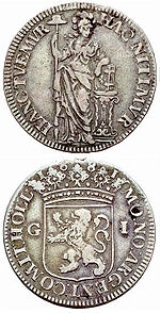
Dutch gulden

Encyclopedia
The Dutch guilder
; , ˈɡunə; sign
: ƒ
or fl.) was the currency
of the Netherlands
from the 17th century until 2002, when it was replaced by the euro
. Between 1999 and 2002, the guilder was officially a "national subunit" of the euro. However, physical payments could only be made in guilder, as no euro coins or banknotes were available. The Netherlands Antillean guilder is still in use in Curaçao
and Sint Maarten (two countries in the Kingdom of the Netherlands
), but this currency is distinct from the Dutch guilder. In 2004, the Surinamese guilder was replaced by the Surinamese dollar.
The Dutch name gulden was a Middle Dutch
adjective
meaning "golden", and the name indicates the coin was originally made of gold. The symbol ƒ or fl. for the Dutch guilder was derived from another old currency, the florijn, called the florin in English.
The exact exchange rate, still relevant for old contracts and for exchange of the legacy currency for euros at the central bank, is 2.20371 Dutch guilders (NLG) for 1 euro (EUR). Inverted, this gives EUR 0.453780 for NLG 1.
standing, holding a spear topped by a hat in her right hand, resting with her left forearm on Gospels set on an ornate basis, with a small shield in the legend. This guilder was divided into 20 stuiver
s, each of 8 duit
en or 16 penningen. The guilder gradually replaced other silver coin denominations circulating in the United Netherlands
- florijn (28 stuivers), daalder (1½ guilders or 30 stuivers), rijksdaalder (2½ guilders or 50 stuivers), silver ducat
(2½ guilders or 50 stuivers) and the silver rider ducaton
(3 guilders or 60 stuivers).
Between 1810 and 1814, the Netherlands was annexed to France and the French franc
circulated. After the Napoleonic wars
, the Kingdom of the Netherlands readopted the guilder. In 1817 it became decimalised, with one guilder equal to 100 cents
. However, it was not until the 1840s that the last pre-decimal coins (many of which dated back to the 17th century) were withdrawn from circulation, whilst some of the new, decimal coins continued to bear nicknames based on their values in the older currency system through to the 21st century. Until 1948, the plural of cent used on coins was centen, after that it was cent.
The Netherlands was initially on a bimetallic standard, with the guilder equal to 605.61 milligrams of fine gold or 9.615 grams of fine silver. In 1840, the silver standard was adjusted to 9.45 grams, with the gold standard suspended in 1848. In 1875, the Netherlands adopted a gold standard
with 1 guilder equal to 604.8 milligrams of fine gold. The gold standard was suspended between 1914 and 1925 and was abandoned in 1936.http://www.globalfinancialdata.com/index.php3?action=detailedinfo&id=4016
Following the German occupation, on 10 May 1940, the guilder was pegged to the Reichsmark
at a rate of 1 guilder = 1.5 Reichsmark. This rate was reduced to 1.327 on 17 July of the same year. The liberating Allied forces set an exchange rate of 2.652 guilders = 1 U.S. dollar, which became the peg for the guilder within the Bretton Woods system
. In 1949, the peg was changed to 3.8 guilders = 1 dollar, approximately matching the devaluation of the British pound. In 1961, the guilder was revalued to 3.62 guilders = 1 dollar, a change approximately in line with that of the German mark
. Since 1967 guilders were made from nickel instead of silver.
In 2002, the guilder was replaced by the euro. Coins remained exchangeable for euros at branches of the Netherlands Central Bank until 1 January 2007. Banknotes valid at the time of conversion to the euro may still be exchanged there until 1 January 2032.
issued coins in similar denominations to the earlier provincial issues. The Kingdom of Holland
minted silver 10 stuiver, 1 florin and 1 guilder (equivalent), 50 stuivers and 2½ guilder (also equivalent) and 1 rijksdaalder, along with gold 10 and 20 guilder. Before decimalisation, the Kingdom of the Netherlands briefly issued some 1 rijksdaalder coins.
The gold 1 and 2 ducat and silver ducat (rijksdaalder) are still minted today as bullion coins.
In 1817, the first coins of the decimal currency were issued, the copper 1 cent and silver 3 guilder. The remaining denominations were introduced in 1818. These were copper ½ cent, silver 5, 10 and 25 cents, ½ and 1 guilder, and gold 10 guilder. In 1826, gold 5 guilder coins were introduced.
In 1840, the silver content of the coinage was reduced (see above) and this was marked by the replacement of the 3 guilder coin by a 2½ guilder piece. The gold coinage was completely suspended in 1853, five years after the suspension of the gold standard. By 1874, production of silver coins greater in value than 10 cents had ceased, to be only fully resumed in the 1890s. Gold 10 guilder coins were struck again from 1875. In 1877, bronze 2½ cent coins were introduced. In 1907, silver 5 cent coins were replaced by cupro-nickel pieces. In 1912, gold 5 guilder coins were reintroduced but the gold coinage was ended in 1933.
In 1941, following the German occupation, production of all earlier coin types ceased and zinc coins were introduced for 1, 2½, 5, 10 and 25 cents. Large quantities of pre-war type, silver 10 and 25 cents and 1 guilder coins were minted in the United States
between 1943 and 1945 for use following liberation.
In 1948, all half cents were taken out of circulation, and new bronze 1 and 5 cents coins and nickel 10 and 25 cents coins were introduced. In 1949, 1 and 2½ guilders banknotes were introduced. Five years later, the silver 1 guilder coin was reintroduced, followed by the silver 2½ guilders coin in 1959. The silver content was replaced with nickel in 1967, although no 2½ guilders coins were minted in 1967 and 1968. The silver coins were demonetised in 1973.
In 1980, production of the one cent coin ceased—it was demonetised in 1980. Soon after, it was decided to replace the five guilders banknote with a coin of the same value. However, it wasn't until 1988 that a bronze-coated nickel 5 guilders coins was introduced. The five guilders banknote was legal tender until 1995.
At the time of withdrawal, the following denominations of coins were circulating:
All the coins carried a profile image of the Queen on the obverse and a simple grid on the other side. The 1 guilder, 2½ gilder, and 5 guilder
coins had 'God zij met ons' ('God be with us') inscribed on the edge.
 Between 1814 and 1838, the Netherlands Bank
issued notes in denominations of 25, 40, 60, 80, 100, 200, 300, 500 and 1000 guilders. These were followed, from 1846 by state notes (muntbiljetten) in denominations of 5, 10, 20, 50, 100, 500, 1000 guilders, with the 10 and 50 guilders issued until 1914.
In 1904, the Netherlands Bank recommenced the issuance of paper money. By 1911, it was issuing notes for 10, 25, 40, 60, 100, 200, 300 and 1000 guilders. In 1914, the government introduced silver notes (zilverbonnen) for 1, 2½ and 5 guilder. Although the 5 guilder were only issued that year, the 1 guilder notes continued until 1920 and the 2½ guilder until 1927.
In 1926, the Netherlands Bank introduced 20 guilder notes, followed by 50 guilder in 1929 and 500 guilder in 1930. These introductions followed the cessation of production of the unusual 40, 60 and 300 guilder notes during the 1920s.
In 1938, silver notes were reintroduced for 1 and 2½ guilders. During World War II
, the Netherlands Bank continued to issue paper money, although there were some design changes, most notably, the replacement of a portrait of Queen Emma
by a Rembrandt portrait on the 10 guilder note. The Allies printed state notes dated 1943 for use following liberation. These were in denominations of 1, 2½, 10, 25, 50 and 100 guilders. More state notes were issued for 1 and 2½ guilders in 1945 and 1949.
Following the war, the Netherlands Bank introduced notes for 10, 20, 25, 50, 100 and 1000 guilders. The last 20 guilder notes were dated 1955, whilst 5 guilder notes were introduced in 1966 (replaced by coins in 1987) and 250 guilder in 1985.
At the time of withdrawal, the following denominations of banknotes were circulating:
At the time of withdrawal, all but the 50 and 250 guilder notes had been issued in a new series that was the same colour as the older, long-serving notes but with a mostly abstract pattern, featuring a different bird for each denomination.
Persons depicted on older banknotes were:
These 1970s "face"-notes and the 80's ƒ50 (sunflower), ƒ100 (snipe) and ƒ250 (lighthouse) were designed by R.D.E. Oxenaar. Eventually all faces were to be replaced by abstracts, designed by Jaap Drupsteen
, (see above).
translation for "florin" and consequently "guilder" is "盾" . It originated from the translation referring to the British florin with its four shields in the 1849 design. This translation was then borrowed to refer similarly to the Dutch florin and guilder. As a result, currencies in the guilder-based Aruba
and Netherlands Antilles are still referred to as "盾".
Guilder
Guilder is the English translation of the Dutch gulden — from Old Dutch for 'golden'. The guilder originated as a gold coin but has been a common name for a silver or base metal coin for some centuries...
; , ˈɡunə; sign
Currency sign
A currency sign is a graphic symbol used as a shorthand for a currency's name, especially in reference to amounts of money. They typically employ the first letter or character of the currency, sometimes with minor changes such as ligatures or overlaid vertical or horizontal bars...
: ƒ
Florin sign
The florin sign is a symbol that is used for the currencies named florin, also called a gulden or guilder. The symbol "ƒ" is the lowercase version of of the Latin alphabet. In Unicode it has a separate code point at...
or fl.) was the currency
Currency
In economics, currency refers to a generally accepted medium of exchange. These are usually the coins and banknotes of a particular government, which comprise the physical aspects of a nation's money supply...
of the Netherlands
Netherlands
The Netherlands is a constituent country of the Kingdom of the Netherlands, located mainly in North-West Europe and with several islands in the Caribbean. Mainland Netherlands borders the North Sea to the north and west, Belgium to the south, and Germany to the east, and shares maritime borders...
from the 17th century until 2002, when it was replaced by the euro
Euro
The euro is the official currency of the eurozone: 17 of the 27 member states of the European Union. It is also the currency used by the Institutions of the European Union. The eurozone consists of Austria, Belgium, Cyprus, Estonia, Finland, France, Germany, Greece, Ireland, Italy, Luxembourg,...
. Between 1999 and 2002, the guilder was officially a "national subunit" of the euro. However, physical payments could only be made in guilder, as no euro coins or banknotes were available. The Netherlands Antillean guilder is still in use in Curaçao
Curaçao
Curaçao is an island in the southern Caribbean Sea, off the Venezuelan coast. The Country of Curaçao , which includes the main island plus the small, uninhabited island of Klein Curaçao , is a constituent country of the Kingdom of the Netherlands...
and Sint Maarten (two countries in the Kingdom of the Netherlands
Kingdom of the Netherlands
The Kingdom of the Netherlands is a sovereign state and constitutional monarchy with territory in Western Europe and in the Caribbean. The four parts of the Kingdom—Aruba, Curaçao, the Netherlands, and Sint Maarten—are referred to as "countries", and participate on a basis of equality...
), but this currency is distinct from the Dutch guilder. In 2004, the Surinamese guilder was replaced by the Surinamese dollar.
The Dutch name gulden was a Middle Dutch
Middle Dutch
Middle Dutch is a collective name for a number of closely related West Germanic dialects which were spoken and written between 1150 and 1500...
adjective
Adjective
In grammar, an adjective is a 'describing' word; the main syntactic role of which is to qualify a noun or noun phrase, giving more information about the object signified....
meaning "golden", and the name indicates the coin was originally made of gold. The symbol ƒ or fl. for the Dutch guilder was derived from another old currency, the florijn, called the florin in English.
The exact exchange rate, still relevant for old contracts and for exchange of the legacy currency for euros at the central bank, is 2.20371 Dutch guilders (NLG) for 1 euro (EUR). Inverted, this gives EUR 0.453780 for NLG 1.
History
The first guilder, a 10.61g .910 silver coin, was minted by the States of Holland and West Friesland in 1680. The original guilder design featured Pallas AthenaAthena
In Greek mythology, Athena, Athenê, or Athene , also referred to as Pallas Athena/Athene , is the goddess of wisdom, courage, inspiration, civilization, warfare, strength, strategy, the arts, crafts, justice, and skill. Minerva, Athena's Roman incarnation, embodies similar attributes. Athena is...
standing, holding a spear topped by a hat in her right hand, resting with her left forearm on Gospels set on an ornate basis, with a small shield in the legend. This guilder was divided into 20 stuiver
Stuiver
The stuiver was a pre-decimal coin used in the Netherlands It was worth 16 penning or 8 duit. Twenty stuivers equalled a guilder.It circulated until the Napoleonic Wars...
s, each of 8 duit
Duit
The duit was a Dutch coin worth 2 penning, with 4 duit equal to one stuiver and 80 duit equal to one gulden. It was once used in the Americas while under Dutch rule....
en or 16 penningen. The guilder gradually replaced other silver coin denominations circulating in the United Netherlands
United Netherlands
United Netherlands is an educational student-led organization that focuses on the theory and practice of international relations and diplomacy...
- florijn (28 stuivers), daalder (1½ guilders or 30 stuivers), rijksdaalder (2½ guilders or 50 stuivers), silver ducat
Ducat
The ducat is a gold coin that was used as a trade coin throughout Europe before World War I. Its weight is 3.4909 grams of .986 gold, which is 0.1107 troy ounce, actual gold weight...
(2½ guilders or 50 stuivers) and the silver rider ducaton
Ducaton
The ducaton, ducatone or ducatoon was a crown-sized silver coin of the 16th-18th centuries.The first ducaton-type coin was the scudo known as the 'ducatone da soldi cento' , issued by Charles V, Holy Roman Emperor, in Milan in 1551...
(3 guilders or 60 stuivers).
Between 1810 and 1814, the Netherlands was annexed to France and the French franc
French franc
The franc was a currency of France. Along with the Spanish peseta, it was also a de facto currency used in Andorra . Between 1360 and 1641, it was the name of coins worth 1 livre tournois and it remained in common parlance as a term for this amount of money...
circulated. After the Napoleonic wars
Napoleonic Wars
The Napoleonic Wars were a series of wars declared against Napoleon's French Empire by opposing coalitions that ran from 1803 to 1815. As a continuation of the wars sparked by the French Revolution of 1789, they revolutionised European armies and played out on an unprecedented scale, mainly due to...
, the Kingdom of the Netherlands readopted the guilder. In 1817 it became decimalised, with one guilder equal to 100 cents
Cent (currency)
In many national currencies, the cent is a monetary unit that equals 1⁄100 of the basic monetary unit. Etymologically, the word cent derives from the Latin word "centum" meaning hundred. Cent also refers to a coin which is worth one cent....
. However, it was not until the 1840s that the last pre-decimal coins (many of which dated back to the 17th century) were withdrawn from circulation, whilst some of the new, decimal coins continued to bear nicknames based on their values in the older currency system through to the 21st century. Until 1948, the plural of cent used on coins was centen, after that it was cent.
The Netherlands was initially on a bimetallic standard, with the guilder equal to 605.61 milligrams of fine gold or 9.615 grams of fine silver. In 1840, the silver standard was adjusted to 9.45 grams, with the gold standard suspended in 1848. In 1875, the Netherlands adopted a gold standard
Gold standard
The gold standard is a monetary system in which the standard economic unit of account is a fixed mass of gold. There are distinct kinds of gold standard...
with 1 guilder equal to 604.8 milligrams of fine gold. The gold standard was suspended between 1914 and 1925 and was abandoned in 1936.http://www.globalfinancialdata.com/index.php3?action=detailedinfo&id=4016
Following the German occupation, on 10 May 1940, the guilder was pegged to the Reichsmark
German reichsmark
The Reichsmark was the currency in Germany from 1924 until June 20, 1948. The Reichsmark was subdivided into 100 Reichspfennig.-History:...
at a rate of 1 guilder = 1.5 Reichsmark. This rate was reduced to 1.327 on 17 July of the same year. The liberating Allied forces set an exchange rate of 2.652 guilders = 1 U.S. dollar, which became the peg for the guilder within the Bretton Woods system
Bretton Woods system
The Bretton Woods system of monetary management established the rules for commercial and financial relations among the world's major industrial states in the mid 20th century...
. In 1949, the peg was changed to 3.8 guilders = 1 dollar, approximately matching the devaluation of the British pound. In 1961, the guilder was revalued to 3.62 guilders = 1 dollar, a change approximately in line with that of the German mark
German mark
The Deutsche Mark |mark]], abbreviated "DM") was the official currency of West Germany and Germany until the adoption of the euro in 2002. It is commonly called the "Deutschmark" in English but not in German. Germans often say "Mark" or "D-Mark"...
. Since 1967 guilders were made from nickel instead of silver.
In 2002, the guilder was replaced by the euro. Coins remained exchangeable for euros at branches of the Netherlands Central Bank until 1 January 2007. Banknotes valid at the time of conversion to the euro may still be exchanged there until 1 January 2032.
Coins
In the 18th century, coins were issued by the various provinces. There were copper 1 duit, silver 1, 2, 6 and 10 stuivers, 1 and 3 guilder, ½ and 1 rijksdaalder and ½ and 1 ducaton. Gold 1 and 2 ducat trade coins were also minted. Between 1795 and 1806, the Batavian RepublicBatavian Republic
The Batavian Republic was the successor of the Republic of the United Netherlands. It was proclaimed on January 19, 1795, and ended on June 5, 1806, with the accession of Louis Bonaparte to the throne of the Kingdom of Holland....
issued coins in similar denominations to the earlier provincial issues. The Kingdom of Holland
Kingdom of Holland
The Kingdom of Holland 1806–1810 was set up by Napoleon Bonaparte as a puppet kingdom for his third brother, Louis Bonaparte, in order to better control the Netherlands. The name of the leading province, Holland, was now taken for the whole country...
minted silver 10 stuiver, 1 florin and 1 guilder (equivalent), 50 stuivers and 2½ guilder (also equivalent) and 1 rijksdaalder, along with gold 10 and 20 guilder. Before decimalisation, the Kingdom of the Netherlands briefly issued some 1 rijksdaalder coins.
The gold 1 and 2 ducat and silver ducat (rijksdaalder) are still minted today as bullion coins.
In 1817, the first coins of the decimal currency were issued, the copper 1 cent and silver 3 guilder. The remaining denominations were introduced in 1818. These were copper ½ cent, silver 5, 10 and 25 cents, ½ and 1 guilder, and gold 10 guilder. In 1826, gold 5 guilder coins were introduced.
In 1840, the silver content of the coinage was reduced (see above) and this was marked by the replacement of the 3 guilder coin by a 2½ guilder piece. The gold coinage was completely suspended in 1853, five years after the suspension of the gold standard. By 1874, production of silver coins greater in value than 10 cents had ceased, to be only fully resumed in the 1890s. Gold 10 guilder coins were struck again from 1875. In 1877, bronze 2½ cent coins were introduced. In 1907, silver 5 cent coins were replaced by cupro-nickel pieces. In 1912, gold 5 guilder coins were reintroduced but the gold coinage was ended in 1933.
In 1941, following the German occupation, production of all earlier coin types ceased and zinc coins were introduced for 1, 2½, 5, 10 and 25 cents. Large quantities of pre-war type, silver 10 and 25 cents and 1 guilder coins were minted in the United States
United States
The United States of America is a federal constitutional republic comprising fifty states and a federal district...
between 1943 and 1945 for use following liberation.
In 1948, all half cents were taken out of circulation, and new bronze 1 and 5 cents coins and nickel 10 and 25 cents coins were introduced. In 1949, 1 and 2½ guilders banknotes were introduced. Five years later, the silver 1 guilder coin was reintroduced, followed by the silver 2½ guilders coin in 1959. The silver content was replaced with nickel in 1967, although no 2½ guilders coins were minted in 1967 and 1968. The silver coins were demonetised in 1973.
In 1980, production of the one cent coin ceased—it was demonetised in 1980. Soon after, it was decided to replace the five guilders banknote with a coin of the same value. However, it wasn't until 1988 that a bronze-coated nickel 5 guilders coins was introduced. The five guilders banknote was legal tender until 1995.
At the time of withdrawal, the following denominations of coins were circulating:
- 5 cents - stuiverStuiverThe stuiver was a pre-decimal coin used in the Netherlands It was worth 16 penning or 8 duit. Twenty stuivers equalled a guilder.It circulated until the Napoleonic Wars...
—the name survived, although the stuiver hadn't been an official subunit of the guilder since decimalisation in 1817; - 10 cents - dubbeltje ("littleDiminutiveIn language structure, a diminutive, or diminutive form , is a formation of a word used to convey a slight degree of the root meaning, smallness of the object or quality named, encapsulation, intimacy, or endearment...
double")—being small enough to fit into the center hole of a compact discCompact DiscThe Compact Disc is an optical disc used to store digital data. It was originally developed to store and playback sound recordings exclusively, but later expanded to encompass data storage , write-once audio and data storage , rewritable media , Video Compact Discs , Super Video Compact Discs ,...
, it was the smallest coin in circulation. It was worth two stuivers, hence the name; - 25 cents - kwartje ("little quarter")—the kwartje was smaller than the stuiver, though larger than the dubbeltje and the cent;
- 1 guilders - gulden, colloquially piek;
- 2½ guilders - rijksdaalderDutch rijksdaalderThe rijksdaalder was a Dutch coin first issued by the Republic of the Seven United Netherlands in the late 16th century during the Dutch Revolt. Featuring an armored half bust of the William the Silent, rijksdaalder was minted to the Saxon reichsthaler weight standard - 448 grains of .885 fine...
, colloquially riks or knaak; - 5 guilders5 Guilders (Dutch coin)The Dutch Five guilder coin was the highest-denomination coin in the Netherlands from its introduction in 1988 until the adoption of the euro in 2002...
- vijfje ("fiver");
All the coins carried a profile image of the Queen on the obverse and a simple grid on the other side. The 1 guilder, 2½ gilder, and 5 guilder
5 Guilders (Dutch coin)
The Dutch Five guilder coin was the highest-denomination coin in the Netherlands from its introduction in 1988 until the adoption of the euro in 2002...
coins had 'God zij met ons' ('God be with us') inscribed on the edge.
Banknotes
De Nederlandsche Bank
De Nederlandsche Bank is the central bank of the Netherlands. It is part of the European System of Central Banks .-History:...
issued notes in denominations of 25, 40, 60, 80, 100, 200, 300, 500 and 1000 guilders. These were followed, from 1846 by state notes (muntbiljetten) in denominations of 5, 10, 20, 50, 100, 500, 1000 guilders, with the 10 and 50 guilders issued until 1914.
In 1904, the Netherlands Bank recommenced the issuance of paper money. By 1911, it was issuing notes for 10, 25, 40, 60, 100, 200, 300 and 1000 guilders. In 1914, the government introduced silver notes (zilverbonnen) for 1, 2½ and 5 guilder. Although the 5 guilder were only issued that year, the 1 guilder notes continued until 1920 and the 2½ guilder until 1927.
In 1926, the Netherlands Bank introduced 20 guilder notes, followed by 50 guilder in 1929 and 500 guilder in 1930. These introductions followed the cessation of production of the unusual 40, 60 and 300 guilder notes during the 1920s.
In 1938, silver notes were reintroduced for 1 and 2½ guilders. During World War II
World War II
World War II, or the Second World War , was a global conflict lasting from 1939 to 1945, involving most of the world's nations—including all of the great powers—eventually forming two opposing military alliances: the Allies and the Axis...
, the Netherlands Bank continued to issue paper money, although there were some design changes, most notably, the replacement of a portrait of Queen Emma
Emma of Waldeck and Pyrmont
Princess Emma of Waldeck and Pyrmont was Queen consort of William III, King of the Netherlands and Grand Duke of Luxembourg...
by a Rembrandt portrait on the 10 guilder note. The Allies printed state notes dated 1943 for use following liberation. These were in denominations of 1, 2½, 10, 25, 50 and 100 guilders. More state notes were issued for 1 and 2½ guilders in 1945 and 1949.
Following the war, the Netherlands Bank introduced notes for 10, 20, 25, 50, 100 and 1000 guilders. The last 20 guilder notes were dated 1955, whilst 5 guilder notes were introduced in 1966 (replaced by coins in 1987) and 250 guilder in 1985.
At the time of withdrawal, the following denominations of banknotes were circulating:
- ƒ10 - tientje ("little ten", see DiminutiveDiminutiveIn language structure, a diminutive, or diminutive form , is a formation of a word used to convey a slight degree of the root meaning, smallness of the object or quality named, encapsulation, intimacy, or endearment...
), joet - ƒ25 - geeltje (yellow one)
- ƒ50 - zonnebloem (sunflowerSunflowerSunflower is an annual plant native to the Americas. It possesses a large inflorescence . The sunflower got its name from its huge, fiery blooms, whose shape and image is often used to depict the sun. The sunflower has a rough, hairy stem, broad, coarsely toothed, rough leaves and circular heads...
) - ƒ100 - honderdje, meier / later: snip (common SnipeCommon SnipeThe Common Snipe is a small, stocky wader native to the Old World. The breeding habitat is marshes, bogs, tundra and wet meadows throughout northern Europe and northern Asia...
) - ƒ250 - vuurtoren (lighthouseLighthouseA lighthouse is a tower, building, or other type of structure designed to emit light from a system of lamps and lenses or, in older times, from a fire, and used as an aid to navigation for maritime pilots at sea or on inland waterways....
) - ƒ1000 - duizendje, (rooie) rug (red back) / rooi(tj)e
At the time of withdrawal, all but the 50 and 250 guilder notes had been issued in a new series that was the same colour as the older, long-serving notes but with a mostly abstract pattern, featuring a different bird for each denomination.
Persons depicted on older banknotes were:
- ƒ5 - poet Joost van den VondelJoost van den VondelJoost van den Vondel was a Dutch writer and playwright. He is considered the most prominent Dutch poet and playwright of the 17th century. His plays are the ones from that period that are still most frequently performed, and his epic Joannes de Boetgezant , on the life of John the Baptist, has...
(until 1988, when the note was replaced by a ƒ 5 coin) - ƒ10 - painter Frans HalsFrans HalsFrans Hals was a Dutch Golden Age painter. He is notable for his loose painterly brushwork, and helped introduce this lively style of painting into Dutch art. Hals was also instrumental in the evolution of 17th century group portraiture.-Biography:Hals was born in 1580 or 1581, in Antwerp...
- ƒ25 - composer Jan Petersz. Sweelinck
- ƒ100 - admiral Michiel de RuyterMichiel de RuyterMichiel Adriaenszoon de Ruyter is the most famous and one of the most skilled admirals in Dutch history. De Ruyter is most famous for his role in the Anglo-Dutch Wars of the 17th century. He fought the English and French and scored several major victories against them, the best known probably...
(This being the most profitable note to counterfeit it was first replaced by a note featuring the common snipe. This note was of a similar design as the newly introduced 50 and 250 guilder notes; and was again replaced by an abstract design in the last series of guilder notes) - ƒ1000 - philosopher Baruch de Spinoza
These 1970s "face"-notes and the 80's ƒ50 (sunflower), ƒ100 (snipe) and ƒ250 (lighthouse) were designed by R.D.E. Oxenaar. Eventually all faces were to be replaced by abstracts, designed by Jaap Drupsteen
Jaap Drupsteen
Jaap Drupsteen is a Dutch graphic designer.Drupsteen worked as a graphic designer for NOS and VPRO; he specialized in making leaders, music videos, and other video and television productions....
, (see above).
Name in Chinese
The ChineseChinese language
The Chinese language is a language or language family consisting of varieties which are mutually intelligible to varying degrees. Originally the indigenous languages spoken by the Han Chinese in China, it forms one of the branches of Sino-Tibetan family of languages...
translation for "florin" and consequently "guilder" is "盾" . It originated from the translation referring to the British florin with its four shields in the 1849 design. This translation was then borrowed to refer similarly to the Dutch florin and guilder. As a result, currencies in the guilder-based Aruba
Aruban florin
The florin is the currency of Aruba. It is subdivided into 100 cents. The florin was introduced in 1986, replacing the Netherlands Antillean guilder at par.-History:...
and Netherlands Antilles are still referred to as "盾".
See also
- Aruban florinAruban florinThe florin is the currency of Aruba. It is subdivided into 100 cents. The florin was introduced in 1986, replacing the Netherlands Antillean guilder at par.-History:...
- Caribbean guilderCaribbean guilderThe Caribbean guilder is the proposed currency of the Caribbean islands of Curaçao and Sint Maarten which formed after the dissolution of the Netherlands Antilles in October 2010. The Netherlands Antillean guilder is expected continue to circulate until 2013 as the currency was not finalised in...
- Dutch euro coinsDutch euro coinsDutch euro coins have two designs by Bruno Ninaber van Eyben, both of which feature a portrait or effigy of Queen Beatrix of the Netherlands. All coins share the 12 stars of the EU and the year of imprint in their design....
- Economy of the NetherlandsEconomy of the NetherlandsOn the Index of Economic Freedom, the Netherlands is the 13th most laissez-faire capitalist economy out of 157 surveyed countries. At the time of writing the Netherlands is the 16th largest economy of the world. Between 1998 and 2000 annual economic growth averaged nearly 4%, well above the...
- Netherlands Antillean guilder
- Netherlands Indian guilder
External links
- The Marteau Early 18th century Currency Converter with tools to convert early 18th century Dutch Guilders into the major contemporary European currencies.
- Overview of the Dutch guilder and its history from the BBC