

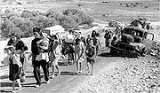
1948 Palestinian exodus

Encyclopedia
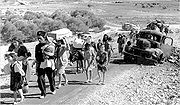
Estimates of the Palestinian Refugee flight of 1948
This article lists the various interim and final United Nations estimates for the number of Palestinian people who fled or were expelled from the area that became part of the State of Israel after the 1948 Arab-Israeli war...
Palestinian Arabs
Palestinian people
The Palestinian people, also referred to as Palestinians or Palestinian Arabs , are an Arabic-speaking people with origins in Palestine. Despite various wars and exoduses, roughly one third of the world's Palestinian population continues to reside in the area encompassing the West Bank, the Gaza...
left, fled or were expelled from their homes
Causes of the 1948 Palestinian exodus
The causes and explanations of the exodus of Palestinian Arabs that arose during the 1947-1948 Civil War in Mandatory Palestine and the 1948 Arab-Israeli War are a matter of great controversy between historians and journalists, and of the Arab-Israeli conflict....
, during the 1948 Arab-Israeli War
1948 Arab-Israeli War
The 1948 Arab–Israeli War, known to Israelis as the War of Independence or War of Liberation The war commenced after the termination of the British Mandate for Palestine and the creation of an independent Israel at midnight on 14 May 1948 when, following a period of civil war, Arab armies invaded...
and the Civil War
1947–1948 Civil War in Mandatory Palestine
The 1947–1948 Civil War in Mandatory Palestine lasted from 30 November 1947, the date of the United Nations vote in favour of the termination of the British Mandate for Palestine and the UN Partition Plan, to the termination of the British Mandate itself on 14 May 1948.This period constitutes the...
that preceded it. The exact number of refugees is a matter of dispute. The causes remain the subject of fundamental disagreement between Arabs and Israelis.
Nur-eldeen Masalha
Nur-eldeen Masalha
Nur-eldeen Masalha is a Palestinian writer and academic.He is Professor of Religion and Politics and Director of the Centre for Religion and History and the Holy Land Research Project at St. Mary's University College, University of Surrey...
writes that over 80 percent of the Arab inhabitants left their towns and villages in 1948, while Rashid Khalidi
Rashid Khalidi
Rashid Ismail Khalidi , born 1948, a Palestinian-American historian of the Middle East, is the Edward Said Professor of Modern Arab Studies at Columbia University, and director of the Middle East Institute of Columbia's School of International and Public Affairs.-Family, education and...
puts the percentage at 50. Factors involved in the flight include the voluntary self-removal of the wealthier classes, the collapse in Palestinian leadership, an unwillingness to live under Jewish control, Jewish military advances, and fears of massacre after Deir Yassin, which caused many to leave out of panic. Later, a series of laws passed by the first Israeli government prevented them from returning to their homes, or claiming their property. They and many of their descendants remain refugees. Later in the war, Palestinians were expelled as part of Plan Dalet
Plan Dalet
Plan Dalet, or Plan D, was a plan worked out by the Haganah, a Jewish paramilitary group and the forerunner of the Israel Defense Forces, in Palestine in autumn 1947 to spring 1948. Its purpose is much debated...
. The expulsion of the Palestinians has since been described by some historians as ethnic cleansing
Ethnic cleansing
Ethnic cleansing is a purposeful policy designed by one ethnic or religious group to remove by violent and terror-inspiring means the civilian population of another ethnic orreligious group from certain geographic areas....
, while others dispute this charge.
During the 1949 Lausanne conference
Lausanne Conference, 1949
The Lausanne Conference, 1949 was convened by the United Nations Conciliation Commission for Palestine from 27 April to 12 September 1949 in Lausanne, Switzerland...
, Israel proposed allowing the return of 100,000 of the refugees as a goodwill gesture prior to negotiation for the whole refugee population, though not necessarily to their homes, and including 25,000 who had returned surreptitiously and 10,000 family-reunion cases. The proposal was conditional on a peace treaty that would allow Israel to retain the territory it had taken, and on the Arab states absorbing the remaining 550,000–650,000 refugees. "The Arab states rejected the proposal on both moral and political grounds."
The status of the refugees, and in particular whether Israel will grant them their claimed right to return
Palestinian right of return
The Palestinian right of return is a political position or principle asserting that Palestinian refugees, both first-generation refugees and their descendants, have a right to return, and a right to the property they or their forebears left or which they were forced to leave in what is now Israel...
to their homes or be compensated, are key issues in the ongoing Israeli-Palestinian conflict
Israeli-Palestinian conflict
The Israeli–Palestinian conflict is the ongoing conflict between Israelis and Palestinians. The conflict is wide-ranging, and the term is also used in reference to the earlier phases of the same conflict, between Jewish and Zionist yishuv and the Arab population living in Palestine under Ottoman or...
. The events of 1948 are commemorated by Palestinians on May 15, now known as Nakba Day
Nakba Day
Nakba Day is generally commemorated on May 15, the day after the Gregorian calendar date for Israeli independence day...
.
History
The history of the Palestinian exodus is closely tied to the events of the war in Palestine, which lasted from 1947 to 1949, and to the political events preceding it. In September 1949, the United Nations Conciliation Commission for Palestine estimated 711,000 Palestinian refugees existed outside Israel, with about one-quarter of the estimated 160,000 Palestinian Arabs remaining in Israel as "internal refugees".Israel maintains that the Palestinians left because they were ordered to and were deliberately incited into panic by their own leaders who wanted the field cleared for the 1948 war. The Palestinians say they were evicted at bayonet-point and by panic deliberately incited by the Zionists.
Efraim Karsh
Efraim Karsh
Efraim Karsh is professor and head of Middle East and Mediterranean Studies at King's College London, and director of the Philadelphia-based think tank, the Middle East Forum...
believes that the Israeli government never took such a "simplistic, single-cause viewpoint". Walid Khalidi and Ilan Pappé say that the expulsion was based on a deliberate policy. Based on the protocols of Israel's cabinet meetings, the Haganah Archive in Tel Aviv, and the IDF and Israel Defense Ministry Archive in Givatayim, a number of historians have concluded that around half the Palestinians who became refugees were evicted by the Israeli army but this was not an organized policy.
1947–March 1948
In the first few months of the civil war the climate in the Mandate of Palestine became volatile, although throughout this period both Arab and Jewish leaders tried to limit hostilities. According to historian Benny MorrisBenny Morris
Benny Morris is professor of History in the Middle East Studies department of Ben-Gurion University of the Negev in the city of Be'er Sheva, Israel...
, the period was marked by Palestinian Arab attacks and Jewish defensiveness, increasingly punctuated by Jewish reprisals. Simha Flapan
Simha Flapan
Simha Flapan was an Israeli historian and politician. He was the author of The Birth of Israel: Myths And Realities.He is probably best known for his book The Birth of Israel: Myths And Realities, published in the year of his death....
pointed out that attacks by the Irgun
Irgun
The Irgun , or Irgun Zevai Leumi to give it its full title , was a Zionist paramilitary group that operated in Mandate Palestine between 1931 and 1948. It was an offshoot of the earlier and larger Jewish paramilitary organization haHaganah...
and Lehi
Lehi (group)
Lehi , commonly referred to in English as the Stern Group or Stern Gang, was a militant Zionist group founded by Avraham Stern in the British Mandate of Palestine...
resulted in Palestinian Arab retaliation and condemnation. Jewish reprisal operations were directed against villages and neighborhoods from which attacks against Jews were believed to have originated.
The attacks were more damaging than the provoking attack and included killing of armed and unarmed men, destruction of houses and sometimes expulsion of inhabitants. The Zionist groups of Irgun
Irgun
The Irgun , or Irgun Zevai Leumi to give it its full title , was a Zionist paramilitary group that operated in Mandate Palestine between 1931 and 1948. It was an offshoot of the earlier and larger Jewish paramilitary organization haHaganah...
and Lehi
Lehi (group)
Lehi , commonly referred to in English as the Stern Group or Stern Gang, was a militant Zionist group founded by Avraham Stern in the British Mandate of Palestine...
reverted to their 1937–1939 strategy of indiscriminate attacks by placing bombs and throwing grenades into crowded places such as bus stops, shopping centres and markets. Their attacks on British forces reduced British troops' ability and willingness to protect Jewish traffic. General conditions deteriorated: the economic situation became unstable and unemployment grew. Rumours spread that the Husaynis were planning to bring in bands of fellah
Fellah
Fellah , also alternatively known as Fallah is a peasant, farmer or agricultural laborer in the Middle East and North Africa...
in (peasant, farmers) to take over the towns. Some Palestinian Arab leaders sent their families abroad.
Gelber claims that the Arab Liberation Army
Arab Liberation Army
The Arab Liberation Army , also translated as Arab Salvation Army, was an army of volunteers from Arab countries led by Fawzi al-Qawuqji...
embarked on a systematic evacuation of non-combatants from several frontier villages in order to turn them into military strongholds. Arab depopulation occurred most in villages close to Jewish settlements and in vulnerable neighborhoods in Haifa, Jaffa and West-Jerusalem. The poor inhabitants of these neighborhoods generally fled to other parts of the city. Many rich inhabitants fled further away, most of them expecting to return when the troubles were over. By the end of March 1948 thirty villages were depopulated of their Palestinian Arab population. Approximately 100,000 Palestinian Arabs had fled to Arab parts of Palestine, such as Gaza, Beersheba, Haifa, Nazareth, Nablus, Jaffa and Bethlehem.
Some had left the country altogether, to Jordan
Jordan
Jordan , officially the Hashemite Kingdom of Jordan , Al-Mamlaka al-Urduniyya al-Hashemiyya) is a kingdom on the East Bank of the River Jordan. The country borders Saudi Arabia to the east and south-east, Iraq to the north-east, Syria to the north and the West Bank and Israel to the west, sharing...
, Lebanon
Lebanon
Lebanon , officially the Republic of LebanonRepublic of Lebanon is the most common term used by Lebanese government agencies. The term Lebanese Republic, a literal translation of the official Arabic and French names that is not used in today's world. Arabic is the most common language spoken among...
and Egypt
Egypt
Egypt , officially the Arab Republic of Egypt, Arabic: , is a country mainly in North Africa, with the Sinai Peninsula forming a land bridge in Southwest Asia. Egypt is thus a transcontinental country, and a major power in Africa, the Mediterranean Basin, the Middle East and the Muslim world...
. Other sources speak of 30,000 Palestinian Arabs. Many of these were Palestinian Arab leaders, middle and upper-class Palestinian Arab families from urban areas. Around 22 March, the Arab governments agreed that their consulates in Palestine would only issue entry visas to old people, women and children and the sick. On 29–30 March the Haganah Intelligence Service (HIS) reported that 'the AHC
Arab Higher Committee
The Arab Higher Committee was the central political organ of the Arab community of Mandate Palestine. It was established on 25 April 1936, on the initiative of Hajj Amin al-Husayni, the Grand Mufti of Jerusalem, and comprised the leaders of Palestinian Arab clans under the mufti's...
was no longer approving exit permits for fear of [causing] panic in the country'.
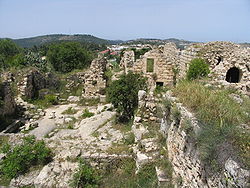

Yishuv
The Yishuv or Ha-Yishuv is the term referring to the body of Jewish residents in Palestine before the establishment of the State of Israel...
policy favoring expulsion until the Arab riots in 1920s and 1930s, and Jewish leaders anticipated that the new Jewish state would have a sizable Arab minority.
The Haganah was instructed to avoid spreading the conflagration by indiscriminate attacks and to avoid provoking British intervention. On 18 December 1947 the Haganah approved an aggressive defense strategy, which in practice meant 'a limited implementation of "Plan May" (Tochnit Mai or Tochnit Gimel), which, produced in May 1946, was the Haganah master plan for the defence of the Yishuv in the event of the outbreak of new troubles. The plan included provision, in extremis, for "destroying Arab transport" in Palestine, and blowing up houses used by Arab terrorists and expelling their inhabitants.
In early January the Haganah adopted Operation Zarzir, a scheme to assassinate leaders affiliated to Amin al-Husayni, placing the blame on other Arab leaders, but in practice few resources were devoted to the project and the only attempted killing was of Nimr al Khatib.
The only authorised expulsion at this time took place at Qisarya
Qisarya
The village of Qisarya was located south of Haifa.-History:After the Muslim conquest, during the Mamluk area, the ruins of Caesarea Maritima by the Crusader fortress near Caesarea on the Mediterranean coast was uninhabited. First in 1664 a settlement is mentioned. It consisted of 100...
, south of Haifa, where Palestinian Arabs were evicted and their houses destroyed on 19 February – 20 February 1948. In attacks that were not authorised in advance, several communities were expelled by the Haganah and several others were chased away by the Irgun.
According to Ilan Pappé
Ilan Pappé
Ilan Pappé is a professor with the College of Social Sciences and International Studies at the University of Exeter in the UK, director of the university's European Centre for Palestine Studies, co-director of the Exeter Centre for Ethno-Political Studies, and political activist...
, the Zionists organised a campaign of threats, consisting of the distribution of threatening leaflets, 'violent reconnaissance' and, after the arrival of mortars, the shelling of Arab villages and neighborhoods. Pappé also notes that the Haganah shifted its policy from retaliation through excessive retaliation to offensive initiatives.
During the 'long seminar', a meeting of Ben-Gurion
David Ben-Gurion
' was the first Prime Minister of Israel.Ben-Gurion's passion for Zionism, which began early in life, led him to become a major Zionist leader and Executive Head of the World Zionist Organization in 1946...
with his chief advisors in January 1948, the departure point was that it was desirable to 'transfer' as many Arabs as possible out of Jewish territory, and the discussion focussed mainly on the implementation. The experience gained in a number of attacks in February 1948, notably those on Qisarya
Qisarya
The village of Qisarya was located south of Haifa.-History:After the Muslim conquest, during the Mamluk area, the ruins of Caesarea Maritima by the Crusader fortress near Caesarea on the Mediterranean coast was uninhabited. First in 1664 a settlement is mentioned. It consisted of 100...
and Sa'sa'
Sa'sa'
Sa'sa was a Palestinian village, located 12 kilometres northwest of Safed that was depopulated by Israeli forces during the 1948 Arab-Israeli war...
, was used in the development of a plan
Plan Dalet
Plan Dalet, or Plan D, was a plan worked out by the Haganah, a Jewish paramilitary group and the forerunner of the Israel Defense Forces, in Palestine in autumn 1947 to spring 1948. Its purpose is much debated...
detailing how enemy population centers should be handled. According to Pappé, plan Dalet
Plan Dalet
Plan Dalet, or Plan D, was a plan worked out by the Haganah, a Jewish paramilitary group and the forerunner of the Israel Defense Forces, in Palestine in autumn 1947 to spring 1948. Its purpose is much debated...
was the master plan for the expulsion of the Palestinians.
Palestinian belligerency in these first few months was "disorganised, sporadic and localised and for months remained chaotic and uncoordinated, if not undirected". Husayni lacked the resources to mount a full-scale assault on the Yishuv, and restricted himself to sanctioning minor attacks and to tightening the economic boycott. The British claimed that Arab rioting might well have subsided had the Jews not retaliated with firearms.
Overall, Morris concludes that the "Arab evacuees from the towns and villages left largely because of Jewish — Haganah, IZL or LHI — attacks or fear of impending attack" but that only "an extremely small, almost insignificant number of the refugees during this early period left because of Haganah or IZL or LHI expulsion orders or forceful 'advice' to that effect". In this sense, Glazer quotes the testimony of Count Bernadotte, the UN mediator in Palestine, who reported that "the exodus of the Palestinian Arabs resulted from panic created by fighting in their communities, by rumours concerning real or alleged acts of terrorism, or expulsion. Almost the whole of the Arab population fled or was expelled from the area under Jewish occupation".
April 1948–June 1948
By 1 May 1948, two weeks before the Israeli Declaration of Independence, nearly 175,000 Palestinians (approximately 25%) had already fled.The fighting in these months was concentrated in the Jerusalem – Tel Aviv
Tel Aviv
Tel Aviv , officially Tel Aviv-Yafo , is the second most populous city in Israel, with a population of 404,400 on a land area of . The city is located on the Israeli Mediterranean coastline in west-central Israel. It is the largest and most populous city in the metropolitan area of Gush Dan, with...
area and most depopulations took place in Jewish controlled areas, such as Tiberias, Haifa, Jaffa
Jaffa
Jaffa is an ancient port city believed to be one of the oldest in the world. Jaffa was incorporated with Tel Aviv creating the city of Tel Aviv-Yafo, Israel. Jaffa is famous for its association with the biblical story of the prophet Jonah.-Etymology:...
and the coastal region. The Deir Yassin massacre
Deir Yassin massacre
The Deir Yassin massacre took place on April 9, 1948, when around 120 fighters from the Irgun Zevai Leumi and Lohamei Herut Israel Zionist paramilitary groups attacked Deir Yassin near Jerusalem, a Palestinian-Arab village of roughly 600 people...
in early April, and the rumours that followed it, helped spread fear and panic among the Palestinians.
Even so, Palestinians fled the city of Haifa
Haifa
Haifa is the largest city in northern Israel, and the third-largest city in the country, with a population of over 268,000. Another 300,000 people live in towns directly adjacent to the city including the cities of the Krayot, as well as, Tirat Carmel, Daliyat al-Karmel and Nesher...
en masse, in one of the most notable flights of this stage. Historian Efraim Karsh
Efraim Karsh
Efraim Karsh is professor and head of Middle East and Mediterranean Studies at King's College London, and director of the Philadelphia-based think tank, the Middle East Forum...
writes that not only had half of the Arab community in Haifa community fled the city before the final battle was joined in late April 1948, but another 5,000–15,000 left apparently voluntarily during the fighting while the rest, some 15,000–25,000, were ordered to leave, almost certainly on the instructions of the Arab Higher Committee.
Karsh concludes that there was no Jewish grand design to force this departure, and that in fact the Haifa Jewish leadership tried to convince some Arabs to stay, to no avail. However, Karsh based his observations on a "British Police Report" of 26 April sent after the British forces had evacuated from Haifa and the Jewish forces had taken over the port of Haifa and the Palestinian population had already fled. The British report of 22 April at the height of the fight for Haifa portrays a different picture. Furthermore, two independent studies, which analysed CIA and BBC
BBC
The British Broadcasting Corporation is a British public service broadcaster. Its headquarters is at Broadcasting House in the City of Westminster, London. It is the largest broadcaster in the world, with about 23,000 staff...
intercepts of radio broadcasts from the region, concluded that no orders or instructions were given by the Arab Higher Committee.
According to Morris, "The Haganah mortar attacks of 21–22 April [on Haifa] were primarily designed to break Arab morale in order to bring about a swift collapse of resistance and speedy surrender. […] But clearly the offensive, and especially the mortaring, precipitated the exodus. The three-inch mortars opened up on the market square [where there was] a great crowd […] a great panic took hold. The multitude burst into the port, pushed aside the policemen, charged the boats and began to flee the town, as the official Haganah history later put it". According to Pappé, this mortar barrage was deliberately aimed at civilians to precipitate their flight from Haifa.
The Haganah broadcast a warning to Arabs in Haifa on 21 April: "that unless they sent away 'infiltrated dissidents' they would be advised to evacuate all women and children, because they would be strongly attacked from now on".
Commenting on the use of 'psychological warfare broadcasts' and military tactics in Haifa, Benny Morris
Benny Morris
Benny Morris is professor of History in the Middle East Studies department of Ben-Gurion University of the Negev in the city of Be'er Sheva, Israel...
writes:
Throughout the Haganah made effective use of Arabic language broadcasts and loudspeaker vans. Haganah Radio announced that 'the day of judgement had arrived' and called on inhabitants to 'kick out the foreign criminals' and to 'move away from every house and street, from every neighbourhood occupied by foreign criminals'. The Haganah broadcasts called on the populace to 'evacuate the women, the children and the old immediately, and send them to a safe haven'. Jewish tactics in the battle were designed to stun and quickly overpower opposition; demoralisation was a primary aim. It was deemed just as important to the outcome as the physical destruction of the Arab units. The mortar barrages and the psychological warfare broadcasts and announcements, and the tactics employed by the infantry companies, advancing from house to house, were all geared to this goal. The orders of Carmeli's 22nd Battalion were 'to kill every [adult male] Arab encountered' and to set alight with fire-bombs 'all objectives that can be set alight. I am sending you posters in Arabic; disperse on route'.
By mid-May 4,000 Arabs remained in Haifa. These were concentrated in Wadi Nisnas in accordance with Plan D whilst the systematic destruction of Arab housing in certain areas, which had been planned before the War, was implemented by Haifa's Technical and Urban Development departments in cooperation with the IDF's city commander Ya'akov Lublini.
According to Glazer (1980, p. 111), from 15 May 1948 onwards, expulsion of Palestinians became a regular practice. Avnery (1971), explaining the Zionist rationale, says,
I believe that during this phase, the eviction of Arab civilians had become an aim of David Ben-Gurion and his government …. UN opinion could very well be disregarded. Peace with the Arabs seemed out of the question, considering the extreme nature of the Arab propaganda. In this situation, it was easy for people like Ben-Gurion to believe the capture of uninhabited territory was both necessary for security reasons and desirable for the homogeneity of the new Hebrew state.
Edgar O'Ballance, a military historian, adds,
Israeli vans with loudspeakers drove through the streets ordering all the inhabitants to evacuate immediately, and such as were reluctant to leave were forcibly ejected from their homes by the triumphant Israelis whose policy was now openly one of clearing out all the Arab civil population before them…. From the surrounding villages and hamlets, during the next two or three days, all the inhabitants were uprooted and set off on the road to Ramallah…. No longer was there any "reasonable persuasion". Bluntly, the Arab inhabitants were ejected and forced to flee into Arab territory…. Wherever the Israeli troops advanced into Arab country the Arab population was bulldozed out in front of them.
After the fall of Haifa the villages on the slopes of Mount Carmel
Mount Carmel
Mount Carmel ; , Kármēlos; , Kurmul or جبل مار إلياس Jabal Mar Elyas 'Mount Saint Elias') is a coastal mountain range in northern Israel stretching from the Mediterranean Sea towards the southeast. Archaeologists have discovered ancient wine and oil presses at various locations on Mt. Carmel...
had been harassing the Jewish traffic on the main road to Haifa. A decision was made on 9 May 1948 to expel or subdue the villages of Kafr Saba
Kafr Saba
Kafr Saba was a Palestinian-Arab village famous for its shrine dating to the Mamluk period and for a history stretching back for more than a millennium...
, al-Tira, Qaqun
Qaqun
Qaqun was a Palestinian Arab village located northwest of the city of Tulkarm at the only entrance to Mount Nablus from the coastal Sharon plain....
, Qalansuwa and Tantura. On 11 May 1948 Ben-Gurion convened the "Consultancy"; the outcome of the meeting is confirmed in a letter to commanders of the Haganah Brigades telling them that the Arab legion's
Arab Legion
The Arab Legion was the regular army of Transjordan and then Jordan in the early part of the 20th century.-Creation:...
offensive should not distract their troops from the principal tasks:
"the cleansing of Palestine remained the prime objective of Plan DaletPlan DaletPlan Dalet, or Plan D, was a plan worked out by the Haganah, a Jewish paramilitary group and the forerunner of the Israel Defense Forces, in Palestine in autumn 1947 to spring 1948. Its purpose is much debated...
"
The attention of the commanders of the Alexandroni Brigade
Alexandroni Brigade
The Alexandroni Brigade is an Israel Defense Forces brigade that fought in the 1948 Arab-Israeli war. Along with the 7th Armoured Brigade both units had 139 killed during the first battle of Latrun - Operation Ben Nun Alef .The unit is currently a reserve unit.-Katz controversy:In 1998, Teddy Katz...
was turned to reducing the Mount Carmel
Mount Carmel
Mount Carmel ; , Kármēlos; , Kurmul or جبل مار إلياس Jabal Mar Elyas 'Mount Saint Elias') is a coastal mountain range in northern Israel stretching from the Mediterranean Sea towards the southeast. Archaeologists have discovered ancient wine and oil presses at various locations on Mt. Carmel...
pocket. Tantura, being on the coast, gave the Carmel villages access to the outside world and so was chosen as the point to surround the Carmel villages as a part of the Coastal Clearing offensive operation in the beginning of the 1948 Arab-Israeli War
1948 Arab-Israeli War
The 1948 Arab–Israeli War, known to Israelis as the War of Independence or War of Liberation The war commenced after the termination of the British Mandate for Palestine and the creation of an independent Israel at midnight on 14 May 1948 when, following a period of civil war, Arab armies invaded...
.
On the night of 22–23 May 1948, one week and one day after the declaration of Independence of the State of Israel
Israel
The State of Israel is a parliamentary republic located in the Middle East, along the eastern shore of the Mediterranean Sea...
, the coastal village of Tantura was attacked and occupied by the 33rd Battalion of the Alexandroni Brigade
Alexandroni Brigade
The Alexandroni Brigade is an Israel Defense Forces brigade that fought in the 1948 Arab-Israeli war. Along with the 7th Armoured Brigade both units had 139 killed during the first battle of Latrun - Operation Ben Nun Alef .The unit is currently a reserve unit.-Katz controversy:In 1998, Teddy Katz...
of the Haganah
Haganah
Haganah was a Jewish paramilitary organization in what was then the British Mandate of Palestine from 1920 to 1948, which later became the core of the Israel Defense Forces.- Origins :...
. The village of Tantura was not given the option of surrender and the initial report spoke of dozens of villagers killed, with 300 adult male prisoners and 200 women and children. Many of the villagers fled to Fureidis
Fureidis
Fureidis is an Israeli Arab town in the Haifa District of Israel. It received local council status in 1952.-History:Fureidis was established in the 19th century. The name is believed to come from the Arabic , meaning little Garden of Eden, borrowed from the Persian paradise...
(previously captured) and to Arab-held territory. The captured women of Tantura were moved to Fureidis, and on 31 May Brechor Shitrit, Minister of Minority Affairs of the provisional Government of Israel, sought permission to expel the refugee women of Tantura from Fureidis as the number of refugees in Fureidis was causing problems of overcrowding and sanitation.
A report from the military intelligence SHAI of the Haganah
Haganah
Haganah was a Jewish paramilitary organization in what was then the British Mandate of Palestine from 1920 to 1948, which later became the core of the Israel Defense Forces.- Origins :...
entitled "The emigration of Palestinian Arabs in the period 1/12/1947-1/6/1948", dated 30 June 1948, affirms that:
At least 55% of the total of the exodus was caused by our (Haganah/IDF) operations." To this figure, the report's compilers add the operations of the Irgun and Lehi, which "directly (caused) some 15%… of the emigration". A further 2% was attributed to explicit expulsion orders issued by Israeli troops, and 1% to their psychological warfare. This leads to a figure of 73% for departures caused directly by the Israelis. In addition, the report attributes 22% of the departures to "fears" and "a crisis of confidence" affecting the Palestinian population. As for Arab calls for flight, these were reckoned to be significant in only 5% of cases…
According to Morris's estimates, 250,000 to 300,000 Palestinians left Israel during this stage. Keesing's Contemporary Archives in London place the total number of refugees before Israel's independence at 300,000.
July–October 1948
Israeli operations labeled Dani and Dekel that broke the truce was the start of the third phase of expulsions. The largest single expulsion of the war began in LyddaLod
Lod is a city located on the Sharon Plain southeast of Tel Aviv in the Center District of Israel. At the end of 2010, it had a population of 70,000, roughly 75 percent Jewish and 25 percent Arab.The name is derived from the Biblical city of Lod...
and Ramla
Ramla
Ramla , is a city in central Israel. The city is predominantly Jewish with a significant Arab minority. Ramla was founded circa 705–715 AD by the Umayyad Caliph Suleiman ibn Abed al-Malik after the Arab conquest of the region...
14 July when 60,000 inhabitants (nearly 10% of the whole exodus) of the two cities were forcibly expelled on the orders of Ben-Gurion
David Ben-Gurion
' was the first Prime Minister of Israel.Ben-Gurion's passion for Zionism, which began early in life, led him to become a major Zionist leader and Executive Head of the World Zionist Organization in 1946...
and Yitzhak Rabin
Yitzhak Rabin
' was an Israeli politician, statesman and general. He was the fifth Prime Minister of Israel, serving two terms in office, 1974–77 and 1992 until his assassination in 1995....
in events that came to be known as the "Lydda Death March."
According to Flapan (1987, pp. 13–14) in Ben-Gurion's view Ramlah and Lydda constituted a special danger because their proximity might encourage co-operation between the Egyptian army, which had started its attack on Kibbutz Negbah, near Ramlah, and the Arab Legion, which had taken the Lydda police station. However, the author considers that Operation Dani, under which the two towns were seized, revealed that no such co-operation existed.
In Flapan's opinion, "in Lydda, the exodus took place on foot. In Ramlah, the IDF provided buses and trucks. Originally, all males had been rounded up and enclosed in a compound, but after some shooting was heard, and construed by Ben-Gurion to be the beginning of an Arab Legion counteroffensive, he stopped the arrests and ordered the speedy eviction of all the Arabs, including women, children, and the elderly". In explanation, Flapan cites that Ben-Gurion said that "those who made war on us bear responsibility after their defeat".
Rabin wrote in his memoirs:
- What would they do with the 50,000 civilians in the two cities … Not even Ben-Gurion could offer a solution, and during the discussion at operation headquarters, he remained silent, as was his habit in such situations. Clearly, we could not leave [Lydda's] hostile and armed populace in our rear, where it could endanger the supply route [to the troops who were] advancing eastward. … Allon repeated the question: What is to be done with the population? Ben-Gurion waved his hand in a gesture that said: Drive them out! … 'Driving out' is a term with a harsh ring … Psychologically, this was one of the most difficult actions we undertook. The population of [Lydda] did not leave willingly. There was no way of avoiding the use of force and warning shots in order to make the inhabitants march the 10 to 15 miles to the point where they met up with the legion. (Soldier of Peace, p. 140–141)
Flapan maintains that events in Nazareth, although ending differently, point to the existence of a definite pattern of expulsion. On 16 July, three days after the Lydda and Ramlah evictions, the city of Nazareth surrendered to the IDF. The officer in command, a Canadian Jew named Ben Dunkelman
Ben Dunkelman
Benjamin Dunkelman was a Canadian Jewish officer who served in the Canadian Army in World War II and the Israel Defense Forces in the 1948 Arab–Israeli War. In Israel, he was called Benjamin Ben-David....
, had signed the surrender agreement on behalf of the Israeli army along with Chaim Laskov (then a brigadier general, later IDF chief of staff). The agreement assured the civilians that they would not be harmed, but the next day, Laskov handed Dunkelman an order to evacuate the population, which Dunkelman refused.
Additionally, widespread looting and several cases of rape took place during the evacuation. In total, about 100,000 Palestinians became refugees in this stage according to Morris.
October 1948–March 1949
This period of the exodus was characterized by Israeli military accomplishments; Operation YoavOperation Yoav
Operation Yoav was an Israeli military operation carried out from 15–22 October 1948 in the Negev Desert, during the 1948 Arab-Israeli War. Its goal was to drive a wedge between the Egyptian forces along the coast and the Beersheba–Hebron–Jerusalem road and ultimately to conquer the whole Negev...
, in October, this cleared the road to the Negev, culminating in the capture of Beersheba
Beersheba
Beersheba is the largest city in the Negev desert of southern Israel. Often referred to as the "Capital of the Negev", it is the seventh-largest city in Israel with a population of 194,300....
; Operation Hiram
Operation Hiram
Operation Hiram was a military operation conducted by the Israel Defense Forces during the 1948 Arab-Israeli War. It was led by General Moshe Carmel, and aimed at capturing the upper Galilee region from the Arab Liberation Army forces led by Fawzi al-Qawuqji and a Syrian battalion...
, at the end of October, resulted in the capture of the Upper Galilee
Upper Galilee
The Upper Galilee is a geographical-political term in use since the end of the Second Temple period, originally referring to a mountainous area overlapping the present northern Israel and southern Lebanon, its borders being the Litani river in the north, the Mediterranean Sea in the west, the Beit...
; Operation Horev
Operation Horev
At the end of Israel's War of Independence Operation Horev was a large scale attack against the Egyptian army in the Western Negev. Its objective was to trap the Egyptian Army in the Gaza Strip...
in December 1948 and Operation Uvda in March 1949, completed the capture of the Negev (the Negev had been allotted to the Jewish State by the United Nations) these operations were met with resistance from the Palestinian Arabs who were to become refugees. The Israeli military activities were confined to the Galilee
Galilee
Galilee , is a large region in northern Israel which overlaps with much of the administrative North District of the country. Traditionally divided into Upper Galilee , Lower Galilee , and Western Galilee , extending from Dan to the north, at the base of Mount Hermon, along Mount Lebanon to the...
and the sparsely populated Negev desert. It was clear to the villages in the Galilee, that if they left, return was far from imminent. Therefore, far fewer villages spontaneously depopulated than previously. Most of the Palestinian exodus was due to a clear, direct cause: expulsion and deliberate harassment, as Morris writes 'commanders were clearly bent on driving out the population in the area they were conquering'.
During Operation Hiram in the upper Galilee, Israeli military commanders received the order: 'Do all you can to immediately and quickly purge the conquered territories of all hostile elements in accordance with the orders issued. The residents should be helped to leave the areas that have been conquered'. (31 October 1948, Moshe Carmel
Moshe Carmel
Moshe Carmel was an Israeli soldier and politician who served as Minister of Transportation for eight years.-Background:Born in Mińsk Mazowiecki in the Russian Empire , Carmel emigrated to Mandate Palestine in 1924 when he was 13 years old. He was a founding member of kibbutz Na'an, and was...
) The UN's acting Mediator, Ralph Bunche
Ralph Bunche
Ralph Johnson Bunche or 1904December 9, 1971) was an American political scientist and diplomat who received the 1950 Nobel Peace Prize for his late 1940s mediation in Palestine. He was the first person of color to be so honored in the history of the Prize...
, reported that United Nations Observers had recorded extensive looting of villages in Galilee by Israeli forces, who carried away goats, sheep and mules. This looting, United Nations Observers report, appeared to have been systematic as army trucks were used for transportation. The situation, states the report, created a new influx of refugees into Lebanon. Israeli forces, he stated, have occupied the area in Galilee formerly occupied by Kaukji's forces, and have crossed the Lebanese frontier. Bunche goes on to say "that Israeli forces now hold positions inside the south-east corner of Lebanon, involving some fifteen Lebanese villages which are occupied by small Israeli detachments".
According to Morris altogether 200,000–230,000 Palestinians left in this stage. According to Ilan Pappé
Ilan Pappé
Ilan Pappé is a professor with the College of Social Sciences and International Studies at the University of Exeter in the UK, director of the university's European Centre for Palestine Studies, co-director of the Exeter Centre for Ethno-Political Studies, and political activist...
, "In a matter of seven months, five hundred and thirty one villages were destroyed and eleven urban neighborhoods emptied […] The mass expulsion was accompanied by massacres, rape and [the] imprisonment of men […] in labor camps for periods [of] over a year".
UN mediation
The United Nations, using the offices of the United Nations Truce Supervision Organisation and the Mixed Armistice CommissionsMixed Armistice Commissions
The Mixed Armistice Commissions is an organisation for monitoring the ceasefire along the lines set by the General Armistice Agreements. It was composed of United Nations Military Observers and was part of the United Nations Truce Supervision Organization peacekeeping force in the Middle East...
, was involved in the conflict from the very beginning. In the autumn of 1948 the refugee problem was a fact and possible solutions were discussed. Count Folke Bernadotte said on 16 September:
- No settlement can be just and complete if recognition is not accorded to the right of the Arab refugee to return to the home from which he has been dislodged. It would be an offence against the principles of elemental justice if these innocent victims of the conflict were denied the right to return to their homes while Jewish immigrants flow into Palestine, and indeed, offer the threat of permanent replacement of the Arab refugees who have been rooted in the land for centuries
UN General Assembly Resolution 194
UN General Assembly Resolution 194
United Nations General Assembly Resolution 194 was passed on December 11, 1948, near the end of the 1948 Arab-Israeli War. The resolution expresses appreciation for the efforts of UN Envoy Folke Bernadotte after his assassination by members of the Zionist ultra-nationalist Lehi , headed by Yitzhak...
, passed on 11 December 1948 and reaffirmed every year since, was the first resolution that called for Israel to let the refugees return:
- the refugees wishing to return to their homes and live at peace with their neighbours should be permitted to do so at the earliest practicable date, and that compensation should be paid for the property of those choosing not to return and for loss of or damage to property which, under principles of international law or in equity, should be made good by the Governments or authorities responsible.
The Lausanne Conference of 1949
At the start of the 1949 Lausanne conferenceLausanne Conference, 1949
The Lausanne Conference, 1949 was convened by the United Nations Conciliation Commission for Palestine from 27 April to 12 September 1949 in Lausanne, Switzerland...
, on 12 May 1949, Israel agreed in principle to allow the return of all Palestinian refugees. At the same time, Israel became a member of the U.N. upon the passage of United Nations General Assembly Resolution 273
United Nations General Assembly Resolution 273
United Nations General Assembly Resolution 273 was passed on May 11, 1949 to admit the State of Israel to membership in the United Nations. Admission was made conditional upon implementation of Resolutions 181 of November 29, 1947 and 194 of December 11, 1948 .-Full text:Having received the report...
on May 11, 1949, which read, in part,
- Noting furthermore the declaration by the State of Israel that it "unreservedly accepts the obligations of the United Nations Charter and undertakes to honour them from the day when it becomes a member of the United Nations,"
Israel began with an offer of allowing 100,000 of the refugees to return to the area, though not necessarily to their homes, including 25,000 who had returned surreptitiously and 10,000 family-reunion cases. The proposal was conditional on a peace treaty that would allow Israel to retain the territory it had captured which had been allocated to the Arab state by the United Nations Partition Plan for Palestine, and on the Arab states absorbing the remaining 550,000–650,000 refugees. The Arab states rejected the proposal on both moral and political grounds, and Israel quickly withdrew its limited offer.
Benny Morris, in his 2004 book, The Birth of the Palestinian Refugee Problem Revisited, summarizes it from his perspective:
- In retrospect, it appeared that at Lausanne was lost the best and perhaps only chance for a solution of the refugee problem, if not for the achievement of a comprehensive Middle East settlement. But the basic incompatibility of the initial starting positions and the unwillingness of the two sides to move, and to move quickly, towards a compromise — born of Arab rejectionism and a deep feeling of humiliation, and of Israeli drunkenness with victory and physical needs determined largely by the Jewish refugee influx — doomed the 'conference' from the start. American pressure on both sides, lacking a sharp, determined cutting edge, failed to budge sufficiently either Jew or Arab. The '100,000 Offer' was a classic of too little, too late.
Initial positions
In the first decades after the exodus, two diametrically opposed schools of analysis could be distinguished. In the words of Erskine Childers: "Israel claims that the Arabs left because they were ordered to, and deliberately incited into panic, by their own leaders who wanted the field cleared for the 1948 war", while "The Arabs charge that their people were evicted at bayonet-point and by panic deliberately incited by the Zionists". Alternative explanations had also been offered. For instance Peretz and Gabbay emphasize the psychological component: panic or hysteria swept the Palestinians and caused the exodus.Changes after the advent of the 'New Historians'
Israel opened up part of its archives in the 1980s for investigation by historians. This coincided with the emergence of various Israeli historians, called New HistoriansNew Historians
The New Historians are a loosely-defined group of Israeli historians who have challenged traditional versions of Israeli history, including Israel's role in the Palestinian Exodus in 1948 and Arab willingness to discuss peace. The term was coined in 1988 by one of the leading New Historians, Benny...
, who favored a more critical analysis of Israel's history. The most famous scholar of this group, Benny Morris
Benny Morris
Benny Morris is professor of History in the Middle East Studies department of Ben-Gurion University of the Negev in the city of Be'er Sheva, Israel...
, concludes that Jewish military attacks were the main direct cause of the exodus, followed by Arab fear due to the fall of a nearby town, Arab fear of impending attack, and expulsions. The traditional Israeli version was replaced by a new version stating that the exodus was caused by neither Israeli nor Arab policies, but rather was a by-product of the 1948 War
1948 Palestine war
The 1948 Palestine war refers to the events in the British Mandate of Palestine between the United Nations vote on the partition plan on November 30, 1947, to the end of the first Arab-Israeli war on July 20, 1949.The war is divided into two phases:...
.
The Arab version hardly changed but did get support from some of the New Historians
New Historians
The New Historians are a loosely-defined group of Israeli historians who have challenged traditional versions of Israeli history, including Israel's role in the Palestinian Exodus in 1948 and Arab willingness to discuss peace. The term was coined in 1988 by one of the leading New Historians, Benny...
. Pappé calls the exodus an ethnic cleansing and points at Zionist preparations in the preceding years and provides more details on the planning process by a group he calls the 'Consultancy'. Morris also says that ethnic cleansing took place during the Palestinian exodus, though Morris considers that to have been justified. In an interview with Ari Shavit, Morris says that "there are circumstances in history that justify ethnic cleansing. … when the choice is between ethnic cleansing and genocide—the annihilation of your people—I prefer ethnic cleansing."
The expulsion of the Palestinians has since been widely described as having involved ethnic cleansing
Ethnic cleansing
Ethnic cleansing is a purposeful policy designed by one ethnic or religious group to remove by violent and terror-inspiring means the civilian population of another ethnic orreligious group from certain geographic areas....
, although not all historians accept that characterization.
Abandoned, evacuated and destroyed Palestinian localities
Several authors have conducted studies on the number of Palestinian localities which were abandoned, evacuated and/or destroyed during the 1947–1949 period. Based on their respective calculations, the table below summarises their information.| Reference | Towns | Villages | Tribes | Total |
|---|---|---|---|---|
| Morris | 10 | 342 | 17 | 369 |
| Khalidi | 1 | 400 | 17 | 418 |
| Abu Sitta | 13 | 419 | 99 | 531 |
Source: The table data was taken from Ruling Palestine, A History of the Legally Sanctioned Jewish-Israeli Seizure of Land and Housing in Palestine. Publishers: COHRE & BADIL, May 2005, p. 34.
Note: For information on methodologies; see: Morris, Benny (1987): The Birth of the Palestinian Refugee Problem, 1947–1949. New York: Cambridge University Press, 1987; Khalidi, Walid (ed.): All that Remains. The Palestinian Villages Occupied and Depopulated by Israel in 1948. Washington, D.C: Institute for Palestine Studies, 1992, App. IV, pp. xix, 585–586; and Sitta, Salman Abu: The Palestinian Nakba 1948. London: The Palestinian Return Centre, 2000.
According to COHRE and BADIL, Morris's list of affected localities, the shortest of the three, includes towns but excludes other localities cited by Khalidi and/or Abu Sitta. The six sources compared in Khalidi's study have in common 296 of the villages listed as destroyed and/or depopulated. Sixty other villages are cited in all but one source. Of the total of 418 localities cited in Khalidi, 292 (70 percent) were completely destroyed and 90 (22 percent) "largely destroyed". COHRE and BADIL also note that other sources refer to an additional 151 localities that are omitted from Khalidi's study for various reasons (for example, major cities and towns that were depopulated, as well as some Bedouin encampments and villages 'vacated' before the start of hostilities). Abu Sitta's list includes tribes in Beersheba that lost lands; most of these were omitted from Khalidi's work.
Another study, involving field research and comparisons with British and other documents, concludes that 472 Palestinian habitations (including towns and villages) were destroyed in 1948. It notes that the devastation was virtually complete in some sub-districts. For example, it points out that 96.0% of the villages in the Jaffa area were totally destroyed, as were 90.0% of those in Tiberiade, 90.3% of those in Safad, and 95.9% of those in Beisan. It also extrapolates from 1931 British census data to estimate that over 70 280 Palestinian houses were destroyed in this period.
In another study, Abu Sitta shows the following findings in eight distinct phases of the depopulation of Palestine between 1947–1949. His findings are summarized in the table below:
| Phase: | No. of destroyed/depopulated localities | No. of refugees | Jewish/Israeli lands (km2) |
|---|---|---|---|
| 29 Nov. 1947 – Mar. 1948 | 30 | >22,600* | 1,159.4 |
| Apr. – 13 May 1948 (Tiberiade, Jaffa, Haifa, Safed, etc.) |
199 | >400,000 | 3,363.9 |
| 15 May – 11 June 1948 (an additional 90 villages) |
290 | >500,000 | 3,943.1 |
| 12 June – 18 July 1948 (Lydda/Ramleh, Nazareth, etc.) |
378 | >628,000 | 5,224.2 |
| 19 July – 24 Oct. 1948 (Galilee and southern areas) |
418 | >664,000 | 7,719.6 |
| 24 Oct. – 5 Nov. 1948 (Galilee, etc.) |
465 | >730,000 | 10,099.6 |
| 5 Nov. 1948 – 18 Jan. 1949 (Negev, etc.) |
481 | >754,000 | 12,366.3 |
| 19 Jan. – 20 July 1949 (Negev, etc.) |
531 | >804,000 | 20,350.0 |
Source: The table data was taken from Ruling Palestine, A History of the Legally Sanctioned Jewish-Israeli Seizure of Land and Housing in Palestine. Publishers: COHRE & BADIL, May 2005, p. 34. The source being: Abu Sitta, Salman (2001): From Refugees to Citizens at Home. London: Palestine Land Society and Palestinian Return Centre, 2001.
Palestinian refugees
On 11th December 1948, 12 months prior to UNRWA's establishment, United Nations General Assembly Resolution 194 was adopted. The resolution accepted the definition of Palestinian refugees as "persons of Arab origin who, after 29 November 1947, left territory at present under the control of the Israel authorities and who were Palestinian citizens at that date" and; "Persons of Arab origin who left the said territory after 6 August 1924 and before 29 November 1947 and who at that latter date were Palestinian citizens; 2. Persons of Arab origin who left the territory in question before 6 August 1924 and who, having opted for Palestinian citizenship, retained that citizenship up to 29 November 1947"UNRWA was established under UNGA resolution 302 (IV) of 8 December 1949. It defines refugees qualifying for UNRWA's services as "persons whose normal place of residence was Palestine between June 1946 and May 1948, who lost both their homes and means of livelihood as a result of the 1948 Arab-Israeli conflict" and also covers the descendants of persons who became refugees in 1948. The UNRWA mandate does not extend to final status.
The final 1949 UNRWA estimate of the refugee count was 726,000. On the other hand, the number of registered refugees was 914,000. The U.N. Conciliation Commission explains that this number is inflated by "duplication of ration cards, addition of persons who have been displaced from area other than Israel-held areas and of persons who, although not displaced, are destitute", and the UNWRA additionally noted that "all births are eagerly announced, the deaths wherever possible are passed over in silence," as well as the fact that "the birthrate is high in any case, a net addition of 30,000 names a year". By June 1951, the UNWRA had reduced the number of registered refugees to 876,000 after "many false and duplicate registrations [were] weeded out".
Today the number who qualify for UNRWA's services has grown to over 4 million. One third of whom live in the West Bank and Gaza; slightly less than one third in Jordan; 17% in Syria and Lebanon (Bowker, 2003, p. 72) and around 15% in other Arab and Western countries. Approximately 1 million refugees have no form of identification other than an UNRWA identification card.
The Prevention of Infiltration law
Following the emergence of the Palestinian refugeePalestinian refugee
Palestinian refugees or Palestine refugees are the people and their descendants, predominantly Palestinian Arabic-speakers, who fled or were expelled from their homes during and after the 1948 Palestine War, within that part of the British Mandate of Palestine, that after that war became the...
problem after the 1948 Arab-Israeli war
1948 Arab-Israeli War
The 1948 Arab–Israeli War, known to Israelis as the War of Independence or War of Liberation The war commenced after the termination of the British Mandate for Palestine and the creation of an independent Israel at midnight on 14 May 1948 when, following a period of civil war, Arab armies invaded...
, many Palestinians tried, in one way or another, to return to their homes. For some time these practices continued to embarrass the Israeli authorities until they passed the Prevention of Infiltration Law
Prevention of Infiltration Law
The Prevention of Infiltration Law is an Israeli law enacted in 1954, which defines offenses of armed and non-armed infiltration to Israel and from Israel to hostile neighboring countries...
, which defines offenses of armed and non-armed infiltration to Israel and from Israel to hostile neighboring countries. According to Arab Israeli writer Sabri Jiryis
Sabri Jiryis
Sabri Jiryis is a Palestinian-Arab Israeli writer and lawyer, a graduate of the Hebrew University law faculty, and prominent Palestinian activist. In 1966 the first edition of his book The Arabs in Israel was published in Hebrew.- Arrest in Israel :He was given an "Administrative House Arrest"...
, the purpose of the law was to prevent Palestinians from returning to Israel, those who did so being regarded as infiltrators.
According to Kirsbaum, over the years the Israeli Government has continued to cancel and modify some of the Defence (Emergency) Regulations of 1945, but mostly it has added more as it has continued to extend its declared state of emergency. For example, even though the Prevention of Infiltration Law of 1954 is not labelled as an official "Emergency Regulation", it extends the applicability of the Defence (Emergency) Regulation 112 of 1945 giving the Minister of Defence extraordinary powers of deportation for accused infiltrators even before they are convicted (Articles 30 & 32), and makes itself subject to cancellation when the Knesset
Knesset
The Knesset is the unicameral legislature of Israel, located in Givat Ram, Jerusalem.-Role in Israeli Government :The legislative branch of the Israeli government, the Knesset passes all laws, elects the President and Prime Minister , approves the cabinet, and supervises the work of the government...
ends the State of Emergency
State of emergency
A state of emergency is a governmental declaration that may suspend some normal functions of the executive, legislative and judicial powers, alert citizens to change their normal behaviours, or order government agencies to implement emergency preparedness plans. It can also be used as a rationale...
upon which all of the Emergency Regulations are dependent.
Land and Property laws
Following its establishment, Israel designed a system of law that legitimised both a continuation and a consolidation of the nationalisation of land and property, a process that it had begun decades earlier. For the first few years of Israel's existence, many of the new laws continued to be rooted in earlier Ottoman and British law. These laws were later amended or replaced altogether.The first challenge facing Israel was to transform its control over land into legal ownership. This was the motivation underlying the passing of several of the first group of land laws.
Initial 'Emergency Laws' and 'Regulations'
Among the more important initial laws was article 125 of the Defence (Emergency) RegulationsAccording to Kirshbaum, the Law has as effect that "no one is allowed in or out without permission from the Israeli Military". "This regulation has been used to exclude a land owner from his own land so that it could be judged as unoccupied, and then expropriated under the Land Acquisition (Validation of Acts and Compensation) Law (1953). Closures need not be published in the Official Gazette".
The Absentees' Property Law'
The Absentees' Property Laws were several laws, first introduced as emergency ordinances issued by the Jewish leadership but which after the war were incorporated into the laws of Israel. As examples of the first type of laws are the Emergency Regulations (Absentees' Property) Law, 5709-1948 (December) which according to article 37 of the Absentees Property Law, 5710-1950 was replaced by the latter; the Emergency Regulations (Requisition of Property) Law, 5709-1949, and other related laws.According to COHRE and BADIL (p. 41), unlike other laws that were designed to establish Israel's 'legal' control over lands, this body of law focused on formulating a 'legal' definition for the people (mostly Arabs) who had left or been forced to flee from these lands.
The absentee property played an enormous role in making Israel a viable state. In 1954, more than one third of Israel's Jewish population lived on absentee property and nearly a third of the new immigrants (250,000 people) settled in urban areas abandoned by Arabs. Of 370 new Jewish settlements established between 1948 and 1953, 350 were on absentee property.
The absentee property law is directly linked to the controversy of parallelism between the Jewish exodus from Arab lands
Jewish exodus from Arab lands
The Jewish exodus from Arab and Muslim countries was a mass departure, flight and expulsion of Jews, primarily of Sephardi and Mizrahi background, from Arab and Muslim countries, from 1948 until the early 1970s...
and the Palestinian Exodus, as advocacy groups have suggested that there are strong ties between the two processes and some of them even claim that decoupling the two issues is unjust.
Laws enacted
A number of Israeli laws were enacted which enabled the further acquisition of depopulated lands. Among these laws were:- The Land (Acquisition for Public Purposes) Ordinance (1943). To authorise the confiscation of lands for Government and public purposes.
- The Prescription Law, 5718-1958. According to COHRE and BADIL (p. 44), this law, in conjunction with the Land (Settlement of Title) Ordinance (Amendment) Law, 5720-1960, the Land (Settlement of Title) Ordinance (New Version), 5729-1969 and the Land Law, 5729-1969, was designed to revise criteria related to the use and registration of Miri lands – one of the most prevalent types in Palestine – and to facilitate Israel's acquisition of such land.
Israeli resettlement program
Following the Six-Day WarSix-Day War
The Six-Day War , also known as the June War, 1967 Arab-Israeli War, or Third Arab-Israeli War, was fought between June 5 and 10, 1967, by Israel and the neighboring states of Egypt , Jordan, and Syria...
, Israel gained control over a substantial number of refugee camps in the territories it captured from Egypt
Egypt
Egypt , officially the Arab Republic of Egypt, Arabic: , is a country mainly in North Africa, with the Sinai Peninsula forming a land bridge in Southwest Asia. Egypt is thus a transcontinental country, and a major power in Africa, the Mediterranean Basin, the Middle East and the Muslim world...
and Jordan
Jordan
Jordan , officially the Hashemite Kingdom of Jordan , Al-Mamlaka al-Urduniyya al-Hashemiyya) is a kingdom on the East Bank of the River Jordan. The country borders Saudi Arabia to the east and south-east, Iraq to the north-east, Syria to the north and the West Bank and Israel to the west, sharing...
. The Israeli government attempted to resettle them permanently by initiating a subsidized "build-your-own home" program. Israel provided land for refugees who chose to participate; the Palestinians bought building materials on credit and built their own houses, usually with friends. Israel provided the new neighborhoods with necessary services, such as schools and sewers.
The United Nations General Assembly
United Nations General Assembly
For two articles dealing with membership in the General Assembly, see:* General Assembly members* General Assembly observersThe United Nations General Assembly is one of the five principal organs of the United Nations and the only one in which all member nations have equal representation...
passed Resolutions 31/15 and 34/52, which condemned the program as a violation of the refugees' "inalienable right of return
Palestinian right of return
The Palestinian right of return is a political position or principle asserting that Palestinian refugees, both first-generation refugees and their descendants, have a right to return, and a right to the property they or their forebears left or which they were forced to leave in what is now Israel...
", and called upon Israel to stop the program. Thousands of refugees were resettled into various neighborhoods, but the program was suspended due to pressure from the PLO.
Palestinian narrative
The term "Nakba" was first applied to the events of 1948 by Constantin ZureiqConstantin Zureiq
Constantin Zureiq was a prominent and influential Syrian Arab intellectual who was one of the first to pioneer and express the importance of Arab nationalism. He stressed the urgent need to transform stagnate Arab society by means of rational thought and radical modification of the methods of...
, a professor of history at the American University of Beirut
American University of Beirut
The American University of Beirut is a private, independent university in Beirut, Lebanon. It was founded as the Syrian Protestant College by American missionaries in 1866...
, in his 1948 book Ma'na al-Nakba (The Meaning of the Disaster) he wrote "the tragic aspect of the Nakba is related to the fact that it is not a regular misfortune or a temporal evil, but a Disaster in the very essence of the word, one of the most difficult that Arabs have ever known over their long history." The word was used again one year later by the Palestinian poet Burhan al-Deen al-Abushi.
In his encyclopedia published in the late 1950s, Aref al-Aref
Aref al-Aref
Aref al-Aref was a Palestinian journalist, historian and politician who served as mayor of East Jerusalem in the 1950s.-Biography:...
wrote: "How Can I call it but Nakba? When we the Arab people generally and the Palestinians particularly, faced such a disaster (Nakba) that we never faced like it along the centuries, our homeland was sealed, we [were] expelled from our country, and we lost many of our beloved sons." Muhammad Nimr al-Hawari
Muhammad Nimr al-Hawari
Muhammad Nimr al-Hawari was a Nazareth-born Bedouin who studied law in Jerusalem, graduating in 1939. al-Hawari served in the British Mandate administration as chief interpreter in the district court of Jaffa and chairman of the Association of Government second-division officers...
also used the term Nakba in the title of his book Sir al Nakba (The Secret behind the Disaster) written in 1955. After the Six Day War in 1967 Zureiq wrote another book, The New Meaning of the Disaster, but the term Nakba is reserved for the 1948 war.
Together with Naji al-Ali
Naji al-Ali
Naji Salim al-Ali was a Palestinian cartoonist, noted for the political criticism of Israel in his works.He drew over 40,000 cartoons, which often reflected Palestinian and Arab public opinion and were sharply critical commentaries on Palestinian and Arab politics and political leaders...
's Handala (the barefoot child always drawn from behind), and the symbolic key for the house in Palestine carried by so many Palestinian refugees, the 'collective memory of' the Nakba 'has shaped the identity of the Palestinian refugees as a people'.
The events of the 1948 Arab-Israeli War greatly influenced the Palestinian culture. Countless books, songs and poems have been written about the Nakba. The exodus is usually described in strongly emotional terms. For example, at the controversial 2001 World Conference Against Racism
World Conference against Racism
The World Conference against Racism are international events organised by the UNESCO to struggle against racism ideologies and behaviours. Four conferences have been held so far, in 1978, 1983, 2001 and 2009...
in Durban
Durban
Durban is the largest city in the South African province of KwaZulu-Natal and the third largest city in South Africa. It forms part of the eThekwini metropolitan municipality. Durban is famous for being the busiest port in South Africa. It is also seen as one of the major centres of tourism...
, prominent Palestinian scholar and activist Hanan Ashrawi
Hanan Ashrawi
Hanan Daoud Khalil Ashrawi is a Palestinian legislator, activist, and scholar. She was a protégé and later colleague and close friend of Edward Said. Ashrawi was an important leader during the First Intifada, served as the official spokesperson for the Palestinian Delegation to the Middle East...
referred to the Palestinians as "a nation in captivity held hostage to an ongoing Nakba, as the most intricate and pervasive expression of persistent colonialism, apartheid, racism, and victimization" (original emphasis).
In the Palestinian calendar, the day after Israel declared independence (15 May) is observed as Nakba Day
Nakba Day
Nakba Day is generally commemorated on May 15, the day after the Gregorian calendar date for Israeli independence day...
. It is traditionally observed as an important day of remembrance. In May 2009 the political party headed by Israeli foreign minister Avigdor Lieberman introduced a bill which would outlaw all Nakba commemorations, with a three-year prison sentence for such acts of remembrance. The bill was then changed, the prison sentence dropped and instead the denial
Denial of request
Denial of request is the refusal of one party to grant the request of another. Some acts that can be considered denial may include the refusal of a person or a group of people representing a company, organization, or government agency to provide what a client or one seeking to be a client has...
of state funding for Israeli institutions that hold the commemorations was implemented.
Ghada Karmi
Ghada Karmi
Ghada Karmi is a Palestinian doctor of medicine, author and academic. She writes frequently on Palestinian issues in newspapers and magazines, including The Guardian, The Nation and Journal of Palestine Studies...
writes that the Israeli version of history is that the "Palestinians left voluntarily or under orders from their leaders and that Israelis had no responsibility, material or moral, for their plight." She also finds a form of denial among Israelis that Palestinians bear the blame for the Nakba by not accepting the UN's proposed partition of Palestine into separate ethnic states.
Claims that the Nakba is equivalent to the Jewish exodus from Arab countries
In response to the Palestinian Nakba narrative, the term "Jewish Nakba" has sometimes been used to refer to the persecution and expulsion of Jews from Arab countries in the years and decades following the creation of the State of Israel. Israeli columnist Ben Dror YeminiBen Dror Yemini
Ben-Dror Yemini is an Israeli journalist. He currently works for the daily newspaper Maariv.-Biography:Ben-Dror Yemini was born in Tel-Aviv to a Yemenite Jewish family. He studied Humanities and History at Tel Aviv University and then pursued a degree in law...
wrote:
However, there is another Nakba: the Jewish Nakba. During those same years [the 1940's], there was a long line of slaughters, of pogroms, of property confiscation and of deportations against Jews in Islamic countries. This chapter of history has been left in the shadows. The Jewish Nakba was worse than the Palestinian Nakba. The only difference is that the Jews did not turn that Nakba into their founding ethos. To the contrary.
Professor Ada Aharoni, chairman of The World Congress of the Jews from Egypt, argues in an article entitled "What about the Jewish Nakba?" that exposing the truth about the expulsion of the Jews from Arab states could facilitate a genuine peace process, since it would enable Palestinians to realize they were not the only ones who suffered, and thus their sense of "victimization and rejectionism" will decline.
Films about the exodus
- "The Promise (2011 TV mini-series) is a BritishUnited KingdomThe United Kingdom of Great Britain and Northern IrelandIn the United Kingdom and Dependencies, other languages have been officially recognised as legitimate autochthonous languages under the European Charter for Regional or Minority Languages...
serial written and directed by Peter KosminskyPeter KosminskyPeter Kosminsky is a British writer, director and producer. He has directed Hollywood movies such as White Oleander and television films like Warriors, The Government Inspector and The Promise.- Biography :...
, which deals with a young woman going to IsraelIsraelThe State of Israel is a parliamentary republic located in the Middle East, along the eastern shore of the Mediterranean Sea...
in the present day, using her visit to investigate her soldier grandfather's part in the post-war phase of the British Mandate of PalestineMandate PalestineMandate Palestine existed while the British Mandate for Palestine, which formally began in September 1923 and terminated in May 1948, was in effect...
. - "500 Dunam on the Moon500 Dunam on the Moon500 Dunam on the Moon is a 2002 documentary film directed by Israeli director Rachel Leah Jones, about Ayn Hawd a Palestinian village that was captured and depopulated by Israeli forces in the 1948 war....
" is a documentary filmDocumentary filmDocumentary films constitute a broad category of nonfictional motion pictures intended to document some aspect of reality, primarily for the purposes of instruction or maintaining a historical record...
directed by Rachel Leah Jones, about Ayn Hawd, a Palestinian village that was captured and depopulated by Israeli forces in the 1948 war. - "The Palestinian Catastrophe 1948The Palestinian Catastrophe 1948The Palestinian Catastrophe 1948 is a documentary film of Benny Brunner and Alexandra Jansse. It follows the events that surround the 1948 Palestinian exodus. It was made in 1998, is 56 minutes long and is in English.- External links :*...
" is a documentary film by Benny Brunner and Alexandra Jansse, that follows the events surrounding the creation of the Palestinian refugee problem. - "The Sons of EilabounThe Sons of EilabounThe Sons of Eilaboun is a 2007 documentary film by Palestinian artist and film maker Hisham Zreiq , that tells the story of the Nakba in Eilaboun and Eilabun massacre, which was committed by the Israeli army during Operation Hiram in October 1948...
" is a documentary film by Hisham ZreiqHisham ZreiqHisham Zreiq , also spelled Zrake, is an award-winning Palestinian Christian Independent film maker, poet and visual artist. He began working in computer art in 1994, and in 1996 started exhibiting his work in galleries and museums....
that tells the story of the exodus and return of a small Palestinian village called Eilaboun in 1948.
See also
- 1948 Palestine War1948 Palestine warThe 1948 Palestine war refers to the events in the British Mandate of Palestine between the United Nations vote on the partition plan on November 30, 1947, to the end of the first Arab-Israeli war on July 20, 1949.The war is divided into two phases:...
- Nakba DayNakba DayNakba Day is generally commemorated on May 15, the day after the Gregorian calendar date for Israeli independence day...
- Palestinian Exodus 1949 to 1956
- 1967 Palestinian exodus1967 Palestinian exodusThe 1967 Palestinian exodus refers to the flight of around 280,000 to 325,000 Palestinians out of the territories taken by Israel during and in the aftermath of the Six-Day War including the demolition of the Palestinian villages of Imwas, Yalo, and Bayt Nuba, Surit, Beit Awwa, Beit Mirsem,...
- Palestinian expulsion from Kuwait
- Jewish exodus from Arab and Muslim lands (contemporary flight and/or expulsion of Jews from Arab countries)
- Arab diasporaArab diasporaArab diaspora refers to Arab immigrants, and their descendants who, voluntarily or as refugees, emigrated from their native lands and now reside in non-Arab countries, primarily in Latin America, and Europe, as well as North America and South Asia, parts of Southeast Asia, the Caribbean, and West...
- Palestinian diasporaPalestinian diasporaPalestinian diaspora is a term used to describe Palestinians living outside of historic Palestine - an area today known as Israel and the Palestinian territories or the West Bank, and the Gaza Strip...
- Palestinian refugeePalestinian refugeePalestinian refugees or Palestine refugees are the people and their descendants, predominantly Palestinian Arabic-speakers, who fled or were expelled from their homes during and after the 1948 Palestine War, within that part of the British Mandate of Palestine, that after that war became the...
- Expulsion of Germans after World War IIExpulsion of Germans after World War IIThe later stages of World War II, and the period after the end of that war, saw the forced migration of millions of German nationals and ethnic Germans from various European states and territories, mostly into the areas which would become post-war Germany and post-war Austria...
(contemporary "exodus", executed 1944 – 1950) - History of Palestine (region)#Post-Mandate
- Land and Property laws in IsraelLand and Property Laws in IsraelLand and property laws in Israel provide a legal framework which governs land and property issues in Israel. At its establishment, Israel continued to apply the pre-existing Ottoman and British land law...
- List of villages depopulated during the Arab-Israeli conflict
- New HistoriansNew HistoriansThe New Historians are a loosely-defined group of Israeli historians who have challenged traditional versions of Israeli history, including Israel's role in the Palestinian Exodus in 1948 and Arab willingness to discuss peace. The term was coined in 1988 by one of the leading New Historians, Benny...