


Tzipi Livni

Encyclopedia
Israel
The State of Israel is a parliamentary republic located in the Middle East, along the eastern shore of the Mediterranean Sea...
i lawyer
Lawyer
A lawyer, according to Black's Law Dictionary, is "a person learned in the law; as an attorney, counsel or solicitor; a person who is practicing law." Law is the system of rules of conduct established by the sovereign government of a society to correct wrongs, maintain the stability of political...
and politician
Politician
A politician, political leader, or political figure is an individual who is involved in influencing public policy and decision making...
. She is the current Israeli Opposition Leader
Leader of the Opposition (Israel)
The Leader of the Opposition , is the politician who leads the Official Opposition in the Israeli legislative body, the Knesset.-Until 2000:Until 2000, the role of the Opposition Leader was not an official position, but rather an honorary role...
and leader of Kadima
Kadima
Kadima is a centrist and liberal political party in Israel. It was established on 24 November 2005 by moderates from Likud largely to support the issue of Ariel Sharon's unilateral disengagement plan, and was soon joined by like-minded Labor politicians...
, the largest party in the Knesset
Knesset
The Knesset is the unicameral legislature of Israel, located in Givat Ram, Jerusalem.-Role in Israeli Government :The legislative branch of the Israeli government, the Knesset passes all laws, elects the President and Prime Minister , approves the cabinet, and supervises the work of the government...
. Raised an ardent nationalist, Livni has become one of her nation's leading voices for the two-state solution
Two-state solution
The two-state solution to the Israeli-Palestinian conflict is the consensus solution that is currently under discussion by the key parties to the conflict, most recently at the Annapolis Conference in November 2007...
. In Israel she has earned a reputation as honest, clean, and sticking to her principles. She is the first woman to be leader of the opposition in Israel. In 2011 Livni was named one of "150 Women Who Shake the World" by Newsweek and The Daily Beast
The Daily Beast
The Daily Beast is an American news reporting and opinion website founded and published by Tina Brown, former editor of Vanity Fair and The New Yorker as well as the short-lived Talk Magazine. The Daily Beast was launched on October 6, 2008, and is owned by IAC...
.
Early life
Born in Tel AvivTel Aviv
Tel Aviv , officially Tel Aviv-Yafo , is the second most populous city in Israel, with a population of 404,400 on a land area of . The city is located on the Israeli Mediterranean coastline in west-central Israel. It is the largest and most populous city in the metropolitan area of Gush Dan, with...
, Livni is the daughter of Eitan Livni
Eitan Livni
Yeruham "Eitan" Livni was a Revisionist Zionist activist, Irgun commander and Israeli politician, father of Israeli politician Tzipi Livni, who is the current leader of the largest party in the Knesset, Kadima.-Biography:...
(born in Poland
Poland
Poland , officially the Republic of Poland , is a country in Central Europe bordered by Germany to the west; the Czech Republic and Slovakia to the south; Ukraine, Belarus and Lithuania to the east; and the Baltic Sea and Kaliningrad Oblast, a Russian exclave, to the north...
) and Sara Rosenberg, both prominent former Irgun
Irgun
The Irgun , or Irgun Zevai Leumi to give it its full title , was a Zionist paramilitary group that operated in Mandate Palestine between 1931 and 1948. It was an offshoot of the earlier and larger Jewish paramilitary organization haHaganah...
members. Her father served as the chief operations officer of the Irgun.
Military service
Tzipi Livni served as a lieutenantLieutenant
A lieutenant is a junior commissioned officer in many nations' armed forces. Typically, the rank of lieutenant in naval usage, while still a junior officer rank, is senior to the army rank...
in the Israel Defense Forces
Israel Defense Forces
The Israel Defense Forces , commonly known in Israel by the Hebrew acronym Tzahal , are the military forces of the State of Israel. They consist of the ground forces, air force and navy. It is the sole military wing of the Israeli security forces, and has no civilian jurisdiction within Israel...
(IDF). According to an interview in Yediot Aharonot, described in The Sunday Times
The Sunday Times
The Sunday Times is a British Sunday newspaper.The Sunday Times may also refer to:*The Sunday Times *The Sunday Times *The Sunday Times *The Sunday Times...
, she served in the elite Mossad
Mossad
The Mossad , short for HaMossad leModi'in uleTafkidim Meyuchadim , is the national intelligence agency of Israel....
unit responsible for Operation Wrath of God
Operation Wrath of God
Operation Wrath of God ,This title was an invention of later writers, and was most likely not used by the Mossad itself. also called Operation Bayonet, was a covert operation directed by Israel and the Mossad to assassinate individuals alleged to have been directly or indirectly involved in the...
(also known as Bayonet) in the 1980s. She resigned from the IDF in August 1983 to marry and finish her law studies.
Education, family, early career
A graduate of Bar-Ilan UniversityBar-Ilan University
Bar-Ilan University is a university in Ramat Gan of the Tel Aviv District, Israel.Established in 1955, Bar Ilan is now Israel's second-largest academic institution. It has nearly 26,800 students and 1,350 faculty members...
's Faculty of Law, she has practiced public and commercial law for 10 years. Livni resides in Tel Aviv. She is married to advertising
Advertising
Advertising is a form of communication used to persuade an audience to take some action with respect to products, ideas, or services. Most commonly, the desired result is to drive consumer behavior with respect to a commercial offering, although political and ideological advertising is also common...
executive Naftali Spitzer, and the couple have two children, Omri and Yuval. Livni has been a vegetarian since the age of 12. Besides her native language, Hebrew, Livni also speaks English
English language
English is a West Germanic language that arose in the Anglo-Saxon kingdoms of England and spread into what was to become south-east Scotland under the influence of the Anglian medieval kingdom of Northumbria...
and fluent French
French language
French is a Romance language spoken as a first language in France, the Romandy region in Switzerland, Wallonia and Brussels in Belgium, Monaco, the regions of Quebec and Acadia in Canada, and by various communities elsewhere. Second-language speakers of French are distributed throughout many parts...
(having lived in Paris for a number of years).
Early political and public career
Livni entered politics in 1996 when she tried unsuccessfully to win a spot on Likud's list to the Knesset. She was appointed as head of the government-owned corporationGovernment-owned corporation
A government-owned corporation, state-owned company, state-owned entity, state enterprise, publicly owned corporation, government business enterprise, or parastatal is a legal entity created by a government to undertake commercial activities on behalf of an owner government...
s authority in Netanyahu
Netanyahu
Netanyahu is a surname, and may refer to the following members of the Netanyahu family in Israel.First generation:* Benzion Netanyahu , scholar of Jewish history, Zionist activist, professor emeritus of Cornell University, author of The Origins of the Inquisition in Fifteenth-Century Spain and...
's government, and oversaw the privatization
Privatization
Privatization is the incidence or process of transferring ownership of a business, enterprise, agency or public service from the public sector to the private sector or to private non-profit organizations...
of a number of companies.
Cabinet minister
Livni was first elected to the Knesset as a member of the Likud party in 1999. When Likud leader Ariel SharonAriel Sharon
Ariel Sharon is an Israeli statesman and retired general, who served as Israel’s 11th Prime Minister. He has been in a permanent vegetative state since suffering a stroke on 4 January 2006....
became prime minister in July 2001, Livni was appointed Minister of Regional Co-operation
Regional Development Minister of Israel
The Regional Development Minister is a member of the Israeli cabinet. The post was created following the formation of a new government in March 2009, and is held by Silvan Shalom, who also holds the post of Minister of Development of the Negev and Galilee....
, and thereafter held various Cabinet positions including Minister of Agriculture and Rural Development
Agriculture Minister of Israel
The Agriculture Minister of Israel is the political head of the Israeli Ministry of Agriculture and a relatively minor position in the Israeli cabinet. Since 1992 the full title of the position has been the Minister of Agriculture and Rural Development , the Development Ministry having been...
, Minister of Immigrant Absorption
Immigrant Absorption Minister of Israel
The Ministry of Immigrant Absorption of Israel , known until 1951 as the Ministry of Immigration , a ministry in the Israeli government.In co-ordination with local authorities, the Ministry is responsible for new immigrants for three weeks after they arrive...
and Minister of Housing and Construction
Housing and Construction Minister of Israel
The Ministry of Housing and Construction is a portfolio in the Israeli cabinet. The ministry was created in 1961, and until 1977 it was known as the Ministry of Housing. Construction was also previously part of the Labour and Construction ministry during the provisional government between 1948 and...
. She received the Abirat Ha-Shilton ("Quality of Governance") award for 2004. On 1 October 2005, she was appointed Minister of Justice after several months acting in that position.
In Sharon's Cabinet, Livni was an avid supporter of the prime minister's disengagement plan
Israel's unilateral disengagement plan
Israel's unilateral disengagement plan , also known as the "Disengagement plan", "Gaza expulsion plan", and "Hitnatkut", was a proposal by Israeli Prime Minister Ariel Sharon, adopted by the government on June 6, 2004 and enacted in August 2005, to evict all Israelis from the Gaza Strip and from...
, and was generally considered to be among the key dovish or moderate members of the Likud party. She often mediated between various elements inside the party, and made efforts to achieve a two-state solution
Two-state solution
The two-state solution to the Israeli-Palestinian conflict is the consensus solution that is currently under discussion by the key parties to the conflict, most recently at the Annapolis Conference in November 2007...
to the Israeli-Palestinian conflict
Israeli-Palestinian conflict
The Israeli–Palestinian conflict is the ongoing conflict between Israelis and Palestinians. The conflict is wide-ranging, and the term is also used in reference to the earlier phases of the same conflict, between Jewish and Zionist yishuv and the Arab population living in Palestine under Ottoman or...
, including successful efforts to have the pullout from the Gaza Strip
Gaza Strip
thumb|Gaza city skylineThe Gaza Strip lies on the Eastern coast of the Mediterranean Sea. The Strip borders Egypt on the southwest and Israel on the south, east and north. It is about long, and between 6 and 12 kilometres wide, with a total area of...
ratified by the Knesset. On 12 November 2005, she spoke at the official yearly commemoration of Yitzhak Rabin
Yitzhak Rabin
' was an Israeli politician, statesman and general. He was the fifth Prime Minister of Israel, serving two terms in office, 1974–77 and 1992 until his assassination in 1995....
's assassination
Assassination of Yitzhak Rabin
The assassination of Yitzhak Rabin took place on November 4, 1995 at 21:30, at the end of a rally in support of the Oslo Accords at the Kings of Israel Square in Tel Aviv...
.
Joining Kadima
On 20 November 2005, Livni followed Sharon and Ehud OlmertEhud Olmert
Ehud Olmert is an Israeli politician and lawyer. He served as Prime Minister of Israel from 2006 to 2009, as a Cabinet Minister from 1988 to 1992 and from 2003 to 2006, and as Mayor of Jerusalem from 1993 to 2003....
into the new Kadima Party. Ahead of the 28 March elections, Livni was appointed to be the new Foreign Minister, while continuing to serve as Justice Minister, as a result of the mass resignation of Likud Party members from the government.
Deputy prime minister
On 4 May 2006, with the swearing-in of the 31st Government, Livni became Vice (or Deputy) Prime Minister and retained the position of Foreign Minister. She ceased serving as Justice Minister at that time, but again held that position from 29 November 2006 to 7 February 2007, while still serving in her primary role of Foreign Minister.After the March 2006 Knesset election, Livni was described as "the second most powerful politician in Israel". Livni is the second woman in Israel to hold the post of foreign minister, after Golda Meir
Golda Meir
Golda Meir ; May 3, 1898 – December 8, 1978) was a teacher, kibbutznik and politician who became the fourth Prime Minister of the State of Israel....
. In 2007, she was included in the Time 100
Time 100
Time 100 is an annual list of the 100 most influential people in the world, as assembled by Time. First published in 1999 as a result of a debate among several academics, the list has become an annual event.-History and format:...
Most Influential People in the World. Forbes
Forbes
Forbes is an American publishing and media company. Its flagship publication, the Forbes magazine, is published biweekly. Its primary competitors in the national business magazine category are Fortune, which is also published biweekly, and Business Week...
ranked her the 40th most powerful woman in the world in 2006, 39th in 2007, and 52nd in 2008.
Livni became the first Israeli cabinet minister to explicitly differentiate Palestinian guerrilla attacks against Israeli military targets from terrorist attacks against civilians. In an interview on the US television news show Nightline, recorded on 28 March 2006, Livni stated, "Somebody who is fighting against Israeli soldiers is an enemy and we will fight back, but I believe that this is not under the definition of terrorism, if the target is a soldier."
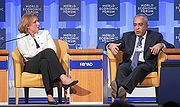
In 2007, she met with Palestinian Prime Minister
Prime Minister of the Palestinian National Authority
The Prime Minister of the Palestinian National Authority is the head of government of the Palestinian Authority government.The Prime Minister's Office was created in 2003 to manage day-to-day activities of the Palestinian government. The position was created because both Israel and the United...
, Salam Fayyad
Salam Fayyad
Salam Fayyad is a Palestinian politician and Prime Minister of the Palestinian National Authority of the Palestinian National Authority. His first appointment, on 15 June 2007, which was justified by President Mahmoud Abbas on the basis of "national emergency", has not been confirmed by the...
, to discuss "improving the lives of the Palestinian people, without compromising Israel's security."
On 2 May 2007, Livni called for Olmert's resignation in the wake of the publication of the Winograd Commission
Winograd Commission
The Winograd Commission is an Israeli government-appointed commission of inquiry, chaired by retired judge Eliyahu Winograd, which investigated and drew lessons from the Israel-Hezbollah War...
's interim report. She offered herself as leader of Kadima if Olmert decided to step down, and asserted her confidence in her ability to defeat him in a party election should he decline. However, her call was ignored by Olmert and her decision to stay in the Cabinet sparked some controversy.
As foreign minister, Livni won the admiration of European
Europe
Europe is, by convention, one of the world's seven continents. Comprising the westernmost peninsula of Eurasia, Europe is generally 'divided' from Asia to its east by the watershed divides of the Ural and Caucasus Mountains, the Ural River, the Caspian and Black Seas, and the waterways connecting...
colleagues, who cite her lawyerly logic and pragmatism.
In 2008, Livni condemned a photomontage of Pope Benedict XVI with a swastika
Swastika
The swastika is an equilateral cross with its arms bent at right angles, in either right-facing form in counter clock motion or its mirrored left-facing form in clock motion. Earliest archaeological evidence of swastika-shaped ornaments dates back to the Indus Valley Civilization of Ancient...
displayed on his chest, which was published on a website run by supporters of her Kadima party.
Kadima leadership and Prime Minister-designation
In the Kadima leadership election held on 17 September 2008, Olmert decided not to stand for re-election as party leader, and stated he would resign as Prime Minister following the election. Livni and Shaul MofazShaul Mofaz
Lt. General Shaul Mofaz is an Israeli politician who serves as the Chairman of the Foreign Affairs And Defense Committee at the Knesset...
emerged as the main rivals for the leadership.
Livni won the Kadima leadership election
Kadima leadership election, 2008
An election for the leadership of Kadima was held on 17 September 2008 as a concession to Kadima's coalition partner, Labour, which had threatened to bring down the government if Prime Minister Ehud Olmert didn't stand aside following police investigations into alleged corruption during his terms...
by a margin of just 431 votes (1%). Palestinian peace negotiators were reportedly pleased with the result.
Upon declaring victory in the leadership election, Livni said the "national responsibility (bestowed) by the public brings me to approach this job with great reverence."
On 21 September 2008, Olmert, who was facing several criminal investigations, formally resigned his office in a letter submitted to President Shimon Peres
Shimon Peres
GCMG is the ninth President of the State of Israel. Peres served twice as the eighth Prime Minister of Israel and once as Interim Prime Minister, and has been a member of 12 cabinets in a political career spanning over 66 years...
, and the following day Peres formally asked Livni to form a new government. Livni faced tough negotiations with Kadima's coalition partners, particularly the Shas party, which had set conditions for joining a Livni government. Likud, the main opposition party, lobbyied Shas and other parties seeking to bring about that result.
2009 elections

In February 2009 Israel held elections for the national parliament, the Knesset
Knesset
The Knesset is the unicameral legislature of Israel, located in Givat Ram, Jerusalem.-Role in Israeli Government :The legislative branch of the Israeli government, the Knesset passes all laws, elects the President and Prime Minister , approves the cabinet, and supervises the work of the government...
. Livni, foreign minister and head of the Kadima
Kadima
Kadima is a centrist and liberal political party in Israel. It was established on 24 November 2005 by moderates from Likud largely to support the issue of Ariel Sharon's unilateral disengagement plan, and was soon joined by like-minded Labor politicians...
party, campaigned against Benjamin Netanyahu
Benjamin Netanyahu
Benjamin "Bibi" Netanyahu is the current Prime Minister of Israel. He serves also as the Chairman of the Likud Party, as a Knesset member, as the Health Minister of Israel, as the Pensioner Affairs Minister of Israel and as the Economic Strategy Minister of Israel.Netanyahu is the first and, to...
of the Likud
Likud
Likud is the major center-right political party in Israel. It was founded in 1973 by Menachem Begin in an alliance with several right-wing and liberal parties. Likud's victory in the 1977 elections was a major turning point in the country's political history, marking the first time the left had...
party to lead the new government. While election results gave Kadima the most seats in the Knesset, parties to the right in Israel's political spectrum gained enough seats that a coalition government under Kadima leadership was unlikely. As a result, Israeli president Shimon Peres
Shimon Peres
GCMG is the ninth President of the State of Israel. Peres served twice as the eighth Prime Minister of Israel and once as Interim Prime Minister, and has been a member of 12 cabinets in a political career spanning over 66 years...
asked Netanyahu and Likud (which received one less seat than Kadima in the elections) to form a government; this is the first time in Israel's history that the party with the most seats was not asked to attempt to form a government.
Although it expressed some doubts, the influential Haaretz
Haaretz
Haaretz is Israel's oldest daily newspaper. It was founded in 1918 and is now published in both Hebrew and English in Berliner format. The English edition is published and sold together with the International Herald Tribune. Both Hebrew and English editions can be read on the Internet...
newspaper endorsed Livni for prime minister.
Opposition leader
After an internal Foreign Ministry document stated that some European UnionEuropean Union
The European Union is an economic and political union of 27 independent member states which are located primarily in Europe. The EU traces its origins from the European Coal and Steel Community and the European Economic Community , formed by six countries in 1958...
countries were considering freezing a planned upgrade in relations with Israel, Livni, as opposition leader
Leader of the Opposition (Israel)
The Leader of the Opposition , is the politician who leads the Official Opposition in the Israeli legislative body, the Knesset.-Until 2000:Until 2000, the role of the Opposition Leader was not an official position, but rather an honorary role...
, wrote in the message addressed to EU foreign policy chief Javier Solana
Javier Solana
Francisco Javier Solana de Madariaga, KOGF is a Spanish physicist and Socialist politician. After serving in the Spanish government under Felipe González and Secretary General of NATO , he was appointed the European Union's High Representative for Common Foreign and Security Policy, Secretary...
, the EU's external relations commissioner Benita Ferrero-Waldner
Benita Ferrero-Waldner
Dr. Benita Ferrero-Waldner is an Austrian diplomat and politician, and a member of the conservative Austrian People's Party . Ferrero-Waldner served as the Foreign Minister of Austria 2000–2004 and was the candidate of the Austrian People's Party in the Austrian presidential election, 2004, which...
, and the EU's current council president, Czech foreign minister Karel Schwarzenberg
Karel Schwarzenberg
Karel Schwarzenberg or Karel, Prince of Schwarzenberg , 7...
: "You all know my commitment to peace between Israel and its neighbors and to the two-state solution, a commitment shared with the majority of the Israeli public. I believe that this kind of attitude, one which directly links an upgrade in relations with regional diplomatic progress, is overlooking the substantial gains that the upgrade could provide both to the people of Israel and the people of Europe."
On May 25, 2009, Livni told Harvard University
Harvard University
Harvard University is a private Ivy League university located in Cambridge, Massachusetts, United States, established in 1636 by the Massachusetts legislature. Harvard is the oldest institution of higher learning in the United States and the first corporation chartered in the country...
students: "On the Iranian issue, there is no opposition or coalition in Israel."
Prior to Lebanon's 2009 general elections
Lebanese general election, 2009
-Background:Prior to the election, the process to lower the voting age from 21 to 18 years was put into motion, but as this requires a constitutional amendment, it did not happen before the election.- Allocation of seats :...
(and its inclusion of Hezbollah), Livni "acknowledged an important principle" from U.S. President Barack Obama
Barack Obama
Barack Hussein Obama II is the 44th and current President of the United States. He is the first African American to hold the office. Obama previously served as a United States Senator from Illinois, from January 2005 until he resigned following his victory in the 2008 presidential election.Born in...
's then-recent speech in Cairo
A New Beginning
"A New Beginning" is the name of a speech delivered by United States President Barack Obama on June 4, 2009, from the Major Reception Hall at Cairo University in Cairo, Egypt. Al-Azhar University co-hosted the event...
that “Elections alone do not make true democracy.” She explained her position in a New York Times op-ed by alluding to her experience as Israel's justice minister when Hamas
Hamas
Hamas is the Palestinian Sunni Islamic or Islamist political party that governs the Gaza Strip. Hamas also has a military wing, the Izz ad-Din al-Qassam Brigades...
participated in Palestinian elections in 2006
Palestinian legislative election, 2006
On January 25, 2006, elections were held for the Palestinian Legislative Council , the legislature of the Palestinian National Authority . Notwithstanding the 2005 municipal elections and the January 9, 2005 presidential election, this was the first election to the PLC since 1996; subsequent...
: "At the time, the counterargument was that the very participation in elections would act as a moderating force on extremist groups. With more accountability, such groups would be tempted to abandon their militant approach in favor of a purely political platform. But this analysis ignored the possibility that some radical groups sought participation in the democratic process not to forsake their violent agenda but to advance it." Livni advocated that "the international community must adopt at the global level what true democracies apply at the national one -— a universal code for participation in democratic elections. This would include requiring every party running for office to renounce violence, pursue its aims by peaceful means and commit to binding laws and international agreements." She added that "The intent here is not to stifle disagreement, exclude key actors from the political process or suggest that democracy be uniform and disregard local cultures and values."
Livni voiced support for Israel's gay community ahead of Gay and Lesbian Pride Month in June 2009. She addressed an event held at the gay community's municipal center in Tel Aviv's Meir Park. After a 1 August 2009 attack on a gay youth center that left two people dead and 15 wounded in Tel Aviv, Livni, who is in contact with the gay and lesbian community, said "This event should shake up society, and all the circles inherent in it, including the political establishment and the education system, and on this day deliver an unequivocal message against intolerance, incitement and violence, and to act against any manifestation of these." She attended a rally near the location of the attack, along with hundreds of Israelis and some other politicians, and urged Israel's gay and lesbian community to continue living their lives, despite the "hate crime."
Livni opposed Netanyahu's land reform bill.
On 8 October 2009, Livni was honored by Yale University
Yale University
Yale University is a private, Ivy League university located in New Haven, Connecticut, United States. Founded in 1701 in the Colony of Connecticut, the university is the third-oldest institution of higher education in the United States...
as a Chubb Fellow for her work and the inspiration spurred by her activities. She is the third Israeli leader to receive this honor after Shimon Peres
Shimon Peres
GCMG is the ninth President of the State of Israel. Peres served twice as the eighth Prime Minister of Israel and once as Interim Prime Minister, and has been a member of 12 cabinets in a political career spanning over 66 years...
and Moshe Dayan
Moshe Dayan
Moshe Dayan was an Israeli military leader and politician. The fourth Chief of Staff of the Israel Defense Forces , he became a fighting symbol to the world of the new State of Israel...
. The list also includes former U.S. Presidents Jimmy Carter
Jimmy Carter
James Earl "Jimmy" Carter, Jr. is an American politician who served as the 39th President of the United States and was the recipient of the 2002 Nobel Peace Prize, the only U.S. President to have received the Prize after leaving office...
and Bill Clinton
Bill Clinton
William Jefferson "Bill" Clinton is an American politician who served as the 42nd President of the United States from 1993 to 2001. Inaugurated at age 46, he was the third-youngest president. He took office at the end of the Cold War, and was the first president of the baby boomer generation...
. Livni referred to the Goldstone Report accusing Israel of committing war crimes in Gaza, and said there was a huge ethical gap between those seeking to murder children in their homes and those unintentionally harming civilians used by terrorists as human shields. Addressing the peace process, she said Israel is not involved in it as a favor to anyone, but that it is in the interest of all parties. At her next stop in Miami, Livni became the first Israeli woman to receive the International Hall of Fame Award from the International Women's Forum.
As opposition leader, Livni noted in a 2009 Knesset speech that she herself did not support Yitzhak Rabin
Yitzhak Rabin
' was an Israeli politician, statesman and general. He was the fifth Prime Minister of Israel, serving two terms in office, 1974–77 and 1992 until his assassination in 1995....
's policies at the time. "The dispute is around the question of whether you can have it both ways -– maintaining Israel as a Jewish state and keeping the entire Land of Israel," she said. Political analysts see Livni's speech at the 2003 commemoration rally for Rabin as a turning point in her political career when she became more popular among the Israeli peace camp. She delivered a speech which many found deeply moving in which she said the day Rabin was murdered was "the day that the skies fell down on me because of what happened to us, to all the citizens of Israel." As foreign minister, Livni would again attend the memorial for Rabin in 2009. Labor Party officials were not keen on this idea, fearing that her appearance would cost them votes. Some Kadima officials also seemed reluctant, fearing her appearance at left-wing event would send some votes Likud
Likud
Likud is the major center-right political party in Israel. It was founded in 1973 by Menachem Begin in an alliance with several right-wing and liberal parties. Likud's victory in the 1977 elections was a major turning point in the country's political history, marking the first time the left had...
's way. Livni attended the memorial for Rabin in 2009.
After a draft document authored by Sweden
Sweden
Sweden , officially the Kingdom of Sweden , is a Nordic country on the Scandinavian Peninsula in Northern Europe. Sweden borders with Norway and Finland and is connected to Denmark by a bridge-tunnel across the Öresund....
(the then-holder of the rotating EU presidency) surfaced that calls officially for a division of Jerusalem and implies that the EU would also recognize a unilateral Palestinian declaration of statehood, Livni wrote a letter to Swedish Foreign Minister Carl Bildt
Carl Bildt
, Honorary KCMG is a Swedish politician, diplomat and nobleman. Formerly Prime Minister of Sweden from 1991 to 1994 and leader of the liberal conservative Moderate Party from 1986 to 1999, Bildt has served as Swedish Minister for Foreign Affairs since 6 October 2006...
, saying it was "wrong and not helpful," and that she conveyed "deep concern regarding what appears to be an attempt to prejudge the outcome of issues reserved for final status negotiations." European efforts to "dictate for either party the nature of the outcome on the status of Jerusalem," she said, would only serve to endanger the fulfillment of "our shared vision of two states for two peoples into a reality." Livni also called on France to speak up against the draft during her meeting with Sarkozy in Paris.
In December 2009, Livni travelled to Paris
Paris
Paris is the capital and largest city in France, situated on the river Seine, in northern France, at the heart of the Île-de-France region...
and met with French President Nicolas Sarkozy
Nicolas Sarkozy
Nicolas Sarkozy is the 23rd and current President of the French Republic and ex officio Co-Prince of Andorra. He assumed the office on 16 May 2007 after defeating the Socialist Party candidate Ségolène Royal 10 days earlier....
. "Time is against us," she told reporters following talks at the Elysee Palace
Élysée Palace
The Élysée Palace is the official residence of the President of the French Republic, containing his office, and is where the Council of Ministers meets. It is located near the Champs-Élysées in Paris....
that also touched on Iran. "We discussed the need to re-launch the peace process between Israel and the Palestinians, and I believe that this is part of Israel's interest to relaunch the negotiations from the point at which we stopped basically a year ago."
Criticism
During the 2008–2009 Israel–Gaza conflict2008–2009 Israel–Gaza conflict
The Gaza War, known as Operation Cast Lead in Israel and as the Gaza Massacre in the Arab world, was a three-week bombing and invasion of the Gaza Strip by Israel, and hundreds of rocket attacks on south of Israel which...
, Livni was criticized by Arab League
Arab League
The Arab League , officially called the League of Arab States , is a regional organisation of Arab states in North and Northeast Africa, and Southwest Asia . It was formed in Cairo on 22 March 1945 with six members: Egypt, Iraq, Transjordan , Lebanon, Saudi Arabia, and Syria. Yemen joined as a...
Chairman Amre Moussa as, "I am greatly surprised by, and I reject, the words of the Israeli foreign minister (Livni), who asks: 'Is there a humanitarian crisis? There is no humanitarian crisis in Gaza.' " Livni was quoted as saying "Israel has been supplying comprehensive humanitarian aid to the Strip
Gaza Strip
thumb|Gaza city skylineThe Gaza Strip lies on the Eastern coast of the Mediterranean Sea. The Strip borders Egypt on the southwest and Israel on the south, east and north. It is about long, and between 6 and 12 kilometres wide, with a total area of...
... and has even been stepping this up by the day." Israel would later allow a daily three-hour truce during the offensive to enable aid to flow through a humanitarian corridor.
UK arrest warrant
In December 2009, a warrantWarrant (law)
Most often, the term warrant refers to a specific type of authorization; a writ issued by a competent officer, usually a judge or magistrate, which permits an otherwise illegal act that would violate individual rights and affords the person executing the writ protection from damages if the act is...
for Livni's arrest was understood to have been issued by a London court at the weekend, following an application by lawyers acting for some of the Palestinian victims of Operation Cast Lead, focused on Livni's role in Israel's war against Hamas-run Gaza at the turn of the year. It was withdrawn after she cancelled her visit. For several years, Palestinian activists have made largely unsuccessful attempts to prosecute Israeli officials in European courts under the universal jurisdiction system. The warrant was issued on 12 December and revoked on 14 December 2009, after it was revealed that Livni had not entered British territory. Israeli government experts on international law have advised cabinet ministers with a security background and senior IDF officers not to visit Britain, Spain
Spain
Spain , officially the Kingdom of Spain languages]] under the European Charter for Regional or Minority Languages. In each of these, Spain's official name is as follows:;;;;;;), is a country and member state of the European Union located in southwestern Europe on the Iberian Peninsula...
, Belgium
Belgium
Belgium , officially the Kingdom of Belgium, is a federal state in Western Europe. It is a founding member of the European Union and hosts the EU's headquarters, and those of several other major international organisations such as NATO.Belgium is also a member of, or affiliated to, many...
or Norway
Norway
Norway , officially the Kingdom of Norway, is a Nordic unitary constitutional monarchy whose territory comprises the western portion of the Scandinavian Peninsula, Jan Mayen, and the Arctic archipelago of Svalbard and Bouvet Island. Norway has a total area of and a population of about 4.9 million...
, because in these countries they risk being arrested on charges of alleged war crimes through “universal jurisdiction
Universal jurisdiction
Universal jurisdiction or universality principle is a principle in public international law whereby states claim criminal jurisdiction over persons whose alleged crimes were committed outside the boundaries of the prosecuting state, regardless of nationality, country of residence, or any other...
” laws. The warrant was later denounced as "cynical" by the Israeli foreign ministry.
British Foreign Secretary David Miliband
David Miliband
David Wright Miliband is a British Labour Party politician who has been the Member of Parliament for South Shields since 2001, and was the Secretary of State for Foreign and Commonwealth Affairs from 2007 to 2010. He is the elder son of the late Marxist theorist Ralph Miliband...
contacted Livni and his Israeli counterpart Avigdor Lieberman to formally explain the incident on behalf of the British government. Secretary Miliband had expressed concern at the situation and said officials were looking "urgently at ways in which the UK system might be changed in order to avoid this sort of situation arising again". Judges in the United Kingdom can issue arrest warrants for war crimes suspects around the world under the Geneva Convention Act 1957, without any requirement to consult public prosecutors -— something Miliband said was "unusual". Foreign Office minister Ivan Lewis
Ivan Lewis
Ivan Lewis is a British Labour Party politician who has been the Member of Parliament for Bury South since 1997. Lewis served in a variety of junior ministerial positions, including as Minister of State at the Foreign and Commonwealth Office.-Personal life:Lewis was born to a British Jewish...
, also Jewish and former Vice-Chair of Labour Friends of Israel, said Wednesday that Britain was "absolutely determined to make sure that this can never happen again". "Because Israel is a strategic partner and close friend of the UK, it is absolutely essential representatives of the state of Israel can visit Britain freely to talk about the Middle East peace process," he told the BBC. J Street
J Street
J Street is a nonprofit liberal advocacy group based in the United States whose stated aim is to promote American leadership to end the Arab-Israeli and Israel-Palestinian conflicts peacefully and diplomatically. It was founded in April 2008....
applauded Milibrand's rejection of the warrant and "his promise to pursue a change in the law that would prevent unfortunate events like these from happening in the future."
Prime Minister Gordon Brown
Gordon Brown
James Gordon Brown is a British Labour Party politician who was the Prime Minister of the United Kingdom and Leader of the Labour Party from 2007 until 2010. He previously served as Chancellor of the Exchequer in the Labour Government from 1997 to 2007...
expressed his regret over the warrant and broke off from climate talks in Copenhagen
Copenhagen
Copenhagen is the capital and largest city of Denmark, with an urban population of 1,199,224 and a metropolitan population of 1,930,260 . With the completion of the transnational Øresund Bridge in 2000, Copenhagen has become the centre of the increasingly integrating Øresund Region...
to call Livni and reassure her that she was "most welcome in Britain any time." According to a statement released by Livni's office, Brown also promised to seek legislative changes to ensure no Israeli official would risk arrest while on British soil. Livni replied by saying: "The situation must be repaired immediately."
Yehuda Blum
Yehuda Blum
Yehuda Zvi Blum is an Israeli professor of law and diplomat. In 1978-1984, Blum served as Israel Ambassador to the United Nations.-Biography:...
, Israel's former ambassador to the United Nations and a professor of law at Hebrew University of Jerusalem
Hebrew University of Jerusalem
The Hebrew University of Jerusalem ; ; abbreviated HUJI) is Israel's second-oldest university, after the Technion – Israel Institute of Technology. The Hebrew University has three campuses in Jerusalem and one in Rehovot. The world's largest Jewish studies library is located on its Edmond J...
commented: "The abuse and misuse of this concept of universal jurisdiction should be discontinued." Blum said the law was intended for use in cases with no clear jurisdiction, such as piracy in international waters, and should not be expanded for political aims. Israeli officials, acting under orders from Prime Minister Benjamin Netanyahu, told the British ambassador they expect quick action to change the law. In London, chagrined British officials said they were seeking solutions.
Livni called the arrest warrant "an abuse of the British legal system". At a security conference in Israel, Livni did not directly address the arrest warrant but defended Israel's conduct during Operation Cast Lead, saying she "would make the same decisions all over again". "When the state of Israel has to do the right thing, it has to be done –- condemnation or no condemnation, statements or no statements, arrest warrants or no arrest warrants." "This is the role of leadership, and as far as I’m concerned I would repeat each and every decision."