

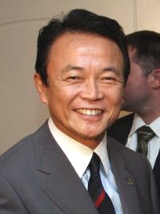
Prime Minister of Japan

Encyclopedia
The is the head of government
of Japan. He is appointed by the Emperor of Japan
after being designated by the Diet
from among its members, and must enjoy the confidence of the House of Representatives
to remain in office. He is the head of the Cabinet
and appoints and dismisses the Ministers of State
; the literal translation of the Japanese name for the office is Minister for the General Administration of the Cabinet.
The office was created in 1885, four years before the enactment of the Meiji Constitution
. It took its current form with the adoption of the current constitution
in 1947.
The current Prime Minister is Yoshihiko Noda
, who took the post on 2 September 2011.
, before the conduct of any other business. For that purpose, each conducts a ballot under the run-off
system. If the two houses choose different individuals, then a joint committee of both houses is appointed to agree on a common candidate. Ultimately, however, if the two houses do not agree within ten days, the decision of the House of Representatives is deemed to be that of the Diet. Therefore, the House of Representatives can theoretically ensure the appointment of any Prime Minister it wishes. The candidate is then formally appointed to office by the Emperor
.
The Prime Minister must resign if the House of Representatives adopts a motion of no confidence or defeats a vote of confidence, unless the House of Representatives is dissolved within ten days.
, the Daijō-kan system, which was used in the Nara period
, was adopted as the Japanese government entity. Political powers of their leader, Daijō Daijin and his aides, Sadaijin
and Nadaijin were ambiguous and frequently conflicted with other positions such as Sangi. In the 1880s, Itō Hirobumi
, then one of Sangi, started to examine the reformation of the governmental organization. In 1882, Ito and his staff, Itō Miyoji
and Saionji Kinmochi
, traveled to Europe and investigated constitutions in constitutional monarchies
, the British Empire
and the German Empire
. After his return to Japan, Ito urged the need of a Constitution and a modern governmental system and persuaded conservatives to approve his plan.
On December 22, 1885, in the Daijō-kan order No. 69, abolition of Daijō-kan and the induction of the Prime Minister (内閣総理大臣) and his cabinet were published.
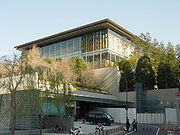 The Office of the Prime Minister of Japan is called the Kantei
(官邸). The original Kantei served from 1929 until 2002, until a new building was inaugurated which now serves as the new Kantei. The old Kantei was then converted to the new official residence, or Kōtei (公邸).
(1998–2000), on 14 May 2000. The most recent prime minister to die was Kiichi Miyazawa
(1991–1993), on 28 June 2007.
Head of government
Head of government is the chief officer of the executive branch of a government, often presiding over a cabinet. In a parliamentary system, the head of government is often styled prime minister, chief minister, premier, etc...
of Japan. He is appointed by the Emperor of Japan
Emperor of Japan
The Emperor of Japan is, according to the 1947 Constitution of Japan, "the symbol of the state and of the unity of the people." He is a ceremonial figurehead under a form of constitutional monarchy and is head of the Japanese Imperial Family with functions as head of state. He is also the highest...
after being designated by the Diet
Diet of Japan
The is Japan's bicameral legislature. It is composed of a lower house, called the House of Representatives, and an upper house, called the House of Councillors. Both houses of the Diet are directly elected under a parallel voting system. In addition to passing laws, the Diet is formally...
from among its members, and must enjoy the confidence of the House of Representatives
House of Representatives of Japan
The is the lower house of the Diet of Japan. The House of Councillors of Japan is the upper house.The House of Representatives has 480 members, elected for a four-year term. Of these, 180 members are elected from 11 multi-member constituencies by a party-list system of proportional representation,...
to remain in office. He is the head of the Cabinet
Cabinet of Japan
The of Japan is the executive branch of the government of Japan. It consists of the Prime Minister and up to fourteen other members, called Ministers of State. The Prime Minister is designated by the Diet, and the remaining ministers are appointed and dismissed by the Prime Minister...
and appoints and dismisses the Ministers of State
Ministries of Japan
The most influential part of the executive of the Japanese government are the ministries. In postwar politics, the posts of ministers have been given to senior legislators, mostly of the LDP. However, few ministers have been serving their terms for more than one or two years, and developed the...
; the literal translation of the Japanese name for the office is Minister for the General Administration of the Cabinet.
The office was created in 1885, four years before the enactment of the Meiji Constitution
Meiji Constitution
The ', known informally as the ', was the organic law of the Japanese empire, in force from November 29, 1890 until May 2, 1947.-Outline:...
. It took its current form with the adoption of the current constitution
Constitution of Japan
The is the fundamental law of Japan. It was enacted on 3 May, 1947 as a new constitution for postwar Japan.-Outline:The constitution provides for a parliamentary system of government and guarantees certain fundamental rights...
in 1947.
The current Prime Minister is Yoshihiko Noda
Yoshihiko Noda
is the current Prime Minister of Japan, a member of the Democratic Party of Japan , and a member of the House of Representatives in the Diet...
, who took the post on 2 September 2011.
Appointment
The Prime Minister is designated by both houses of the DietDiet of Japan
The is Japan's bicameral legislature. It is composed of a lower house, called the House of Representatives, and an upper house, called the House of Councillors. Both houses of the Diet are directly elected under a parallel voting system. In addition to passing laws, the Diet is formally...
, before the conduct of any other business. For that purpose, each conducts a ballot under the run-off
Two-round system
The two-round system is a voting system used to elect a single winner where the voter casts a single vote for their chosen candidate...
system. If the two houses choose different individuals, then a joint committee of both houses is appointed to agree on a common candidate. Ultimately, however, if the two houses do not agree within ten days, the decision of the House of Representatives is deemed to be that of the Diet. Therefore, the House of Representatives can theoretically ensure the appointment of any Prime Minister it wishes. The candidate is then formally appointed to office by the Emperor
Emperor of Japan
The Emperor of Japan is, according to the 1947 Constitution of Japan, "the symbol of the state and of the unity of the people." He is a ceremonial figurehead under a form of constitutional monarchy and is head of the Japanese Imperial Family with functions as head of state. He is also the highest...
.
The Prime Minister must resign if the House of Representatives adopts a motion of no confidence or defeats a vote of confidence, unless the House of Representatives is dissolved within ten days.
Qualifications
- Must be a member of either house of the Diet. (This implies a minimum age of 25 and a Japanese nationality requirement.)
- Must be a "civilian". This excludes members of the Japan Self-Defense ForcesJapan Self-Defense ForcesThe , or JSDF, occasionally referred to as JSF or SDF, are the unified military forces of Japan that were established after the end of the post–World War II Allied occupation of Japan. For most of the post-war period the JSDF was confined to the islands of Japan and not permitted to be deployed...
, as well as any former member of the Imperial Japanese ArmyImperial Japanese Army-Foundation:During the Meiji Restoration, the military forces loyal to the Emperor were samurai drawn primarily from the loyalist feudal domains of Satsuma and Chōshū...
and Imperial Japanese NavyImperial Japanese NavyThe Imperial Japanese Navy was the navy of the Empire of Japan from 1869 until 1947, when it was dissolved following Japan's constitutional renunciation of the use of force as a means of settling international disputes...
who is strongly connected to militaristJapanese militarismrefers to the ideology in the Empire of Japan that militarism should dominate the political and social life of the nation, and that the strength of the military is equal to the strength of a nation.-Rise of militarism :...
thought. Note that former military officers from the World War IIWorld War IIWorld War II, or the Second World War , was a global conflict lasting from 1939 to 1945, involving most of the world's nations—including all of the great powers—eventually forming two opposing military alliances: the Allies and the Axis...
era may be appointed prime minister despite the "civilian" requirement, Yasuhiro NakasoneYasuhiro Nakasoneis a Japanese politician who served as Prime Minister of Japan from November 27, 1982 to November 6, 1987. A contemporary of Brian Mulroney, Ronald Reagan, Helmut Kohl, François Mitterrand, Margaret Thatcher, and Mikhail Gorbachev, he is best known for pushing through the privatization of...
being one prominent example.
Constitutional roles
- Exercises "control and supervision" over the entire executive branch.
- Presents bills to the Diet on behalf of the Cabinet.
- Signs laws and Cabinet orders (along with other members of the Cabinet).
- Appoints all Cabinet ministers, and can dismiss them at any time.
- May permit legal action to be taken against Cabinet ministers.
- Must make reports on domestic and foreign relations to the Diet.
- Must report to the Diet upon demand to provide answers or explanations.
Statutory roles
- Presides over meetings of the Cabinet.
- Commander in chief of the Japan Self-Defense ForcesJapan Self-Defense ForcesThe , or JSDF, occasionally referred to as JSF or SDF, are the unified military forces of Japan that were established after the end of the post–World War II Allied occupation of Japan. For most of the post-war period the JSDF was confined to the islands of Japan and not permitted to be deployed...
. - May override a court injunction against an administrative act upon showing of cause.
History
After the Meiji RestorationMeiji Restoration
The , also known as the Meiji Ishin, Revolution, Reform or Renewal, was a chain of events that restored imperial rule to Japan in 1868...
, the Daijō-kan system, which was used in the Nara period
Nara period
The of the history of Japan covers the years from AD 710 to 794. Empress Gemmei established the capital of Heijō-kyō . Except for 5 years , when the capital was briefly moved again, it remained the capital of Japanese civilization until Emperor Kammu established a new capital, Nagaoka-kyō, in 784...
, was adopted as the Japanese government entity. Political powers of their leader, Daijō Daijin and his aides, Sadaijin
Sadaijin
, most commonly translated as "Minister of the Left", was a government position in Japan in the late Nara and Heian periods. The position was consolidated in the Taihō Code of 702. The Asuka Kiyomihara Code of 689 marks the initial appearance of the Sadaijin in the context of a central...
and Nadaijin were ambiguous and frequently conflicted with other positions such as Sangi. In the 1880s, Itō Hirobumi
Ito Hirobumi
Prince was a samurai of Chōshū domain, Japanese statesman, four time Prime Minister of Japan , genrō and Resident-General of Korea. Itō was assassinated by An Jung-geun, a Korean nationalist who was against the annexation of Korea by the Japanese Empire...
, then one of Sangi, started to examine the reformation of the governmental organization. In 1882, Ito and his staff, Itō Miyoji
Ito Miyoji
Count was a statesman in Meiji period Japan.-Biography:Itō was born into a local samurai administrator's family in Nagasaki, Hizen Province . From his early days, he showed a mastery of foreign languages...
and Saionji Kinmochi
Saionji Kinmochi
Prince was a Japanese politician, statesman and twice Prime Minister of Japan. His title does not signify the son of an emperor, but the highest rank of Japanese hereditary nobility; he was elevated from marquis to prince in 1920...
, traveled to Europe and investigated constitutions in constitutional monarchies
Constitutional monarchy
Constitutional monarchy is a form of government in which a monarch acts as head of state within the parameters of a constitution, whether it be a written, uncodified or blended constitution...
, the British Empire
British Empire
The British Empire comprised the dominions, colonies, protectorates, mandates and other territories ruled or administered by the United Kingdom. It originated with the overseas colonies and trading posts established by England in the late 16th and early 17th centuries. At its height, it was the...
and the German Empire
German Empire
The German Empire refers to Germany during the "Second Reich" period from the unification of Germany and proclamation of Wilhelm I as German Emperor on 18 January 1871, to 1918, when it became a federal republic after defeat in World War I and the abdication of the Emperor, Wilhelm II.The German...
. After his return to Japan, Ito urged the need of a Constitution and a modern governmental system and persuaded conservatives to approve his plan.
On December 22, 1885, in the Daijō-kan order No. 69, abolition of Daijō-kan and the induction of the Prime Minister (内閣総理大臣) and his cabinet were published.
Official office and residence
Kantei
The is the principal workplace of the Prime Minister of Japan.- About :Located at 2-3-1 Nagata-chō, Chiyoda-ku, Tokyo 100-8968, it is diagonally adjacent to the National Diet Building. The new residence went into service in April 2002 and replaced the former residence, built in 1929. The former...
(官邸). The original Kantei served from 1929 until 2002, until a new building was inaugurated which now serves as the new Kantei. The old Kantei was then converted to the new official residence, or Kōtei (公邸).
Living former Prime Ministers
There are twelve living former prime ministers of Japan. The most recently serving prime minister to die was Keizō ObuchiKeizo Obuchi
was a Japanese politician who served in the House of Representatives for twelve terms, and ultimately as the 84th Prime Minister of Japan from July 30, 1998 to April 5, 2000. His political career ended when he suffered a serious and ultimately fatal stroke....
(1998–2000), on 14 May 2000. The most recent prime minister to die was Kiichi Miyazawa
Kiichi Miyazawa
was a Japanese politician and the 78th Prime Minister from November 5, 1991 to August 9, 1993.-Early life and career:Miyazawa was born in Fukuyama, Hiroshima Prefecture, and graduated from Tokyo Imperial University with a degree in law. In 1942 he joined the Ministry of Finance...
(1991–1993), on 28 June 2007.
| Name | Term of office | Date of birth |
|---|---|---|
| Yasuhiro Nakasone Yasuhiro Nakasone is a Japanese politician who served as Prime Minister of Japan from November 27, 1982 to November 6, 1987. A contemporary of Brian Mulroney, Ronald Reagan, Helmut Kohl, François Mitterrand, Margaret Thatcher, and Mikhail Gorbachev, he is best known for pushing through the privatization of... |
1982–1987 | 27 May 1918 (age 93) |
| Toshiki Kaifu Toshiki Kaifu is a Japanese politician who was the 76th and 77th Prime Minister of Japan from 1989 to 1991.- Career :He was born in Nagoya City, Aichi Prefecture, and was educated at Chuo University and Waseda University. A member of the Liberal Democratic Party , Kaifu ran successfully for the Diet in 1960 and... |
1989–1991 | 2 January 1931 (age 81) |
| Morihiro Hosokawa Morihiro Hosokawa is a Japanese politician who was the 79th Prime Minister of Japan from August 9, 1993 to April 28, 1994. His coalition was the first non-Liberal Democratic Party government since 1955.- Early life :... |
1993–1994 | 14 January 1938 (age 74) |
| Tsutomu Hata Tsutomu Hata is a Japanese politician and was the 80th Prime Minister of Japan for 9 weeks in 1994.He was born in Tokyo, a son of the Liberal Democratic Party Member of Parliament Bushiro Hata. Hata graduated from Seijo University and was employed by the Odakyu bus company from 1958 to 1969... |
1994 | 24 August 1935 (age 76) |
| Tomiichi Murayama Tomiichi Murayama is a retired Japanese politician who served as the 81st Prime Minister of Japan from June 30, 1994 to January 11, 1996. He was the head of the Social Democratic Party of Japan and the first Socialist prime minister in nearly fifty years... |
1994–1996 | 3 March 1924 (age 87) |
| Yoshirō Mori Yoshiro Mori is a Japanese politician who served as the 85th and 86th Prime Minister of Japan starting at 5 April 2000 ending 26 April 2001. Described as having "the heart of a flea and the brain of a shark," he was an unpopular prime minister mainly remembered today for his many gaffes and situationally... |
2000–2001 | 14 July 1937 (age 74) |
| Junichiro Koizumi Junichiro Koizumi is a Japanese politician who served as Prime Minister of Japan from 2001 to 2006. He retired from politics when his term in parliament ended.Widely seen as a maverick leader of the Liberal Democratic Party , he became known as an economic reformer, focusing on Japan's government debt and the... |
2001–2006 | 8 January 1942 (age 70) |
| Shinzō Abe Shinzo Abe was the 90th Prime Minister of Japan, elected by a special session of the National Diet on 26 September 2006. He was Japan's youngest post–World War II prime minister and the first born after the war. Abe served as prime minister for nearly twelve months, before resigning on 12 September 2007... |
2006–2007 | 21 September 1954 (age 57) |
| Yasuo Fukuda Yasuo Fukuda was the 91st Prime Minister of Japan, serving from 2007 to 2008. He was previously the longest-serving Chief Cabinet Secretary in Japanese history, serving for three and a half years under Prime Ministers Yoshirō Mori and Junichiro Koizumi.... |
2007–2008 | 16 July 1936 (age 75) |
| Taro Aso Taro Aso was the 92nd Prime Minister of Japan serving from September 2008 to September 2009, and was defeated in the August 2009 election.He has served in the House of Representatives since 1979. He was Minister for Foreign Affairs from 2005 to 2007, and was Secretary-General of the LDP briefly in 2007 and... |
2008–2009 | 20 September 1940 (age 71) |
| Yukio Hatoyama Yukio Hatoyama is a Japanese politician who served as Prime Minister of Japan between 16 September 2009 and 2 June 2010, and was the first ever Prime Minister from the modern Democratic Party of Japan.... |
2009–2010 | 11 February 1947 (age 64) |
| Naoto Kan Naoto Kan is a Japanese politician, and former Prime Minister of Japan. In June 2010, then-Finance Minister Kan was elected as the leader of the Democratic Party of Japan and designated Prime Minister by the Diet to succeed Yukio Hatoyama. On 26 August 2011, Kan announced his resignation... |
2010–2011 | 10 October 1946 (age 65) |