


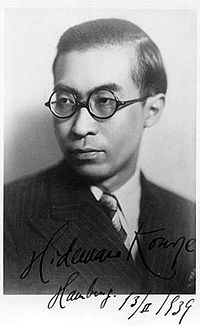
Hidemaro Konoye

Encyclopedia
Conducting
Conducting is the art of directing a musical performance by way of visible gestures. The primary duties of the conductor are to unify performers, set the tempo, execute clear preparations and beats, and to listen critically and shape the sound of the ensemble...
and composer
Composer
A composer is a person who creates music, either by musical notation or oral tradition, for interpretation and performance, or through direct manipulation of sonic material through electronic media...
of classical music
Classical music
Classical music is the art music produced in, or rooted in, the traditions of Western liturgical and secular music, encompassing a broad period from roughly the 11th century to present times...
in Shōwa period
Showa period
The , or Shōwa era, is the period of Japanese history corresponding to the reign of the Shōwa Emperor, Hirohito, from December 25, 1926 through January 7, 1989.The Shōwa period was longer than the reign of any previous Japanese emperor...
Japan
Japan
Japan is an island nation in East Asia. Located in the Pacific Ocean, it lies to the east of the Sea of Japan, China, North Korea, South Korea and Russia, stretching from the Sea of Okhotsk in the north to the East China Sea and Taiwan in the south...
. He was the brother of pre-war Japanese Prime Minister
Prime Minister of Japan
The is the head of government of Japan. He is appointed by the Emperor of Japan after being designated by the Diet from among its members, and must enjoy the confidence of the House of Representatives to remain in office...
Fumimaro Konoe
Fumimaro Konoe
Prince was a politician in the Empire of Japan who served as the 34th, 38th and 39th Prime Minister of Japan and founder/leader of the Taisei Yokusankai.- Early life :...
.
Biography
Konoye was born in KōjimachiKojimachi
is a neighborhood in Chiyoda, Tokyo.Prior to the arrival of Tokugawa Ieyasu, it was known as . The area developed as townspeople settled along the Kōshū Kaidō. In 1878 Kōjimachi became a ward in the city of Tokyo. It was the forerunner of Chiyoda which is now a special ward.The Kōjimachi ward was...
, Tokyo
Tokyo
, ; officially , is one of the 47 prefectures of Japan. Tokyo is the capital of Japan, the center of the Greater Tokyo Area, and the largest metropolitan area of Japan. It is the seat of the Japanese government and the Imperial Palace, and the home of the Japanese Imperial Family...
as the younger son of Prince Konoe Atsumaro
Konoe Atsumaro
Prince was a Japanese politician and journalist of the Meiji era. He served as the 3rd President of the House of Peers and 7th President of the Gakushūin Peer's School in Meiji period Japan...
, scion of one of the Five regent houses
Five regent houses
The Five regent houses is a collective term for those five families of Fujiwara clan, who were regarded entitled to the position of Sekkan in the Imperial Court of Kyoto, Japan, and monopolized the position between 12th and 19th century...
of the Fujiwara clan. The Konoe clan traditionally provided gagaku
Gagaku
Gagaku is a type of Japanese classical music that has been performed at the Imperial Court in Kyoto for several centuries. It consists of three primary repertoires:#Native Shinto religious music and folk songs and dance, called kuniburi no utamai...
musicians to the Imperial Household, and Hidemaro chose to follow the family’s musical tradition, whereas his older brother Fumimaro went into politics.
Konoye attended the Gakushuin
Gakushuin
The or Peers School is an educational institution founded in Tokyo in 1877, during the Meiji period, for the education of the children of the Japanese aristocracy, though it eventually also opened its doors to the offspring of extremely wealthy commoners...
Peers School, where he became a close friend of Takashi Inukai
Takashi Inukai
Takashi Inukai was a professor at Osaka University and Kōnan Women's University, and a noted scholar of Japanese literature and especially the Man'yōshū poetry. He earned his bachelor's degree in Japanese literature from the University of Tokyo in 1932, as well as its Ph.D. in 1962...
. In 1913, he entered the Tokyo University of the Arts, where he specialized in the violin
Violin
The violin is a string instrument, usually with four strings tuned in perfect fifths. It is the smallest, highest-pitched member of the violin family of string instruments, which includes the viola and cello....
. In 1915, he went to study briefly in Germany
Germany
Germany , officially the Federal Republic of Germany , is a federal parliamentary republic in Europe. The country consists of 16 states while the capital and largest city is Berlin. Germany covers an area of 357,021 km2 and has a largely temperate seasonal climate...
to study musical composition
Musical composition
Musical composition can refer to an original piece of music, the structure of a musical piece, or the process of creating a new piece of music. People who practice composition are called composers.- Musical compositions :...
, and became a pupil of Kosaku Yamada
Kosaku Yamada
was a Japanese composer and conductor.In many Western reference books his name is given as Kósçak Yamada. During his music study in the Imperial German capital of Berlin from 1910-13 he hated the times when people laughed at him because his "normal" transliteration of his first name "Kosaku"...
on his return to Japan. His debut as a conductor was in 1920, with an amateur orchestra
Orchestra
An orchestra is a sizable instrumental ensemble that contains sections of string, brass, woodwind, and percussion instruments. The term orchestra derives from the Greek ορχήστρα, the name for the area in front of an ancient Greek stage reserved for the Greek chorus...
led by Toukichi Setoguchi. Konoye returned to Europe for further studies in 1923 in Paris
Paris
Paris is the capital and largest city in France, situated on the river Seine, in northern France, at the heart of the Île-de-France region...
under Vincent d'Indy
Vincent d'Indy
Vincent d'Indy was a French composer and teacher.-Life:Paul Marie Théodore Vincent d'Indy was born in Paris into an aristocratic family of royalist and Catholic persuasion. He had piano lessons from an early age from his paternal grandmother, who passed him on to Antoine François Marmontel and...
and Berlin
Berlin
Berlin is the capital city of Germany and is one of the 16 states of Germany. With a population of 3.45 million people, Berlin is Germany's largest city. It is the second most populous city proper and the seventh most populous urban area in the European Union...
under Franz Schreker
Franz Schreker
Franz Schreker was an Austrian composer, conductor, teacher and administrator. Primarily a composer of operas, his style is characterized by aesthetic plurality , timbral experimentation, strategies of extended tonality and...
.
He also studied conducting under Erich Kleiber
Erich Kleiber
Erich Kleiber was an Austrian conductor.- Biography :Born in Vienna, Kleiber studied in Prague...
, and Karl Muck
Karl Muck
Karl Muck was a German-born conductor of classical music. He based his activities principally in Europe and mostly in opera. His American career comprised two stints at the Boston Symphony Orchestra. He endured a public outcry in 1917 that questioned whether his loyalties lay with Germany or the...
. In 1924, he conducted at the Berlin Philharmonic, and returned to Japan in the fall of the same year.
Konoye co-founded the Japan Symphonic Association in 1925, and the following year became conductor of the orchestra. Konoe later founded the New Symphony Orchestra of Tokyo (the present day NHK Symphony Orchestra
NHK Symphony Orchestra
The in Tokyo, Japan began as the New Symphony Orchestra on October 5, 1926 and was the country's first professional symphony orchestra. Later, it changed its name to Japan Symphony Orchestra and in 1951, after receiving financial support from NHK, it took its current name...
), and helped mold the orchestra over a 10 year period into an ensemble that was praised as competitive with many of the better orchestras in Europe.
Today he is remembered for making the premiere recording of Mahler
Gustav Mahler
Gustav Mahler was a late-Romantic Austrian composer and one of the leading conductors of his generation. He was born in the village of Kalischt, Bohemia, in what was then Austria-Hungary, now Kaliště in the Czech Republic...
's Fourth Symphony
Symphony No. 4 (Mahler)
The Symphony No. 4 by Gustav Mahler was written between 1899 and 1901, though it incorporates a song originally written in 1892. The song, "Das himmlische Leben", presents a child's vision of Heaven. It is sung by a soprano in the work's fourth and last movement...
, done in May 1930. It was also the first electrical recording of any complete Mahler symphony.
Additionally, Konoye made numerous guest appearances in Europe and America, conducting some 90 different orchestras in the course of his career including the orchestra of La Scala
La Scala
La Scala , is a world renowned opera house in Milan, Italy. The theatre was inaugurated on 3 August 1778 and was originally known as the New Royal-Ducal Theatre at La Scala...
, Milan
Milan
Milan is the second-largest city in Italy and the capital city of the region of Lombardy and of the province of Milan. The city proper has a population of about 1.3 million, while its urban area, roughly coinciding with its administrative province and the bordering Province of Monza and Brianza ,...
and the NBC Symphony Orchestra
NBC Symphony Orchestra
The NBC Symphony Orchestra was a radio orchestra established by David Sarnoff of the National Broadcasting Company especially for conductor Arturo Toscanini...
. He created friendships with Erich Kleiber, Leopold Stokowski
Leopold Stokowski
Leopold Anthony Stokowski was a British-born, naturalised American orchestral conductor, well known for his free-hand performing style that spurned the traditional baton and for obtaining a characteristically sumptuous sound from many of the great orchestras he conducted.In America, Stokowski...
, Wilhelm Furtwängler
Wilhelm Furtwängler
Wilhelm Furtwängler was a German conductor and composer. He is widely considered to have been one of the greatest symphonic and operatic conductors of the 20th century. By the 1930s he had built a reputation as one of the leading conductors in Europe, and he was the leading conductor who remained...
and Richard Strauss
Richard Strauss
Richard Georg Strauss was a leading German composer of the late Romantic and early modern eras. He is known for his operas, which include Der Rosenkavalier and Salome; his Lieder, especially his Four Last Songs; and his tone poems and orchestral works, such as Death and Transfiguration, Till...
. He went to Germany and conducted Berlin Philharmonic Orchestra
Berlin Philharmonic Orchestra
The Berlin Philharmonic, German: , formerly Berliner Philharmonisches Orchester , is an orchestra based in Berlin, Germany. In 2006, a group of ten European media outlets voted the Berlin Philharmonic number three on a list of "top ten European Orchestras", after the Vienna Philharmonic and the...
in second half of 1930s. In the early days of the NBC Symphony, he planned an American tour under the supervision of Stokowski, but the project was cancelled due to World War II
World War II
World War II, or the Second World War , was a global conflict lasting from 1939 to 1945, involving most of the world's nations—including all of the great powers—eventually forming two opposing military alliances: the Allies and the Axis...
.
Konoye wrote original compositions, but was more deeply interested in arranging existing music, including, for example, Modest Mussorgsky
Modest Mussorgsky
Modest Petrovich Mussorgsky was a Russian composer, one of the group known as 'The Five'. He was an innovator of Russian music in the romantic period...
's Pictures at an Exhibition and Schubert's C major Quintet, which he orchestrated.
Konoe died in 1972.
Major works
- Kronungs-Kantate for soprano, mezzo soprano, bariton, chorus and orchestra (1928)
- EtenrakuEtenrakuis a Japanese gagaku melody and dance. It is usually played with a hichiriki or ryūteki, and is accompanied by other traditional instruments such as the shō, koto and kakko.- History :The origin of Etenraku is not fully known...
for orchestra (1931; Transcription from gagaku) - Chin Chin Chidori for voice and piano
Notable recordings
- Mahler, Fourth Symphony, Sakaye Kitasaya (soprano), New Symphony Orchestra of TokyoNHK Symphony OrchestraThe in Tokyo, Japan began as the New Symphony Orchestra on October 5, 1926 and was the country's first professional symphony orchestra. Later, it changed its name to Japan Symphony Orchestra and in 1951, after receiving financial support from NHK, it took its current name...
, Japanese Parlophone, May 1930