

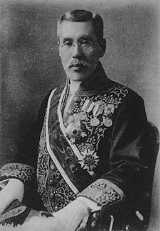
Kiichiro Hiranuma

Encyclopedia
Baron
was a prominent pre–World War II right-wing Japan
ese politician
and the 35th Prime Minister of Japan
from 5 January 1939 to 30 August 1939. The modern Japanese politician, Takeo Hiranuma
, is his adopted son.
city Okayama Prefecture
, as the son of a low-ranking samurai
from the Tsuyama Domain
of Mimasaka Province
. He graduated with a degree in English law
from Tokyo Imperial University in 1888. After graduation, he obtained a posting in the Ministry of Justice
.
, public prosecutor of the Supreme Court
, and Director of the Civil and Criminal Affairs Bureau. In 1909, he secured the conviction of 25 former and serving members of the Diet of Japan
for accepting bribes from the Japan Sugar Company. He rose to become Vice Minister of Justice
in 1911, and Public Prosecutor-general in 1912.
In 1915, he forced Home Minister
Oura Kanetake in the cabinet of Prime Minister
Ōkuma Shigenobu
to resign due to suspected bribery.
Hiranuma was highly outspoken against the corruption and immorality in Japan's political parties
, and this attitude soon expanded to include what he perceived to be threatening foreign influences, such as socialism
and liberal democracy
.
With Sadao Araki
, Hiranuma created the Kokuhonsha
group, as well as participating in other nationalist groups.
In 1921, Hiranuma became chief of the Supreme Court of Japan.
Hiranuma became Minister of Justice
under the second Yamamoto administration
from September 1923 to January 1924. While Minister, he promoted the creation of the Thought Police
to combat communism
, socialism, and the spread of what he considered subversive ideologies. In 1924, he became chairman of the House of Peers and was also appointed to the Privy Council
. In 1926, he was elevated to the title of danshaku (baron
) under the kazoku
peerage system.
's efforts at economic reform. He was also strongly opposed to the ratification of the London Naval Treaty
of 1930. In 1931, he rallied support within the government for the Imperial Japanese Army
after the army seized control of Manchuria
without prior authorization, and later helped in the creation of Manchukuo
. He also pushed for Japan's withdrawal from the League of Nations
. In 1934, he directed the prosecution during the Teijin Incident
, bringing down the administration of Prime Minister Saitō Makoto
. In 1936, Hiranuma was appointed President of the Privy Council.
 Hiranuma was appointed Prime Minister of Japan
from 5 January 1939 to 30 August 1939. As Prime Minister, his administration was dominated by the debate on whether or not Japan should ally itself with Nazi Germany
in order to neutralize the threat posed to Japan by the Soviet Union
. Hiranuma wanted an anti-communist pact, but feared that a military alliance would commit Japan to war against the United States
and Great Britain
at a time when the bulk of its armed forces were committed to the Second Sino-Japanese War
. With the signing of the German-Soviet Non-Aggression Pact in August 1939, Hiranuma's cabinet resigned over this foreign policy issue and over the massive defeat of the Japanese Army in Mongolia
during the Nomonhan Incident against the Soviet Union.
in the second Konoe Fumimaro administration from 21 December 1940 to 18 July 1941.
As Home Minister, he was a staunch defender of State Shintoism". Hiranuma declared: "We should research the ancient rites in detail and consider their application in administrative affairs in general and the common life of the nation".
However, Hiranuma was strongly opposed to the political and diplomatic actions of Foreign Minister
Yosuke Matsuoka
, and the Tripartite Pact
between Japan, Nazi Germany and Fascist Italy
in 1940.
He withdrew from the government on the resignation of Prime Minister Konoe in October 1941.
. Hiranuma saw the jushin as the core of a new group of genro
advisors, as the last surviving Meiji period
genrō Prince Kimmochi Saionji, died in November 1940. The new group included former Prime Ministers Mitsumasa Yonai
, Nobuyuki Abe, and Konoe Fumimaro, all of whom supported Japan's aggressive foreign policy and the right-socialist ideals of Kingoro Hashimoto
on creation of a Military Shogunate that would manage the Imperial affairs directly.
In April 1945, Hiranuma was again appointed President of the Privy Council. After the war, he was arrested by the American Occupation Authorities
and was convicted by International Military Tribunal for the Far East
as a Class A War Criminal and given a life sentence. However, he was parole
d in early 1952, and died shortly afterwards. His grave is at Tama Cemetery, outside of Tokyo.
Baron
Baron is a title of nobility. The word baron comes from Old French baron, itself from Old High German and Latin baro meaning " man, warrior"; it merged with cognate Old English beorn meaning "nobleman"...
was a prominent pre–World War II right-wing Japan
Japan
Japan is an island nation in East Asia. Located in the Pacific Ocean, it lies to the east of the Sea of Japan, China, North Korea, South Korea and Russia, stretching from the Sea of Okhotsk in the north to the East China Sea and Taiwan in the south...
ese politician
Politician
A politician, political leader, or political figure is an individual who is involved in influencing public policy and decision making...
and the 35th Prime Minister of Japan
Prime Minister of Japan
The is the head of government of Japan. He is appointed by the Emperor of Japan after being designated by the Diet from among its members, and must enjoy the confidence of the House of Representatives to remain in office...
from 5 January 1939 to 30 August 1939. The modern Japanese politician, Takeo Hiranuma
Takeo Hiranuma
Takeo Hiranuma is a Japanese politician. He advocates historical revisionism regarding the Nanking Massacre.- Basic biography :...
, is his adopted son.
Early life
Hiranuma was born in what is now TsuyamaTsuyama, Okayama
is a city located in Okayama, Japan.As of 2003, the city had an estimated population of 89,974 and the density of 484.43 persons per km². The total area was 185.73 km²...
city Okayama Prefecture
Okayama Prefecture
is a prefecture of Japan located in the Chūgoku region on Honshū island. The capital is the city of Okayama.- History :During the Meiji Restoration, the area of Okayama Prefecture was known as Bitchū Province, Bizen Province and Mimasaka Province.- Geography :...
, as the son of a low-ranking samurai
Samurai
is the term for the military nobility of pre-industrial Japan. According to translator William Scott Wilson: "In Chinese, the character 侍 was originally a verb meaning to wait upon or accompany a person in the upper ranks of society, and this is also true of the original term in Japanese, saburau...
from the Tsuyama Domain
Tsuyama Domain
The was a feudal domain in Mimasaka Province of Japan during the Edo period.- History :In 1600, the territory that became the Tsuyama domain formed part of the territory ruled from Okayama by Kobayakawa Hideaki...
of Mimasaka Province
Mimasaka Province
or was a province of Japan in the part of Honshū that is today northeastern Okayama Prefecture. Mimasaka bordered Bitchū, Bizen, Harima, Hōki, and Inaba Provinces....
. He graduated with a degree in English law
English law
English law is the legal system of England and Wales, and is the basis of common law legal systems used in most Commonwealth countries and the United States except Louisiana...
from Tokyo Imperial University in 1888. After graduation, he obtained a posting in the Ministry of Justice
Ministry of Justice (Japan)
The is one of Ministries of the Japanese government.-Meiji Constitution:The Ministry of Justice was established under the Constitution of the Empire of Japan in 1871 as the .-Constitution of Japan:...
.
At the Ministry of Justice
Hiranuma established a reputation during his time at the Ministry of Justice as a strong opponent of government corruption, successfully handling a number of high profile cases. He served as the director of the Tokyo High CourtTokyo High Court
is a high court in Kasumigaseki, Chiyoda, Tokyo, Japan. The Intellectual Property High Court is a special branch of Tokyo High Court....
, public prosecutor of the Supreme Court
Supreme Court of Japan
The Supreme Court of Japan , located in Chiyoda, Tokyo is the highest court in Japan. It has ultimate judicial authority to interpret the Japanese constitution and decide questions of national law...
, and Director of the Civil and Criminal Affairs Bureau. In 1909, he secured the conviction of 25 former and serving members of the Diet of Japan
Diet of Japan
The is Japan's bicameral legislature. It is composed of a lower house, called the House of Representatives, and an upper house, called the House of Councillors. Both houses of the Diet are directly elected under a parallel voting system. In addition to passing laws, the Diet is formally...
for accepting bribes from the Japan Sugar Company. He rose to become Vice Minister of Justice
Ministry of Justice (Japan)
The is one of Ministries of the Japanese government.-Meiji Constitution:The Ministry of Justice was established under the Constitution of the Empire of Japan in 1871 as the .-Constitution of Japan:...
in 1911, and Public Prosecutor-general in 1912.
In 1915, he forced Home Minister
Home Ministry (Japan)
The ' was a Cabinet-level ministry established under the Meiji Constitution that managed the internal affairs of Empire of Japan from 1873-1947...
Oura Kanetake in the cabinet of Prime Minister
Prime Minister of Japan
The is the head of government of Japan. He is appointed by the Emperor of Japan after being designated by the Diet from among its members, and must enjoy the confidence of the House of Representatives to remain in office...
Ōkuma Shigenobu
Okuma Shigenobu
Marquis ; was a statesman in the Empire of Japan and the 8th and 17th Prime Minister of Japan...
to resign due to suspected bribery.
Hiranuma was highly outspoken against the corruption and immorality in Japan's political parties
Political Parties
Political Parties: A Sociological Study of the Oligarchical Tendencies of Modern Democracy is a book by sociologist Robert Michels, published in 1911 , and first introducing the concept of iron law of oligarchy...
, and this attitude soon expanded to include what he perceived to be threatening foreign influences, such as socialism
Socialism
Socialism is an economic system characterized by social ownership of the means of production and cooperative management of the economy; or a political philosophy advocating such a system. "Social ownership" may refer to any one of, or a combination of, the following: cooperative enterprises,...
and liberal democracy
Liberal democracy
Liberal democracy, also known as constitutional democracy, is a common form of representative democracy. According to the principles of liberal democracy, elections should be free and fair, and the political process should be competitive...
.
With Sadao Araki
Sadao Araki
Baron was a general in the Imperial Japanese Army before World War II. A charismatic leader and one of the principal nationalist right-wing political theorists in the late Japanese Empire, he was regarded as the leader of the radical faction within the politicized Japanese Army and served as...
, Hiranuma created the Kokuhonsha
Kokuhonsha
The was a nationalist political society in late 1920s and early 1930s Japan.-History:The Kokuhonsha was founded in 1924 by conservative Minister of Justice and President of the House of Peers, Kiichirō Hiranuma....
group, as well as participating in other nationalist groups.
In 1921, Hiranuma became chief of the Supreme Court of Japan.
Hiranuma became Minister of Justice
Minister of Justice (Japan)
The is the member of the Cabinet of Japan in charge of the Ministry of Justice. The post has been held by Hideo Hiraoka since 2 September 2011.- Ministers of Justice :...
under the second Yamamoto administration
Yamamoto Gonnohyoe
, also called Gonnohyōe, was an admiral in the Imperial Japanese Navy and the 16th and 22nd Prime Minister of Japan.-Early life:...
from September 1923 to January 1924. While Minister, he promoted the creation of the Thought Police
Tokko
', often shortened to ' was a police force established in 1911 in Japan, specifically to investigate and control political groups and ideologies deemed to be a threat to public order....
to combat communism
Communism
Communism is a social, political and economic ideology that aims at the establishment of a classless, moneyless, revolutionary and stateless socialist society structured upon common ownership of the means of production...
, socialism, and the spread of what he considered subversive ideologies. In 1924, he became chairman of the House of Peers and was also appointed to the Privy Council
Privy Council (Japan)
was an advisory council to the Emperor of Japan that operated from 1888 to 1947.-Functions:Modeled in part upon the Privy Council of the United Kingdom, this body advised the throne on matters of grave importance including:...
. In 1926, he was elevated to the title of danshaku (baron
Baron
Baron is a title of nobility. The word baron comes from Old French baron, itself from Old High German and Latin baro meaning " man, warrior"; it merged with cognate Old English beorn meaning "nobleman"...
) under the kazoku
Kazoku
The was the hereditary peerage of the Empire of Japan that existed between 1869 and 1947.-Origins:Following the Meiji Restoration of 1868, the ancient court nobility of Kyoto regained some of its lost status...
peerage system.
Privy Councilor
Hiranuma served on the Privy Council for over 10 years, exerting considerable behind-the-scenes influence. He was strongly opposed to Prime Minister Wakatsuki ReijirōWakatsuki Reijiro
ōBaron was a Japanese politician and the 25th and 28th Prime Minister of Japan. Opposition politicians of the time derogatorily labeled him Usotsuki Reijirō, or "Reijirō the Liar".- Early life :...
's efforts at economic reform. He was also strongly opposed to the ratification of the London Naval Treaty
London Naval Treaty
The London Naval Treaty was an agreement between the United Kingdom, the Empire of Japan, France, Italy and the United States, signed on April 22, 1930, which regulated submarine warfare and limited naval shipbuilding. Ratifications were exchanged in London on October 27, 1930, and the treaty went...
of 1930. In 1931, he rallied support within the government for the Imperial Japanese Army
Imperial Japanese Army
-Foundation:During the Meiji Restoration, the military forces loyal to the Emperor were samurai drawn primarily from the loyalist feudal domains of Satsuma and Chōshū...
after the army seized control of Manchuria
Manchuria
Manchuria is a historical name given to a large geographic region in northeast Asia. Depending on the definition of its extent, Manchuria usually falls entirely within the People's Republic of China, or is sometimes divided between China and Russia. The region is commonly referred to as Northeast...
without prior authorization, and later helped in the creation of Manchukuo
Manchukuo
Manchukuo or Manshū-koku was a puppet state in Manchuria and eastern Inner Mongolia, governed under a form of constitutional monarchy. The region was the historical homeland of the Manchus, who founded the Qing Empire in China...
. He also pushed for Japan's withdrawal from the League of Nations
League of Nations
The League of Nations was an intergovernmental organization founded as a result of the Paris Peace Conference that ended the First World War. It was the first permanent international organization whose principal mission was to maintain world peace...
. In 1934, he directed the prosecution during the Teijin Incident
Teijin Incident
was a political scandal in the early Shōwa period of the Empire of Japan which brought about the collapse of the administration of Prime Minister Saitō Makoto in 1934.-History and background:...
, bringing down the administration of Prime Minister Saitō Makoto
Saito Makoto
Viscount was an admiral in the Imperial Japanese Navy, two-time Governor-General of Korea from 1919 to 1927 and from 1929 to 1931, and the 30th Prime Minister of Japan from May 26, 1932 to July 8, 1934.-Early life:...
. In 1936, Hiranuma was appointed President of the Privy Council.
Prime minister
Prime Minister of Japan
The is the head of government of Japan. He is appointed by the Emperor of Japan after being designated by the Diet from among its members, and must enjoy the confidence of the House of Representatives to remain in office...
from 5 January 1939 to 30 August 1939. As Prime Minister, his administration was dominated by the debate on whether or not Japan should ally itself with Nazi Germany
Nazi Germany
Nazi Germany , also known as the Third Reich , but officially called German Reich from 1933 to 1943 and Greater German Reich from 26 June 1943 onward, is the name commonly used to refer to the state of Germany from 1933 to 1945, when it was a totalitarian dictatorship ruled by...
in order to neutralize the threat posed to Japan by the Soviet Union
Soviet Union
The Soviet Union , officially the Union of Soviet Socialist Republics , was a constitutionally socialist state that existed in Eurasia between 1922 and 1991....
. Hiranuma wanted an anti-communist pact, but feared that a military alliance would commit Japan to war against the United States
United States
The United States of America is a federal constitutional republic comprising fifty states and a federal district...
and Great Britain
Great Britain
Great Britain or Britain is an island situated to the northwest of Continental Europe. It is the ninth largest island in the world, and the largest European island, as well as the largest of the British Isles...
at a time when the bulk of its armed forces were committed to the Second Sino-Japanese War
Second Sino-Japanese War
The Second Sino-Japanese War was a military conflict fought primarily between the Republic of China and the Empire of Japan. From 1937 to 1941, China fought Japan with some economic help from Germany , the Soviet Union and the United States...
. With the signing of the German-Soviet Non-Aggression Pact in August 1939, Hiranuma's cabinet resigned over this foreign policy issue and over the massive defeat of the Japanese Army in Mongolia
Mongolia
Mongolia is a landlocked country in East and Central Asia. It is bordered by Russia to the north and China to the south, east and west. Although Mongolia does not share a border with Kazakhstan, its western-most point is only from Kazakhstan's eastern tip. Ulan Bator, the capital and largest...
during the Nomonhan Incident against the Soviet Union.
Home Minister
Hiranuma returned to the government after his resignation as Prime Minister, accepting the post of Home MinisterHome Ministry (Japan)
The ' was a Cabinet-level ministry established under the Meiji Constitution that managed the internal affairs of Empire of Japan from 1873-1947...
in the second Konoe Fumimaro administration from 21 December 1940 to 18 July 1941.
As Home Minister, he was a staunch defender of State Shintoism". Hiranuma declared: "We should research the ancient rites in detail and consider their application in administrative affairs in general and the common life of the nation".
However, Hiranuma was strongly opposed to the political and diplomatic actions of Foreign Minister
Minister for Foreign Affairs (Japan)
The of Japan is the Cabinet member responsible for Japanese foreign policy and the chief executive of the Ministry of Foreign Affairs.Since the end of the American occupation of Japan, the position has been one of the most powerful in the Cabinet, as Japan's economic interests have long relied on...
Yosuke Matsuoka
Yosuke Matsuoka
was a diplomat and Minister of Foreign Affairs of the Empire of Japan during the early stages of World War II. He is best known for his defiant speech at the League of Nations in 1933, ending Japan’s participation in that organization...
, and the Tripartite Pact
Tripartite Pact
The Tripartite Pact, also the Three-Power Pact, Axis Pact, Three-way Pact or Tripartite Treaty was a pact signed in Berlin, Germany on September 27, 1940, which established the Axis Powers of World War II...
between Japan, Nazi Germany and Fascist Italy
Kingdom of Italy (1861–1946)
The Kingdom of Italy was a state forged in 1861 by the unification of Italy under the influence of the Kingdom of Sardinia, which was its legal predecessor state...
in 1940.
He withdrew from the government on the resignation of Prime Minister Konoe in October 1941.
As Jushin
Hiranuma served as one the Jushin, or unofficial senior advisors to Emperor Hirohito during World War IIWorld War II
World War II, or the Second World War , was a global conflict lasting from 1939 to 1945, involving most of the world's nations—including all of the great powers—eventually forming two opposing military alliances: the Allies and the Axis...
. Hiranuma saw the jushin as the core of a new group of genro
Genro
was an unofficial designation given to certain retired elder Japanese statesmen, considered the "founding fathers" of modern Japan, who served as informal extraconstitutional advisors to the emperor, during the Meiji, Taishō and early Shōwa periods in Japanese history.The institution of genrō...
advisors, as the last surviving Meiji period
Meiji period
The , also known as the Meiji era, is a Japanese era which extended from September 1868 through July 1912. This period represents the first half of the Empire of Japan.- Meiji Restoration and the emperor :...
genrō Prince Kimmochi Saionji, died in November 1940. The new group included former Prime Ministers Mitsumasa Yonai
Mitsumasa Yonai
was an admiral in the Imperial Japanese Navy, and politician. He was the 37th Prime Minister of Japan from 16 January to 22 July 1940.-Early life & Naval career:...
, Nobuyuki Abe, and Konoe Fumimaro, all of whom supported Japan's aggressive foreign policy and the right-socialist ideals of Kingoro Hashimoto
Kingoro Hashimoto
was a soldier in the Imperial Japanese Army and politician.-Early career:Hashimoto was born in Okayama City, and a graduate of the 23rd class of the Imperial Japanese Army Academy in 1911. He subsequently graduated from the Army Staff College in 1920. In April 1922, he was assigned to the Kwangtung...
on creation of a Military Shogunate that would manage the Imperial affairs directly.
In April 1945, Hiranuma was again appointed President of the Privy Council. After the war, he was arrested by the American Occupation Authorities
Supreme Commander of the Allied Powers
Supreme Commander of the Allied Powers was the title held by General Douglas MacArthur during the Occupation of Japan following World War II...
and was convicted by International Military Tribunal for the Far East
International Military Tribunal for the Far East
The International Military Tribunal for the Far East , also known as the Tokyo Trials, the Tokyo War Crimes Tribunal, or simply the Tribunal, was convened on April 29, 1946, to try the leaders of the Empire of Japan for three types of crimes: "Class A" crimes were reserved for those who...
as a Class A War Criminal and given a life sentence. However, he was parole
Parole
Parole may have different meanings depending on the field and judiciary system. All of the meanings originated from the French parole . Following its use in late-resurrected Anglo-French chivalric practice, the term became associated with the release of prisoners based on prisoners giving their...
d in early 1952, and died shortly afterwards. His grave is at Tama Cemetery, outside of Tokyo.