


Imperial General Headquarters

Encyclopedia
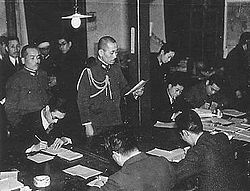
Supreme War Council (Japan)
The Supreme War Council was established during the development of representative government in Meiji period Japan to further strengthen the authority of the state. Its first leader was Yamagata Aritomo , a Chōshū native who has been credited with the founding of the modern Japanese army and was to...
was established in 1893 to coordinate efforts between the Imperial Japanese Army
Imperial Japanese Army
-Foundation:During the Meiji Restoration, the military forces loyal to the Emperor were samurai drawn primarily from the loyalist feudal domains of Satsuma and Chōshū...
and Imperial Japanese Navy
Imperial Japanese Navy
The Imperial Japanese Navy was the navy of the Empire of Japan from 1869 until 1947, when it was dissolved following Japan's constitutional renunciation of the use of force as a means of settling international disputes...
during wartime. In terms of function, it was approximately equivalent to the United States Joint Chiefs of Staff
Joint Chiefs of Staff
The Joint Chiefs of Staff is a body of senior uniformed leaders in the United States Department of Defense who advise the Secretary of Defense, the Homeland Security Council, the National Security Council and the President on military matters...
.
History
The Imperial General Headquarters was established by Imperial Decree 52 on 19 May 1893 within the Imperial Japanese Army General Staff OfficeImperial Japanese Army General Staff Office
, also called the Army General Staff, was one of the four principal agencies charged with overseeing the Imperial Japanese Army.-Role:The was created in April 1872, along with the Navy Ministry, to replace the Ministry of Military Affairs of the early Meiji government.Initially, the Army Ministry...
. The Emperor of Japan
Emperor of Japan
The Emperor of Japan is, according to the 1947 Constitution of Japan, "the symbol of the state and of the unity of the people." He is a ceremonial figurehead under a form of constitutional monarchy and is head of the Japanese Imperial Family with functions as head of state. He is also the highest...
who was defined as both Head of State
Head of State
A head of state is the individual that serves as the chief public representative of a monarchy, republic, federation, commonwealth or other kind of state. His or her role generally includes legitimizing the state and exercising the political powers, functions, and duties granted to the head of...
and the Generalissimo of the Imperial Japanese Armed Forces
Generalissimo
Generalissimo and Generalissimus are military ranks of the highest degree, superior to Field Marshal and other five-star ranks.-Usage:...
according to the Meiji Constitution
Meiji Constitution
The ', known informally as the ', was the organic law of the Japanese empire, in force from November 29, 1890 until May 2, 1947.-Outline:...
of 1889 to 1945, was the head of the Imperial General Headquarters, and was assisted by staff appointed from the Imperial Japanese Army and Imperial Japanese Navy.
The Imperial General Staff Headquarters was completely independent of the civilian government of the Empire of Japan
Empire of Japan
The Empire of Japan is the name of the state of Japan that existed from the Meiji Restoration on 3 January 1868 to the enactment of the post-World War II Constitution of...
, including the Cabinet
Cabinet (government)
A Cabinet is a body of high ranking government officials, typically representing the executive branch. It can also sometimes be referred to as the Council of Ministers, an Executive Council, or an Executive Committee.- Overview :...
and even the Prime Minister of Japan
Prime Minister of Japan
The is the head of government of Japan. He is appointed by the Emperor of Japan after being designated by the Diet from among its members, and must enjoy the confidence of the House of Representatives to remain in office...
. Prime Minister Itō Hirobumi
Ito Hirobumi
Prince was a samurai of Chōshū domain, Japanese statesman, four time Prime Minister of Japan , genrō and Resident-General of Korea. Itō was assassinated by An Jung-geun, a Korean nationalist who was against the annexation of Korea by the Japanese Empire...
was allowed to attend meetings by the express order of Emperor Meiji
Emperor Meiji
The or was the 122nd emperor of Japan according to the traditional order of succession, reigning from 3 February 1867 until his death...
during the First Sino-Japanese War
First Sino-Japanese War
The First Sino-Japanese War was fought between Qing Dynasty China and Meiji Japan, primarily over control of Korea...
. However, Prime Minister Katsura Taro
Katsura Taro
Prince , was a general in the Imperial Japanese Army, politician and three-time Prime Minister of Japan.-Early life:Katsura was born into a samurai family from Hagi, Chōshū Domain...
, despite his military background, was denied entry to meetings during the subsequent Russo-Japanese War
Russo-Japanese War
The Russo-Japanese War was "the first great war of the 20th century." It grew out of rival imperial ambitions of the Russian Empire and Japanese Empire over Manchuria and Korea...
.
Imperial Decree 658 of 18 November 1937 abolished the original Imperial General Headquarters, which was then immediately re-constituted under Military Decree 1, which gave the new Imperial General Headquarters command authority over all military operations during peacetime situations as well as wartime situations.
In November 1937, to bring the chiefs of Army and Navy General Staff
Imperial Japanese Navy General Staff
The was the highest organ within the Imperial Japanese Navy. In charge of planning and operations, it was headed by an Admiral headquartered in Tokyo.-History:...
into closer consultation with his government, Emperor Hirohito established a body known as the Imperial General Headquarters-Government Liaison Conference within Imperial General Headquarters. The Liaison Conferences were intended to assist in integrating the decisions and needs of the two military sections of Imperial General Headquarters with the resources and policies of the rest of the government. Reaching agreement between the Army and Navy on strategic planning was often difficult. When agreement was finally reached on an important strategic issue, the agreement was reduced to writing in a document called a Central Agreement and signed by both Chiefs of Army and Navy General Staffs.
The final decisions of Liaison Conferences were formally disclosed and approved at Imperial Conferences over which Emperor Hirohito presided in person at the Tokyo Imperial Palace.
During the Pacific War
Pacific War
The Pacific War, also sometimes called the Asia-Pacific War refers broadly to the parts of World War II that took place in the Pacific Ocean, its islands, and in East Asia, then called the Far East...
, and after the firebombing of Tokyo, the Imperial General Headquarters relocated to an underground facility in the mountains outside of Nagano
Matsushiro Underground Imperial Headquarters
The was a large underground bunker complex built during the Second World War in the Matsushiro suburb of Nagano, Japan.. The facility was to be used by Emperor Hirohito, his family, and the Imperial General Headquarters to direct Japanese armed forces fighting against the Allied invasion of...
.
With the surrender of Japan
Surrender of Japan
The surrender of Japan in 1945 brought hostilities of World War II to a close. By the end of July 1945, the Imperial Japanese Navy was incapable of conducting operations and an Allied invasion of Japan was imminent...
, the Supreme Commander of the Allied Powers
Supreme Commander of the Allied Powers
Supreme Commander of the Allied Powers was the title held by General Douglas MacArthur during the Occupation of Japan following World War II...
ordered the Imperial General Headquarters abolished on 13 September 1945.
Organization of the Imperial General Headquarters
Imperial General Headquarters comprised Army and Navy Sections. The Army Section comprised the Chief of Army General Staff and his chief of Army Operations, and the Army Minister. The Navy Section comprised Chief of Navy General Staff, his chief of Navy Operations, and the Navy MinisterMinistry of the Navy of Japan
The was a cabinet-level ministry in the Empire of Japan charged with the administrative affairs of the Imperial Japanese Navy . It existed from 1872 to 1945.-History:...
. In addition, the Inspector-General of Military Training
Inspectorate General of Military Training
The was responsible for all non-military aviation training of the Imperial Japanese Army. It was headed by an Inspector general who was responsible for overseeing technical and tactical training, and who reported directly to the Emperor of Japan via the Imperial General Headquarters rather than to...
, whose rank was almost on-par with that of the Chiefs of the General Staff, and the Aide-de-camp to the Emperor of Japan
Aide-de-camp to the Emperor of Japan
In Japan, the is a special military official whose primary duties are to report military affairs to the Emperor and act as a close attendant...
were also members.
Middle-ranking officers of Army and Navy General Staff, and Army and Navy Ministry, met from time to time at middle-level liaison or study conferences to discuss Japan's strategic war plans, and especially, plans requiring cooperation between the two armed services, outside of the formal meeting in the presence of the Emperor.
Relations between the Japanese Army and Navy were never cordial, and often marked by deep hostility. The Army saw the Soviet Union as Japan's greatest threat and for the most part supported the Hokushin-ron concept that Japan's strategic interests were on the Asian continent. The Navy looked across the Pacific Ocean and saw the United States as the greatest threat, and for the most part supported the Nanshin-ron
Nanshin-ron
The was a political doctrine in the pre-WW2 Japan which stated that Southeast Asia and the Pacific Islands were Japan's sphere of interest and that the potential value to the Japanese Empire for economic and territorial expansion in those areas was greater than elsewhere.This political doctrine...
concept that Japan's strategic interests were in Southeast Asia
Southeast Asia
Southeast Asia, South-East Asia, South East Asia or Southeastern Asia is a subregion of Asia, consisting of the countries that are geographically south of China, east of India, west of New Guinea and north of Australia. The region lies on the intersection of geological plates, with heavy seismic...
and the Pacific islands.
Organization during World War II
HirohitoHirohito
, posthumously in Japan officially called Emperor Shōwa or , was the 124th Emperor of Japan according to the traditional order, reigning from December 25, 1926, until his death in 1989. Although better known outside of Japan by his personal name Hirohito, in Japan he is now referred to...
, the Emperor of Japan, was defined as the Head of State and the Generalissimo of the Imperial Japanese Armed Forces according to the constitution of 1889. During World War II, the leadership of the Imperial General Headquarters consisting of the following:
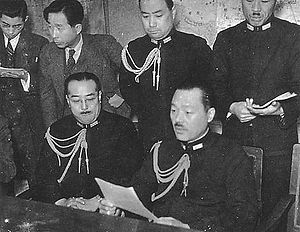
- Chief of the Army General Staff
- Kotohito Kan'inPrince Kan'in Kotohito, wasthe sixth head of a cadet branch the Japanese imperial family, and a career army officer who served as Chief of the Imperial Japanese Army General Staff from 1931 to 1940.-Early years:...
(1931–1940) - Hajime Sugiyama (1940–1944)
- Hideki TōjōHideki TōjōHideki Tōjō was a general of the Imperial Japanese Army , the leader of the Taisei Yokusankai, and the 40th Prime Minister of Japan during most of World War II, from 17 October 1941 to 22 July 1944...
(1944) - Yoshijirō Umezu (1944–1945)
- Kotohito Kan'in
- Chief of the Navy General StaffImperial Japanese Navy General StaffThe was the highest organ within the Imperial Japanese Navy. In charge of planning and operations, it was headed by an Admiral headquartered in Tokyo.-History:...
- Hiroyasu Fushimi (1932–1941)
- Osami Nagano (1941–1944)
- Shigetarō ShimadaShigetaro Shimadawas an admiral in the Imperial Japanese Navy during World War II. He also served as Navy Minister-Biography:A native of Tokyo, Shimada graduated from the 32nd class of the Imperial Japanese Naval Academy in 1904...
(1944) - Koshirō OikawaKoshiro Oikawawas an admiral in the Imperial Japanese Navy and Naval Minister during World War II.-Biography:Oikawa was born into a wealthy family in rural Koshi County, Niigata Prefecture, but was raised in Morioka city, Iwate prefecture in northern Japan....
(1944–1945) - Soemu Toyoda (1945)
- Minister of WarMinistry of War of JapanThe , more popularly known as the Ministry of War of Japan, was cabinet-level ministry in the Empire of Japan charged with the administrative affairs of the Imperial Japanese Army...
- Hajime Sugiyama (1937–1938)
- Seishirō Itagaki (1938–1939)
- Shunroku Hata (1939–1940)
- Hideki TōjōHideki TōjōHideki Tōjō was a general of the Imperial Japanese Army , the leader of the Taisei Yokusankai, and the 40th Prime Minister of Japan during most of World War II, from 17 October 1941 to 22 July 1944...
(1939–1944) - Korechika Anami (1945)
- Minister of the NavyMinistry of the Navy of JapanThe was a cabinet-level ministry in the Empire of Japan charged with the administrative affairs of the Imperial Japanese Navy . It existed from 1872 to 1945.-History:...
- Mitsumasa YonaiMitsumasa Yonaiwas an admiral in the Imperial Japanese Navy, and politician. He was the 37th Prime Minister of Japan from 16 January to 22 July 1940.-Early life & Naval career:...
(1937–1939, 1945) - Zengo YoshidaZengo Yoshidawas an admiral in the Imperial Japanese Navy.-Biography:Yoshida was born into an impoverished farming family in Saga prefecture in 1885, and was adopted into the family of a local rice merchant. He was a graduate of the 32nd class of the Imperial Japanese Naval Academy in 1904, ranking 12th out of...
(1939–1940) - Koshirō OikawaKoshiro Oikawawas an admiral in the Imperial Japanese Navy and Naval Minister during World War II.-Biography:Oikawa was born into a wealthy family in rural Koshi County, Niigata Prefecture, but was raised in Morioka city, Iwate prefecture in northern Japan....
(1940–1941) - Shigetarō ShimadaShigetaro Shimadawas an admiral in the Imperial Japanese Navy during World War II. He also served as Navy Minister-Biography:A native of Tokyo, Shimada graduated from the 32nd class of the Imperial Japanese Naval Academy in 1904...
(1941–1944)
- Mitsumasa Yonai
Organization of the Imperial Japanese Army -- December 8, 1941
The majority of these troops were stationed in China, IndochinaIndochina
The Indochinese peninsula, is a region in Southeast Asia. It lies roughly southwest of China, and east of India. The name has its origins in the French, Indochine, as a combination of the names of "China" and "India", and was adopted when French colonizers in Vietnam began expanding their territory...
, Japan, Taiwan
Taiwan
Taiwan , also known, especially in the past, as Formosa , is the largest island of the same-named island group of East Asia in the western Pacific Ocean and located off the southeastern coast of mainland China. The island forms over 99% of the current territory of the Republic of China following...
, and Korea
Korea
Korea ) is an East Asian geographic region that is currently divided into two separate sovereign states — North Korea and South Korea. Located on the Korean Peninsula, Korea is bordered by the People's Republic of China to the northwest, Russia to the northeast, and is separated from Japan to the...
. This includes some 61 division
Division (military)
A division is a large military unit or formation usually consisting of between 10,000 and 20,000 soldiers. In most armies, a division is composed of several regiments or brigades, and in turn several divisions typically make up a corps...
s, 59 brigade
Brigade
A brigade is a major tactical military formation that is typically composed of two to five battalions, plus supporting elements depending on the era and nationality of a given army and could be perceived as an enlarged/reinforced regiment...
s, and 51 air squadrons
Squadron (aviation)
A squadron in air force, army aviation or naval aviation is mainly a unit comprising a number of military aircraft, usually of the same type, typically with 12 to 24 aircraft, sometimes divided into three or four flights, depending on aircraft type and air force...
. Only a fraction of Japan's military, 11 to 14 divisions and the South Seas Detachment
South Seas Detachment
The South Seas Detachment of the Imperial Japanese Army was a brigade-size force formed in 1941 to be the army unit used in the Japanese seizure of the South Pacific island groups of Wake, Guam and the Gilberts. As part of the South Seas Force, it fell under Imperial Japanese Navy command and...
, were available for the December 1941 operations in South-East Asia and the Pacific.

- Imperial General Headquarters
- IJA General Staff
- General Affairs Bureau
- Organization and Mobilization Department
- Training Department
- 1st (Operations) Bureau
- Operations Department
- Defence Department
- 2nd (Intelligence)Bureau
- Europe and the Americas Department
- China Department
- Russia/Soviet Union Department
- Intelligence Department
- 3rd (Transport and Communications) Bureau
- Transport Department
- Communications Department
- 4th (Historical) Bureau
- Military History Department
- Strategy and Tactics Department
- General Staff CollegeArmy War College (Japan)The ; Short form: of the Empire of Japan was founded in 1882 in Minato, Tokyo to modernize and Westernize the Imperial Japanese Army. Much of the empire's elite including prime ministers during the period of Japanese militarism were graduates of the college....
- Land Survey Department
- General Affairs Bureau
- Ministry Of WarMinistry of War of JapanThe , more popularly known as the Ministry of War of Japan, was cabinet-level ministry in the Empire of Japan charged with the administrative affairs of the Imperial Japanese Army...
- General Defense Command
- China Expeditionary Army
- Kwantung Army
- Southern Expeditionary Army GroupSouthern Expeditionary Army GroupThe was a army group of the Imperial Japanese Army during World War II. It was responsible for all military operations in South East Asian and South West Pacific campaigns of World War II....
- Units under direct General Staff control
- Imperial Japanese Army Air Force
- 4th Infantry Division
- South Seas DetachmentSouth Seas DetachmentThe South Seas Detachment of the Imperial Japanese Army was a brigade-size force formed in 1941 to be the army unit used in the Japanese seizure of the South Pacific island groups of Wake, Guam and the Gilberts. As part of the South Seas Force, it fell under Imperial Japanese Navy command and...
- 1st Army Hospital
- 2nd Army Hospital
- 3rd Army Hospital
- Korean Remount Department
- Army Air Service Transport Department
- IGHQ Communications Department
- IJA General Staff
See also
- List of Japanese government and military commanders of World War II
- Military history of JapanMilitary history of JapanThe military history of Japan is characterised by a long period of feudal wars, followed by domestic stability, and then rampant imperialism. It culminates with Japan's defeat by the Allies in World War II...
- Imperial Japanese ArmyImperial Japanese Army-Foundation:During the Meiji Restoration, the military forces loyal to the Emperor were samurai drawn primarily from the loyalist feudal domains of Satsuma and Chōshū...
- Imperial Japanese NavyImperial Japanese NavyThe Imperial Japanese Navy was the navy of the Empire of Japan from 1869 until 1947, when it was dissolved following Japan's constitutional renunciation of the use of force as a means of settling international disputes...