


Figurative art

Encyclopedia
Figurative art, sometimes written as figurativism, describes art
work—particularly paintings and sculptures—which are clearly derived from real object sources, and are therefore by definition representational
.
figure, or even an animal figure, and, though this is often the case, it is not necessarily so:
Painting and sculpture can therefore be divided into the categories of figurative, representational and abstract, although, strictly speaking, abstract art
is derived (or abstracted) from a figurative or other natural source. However, the term is sometimes used as a synonym for non-representational art and non-objective art, i.e. art which has no derivation from figures or objects.
, color
, light
and dark
, mass
, volume
, texture
, and perspective
, although it should be pointed out that these elements of design could also play a role in creating other types of imagery -- for instance abstract, or non-representational or non-objective two-dimensional artwork. The difference is that in figurative art these elements are deployed to create an impression or illusion of form and space, and, usually, to create emphasis in the narrative portrayed.
antiquity
was not naturalistic, for its forms were idealized and geometric. Ernst Gombrich
referred to the strictures of this schematic imagery, the adherence to that which was already known, rather than that which is seen, as the "Egyptian method", an allusion to the memory-based clarity of imagery in Egyptian art
.
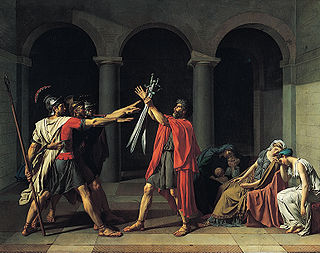 Eventually idealization gave way to observation, and a figurative art which balanced ideal geometry with greater realism was seen in Classical
sculpture by 480 B.C. The Greeks referred to the reliance on visual observation as mimesis
. Until the time of the Impressionists, figurative art was characterized by attempts to reconcile these opposing principles.
From the early Renaissance, Mannerism and the Baroque through 18th, 19th and 20th century painting Figurative art has steadily broadened its parameters. Nicolas Poussin
(1594-1665), a French painter
in the classical
style whose work predominantly features clarity, logic, and order, and favors line over color; served as an alternative to the more narrative Baroque
style of the 17th century. He was a major inspiration for such classically-oriented artists as Jacques-Louis David
, Jean-Auguste-Dominique Ingres and Paul Cézanne
. The rise of the Neoclassical
art of Jacques-Louis David ultimately engendered the realistic
reactions of Gustave Courbet
and Édouard Manet
leading to the multi-faceted figurative art of the 20th century.
Art
Art is the product or process of deliberately arranging items in a way that influences and affects one or more of the senses, emotions, and intellect....
work—particularly paintings and sculptures—which are clearly derived from real object sources, and are therefore by definition representational
Representation (arts)
Representation is the use of signs that stand in for and take the place of something else. It is through representation that people organize the world and reality through the act of naming its elements...
.
Definition
The term "figurative art" is often taken to mean art which represents the humanHuman
Humans are the only living species in the Homo genus...
figure, or even an animal figure, and, though this is often the case, it is not necessarily so:
Painting and sculpture can therefore be divided into the categories of figurative, representational and abstract, although, strictly speaking, abstract art
Abstract art
Abstract art uses a visual language of form, color and line to create a composition which may exist with a degree of independence from visual references in the world. Western art had been, from the Renaissance up to the middle of the 19th century, underpinned by the logic of perspective and an...
is derived (or abstracted) from a figurative or other natural source. However, the term is sometimes used as a synonym for non-representational art and non-objective art, i.e. art which has no derivation from figures or objects.
Formal elements
The formal elements, those aesthetic effects created by design, upon which figurative art is dependent, include line, shapeShape
The shape of an object located in some space is a geometrical description of the part of that space occupied by the object, as determined by its external boundary – abstracting from location and orientation in space, size, and other properties such as colour, content, and material...
, color
Color
Color or colour is the visual perceptual property corresponding in humans to the categories called red, green, blue and others. Color derives from the spectrum of light interacting in the eye with the spectral sensitivities of the light receptors...
, light
Light
Light or visible light is electromagnetic radiation that is visible to the human eye, and is responsible for the sense of sight. Visible light has wavelength in a range from about 380 nanometres to about 740 nm, with a frequency range of about 405 THz to 790 THz...
and dark
Dark
Dark commonly refers to darkness, the absence of light.Dark may also refer to:*Evil, sinister or malign*Dark , a term used to describe a broadcasting service that has ceased transmission...
, mass
Mass
Mass can be defined as a quantitive measure of the resistance an object has to change in its velocity.In physics, mass commonly refers to any of the following three properties of matter, which have been shown experimentally to be equivalent:...
, volume
Volume
Volume is the quantity of three-dimensional space enclosed by some closed boundary, for example, the space that a substance or shape occupies or contains....
, texture
Texture (painting)
Texture in painting is the look and feel of the canvas. It is based on the paint, and its application, or the addition of materials such as ribbon, metal, wood, lace, leather and sand. The concept of 'painterliness' also has bearing on texture. The texture stimulates two different senses; sight...
, and perspective
Perspective (visual)
Perspective, in context of vision and visual perception, is the way in which objects appear to the eye based on their spatial attributes; or their dimensions and the position of the eye relative to the objects...
, although it should be pointed out that these elements of design could also play a role in creating other types of imagery -- for instance abstract, or non-representational or non-objective two-dimensional artwork. The difference is that in figurative art these elements are deployed to create an impression or illusion of form and space, and, usually, to create emphasis in the narrative portrayed.
Evolution
Figurative art is itself based upon a tacit understanding of abstracted shapes: the figure sculpture of GreekGreece
Greece , officially the Hellenic Republic , and historically Hellas or the Republic of Greece in English, is a country in southeastern Europe....
antiquity
Classical antiquity
Classical antiquity is a broad term for a long period of cultural history centered on the Mediterranean Sea, comprising the interlocking civilizations of ancient Greece and ancient Rome, collectively known as the Greco-Roman world...
was not naturalistic, for its forms were idealized and geometric. Ernst Gombrich
Ernst Gombrich
Sir Ernst Hans Josef Gombrich, OM, CBE was an Austrian-born art historian who became naturalized British citizen in 1947. He spent most of his working life in the United Kingdom...
referred to the strictures of this schematic imagery, the adherence to that which was already known, rather than that which is seen, as the "Egyptian method", an allusion to the memory-based clarity of imagery in Egyptian art
Egyptian Art
Egyptian Art may refer to:*The Art of ancient Egypt, c. 5000 BCE - c. 300 BCE*Hellenistic art of Egypt, c. 300 BCE - c. 100 CE, during the Ptolemaic dynasty*Coptic art c. 100 CE - present, see, e.g., Coptic iconography...
.
Classical antiquity
Classical antiquity is a broad term for a long period of cultural history centered on the Mediterranean Sea, comprising the interlocking civilizations of ancient Greece and ancient Rome, collectively known as the Greco-Roman world...
sculpture by 480 B.C. The Greeks referred to the reliance on visual observation as mimesis
Mimesis
Mimesis , from μιμεῖσθαι , "to imitate," from μῖμος , "imitator, actor") is a critical and philosophical term that carries a wide range of meanings, which include imitation, representation, mimicry, imitatio, receptivity, nonsensuous similarity, the act of resembling, the act of expression, and the...
. Until the time of the Impressionists, figurative art was characterized by attempts to reconcile these opposing principles.
From the early Renaissance, Mannerism and the Baroque through 18th, 19th and 20th century painting Figurative art has steadily broadened its parameters. Nicolas Poussin
Nicolas Poussin
Nicolas Poussin was a French painter in the classical style. His work predominantly features clarity, logic, and order, and favors line over color. His work serves as an alternative to the dominant Baroque style of the 17th century...
(1594-1665), a French painter
Painting
Painting is the practice of applying paint, pigment, color or other medium to a surface . The application of the medium is commonly applied to the base with a brush but other objects can be used. In art, the term painting describes both the act and the result of the action. However, painting is...
in the classical
Classicism
Classicism, in the arts, refers generally to a high regard for classical antiquity, as setting standards for taste which the classicists seek to emulate. The art of classicism typically seeks to be formal and restrained: of the Discobolus Sir Kenneth Clark observed, "if we object to his restraint...
style whose work predominantly features clarity, logic, and order, and favors line over color; served as an alternative to the more narrative Baroque
Baroque
The Baroque is a period and the style that used exaggerated motion and clear, easily interpreted detail to produce drama, tension, exuberance, and grandeur in sculpture, painting, literature, dance, and music...
style of the 17th century. He was a major inspiration for such classically-oriented artists as Jacques-Louis David
Jacques-Louis David
Jacques-Louis David was an influential French painter in the Neoclassical style, considered to be the preeminent painter of the era...
, Jean-Auguste-Dominique Ingres and Paul Cézanne
Paul Cézanne
Paul Cézanne was a French artist and Post-Impressionist painter whose work laid the foundations of the transition from the 19th century conception of artistic endeavour to a new and radically different world of art in the 20th century. Cézanne can be said to form the bridge between late 19th...
. The rise of the Neoclassical
Neoclassicism
Neoclassicism is the name given to Western movements in the decorative and visual arts, literature, theatre, music, and architecture that draw inspiration from the "classical" art and culture of Ancient Greece or Ancient Rome...
art of Jacques-Louis David ultimately engendered the realistic
Realism (visual arts)
Realism in the visual arts is a style that depicts the actuality of what the eyes can see. The term is used in different senses in art history; it may mean the same as illusionism, the representation of subjects with visual mimesis or verisimilitude, or may mean an emphasis on the actuality of...
reactions of Gustave Courbet
Gustave Courbet
Jean Désiré Gustave Courbet was a French painter who led the Realist movement in 19th-century French painting. The Realist movement bridged the Romantic movement , with the Barbizon School and the Impressionists...
and Édouard Manet
Édouard Manet
Édouard Manet was a French painter. One of the first 19th-century artists to approach modern-life subjects, he was a pivotal figure in the transition from Realism to Impressionism....
leading to the multi-faceted figurative art of the 20th century.
See also
- Abstract artAbstract artAbstract art uses a visual language of form, color and line to create a composition which may exist with a degree of independence from visual references in the world. Western art had been, from the Renaissance up to the middle of the 19th century, underpinned by the logic of perspective and an...
- IllustrationIllustrationAn illustration is a displayed visualization form presented as a drawing, painting, photograph or other work of art that is created to elucidate or dictate sensual information by providing a visual representation graphically.- Early history :The earliest forms of illustration were prehistoric...
- Neofigurative Art
- StuckismStuckismStuckism is an international art movement founded in 1999 by Billy Childish and Charles Thomson to promote figurative painting in opposition to conceptual art...
- Abstract figurativeAbstract figurativeAbstract figurative is a term describing a synthesis of abstraction and figuration in art – the creation of any art piece that combines Abstract art and Figurative art, bringing together two opposing styles by taking strong references to the real world and synthesizing them with departures from...