


Encyclopædia Britannica

Encyclopedia
The Encyclopædia Britannica (Latin
for "British Encyclopaedia"), published by Encyclopædia Britannica, Inc., is a general knowledge English-language encyclopaedia
that is available in print, as a DVD
, and on the Internet
. It is written and continuously updated by about 100 full-time editors and more than 4,000 expert contributors. It is regarded as one of the most scholarly of encyclopaedias.
The Britannica is the oldest English-language encyclopaedia still in print. It was first published between 1768 and 1771 in Edinburgh
, Scotland as three volumes. The encyclopaedia grew in size, and by its fourth edition (1801–1809) it had expanded to a well known 20-volume set. Its rising stature helped recruit eminent contributors, and the 9th edition (1875–1889) and the 11th edition
(1911) are landmark encyclopaedias for scholarship and literary style. Beginning with the 11th edition, the Britannica shortened and simplified articles to broaden its North American market. In 1933, the Britannica became the first encyclopaedia to adopt "continuous revision", in which the encyclopaedia is continually reprinted and every article updated on a schedule.
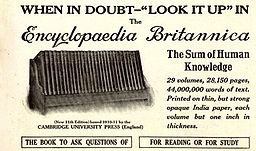
The current 15th edition has a unique three-part structure: a 12-volume Micropædia
of short articles (generally fewer than 750 words), a 17-volume Macropædia
of long articles (two to 310 pages) and a single Propædia
volume to give a hierarchical
outline of knowledge. The Micropædia is meant for quick fact-checking and as a guide to the Macropædia; readers are advised to study the Propædia outline to understand a subject's context and to find more detailed articles. The size of the Britannica has remained roughly constant over 70 years, with about 40 million words on half a million topics. Although publication has been based in the United States since 1901, the Britannica has maintained British spelling
.
The Britannica has had difficulty remaining profitable. Some articles in earlier editions have been criticised for inaccuracy, bias, or unqualified contributors. The accuracy in parts of the present edition has likewise been questioned, although criticisms have been challenged by Britannica's management.
, Horace Everett Hooper
, Sears Roebuck and William Benton. The present owner of Encyclopædia Britannica Inc. is Jacqui Safra, a Swiss billionaire and actor. Recent advances in information technology
and the rise of electronic encyclopedias such as Encarta
and Wikipedia
have reduced the demand for print encyclopedias. To remain competitive, Encyclopædia Britannica, Inc. has stressed the reputation of the Britannica, reduced its price and production costs, and developed electronic versions on CD-ROM
, DVD, and the World Wide Web
. Since the early 1930s, the company has promoted spin-off reference works.
Throughout history, the Britannica has had two aims: to be an excellent reference book and to provide educational material. In 1974, the 15th edition adopted a third goal: to systematise all human knowledge. The history of the Britannica can be divided into five eras, punctuated by changes in management or re-organisation of the dictionary.
and Andrew Bell, by Archibald Constable
, and by others. The Britannica was first published between 1768 and 1771 in Edinburgh
as the Encyclopædia Britannica, or, A Dictionary of Arts and Sciences, compiled upon a New Plan. In part, it was conceived in reaction to the French Encyclopédie
of Denis Diderot
and Jean le Rond d'Alembert
(published 1751–1772), which had been inspired by Chambers's Cyclopaedia (first edition 1728). The Britannica was primarily a Scottish enterprise; it is one of the most enduring legacies of the Scottish Enlightenment
. In this era, the Britannica moved from being a three-volume set (1st edition) compiled by one young editor—William Smellie
—to a well known 20-volume set written by numerous authorities. Several other encyclopaedias competed throughout this period, among them editions of Abraham Rees
's Cyclopaedia and Coleridge's
Encyclopaedia Metropolitana
. and David Brewster's
Edinburgh Encyclopedia
.

. Although some contributors were again recruited through friendships of the chief editors, notably Macvey Napier
, others were attracted by the Britannica's reputation. The contributors often came from other countries and included the world's most respected authorities in their fields. A general index of all articles was included for the first time in the 7th edition, a practice maintained until 1974. The first English-born editor-in-chief was Thomas Spencer Baynes
, who oversaw the production of the 9th edition; dubbed the "Scholar's Edition", the 9th is the most scholarly Britannica. After 1880, Baynes was assisted by William Robertson Smith
. No biographies of living persons were included. James Clerk Maxwell
and Thomas Huxley
were special advisors on science. However, by the close of the 19th century, the 9th edition was outdated and the Britannica faced financial difficulties.
and door-to-door
sales. The American owners gradually simplified articles, making them less scholarly for a mass market. The 10th edition was a nine-volume supplement to the 9th, but the 11th edition was a completely new work, and is still praised for excellence; its owner, Horace Hooper
, lavished enormous effort on its perfection. When Hooper fell into financial difficulties, the Britannica was managed by Sears Roebuck for 18 years (1920–23, 1928–43). In 1932, the vice-president of Sears, Elkan Harrison Powell
, assumed presidency of the Britannica; in 1936, he began the policy of continuous revision. This was a departure from earlier practice, in which the articles were not changed until a new edition was produced, at roughly 25-year intervals, some articles unchanged from earlier editions. Powell developed new educational products that built upon the Britannica's reputation. In 1943, ownership passed to William Benton, who managed the Britannica until his death in 1973. Benton set up the Benton Foundation
, which managed the Britannica until 1996. In 1968, near the end of this era, the Britannica celebrated its bicentennial
.
, the Macropædia
, and the Propædia
. Under Mortimer J. Adler (member of the Board of Editors of Encyclopædia Britannica since its inception in 1949, and its chair from 1974; director of editorial planning for the 15th edition of Britannica from 1965), the Britannica sought not only to be a good reference work and educational tool but to systematise all human knowledge. The absence of a separate index and the grouping of articles into parallel encyclopaedias (the Micro- and Macropædia) provoked a "firestorm of criticism" of the initial 15th edition.*
*
*
*
*
*
* In response, the 15th edition was completely re-organised and indexed for a re-release in 1985. This second version of the 15th edition continues to be published and revised; the latest version is the 2010 print version. The official title of the 15th edition is the New Encyclopædia Britannica, although it has also been promoted as Britannica 3.
and online. In 1996, the Britannica was bought by Jacqui Safra at well below its estimated value, owing to the company's financial difficulties. Encyclopædia Britannica, Inc split in 1999. One part retained the company name and developed the print version, and the other, Britannica.com Inc.
, developed digital versions. Since 2001, the two companies shared a CEO
, originally Ilan Yeshua
, who has continued Powell's
strategy of introducing new products with the Britannica name.
to the reigning British monarch
from 1788 to 1901 and then, upon its sale to an American partnership, to the British monarch and the President of the United States. Thus, the 11th edition is "dedicated by Permission to His Majesty George the Fifth
, King of Great Britain and Ireland and of the British Dominions beyond the Seas, Emperor of India
, and to William Howard Taft
, President of the United States of America." The order of the dedications has changed with the relative power of the United States and Britain, and with relative sales; the 1954 version of the 14th edition is "Dedicated by Permission to the Heads of the Two English-Speaking Peoples, Dwight David Eisenhower
, President of the United States of America, and Her Majesty, Queen Elizabeth the Second
." Consistent with this tradition, the 2007 version of the current 15th edition was "dedicated by permission to the current President of the United States of America, George W. Bush
, and Her Majesty, Queen Elizabeth II," while the 2010 version of the current 15th edition is "dedicated by permission to Barack Obama
, President of the United States of America, and Her Majesty Queen Elizabeth II."
. On the release of the 14th edition, Time magazine
dubbed the Britannica the "Patriarch of the Library". In a related advertisement, naturalist William Beebe
was quoted as saying that the Britannica was "beyond comparison because there is no competitor." References to the Britannica can be found throughout English literature
, most notably in one of Arthur Conan Doyle
's favourite Sherlock Holmes
stories, "The Red-Headed League
". The tale was highlighted by the Lord Mayor of London
, Gilbert Inglefield, at the bicentennial of the Britannica
.
The Britannica has a reputation for summarising knowledge. To further their education, many have devoted themselves to reading the entire Britannica, taking anywhere from three to 22 years to do so. When Fat'h Ali became the Shah of Persia
in 1797, he was given a set of the Britannica's 3rd edition, which he read completely; after this feat, he extended his royal title to include "Most Formidable Lord and Master of the Encyclopædia Britannica." Writer George Bernard Shaw
claimed to have read the complete 9th edition—except for the science articles—and Richard Evelyn Byrd
took the Britannica as reading material for his five-month stay at the South Pole
in 1934, while Philip Beaver
read it during a sailing expedition. More recently, A.J. Jacobs
, an editor at Esquire
magazine, read the entire 2002 version of the 15th edition, describing his experiences in the well-received 2004 book, The Know-It-All: One Man's Humble Quest to Become the Smartest Person in the World
. Only two people are known to have read two independent editions: the author C. S. Forester
and Amos Urban Shirk
, an American businessman, who read the 11th and 14th editions, devoting roughly three hours per night for four and a half years to read the 11th. Several editors-in-chief of the Britannica are likely to have read their editions completely, such as William Smellie
(1st edition), William Robertson Smith
(9th edition), and Walter Yust
(14th edition).
for "Best Online Consumer Information Service"; the Codie awards are granted yearly by the Software and Information Industry Association
to recognise the best products among categories of software. In 2006, the Britannica was again a finalist. Similarly, the CD/DVD-ROM version of the Britannica received the 2004 Distinguished Achievement Award from the Association of Educational Publishers
, and Codie awards in 2000, 2001 and 2002. On 15 July 2009, Encyclopædia Britannica was awarded a spot as one of "Top Ten Superbrands in the UK" by a panel of more than 2,000 independent reviewers, as reported by the BBC.
"Outline of Knowledge". The bulk of the Britannica is devoted to geography (26% of the Macropædia
), biography (14%), biology and medicine (11%), literature (7%), physics and astronomy (6%), religion (5%), art (4%), Western philosophy (4%), and law (3%). A complementary study of the Micropædia
found that geography accounted for 25% of articles, science 18%, social sciences 17%, biography 17%, and all other humanities 25%. Writing in 1992, one reviewer judged that the "range, depth, and catholicity of coverage [of the Britannica] are unsurpassed by any other general encyclopedia."
The Britannica does not cover topics in equivalent detail; for example, the whole of Buddhism
and most other religions is covered in a single Macropædia
article, whereas 14 articles are devoted to Christianity, comprising nearly half of all religion articles. However, the Britannica has been lauded as the least biased of general encyclopedias marketed to Western readers and praised for its biographies of important women of all eras.
detailed its failings in his 1964 book, The Myth of the Britannica, the encyclopaedia was provoked to produce the 15th edition, which required 10 years of work. It is still difficult to keep the Britannica current; one recent critic writes, "it is not difficult to find articles that are out-of-date or in need of revision", noting that the longer Macropædia articles are more likely to be outdated than the shorter Micropædia articles. Information in the Micropædia is sometimes inconsistent with the corresponding Macropædia article(s), mainly because of the failure to update one or the other. The bibliographies of the Macropædia articles have been criticised for being more out-of-date than the articles themselves.
While Britannicas authors have included authorities such as Albert Einstein
, Marie Curie
, and Leon Trotsky
, some have been criticised for lack of expertise:
to professors criticised the 11th edition for having bourgeois and old-fashioned opinions on art, literature, and social sciences. A contemporary Cornell
professor, Edward B. Titchener
, wrote in 1912, "the new Britannica does not reproduce the psychological atmosphere of its day and generation... Despite the halo of authority, and despite the scrutiny of the staff, the great bulk of the secondary articles in general psychology ... are not adapted to the requirements of the intelligent reader."
, military decoration
s, and the French poet Joachim du Bellay
; editorial mistakes were also alleged, such as inconsistent sorting of Japanese biographies. Its elimination of the index was condemned, as was the apparently arbitrary division of articles into the Micropædia
and Macropædia
. Summing up, one critic called the initial 15th edition a "qualified failure...[that] cares more for juggling its format than for preserving information." More recently, reviewers from the American Library Association
were surprised to find that most educational articles had been eliminated from the 1992 Macropædia, along with the article on psychology
.
Britannica-appointed contributors are occasionally mistaken or unscientific. A notorious instance from the Britannica's early years is the rejection of Newtonian gravity by George Gleig
, the chief editor of the 3rd edition (1788–1797), who wrote that gravity was caused by the classical element of fire
. However, the Britannica has also staunchly defended a scientific approach to emotional topics, as it did with William Robertson Smith
's articles on religion in the 9th edition, particularly his article stating that the Bible
was not historically accurate (1875).
Wendy Doniger
, who is on the editorial board of Britannica, has been criticized for her negative portrayal of Hinduism
. Britannica's presentation of Hinduism has also been criticized.
as protecting the white race and restoring order to the American South
after the American Civil War
, citing the need to "control the negro", and "the frequent occurrence of the crime of rape by negro men upon white women." Similarly, the "Civilization" article argues for eugenics
, stating that it is irrational to "propagate low orders of intelligence, to feed the ranks of paupers, defectives and criminals ... which to-day constitute so threatening an obstacle to racial progress." The 11th edition has no biography of Marie Curie
, despite her winning of the Nobel Prize in Physics
in 1903 and the Nobel Prize in Chemistry
in 1911, although she is mentioned briefly under the biography of her husband Pierre Curie
. The Britannica employed a large female editorial staff that wrote hundreds of articles for which they were not given credit.
for inaccuracies in articles on the history of mathematics
, none of which had been written by specialists.
In 1917, art critic Willard Huntington Wright
published Misinforming a Nation, which highlighted inaccuracies and English biases of the Eleventh Edition, particularly in humanities. Many of Wright's criticisms were addressed in later editions. However, his book was denounced as a polemic one by some contemporary reviewers; for example, the New York Times wrote that a "spiteful and shallow temper...pervades the book", while The New Republic
opined, "it is unfortunate for Mr Wright's remorseless purpose that he has proceeded in an unscientific spirit and given so little objective justification of his criticism."
English writer and former priest Joseph McCabe
claimed in Lies and Fallacies of the Encyclopædia Britannica (1947) that Britannica was censored under pressure from the Roman Catholic Church after the 11th edition.
American physicist Harvey Einbinder
detailed failings of the 14th edition in his 1964 book, The Myth of the Britannica.
An Irish
newspaper, The Evening Herald
, based in Dublin, said in February 2010 that Britannica offers a "farcically inaccurate version" of the country's history. An opposition Senator
said: "This screwy version of events is a gross insult to our people and our history. That it is being used to educate our children is even more ridiculous." The Department of Education and Science
, which paid €450,000 to give children in school online access to the Encyclopaedia, said it was "disappointed".
The Britannica has always conceded that errors are inevitable. Speaking of the 3rd edition (1788–1797), its chief editor George Gleig
wrote that "perfection seems to be incompatible with the nature of works constructed on such a plan, and embracing such a variety of subjects." More recently (March 2006), the Britannica wrote that "we in no way mean to imply that Britannica is error-free; we have never made such a claim." The sentiment is expressed by its original editor, William Smellie
:
, the Macropædia
, the Propædia
, and a two-volume index. The Britannicas articles are found in the Micro- and Macropædia, which encompass 12 and 17 volumes, respectively, each volume having roughly one thousand pages. The 2007 Macropædia has 699 in-depth articles, ranging in length from 2 to 310 pages and having references and named contributors. In contrast, the 2007 Micropædia has roughly 65,000 articles, the vast majority (about 97%) of which contain fewer than 750 words, no references, and no named contributors. The Micropædia articles are intended for quick fact-checking and to help in finding more thorough information in the Macropædia. The Macropædia articles are meant both as authoritative, well-written articles on their subjects and as storehouses of information not covered elsewhere. The longest article (310 pages) is on the United States, and resulted from the merger of the articles on the individual states
.
Information can be found in the Britannica by following the cross-references in the Micropædia and Macropædia; however, these are sparse, averaging one cross-reference per page. Hence, readers are recommended to consult instead the alphabetical index or the Propædia, which organises the Britannicas contents by topic.
The core of the Propædia is its "Outline of Knowledge", which aims to provide a logical framework for all human knowledge. Accordingly, the Outline is consulted by the Britannicas editors to decide which articles should be included in the Micro- and Macropædia. The Outline is also intended to be a study guide, to put subjects in their proper perspective, and to suggest a series of Britannica articles for the student wishing to learn a topic in depth. However, libraries have found that it is scarcely used, and reviewers have recommended that it be dropped from the encyclopedia. The Propædia also has color transparencies of human anatomy and several appendices listing the staff members, advisors, and contributors to all three parts of the Britannica.
Taken together, the Micropædia and Macropædia comprise roughly 40 million words and 24,000 images. The two-volume index has 2,350 pages, listing the 228,274 topics covered in the Britannica, together with 474,675 subentries under those topics. The Britannica generally prefers British spelling
over American
; for example, it uses colour (not color), centre (not center), and encyclopaedia (not encyclopedia). However, there are exceptions to this rule, such as defense rather than defence. Common alternative spellings are provided with cross-references such as "Color: see Colour."
Since 1936, the articles of the Britannica have been revised on a regular schedule, with at least 10% of them considered for revision each year. According to one Britannica website, 46% of its articles were revised over the past three years; however, according to another Britannica web-site, only 35% of the articles were revised.
The alphabetisation of articles in the Micropædia and Macropædia follows strict rules. Diacritical marks
and non-English letters are ignored, while numerical entries such as "1812, War of
" are alphabetised as if the number had been written out ("Eighteen-twelve, War of"). Articles with identical names are ordered first by persons, then by places, then by things. Rulers with identical names are organised first alphabetically by country and then by chronology; thus, Charles III
of France precedes Charles I of England
, listed in Britannica as the ruler of Great Britain and Ireland. (That is, they are alphabetised as if their titles were "Charles, France, 3" and "Charles, Great Britain and Ireland, 1".) Similarly, places that share names are organised alphabetically by country, then by ever-smaller political divisions.
A British Children's Britannica edited by John Armitage was issued in London in 1960. Its contents were determined largely by the 11-plus standardized tests given in Britain. Britannica introduced the Children's Britannica to the U.S. market in 1988, aimed at ages 7 to 14.
In 1961 a 16 volume Young Children's Encyclopaedia was issued for children just learning to read.
My First Britannica is aimed at children ages six to twelve, and the Britannica Discovery Library is for children aged three to six (issued 1974 to 1991).
There have been and are several abridged Britannica encyclopedias. The single-volume Britannica Concise Encyclopædia has 28,000 short articles condensing the larger 32-volume Britannica. Compton's by Britannica, first published in 2007, incorporating the former Compton's Encyclopedia
, is aimed at 10–17 year olds and consists of 26 volumes and 11,000 pages.
Since 1938, Encyclopædia Britannica, Inc. has published annually a Book of the Year covering the past year's events, which is available online back to the 1994 edition (covering the events of 1993). The company also publishes several specialised reference works, such as Shakespeare: The Essential Guide to the Life and Works of the Bard (Wiley, 2006).
.
Britannica Online is a web site with more than 120,000 articles and is updated regularly. It has daily features, updates and links to news reports from The New York Times and the BBC
. Roughly 60% of Encyclopædia Britannica's revenue comes from online operations, of which around 15% comes from subscriptions to the consumer version of the websites. Subscriptions are available on a yearly, monthly or weekly basis. Special subscription plans are offered to schools, colleges and libraries; such institutional subscribers constitute an important part of Britannica's business. Articles may be accessed online for free, but only a few opening lines of text are displayed. Beginning in early 2007, the Britannica made articles freely available if they are linked to from an external site; such external links often improve an article's rankings
in search engine
results.
On 20 February 2007, Encyclopædia Britannica, Inc. announced that it was working with mobile phone
search company AskMeNow
to launch a mobile encyclopedia. Users will be able to send a question via text message, and AskMeNow will search Britannicas 28,000-article concise encyclopedia to return an answer to the query. Daily topical features sent directly to users' mobile phones are also planned.
On 3 June 2008, an initiative to facilitate collaboration between online expert and amateur scholarly contributors for Britannica's on-line content (in the spirit of a wiki
), with editorial oversight from Britannica staff, was announced. Approved contributions would be credited, though contributing automatically grants Encyclopædia Britannica, Inc. perpetual, irrevocable license to those contributions.
On 22 January 2009, Britannica's president, Jorge Cauz
, announced that the company would be accepting edits and additions to the online Britannica website from the public. The published edition of the encyclopedia will not be affected by the changes. Individuals wishing to edit the Britannica website will have to register under their real name and address prior to editing or submitting their content. All edits submitted will be reviewed and checked and will have to be approved by the encyclopedia's professional staff. Contributions from non-academic users will sit in a separate section from the expert-generated Britannica content, as will content submitted by non-Britannica scholars. Articles written by users, if vetted and approved, will also only be available in a special section of the website, separate from the professional articles. Official Britannica material would carry a "Britannica Checked" stamp, to distinguish it from the user-generated content.
On 14 September 2010, Encyclopædia Britannica, Inc. announced a partnership with mobile phone
development company Concentric Sky to launch a series of iPhone
products aimed at the K-12 market. On 20 July 2011, Encyclopædia Britannica, Inc. announced that Concentric Sky had ported the Britannica Kids product line to Intel's Intel Atom
-based Netbooks.
, astronomer Carl Sagan
, and surgeon Michael DeBakey. Roughly a quarter of the contributors are deceased, some as long ago as 1947 (Alfred North Whitehead
), while another quarter are retired or emeritus
. Most (approximately 98%) contribute to only a single article; however, 64 contributed to three articles, 23 contributed to four articles, 10 contributed to five articles, and 8 contributed to more than five articles. An exceptionally prolific contributor is Dr. Christine Sutton
of the University of Oxford, who contributed 24 articles on particle physics
.
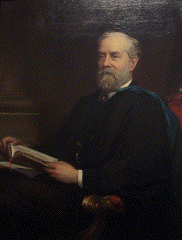 Dale Hoiberg
, a sinologist
, is the Britannica's Senior Vice President and editor-in-chief. Among his predecessors as editors-in-chief were Hugh Chisholm
(1902–1924), James Louis Garvin
(1926–1932), Franklin Henry Hooper
(1932–1938), Walter Yust
(1938–1960), Harry Ashmore
(1960–1963), Warren E. Preece
(1964–1968, 1969–1975), Sir William Haley
(1968–1969), Philip W. Goetz
(1979–1991), and Robert McHenry
(1992–1997). Anita Wolff and Theodore Pappas
serve as the current Deputy Editor and Executive Editor, respectively. Prior Executive Editors include John V. Dodge (1950–1964) and Philip W. Goetz
.
The current editorial staff of the Britannica includes five Senior Editors and nine Associate Editors, supervised by Dale Hoiberg
and four others. The editorial staff help to write the articles of the Micropædia
and some sections of the Macropædia
.
, religion scholar Wendy Doniger
, political economist Benjamin M. Friedman
, Council on Foreign Relations
President Emeritus Leslie H. Gelb, computer scientist David Gelernter
, Physics Nobel laureate Murray Gell-Mann
, Carnegie Corporation of New York
President Vartan Gregorian
, philosopher Thomas Nagel
, cognitive scientist Donald Norman
, musicologist Don Michael Randel
, Stewart Sutherland, Baron Sutherland of Houndwood
, President of the Royal Society of Edinburgh
, and cultural anthropologist Michael Wesch
.
The Propædia
and its Outline of Knowledge were produced by dozens of editorial advisors under the direction of Mortimer J. Adler. Roughly half of these advisors have since died, including some of the Outline's chief architects: Rene Dubos
(d. 1982), Loren Eiseley
(d. 1977), Harold D. Lasswell (d. 1978), Mark Van Doren
(d. 1972), Peter Ritchie Calder
(d. 1982) and Mortimer J. Adler (d. 2001). The Propædia also lists just under 4,000 advisors who were consulted for the unsigned Micropædia
articles.
by billionaire Swiss financier Jacqui Safra, who serves as its current Chair of the Board. In 1997, Don Yannias
, a long-time associate and investment advisor of Safra, became CEO
of Encyclopædia Britannica, Inc. A new company, Britannica.com Inc.
was spun off in 1999 to develop the digital versions of the Britannica; Yannias assumed the role of CEO in the new company, while that of Encyclopædia Britannica, Inc. remained vacant for two years. Yannias' tenure at Britannica.com Inc.
was marked by missteps, large lay-offs and financial losses. In 2001, Yannias was replaced by Ilan Yeshua
, who reunited the leadership of the two companies. Yannias later returned to investment management, but remains on the Britannica's Board of Directors
.
In 2003, former management consultant Jorge Aguilar-Cauz was appointed President of Encyclopædia Britannica, Inc. Cauz is the senior executive and reports directly to the Britannica's Board of Directors. Cauz has been pursuing alliances with other companies and extending the Britannica brand to new educational and reference products, continuing the strategy pioneered by former CEO Elkan Harrison Powell
in the mid-1930s.
Under Safra's ownership, the company has experienced financial difficulties, and has responded by reducing the price of its products and implementing drastic cost cuts. According to a 2003 report in the New York Post
, the Britannica management has eliminated employee 401(k)
accounts and encouraged the use of free images. These changes have had negative impacts, as freelance contributors have waited up to six months for checks and the Britannica staff have gone years without pay rises.
Encyclopædia Britannica, Inc. now owns registered trademark
s on the words Britannica, Encyclopædia Britannica, Macropædia, Micropædia, and Propædia, as well as on its thistle
logo. It has exercised its trademark rights as recently as 2005.
or the Dictionary of the Middle Ages
, which can devote much more space to their chosen topics. In its first years, the Britannicas main competitor was the general encyclopaedia of Ephraim Chambers
and, soon thereafter, Rees's Cyclopaedia
and Coleridge's
Encyclopaedia Metropolitana
. In the 20th century, successful competitors included Collier's Encyclopedia
, the Encyclopedia Americana
, and the World Book Encyclopedia
. Nevertheless, from the 9th edition onwards, the Britannica was widely considered to have the greatest authority of any general English language encyclopaedia, especially because of its broad coverage and eminent authors. The print version of the Britannica is significantly more expensive than its competitors.
Since the early 1990s, the Britannica has faced new challenges from digital information sources. The Internet, facilitated by the development of search engine
s, has grown into a common source of information for many people, and provides easy access to reliable original sources and expert opinions, thanks in part to initiatives such as Google Books
, MIT
's release of its educational materials
and the open PubMed Central
library of the National Library of Medicine. In general, the Internet tends to provide more current coverage than print media, due to the ease with which material on the Internet can be updated. In rapidly changing fields such as science, technology, politics, culture and modern history, the Britannica has struggled to stay up-to-date, a problem first analysed systematically by its former editor Walter Yust
. Although the Britannica is now available both in multimedia form and over the Internet, its preeminence is being challenged by other online encyclopaedias, such as Wikipedia
.
, who gave a qualitative and quantitative comparison of the Britannica with two comparable encyclopaedias, Collier's Encyclopedia
and the Encyclopedia Americana
. For the quantitative analysis, ten articles were selected at random – circumcision
, Charles Drew, Galileo, Philip Glass
, heart disease
, IQ, panda bear, sexual harassment
, Shroud of Turin
and Uzbekistan
– and letter grades of A–D or F were awarded in four categories: coverage, accuracy, clarity, and recency. In all four categories and for all three encyclopaedias, the four average grades fell between B− and B+, chiefly because none of the encyclopaedias had an article on sexual harassment in 1994. In the accuracy category, the Britannica received one "D" and seven "A"s, Encyclopedia Americana received eight "A"s, and Collier's received one "D" and seven "A"s; thus, Britannica received an average score of 92% for accuracy to Americana′s 95% and Collier's 92%. The 1994 Britannica was faulted for publishing an inflammatory story about Charles Drew that had long been discredited. In the timeliness category, Britannica averaged an 86% to Americana′s 90% and Collier's 85%. After a more thorough qualitative comparison of all three encyclopedias, Kister recommended Collier's Encyclopedia as the superior encyclopaedia, primarily on the strength of its excellent writing, balanced presentation and easy navigation.
Collier's has not been in print since 1998. The Encyclopedia Americana was last published in 2006. Britannica was last published in 2010.
, now discontinued, a modern, multimedia encyclopedia that incorporated three print encyclopedias: Funk & Wagnalls, Collier's
and the New Merit Scholar. Encarta was the top-selling multimedia encyclopaedia, based on total US retail sales from January 2000 to February 2006. Both occupied the same price range, with the 2007 Encyclopædia Britannica Ultimate
CD or DVD costing US$50 and the Microsoft Encarta Premium 2007 DVD costing US$45. The Britannica contains 100,000 articles and Merriam-Webster's Dictionary and Thesaurus
(US only), and offers Primary and Secondary School editions. Encarta contained 66,000 articles, a user-friendly Visual Browser, interactive maps, math, language and homework tools, a US and UK dictionary, and a youth edition. Like Encarta, the Britannica has been criticised for being biased towards United States audiences; the United Kingdom-related articles are updated less often, maps of the United States are more detailed than those of other countries, and it lacks a UK dictionary. Like the Britannica, Encarta was available online by subscription, although some content could be accessed for free.
, a freely available Web
-based free-content encyclopedia. A key difference between the two encyclopaedias lies in article authorship. The 699 Macropædia
articles are generally written by identified contributors, and the roughly 65,000 Micropædia
articles are the work of the editorial staff and identified outside consultants. Thus, a Britannica article either has known authorship or a set of possible authors (the editorial staff). With the exception of the editorial staff, most of the Britannicas contributors are experts in their field—some are Nobel laureates. By contrast, the articles of Wikipedia are written by a community of editors with varying levels of expertise: most editors do not claim any particular expertise; of those who do, many are anonymous
and have no verifiable credentials. Another difference is the pace of article change: the Britannica is published in print every few years, while Wikipedia's articles are likely to update frequently. Robert McHenry stated that Wikipedia cannot hope to rival the Britannica in accuracy.
On 14 December 2005, in a study, the journal Nature chose articles from both sites in a wide range of topics and sent them to what it called "relevant" field experts for peer review. The experts then compared the competing articles—one from each site on a given topic—side by side, but were not told which article came from which site. Nature got back 42 usable reviews from its field of experts.
In the end, the journal found just eight serious errors, such as general misunderstandings of vital concepts, in the articles. Of those, four came from each site. They did, however, discover a series of factual errors, omissions or misleading statements. All told, Wikipedia had 162 such problems, while Britannica had 123.
That averages out to 2.92 mistakes per article for Britannica and 3.86 for Wikipedia. In its detailed 20-page rebuttal, Encyclopædia Britannica, Inc. characterized Natures study as flawed and misleading and called for a "prompt" retraction. It noted that two of the articles in the study were taken from a Britannica year book, and not the encyclopedia; another two were from Compton's Encyclopedia (called the Britannica Student Encyclopedia on the company's web site). The rebuttal went on to mention that some of the articles presented to reviewers were combinations of several articles, and that other articles were merely excerpts but were penalised for factual omissions. The company also noted that several facts classified as errors by Nature were minor spelling variations, and that several of its alleged errors were matters of interpretation. Nature defended its story and declined to retract, stating that, as it was comparing Wikipedia with the web version of Britannica, it used whatever relevant material was available on Britannica's website.
Interviewed in February 2009, the managing director of Britannica UK said:
Earlier editions (in the public domain
in the U.S.A.):
Historical articles:
Recent events:
Business history:
Latin
Latin is an Italic language originally spoken in Latium and Ancient Rome. It, along with most European languages, is a descendant of the ancient Proto-Indo-European language. Although it is considered a dead language, a number of scholars and members of the Christian clergy speak it fluently, and...
for "British Encyclopaedia"), published by Encyclopædia Britannica, Inc., is a general knowledge English-language encyclopaedia
Encyclopedia
An encyclopedia is a type of reference work, a compendium holding a summary of information from either all branches of knowledge or a particular branch of knowledge....
that is available in print, as a DVD
DVD
A DVD is an optical disc storage media format, invented and developed by Philips, Sony, Toshiba, and Panasonic in 1995. DVDs offer higher storage capacity than Compact Discs while having the same dimensions....
, and on the Internet
Internet
The Internet is a global system of interconnected computer networks that use the standard Internet protocol suite to serve billions of users worldwide...
. It is written and continuously updated by about 100 full-time editors and more than 4,000 expert contributors. It is regarded as one of the most scholarly of encyclopaedias.
The Britannica is the oldest English-language encyclopaedia still in print. It was first published between 1768 and 1771 in Edinburgh
Edinburgh
Edinburgh is the capital city of Scotland, the second largest city in Scotland, and the eighth most populous in the United Kingdom. The City of Edinburgh Council governs one of Scotland's 32 local government council areas. The council area includes urban Edinburgh and a rural area...
, Scotland as three volumes. The encyclopaedia grew in size, and by its fourth edition (1801–1809) it had expanded to a well known 20-volume set. Its rising stature helped recruit eminent contributors, and the 9th edition (1875–1889) and the 11th edition
Encyclopædia Britannica Eleventh Edition
The Encyclopædia Britannica Eleventh Edition is a 29-volume reference work, an edition of the Encyclopædia Britannica. It was developed during the encyclopaedia's transition from a British to an American publication. Some of its articles were written by the best-known scholars of the time...
(1911) are landmark encyclopaedias for scholarship and literary style. Beginning with the 11th edition, the Britannica shortened and simplified articles to broaden its North American market. In 1933, the Britannica became the first encyclopaedia to adopt "continuous revision", in which the encyclopaedia is continually reprinted and every article updated on a schedule.
The current 15th edition has a unique three-part structure: a 12-volume Micropædia
Micropædia
The 12-volume Micropædia is one of the three parts of the 15th edition of Encyclopædia Britannica, the other two being the one-volume Propædia and the 17-volume Macropædia. The name Micropædia is a neologism coined by Mortimer J...
of short articles (generally fewer than 750 words), a 17-volume Macropædia
Macropædia
The 17-volume Macropædia is the third part of the Encyclopædia Britannica; the other two parts are the 12-volume Micropædia and the 1-volume Propædia. The name Macropædia is a neologism coined by Mortimer J. Adler from the ancient Greek words for "large" and "instruction"; the best English...
of long articles (two to 310 pages) and a single Propædia
Propædia
The one-volume Propædia is the first of three parts of the 15th edition of Encyclopædia Britannica, the other two being the 12-volume Micropædia and the 17-volume Macropædia. The Propædia is intended as a topical organization of the Britannica's contents, complementary to the alphabetical...
volume to give a hierarchical
Hierarchy
A hierarchy is an arrangement of items in which the items are represented as being "above," "below," or "at the same level as" one another...
outline of knowledge. The Micropædia is meant for quick fact-checking and as a guide to the Macropædia; readers are advised to study the Propædia outline to understand a subject's context and to find more detailed articles. The size of the Britannica has remained roughly constant over 70 years, with about 40 million words on half a million topics. Although publication has been based in the United States since 1901, the Britannica has maintained British spelling
American and British English spelling differences
One of the ways in which American English and British English differ is in spelling.-Historical origins:In the early 18th century, English spelling was not standardized. Differences became noticeable after the publishing of influential dictionaries...
.
The Britannica has had difficulty remaining profitable. Some articles in earlier editions have been criticised for inaccuracy, bias, or unqualified contributors. The accuracy in parts of the present edition has likewise been questioned, although criticisms have been challenged by Britannica's management.
History
Ownership has changed many times, past owners including the Scottish publisher A & C BlackA & C Black
A & C Black is a British book publishing company.The firm was founded in 1807 by Adam and Charles Black in Edinburgh, and moved to the Soho district of London in 1889. In 1851, the firm bought the copyright of Walter Scott's Waverley Novels for £27,000. In 1902 it published P. G...
, Horace Everett Hooper
Horace Everett Hooper
Horace Everett Hooper was the publisher of Encyclopædia Britannica from 1897 until his death.-Early life:...
, Sears Roebuck and William Benton. The present owner of Encyclopædia Britannica Inc. is Jacqui Safra, a Swiss billionaire and actor. Recent advances in information technology
Information technology
Information technology is the acquisition, processing, storage and dissemination of vocal, pictorial, textual and numerical information by a microelectronics-based combination of computing and telecommunications...
and the rise of electronic encyclopedias such as Encarta
Encarta
Microsoft Encarta was a digital multimedia encyclopedia published by Microsoft Corporation from 1993 to 2009. , the complete English version, Encarta Premium, consisted of more than 62,000 articles, numerous photos and illustrations, music clips, videos, interactive contents, timelines, maps and...
and Wikipedia
Wikipedia
Wikipedia is a free, web-based, collaborative, multilingual encyclopedia project supported by the non-profit Wikimedia Foundation. Its 20 million articles have been written collaboratively by volunteers around the world. Almost all of its articles can be edited by anyone with access to the site,...
have reduced the demand for print encyclopedias. To remain competitive, Encyclopædia Britannica, Inc. has stressed the reputation of the Britannica, reduced its price and production costs, and developed electronic versions on CD-ROM
CD-ROM
A CD-ROM is a pre-pressed compact disc that contains data accessible to, but not writable by, a computer for data storage and music playback. The 1985 “Yellow Book” standard developed by Sony and Philips adapted the format to hold any form of binary data....
, DVD, and the World Wide Web
World Wide Web
The World Wide Web is a system of interlinked hypertext documents accessed via the Internet...
. Since the early 1930s, the company has promoted spin-off reference works.
Editions
The Britannica has been issued in 15 editions, with multi-volume supplements to the 3rd and 5th editions (see the Table below). The 10th edition was only a supplement to the 9th, just as the 12th and 13th editions were supplements to the 11th. The 15th underwent massive re-organisation in 1985, but the updated, current version is still known as the 15th.Throughout history, the Britannica has had two aims: to be an excellent reference book and to provide educational material. In 1974, the 15th edition adopted a third goal: to systematise all human knowledge. The history of the Britannica can be divided into five eras, punctuated by changes in management or re-organisation of the dictionary.
1768–1826
In the first era (1st–6th editions, 1768–1826), the Britannica was managed and published by its founders, Colin MacfarquharColin Macfarquhar
Colin Macfarquhar was a Scottish bookseller and printer. He is best known for being one of the "Society of Gentlemen in Scotland", along with Andrew Bell, who first published the Encyclopædia Britannica. Macfarquhar also contributed heavily to the second and third edition...
and Andrew Bell, by Archibald Constable
Archibald Constable
Archibald Constable was a Scottish publisher, bookseller and stationer.He was born at Carnbee, Fife, as the son of the land steward to the Earl of Kellie. In 1788 Archibald was apprenticed to Peter Hill, an Edinburgh bookseller, but in 1795 he started in business for himself as a dealer in rare...
, and by others. The Britannica was first published between 1768 and 1771 in Edinburgh
Edinburgh
Edinburgh is the capital city of Scotland, the second largest city in Scotland, and the eighth most populous in the United Kingdom. The City of Edinburgh Council governs one of Scotland's 32 local government council areas. The council area includes urban Edinburgh and a rural area...
as the Encyclopædia Britannica, or, A Dictionary of Arts and Sciences, compiled upon a New Plan. In part, it was conceived in reaction to the French Encyclopédie
Encyclopédie
Encyclopédie, ou dictionnaire raisonné des sciences, des arts et des métiers was a general encyclopedia published in France between 1751 and 1772, with later supplements, revised editions, and translations. It was edited by Denis Diderot and Jean le Rond d'Alembert...
of Denis Diderot
Denis Diderot
Denis Diderot was a French philosopher, art critic, and writer. He was a prominent person during the Enlightenment and is best known for serving as co-founder and chief editor of and contributor to the Encyclopédie....
and Jean le Rond d'Alembert
Jean le Rond d'Alembert
Jean-Baptiste le Rond d'Alembert was a French mathematician, mechanician, physicist, philosopher, and music theorist. He was also co-editor with Denis Diderot of the Encyclopédie...
(published 1751–1772), which had been inspired by Chambers's Cyclopaedia (first edition 1728). The Britannica was primarily a Scottish enterprise; it is one of the most enduring legacies of the Scottish Enlightenment
Scottish Enlightenment
The Scottish Enlightenment was the period in 18th century Scotland characterised by an outpouring of intellectual and scientific accomplishments. By 1750, Scots were among the most literate citizens of Europe, with an estimated 75% level of literacy...
. In this era, the Britannica moved from being a three-volume set (1st edition) compiled by one young editor—William Smellie
William Smellie (encyclopedist)
William Smellie was a Scottish master printer, naturalist, antiquary, editor and encyclopedist. He was friends with Robert Burns, whose assessment is engraved on Smellie's tombstone: "Here lies a man who did honour to human nature"...
—to a well known 20-volume set written by numerous authorities. Several other encyclopaedias competed throughout this period, among them editions of Abraham Rees
Abraham Rees
Abraham Rees was a Welsh nonconformist minister, and compiler of Rees's Cyclopaedia .- Life :He was the second son of Lewis Rees, by his wife Esther, daughter of Abraham Penry, and was born at born in Llanbrynmair, Montgomeryshire. Lewis Rees Abraham Rees (1743 – 9 June 1825) was a Welsh...
's Cyclopaedia and Coleridge's
Samuel Taylor Coleridge
Samuel Taylor Coleridge was an English poet, Romantic, literary critic and philosopher who, with his friend William Wordsworth, was a founder of the Romantic Movement in England and a member of the Lake Poets. He is probably best known for his poems The Rime of the Ancient Mariner and Kubla...
Encyclopaedia Metropolitana
Encyclopaedia Metropolitana
The Encyclopædia Metropolitana was an encyclopedic work published in London, from 1817 to 1845, by part publication. In all it came to quarto, 30 vols., having been issued in 59 parts .-Origins:...
. and David Brewster's
David Brewster
Sir David Brewster KH PRSE FRS FSA FSSA MICE was a Scottish physicist, mathematician, astronomer, inventor, writer and university principal.-Early life:...
Edinburgh Encyclopedia
Edinburgh Encyclopedia
The Edinburgh Encyclopedia was an encyclopedia in 18 volumes, printed and published by William Blackwood and edited by David Brewster between 1808 and 1830...
.
1827–1901
During the second era (7th–9th editions, 1827–1901), the Britannica was managed by the Edinburgh publishing firm, A & C BlackA & C Black
A & C Black is a British book publishing company.The firm was founded in 1807 by Adam and Charles Black in Edinburgh, and moved to the Soho district of London in 1889. In 1851, the firm bought the copyright of Walter Scott's Waverley Novels for £27,000. In 1902 it published P. G...
. Although some contributors were again recruited through friendships of the chief editors, notably Macvey Napier
Macvey Napier
Macvey Napier FRS FRSE was a Scottish lawyer and an editor of the Encyclopædia Britannica. A hard-working scholar in his youth, he was recruited by Archibald Constable...
, others were attracted by the Britannica's reputation. The contributors often came from other countries and included the world's most respected authorities in their fields. A general index of all articles was included for the first time in the 7th edition, a practice maintained until 1974. The first English-born editor-in-chief was Thomas Spencer Baynes
Thomas Spencer Baynes
Thomas Spencer Baynes was a philosopher, son of a Baptist minister, born at Wellington, Somerset, intended to study for Baptist ministry, and was at a theological seminary at Bath with that view, but being strongly attracted to philosophical studies, left it and went to Edinburgh, when he became...
, who oversaw the production of the 9th edition; dubbed the "Scholar's Edition", the 9th is the most scholarly Britannica. After 1880, Baynes was assisted by William Robertson Smith
William Robertson Smith
William Robertson Smith was a Scottish orientalist, Old Testament scholar, professor of divinity, and minister of the Free Church of Scotland. He was an editor of the Encyclopædia Britannica and contributor to the Encyclopaedia Biblica...
. No biographies of living persons were included. James Clerk Maxwell
James Clerk Maxwell
James Clerk Maxwell of Glenlair was a Scottish physicist and mathematician. His most prominent achievement was formulating classical electromagnetic theory. This united all previously unrelated observations, experiments and equations of electricity, magnetism and optics into a consistent theory...
and Thomas Huxley
Thomas Huxley
Thomas Henry Huxley PC FRS was an English biologist, known as "Darwin's Bulldog" for his advocacy of Charles Darwin's theory of evolution....
were special advisors on science. However, by the close of the 19th century, the 9th edition was outdated and the Britannica faced financial difficulties.
1901–1973
In the third era (10th–14th editions, 1901–73), the Britannica was managed by American businessmen who introduced direct marketingDirect marketing
Direct marketing is a channel-agnostic form of advertising that allows businesses and nonprofits to communicate straight to the customer, with advertising techniques such as mobile messaging, email, interactive consumer websites, online display ads, fliers, catalog distribution, promotional...
and door-to-door
Door-to-door
Door-to-door is a sales technique in which a salesperson walks from the door of one house to the door of another trying to sell a product or service to the general public. A variant of this involves cold calling first, when another sales representative attempts to gain agreement that a salesperson...
sales. The American owners gradually simplified articles, making them less scholarly for a mass market. The 10th edition was a nine-volume supplement to the 9th, but the 11th edition was a completely new work, and is still praised for excellence; its owner, Horace Hooper
Horace Everett Hooper
Horace Everett Hooper was the publisher of Encyclopædia Britannica from 1897 until his death.-Early life:...
, lavished enormous effort on its perfection. When Hooper fell into financial difficulties, the Britannica was managed by Sears Roebuck for 18 years (1920–23, 1928–43). In 1932, the vice-president of Sears, Elkan Harrison Powell
Elkan Harrison Powell
Elkan Harrison Powell was the president of Encyclopædia Britannica Inc. who introduced the policies of continuous revision and of leveraging the Britannica's fame to market successful spin-off products, such as historical overviews, compilations of good Britannica articles, children's...
, assumed presidency of the Britannica; in 1936, he began the policy of continuous revision. This was a departure from earlier practice, in which the articles were not changed until a new edition was produced, at roughly 25-year intervals, some articles unchanged from earlier editions. Powell developed new educational products that built upon the Britannica's reputation. In 1943, ownership passed to William Benton, who managed the Britannica until his death in 1973. Benton set up the Benton Foundation
Benton Foundation
The Benton Foundation is a nonprofit organization set up by former U.S. Senator, William Benton and his wife, Helen Hemingway Benton. Its present chairman and CEO is their son, Charles Benton....
, which managed the Britannica until 1996. In 1968, near the end of this era, the Britannica celebrated its bicentennial
Bicentennial of the Encyclopædia Britannica
The first two pamphlets of the Encyclopædia Britannica were issued in December 1768, being sold from the printing office of its originator, Colin Macfarquhar, in Nicholson Street in Edinburgh...
.
1974–1994
In the fourth era (15th edition, 1974–94), the Britannica introduced its 15th edition, which was re-organised into three parts: the MicropædiaMicropædia
The 12-volume Micropædia is one of the three parts of the 15th edition of Encyclopædia Britannica, the other two being the one-volume Propædia and the 17-volume Macropædia. The name Micropædia is a neologism coined by Mortimer J...
, the Macropædia
Macropædia
The 17-volume Macropædia is the third part of the Encyclopædia Britannica; the other two parts are the 12-volume Micropædia and the 1-volume Propædia. The name Macropædia is a neologism coined by Mortimer J. Adler from the ancient Greek words for "large" and "instruction"; the best English...
, and the Propædia
Propædia
The one-volume Propædia is the first of three parts of the 15th edition of Encyclopædia Britannica, the other two being the 12-volume Micropædia and the 17-volume Macropædia. The Propædia is intended as a topical organization of the Britannica's contents, complementary to the alphabetical...
. Under Mortimer J. Adler (member of the Board of Editors of Encyclopædia Britannica since its inception in 1949, and its chair from 1974; director of editorial planning for the 15th edition of Britannica from 1965), the Britannica sought not only to be a good reference work and educational tool but to systematise all human knowledge. The absence of a separate index and the grouping of articles into parallel encyclopaedias (the Micro- and Macropædia) provoked a "firestorm of criticism" of the initial 15th edition.*
*
*
*
*
*
* In response, the 15th edition was completely re-organised and indexed for a re-release in 1985. This second version of the 15th edition continues to be published and revised; the latest version is the 2010 print version. The official title of the 15th edition is the New Encyclopædia Britannica, although it has also been promoted as Britannica 3.
1994–present
In the fifth era (1994–present), digital versions have been developed and released on optical mediaOptical disc
In computing and optical disc recording technologies, an optical disc is a flat, usually circular disc which encodes binary data in the form of pits and lands on a special material on one of its flat surfaces...
and online. In 1996, the Britannica was bought by Jacqui Safra at well below its estimated value, owing to the company's financial difficulties. Encyclopædia Britannica, Inc split in 1999. One part retained the company name and developed the print version, and the other, Britannica.com Inc.
Britannica.com Inc.
The company Britannica.com was spun off in 1999 from Encyclopædia Britannica Inc., which owns the Encyclopædia Britannica, to develop the Britannica as an online resource. Both companies are owned by Jacqui Safra under a holding company...
, developed digital versions. Since 2001, the two companies shared a CEO
Chief executive officer
A chief executive officer , managing director , Executive Director for non-profit organizations, or chief executive is the highest-ranking corporate officer or administrator in charge of total management of an organization...
, originally Ilan Yeshua
Ilan Yeshua
Ilan Yeshua is the current chief executive officer of Walla Communications Channels Ltd. , an Israeli web portal, traded on the Tel Aviv Stock Exchange....
, who has continued Powell's
Elkan Harrison Powell
Elkan Harrison Powell was the president of Encyclopædia Britannica Inc. who introduced the policies of continuous revision and of leveraging the Britannica's fame to market successful spin-off products, such as historical overviews, compilations of good Britannica articles, children's...
strategy of introducing new products with the Britannica name.
Dedications
The Britannica was dedicatedDedication (publishing)
A Dedication is the expression of friendly connection or thank by the author towards another person...
to the reigning British monarch
British monarchy
The monarchy of the United Kingdom is the constitutional monarchy of the United Kingdom and its overseas territories. The present monarch, Queen Elizabeth II, has reigned since 6 February 1952. She and her immediate family undertake various official, ceremonial and representational duties...
from 1788 to 1901 and then, upon its sale to an American partnership, to the British monarch and the President of the United States. Thus, the 11th edition is "dedicated by Permission to His Majesty George the Fifth
George V of the United Kingdom
George V was King of the United Kingdom and the British Dominions, and Emperor of India, from 6 May 1910 through the First World War until his death in 1936....
, King of Great Britain and Ireland and of the British Dominions beyond the Seas, Emperor of India
Emperor of India
Emperor/Empress of India was used as a title by the last Mughal emperor Bahadur Shah II, and revived by the colonial British monarchs during the British Raj in India....
, and to William Howard Taft
William Howard Taft
William Howard Taft was the 27th President of the United States and later the tenth Chief Justice of the United States...
, President of the United States of America." The order of the dedications has changed with the relative power of the United States and Britain, and with relative sales; the 1954 version of the 14th edition is "Dedicated by Permission to the Heads of the Two English-Speaking Peoples, Dwight David Eisenhower
Dwight D. Eisenhower
Dwight David "Ike" Eisenhower was the 34th President of the United States, from 1953 until 1961. He was a five-star general in the United States Army...
, President of the United States of America, and Her Majesty, Queen Elizabeth the Second
Elizabeth II of the United Kingdom
Elizabeth II is the constitutional monarch of 16 sovereign states known as the Commonwealth realms: the United Kingdom, Canada, Australia, New Zealand, Jamaica, Barbados, the Bahamas, Grenada, Papua New Guinea, the Solomon Islands, Tuvalu, Saint Lucia, Saint Vincent and the Grenadines, Belize,...
." Consistent with this tradition, the 2007 version of the current 15th edition was "dedicated by permission to the current President of the United States of America, George W. Bush
George W. Bush
George Walker Bush is an American politician who served as the 43rd President of the United States, from 2001 to 2009. Before that, he was the 46th Governor of Texas, having served from 1995 to 2000....
, and Her Majesty, Queen Elizabeth II," while the 2010 version of the current 15th edition is "dedicated by permission to Barack Obama
Barack Obama
Barack Hussein Obama II is the 44th and current President of the United States. He is the first African American to hold the office. Obama previously served as a United States Senator from Illinois, from January 2005 until he resigned following his victory in the 2008 presidential election.Born in...
, President of the United States of America, and Her Majesty Queen Elizabeth II."
Reputation
Since the 3rd edition, the Britannica has enjoyed a popular and critical reputation for general excellence. Various editions from the 3rd to the 9th were pirated for sale in the United States, beginning with Dobson's EncyclopædiaDobson's Encyclopædia
Dobson's Encyclopædia was the first encyclopedia published in the newly independent United States of America, by Thomas Dobson from 1789–1798...
. On the release of the 14th edition, Time magazine
Time (magazine)
Time is an American news magazine. A European edition is published from London. Time Europe covers the Middle East, Africa and, since 2003, Latin America. An Asian edition is based in Hong Kong...
dubbed the Britannica the "Patriarch of the Library". In a related advertisement, naturalist William Beebe
William Beebe
William Beebe, born Charles William Beebe was an American naturalist, ornithologist, marine biologist, entomologist, explorer, and author...
was quoted as saying that the Britannica was "beyond comparison because there is no competitor." References to the Britannica can be found throughout English literature
English literature
English literature is the literature written in the English language, including literature composed in English by writers not necessarily from England; for example, Robert Burns was Scottish, James Joyce was Irish, Joseph Conrad was Polish, Dylan Thomas was Welsh, Edgar Allan Poe was American, J....
, most notably in one of Arthur Conan Doyle
Arthur Conan Doyle
Sir Arthur Ignatius Conan Doyle DL was a Scottish physician and writer, most noted for his stories about the detective Sherlock Holmes, generally considered a milestone in the field of crime fiction, and for the adventures of Professor Challenger...
's favourite Sherlock Holmes
Sherlock Holmes
Sherlock Holmes is a fictional detective created by Scottish author and physician Sir Arthur Conan Doyle. The fantastic London-based "consulting detective", Holmes is famous for his astute logical reasoning, his ability to take almost any disguise, and his use of forensic science skills to solve...
stories, "The Red-Headed League
The Red-Headed League
"The Adventure of the Red-Headed League" is one of the 56 Sherlock Holmes short stories written by Arthur Conan Doyle. It first appeared in The Strand Magazine in August 1891, with illustrations by Sidney Paget. Conan Doyle ranked "The Red-Headed League" second in his list of his twelve favorite...
". The tale was highlighted by the Lord Mayor of London
Lord Mayor of London
The Right Honourable Lord Mayor of London is the legal title for the Mayor of the City of London Corporation. The Lord Mayor of London is to be distinguished from the Mayor of London; the former is an officer only of the City of London, while the Mayor of London is the Mayor of Greater London and...
, Gilbert Inglefield, at the bicentennial of the Britannica
Bicentennial of the Encyclopædia Britannica
The first two pamphlets of the Encyclopædia Britannica were issued in December 1768, being sold from the printing office of its originator, Colin Macfarquhar, in Nicholson Street in Edinburgh...
.
The Britannica has a reputation for summarising knowledge. To further their education, many have devoted themselves to reading the entire Britannica, taking anywhere from three to 22 years to do so. When Fat'h Ali became the Shah of Persia
Qajar dynasty
The Qajar dynasty was an Iranian royal family of Turkic descent who ruled Persia from 1785 to 1925....
in 1797, he was given a set of the Britannica's 3rd edition, which he read completely; after this feat, he extended his royal title to include "Most Formidable Lord and Master of the Encyclopædia Britannica." Writer George Bernard Shaw
George Bernard Shaw
George Bernard Shaw was an Irish playwright and a co-founder of the London School of Economics. Although his first profitable writing was music and literary criticism, in which capacity he wrote many highly articulate pieces of journalism, his main talent was for drama, and he wrote more than 60...
claimed to have read the complete 9th edition—except for the science articles—and Richard Evelyn Byrd
Richard Evelyn Byrd
Rear Admiral Richard Evelyn Byrd, Jr., USN was a naval officer who specialized in feats of exploration. He was a pioneering American aviator, polar explorer, and organizer of polar logistics...
took the Britannica as reading material for his five-month stay at the South Pole
South Pole
The South Pole, also known as the Geographic South Pole or Terrestrial South Pole, is one of the two points where the Earth's axis of rotation intersects its surface. It is the southernmost point on the surface of the Earth and lies on the opposite side of the Earth from the North Pole...
in 1934, while Philip Beaver
Philip Beaver
Philip Beaver was an officer of the Royal Navy, serving during the late eighteenth and early nineteenth centuries...
read it during a sailing expedition. More recently, A.J. Jacobs
A.J. Jacobs
Arnold Stephen Jacobs, Jr., commonly called A.J. Jacobs is an American journalist and author.-Personal:...
, an editor at Esquire
Esquire (magazine)
Esquire is a men's magazine, published in the U.S. by the Hearst Corporation. Founded in 1932, it flourished during the Great Depression under the guidance of founder and editor Arnold Gingrich.-History:...
magazine, read the entire 2002 version of the 15th edition, describing his experiences in the well-received 2004 book, The Know-It-All: One Man's Humble Quest to Become the Smartest Person in the World
The Know-It-All: One Man's Humble Quest to Become the Smartest Person in the World
The Know-It-All: One Man's Humble Quest to Become the Smartest Person in the World is the title of a book by Esquire editor A. J. Jacobs, published in 2004....
. Only two people are known to have read two independent editions: the author C. S. Forester
C. S. Forester
Cecil Scott "C.S." Forester was the pen name of Cecil Louis Troughton Smith , an English novelist who rose to fame with tales of naval warfare. His most notable works were the 11-book Horatio Hornblower series, depicting a Royal Navy officer during the Napoleonic era, and The African Queen...
and Amos Urban Shirk
Amos Urban Shirk
Amos Urban Shirk was an American businessman, author and reader of encyclopedias.As a businessman he worked in the food industry. He wrote Marketing Through Food Brokers, published in 1939 by McGraw-Hill. He invented a synthetic chicle and introduced vitamin capsules to grocery stores.He was also...
, an American businessman, who read the 11th and 14th editions, devoting roughly three hours per night for four and a half years to read the 11th. Several editors-in-chief of the Britannica are likely to have read their editions completely, such as William Smellie
William Smellie (encyclopedist)
William Smellie was a Scottish master printer, naturalist, antiquary, editor and encyclopedist. He was friends with Robert Burns, whose assessment is engraved on Smellie's tombstone: "Here lies a man who did honour to human nature"...
(1st edition), William Robertson Smith
William Robertson Smith
William Robertson Smith was a Scottish orientalist, Old Testament scholar, professor of divinity, and minister of the Free Church of Scotland. He was an editor of the Encyclopædia Britannica and contributor to the Encyclopaedia Biblica...
(9th edition), and Walter Yust
Walter Yust
Walter M. Yust was an American journalist and writer. Yust was also the American editor-in-chief of the Encyclopædia Britannica from 1938 to 1960. He was the father of filmmaker Larry Yust and Jane Yust Rivera....
(14th edition).
Awards
The online Britannica won the 2005 Codie awardCodie awards
The CODiE awards are annual awards issued by the Software and Information Industry Association for excellence in software development within the software industry....
for "Best Online Consumer Information Service"; the Codie awards are granted yearly by the Software and Information Industry Association
Software and Information Industry Association
The Software & Information Industry Association is a United States based software trade association. The organization lobbies United States policy makers as well as conducting surveys and research and many conferences and webcasts....
to recognise the best products among categories of software. In 2006, the Britannica was again a finalist. Similarly, the CD/DVD-ROM version of the Britannica received the 2004 Distinguished Achievement Award from the Association of Educational Publishers
Association of Educational Publishers
The Association of Educational Publishers is an American professional organization for educational publishers. It is a non-profit organization and is active in public awareness campaigns on effective educational resources, as well as aiding communication between educational organizations, such as...
, and Codie awards in 2000, 2001 and 2002. On 15 July 2009, Encyclopædia Britannica was awarded a spot as one of "Top Ten Superbrands in the UK" by a panel of more than 2,000 independent reviewers, as reported by the BBC.
Coverage of topics
Topics are chosen in part by reference to the PropædiaPropædia
The one-volume Propædia is the first of three parts of the 15th edition of Encyclopædia Britannica, the other two being the 12-volume Micropædia and the 17-volume Macropædia. The Propædia is intended as a topical organization of the Britannica's contents, complementary to the alphabetical...
"Outline of Knowledge". The bulk of the Britannica is devoted to geography (26% of the Macropædia
Macropædia
The 17-volume Macropædia is the third part of the Encyclopædia Britannica; the other two parts are the 12-volume Micropædia and the 1-volume Propædia. The name Macropædia is a neologism coined by Mortimer J. Adler from the ancient Greek words for "large" and "instruction"; the best English...
), biography (14%), biology and medicine (11%), literature (7%), physics and astronomy (6%), religion (5%), art (4%), Western philosophy (4%), and law (3%). A complementary study of the Micropædia
Micropædia
The 12-volume Micropædia is one of the three parts of the 15th edition of Encyclopædia Britannica, the other two being the one-volume Propædia and the 17-volume Macropædia. The name Micropædia is a neologism coined by Mortimer J...
found that geography accounted for 25% of articles, science 18%, social sciences 17%, biography 17%, and all other humanities 25%. Writing in 1992, one reviewer judged that the "range, depth, and catholicity of coverage [of the Britannica] are unsurpassed by any other general encyclopedia."
The Britannica does not cover topics in equivalent detail; for example, the whole of Buddhism
Buddhism
Buddhism is a religion and philosophy encompassing a variety of traditions, beliefs and practices, largely based on teachings attributed to Siddhartha Gautama, commonly known as the Buddha . The Buddha lived and taught in the northeastern Indian subcontinent some time between the 6th and 4th...
and most other religions is covered in a single Macropædia
Macropædia
The 17-volume Macropædia is the third part of the Encyclopædia Britannica; the other two parts are the 12-volume Micropædia and the 1-volume Propædia. The name Macropædia is a neologism coined by Mortimer J. Adler from the ancient Greek words for "large" and "instruction"; the best English...
article, whereas 14 articles are devoted to Christianity, comprising nearly half of all religion articles. However, the Britannica has been lauded as the least biased of general encyclopedias marketed to Western readers and praised for its biographies of important women of all eras.
Criticisms
The Britannica has received criticism, especially as editions become outdated. It is expensive to produce a completely new edition of the Britannica, and its editors delay for as long as fiscally sensible (usually about 25 years). For example, despite continuous revision, the 14th edition had become outdated after 35 years (1929–1964). When American physicist Harvey EinbinderHarvey Einbinder
Dr. Harvey Einbinder , an American physicist and amateur historian, spent five years combing the Encyclopædia Britannica for flaws, and found enough to fill a 390-page book, called The Myth of the Britannica, in 1964...
detailed its failings in his 1964 book, The Myth of the Britannica, the encyclopaedia was provoked to produce the 15th edition, which required 10 years of work. It is still difficult to keep the Britannica current; one recent critic writes, "it is not difficult to find articles that are out-of-date or in need of revision", noting that the longer Macropædia articles are more likely to be outdated than the shorter Micropædia articles. Information in the Micropædia is sometimes inconsistent with the corresponding Macropædia article(s), mainly because of the failure to update one or the other. The bibliographies of the Macropædia articles have been criticised for being more out-of-date than the articles themselves.
While Britannicas authors have included authorities such as Albert Einstein
Albert Einstein
Albert Einstein was a German-born theoretical physicist who developed the theory of general relativity, effecting a revolution in physics. For this achievement, Einstein is often regarded as the father of modern physics and one of the most prolific intellects in human history...
, Marie Curie
Marie Curie
Marie Skłodowska-Curie was a physicist and chemist famous for her pioneering research on radioactivity. She was the first person honored with two Nobel Prizes—in physics and chemistry...
, and Leon Trotsky
Leon Trotsky
Leon Trotsky , born Lev Davidovich Bronshtein, was a Russian Marxist revolutionary and theorist, Soviet politician, and the founder and first leader of the Red Army....
, some have been criticised for lack of expertise:
Bias
Authorities ranging from Virginia WoolfVirginia Woolf
Adeline Virginia Woolf was an English author, essayist, publisher, and writer of short stories, regarded as one of the foremost modernist literary figures of the twentieth century....
to professors criticised the 11th edition for having bourgeois and old-fashioned opinions on art, literature, and social sciences. A contemporary Cornell
Cornell University
Cornell University is an Ivy League university located in Ithaca, New York, United States. It is a private land-grant university, receiving annual funding from the State of New York for certain educational missions...
professor, Edward B. Titchener
Edward B. Titchener
Edward Bradford Titchener, D.Sc., Ph.D., LL.D., Litt.D. was a British psychologist who studied under Wilhelm Wundt for several years. Titchener is best known for creating his version of psychology that described the structure of the mind; structuralism...
, wrote in 1912, "the new Britannica does not reproduce the psychological atmosphere of its day and generation... Despite the halo of authority, and despite the scrutiny of the staff, the great bulk of the secondary articles in general psychology ... are not adapted to the requirements of the intelligent reader."
Editorial choices
The Britannica is occasionally criticised for its editorial choices. Given its roughly constant size, the encyclopaedia has needed to reduce or eliminate some topics to accommodate others, resulting in controversial decisions. The initial 15th edition (1974–1985) was faulted for having reduced or eliminated coverage of children's literatureChildren's literature
Children's literature is for readers and listeners up to about age twelve; it is often defined in four different ways: books written by children, books written for children, books chosen by children, or books chosen for children. It is often illustrated. The term is used in senses which sometimes...
, military decoration
Military decoration
A military decoration is a decoration given to military personnel or units for heroism in battle or distinguished service. They are designed to be worn on military uniform....
s, and the French poet Joachim du Bellay
Joachim du Bellay
Joachim du Bellay was a French poet, critic, and a member of the Pléiade.-Biography:He was born at the Château of La Turmelière, not far from Liré, near Angers, being the son of Jean du Bellay, Lord of Gonnor, first cousin of the cardinal Jean du Bellay and of Guillaume du Bellay.Both his parents...
; editorial mistakes were also alleged, such as inconsistent sorting of Japanese biographies. Its elimination of the index was condemned, as was the apparently arbitrary division of articles into the Micropædia
Micropædia
The 12-volume Micropædia is one of the three parts of the 15th edition of Encyclopædia Britannica, the other two being the one-volume Propædia and the 17-volume Macropædia. The name Micropædia is a neologism coined by Mortimer J...
and Macropædia
Macropædia
The 17-volume Macropædia is the third part of the Encyclopædia Britannica; the other two parts are the 12-volume Micropædia and the 1-volume Propædia. The name Macropædia is a neologism coined by Mortimer J. Adler from the ancient Greek words for "large" and "instruction"; the best English...
. Summing up, one critic called the initial 15th edition a "qualified failure...[that] cares more for juggling its format than for preserving information." More recently, reviewers from the American Library Association
American Library Association
The American Library Association is a non-profit organization based in the United States that promotes libraries and library education internationally. It is the oldest and largest library association in the world, with more than 62,000 members....
were surprised to find that most educational articles had been eliminated from the 1992 Macropædia, along with the article on psychology
Psychology
Psychology is the study of the mind and behavior. Its immediate goal is to understand individuals and groups by both establishing general principles and researching specific cases. For many, the ultimate goal of psychology is to benefit society...
.
Britannica-appointed contributors are occasionally mistaken or unscientific. A notorious instance from the Britannica's early years is the rejection of Newtonian gravity by George Gleig
George Gleig
George Gleig was a Primus of the Scottish Episcopal Church.He was born at Boghall, Aberdeenshire, Scotland, the son of a farmer. At the age of thirteen he entered King's College, University of Aberdeen, where the first prize in mathematics and physical and moral sciences fell to him...
, the chief editor of the 3rd edition (1788–1797), who wrote that gravity was caused by the classical element of fire
Fire (classical element)
Fire has been an important part of all cultures and religions from pre-history to modern day and was vital to the development of civilization. It has been regarded in many different contexts throughout history, but especially as a metaphysical constant of the world.-Greek and Roman tradition:Fire...
. However, the Britannica has also staunchly defended a scientific approach to emotional topics, as it did with William Robertson Smith
William Robertson Smith
William Robertson Smith was a Scottish orientalist, Old Testament scholar, professor of divinity, and minister of the Free Church of Scotland. He was an editor of the Encyclopædia Britannica and contributor to the Encyclopaedia Biblica...
's articles on religion in the 9th edition, particularly his article stating that the Bible
Bible
The Bible refers to any one of the collections of the primary religious texts of Judaism and Christianity. There is no common version of the Bible, as the individual books , their contents and their order vary among denominations...
was not historically accurate (1875).
Wendy Doniger
Wendy Doniger
Wendy Doniger is an American Indologist and Mircea Eliade Distinguished Service Professor of the History of Religions at the University of Chicago Divinity School, the Department of South Asian Languages and Civilizations, and the Committee on Social Thought...
, who is on the editorial board of Britannica, has been criticized for her negative portrayal of Hinduism
Hinduism
Hinduism is the predominant and indigenous religious tradition of the Indian Subcontinent. Hinduism is known to its followers as , amongst many other expressions...
. Britannica's presentation of Hinduism has also been criticized.
Racism and sexism
Critics have charged past editions with racism and sexism. For instance, the 11th edition (1910–1911) characterises the Ku Klux KlanKu Klux Klan
Ku Klux Klan, often abbreviated KKK and informally known as the Klan, is the name of three distinct past and present far-right organizations in the United States, which have advocated extremist reactionary currents such as white supremacy, white nationalism, and anti-immigration, historically...
as protecting the white race and restoring order to the American South
Confederate States of America
The Confederate States of America was a government set up from 1861 to 1865 by 11 Southern slave states of the United States of America that had declared their secession from the U.S...
after the American Civil War
American Civil War
The American Civil War was a civil war fought in the United States of America. In response to the election of Abraham Lincoln as President of the United States, 11 southern slave states declared their secession from the United States and formed the Confederate States of America ; the other 25...
, citing the need to "control the negro", and "the frequent occurrence of the crime of rape by negro men upon white women." Similarly, the "Civilization" article argues for eugenics
Eugenics
Eugenics is the "applied science or the bio-social movement which advocates the use of practices aimed at improving the genetic composition of a population", usually referring to human populations. The origins of the concept of eugenics began with certain interpretations of Mendelian inheritance,...
, stating that it is irrational to "propagate low orders of intelligence, to feed the ranks of paupers, defectives and criminals ... which to-day constitute so threatening an obstacle to racial progress." The 11th edition has no biography of Marie Curie
Marie Curie
Marie Skłodowska-Curie was a physicist and chemist famous for her pioneering research on radioactivity. She was the first person honored with two Nobel Prizes—in physics and chemistry...
, despite her winning of the Nobel Prize in Physics
Nobel Prize in Physics
The Nobel Prize in Physics is awarded once a year by the Royal Swedish Academy of Sciences. It is one of the five Nobel Prizes established by the will of Alfred Nobel in 1895 and awarded since 1901; the others are the Nobel Prize in Chemistry, Nobel Prize in Literature, Nobel Peace Prize, and...
in 1903 and the Nobel Prize in Chemistry
Nobel Prize in Chemistry
The Nobel Prize in Chemistry is awarded annually by the Royal Swedish Academy of Sciences to scientists in the various fields of chemistry. It is one of the five Nobel Prizes established by the will of Alfred Nobel in 1895, awarded for outstanding contributions in chemistry, physics, literature,...
in 1911, although she is mentioned briefly under the biography of her husband Pierre Curie
Pierre Curie
Pierre Curie was a French physicist, a pioneer in crystallography, magnetism, piezoelectricity and radioactivity, and Nobel laureate. He was the son of Dr. Eugène Curie and Sophie-Claire Depouilly Curie ...
. The Britannica employed a large female editorial staff that wrote hundreds of articles for which they were not given credit.
Inaccuracy
In 1912 mathematician L. C. Karpinski criticised the Encyclopædia Britannica Eleventh EditionEncyclopædia Britannica Eleventh Edition
The Encyclopædia Britannica Eleventh Edition is a 29-volume reference work, an edition of the Encyclopædia Britannica. It was developed during the encyclopaedia's transition from a British to an American publication. Some of its articles were written by the best-known scholars of the time...
for inaccuracies in articles on the history of mathematics
History of mathematics
The area of study known as the history of mathematics is primarily an investigation into the origin of discoveries in mathematics and, to a lesser extent, an investigation into the mathematical methods and notation of the past....
, none of which had been written by specialists.
In 1917, art critic Willard Huntington Wright
S. S. Van Dine
S. S. Van Dine was the pseudonym of Willard Huntington Wright , a U.S art critic and author. He created the once immensely popular fictional detective Philo Vance, who first appeared in books in the 1920s, then in movies and on the radio.-Early life and career:Willard Huntington Wright was born...
published Misinforming a Nation, which highlighted inaccuracies and English biases of the Eleventh Edition, particularly in humanities. Many of Wright's criticisms were addressed in later editions. However, his book was denounced as a polemic one by some contemporary reviewers; for example, the New York Times wrote that a "spiteful and shallow temper...pervades the book", while The New Republic
The New Republic
The magazine has also published two articles concerning income inequality, largely criticizing conservative economists for their attempts to deny the existence or negative effect increasing income inequality is having on the United States...
opined, "it is unfortunate for Mr Wright's remorseless purpose that he has proceeded in an unscientific spirit and given so little objective justification of his criticism."
English writer and former priest Joseph McCabe
Joseph McCabe
Joseph Martin McCabe was an English writer and speaker on freethought, after having been a Roman Catholic priest earlier in his life.-Early life:...
claimed in Lies and Fallacies of the Encyclopædia Britannica (1947) that Britannica was censored under pressure from the Roman Catholic Church after the 11th edition.
American physicist Harvey Einbinder
Harvey Einbinder
Dr. Harvey Einbinder , an American physicist and amateur historian, spent five years combing the Encyclopædia Britannica for flaws, and found enough to fill a 390-page book, called The Myth of the Britannica, in 1964...
detailed failings of the 14th edition in his 1964 book, The Myth of the Britannica.
An Irish
Ireland
Ireland is an island to the northwest of continental Europe. It is the third-largest island in Europe and the twentieth-largest island on Earth...
newspaper, The Evening Herald
Evening Herald
The Evening Herald is a mid-market tabloid evening newspaper published in Dublin, Ireland by Independent News & Media. It is published Monday-Saturday, and has three editions — City Edition, City Final Edition and National Edition...
, based in Dublin, said in February 2010 that Britannica offers a "farcically inaccurate version" of the country's history. An opposition Senator
Seanad Éireann
Seanad Éireann is the upper house of the Oireachtas , which also comprises the President of Ireland and Dáil Éireann . It is commonly called the Seanad or Senate and its members Senators or Seanadóirí . Unlike Dáil Éireann, it is not directly elected but consists of a mixture of members chosen by...
said: "This screwy version of events is a gross insult to our people and our history. That it is being used to educate our children is even more ridiculous." The Department of Education and Science
Department of Education and Science (Ireland)
The Department of Education and Skills is a department of the Government of Ireland. It is led by the Minister for Education and Skills who is assisted by two Ministers of State.-Departmental team:...
, which paid €450,000 to give children in school online access to the Encyclopaedia, said it was "disappointed".
The Britannica has always conceded that errors are inevitable. Speaking of the 3rd edition (1788–1797), its chief editor George Gleig
George Gleig
George Gleig was a Primus of the Scottish Episcopal Church.He was born at Boghall, Aberdeenshire, Scotland, the son of a farmer. At the age of thirteen he entered King's College, University of Aberdeen, where the first prize in mathematics and physical and moral sciences fell to him...
wrote that "perfection seems to be incompatible with the nature of works constructed on such a plan, and embracing such a variety of subjects." More recently (March 2006), the Britannica wrote that "we in no way mean to imply that Britannica is error-free; we have never made such a claim." The sentiment is expressed by its original editor, William Smellie
William Smellie (encyclopedist)
William Smellie was a Scottish master printer, naturalist, antiquary, editor and encyclopedist. He was friends with Robert Burns, whose assessment is engraved on Smellie's tombstone: "Here lies a man who did honour to human nature"...
:
Present status
Print version
Since 1985, the Britannica has had four parts: the MicropædiaMicropædia
The 12-volume Micropædia is one of the three parts of the 15th edition of Encyclopædia Britannica, the other two being the one-volume Propædia and the 17-volume Macropædia. The name Micropædia is a neologism coined by Mortimer J...
, the Macropædia
Macropædia
The 17-volume Macropædia is the third part of the Encyclopædia Britannica; the other two parts are the 12-volume Micropædia and the 1-volume Propædia. The name Macropædia is a neologism coined by Mortimer J. Adler from the ancient Greek words for "large" and "instruction"; the best English...
, the Propædia
Propædia
The one-volume Propædia is the first of three parts of the 15th edition of Encyclopædia Britannica, the other two being the 12-volume Micropædia and the 17-volume Macropædia. The Propædia is intended as a topical organization of the Britannica's contents, complementary to the alphabetical...
, and a two-volume index. The Britannicas articles are found in the Micro- and Macropædia, which encompass 12 and 17 volumes, respectively, each volume having roughly one thousand pages. The 2007 Macropædia has 699 in-depth articles, ranging in length from 2 to 310 pages and having references and named contributors. In contrast, the 2007 Micropædia has roughly 65,000 articles, the vast majority (about 97%) of which contain fewer than 750 words, no references, and no named contributors. The Micropædia articles are intended for quick fact-checking and to help in finding more thorough information in the Macropædia. The Macropædia articles are meant both as authoritative, well-written articles on their subjects and as storehouses of information not covered elsewhere. The longest article (310 pages) is on the United States, and resulted from the merger of the articles on the individual states
U.S. state
A U.S. state is any one of the 50 federated states of the United States of America that share sovereignty with the federal government. Because of this shared sovereignty, an American is a citizen both of the federal entity and of his or her state of domicile. Four states use the official title of...
.
Information can be found in the Britannica by following the cross-references in the Micropædia and Macropædia; however, these are sparse, averaging one cross-reference per page. Hence, readers are recommended to consult instead the alphabetical index or the Propædia, which organises the Britannicas contents by topic.
The core of the Propædia is its "Outline of Knowledge", which aims to provide a logical framework for all human knowledge. Accordingly, the Outline is consulted by the Britannicas editors to decide which articles should be included in the Micro- and Macropædia. The Outline is also intended to be a study guide, to put subjects in their proper perspective, and to suggest a series of Britannica articles for the student wishing to learn a topic in depth. However, libraries have found that it is scarcely used, and reviewers have recommended that it be dropped from the encyclopedia. The Propædia also has color transparencies of human anatomy and several appendices listing the staff members, advisors, and contributors to all three parts of the Britannica.
Taken together, the Micropædia and Macropædia comprise roughly 40 million words and 24,000 images. The two-volume index has 2,350 pages, listing the 228,274 topics covered in the Britannica, together with 474,675 subentries under those topics. The Britannica generally prefers British spelling
British English
British English, or English , is the broad term used to distinguish the forms of the English language used in the United Kingdom from forms used elsewhere...
over American
American English
American English is a set of dialects of the English language used mostly in the United States. Approximately two-thirds of the world's native speakers of English live in the United States....
; for example, it uses colour (not color), centre (not center), and encyclopaedia (not encyclopedia). However, there are exceptions to this rule, such as defense rather than defence. Common alternative spellings are provided with cross-references such as "Color: see Colour."
Since 1936, the articles of the Britannica have been revised on a regular schedule, with at least 10% of them considered for revision each year. According to one Britannica website, 46% of its articles were revised over the past three years; however, according to another Britannica web-site, only 35% of the articles were revised.
The alphabetisation of articles in the Micropædia and Macropædia follows strict rules. Diacritical marks
Diacritic
A diacritic is a glyph added to a letter, or basic glyph. The term derives from the Greek διακριτικός . Diacritic is both an adjective and a noun, whereas diacritical is only an adjective. Some diacritical marks, such as the acute and grave are often called accents...
and non-English letters are ignored, while numerical entries such as "1812, War of
War of 1812
The War of 1812 was a military conflict fought between the forces of the United States of America and those of the British Empire. The Americans declared war in 1812 for several reasons, including trade restrictions because of Britain's ongoing war with France, impressment of American merchant...
" are alphabetised as if the number had been written out ("Eighteen-twelve, War of"). Articles with identical names are ordered first by persons, then by places, then by things. Rulers with identical names are organised first alphabetically by country and then by chronology; thus, Charles III
Charles the Simple
Charles III , called the Simple or the Straightforward , was the undisputed King of France from 898 until 922 and the King of Lotharingia from 911 until 919/23...
of France precedes Charles I of England
Charles I of England
Charles I was King of England, King of Scotland, and King of Ireland from 27 March 1625 until his execution in 1649. Charles engaged in a struggle for power with the Parliament of England, attempting to obtain royal revenue whilst Parliament sought to curb his Royal prerogative which Charles...
, listed in Britannica as the ruler of Great Britain and Ireland. (That is, they are alphabetised as if their titles were "Charles, France, 3" and "Charles, Great Britain and Ireland, 1".) Similarly, places that share names are organised alphabetically by country, then by ever-smaller political divisions.
Related printed material
Britannica Junior was first published in 1934 as 12 volumes. It was expanded to 15 volumes in 1947, and renamed Britannica Junior Encyclopaedia in 1963. It was taken off the market after the 1984 printing.A British Children's Britannica edited by John Armitage was issued in London in 1960. Its contents were determined largely by the 11-plus standardized tests given in Britain. Britannica introduced the Children's Britannica to the U.S. market in 1988, aimed at ages 7 to 14.
In 1961 a 16 volume Young Children's Encyclopaedia was issued for children just learning to read.
My First Britannica is aimed at children ages six to twelve, and the Britannica Discovery Library is for children aged three to six (issued 1974 to 1991).
There have been and are several abridged Britannica encyclopedias. The single-volume Britannica Concise Encyclopædia has 28,000 short articles condensing the larger 32-volume Britannica. Compton's by Britannica, first published in 2007, incorporating the former Compton's Encyclopedia
Compton's Encyclopedia
Compton's Encyclopedia and Fact-Index is a home and school encyclopedia first published in 1922 as "Compton's Pictured Encyclopedia". The word "Pictured" was removed from the title with the 1968 edition. The encyclopedia is now advertised as Compton's by Britannica.Compton's Multimedia Encyclopedia...
, is aimed at 10–17 year olds and consists of 26 volumes and 11,000 pages.
Since 1938, Encyclopædia Britannica, Inc. has published annually a Book of the Year covering the past year's events, which is available online back to the 1994 edition (covering the events of 1993). The company also publishes several specialised reference works, such as Shakespeare: The Essential Guide to the Life and Works of the Bard (Wiley, 2006).
Optical disc, online, and mobile versions
The Britannica Ultimate Reference Suite 2006 DVD contains over 55 million words and just over 100,000 articles. This includes 73,645 regular Britannica articles, with the remainder drawn from the Britannica Student Encyclopædia, the Britannica Elementary Encyclopædia and the Britannica Book of the Year (1993–2004), plus a few "classic" articles from early editions of the encyclopaedia. The package includes a range of supplementary content including maps, videos, sound clips, animations and web links. It also offers study tools and dictionary and thesaurus entries from Merriam-WebsterMerriam-Webster
Merriam–Webster, which was originally the G. & C. Merriam Company of Springfield, Massachusetts, is an American company that publishes reference books, especially dictionaries that are descendants of Noah Webster’s An American Dictionary of the English Language .Merriam-Webster Inc. has been a...
.
Britannica Online is a web site with more than 120,000 articles and is updated regularly. It has daily features, updates and links to news reports from The New York Times and the BBC
BBC News
BBC News is the department of the British Broadcasting Corporation responsible for the gathering and broadcasting of news and current affairs. The department is the world's largest broadcast news organisation and generates about 120 hours of radio and television output each day, as well as online...
. Roughly 60% of Encyclopædia Britannica's revenue comes from online operations, of which around 15% comes from subscriptions to the consumer version of the websites. Subscriptions are available on a yearly, monthly or weekly basis. Special subscription plans are offered to schools, colleges and libraries; such institutional subscribers constitute an important part of Britannica's business. Articles may be accessed online for free, but only a few opening lines of text are displayed. Beginning in early 2007, the Britannica made articles freely available if they are linked to from an external site; such external links often improve an article's rankings
Search engine optimization
Search engine optimization is the process of improving the visibility of a website or a web page in search engines via the "natural" or un-paid search results...
in search engine
Web search engine
A web search engine is designed to search for information on the World Wide Web and FTP servers. The search results are generally presented in a list of results often referred to as SERPS, or "search engine results pages". The information may consist of web pages, images, information and other...
results.
On 20 February 2007, Encyclopædia Britannica, Inc. announced that it was working with mobile phone
Mobile phone
A mobile phone is a device which can make and receive telephone calls over a radio link whilst moving around a wide geographic area. It does so by connecting to a cellular network provided by a mobile network operator...
search company AskMeNow
AskMeNow
AskMeNow Inc. was an American public corporation, specializing in mobile search and mobile advertising. The Irvine, California based company officially launched in November 2005 and ceased operations in late 2008...
to launch a mobile encyclopedia. Users will be able to send a question via text message, and AskMeNow will search Britannicas 28,000-article concise encyclopedia to return an answer to the query. Daily topical features sent directly to users' mobile phones are also planned.
On 3 June 2008, an initiative to facilitate collaboration between online expert and amateur scholarly contributors for Britannica's on-line content (in the spirit of a wiki
Wiki
A wiki is a website that allows the creation and editing of any number of interlinked web pages via a web browser using a simplified markup language or a WYSIWYG text editor. Wikis are typically powered by wiki software and are often used collaboratively by multiple users. Examples include...
), with editorial oversight from Britannica staff, was announced. Approved contributions would be credited, though contributing automatically grants Encyclopædia Britannica, Inc. perpetual, irrevocable license to those contributions.
On 22 January 2009, Britannica's president, Jorge Cauz
Jorge Cauz
Jorge Aguilar Cauz is an American businessman and the president of Encyclopædia Britannica Inc., the publishers of the Encyclopædia Britannica, a position to which he was appointed in November 2003.-Education:...
, announced that the company would be accepting edits and additions to the online Britannica website from the public. The published edition of the encyclopedia will not be affected by the changes. Individuals wishing to edit the Britannica website will have to register under their real name and address prior to editing or submitting their content. All edits submitted will be reviewed and checked and will have to be approved by the encyclopedia's professional staff. Contributions from non-academic users will sit in a separate section from the expert-generated Britannica content, as will content submitted by non-Britannica scholars. Articles written by users, if vetted and approved, will also only be available in a special section of the website, separate from the professional articles. Official Britannica material would carry a "Britannica Checked" stamp, to distinguish it from the user-generated content.
On 14 September 2010, Encyclopædia Britannica, Inc. announced a partnership with mobile phone
Mobile phone
A mobile phone is a device which can make and receive telephone calls over a radio link whilst moving around a wide geographic area. It does so by connecting to a cellular network provided by a mobile network operator...
development company Concentric Sky to launch a series of iPhone
IPhone
The iPhone is a line of Internet and multimedia-enabled smartphones marketed by Apple Inc. The first iPhone was unveiled by Steve Jobs, then CEO of Apple, on January 9, 2007, and released on June 29, 2007...
products aimed at the K-12 market. On 20 July 2011, Encyclopædia Britannica, Inc. announced that Concentric Sky had ported the Britannica Kids product line to Intel's Intel Atom
Intel Atom
Intel Atom is the brand name for a line of ultra-low-voltage x86 and x86-64 CPUs from Intel, designed in 45 nm CMOS and used mainly in netbooks, nettops, embedded application ranging from health care to advanced robotics and Mobile Internet devices...
-based Netbooks.
Contributors
The 2007 print version of the Britannica boasts 4,411 contributors, many eminent in their fields, such as Nobel Laureate economist Milton FriedmanMilton Friedman
Milton Friedman was an American economist, statistician, academic, and author who taught at the University of Chicago for more than three decades...
, astronomer Carl Sagan
Carl Sagan
Carl Edward Sagan was an American astronomer, astrophysicist, cosmologist, author, science popularizer and science communicator in astronomy and natural sciences. He published more than 600 scientific papers and articles and was author, co-author or editor of more than 20 books...
, and surgeon Michael DeBakey. Roughly a quarter of the contributors are deceased, some as long ago as 1947 (Alfred North Whitehead
Alfred North Whitehead
Alfred North Whitehead, OM FRS was an English mathematician who became a philosopher. He wrote on algebra, logic, foundations of mathematics, philosophy of science, physics, metaphysics, and education...
), while another quarter are retired or emeritus
Emeritus
Emeritus is a post-positive adjective that is used to designate a retired professor, bishop, or other professional or as a title. The female equivalent emerita is also sometimes used.-History:...
. Most (approximately 98%) contribute to only a single article; however, 64 contributed to three articles, 23 contributed to four articles, 10 contributed to five articles, and 8 contributed to more than five articles. An exceptionally prolific contributor is Dr. Christine Sutton
Christine Sutton
Christine Sutton is a physicist associated with the Particle Physics Group in the Physics Department of the University of Oxford.Sutton is active in outreach programs for particle physics and has previously represented Great Britain in the European Particle Physics Outreach Group...
of the University of Oxford, who contributed 24 articles on particle physics
Particle physics
Particle physics is a branch of physics that studies the existence and interactions of particles that are the constituents of what is usually referred to as matter or radiation. In current understanding, particles are excitations of quantum fields and interact following their dynamics...
.
Staff
Dale Hoiberg
Dale Hollis Hoiberg is a sinologist and has been the editor-in-chief of the Encyclopædia Britannica since 1997. He holds a Ph.D. degree in Chinese literature and began to work for Encyclopædia Britannica as an index editor in 1978.-External links:*...
, a sinologist
Sinology
Sinology in general use is the study of China and things related to China, but, especially in the American academic context, refers more strictly to the study of classical language and literature, and the philological approach...
, is the Britannica's Senior Vice President and editor-in-chief. Among his predecessors as editors-in-chief were Hugh Chisholm
Hugh Chisholm
Hugh Chisholm was a British journalist, and editor of the 11th and 12th editions of the Encyclopædia Britannica....
(1902–1924), James Louis Garvin
James Louis Garvin
For the basketball player, see James Garvin James Louis Garvin , was an influential British journalist, editor, and author...
(1926–1932), Franklin Henry Hooper
Franklin Henry Hooper
Franklin Henry Hooper was a U.S. editor. His older brother Horace Everett Hooper was publisher of the Encyclopædia Britannica, and Franklin was an editor there...
(1932–1938), Walter Yust
Walter Yust
Walter M. Yust was an American journalist and writer. Yust was also the American editor-in-chief of the Encyclopædia Britannica from 1938 to 1960. He was the father of filmmaker Larry Yust and Jane Yust Rivera....
(1938–1960), Harry Ashmore
Harry Ashmore
Harry Scott Ashmore was an American journalist who won a Pulitzer Prize for his editorials in 1957 on the school integration conflict in Little Rock, Arkansas....
(1960–1963), Warren E. Preece
Warren E. Preece
Warren Eversleigh Preece was editor of Encyclopædia Britannica from 1964 to 1975, during the development of "Britannica 3"...
(1964–1968, 1969–1975), Sir William Haley
William Haley
Sir William John Haley, KCMG was a British newspaper editor and broadcasting administrator.-Biography:Early in his career on the Manchester Evening News, Haley was found to be too shy to work as a reporter...
(1968–1969), Philip W. Goetz
Philip W. Goetz
Philip W. Goetz was the Executive Editor for the first version of the 15th edition of the Encyclopædia Britannica. More importantly, he was the Chief Editor for the second version of the 15th edition, which was a massive revision and re-organization of the Britannica.Goetz, who obtained a B.S...
(1979–1991), and Robert McHenry
Robert McHenry
Robert Dale McHenry is an American editor, encyclopedist, and writer. McHenry worked from 1967 for Encyclopædia Britannica Inc. or associated companies, becoming editor-in-chief of the Encyclopædia Britannica in 1992, a position he held until 1997...
(1992–1997). Anita Wolff and Theodore Pappas
Theodore Pappas
Theodore N. "Ted" Pappas is the current executive editor of Encyclopædia Britannica. Earlier he was managing editor of the paleoconservative magazine Chronicles: A Magazine of American Culture. He has also written Plagiarism and the Culture War: The Writings of Martin Luther King Jr. and Other...
serve as the current Deputy Editor and Executive Editor, respectively. Prior Executive Editors include John V. Dodge (1950–1964) and Philip W. Goetz
Philip W. Goetz
Philip W. Goetz was the Executive Editor for the first version of the 15th edition of the Encyclopædia Britannica. More importantly, he was the Chief Editor for the second version of the 15th edition, which was a massive revision and re-organization of the Britannica.Goetz, who obtained a B.S...
.
The current editorial staff of the Britannica includes five Senior Editors and nine Associate Editors, supervised by Dale Hoiberg
Dale Hoiberg
Dale Hollis Hoiberg is a sinologist and has been the editor-in-chief of the Encyclopædia Britannica since 1997. He holds a Ph.D. degree in Chinese literature and began to work for Encyclopædia Britannica as an index editor in 1978.-External links:*...
and four others. The editorial staff help to write the articles of the Micropædia
Micropædia
The 12-volume Micropædia is one of the three parts of the 15th edition of Encyclopædia Britannica, the other two being the one-volume Propædia and the 17-volume Macropædia. The name Micropædia is a neologism coined by Mortimer J...
and some sections of the Macropædia
Macropædia
The 17-volume Macropædia is the third part of the Encyclopædia Britannica; the other two parts are the 12-volume Micropædia and the 1-volume Propædia. The name Macropædia is a neologism coined by Mortimer J. Adler from the ancient Greek words for "large" and "instruction"; the best English...
.
Editorial advisors
The Britannica has an Editorial Board of Advisors, which includes 12 distinguished scholars: author Nicholas CarrNicholas G. Carr
Nicholas George Carr is an American writer who has published books and articles on technology, business, and culture. His book The Shallows: What the Internet Is Doing to Our Brains was a finalist for the 2011 Pulitzer Prize in General Nonfiction.-Career:Carr originally came to prominence with the...
, religion scholar Wendy Doniger
Wendy Doniger
Wendy Doniger is an American Indologist and Mircea Eliade Distinguished Service Professor of the History of Religions at the University of Chicago Divinity School, the Department of South Asian Languages and Civilizations, and the Committee on Social Thought...
, political economist Benjamin M. Friedman
Benjamin M. Friedman
Benjamin Morton Friedman, a leading American political economist, is the William Joseph Maier Professor of Political Economy at Harvard University. Friedman is a member of the Council on Foreign Relations, the Brookings Institute's Panel on Economic Activity, and the editorial board of the...
, Council on Foreign Relations
Council on Foreign Relations
The Council on Foreign Relations is an American nonprofit nonpartisan membership organization, publisher, and think tank specializing in U.S. foreign policy and international affairs...
President Emeritus Leslie H. Gelb, computer scientist David Gelernter
David Gelernter
David Hillel Gelernter is a professor of computer science at Yale University. In the 1980s, he made seminal contributions to the field of parallel computation, specifically the tuple space coordination model, as embodied by the Linda programming system...
, Physics Nobel laureate Murray Gell-Mann
Murray Gell-Mann
Murray Gell-Mann is an American physicist and linguist who received the 1969 Nobel Prize in physics for his work on the theory of elementary particles...
, Carnegie Corporation of New York
Carnegie Corporation of New York
Carnegie Corporation of New York, which was established by Andrew Carnegie in 1911 "to promote the advancement and diffusion of knowledge and understanding," is one of the oldest, largest and most influential of American foundations...
President Vartan Gregorian
Vartan Gregorian
Vartan Gregorian is an Armenian-American academic, serving as the president of Carnegie Corporation of New York. He is an ethnic Armenian, born in Iran....
, philosopher Thomas Nagel
Thomas Nagel
Thomas Nagel is an American philosopher, currently University Professor of Philosophy and Law at New York University, where he has taught since 1980. His main areas of philosophical interest are philosophy of mind, political philosophy and ethics...
, cognitive scientist Donald Norman
Donald Norman
Donald Arthur Norman is an academic in the field of cognitive science, design and usability engineering and a co-founder and consultant with the Nielsen Norman Group. He is the author of the book The Design of Everyday Things....
, musicologist Don Michael Randel
Don Michael Randel
Don Michael Randel is a prominent American musicologist, the fifth president of The Andrew W. Mellon Foundation, and a member of the editorial board of Encyclopaedia Britannica...
, Stewart Sutherland, Baron Sutherland of Houndwood
Stewart Sutherland, Baron Sutherland of Houndwood
Stewart Ross Sutherland, Baron Sutherland of Houndwood, is a British academic and public servant and one of the UK's most distinguished philosophers of religion.He was educated at Robert Gordon's College...
, President of the Royal Society of Edinburgh
Royal Society of Edinburgh
The Royal Society of Edinburgh is Scotland's national academy of science and letters. It is a registered charity, operating on a wholly independent and non-party-political basis and providing public benefit throughout Scotland...
, and cultural anthropologist Michael Wesch
Michael Wesch
Michael Lee Wesch is associate professor of cultural anthropology at Kansas State University. Wesch's work also includes media ecology and the emerging field of digital ethnography, where he studies the effect of new media on human interaction.Wesch is a cultural anthropologist and media ecologist...
.
The Propædia
Propædia
The one-volume Propædia is the first of three parts of the 15th edition of Encyclopædia Britannica, the other two being the 12-volume Micropædia and the 17-volume Macropædia. The Propædia is intended as a topical organization of the Britannica's contents, complementary to the alphabetical...
and its Outline of Knowledge were produced by dozens of editorial advisors under the direction of Mortimer J. Adler. Roughly half of these advisors have since died, including some of the Outline's chief architects: Rene Dubos
René Dubos
René Jules Dubos was a French-born American microbiologist, experimental pathologist, environmentalist, humanist, and winner of the Pulitzer Prize for General Non-Fiction for his book So Human An Animal. He is credited as an author of a maxim "Think globally, act locally"...
(d. 1982), Loren Eiseley
Loren Eiseley
Loren Eiseley was an American anthropologist, educator, philosopher, and natural science writer, who taught and published books from the 1950s through the 1970s. During this period he received more than 36 honorary degrees and was a fellow of many distinguished professional societies...
(d. 1977), Harold D. Lasswell (d. 1978), Mark Van Doren
Mark Van Doren
Mark Van Doren was an American poet, writer and a critic, apart from being a scholar and a professor of English at Columbia University for nearly 40 years, where he inspired a generation of influential writers and thinkers including Thomas Merton, Robert Lax, John Berryman, and Beat Generation...
(d. 1972), Peter Ritchie Calder
Peter Ritchie Calder
Peter Ritchie Ritchie-Calder, Baron Ritchie-Calder was a noted Scottish author, journalist and academic....
(d. 1982) and Mortimer J. Adler (d. 2001). The Propædia also lists just under 4,000 advisors who were consulted for the unsigned Micropædia
Micropædia
The 12-volume Micropædia is one of the three parts of the 15th edition of Encyclopædia Britannica, the other two being the one-volume Propædia and the 17-volume Macropædia. The name Micropædia is a neologism coined by Mortimer J...
articles.
Corporate structure
In January 1996, the Britannica was purchased from the Benton FoundationBenton Foundation
The Benton Foundation is a nonprofit organization set up by former U.S. Senator, William Benton and his wife, Helen Hemingway Benton. Its present chairman and CEO is their son, Charles Benton....
by billionaire Swiss financier Jacqui Safra, who serves as its current Chair of the Board. In 1997, Don Yannias
Don Yannias
Don Yannias was appointed to be the Chief Executive Officer of Encyclopædia Britannica Inc. on 4 March 1997, after having become a director in January 1996...
, a long-time associate and investment advisor of Safra, became CEO
Chief executive officer
A chief executive officer , managing director , Executive Director for non-profit organizations, or chief executive is the highest-ranking corporate officer or administrator in charge of total management of an organization...
of Encyclopædia Britannica, Inc. A new company, Britannica.com Inc.
Britannica.com Inc.
The company Britannica.com was spun off in 1999 from Encyclopædia Britannica Inc., which owns the Encyclopædia Britannica, to develop the Britannica as an online resource. Both companies are owned by Jacqui Safra under a holding company...
was spun off in 1999 to develop the digital versions of the Britannica; Yannias assumed the role of CEO in the new company, while that of Encyclopædia Britannica, Inc. remained vacant for two years. Yannias' tenure at Britannica.com Inc.
Britannica.com Inc.
The company Britannica.com was spun off in 1999 from Encyclopædia Britannica Inc., which owns the Encyclopædia Britannica, to develop the Britannica as an online resource. Both companies are owned by Jacqui Safra under a holding company...
was marked by missteps, large lay-offs and financial losses. In 2001, Yannias was replaced by Ilan Yeshua
Ilan Yeshua
Ilan Yeshua is the current chief executive officer of Walla Communications Channels Ltd. , an Israeli web portal, traded on the Tel Aviv Stock Exchange....
, who reunited the leadership of the two companies. Yannias later returned to investment management, but remains on the Britannica's Board of Directors
Board of directors
A board of directors is a body of elected or appointed members who jointly oversee the activities of a company or organization. Other names include board of governors, board of managers, board of regents, board of trustees, and board of visitors...
.
In 2003, former management consultant Jorge Aguilar-Cauz was appointed President of Encyclopædia Britannica, Inc. Cauz is the senior executive and reports directly to the Britannica's Board of Directors. Cauz has been pursuing alliances with other companies and extending the Britannica brand to new educational and reference products, continuing the strategy pioneered by former CEO Elkan Harrison Powell
Elkan Harrison Powell
Elkan Harrison Powell was the president of Encyclopædia Britannica Inc. who introduced the policies of continuous revision and of leveraging the Britannica's fame to market successful spin-off products, such as historical overviews, compilations of good Britannica articles, children's...
in the mid-1930s.
Under Safra's ownership, the company has experienced financial difficulties, and has responded by reducing the price of its products and implementing drastic cost cuts. According to a 2003 report in the New York Post
New York Post
The New York Post is the 13th-oldest newspaper published in the United States and is generally acknowledged as the oldest to have been published continuously as a daily, although – as is the case with most other papers – its publication has been periodically interrupted by labor actions...
, the Britannica management has eliminated employee 401(k)
401(k)
A 401 is a type of retirement savings account in the United States, which takes its name from subsection of the Internal Revenue Code . A contributor can begin to withdraw funds after reaching the age of 59 1/2 years...
accounts and encouraged the use of free images. These changes have had negative impacts, as freelance contributors have waited up to six months for checks and the Britannica staff have gone years without pay rises.
Encyclopædia Britannica, Inc. now owns registered trademark
Trademark
A trademark, trade mark, or trade-mark is a distinctive sign or indicator used by an individual, business organization, or other legal entity to identify that the products or services to consumers with which the trademark appears originate from a unique source, and to distinguish its products or...
s on the words Britannica, Encyclopædia Britannica, Macropædia, Micropædia, and Propædia, as well as on its thistle
Thistle
Thistle is the common name of a group of flowering plants characterised by leaves with sharp prickles on the margins, mostly in the family Asteraceae. Prickles often occur all over the plant – on surfaces such as those of the stem and flat parts of leaves. These are an adaptation that protects the...
logo. It has exercised its trademark rights as recently as 2005.
Competition
As the Britannica is a general encyclopaedia, it does not seek to compete with specialised encyclopaedias such as the Encyclopaedia of MathematicsEncyclopaedia of Mathematics
The Encyclopaedia of Mathematics is a large reference work in mathematics. It is available in book form and on CD-ROM....
or the Dictionary of the Middle Ages
Dictionary of the Middle Ages
The Dictionary of the Middle Ages is a 13-volume encyclopedia of the Middle Ages published by the American Council of Learned Societies between 1982 and 1989. It was first conceived and started in 1975 with American medieval historian Joseph Strayer of Princeton University as editor-in-chief...
, which can devote much more space to their chosen topics. In its first years, the Britannicas main competitor was the general encyclopaedia of Ephraim Chambers
Ephraim Chambers
Ephraim Chambers was an English writer and encyclopaedist, who is primarily known for producing the Cyclopaedia, or a Universal Dictionary of Arts and Sciences.-Early life:...
and, soon thereafter, Rees's Cyclopaedia
Rees's Cyclopaedia
Rees's Cyclopædia, or The New Cyclopaedia, or, Universal Dictionary of the Arts and Sciences was an important 19th Century encyclopaedia which was regarded by some as subversive when it first appeared. It was edited by Revd...
and Coleridge's
Samuel Taylor Coleridge
Samuel Taylor Coleridge was an English poet, Romantic, literary critic and philosopher who, with his friend William Wordsworth, was a founder of the Romantic Movement in England and a member of the Lake Poets. He is probably best known for his poems The Rime of the Ancient Mariner and Kubla...
Encyclopaedia Metropolitana
Encyclopaedia Metropolitana
The Encyclopædia Metropolitana was an encyclopedic work published in London, from 1817 to 1845, by part publication. In all it came to quarto, 30 vols., having been issued in 59 parts .-Origins:...
. In the 20th century, successful competitors included Collier's Encyclopedia
Collier's Encyclopedia
P.F. Collier & Son Company published Collier's New Encyclopedia from 1902–1929, initially in 16 volumes and later in 10 volumes.Collier's 11 volume National Encyclopedia replaced Collier's New Encyclopedia....
, the Encyclopedia Americana
Encyclopedia Americana
Encyclopedia Americana is one of the largest general encyclopedias in the English language. Following the acquisition of Grolier in 2000, the encyclopedia has been produced by Scholastic....
, and the World Book Encyclopedia
World Book Encyclopedia
The World Book Encyclopedia is an encyclopedia published in the United States. It is self-described as "the number-one selling print encyclopedia in the world." The encyclopedia is designed to cover major areas of knowledge uniformly, but it shows particular strength in scientific, technical, and...
. Nevertheless, from the 9th edition onwards, the Britannica was widely considered to have the greatest authority of any general English language encyclopaedia, especially because of its broad coverage and eminent authors. The print version of the Britannica is significantly more expensive than its competitors.
Since the early 1990s, the Britannica has faced new challenges from digital information sources. The Internet, facilitated by the development of search engine
Web search engine
A web search engine is designed to search for information on the World Wide Web and FTP servers. The search results are generally presented in a list of results often referred to as SERPS, or "search engine results pages". The information may consist of web pages, images, information and other...
s, has grown into a common source of information for many people, and provides easy access to reliable original sources and expert opinions, thanks in part to initiatives such as Google Books
Google Book Search
Google Books is a service from Google that searches the full text of books that Google has scanned, converted to text using optical character recognition, and stored in its digital database. The service was formerly known as Google Print when it was introduced at the Frankfurt Book Fair in October...
, MIT
Massachusetts Institute of Technology
The Massachusetts Institute of Technology is a private research university located in Cambridge, Massachusetts. MIT has five schools and one college, containing a total of 32 academic departments, with a strong emphasis on scientific and technological education and research.Founded in 1861 in...
's release of its educational materials
MIT OpenCourseWare
MIT OpenCourseWare is an initiative of the Massachusetts Institute of Technology to put all of the educational materials from its undergraduate- and graduate-level courses online, partly free and openly available to anyone, anywhere. MIT OpenCourseWare is a large-scale, web-based publication of...
and the open PubMed Central
PubMed Central
PubMed Central is a free digital database of full-text scientific literature in biomedical and life sciences. It grew from the online Entrez PubMed biomedical literature search system. PubMed Central was developed by the U.S. National Library of Medicine as an online archive of biomedical journal...
library of the National Library of Medicine. In general, the Internet tends to provide more current coverage than print media, due to the ease with which material on the Internet can be updated. In rapidly changing fields such as science, technology, politics, culture and modern history, the Britannica has struggled to stay up-to-date, a problem first analysed systematically by its former editor Walter Yust
Walter Yust
Walter M. Yust was an American journalist and writer. Yust was also the American editor-in-chief of the Encyclopædia Britannica from 1938 to 1960. He was the father of filmmaker Larry Yust and Jane Yust Rivera....
. Although the Britannica is now available both in multimedia form and over the Internet, its preeminence is being challenged by other online encyclopaedias, such as Wikipedia
Wikipedia
Wikipedia is a free, web-based, collaborative, multilingual encyclopedia project supported by the non-profit Wikimedia Foundation. Its 20 million articles have been written collaboratively by volunteers around the world. Almost all of its articles can be edited by anyone with access to the site,...
.
Print encyclopaedias
The Encyclopædia Britannica has been compared with other print encyclopaedias, both qualitatively and quantitatively. A well-known comparison is that of Kenneth KisterKenneth Kister
Kenneth F. Kister is an academic, professor of library science and authority in the field of reference and information sources.As an academic he taught in the 1960s on "Intellectual Freedom and Censorship"...
, who gave a qualitative and quantitative comparison of the Britannica with two comparable encyclopaedias, Collier's Encyclopedia
Collier's Encyclopedia
P.F. Collier & Son Company published Collier's New Encyclopedia from 1902–1929, initially in 16 volumes and later in 10 volumes.Collier's 11 volume National Encyclopedia replaced Collier's New Encyclopedia....
and the Encyclopedia Americana
Encyclopedia Americana
Encyclopedia Americana is one of the largest general encyclopedias in the English language. Following the acquisition of Grolier in 2000, the encyclopedia has been produced by Scholastic....
. For the quantitative analysis, ten articles were selected at random – circumcision
Circumcision
Male circumcision is the surgical removal of some or all of the foreskin from the penis. The word "circumcision" comes from Latin and ....
, Charles Drew, Galileo, Philip Glass
Philip Glass
Philip Glass is an American composer. He is considered to be one of the most influential composers of the late 20th century and is widely acknowledged as a composer who has brought art music to the public .His music is often described as minimalist, along with...
, heart disease
Heart disease
Heart disease, cardiac disease or cardiopathy is an umbrella term for a variety of diseases affecting the heart. , it is the leading cause of death in the United States, England, Canada and Wales, accounting for 25.4% of the total deaths in the United States.-Types:-Coronary heart disease:Coronary...
, IQ, panda bear, sexual harassment
Sexual harassment
Sexual harassment, is intimidation, bullying or coercion of a sexual nature, or the unwelcome or inappropriate promise of rewards in exchange for sexual favors. In some contexts or circumstances, sexual harassment is illegal. It includes a range of behavior from seemingly mild transgressions and...
, Shroud of Turin
Shroud of Turin
The Shroud of Turin or Turin Shroud is a linen cloth bearing the image of a man who appears to have suffered physical trauma in a manner consistent with crucifixion. It is kept in the royal chapel of the Cathedral of Saint John the Baptist in Turin, northern Italy. The image on the shroud is...
and Uzbekistan
Uzbekistan
Uzbekistan , officially the Republic of Uzbekistan is a doubly landlocked country in Central Asia and one of the six independent Turkic states. It shares borders with Kazakhstan to the west and to the north, Kyrgyzstan and Tajikistan to the east, and Afghanistan and Turkmenistan to the south....
– and letter grades of A–D or F were awarded in four categories: coverage, accuracy, clarity, and recency. In all four categories and for all three encyclopaedias, the four average grades fell between B− and B+, chiefly because none of the encyclopaedias had an article on sexual harassment in 1994. In the accuracy category, the Britannica received one "D" and seven "A"s, Encyclopedia Americana received eight "A"s, and Collier's received one "D" and seven "A"s; thus, Britannica received an average score of 92% for accuracy to Americana′s 95% and Collier's 92%. The 1994 Britannica was faulted for publishing an inflammatory story about Charles Drew that had long been discredited. In the timeliness category, Britannica averaged an 86% to Americana′s 90% and Collier's 85%. After a more thorough qualitative comparison of all three encyclopedias, Kister recommended Collier's Encyclopedia as the superior encyclopaedia, primarily on the strength of its excellent writing, balanced presentation and easy navigation.
Collier's has not been in print since 1998. The Encyclopedia Americana was last published in 2006. Britannica was last published in 2010.
Digital encyclopedias on optical media
The most notable competitor of the Britannica among CD/DVD-ROM digital encyclopedias was EncartaEncarta
Microsoft Encarta was a digital multimedia encyclopedia published by Microsoft Corporation from 1993 to 2009. , the complete English version, Encarta Premium, consisted of more than 62,000 articles, numerous photos and illustrations, music clips, videos, interactive contents, timelines, maps and...
, now discontinued, a modern, multimedia encyclopedia that incorporated three print encyclopedias: Funk & Wagnalls, Collier's
Collier's Encyclopedia
P.F. Collier & Son Company published Collier's New Encyclopedia from 1902–1929, initially in 16 volumes and later in 10 volumes.Collier's 11 volume National Encyclopedia replaced Collier's New Encyclopedia....
and the New Merit Scholar. Encarta was the top-selling multimedia encyclopaedia, based on total US retail sales from January 2000 to February 2006. Both occupied the same price range, with the 2007 Encyclopædia Britannica Ultimate
Encyclopædia Britannica Ultimate Reference Suite
Encyclopædia Britannica Ultimate Reference Suite is an encyclopædia published by Encyclopædia Britannica, Inc., available on DVD.-Contents:...
CD or DVD costing US$50 and the Microsoft Encarta Premium 2007 DVD costing US$45. The Britannica contains 100,000 articles and Merriam-Webster's Dictionary and Thesaurus
Webster's Dictionary
Webster's Dictionary refers to the line of dictionaries first developed by Noah Webster in the early 19th century, and also to numerous unrelated dictionaries that added Webster's name just to share his prestige. The term is a genericized trademark in the U.S.A...
(US only), and offers Primary and Secondary School editions. Encarta contained 66,000 articles, a user-friendly Visual Browser, interactive maps, math, language and homework tools, a US and UK dictionary, and a youth edition. Like Encarta, the Britannica has been criticised for being biased towards United States audiences; the United Kingdom-related articles are updated less often, maps of the United States are more detailed than those of other countries, and it lacks a UK dictionary. Like the Britannica, Encarta was available online by subscription, although some content could be accessed for free.
Internet encyclopedias
Online alternatives to the Britannica include WikipediaWikipedia
Wikipedia is a free, web-based, collaborative, multilingual encyclopedia project supported by the non-profit Wikimedia Foundation. Its 20 million articles have been written collaboratively by volunteers around the world. Almost all of its articles can be edited by anyone with access to the site,...
, a freely available Web
World Wide Web
The World Wide Web is a system of interlinked hypertext documents accessed via the Internet...
-based free-content encyclopedia. A key difference between the two encyclopaedias lies in article authorship. The 699 Macropædia
Macropædia
The 17-volume Macropædia is the third part of the Encyclopædia Britannica; the other two parts are the 12-volume Micropædia and the 1-volume Propædia. The name Macropædia is a neologism coined by Mortimer J. Adler from the ancient Greek words for "large" and "instruction"; the best English...
articles are generally written by identified contributors, and the roughly 65,000 Micropædia
Micropædia
The 12-volume Micropædia is one of the three parts of the 15th edition of Encyclopædia Britannica, the other two being the one-volume Propædia and the 17-volume Macropædia. The name Micropædia is a neologism coined by Mortimer J...
articles are the work of the editorial staff and identified outside consultants. Thus, a Britannica article either has known authorship or a set of possible authors (the editorial staff). With the exception of the editorial staff, most of the Britannicas contributors are experts in their field—some are Nobel laureates. By contrast, the articles of Wikipedia are written by a community of editors with varying levels of expertise: most editors do not claim any particular expertise; of those who do, many are anonymous
Anonymity
Anonymity is derived from the Greek word ἀνωνυμία, anonymia, meaning "without a name" or "namelessness". In colloquial use, anonymity typically refers to the state of an individual's personal identity, or personally identifiable information, being publicly unknown.There are many reasons why a...
and have no verifiable credentials. Another difference is the pace of article change: the Britannica is published in print every few years, while Wikipedia's articles are likely to update frequently. Robert McHenry stated that Wikipedia cannot hope to rival the Britannica in accuracy.
On 14 December 2005, in a study, the journal Nature chose articles from both sites in a wide range of topics and sent them to what it called "relevant" field experts for peer review. The experts then compared the competing articles—one from each site on a given topic—side by side, but were not told which article came from which site. Nature got back 42 usable reviews from its field of experts.
In the end, the journal found just eight serious errors, such as general misunderstandings of vital concepts, in the articles. Of those, four came from each site. They did, however, discover a series of factual errors, omissions or misleading statements. All told, Wikipedia had 162 such problems, while Britannica had 123.
That averages out to 2.92 mistakes per article for Britannica and 3.86 for Wikipedia. In its detailed 20-page rebuttal, Encyclopædia Britannica, Inc. characterized Natures study as flawed and misleading and called for a "prompt" retraction. It noted that two of the articles in the study were taken from a Britannica year book, and not the encyclopedia; another two were from Compton's Encyclopedia (called the Britannica Student Encyclopedia on the company's web site). The rebuttal went on to mention that some of the articles presented to reviewers were combinations of several articles, and that other articles were merely excerpts but were penalised for factual omissions. The company also noted that several facts classified as errors by Nature were minor spelling variations, and that several of its alleged errors were matters of interpretation. Nature defended its story and declined to retract, stating that, as it was comparing Wikipedia with the web version of Britannica, it used whatever relevant material was available on Britannica's website.
Interviewed in February 2009, the managing director of Britannica UK said:
Edition summary
| Edition/supplement | Publication years | Size | Chief editor(s) | Notes |
|---|---|---|---|---|
| 1st Encyclopædia Britannica First Edition The Encyclopædia Britannica First Edition is a 3-volume reference work, an edition of the Encyclopædia Britannica. It was developed during the encyclopaedia's earliest period as a two-man operation founded by Colin Macfarquhar and Andrew Bell, in Edinburgh, Scotland, and was sold unbound in... |
1768–1771 | 3 volumes, 2,670 pages, 160 plates | William Smellie William Smellie (encyclopedist) William Smellie was a Scottish master printer, naturalist, antiquary, editor and encyclopedist. He was friends with Robert Burns, whose assessment is engraved on Smellie's tombstone: "Here lies a man who did honour to human nature"... |
Largely the work of one editor, Smellie; 30 articles longer than three pages |
| 2nd Encyclopædia Britannica Second Edition The Encyclopædia Britannica Second Edition is a 10-volume reference work, an edition of the Encyclopædia Britannica. It was developed during the encyclopaedia's earliest period as a two-man operation founded by Colin Macfarquhar and Andrew Bell, in Edinburgh, Scotland, and was sold unbound in... |
1777–1784 | 10 volumes, 8,595 pages, 340 plates | James Tytler James Tytler James Tytler was a Scottish apothecary and the editor of the second edition of Encyclopædia Britannica. Tytler became the first person in Britain to steer a hot air balloon .... |
150 long articles; ongoing pagination errors; all maps under "Geography" article |
| 3rd Encyclopædia Britannica Third Edition The Encyclopædia Britannica Third Edition is an 18-volume reference work, an edition of the Encyclopædia Britannica. It was developed during the encyclopaedia's earliest period as a two-man operation founded by Colin Macfarquhar and Andrew Bell, in Edinburgh, Scotland... |
1788–1797 | 18 volumes, 14,579 pages, 542 plates | Colin Macfarquhar Colin Macfarquhar Colin Macfarquhar was a Scottish bookseller and printer. He is best known for being one of the "Society of Gentlemen in Scotland", along with Andrew Bell, who first published the Encyclopædia Britannica. Macfarquhar also contributed heavily to the second and third edition... and George Gleig George Gleig George Gleig was a Primus of the Scottish Episcopal Church.He was born at Boghall, Aberdeenshire, Scotland, the son of a farmer. At the age of thirteen he entered King's College, University of Aberdeen, where the first prize in mathematics and physical and moral sciences fell to him... |
£42,000 profit on 10,000 copies sold; first dedication to monarch |
| supplement to 3rd Encyclopædia Britannica Third Edition The Encyclopædia Britannica Third Edition is an 18-volume reference work, an edition of the Encyclopædia Britannica. It was developed during the encyclopaedia's earliest period as a two-man operation founded by Colin Macfarquhar and Andrew Bell, in Edinburgh, Scotland... |
1801 | 2 volumes, 1,624 pages, 50 plates | George Gleig | Copyright owned by Thomas Bonar Thomas Bonar Thomson Bonar was a wine-merchant who married the daughter of the engraver Andrew Bell, who co-founded the Encyclopædia Britannica with Colin Macfarquhar.... |
| 4th | 1801–1809 | 20 volumes, 16,033 pages, 581 plates | James Millar | Authors first allowed to retain copyright |
| 5th | 1817 | 20 volumes, 16,017 pages, 582 plates | James Millar | Financial losses by Millar and Andrew Bell's heirs; EB rights sold to Archibald Constable Archibald Constable Archibald Constable was a Scottish publisher, bookseller and stationer.He was born at Carnbee, Fife, as the son of the land steward to the Earl of Kellie. In 1788 Archibald was apprenticed to Peter Hill, an Edinburgh bookseller, but in 1795 he started in business for himself as a dealer in rare... |
| supplement to 5th | 1816–1824 | 6 volumes, 4,933 pages, 125 plates1 | Macvey Napier Macvey Napier Macvey Napier FRS FRSE was a Scottish lawyer and an editor of the Encyclopædia Britannica. A hard-working scholar in his youth, he was recruited by Archibald Constable... |
Famous contributors recruited, such as Sir Humphry Davy Humphry Davy Sir Humphry Davy, 1st Baronet FRS MRIA was a British chemist and inventor. He is probably best remembered today for his discoveries of several alkali and alkaline earth metals, as well as contributions to the discoveries of the elemental nature of chlorine and iodine... , Sir Walter Scott, Malthus |
| 6th | 1820–1823 | 20 volumes | Charles Maclaren Charles Maclaren Charles Maclaren was a Scottish editor born in Ormiston, Haddingtonshire, the son of a farmer and cattle-dealer. He was almost entirely self-educated, and when a young man became a clerk in Edinburgh. In 1817, with others, he established The Scotsman newspaper in Edinburgh and at first acted as... |
Constable Archibald Constable Archibald Constable was a Scottish publisher, bookseller and stationer.He was born at Carnbee, Fife, as the son of the land steward to the Earl of Kellie. In 1788 Archibald was apprenticed to Peter Hill, an Edinburgh bookseller, but in 1795 he started in business for himself as a dealer in rare... went bankrupt on 19 January 1826; EB rights eventually secured by Adam Black Adam Black Adam Black was a Scottish publisher, and founded the A & C Black publishing company.Black was born in Edinburgh, the son of a builder, and educated at the Royal High School. After serving as an apprentice to a bookseller in Edinburgh and London, he began business for himself in Edinburgh in 1808... |
| 7th | 1830–1842 | 21 volumes, 17,101 pages, 506 plates, 187-page index | Macvey Napier Macvey Napier Macvey Napier FRS FRSE was a Scottish lawyer and an editor of the Encyclopædia Britannica. A hard-working scholar in his youth, he was recruited by Archibald Constable... , assisted by James Browne, LLD |
Widening network of famous contributors, such as Sir David Brewster David Brewster Sir David Brewster KH PRSE FRS FSA FSSA MICE was a Scottish physicist, mathematician, astronomer, inventor, writer and university principal.-Early life:... , Thomas de Quincey Thomas de Quincey Thomas Penson de Quincey was an English esssayist, best known for his Confessions of an English Opium-Eater .-Child and student:... , Antonio Panizzi |
| 8th | 1853–1860 | 21 volumes, 17,957 pages, 402 plates; separate 239-page index, published 18612 | Thomas Stewart Traill Thomas Stewart Traill Thomas Stewart Traill was a Scottish physician, chemist, mineralogist, meteorologist, zoologist and scholar of medical jurisprudence.He was the grandfather of the physicist, meteorologist and geologist Robert Traill Omond.... |
Many long articles were copied from the 7th edition; 344 contributors including William Thomson William Thomson, 1st Baron Kelvin William Thomson, 1st Baron Kelvin OM, GCVO, PC, PRS, PRSE, was a mathematical physicist and engineer. At the University of Glasgow he did important work in the mathematical analysis of electricity and formulation of the first and second laws of thermodynamics, and did much to unify the emerging... |
| 9th | 1875–1889 | 24 volumes, plus one index volume | Thomas Spencer Baynes Thomas Spencer Baynes Thomas Spencer Baynes was a philosopher, son of a Baptist minister, born at Wellington, Somerset, intended to study for Baptist ministry, and was at a theological seminary at Bath with that view, but being strongly attracted to philosophical studies, left it and went to Edinburgh, when he became... (1875–80); then W. Robertson Smith |
Some carry-over from 8th edition, but mostly a new work; high point of scholarship; pirated widely in the U.S.3 |
| 10th, supplement to 9th |
1902–1903 | 11 volumes, plus the 24 volumes of the 9th4 | Sir Donald Mackenzie Wallace Donald Mackenzie Wallace Sir Donald Mackenzie Wallace KCIE, KCVO was a British public servant, editor and foreign correspondent of The Times .-Early life:... and Hugh Chisholm Hugh Chisholm Hugh Chisholm was a British journalist, and editor of the 11th and 12th editions of the Encyclopædia Britannica.... in London; Arthur T. Hadley & Franklin Henry Hooper Franklin Henry Hooper Franklin Henry Hooper was a U.S. editor. His older brother Horace Everett Hooper was publisher of the Encyclopædia Britannica, and Franklin was an editor there... in New York City |
American partnership bought EB rights on 9 May 1901; high-pressure sales methods |
| 11th Encyclopædia Britannica Eleventh Edition The Encyclopædia Britannica Eleventh Edition is a 29-volume reference work, an edition of the Encyclopædia Britannica. It was developed during the encyclopaedia's transition from a British to an American publication. Some of its articles were written by the best-known scholars of the time... |
1910–1911 | 28 volumes, plus one index volume | Hugh Chisholm in London, Franklin Henry Hooper in New York City | Another high point of scholarship and writing; more articles than the 9th, but shorter and simpler; financial difficulties for owner, Horace Everett Hooper Horace Everett Hooper Horace Everett Hooper was the publisher of Encyclopædia Britannica from 1897 until his death.-Early life:... ; EB rights sold to Sears Roebuck Sears, Roebuck and Company Sears, officially named Sears, Roebuck and Co., is an American chain of department stores which was founded by Richard Warren Sears and Alvah Curtis Roebuck in the late 19th century... in 1920 |
| 12th, supplement to 11th |
1921–1922 | 3 volumes, plus the 28 volumes of the 11th5 | Hugh Chisholm in London, Franklin Henry Hooper in New York City | Summarised state of the world before, during, and after World War I |
| 13th, supplement to 11th |
1926 | 3 volumes, plus the 28 volumes of the 11th6 | James Louis Garvin James Louis Garvin For the basketball player, see James Garvin James Louis Garvin , was an influential British journalist, editor, and author... in London, Franklin Henry Hooper in New York City |
Replaced 12th edition volumes; improved perspective of the events of 1910–1926 |
| 14th | 1929–1933 | 24 volumes 7 | James Louis Garvin James Louis Garvin For the basketball player, see James Garvin James Louis Garvin , was an influential British journalist, editor, and author... in London, Franklin Henry Hooper in New York City |
Publication just before Great Depression was financially catastrophic |
| revised 14th | 1933–1973 | 24 volumes 7 | Franklin Henry Hooper until 1938; then Walter Yust Walter Yust Walter M. Yust was an American journalist and writer. Yust was also the American editor-in-chief of the Encyclopædia Britannica from 1938 to 1960. He was the father of filmmaker Larry Yust and Jane Yust Rivera.... , Harry Ashmore Harry Ashmore Harry Scott Ashmore was an American journalist who won a Pulitzer Prize for his editorials in 1957 on the school integration conflict in Little Rock, Arkansas.... , Warren E. Preece Warren E. Preece Warren Eversleigh Preece was editor of Encyclopædia Britannica from 1964 to 1975, during the development of "Britannica 3"... , William Haley William Haley Sir William John Haley, KCMG was a British newspaper editor and broadcasting administrator.-Biography:Early in his career on the Manchester Evening News, Haley was found to be too shy to work as a reporter... |
Began continuous revision in 1936: every article revised at least twice every decade |
| 15th | 1974–1984 | 30 volumes 8 | Warren E. Preece Warren E. Preece Warren Eversleigh Preece was editor of Encyclopædia Britannica from 1964 to 1975, during the development of "Britannica 3"... , then Philip W. Goetz Philip W. Goetz Philip W. Goetz was the Executive Editor for the first version of the 15th edition of the Encyclopædia Britannica. More importantly, he was the Chief Editor for the second version of the 15th edition, which was a massive revision and re-organization of the Britannica.Goetz, who obtained a B.S... |
Introduced three-part structure; division of articles into Micropædia Micropædia The 12-volume Micropædia is one of the three parts of the 15th edition of Encyclopædia Britannica, the other two being the one-volume Propædia and the 17-volume Macropædia. The name Micropædia is a neologism coined by Mortimer J... and Macropædia Macropædia The 17-volume Macropædia is the third part of the Encyclopædia Britannica; the other two parts are the 12-volume Micropædia and the 1-volume Propædia. The name Macropædia is a neologism coined by Mortimer J. Adler from the ancient Greek words for "large" and "instruction"; the best English... ; Propædia Propædia The one-volume Propædia is the first of three parts of the 15th edition of Encyclopædia Britannica, the other two being the 12-volume Micropædia and the 17-volume Macropædia. The Propædia is intended as a topical organization of the Britannica's contents, complementary to the alphabetical... Outline of Knowledge; separate index eliminated |
| 1985–present | 32 volumes 9 | Philip W. Goetz Philip W. Goetz Philip W. Goetz was the Executive Editor for the first version of the 15th edition of the Encyclopædia Britannica. More importantly, he was the Chief Editor for the second version of the 15th edition, which was a massive revision and re-organization of the Britannica.Goetz, who obtained a B.S... , then Robert McHenry Robert McHenry Robert Dale McHenry is an American editor, encyclopedist, and writer. McHenry worked from 1967 for Encyclopædia Britannica Inc. or associated companies, becoming editor-in-chief of the Encyclopædia Britannica in 1992, a position he held until 1997... , currently Dale Hoiberg Dale Hoiberg Dale Hollis Hoiberg is a sinologist and has been the editor-in-chief of the Encyclopædia Britannica since 1997. He holds a Ph.D. degree in Chinese literature and began to work for Encyclopædia Britannica as an index editor in 1978.-External links:*... |
Restored two-volume index; merged Micropædia and Macropædia articles; slightly longer overall; new versions issued every few years |
| Edition notes 1Supplement to the fourth, fifth, and sixth editions of the Encyclopaedia Britannica. With preliminary dissertations on the history of the sciences. 2 The 8th to 14th editions included a separate index volume. 3 The 9th edition featured articles by notables of the day, such as James Maxwell James Clerk Maxwell James Clerk Maxwell of Glenlair was a Scottish physicist and mathematician. His most prominent achievement was formulating classical electromagnetic theory. This united all previously unrelated observations, experiments and equations of electricity, magnetism and optics into a consistent theory... on electricity and magnetism, and William Thomson William Thomson, 1st Baron Kelvin William Thomson, 1st Baron Kelvin OM, GCVO, PC, PRS, PRSE, was a mathematical physicist and engineer. At the University of Glasgow he did important work in the mathematical analysis of electricity and formulation of the first and second laws of thermodynamics, and did much to unify the emerging... (who became Lord Kelvin) on heat. 4 The 10th edition included a maps volume and a cumulative index volume for the 9th and 10th edition volumes: the new volumes, constituting, in combination with the existing volumes of the 9th ed., the 10th ed. ... and also supplying a new, distinctive, and independent library of reference dealing with recent events and developments 5 Vols. 30–32 ... the New volumes constituting, in combination with the twenty-nine volumes of the eleventh edition, the twelfth edition 6 This supplement replaced the previous supplement: The three new supplementary volumes constituting, with the volumes of the latest standard edition, the thirteenth edition. 7 This edition was the first to be kept up to date by continual (usually annual) revision. 8 The 15th edition (introduced as "Britannica 3") was published in three parts: a 10-volume Micropædia (which contained short articles and served as an index), a 19-volume Macropædia, plus the Propædia (see text). It was reorganised in 1985 to have 12 and 17 volumes in the Micro- and Macropædia. 9 In 1985, the system was modified by adding a separate two-volume index; the Macropædia articles were further consolidated into fewer, larger ones (for example, the previously separate articles about the 50 U.S. states were all included into the "United States of America" article), with some medium-length articles moved to the Micropædia. The first CD-ROM edition was issued in 1994. At that time also an online version was offered for paid subscription. In 1999 this was offered for free, and no revised print versions appeared. The experiment was ended in 2001 and a new printed set was issued in 2001. |
See also
- List of encyclopedias by branch of knowledge
- List of encyclopedias by language (English)
- List of historical encyclopedias
- List of online encyclopedias
Further reading
}}- Lee, Timothy. Techdirt Interviews Britannica President Jorge Cauz, Techdirt.com, 2 June 2008
- Greenstein, Shane, and Michelle Devereux (2006). "The Crisis at Encyclopædia Britannica" case history, Kellogg School of ManagementKellogg School of ManagementThe Kellogg School of Management is the business school of Northwestern University in Evanston, Illinois, downtown Chicago, Illinois and Miami, Florida. Kellogg offers full-time, part-time, and executive programs, as well as partnering programs with schools in China, India, Hong Kong, Israel,...
, Northwestern UniversityNorthwestern UniversityNorthwestern University is a private research university in Evanston and Chicago, Illinois, USA. Northwestern has eleven undergraduate, graduate, and professional schools offering 124 undergraduate degrees and 145 graduate and professional degrees....
.
External links
Official site:Earlier editions (in the public domain
Public domain
Works are in the public domain if the intellectual property rights have expired, if the intellectual property rights are forfeited, or if they are not covered by intellectual property rights at all...
in the U.S.A.):
- Preface to the 1st edition of the Britannica, by William SmellieWilliam Smellie (encyclopedist)William Smellie was a Scottish master printer, naturalist, antiquary, editor and encyclopedist. He was friends with Robert Burns, whose assessment is engraved on Smellie's tombstone: "Here lies a man who did honour to human nature"...
. - The article "History" in the 3rd edition of the Britannica.
- Articles and illustrations from the 9th and 10th editions of the Britannica.
- Scanned version of the famous 11th edition of the Britannica.
- Text version of the famous 11th edition of the Britannica. (Partial)
Historical articles:
- "Encyclopaedia Britannica". In Encyclopaedia Britannica Online.
- 1768–2005:l'aventure Britannica. History of the Britannica, from the French Britannica site., history of the Britannica on The ScotsmanThe ScotsmanThe Scotsman is a British newspaper, published in Edinburgh.As of August 2011 it had an audited circulation of 38,423, down from about 100,000 in the 1980s....
's Heritage and Culture pages.
Recent events:
- Technical aspects of the Britannica's online and CD/DVD-ROM editions.
- Britannica disagrees with Wikipedia comparison study. Archived from the original on April 16, 2009.
- To wire or not to wire? Encyclopædia Britannica vs. Microsoft Encarta
- A comparison of the two encyclopedias by Panagiota Alevizou, published in the Educational Technology & SocietyEducational Technology & SocietyEducational Technology & Society is a quarterly peer-reviewed academic journal covering educational technology that was established in 1988. According to the Journal Citation Reports, its 2009 impact factor is 1.067-Publication:...
journal.
Business history:
- "Dusting off the Britannica". Article from BusinessWeek magazine (1997).
- "Death of a salesforce". Article from SalonSalon.comSalon.com, part of Salon Media Group , often just called Salon, is an online liberal magazine, with content updated each weekday. Salon was founded by David Talbot and launched on November 20, 1995. It was the internet's first online-only commercial publication. The magazine focuses on U.S...
(1996). Archived from the original on May 14, 2011. - "The Work of the Encyclopedia in the Age of Electronic Reproduction". Article by Alex Soojung-Kim Pang in First MondayFirst Monday (journal)First Monday is an open-access electronic peer-reviewed scientific journal for articles about the Internet.-Publication:First Monday is sponsored and hosted by the University of Illinois at Chicago...
. - The Crisis at Encyclopædia Britannica Kellogg School of Management