
All Topics  
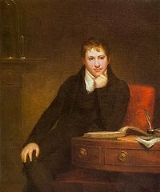
Humphry Davy

 
Humphry Davy

   Email Print
   Bookmark   Link


Humphry Davy


Sir Humphry Davy, 1st Baronet FRS MRIA
Royal Irish Academy

The Royal Irish Academy , based in Dublin, is an Ireland, independent, academic body that promotes study and excellence in the sciences, humanities and social sciences....
 (17 December 1778 – 29 May 1829) was a Cornish
Cornish

Cornish may refer to:...
 chemist
Chemist

A chemist is a scientist trained in the science of chemistry. Chemists study the composition of matter and its properties such as density, acidity, size and shape....
 and inventor. He is probably best remembered today for his discoveries of several alkali
Alkali metal

The alkali metals are a chemical series of chemical elements comprising Periodic table group of the periodic table: lithium , sodium , potassium , rubidium , caesium , and francium ....
 and alkaline earth metal
Alkaline earth metal

The alkaline earth metals are a chemical series of chemical element comprising Periodic table group of the periodic table: beryllium , magnesium , calcium , strontium , barium and radium ....
s, as well as contributions to the discoveries of the elemental nature of chlorine
Chlorine

Chlorine...
 and iodine
Iodine

Iodine , is a chemical element that has the symbol I and atomic number 53. Naturally-occurring iodine is a single isotope with 74 neutrons....
. He invented the Davy lamp
Davy lamp

The Davy lamp is a safety lamp containing a candle, devised in 1815 by Sir Humphry Davy. It was created for use in coal mines, allowing deep seams to be mined despite the presence of methane and other flammable gases, called firedamp or minedamp....
, which allowed miners to enter gassy workings. Berzelius
Jöns Jakob Berzelius

Friherre J?ns Jacob Berzelius was a Sweden chemist. He worked out the modern technique of chemical formula, and is together with John Dalton, Antoine Lavoisier, and Robert Boyle considered a father of modern chemistry....
 called Davy's 1806 Bakerian Lecture
Bakerian Lecture

The Bakerian Lecture is a prize lecture of the Royal Society, a lecture on physical sciences.In 1775 Henry Baker left GBP100 for a spoken lecture by a Fellow on such part of natural history or experimental philosophy as the Society shall determine....
 On Some Chemical Agencies of Electricity "one of the best memoirs which has ever enriched the theory of chemistry." This paper was central to any chemical affinity
Chemical affinity

In chemical physics and physical chemistry, chemical affinity can be defined as electronic properties by which dissimilar chemical species are capable of forming chemical compounds....
 theory in the first half of the nineteenth century.

was born at Penzance
Penzance

Penzance is a town, civil parish, and port in the Penwith district of Cornwall, England, UK.Granted various Royal Charters from 1512 onwards and Incorporation in 1614, it has a population of 20,255 and is currently Penwith's principal town....
 in Cornwall
Cornwall

Cornwall , constitutional Duchy and palatine, is a metropolitan and non-metropolitan counties of England of England, United Kingdom, located at the tip of the south-western peninsula of Great Britain....
 on 17 December 1778.


Discussion
Ask a question about 'Humphry Davy'
Start a new discussion about 'Humphry Davy'
Answer questions from other users
Full Discussion Forum


Encyclopedia


Sir Humphry Davy, 1st Baronet FRS MRIA
Royal Irish Academy

The Royal Irish Academy , based in Dublin, is an Ireland, independent, academic body that promotes study and excellence in the sciences, humanities and social sciences....
 (17 December 1778 – 29 May 1829) was a Cornish
Cornish

Cornish may refer to:...
 chemist
Chemist

A chemist is a scientist trained in the science of chemistry. Chemists study the composition of matter and its properties such as density, acidity, size and shape....
 and inventor. He is probably best remembered today for his discoveries of several alkali
Alkali metal

The alkali metals are a chemical series of chemical elements comprising Periodic table group of the periodic table: lithium , sodium , potassium , rubidium , caesium , and francium ....
 and alkaline earth metal
Alkaline earth metal

The alkaline earth metals are a chemical series of chemical element comprising Periodic table group of the periodic table: beryllium , magnesium , calcium , strontium , barium and radium ....
s, as well as contributions to the discoveries of the elemental nature of chlorine
Chlorine

Chlorine...
 and iodine
Iodine

Iodine , is a chemical element that has the symbol I and atomic number 53. Naturally-occurring iodine is a single isotope with 74 neutrons....
. He invented the Davy lamp
Davy lamp

The Davy lamp is a safety lamp containing a candle, devised in 1815 by Sir Humphry Davy. It was created for use in coal mines, allowing deep seams to be mined despite the presence of methane and other flammable gases, called firedamp or minedamp....
, which allowed miners to enter gassy workings. Berzelius
Jöns Jakob Berzelius

Friherre J?ns Jacob Berzelius was a Sweden chemist. He worked out the modern technique of chemical formula, and is together with John Dalton, Antoine Lavoisier, and Robert Boyle considered a father of modern chemistry....
 called Davy's 1806 Bakerian Lecture
Bakerian Lecture

The Bakerian Lecture is a prize lecture of the Royal Society, a lecture on physical sciences.In 1775 Henry Baker left GBP100 for a spoken lecture by a Fellow on such part of natural history or experimental philosophy as the Society shall determine....
 On Some Chemical Agencies of Electricity "one of the best memoirs which has ever enriched the theory of chemistry." This paper was central to any chemical affinity
Chemical affinity

In chemical physics and physical chemistry, chemical affinity can be defined as electronic properties by which dissimilar chemical species are capable of forming chemical compounds....
 theory in the first half of the nineteenth century.

Biography

Davy was born at Penzance
Penzance

Penzance is a town, civil parish, and port in the Penwith district of Cornwall, England, UK.Granted various Royal Charters from 1512 onwards and Incorporation in 1614, it has a population of 20,255 and is currently Penwith's principal town....
 in Cornwall
Cornwall

Cornwall , constitutional Duchy and palatine, is a metropolitan and non-metropolitan counties of England of England, United Kingdom, located at the tip of the south-western peninsula of Great Britain....
 on 17 December 1778. The parish register of Madron
Madron

Madron is a village and civil parish in the district of Penwith, Cornwall in the United Kingdom. The parish encompasses the villages of Tredinnick, Lower Ninnes, New Mill, Cornwall, Newbridge, Cornwall and Tregavarah and is bounded by the parishes of Sancreed and St Just in Penwith to the west, by Zennor and Morvah to the north, by the sea a...
 (the parish church) records ‘Humphry Davy, son of Robert Davy, baptized at Penzance, January 22nd, 1779.’ Robert Davy was a wood-carver at Penzance, who pursued his art rather for amusement than profit. As the representative of an old family (monuments to his ancestors in Ludgvan
Ludgvan

Ludgvan is a village and civil parish in the Penwith district of Cornwall, United Kingdom. The parish includes the villages of Ludgvan, Crowlas, Canon's Town and Long Rock....
 Church date as far back as 1635), he became possessor of a modest patrimony. His wife, Grace Millett, came of an old but no longer wealthy family. Her parents died within a few hours of each other from malignant fever, when Grace and her two sisters were adopted by John Tonkin, an eminent surgeon in Penzance. Robert Davy and his wife became the parents of five children—two boys, Humphry, the eldest, and John
John Davy (chemist)

John Davy Fellow of the Royal Society was a British doctor, amateur chemist, and brother of the noted chemist Sir Humphry Davy, and cousin of Edmund Davy....
, and three girls. In Davy's childhood the family moved from Penzance to Varfell
Varfell

Varfell is a hamlet within the parish of Ludgvan, Cornwall, UK. Varfell was formerly the ancestral home of chemist Humphry Davy.Varfell is now one the centres of production for the large flower and bulb growers Winchester Bulbs....
, their family estate in Ludgvan. Davy's boyhood was spent partly with his parents and partly with Tonkin, who placed him at a preparatory school kept by a Mr. Bushell, who was so much struck with the boy's progress that he persuaded the father to send him to a better school. Davy was at an early age placed at the Penzance grammar school, then under the care of the Rev. J. C. Coryton. Numerous anecdotes show that Davy was a precocious boy, possessing a remarkable memory and being singularly rapid in acquiring knowledge of books. He was especially attracted by the ‘Pilgrim's Progress,’ and he delighted in reading history. When but eight years of age he would collect a number of boys, and standing on a cart in the market-place address them on the subject of his latest reading. He delighted in the folklore of this remote district, and became, as he himself tells us, a ‘tale-teller.’ The ‘applause of my companions,’ he says, ‘was my recompense for punishments incurred for being idle.’ These conditions developed a love of poetry and the composition of verses and ballads.

At the same time Davy acquired a taste for experimental science. This was mainly due to a member of the Society of Friends named Robert Dunkin, a saddler and a man of original mind and of the most varied acquirements. Dunkin constructed for himself an electrical machine, voltaic piles, and Leyden jar
Leyden jar

The Leyden jar, or Leiden jar, is a device that "stores" static electricity between two electrodes on the inside and outside of a jar. It was invented in 1745 by Pieter van Musschenbroek , in Leiden, The Netherlands....
s, and made models illustrative of the principles of mechanics. By the aid of these appliances he instructed Davy in the rudiments of science. As professor at the Royal Institution
Royal Institution

The Royal Institution of Great Britain is an organization devoted to scientific education and research, based in London. It was founded in 1799 by the leading British scientists of the age, including Henry Cavendish and its first president, George Finch, 9th Earl of Winchilsea, for "diffusing the knowledge, and facilitating the general int...
, Davy repeated many of the ingenious experiments which he had learned from his Quaker instructor. From the Penzance school Davy went in 1793 to Truro
Truro

Truro is a City status in the United Kingdom in Cornwall, England, United Kingdom, and is the centre for administration, leisure and retail in Cornwall, with a population of 20,920....
, and finished his education under the Rev. Dr. Cardew, who, in a letter to Davies Gilbert
Davies Gilbert

Davies Gilbert was a United Kingdom engineer, author, and politician. He was elected to the Royal Society on November 17, 1791 and served as President of the Royal Society from 1827 to 1830....
, says: ‘I could not discern the faculties by which he was afterwards so much distinguished.’ Davy says himself: ‘I consider it fortunate I was left much to myself as a child, and put upon no particular plan of study. … What I am I made myself.’

Apprentice and poet

After the death of Davy's father in 1794, Tonkin apprenticed the boy to John Bingham Borlase, a surgeon in large practice at Penzance. Davy's indenture
Indenture

An Indenture is a legal contract between two parties, particularly for Indentured servant or a term of apprenticeship but also for certain real estate transactions....
 is dated 10 February 1795. In the apothecary
Apothecary

Apothecary is a historical name for a medicine who formulates and dispenses materia medica to physicians, surgery and patients ? a role now served by a pharmacist ....
's dispensary Davy became a chemist, and a garret in Tonkin's house was the scene of his earliest chemical operations. Davy's friends would often say: ‘This boy Humphry is incorrigible. He will blow us all into the air,’ and his eldest sister complained of the ravages made on her dresses by corrosive substances.

Much has been said of Davy as a poet, and John Ayrton Paris
John Ayrton Paris

'John Ayrton Paris' was a United Kingdom physician. He is most widely remembered as the probable inventor of the thaumatrope, which he used to demonstrate persistence of vision to the Royal College of Physicians in London in 1824; at about this time he wrote a book entitled Philosophy in sport made science in earnest : being an attempt to i...
 somewhat hastily says that his verses ‘bear the stamp of lofty genius.’ Davy's first production preserved bears the date of 1795. It is entitled ‘The Sons of Genius,’ and is marked by the usual immaturity of youth. The poems, produced in the following years, especially those ‘On the Mount's Bay’ and ‘St. Michael's Mount,’ are pleasingly descriptive verses, showing sensibility, but no true poetic imagination. Davy soon abandoned poetry for science. While writing verses at the age of seventeen in honour of his first love, he was eagerly discussing with his Quaker friend the question of the materiality of heat. Dunkin once remarked: ‘I tell thee what, Humphry, thou art the most quibbling hand at a dispute I ever met with in my life.’ One winter day he took Dunkin to Larigan river, to show him that the rubbing of two plates of ice together developed sufficient energy by motion to melt them, and that the motion being suspended the pieces were united by regelation. This was, in a rude form, an elementary version of an analogous experiment later exhibited by Davy in the lecture-room of the Royal Institution, which excited considerable attention.

Early scientific leanings

Davies Giddy, afterwards Davies Gilbert, accidentally saw Davy in Penzance, carelessly swinging on the half-gate of Dr. Borlase's house. Gilbert was interested by the lad's talk, offered him the use of his library, and invited him to his house at Tredrea. This led to an introduction to Dr. Edwards, who then resided at Hayle Copper House, and was also chemical lecturer in the school of St. Bartholomew's Hospital. Dr. Edwards permitted Davy to use the apparatus in his laboratory, and appears to have directed his attention to the floodgates of the port of Hayle
Hayle

Hayle is a small town, civil parish and cargo port in the Penwith district of Cornwall, UK. The parish was created in 1888 from part of the now defunct Phillack parish, with which it was later combined in 1935, and incorporated part of St Erth in 1937....
, which were rapidly decaying from the contact of copper and iron under the influence of seawater. This galvanic action was not then understood, but the phenomenon prepared the mind of Davy for his experiments on the copper sheathing of ships in later days. Gregory Watt, the son of James Watt, visited Penzance for his health's sake, and lodging at Mrs. Davy's house became a friend of her son and gave him instructions in chemistry. Davy also formed a useful acquaintance with the Wedgwoods, who spent a winter at Penzance.

Thomas Beddoes
Thomas Beddoes

Thomas Beddoes , English physician and scientific writer, was born at Shifnal in Shropshire. He was a reforming practitioner and teacher of medicine, and an associate of leading scientific figures....
 and Professor Hailstone
John Hailstone

John Hailstone , geologist, born near London on 13 Dec. 1759, was placed at an early age under the care of a maternal uncle at York, and was sent to Beverley school in the East Riding of Yorkshire....
 were engaged in a geological controversy upon the rival merits of the Plutonian
Plutonism

Plutonic theory is the geologic theory proposed by James Hutton around the turn of the 19th century that volcano was the source of rocks on the surface of the Earth....
 and the Neptunist hypotheses. They travelled together to examine the Cornish coast accompanied by Davies Gilbert, and thus made Davy's acquaintance. Beddoes, who had recently established at Bristol
Bristol

Bristol is a City status in the United Kingdom, unitary authority area and Ceremonial counties of England in South West England, west of London, and east of Cardiff....
 a ‘Pneumatic Institution,’ required an assistant to superintend the laboratory. Gilbert recommended Davy for the post, and Gregory Watt placed (in April 1798) in the hands of Beddoes the ‘Young man's Researches on Heat and Light,’ which were subsequently published by him in the first volume of ‘West-Country Contributions.’ Prolonged negotiations were carried on, mainly by Gilbert. Mrs. Davy and Borlase consented to Davy's departure, but Tonkin desired to fix him in his native town as a surgeon, and actually altered his will when he found that Davy insisted on going to Dr. Beddoes.

The Pneumatic Institution


On 2 October 1798 Davy joined the ‘Pneumatic Institution’ at Bristol. This institution was established for the purpose of investigating the medical powers of factitious airs and gases, and to Davy was committed the superintendence of the various experiments. The arrangement concluded between Dr. Beddoes and Davy was a liberal one, and enabled Davy to give up all claims upon his paternal property in favour of his mother. He did not intend to abandon the profession of medicine, being still determined to study and graduate at Edinburgh. However, he soon found his whole energies absorbed in the labours of the laboratory. During his residence at Bristol, Davy formed the acquaintance of the Earl of Durham
Earl of Durham

Earl of Durham is a title in the Peerage of the United Kingdom. It was created in 1833 for the prominent British Whig Party politician and colonial official John Lambton, 1st Earl of Durham....
, who became a resident for his health in the Pneumatic Institution, and of Samuel Taylor Coleridge
Samuel Taylor Coleridge

Samuel Taylor Coleridge was an England poet, critic and Philosophy who was, along with his friend William Wordsworth, one of the founders of the Romanticism in England and one of the Lake Poets....
 and Robert Southey
Robert Southey

Robert Southey was an English poet of the Romantic poetry school, one of the so-called "Lake Poets", and Poet Laureate for 30 years from 1813 to his death in 1843....
. In December 1799 Davy visited London for the first time, and his circle of friends was there much extended.

In this year the first volume of the ‘West-Country Collections’ was issued. Half of the volume consisted of Davy's essays ‘On Heat, Light, and the Combinations of Light,’ ‘On Phos-oxygen and its Combinations,’ and on the ‘Theory of Respiration.’ On 22 February 1799 Davy, writing to Davies Gilbert, says: ‘I am now as much convinced of the non-existence of caloric as I am of the existence of light.’ In another letter written to Davies Gilbert, on 10 April, Davy informs him: I made a discovery yesterday which proves how necessary it is to repeat experiments. The gaseous oxide of azote (the laughing gas) is perfectly respirable when pure. It is never deleterious but when it contains nitrous gas. I have found a mode of making it pure.’ He then says that he breathed sixteen quarts of it for nearly seven minutes, and that it ‘absolutely intoxicated me.’ During this year Davy published his ‘Researches, Chemical and Philosophical, chiefly concerning Nitrous Oxide
Nitrous oxide

Nitrous oxide, commonly known as "laughing gas", is a chemical compound with the chemical formula Nitrogen2Oxygen. At room temperature, it is a colorless Flammability gas, with a pleasant, slightly sweet odor and taste....
 and its Respiration
.’ In after years Davy regretted that he had ever published these immature hypotheses, which he himself subsequently designated as ‘the dreams of misemployed genius which the light of experiment and observation has never conducted to truth.’

The Royal Institution


In 1800 Davy informed Davies Gilbert that he had been ‘repeating the galvanic experiments with success’ in the intervals of the experiments on the gases, which ‘almost incessantly occupied him from January to April.’ In these experiments Davy ran considerable risks. His respiration of nitrous oxide may have led, by its union with common air in the mouth, to the formation of nitrous acid (HNO2), which severely injured the mucous membrane, and in Davy's attempt to breathe carburetted hydrogen gas he ‘seemed sinking into annihilation.’ On being removed into the open air, Davy faintly articulated, ‘I do not think I shall die,’ but some hours elapsed before the painful symptoms ceased. It is more likely that the nitrous oxide
Nitrous oxide

Nitrous oxide, commonly known as "laughing gas", is a chemical compound with the chemical formula Nitrogen2Oxygen. At room temperature, it is a colorless Flammability gas, with a pleasant, slightly sweet odor and taste....
 (N2O) he inhaled was contaminated by nitric oxide
Nitric oxide

Nitric oxide or nitrogen monoxide is a chemical compound with chemical formula NitrogenOxygen. This gas is an important signaling molecule in the body of mammals, including humans, and is an extremely important intermediate in the chemical industry....
 (NO), a toxic gas which combines with oxygen
Oxygen

Oxygen no O2 produced; 2) O2 produced, but absorbed in oceans & seabed rock; 3) O2 starts to gas out of the oceans, but is absorbed by land surfaces and formation of ozone layer; 4-5) O2 sinks filled and the gas accumulates]]...
 and water to form HNO3
Nitric acid

Nitric acid , also known as aqua fortis and spirit of nitre, is a highly corrosion and toxic strong acid that can cause severe burns....
, a very strong acid and irritant, explaining the pain Davy felt.

Davy's ‘Researches,’ which was full of striking and novel facts, and rich in chemical discoveries, soon attracted the attention of the scientific world, and Davy now made his grand move in life. In 1799 Count Rumford had proposed the establishment in London of an ‘Institution for Diffusing Knowledge,’ i.e. the Royal Institution
Royal Institution

The Royal Institution of Great Britain is an organization devoted to scientific education and research, based in London. It was founded in 1799 by the leading British scientists of the age, including Henry Cavendish and its first president, George Finch, 9th Earl of Winchilsea, for "diffusing the knowledge, and facilitating the general int...
. The house in Albemarle Street
Albemarle Street

Albemarle Street is a street in Mayfair in central London, off Piccadilly. It has historic associations with George Gordon Byron, 6th Baron Byron, whose publisher John Murray was based here, and Oscar Wilde, a member of the Albemarle Club, where an insult he received led to his suing for libel and to his eventual imprisonment....
 was bought in April 1799. Rumford became secretary to the institution, and Dr. Garnett was the first lecturer. Garnett was forced to resign from ill-health in 1801. Rumford had already been empowered to treat with Davy. Personal interviews followed, and on 15 July 1801 it was resolved by the managers ‘that Humphry Davy be engaged in the service of the Royal Institution in the capacity of assistant lecturer in chemistry, director of the chemical laboratory, and assistant editor of the journals of the institution, and that he be allowed to occupy a room in the house, and be furnished with coals and candles, and that he be paid a salary of 100l. per annum.’ In 1801 he was nominated professor
Professor

The meaning of the word professor varies. In some English-speaking countries, it refers to a senior academic who holds a departmental chair, especially as head of the Academic department, or a personal chair awarded specifically to that individual....
 at the Royal Institution
Royal Institution

The Royal Institution of Great Britain is an organization devoted to scientific education and research, based in London. It was founded in 1799 by the leading British scientists of the age, including Henry Cavendish and its first president, George Finch, 9th Earl of Winchilsea, for "diffusing the knowledge, and facilitating the general int...
 of Great Britain and Fellow of the Royal Society
Royal Society

The Royal Society of London for the Improvement of Natural Knowledge, known simply as the Royal Society, or even the Royal, is a learned society for science that was founded in 1660 and is considered by most to be the oldest such society still in existence....
, over which he would later preside.

Electrolysis

Davy was a pioneer in the field of electrolysis
Electrolysis

In chemistry and manufacturing, electrolysis is a method of separating Chemical bond chemical compound by passing an electric current through them....
 using the battery
Battery (electricity)

In electronics, a battery or voltaic cell is a combination of one or more electrochemical cell Galvanic cells which store chemical energy that can be converted into electric potential energy, creating electricity....
 to split up common compounds and thus prepare many new elements. He went on to electrolyse molten salts and discovered several new metals, especially sodium
Sodium

Sodium is an element which has the symbol Na , atomic number 11, atomic mass 23 amu , and a common oxidation number +1. Sodium is a soft, silvery white, highly reactive element and is a member of the alkali metals within "group 1" ....
 and potassium
Potassium

Potassium is a chemical element. It has the symbol K , atomic number 19, and atomic mass 39.0983. Potassium was first isolated from potash, hence the name....
, highly reactive elements known as the alkali metal
Alkali metal

The alkali metals are a chemical series of chemical elements comprising Periodic table group of the periodic table: lithium , sodium , potassium , rubidium , caesium , and francium ....
s. Potassium was discovered in 1807 by Davy, who derived it from caustic potash (KOH). Before the 18th century, no distinction was made between potassium and sodium. Potassium was the first metal that was isolated by electrolysis. Sodium was first isolated by Davy in the same year by passing an electric current through molten sodium hydroxide
Sodium hydroxide

Sodium hydroxide , also known as lye, caustic soda and sodium hydrate, is a caustic metallic Base . Sodium hydroxide forms a strong alkaline solution when dissolved in a solvent such as water, however, only the hydroxide ion is basic....
. Sodium quickly oxidizes in air and is violently reactive with water, so it must be stored in an inert medium, such as kerosene. Sodium is present in great quantities in the earth's oceans as sodium chloride
Sodium chloride

Sodium chloride, also known as common salt, table salt, or halite, is a chemical compound with the chemical formula SodiumChlorine....
 (common salt). Davy went on to discover calcium
Calcium

Calcium is the chemical element with the symbol Ca and atomic number 20. It has an atomic mass of 40.078 amu. Calcium is a soft grey alkaline earth metal, and is the fifth most abundant element by mass in the earth's Crust ....
 in 1808 by electrolyzing a mixture of Lime and mercuric oxide. Davy was trying to isolate calcium; when he heard that Berzelius
Jöns Jakob Berzelius

Friherre J?ns Jacob Berzelius was a Sweden chemist. He worked out the modern technique of chemical formula, and is together with John Dalton, Antoine Lavoisier, and Robert Boyle considered a father of modern chemistry....
 and Pontin prepared calcium amalgam by electrolyzing lime in mercury, he tried it himself. He worked with electrolysis throughout his life and also discovered magnesium
Magnesium

Magnesium is a chemical element with the symbol Mg, atomic number 12, atomic weight 24.3050 and common oxidation number +2.Magnesium, an alkaline earth metal, is the ninth most abundance of the chemical elements in the universe by mass....
, boron
Boron

Boron is a chemical element with atomic number 5 and the chemical symbol B. Boron is a trivalent metalloid element which occurs abundantly in the evaporite ores borax and ulexite....
 and barium
Barium

Barium is a chemical element. It has the symbol Ba, and atomic number 56. Barium is a soft silvery metallic alkaline earth metal. It is never found in nature in its pure form due to its reactivity with Earth's atmosphere....
.

Discovery of chlorine

Chlorine was discovered in 1774 by Swedish chemist Carl Wilhelm Scheele
Carl Wilhelm Scheele

Carl Wilhelm Scheele was a Germany-Sweden pharmaceutical chemist, born in Stralsund, Western Pomerania, Germany . He was the discoverer of many chemical substances, most notably discovering oxygen , molybdenum and chlorine before Humphry Davy....
, who called it dephlogisticated marine acid (see phlogiston theory
Phlogiston theory

The phlogiston theory , first stated in 1667 by J. J. Becher, is a defunct scientific theories that posited the existence of, in addition to the classical classical elements of the Greeks, an additional fire-like element called "phlogiston" that was contained within combustible bodies, and released during combustion....
) and mistakenly thought it contained oxygen. Scheele produced chlorine by reacting manganese dioxide (MnO2) with hydrogen chloride
Hydrogen chloride

The Chemical compound hydrogen chloride has the chemical formula HydrogenChlorine. At room temperature, it is a colorless gas, which forms white fumes of hydrochloric acid upon contact with atmospheric humidity....
 (HCl).

4 HCl + MnO2 ? MnCl2 + 2 H2O + Cl2

Scheele observed several properties of chlorine gas, such as its bleaching effect on litmus, its deadly effect on insects, its yellow-green colour, and the similarity of its smell to that of aqua regia
Aqua regia

Aqua regia is a highly corrosive, fuming yellow or red solution. The mixture is formed by freshly mixing concentrated nitric acid and concentrated hydrochloric acid, usually in a volumetric ratio of 1:3 respectively....
. However, Scheele was unable to publish his findings at the time.

In 1810, chlorine was given its current name by Humphry Davy, who insisted that chlorine was in fact an element
Chemical element

A chemical element is a type of atom that is distinguished by its atomic number; that is, by the number of protons in its atomic nucleus. The term is also used to refer to a pure chemical Chemical substance composed of atoms with the same number of protons....
. He also showed that oxygen
Oxygen

Oxygen no O2 produced; 2) O2 produced, but absorbed in oceans & seabed rock; 3) O2 starts to gas out of the oceans, but is absorbed by land surfaces and formation of ozone layer; 4-5) O2 sinks filled and the gas accumulates]]...
 could not be obtained from the substance known as oxymuriatic acid
Chlorine

Chlorine...
 (HCl solution). This discovery overturned Lavoisier's
Antoine Lavoisier

Antoine-Laurent de Lavoisier , the Fathers_of_scientific_fields#Chemistry, was a French people noble prominent in the histories of chemistry and biology....
 definition of acids as compounds of oxygen.

Popular public figure


Sir Humphry revelled in his public status, as his lectures gathered many spectators. He became well known due to his experiments with the physiological action of some gas
Gas

In physics, a gas is a state of matter, consisting of a collection of particles without a definite shape or volume that are in more or less random motion....
es, including laughing gas (nitrous oxide
Nitrous oxide

Nitrous oxide, commonly known as "laughing gas", is a chemical compound with the chemical formula Nitrogen2Oxygen. At room temperature, it is a colorless Flammability gas, with a pleasant, slightly sweet odor and taste....
) - to which he was addicted, once stating that its properties bestowed all of the benefits of alcohol but was devoid of its flaws.

Davy later damaged his eyesight in a laboratory accident with nitrogen trichloride
Nitrogen trichloride

Nitrogen trichloride, also known as trichloramine, trichlorine nitride is the chemical compound with the chemical formula NCl3....
. Pierre Louis Dulong
Pierre Louis Dulong

Pierre Louis Dulong was a France physicist and chemist, remembered today largely for the law of Dulong and Petit....
 first prepared this compound in 1812, and lost two fingers and an eye in two separate explosions with it. Davy's own accident induced him to hire Michael Faraday
Michael Faraday

Michael Faraday, Fellow of the Royal Society was an English chemist and physicist who contributed to the fields of electromagnetism and electrochemistry....
 as a coworker.

European travels

Rough Diamond
In 1812, Davy was knighted, gave a farewell lecture to the Royal Institution, and married a wealthy widow, Jane Apreece
Jane Apreece

Jane Apreece , was a wealthy Scotland socialite and widow who married Sir Humphry Davy in 1812 to become Lady Davy. The marriage was ultimately unhappy and childless....
. (While generally acknowledged as being faithful to his wife, their relationship was stormy, and in his later years Davy travelled to continental Europe alone.) In October 1813, he and his wife, accompanied by Michael Faraday
Michael Faraday

Michael Faraday, Fellow of the Royal Society was an English chemist and physicist who contributed to the fields of electromagnetism and electrochemistry....
 as his scientific assistant (and valet), travelled to France to collect a medal that Napoleon Bonaparte had awarded Davy for his electro-chemical work. While in Paris, Davy was asked by Gay-Lussac
Joseph Louis Gay-Lussac

Joseph Louis Gay-Lussac was a France chemistry and physics. He is known mostly for Gay-Lussac's law related to gases, and for his work on alcohol-water mixtures, which led to the degrees Gay-Lussac used to measure alcoholic beverages in many countries....
 to investigate a mysterious substance isolated by Bernard Courtois
Bernard Courtois

Bernard Courtois, also spelled Barnard Courtois, was a France chemist born in Dijon....
. Davy showed it to be an element, which is now called iodine
Iodine

Iodine , is a chemical element that has the symbol I and atomic number 53. Naturally-occurring iodine is a single isotope with 74 neutrons....
.

The party left Paris in December 1813, travelling south to Italy. They sojourned in Florence
Florence

Florence is the Capital city of the Italy Regions of Italy of Tuscany and of the provinces of Italy Province of Florence. It is the most populous city in Tuscany and has a population of 364,779 ....
, where, in a series of experiments conducted with Faraday's assistance, Davy succeeded in using the sun's rays to ignite diamond
Diamond

In mineralogy, diamond is the Allotropes of carbon where the carbon atoms are arranged in an isometric-hexoctahedral crystal lattice. After graphite, diamond is the second most stable form of carbon....
, proving it is composed of pure carbon
Carbon

Carbon is a chemical element with chemical symbol C and atomic number 6. As a member of group 14 on the periodic table, it is nonmetallic and tetravalence?making four electrons available to form covalent bond chemical bonds....
.

Davy's party continued to Rome
Rome

Rome is the capital city of Italy and Lazio, and is Italy's largest and most populous city, with 2,724,347 residents in an urban area of some ....
, and also visited Naples
Naples

Naples is a city in southern Italy, the capital of the region of Campania and of the province of Naples. The city is known for its rich history, art, culture and gastronomy, playing an important role throughout much of its existence; it is over 2,800 years old....
 and Mount Vesuvius
Mount Vesuvius

Mount Vesuvius is an stratovolcano east of Naples Italy. It is the only volcano on the European mainland to have erupted within the last hundred years, although it is not currently eruption....
. By June 1814, they were in Milan
Milan

Milan is the second largest city of Italy, located in the plains of Lombardy. It is the capital in the Province of Milan, as well as the Regions of Italy capital of Lombardy....
, where they met Alessandro Volta
Alessandro Volta

Count Alessandro Antonio Anastasio Volta was a Lombardy Physics known especially for the development of the first cell in 1800....
, and then continued north to Geneva
Geneva

Geneva is the second-most-populous city in Switzerland and is the most populous city of Romandie . Situated where the Rh?ne River exits Lake Geneva , it is the capital of the Canton of Geneva....
. They returned to Italy via Munich
Munich

Munich is the capital city of Bavaria, Germany. Munich is located on the River Isar north of the Northern Limestone Alps. Munich is the third largest city in Germany, after Berlin and Hamburg....
 and Innsbruck
Innsbruck

Innsbruck is the Capital of the federal state of Tyrol in western Austria. It is located in the Inn River Valley at the junction with the Wipptal , which provides access to the Brenner Pass, some 30 km south of Innsbruck....
, and when their plans to travel to Greece and Constantinople
Constantinople

Constantinople was the empire capital of the Roman Empire , the Byzantine Empire , the Latin Empire , and the Ottoman Empire . Strategically located between the Golden Horn and the Sea of Marmara at the point where Europe meets Asia, Byzantine Constantinople had been the capital of a Christendom empire, successor to ancient ancient Greece...
 (Istanbul) were abandoned after Napoleon's escape from Elba
Elba

Elba is an island in Tuscany, Italy, from the coastal town of Piombino. It is the largest island of the Tuscan Archipelago, and the third largest List of islands of Italy after Sicily and Sardinia....
, they returned to England.

Davy lamp
Davy Lamp
After his return to England in 1815, Davy experimented with lamps for use in coal mines. There had been many mining explosions caused by firedamp
Firedamp

Firedamp is a flammable gas found in coal mining. It is actually the name given to a number of flammable gases, including methane. It is particularly commonly found in areas where the coal is Bituminous coal....
 or methane
Methane

Methane is a chemical compound with the molecular formula . It is the simplest alkane, and the principal component of natural gas. Methane's bond angles are 109.5 degrees....
 often ignited by open flames of the lamps then used by miners. In particular the Felling mine disaster
Felling mine disaster

Felling mine disaster was one of the first major Mining accidents or mine disasters in Great Britain, claiming 92 lives on 25 May 1812.The colliery was situated between Gateshead and Jarrow in what used to be County Durham, now South Tyneside and had two shafts about 600 feet deep....
 in 1812 near Newcastle
Newcastle upon Tyne

Newcastle upon Tyne is a City status in the United Kingdom and metropolitan borough of Tyne and Wear, in North East England. Situated on the north bank of the River Tyne, the city developed from a Roman Empire settlement called Pons Aelius, though it owes its name to the Newcastle Castle built in 1080, by Robert Curthose, the eldest son of...
 caused great loss of life, and action was needed to improve underground lighting and especially the lamps used by miners. Davy conceived of using an iron gauze to enclose a lamp's flame, and so prevent the methane burning inside the lamp from passing out to the general atmosphere. Although the idea of the safety lamp
Safety lamp

A safety lamp is any of several types of Light fixture, which are designed to be safe to use in coal mines. These lamps are designed to operate in air that may contain coal dust, methane, or firedamp, all of which are potentially flammable or explosive....
 had already been demonstrated by William Reid Clanny
William Reid Clanny

William Reid Clanny was an Irish inventor.He was born in Bangor, Northern Ireland, County Down, Ireland. He moved to Sunderland, England and practised as a physician for 45 years....
 and by the then unknown (but later very famous) engineer George Stephenson
George Stephenson

George Stephenson was an England civil engineer and mechanical engineering who built the first public railway line in the world to use steam engine locomotives and is known as the "Father of Railways"....
, Davy's use of wire gauze to prevent the spread of flame was used by many other inventors in their later designs. George Stephenson's lamp was very popular in the north-east coalfields, and used the same principle of preventing the flame reaching the general atmosphere, but by different means. Unfortunately, although the new design of gauze lamp initially did seem to offer protection, it gave much less light, and quickly deteriorated in the wet conditions of most pits. Rusting of the gauze quickly made the lamp unsafe, and the number of deaths from firedamp explosions rose yet further.

There was some discussion as to whether Davy had discovered the principles behind his lamp without the help of the work of Smithson Tennant
Smithson Tennant

Smithson Tennant was an English chemist.Tennant is best known for his discovery of the elements iridium and osmium, which he found in the residues from the solution of platinum ores in 1803....
, but it was generally agreed that the work of both men had been independent. Davy refused to patent the lamp, and its invention led to him being awarded the Rumford medal
Rumford Medal

The Rumford Medal is awarded by the Royal Society every alternating year for "an outstandingly important recent discovery in the field of thermal or optical properties of matter made by a scientist working in Europe"....
 in 1816.

Acid-base studies
In 1815 Davy suggested that acid
Acid

An acid is traditionally considered any chemical compound that, when dissolved in water, gives a solution with a hydrogen ion Activity greater than in pure water, i.e....
s were substances that contained replaceable hydrogen
Hydrogen

Hydrogen is the chemical element with atomic number 1. It is represented by the chemical symbol H. At standard temperature and pressure, hydrogen is a colorless, odorless, nonmetallic, tasteless, highly combustion and explosive Diatomic molecule gas with the molecular formula H2....
 – hydrogen that could be partly or totally replaced by metals. When acids reacted with metals they formed salt
Salt

A salt, in chemistry, is defined as the product formed from the neutralisation reaction of acids and base . Salts are ionic compounds composed of cations and anions so that the product is electrically electric charge ....
s. Base
Base (chemistry)

In chemistry, a base is most commonly thought of as an aqueous substance that can accept protons. A base is also often referred to as an alkali if OH- ions are involved....
s were substances that reacted with acids to form salts and water. These definitions worked well for most of the nineteenth century.

Last years and death


In January 1819, Davy was awarded a baronet
Baronet

A baronet or the rare female equivalent, a baronetess , is the holder of a hereditary title awarded by the British Crown known as a baronetcy....
cy, at the time the highest honour ever conferred on a man of science in Britain. A year later he became President of the Royal Society
Royal Society

The Royal Society of London for the Improvement of Natural Knowledge, known simply as the Royal Society, or even the Royal, is a learned society for science that was founded in 1660 and is considered by most to be the oldest such society still in existence....
.

Davy died in Switzerland in 1829, his various inhalations of chemicals finally taking their toll on his health. He is buried in the Plain Palais Cemetery in Geneva
Geneva

Geneva is the second-most-populous city in Switzerland and is the most populous city of Romandie . Situated where the Rh?ne River exits Lake Geneva , it is the capital of the Canton of Geneva....
.

Davy's laboratory assistant, Michael Faraday
Michael Faraday

Michael Faraday, Fellow of the Royal Society was an English chemist and physicist who contributed to the fields of electromagnetism and electrochemistry....
, went on to enhance Davy's work and in the end he became the more famous and influential scientist – to the extent that Davy is supposed to have claimed Faraday as his greatest discovery. However, Davy later accused Faraday of plagiarism
Plagiarism

Plagiarism is the use or close imitation of the language and ideas of another author and representation of them as one's own original work.Within academia, plagiarism by students, professors, or researchers is considered academic dishonesty or academic fraud and offenders are subject to academic censure....
, causing Faraday (the first Fullerian Professor of Chemistry) to cease all research in electromagnetism
Classical electromagnetism

Classical electromagnetism is a theory of electromagnetism that was developed over the course of the 19th century, most prominently by James Clerk Maxwell....
 until his mentor's death.

Of a sanguine, somewhat irritable temperament, Davy displayed characteristic enthusiasm and energy in all his pursuits. As is shown by his verses and sometimes by his prose, his mind was highly imaginative; the poet Coleridge declared that if he “had not been the first chemist, he would have been the first poet of his age,” and Southey said that “he had all the elements of a poet; he only wanted the art.” In spite of his ungainly exterior and peculiar manner, his happy gifts of exposition and illustration won him extraordinary popularity as a lecturer, his experiments were ingenious and rapidly performed, and Coleridge went to hear him “to increase his stock of metaphors.” The dominating ambition of his life was to achieve fame, but though that sometimes betrayed him into petty jealousy, it did not leave him insensible to the claims on his knowledge of the “cause of humanity,” to use a phrase often employed by him in connection with his invention of the miners' lamp. Of the smaller observances of etiquette he was careless, and his frankness of disposition sometimes exposed him to annoyances which he might have avoided by the exercise of ordinary tact.

Legacy and honours

Humphrydavystatuenew2
  • A lunar crater (Davy
    Davy (crater)

    Davy is a small moon Impact crater that is located on the eastern edge of the Mare Nubium. It overlies the lava-flooded remains of the satellite crater Davy Y to the east, a formation which contains a crater chain designated Catena Davy....
    ) is named after Sir Humphry Davy. It has a diameter of 34 km and coordinates of 11.8S, 8.1W.


  • In Penzance
    Penzance

    Penzance is a town, civil parish, and port in the Penwith district of Cornwall, England, UK.Granted various Royal Charters from 1512 onwards and Incorporation in 1614, it has a population of 20,255 and is currently Penwith's principal town....
     in Cornwall
    Cornwall

    Cornwall , constitutional Duchy and palatine, is a metropolitan and non-metropolitan counties of England of England, United Kingdom, located at the tip of the south-western peninsula of Great Britain....
    , Davy's hometown, there is a statue of him in front of the imposing Market House, now owned by Lloyds TSB
    Lloyds TSB

    In January 2009, Lloyds TSB Group changed its name to Lloyds Banking Group. This article is now about the brand Lloyds TSB which is still operated as part of the Lloyds Banking Group....
    , at the top of Market Jew Street, the town's main high street.


  • There also is a secondary school
    Secondary school

    Secondary school is a term used to describe an educational institution where the final stage of compulsory schooling, known as secondary education, takes place....
     in Penzance named Humphry Davy School
    Humphry Davy School

    Humphry Davy School is a comprehensive school in Penzance, Cornwall, in the United Kingdom. The school teaches 11-16 year olds. In 2005 it gained Specialist school, as a Music College....
    . Like James Prescott Joule
    James Prescott Joule

    James Prescott Joule Fellow of the Royal Society was an English physicist and brewing , born in Salford, Lancashire. Joule studied the nature of heat, and discovered its relationship to mechanical work ....
     and Isaac Newton
    Isaac Newton

    Sir Isaac Newton, Fellow of the Royal Society was an English people physicist, mathematician, Astronomy, Natural philosophy, Alchemy, and Theology and one of the the 100 in human history....
    , Davy is remembered in his hometown by a pub. The Sir Humphry Davy pub is located in Penzance opposite the Greenmarket at the end of Market Jew Street.


  • Davy was the subject of the first ever clerihew
    Clerihew

    A clerihew is a whimsical, four-line biographical poem invented by Edmund Clerihew Bentley. The lines are comically irregular in length, and the rhymes, often contrived, are structured AABB....
    .


  • A satellite of the University of Sheffield
    University of Sheffield

    The University of Sheffield is a research university, located in Sheffield in South Yorkshire, England. Ranked within the World's top 100 Universities, it is one of the original Red brick universities and a member of the Russell Group....
     at Golden Smithies Lane in Wath upon Dearne (Manvers) is called Humphry Davy House and is currently home to the School of Nursing and Midwifery, until April 2009.


  • There is a street named after Sir Humphry Davy (Humphry-Davy-Straße) in the industrial quarter of the town of Cuxhaven
    Cuxhaven

    Cuxhaven is a large independent town and seat of the Cuxhaven , in Lower Saxony, Germany. It is situated on the shore of the North Sea at the mouth of the Elbe River....
    , Schleswig-Holstein
    Schleswig-Holstein

    Schleswig-Holstein is the Northern Germany of the sixteen States of Germany of Germany. Its capital city is Kiel, other notable cities are L?beck and Flensburg....
    , Germany.


  • The University of Plymouth
    University of Plymouth

    The University of Plymouth is the largest university in the southwest of England, with over 30,000 students and is the fifth largest UK university based on student population....
     has named one of its science buildings after the chemist


Publications


See Fullmer's work for a full list of Davy's articles. Davy's books are as follows:

(on Davy's safety lamp)

Bibliography


External links


(Davy's first name is spelled incorrectly in this book.)

  • (1830)
  • by J.J. Tobin (1832)
  • (1888)
  • by Thomas Edward Thorpe, New York: Macmillan, 1896
  • by June Z. Fullmer, Philadelphia: American Philosophical Society, 2000


|-