


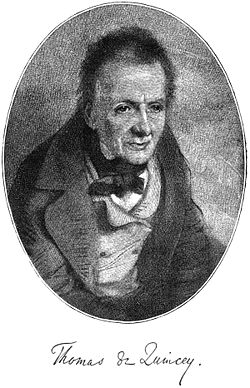
Thomas de Quincey

Encyclopedia

Confessions of an English Opium-Eater
Confessions of an English Opium-Eater is an autobiographical account written by Thomas De Quincey, about his laudanum addiction and its effect on his life...
(1821).
Child and student
De Quincey was born in 86 Cross Street, ManchesterManchester
Manchester is a city and metropolitan borough in Greater Manchester, England. According to the Office for National Statistics, the 2010 mid-year population estimate for Manchester was 498,800. Manchester lies within one of the UK's largest metropolitan areas, the metropolitan county of Greater...
, England. His father was a successful merchant with an interest in literature who died when he was quite young. Soon after his birth the family went to The Farm and then later to Greenheys, a larger country house in Chorlton on Medlock near Manchester. In 1796 De Quincey's mother, now a widow, moved to Bath and enrolled him at King Edward's School, Bath
King Edward's School, Bath
King Edward's School , Bath, Somerset, England is an independent school providing education for 950 pupils aged 3 to 18.The school is a member of The Headmasters' and Headmistresses' Conference....
.
De Quincey was a weak and sickly child. His youth was spent in solitude, and when his elder brother, William, came home, he wreaked havoc in the quiet surroundings. De Quincey's mother (who counted Hannah More
Hannah More
Hannah More was an English religious writer, and philanthropist. She can be said to have made three reputations in the course of her long life: as a poet and playwright in the circle of Johnson, Reynolds and Garrick, as a writer on moral and religious subjects, and as a practical...
amongst her friends) was a woman of strong character and intelligence, but seems to have inspired more awe than affection in her children. She brought them up very strictly, taking Thomas out of school after three years because she was afraid he would become big-headed, and sending him to an inferior school at Winkfield in Wiltshire
Wiltshire
Wiltshire is a ceremonial county in South West England. It is landlocked and borders the counties of Dorset, Somerset, Hampshire, Gloucestershire, Oxfordshire and Berkshire. It contains the unitary authority of Swindon and covers...
.
In 1800, De Quincey, aged fifteen, was ready for the University of Oxford
University of Oxford
The University of Oxford is a university located in Oxford, United Kingdom. It is the second-oldest surviving university in the world and the oldest in the English-speaking world. Although its exact date of foundation is unclear, there is evidence of teaching as far back as 1096...
; his scholarship was far in advance of his years. "That boy," his master at King Edward's School had said, "could harangue an Athenian mob better than you or I could address an English one." He was sent to Manchester Grammar School
Manchester Grammar School
The Manchester Grammar School is the largest independent day school for boys in the UK . It is based in Manchester, England...
, in order that after three years' stay he might obtain a scholarship to Brasenose College, Oxford
Brasenose College, Oxford
Brasenose College, originally Brazen Nose College , is one of the constituent colleges of the University of Oxford in the United Kingdom. As of 2006, it has an estimated financial endowment of £98m...
, but he took flight after nineteen months.
His first plan had been to reach William Wordsworth
William Wordsworth
William Wordsworth was a major English Romantic poet who, with Samuel Taylor Coleridge, helped to launch the Romantic Age in English literature with the 1798 joint publication Lyrical Ballads....
, whose Lyrical Ballads
Lyrical Ballads
Lyrical Ballads, with a Few Other Poems is a collection of poems by William Wordsworth and Samuel Taylor Coleridge, first published in 1798 and generally considered to have marked the beginning of the English Romantic movement in literature...
(1798) had consoled him in fits of depression and had awakened in him a deep reverence for the poet. But for that De Quincey was too timid, so he made his way to Chester, where his mother dwelt, in the hope of seeing a sister; he was caught by the older members of the family, but, through the efforts of his uncle, Colonel Penson, received the promise of a guinea a week to carry out his later project of a solitary tramp through Wales
Wales
Wales is a country that is part of the United Kingdom and the island of Great Britain, bordered by England to its east and the Atlantic Ocean and Irish Sea to its west. It has a population of three million, and a total area of 20,779 km²...
. From July to November, 1802, De Quincey lived as a wayfarer. He soon lost his guinea by ceasing to keep his family informed of his whereabouts, and had difficulty making ends meet. Still apparently fearing pursuit, he borrowed some money and travelled to London
London
London is the capital city of :England and the :United Kingdom, the largest metropolitan area in the United Kingdom, and the largest urban zone in the European Union by most measures. Located on the River Thames, London has been a major settlement for two millennia, its history going back to its...
, where he tried to borrow more. Having failed, he lived close to starvation rather than return to his family.
This deprived period left a profound mark upon De Quincey's psychology, and upon the writing he would later do; it forms a major and crucial part of the first section of the Confessions, and re-appears in various forms throughout the vast body of his lifetime literary work.
Discovered by chance by his friends, De Quincey was brought home and finally allowed to go to Worcester College, Oxford
Worcester College, Oxford
Worcester College is one of the constituent colleges of the University of Oxford in England. The college was founded in the eighteenth century, but its predecessor on the same site had been an institution of learning since the late thirteenth century...
, on a reduced income. Here, we are told, "he came to be looked upon as a strange being who associated with no one." During this time he began to take opium
Opium
Opium is the dried latex obtained from the opium poppy . Opium contains up to 12% morphine, an alkaloid, which is frequently processed chemically to produce heroin for the illegal drug trade. The latex also includes codeine and non-narcotic alkaloids such as papaverine, thebaine and noscapine...
. He completed his studies, but failed to take the oral examination leading to a degree; he left the university without graduating. He became an acquaintance of Samuel Taylor Coleridge
Samuel Taylor Coleridge
Samuel Taylor Coleridge was an English poet, Romantic, literary critic and philosopher who, with his friend William Wordsworth, was a founder of the Romantic Movement in England and a member of the Lake Poets. He is probably best known for his poems The Rime of the Ancient Mariner and Kubla...
and William Wordsworth
William Wordsworth
William Wordsworth was a major English Romantic poet who, with Samuel Taylor Coleridge, helped to launch the Romantic Age in English literature with the 1798 joint publication Lyrical Ballads....
, having already sought out Charles Lamb in London. His acquaintance with Wordsworth led to his settling in 1809 at Grasmere
Grasmere
Grasmere is a village, and popular tourist destination, in the centre of the English Lake District. It takes its name from the adjacent lake, and is associated with the Lake Poets...
, in the Lake District. His home for ten years was Dove Cottage
Dove Cottage
Dove Cottage is a house on the edge of Grasmere in the Lake District. It is best known as the home of the poet William Wordsworth and his sister Dorothy Wordsworth from December 1799 to May 1808, where they spent over eight years of "plain living, but high thinking"...
, which Wordsworth had occupied and which is now a popular tourist attraction. De Quincey was married in 1816, and soon after, having no money left, he took up literary work in earnest.
(His wife Margaret bore him eight children before her death in 1837. Five, however, predeceased their father; three of De Quincey's daughters survived him.)
Journalist
In July 1818 De Quincey became editor of the Westmorland Gazette, a ToryTory
Toryism is a traditionalist and conservative political philosophy which grew out of the Cavalier faction in the Wars of the Three Kingdoms. It is a prominent ideology in the politics of the United Kingdom, but also features in parts of The Commonwealth, particularly in Canada...
newspaper published in Kendal
Kendal
Kendal, anciently known as Kirkby in Kendal or Kirkby Kendal, is a market town and civil parish within the South Lakeland District of Cumbria, England...
, after its first editor had been dismissed. He was unreliable at meeting deadlines, and in June 1819 the proprietors complained about "their dissatisfaction with the lack of ‘regular communication between the Editor and the Printer’", and he resigned in November 1819. De Quincey's political sympathies tended towards the right. He was "a champion of aristocratic privilege," reserved "Jacobin
Jacobin
Jacobin may refer to:* Jacobin , a member of the Jacobin club, or political radical, generally* The Jacobin Club, a political club during the French Revolution* Jacobin , an American leftist political magazine....
" as his highest term of opprobrium, held reactionary
Reactionary
The term reactionary refers to viewpoints that seek to return to a previous state in a society. The term is meant to describe one end of a political spectrum whose opposite pole is "radical". While it has not been generally considered a term of praise it has been adopted as a self-description by...
views on the Peterloo massacre
Peterloo Massacre
The Peterloo Massacre occurred at St Peter's Field, Manchester, England, on 16 August 1819, when cavalry charged into a crowd of 60,000–80,000 that had gathered to demand the reform of parliamentary representation....
and the Sepoy rebellion
Indian Rebellion of 1857
The Indian Rebellion of 1857 began as a mutiny of sepoys of the British East India Company's army on 10 May 1857, in the town of Meerut, and soon escalated into other mutinies and civilian rebellions largely in the upper Gangetic plain and central India, with the major hostilities confined to...
, on Catholic emancipation
Catholic Emancipation
Catholic emancipation or Catholic relief was a process in Great Britain and Ireland in the late 18th century and early 19th century which involved reducing and removing many of the restrictions on Roman Catholics which had been introduced by the Act of Uniformity, the Test Acts and the penal laws...
and the enfranchisement of the common people, and yet was also a staunch abolitionist on the issue of slavery
Slavery
Slavery is a system under which people are treated as property to be bought and sold, and are forced to work. Slaves can be held against their will from the time of their capture, purchase or birth, and deprived of the right to leave, to refuse to work, or to demand compensation...
.
Translator and essayist
In 1821 he went to London to dispose of some translations from German authors, but was persuaded first to write and publish an account of his opiumOpium
Opium is the dried latex obtained from the opium poppy . Opium contains up to 12% morphine, an alkaloid, which is frequently processed chemically to produce heroin for the illegal drug trade. The latex also includes codeine and non-narcotic alkaloids such as papaverine, thebaine and noscapine...
experiences, which that year appeared in the London Magazine
London Magazine
The London Magazine is a historied publication of arts, literature and miscellaneous interests. Its history ranges nearly three centuries and several reincarnations, publishing the likes of William Wordsworth, William S...
. This new sensation eclipsed Lamb's Essays of Elia
Essays of Elia
Essays of Elia is a collection of essays written by Charles Lamb; it was first published in book form in 1823, with a second volume, Last Essays of Elia, issued in 1833 by the publisher Edward Moxon....
, which were then appearing in the same periodical. The Confessions of an English Opium-Eater
Confessions of an English Opium-Eater
Confessions of an English Opium-Eater is an autobiographical account written by Thomas De Quincey, about his laudanum addiction and its effect on his life...
were soon published in book form. De Quincey then made literary acquaintances. Thomas Hood
Thomas Hood
Thomas Hood was a British humorist and poet. His son, Tom Hood, became a well known playwright and editor.-Early life:...
found the shrinking author "at home in a German ocean of literature, in a storm, flooding all the floor, the tables, and the chairs — billows of books ..." De Quincey was famous for his conversation; Richard Woodhouse wrote of the "depth and reality, as I may so call it, of his knowledge ... His conversation appeared like the elaboration of a mine of results ..."
From this time on De Quincey maintained himself by contributing to various magazines. He soon exchanged London and the Lakes for Edinburgh
Edinburgh
Edinburgh is the capital city of Scotland, the second largest city in Scotland, and the eighth most populous in the United Kingdom. The City of Edinburgh Council governs one of Scotland's 32 local government council areas. The council area includes urban Edinburgh and a rural area...
, the nearby village of Polton
Polton
Polton is a village located in Lasswade parish, Midlothian, Scotland, anciently a superiority of the Ramsay family, cadets of Dalhousie. In 1618 David Ramsay of Polton was in possession. ....
, and Glasgow
Glasgow
Glasgow is the largest city in Scotland and third most populous in the United Kingdom. The city is situated on the River Clyde in the country's west central lowlands...
; he spent the remainder of his life in Scotland. Blackwood's Edinburgh Magazine and its rival Tait's Magazine
Tait's Magazine
Tait's Edinburgh Magazine was a monthly periodical founded in 1832. It was an important venue for liberal political views, as well as contemporary cultural and literary developments, in early-to-mid-nineteenth century Britain....
received a large number of contributions. Suspiria de Profundis
Suspiria de Profundis
Suspiria de Profundis is one of the best-known and most distinctive literary works of the English essayist Thomas De Quincey.__FORCETOC__-Genre:...
(1845) appeared in Blackwood's, as did The English Mail-Coach
The English Mail-Coach
The English Mail-Coach is an essay by the English author Thomas De Quincey. A "three-part masterpiece" and "one of his most magnificent works," it first appeared in 1849 in Blackwood's Edinburgh Magazine, in the October and December issues.The essay is divided into three sections:*Part I, "The...
(1849). Joan of Arc (1847) was published in Tait's. Between 1835 and 1849, Tait's published a series of De Quincey's reminiscences of Wordsworth, Coleridge, Robert Southey
Robert Southey
Robert Southey was an English poet of the Romantic school, one of the so-called "Lake Poets", and Poet Laureate for 30 years from 1813 to his death in 1843...
, and other figures among the Lake Poets
Lake Poets
The Lake Poets are a group of English poets who all lived in the Lake District of England at the turn of the nineteenth century. As a group, they followed no single "school" of thought or literary practice then known, although their works were uniformly disparaged by the Edinburgh Review...
— a series that taken together constitutes one of his most important works.
Financial pressures
De Quincey was oppressed by debt for most of his adult life; along with his opium addiction, debt was one of the primary constraints of his existence. He pursued journalism as the one way available to him to pay his bills; and without financial need it is an open question how much writing he would ever have done.De Quincey came into his patrimony at the age of 21, when he received ₤2000 from his late father's estate. He was unwisely generous with his funds, making loans that could not or would not be repaid, including a ₤300 loan to Coleridge in 1807. After leaving Oxford without a degree, he made an attempt to study law, but desultorily and unsuccessfully; he had no steady income and spent large sums on books (he was a lifelong collector). By the 1820s he was constantly in financial difficulties. More than once in his later years, De Quincey was forced to seek protection from arrest in the debtors' sanctuary of Holyrood in Edinburgh. (At the time, Holyrood Park
Holyrood Park
Holyrood Park is a royal park in central Edinburgh, Scotland about a mile to the east of Edinburgh Castle. It has an array of hills, lochs, glens, ridges, basalt cliffs, and patches of whin providing a remarkably wild piece of highland landscape within its area...
formed a debtors' sanctuary; people could not be arrested for debt within those bounds.The debtors who took sanctuary there could only emerge on Sundays, when arrests for debt were not allowed.) Yet De Quincey's money problems persisted; he got into further difficulties for debts he acquired within the sanctuary.
His financial situation improved only later in his life. His mother's death in 1846 brought him an income of ₤200 per year. When his daughters matured, they managed his budget more responsibly than he ever had himself.
Medical issues
A number of medical practitioners have speculated on the physical ailments that inspired and underlay De Quincey's resort to opium, and searched the corpus of his autobiographical works for evidence. One possibility is "a mild ... case of infantile paralysis" that he may have contracted from Wordsworth's children. De Quincey certainly had intestinal problems, and problems with his vision — which could have been related: "uncorrected myopic astigmatism ... manifests itself as digestive problems in men." De Quincey also suffered neuralgic facial pain, "trigeminal neuralgia" — "attacks of piercing pain in the face, of such severity that they sometimes drive the victim to suicide."As with many addicts, De Quincey's opium addiction may have had a "self-medication" aspect for real physical illnesses, as well as a psychological aspect. Psychologically, he had what Alethea Hayter has called the "pariah temperament" typical of drug addicts.
By his own testimony, De Quincey first used opium in 1804 to relieve his neuralgia; he used it for pleasure, but no more than weekly, through 1812. It was in 1813 that he first commenced daily usage, in response to illness and his grief over the death of Wordsworth's young daughter Catherine. In the periods of 1813–16 and 1817–19 his daily dose was very high, and resulted in the sufferings recounted in the final sections of his Confessions. For the rest of his life his opium use fluctuated between extremes; he took "enormous doses" in 1843, but late in 1848 he went for 61 days with none at all. There are many theories surrounding the effects of opium on literary creation
Opium and Romanticism
Readers of Romantic poetry usually come into contact with literary criticisms about the influence of opium on its works. Whether or not opium had a direct effect is still up for debate, however the literary criticisms that have emerged throughout the years suggest very compelling things about...
, and notably, his periods of low usage were literarily unproductive.
He died in Edinburgh and is buried in St Cuthbert's Churchyard at the west end of Princes street. His stone, in the southwest section of the churchyard on a west facing wall, is plain and says nothing of his work.
Collected works
During the final decade of his life, De Quincey laboured on a collected edition of his works. Ticknor and FieldsTicknor and Fields
Ticknor and Fields was an American publishing company based in Boston, Massachusetts.-Early years:In 1832 William Davis Ticknor and John Allen began a small publishing business which operated out of the Old Corner Bookstore located on Washington and School Streets in Boston, Massachusetts...
, a Boston publishing house, first proposed such a collection, and solicited De Quincey's approval and co-operation. It was only when De Quincey, a chronic procrastinator, failed to answer repeated letters from James Thomas Fields
James Thomas Fields
James Thomas Fields was an American publisher, editor, and poet.-Early life and family:He was born in Portsmouth, New Hampshire on December 31, 1817 and named James Field; the family later added the "s". His father was a sea captain and died before Fields was three...
that the American publisher proceeded independently, reprinting the author's works from their original magazine appearances. Twenty-two volumes of De Quincey's Writings were issued from 1851 to 1859.
The existence of the American edition prompted a corresponding British edition. Since the Spring of 1850 De Quincey had been a regular contributor to an Edinburgh periodical called Hogg's Weekly Instructor whose publisher, James Hogg
James Hogg (publisher)
James Hogg was a Scottish publisher.Hogg, son of James Hogg, was born near Edinburgh on 26 March 1806, and educated under the Rev. Thomas Sheriff, who became minister of Fala, in the presbytery of Dalkeith, in 1828, and died in 1836. On 24 Aug. 1818 Hogg was bound apprentice to James Muirhead,...
, undertook to publish Selections Grave and Gay from Writings Published and Unpublished by Thomas De Quincey. De Quincey edited and revised his works for the Hogg edition; the 1856 second edition of the Confessions was prepared for inclusion in Selections Grave and Gay.... The first volume of that edition appeared in May 1853, and the fourteenth and last in January 1860, a month after the author's death.
Both of these were multi-volume collections, yet made no pretense to be complete. Scholar and editor David Masson attempted a more definitive collection: The Works of Thomas De Quincey appeared in fourteen volumes in 1889 and 1890. Yet De Quincey's writings were so voluminous and widely-dispersed that further collections followed: two volumes of The Uncollected Writings (1890), and two volumes of Posthumous Works (1891–93). De Quincey's 1803 diary was published in 1927. Yet another volume, New Essays by De Quincey, appeared in 1966.
Influence
His immediate influence extended to Edgar Allan PoeEdgar Allan Poe
Edgar Allan Poe was an American author, poet, editor and literary critic, considered part of the American Romantic Movement. Best known for his tales of mystery and the macabre, Poe was one of the earliest American practitioners of the short story and is considered the inventor of the detective...
, Fitz Hugh Ludlow
Fitz Hugh Ludlow
Fitz Hugh Ludlow, sometimes seen as “Fitzhugh Ludlow,” was an American author, journalist, and explorer; best-known for his autobiographical book The Hasheesh Eater ....
, Charles Baudelaire
Charles Baudelaire
Charles Baudelaire was a French poet who produced notable work as an essayist, art critic, and pioneering translator of Edgar Allan Poe. His most famous work, Les Fleurs du mal expresses the changing nature of beauty in modern, industrializing Paris during the nineteenth century...
, and Nikolai Gogol
Nikolai Gogol
Nikolai Vasilievich Gogol was a Ukrainian-born Russian dramatist and novelist.Considered by his contemporaries one of the preeminent figures of the natural school of Russian literary realism, later critics have found in Gogol's work a fundamentally romantic sensibility, with strains of Surrealism...
, but even major 20th century writers such as Jorge Luis Borges
Jorge Luis Borges
Jorge Francisco Isidoro Luis Borges Acevedo , known as Jorge Luis Borges , was an Argentine writer, essayist, poet and translator born in Buenos Aires. In 1914 his family moved to Switzerland where he attended school, receiving his baccalauréat from the Collège de Genève in 1918. The family...
admired and claimed to be partly influenced by his work. Berlioz also loosely based his Symphonie Fantastique
Symphonie Fantastique
Symphonie Fantastique: Épisode de la vie d'un Artiste...en cinq parties , Op. 14, is a program symphony written by the French composer Hector Berlioz in 1830. It is one of the most important and representative pieces of the early Romantic period, and is still very popular with concert audiences...
on Confessions of an English Opium Eater, drawing on the theme of the internal struggle with one's self. De Quincey is also referred to in the Sherlock Holmes
Sherlock Holmes
Sherlock Holmes is a fictional detective created by Scottish author and physician Sir Arthur Conan Doyle. The fantastic London-based "consulting detective", Holmes is famous for his astute logical reasoning, his ability to take almost any disguise, and his use of forensic science skills to solve...
short story The Man with the Twisted Lip
The Man with the Twisted Lip
"The Man with the Twisted Lip", one of the 56 short Sherlock Holmes stories written by British author Sir Arthur Conan Doyle, is the sixth of the twelve stories in The Adventures of Sherlock Holmes. The story was first published in the Strand Magazine in December 1891...
.
Online texts
- Project GutenbergProject GutenbergProject Gutenberg is a volunteer effort to digitize and archive cultural works, to "encourage the creation and distribution of eBooks". Founded in 1971 by Michael S. Hart, it is the oldest digital library. Most of the items in its collection are the full texts of public domain books...
e-texts of some of Thomas De Quincey's works - WikisourceWikisourceWikisource is an online digital library of free content textual sources on a wiki, operated by the Wikimedia Foundation. Its aims are to host all forms of free text, in many languages, and translations. Originally conceived as an archive to store useful or important historical texts, it has...
: Les Derniers jours d'Emmanuel Kant, translated in French by Marcel Schwob - Thomas De Quincey elibrary PDFs of Confessions of an English Opium-Eater, On Murder Considered as One of the Fine Arts, and The Literature of Knowledge and the Literature of Power
- Thomas De Quincey in Spanish
External links
(plain text and HTML)- Work by or about Thomas De Quincey at Internet ArchiveInternet ArchiveThe Internet Archive is a non-profit digital library with the stated mission of "universal access to all knowledge". It offers permanent storage and access to collections of digitized materials, including websites, music, moving images, and nearly 3 million public domain books. The Internet Archive...
(scanned books original editions) - Thomas De Quincey Homepage, maintained by Dr Robert Morrison
- "The fascinating life of an English writer, essayist and 'opium eater'", Michael DirdaMichael DirdaMichael Dirda , a Fulbright Fellowship recipient, is a Pulitzer Prize–winning book critic for the Washington Post.-Career:Having studied at Oberlin College for his undergraduate degree, Dirda took a Ph.D. from Cornell University in comparative literature. In 1978 Dirda started writing for the...
, Washington Post, December 30, 2010 - "Drugs and Words", Laura Marsh, The New RepublicThe New RepublicThe magazine has also published two articles concerning income inequality, largely criticizing conservative economists for their attempts to deny the existence or negative effect increasing income inequality is having on the United States...
, February 15, 2011.