All Topics  
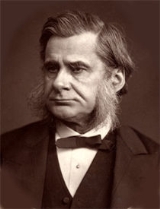
Thomas Huxley

 
Thomas Huxley

   Email Print
   Bookmark   Link


Thomas Huxley


Thomas Henry Huxley PC FRS
Royal Society

The Royal Society of London for the Improvement of Natural Knowledge, known simply as the Royal Society, or even the Royal, is a learned society for science that was founded in 1660 and is considered by most to be the oldest such society still in existence....
 (4 May 1825 – 29 June 1895) was an English
English people

The English are a nation and ethnic group native to England who speak English language in England. The English identity as a people is of early medieval origin, when they were known in Old English as the Anglecynn....
 biologist
Biologist

A biologist is a scientist devoted to and producing results in biology through the study of life.Typically biologists study organisms and their relationship to their environment....
, known as "Darwin's Bulldog" for his advocacy of Charles Darwin
Charles Darwin

Charles Robert Darwin Royal Society was an English people natural history who realised and presented compelling evidence that all species of life have evolution over time from common descent, through the process he called natural selection....
's theory of evolution
Evolution

In biology, evolution is change in the heritability trait of a population of organisms from one generation to the next. These changes are caused by a combination of three main processes: variation, reproduction, and selection....
.

Huxley's famous 1860 debate
1860 Oxford evolution debate

The 1860 Oxford evolution debate took place at the Oxford University Museum of Natural History on 30 June 1860, seven months after the publication of Charles Darwin's On the Origin of Species....
 with Samuel Wilberforce
Samuel Wilberforce

Samuel Wilberforce was an England bishop in the Church of England, third son of William Wilberforce. Known as "Soapy Sam", Wilberforce was one of the greatest public speakers of his day....
 was a key moment in the wider acceptance of evolution
Evolution

In biology, evolution is change in the heritability trait of a population of organisms from one generation to the next. These changes are caused by a combination of three main processes: variation, reproduction, and selection....
, and in his own career. Wilberforce was coached by Richard Owen
Richard Owen

Sir Richard Owen Order of the Bath was an English people biologist, comparative anatomy and paleontology.Owen is probably best remembered today for coining the word Dinosauria and for his outspoken opposition to Charles Darwin's theory of evolution by natural selection....
, against whom Huxley also debated on whether man was closely related to apes. Huxley was slow to accept some of Darwin's ideas, such as gradualism
Gradualism

Gradualism is the belief that changes occur, or ought to occur, slowly in the form of gradual steps ...
, and was undecided about natural selection
Natural selection

Natural selection is the process by which favorable heritable trait become more common in successive generations of a population of Reproduction organisms, and unfavorable heritable traits become less common, due to differential reproduction of genotypes....
, but despite this he was wholehearted in his public support of Darwin.


Discussion
Ask a question about 'Thomas Huxley'
Start a new discussion about 'Thomas Huxley'
Answer questions from other users
Full Discussion Forum


Quotations


For every man the world is as fresh as it was at the first day, and as full of untold novelties for him who has the eyes to see them.

It is the customary fate of new truths to begin as heresies and to end as superstitions.

The Coming of Age of The Origin of Species

The great end of life is not knowledge but action.

"Technical Education" (1877)

To a person uninstructed in natural history, his country or seaside stroll is a walk through a gallery filled with wonderful works of art, nine-tenths of which have their faces turned to the wall.

"On the Educational Value of the Natural History Sciences" (1854)

My business is to teach my aspirations to conform themselves to fact, not to try and make facts harmonise with my aspirations.

Letter to Charles Kingsley (23 September 1860)

I neither deny nor affirm the immortality of man. I see no reason for believing in it, but, on the other hand, I have no means of disproving it.

Letter to Charles Kingsley (23 September 1860)


Encyclopedia


Thomas Henry Huxley PC FRS
Royal Society

The Royal Society of London for the Improvement of Natural Knowledge, known simply as the Royal Society, or even the Royal, is a learned society for science that was founded in 1660 and is considered by most to be the oldest such society still in existence....
 (4 May 1825 – 29 June 1895) was an English
English people

The English are a nation and ethnic group native to England who speak English language in England. The English identity as a people is of early medieval origin, when they were known in Old English as the Anglecynn....
 biologist
Biologist

A biologist is a scientist devoted to and producing results in biology through the study of life.Typically biologists study organisms and their relationship to their environment....
, known as "Darwin's Bulldog" for his advocacy of Charles Darwin
Charles Darwin

Charles Robert Darwin Royal Society was an English people natural history who realised and presented compelling evidence that all species of life have evolution over time from common descent, through the process he called natural selection....
's theory of evolution
Evolution

In biology, evolution is change in the heritability trait of a population of organisms from one generation to the next. These changes are caused by a combination of three main processes: variation, reproduction, and selection....
.

Huxley's famous 1860 debate
1860 Oxford evolution debate

The 1860 Oxford evolution debate took place at the Oxford University Museum of Natural History on 30 June 1860, seven months after the publication of Charles Darwin's On the Origin of Species....
 with Samuel Wilberforce
Samuel Wilberforce

Samuel Wilberforce was an England bishop in the Church of England, third son of William Wilberforce. Known as "Soapy Sam", Wilberforce was one of the greatest public speakers of his day....
 was a key moment in the wider acceptance of evolution
Evolution

In biology, evolution is change in the heritability trait of a population of organisms from one generation to the next. These changes are caused by a combination of three main processes: variation, reproduction, and selection....
, and in his own career. Wilberforce was coached by Richard Owen
Richard Owen

Sir Richard Owen Order of the Bath was an English people biologist, comparative anatomy and paleontology.Owen is probably best remembered today for coining the word Dinosauria and for his outspoken opposition to Charles Darwin's theory of evolution by natural selection....
, against whom Huxley also debated on whether man was closely related to apes. Huxley was slow to accept some of Darwin's ideas, such as gradualism
Gradualism

Gradualism is the belief that changes occur, or ought to occur, slowly in the form of gradual steps ...
, and was undecided about natural selection
Natural selection

Natural selection is the process by which favorable heritable trait become more common in successive generations of a population of Reproduction organisms, and unfavorable heritable traits become less common, due to differential reproduction of genotypes....
, but despite this he was wholehearted in his public support of Darwin. He was instrumental in developing scientific education in Britain, and fought against the more extreme versions of religious tradition.

Huxley used the term 'agnostic' to describe his own views on religion, a term whose use has continued to the present day (see Thomas Henry Huxley and agnosticism).

Huxley had little schooling, and taught himself almost everything he knew. Remarkably, he became perhaps the finest comparative anatomist
Comparative anatomy

Comparative anatomy is the study of similarities and differences in the anatomy of organisms. It is closely related to evolutionary biology and phylogeny ....
 of the second half of the nineteenth century. He worked on invertebrates, clarifying relationships between groups previously little understood. Later, he worked on vertebrates, especially on the relationship between man and the apes. One important conclusion was that birds evolved from small carnivorous dinosaurs
Theropoda

Theropods are a group of bipedal saurischian dinosaurs. Although they were primarily carnivorous, a number of theropod families evolved herbivore during the Cretaceous Period ....
, a view widely held today. The tendency has been for this fine anatomical work to be overshadowed by his energetic and controversial activity in favour of evolution
Evolution

In biology, evolution is change in the heritability trait of a population of organisms from one generation to the next. These changes are caused by a combination of three main processes: variation, reproduction, and selection....
, and by his extensive public work on scientific education
Education

File:Inukshuk Monterrey 1.jpgEducation can be seen as a product or a process and considered in a broad sense or a technical sense. According to philosophy of education George F....
, both of which had significant effects on society in Britain and elsewhere.

Biography


Early life

Thomas Henry Huxley was born in Ealing
Ealing

Ealing is a town in the London Borough of Ealing. It is a suburban development situated 7.7 miles west of Charing Cross. It is one of the major metropolitan area centres identified in the London Plan and is often referred to as the "Queen of the Suburbs"....
, then a village in Middlesex
Middlesex

Middlesex , from the Old English Middelseaxe , is one of the 39 Historic counties of England of England and the List of counties of England by area in 1831....
. He was the second youngest of eight children of George Huxley and Rachel Withers. Like some other British scientists of the nineteenth century such as Alfred Russel Wallace
Alfred Russel Wallace

Alfred Russel Wallace, Order of Merit, Fellow of the Royal Society was a United Kingdom of Great Britain and Ireland Natural history, explorer, geographer, anthropologist and biologist....
, Huxley was brought up in a literate middle-class family which had fallen on hard times. His father was a mathematics teacher at Ealing School until it closed, putting the family into financial difficulties. As a result, Thomas left school at 10, after only two years of formal schooling.

Despite this unenviable start, Huxley was determined to educate himself. He became one of the great autodidact
Autodidacticism

Autodidacticism is self-education or self-directed learning. An autodidact is a mostly self-taught person, as opposed to learning in a school setting or from a tutor....
s of the nineteenth century. At first he read Thomas Carlyle
Thomas Carlyle

Thomas Carlyle was a Scotland satire writer, essayist, historian and teacher during the Victorian era.He called economics the "dismal science", wrote articles for the Edinburgh Encyclopedia, and became a controversial social commentator....
, James Hutton
James Hutton

James Hutton Doctor of Medicine was a Scotland geologist, physician, Natural history, chemist and experimental Agriculture. He is considered the father of modern geology....
's Geology, Hamilton
Sir William Hamilton, 9th Baronet

Sir William Hamilton, 9th Baronet was a Scotland metaphysics....
's Logic. In his teens he taught himself German
German language

German is a West Germanic languages, thus related to and classified alongside English language and Dutch language. It is one of the world's world language and the most widely spoken mother tongue in the European Union....
, eventually becoming fluent and used by Charles Darwin
Charles Darwin

Charles Robert Darwin Royal Society was an English people natural history who realised and presented compelling evidence that all species of life have evolution over time from common descent, through the process he called natural selection....
 as a translator of scientific material in German. He learnt Latin, and enough Greek to read Aristotle in the original.

Later on, as a young adult, he made himself an expert first on invertebrates, and later on vertebrates, all self-taught. He was skilled in drawing, and did many of the illustrations for his publications on marine invertebrates. In his later debates and writing on science and religion his grasp of theology was better than most of his clerical opponents. So, a boy who left school at ten became one of the most knowledgeable men in Britain.

He was apprenticed for short periods to several medical practitioners: at 13 to his brother-in-law John Cooke in Coventry, who passed him on to Thomas Chandler, notable for his experiments using mesmerism
Animal magnetism

Animal magnetism , in its most common usage today, refers to a person's sexual attractiveness or raw charisma. But the term originally signified a magnetic fluid or Aether residing in the bodies of animate beings, as postulated by Franz Mesmer....
 for medical purposes. Chandler's practice was in London's Rotherhithe
Rotherhithe

Rotherhithe is a district of central SE16 London in the London Borough of Southwark. It is located on a peninsula on the south bank of the Thames, facing Wapping and the Isle of Dogs on the north bank, and is a part of the London Docklands area....
 amidst the squalor endured by the Dickens
Charles Dickens

Charles John Huffam Dickens, Royal Society of Arts , pen-name "Boz", was the most popular English people novelist of the Victorian era, as well as a vigorous Reform movement....
ian poor. Here Thomas would have seen poverty, crime and rampant disease at its worst. Next, another brother-in-law took him on: John Salt, his eldest sister's husband. Now 16, Huxley entered Sydenham College (behind University College Hospital
University College Hospital

University College Hospital is a teaching hospital in London, England, part of the University College London Hospitals NHS Foundation Trust, and associated with University College London....
), a cut-price anatomy school whose founder Marshall Hall
Marshall Hall (physiologist)

Marshall Hall was an English physician and physiologist. His name is attached to the theory of reflex arc mediated by the spinal cord, to a method of resuscitation of drowning people, and to the elucidation of function of capillary vessels....
 discovered the reflex arc
Reflex arc

A reflex arc is the neural pathway that mediates a reflex action. In higher animals, most sensory neurons do not pass directly into the brain, but synapse in the spinal cord....
. All this time Huxley continued his program of reading, which more than made up for his lack of formal schooling.

A year later, buoyed by excellent results and a silver medal prize in the Apothecaries' yearly competition, Huxley was admitted to study at Charing Cross Hospital
Charing Cross Hospital

Charing Cross Hospital is a hospital in London, England. It was established in 1823 as the West London Infirmary, and was originally located in Villiers Street, near Charing Cross in the heart of the metropolis....
, where he obtained a small scholarship. At Charing Cross, he was taught by the remarkable Scot, Thomas Wharton Jones
Thomas Wharton Jones

Thomas Wharton Jones was an eminent ophthalmologist and physiologist of the 19th century....
, who had been Robert Knox
Robert Knox

Robert Knox Doctor of Medicine Royal College of Surgeons of Edinburgh Royal Society of Edinburgh was a Scotland surgeon, anatomist and zoologist....
's assistant when Knox bought cadavers from Burke and Hare.

The young Wharton Jones, who acted as go-between, was exonerated of crime, but thought it best to leave Scotland. He was a fine teacher, up-to-date in physiology and also an ophthalmic surgeon. In 1845, under Wharton Jones' guidance, Huxley published his first scientific paper demonstrating the existence of a hitherto unrecognized layer in the inner sheath of hairs, a layer that has been known since as Huxley's layer
Huxley's layer

The second layer of the inner root sheath of the hair consists of one or two layers of horny, flattened, nucleated cells, known as Huxley's layer....
. No doubt remembering this, and of course knowing his merit, later in life Huxley organised a pension for his old tutor.

At twenty he passed his First M.B. examination at the University of London
University of London

Based primarily in London, England, United Kingdom, the University of London is a federal mega university made up of 31 affiliates: 19 separate university institutions, and 12 research institutes....
, winning the gold medal for anatomy
Anatomy

Anatomy is a branch of biology that is the consideration of the body plan. It is a general term that includes human anatomy, animal anatomy and plant anatomy ....
 and physiology
Physiology

Physiology is the study of the mechanical, physical, and biochemical functions of living organisms. Physiology has traditionally been divided between plant physiology and animal and all living things physiology but the principles of physiology are universal, no matter what particular organism is being studied....
. However, he did not present himself for the final (2nd M.B.) exams and consequently did not qualify with a university degree. His apprenticeships and exam results formed a sufficient basis for his application to the Royal Navy.

Voyage of the Rattlesnake

Aged 20, Huxley was too young to apply to the Royal College of Surgeons for a licence to practice, yet he was 'deep in debt'. So, at a friend's suggestion, he applied for an appointment in the Royal Navy
Royal Navy

The Royal Navy of the United Kingdom is the oldest of the British Armed Forces . From the mid-18th century until well into the 20th century, it was the most powerful navy in the world, playing a key part in establishing the British Empire as the dominant world power from 1815 until the early 1940s....
. He had references on character and certificates showing the time spent on his apprenticeship and on requirements such as dissection and pharmacy. Sir William Burnett, the Physician General of the Navy, interviewed him and arranged for the College of Surgeons to test his competence (by means of a viva voce
Viva voce

Viva voce is Latin for "by live voice." It may refer to:*Voice vote in a deliberative assembly*An oral examination, especially to reference to a Thesis#Thesis examinations in academia ...
).

Finally Huxley was made Assistant Surgeon
Surgery

Surgery is a medical specialty that uses operative manual and instrumental techniques on a patient to investigate and/or treat a pathological condition such as disease or injury, to help improve bodily function or appearance, or sometimes for some other reason....
 ('surgeon's mate') to HMS Rattlesnake
HMS Rattlesnake (1822)

HMS Rattlesnake was a 28-gun sixth-rate frigate of the Royal Navy launched in 1822. She made a historic voyage of discovery to the Cape York and Torres Strait areas of northern Australia....
, about to start for a voyage of discovery and surveying to New Guinea and Australia. Rattlesnake left England on 3 December 1846 and, once they had arrived in the southern hemisphere, Huxley devoted his time to the study of marine invertebrates. He began to send details of his discoveries back to England, where publication was arranged by Edward Forbes
Edward Forbes

Edward Forbes was a United Kingdom natural history....
 FRS (who had also been a pupil of Knox). Both before and after the voyage Forbes was something of a mentor to Huxley.

Huxley's paper On the anatomy and the affinities of the family of Medusae was published in 1849 by the Royal Society
Royal Society

The Royal Society of London for the Improvement of Natural Knowledge, known simply as the Royal Society, or even the Royal, is a learned society for science that was founded in 1660 and is considered by most to be the oldest such society still in existence....
 in its Philosophical Transactions. Huxley united the Hydroid and Sertularian polyps with the Medusae to form a class to which he subsequently gave the name of Hydrozoa
Hydrozoa

Hydrozoa are a taxonomic Class of very small, predatory animals which can be solitary or colonial and which mostly live in saltwater. A few genera within this class live in freshwater....
. The connection he made was that all the members of the class consisted of two cell layers, enclosing a central cavity or stomach. This is characteristic of the phylum
Phylum

A phylum "Phylum" is adopted from the Greek phylai, the clan-based voting groups in Greek city-states. is a taxonomic rank below Kingdom and above Class ....
 now called the Cnidaria
Cnidaria

Cnidaria Cnidarians were for a long time grouped with Ctenophores in the phylum Coelenterata, but increasing awareness of their differences caused them to be placed in separate phyla....
. He compared this feature to the serous and mucous structures of embryos of higher animals. When at last he got a grant from the Royal Society for the printing of plates, Huxley was able to summarise this work in The Oceanic Hydrozoa, published by the Ray Society
Ray Society

The Ray Society was instituted in 1844 and named after John Ray, the 17th century naturalist, as a scientific publishing organization whose activities are devoted mainly to the British flora and fauna....
 in 1859.

The value of Huxley's work was recognized and, on returning to England in 1850, he was elected a Fellow of the Royal Society. In the following year, at the age of twenty-six, he not only received the Royal Society Medal but was also elected to the Council. He met Joseph Dalton Hooker
Joseph Dalton Hooker

Sir Joseph Dalton Hooker, Order of Merit, Order of the Star of India, Order of the Bath, Doctor of Medicine, Fellow of the Royal Society was an England botanist and explorer....
 and John Tyndall
John Tyndall

John Tyndall Fellow of the Royal Society was a prominent 19th century physicist. His initial scientific fame arose in the 1850s from his study of diamagnetism....
, who remained his lifelong friends. The Admiralty retained him as a nominal assistant-surgeon, so he might work on the specimens he collected and the observations he made during the voyage of Rattlesnake. He solved the problem of Appendicularia, whose place in the animal kingdom Johannes Peter Müller
Johannes Peter Müller

Johannes Peter M?ller , was a Germany physiologist, comparative anatomy, and ichthyology not only known for his discoveries but also for his ability to synthesize knowledge....
 had found himself wholly unable to assign. It and the Ascidians
Ascidiacea

Ascidiacea is a class in the Tunicata subphylum of sac-like marine invertebrate filter feeders. Ascidians are characterized by a tough outer "tunic" made of the polysaccharide tunicin, as compared to other tunicates which are less rigid....
 are both, as Huxley showed, tunicates, today regarded as a sister group to the vertebrates in the phylum Chordata. Other papers on the morphology
Morphology (biology)

The term morphology in biology refers to form, structure and configuration of an organism. This includes aspects of the outward appearance as well as the form and structure of the internal parts like bones and organs....
 of the cephalopod
Cephalopod

The cephalopods are the mollusc class Cephalopoda characterized by bilateral symmetry, a prominent head, and a modification of the mollusk foot, a muscular hydrostat, into the form of cephalopod arms or tentacles....
s and on brachiopod
Brachiopod

Brachiopods are a small Phylum of benthic invertebrates. Also known as lamp shells , "brachs" or Brachiopoda, they are Sessility , two-valved, Marine animals with an external morphology superficially resembling Bivalvias to which they are not closely related....
s and rotifer
Rotifer

The rotifers make up a phylum of microscopic and near-microscopic body cavity animals. They were first described by Rev. John Harris in 1696 and other forms were described by Anton van Leeuwenhoek in 1703....
s are also noteworthy. The Rattlesnake's official naturalist, John MacGillivray
John MacGillivray

John MacGillivray was a Scotland-naturalist, active in Australia between 1842 and 1867.MacGillivray was born in Aberdeen, the son of ornithologist William MacGillivray....
, did some work on botany, and proved surprisingly good at notating Australian aboriginal languages. He wrote up the voyage in the standard Victorian two volume format.

Later life

Huxley effectively resigned from the navy (by refusing to return to active service) and, in July 1854, he became Professor of Natural History at the Royal School of Mines
Royal School of Mines

Royal School of Mines comprises the departments of Earth Science and Engineering , and Materials Science at Imperial College London....
 and naturalist to the Geological Survey
Geological survey

The term geological survey can be used to describe both the conduct of a surveying for geological purposes and an institution holding geological information....
 in the following year. In addition, he was Fullerian Professor at the Royal Institution
Royal Institution

The Royal Institution of Great Britain is an organization devoted to scientific education and research, based in London. It was founded in 1799 by the leading British scientists of the age, including Henry Cavendish and its first president, George Finch, 9th Earl of Winchilsea, for "diffusing the knowledge, and facilitating the general int...
 1855–58 and 1865–67; Hunterian Professor at the Royal College of Surgeons 1863–69; President of the British Association for the Advancement of Science
British Association for the Advancement of Science

The British Association for the Advancement of Science or the British Science Association, formally known as the BA, is a learned society with the object of promoting science, directing general attention to scientific matters, and facilitating interaction between scientific workers....
 1869–1870; and, later, President of the Royal Society
Royal Society

The Royal Society of London for the Improvement of Natural Knowledge, known simply as the Royal Society, or even the Royal, is a learned society for science that was founded in 1660 and is considered by most to be the oldest such society still in existence....
 1883–85; and Inspector of Fisheries 1881–85.

The thirty-one years during which Huxley occupied the chair of natural history at the Royal School of Mines included work on vertebrate palaeontology and on many projects to advance the place of science in British life. Huxley retired in 1885, after a bout of depressive illness which started in 1884. He resigned the Presidency of the Royal Society in mid-term, the Inspectorship of Fisheries, and his chair (as soon as he decently could) and took six month's leave. His pension was a fairly handsome £1500 a year.

In 1890, he moved from London to Eastbourne
Eastbourne

Eastbourne is a large town and borough of East Sussex, on the south coast of England, with an estimated population of 94,816 as of 2007. The area has seen human activity since the stone age and it remained one of small settlements until the 19th century when its four hamlets gradually merged to form a town....
 where he edited the nine volumes of his Collected Essays. In 1894 he heard of the Eugene Dubois
Eugène Dubois

Marie Eug?ne Fran?ois Thomas Dubois was a Netherlands anatomist. He earned world-wide fame for his discovery of Homo erectus, or 'Java Man'....
' discovery in Java of the remains of Pithecanthropus erectus (now known as Homo erectus
Homo Erectus

Homo Erectus is a 2007 comedy film about cavemen that was written and directed by Adam Rifkin, and starring Giuseppe Andrews, Gary Busey, David Carradine, Ron Jeremy, Ali Larter, Hayes MacArthur, Adam Rifkin, and Talia Shire....
). Finally, in 1895, he died of a heart attack (after contracting influenza and pneumonia), and was buried in North London at St Marylebone
East Finchley Cemetery

East Finchley Cemetery is a cemetery and crematorium in East Finchley in the London Borough of Barnet. The facilities are owned and managed by the City of Westminster....
. This small family plot had been purchased upon the death of his beloved little son Noel, who died of scarlet fever in 1860; Huxley's wife is also buried there. No invitations were sent out, but two hundred people turned up for the ceremony; they included Hooker, Flower, Foster, Lankester, Joseph Lister and, apparently, Henry James
Henry James

Henry James, Order of Merit , son of theologian Henry James Sr., brother of the philosopher and psychologist William James and diarist Alice James, was an United States author....
.

Public duties and awards
From 1870 onwards, Huxley was to some extent drawn away from scientific research by the claims of public duty. From 1862 to 1884 he served on eight Royal Commission
Royal Commission

In states that are Commonwealth Realms a Royal Commission is a major government public inquiry into an issue. They have been held in states such as the United Kingdom, Canada, Australia, New Zealand and Saudi Arabia....
s. From 1871–80 he was a Secretary of the Royal Society
Royal Society

The Royal Society of London for the Improvement of Natural Knowledge, known simply as the Royal Society, or even the Royal, is a learned society for science that was founded in 1660 and is considered by most to be the oldest such society still in existence....
 and from 1883–85 he was President. He was President of the Geological Society from 1868–70. In 1870, he was President of the British Association at Liverpool and, in the same year was elected a member of the newly-constituted London School Board
London School Board

The School Board for London was an institution of local government and the first directly elected body covering the whole of London.The Elementary Education Act 1870 was the first to provide for education for the whole population of England and Wales....
. He was the leading person amongst those who reformed the Royal Society, persuaded government about science, and established scientific education in British schools and universities. Before him, science was mostly a gentleman's occupation; after him, science was a profession.

He was awarded the highest honours then open to British men of science. The Royal Society
Royal Society

The Royal Society of London for the Improvement of Natural Knowledge, known simply as the Royal Society, or even the Royal, is a learned society for science that was founded in 1660 and is considered by most to be the oldest such society still in existence....
, who had elected him as Fellow when he was 25 (1851), awarded him the Royal Medal
Royal Medal

The Royal Medal, also known as The Queen's Medal, is a silver gilt medal awarded each year by the Royal Society, two for "the most important contributions to the advancement of natural knowledge" and one for "distinguished contributions in the applied sciences" made within the Commonwealth of Nations....
 the next year (1852), a year before Charles Darwin got the same award! He was the youngest biologist to receive such recognition. Then later in life came the Copley Medal
Copley Medal

The Copley Medal is an award given by the Royal Society of London for "outstanding achievements in research in any branch of science, and alternates between the physical sciences and the biological sciences"....
 in 1888 and the Darwin Medal
Darwin Medal

The Darwin Medal is awarded by the Royal Society every alternate year for "work of acknowledged distinction in the broad area of biology in which Charles Darwin worked"....
 in 1894; the Geological Society awarded him the Wollaston Medal
Wollaston Medal

The Wollaston Medal is a scientific award for geology, the highest award granted by the Geological Society of London.The medal is named after William Hyde Wollaston, and was first awarded in 1831....
 in 1876; the Linnean Society awarded him the Linnean Medal
Linnean Medal

The Linnean Medal of the Linnean Society of London was established in 1888, and is awarded annually to alternately a botanist or a zoologist or to one of each in the same year....
 in 1890. There were many other elections and appointments to eminent scientific bodies; these and his many academic awards are listed in the Life and Letters. He turned down many other appointments, notably the Linacre chair in zoology at Oxford and the Mastership of University College, Oxford
University College, Oxford

University College , is one of the Colleges of the University of Oxford of the University of Oxford in England. It is a contender for being the oldest of the colleges of the university, and is amongst the largest in terms of population....
.

In 1873 the King of Sweden made Huxley, Hooker and Tyndall Knights of the Order of the North Star: they could wear the insignia but not use the title in Britain. Huxley collected many honorary memberships of foreign societies, academic awards and honorary doctorates from Britain and Germany.

As recognition of his many public services he was given a pension by the state, and was appointed Privy Councillor in 1892.

There was so much achievement in his life that it seems extraordinary that he was given no award by the British state until late in life. In this he did better than Darwin, who got no award of any kind from the state. (Darwin's proposed knighthood was vetoed by ecclesiastical advisors, including Wilberforce) Perhaps Huxley had commented too often on his dislike of honours, or perhaps his many assaults on the traditional beliefs of organised religion made enemies in the establishment—he had vigorous debates in print with Prime Ministers Disraeli, Gladstone and Arthur Balfour
Arthur Balfour

Arthur James Balfour, 1st Earl of Balfour, Order of the Garter, Order of Merit , Privy Council of the United Kingdom was a United Kingdom Conservative Party politician and statesman....
, and his relationship with Lord Salisbury was less than tranquil.

Huxley was for about thirty years evolution's most effective advocate, and for some Huxley was "the premier advocate of science in the nineteenth century [for] the whole English-speaking world".

Though he had many admirers and disciples, his retirement and later death left British zoology somewhat bereft of leadership. He had, directly or indirectly, guided the careers and appointments of the next generation, but none were of his stature. The loss of Francis Balfour in 1882, climbing the Alps just after he was appointed to a chair at Cambridge, was a tragedy. Huxley thought he was "the only man who can carry out my work": the deaths of Balfour and W.K. Clifford
William Kingdon Clifford

William Kingdon Clifford Fellow of the Royal Society was an England mathematician and philosopher. Along with Hermann Grassmann, he introduced what is now termed geometric algebra, a special case of the Clifford algebra named in his honour, with interesting applications in contemporary mathematical physics and geometry....
 were "the greatest losses to science in our time".

Vertebrate palaeontology
The first half of Huxley's career as a palaeontologist is marked by a rather strange predilection for 'persistent types', in which he seemed to argue that evolutionary advancement (in the sense of major new groups of animals and plants) was rare or absent in the Phanerozoic
Phanerozoic

The Phanerozoic Eon is the current eon in the geologic timescale, and the one during which abundant animal life has existed. It covers roughly 545 million years and goes back to the time when diverse hard-shelled animals first appeared....
. In the same vein, he tended to push the origin of major groups such as birds and mammals back into the Palaeozoic era, and to claim that no order of plants had ever gone extinct.

Much paper has been consumed by historians of science ruminating on this strange and somewhat unclear idea. Huxley was wrong to pitch the loss of orders
Order (biology)

In Biological classification used in biology, the order is a taxonomic rank between class and family . The superorder is a rank between class and order....
 in the Phanerozoic as low as 7%, and he did not estimate the number of new orders which evolved. Persistent types sat rather uncomfortably next to Darwin's more fluid ideas; despite his intelligence, it took Huxley a surprisingly long time to appreciate some of the implications of evolution. However, gradually Huxley moved away from this conservative style of thinking as his understanding of palaeontology, and the discipline itself, developed.

Huxley's detailed anatomical work was, as always, first-rate and productive. His work on fossil fish shows his distinctive approach: whereas pre-Darwinian naturalists collected, identified and classified, Huxley worked mainly to reveal the relationships between groups.

The lobed-finned fish (such as coelacanths and lung fish) have paired appendages whose internal skeleton is attached to the shoulder or pelvis by a single bone, the humerus or femur. His interest in these fish brought him close to the origin of tetrapods, one of the most important areas of vertebrate palaeontology.

The study of fossil reptiles led to his demonstrating the fundamental affinity of birds and reptiles, which he united under the title of Sauropsida
Sauropsida

Sauropsida is a group of amniotes that includes reptiles, dinosaurs, and birds. Among amniotes, sauropsida is distinguished from theropsida , also called synapsids....
. His papers on Archaeopteryx
Archaeopteryx

Archaeopteryx, sometimes referred to by its German name Urvogel , is the earliest and most primitive bird known. The name is from the Ancient Greek archaios meaning 'ancient' and pteryx meaning 'feather' or 'wing'; ....
 and the origin of birds were of great interest then and still are.

Apart from his interest in persuading the world that man was a primate, and had descended from the same stock as the apes, Huxley did little work on mammals, with one exception. On his tour of America Huxley was shown the remarkable series of fossil horses, discovered by O.C. Marsh, in Yale
YALE

RapidMiner is an environment for machine learning and data mining experiments. It allows experiments to be made up of a large number of arbitrarily nestable operators, described in XML files which can easily be created with RapidMiner's graphical user interface....
's Peabody Museum
Peabody Museum

The Peabody Museum of Natural History at Yale University is among the oldest, largest, and most prolific university List of natural history museums in the world....
. Marsh was part palaeontologist, part robber baron, a man who had hunted buffalo and met Red Cloud
Red Cloud

Red Cloud , was a war leader of the Oglala Sioux Lakota people . One of the most capable Native American opponents the United States Army ever faced, he led a successful conflict in 1866?1868 known as Red Cloud's War over control of the Powder River Country in northwestern Wyoming and southern Montana....
 (in 1874). Funded by his uncle George Peabody
George Peabody

George Peabody was an entrepreneur and philanthropy who founded the Peabody Institute. He was born in what was then South Danvers, Massachusetts , to a family with Puritan antecedents in the state, but that was solidly middle class....
, Marsh had made some remarkable discoveries: the huge Cretaceous
Cretaceous

The Cretaceous , usually abbreviated K for its German translation Kreide, is a geologic period from circa to million years ago . In the geologic timescale, the Cretaceous follows on the Jurassic period and is followed by the Paleogene period....
 aquatic bird Hesperornis
Hesperornis

Hesperornis is an extinct genus of flightless aquatic birds that lived during the Santonian to Campanian sub-epochs of the Late Cretaceous ....
, and the dinosaur footprints along the Connecticut River
Connecticut River

The Connecticut River is the largest river in New England, flowing south from the Connecticut Lakes in northern New Hampshire, along the border between New Hampshire and Vermont, through Western Massachusetts and central Connecticut into Long Island Sound at Old Saybrook, Connecticut....
 were worth the trip by themselves, but the horse fossils were really special.

The collection at that time went from the small four-toed forest-dwelling Orohippus
Orohippus

Orohippus is an extinct ancestor of the modern horse that lived in the Eocene .It is believed to have evolution from animals like Hyracotherium, as the earliest evidence for Orohippus appears about 2 million years after the first appearance of Hyracotherium....
 from the Eocene through three-toed species such as Miohippus
Miohippus

Miohippus was a genus of prehistoric horse that lived in what is now North America during the late Eocene to early Oligocene Period some 36 million years ago....
 to species more like the modern horse. By looking at their teeth he could see that, as the size grew larger and the toes reduced, the teeth changed from those of a browser to those of a grazer. All such changes could be explained by a general alteration in habitat from forest to grassland. And that, we now know, is what did happen over large areas of North America from the Eocene
Eocene

The Eocene Geologic time scale is a major division of the geologic timescale and the second epoch of the Palaeogene period in the Cenozoic era....
 to the Pleistocene
Pleistocene

The Pleistocene is the epoch from 1.8 million to 10,000 years Before Present covering the world's recent period of repeated glaciations. The name pleistocene is derived from the Greek and ....
: the ultimate causative agent was global temperature reduction (see Paleocene-Eocene thermal maximum
Paleocene-Eocene Thermal Maximum

The Paleocene/Eocene boundary, , was marked by the most rapid and significant climatic disturbance of the Cenozoic. A sudden global warming event, leading to the Paleocene-Eocene Thermal Maximum , is associated with changes in oceanic and atmospheric circulation, the extinction of numerous deep-sea benthos foraminifera, and a major turnover...
). The modern account of the evolution of the horse
Evolution of the horse

The evolution of the horse involves the gradual development of the modern horse from the fox-sized, forest-dwelling Hyracotherium. Paleozoology have been able to piece together a more complete picture of the modern horse's evolutionary lineage than that of any other animal....
 has many other members, and the overall appearance of the tree of descent is more like a bush than a straight line.

The horse series also strongly suggested that the process was gradual, and that the origin of the modern horse lay in North America, not in Eurasia. And if so, then something must have happened to horses in North America, since none were there when the Spanish arrived... That, however, is another story. The experience was enough for Huxley to give credence to Darwin's gradualism, and to introduce the story of the horse into his lecture series.

Darwin's bulldog

Huxley   Mans Place in Nature
Huxley was originally not persuaded of 'development theory' as evolution was once called. We can see that in his savage review of Robert Chambers
Robert Chambers

Robert Chambers , was a Scotland author, periodical editor and publisher, who together in partnership with his older brother William Chambers of Glenormiston the publisher and politician were both highly influential in the mid-19th century in both scientific and political circles....
' Vestiges of the Natural History of Creation
Vestiges of the Natural History of Creation

Vestiges of the Natural History of Creation was an important controversial theory of Natural history book published anonymously in England in 1844, as championing a natural or evolutionary by way of contrast with a god-given world championed in the era when much thought was still dominated by reliance on religious memes....
, a book which contained some quite pertinent arguments in favour of evolution. Huxley had also rejected Lamarck's theory of transmutation, on the basis that there was insufficient evidence to support it. All this scepticism was brought together in a lecture to the Royal Institution, which made Darwin anxious enough to set about an effort to change young Huxley's mind. It was the kind of thing Darwin did with his closest scientific friends, but he must have had some particular intuition about Huxley, who was from all accounts a most impressive person even as a young man.

Huxley was therefore one of the small group who knew about Darwin's views before they were published (the group included Joseph Dalton Hooker
Joseph Dalton Hooker

Sir Joseph Dalton Hooker, Order of Merit, Order of the Star of India, Order of the Bath, Doctor of Medicine, Fellow of the Royal Society was an England botanist and explorer....
 and Charles Lyell
Charles Lyell

Sir Charles Lyell, 1st Baronet, Order of the Thistle, Fellow of the Royal Society was a Scotland lawyer, geologist, and protagonist of Uniformitarianism ....
). The first publication by Darwin of his ideas came when Wallace sent Darwin his famous paper on natural selection, which was presented by Lyell and Hooker to the Linnean Society in 1858 alongside excerpts from Darwin's notebook and a Darwin letter to Asa Gray
Asa Gray

Asa Gray is considered the most important United States botany of the 19th century.He was instrumental in unifying the taxonomy knowledge of the plants of North America....
. Huxley's famous response to the idea of natural selection was "How extremely stupid not to have thought of that!". However, the correctness of natural selection as the main mechanism for evolution was to lie permanently in Huxley's mental pending tray. He never conclusively made up his mind about it, though he did admit it was an hypothesis which was a good working basis.

Logically speaking, the prior question was whether evolution had taken place at all. It is to this question that much of Charles Darwin
Charles Darwin

Charles Robert Darwin Royal Society was an English people natural history who realised and presented compelling evidence that all species of life have evolution over time from common descent, through the process he called natural selection....
's The Origin of Species
The Origin of Species

Charles Darwin's On the Origin of Species is a seminal work in scientific literature and a landmark work in evolutionary biology. The book's full title is On the Origin of Species by Means of Natural Selection, or the Preservation of Favoured Races in the Struggle for Life....
 was devoted. Its publication in 1859 completely convinced Huxley of evolution and it was this and no doubt his admiration of Darwin's way of amassing and using evidence that formed the basis of his support for Darwin in the debates that followed the book's publication.

Huxley's support started with his anonymous favourable review of the Origin in the Times for 26 December 1859, and continued with articles in several periodicals, and in a lecture at the Royal Institution
Royal Institution

The Royal Institution of Great Britain is an organization devoted to scientific education and research, based in London. It was founded in 1799 by the leading British scientists of the age, including Henry Cavendish and its first president, George Finch, 9th Earl of Winchilsea, for "diffusing the knowledge, and facilitating the general int...
 in February 1860. At the same time, Richard Owen
Richard Owen

Sir Richard Owen Order of the Bath was an English people biologist, comparative anatomy and paleontology.Owen is probably best remembered today for coining the word Dinosauria and for his outspoken opposition to Charles Darwin's theory of evolution by natural selection....
, whilst writing an extremely hostile anonymous review of the Origin in the Edinburgh Review
Edinburgh Review

The Edinburgh Review, founded in 1802, was one of the most influential British magazines of the 19th century. It ceased publication in 1929....
, also primed Samuel Wilberforce
Samuel Wilberforce

Samuel Wilberforce was an England bishop in the Church of England, third son of William Wilberforce. Known as "Soapy Sam", Wilberforce was one of the greatest public speakers of his day....
 who wrote one in the Quarterly Review
Quarterly Review

The Quarterly Review was a literary and political periodical founded in March 1809 by the well known London publishing house John Murray . It ceased publication in 1967....
, running to 17,000 words. The authorship of this latter review was not known for sure until Wilberforce's son wrote his biography. So it can be said that, just as Darwin groomed Huxley, so Owen groomed Wilberforce; and both the proxies fought public battles on behalf of their principals as much as themselves. Though we do not know the exact words of the Oxford debate, we do know what Huxley thought of the review in the Quarterly:

"Since Lord Brougham assailed Dr Young
Thomas Young (scientist)

Thomas Young was an England polymath who made notable contributions to the fields of Visual perception, light, solid mechanics, energy, physiology, language, harmony and Egyptology....
, the world has seen no such specimen of the insolence of a shallow pretender to a Master in Science as this remarkable production, in which one of the most exact of observers, most cautious of reasoners, and most candid of expositors, of this or any other age, is held up to scorn as a "flighty" person, who endeavours "to prop up his utterly rotten fabric of guess and speculation," and whose "mode of dealing with nature" is reprobated as "utterly dishonourable to Natural Science."


If I confine my retrospect of the reception of the 'Origin of Species' to a twelvemonth, or thereabouts, from the time of its publication, I do not recollect anything quite so foolish and unmannerly as the Quarterly Review article...


"I am Darwin's bulldog" said Huxley, and it is apt; the second half of Darwin's life was lived mainly within his family, and the younger, combative Huxley operated mainly out in the world at large. A letter from THH to Ernst Haeckel (2 November 1871) goes "The dogs have been snapping at [Darwin's] heels too much of late."

Debate with Wilberforce

Famously, Huxley responded to Wilberforce in the debate at the British Association meeting, on Saturday 30 June 1860 at the Oxford University Museum. He was joined at the debate by his and Darwin's friends Hooker and Lubbock, and they were opposed by the Lord Bishop of Oxford, Samuel Wilberforce
Samuel Wilberforce

Samuel Wilberforce was an England bishop in the Church of England, third son of William Wilberforce. Known as "Soapy Sam", Wilberforce was one of the greatest public speakers of his day....
, and Robert FitzRoy
Robert FitzRoy

Vice-Admiral Robert FitzRoy achieved lasting fame as the captain of HMS Beagle during Charles Darwin's famous voyage, and as a pioneering meteorology who made accurate weather forecasting a reality....
, the captain of HMS Beagle. The chair for this debate was Darwins's former botany tutor John Stevens Henslow
John Stevens Henslow

John Stevens Henslow was an England botanist and geologist.Henslow was born at Rochester, Kent, the son of a solicitor John Prentis Henslow, who was the son of Sir John Henslow....
, and flanking him on the platform were Dr John William Draper from New York, Rev Dingle, Hooker
Joseph Dalton Hooker

Sir Joseph Dalton Hooker, Order of Merit, Order of the Star of India, Order of the Bath, Doctor of Medicine, Fellow of the Royal Society was an England botanist and explorer....
, Lubbock
John Lubbock

John Lubbock can refer to:Several members of the Lubbock family:*Sir John Lubbock, 1st Baronet *Sir John Lubbock, 2nd Baronet *John William Lubbock ...
, Brodie, Professor Beale and Huxley.

Wilberforce had a track record against evolution as far back as the previous Oxford B.A. meeting in 1847 when he attacked Chambers' Vestiges. For the more challenging task of opposing the Origin, and the implication that man descended from apes, he had been assiduously coached by Richard Owen
Richard Owen

Sir Richard Owen Order of the Bath was an English people biologist, comparative anatomy and paleontology.Owen is probably best remembered today for coining the word Dinosauria and for his outspoken opposition to Charles Darwin's theory of evolution by natural selection....
 – Owen stayed with him the night before the debate. On the day Wilberforce repeated some of the arguments from his Quarterly Review article (written but not yet published), then ventured onto slippery ground. His famous jibe at Huxley (as to whether H. was descended from an ape on his mother's side or his father's side) was probably unplanned, and certainly unwise. Huxley's reply to the effect that he would rather be descended from an ape than a man who misused his great talents to suppress debate—the exact wording is not certain—was widely recounted in pamphlets and a spoof play.

The letters of Alfred Newton
Alfred Newton

Alfred Newton Fellow of the Royal Society was an England zoology and ornithology.Newton was Professor of Comparative Anatomy at Cambridge University from 1866 to 1907....
 include one to his brother giving an eye-witness account of the debate, and written less than a month afterwards. Other eyewitnesses, with one or two exceptions (Hooker especially thought he had made the best points), give similar accounts, at varying dates after the event. The general view was and still is that Huxley got much the better of the exchange though Wilberforce himself thought he had done quite well. In the absence of a verbatim report differing perceptions are difficult to judge fairly; Huxley wrote a detailed account for Darwin, a letter which does not survive; however, a letter to his friend Frederick Daniel Dyster does survive with an account just three months after the event.

One effect of the debate was to increase hugely Huxley's visibility amongst educated people, through the accounts in newspapers and periodicals. Another consequence was to alert him to the importance of public debate: a lesson he never forgot. A third effect was to serve notice that Darwinian ideas could not be easily dismissed: on the contrary, they would be vigorously defended against orthodox authority. A fourth effect was to promote professionalism in science, with its implied need for scientific education. A fifth consequence was indirect: as Wilberforce had feared, a defence of evolution did undermine literal belief in the Old Testament
Old Testament

In Western Christianity, the Old Testament refers to the books that form the first of the two-part Christianity Bible Biblical canon. These works correspond to the Hebrew Bible , with some variations and additions....
, especially the Book of Genesis. Many of the liberal clergy at the meeting were quite pleased with the outcome of the debate; they were supporters, perhaps, of the controversial Essays and Reviews
Essays and Reviews

Essays and Reviews, published in March 1860, is a Broad church volume of seven essays on religion. The topics covered the biblical research of the German critics, the evidences of Christianity, religious thought in England, and the cosmology of Genesis....
. Thus both on the side of science, and on the side of religion, the debate was important, and its outcome significant. (see also below)

That Huxley and Wilberforce remained on courteous terms after the debate (and able to work together on projects such as the Metropolitan Board of Education) says something about both men, whereas Huxley and Owen were never reconciled.

Man's place in nature
For nearly a decade his work was directed mainly to the relationship of man to the apes. This led him directly into a clash with Richard Owen
Richard Owen

Sir Richard Owen Order of the Bath was an English people biologist, comparative anatomy and paleontology.Owen is probably best remembered today for coining the word Dinosauria and for his outspoken opposition to Charles Darwin's theory of evolution by natural selection....
, a man widely disliked for his behaviour whilst also being admired for his capability. The struggle was to culminate in some severe defeats for Owen. Huxley's Croonian Lecture
Croonian Lecture

The Croonian Lectures are prestigious lectureships given at the invitation of the Royal Society and the Royal College of Physicians. Among the papers of William Croone at his death in 1684, was a plan to endow one lectureship at both the Royal Society and the Royal College of Physicians....
, delivered before the Royal Society in 1858 on The Theory of the Vertebrate Skull was the start. In this, he rejected Owen's view that the bones of the skull and the spine were homologous
Homology (biology)

In evolutionary biology, homology refers to any similarity between characteristics that is due to their common descent. The word homologous derives from the ancient Greek ??????e??, 'to agree'....
, an opinion previously held by Goethe
Johann Wolfgang von Goethe

was a Germans writer and according to George Eliot, "Germany's greatest man of letters? and the last true polymath to walk the earth." Goethe's works span the fields of poetry, drama, literature, theology, philosophy, humanism and science....
 and Lorenz Oken
Lorenz Oken

Lorenz Oken was a Germany natural history.Oken was born Lorenz Okenfuss in Bohlsbach in Swabia and studied natural history and medicine at the universities of University of Freiburg and University of W?rzburg....
.

From 1860–63 Huxley developed his ideas, presenting them in lectures to working men, students and the general public, followed by publication. Also in 1862 a series of talks to working men was printed lecture by lecture as pamphlets, later bound up as a little green book; the first copies went on sale in December. Other lectures grew into Huxley's most famous work Evidence as to Man's place in Nature (1863) where he addressed the key issues long before Charles Darwin
Charles Darwin

Charles Robert Darwin Royal Society was an English people natural history who realised and presented compelling evidence that all species of life have evolution over time from common descent, through the process he called natural selection....
 published his Descent of Man in 1871.

Although Darwin did not publish his Descent of Man until 1871, the general debate on this topic had started years before (there was even a precursor debate in the 18th century between Monboddo and Buffon). Darwin had dropped a hint when, in the conclusion to the Origin, he wrote: "In the distant future... light will be thrown on the origin of man and his history." Not so distant, as it turned out. A key event had already occurred in 1857 when Richard Owen
Richard Owen

Sir Richard Owen Order of the Bath was an English people biologist, comparative anatomy and paleontology.Owen is probably best remembered today for coining the word Dinosauria and for his outspoken opposition to Charles Darwin's theory of evolution by natural selection....
 presented (to the Linnean Society) his view that man was marked off from all other mammals by possessing features of the brain peculiar to the genus Homo. Having reached this opinion, Owen separated man from all other mammals in a subclass of its own. No other biologist held such an extreme view. Darwin reacted "Man...as distinct from a chimpanzee [as] an ape from a platypus... I cannot swallow that!" Neither could Huxley, who was able to demonstrate that Owen's idea was completely wrong.

The subject was raised at the 1860 BA Oxford meeting, when Huxley flatly contradicted Owen, and promised a later demonstration of the facts. In fact, a number of demonstrations were held in London and the provinces. In 1862 at the Cambridge meeting of the B.A. Huxley's friend William Flower gave a public dissection to show that the same structures (the posterior horn of the lateral ventricle and hippocampus minor) were indeed present in apes. Thus was exposed one of Owen's greatest blunders, revealing Huxley as not only dangerous in debate, but also a better anatomist.

Owen conceded that there was something that could be called a hippocampus minor in the apes, but stated that it was much less developed and that such a presence did not detract from the overall distinction of simple brain size.

Huxley's ideas on this topic were summed up in January 1861 in the first issue (new series) of his own journal, the Natural History Review: "the most violent scientific paper he had ever composed". This paper was reprinted in 1863 as chapter 2 of Man's place in Nature
Evidence as to Man's Place in Nature

Evidence as to Man's Place in Nature is an 1863 book by Thomas Henry Huxley and arguably the first to discuss human evolution. It came five years after Charles Darwin announced his and Alfred Russel Wallace's theory of evolution by means of natural selection, four years after the publication of Darwin's The Origin of Species and eight...
, with an addendum giving his account of the Owen/Huxley controversy about the ape brain. In his Collected Essays this addendum was edited out.

The extended argument on the ape brain, partly in debate and partly in print, backed by dissections and demonstrations, was a landmark in Huxley's career. It was highly important in asserting his dominance of comparative anatomy, and in the long run more influential in establishing evolution amongst biologists than was the debate with Wilberforce. It also marked the start of Owen's decline in the esteem of his fellow biologists.

The following was written by Huxley to Rolleston
George Rolleston

George Rolleston Fellow of the Royal Society was an English physician and zoologist. He was Professor of Anatomy and Physiology, University of Oxford from 1860 until his death in 1881....
 before the 1861 BA meeting:
"My dear Rolleston... The obstinate reiteration of erroneous assertions can only be nullified by as persistent an appeal to facts; and I greatly regret that my engagements do not permit me to be present at the British Association in order to assist personally at what, I believe, will be the seventh public demonstration during the past twelve months of the untruth of the three assertions, that the posterior lobe of the cerebrum, the posterior cornu of the lateral ventricle, and the hippocampus minor, are peculiar to man and do not exist in the apes. I shall be obliged if you will read this letter to the Section" Yours faithfully, Thos. H. Huxley.


During those years there was also work on human fossil anatomy and anthropology. In 1862 he examined the Neanderthal
Neanderthal

The Neanderthal , or Neandertal, is an extinct member of the Homo genus that is known from Pleistocene specimens found in Europe and parts of western and central Asia....
 skull-cap, which had been discovered in 1857. It was the first pre-sapiens discovery of a fossil man, and it was immediately clear to him that the brain case was surprisingly large. Perhaps less productive was his work on physical anthropology, a topic which fascinated the Victorians. Huxley classified the human races as: Europeans, Mongolian, Negro (or Ethiopian) and Australian; each of these categories being broken down further into sub-sets. In fact all such anthropological classifications are put in the shade by our modern discovery that the genetic diversity of man in Africa is greater than exists in the rest of mankind put together.

Natural selection
Huxley was certainly not slavish in his dealings with Darwin. As shown in every biography, they had quite different and rather complementary characters. Important also, Darwin was a field naturalist, but Huxley was an anatomist, so there was a difference in their experience of nature. Lastly, Darwin's views on science were different from Huxley's views. For Darwin, natural selection was the best way to explain evolution because it explained a huge range of natural history facts and observations: it solved problems. Huxley, on the other hand, was an empiricist who trusted what he could see, and some things are not easily seen. With this in mind, one can appreciate the debate between them, Darwin writing his letters, Huxley never going quite so far as to say he thought Darwin was right.

Huxley's reservations on natural selection were of the type "until selection and breeding can be seen to give rise to varieties which are infertile with each other, natural selection cannot be proved." Huxley's position on selection was agnostic; yet he gave no credence to any other theory.

Darwin's part in the discussion came mostly in letters, as was his wont, along the lines: "The empirical evidence you call for is both impossible in practical terms, and in any event unnecessary. It's the same as asking to see every step in the transformation (or the splitting) of one species into another. My way so many issues are clarified and problems solved; no other theory does nearly so well."

Huxley's reservation, as Helena Cronin has so aptly remarked, was contagious: "it spread itself for years among all kinds of doubters of Darwinism." One reason for this doubt was that comparative anatomy could address the question of descent, but not the question of mechanism. Huxley's resistance to Darwin's massaging and suasion is evidence of mental firmness; he may be Darwin's bulldog, but not his poodle. At least he went so far as to say that he knew of no better hypothesis.

The X Club


In November 1864 Huxley succeeded in launching a dining club, the X Club
X Club

The X Club was a dining club of nine men who supported the theories of natural selection and academic liberalism in Victorian era. Thomas Henry Huxley was the initiator: he called the first meeting for November 3, 1864....
, like-minded people working to advance the cause of science; not surprisingly, the club consisted of most of his closest friends. There were nine members, who decided at their first meeting that there should be no more. The members were: Huxley, John Tyndall
John Tyndall

John Tyndall Fellow of the Royal Society was a prominent 19th century physicist. His initial scientific fame arose in the 1850s from his study of diamagnetism....
, J.D. Hooker, John Lubbock
John Lubbock

John Lubbock can refer to:Several members of the Lubbock family:*Sir John Lubbock, 1st Baronet *Sir John Lubbock, 2nd Baronet *John William Lubbock ...
 (banker, biologist and cousin of Darwin), Herbert Spencer
Herbert Spencer

Herbert Spencer was an England philosopher, prominent Classical liberalism political theorist, and sociological theorist of the Victorian era....
 (social philosopher and sub-editor of the Economist), William Spottiswoode
William Spottiswoode

William Spottiswoode Royal Society was an English mathematician and physicist....
 (mathematician and the Queen's Printer), Thomas Hirst
Thomas Archer Hirst

Thomas Archer Hirst Fellow of the Royal Society was a 19th century mathematician, specialising in geometry. He was awarded the Royal Society's Royal Medal in 1883....
 (Professor of Physics at University College London), Edward Frankland
Edward Frankland

Sir Edward Frankland, Order of the Bath, Fellow of the Royal Society was a chemist, one of the foremost of his day. He was an expert in water quality and analysis, and originated the concept of combining power, or valence , in chemistry....
 (the new Professor of Chemistry at the Royal Institution) and George Busk
George Busk

George Busk Royal Navy Fellow of the Royal Society , was a United Kingdom Royal Navy surgery, zoologist and palaeontologist.Busk was born in St Petersburg, the son of the merchant Robert Busk....
, zoologist and palaeontologist (formerly surgeon for HMS Dreadnought
HMS Dreadnought (1801)

HMS Dreadnought was a 98-gun second-rate ship of the line of the Royal Navy, ship naming and launching at Portsmouth at midday on Saturday, 13 June 1801, after 13 years on the stocks....
). All except Spencer were Fellows of the Royal Society. Tyndall was a particularly close friend; for many years they met regularly and discussed issues of the day. On more than one occasion Huxley joined Tyndall in the latter's trips into the Alps and helped with his investigations in glaciology
Glaciology

Glaciology is the study of glaciers, or more generally ice and natural phenomena that involve ice.Glaciology is an interdisciplinary earth science that integrates geophysics, geology, physical geography, geomorphology, climatology, meteorology, hydrology, biology, and ecology....
.

There were also some quite significant X-Club satellites such as William Flower and George Rolleston
George Rolleston

George Rolleston Fellow of the Royal Society was an English physician and zoologist. He was Professor of Anatomy and Physiology, University of Oxford from 1860 until his death in 1881....
, (Huxley protegées), and liberal clergyman Arthur Stanley
Arthur Stanley

Sir Arthur Stanley, Royal Victorian Order, Order of the British Empire, Order of the Bath was a British Conservative Party politician.Born Hon....
, the Dean of Westminster. Guests such as Charles Darwin
Charles Darwin

Charles Robert Darwin Royal Society was an English people natural history who realised and presented compelling evidence that all species of life have evolution over time from common descent, through the process he called natural selection....
 and Hermann von Helmholtz
Hermann von Helmholtz

Hermann Ludwig Ferdinand von Helmholtz was a Germany physician and physicist who made significant contributions to several widely varied areas of modern science....
 were entertained from time to time.

They would dine early on first Thursdays at a hotel, planning what to do; high on the agenda was to change the way the Royal Society Council did business. It was no coincidence that the Council met later that same evening. First item for the Xs was to get the Copley Medal
Copley Medal

The Copley Medal is an award given by the Royal Society of London for "outstanding achievements in research in any branch of science, and alternates between the physical sciences and the biological sciences"....
 for Darwin, which they managed after quite a struggle.

The next step was to acquire an organ for propaganda. This was the weekly Reader, which they bought, revamped and redirected. Huxley had already become part-owner of the Natural History Review bolstered by the support of Lubbock, Rolleston, Busk and Carpenter (X-clubbers and satellites). The journal was switched to pro-Darwinian lines and relaunched in January 1861. After a stream of good articles the NHR failed after four years; but it had helped at a critical time for the establishment of evolution. The Reader also failed, despite its broader appeal which included art & literature as well as science. The periodical market was quite crowded at the time, but most probably the critical factor was Huxley's time; he was simply over-committed, and could not afford to hire full-time editors. This occurred often in his life: Huxley took on too many ventures, and was not so astute as Darwin at getting others to do work for him.

However, the experience gained with the Reader was put to good use when the X Club put their weight behind the founding of Nature
Nature (journal)

Nature is a prominent scientific journal, first published on 4 November 1869. Although most scientific journals are now highly specialized, Nature is one of the few journals, along with other weekly journals such as Science and Proceedings of the National Academy of Sciences, that still publishes original research articles ac...
 in 1869. This time no mistakes were made: above all there was a permanent editor (though not full-time), Norman Lockyer, who served until 1919, a year before his death. In 1925, to celebrate his centenary, Nature issued a supplement devoted to Huxley.

The peak of the X Club's influence was from 1873–85 as Hooker, Spottiswoode and Huxley were Presidents of the Royal Society in succession. Spencer resigned in 1889 after a dispute wth Huxley over state support for science. After 1892 it was just an excuse for the surviving members to meet. Hooker died in 1911, and Lubbock (now Lord Avebury) was the last surviving member.

Huxley was also an active member of the Metaphysical Society
Metaphysical Society

The Metaphysical Society was a British society, founded in 1869 by James Knowles. Many of its members were prominent clergymen.Papers were read and discussed at meetings on such subjects as the ultimate grounds of belief in the objective and moral sciences, the immortality of the soul, etc....
, which ran from 1869–80. It was formed around a nucleus of clergy and expanded to include all kinds of opinions. Tyndall and Huxley later joined The Club
The Club

The Club may refer to :*The Club , 1977 play about Australian rules football by Australian playwright David Williamson; also adapted into a film in 1980 which was directed by Bruce Beresford...
 (founded by Dr. Johnson) when they could be sure that Owen would not turn up.

Educational influence

When Huxley himself was young there were virtually no degrees in British universities in the biological sciences and few courses. Most biologists of his day were either self-taught, or took medical degrees. When he retired there were established chairs in biological disciplines in most universities, and a broad consensus on the curricula to be followed. Huxley was the single most influential person in this transformation.

School of Mines and Zoology
In the early 1870s the Royal School of Mines moved to new quarters in South Kensington; ultimately it would become one of the constituent parts of Imperial College London. The move gave Huxley the chance to give more prominence to laboratory work in biology teaching, an idea suggested by practice in German universities. In the main, the method was based on the use of carefully chosen types, and depended on the dissection of anatomy, supplemented by microscopy, museum specimens and some elementary physiology at the hands of Foster.

The typical day would start with Huxley lecturing at 9am, followed by a program of laboratory work supervised by his demonstrators. Huxley's demonstrators were picked men—all became leaders of biology in Britain in later life, spreading Huxley's ideas as well as their own. Michael Foster
Michael Foster (physiologist)

Sir Michael Foster was an England physiologist.He was born in Huntingdon, Cambridgeshire and educated at University College School, London....
 became Professor of Physiology at Cambridge; E. Ray Lankester
Ray Lankester

Sir E. Ray Lankester Order of the Bath, Fellow of the Royal Society was a United Kingdom zoologist, born in London.An invertebrate zoologist and evolutionary biologist, he held chairs at University College London and Oxford University....
 became Jodrell Professor of Zoology at University College London (1875–91), Professor of Comparative Anatomy at Oxford (1891–98) and Director of the Natural History Museum (1898–1907); S.H. Vines became Professor of Botany at Cambridge; W.T. Thiselton-Dyer
William Turner Thiselton-Dyer

Sir William Turner Thiselton-Dyer KCMG Fellow of the Royal Society Linnean Society of London was a United Kingdom botanist.Thiselton-Dyer was born in Westminster, London....
 became Hooker's successor at Kew (he was already Hooker's son-in-law!); T. Jeffery Parker became Professor of Zoology and Comparative Anatomy at University College, Cardiff; and William Rutherford became the Professor of Physiology at Edinburgh. William Flower, Conservator to the Hunterian Museum, and THH's assistant in many dissections, became Sir William Flower, Hunterian Professor of Comparative Anatomy and, later, Director of the Natural History Museum. It's a remarkable list of disciples, especially when contrasted with Owen who, in a longer professional life than Huxley, left no disciples at all. "No one fact tells so strongly against Owen... as that he has never reared one pupil or follower".

Huxley's courses for students were so much narrower than the man himself that many were bewildered by the contrast: "The teaching of zoology by use of selected animal types has come in for much criticism"; Looking back in 1914 to his time as a student, Sir Arthur Shipley
Arthur Shipley

File:Arthur Shipley.jpgSir Arthur Everett Shipley Order of the British Empire Fellow of the Royal Society was an England zoologist and Vice-Chancellor of the University of Cambridge....
 said "[Although] Darwin's later works all dealt with living organisms, yet our obsession was with the dead, with bodies preserved, and cut into the most refined slices". E.W MacBride said "Huxley... would persist in looking at animals as material structures and not as living, active beings; in a word... he was a necrologist. To put it simply, Huxley preferred to teach what he had actually seen with his own eyes.

This largely morphological
Morphology (biology)

The term morphology in biology refers to form, structure and configuration of an organism. This includes aspects of the outward appearance as well as the form and structure of the internal parts like bones and organs....
 program of comparative anatomy
Comparative anatomy

Comparative anatomy is the study of similarities and differences in the anatomy of organisms. It is closely related to evolutionary biology and phylogeny ....
 remained at the core of most biological education for a hundred years until the advent of cell and molecular biology and interest in evolutionary ecology forced a fundamental rethink. It is an interesting fact that the methods of the field naturalists who led the way in developing the theory of evolution (Darwin
Charles Darwin

Charles Robert Darwin Royal Society was an English people natural history who realised and presented compelling evidence that all species of life have evolution over time from common descent, through the process he called natural selection....
, Wallace
Alfred Russel Wallace

Alfred Russel Wallace, Order of Merit, Fellow of the Royal Society was a United Kingdom of Great Britain and Ireland Natural history, explorer, geographer, anthropologist and biologist....
, Fritz Müller
Fritz Müller

Johann Friedrich Theodor M?ller , always known as Fritz, was a German biologist and physician who emigrated to southern Brazil, where he lived in and near the German community of Blumenau, Santa Catarina ....
, Henry Bates) were scarcely represented at all in Huxley's program. Ecological investigation of life in its environment was virtually non-existent, and theory, evolutionary or otherwise, was at a discount. Michael Ruse finds no mention of evolution or Darwinism in any of the exams set by Huxley, and confirms the lecture content based on two complete sets of lecture notes.

Since Darwin, Wallace and Bates did not hold teaching posts at any stage of their adult careers (and Muller never returned from Brazil) the imbalance in Huxley's program went uncorrected. It is surely strange that Huxley's courses did not contain an account of the evidence collected by those naturalists of life in the tropics; evidence which they had found so convincing, and which caused their views on evolution by natural selection to be so similar. Desmond suggests that "[biology] had to be simple, synthetic and assimilable [because] it was to train teachers and had no other heuristic function". That must be part of the reason; indeed it does help to explain the stultifying nature of much school biology. But zoology as taught at all levels became far too much the product of one man.

Huxley was comfortable with comparative anatomy, at which he was the greatest master of the day. He was not an all-round naturalist like Darwin, who had shown clearly enough how to weave together detailed factual information and subtle arguments across the vast web of life. Huxley chose, in his teaching (and to some extent in his research) to take a more straightforward course, concentrating on his personal strengths.

Schools and the Bible
Huxley was also a major influence in the direction taken by British schools: in November 1870 he was voted onto the London School Board
London School Board

The School Board for London was an institution of local government and the first directly elected body covering the whole of London.The Elementary Education Act 1870 was the first to provide for education for the whole population of England and Wales....
. In primary schooling, he advocated a wide range of disciplines, similar to what is taught today: reading, writing, arithmetic, art, science, music, etc. In secondary education he recommended two years of basic liberal studies followed by two years of some upper-division work, focusing on a more specific area of study. A practical example is his famous essay On a piece of chalk first published in Macmillan's Magazine in London, 1868. The piece reconstructs the geological history of Britain, from a simple piece of chalk and demonstrates science as "organized common sense".

Huxley supported the reading of the Bible in schools. This may seem out of step with his agnostic convictions, but he believed that the Bible's significant moral teachings and superb use of language were relevant to English life. "I do not advocate burning your ship to get rid of the cockroaches". However, what Huxley proposed was to create an edited version of the Bible, shorn of "shortcomings and errors... statements to which men of science absolutely and entirely demur... These tender children [should] not be taught that which you do not yourselves believe." The Board voted against his idea, but it also voted against the idea that public money should be used to support students attending church schools. Vigorous debate took place on such points, and the debates were minuted in detail. Huxley said "I will never be a party to enabling the State to sweep the children of this country into denominational schools". The Act of Parliament which founded board schools permitted the reading of the Bible, but did not permit any denominational doctrine to be taught.

It may be right to see Huxley's life and work as contributing to the secularisation of British society which gradually occurred over the following century. Ernst Mayr said "It can hardly be doubted that [biology] has helped to undermine traditional beliefs and value systems" — and Huxley more than anyone else was responsible for this trend in Britain. Some modern Christian apologists consider Huxley the father of atheistic evangelism, though he himself maintained that he was an agnostic, not an atheist. He was, however, a lifelong and determined opponent of almost all forms of organised religion, especially the "Roman Church... carefully calculated for the destruction of all that is highest in the moral nature, in the intellectual freedom, and in the political freedom of mankind". Perhaps Lenin was right when he remarked (in Materialism and empirio-criticism) "In Huxley's case... agnosticism serves as a fig-leaf for materialism" (see also above).

Adult education
Huxley's interest in education went still further than school and university classrooms; he made a great effort to reach interested adults of all kinds: after all, he himself was largely self-educated. There were his lecture courses for working men, many of which were published afterwards, and there was the use he made of journalism, partly to earn money but mostly to reach out to the literate public. For most of his adult life he wrote for periodicals—the Westminster Review
Westminster Review

The Westminster Review was founded in 1823 by Jeremy Bentham and James Mill as a quarterly journal for Historical radicalism#Political reform, and was published from 1824 to 1914....
, the Saturday Review, the Reader, the Pall Mall Gazette
Pall Mall Gazette

The Pall Mall Gazette was an evening newspaper founded in London on February 7, 1865. It was owned by George Murray Smith; its first editor was Frederick Greenwood....
, Macmillan's Magazine, the Contemporary Review. Germany was still ahead in formal science education, but interested people in Victorian Britain could use their initiative and find out what was going on by reading periodicals and using the lending libraries.

In 1868 Huxley became Principal of the South London Working Men's College in Blackfriars Road
Blackfriars Road

Blackfriars Road is a road in Southwark, SE postcode area. It runs between St George's Circus at the southern end and Blackfriars Bridge over the River Thames at the northern end, leading to the City of London....
. The moving spirit was a portmanteau worker, Wm. Rossiter, who did most of the work; the funds were put up mainly by F.D. Maurice
Maurice

Maurice is a name used as a given name or surname. It is a French and has become an English name, derived from the Roman Mauricius. It is of Latin origin, and its meaning is "dark-skinned, Moorish"....
's Christian Socialists. At sixpence for a course and a penny for a lecture by Huxley, this was some bargain; and so was the free library organised by the college, an idea which was widely copied. Huxley thought, and said, that the men who attended were as good as any country squire.

The technique of printing his more popular lectures in periodicals which were sold to the general public was extremely effective. A good example was The physical basis of life, a lecture given in Edinburgh on 8 November 1868. Its theme — that vital action is nothing more than "the result of the molecular forces of the protoplasm which displays it" — shocked the audience, though that was nothing compared to the uproar when it was published in the Fortnightly Review for February 1869. John Morley, the editor, said "No article that had appeared in any periodical for a generation had caused such a sensation". The issue was reprinted seven times and protoplasm
Protoplasm

Protoplasm is the living contents of a cell that are surrounded by a plasma membrane. This term is not commonly used in modern cell biology. Protoplasm is composed of a mixture of small molecules such as ions, amino acids, monosaccharides and water, and macromolecules such as nucleic acids, proteins, lipids and polysaccharides....
 became a household word; Punch
Punch

Punch can refer to:...
 added 'Professor Protoplasm' to his other soubriquets.

The topic had been stimulated by Huxley seeing the cytoplasmic streaming
Cytoplasmic streaming

Cytoplasmic streaming is the flowing of cytoplasm in eukaryotic cells. This occurs in both plant and animal cells. It creates cytoplasmic reorganization during cell reproduction....
 in plant cells, which is indeed a sensational sight. For these audiences Huxley's claim that this activity should not be explained by words such as vitality, but by the working of its constituent chemicals, was surprising and shocking. Today we would perhaps emphasise the extraordinary structural arrangement of those chemicals as the key to understanding what cells do, but little of that was known in the nineteenth century.

When the Archbishop of York thought this 'new philosophy' was based on August Comte's positivism
Positivism

Positivism is a philosophy which holds that the only authentic knowledge is that based on actual sense experience. Such knowledge can come only from affirmation of theories through strict scientific method....
, Huxley corrected him: "Comte's philosophy [is just] Catholicism minus Christianity" (Huxley 1893 vol 1 of Collected Essays Methods & Results 156). A later version was "[positivism is] sheer Popery with M. Comte in the chair of St Peter, and with the names of the saints changed." (lecture on The scientific aspects of positivism Huxley 1870 Lay Sermons, Addresses and Reviews p149). Huxley's dismissal of positivism damaged it so severely that Comte's ideas withered in Britain.

Huxley and the humanities
During his life, and especially in the last ten years after retirement, Huxley wrote on many issues relating to the humanities.

Perhaps the best known of these topics is evolution and ethics, which deals with the question of whether biology has anything particular to say about moral philosophy. Both Huxley and his grandson Julian Huxley
Julian Huxley

Sir Julian Sorell Huxley Fellow of the Royal Society was an English evolutionary biologist, Humanist and Internationalism . He was a proponent of natural selection, and a leading figure in the mid-twentieth century evolutionary synthesis....
 gave Romanes Lectures on this theme. For a start, Huxley dismisses religion as a source of moral authority (as did Matthew Arnold
Matthew Arnold

Matthew Arnold was an England poet, and cultural critic who worked as an inspector of schools. He was the son of Thomas Arnold, the famed headmaster of Rugby School, and brother to both Tom Arnold , literary professor, and William Delafield Arnold, novelist and colonial administrator....
). Next, he believes the mental characteristics of man are as much a product of evolution as the physical aspects. Thus, our emotions, our intellect, our tendency to prefer living in groups and spend resources on raising our young are part and parcel of our evolution, and therefore inherited.

Despite this, the details of our values and ethics are not inherited: they are partly determined by our culture, and partly chosen by ourselves. Morality and duty are often at war with natural instincts; ethics cannot be derived from the struggle for existence. It is therefore our responsibility to make ethical choices (see Ethics
Ethics

Ethics is a word for a philosophy that encompasses proper conduct and good living. It is significantly broader than the common conception of ethics as the analyzing of right and wrong....
 and Evolutionary ethics
Evolutionary ethics

Evolutionary ethics concerns approaches to ethics based on the role of evolution in shaping human psychology and behavior. Such approaches may be based in scientific fields such as evolutionary psychology or sociobiology, with a focus on understanding and explaining observed ethical preferences and choices....
). This seems to put Huxley as a compatibilist
Free will

The question of free will is whether, and in what sense, rational agents exercise control over their actions and decisions. Addressing this question requires understanding the relationship between freedom and Causality, and determining whether the laws of nature are causally deterministic....
 in the Free Will
Free will

The question of free will is whether, and in what sense, rational agents exercise control over their actions and decisions. Addressing this question requires understanding the relationship between freedom and Causality, and determining whether the laws of nature are causally deterministic....
 vs Determinism
Determinism

Determinism is the philosophy proposition that every event, including human cognition and behavior, decision and action, is causality determined by an unbroken chain of prior occurrences. With numerous historical debates, many varieties and philosophical positions on the subject of determinism exist from traditions throughout...
 debate. In this argument Huxley is diametrically opposed to his old friend Herbert Spencer
Herbert Spencer

Herbert Spencer was an England philosopher, prominent Classical liberalism political theorist, and sociological theorist of the Victorian era....
.
"Of moral purpose I see not a trace in nature. That is an article of exclusively human manufacture." letter THH to W. Platt Ball.


Huxley's dissection of Rousseau's views on man and society is another example of his later work. The essay undermines Rousseau's ideas on man as a preliminary to undermining his ideas on the ownership of property. Characteristic is:
"The doctrine that all men are, in any sense, or have been, at any time, free and equal, is an utterly baseless fiction."


Huxley's method of argumentation (his strategy and tactics of persuasion in speech and print) is itself much studied. His career included controversial debates with scientists, clerics and politicians; persuasive discussions with Royal Commissions and other public bodies; lectures and articles for the general public, and a mass of detailed letter-writing to friends and other correspondents. A large number of textbooks have excerpted his prose for anthologies.

Royal and other commissions

Huxley worked on ten Royal and other commissions (titles somewhat shortened here). The Royal Commission
Royal Commission

In states that are Commonwealth Realms a Royal Commission is a major government public inquiry into an issue. They have been held in states such as the United Kingdom, Canada, Australia, New Zealand and Saudi Arabia....
 is the senior investigative forum in the British constitution. A rough analysis shows that five commissions involved science and scientific education; three involved medicine and three involved fisheries. Several involve difficult ethical and legal issues. All deal with possible changes to law and/or administrative practice.

Royal Commissions
  • 1862 Trawling for herrings on the coast of Scotland.
  • 1863–65 Sea fisheries of the United Kingdom.
  • 1870–71 The Contagious Diseases Acts
    Contagious Diseases Acts

    The Contagious Diseases Acts were passed by the Parliament of the United Kingdom in 1864, 1867, and 1869. The initial Act of 1864 was passed after concern over the high levels of venereal disease in the armed forces: during the 1860s, one in three sick cases in the military was venereal in origin....
    .
  • 1870–75 Scientific instruction and the advancement of science.
  • 1876 The practice of subjugating live animals to scientific experiments (vivisection
    Vivisection

    File:Frog vivisection.jpgFile:Activist against vivisection.JPGVivisection is surgery conducted upon a living organism, typically animals with a central nervous system....
    ).
  • 1876–78 The universities of Scotland.
  • 1881–82 The Medical Acts. [i.e. the legal framework for medicine]
  • 1884 Trawl, net and beam trawl fishing.


Other commissions
  • 1866 On the Royal College of Science for Ireland.
  • 1868 On science and art instruction in Ireland.


Family


In 1855, he married Henrietta Anne Heathorn (1825–1915), an English émigrée whom he had met in Sydney. They kept correspondence until he was able to send for her. They had five daughters and three sons:
  • Noel Huxley (1856–60), died aged 4.
  • Jessie Oriana Huxley (1856–1927), married architect Fred Waller in 1877.
  • Marian Huxley (1859–87), married artist John Collier
    John Collier (artist)

    The Honourable John Maler Collier Order of the British Empire RP ROI was a British writer and painter in the Pre-Raphaelite style. He was one of the most prominent portrait painters of his generation....
     in 1879.
  • Leonard Huxley
    Leonard Huxley (writer)

    Leonard Huxley was a United Kingdom schoolteacher, writer and editing....
    , (1860–1933) author.
  • Rachel Huxley (1862–1934) married civil engineer Alfred Eckersley in 1884; he died 1895.
  • Henrietta (Nettie) Huxley (1863–1940), married Harold Roller, travelled Europe as a singer.
  • Henry Huxley (1865–1946), became a fashionable general practitioner in London
    London

    London is the capital of both England and the United Kingdom, and the most populous municipality in the European Union. An important settlement for two millennia, History of London goes back to its founding by the Roman Empire....
    .
  • Ethel Huxley (1866–1941), married artist John Collier
    John Collier (artist)

    The Honourable John Maler Collier Order of the British Empire RP ROI was a British writer and painter in the Pre-Raphaelite style. He was one of the most prominent portrait painters of his generation....
     (widower of sister) in 1889.


Huxley's relationship with his relatives and children were genial by the standards of the day—so long as they lived their lives in an honourable manner, which some did not. After his mother, his eldest sister Lizzie was the most important person in his life until his own marriage. He remained on good terms with his children, more than can be said of many Victorian fathers. This excerpt from a letter to Jessie, his eldest daughter is full of affection:
  • "Dearest Jess, You are a badly used young person—you are; and nothing short of that conviction would get a letter out of your still worse used Pater, the bête noir of whose existence is letter-writing. Catch me discussing the Afghan question with you, you little pepper-pot! No, not if I know it..." [goes on nevertheless to give strong opinions of the Afghans, at that time causing plenty of trouble to the Indian Empire—see Second Anglo-Afghan War] "There, you plague—ever your affec. Daddy, THH." (letter Dec 7th 1878, Huxley L 1900)


Huxley's descendents include children of Leonard Huxley:

  • Sir Julian Huxley
    Julian Huxley

    Sir Julian Sorell Huxley Fellow of the Royal Society was an English evolutionary biologist, Humanist and Internationalism . He was a proponent of natural selection, and a leading figure in the mid-twentieth century evolutionary synthesis....
     FRS was the first Director of UNESCO
    UNESCO

    United Nations Educational, Scientific and Cultural Organization is a specialized agency of the United Nations established on 16 November 1945....
     and a notable evolutionary biologist and humanist.


  • Aldous Huxley
    Aldous Huxley

    Aldous Leonard Huxley was an English writer and one of the most prominent members of the famous Huxley family. He spent the later part of his life in the United States, living in Los Angeles from 1937 until his death in 1963....
     was a famous author (Brave New World
    Brave New World

    Brave New World is a novel by Aldous Huxley, written in 1931 in literature and published in 1932 in literature. Set in the London of AD 2540 , the novel anticipates developments in reproductive technology and sleep-learning that combine to change society....
     1932, Eyeless in Gaza
    Eyeless in Gaza

    Eyeless in Gaza is a novel by Aldous Huxley, first published in 1936. The title originates from a phrase in John Milton's Samson Agonistes:...
     1936, The Doors of Perception
    The Doors of Perception

    The Doors of Perception is a 1954 book by Aldous Huxley detailing his experiences when taking mescaline.The title comes from William Blake's The Marriage of Heaven and Hell:...
     1954).


  • Sir Andrew Huxley
    Andrew Huxley

    Sir Andrew Fielding Huxley, Order of Merit , Royal Society is an England physiology and biophysics, who won the 1963 Nobel Prize in Physiology or Medicine for his work with Alan Lloyd Hodgkin on the basis of nerve action potentials, the electrical impulses that enable the activity of an organism to be coordinated by a central nervous system....
     OM FRS won the Nobel Prize in Physiology or Medicine
    Nobel Prize in Physiology or Medicine

    The Nobel Prize in Physiology or Medicine is awarded once a year by the Swedish Karolinska Institutet. It is one of the five Nobel Prizes established by the will of Alfred Nobel in 1895, awarded for outstanding contributions in Nobel Prize in Physics, Nobel Prize in Chemistry, Nobel Prize in Literature, Nobel Peace Prize, and Physiology or Medic...
     in 1963. Andrew is the second Huxley to become President of the Royal Society.


Other significant descendents of Huxley, such as Sir Crispin Tickell
Crispin Tickell

Sir Crispin Tickell, Order of St Michael and St George, Royal Victorian Order, Royal Scottish Geographical Society, Royal Institute of British Architects, Royal Institution of Great Britain, Chartered Institution of Water and Environmental Management is a British diplomat, environmentalist, and academic....
, are treated in the Huxley family
Huxley family

The Huxley family is a British family, with outstanding scientific, medical, artistic, and literary talent. The patriarch was the zoologist and comparative anatomist Thomas Henry Huxley ....
.

Mental problems in the family
Biographers have sometimes noted the occurrence of mental illness in the Huxley family. His father became "sunk in worse than childish imbecility of mind" , and later died in Barming Asylum; brother George suffered from "extreme mental anxiety" and died in 1863 leaving serious debts. Brother James was at 55 "as near mad as any sane man can be" ; and there is more. His favourite daughter, the artistically talented Mady (Marion), who became the first wife of artist John Collier
John Collier (artist)

The Honourable John Maler Collier Order of the British Empire RP ROI was a British writer and painter in the Pre-Raphaelite style. He was one of the most prominent portrait painters of his generation....
, was troubled by mental illness for years. She died of pneumonia in her mid-twenties.

About Huxley himself we have a more complete record. As a young apprentice to a medical practitioner, aged thirteen or fourteen, Huxley was taken to watch a post-mortem dissection. Afterwards he sank into a 'deep lethargy' and though Huxley ascribed this to dissection poisoning, Bibby and others may be right to suspect that emotional shock precipitated the depression
Clinical depression

Major depressive disorder is a mental disorder characterized by a pervasive depression , low self-esteem, and anhedonia in normally enjoyable activities....
. Huxley recuperated on a farm, looking thin and ill.

The next episode we know of in Huxley's life when he suffered a debilitating depression was on the third voyage of HMS Rattlesnake in 1848. Huxley had further periods of depression at the end of 1871, and again in 1873. Finally, in 1884 he sank into another depression, and this time it precipitated his decision to retire in 1885, at the age of only 60. This is enough to indicate the way depression (or perhaps a moderate bi-polar disorder) interfered with his life, yet unlike some of the other family members, he was able to function extremely well at other times.

Thomas Henry Huxley   Project Gutenberg Etext 16935
The problems continued sporadically into the third generation. Two of Leonard's sons suffered serious depression: Trevennen committed suicide in 1914 and Julian suffered a breakdown in 1913, and five more later in life.

Satires

Darwin's ideas and Huxley's controversies gave rise to many cartoons and satires. It was the debate about man's place in nature that roused such widespread comment: cartoons are so numerous as to be almost impossible to count; Darwin's head on a monkey's body is one of the visual clichés of the age. Three or four items of especial ripeness are:

  • Monkeyana (Punch vol 40, 18 May 1861). Signed 'Gorilla', this turned out to be by Sir Philip Egerton MP, amateur naturalist, fossil fish collector and — Richard Owen's patron! Last two stanzas:


  • The Gorilla's Dilemma (Punch 1862, vol 43 p164). First two lines:


  • Report of a sad case recently tried before the Lord Mayor, Owen versus Huxley . Lord Mayor asks whether either side is known to the police:
[Tom Huxley's 'low set' included Hooker 'in the green and vegetable line' and 'Charlie Darwin, the pigeon-fancier'; Owen's 'crib in Bloomsbury' was the British Museum, of which Natural History was but one department.]


  • The Water Babies, a fairy tale for a land baby
    The Water-Babies, A Fairy Tale for a Land Baby

    File:Water Babies.jpgThe Water-Babies, A Fairy Tale for a Land Baby is a children's novel by the Reverend Charles Kingsley. Written in 1862-1863 as a serial for Macmillan's Magazine, it was first published in its entirety in 1863....
     by Charles Kingsley
    Charles Kingsley

    Charles Kingsley was an England university professor, historian, and novelist, particularly associated with the West Country and north-east Hampshire....
     (serialised in Macmillan's Magazine 1862–63, published in book form, with additions, in 1863). Kingsley had been among first to give a favourable review to Darwin's On the Origin of Species
    The Origin of Species

    Charles Darwin's On the Origin of Species is a seminal work in scientific literature and a landmark work in evolutionary biology. The book's full title is On the Origin of Species by Means of Natural Selection, or the Preservation of Favoured Races in the Struggle for Life....
    , having "long since... learnt to disbelieve the dogma of the permanence of species", and the story includes a satire
    Satire

    Satire is often strictly defined as a literary genre; although, in practice, it is also found in the graphic arts and performing arts. In satire, human or individual vices, follies, abuses, or shortcomings are held up to censure by means of ridicule, derision, burlesque, irony, or other methods, ideally with the intent to bring about improv...
     on the reaction to Darwin's theory
    Reaction to Darwin's theory

    The immediate reaction to Darwin's theory followed closely on his publication of On the Origin of Species, and Charles Darwin?s book sparked off international debate, though the heat of controversy was less than that over earlier works such as Vestiges of Creation....
    , with the main scientific participants appearing, including Richard Owen
    Richard Owen

    Sir Richard Owen Order of the Bath was an English people biologist, comparative anatomy and paleontology.Owen is probably best remembered today for coining the word Dinosauria and for his outspoken opposition to Charles Darwin's theory of evolution by natural selection....
     and Huxley.


  • In 1892 Thomas Henry Huxley's five-year-old grandson Julian
    Julian Huxley

    Sir Julian Sorell Huxley Fellow of the Royal Society was an English evolutionary biologist, Humanist and Internationalism . He was a proponent of natural selection, and a leading figure in the mid-twentieth century evolutionary synthesis....
     saw the illustration by Edward Linley Sambourne
    Edward Linley Sambourne

    Edward Linley Sambourne was a cartoonist for Punch magazine. He was born in Pentonville, London, the son of Edward Moot Sambourne. His middle name of Linley comes from his mother's maiden name, Frances Linley....
     (right) and wrote his grandfather a letter asking:


Huxley wrote back:

Other biographies of Huxley

  • Ashforth, Albert. Thomas Henry Huxley. Twayne, New York 1969.
  • Ayres, Clarence. Huxley. Norton, New York 1932.
  • Clodd, Edward. Thomas Henry Huxley. Blackwood, Edinburgh 1902.
  • Huxley, Leonard. Thomas Henry Huxley: a character sketch. Watts, London 1920.
  • Irvine, William. Apes, Angels and Victorians. New York 1955.
  • Irvine, William. Thomas Henry Huxley. Longmans, London 1960.
  • Mitchell, P. Chalmers. Thomas Henry Huxley: a sketch of his life and work London 1901. Available at .
  • Voorhees, Irving Wilson. The teachings of Thomas Henry Huxley. Broadway, New York 1907.


External links

  • from LibriVox
    LibriVox

    LibriVox is an online digital library of free public domain audiobooks, read by volunteers. In January 2009, it had a catalog of 2,014 unabridged books and shorter works available to download....
  • at the Millennium Project
    Millennium Project

    The World Federation of United Nations Associations Millennium Project is an international think tank that gathers and accesses information on futures studies....
  • - Lists his publications, contains much of his writing.
  • , by P. Chalmers Mitchell, 1900, from Project Gutenberg
    Project Gutenberg

    Project Gutenberg, abbreviated as PG, is a volunteer effort to digitize, archive and distribute cultural works, as founder Michael Hart said "To encourage the creation and distribution of eBooks."....