
All Topics  
Optical disc

 
Optical Disc

   Email Print
   Bookmark   Link


Optical disc


In computing
Computing

Computing is usually defined as the activity of using and developing computer technology, computer hardware and computer software. It is the computer-specific part of information technology....
, sound reproduction, and video
Video

Video is the technology of electronics Videography, recording, processing, storing, transmitting, and reconstructing a sequence of still images representing Scene in motion....
, an optical disc is a flat, circular disc (usually polycarbonate
Polycarbonate

Polycarbonates are a particular group of thermoplastic polymers. They are easily worked, injection moulding, and thermoforming; as such, these plastics are very widely used in the modern chemical industry....
) wherein data
Data (computing)

In computer science, data is anything in a form suitable for use with a computer. Data is often distinguished from computer programs. A program is a set of instruction that detail a task for the computer to perform....
 is stored in the pits (or bumps) in its flat surface — sequentially on the continuous, spiral track extending from the innermost track to the outermost track, covering the entire disc surface.


Discussion
Ask a question about 'Optical disc'
Start a new discussion about 'Optical disc'
Answer questions from other users
Full Discussion Forum


Recent Posts


Encyclopedia


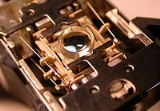
Cd Drive Lens
In computing
Computing

Computing is usually defined as the activity of using and developing computer technology, computer hardware and computer software. It is the computer-specific part of information technology....
, sound reproduction, and video
Video

Video is the technology of electronics Videography, recording, processing, storing, transmitting, and reconstructing a sequence of still images representing Scene in motion....
, an optical disc is a flat, circular disc (usually polycarbonate
Polycarbonate

Polycarbonates are a particular group of thermoplastic polymers. They are easily worked, injection moulding, and thermoforming; as such, these plastics are very widely used in the modern chemical industry....
) wherein data
Data (computing)

In computer science, data is anything in a form suitable for use with a computer. Data is often distinguished from computer programs. A program is a set of instruction that detail a task for the computer to perform....
 is stored in the pits (or bumps) in its flat surface — sequentially on the continuous, spiral track extending from the innermost track to the outermost track, covering the entire disc surface. The data is accessed in the disc when a special material (often aluminium
Aluminium

Aluminium or aluminum is a silvery white and ductile member of the boron group of chemical elements. It has the symbol Al; its atomic number is 13....
) is illuminated with a laser diode
Laser diode

A laser diode is a laser where the active medium is a semiconductor similar to that found in a light-emitting diode. The most common and practical type of laser diode is formed from a p-n junction and powered by injected electric current....
. The pits distort the reflected laser light, hence, most optical discs (except the black discs of the original PlayStation
PlayStation

The PlayStation is a 32-bit history of video game consoles video game console released by Sony Computer Entertainment in December .The PlayStation was the first of the ubiquitous PlayStation ....
 video game console
Video game console

A video game console is an game development that produces a video signal which can be used with a display device to display a video game. The term "video game console" is used to distinguish a machine designed for consumers to buy and use solely for playing video games from a personal computer, which has many other functions, or arcade machi...
), characteristically have an iridescent appearance created by the grooves of the reflective layer.

Write-once optical discs commonly use an organic dye, and re-writable discs use phase change alloys.

History

The optical disc was invented in 1958. In 1961 and 1969, David Paul Gregg
David Paul Gregg

David Paul Gregg was the inventor of the laserdisc. Gregg was inspired to create the laserdisc in the late 1950s. He originally had it patented as the "Videodisk" in 1961....
 registered a patent for the analog optical disc for video recording, (US Patent 3,430,966). It is of special interest that US Patent 4,893,297, filed 1968, issued 1990, generated royalty income for Pioneer Corporation’s DVA
DVA

DVA may refer to:* Department of Veterans' Affairs * United States United States Department of Veterans Affairs* Value averaging* The Driver & Vehicle Agency of Northern Ireland...
 until 2007 — encompassing the CD, DVD, and Blu-ray disc systems. In the early 1960s, the Music Corporation of America bought Gregg's patents and his company, Gauss Electrophysics.

Likewise, in 1969 Holland, Philips
Philips

Koninklijke Philips Electronics N.V. , usually known as Philips, is a Netherlands electronics company. It is one of the largest electronics companies in the world, founded and headquartered in the Netherlands....
 Research physicists began their first optical videodisc experiments at Eindhoven. In 1975, Philips and MCA join efforts, and in 1978, commercially much too late, they presented their long-awaited laserdisc
Laserdisc

The Laserdisc is an obsolete home video disc format, and was the first commercial optical disc storage medium. Initially marketed as Discovision in 1978, the technology was licensed and sold as Reflective Optical Videodisc, Laser Videodisc, 'Laservision, 'Disco-Vision, 'DiscoVision, and MCA DiscoVision...
 in Atlanta, Georgia, USA MCA delivered the discs, Philips the players; the presentation was a technical and commercial failure; the Philips/MCA cooperation ended.

In Japan and the U.S., Pioneer
Pioneer Corporation

is a multinational corporation that specializes in digital entertainment products, based in Tokyo, Japan. The company was founded in 1938 in Tokyo as a radio and Loudspeaker repair shop....
 succeeded with the videodisc until the advent of the DVD. In 1979, Philips and Sony
Sony

is a multinational corporation list of conglomerates corporation headquartered in Minato, Tokyo, Japan, and one of the world's largest media conglomerates with revenue exceeding US$99.1 billion ....
, in consortium, successfully developed the compact disc
Compact Disc

A Compact Disc is an optical disc used to store Data , originally developed for storing digital audio. The CD, available on the market since October 1982, remains the standard physical medium for sale of commercial Sound recording and reproduction to the present day....
 in 1983. The Optical Storage Technology Association
Optical Storage Technology Association

The Optical Storage Technology Association is an international trade association which promotes the use of recordable optical technologies and products, and most notably it is responsible for the creation and maintenance of the Universal Disk Format specification....
 (OSTA) promote standardised optical storage means. Although optical discs are more durable than earlier audio-visual and data storage formats, they are susceptible to environmental and daily-use damage. Libraries and archives enact optical media preservation
Optical media preservation

Optical discs are essential components in libraries, and store audio, video, and computer data. While optical discs are generally more reliable and durable than older media types, environmental conditions and/or poor handling can result in lost information....
 procedures to ensure continued usability in the computer's optical disc drive or corresponding disc player.

First-generation

Initially, optical discs were for storing music and computer software. The laser disc format stored analog video signals, but, commercially, lost to the VHS
VHS

The Video Home System, better known by its abbreviation VHS, is a recording and playing standard developed by JVC and launched in Europe and Asia in September 1976, and the United States in June 1977....
 videotape cassette, mainly its high cost and non-recordability; other first-generation disc formats are designed solely to store digital data.

Most first-generation disc devices had an infrared laser reading head. The minimum size of the laser spot is proportional to its wavelength, thus wavelength is a limiting factor against great information density, too little data can be stored so. The infrared range is beyond the long-wavelength end of the visible light spectrum, so, supports less density than any visible light colour. One example of high-density data storage capacity, achieved with an infrared laser, is 700MB of net user data for a 12cm compact disc.

NOTE: other factors affecting data storage density are, for example, a multi-layered infrared disc would hold more data than an identical single-layer disc; whether CAV, CLV, or zoned-CAV; how the data are encoded; how much clear margin at the center and the edge

  • Compact Disc
    Compact Disc

    A Compact Disc is an optical disc used to store Data , originally developed for storing digital audio. The CD, available on the market since October 1982, remains the standard physical medium for sale of commercial Sound recording and reproduction to the present day....
     (CD)
  • Laser disc
  • Magneto-optical disc
    • mini disc


Second-generation

Second-generation optical discs were for storing great amounts of data, including broadcast-quality digital video. Such discs usually are read with a visible-light laser (usually red); the shorter wavelength and greater numerical aperture
Numerical aperture

In optics, the numerical aperture of an optical system is a dimensionless number that characterizes the range of angles over which the system can accept or emit light....
 allow a narrower light beam, permitting smaller pits and lands in the disc. In the DVD format, this allows 4.7GB storage on a standard 12cm, single-sided, single-layer disc; alternately, smaller media, such as the MiniDisc
MiniDisc

A MiniDisc is a magneto-optical disc-based data storage device initially intended for storage of up to 80 minutes of digitized sound. Today, in the form of Hi-MD, it has developed into a general-purpose storage medium in addition to greatly expanding its audio roots....
 and the DataPlay
DataPlay

DataPlay is an optical disc system developed by DataPlay Inc. and released to the consumer market in 2002. Using very small disks enclosed in a protective cartridge storing 250MB per side, DataPlay was intended primarily for portable music playback, including both pre-recorded disks and user-recorded disks ....
 formats, can have capacity comparable to that of the larger, standard compact 12cm disc.

  • Hi-MD
    Hi-MD

    In January 2004, Sony announced the Hi-MD media storage format as a further development of the MiniDisc. With its release in later 2004 came the ability to use newly-developed, high-capacity 1 gigabyte Hi-MD discs, sporting the same dimensions as regular MiniDiscs....
  • DVD
    DVD

    DVD, also known as "Digital Versatile Disc" or "Digital Video Disc,"is a popular optical disc data storage device media format. Its main uses are video and data storage....
     and derivatives
    • DVD-Audio
      DVD-Audio

      DVD-Audio is a digital audio format for delivering very high-fidelity audio content on a Digital Versatile Disk. DVD-Audio is not intended to be a video delivery format and should not be confused with DVD-Video containing concerts and music videos....
    • DualDisc
      DualDisc

      DualDisc is a type of double-sided optical disc product developed by a group of record companies including EMI, Universal Music Group, Sony Music Entertainment, Warner Music Group, and 5.1 Entertainment Group and now under the aegis of the Recording Industry Association of America ....
    • Digital Video Express
      DivX

      DivX is a brand name of products created by DivX, Inc. , including the DivX Codec which has become popular due to its ability to video compression lengthy video segments into small sizes while maintaining relatively high visual quality....
       (DIVX)
  • Super Audio CD
    Super Audio CD

    Super Audio CD is a read-only optical disc audio storage format that can provide higher accuracy as well as surround sound compared to the Red Book ....
  • Video CD
    Video CD

    Video CD is a standard digital format for storing video on a Compact Disc. VCDs are playable in dedicated VCD players, most modern DVD-Video players, personal computers, and some video game consoles....
  • Super Video CD
    Super Video CD

    Super Video CD is a digital format for storing video on standard compact discs. SVCD was intended as a successor to Video CD and an alternative to DVD-Video, and falls somewhere between both in terms of technical capability and picture quality....
  • Enhanced Versatile Disc
    Enhanced Versatile Disc

    The Enhanced Versatile Disc is an optical medium-based digital audio/video format, developed to provide a means for playing HDTV content using existing optical media....
  • GD-ROM
    GD-ROM

    GD-ROM is the proprietary optical disc format used by the Sega Dreamcast. It is similar to the standard CD-ROM except that the pits on the disc are packed more closely together, resulting in a higher storage capacity: around 1.2 gigabytes, which is almost double the storage capacity of a typical CD-ROM....
  • DataPlay
    DataPlay

    DataPlay is an optical disc system developed by DataPlay Inc. and released to the consumer market in 2002. Using very small disks enclosed in a protective cartridge storing 250MB per side, DataPlay was intended primarily for portable music playback, including both pre-recorded disks and user-recorded disks ....
  • Phase-change Dual
    Phase-change Dual

    Phase-Change Dual is a rewritable optical disc format introduced by Panasonic in 1995. Much like CD-RW, PD uses a phase change layer that can be overwritten in a single pass of the read/write head....
  • Universal Media Disc
    Universal Media Disc

    The Universal Media Disc is an optical disc medium developed by Sony for use on the PlayStation Portable. It can hold up to 1.8 gigabytes of data....
  • Ultra Density Optical
    Ultra Density Optical

    Ultra Density Optical is an optical disc format designed for high-density storage of high-definition television and data....


Third-generation

Third-generation optical discs are in development, meant for distributing high-definition video and support greater data storage capacities, accomplished with short-wavelength visible-light lasers and greater numerical apertures. The Blu-ray disc uses blue-violet lasers of greater aperture, for use with discs with smaller pits and lands, thereby greater data storage capacity per layer. In practice, the effective multimedia presentation capacity is improved with enhanced video data compression
Data compression

In computer science and information theory, data compression or source coding is the process of encoding information using fewer bits than an code representation would use through use of specific encoding schemes....
 codec
Codec

A codec is a device or computer program capable of encoder and/or Decoding methods a digital data stream or signal . The word codec is a portmanteau of 'compressor-decompressor' or, most commonly, 'coder-decoder'....
s such as H.264, and VC-1
VC-1

VC-1 is the informal name of the SMPTE 421M video codec standard initially developed by Microsoft. It was released on April 3, 2006 by SMPTE. It is now a supported standard for HD DVDs, Blu-ray Discs, and Windows Media Video 9....
.

  • Currently shipping:
    • Blu-ray Disc
      Blu-ray Disc

      Blu-ray Disc is an optical disc data storage device medium. Its main uses are high-definition video and data storage. The disc has the same physical dimensions as standard DVDs and CDs....
    • HD VMD Disc
    • CBHD Disc


  • In development:
    • Forward Versatile Disc
      Forward Versatile Disc

      FVD, or Forward Versatile Disc, is an offshoot ofDVD developed in Taiwan jointly by the Advanced Optical Storage Research Alliance and the Industrial Technology Research Institute as a less expensive alternative for high-definition content....
    • Digital Multilayer Disk
      Digital Multilayer Disk

      Digital Multilayer Disk is an optical disc format developed by D Data Inc. It is based on the 3D optical data storage technology developed for the Fluorescent Multilayer Disc by the defunct company Constellation 3D....
       or Fluorescent Multilayer Disc
      Fluorescent Multilayer Disc

      Fluorescent Multilayer Disc was an optical disc format developed by Constellation 3D that uses fluorescence, rather than reflection materials to store data....


  • Abandoned:
    • HD DVD
      HD DVD

      HD DVD is a discontinued high-density optical media optical disc format for storing data and high-definition video.HD DVD was supported principally by Toshiba, and was envisaged to be the successor to the standard DVD format....


Next generation

The following formats are ahead of current (third-generation) discs, having the potential more than one terabyte (1TB
Terabyte

A terabyte is a measurement term for computer storage. The value of a terabyte based upon a decimal radix is defined as one 1000000000000 bytes, or 1000 gigabytes....
) of data storage space.

  • Holographic Versatile Disc
    Holographic Versatile Disc

    The Holographic Versatile Disc is an optical disc technology that, in the future, may hold up to 3.9 terabytes of information, although the current maximum is 250GB....
  • LS-R
    LS-R

    LS-R, or the Layer-Selection-Type Recordable Optical Disk, is the term coined by Hitachi, Ltd. in 2003 for a next-generation optical disc technology which allows much larger data storage densities than DVD, HD DVD or Blu-ray Disc, by allowing the use of a large number of data layers in a single disc....
  • Protein-coated disc
    Protein-coated disc

    Protein-Coated Disc is a theoretical optical disc technology currently being developed by Professor Venkatesan Renugopalakrishnan, formerly of Harvard Medical School and Florida International University....


Recordable and writable optical discs


Specifications

Base (1×) and (current) maximum speeds by generation
Generation Base Max
(Mbit/s) (Mbit/s) ×
1st (CD) 1.17 65.62 56×
2nd (DVD) 10.55 210.94 20×
3rd (BD) 36 432 12×


Capacity and nomenclature
Designation Sides Layers
(total)
Diameter Capacity
(cm) (GB
Gigabyte

Gigabyte is an SI prefix-multiple of the unit byte for Computer data storage. Since the giga- prefix means 109, gigabyte means 1,000,000,000 bytes ....
)
(GiB
Gibibyte

Gibibyte is a unit of Computer data storage, abbreviated GiB.The gibibyte is closely related to the gigabyte, which can either be a synonym for gibibyte, or refer to 109 bytes = 1,000,000,000 bytes, depending on context ....
)
DVD-1 SS SL 1 1 8 1.46 1.36
DVD-2 SS DL 1 2 8 2.66 2.47
DVD-3 DS SL 2 2 8 2.92 2.72
DVD-4 DS DL 2 4 8 5.32 4.95
DVD-5 SS SL 1 1 12 4.70 4.37
DVD-9 SS DL 1 2 12 8.54 7.95
DVD-10 DS SL 2 2 12 9.40 8.74
DVD-14 DS DL/SL 2 3 12 13.24 12.32
DVD-18 DS DL 2 4 12 17.08 15.90
DVD-R 1.0 SS SL 1 1 12 3.95 3.68
DVD-R 2.0 SS SL 1 1 12 4.70 4.37
DVD-R 2.0 DS SL 2 2 12 9.40 8.75
DVD-RW 2.0 SS SL 1 1 12 4.70 4.37
DVD-RW 2.0 DS SL 2 2 12 9.40 8.75
DVD+R 2.0 SS SL 1 1 12 4.70 4.37
DVD+R 2.0 DS SL 2 2 12 9.40 8.75
DVD+RW 2.0 SS SL 1 1 12 4.70 4.37
DVD+RW 2.0 DS SL 2 2 12 9.40 8.75
DVD-RAM 1.0 SS SL 1 1 12 2.58 2.40
DVD-RAM 1.0 DS SL 2 2 12 5.16 4.80
DVD-RAM 2.0 SS SL 1 1 12 4.70 4.37
DVD-RAM 2.0 DS SL 2 2 12 9.40 8.75
DVD-RAM 2.0 SS SL 1 1 8 1.46 1.36
DVD-RAM 2.0 DS SL 2 2 8 2.65 2.47
CD-ROM 74 min SS SL 1 1 12 0.682 0.635
CD-ROM 80 min SS SL 1 1 12 0.737 0.687
CD-ROM SS SL 1 1 8 0.194 0.180
DDCD-ROM SS SL 1 1 12 1.364 1.270
DDCD-ROM SS SL 1 1 8 0.387 0.360
HD DVD SS SL 1 1 8 4.70  
HD DVD SS DL 1 2 8 9.40  
HD DVD DS SL 2 2 8 9.40  
HD DVD DS DL 2 4 8 18.80  
HD DVD SS SL 1 1 12 15.00  
HD DVD SS DL 1 2 12 30.00  
HD DVD DS SL 2 2 12 30.00  
HD DVD DS DL 2 4 12 60.00  
HD DVD-RAM SS SL 1 1 12 20.00  


External links

  • by Terence O'Kelly (Memorex Inc.)