


Eikon Basilike

Encyclopedia
Autobiography
An autobiography is a book about the life of a person, written by that person.-Origin of the term:...
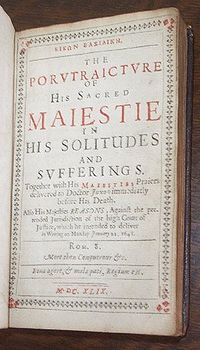
attributed to King Charles I of England
Charles I of England
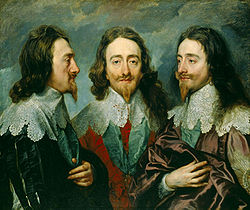
Charles I was King of England, King of Scotland, and King of Ireland from 27 March 1625 until his execution in 1649. Charles engaged in a struggle for power with the Parliament of England, attempting to obtain royal revenue whilst Parliament sought to curb his Royal prerogative which Charles...
. It was published on February 9, 1649, ten days after the King was beheaded by Parliament
Parliament
A parliament is a legislature, especially in those countries whose system of government is based on the Westminster system modeled after that of the United Kingdom. The name is derived from the French , the action of parler : a parlement is a discussion. The term came to mean a meeting at which...
in the aftermath of the English Civil War
English Civil War
The English Civil War was a series of armed conflicts and political machinations between Parliamentarians and Royalists...
in 1649.
Contents and authorship
Diary
A diary is a record with discrete entries arranged by date reporting on what has happened over the course of a day or other period. A personal diary may include a person's experiences, and/or thoughts or feelings, including comment on current events outside the writer's direct experience. Someone...
, the book combines irenic prayer
Prayer
Prayer is a form of religious practice that seeks to activate a volitional rapport to a deity through deliberate practice. Prayer may be either individual or communal and take place in public or in private. It may involve the use of words or song. When language is used, prayer may take the form of...
s urging the forgiveness of Charles's executioners with a justification of royalism and the King's political and military program that led to the Civil War.
It is by no means certain that Charles wrote the book. After the Restoration
English Restoration
The Restoration of the English monarchy began in 1660 when the English, Scottish and Irish monarchies were all restored under Charles II after the Interregnum that followed the Wars of the Three Kingdoms...
, John Gauden
John Gauden
John Gauden was an English bishop of Exeter then bishop of Worcester and writer, and the reputed author of the important Royalist work Eikon Basilike.-Life:...
, bishop of Worcester
Bishop of Worcester
The Bishop of Worcester is the Ordinary of the Church of England Diocese of Worcester in the Province of Canterbury, England. He is the head of the Diocese of Worcester in the Province of Canterbury...
, claimed to have written it. Scholars continue to disagree about the merits of this claim, though assuming that if Gauden wrote it, he had access to Charles's papers when he did so. Jeremy Taylor
Jeremy Taylor
Jeremy Taylor was a clergyman in the Church of England who achieved fame as an author during the Protectorate of Oliver Cromwell. He is sometimes known as the "Shakespeare of Divines" for his poetic style of expression and was often presented as a model of prose writing...
is also said to have had a hand in its revision, and to be the source of its title; an earlier draft bore the name Suspiria Regalia, the "Royal Sighs."
Some later editions of the Eikon Basilike contained a sworn statement by William Levett
William Levett
William Levett, Esq., was a longserving courtier to King Charles I of England. Levett accompanied the King during his flight from Parliamentary forces, including his escape from Hampton Court palace, and eventually to his imprisonment in Carisbrooke Castle on the Isle of Wight, and finally to the...
, Esq., longtime courtier and groom of the bedchamber to the King, that Levett had witnessed Charles writing the text during the time that Levett
Levett
Levett is an Anglo-Norman territorial surname deriving from the village of Livet-en-Ouche, now Jonquerets-de-Livet, in Eure, Normandy. Ancestors of the earliest Levett family in England, the de Livets were lords of the village of Livet, and undertenants of the de Ferrers, among the most powerful of...
accompanied him in his imprisonment on the Isle of Wight. A witness to the King's execution, Levett later helped transport the King's body back to Windsor Castle
Windsor Castle
Windsor Castle is a medieval castle and royal residence in Windsor in the English county of Berkshire, notable for its long association with the British royal family and its architecture. The original castle was built after the Norman invasion by William the Conqueror. Since the time of Henry I it...
for burial.
Whoever wrote the Eikon Basilike, its author was an effective prose stylist, one who had partaken deeply of the solemn yet simple eloquence of Anglican piety as expressed in Cranmer's
Thomas Cranmer
Thomas Cranmer was a leader of the English Reformation and Archbishop of Canterbury during the reigns of Henry VIII, Edward VI and, for a short time, Mary I. He helped build a favourable case for Henry's divorce from Catherine of Aragon which resulted in the separation of the English Church from...
Book of Common Prayer
Book of Common Prayer
The Book of Common Prayer is the short title of a number of related prayer books used in the Anglican Communion, as well as by the Continuing Anglican, "Anglican realignment" and other Anglican churches. The original book, published in 1549 , in the reign of Edward VI, was a product of the English...
. The end result is an image of a steadfast monarch
Monarch
A monarch is the person who heads a monarchy. This is a form of government in which a state or polity is ruled or controlled by an individual who typically inherits the throne by birth and occasionally rules for life or until abdication...
who, while admitting his weaknesses, declares the truth of his religious principles and the purity of his political motives, while trusting in God despite adversity. Charles's chief weakness, it says, was in yielding to Parliament's demands for the head of the Earl of Strafford
Thomas Wentworth, 1st Earl of Strafford
Thomas Wentworth, 1st Earl of Strafford was an English statesman and a major figure in the period leading up to the English Civil War. He served in Parliament and was a supporter of King Charles I. From 1632 to 1639 he instituted a harsh rule as Lord Deputy of Ireland...
; for this sin
Sin
In religion, sin is the violation or deviation of an eternal divine law or standard. The term sin may also refer to the state of having committed such a violation. Christians believe the moral code of conduct is decreed by God In religion, sin (also called peccancy) is the violation or deviation...
, Charles paid with his throne and his life. Its portrait of Charles as a martyr invited comparison of the King to Jesus
Jesus
Jesus of Nazareth , commonly referred to as Jesus Christ or simply as Jesus or Christ, is the central figure of Christianity...
.
The pathos
Pathos
Pathos represents an appeal to the audience's emotions. Pathos is a communication technique used most often in rhetoric , and in literature, film and other narrative art....
of this dramatic presentation made it a master stroke of Royalist propaganda
Propaganda
Propaganda is a form of communication that is aimed at influencing the attitude of a community toward some cause or position so as to benefit oneself or one's group....
. The book was quite popular despite official disapproval during the Protectorate
The Protectorate
In British history, the Protectorate was the period 1653–1659 during which the Commonwealth of England was governed by a Lord Protector.-Background:...
and the Restoration
English Restoration
The Restoration of the English monarchy began in 1660 when the English, Scottish and Irish monarchies were all restored under Charles II after the Interregnum that followed the Wars of the Three Kingdoms...
; it went into 36 editions in 1649 alone. Because of the favourable impression the book made of the King, Parliament commissioned John Milton
John Milton
John Milton was an English poet, polemicist, a scholarly man of letters, and a civil servant for the Commonwealth of England under Oliver Cromwell...
to write a riposte to it, which he published under the title Eikonoklastes
Eikonoklastes
Eikonoklastes is a book by John Milton, published October 1649. In it he provides a justification for the execution of Charles I, which had taken place on 30 January 1649. The book's title is taken from the Greek, and means "iconoclast" or "breaker of the icon", and refers to Eikon Basilike, a...
("The Icon-Breaker
Iconoclasm
Iconoclasm is the deliberate destruction of religious icons and other symbols or monuments, usually with religious or political motives. It is a frequent component of major political or religious changes...
") in 1649. Milton's response sought to portray the image of Charles, and the absolute monarchy
Absolute monarchy
Absolute monarchy is a monarchical form of government in which the monarch exercises ultimate governing authority as head of state and head of government, his or her power not being limited by a constitution or by the law. An absolute monarch thus wields unrestricted political power over the...
he aspired to, as idols
Idolatry
Idolatry is a pejorative term for the worship of an idol, a physical object such as a cult image, as a god, or practices believed to verge on worship, such as giving undue honour and regard to created forms other than God. In all the Abrahamic religions idolatry is strongly forbidden, although...
, claiming a reverence due only to God, and therefore justly overthrown to preserve the law of God. This theological counterattack failed to dislodge the sentimental narrative of the Eikon itself from public esteem.
Its famous frontispiece
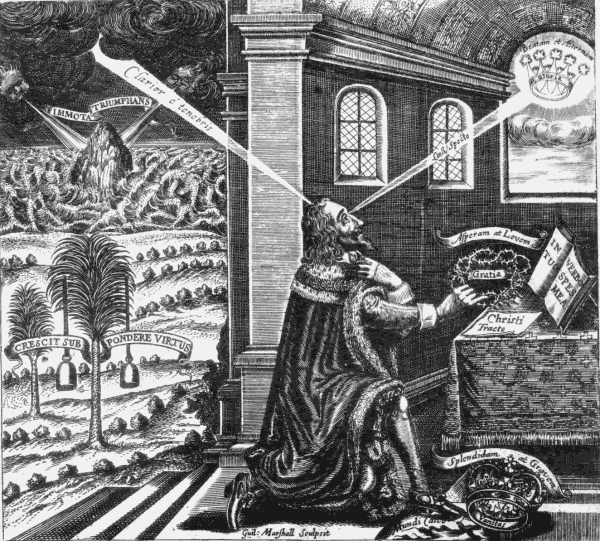
The heavily allegorical
Allegory
Allegory is a demonstrative form of representation explaining meaning other than the words that are spoken. Allegory communicates its message by means of symbolic figures, actions or symbolic representation...
frontispiece
Book frontispiece
A frontispiece is a decorative illustration facing a book's title page. The frontispiece is the verso opposite the recto title page. Elaborate engraved frontispieces were in frequent use, especially in Bibles and in scholarly books, and many are masterpieces of engraving...
of the Eikon Basilike depicts the King as a Christian
Christianity
Christianity is a monotheistic religion based on the life and teachings of Jesus as presented in canonical gospels and other New Testament writings...
martyr
Martyr
A martyr is somebody who suffers persecution and death for refusing to renounce, or accept, a belief or cause, usually religious.-Meaning:...
. The Latin
Latin
Latin is an Italic language originally spoken in Latium and Ancient Rome. It, along with most European languages, is a descendant of the ancient Proto-Indo-European language. Although it is considered a dead language, a number of scholars and members of the Christian clergy speak it fluently, and...
texts read:
- IMMOTA, TRIVMPHANS — "Unmoved, Triumphant" (scroll around the rock);
- Clarior é tenebris — "Brighter through the darkness" (beam from the clouds);
- CRESCIT SUB PONDERE VIRTVS — "Virtue grows beneath weights" (scroll around the tree);
- Beatam & Æternam — "Blessed and Eternal" (around the heavenly crown marked GLORIA ("Glory")); meant to be contrasted with:
- Splendidam & Gravem — "Splendid and Heavy" (around the CrownThe CrownThe Crown is a corporation sole that in the Commonwealth realms and any provincial or state sub-divisions thereof represents the legal embodiment of governance, whether executive, legislative, or judicial...
of EnglandEnglandEngland is a country that is part of the United Kingdom. It shares land borders with Scotland to the north and Wales to the west; the Irish Sea is to the north west, the Celtic Sea to the south west, with the North Sea to the east and the English Channel to the south separating it from continental...
, removed from the King's head and lying on the ground), with the motto Vanitas ("vanityVanityIn conventional parlance, vanity is the excessive belief in one's own abilities or attractiveness to others. Prior to the 14th century it did not have such narcissistic undertones, and merely meant futility. The related term vainglory is now often seen as an archaic synonym for vanity, but...
"); and - Asperam & Levem — "Bitter and Light", the martyr's crown of thornsCrown of ThornsIn Christianity, the Crown of Thorns, one of the instruments of the Passion, was woven of thorn branches and placed on Jesus Christ before his crucifixion...
held by Charles; contains the motto Gratia ("graceDivine graceIn Christian theology, grace is God’s gift of God’s self to humankind. It is understood by Christians to be a spontaneous gift from God to man - "generous, free and totally unexpected and undeserved" - that takes the form of divine favour, love and clemency. It is an attribute of God that is most...
");
- Splendidam & Gravem — "Splendid and Heavy" (around the Crown
- Coeli Specto — "I look to Heaven";
- IN VERBO TVO SPES MEA — "In Thy Word is My Hope";
- Christi Tracto — "I entreat Christ" or "By the word of Christ";
- Mundi Calco — "I tread on the world".
The frontispiece was engraved
Engraving
Engraving is the practice of incising a design on to a hard, usually flat surface, by cutting grooves into it. The result may be a decorated object in itself, as when silver, gold, steel, or glass are engraved, or may provide an intaglio printing plate, of copper or another metal, for printing...
by William Marshall
William Marshall (illustrator)
William Marshall was a seventeenth century British engraver and illustrator, best known for his print depicting "Charles the Martyr", a symbolic portrayal of King Charles I of England as a Christian martyr.-Early career:...
. In the first edition, the frontispiece was accompanied by Latin and English verses that explain it. The English verses go:
- Tho' clogg'd with weighs of miseries
- Palm-like Depress'd, I higher rise
- And as th'unmoved Rock outbraues
- The boist'rous Windes and raging waues
- So triumph I. And shine more bright
- In sad Affliction's darksom night.
- That Splendid, but yet toilsom Crown
- Regardlessly I trample down.
- With joie I take this Crown of thorn
- Though sharp, yet easie to be born.
- That heavn'nlie Crown, already mine
- I view with eies of Faith diuine.
- I slight vain things, and do embrace
- Glorie, the just reward of Grace.
King Charles venerated by the Church of England
The Eikon Basilike and its portrait of Charles's execution as a martyrdom were so successful that, at the Restoration, a special commemoration of the King on January 30 was added to the Book of Common PrayerBook of Common Prayer
The Book of Common Prayer is the short title of a number of related prayer books used in the Anglican Communion, as well as by the Continuing Anglican, "Anglican realignment" and other Anglican churches. The original book, published in 1549 , in the reign of Edward VI, was a product of the English...
, directing that the day be observed as an occasion for fasting
Fasting
Fasting is primarily the act of willingly abstaining from some or all food, drink, or both, for a period of time. An absolute fast is normally defined as abstinence from all food and liquid for a defined period, usually a single day , or several days. Other fasts may be only partially restrictive,...
and repentance
Repentance
Repentance is a change of thought to correct a wrong and gain forgiveness from a person who is wronged. In religious contexts it usually refers to confession to God, ceasing sin against God, and resolving to live according to religious law...
. On May 19, 1660, the Convocation
Convocation
A Convocation is a group of people formally assembled for a special purpose.- University use :....
of Canterbury
Canterbury
Canterbury is a historic English cathedral city, which lies at the heart of the City of Canterbury, a district of Kent in South East England. It lies on the River Stour....
and York
York
York is a walled city, situated at the confluence of the Rivers Ouse and Foss in North Yorkshire, England. The city has a rich heritage and has provided the backdrop to major political events throughout much of its two millennia of existence...
canonised
Canonization
Canonization is the act by which a Christian church declares a deceased person to be a saint, upon which declaration the person is included in the canon, or list, of recognized saints. Originally, individuals were recognized as saints without any formal process...
King Charles at the urging of Charles II
Charles II of England
Charles II was monarch of the three kingdoms of England, Scotland, and Ireland.Charles II's father, King Charles I, was executed at Whitehall on 30 January 1649, at the climax of the English Civil War...
, and added his name to the prayer book. Charles I is the only saint
Saint
A saint is a holy person. In various religions, saints are people who are believed to have exceptional holiness.In Christian usage, "saint" refers to any believer who is "in Christ", and in whom Christ dwells, whether in heaven or in earth...
formally canonised by the Church of England
Church of England
The Church of England is the officially established Christian church in England and the Mother Church of the worldwide Anglican Communion. The church considers itself within the tradition of Western Christianity and dates its formal establishment principally to the mission to England by St...
.
The commemoration was removed from the prayer book by Queen Victoria
Victoria of the United Kingdom
Victoria was the monarch of the United Kingdom of Great Britain and Ireland from 20 June 1837 until her death. From 1 May 1876, she used the additional title of Empress of India....
in 1859. Several Anglican
Anglicanism
Anglicanism is a tradition within Christianity comprising churches with historical connections to the Church of England or similar beliefs, worship and church structures. The word Anglican originates in ecclesia anglicana, a medieval Latin phrase dating to at least 1246 that means the English...
churches and chapel
Chapel
A chapel is a building used by Christians as a place of fellowship and worship. It may be part of a larger structure or complex, such as a church, college, hospital, palace, prison or funeral home, located on board a military or commercial ship, or it may be an entirely free-standing building,...
s are dedicated to "King Charles the Martyr." The Society of King Charles the Martyr
Society of King Charles the Martyr
The Society of King Charles the Martyr is an Anglican devotional society and one of the Catholic Societies of the Church of England. It is dedicated to and under the patronage of King Charles I of England , the only person to be canonised by the Church of...
was established in 1894 to work for the restoration of the King's name to the Calendar
Calendar
A calendar is a system of organizing days for social, religious, commercial, or administrative purposes. This is done by giving names to periods of time, typically days, weeks, months, and years. The name given to each day is known as a date. Periods in a calendar are usually, though not...
and to encourage the veneration of the Royal Martyr.
Representation of Charles as Martyr in the Text
Richard Helgerson suggests that Eikon Basilike represents the culmination of the representational strategies of Charles’ immediate TudorTudor dynasty
The Tudor dynasty or House of Tudor was a European royal house of Welsh origin that ruled the Kingdom of England and its realms, including the Lordship of Ireland, later the Kingdom of Ireland, from 1485 until 1603. Its first monarch was Henry Tudor, a descendant through his mother of a legitimised...
and Stuart predecessors: the textual absolutism of King James
James I of England
James VI and I was King of Scots as James VI from 24 July 1567 and King of England and Ireland as James I from the union of the English and Scottish crowns on 24 March 1603...
and the “iconic performativity” of Elizabeth
Elizabeth I of England
Elizabeth I was queen regnant of England and Ireland from 17 November 1558 until her death. Sometimes called The Virgin Queen, Gloriana, or Good Queen Bess, Elizabeth was the fifth and last monarch of the Tudor dynasty...
. In addition to the way it recapitulates previous modes of royal representation, Helgerson notes a certain affinity between the textual aesthetics of the “King’s Book” and those of the Counter-Reformation
Counter-Reformation
The Counter-Reformation was the period of Catholic revival beginning with the Council of Trent and ending at the close of the Thirty Years' War, 1648 as a response to the Protestant Reformation.The Counter-Reformation was a comprehensive effort, composed of four major elements:#Ecclesiastical or...
: “Eikon Basilike drew on a set of culturally conditioned responses against which the new culture of print was defining itself, responses that had previously served Elizabeth and Shakespeare and that even then were serving Counter-Reformation Catholicism. This unbookish—indeed anti-bookish—book thus turned print against itself.” In Helgerson’s view, Eikon Basilike draws upon devotional impulses that both precede and supersede the dominance of the print-obsessed Protestant scripturalism ascendant at the moment of Charles’ execution.
Quotation
- I would rather choose to wear a crown of thorns with my Saviour, than to exchange that of gold, which is due to me, for one of lead, whose embased flexibleness shall be forced to bend and comply to the various and oft contrary dictates of any factions, when instead of reason and public concernments they obtrude nothing but what makes for the interest of parties, and flows from the partialities of private wills and passions. I know no resolutions more worthy a Christian king, than to prefer his conscience before his kingdoms.
Editions
- Milton, John. Eikon Basilike with selections from Eikonklastes. 2005. Eds. Jim Daems and Holly Faith Nelson. Peterborough, ON: Broadview Press. ISBN 978-1551115948. http://www.broadviewpress.com/product.php?productid=730&cat=66&page=1
External links
- The Eikon Basilike
- The Society of King Charles the Martyr, dedicated to the commemoration of Charles I as a martyr for the Church of England.
- Selections and summary of Milton's Eikonoklastes.
- Eikon Basilike at Literary Encyclopedia