


Society of King Charles the Martyr

Encyclopedia
The Society of King Charles the Martyr is an Anglican devotional society
and one of the Catholic Societies of the Church of England
. (It is also active in the Episcopal Church USA and has international members elsewhere.) It is dedicated to and under the patronage of King Charles I of England
(19 November 1600–30 January 1649), the only person to be canonised by the Church of England after the English Reformation
.
, head of the House of Stuart
, was King of England
, Scotland
and Ireland
from 27 March 1625 until his death on 30 January 1649.
Charles believed in a sacramental version of the Church of England
, called High Anglicanism
, with a theology based upon Arminianism
, a belief shared by his main political advisor, Archbishop William Laud
. Laud was appointed by Charles as the Archbishop of Canterbury
in 1633 and started a series of reforms in the Church to make it more ceremonial. This was actively hostile to the Reformist
tendencies of many of his English and Scottish subjects. He rejected the Calvinism
of the Presbyterians, insisted on an episcopal
(hierarchical) form of church government as opposed to presbyterian
or congregational
forms, and required that the Church of England
's liturgy
be celebrated with all of the ceremony and vestment
s called for by the Book of Common Prayer
. Many of his subjects thought these policies brought the Church of England too close to Roman Catholicism
.
Charles ruled in an era of great religious turmoil in Britain and at the end of the English Civil War
he was executed. At his trial, he was charged with attempting to govern as an absolute monarch rather than in combination with Parliament; with fighting against his people; with continuing the war after the defeat of his forces (the continuation is often regarded as the Second English Civil War
); with conspiring after defeat to promote yet another continuation; and with encouraging his troops to kill prisoners of war (often called war crimes today). (Robertson ibid ch 10)
Charles is officially regarded by the Church of England
as a martyr
because, it is said, he was offered his life if he would abandon the historic episcopacy in the Church of England. It is said he refused, however, believing that the Church of England was truly "Catholic" and should maintain the Catholic episcopate. His designation in the Church of England's calendar is "Charles, King and Martyr, 1649". Bishop
Mandell Creighton
of London wrote "Had Charles been willing to abandon the Church and give up episcopacy, he might have saved his throne and his life. But on this point Charles stood firm: for this he died, and by dying saved it for the future." However, he had already made a Covenant with the Scots to introduce Presbyterianism in England in return for the aid of Scots forces in the Second Civil War.
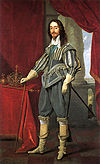 When Charles was beheaded
on 30 January 1649, Phillip Henry records that a moan was heard from the assembled crowd, some of whom then dipped their handkerchiefs in his blood, thus starting the cult of the Martyr King. However, no other eyewitness source, including Samuel Pepys
, records this. Note also that Henry's account was written during the Restoration (i e some 12 years after the event), Henry was 19 when the King was executed, and he and his family were Royalist propaganda writers. (See J Rushworth in R Lockyer (ed) The Trial of King Charles I pp133–4)
There is some historical debate over the identity of the man who beheaded the King, who was masked at the scene. It is known the regicides approached Richard Brandon
, the common Hangman of London, but that he refused, and contemporary sources do not generally identify him as the King's headsman. Ellis's Historical Inquiries, however, name him as the executioner, stating that he stated so before dying. It is possible he relented and agreed to do the deed, but there are others who have been identified. William Hewlett
was tried for the murder after the Restoration
and convicted. In 1661, two people identified as "Dayborne and Bickerstaffe" were arrested but then discharged. Henry Walker, a revolutionary journalist, or his brother William, were suspected but never charged. Various local legends around England name local worthies.
It was common practice for the head of a traitor to be held up and exhibited to the crowd with the words "Behold the head of a traitor!" Although Charles' head was exhibited, the words were not used. In an unprecedented gesture, one of the prominent leaders of the revolutionaries, Oliver Cromwell
, allowed the King's head to be sewn back on his body so the family could pay its respects. Charles was buried privately and at night on 7 February 1649, in the Henry VIII
vault inside St. George's Chapel in Windsor Castle
. The King's son, King Charles II
, later planned an elaborate royal mausoleum, but this never eventuated.
When the Church and the Monarchy were restored on 29 May 1660, Canterbury and York, being the two primacies of the Church of England, assembled their convocations and added his name to the ecclesiastical calendar in the Book of Common Prayer
to be celebrated on the day of his death. In the time of Queen Victoria
this was, however, removed upon request by elected representatives of the Commons; 30 January is listed as only a "Lesser Festival." The Feast was restored to the calendar in the Alternative Service Book
of 1980 and a new collect composed for Common Worship
in 2000. However, the Feast has yet to be restored to the Book of Common Prayer.
There are several Anglican/Episcopal churches dedicated to Charles I as "King and Martyr," in England
, Canada
, Australia
and the United States
.
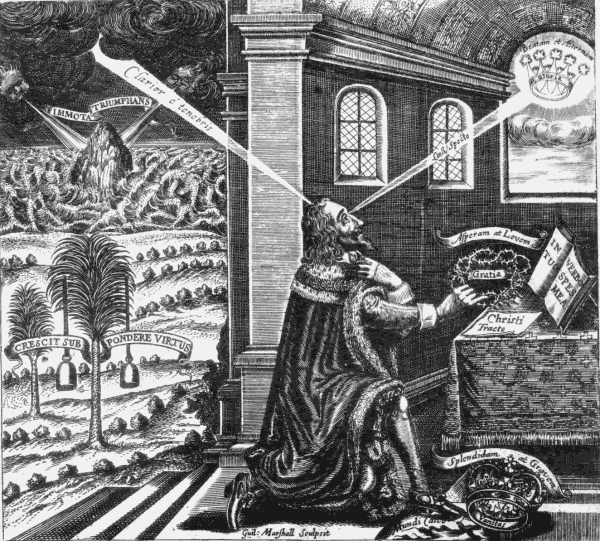 Founded in 1894, the Society's stated purpose was "intercessory prayer for the defence of the Church of England against the attacks of her enemies." Since then, the objectives have extended to religious devotion in keeping with the traditions of Anglo-Catholicism
.
Today, the Society's stated objectives are the following:
The Patrons of the Society are Lord Nicholas Windsor
; the Rt Hon Lord St. John of Fawsley; the Rev'd. Fr. J. M. Charles-Roux, I.C.
; Sir Leslie Fielding, KCMG; and Rev'd Canon
Arthur Middleton.
Outside of England, the objectives vary slightly, especially in regard to the Feast of St. Charles, which is widely observed by the church in some places and not in others.
In the United States and Canada, the Society is independently constituted as the American Region. The Society's activities in the United States can be traced back to 1895, within a year of the Society's foundation in 1894 in London. The American Region is incorporated under the General Laws of the State of Maryland
as a not-for-profit corporation, the "Society of King Charles the Martyr, Inc.", and is tax-exempt under Section 501(c)(3) of the IRS code, both effective as of 8 April 2008. The American Region is governed by a Board of Trustees, and holds a Solemn Mass
of the Feast of St. Charles Martyr on a Saturday close to January 30. In addition, the American Region confers an honor on some members through membership in the Order of Blessed William Laud.
(also known as the "Catholic Revival") in the Church of England (and her sister churches), there have been organizations whose purpose is the propagation of Catholic faith and practice within the Anglican tradition. The Society of King Charles the Martyr is among the most famous of these societies, which include the Society of Mary (Anglican)
, the Guild of All Souls
and the Confraternity of the Blessed Sacrament
.
Each of these societies champions one aspect of Catholic faith and practice that otherwise could be considered underemphasized by the Anglican Churches as a whole. For the Society of King Charles the Martyr, this is the cultus of Saint Charles I of England, King and Martyr.
Anglican devotional society
Since the time of the Oxford Movement in the Church of England, there have been organizations whose purpose is the propagation of the Catholic Faith within the Anglican Communion. Each of these societies champions one aspect of Ritualism and Anglican doctrine which otherwise is not emphasized by...
and one of the Catholic Societies of the Church of England
Church of England
The Church of England is the officially established Christian church in England and the Mother Church of the worldwide Anglican Communion. The church considers itself within the tradition of Western Christianity and dates its formal establishment principally to the mission to England by St...
. (It is also active in the Episcopal Church USA and has international members elsewhere.) It is dedicated to and under the patronage of King Charles I of England
Charles I of England
Charles I was King of England, King of Scotland, and King of Ireland from 27 March 1625 until his execution in 1649. Charles engaged in a struggle for power with the Parliament of England, attempting to obtain royal revenue whilst Parliament sought to curb his Royal prerogative which Charles...
(19 November 1600–30 January 1649), the only person to be canonised by the Church of England after the English Reformation
English Reformation
The English Reformation was the series of events in 16th-century England by which the Church of England broke away from the authority of the Pope and the Roman Catholic Church....
.
Charles Stuart as an Anglican Martyr
King CharlesCharles I of England
Charles I was King of England, King of Scotland, and King of Ireland from 27 March 1625 until his execution in 1649. Charles engaged in a struggle for power with the Parliament of England, attempting to obtain royal revenue whilst Parliament sought to curb his Royal prerogative which Charles...
, head of the House of Stuart
House of Stuart
The House of Stuart is a European royal house. Founded by Robert II of Scotland, the Stewarts first became monarchs of the Kingdom of Scotland during the late 14th century, and subsequently held the position of the Kings of Great Britain and Ireland...
, was King of England
England
England is a country that is part of the United Kingdom. It shares land borders with Scotland to the north and Wales to the west; the Irish Sea is to the north west, the Celtic Sea to the south west, with the North Sea to the east and the English Channel to the south separating it from continental...
, Scotland
Scotland
Scotland is a country that is part of the United Kingdom. Occupying the northern third of the island of Great Britain, it shares a border with England to the south and is bounded by the North Sea to the east, the Atlantic Ocean to the north and west, and the North Channel and Irish Sea to the...
and Ireland
Ireland
Ireland is an island to the northwest of continental Europe. It is the third-largest island in Europe and the twentieth-largest island on Earth...
from 27 March 1625 until his death on 30 January 1649.
Charles believed in a sacramental version of the Church of England
Church of England
The Church of England is the officially established Christian church in England and the Mother Church of the worldwide Anglican Communion. The church considers itself within the tradition of Western Christianity and dates its formal establishment principally to the mission to England by St...
, called High Anglicanism
Anglicanism
Anglicanism is a tradition within Christianity comprising churches with historical connections to the Church of England or similar beliefs, worship and church structures. The word Anglican originates in ecclesia anglicana, a medieval Latin phrase dating to at least 1246 that means the English...
, with a theology based upon Arminianism
Arminianism
Arminianism is a school of soteriological thought within Protestant Christianity based on the theological ideas of the Dutch Reformed theologian Jacobus Arminius and his historic followers, the Remonstrants...
, a belief shared by his main political advisor, Archbishop William Laud
William Laud
William Laud was Archbishop of Canterbury from 1633 to 1645. One of the High Church Caroline divines, he opposed radical forms of Puritanism...
. Laud was appointed by Charles as the Archbishop of Canterbury
Archbishop of Canterbury
The Archbishop of Canterbury is the senior bishop and principal leader of the Church of England, the symbolic head of the worldwide Anglican Communion, and the diocesan bishop of the Diocese of Canterbury. In his role as head of the Anglican Communion, the archbishop leads the third largest group...
in 1633 and started a series of reforms in the Church to make it more ceremonial. This was actively hostile to the Reformist
Reformed churches
The Reformed churches are a group of Protestant denominations characterized by Calvinist doctrines. They are descended from the Swiss Reformation inaugurated by Huldrych Zwingli but developed more coherently by Martin Bucer, Heinrich Bullinger and especially John Calvin...
tendencies of many of his English and Scottish subjects. He rejected the Calvinism
Calvinism
Calvinism is a Protestant theological system and an approach to the Christian life...
of the Presbyterians, insisted on an episcopal
Episcopal polity
Episcopal polity is a form of church governance that is hierarchical in structure with the chief authority over a local Christian church resting in a bishop...
(hierarchical) form of church government as opposed to presbyterian
Presbyterian polity
Presbyterian polity is a method of church governance typified by the rule of assemblies of presbyters, or elders. Each local church is governed by a body of elected elders usually called the session or consistory, though other terms, such as church board, may apply...
or congregational
Congregationalist polity
Congregationalist polity, often known as congregationalism, is a system of church governance in which every local church congregation is independent, ecclesiastically sovereign, or "autonomous"...
forms, and required that the Church of England
Church of England
The Church of England is the officially established Christian church in England and the Mother Church of the worldwide Anglican Communion. The church considers itself within the tradition of Western Christianity and dates its formal establishment principally to the mission to England by St...
's liturgy
Liturgy
Liturgy is either the customary public worship done by a specific religious group, according to its particular traditions or a more precise term that distinguishes between those religious groups who believe their ritual requires the "people" to do the "work" of responding to the priest, and those...
be celebrated with all of the ceremony and vestment
Vestment
Vestments are liturgical garments and articles associated primarily with the Christian religion, especially among Latin Rite and other Catholics, Eastern Orthodox, Anglicans, and Lutherans...
s called for by the Book of Common Prayer
Book of Common Prayer
The Book of Common Prayer is the short title of a number of related prayer books used in the Anglican Communion, as well as by the Continuing Anglican, "Anglican realignment" and other Anglican churches. The original book, published in 1549 , in the reign of Edward VI, was a product of the English...
. Many of his subjects thought these policies brought the Church of England too close to Roman Catholicism
Roman Catholic Church
The Catholic Church, also known as the Roman Catholic Church, is the world's largest Christian church, with over a billion members. Led by the Pope, it defines its mission as spreading the gospel of Jesus Christ, administering the sacraments and exercising charity...
.
Charles ruled in an era of great religious turmoil in Britain and at the end of the English Civil War
English Civil War
The English Civil War was a series of armed conflicts and political machinations between Parliamentarians and Royalists...
he was executed. At his trial, he was charged with attempting to govern as an absolute monarch rather than in combination with Parliament; with fighting against his people; with continuing the war after the defeat of his forces (the continuation is often regarded as the Second English Civil War
English Civil War
The English Civil War was a series of armed conflicts and political machinations between Parliamentarians and Royalists...
); with conspiring after defeat to promote yet another continuation; and with encouraging his troops to kill prisoners of war (often called war crimes today). (Robertson ibid ch 10)
Charles is officially regarded by the Church of England
Church of England
The Church of England is the officially established Christian church in England and the Mother Church of the worldwide Anglican Communion. The church considers itself within the tradition of Western Christianity and dates its formal establishment principally to the mission to England by St...
as a martyr
Martyr
A martyr is somebody who suffers persecution and death for refusing to renounce, or accept, a belief or cause, usually religious.-Meaning:...
because, it is said, he was offered his life if he would abandon the historic episcopacy in the Church of England. It is said he refused, however, believing that the Church of England was truly "Catholic" and should maintain the Catholic episcopate. His designation in the Church of England's calendar is "Charles, King and Martyr, 1649". Bishop
Bishop
A bishop is an ordained or consecrated member of the Christian clergy who is generally entrusted with a position of authority and oversight. Within the Catholic Church, Eastern Orthodox, Oriental Orthodox Churches, in the Assyrian Church of the East, in the Independent Catholic Churches, and in the...
Mandell Creighton
Mandell Creighton
Mandell Creighton , was a British historian and a bishop of the Church of England. A scholar of the Renaissance papacy, Creighton was the first occupant of the Dixie Chair of Ecclesiastical History at the University of Cambridge, a professorship that was established around the time that the study...
of London wrote "Had Charles been willing to abandon the Church and give up episcopacy, he might have saved his throne and his life. But on this point Charles stood firm: for this he died, and by dying saved it for the future." However, he had already made a Covenant with the Scots to introduce Presbyterianism in England in return for the aid of Scots forces in the Second Civil War.
Decapitation
Decapitation is the separation of the head from the body. Beheading typically refers to the act of intentional decapitation, e.g., as a means of murder or execution; it may be accomplished, for example, with an axe, sword, knife, wire, or by other more sophisticated means such as a guillotine...
on 30 January 1649, Phillip Henry records that a moan was heard from the assembled crowd, some of whom then dipped their handkerchiefs in his blood, thus starting the cult of the Martyr King. However, no other eyewitness source, including Samuel Pepys
Samuel Pepys
Samuel Pepys FRS, MP, JP, was an English naval administrator and Member of Parliament who is now most famous for the diary he kept for a decade while still a relatively young man...
, records this. Note also that Henry's account was written during the Restoration (i e some 12 years after the event), Henry was 19 when the King was executed, and he and his family were Royalist propaganda writers. (See J Rushworth in R Lockyer (ed) The Trial of King Charles I pp133–4)
There is some historical debate over the identity of the man who beheaded the King, who was masked at the scene. It is known the regicides approached Richard Brandon
Richard Brandon
Richard Brandon was a 17th century English hangman who inherited his role from his father Gregory Brandon and was sometimes known as "Young Gregory"...
, the common Hangman of London, but that he refused, and contemporary sources do not generally identify him as the King's headsman. Ellis's Historical Inquiries, however, name him as the executioner, stating that he stated so before dying. It is possible he relented and agreed to do the deed, but there are others who have been identified. William Hewlett
William Hewlett (regicide)
On 30 January 1649, Captain William Hewlett was the officer in charge of the soldiers at the execution of Charles I.After the Restoration, Captain Hewlett was convicted on 15 October 1660 for his part in the regicide of Charles I on January 30, 1649, but was not executed along with the other men...
was tried for the murder after the Restoration
English Restoration
The Restoration of the English monarchy began in 1660 when the English, Scottish and Irish monarchies were all restored under Charles II after the Interregnum that followed the Wars of the Three Kingdoms...
and convicted. In 1661, two people identified as "Dayborne and Bickerstaffe" were arrested but then discharged. Henry Walker, a revolutionary journalist, or his brother William, were suspected but never charged. Various local legends around England name local worthies.
It was common practice for the head of a traitor to be held up and exhibited to the crowd with the words "Behold the head of a traitor!" Although Charles' head was exhibited, the words were not used. In an unprecedented gesture, one of the prominent leaders of the revolutionaries, Oliver Cromwell
Oliver Cromwell
Oliver Cromwell was an English military and political leader who overthrew the English monarchy and temporarily turned England into a republican Commonwealth, and served as Lord Protector of England, Scotland, and Ireland....
, allowed the King's head to be sewn back on his body so the family could pay its respects. Charles was buried privately and at night on 7 February 1649, in the Henry VIII
Henry VIII of England
Henry VIII was King of England from 21 April 1509 until his death. He was Lord, and later King, of Ireland, as well as continuing the nominal claim by the English monarchs to the Kingdom of France...
vault inside St. George's Chapel in Windsor Castle
Windsor Castle
Windsor Castle is a medieval castle and royal residence in Windsor in the English county of Berkshire, notable for its long association with the British royal family and its architecture. The original castle was built after the Norman invasion by William the Conqueror. Since the time of Henry I it...
. The King's son, King Charles II
Charles II of England
Charles II was monarch of the three kingdoms of England, Scotland, and Ireland.Charles II's father, King Charles I, was executed at Whitehall on 30 January 1649, at the climax of the English Civil War...
, later planned an elaborate royal mausoleum, but this never eventuated.
When the Church and the Monarchy were restored on 29 May 1660, Canterbury and York, being the two primacies of the Church of England, assembled their convocations and added his name to the ecclesiastical calendar in the Book of Common Prayer
Book of Common Prayer
The Book of Common Prayer is the short title of a number of related prayer books used in the Anglican Communion, as well as by the Continuing Anglican, "Anglican realignment" and other Anglican churches. The original book, published in 1549 , in the reign of Edward VI, was a product of the English...
to be celebrated on the day of his death. In the time of Queen Victoria
Victoria of the United Kingdom
Victoria was the monarch of the United Kingdom of Great Britain and Ireland from 20 June 1837 until her death. From 1 May 1876, she used the additional title of Empress of India....
this was, however, removed upon request by elected representatives of the Commons; 30 January is listed as only a "Lesser Festival." The Feast was restored to the calendar in the Alternative Service Book
Alternative Service Book
The Alternative Service Book 1980 was the first complete prayer book produced by the Church of England since 1662. Its name derives from the fact that it was proposed not as a replacement for the Book of Common Prayer but merely as an alternative to it...
of 1980 and a new collect composed for Common Worship
Common Worship
Common Worship is the name given to the series of services authorised by the General Synod of the Church of England and launched on the first Sunday of Advent in 2000. It represents the most recent stage of development of the Liturgical Movement within the Church and is the successor to the...
in 2000. However, the Feast has yet to be restored to the Book of Common Prayer.
There are several Anglican/Episcopal churches dedicated to Charles I as "King and Martyr," in England
England
England is a country that is part of the United Kingdom. It shares land borders with Scotland to the north and Wales to the west; the Irish Sea is to the north west, the Celtic Sea to the south west, with the North Sea to the east and the English Channel to the south separating it from continental...
, Canada
Canada
Canada is a North American country consisting of ten provinces and three territories. Located in the northern part of the continent, it extends from the Atlantic Ocean in the east to the Pacific Ocean in the west, and northward into the Arctic Ocean...
, Australia
Australia
Australia , officially the Commonwealth of Australia, is a country in the Southern Hemisphere comprising the mainland of the Australian continent, the island of Tasmania, and numerous smaller islands in the Indian and Pacific Oceans. It is the world's sixth-largest country by total area...
and the United States
United States
The United States of America is a federal constitutional republic comprising fifty states and a federal district...
.
The Society
Anglo-Catholicism
The terms Anglo-Catholic and Anglo-Catholicism describe people, beliefs and practices within Anglicanism that affirm the Catholic, rather than Protestant, heritage and identity of the Anglican churches....
.
Today, the Society's stated objectives are the following:
- Intercessory prayer for the Church of EnglandChurch of EnglandThe Church of England is the officially established Christian church in England and the Mother Church of the worldwide Anglican Communion. The church considers itself within the tradition of Western Christianity and dates its formal establishment principally to the mission to England by St...
and Churches in communionCommunion (Christian)The term communion is derived from Latin communio . The corresponding term in Greek is κοινωνία, which is often translated as "fellowship". In Christianity, the basic meaning of the term communion is an especially close relationship of Christians, as individuals or as a Church, with God and with...
therewith. - Promotion of a wider and better observance of the FeastdayFestivalA festival or gala is an event, usually and ordinarily staged by a local community, which centers on and celebrates some unique aspect of that community and the Festival....
of St. Charles, 30 January. - Work for the reinstatement of the Feast of St. Charles in the calendarCalendarA calendar is a system of organizing days for social, religious, commercial, or administrative purposes. This is done by giving names to periods of time, typically days, weeks, months, and years. The name given to each day is known as a date. Periods in a calendar are usually, though not...
of The Prayer BookBook of Common PrayerThe Book of Common Prayer is the short title of a number of related prayer books used in the Anglican Communion, as well as by the Continuing Anglican, "Anglican realignment" and other Anglican churches. The original book, published in 1549 , in the reign of Edward VI, was a product of the English...
from which it was removed in 1859 without the due consent of the Church as expressed in ConvocationConvocationA Convocation is a group of people formally assembled for a special purpose.- University use :....
; the Feast was restored to the calendar in the Alternative Service BookAlternative Service BookThe Alternative Service Book 1980 was the first complete prayer book produced by the Church of England since 1662. Its name derives from the fact that it was proposed not as a replacement for the Book of Common Prayer but merely as an alternative to it...
of 1980 and a new *collect composed for Common WorshipCommon WorshipCommon Worship is the name given to the series of services authorised by the General Synod of the Church of England and launched on the first Sunday of Advent in 2000. It represents the most recent stage of development of the Liturgical Movement within the Church and is the successor to the...
in 2000. *This collect does not appear in the official Common WorshipCommon WorshipCommon Worship is the name given to the series of services authorised by the General Synod of the Church of England and launched on the first Sunday of Advent in 2000. It represents the most recent stage of development of the Liturgical Movement within the Church and is the successor to the...
as published by Church House Publishing, the official publisher of Church of England liturgy. Charles I is however included in the list of holy days on page 5 of the Calendar. - The propagation of the true knowledge about the life and times of S. Charles, and winning general recognition of the great debt the Church of England owes to him for his faithfulness unto death in defence of the Church and Her apostolic ministry.
- The support of efforts to build and equip churches dedicated under the patronage of S.Charles the Martyr (both at home and overseas).
The Patrons of the Society are Lord Nicholas Windsor
Lord Nicholas Windsor
The Lord Nicholas Windsor is the youngest child of the Duke and Duchess of Kent, a great-grandson of King George V of the United Kingdom, and a first cousin once removed of Queen Elizabeth II....
; the Rt Hon Lord St. John of Fawsley; the Rev'd. Fr. J. M. Charles-Roux, I.C.
Rosminians
The Rosminians, officially the Institute of Charity or Societas a charitate nuncupata, are a Roman Catholic religious congregation founded by Antonio Rosmini and first organised in 1828....
; Sir Leslie Fielding, KCMG; and Rev'd Canon
Canon (priest)
A canon is a priest or minister who is a member of certain bodies of the Christian clergy subject to an ecclesiastical rule ....
Arthur Middleton.
Outside of England, the objectives vary slightly, especially in regard to the Feast of St. Charles, which is widely observed by the church in some places and not in others.
In the United States and Canada, the Society is independently constituted as the American Region. The Society's activities in the United States can be traced back to 1895, within a year of the Society's foundation in 1894 in London. The American Region is incorporated under the General Laws of the State of Maryland
Maryland
Maryland is a U.S. state located in the Mid Atlantic region of the United States, bordering Virginia, West Virginia, and the District of Columbia to its south and west; Pennsylvania to its north; and Delaware to its east...
as a not-for-profit corporation, the "Society of King Charles the Martyr, Inc.", and is tax-exempt under Section 501(c)(3) of the IRS code, both effective as of 8 April 2008. The American Region is governed by a Board of Trustees, and holds a Solemn Mass
Solemn Mass
Solemn Mass , sometimes also referred to as Solemn High Mass or simply High Mass, is, when used not merely as a description, the full ceremonial form of the Tridentine Mass, celebrated by a priest with a deacon and a subdeacon, requiring most of the parts of the Mass to be sung, and the use of...
of the Feast of St. Charles Martyr on a Saturday close to January 30. In addition, the American Region confers an honor on some members through membership in the Order of Blessed William Laud.
Catholic Societies within Anglicanism
Since the time of the Oxford MovementOxford Movement
The Oxford Movement was a movement of High Church Anglicans, eventually developing into Anglo-Catholicism. The movement, whose members were often associated with the University of Oxford, argued for the reinstatement of lost Christian traditions of faith and their inclusion into Anglican liturgy...
(also known as the "Catholic Revival") in the Church of England (and her sister churches), there have been organizations whose purpose is the propagation of Catholic faith and practice within the Anglican tradition. The Society of King Charles the Martyr is among the most famous of these societies, which include the Society of Mary (Anglican)
Society of Mary (Anglican)
The Society of Mary is an Anglican devotional society dedicated to and under the patronage of the Blessed Virgin Mary. As its website states, it is a group of Anglican Christians "dedicated to the Glory of God and the Holy Incarnation of Christ under the invocation of Our Lady, Help of...
, the Guild of All Souls
Guild of All Souls
The Guild of All Souls is an Anglican devotional society dedicated to prayer for faithful departed Christians. As stated on its website, it is a "devotional society praying for the souls of the Faithful Departed, and teaching the Catholic doctrine of the Communion of Saints."-Objectives:The stated...
and the Confraternity of the Blessed Sacrament
Confraternity of the Blessed Sacrament
The Confraternity of the Blessed Sacrament is a devotional society in the Anglican Communion dedicated to venerating the Real Presence of Christ in the Eucharist...
.
Each of these societies champions one aspect of Catholic faith and practice that otherwise could be considered underemphasized by the Anglican Churches as a whole. For the Society of King Charles the Martyr, this is the cultus of Saint Charles I of England, King and Martyr.
See also
- Charles I of EnglandCharles I of EnglandCharles I was King of England, King of Scotland, and King of Ireland from 27 March 1625 until his execution in 1649. Charles engaged in a struggle for power with the Parliament of England, attempting to obtain royal revenue whilst Parliament sought to curb his Royal prerogative which Charles...
- Anglican CommunionAnglican CommunionThe Anglican Communion is an international association of national and regional Anglican churches in full communion with the Church of England and specifically with its principal primate, the Archbishop of Canterbury...
- Anglo-CatholicismAnglo-CatholicismThe terms Anglo-Catholic and Anglo-Catholicism describe people, beliefs and practices within Anglicanism that affirm the Catholic, rather than Protestant, heritage and identity of the Anglican churches....
- Confraternity of the Blessed SacramentConfraternity of the Blessed SacramentThe Confraternity of the Blessed Sacrament is a devotional society in the Anglican Communion dedicated to venerating the Real Presence of Christ in the Eucharist...
- Guild of All SoulsGuild of All SoulsThe Guild of All Souls is an Anglican devotional society dedicated to prayer for faithful departed Christians. As stated on its website, it is a "devotional society praying for the souls of the Faithful Departed, and teaching the Catholic doctrine of the Communion of Saints."-Objectives:The stated...
- Guild of Servants of the SanctuaryGuild of Servants of the SanctuaryThe Guild of Servants of the Sanctuary or GSS is an association of altar servers in the Church of England and the Church in Wales, with some overseas organisation in several other countries.-Objectives and Membership:...
- Society of the Holy CrossSociety of the Holy CrossThe Society of the Holy Cross is an international Anglo-Catholic society of priests with members in the Anglican Communion, the Continuing Anglican Movement and the Roman Catholic Church's Anglican Use...
- Society of Mary (Anglican)Society of Mary (Anglican)The Society of Mary is an Anglican devotional society dedicated to and under the patronage of the Blessed Virgin Mary. As its website states, it is a group of Anglican Christians "dedicated to the Glory of God and the Holy Incarnation of Christ under the invocation of Our Lady, Help of...
- Church of King Charles the Martyr, FalmouthChurch of King Charles the Martyr, FalmouthThe Church of King Charles the Martyr is a parish church in the Church of England located in Falmouth, Cornwall.-History:The foundation stone was laid in August 1662 and the church was consecrated in 1665 by Seth Ward, Bishop of Exeter....
- Calves Head ClubCalves Head ClubCalves Head Club was a club established in derision of the memory of Charles I of England shortly after his death. Its chief meeting was held on each 30 January, the anniversary of the king's execution....
- Personal Ordinariate of Our Lady of WalsinghamPersonal Ordinariate of Our Lady of WalsinghamThe Personal Ordinariate of Our Lady of Walsingham is a personal ordinariate of the Roman Catholic Church within the territory of the Catholic Bishops' Conference of England and Wales, but immediately subject to the Holy See in Rome and encompassing Scotland...
External links
- The Website of the Society of King Charles the Martyr in England
- The Website of the American Region of the Society of King Charles the Martyr
- The Parish Church of King Charles the Martyr, Tunbridge Wells, England
- Historical documents on Charles as Martyr
- Parish Church of St. Charles, King & Martyr, Huntsville, Alabama, USA
- Profile of Charles I from the official website of the British Monarchy
- The Parish Church of St. Andrew and St. Charles (King and Martyr), Granada Hills, California, USA