


Bronzeware script

Encyclopedia
Chinese Bronze inscriptions are writing in a variety of Chinese scripts on Chinese bronze artifacts such as zhōng bells and dǐng
tripodal cauldrons from the Shāng dynasty
to the Zhōu dynasty
and even later. Early bronze inscriptions were almost always cast (that is, the writing was done with a stylus in the wet clay of the piece-mold from which the bronze was then cast), while later inscriptions were often engraved after the bronze was cast.
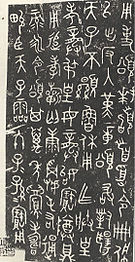 For the early Western Zhōu
to early Warring States period, the bulk of writing which has been unearthed has been in the form of bronze inscriptions. As a result, it is common to refer to the variety of scripts of this period as bronze script, even though there is no single such script. The term usually includes bronze inscriptions of the preceding Shāng
dynasty as well.
However, there are great differences between the highly pictorial Shāng emblem (aka ‘identificational’) characters on bronzes (see ‘ox’ clan insignia at left), typical Shāng bronze graphs, writing on bronzes from the middle of the Zhōu dynasty, and that on late Zhōu to Qín
, Hàn
and subsequent period bronzes. Furthermore, starting in the Spring and Autumn period, the writing in each region gradually evolved in different directions, such that the script styles in the Warring States of Chǔ
, Qín
and the eastern regions, for instance, were strikingly divergent. In addition, artistic scripts also emerged in the late Spring and Autumn to early Warring States, such as Bird Script
(鳥書 niǎoshū), also called Bird Seal Script (鳥篆 niǎozhuàn), and Worm Script
(蟲書 chóngshū). The comparison below of one Shāng graph and three Zhōu
graphs, all from bronzes but clearly in four different scripts, illustrates why talk of “bronze script” as if it were one entity is meaningless, even when referring only to the Zhōu dynasty period. Such vague references make discussions of etymology
particularly problematic:
When precision is needed, bronze may be viewed as a medium, and more specific reference may be made to a script by naming one of the periods, areas, or script styles, e.g.:
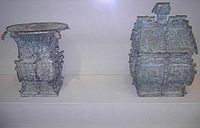 Over ten thousand inscribed bronzes have been uncovered which date to before the Qín dynasty
, with roughly a quarter dating to the Shāng
and three quarters dating to the Zhōu dynasty
. These have been periodically unearthed ever since their creation, and have been systematically collected and studied since at least the Sòng dynasty
. The inscriptions tend to grow in length over time, from only one to six or so characters for the earlier Shāng examples, to forty or so characters in the longest, late-Shāng case, and frequently a hundred or more on Zhōu bronzes, with the longest up to around 500
In general, characters on ancient Chinese bronze inscriptions were arranged in vertical columns, written top to bottom, in a fashion thought to have been influenced by bamboo
books, which are believed to have been the main medium for writing in the Shāng and Zhōu dynasties. The very narrow, vertical bamboo slats of these books were not suitable for writing wide characters, and so a number of graphs were rotated 90 degrees; this style then carried over to the Shāng and Zhōu oracle bones and bronzes. Examples:
bronzes are of a fairly uniform style, making it possible to discuss a “Shāng bronze script”, although great differences still exist between typical characters and certain instances of clan names or emblems. Like early period oracle bone script
, the structures and orientations of individual graphs varied greatly in the Shāng bronze inscriptions, such that one may find a particular character written differently each time rather than in a standardized way (see the many examples of ‘tiger’ graph to the lower left).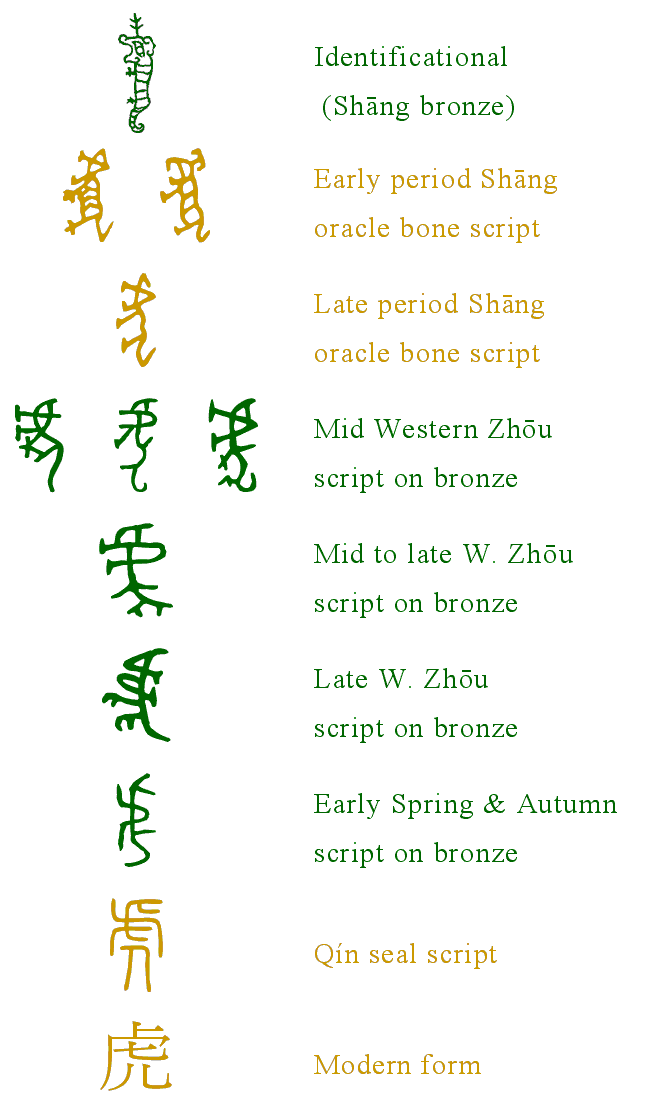 As in the oracle bone script, characters could be written facing left or right, turned 90 degrees, and sometimes even flipped vertically, generally with no change in meaning. For instance, and both represent the modern character 戌 xū (the 11th Earthly Branch
), while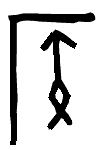 and are both 侯 hóu ‘marquis’. This was true of normal as well as extra complex identificational graphs, such as the 虎 hǔ ‘tiger’ clan emblem at right, which was turned 90 degrees clockwise on its bronze.
These inscriptions are almost all cast (as opposed to engraved), and are relatively short and simple. Some were mainly to identify the name of a clan or other name, while typical inscriptions include the maker's clan name and the posthumous title of the ancestor who is commemorated by the making and use of the vessel. These inscriptions, especially those late period examples identifying a name, are typically executed in a script of highly pictographic flavor, which preserves the formal, complex Shāng writing as would have primarily been written on bamboo or wood books, as opposed to the concurrent simplified, linearized and more rectilinear form of writing as seen on the oracle bones. A few Shāng inscriptions have been found which were brush-written on pottery, stone, jade or bone artifacts, and there are also some bone engravings on non-divination matters written in a complex, highly pictographic style; the structure and style of the bronze inscriptions is consistent with these. The soft clay of the piece-molds used to produce the Shāng to early Zhōu bronzes was suitable for preserving most of the complexity of the brush-written characters on such books and other media, whereas the hard, bony surface of the oracle bones was difficult to engrave, spurring significant simplification and conversion to rectilinearity. Furthermore, some of the characters on the Shāng bronzes may have been more complex than normal due to particularly conservative usage in this ritual medium, or when recording identificational inscriptions (clan or personal names); some scholars instead attribute this to purely decorative considerations. Shāng bronze script may thus be considered a formal script, similar to but sometimes even more complex than the unattested daily Shāng script on bamboo and wood books and other media, yet far more complex than the Shāng script on the oracle bones
.
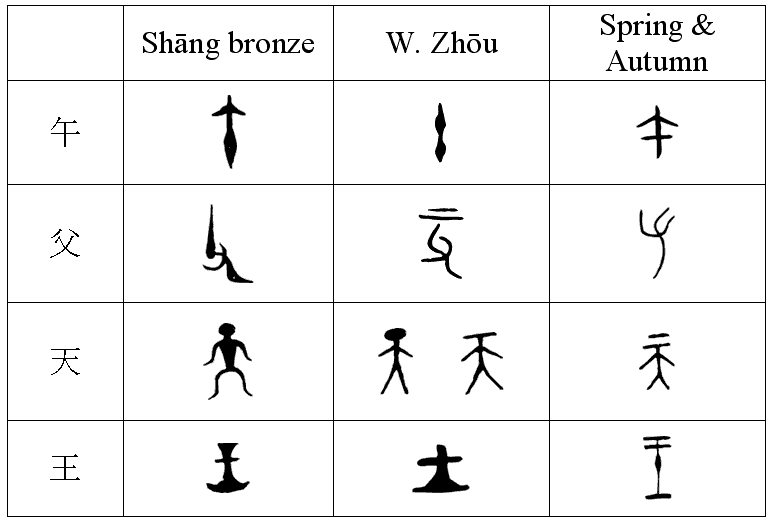 Some flexibility in orientation of graphs (rotation and reversibility) continues in the Western Zhou, but this becomes increasingly scarce throughout the Zhōu dynasty. The graphs start to become slightly more uniform in structure, size and arrangement by the time of the third Zhou sovereign, King Kāng
, and after the ninth, King Yì
, this trend becomes more obvious.
Some have used the problematic term large seal
’ (大篆 dàzhuàn) to refer to the script of this period. This term dates back to the Hàn dynasty
, when (small) seal script
and clerical script
were both in use. It thus became necessary to distinguish between the two, as well as any earlier script forms which were still accessible in the form of books and inscriptions, so the terms ‘large seal
’ (大篆 dàzhuàn) and ‘small seal’ (小篆 xiǎozhuàn, aka 秦篆 Qín zhuàn) came into being. However, since the term ‘large seal’ is variously used to describe zhòuwén (籀文) examples from the ca. 800 BCE Shizhoupian compendium
, or inscriptions on both late W. Zhōu bronze inscriptions and the Stone Drums of Qín
, or all forms (including oracle bone script
) predating small seal, the term is best avoided entirely.
In the Eastern Zhōu, the various states initially continued using the same forms as in the late Western Zhōu. However, regional forms then began to diverge stylistically as early as the Spring and Autumn period, with the forms in the state of Qín
remaining more conservative. At this time, seals
and minted coins, both probably primarily of bronze, were already in use, according to traditional documents, but none of the extant seals have yet been indisputably dated to that period.
By the mid to late Spring and Autumn period, artistic derivative scripts with vertically elongated forms appeared on bronzes, especially in the eastern and southern states, and remained in use into the Warring States period (see detail of inscription from the Warring States Tomb of Marquis Yĭ of Zēng
below left). In the same areas, in the late Spring and Autumn to early Warring States, scripts which embellished basic structures with decorative forms such as birds or worms also appeared. These are known as Bird Script (鳥書 niǎoshū) and Worm Script (蟲書chóngshū), and collectively as Bird-worm script
s, (鳥蟲書 niǎochóngshū; see Bronze sword of King Gōujiàn to right); however, these were primarily decorative forms for inscriptions on bronzes and other items, and not scripts in daily use. Some bronzes of the period were incised in a rough, casual manner, with graph structures often differing somewhat from typical ones. It is thought that these reflected the popular (vulgar) writing of the time which coexisted with the formal script.
have been found from the Warring States period
, mostly cast in bronze, and minted bronze coins from this period are also numerous. These form an additional, valuable resource for the study of Chinese bronze inscriptions. It is also from this period that the first surviving bamboo and silk manuscripts have been uncovered.
In the early Warring States period, typical bronze inscriptions were similar in content and length to those in the late Western Zhōu
to Spring and Autumn period. One of the most famous sets of bronzes ever discovered dates to the early Warring States: a large set of biānzhōng'
' bells from the tomb of Marquis Yĭ of the state of Zēng
, unearthed in 1978. The total length of the inscriptions on this set was almost 2,800 characters.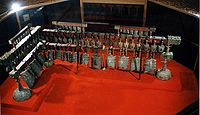
In the mid to late Warring States period, the average length of inscriptions decreased greatly. Many, especially on weapons, recorded only the date, maker and so on, in contrast with earlier narrative contents. Beginning at this time, such inscriptions were typically engraved onto the already cast bronzes, rather than being written into the wet clay of piece-molds as had been the earlier practice. The engraving was often roughly and hastily executed.
In Warring States period bronze inscriptions, trends from the late Spring and Autumn period continue, such as the use of artistically embellished scripts (e.g., Bird and Insect Scripts) on decorated bronze items. In daily writing, which was not embellished in this manner, the typical script continued evolving in different directions in various regions, and this divergence was accelerated by both a lack of central political control as well as the spread of writing outside of the nobility. In the state of Qín, which was somewhat culturally isolated from the other states, and which was positioned on the old Zhōu homeland, the script became more uniform and stylistically symmetrical, rather than changing much structurally. Change in the script was slow, so it remained more similar to the typical late Western Zhōu script as found on bronzes of that period and the Shĭ Zhoù Piān (史籀篇)
compendium of ca. 800 BCE. As a result, it was not until around the middle of the Warring States period that popular (aka common or vulgar) writing gained momentum in Qín, and even then, the vulgar forms remained somewhat similar to traditional forms, changing primarily in terms of becoming more rectilinear. Traditional forms in Qín remained in use as well, so that two forms of writing coexisted. The traditional forms in Qín evolved slowly during the Eastern Zhōu, gradually becoming what is now called (small) seal script
during that period, without any clear dividing line (it is not the case, as is commonly believed, that small seal script was a sudden invention by Lĭ Sī
in the Qín dynasty
). Meanwhile, the Qín vulgar writing evolved into early clerical (or proto-clerical) in the late Warring States to Qín dynasty period, which would then evolve further into the clerical script
used in the Hàn
through the Wèi
-Jìn (晉) periods.
Meanwhile, in the eastern states, vulgar forms had become popular sooner; they also differed more radically from and more completely displaced the traditional forms. These eastern scripts, which also varied somewhat by state or region, were later misunderstood by Xŭ Shèn
, author of the Hàn dynasty etymological dictionary Shuōwén Jiézì, who thought they predated the Warring States Qín forms, and thus labeled them gǔwén (古文), or “ancient script”
.
Ding (vessel)
A ding is an ancient Chinese cauldron with legs, a lid and two handles opposite each other. They were made in two shapes with round vessels having three legs and rectangular ones four....
tripodal cauldrons from the Shāng dynasty
Shang Dynasty
The Shang Dynasty or Yin Dynasty was, according to traditional sources, the second Chinese dynasty, after the Xia. They ruled in the northeastern regions of the area known as "China proper" in the Yellow River valley...
to the Zhōu dynasty
Zhou Dynasty
The Zhou Dynasty was a Chinese dynasty that followed the Shang Dynasty and preceded the Qin Dynasty. Although the Zhou Dynasty lasted longer than any other dynasty in Chinese history, the actual political and military control of China by the Ji family lasted only until 771 BC, a period known as...
and even later. Early bronze inscriptions were almost always cast (that is, the writing was done with a stylus in the wet clay of the piece-mold from which the bronze was then cast), while later inscriptions were often engraved after the bronze was cast.
Terminology
Western Zhou
The Western Zhōu period was the first half of the Zhou Dynasty of ancient China. It began when King Wu of Zhou overthrew the Shang Dynasty at the Battle of Muye. C.H...
to early Warring States period, the bulk of writing which has been unearthed has been in the form of bronze inscriptions. As a result, it is common to refer to the variety of scripts of this period as bronze script, even though there is no single such script. The term usually includes bronze inscriptions of the preceding Shāng
Shang Dynasty
The Shang Dynasty or Yin Dynasty was, according to traditional sources, the second Chinese dynasty, after the Xia. They ruled in the northeastern regions of the area known as "China proper" in the Yellow River valley...
dynasty as well.
However, there are great differences between the highly pictorial Shāng emblem (aka ‘identificational’) characters on bronzes (see ‘ox’ clan insignia at left), typical Shāng bronze graphs, writing on bronzes from the middle of the Zhōu dynasty, and that on late Zhōu to Qín
Qin Dynasty
The Qin Dynasty was the first imperial dynasty of China, lasting from 221 to 207 BC. The Qin state derived its name from its heartland of Qin, in modern-day Shaanxi. The strength of the Qin state was greatly increased by the legalist reforms of Shang Yang in the 4th century BC, during the Warring...
, Hàn
Han Dynasty
The Han Dynasty was the second imperial dynasty of China, preceded by the Qin Dynasty and succeeded by the Three Kingdoms . It was founded by the rebel leader Liu Bang, known posthumously as Emperor Gaozu of Han. It was briefly interrupted by the Xin Dynasty of the former regent Wang Mang...
and subsequent period bronzes. Furthermore, starting in the Spring and Autumn period, the writing in each region gradually evolved in different directions, such that the script styles in the Warring States of Chǔ
Chu (state)
The State of Chu was a Zhou Dynasty vassal state in present-day central and southern China during the Spring and Autumn period and Warring States Period . Its ruling house had the surname Nai , and clan name Yan , later evolved to surname Mi , and clan name Xiong...
, Qín
Qin (state)
The State of Qin was a Chinese feudal state that existed during the Spring and Autumn and Warring States Periods of Chinese history...
and the eastern regions, for instance, were strikingly divergent. In addition, artistic scripts also emerged in the late Spring and Autumn to early Warring States, such as Bird Script
Bird-worm seal script
Bird-worm seal script , is a type of ancient seal script originated from China.-Names:...
(鳥書 niǎoshū), also called Bird Seal Script (鳥篆 niǎozhuàn), and Worm Script
Bird-worm seal script
Bird-worm seal script , is a type of ancient seal script originated from China.-Names:...
(蟲書 chóngshū). The comparison below of one Shāng graph and three Zhōu
Zhou Dynasty
The Zhou Dynasty was a Chinese dynasty that followed the Shang Dynasty and preceded the Qin Dynasty. Although the Zhou Dynasty lasted longer than any other dynasty in Chinese history, the actual political and military control of China by the Ji family lasted only until 771 BC, a period known as...
graphs, all from bronzes but clearly in four different scripts, illustrates why talk of “bronze script” as if it were one entity is meaningless, even when referring only to the Zhōu dynasty period. Such vague references make discussions of etymology
Etymology
Etymology is the study of the history of words, their origins, and how their form and meaning have changed over time.For languages with a long written history, etymologists make use of texts in these languages and texts about the languages to gather knowledge about how words were used during...
particularly problematic:
When precision is needed, bronze may be viewed as a medium, and more specific reference may be made to a script by naming one of the periods, areas, or script styles, e.g.:
- By period: Western ZhōuWestern ZhouThe Western Zhōu period was the first half of the Zhou Dynasty of ancient China. It began when King Wu of Zhou overthrew the Shang Dynasty at the Battle of Muye. C.H...
bronze script, or even its early, middle or late phases - By region or lineage: QínQin (state)The State of Qin was a Chinese feudal state that existed during the Spring and Autumn and Warring States Periods of Chinese history...
-lineage Spring and Autumn script; or Warring State of ChǔChu (state)The State of Chu was a Zhou Dynasty vassal state in present-day central and southern China during the Spring and Autumn period and Warring States Period . Its ruling house had the surname Nai , and clan name Yan , later evolved to surname Mi , and clan name Xiong...
script - By script style: seal scriptSeal scriptSeal script is an ancient style of Chinese calligraphy. It evolved organically out of the Zhōu dynasty script , arising in the Warring State of Qin...
(broadly meaning the Qín script in the Eastern Zhou to Qín dynastyQin DynastyThe Qin Dynasty was the first imperial dynasty of China, lasting from 221 to 207 BC. The Qin state derived its name from its heartland of Qin, in modern-day Shaanxi. The strength of the Qin state was greatly increased by the legalist reforms of Shang Yang in the 4th century BC, during the Warring...
); or Bird Script, Worm Script, etc.
Inscribed Bronzes Found
Qin Dynasty
The Qin Dynasty was the first imperial dynasty of China, lasting from 221 to 207 BC. The Qin state derived its name from its heartland of Qin, in modern-day Shaanxi. The strength of the Qin state was greatly increased by the legalist reforms of Shang Yang in the 4th century BC, during the Warring...
, with roughly a quarter dating to the Shāng
Shang Dynasty
The Shang Dynasty or Yin Dynasty was, according to traditional sources, the second Chinese dynasty, after the Xia. They ruled in the northeastern regions of the area known as "China proper" in the Yellow River valley...
and three quarters dating to the Zhōu dynasty
Zhou Dynasty
The Zhou Dynasty was a Chinese dynasty that followed the Shang Dynasty and preceded the Qin Dynasty. Although the Zhou Dynasty lasted longer than any other dynasty in Chinese history, the actual political and military control of China by the Ji family lasted only until 771 BC, a period known as...
. These have been periodically unearthed ever since their creation, and have been systematically collected and studied since at least the Sòng dynasty
Song Dynasty
The Song Dynasty was a ruling dynasty in China between 960 and 1279; it succeeded the Five Dynasties and Ten Kingdoms Period, and was followed by the Yuan Dynasty. It was the first government in world history to issue banknotes or paper money, and the first Chinese government to establish a...
. The inscriptions tend to grow in length over time, from only one to six or so characters for the earlier Shāng examples, to forty or so characters in the longest, late-Shāng case, and frequently a hundred or more on Zhōu bronzes, with the longest up to around 500
In general, characters on ancient Chinese bronze inscriptions were arranged in vertical columns, written top to bottom, in a fashion thought to have been influenced by bamboo
Bamboo
Bamboo is a group of perennial evergreens in the true grass family Poaceae, subfamily Bambusoideae, tribe Bambuseae. Giant bamboos are the largest members of the grass family....
books, which are believed to have been the main medium for writing in the Shāng and Zhōu dynasties. The very narrow, vertical bamboo slats of these books were not suitable for writing wide characters, and so a number of graphs were rotated 90 degrees; this style then carried over to the Shāng and Zhōu oracle bones and bronzes. Examples:
Shāng bronze inscriptions
Inscriptions on ShāngShang Dynasty
The Shang Dynasty or Yin Dynasty was, according to traditional sources, the second Chinese dynasty, after the Xia. They ruled in the northeastern regions of the area known as "China proper" in the Yellow River valley...
bronzes are of a fairly uniform style, making it possible to discuss a “Shāng bronze script”, although great differences still exist between typical characters and certain instances of clan names or emblems. Like early period oracle bone script
Oracle bone script
Oracle bone script refers to incised ancient Chinese characters found on oracle bones, which are animal bones or turtle shells used in divination in Bronze Age China...
, the structures and orientations of individual graphs varied greatly in the Shāng bronze inscriptions, such that one may find a particular character written differently each time rather than in a standardized way (see the many examples of ‘tiger’ graph to the lower left).
Sexagenary cycle
The Chinese sexagenary cycle , also known as the Stems-and-Branches , is a cycle of sixty terms used for recording days or years. It appears, as a means of recording days, in the first Chinese written texts, the Shang dynasty oracle bones from the late second millennium BC. Its use to record years...
), while
and are both 侯 hóu ‘marquis’. This was true of normal as well as extra complex identificational graphs, such as the 虎 hǔ ‘tiger’ clan emblem at right, which was turned 90 degrees clockwise on its bronze. These inscriptions are almost all cast (as opposed to engraved), and are relatively short and simple. Some were mainly to identify the name of a clan or other name, while typical inscriptions include the maker's clan name and the posthumous title of the ancestor who is commemorated by the making and use of the vessel. These inscriptions, especially those late period examples identifying a name, are typically executed in a script of highly pictographic flavor, which preserves the formal, complex Shāng writing as would have primarily been written on bamboo or wood books, as opposed to the concurrent simplified, linearized and more rectilinear form of writing as seen on the oracle bones. A few Shāng inscriptions have been found which were brush-written on pottery, stone, jade or bone artifacts, and there are also some bone engravings on non-divination matters written in a complex, highly pictographic style; the structure and style of the bronze inscriptions is consistent with these. The soft clay of the piece-molds used to produce the Shāng to early Zhōu bronzes was suitable for preserving most of the complexity of the brush-written characters on such books and other media, whereas the hard, bony surface of the oracle bones was difficult to engrave, spurring significant simplification and conversion to rectilinearity. Furthermore, some of the characters on the Shāng bronzes may have been more complex than normal due to particularly conservative usage in this ritual medium, or when recording identificational inscriptions (clan or personal names); some scholars instead attribute this to purely decorative considerations. Shāng bronze script may thus be considered a formal script, similar to but sometimes even more complex than the unattested daily Shāng script on bamboo and wood books and other media, yet far more complex than the Shāng script on the oracle bones
Oracle bone script
Oracle bone script refers to incised ancient Chinese characters found on oracle bones, which are animal bones or turtle shells used in divination in Bronze Age China...
.
Western Zhōu script on bronzes
Western Zhōu dynasty characters (as exemplified by bronze inscriptions of that time) basically continue from the Shāng writing system; that is, early W. Zhōu forms resemble Shāng bronze forms (both identificational inscriptions such as clan names, and typical writing), without any clear or sudden distinction. They are, like their Shāng predecessors in all media, often irregular in shape and size, and the structures and details often vary from one piece of writing to the next, and even within the same piece. Although most are not pictographs in function, the early Western Zhōu bronze inscriptions have been described as more pictographic in flavor than those of subsequent periods. During the Western Zhōu, many graphs begin to show signs of simplification and linearization (the changing of rounded elements into squared ones, solid elements into short line segments, and thick, variable-width lines into thin ones of uniform width), with the result being a decrease in pictographic quality, as depicted in the chart below.King Kang of Zhou
King Kang of Zhou or King K'ang of Chou was the third sovereign of the Chinese Zhou Dynasty. The dates of his reign are 1020-996 BC or 1005-978 BC ....
, and after the ninth, King Yì
King Yi of Zhou (Ji Xie)
King Yi of Zhou or King I of Chou was the ninth sovereign of the Chinese Zhou Dynasty. Estimated dates of his reign are 885–878 BC or 865–858 BC....
, this trend becomes more obvious.
Some have used the problematic term large seal
Large Seal Script
Large Seal script or Great Seal script is a traditional reference to Chinese writing from before the Qin dynasty, and is now popularly understood to refer narrowly to the writing of the Western and early Eastern Zhou dynasties, and more broadly to also include the oracle bone script...
’ (大篆 dàzhuàn) to refer to the script of this period. This term dates back to the Hàn dynasty
Han Dynasty
The Han Dynasty was the second imperial dynasty of China, preceded by the Qin Dynasty and succeeded by the Three Kingdoms . It was founded by the rebel leader Liu Bang, known posthumously as Emperor Gaozu of Han. It was briefly interrupted by the Xin Dynasty of the former regent Wang Mang...
, when (small) seal script
Seal script
Seal script is an ancient style of Chinese calligraphy. It evolved organically out of the Zhōu dynasty script , arising in the Warring State of Qin...
and clerical script
Clerical script
The clerical script , also formerly chancery script, is an archaic style of Chinese calligraphy which evolved in the Warring States period to the Qin dynasty, was dominant in the Han dynasty, and remained in use through the Wèi-Jìn periods...
were both in use. It thus became necessary to distinguish between the two, as well as any earlier script forms which were still accessible in the form of books and inscriptions, so the terms ‘large seal
Large Seal Script
Large Seal script or Great Seal script is a traditional reference to Chinese writing from before the Qin dynasty, and is now popularly understood to refer narrowly to the writing of the Western and early Eastern Zhou dynasties, and more broadly to also include the oracle bone script...
’ (大篆 dàzhuàn) and ‘small seal’ (小篆 xiǎozhuàn, aka 秦篆 Qín zhuàn) came into being. However, since the term ‘large seal’ is variously used to describe zhòuwén (籀文) examples from the ca. 800 BCE Shizhoupian compendium
Shizhoupian
Shizhoupian refers to the Hàn dynasty etymological dictionary Shuōwén Jiézì, based on fragments of a compendium of roughly 800 BCE which was written in the late Western Zhōu script....
, or inscriptions on both late W. Zhōu bronze inscriptions and the Stone Drums of Qín
Stone Drums of Qin
The Stone Drums of Qín are ten granite boulders bearing the oldest known "stone" inscriptions in ancient Chinese...
, or all forms (including oracle bone script
Oracle bone script
Oracle bone script refers to incised ancient Chinese characters found on oracle bones, which are animal bones or turtle shells used in divination in Bronze Age China...
) predating small seal, the term is best avoided entirely.
Spring & Autumn period scripts on bronzes
By the beginning of the Eastern Zhōu, in the Spring and Autumn period, many graphs are fully linearized, as seen in the chart above; additionally, curved lines are straightened, and disconnected lines are often connected, with the result of greater convenience in writing, but a marked decrease in pictographic quality.In the Eastern Zhōu, the various states initially continued using the same forms as in the late Western Zhōu. However, regional forms then began to diverge stylistically as early as the Spring and Autumn period, with the forms in the state of Qín
Qin (state)
The State of Qin was a Chinese feudal state that existed during the Spring and Autumn and Warring States Periods of Chinese history...
remaining more conservative. At this time, seals
Seal (Chinese)
A seal, in an East Asian context, is a general name for printing stamps and impressions thereof that are used in lieu of signatures in personal documents, office paperwork, contracts, art, or any item requiring acknowledgment or authorship...
and minted coins, both probably primarily of bronze, were already in use, according to traditional documents, but none of the extant seals have yet been indisputably dated to that period.
By the mid to late Spring and Autumn period, artistic derivative scripts with vertically elongated forms appeared on bronzes, especially in the eastern and southern states, and remained in use into the Warring States period (see detail of inscription from the Warring States Tomb of Marquis Yĭ of Zēng
Tomb of Marquis Yi of Zeng
The Tomb of Marquis Yi of Zeng is an important archaeological site in Suizhou, Hubei, China, dated sometime after 433 BCE. The tomb contained the remains of Marquis Yi of Zeng...
below left). In the same areas, in the late Spring and Autumn to early Warring States, scripts which embellished basic structures with decorative forms such as birds or worms also appeared. These are known as Bird Script (鳥書 niǎoshū) and Worm Script (蟲書chóngshū), and collectively as Bird-worm script
Bird-worm seal script
Bird-worm seal script , is a type of ancient seal script originated from China.-Names:...
s, (鳥蟲書 niǎochóngshū; see Bronze sword of King Gōujiàn to right); however, these were primarily decorative forms for inscriptions on bronzes and other items, and not scripts in daily use. Some bronzes of the period were incised in a rough, casual manner, with graph structures often differing somewhat from typical ones. It is thought that these reflected the popular (vulgar) writing of the time which coexisted with the formal script.
Warring States Period scripts on bronzes
SealsSeal (Chinese)
A seal, in an East Asian context, is a general name for printing stamps and impressions thereof that are used in lieu of signatures in personal documents, office paperwork, contracts, art, or any item requiring acknowledgment or authorship...
have been found from the Warring States period
Warring States Period
The Warring States Period , also known as the Era of Warring States, or the Warring Kingdoms period, covers the Iron Age period from about 475 BC to the reunification of China under the Qin Dynasty in 221 BC...
, mostly cast in bronze, and minted bronze coins from this period are also numerous. These form an additional, valuable resource for the study of Chinese bronze inscriptions. It is also from this period that the first surviving bamboo and silk manuscripts have been uncovered.
In the early Warring States period, typical bronze inscriptions were similar in content and length to those in the late Western Zhōu
Western Zhou
The Western Zhōu period was the first half of the Zhou Dynasty of ancient China. It began when King Wu of Zhou overthrew the Shang Dynasty at the Battle of Muye. C.H...
to Spring and Autumn period. One of the most famous sets of bronzes ever discovered dates to the early Warring States: a large set of biānzhōng'
Bianzhong
Bianzhong is an ancient Chinese musical instrument consisting of a set of bronze bells, played melodically. These sets of chime bells were used as polyphonic musical instruments and some of these bells have been dated at between 2,000 to 3,600 years old. They were hung in a wooden frame and...
' bells from the tomb of Marquis Yĭ of the state of Zēng
Tomb of Marquis Yi of Zeng
The Tomb of Marquis Yi of Zeng is an important archaeological site in Suizhou, Hubei, China, dated sometime after 433 BCE. The tomb contained the remains of Marquis Yi of Zeng...
, unearthed in 1978. The total length of the inscriptions on this set was almost 2,800 characters.
In the mid to late Warring States period, the average length of inscriptions decreased greatly. Many, especially on weapons, recorded only the date, maker and so on, in contrast with earlier narrative contents. Beginning at this time, such inscriptions were typically engraved onto the already cast bronzes, rather than being written into the wet clay of piece-molds as had been the earlier practice. The engraving was often roughly and hastily executed.
In Warring States period bronze inscriptions, trends from the late Spring and Autumn period continue, such as the use of artistically embellished scripts (e.g., Bird and Insect Scripts) on decorated bronze items. In daily writing, which was not embellished in this manner, the typical script continued evolving in different directions in various regions, and this divergence was accelerated by both a lack of central political control as well as the spread of writing outside of the nobility. In the state of Qín, which was somewhat culturally isolated from the other states, and which was positioned on the old Zhōu homeland, the script became more uniform and stylistically symmetrical, rather than changing much structurally. Change in the script was slow, so it remained more similar to the typical late Western Zhōu script as found on bronzes of that period and the Shĭ Zhoù Piān (史籀篇)
Shizhoupian
Shizhoupian refers to the Hàn dynasty etymological dictionary Shuōwén Jiézì, based on fragments of a compendium of roughly 800 BCE which was written in the late Western Zhōu script....
compendium of ca. 800 BCE. As a result, it was not until around the middle of the Warring States period that popular (aka common or vulgar) writing gained momentum in Qín, and even then, the vulgar forms remained somewhat similar to traditional forms, changing primarily in terms of becoming more rectilinear. Traditional forms in Qín remained in use as well, so that two forms of writing coexisted. The traditional forms in Qín evolved slowly during the Eastern Zhōu, gradually becoming what is now called (small) seal script
Seal script
Seal script is an ancient style of Chinese calligraphy. It evolved organically out of the Zhōu dynasty script , arising in the Warring State of Qin...
during that period, without any clear dividing line (it is not the case, as is commonly believed, that small seal script was a sudden invention by Lĭ Sī
Li Si
Li Si was the influential Prime Minister of the feudal state and later of the dynasty of Qin, between 246 BC and 208 BC. A famous Legalist, he was also a notable calligrapher. Li Si served under two rulers: Qin Shi Huang, king of Qin and later First Emperor of China—and his son, Qin Er Shi...
in the Qín dynasty
Qin Dynasty
The Qin Dynasty was the first imperial dynasty of China, lasting from 221 to 207 BC. The Qin state derived its name from its heartland of Qin, in modern-day Shaanxi. The strength of the Qin state was greatly increased by the legalist reforms of Shang Yang in the 4th century BC, during the Warring...
). Meanwhile, the Qín vulgar writing evolved into early clerical (or proto-clerical) in the late Warring States to Qín dynasty period, which would then evolve further into the clerical script
Clerical script
The clerical script , also formerly chancery script, is an archaic style of Chinese calligraphy which evolved in the Warring States period to the Qin dynasty, was dominant in the Han dynasty, and remained in use through the Wèi-Jìn periods...
used in the Hàn
Han Dynasty
The Han Dynasty was the second imperial dynasty of China, preceded by the Qin Dynasty and succeeded by the Three Kingdoms . It was founded by the rebel leader Liu Bang, known posthumously as Emperor Gaozu of Han. It was briefly interrupted by the Xin Dynasty of the former regent Wang Mang...
through the Wèi
Cao Wei
Cao Wei was one of the states that competed for control of China during the Three Kingdoms period. With the capital at Luoyang, the state was established by Cao Pi in 220, based upon the foundations that his father Cao Cao laid...
-Jìn (晉) periods.
Meanwhile, in the eastern states, vulgar forms had become popular sooner; they also differed more radically from and more completely displaced the traditional forms. These eastern scripts, which also varied somewhat by state or region, were later misunderstood by Xŭ Shèn
Xu Shen
Xǔ Shèn was a Chinese philologist of the Han Dynasty. He was the author of Shuowen Jiezi, the first Chinese dictionary with character analysis, as well as the first to organize the characters by shared components. It contains over 9,000 character entries under 540 radicals, explaining the origins...
, author of the Hàn dynasty etymological dictionary Shuōwén Jiézì, who thought they predated the Warring States Qín forms, and thus labeled them gǔwén (古文), or “ancient script”
Guwen
Gǔwén literally means ancient Chinese script. Historically the term has been used in several different ways.The first usage, which is common, is as a reference to the most ancient forms of Chinese writing, namely the writing of the Shāng and early Zhōu dynasties, such as found on oracle bones,...
.
See also
- Chinese writing
- Chinese calligraphy
- Oracle bone scriptOracle bone scriptOracle bone script refers to incised ancient Chinese characters found on oracle bones, which are animal bones or turtle shells used in divination in Bronze Age China...
- Seal scriptSeal scriptSeal script is an ancient style of Chinese calligraphy. It evolved organically out of the Zhōu dynasty script , arising in the Warring State of Qin...
- clerical scriptClerical scriptThe clerical script , also formerly chancery script, is an archaic style of Chinese calligraphy which evolved in the Warring States period to the Qin dynasty, was dominant in the Han dynasty, and remained in use through the Wèi-Jìn periods...