

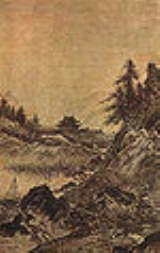
Ink and wash painting

Encyclopedia
Ink and wash painting is an East Asian type of brush
painting
also known as ink wash painting. Only black ink — the same as used in East Asian calligraphy
— is used, in various concentrations.
In Western art, works on paper in similar techniques are generally classified with drawing
s.
during the Tang Dynasty
(618-907). Wang Wei is generally credited as the painter who applied color to existing ink wash paintings. The art was further developed into a more polished style during the Song Dynasty
(960-1279). It was introduced to Korea shortly after China's discovery of the ink.
This story embodies the philosophy of East Asian ink wash painting. The goal is not simply to reproduce the appearance of the subject, but to capture its soul. To paint a horse, the ink wash painting artist must understand its temperament better than its muscles and bones. To paint a flower, there is no need to perfectly match its petals and colors, but it is essential to convey its liveliness and fragrance. East Asian ink wash painting may be regarded as an earliest form of expressionistic art that captures the unseen.
East Asian ink wash painting has long inspired modern artists in the West. In his classic book Composition, American artist and educator Arthur Wesley Dow (1857–1922) wrote this about ink wash painting: "The painter ...put upon the paper the fewest possible lines and tones; just enough to cause form, texture and effect to be felt. Every brush-touch must be full-charged with meaning, and useless detail eliminated. Put together all the good points in such a method, and you have the qualities of the highest art". Dow's fascination with ink wash painting not only shaped his own approach to art but also helped free many American modernists of the era, including his student Georgia O'Keeffe, from what he called a 'story-telling' approach. Dow strived for harmonic compositions through three elements: line, shading, and color. He advocated practicing with East Asian brushes and ink to develop aesthetic acuity with line and shading.
Shading in ink wash painting refers to the varying ink density produced by grinding an ink stick in water. Ink wash painting artists spend years practicing basic brush strokes to refine their brush movement and ink flow. In the hand of a master, a single stroke can produce astonishing variations in tonality, from deep black to silvery gray. Thus, in its original context, shading means more than just dark-light arrangement, it is the basis for the beautiful nuance in tonality unique to East Asian ink wash painting and brush-and-ink calligraphy.
, artists usually grind inkstick
over an inkstone to obtain black ink
, but prepared inks are also available. Most inksticks are made of either pine
or oil
soot
combined with animal glue
. An artist puts a few drops of water on an inkstone and grinds the inkstick in a circular motion until a smooth, black ink of the desired concentration is made. Prepared inks are usually of much lower quality. Inksticks themselves are sometimes ornately decorated with landscapes
or flowers in bas-relief and some are highlighted with gold.
Ink wash painting brushes
are similar to the brushes used for calligraphy and are traditionally made from bamboo
with goat, cattle
, horse
, sheep
, rabbit
, marten, badger, deer
, boar and wolf
hair. The brush hairs are tapered to a fine point, a feature vital to the style of wash paintings.
Different brushes have different qualities. A small wolf-hair brush that is tapered to a fine point can deliver an even thin line of ink (much like a pen). A large wool brush (one variation called the big cloud) can hold a large volume of water and ink. When the big cloud brush rains down upon the paper, it delivers a graded swath of ink encompassing myriad shades of gray to black.
Once a stroke is painted, it cannot be changed or erased. This makes ink and wash painting a technically demanding art-form requiring great skill, concentration, and years of training.
titled "Save the Crane" has the characters fly into an ink wash painting painting to rescue a baby crane.
The video game Ōkami
, developed by Capcom
for the PS2 and Wii
systems, is done almost entirely in this art style.
In the episode of Avatar: The Last Airbender
, "The Cave of Two Lovers," the backstory behind Omashu was illustrated in ink wash painting.
Okami
Ink brush
Ink brushes are used in Chinese calligraphy. They are also used in Chinese painting and descendant brush painting styles. The ink brush was invented in China, believed to be around 300BCE...
painting
Painting
Painting is the practice of applying paint, pigment, color or other medium to a surface . The application of the medium is commonly applied to the base with a brush but other objects can be used. In art, the term painting describes both the act and the result of the action. However, painting is...
also known as ink wash painting. Only black ink — the same as used in East Asian calligraphy
East Asian calligraphy
East Asian calligraphy is a form of calligraphy widely practised and revered in the Sinosphere. This most often includes China, Japan, Korea, and Vietnam. The East Asian calligraphic tradition originated and developed from China. There is a general standardization of the various styles of...
— is used, in various concentrations.
In Western art, works on paper in similar techniques are generally classified with drawing
Drawing
Drawing is a form of visual art that makes use of any number of drawing instruments to mark a two-dimensional medium. Common instruments include graphite pencils, pen and ink, inked brushes, wax color pencils, crayons, charcoal, chalk, pastels, markers, styluses, and various metals .An artist who...
s.
History
Ink wash painting developed in ChinaChina
Chinese civilization may refer to:* China for more general discussion of the country.* Chinese culture* Greater China, the transnational community of ethnic Chinese.* History of China* Sinosphere, the area historically affected by Chinese culture...
during the Tang Dynasty
Tang Dynasty
The Tang Dynasty was an imperial dynasty of China preceded by the Sui Dynasty and followed by the Five Dynasties and Ten Kingdoms Period. It was founded by the Li family, who seized power during the decline and collapse of the Sui Empire...
(618-907). Wang Wei is generally credited as the painter who applied color to existing ink wash paintings. The art was further developed into a more polished style during the Song Dynasty
Song Dynasty
The Song Dynasty was a ruling dynasty in China between 960 and 1279; it succeeded the Five Dynasties and Ten Kingdoms Period, and was followed by the Yuan Dynasty. It was the first government in world history to issue banknotes or paper money, and the first Chinese government to establish a...
(960-1279). It was introduced to Korea shortly after China's discovery of the ink.
Philosophy
In an old Chinese legend, an artist named Zhang Sengyou (張僧繇) was asked to paint a mural in a temple. He painted four dragons but left out the pupils from their eyes. The Abbot asked him why. Zhang explained that if he painted the pupils, the dragons would come alive. When the Abbot insisted, Zhang proceeded to paint two of the dragons’ eyes. As soon as he finished painting the pupils on two of the dragons, they roared to life and flew away in a thunderous flash of lightning. The two dragons that had no pupils stayed on the wall.This story embodies the philosophy of East Asian ink wash painting. The goal is not simply to reproduce the appearance of the subject, but to capture its soul. To paint a horse, the ink wash painting artist must understand its temperament better than its muscles and bones. To paint a flower, there is no need to perfectly match its petals and colors, but it is essential to convey its liveliness and fragrance. East Asian ink wash painting may be regarded as an earliest form of expressionistic art that captures the unseen.
East Asian ink wash painting has long inspired modern artists in the West. In his classic book Composition, American artist and educator Arthur Wesley Dow (1857–1922) wrote this about ink wash painting: "The painter ...put upon the paper the fewest possible lines and tones; just enough to cause form, texture and effect to be felt. Every brush-touch must be full-charged with meaning, and useless detail eliminated. Put together all the good points in such a method, and you have the qualities of the highest art". Dow's fascination with ink wash painting not only shaped his own approach to art but also helped free many American modernists of the era, including his student Georgia O'Keeffe, from what he called a 'story-telling' approach. Dow strived for harmonic compositions through three elements: line, shading, and color. He advocated practicing with East Asian brushes and ink to develop aesthetic acuity with line and shading.
Shading in ink wash painting refers to the varying ink density produced by grinding an ink stick in water. Ink wash painting artists spend years practicing basic brush strokes to refine their brush movement and ink flow. In the hand of a master, a single stroke can produce astonishing variations in tonality, from deep black to silvery gray. Thus, in its original context, shading means more than just dark-light arrangement, it is the basis for the beautiful nuance in tonality unique to East Asian ink wash painting and brush-and-ink calligraphy.
Tools
In ink wash paintings, as in calligraphyEast Asian calligraphy
East Asian calligraphy is a form of calligraphy widely practised and revered in the Sinosphere. This most often includes China, Japan, Korea, and Vietnam. The East Asian calligraphic tradition originated and developed from China. There is a general standardization of the various styles of...
, artists usually grind inkstick
Inkstick
Inksticks are a type of solid ink used traditionally in several East Asian cultures for calligraphy and brush painting. Inksticks are made mainly of soot and animal glue, sometimes with incense or medicinal scents added...
over an inkstone to obtain black ink
Ink
Ink is a liquid or paste that contains pigments and/or dyes and is used to color a surface to produce an image, text, or design. Ink is used for drawing and/or writing with a pen, brush, or quill...
, but prepared inks are also available. Most inksticks are made of either pine
Pine
Pines are trees in the genus Pinus ,in the family Pinaceae. They make up the monotypic subfamily Pinoideae. There are about 115 species of pine, although different authorities accept between 105 and 125 species.-Etymology:...
or oil
Vegetable fats and oils
Vegetable fats and oils are lipid materials derived from plants. Physically, oils are liquid at room temperature, and fats are solid. Chemically, both fats and oils are composed of triglycerides, as contrasted with waxes which lack glycerin in their structure...
soot
Soot
Soot is a general term that refers to impure carbon particles resulting from the incomplete combustion of a hydrocarbon. It is more properly restricted to the product of the gas-phase combustion process but is commonly extended to include the residual pyrolyzed fuel particles such as cenospheres,...
combined with animal glue
Animal glue
An animal glue is an adhesive that is created by prolonged boiling of animal connective tissue.These protein colloid glues are formed through hydrolysis of the collagen from skins, bones, tendons, and other tissues, similar to gelatin. The word "collagen" itself derives from Greek κόλλα kolla, glue...
. An artist puts a few drops of water on an inkstone and grinds the inkstick in a circular motion until a smooth, black ink of the desired concentration is made. Prepared inks are usually of much lower quality. Inksticks themselves are sometimes ornately decorated with landscapes
Landscape art
Landscape art is a term that covers the depiction of natural scenery such as mountains, valleys, trees, rivers, and forests, and especially art where the main subject is a wide view, with its elements arranged into a coherent composition. In other works landscape backgrounds for figures can still...
or flowers in bas-relief and some are highlighted with gold.
Ink wash painting brushes
Ink brush
Ink brushes are used in Chinese calligraphy. They are also used in Chinese painting and descendant brush painting styles. The ink brush was invented in China, believed to be around 300BCE...
are similar to the brushes used for calligraphy and are traditionally made from bamboo
Bamboo
Bamboo is a group of perennial evergreens in the true grass family Poaceae, subfamily Bambusoideae, tribe Bambuseae. Giant bamboos are the largest members of the grass family....
with goat, cattle
Cattle
Cattle are the most common type of large domesticated ungulates. They are a prominent modern member of the subfamily Bovinae, are the most widespread species of the genus Bos, and are most commonly classified collectively as Bos primigenius...
, horse
Horsehair
Horsehair is the long, coarse hair growing on the manes and tails of horses. It is used for various purposes, including upholstery, brushes, the bows of musical instruments, a hard-wearing fabric called haircloth, and for horsehair plaster, a wallcovering material formerly used in the construction...
, sheep
Wool
Wool is the textile fiber obtained from sheep and certain other animals, including cashmere from goats, mohair from goats, qiviut from muskoxen, vicuña, alpaca, camel from animals in the camel family, and angora from rabbits....
, rabbit
Rabbit
Rabbits are small mammals in the family Leporidae of the order Lagomorpha, found in several parts of the world...
, marten, badger, deer
Sika Deer
The Sika Deer, Cervus nippon, also known as the Spotted Deer or the Japanese Deer, is a species of deer native to much of East Asia and introduced to various other parts of the world...
, boar and wolf
Gray Wolf
The gray wolf , also known as the wolf, is the largest extant wild member of the Canidae family...
hair. The brush hairs are tapered to a fine point, a feature vital to the style of wash paintings.
Different brushes have different qualities. A small wolf-hair brush that is tapered to a fine point can deliver an even thin line of ink (much like a pen). A large wool brush (one variation called the big cloud) can hold a large volume of water and ink. When the big cloud brush rains down upon the paper, it delivers a graded swath of ink encompassing myriad shades of gray to black.
Once a stroke is painted, it cannot be changed or erased. This makes ink and wash painting a technically demanding art-form requiring great skill, concentration, and years of training.
Noted artists
China
- Bada Shanren
- Mi Youren
- Su ShiSu ShiSu Shi , was a writer, poet, artist, calligrapher, pharmacologist, gastronome, and statesman of the Song Dynasty, and one of the major poets of the Song era. His courtesy name was Zizhan and his pseudonym was Dongpo Jushi , and he is often referred to as Su Dongpo...
- Qi BaishiQi BaishiQi Baishi was an influential Chinese painter.Born to a peasant family from Xiangtan, Hunan, Qi became a carpenter at 14, and learned to paint by himself. After he turned 40, he traveled, visiting various scenic spots in China...
- Wu ZuorenWu ZuorenWu Zuoren was a traditional Chinese painter. A native of Jing County, Anhui, he was born in Suzhou, Jiangsu Province. He practiced both traditional Chinese ink painting and European oil painting.-Chronology:...
- Xu BeihongXu BeihongXu Beihong was born in Yixing, China. He was primarily known for his shuimohua of horses and birds and one of the first Chinese artists to articulate the need for artistic expressions that reflected a new modern China at the beginning of the 20th century...
- Zhang DaqianZhang DaqianChang Dai-chien was one of the best-known and most prodigious Chinese artists of the twentieth century. Originally known as a guohua painter, by the 1960s he was also renowned as a modern impressionist and expressionist painter...
In popular culture
An episode of Nickelodeon's Wonder PetsWonder Pets
Wonder Pets is an American animated children's television series. It debuted on March 3, 2006, on the Nick Jr. block of the Nickelodeon cable television network and Noggin on the same day...
titled "Save the Crane" has the characters fly into an ink wash painting painting to rescue a baby crane.
The video game Ōkami
Okami
is an action-adventure video game developed by Clover Studio and published by Capcom. It was released for Sony's PlayStation 2 video game console in 2006 in Japan and North America, and 2007 in Europe and Australia...
, developed by Capcom
Capcom
is a Japanese developer and publisher of video games, known for creating multi-million-selling franchises such as Devil May Cry, Chaos Legion, Street Fighter, Mega Man and Resident Evil. Capcom developed and published Bionic Commando, Lost Planet and Dark Void too, but they are less known. Its...
for the PS2 and Wii
Wii
The Wii is a home video game console released by Nintendo on November 19, 2006. As a seventh-generation console, the Wii primarily competes with Microsoft's Xbox 360 and Sony's PlayStation 3. Nintendo states that its console targets a broader demographic than that of the two others...
systems, is done almost entirely in this art style.
In the episode of Avatar: The Last Airbender
Avatar: The Last Airbender
Avatar: The Last Airbender is an American animated television series that aired for three seasons on Nickelodeon from 2005 to 2008. The series was created and produced by Michael Dante DiMartino and Bryan Konietzko, who served as executive producers along with Aaron Ehasz...
, "The Cave of Two Lovers," the backstory behind Omashu was illustrated in ink wash painting.
See also
- Bird-and-flower paintingBird-and-flower paintingBird-and-flower painting is a kind of Chinese painting named after its subject matter. Normally, most bird-and-flower paintings belong to the scholar-artist style of Chinese painting....
- Chinese artChinese artChinese art is visual art that, whether ancient or modern, originated in or is practiced in China or by Chinese artists or performers. Early so-called "stone age art" dates back to 10,000 BC, mostly consisting of simple pottery and sculptures. This early period was followed by a series of art...
- Chinese paintingChinese paintingChinese painting is one of the oldest continuous artistic traditions in the world. The earliest paintings were not representational but ornamental; they consisted of patterns or designs rather than pictures. Early pottery was painted with spirals, zigzags, dots, or animals...
- Four GentlemenFour GentlemenThe Four Gentlemen, also called the Four Noble Ones, in Chinese art refers to four plants: the orchid, the bamboo, the chrysanthemum, and the plum blossom. The term compares the four plants to Confucianist junzi, or "gentlemen"...
- Japanese paintingJapanese paintingis one of the oldest and most highly refined of the Japanese visual arts, encompassing a wide variety of genres and styles. As with the history of Japanese arts in general, the long history of Japanese painting exhibits synthesis and competition between native Japanese aesthetics and adaptation of...
- Higashiyama BunkaHigashiyama BunkaThe Higashiyama Period also known as the period of "Higashiyama Culture" or , is a segment of Japanese culture originated and promoted in the 15th century by Shogun Ashikaga Yoshimasa, after he retired to his villa in the eastern hills of Kyoto.- Outline :Based largely on the ideals and...
in Muromachi periodMuromachi periodThe is a division of Japanese history running from approximately 1336 to 1573. The period marks the governance of the Muromachi or Ashikaga shogunate, which was officially established in 1338 by the first Muromachi shogun, Ashikaga Takauji, two years after the brief Kemmu restoration of imperial...
- Higashiyama Bunka
- Korean paintingKorean paintingKorean painting includes paintings made in Korea or by overseas Koreans on all surfaces. It includes art as old as the petroglyphs through post-modern conceptual art using transient forms of light...
- HabokuHabokuand are both a technique employed in suiboku , as seen in landscape paintings, involving an abstract simplification of forms and freedom of brushwork. The two terms are often confused with each other in ordinary use. Generally, haboku relies on a layered contrast black, gray and white, whereas...
Okami