

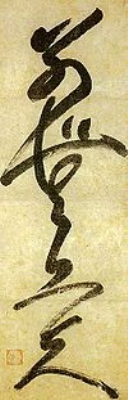
Japanese calligraphy

Encyclopedia
Calligraphy
Calligraphy is a type of visual art. It is often called the art of fancy lettering . A contemporary definition of calligraphic practice is "the art of giving form to signs in an expressive, harmonious and skillful manner"...
, or artistic writing
Writing
Writing is the representation of language in a textual medium through the use of a set of signs or symbols . It is distinguished from illustration, such as cave drawing and painting, and non-symbolic preservation of language via non-textual media, such as magnetic tape audio.Writing most likely...
, of the Japanese language
Japanese language
is a language spoken by over 130 million people in Japan and in Japanese emigrant communities. It is a member of the Japonic language family, which has a number of proposed relationships with other languages, none of which has gained wide acceptance among historical linguists .Japanese is an...
. For a long time, the most esteemed calligrapher in Japan
Japan
Japan is an island nation in East Asia. Located in the Pacific Ocean, it lies to the east of the Sea of Japan, China, North Korea, South Korea and Russia, stretching from the Sea of Okhotsk in the north to the East China Sea and Taiwan in the south...
had been Wang Xizhi
Wang Xizhi
Wang Xizhi was a Chinese calligrapher, traditionally referred to as the Sage of Calligraphy , who lived during the Jin Dynasty...
, a Chinese calligrapher in the 4th century but after the invention of Hiragana
Hiragana
is a Japanese syllabary, one basic component of the Japanese writing system, along with katakana, kanji, and the Latin alphabet . Hiragana and katakana are both kana systems, in which each character represents one mora...
and Katakana
Katakana
is a Japanese syllabary, one component of the Japanese writing system along with hiragana, kanji, and in some cases the Latin alphabet . The word katakana means "fragmentary kana", as the katakana scripts are derived from components of more complex kanji. Each kana represents one mora...
, the Japanese unique syllabaries, the distinctive Japanese writing system
Japanese writing system
The modern Japanese writing system uses three main scripts:*Kanji, adopted Chinese characters*Kana, a pair of syllabaries , consisting of:...
developed and calligraphers produced styles intrinsic to Japan.
Principles
Japanese calligraphy shares its roots with Chinese calligraphy and many of its principles and techniquesEast Asian calligraphy
East Asian calligraphy is a form of calligraphy widely practised and revered in the Sinosphere. This most often includes China, Japan, Korea, and Vietnam. The East Asian calligraphic tradition originated and developed from China. There is a general standardization of the various styles of...
are very similar. It is most often written with on and it recognizes the same basic writing styles: (Chinese: 篆書 ); (Chinese: 隸書 ); (Chinese: 楷書 ); (Chinese: 行書 ); and (Chinese: 草書 ).
Chinese roots
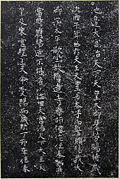
Li Si
Li Si was the influential Prime Minister of the feudal state and later of the dynasty of Qin, between 246 BC and 208 BC. A famous Legalist, he was also a notable calligrapher. Li Si served under two rulers: Qin Shi Huang, king of Qin and later First Emperor of China—and his son, Qin Er Shi...
, prime minister in the Chinese dynasty of Qin
Qin (state)
The State of Qin was a Chinese feudal state that existed during the Spring and Autumn and Warring States Periods of Chinese history...
, standardized a script and its way of being written. He sanctioned a form of script based on squares of uniform size into which all characters
Chinese character
Chinese characters are logograms used in the writing of Chinese and Japanese , less frequently Korean , formerly Vietnamese , or other languages...
could be written from eight strokes. He also devised rules of composition where horizontal strokes are written first and characters are composed starting from top to bottom, left to right. Because the symbols were inscribed with sharp instruments, the lines were originally angular and in many ways Li Si's achievements were made obsolete by the appearance of brush and ink (see Chinese calligraphy). The ink-wet brush creates a line quite different from a sharp stylus. It affords variation in thickness and curve of line. Calligraphy retained the block form of Li Si and his eight strokes but the writer was free to create characters that emphasized aesthetically pleasing balance and form. The way a character was written gave a message of style.
Calligraphy in the Chinese tradition was thus introduced to Japan about 600 CE. Known as the karayō tradition, it has been practiced up to today, rejuvenated continuously through contact with Chinese culture.
The oldest existing calligraphic text in Japan is the inscription on the halo of the Bhaisajyaguru
Bhaisajyaguru
Bhaiṣajyaguru , formally Bhaiṣajyaguruvaidūryaprabharāja , is the buddha of healing and medicine in Mahāyāna Buddhism. Commonly referred to as the "Medicine Buddha", he is described as a doctor who cures suffering using the medicine of his teachings.-Origin:...
statue in the Hōryū-ji
Hōryū-ji
is a Buddhist temple in Ikaruga, Nara Prefecture, Japan. Its full name is Hōryū Gakumonji , or Learning Temple of the Flourishing Law, the complex serving as seminary and monastery both....
Temple. This Chinese
Chinese language
The Chinese language is a language or language family consisting of varieties which are mutually intelligible to varying degrees. Originally the indigenous languages spoken by the Han Chinese in China, it forms one of the branches of Sino-Tibetan family of languages...
text was written in Shakeitai style, prominent in the Chinese Six Dynasties
Six Dynasties
Six Dynasties is a collective noun for six Chinese dynasties during the periods of the Three Kingdoms , Jin Dynasty , and Southern and Northern Dynasties ....
period.
Before the Nara period
Hōryū-ji
is a Buddhist temple in Ikaruga, Nara Prefecture, Japan. Its full name is Hōryū Gakumonji , or Learning Temple of the Flourishing Law, the complex serving as seminary and monastery both....
Temple also holds bibliographic notes on the Lotus Sutra
Lotus Sutra
The Lotus Sūtra is one of the most popular and influential Mahāyāna sūtras, and the basis on which the Tiantai and Nichiren sects of Buddhism were established.-Title:...
: the was written early in the 7th century and is considered the oldest Japanese text. It is written in Cursive script
Cursive script (East Asia)
Cursive script , sometimes translated as Grass script is a style of Chinese calligraphy. Cursive script is faster to write than other styles, but difficult to read for those unfamiliar with it. It functions primarily as a kind of shorthand script or calligraphic style...
and illustrates that calligraphy in the Asuka period
Asuka period
The , was a period in the history of Japan lasting from 538 to 710 , although its beginning could be said to overlap with the preceding Kofun period...
was already refined to a high degree.
The oldest hand-copied sutra in Japan is the Kongō Jōdaranikyō
Kongo Jodaranikyo
is a Japanese sūtra of the Vajrayana school of Buddhism. Copied by the priest Hōrin in 686, it is the oldest hand-copied sūtra in Japan and is designated as a national treasure. Hōrin based his copy on the original by Jñānagupta .-External links:...
. Copied by the priest Hōrin in 686 CE, the calligraphy style shows influences from the work of Ouyang Xun
Ouyang Xun
Ouyang Xun , courtesy name Xinben , was a Confucian scholar and calligrapher of the early Tang Dynasty. He was born in Hunan, Changsha, to a family of government officials; and died in modern Anhui province.-Achievements:...
.
(mid-7th century) and Stone in Nasu County are also typical examples from this time. Both inscriptions were influenced by the Northern Wei
Northern Wei
The Northern Wei Dynasty , also known as the Tuoba Wei , Later Wei , or Yuan Wei , was a dynasty which ruled northern China from 386 to 534 . It has been described as "part of an era of political turbulence and intense social and cultural change"...
robust style.
In the 7th century, the Tang Dynasty
Tang Dynasty
The Tang Dynasty was an imperial dynasty of China preceded by the Sui Dynasty and followed by the Five Dynasties and Ten Kingdoms Period. It was founded by the Li family, who seized power during the decline and collapse of the Sui Empire...
established hegemony in China. Their second Emperor Taizong
Emperor Taizong of Tang
Emperor Taizong of Tang , personal name Lǐ Shìmín , was the second emperor of the Tang Dynasty of China, ruling from 626 to 649...
esteemed Wang Xizhi
Wang Xizhi
Wang Xizhi was a Chinese calligrapher, traditionally referred to as the Sage of Calligraphy , who lived during the Jin Dynasty...
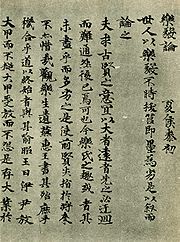
's calligraphic texts and this popularity influenced Japanese calligraphers. All of the original texts written by Wang Xizhi have been lost, and copies such as Gakki-ron written by the Empress Komyo
Empress Komyo
was the Nara period consort of Japanese Emperor Shōmu .A member of the Fujiwara clan, her father was Fujiwara no Fuhito and her mother was Agata Inukai no Michiyo . During her life she was also known as Asukabehime 安宿媛, Kōmyōshi 光明子, and Tōsanjō 藤三娘...
are highly regarded as important sources for Wang Xizhi's style. However Wang's influence can barely be overstated, in particular for the wayō style unique to Japan: "Even today, there is something about Japanese calligraphy that retains the unchanged flavour of Wang Xizhi's
Wang Xizhi
Wang Xizhi was a Chinese calligrapher, traditionally referred to as the Sage of Calligraphy , who lived during the Jin Dynasty...
style".
Heian period
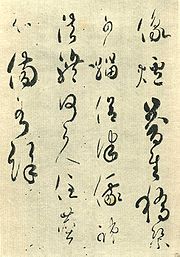
Emperor Kammu
was the 50th emperor of Japan, according to the traditional order of succession. Kammu reigned from 781 to 806.-Traditional narrative:Kammu's personal name was . He was the eldest son of Prince Shirakabe , and was born prior to Shirakabe's ascension to the throne...
moved the capital
Capital of Japan
The capital of Japan, where the seat of the Government of Japan and home of the Emperor are located, is de facto. While this is generally not in dispute, the capital de jure is unclear. There is a dispute as to exactly when Tokyo became the capital. Some state that it occurred when Tokyo...
from Heijō-kyō
Heijo-kyo
Heijō-kyō , was the capital city of Japan during most of the Nara period, from 710–40 and again from 745–84. The Palace site is a listed UNESCO World Heritage together with other places in the city of Nara Heijō-kyō (平城京, also Heizei-kyō, sometimes Nara no miyako), was the capital city of Japan...
in Nara
Nara, Nara
is the capital city of Nara Prefecture in the Kansai region of Japan. The city occupies the northern part of Nara Prefecture, directly bordering Kyoto Prefecture...
, first to Nagaoka-kyō
Nagaoka-kyo
was the capital of Japan from 784 to 794. Its location was reported as Otokuni District, Yamashiro Province, and Nagaokakyō, Kyoto, which took its name from the capital...
in 784, and then to Heian-kyō
Heian-kyo
Heian-kyō , was one of several former names for the city now known as Kyoto. It was the capital of Japan for over one thousand years, from 794 to 1868 with an interruption in 1180....
, Kyoto in 794. This marks the beginning of the Heian era, Japan's "golden age". Chinese influences in calligraphy were not changed in the early period. For example, under the Emperor Saga
Emperor Saga
was the 52nd emperor of Japan, according to the traditional order of succession. Saga's reign spanned the years from 809 through 823.-Traditional narrative:...
's reign, royalty, the aristocracy and even court ladies studied calligraphy by copying Chinese poetry
Chinese poetry
Chinese poetry is poetry written, spoken, or chanted in the Chinese language, which includes various versions of Chinese language, including Classical Chinese, Standard Chinese, Mandarin Chinese, Cantonese, Yue Chinese, as well as many other historical and vernacular varieties of the Chinese language...
texts in artistic style.
Wang Xizhi's influences remained dominant, which are shown in calligraphies written by Kukai
Kukai
Kūkai , also known posthumously as , 774–835, was a Japanese monk, civil servant, scholar, poet, and artist, founder of the Shingon or "True Word" school of Buddhism. Shingon followers usually refer to him by the honorific titles of and ....
or Saichō
Saicho
was a Japanese Buddhist monk credited with founding the Tendai school in Japan, based around the Chinese Tiantai tradition he was exposed to during his trip to China beginning in 804. He founded the temple and headquarters of Tendai at Enryaku-ji on Mt. Hiei near Kyoto. He is also said to have...
. Some other Chinese calligraphers, such as Ouyang Xun
Ouyang Xun
Ouyang Xun , courtesy name Xinben , was a Confucian scholar and calligrapher of the early Tang Dynasty. He was born in Hunan, Changsha, to a family of government officials; and died in modern Anhui province.-Achievements:...
and Yan Zhenqing
Yan Zhenqing
Yan Zhenqing was a leading Chinese calligrapher and a loyal governor of the Tang Dynasty. His artistic accomplishment in Chinese calligraphy parallels the greatest master calligraphers throughout the history, and his regular script style, Yan, is often imitated.-Early life:Yan Zhenqing was born...
were also highly valued. Their most notable admirers were Emperor Saga
Emperor Saga
was the 52nd emperor of Japan, according to the traditional order of succession. Saga's reign spanned the years from 809 through 823.-Traditional narrative:...
and Tachibana no Hayanari
Tachibana no Hayanari
was a Heian period Japanese government official, calligrapher, and member of the Tachibana family. He travelled to China in 804, returning in 806. He died while traveling to exile in Izu Province for supposed participation in an imperial succession controversy. His most famous remaining...
respectively.
At the same time, a style of calligraphy unique to Japan emerged. Writing had been popularized and the kana
Kana
Kana are the syllabic Japanese scripts, as opposed to the logographic Chinese characters known in Japan as kanji and the Roman alphabet known as rōmaji...
syllabary was devised to deal with elements of pronunciation that could not be written with the borrowed Chinese characters. Japanese calligraphers still fitted the basic characters, called kanji
Kanji
Kanji are the adopted logographic Chinese characters hanzi that are used in the modern Japanese writing system along with hiragana , katakana , Indo Arabic numerals, and the occasional use of the Latin alphabet...
, into the squares laid out centuries before. Soukou Shujitsu is regarded to be the first text which shows a style unique to Japanese calligraphy. This Tanka
Waka (poetry)
Waka or Yamato uta is a genre of classical Japanese verse and one of the major genres of Japanese literature...
poem was written in 749 CE and shows some differences from Chinese calligraphy. Ono no Michikaze
Ono no Michikaze
was a prominent Shodōka who lived in the Heian period . One of the so-called Sanseki 三跡 , along with Fujiwara no Sukemasa and Fujiwara no Yukinari...
(894-966 CE), one of the so-called sanseki
Sanseki
The term Sanseki or "three [brush] traces" is used in Japanese to refer to a group of three famous Heian period calligraphers:*Ono no Michikaze, known as Yaseki from the character 野 in his name....
, "Three Brush Traces"), along with Fujiwara no Sukemasa
Fujiwara no Sukemasa
was a son of Fujiwara no Atsutoshi, and a renowned Japanese calligrapher of the Heian period. He is honored as one of the Sanseki, a group of outstanding calligraphers.-References:...
and Fujiwara no Yukinari
Fujiwara no Yukinari
was a Japanese calligrapher during the Heian period. He was memorialized for his prowess in his chosen art by being remembered as one of the outstanding Three Brush Traces , along with Ono no Michikaze and Fujiwara no Sukemasa.-Life:...
, is considered the founder of the authentically Japanese wayō style, or wayoshodo . This development resonated with the court: Kūkai
Kukai
Kūkai , also known posthumously as , 774–835, was a Japanese monk, civil servant, scholar, poet, and artist, founder of the Shingon or "True Word" school of Buddhism. Shingon followers usually refer to him by the honorific titles of and ....
said to Emperor Saga
Emperor Saga
was the 52nd emperor of Japan, according to the traditional order of succession. Saga's reign spanned the years from 809 through 823.-Traditional narrative:...
, "China is a large country and Japan is relatively small, so I suggest writing in a different way." The , a poem written by Emperor Saga
Emperor Saga
was the 52nd emperor of Japan, according to the traditional order of succession. Saga's reign spanned the years from 809 through 823.-Traditional narrative:...
on the occasion of Saichō
Saicho
was a Japanese Buddhist monk credited with founding the Tendai school in Japan, based around the Chinese Tiantai tradition he was exposed to during his trip to China beginning in 804. He founded the temple and headquarters of Tendai at Enryaku-ji on Mt. Hiei near Kyoto. He is also said to have...
's death, was one of the examples of such a transformation. Ono no Michikaze
Ono no Michikaze
was a prominent Shodōka who lived in the Heian period . One of the so-called Sanseki 三跡 , along with Fujiwara no Sukemasa and Fujiwara no Yukinari...
served as an archetype for the Shōren-in school which later became the Oie style of calligraphy. The Oie style was later used for official documents in the Edo period
Edo period
The , or , is a division of Japanese history which was ruled by the shoguns of the Tokugawa family, running from 1603 to 1868. The political entity of this period was the Tokugawa shogunate....
and was the prevailing style taught in the terakoya schools of that time.
Kamakura and Muromachi period
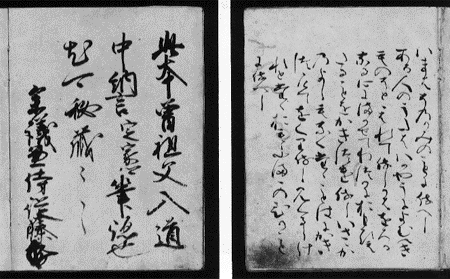
Shogun
A was one of the hereditary military dictators of Japan from 1192 to 1867. In this period, the shoguns, or their shikken regents , were the de facto rulers of Japan though they were nominally appointed by the emperor...
, following the Hōgen
Hogen Rebellion
The was a short civil war fought in order to resolve a dispute about Japanese Imperial succession. The dispute was also about the degree of control exercised by the Fujiwara clan who had become hereditary Imperial regents during the Heian period....
and Heiji
Heiji Rebellion
The was a short civil war fought in order to resolve a dispute about political power. The Heiji no ran encompassed clashes between rival subjects of the cloistered Emperor Go-Shirakawa of Japan in 1159. It was preceded by the Hōgen Rebellion in 1156...
rebellions, and the victory of the Minamoto clan
Minamoto clan
was one of the surnames bestowed by the Emperors of Japan upon members of the imperial family who were demoted into the ranks of the nobility. The practice was most prevalent during the Heian Period , although its last occurrence was during the Sengoku Era. The Taira were another such offshoot of...
over the Taira
Taira clan
The was a major Japanese clan of samurai in historical Japan.In reference to Japanese history, along with Minamoto, Taira was a hereditary clan name bestowed by the emperors of the Heian Period to certain ex-members of the imperial family when they became subjects...
, marked the beginning of the Kamakura period
Kamakura period
The is a period of Japanese history that marks the governance by the Kamakura Shogunate, officially established in 1192 in Kamakura by the first shogun Minamoto no Yoritomo....
(1185–1333 CE), however not yet a return to peace and tranquility. The era is sometimes called "the age of the warriors" and a broad transition from court influences to a leading role of the military establishment pervaded the culture. It is however also a time when exchanges with China of the Song dynasty
Song Dynasty
The Song Dynasty was a ruling dynasty in China between 960 and 1279; it succeeded the Five Dynasties and Ten Kingdoms Period, and was followed by the Yuan Dynasty. It was the first government in world history to issue banknotes or paper money, and the first Chinese government to establish a...
continued and Buddhism
Buddhism
Buddhism is a religion and philosophy encompassing a variety of traditions, beliefs and practices, largely based on teachings attributed to Siddhartha Gautama, commonly known as the Buddha . The Buddha lived and taught in the northeastern Indian subcontinent some time between the 6th and 4th...
greatly flourished. Zen monks such as Shunjo studied in China and the copybooks that he brought with him are regarded to be highly influential for the karayō tradition of the time, expressing a clear kaisho style
Regular script
Regular script , also called 正楷 , 真書 , 楷体 and 正書 , is the newest of the Chinese script styles Regular script , also called 正楷 , 真書 (zhēnshū), 楷体 (kǎitǐ) and 正書 (zhèngshū), is the newest of the Chinese script styles Regular script , also called 正楷 , 真書 (zhēnshū), 楷体 (kǎitǐ) and 正書 (zhèngshū), is...
. But this was not the only example, indeed a succession of Chinese monks was naturalized at that time, encouraged by regent Hōjō Tokiyori
Hojo Tokiyori
Hōjō Tokiyori was the fifth shikken of the Kamakura shogunate in Japan. He was born to Hōjō Tokiuji and a daughter of Adachi Kagemori....
. Rankei Doryū founded the Kenchō-ji
Kencho-ji
Kenchō-ji is a Rinzai Zen temple in Kamakura, Kanagawa Prefecture, Japan, which ranks first among Kamakura's so-called Five Great Zen Temples and is the oldest Zen training monastery in Japan. These temples were at the top of the Five Mountain System, a network of Zen temples started by the Hōjō...
temple in Kamakura
Kamakura, Kanagawa
is a city located in Kanagawa Prefecture, Japan, about south-south-west of Tokyo. It used to be also called .Although Kamakura proper is today rather small, it is often described in history books as a former de facto capital of Japan as the seat of the Shogunate and of the Regency during the...
and many of his works have been preserved. However, with the rise of the Rinzai school
Rinzai school
The Rinzai school is , one of three sects of Zen in Japanese Buddhism.Rinzai is the Japanese line of the Chinese Linji school, which was founded during the Tang Dynasty by Linji Yixuan...
of Zen Buddhism a less technical style appeared, representative of Zen attitudes and exemplified in the works of Musō Soseki
Muso Soseki
was a Rinzai Zen Buddhist monk and teacher, and a calligraphist, poet and garden designer. The most famous monk of his time, he is also known as , a posthumous name given him by Emperor Go-Daigo...
who wrote in a refined sosho style, or Shūhō Myōcho (1282-1337; better known as Daito Kokushi), the founder of Daitoku-ji
Daitoku-ji
is a Buddhist temple, one of fourteen autonomous branches of the Rinzai school of Japanese Zen. It is located in Kita-ku, Kyoto, Japan. The "mountain name" , who is known by the title Daitō Kokushi, or "National Teacher of the Great Lamp," that he was given by Emperor Go-Daigo...
in Kyoto
Kyoto
is a city in the central part of the island of Honshū, Japan. It has a population close to 1.5 million. Formerly the imperial capital of Japan, it is now the capital of Kyoto Prefecture, as well as a major part of the Osaka-Kobe-Kyoto metropolitan area.-History:...
, who had not traveled to China to study. In terms of wayō style, the works of Fujiwara no Shunzei
Fujiwara no Shunzei
was a noted Japanese poet and nobleman, son of Fujiwara no Toshitada. He was also known as Fujiwara no Toshinari or Shakua ; in his younger days , he gave his name as Akihiro , but in 1167, changed to Shunzei...
and Fujiwara no Teika
Fujiwara no Teika
Fujiwara no Teika , also known as Fujiwara no Sadaie or Sada-ie, was a Japanese poet, critic, calligrapher, novelist, anthologist, scribe, and scholar of the late Heian and early Kamakura periods...
are considered outstanding examples of the late Heian and early Kamakura
Kamakura period
The is a period of Japanese history that marks the governance by the Kamakura Shogunate, officially established in 1192 in Kamakura by the first shogun Minamoto no Yoritomo....
.
Political and military unrest continued throughout the Muromachi period
Muromachi period
The is a division of Japanese history running from approximately 1336 to 1573. The period marks the governance of the Muromachi or Ashikaga shogunate, which was officially established in 1338 by the first Muromachi shogun, Ashikaga Takauji, two years after the brief Kemmu restoration of imperial...
(1336-1537 CE), characterized by tensions between imperial and civil authority and outright periods of civil war. However, as Ashikaga Takauji
Ashikaga Takauji
was the founder and first shogun of the Ashikaga shogunate. His rule began in 1338, beginning the Muromachi period of Japan, and ended with his death in 1358...
had ousted Emperor Go-Daigo
Emperor Go-Daigo
Emperor Go-Daigo was the 96th emperor of Japan, according to the traditional order of succession....
from Kyoto
Kyoto
is a city in the central part of the island of Honshū, Japan. It has a population close to 1.5 million. Formerly the imperial capital of Japan, it is now the capital of Kyoto Prefecture, as well as a major part of the Osaka-Kobe-Kyoto metropolitan area.-History:...
to establish his own bakufu
Shogun
A was one of the hereditary military dictators of Japan from 1192 to 1867. In this period, the shoguns, or their shikken regents , were the de facto rulers of Japan though they were nominally appointed by the emperor...
there, the intermingling of residual members of the imperial court, courtiers, daimyo
Daimyo
is a generic term referring to the powerful territorial lords in pre-modern Japan who ruled most of the country from their vast, hereditary land holdings...
, samurai
Samurai
is the term for the military nobility of pre-industrial Japan. According to translator William Scott Wilson: "In Chinese, the character 侍 was originally a verb meaning to wait upon or accompany a person in the upper ranks of society, and this is also true of the original term in Japanese, saburau...
, and Zen priests
Zen
Zen is a school of Mahāyāna Buddhism founded by the Buddhist monk Bodhidharma. The word Zen is from the Japanese pronunciation of the Chinese word Chán , which in turn is derived from the Sanskrit word dhyāna, which can be approximately translated as "meditation" or "meditative state."Zen...
resulted in vibrant cultural impulses. The arts prospered, but are not considered as refined as that of earlier times. Of note is the role of Ikkyū Sōjun
Ikkyu
was an eccentric, iconoclastic Japanese Zen Buddhist monk and poet. He had a great impact on the infusion of Japanese art and literature with Zen attitudes and ideals.-Childhood:...
, a successor of Shūhō Myōcho at Daitoku-ji
Daitoku-ji
is a Buddhist temple, one of fourteen autonomous branches of the Rinzai school of Japanese Zen. It is located in Kita-ku, Kyoto, Japan. The "mountain name" , who is known by the title Daitō Kokushi, or "National Teacher of the Great Lamp," that he was given by Emperor Go-Daigo...
; Ikkyū was instrumental in elevating the appreciation of calligraphy to an integral part of the tea ceremony
Japanese tea ceremony
The Japanese tea ceremony, also called the Way of Tea, is a Japanese cultural activity involving the ceremonial preparation and presentation of matcha, powdered green tea. In Japanese, it is called . The manner in which it is performed, or the art of its performance, is called...
in the 15th century.
Edo period
Tokugawa IeyasuTokugawa Ieyasu
was the founder and first shogun of the Tokugawa shogunate of Japan , which ruled from the Battle of Sekigahara in 1600 until the Meiji Restoration in 1868. Ieyasu seized power in 1600, received appointment as shogun in 1603, abdicated from office in 1605, but...
centralized power in his shogunate between 1603 and 1615 and this marked the beginning of the Edo period
Edo period
The , or , is a division of Japanese history which was ruled by the shoguns of the Tokugawa family, running from 1603 to 1868. The political entity of this period was the Tokugawa shogunate....
which brought 250 years of relative stability to Japan, lasting until the second half of the 19th century. The period was marked by an emphasis on the values of the bushi
Bushido
, meaning "Way of the Warrior-Knight", is a Japanese word which is used to describe a uniquely Japanese code of conduct and a way of the samurai life, loosely analogous to the concept of chivalry. It originates from the samurai moral code and stresses frugality, loyalty, martial arts mastery, and...
and seclusion from overseas influences with the policy. Calligraphic studies were essentially limited to the study of karayō style works, via Ming Dynasty China
Ming Dynasty
The Ming Dynasty, also Empire of the Great Ming, was the ruling dynasty of China from 1368 to 1644, following the collapse of the Mongol-led Yuan Dynasty. The Ming, "one of the greatest eras of orderly government and social stability in human history", was the last dynasty in China ruled by ethnic...
. Indigenous developments were contributed by Ingen
Ingen
Ingen Ryūki was a Chinese Linji Chán Buddhist monk, poet, and calligrapher....
and the Ōbaku
Obaku
Ōbaku is the Amur Corktree. It may refer to:*Mount Huangbo , a mountain in China's Fujian province, noted for its Buddhist temples*Mount Ōbaku , a mountain in the city of Uji in Japan...
sect of Zen buddhism, and the Daishi school of calligraphy. The latter focused on the study of the , which go back to Wang Xizhi
Wang Xizhi
Wang Xizhi was a Chinese calligrapher, traditionally referred to as the Sage of Calligraphy , who lived during the Jin Dynasty...
, and the and 72 types of hissei (lit. "brush energy") expounded by Wang Xizhi
Wang Xizhi
Wang Xizhi was a Chinese calligrapher, traditionally referred to as the Sage of Calligraphy , who lived during the Jin Dynasty...
's teacher, the Lady Wei
Wei Shuo
Wei Shuo , courtesy name Mouyi , sobriquet He'nan , commonly addressed just as Lady Wei , was a Chinese calligrapher of Eastern Jin, who established consequential rules about the regular script. Her famous disciple was Wang Xizhi....
. The 1664 reprint of a copybook based on these principles in Kyoto contributed an important theoretical development. Calligraphers such as Hosoi Kotaku, who authored the five-volume Kanga Hyakudan in 1735, further advanced the karayō style. Very characteristic for the early Edo period was an innovation by Hon'ami Kōetsu
Honami Koetsu
was a Japanese craftsman, potter, lacquerer, and calligrapher, whose work is generally considered to have inspired the founding of the Rinpa school of painting.-Early life:...
(1558-1637) who had paper made to order and painted a backdrop of decorative patterns, butterflies or floral elements with which his calligraphy established a poetic correspondence. Together with Konoe Nobutada
Konoe Nobutada
was a Momoyama period Japanese courtier known as a poet, calligrapher, painter and diarist. Having no legitimate son, he adopted his nephew Nobuhiro as his heir...
(1565-1614) and Shōkadō Shōjō
Shōkadō Shōjō
Shōkadō Shōjō was an Edo period Buddhist monk, painter, calligrapher and master of the tea ceremony. He is one of the .Shōjō is the Buddhist name the youth was given when he entered the Hachiman shrine on Otoko-yama near Kyoto. He later served the Konoe family under Konoe Nobutada. At that time...
(1584-1639) - the three Kan'ei Sanpitsu
Sanpitsu
The term Sanpitsu or "three brushes" is used in Japanese to refer to a group of three famous Heian period calligraphers:*Emperor Saga 嵯峨天皇, 786–842.*Kūkai 空海, 774–835.*Tachibana no Hayanari, 橘逸勢 c...
- he is considered one of the greatest calligraphers in the wayō style at the time, creating examples of "a uniquely Japanese calligraphy".
Around 1736 Yoshimune
Tokugawa Yoshimune
was the eighth shogun of the Tokugawa shogunate of Japan, ruling from 1716 until his abdication in 1745. He was the son of Tokugawa Mitsusada, the grandson of Tokugawa Yorinobu, and the great-grandson of Tokugawa Ieyasu.-Lineage:...
began relaxing Japan's isolation policy and Chinese cultural imports increased, in particular via the port of Nagasaki
Nagasaki
is the capital and the largest city of Nagasaki Prefecture on the island of Kyushu in Japan. Nagasaki was founded by the Portuguese in the second half of the 16th century on the site of a small fishing village, formerly part of Nishisonogi District...
. Catalogues of imported copybooks testify to a broad appreciation of Chinese calligraphers among the Japanese literati who pursued the karayō style: "traditionalists" studied Wang Xizhi
Wang Xizhi
Wang Xizhi was a Chinese calligrapher, traditionally referred to as the Sage of Calligraphy , who lived during the Jin Dynasty...
and Wen Zhengming
Wen Zhengming
Wen Zhengming was a leading Ming Dynasty painter, calligrapher, and scholar.Born in present-day Suzhou, he claimed to be a descendant of the Song Dynasty prime minister and patriot Wen Tianxiang. Wen’s family was originally from Hengyang, Hunan, where his family had established itself shortly...
, while "reformists" modeled their work on the soshō style of calligraphers such as Zhang Xu
Zhang Xu (calligrapher)
Zhang Xu , courtesy name: Bogao , was a Chinese calligrapher of the Tang Dynasty.A native of Suzhou, he became an official during the reign of Emperor Xuanzong of Tang. Zhang was known as one of the Eight Immortals of the Wine Cup...
, Huai Su
Huai Su
thumb|250px|One of Huai Su's surviving worksHuai Su , courtesy name Cangzhen , was a Buddhist monk and calligrapher of the Tang Dynasty, famous for his cursive calligraphy. Less than 10 pieces of his works have survived....
and Mi Fu
Mi Fu
Mi Fu , also known as Mi Fei , was a Chinese painter, poet, and calligrapher born in Taiyuan, Shanxi during the Song Dynasty. In painting he gained renown for his style of painting misty landscapes. This style would be deemed the "Mi Fu" style and involved the use of large wet dots of ink applied...
. In terms of wayō, Konoe Iehiro
Konoe Iehiro
, son of regent Motohiro, was a kugyō or Japanese court noble of the Edo period . He held a regent position kampaku from 1707 to 1709 and from 1709 to 1712.A daughter of Emperor Reigen was his consort with whom he had children, among others:...
contributed many fine kana works but generally speaking, wayō style was not as vigorously practised as karayō at that time. Nevertheless some examples have been preserved by scholars of , or poets and painters such as Kaga no Chiyo, Yosa Buson
Yosa Buson
was a Japanese poet and painter from the Edo period. Along with Matsuo Bashō and Kobayashi Issa, Buson is considered among the greatest poets of the Edo Period. Buson was born in the village of Kema in Settsu Province...
or Sakai Hoitsu
Sakai Hoitsu
was a Japanese painter of the Rimpa school. He is famous for reviving the style and popularity of Ogata Kōrin, and for creating a number of reproductions of Kōrin's work.-Family background:...
.
Today
Calligraphy is an elementary schoolElementary school
An elementary school or primary school is an institution where children receive the first stage of compulsory education known as elementary or primary education. Elementary school is the preferred term in some countries, particularly those in North America, where the terms grade school and grammar...
subject in the Japanese mandatory education system. In high school, calligraphy is one of the choices among art subjects, along with music or painting. Some universities, such as University of Tsukuba
University of Tsukuba
is located in the city of Tsukuba, Ibaraki Prefecture in the Kantō region of Japan. The University has 28 college clusters and schools with a total of around 15,000 students...
, Tokyo Gakugei University
Tokyo Gakugei University
Tokyo Gakugei University or Gakudai , for short, is a national university in Koganei, Tokyo. While its history may be traced to 1873, it was formally chartered as a university in 1949 through the merging of four teacher-training institutions....
and Fukuoka University of Education
Fukuoka University of Education
is a national university in Munakata, Fukuoka, Japan. The predecessor of the school was founded in 1876, and it was chartered as a university in 1949...
, have special departments of calligraphic study which emphasize teacher-training programs in calligraphy.
Japanese calligraphy has also fascinated many Western artists through the centuries — mainly calligraphers themselves, but famous artists as well, who studied and practiced calligraphy as a parallel to their own art (see also list of prominent calligraphers).
Connection to Zen Buddhism
Japanese calligraphy was influenced by, and influenced, ZenZen
Zen is a school of Mahāyāna Buddhism founded by the Buddhist monk Bodhidharma. The word Zen is from the Japanese pronunciation of the Chinese word Chán , which in turn is derived from the Sanskrit word dhyāna, which can be approximately translated as "meditation" or "meditative state."Zen...
thought. For any particular piece of paper, the calligrapher has but one chance to create with the brush. The brush strokes cannot be corrected and even a lack of confidence will show up in the work. The calligrapher must concentrate and be fluid in execution. The brush writes a statement about the calligrapher at a moment in time (see Hitsuzendo, the Zen way of the brush). Through Zen, Japanese calligraphy absorbed a distinct Japanese aesthetic
Japanese aesthetics
The modern study of a Japanese aesthetics in the Western sense only started a little over two hundred years ago. But, by the term Japanese aesthetic, we tend to mean not this modern study, but a set of ancient ideals that include wabi , sabi , and yûgen...
often symbolised by the ensō
Enso
Ensō is a Japanese word meaning "circle" and a concept strongly associated with Zen. Ensō is one of the most common subjects of Japanese calligraphy even though it is a symbol and not a character. It symbolizes the Absolute enlightenment, strength, elegance, the Universe, and the void; it can...
or circle of enlightenment.
Zen calligraphy is practiced by Buddhist
Buddhism
Buddhism is a religion and philosophy encompassing a variety of traditions, beliefs and practices, largely based on teachings attributed to Siddhartha Gautama, commonly known as the Buddha . The Buddha lived and taught in the northeastern Indian subcontinent some time between the 6th and 4th...
monks and most shodō practitioners. To write Zen calligraphy with mastery, one must clear one's mind and let the letters flow out of themselves, not practice and make a tremendous effort. This state of mind was called the by the Japanese philosopher Nishida Kitaro
Nishida Kitaro
was a prominent Japanese philosopher, founder of what has been called the Kyoto School of philosophy. He graduated from The University of Tokyo during the Meiji period in 1894 with a degree in philosophy. He was named professor of the Fourth High School in Ishikawa Prefecture in 1899 and later...
. It is based on the principles of Zen Buddhism, which stresses a connection to the spiritual rather than the physical.
Before Japanese tea ceremonies
Japanese tea ceremony
The Japanese tea ceremony, also called the Way of Tea, is a Japanese cultural activity involving the ceremonial preparation and presentation of matcha, powdered green tea. In Japanese, it is called . The manner in which it is performed, or the art of its performance, is called...
(which are connected to Zen Buddhism), one is to look at a work of shodō to clear one's mind. This is considered an essential step in the preparation for a tea ceremony.
See also
- East Asian calligraphyEast Asian calligraphyEast Asian calligraphy is a form of calligraphy widely practised and revered in the Sinosphere. This most often includes China, Japan, Korea, and Vietnam. The East Asian calligraphic tradition originated and developed from China. There is a general standardization of the various styles of...
- List of prominent calligraphers
- List of National Treasures of Japan (writings)
- Sumi-e (Japanese ink painting) is related in method.