


Classical Chinese poetry

Encyclopedia
Classical Chinese poetry is that type of poetry
that is the traditional Chinese poetry
written in Classical Chinese
. It is typified by certain traditional forms
, or modes, and certain traditional genres
. Its existence is documented as early as the publication of the Classic of Poetry. Various combinations of forms and genres exist. Many or most of these were developed by the end of the Tang Dynasty
, in CE 907. Use and development of Classical Chinese poetry actively continued up to until the May Fourth Movement
, in 1919, and is not totally extinct even today in the 21st century. During this over two-and-a-half thousand years of more-or-less continuous historical development, much diversity is displayed –– both between the poetry typical of major historical periods
, or, as by the traditional Chinese historical method, by dynastic periods. Another aspect of Classical Chinese poetry worthy of mention is its intense inter-relationship with other forms of Chinese art
, such as Chinese painting
and Chinese calligraphy. Eventually, Classical Chinese poetry has proven to be of immense influence upon poetry worldwide.
 The stylistic development of Classical Chinese poetry consists of both literary and oral cultural processes, which may be and usually are divided into certain standard periods or eras, in terms both of specific poems as well as styles characteristic of those eras, generally corresponding with Chinese Dynastic Eras, which were the traditional chronological process for Chinese historical events. The poems preserved in written form form the poetic literature. Furthermore, there is or were parallel traditions of oral and traditional poetry also known as popular or folk poems or ballads. Some of these poems seem to have been preserved in written form. Generally, the folk type of poems they are anonymous, and may show signs of having been edited or polished in the process of fixing them in written characters. The main source sources for the earliest preserved poems are the Classic of Poetry, or Shijing and the Songs of the South, (or Chuci, although some individual pieces or fragments survive in other forms, for example embedded in classical histories or other literature.
(551 BCE – 479 BCE) was the final editor of the collection in its present form, although the individual poems would accordingly all be more-or-less older than this. Burton Watson
dates the anthology's main compilation date to about 600 BCE, with the poems having been collected over the previous four to five centuries before. This, among other factors, indicates a rather sustained cross-class popularity for this type or these types of poetry, including for instance their characteristic four-character per line meter. The Shijing tends to be associated with northern Chinese vocabulary and culture, and in particular with the great sage and philosopher Confucius: this helped to eventuate the development of this type of poetry into the classic shi style, the literal meaning of Shijing. The remarkable thing is that despite their commendation by Confucius, no extant samples of any poetry of this style are known for the next three hundred years.
, in southern China. One important part of this is the Li Sao
, attributed to Qu Yuan
. These poems from the State of Chu
are among the most important of all Classical Chinese poetry, however, these poems and their style seem to have had less impact on Classical Chinese poetry, at least at first, than did the Shijing collection and style.
 The classic shi poetry, with its four-character lines, was revived by Han and Three Kingdoms poets, to some extent. However, among other poetic developments during the Han epoch was the development of a new form of shi poetry, dating from about the first century BCE, initially consisting of five-character lines, and later seven-character lines. The development of this form of shi poetry would occur in conjunction with various other phenomena related to Han poetry. It is indeed ironic that the new form of shi developed during the Han and the Jian'an period would become known as "gushi
", or "ancient style poetry".
witnessed major developments in Classical Chinese poems, including both the active role of the imperial government in encouraging poetry through the Music Bureau
, an official agency, and through the collection of Han dynasty folk ballads
(although some of these seem to have perhaps been subject to a post-folk literary polishing, as in the case of the Shijing, the amount of editing is not certain). In Chinese, Yuefu, "Music Bureau", is synonymous with Yuefu the poetry style, thus the term Yuefu has come to refer both to the Music Bureau's collected lyrics, but also to the genre of which they are representative and a source of inspiration. Another important Han dynasty poetry collection is the Nineteen Old Poems
.
, as opposed to the shi
style of poetry or literature: note, however, that this fu is a different word than the fu meaning government bureau in the term yuefu (sometimes spelled Yüeh Fu, or similarly). One exponent of this style was Sima Xiangru
.
refers to those poetic movements occurring during the final years of the failing Han Dynasty and continuing their development into the beginning of the Six Dynasties period. The reason why Jian'an is considered as a separate period is because this is one case where the poetic developments fail to correspond with the neat categories aligned to chronology by dynasty. Typical poets of this period are Cao Cao
, Cao Pi
, Cao Zhi
, and Xu Gan
. One of the more important poetic developments of this period is toward the odd number, fixed length, verse styles also typical of the Tang poetry
period. Thus, some of the poetic forms especially associated with Tang poetry can be traced back developmentally to some of the new forms which seem to have developed during the Jian'an period.
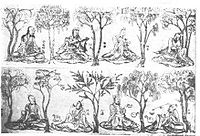 The Six Dynasties
(220 -589) also witnessed major developments in Classical Chinese poetry, especially emphasizing romantic love
, gender roles, and human relationships, and including the important collection New Songs from the Jade Terrace
. The Six Dynasties era covers three main periods: the Three Kingdoms
(220–280), Jin Dynasty
(265–420), and Southern and Northern Dynasties
(420–589). The Three Kingdoms was a period with much violence, which was sometimes reflected in the poetry, or sometimes highlighted by the poets' seeking refuge from the social and political turmoil be retreating into more natural settings, as in the case of the Seven Sages of the Bamboo Grove
. The Jin Dynasty era was typified poetically by, for example, the Orchid Pavilion Gathering
of 42 literati; the romantic Midnight Songs poetry
; and, Tao Yuanming, the great and highly personal poet who was note for speaking in his own voice rather than a persona or anonymously. Some of the highlights of the poetry of the Northern and Southern Dynasties include the Yongming poets and the anthology collection New Songs from the Jade Terrace
.
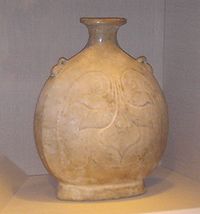 Although poetry continued to be written, and individual poets were born or died, the brief Sui Dynasty
(581-618 CE), in terms of the development of Chinese poetry, lacks distinction, representing a continuity between the Six Dynasties and the poetry of Tang. Sui dynasty poets include Yang Guang
(580-618), who was the last Sui emperor (and a sort of poetry critic); and also, the Lady Hou, one of his consorts.
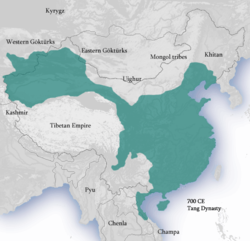 The Tang dynasty
(618 - 907) was particularly noted for its poetry
, especially the shi
forms. This poetry was both a pervasive social phenomenon throughout the Tang literate classes, which the ability to compose poems on demand part of the Imperial examination
system, but also a social grace necessary for polite conduct on social occasions, such as seeing a friend off on a long assignment to a distant post or as part of the interaction at banquets or social gatherings. Some 50,000 poems survive, mostly represented in the Ming Dynasty collection the Quantangshi
. Their popularity in the historical Chinese cultural area has varied over time, with certain authors coming in and out of favor, others permanently obscure, and some, such as Wang Wei
, Du Fu
, and Bai Juyi (also, known as "Po Chü-i") maintaining consistent popularity. Tang poetry has since developed an on-going influence on world literature and modern and quasi-modern poetry; for instance, as in the case of Li Bai
(also known as Li Po) whose modern influence extends as far as Gustav Mahler's Das Lied von der Erde
, Beat poetry, and the name of a crater on the planet Mercury
. Furthermore, in part, because of the prevalence of rhymed and parallel structures within Tang poetry; it has a role in linguistics studies, such as in the reconstruction of Middle Chinese
pronunciation.
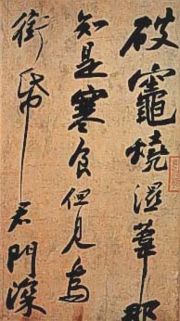 The Song dynasty
(960 - 1279) was noted for its poetry, perhaps especially the development of the Ci
form; indeed, the ci as a poetic form perhaps reached a high point during the Song Dynasty. Although, the poets of the Song Dynasty drew on a long tradition of poetry, perhaps especially those forms which were prevalent in the Tang Dynasty. The Song Dynasty is known for its achievements in terms of combining poetry, painting, and calligraphy into a shared art form. Prominent examples of Song poets include Su Shi (Dongpo)
, Ouyang Xiu
, Lu You
and Yang Wanli
. The ci is a kind of lyric poetry using a poetic meter based upon certain patterns of fixed-rhythm formal types, of which there were about 800 of these set patterns, each associated with a particular title. Originally ci were written to be sung to a specific tune of that title, with set rhythm, rhyme, and tempo. However, over time the actual tunes seem to have disappeared (similarly to the case of the English ballads). Thus, the title of a certain ci may have nothing to do with its contents, although the poetic meter is the same. It is common for several ci to share the same title. As developed during the Song poetic period, the ci was a versatile verse form.
(1271–1368) continued the Classical Chinese poetry tradition and is especially noted for the burgeoning of the Chinese opera verse tradition. Yuan drama's notable qu
form was set to song, restricting each individual poem to one of nine modal key selections and one of over two hundred tune patterns. Depending on the pattern, this imposed fixed rhythmic and tonal requirements that remained in place for future poets even if its musical component was later lost. Noteworthy Yuan dramatist-poets include Bai Pu
, Guan Hanqing
, Ma Zhiyuan
, and Qiao Ji
.
A painter-poet tradition also thrived during the Yuan period, including masterful calligraphy, for example Ni Zan
and Wu Zhen
. Another exemplar was Zhao Mengfu
(1254–1322), a former official of the Song Dynasty
who served under the Mongol administration of the Yuan and whose wife Guan Daosheng
(1262–1319) was also a painter-poet and calligrapher.
(1368–1644). Ming prosperity was accompanied by a tremendous increase in population, commerce, and poetry composition. Thanks to educational opportunities made possible by commercial printing and the reinvigorated examination system, a massively larger literate population emerged who relied on poetry to express personal emotion and to engage with each other socially. A contemporaneous debate as to whether the Tang or Song poets had achieved the highest heights of excellence solidified a collective consensus that past heights could not be surpassed. With over one million surviving Ming poems, modern critics and researchers have been unable to sufficiently sift through it all to definitively answer whether that conviction of past greatest glories is a prejudice or a fact.
Leading Ming poets include Gao Qi
, Li Dongyang
, and the publisher-poet Yuan Hongdao
. Representatives of the dramatist-poet tradition include Tang Xianzu
and Li Yu
. Li Yu is also a prime example of the Ming-Qing transition's emotional outpouring when disorder swept away Ming stability as the incoming dynasty's Manchu warriors conquered from North to South. Ming representatives of the painter-poet tradition include Shen Zhou
, Tang Yin
, and Wen Zhengming
.
(1644–1912). This was also a time of related literary developments, such as the collection of Tang poetry, under the Kangxi Emperor
. The debates, trends and widespread literacy of the Ming period began to flourish once again after the Qing Dynasty had established its dominance. The fresh poetic voice of Yuan Mei
has won wide appeal, as have the long narrative poems by Wu Jiaji
. Kunqu opera matured and led toward the later Chinese opera tradition of drama, poetry and music combined. The painter-poet tradition thrived with exemplars such as Yun Shouping
. The challenge for researchers grew as even more people became poets and even more poems were preserved, including (with Yuan Mei's encouragement) more poetry by women. In 1980 fine shi
poems by the famed Qing novelist Liu E
were published for the first time, illustrating the potential to continue finding sunken treasure in the vast body of surviving Qing poetry.
of the Communist Party of China
was a major exponent and practitioner of Classical Chinese poetry well into the Twentieth Century. However, the development and great expansion of Modern Chinese poetry
is something to consider, beginning at this point, or shortly after.
who were generally literate; however, even the poems of the scholarly classes were intended to be sung or chanted.
, through the Middle Chinese
period (which included the Tang Dynasty), and up into the Modern Chinese
period. During this course of development, Classical Chinese
evolved as a distinct literary language
, distinct from the spoken vernacular. The tension between a spoken vernacular and a literary form of the language worked both ways, the poetry of literature can be seen to have "various degrees of vernacular overlay" and also the oral folk poetry sometimes were "filled with literary phrases and constructions", perhaps due to the prestigious nature of the written language.
, many of the earliest characters seem to have begun as pictograms, with a picture representing an idea which corresponded with the word for that idea. By the times of Classical Chinese, a complex system of writing had evolved with many characters being composed of combinations of other characters, chosen for similarities of meaning and/or sound. The resulting strong graphical aspect, versus a weaker phonetic element (at least, say, compared to standard written English) cannot be ignored. However, different translators of Classical Chinese poetry have emphasized these elements to differing degrees. Sinologist and translator A. C. Graham
cautions against over-emphasizing this visual effect, which he says can "...act on the imagination like blobs in the Rorschach test. It is rather difficult to estimate this effect since a habitual reader of Chinese is hardly conscious of it without deliberately analysing his [sic] reactions....Certainly one can give too much weight to the visual aspect of Chinese writing. Poems in China, as elsewhere, are firstly patterns of sound...." However, Graham is in no way suggesting that the Chinese poet is unaware of the background considerations stemming from character construction.
which were popularized during the Song Dynasty; although, the theme can certainly be traced back as far as the Chuci.
.
, the New Songs from the Jade Terrace
, and the Three Hundred Tang Poems
.
), for example, certain early forms of Japanese poetry, such as kanshi
.
and Archie Barnes
.
Poetry
Poetry is a form of literary art in which language is used for its aesthetic and evocative qualities in addition to, or in lieu of, its apparent meaning...
that is the traditional Chinese poetry
Chinese poetry
Chinese poetry is poetry written, spoken, or chanted in the Chinese language, which includes various versions of Chinese language, including Classical Chinese, Standard Chinese, Mandarin Chinese, Cantonese, Yue Chinese, as well as many other historical and vernacular varieties of the Chinese language...
written in Classical Chinese
Classical Chinese
Classical Chinese or Literary Chinese is a traditional style of written Chinese based on the grammar and vocabulary of ancient Chinese, making it different from any modern spoken form of Chinese...
. It is typified by certain traditional forms
Classical Chinese poetry forms
thumb|right|350px|Poet on a Mountaintop by [[Shen Zhou]], about 1500 CE .Classical Chinese poetry forms are those poetry forms, or modes, which typify the traditional Chinese poems written in Literary or Classical Chinese...
, or modes, and certain traditional genres
Classical Chinese poetry genres
thumb|right|350px|"Reading in Autumn Scenery", Palace Museum, Beijing by [[Shen Zhou]], about 1500 CE .Classical Chinese poetry forms are those genres which typify the traditional Chinese poems written in Classical Chinese...
. Its existence is documented as early as the publication of the Classic of Poetry. Various combinations of forms and genres exist. Many or most of these were developed by the end of the Tang Dynasty
Tang Dynasty
The Tang Dynasty was an imperial dynasty of China preceded by the Sui Dynasty and followed by the Five Dynasties and Ten Kingdoms Period. It was founded by the Li family, who seized power during the decline and collapse of the Sui Empire...
, in CE 907. Use and development of Classical Chinese poetry actively continued up to until the May Fourth Movement
May Fourth Movement
The May Fourth Movement was an anti-imperialist, cultural, and political movement growing out of student demonstrations in Beijing on May 4, 1919, protesting the Chinese government's weak response to the Treaty of Versailles, especially the Shandong Problem...
, in 1919, and is not totally extinct even today in the 21st century. During this over two-and-a-half thousand years of more-or-less continuous historical development, much diversity is displayed –– both between the poetry typical of major historical periods
History of China
Chinese civilization originated in various regional centers along both the Yellow River and the Yangtze River valleys in the Neolithic era, but the Yellow River is said to be the Cradle of Chinese Civilization. With thousands of years of continuous history, China is one of the world's oldest...
, or, as by the traditional Chinese historical method, by dynastic periods. Another aspect of Classical Chinese poetry worthy of mention is its intense inter-relationship with other forms of Chinese art
Chinese art
Chinese art is visual art that, whether ancient or modern, originated in or is practiced in China or by Chinese artists or performers. Early so-called "stone age art" dates back to 10,000 BC, mostly consisting of simple pottery and sculptures. This early period was followed by a series of art...
, such as Chinese painting
Chinese painting
Chinese painting is one of the oldest continuous artistic traditions in the world. The earliest paintings were not representational but ornamental; they consisted of patterns or designs rather than pictures. Early pottery was painted with spirals, zigzags, dots, or animals...
and Chinese calligraphy. Eventually, Classical Chinese poetry has proven to be of immense influence upon poetry worldwide.
History and development
Classic of Poetry (Shijing)
The literary tradition of Classical Chinese poetry begins with the Classic of Poetry, or Shijing, dated to early 1st millennium BC. According to tradition, ConfuciusConfucius
Confucius , literally "Master Kong", was a Chinese thinker and social philosopher of the Spring and Autumn Period....
(551 BCE – 479 BCE) was the final editor of the collection in its present form, although the individual poems would accordingly all be more-or-less older than this. Burton Watson
Burton Watson
Burton Watson is an accomplished translator of Chinese and Japanese literature and poetry. He has received awards including the Gold Medal Award of the Translation Center at Columbia University in 1979, the PEN Translation Prize in 1981 for his translation with Hiroaki Sato of From the Country of...
dates the anthology's main compilation date to about 600 BCE, with the poems having been collected over the previous four to five centuries before. This, among other factors, indicates a rather sustained cross-class popularity for this type or these types of poetry, including for instance their characteristic four-character per line meter. The Shijing tends to be associated with northern Chinese vocabulary and culture, and in particular with the great sage and philosopher Confucius: this helped to eventuate the development of this type of poetry into the classic shi style, the literal meaning of Shijing. The remarkable thing is that despite their commendation by Confucius, no extant samples of any poetry of this style are known for the next three hundred years.
Songs of the South (Chu Ci)
Another early poetry collection/genre is the Chu Ci (dated to the Warring States period about 475-221 BCE), which is typified by various line lengths and the imagery and influence of the vernacular associated with the state of ChuChu (state)
The State of Chu was a Zhou Dynasty vassal state in present-day central and southern China during the Spring and Autumn period and Warring States Period . Its ruling house had the surname Nai , and clan name Yan , later evolved to surname Mi , and clan name Xiong...
, in southern China. One important part of this is the Li Sao
Li Sao
Li Sao is a Chinese poem dating from the Warring States Period, largely written by Qu Yuan of the Kingdom of Chu. One of the most famous poems of pre-Qin China, it is a representative work of the Chu Ci form of poetry.-Title:The title's meaning has been debated about even in historical times...
, attributed to Qu Yuan
Qu Yuan
Qu Yuan was a Chinese poet who lived during the Warring States Period in ancient China. He is famous for his contributions to the poetry collection known as the Chu-ci...
. These poems from the State of Chu
Chu (state)
The State of Chu was a Zhou Dynasty vassal state in present-day central and southern China during the Spring and Autumn period and Warring States Period . Its ruling house had the surname Nai , and clan name Yan , later evolved to surname Mi , and clan name Xiong...
are among the most important of all Classical Chinese poetry, however, these poems and their style seem to have had less impact on Classical Chinese poetry, at least at first, than did the Shijing collection and style.
Han dynasty
Gushi (poetry)
Gushi is a type of Classical Chinese poem literally meaning "old poetry" or "old style poetry": gushi is a technical term for certain historically exemplary poems together with poetry composed in this formal style...
", or "ancient style poetry".
Music Bureau and folk ballads
The Han dynastyHan Dynasty
The Han Dynasty was the second imperial dynasty of China, preceded by the Qin Dynasty and succeeded by the Three Kingdoms . It was founded by the rebel leader Liu Bang, known posthumously as Emperor Gaozu of Han. It was briefly interrupted by the Xin Dynasty of the former regent Wang Mang...
witnessed major developments in Classical Chinese poems, including both the active role of the imperial government in encouraging poetry through the Music Bureau
Music Bureau
Music Bureau , also known as the "Imperial Music Bureau", discontinuously and in various incarnations was an organ of the imperial governmental bureaucracy of several Chinese dynasties...
, an official agency, and through the collection of Han dynasty folk ballads
Han poetry
Han poetry refers to those types or styles of poetry particularly associated with the Han Dynasty era of China. This poetry reflects one of the poetry world's more important flowerings, as well as being a special period in Classical Chinese poetry, particularly in regard to a new style of shi...
(although some of these seem to have perhaps been subject to a post-folk literary polishing, as in the case of the Shijing, the amount of editing is not certain). In Chinese, Yuefu, "Music Bureau", is synonymous with Yuefu the poetry style, thus the term Yuefu has come to refer both to the Music Bureau's collected lyrics, but also to the genre of which they are representative and a source of inspiration. Another important Han dynasty poetry collection is the Nineteen Old Poems
Nineteen Old Poems
Nineteen Old Poems , also known as Ku-shih shih-chiu shih is an anthology of Chinese poems, consisting of nineteen poems collected during the Han Dynasty. These nineteen poems were very influential in regards to later poetry, in part because of their use of the five-character line...
.
The Fu form
The Han Dynasty poetry is particularly associated with the fuFu (poetry)
Fu is a kind of rhymed prose, or poetry style essay, popular in ancient China, especially during the Han Dynasty. The term fu is often used in a multiway contrast with the more purely poetic shi style, with the fixed-rhythm forms of poetry , and with various more explicitly prosaic forms of...
, as opposed to the shi
Shi (poetry)
Shi is the Chinese word for "poetry" or "poem", anciently associated with Chinese poetry. In modern times, shi can and has been used as an umbrella term to mean poetry in any form or language, whether or not Chinese; but, it may imply or be used to refer certain classical forms of poetry, for...
style of poetry or literature: note, however, that this fu is a different word than the fu meaning government bureau in the term yuefu (sometimes spelled Yüeh Fu, or similarly). One exponent of this style was Sima Xiangru
Sima Xiangru
Sima Xiangru, also known as Ssu-ma Hsiang-ju was a Chinese writer. He was a minor official of the Western Han Dynasty, but was better known for his poetic skills, jiu business, and controversial marriage to the widow Zhuo Wenjun after both eloped...
.
Jian'an poetry
Jian'an poetryJian'an poetry
Jian'an poetry, or Chien'an poetry refers to those types or styles of poetry particularly associated with the end of the Han Dynasty and the beginning of the Six dynasties era of China...
refers to those poetic movements occurring during the final years of the failing Han Dynasty and continuing their development into the beginning of the Six Dynasties period. The reason why Jian'an is considered as a separate period is because this is one case where the poetic developments fail to correspond with the neat categories aligned to chronology by dynasty. Typical poets of this period are Cao Cao
Cao Cao
Cao Cao was a warlord and the penultimate chancellor of the Eastern Han Dynasty who rose to great power during the dynasty's final years. As one of the central figures of the Three Kingdoms period, he laid the foundations for what was to become the state of Cao Wei and was posthumously titled...
, Cao Pi
Cao Pi
Cao Pi , formally known as Emperor Wen of Wei, was the first emperor of the state of Cao Wei during the Three Kingdoms period of Chinese history. Born in Qiao County, Pei Commandery , he was the second son of the late Han Dynasty warlord Cao Cao.Cao Pi, like his father, was a poet...
, Cao Zhi
Cao Zhi
Cao Zhi was a poet who lived during the late Han Dynasty and Three Kingdoms period of Chinese history. His poetry style, greatly revered during the Jin Dynasty and Southern and Northern Dynasties, came to be known as the Jian'an style....
, and Xu Gan
Xu Gan
Xu Gan was a philosopher and poet of the late Han Dynasty period of Chinese history. He was known in the cohort of the Seven scholars of Jian'an 建安七子 ....
. One of the more important poetic developments of this period is toward the odd number, fixed length, verse styles also typical of the Tang poetry
Tang poetry
Tang poetry refers to poetry written in or around the time of and in the characteristic style of China's Tang dynasty, and/or follows a certain style, often considered as the Golden Age of Chinese poetry...
period. Thus, some of the poetic forms especially associated with Tang poetry can be traced back developmentally to some of the new forms which seem to have developed during the Jian'an period.
Six Dynasties poetry
Six Dynasties
Six Dynasties is a collective noun for six Chinese dynasties during the periods of the Three Kingdoms , Jin Dynasty , and Southern and Northern Dynasties ....
(220 -589) also witnessed major developments in Classical Chinese poetry, especially emphasizing romantic love
Romantic love
Romance is the pleasurable feeling of excitement and mystery associated with love.In the context of romantic love relationships, romance usually implies an expression of one's love, or one's deep emotional desires to connect with another person....
, gender roles, and human relationships, and including the important collection New Songs from the Jade Terrace
New Songs from the Jade Terrace
New Songs from the Jade Terrace is a collection of Chinese poetry dating to the time of the Six Dynasties. Its poems have frequently been translated and have otherwise been of great artistic influence around the world. Although there is uncertainty about the authorship of the individual poems, the...
. The Six Dynasties era covers three main periods: the Three Kingdoms
Three Kingdoms
The Three Kingdoms period was a period in Chinese history, part of an era of disunity called the "Six Dynasties" following immediately the loss of de facto power of the Han Dynasty rulers. In a strict academic sense it refers to the period between the foundation of the state of Wei in 220 and the...
(220–280), Jin Dynasty
Jìn Dynasty (265-420)
The Jìn Dynasty , was a dynasty in Chinese history, lasting between the years 265 and 420 AD. There are two main divisions in the history of the Dynasty, the first being Western Jin and the second Eastern Jin...
(265–420), and Southern and Northern Dynasties
Southern and Northern Dynasties
The Southern and Northern Dynasties was a period in the history of China that lasted from 420 to 589 AD. Though an age of civil war and political chaos, it was also a time of flourishing arts and culture, advancement in technology, and the spreading of Mahayana Buddhism and Daoism...
(420–589). The Three Kingdoms was a period with much violence, which was sometimes reflected in the poetry, or sometimes highlighted by the poets' seeking refuge from the social and political turmoil be retreating into more natural settings, as in the case of the Seven Sages of the Bamboo Grove
Seven Sages of the Bamboo Grove
The Seven Sages of the Bamboo Grove were a group of Chinese Taoist Qingtan scholars, writers, and musicians who came together in the 3rd century CE. Although the individual members all existed, their interconnection is not entirely certain...
. The Jin Dynasty era was typified poetically by, for example, the Orchid Pavilion Gathering
Orchid Pavilion Gathering
The Orchid Pavilion Gathering was a cultural and poetic event during the Six Dynasties era, in China. This event itself has a certain inherent and poetic interest in regards to the development of landscape poetry and the philosophical ideas of Zhuangzi...
of 42 literati; the romantic Midnight Songs poetry
Midnight Songs poetry
Midnight Songs poetry , also Tzu-yeh Songs, refers both to a genre of poetry as well as to specifically collected poems under the same name, during the Fourth Century CE...
; and, Tao Yuanming, the great and highly personal poet who was note for speaking in his own voice rather than a persona or anonymously. Some of the highlights of the poetry of the Northern and Southern Dynasties include the Yongming poets and the anthology collection New Songs from the Jade Terrace
New Songs from the Jade Terrace
New Songs from the Jade Terrace is a collection of Chinese poetry dating to the time of the Six Dynasties. Its poems have frequently been translated and have otherwise been of great artistic influence around the world. Although there is uncertainty about the authorship of the individual poems, the...
.
Sui poetry
Sui Dynasty
The Sui Dynasty was a powerful, but short-lived Imperial Chinese dynasty. Preceded by the Southern and Northern Dynasties, it ended nearly four centuries of division between rival regimes. It was followed by the Tang Dynasty....
(581-618 CE), in terms of the development of Chinese poetry, lacks distinction, representing a continuity between the Six Dynasties and the poetry of Tang. Sui dynasty poets include Yang Guang
Emperor Yang of Sui
Emperor Yang of Sui , personal name Yang Guang , alternative name Ying , nickname Amo , known as Emperor Ming during the brief reign of his grandson Yang Tong), was the second son of Emperor Wen of Sui, and the second emperor of China's Sui Dynasty.Emperor Yang's original name was Yang Ying, but...
(580-618), who was the last Sui emperor (and a sort of poetry critic); and also, the Lady Hou, one of his consorts.
Tang poetry
Tang Dynasty
The Tang Dynasty was an imperial dynasty of China preceded by the Sui Dynasty and followed by the Five Dynasties and Ten Kingdoms Period. It was founded by the Li family, who seized power during the decline and collapse of the Sui Empire...
(618 - 907) was particularly noted for its poetry
Tang poetry
Tang poetry refers to poetry written in or around the time of and in the characteristic style of China's Tang dynasty, and/or follows a certain style, often considered as the Golden Age of Chinese poetry...
, especially the shi
Shi (poetry)
Shi is the Chinese word for "poetry" or "poem", anciently associated with Chinese poetry. In modern times, shi can and has been used as an umbrella term to mean poetry in any form or language, whether or not Chinese; but, it may imply or be used to refer certain classical forms of poetry, for...
forms. This poetry was both a pervasive social phenomenon throughout the Tang literate classes, which the ability to compose poems on demand part of the Imperial examination
Imperial examination
The Imperial examination was an examination system in Imperial China designed to select the best administrative officials for the state's bureaucracy. This system had a huge influence on both society and culture in Imperial China and was directly responsible for the creation of a class of...
system, but also a social grace necessary for polite conduct on social occasions, such as seeing a friend off on a long assignment to a distant post or as part of the interaction at banquets or social gatherings. Some 50,000 poems survive, mostly represented in the Ming Dynasty collection the Quantangshi
Quantangshi
The Quantangshi , and also translated as the Complete Tang Poems, is a collection of Tang poetry...
. Their popularity in the historical Chinese cultural area has varied over time, with certain authors coming in and out of favor, others permanently obscure, and some, such as Wang Wei
Wang Wei
Wang Wei , was a Tang Dynasty Chinese poet, musician, painter, and statesman. He was one of the most famous men of arts and letters of his time. Many of his poems are preserved, and twenty-nine were included in the highly influential 18th century anthology Three Hundred Tang Poems.-Name...
, Du Fu
Du Fu
Du Fu was a prominent Chinese poet of the Tang Dynasty.Along with Li Bai , he is frequently called the greatest of the Chinese poets. His greatest ambition was to serve his country as a successful civil servant, but he proved unable to make the necessary accommodations...
, and Bai Juyi (also, known as "Po Chü-i") maintaining consistent popularity. Tang poetry has since developed an on-going influence on world literature and modern and quasi-modern poetry; for instance, as in the case of Li Bai
Li Bai
Li Bai , also known in the West by various other transliterations, especially Li Po, was a major Chinese poet of the Tang dynasty poetry period. He has been regarded as one of the greatest poets in China's Tang period, which is often called China's "golden age" of poetry. Around a thousand existing...
(also known as Li Po) whose modern influence extends as far as Gustav Mahler's Das Lied von der Erde
Das Lied von der Erde
Das Lied von der Erde is a large-scale work for two vocal soloists and orchestra by the Austrian composer Gustav Mahler...
, Beat poetry, and the name of a crater on the planet Mercury
Mercury (planet)
Mercury is the innermost and smallest planet in the Solar System, orbiting the Sun once every 87.969 Earth days. The orbit of Mercury has the highest eccentricity of all the Solar System planets, and it has the smallest axial tilt. It completes three rotations about its axis for every two orbits...
. Furthermore, in part, because of the prevalence of rhymed and parallel structures within Tang poetry; it has a role in linguistics studies, such as in the reconstruction of Middle Chinese
Middle Chinese
Middle Chinese , also called Ancient Chinese by the linguist Bernhard Karlgren, refers to the Chinese language spoken during Southern and Northern Dynasties and the Sui, Tang, and Song dynasties...
pronunciation.
Song dynasty poetry
Song Dynasty
The Song Dynasty was a ruling dynasty in China between 960 and 1279; it succeeded the Five Dynasties and Ten Kingdoms Period, and was followed by the Yuan Dynasty. It was the first government in world history to issue banknotes or paper money, and the first Chinese government to establish a...
(960 - 1279) was noted for its poetry, perhaps especially the development of the Ci
Ci (poetry)
Ci is a kind of lyric Classical Chinese poetry using a poetic meter based upon certain patterns of fixed-rhythm formal types. For speakers of English, the word "ci" is pronounced somewhat like "tsuh"...
form; indeed, the ci as a poetic form perhaps reached a high point during the Song Dynasty. Although, the poets of the Song Dynasty drew on a long tradition of poetry, perhaps especially those forms which were prevalent in the Tang Dynasty. The Song Dynasty is known for its achievements in terms of combining poetry, painting, and calligraphy into a shared art form. Prominent examples of Song poets include Su Shi (Dongpo)
Su Shi
Su Shi , was a writer, poet, artist, calligrapher, pharmacologist, gastronome, and statesman of the Song Dynasty, and one of the major poets of the Song era. His courtesy name was Zizhan and his pseudonym was Dongpo Jushi , and he is often referred to as Su Dongpo...
, Ouyang Xiu
Ouyang Xiu
Ouyang Xiu was a Chinese statesman, historian, essayist and poet of the Song Dynasty. He is also known by his courtesy name of Yongshu, and was also self nicknamed The Old Drunkard 醉翁, or Householder of the One of Six 六一居士 in his old age...
, Lu You
Lu You
Lu You , was a Chinese poet of the Southern Song dynasty.-Early life and marriage:Lu You was born on a boat floating in the Wei River early on a rainy morning, October 17, 1125...
and Yang Wanli
Yang Wanli
Yang Wanli was a Chinese poet, born in Jishui, Jiangxi. He was one of the "four masters" of Song Dynasty poetry....
. The ci is a kind of lyric poetry using a poetic meter based upon certain patterns of fixed-rhythm formal types, of which there were about 800 of these set patterns, each associated with a particular title. Originally ci were written to be sung to a specific tune of that title, with set rhythm, rhyme, and tempo. However, over time the actual tunes seem to have disappeared (similarly to the case of the English ballads). Thus, the title of a certain ci may have nothing to do with its contents, although the poetic meter is the same. It is common for several ci to share the same title. As developed during the Song poetic period, the ci was a versatile verse form.
Yuan Dynasty poetry
Poetry during the Yuan DynastyYuan Dynasty
The Yuan Dynasty , or Great Yuan Empire was a ruling dynasty founded by the Mongol leader Kublai Khan, who ruled most of present-day China, all of modern Mongolia and its surrounding areas, lasting officially from 1271 to 1368. It is considered both as a division of the Mongol Empire and as an...
(1271–1368) continued the Classical Chinese poetry tradition and is especially noted for the burgeoning of the Chinese opera verse tradition. Yuan drama's notable qu
Qu (poetry)
In Chinese literature, qu , or yuanqu consists of sanqu and zaju . Together with the various shi and fu forms of poetry, the ci, qu, and the other fixed-rhythm type of verse comprise the three main forms of Classical Chinese poetry.Yuanqu is a form of Chinese opera, which became popular in Yuan...
form was set to song, restricting each individual poem to one of nine modal key selections and one of over two hundred tune patterns. Depending on the pattern, this imposed fixed rhythmic and tonal requirements that remained in place for future poets even if its musical component was later lost. Noteworthy Yuan dramatist-poets include Bai Pu
Bai Pu
Bai Renfu , a.k.a. Bai Pu is considered to be one of the Four Great Yuan Playwrights, along with Guan Hanqing, Ma Zhiyuan, and Zheng Guangzu.He wrote 16 plays, three of which are extant:* Over the Wall...
, Guan Hanqing
Guan Hanqing
Guan Hanqing , sobriquet "the Oldman of the Studio" , was a notable Chinese playwright and poet in the Yuan Dynasty.-Biography:...
, Ma Zhiyuan
Ma Zhiyuan
Ma Zhiyuan , courtesy name Dongli , was a Chinese poet and celebrated playwright, a native of Dadu during the Yuan Dynasty.Among his achievements is the development and popularizing of the new sanqu lyric form of poetry...
, and Qiao Ji
Qiao Ji
Qiao Ji also known as Qiao Jifu was a major Chinese dramatist and poet in the Yuan Dynasty. He was originally from Taiyuan in Shanxi, but lived in the West Lake area in Zhejiang province. His courtesy name was Mengfu and his pen name was Shenghao Weng...
.
A painter-poet tradition also thrived during the Yuan period, including masterful calligraphy, for example Ni Zan
Ni Zan
Ni Zan was a Chinese painter during the Yuan Dynasty. Along with Huang Gongwang, Wu Zhen, and Wang Meng, he is considered to be one of the four "Late Yuan" masters....
and Wu Zhen
Wu Zhen
Wu Zhen was a painter during the Yuan dynasty of China. He followed the Dong Yuan school of painting. Following along with trends of the time, Wu's works tended less toward naturalism and more toward abstraction, focusing on dynamic balance of elements, and personifying nature...
. Another exemplar was Zhao Mengfu
Zhao Mengfu
Zhao Mengfu courtesy name Ziang , pseudonyms Songxue , Oubo , and Shuijing-gong Dao-ren , was a prince and descendant of the Song Dynasty, and a Chinese scholar, painter and calligrapher during the Yuan Dynasty.He was recommended by the Censor-in-chief Cheng Jufu to pay an audience...
(1254–1322), a former official of the Song Dynasty
Song Dynasty
The Song Dynasty was a ruling dynasty in China between 960 and 1279; it succeeded the Five Dynasties and Ten Kingdoms Period, and was followed by the Yuan Dynasty. It was the first government in world history to issue banknotes or paper money, and the first Chinese government to establish a...
who served under the Mongol administration of the Yuan and whose wife Guan Daosheng
Guan Daosheng
Guan Daosheng was a Chinese poet and painter who was active during the Yuan Dynasty.She was born in Huzhou and was the wife of Zhao Mengfu. She was talented in calligraphy and painting ink bamboo and plum with delicate and elegant strokes...
(1262–1319) was also a painter-poet and calligrapher.
Ming Dynasty poetry
Classical Chinese poetry continued to thrive during the Ming DynastyMing Dynasty
The Ming Dynasty, also Empire of the Great Ming, was the ruling dynasty of China from 1368 to 1644, following the collapse of the Mongol-led Yuan Dynasty. The Ming, "one of the greatest eras of orderly government and social stability in human history", was the last dynasty in China ruled by ethnic...
(1368–1644). Ming prosperity was accompanied by a tremendous increase in population, commerce, and poetry composition. Thanks to educational opportunities made possible by commercial printing and the reinvigorated examination system, a massively larger literate population emerged who relied on poetry to express personal emotion and to engage with each other socially. A contemporaneous debate as to whether the Tang or Song poets had achieved the highest heights of excellence solidified a collective consensus that past heights could not be surpassed. With over one million surviving Ming poems, modern critics and researchers have been unable to sufficiently sift through it all to definitively answer whether that conviction of past greatest glories is a prejudice or a fact.
Leading Ming poets include Gao Qi
Gao Qi
Gao Qi , style name Ji Di 季迪, pseudonym Qinqiuzhi 青丘子 is generally acknowledged as the greatest poet of the Ming dynasty in China. He was born and raised in the shore of Wusong River, north of Puli Town near Suzhou...
, Li Dongyang
Li Dongyang
Li Dongyang was a Ming Dynasty scholar born in Chaling city, Hunan Province.He served as an official under four emperors for over 50 years, including the roles of "Grand Historian" and the "Minister of Rites". He is also known for his distinctive poetry...
, and the publisher-poet Yuan Hongdao
Yuan Hongdao
Yuan Hongdao was Chinese poet of the Ming Dynasty, and one of the Three Yuan Brothers. His life spanned nearly the whole of the Wanli period in Chinese history. Yuan was from Gong'an in Hukuang. His family had been military officials for generations. Yuan showed an interest in literature from...
. Representatives of the dramatist-poet tradition include Tang Xianzu
Tang Xianzu
Tang Xianzu , courtesy name Yireng , was a Chinese playwright of the Ming Dynasty.Tang was a native of Linchuan, Jiangxi and his career as an official consisted principally of low-level positions. He successfully participated in the Provincial examinations at the age of 21 and at the imperial...
and Li Yu
Li Yu (author)
Li Yu , also known as Li Liweng was a Chinese playwright, novelist and publisher. Born in Rugao, he lived in late-Ming and early-Qing dynasties....
. Li Yu is also a prime example of the Ming-Qing transition's emotional outpouring when disorder swept away Ming stability as the incoming dynasty's Manchu warriors conquered from North to South. Ming representatives of the painter-poet tradition include Shen Zhou
Shen Zhou
Shen Zhou , courtesy name Qinan , was a Chinese painter in the Ming dynasty.-Life:Shen Zhou was born into a wealthy family in Xiangcheng, near the thriving city of Suzhou, in the Jiangsu province, China...
, Tang Yin
Tang Yin
Tang Yin , better known by his courtesy name Tang Bohu , was a Chinese scholar, painter, calligrapher, and poet of the Ming Dynasty period whose life story has become a part of popular lore...
, and Wen Zhengming
Wen Zhengming
Wen Zhengming was a leading Ming Dynasty painter, calligrapher, and scholar.Born in present-day Suzhou, he claimed to be a descendant of the Song Dynasty prime minister and patriot Wen Tianxiang. Wen’s family was originally from Hengyang, Hunan, where his family had established itself shortly...
.
Qing Dynasty poetry
Classical Chinese poetry continued to be the major poetic form of the Qing DynastyQing Dynasty
The Qing Dynasty was the last dynasty of China, ruling from 1644 to 1912 with a brief, abortive restoration in 1917. It was preceded by the Ming Dynasty and followed by the Republic of China....
(1644–1912). This was also a time of related literary developments, such as the collection of Tang poetry, under the Kangxi Emperor
Kangxi Emperor
The Kangxi Emperor ; Manchu: elhe taifin hūwangdi ; Mongolian: Энх-Амгалан хаан, 4 May 1654 –20 December 1722) was the fourth emperor of the Qing Dynasty, the first to be born on Chinese soil south of the Pass and the second Qing emperor to rule over China proper, from 1661 to 1722.Kangxi's...
. The debates, trends and widespread literacy of the Ming period began to flourish once again after the Qing Dynasty had established its dominance. The fresh poetic voice of Yuan Mei
Yuan Mei
Yuan Mei was a well-known poet, scholar, artist, and gastronome of the Qing Dynasty.Yuan Mei was born in Qiantang , Zhejiang province, to a cultured family who had never before attained high office. He achieved the degree of jinshi in 1739 at the young age of 23, was immediately appointed to the...
has won wide appeal, as have the long narrative poems by Wu Jiaji
Wu Jiaji
Wu Jiaji was a Chinese poet, and an associate of the official and literary figure Zhou Lianggong.Wu’s writings provide us with a glimpse of conditions just prior to the Manchu Qing conquest and especially descriptions of social conditions in rural society. Wu was from Taizhou, Jiangsu, an area...
. Kunqu opera matured and led toward the later Chinese opera tradition of drama, poetry and music combined. The painter-poet tradition thrived with exemplars such as Yun Shouping
Yun Shouping
Yun Shouping , also known as Nantian , was a major artist of the early Chinese Qing dynasty. He was regarded as one of the "Six Masters" of the Qing period, together with the Four Wangs and Wú Lì.-Biography:...
. The challenge for researchers grew as even more people became poets and even more poems were preserved, including (with Yuan Mei's encouragement) more poetry by women. In 1980 fine shi
Shi (poetry)
Shi is the Chinese word for "poetry" or "poem", anciently associated with Chinese poetry. In modern times, shi can and has been used as an umbrella term to mean poetry in any form or language, whether or not Chinese; but, it may imply or be used to refer certain classical forms of poetry, for...
poems by the famed Qing novelist Liu E
Liu E
Liu E , courtesy name/"zì": "Tieyun" , was a Chinese scholar, entrepreneur, and writer.-Government and politics:...
were published for the first time, illustrating the potential to continue finding sunken treasure in the vast body of surviving Qing poetry.
Post-Qing Classical Chinese poetry
Although Qing is the last Chinese Dynasty, this did not mean that Classical Chinese poetry ended co-conterminously with the end of the imperial period, indeed Mao ZedongMao Zedong
Mao Zedong, also transliterated as Mao Tse-tung , and commonly referred to as Chairman Mao , was a Chinese Communist revolutionary, guerrilla warfare strategist, Marxist political philosopher, and leader of the Chinese Revolution...
of the Communist Party of China
Communist Party of China
The Communist Party of China , also known as the Chinese Communist Party , is the founding and ruling political party of the People's Republic of China...
was a major exponent and practitioner of Classical Chinese poetry well into the Twentieth Century. However, the development and great expansion of Modern Chinese poetry
Modern Chinese poetry
Modern Chinese poetry sometimes referred to as New poetry refers to the modern vernacular style of poetry developed after 4 May 1919, as opposed to the traditional poetry written in Classical Chinese language...
is something to consider, beginning at this point, or shortly after.
Oral nature of poetry
One important aspect of Classical Chinese poetry is that it was generally designed to be chanted or sung, with or without musical accompaniment. In fact, folk poetry, almost by definition, was orally composed and orally transmitted. This is because the "folk" were for the most part illiterate, as opposed to the scholarly classeswho were generally literate; however, even the poems of the scholarly classes were intended to be sung or chanted.
Characteristics of writing poetry
The particular characteristics of the Chinese writing system certainly had an important role in Chinese poetry. In fact, one of the factors which enabled a continuous poetic tradition in China for more than two millenia has to do with the fact that Chinese words can be represented by their corresponding Chinese characters semi-independently of their pronunciation (and, in fact, this extends even to their use in classical versions of Japanese, Korean, and Vietnamese). The pronunciations of spoken Chinese changed quite a bit over the course of time from the oldest surviving written Chinese poetry, during the period of Old ChineseOld Chinese
The earliest known written records of the Chinese language were found at a site near modern Anyang identified as Yin, the last capital of the Shang dynasty, and date from about 1200 BC....
, through the Middle Chinese
Middle Chinese
Middle Chinese , also called Ancient Chinese by the linguist Bernhard Karlgren, refers to the Chinese language spoken during Southern and Northern Dynasties and the Sui, Tang, and Song dynasties...
period (which included the Tang Dynasty), and up into the Modern Chinese
Modern Chinese
Modern Chinese can refer to the following:*Modern Chinese history*Any or all of the modern varieties of Chinese, most commonly**Standard Chinese or Modern Chinese, sometimes known as Mandarin, the national language of the People's Republic of China...
period. During this course of development, Classical Chinese
Classical Chinese
Classical Chinese or Literary Chinese is a traditional style of written Chinese based on the grammar and vocabulary of ancient Chinese, making it different from any modern spoken form of Chinese...
evolved as a distinct literary language
Literary language
A literary language is a register of a language that is used in literary writing. This may also include liturgical writing. The difference between literary and non-literary forms is more marked in some languages than in others...
, distinct from the spoken vernacular. The tension between a spoken vernacular and a literary form of the language worked both ways, the poetry of literature can be seen to have "various degrees of vernacular overlay" and also the oral folk poetry sometimes were "filled with literary phrases and constructions", perhaps due to the prestigious nature of the written language.
Influence of Chinese writing system
To what degree has the pictorial element latent in Chinese characters informed Classical Chinese poetry? The etymology of Chinese characters must be considered to be related but distinct from the evolution of the language itself. As is the case with many ancient writing systems, such as the Phoenician alphabetPhoenician alphabet
The Phoenician alphabet, called by convention the Proto-Canaanite alphabet for inscriptions older than around 1050 BC, was a non-pictographic consonantal alphabet, or abjad. It was used for the writing of Phoenician, a Northern Semitic language, used by the civilization of Phoenicia...
, many of the earliest characters seem to have begun as pictograms, with a picture representing an idea which corresponded with the word for that idea. By the times of Classical Chinese, a complex system of writing had evolved with many characters being composed of combinations of other characters, chosen for similarities of meaning and/or sound. The resulting strong graphical aspect, versus a weaker phonetic element (at least, say, compared to standard written English) cannot be ignored. However, different translators of Classical Chinese poetry have emphasized these elements to differing degrees. Sinologist and translator A. C. Graham
Angus Charles Graham
Angus Charles Graham , Professor of classical Chinese at the School of Oriental and African Studies, University of London, was a noted sinologist....
cautions against over-emphasizing this visual effect, which he says can "...act on the imagination like blobs in the Rorschach test. It is rather difficult to estimate this effect since a habitual reader of Chinese is hardly conscious of it without deliberately analysing his [sic] reactions....Certainly one can give too much weight to the visual aspect of Chinese writing. Poems in China, as elsewhere, are firstly patterns of sound...." However, Graham is in no way suggesting that the Chinese poet is unaware of the background considerations stemming from character construction.
Forms (or modes)
There are various typical forms or modes in which Classical Chinese poetry was written.Genres
Various genres of Classical Chinese poems have been discerned, either by the composing poet or through literary criticism.Specific characteristics
Besides various formal modes and genres, Classical Chinese poetry has various other typical features.Persona
The use of a poetic persona is often encountered in Classical Chinese poetry, in which the author writes a poem from the viewpoint of some other person or type of person. Often these persona types were quite conventional, such as the lonely wife left behind at home, the junior concubine ignored and sequestered in the imperial harem, or the soldier sent off to fight and die beyond the remote frontier.Sociopolitical criticism
Many Classical Chinese poems can be read as a commentary upon current events and society. Sometimes these are somewhat disguised through the use of symbolic imagery. One popular author in this regard was Tang poet Bai Juyi.Imagery and symbolism
Certain images and symbolism became quite conventional, and are key to understanding many of the Classical Chinese poems. For example, the falling autumn leaf can refer to personal or dynastic decline.Exile
Many Classical Chinese poems were written as more-or-less subtle or implied complaints for the treatment of the author by the government. This is in part due to the nature of the imperial examination system as a way of recruiting talented persons into high political office, and the expectations of the talented poet of finding a suitable position within such a society. One example of this is the poetry written to accompany of to follow the eight-fold settings of the Eight Views of XiaoxiangEight Views of Xiaoxiang
The Eight Views of Xiaoxiang are beautiful scenes of the Xiaoxiang region, in what is now modern Hunan Province, China, as having been written in the poems, depicted in the pictures and known among the people, from the time of the Song Dynasty...
which were popularized during the Song Dynasty; although, the theme can certainly be traced back as far as the Chuci.
Allusions
Many Classical Chinese poems involve allusions or references to previous literature or well-known folk material.Optional precision
In part due to the possibilities inherent in the Classical Chinese language and in part as an esthetic principle, many Classical Chinese poems are imprecise when it comes to gender, number, case, or other logically-informative elements of speech which tend to be grammatically obligatory or difficult to avoid in various inflected languages, such as certain Indo-European languagesIndo-European languages
The Indo-European languages are a family of several hundred related languages and dialects, including most major current languages of Europe, the Iranian plateau, and South Asia and also historically predominant in Anatolia...
.
Reader participation
Many Classical Chinese poems appear simple on the surface, but contain deeper, more profound ideas. In order to realize what these are, the reader is expected to meet the poet half-way—not just to be told something, but to actively think and feel in sympathy with the poet or the poet's persona.Parallelism
The arrangement of poems into couplets encouraged the use of parallelism: where for two lines of a poem it would be expected that the reader would compare and contrast the meaning of two lines, which would be specifically marked by the poet by using the same parts of speech in each position, or in certain key positions in each line, or else within one line.Antithesis
Antithesis refers to the often latent contradiction between two statements which when sufficiently considered can lead to the understanding of a third, unstated opinion. It often plays a part in relationship to parallelism: the reader has to consider whether what seem to be parallel constructions and ideas really are so.Autobiographic occasionalism
Many of the Classical Chinese poems were written on the occasion of a certain event. This was generally expected to be a fairly spontaneous creation made just for that particular period of time, and sometimes with a fairly limited intended audience in mind. Examples include occasions of parting from a close friend for an extended period of time, expression of gratitude for a gift or act of someone, lamentations about current event, or even as a sort of game at social gatherings.Collections
Major collections of Classical Chinese poetry include the Shijing, the Chuci, the Collected Tang PoemsQuantangshi
The Quantangshi , and also translated as the Complete Tang Poems, is a collection of Tang poetry...
, the New Songs from the Jade Terrace
New Songs from the Jade Terrace
New Songs from the Jade Terrace is a collection of Chinese poetry dating to the time of the Six Dynasties. Its poems have frequently been translated and have otherwise been of great artistic influence around the world. Although there is uncertainty about the authorship of the individual poems, the...
, and the Three Hundred Tang Poems
Three Hundred Tang Poems
The Three Hundred Tang Poems is an anthology of poems from the Chinese Tang Dynasty first compiled around 1763 by Sun Zhu , the Qing scholar also known as Hengtang Tuishi . Various later editions also exist...
.
Influence of Classical Chinese poetry
Classical Chinese poetry has been an influence both on modern Chinese poetry but also on the poetry of other languages. One group of languages on which Classical Chinese poetry had an early influence was on the poetry of the neighboring linguistic groups (that is, the local sprachbundSprachbund
A Sprachbund – also known as a linguistic area, convergence area, diffusion area or language crossroads – is a group of languages that have become similar in some way because of geographical proximity and language contact. They may be genetically unrelated, or only distantly related...
), for example, certain early forms of Japanese poetry, such as kanshi
Kanshi (poetry)
is a Japanese term for Chinese poetry in general as well as the poetry written in Chinese by Japanese poets. It literally means "Han poetry". Kanshi was the most popular form of poetry during the early Heian period in Japan among Japanese aristocrats and proliferated until the modern period.The...
.
Translation into English
Various translators have worked to translate Classical Chinese poetry into English, with greater or less accuracy. Included among the more accurate are Arthur WaleyArthur Waley
Arthur David Waley CH, CBE was an English orientalist and sinologist.-Life:Waley was born in Tunbridge Wells, Kent, England, as Arthur David Schloss, son of the economist David Frederick Schloss...
and Archie Barnes
Archie Barnes
Archie Barnes was a lecturer in Chinese at the University of Durham from 1961 to 1984 and author of Chinese through poetry.Barnes showed early abilities in learning languages and learnt Russian, Latin, French, German, Greek, and Chinese as a schoolboy...
.
See also
- Chinese literature, Classical poetry section
- Chinese poetryChinese poetryChinese poetry is poetry written, spoken, or chanted in the Chinese language, which includes various versions of Chinese language, including Classical Chinese, Standard Chinese, Mandarin Chinese, Cantonese, Yue Chinese, as well as many other historical and vernacular varieties of the Chinese language...
- Chinese Sanqu poetryChinese Sanqu poetryChinese Sanqu poetry refers to a fixed-rhythm form of Classical Chinese poetry, or "literary song", specifically sanqu is a subtype of the qu formal type of poetry. Sanqu was a notable Chinese poetic form, possibly beginning in the Jin Dynasty ; but, especially associated with the Yuan , Ming ,...
- Ci (poetry)Ci (poetry)Ci is a kind of lyric Classical Chinese poetry using a poetic meter based upon certain patterns of fixed-rhythm formal types. For speakers of English, the word "ci" is pronounced somewhat like "tsuh"...
- Classical Chinese poetry formsClassical Chinese poetry formsthumb|right|350px|Poet on a Mountaintop by [[Shen Zhou]], about 1500 CE .Classical Chinese poetry forms are those poetry forms, or modes, which typify the traditional Chinese poems written in Literary or Classical Chinese...
- Classical Chinese poetry genresClassical Chinese poetry genresthumb|right|350px|"Reading in Autumn Scenery", Palace Museum, Beijing by [[Shen Zhou]], about 1500 CE .Classical Chinese poetry forms are those genres which typify the traditional Chinese poems written in Classical Chinese...
- Classic of Poetry
- Chuci
- Five Classics
- Fu (poetry)Fu (poetry)Fu is a kind of rhymed prose, or poetry style essay, popular in ancient China, especially during the Han Dynasty. The term fu is often used in a multiway contrast with the more purely poetic shi style, with the fixed-rhythm forms of poetry , and with various more explicitly prosaic forms of...
- History of Chinese art
- Japanese poetryJapanese poetryJapanese poets first encountered Chinese poetry during the Tang Dynasty. It took them several hundred years to digest the foreign impact, make it a part of their culture and merge it with their literary tradition in their mother tongue, and begin to develop the diversity of their native poetry. For...
- JuejuJuejuJueju is a style of jintishi, or "Modern form poetry", that grew popular among Chinese poets in the Tang Dynasty , although traceable to earlier origins...
- Kanshi (poetry)Kanshi (poetry)is a Japanese term for Chinese poetry in general as well as the poetry written in Chinese by Japanese poets. It literally means "Han poetry". Kanshi was the most popular form of poetry during the early Heian period in Japan among Japanese aristocrats and proliferated until the modern period.The...
- Korean poetryKorean poetryKorean poetry is poetry performed or written in the Korean language or by Korean people. Traditional Korean poetry is often sung in performance. Until the 20th century, much of Korean poetry was written in Hanja and later Hangul.- History :...
- List of Chinese language poets
- Music BureauMusic BureauMusic Bureau , also known as the "Imperial Music Bureau", discontinuously and in various incarnations was an organ of the imperial governmental bureaucracy of several Chinese dynasties...
- Nineteen Old PoemsNineteen Old PoemsNineteen Old Poems , also known as Ku-shih shih-chiu shih is an anthology of Chinese poems, consisting of nineteen poems collected during the Han Dynasty. These nineteen poems were very influential in regards to later poetry, in part because of their use of the five-character line...
(a Han Dynasty poetry collection) - PailuPailuPailu refers to a Classical Chinese verse form of the regulated verse type: the rules and regulations of the pailu allow for a poem composed of a series of linked couplets, with no maximum upward limit such as the five, six, or seven character lushi have...
- Qu (poetry)Qu (poetry)In Chinese literature, qu , or yuanqu consists of sanqu and zaju . Together with the various shi and fu forms of poetry, the ci, qu, and the other fixed-rhythm type of verse comprise the three main forms of Classical Chinese poetry.Yuanqu is a form of Chinese opera, which became popular in Yuan...
- Rime dictionaryRime dictionarythumb|upright=1.0|A page from Shiyun Hebi , a rime dictionary of the [[Qing Dynasty]]A rime dictionary, rhyme dictionary, or rime book is an ancient type of Chinese dictionary used for writing poetry or other genres requiring rhymes. A rime dictionary focuses on pronunciation and collates...
- Rime tableRime tableA rime table or rhyme table is a syllable chart of the Chinese language, a significant advance on the fǎnqiè analysis used in earlier rime dictionaries...
- Six dynasties poetrySix Dynasties poetrySix dynasties poetry refers to those types or styles of poetry particularly associated with the Six dynasties era of China . This poetry reflects one of the poetry world's more important flowerings, as well as being a unique period in Classical Chinese poetry' which, over this time period,...
- Shi (poetry)Shi (poetry)Shi is the Chinese word for "poetry" or "poem", anciently associated with Chinese poetry. In modern times, shi can and has been used as an umbrella term to mean poetry in any form or language, whether or not Chinese; but, it may imply or be used to refer certain classical forms of poetry, for...
- Song Dynasty poetry
- Tang poetryTang poetryTang poetry refers to poetry written in or around the time of and in the characteristic style of China's Tang dynasty, and/or follows a certain style, often considered as the Golden Age of Chinese poetry...
- Tone patternTone patternTone patterns are common constraints in classical Chinese poetry.The four tones of Middle Chinese—level , rising , departing , and entering tones—are categorized into level tones and oblique tones. All level tones are level. All other tones are oblique...
- Vietnamese poetryVietnamese poetryVietnamese poetry originated in the form of folk poetry and proverbs. Vietnamese poetic structures include six-eight, couplet of seven sextuplet of eight, and various styles shared with Classical Chinese poetry forms, such as are found in Tang poetry; examples include verse forms with "seven words ...
- Yue fuYue fuYue fu are Chinese poems composed in a folk song style. The term literally means "Music Bureau", a reference to the government organisation originally charged with collecting or writing the lyrics....
External links
- :zh:詩 Chinese Wikipedia article on Shi (詩)
- Chinese Poems, a collection of Chinese poems in the original Chinese, pinyinPinyinPinyin is the official system to transcribe Chinese characters into the Roman alphabet in China, Malaysia, Singapore and Taiwan. It is also often used to teach Mandarin Chinese and spell Chinese names in foreign publications and used as an input method to enter Chinese characters into...
and English translations - Understand the basic forms of jintishi (regulated verse)