
All Topics  
Fifth Amendment to the United States Constitution


   Email Print
   Bookmark   Link


Fifth Amendment to the United States Constitution


The Fifth Amendment of the United States Constitution
United States Constitution

The Constitution of the United States of America is the supreme law of the United States. It is the foundation and source of the legal authority underlying the existence of the United States of America; the Federal Government of the United States; and all the State & local governments and Territorial Administrative bodies contained therein....
, which is part of the Bill of Rights
United States Bill of Rights

In the United States, the Bill of Rights is the name by which the first ten amendments to the United States Constitution are known. They were introduced by James Madison to the First United States Congress in 1789 as a series of constitutional amendments, and came into effect on December 15, 1791, when they had been United_States_Constitution...
, protects against abuse of government authority in a legal procedure. Its guarantees stem from English common law which trace back to the Magna Carta
Magna Carta

Magna Carta , also called Magna Carta Libertatum , is an Kingdom of England legal charter, originally issued in the year 1215. It was written in Latin....
 in 1215. For instance, Grand Juries and the phrase "due process
Due process

Due process is the principle that the government must respect all of the legal rights that are owed to a person according to the law of the land, instead of respecting merely some or most of those legal rights....
" both trace their origin to the Magna Carta.

Grand jury Grand juries
Grand jury

In the common law, a grand jury is a type of jury that determines whether there is enough evidence for a Criminal procedure. Grand juries carry out this duty by examining evidence presented to them by a prosecutor and issuing indictments, or by investigating alleged crimes and issuing Wiktionary:presentments....
, which return indictment
Indictment

In the common law legal system, an indictment is a formal accusation that a person has committed a criminal offense. In those jurisdictions which retain the concept of a felony, the serious criminal offense would be a felony; those jurisdictions which have abolished the concept of a felony often substitute the concept of an indictable offenc...
s in many criminal cases, are composed of a jury of peers and operate in closed deliberation proceedings; they are given specific instructions regarding the law by the judge.


Discussion
Ask a question about 'Fifth Amendment to the United States Constitution'
Start a new discussion about 'Fifth Amendment to the United States Constitution'
Answer questions from other users
Full Discussion Forum


Encyclopedia


The Fifth Amendment of the United States Constitution
United States Constitution

The Constitution of the United States of America is the supreme law of the United States. It is the foundation and source of the legal authority underlying the existence of the United States of America; the Federal Government of the United States; and all the State & local governments and Territorial Administrative bodies contained therein....
, which is part of the Bill of Rights
United States Bill of Rights

In the United States, the Bill of Rights is the name by which the first ten amendments to the United States Constitution are known. They were introduced by James Madison to the First United States Congress in 1789 as a series of constitutional amendments, and came into effect on December 15, 1791, when they had been United_States_Constitution...
, protects against abuse of government authority in a legal procedure. Its guarantees stem from English common law which trace back to the Magna Carta
Magna Carta

Magna Carta , also called Magna Carta Libertatum , is an Kingdom of England legal charter, originally issued in the year 1215. It was written in Latin....
 in 1215. For instance, Grand Juries and the phrase "due process
Due process

Due process is the principle that the government must respect all of the legal rights that are owed to a person according to the law of the land, instead of respecting merely some or most of those legal rights....
" both trace their origin to the Magna Carta.

Text


Grand jury

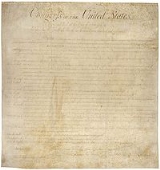
Bill of Rights Pg1of1 Ac
Grand juries
Grand jury

In the common law, a grand jury is a type of jury that determines whether there is enough evidence for a Criminal procedure. Grand juries carry out this duty by examining evidence presented to them by a prosecutor and issuing indictments, or by investigating alleged crimes and issuing Wiktionary:presentments....
, which return indictment
Indictment

In the common law legal system, an indictment is a formal accusation that a person has committed a criminal offense. In those jurisdictions which retain the concept of a felony, the serious criminal offense would be a felony; those jurisdictions which have abolished the concept of a felony often substitute the concept of an indictable offenc...
s in many criminal cases, are composed of a jury of peers and operate in closed deliberation proceedings; they are given specific instructions regarding the law by the judge. Many constitutional restrictions do not apply during grand jury proceedings. The exclusionary rule
Exclusionary rule

The exclusionary rule is a legal principle in the United States, under United States constitutional law, which holds that Evidence collected or analyzed in violation of the Defendant constitutional rights is sometimes Admissible evidence for a criminal prosecution in a Court....
, which prevents evidence seized in violation of the fourth, fifth or sixth amendments from being introduced in court, does not apply to evidence presented to a grand jury. Defendents do not have the right to have their attorneys present in grand jury rooms during hearings; they would normally have such a right when being investigated by the police. The grand jury indictment clause of the Fifth Amendment has not been incorporated
Incorporation (Bill of Rights)

Incorporation is the United States legal doctrine by which portions of the United States Bill of Rights are applied to the U.S. state through the Due process#Interpretation of Due Process Clause in U.S....
 under the Fourteenth Amendment
Fourteenth Amendment to the United States Constitution

The Fourteenth Amendment to the United States Constitution is one of the post-American Civil War Reconstruction Amendments that was first intended to secure the rights of former Slavery in the United States....
; in other words, it has not been ruled applicable to the states. States are thus free to abolish grand juries, and many (though not all) have indeed replaced them with preliminary hearing
Preliminary hearing

Within some criminal justices, a preliminary hearing , often abbreviated verbally as a "prelim") is a proceeding, after a criminal complaint has been filed by the prosecutor, to determine whether, and to what extent, crime charges and civil cause of actions will be heard , what evidence will be admitted, and what else must be done ....
s. This was decided in Hurtado v. California
Hurtado v. California

Hurtado v. California, Case citation , was a case decided on by the Supreme Court of the United States. The case helped define rules regarding the use of Grand jury in indictments....
, 110 U.S. 516 (1884), since "except in cases arising in the land and naval forces, or in the Militia," is held to indicate federal jurisdiction. Presumably the "Militia" refers to state National Guard
National Guard

The term National Guard may refer to an organized militia, a military force, a paramilitary force, a gendarmerie, or a constabulary:...
 units when called to federal service, or federalized. Whether or not a crime is "infamous" is determined by the nature of the punishment that may be imposed (not the punishment that is actually imposed), though crimes punishable by capital punishment
Capital punishment

Capital punishment, the death penalty or execution, is the killing of a person by procedural law for Punishment#Retribution and Punishment#Incapacitation....
 are explicitly required within the text of the Fifth Amendment to be tried upon indictments. In United States v. Moreland
United States v. Moreland

United States v. Moreland, Case citation , was a case heard by the Supreme Court of the United States on March 9 and 10, 1922, and decided a month later on April 17....
, , the Supreme Court held that imprisonment in a prison or penitentiary, as opposed to a correction or reformation house, attaches infamy to a crime. Currently, federal law permits the trial of misdemeanor
Misdemeanor

A misdemeanor, or misdemeanour, in many common law legal systems, is a "lesser" crime act. Misdemeanors are generally punishment much less severely than felony, but theoretically more so than administrative infractions ....
s without indictments and in cases involving felonies, except those in which capital punishment may be applied, the prosecution may proceed without indictments if the defendants waive their Fifth Amendment right.

Indictments found by grand juries may be amended by the prosecution only in limited circumstances. In Ex Parte Bain
Ex Parte Bain

Ex parte Bain, 121 U.S. 1 . George M. Bain, Jr. was indicted by a federal criminal grand jury and subsequently convicted for making a false report or statement as cashier of a bank under U.S....
 (1887), the Supreme Court held that the indictment could not be changed at all by the prosecution. United States v. Miller
United States v. Miller

United States v. Miller, Case citation , was the first Supreme Court of the United States decision to directly address the Second Amendment to the United States Constitution....
, partly reversed the previous ruling; now, an indictment's scope may be narrowed by the prosecution. Thus, lesser included charges may be dropped, but new charges may not be added.

The grand jury clause of the Fifth Amendment does not protect those serving in the armed forces, whether during wartime or peacetime. Members of the state militia called up to serve with federal forces are not protected under the clause either. In O'Callahan v. Parker, , the Supreme Court held that only service-related charges may be brought against members of the militia without indictments. That decision was overturned in 1987, when the Court held that members of the militia in actual service may be tried for any offense with indictments.

Double jeopardy


The fifth amendment refers to being put in "jeopardy of life or limb." The clause, however, has been interpreted as providing protection regarding "every indictment or information charging a party with a known and defined crime or misdemeanor." The clause, it has been held, does not prevent separate trials by different governments, and the state and federal governments are considered "separate sovereigns". Therefore, one may be prosecuted for a crime in a state court, and also prosecuted for the same crime in another state, a foreign country, or (most commonly) in a federal court.

Once acquitted, a defendant may not be retried for the same offense: Ball v. U.S. "A verdict of acquittal, although not followed by any judgment, is a bar to a subsequent prosecution for the same offense." 163 U.S. 662
Case citation

Case citation is the system used in many countries to identify the decisions in past court cases, either in special series of books called Reporter s or law reports, or in a 'neutral' form which will identify a decision wherever it was reported....
 at 672 (1896). Acquittal by a jury is generally final and cannot be appealed by the prosecution, Fong Foo v. United States
Fong Foo v. United States

Fong Foo v. United States, Case citation , was a Supreme Court of the United States ruling that upheld the protection from Double Jeopardy by the Federal Government....
, 369 U.S. 141
Case citation

Case citation is the system used in many countries to identify the decisions in past court cases, either in special series of books called Reporter s or law reports, or in a 'neutral' form which will identify a decision wherever it was reported....
 (1962). An acquittal in a trial by judge (bench trial) is also generally not appealable by the prosecution, United States v. Jenkins, 420 U.S. 358
Case citation

Case citation is the system used in many countries to identify the decisions in past court cases, either in special series of books called Reporter s or law reports, or in a 'neutral' form which will identify a decision wherever it was reported....
 (1975). A trial judge may normally enter an acquittal if he deems the evidence insufficient for conviction. If the judge makes this ruling before the jury reaches its verdict, the judge's determination is final. If, however, the judge overrules a conviction by the jury, the prosecution may appeal to have the conviction reinstated. Additionally, although a judge may overrule a guilty verdict by a jury, he or she does not have the same power to overrule a not guilty verdict.

Defendants may not be retried following conviction except in limited circumstances when the judge sees fit and proper. Bribing a judge to get an acquittal is not valid because the party acquitted has prevented themselves from being placed into "jeopardy" in the first place. Harry Aleman v. Judges of the Criminal Division, Circuit Court of Cook County, Illinois, et al., 138 F.3d 302
Case citation

Case citation is the system used in many countries to identify the decisions in past court cases, either in special series of books called Reporter s or law reports, or in a 'neutral' form which will identify a decision wherever it was reported....
 (1998). If a defendant appeals a conviction and is successful in having it overturned, they are subject to retrial. An exception arises if the verdict is overturned on the grounds of evidentiary insufficiency, rather than on the grounds of procedural faults. As noted above, if the trial court made a determination of evidentiary insufficiency, the determination would constitute a final acquittal; in Burks v. United States 437 U.S. 1
Case citation

Case citation is the system used in many countries to identify the decisions in past court cases, either in special series of books called Reporter s or law reports, or in a 'neutral' form which will identify a decision wherever it was reported....
, (1978), it was held that "it should make no difference that the reviewing court, rather than the trial court, determined the evidence to be insufficient." Another exception arises in cases of conviction for lesser offenses. For instance, if a defendant is charged with murder
Murder

Murder as defined in common law countries, is the unlawful killing of another human being with intent , and generally this state of mind distinguishes murder from other forms of unlawful homicide....
 in the first degree, and is convicted by the jury of murder in the second degree, and later the jury's conviction is overturned on procedural grounds, the defendant may be retried for second degree but not first degree murder; the jury, by convicting the defendant of second degree murder, is deemed to have implicitly acquitted them of first degree murder.

The defendant may not be punished twice for the same offense. In certain circumstances, however, a sentence may be increased. It has been held that sentences do not have the same "finality" as acquittals, and may therefore be reviewed by the courts. Sentence increases may not, however, be made once the defendant has already begun serving his term of imprisonment. If a defendant's conviction is overturned on procedural grounds, the retrial may result in a harsher penalty than the original trial. The only exception is that the prosecution may not seek capital punishment in the retrial if the jury did not impose it in the original trial. The reason for this exception is that before imposing the death penalty the jury has to make several factual determinations and if the jury does not make these it is seen as the equivalent of an acquittal of a more serious offense.

In Arizona v. Rumsey, 467 U.S. 203
Case citation

Case citation is the system used in many countries to identify the decisions in past court cases, either in special series of books called Reporter s or law reports, or in a 'neutral' form which will identify a decision wherever it was reported....
 (1984), it was ruled that in a bench trial, when a judge was holding a separate hearing after the jury trial, to decide if the defendant should be sentenced to death or life imprisonment, the judge decided that the circumstances of the case did not permit death to be imposed. On appeal the judge's ruling was found to be erroneous. However, even though the decision to impose life instead of death was based on an erroneous interpretation of the law by the judge, the finding of life imprisonment in the original case constituted an acquittal of the death penalty and thus death could not be imposed upon a subsequent trial. Even though the acquittal of the death penalty was erroneous in that case, the acquittal must stand.

Mistrials are generally not covered by the double jeopardy clause. If a judge dismisses the case or terminates the trial without deciding the facts in the defendant's favor (for example, by dismissing the case on procedural grounds), the case is a mistrial and may normally be retried. Furthermore, if a jury cannot reach a verdict, the judge may declare a mistrial and order a retrial. When the defendant moves for a mistrial, there is no bar to retrial, even if the prosecutor or judge caused the error that forms the basis of the motion. An exception exists, however, where the prosecutor or judge has acted in bad faith
Bad faith

Bad faith is a legal concept in which a malice Motive on the part of a party in a lawsuit undermines their case. It has an effect on the ability to maintain causes of action and obtain Legal remedy....
. In Oregon v. Kennedy, 456 U.S. 667
Case citation

Case citation is the system used in many countries to identify the decisions in past court cases, either in special series of books called Reporter s or law reports, or in a 'neutral' form which will identify a decision wherever it was reported....
, (1982), the Supreme Court held that "only where the governmental conduct in question is intended to 'goad' the defendant into moving for a mistrial may a defendant raise the bar of double jeopardy to a second trial after having succeeded in aborting the first on his own motion."

Defendants may not more than once be placed in jeopardy for the "same offense". Sometimes, however, the same conduct may violate different statutes. In Blockburger v. United States
Blockburger v. United States

Blockburger v. United States, Case citation , was a case in which the Supreme Court of the United States set an important standard to prevent double jeopardy....
, 284 U.S. 299
Case citation

Case citation is the system used in many countries to identify the decisions in past court cases, either in special series of books called Reporter s or law reports, or in a 'neutral' form which will identify a decision wherever it was reported....
 (1932), the Supreme Court held that "where the same act or transaction constitutes a violation of two distinct statutory provisions, the test to be applied to determine whether there are two offenses or only one, is whether each provision requires proof of an additional fact which the other does not". For example, the test was applied in Brown v. Ohio, 432 U.S. 161
Case citation

Case citation is the system used in many countries to identify the decisions in past court cases, either in special series of books called Reporter s or law reports, or in a 'neutral' form which will identify a decision wherever it was reported....
 (1977). The defendant had first been convicted of operating an automobile without the owner's consent, and later of stealing the same automobile. The Supreme Court concluded that the same evidence was necessary to prove both offenses, and that in effect there was only one offense. Therefore, it overturned the second conviction.

In other cases, the same conduct may constitute multiple offenses under the same statute, for instance where one robs many individuals at the same time. There is no explicit bar to separate prosecutions for different offenses arising under the same "criminal transaction", but it is not permissible for the prosecution to re-litigate facts already determined by a jury. In Ashe v. Swenson
Ashe v. Swenson

Ashe v. Swenson, Case citation , was a decision by the United States Supreme Court, which held that "when an issue of ultimate fact has once been determined by a valid and final judgment, that issue cannot again be litigated between the same parties in any future lawsuit." The Double Jeopardy Clause prevents a state from relitigating a qu...
, 397 U.S. 436
Case citation

Case citation is the system used in many countries to identify the decisions in past court cases, either in special series of books called Reporter s or law reports, or in a 'neutral' form which will identify a decision wherever it was reported....
, (1970), the defendant was accused of robbing seven poker
Poker

Poker is a family of card game that share betting rules and usually List of poker hands. Poker games differ in how the cards are dealt, how hands may be formed, whether the high or low hand wins the pot in a showdown , limits on bets and how many rounds of betting are allowed....
 players during a game. John Ashe was first tried for, and acquitted of, robbing only one of the players; the defense did not contest that a robbery actually took place. The state then tried the defendant for robbing the second player; stronger identification evidence led to a conviction. The Supreme Court, however, overturned the conviction. It was held that in the first trial, since the defense had not presented any evidence that there was no robbery, the jury's acquittal had to be based on the conclusion that the defendant's alibi was valid. Since one jury had held that the defendant was not present at the crime scene, the State could not re-litigate the issue.

Self-incrimination

The fifth amendment protects witnesses from being forced to incriminate themselves
Self-incrimination

Self-incrimination is the act of accusing oneself of a crime for which a person can then be prosecuted. Self-incrimination can occur either directly or indirectly: directly, by means of interrogation where information of a self-incriminatory nature is disclosed; indirectly, when information of a self-incriminatory nature is disclosed voluntar...
. To "plead the Fifth" is to refuse to answer a question because the response could provide self-incriminating evidence of an illegal conduct punished by fines, penalties or forfeiture. Counselman v. Hitchcock, 142 U.S. 547 (1892).

It is an ancient principle of the law of evidence that a witness shall not be compelled, in any proceeding, to make disclosures or to give testimony which will tend to incriminate him or subject him to fines, penalties, or forfeitures.


Historically, the legal protection against self-incrimination is directly related to the question of torture for extracting information and confessions.

The legal shift from widespread use of torture and forced confession dates to turmoil of the late sixteenth and early seventeenth century in England
England

native_name =|conventional_long_name = England|common_name = England|image_flag = Flag of England.svg|image_coat = England COA.svg|symbol_type = Royal Coat of Arms...
. Anyone refusing to take the oath ex-officio (confessions or swearing of innocence, usually before hearing any charges) was taken for guilty. Suspected Puritans were pressed to take the oath and then reveal names of other Puritans. Coercion and torture were commonly employed to compel "cooperation." Puritans, who were at the time fleeing to the New World
New World

The New World is one of the names used for the non-Eurasian/non-African parts of the Earth, specifically the Americas and Australasia. When the term originated in the late 15th century, the Americas were new to the Europeans, who previously thought of the world as consisting only of Europe, Asia, and Africa ....
, began a practice of refusing to cooperate with interrogations. In the most famous case John Lilburne
John Lilburne

John Lilburne , also known as Freeborn John, was an agitator in England before, during and after the English Civil Wars of 1642–1650....
 refused to take the oath in 1637. His case and his call for "freeborn
Freeborn

Freeborn is a prefix associated with John Lilburne , a member of the Levellers, a 17th century England political party. As a word, freeborn means to be born free, rather than to be born in slavery or debt bondage or vassalage....
 rights" were rallying points for reforms against forced oaths, forced self-incrimination, and other kinds of coercion. Oliver Cromwell
Oliver Cromwell

Oliver Cromwell was an English people Military history of the United Kingdom and Politics of England leader best known for his involvement in making England into a republican Commonwealth and for his later role as Lord Protector of England, Scotland, and Ireland....
's revolution overturned the practice and incorporated protections, in response to a popular group of English citizens known as the Levellers
Levellers

The Levellers were members of a mid 17th century England political movement, who came to prominence during the English Civil Wars. They were not a political party in the modern sense of the word, and did not all conform to any specific manifesto....
. The Levellers presented The Humble Petition of Many Thousands to Parliament
Parliament

A parliament is a legislature, especially in those countries whose system of government is based on the Westminster system modeled after that of the United Kingdom....
 in 1647 with thirteen demands, of which the right against self-incrimination (in criminal cases only) was listed at number three. These protections were brought to the American shores by Puritans, and were later incorporated into the United States Constitution
United States Constitution

The Constitution of the United States of America is the supreme law of the United States. It is the foundation and source of the legal authority underlying the existence of the United States of America; the Federal Government of the United States; and all the State & local governments and Territorial Administrative bodies contained therein....
 through its Bill of Rights
Bill of rights

A Bill of Rights is a list or summary of rights that are considered important and essential by a nation. The purpose of these bills is to protect those rights against infringement by the government....
.

This amendment is also similar to Section 13 of the Canadian Charter of Rights and Freedoms.

Legal proceeding


The fifth amendment protections apply when an individual is compelled to testify at a legal proceeding. The U.S. supreme court ruled that the right against self-incrimination applies whether the witness is in a federal or state court (see Malloy v. Hogan
Malloy v. Hogan

Malloy v. Hogan, Case citation , was a case in which the Supreme Court of the United States deemed a defendant's Fifth Amendment to the United States Constitution right against self-incrimination was applicable within state courts as well as federal courts....
, (1964)), and whether the proceeding itself is criminal or civil (see McCarthy v. Arndstein, 266 U.S. 34 (1924)).

The right was asserted at grand jury or congressional hearings in the 1950s, when witnesses testifying before the House Committee on Un-American Activities or the Senate Internal Security Subcommittee claimed the right in response to questions concerning their alleged membership in the Communist Party
Communist party

A political party described as a communist party includes those that advocate the application of the social principles of communism through a communist form of government....
. Under the Red Scare
Red Scare

The term Red Scare has been retroactively applied to two distinct periods of strong anti-Communism in United States history: first from 1917 to 1920, and second from the late 1940s through the late 1950s....
 hysteria at the time of McCarthyism
McCarthyism

McCarthyism is the politically motivated practice of making accusations of disloyalty, subversion, or treason without proper regard for evidence....
, witneeses who refused to answer the questions were accused as "fifth amendment communists". They lost jobs or positions in unions and other political organizations, and suffered other repercussions after "taking the fifth."

Senator Joseph McCarthy
Joseph McCarthy

Joseph Raymond McCarthy was an United States politician who served as a Republican Party United States Senate from the state of Wisconsin from 1947 until his death in 1957....
 (R-Wisc.) asked, "Are you now, or have you ever been a member of the Communist party," while he was chairman of the Senate Government Operations Committee Permanent Subcommittee on Investigations. Admitting to a previous communist party membership was not sufficient. Witneeses were also required to "name names," to implicate others they knew to be communists or who had been communists in the past.

Academy Award winning director Elia Kazan
Elia Kazan

Elia Kazan, September 7 1909 – September 28 2003, was an United States award-winning film director and Theatre direction, film producer and theatrical producer, screenwriter, novelist and co-founder of the influential Actors Studio in New York in 1947....
 testified before the House Committee on Un-American Activities that he had belonged to the communist party briefly in his youth. He also "named names," which incurred enmity of many in Hollywood. Other entertainers such as Zero Mostel
Zero Mostel

Samuel Joel ?Zero? Mostel was an United States actor of theatre and film, best known for his portrayal of comic characters such as Tevye in Fiddler on the Roof, Pseudolus in A Funny Thing Happened on the Way to the Forum, and Max Bialystock in The Producers ....
 found themselves on a Hollywood blacklist
Hollywood blacklist

The Hollywood blacklist?more precisely the entertainment industry blacklist, into which it expanded?was the mid-twentieth-century list of screenwriters, actors, directors, musicians, and other U.S....
 after taking the fifth, and were unable to find work for a while in the show business.

The amendment has also been used, notably, by defendants and witnesses in criminal cases involving the Mafia
Mafia

The Mafia is a Sicily criminal society which is believed to have emerged in late 19th century Sicily. It is a loose association of criminal groups that share a common organizational structure and code of conduct....
. The supreme court has also used the incorporation doctrine to apply the self-incrimination clause against the states under the fourteenth amendment.

The right against self-incrimination does not apply when an individual testifies before a self-regulatory organization
Self-regulatory organization

A self-regulatory organization is an organization that exercises some degree of regulatory authority over an industry or profession. The regulatory authority could be applied in addition to some form of government regulation, or it could fill the vacuum of an absence of government oversight and regulation....
 (SRO). SROs, such as the National Association of Securities Dealers (NASD), are generally not considered as state actors subject to the restraints of the fifth amendment. Department of Enforcement, United States v. Solomon, 509 F. 2d 863 (2d Cir. 1975); D. L. Cromwell Invs., Inc. v. NASD Regulation, Inc., 132 F. Supp. 2d 248, 251-53 (S.D.N.Y. 2001), aff'd, 279 F.3d 155, 162 (2d Cir. 2002), cert. denied, 537 U.S. 1028 (2002); Marchiano v. NASD, 134 F. Supp. 2d 90, 95 (D.D.C. 2001). SROs also lack subpoena powers, so they rely heavily on requiring testimony from individuals while wielding the threat of a bar from the industry (permanent, if decided by the NASD) in the case of noncompliance.

Custodial interrogation

The Fifth Amendment limits the use of evidence obtained illegally by the law enforcement. Originally, at common law
Common law

Common law refers to law and the corresponding Legal systems of the world developed through legal opinion of courts and similar tribunals , rather than through statute law or Executive ....
, even a confession obtained by torture was admissible. In the eighteenth century, common law in England provided that coerced confessions were inadmissible. The common law rule was incorporated into American law by the courts. However, the use of brutal torture to extract confessions was routine in some rural states as late as the 1930s, and stopped only after the Supreme Court kept overruling convictions based on such confessions, in cases like Brown v. Mississippi
Brown v. Mississippi

Brown v. Mississippi, Case citation, , was a Supreme Court of the United States case that ruled that a defendant's confession that is extracted by police violence cannot be entered as evidence and violates the Due process#Due process in the United States....
, .

Law enforcement responded by switching to more subtle techniques, but the courts held that such techniques, even if they do not involve physical torture, may render a confession involuntary and inadmissible. In Chambers v. Florida
Chambers v. Florida

Chambers v. Florida, Case citation , was an important Supreme Court of the United States case that dealt with the extent that police pressure resulting in a criminal defendants confession violate the Due Process clause....
 (1940) the Court held a confession obtained after five days of prolonged questioning, during which time the defendant was held incommunicado, to be coerced. In Ashcraft v. Tennessee (1944), the suspect had been interrogated continuously for thirty-six hours under electric lights. In Haynes v. Washington (1963) the Court held that an "unfair and inherently coercive context" including a prolonged interrogation rendered a confession inadmissible.

Miranda v. Arizona
Miranda v. Arizona

Miranda v. Arizona , , was a Landmark decision 5-4 decision of the Supreme Court of the United States which was argued February 28?March 1, 1966 and decided June 13, 1966....
 (1966) was a landmark case involving confessions. Ernesto Miranda
Ernesto Miranda

Ernesto Arturo Miranda was a laborer whose conviction on kidnapping, rape, and armed robbery charges based on his confession under police interrogation resulted in the landmark Supreme Court of the United States case , which ruled that criminal suspects must be informed of their right against self-incrimination and their right to consult wit...
 had signed a statement confessing the crime, but the Supreme Court held that the confession was inadmissible because the defendant had not been warned of his rights.

The Court held, "the prosecution may not use statements [...] stemming from custodial interrogation of the defendant unless it demonstrates the use of procedural safeguards effective to secure the privilege against self-incrimination. Custodial interrogation is initiated by law enforcement after a person has been taken into custody or otherwise deprived of his freedom of movement.

As for the procedural safeguards to be employed, unless other fully effective means are devised to inform accused persons of their right of silence and to assure a continuous opportunity to exercise it, the following measures are required. Prior to any questioning, the person must be warned that he has a right to remain silent, that any statement he does make may be used as evidence against him, and that he has a right to the presence of an attorney, either retained or appointed." The warning to which Chief Justice Earl Warren
Earl Warren

Earl Warren was the 14th Chief Justice of the United States and the only person ever elected three times as Governor of California. Prior to holding these positions, Warren served as a district attorney for Alameda County, California and California Attorney General....
 referred is now called the Miranda warning
Miranda warning

In the United States, the Miranda warning is a warning given by police to criminal suspects in police custody, or in a custodial situation, before they are asked guilt-seeking questions relating to the commission of a crime....
, and it is customarily delivered by the police to an individual upon his or her arrest.

Miranda has been clarified by several further Supreme Court rulings. For the warning to be necessary, the questioning must be conducted under "custodial" circumstances. A person detained in jail or under arrest is, of course, deemed to be in police custody. Alternatively, a person who is under the reasonable belief that he may not freely leave from the restraint of law enforcement is also deemed to be in "custody." That determination of "reasonableness" is based on a totality of the objective circumstances. A mere presence at a police station may not be sufficient, but nor is it required. Traffic stops are not deemed custodial. Additionally, the Court ruled in Yarborough v. Alvarado that a suspect's age and inexperience are not objective factors required to be taken into consideration when determining whether it was reasonable for the suspect to believe that he was not free to leave during the questioning.

The questioning does not have to be explicit in order to trigger Miranda rights. For example, two police officers engaging in a conversation designed to elicit an incriminating statement from a suspect would constitute questioning. A person may choose to waive his Miranda rights, but the prosecution has the burden of showing that such a waiver was actually made.

A confession not preceded by a Miranda warning where one was necessary cannot be admitted as evidence against the confessing party in a judicial proceeding. The Supreme Court, however, has held that if a defendant voluntarily testifies at the trial that he did not commit the crime, his confession may be introduced to challenge his credibility, to "impeach" the witness, even if it had been obtained without the warning.

In Hiibel v. Sixth Judicial District Court of Nevada
Hiibel v. Sixth Judicial District Court of Nevada

Hiibel v. Sixth Judicial District Court of Nevada, , held that statutes requiring suspects to identify themselves during police investigations did not violate either the Fourth Amendment to the United States Constitution or Fifth Amendment to the United States Constitution Amendments....
, the Supreme Court ruled 5-4 on June 21, 2004 that the Fourth, Fifth, and Fourteenth Amendments do not give people the right to refuse to give their name when questioned by police.

Refusal to testify in a criminal case

The Supreme Court ruled that the government cannot punish a criminal defendant for exercising his right to silence
Right to silence

The right to remain silent is a law protection given to people undergoing police interrogation or trial . The law is recognized, explicitly or by convention, in many of the world's legal systems....
, by allowing the prosecutor to ask the jury to draw an inference of guilt from the defendant's refusal to testify in his own defense. Griffin v. California
Griffin v. California

Griffin v. California, 380 U.S. 609 , was a United States Supreme Court case in which the Court ruled, by a 6-2 vote, that it is a violation of a defendant's Fifth Amendment to the United States Constitution rights for the prosecutor to comment to the jury on the defendant's declining to testify, or for the judge to instruct the jury that...
, (1965). In Griffin, the Court overturned as unconstitutional under the federal constitution a provision of the California state constitution that explicitly granted such power to prosecutors.

Federal income tax

In some cases, individuals may be legally required to file reports that call for information that may be used against them in criminal cases. In United States v. Sullivan, (1927), the United States Supreme Court ruled that a taxpayer could not invoke the Fifth Amendment's protections as the basis for refusing to file a required federal income tax return. The Court stated: "If the form of return provided called for answers that the defendant was privileged from making[,] he could have raised the objection in the return, but could not on that account refuse to make any return at all. We are not called on to decide what, if anything, he might have withheld."

In Garner v. United States, (1976) the defendant was convicted in connection with a conspiracy to "fix” sporting contests and to transmit illegal bets. During the trial the prosecutor introduced, as evidence, the taxpayer's Federal income tax returns for various years. In one return the taxpayer had showed his occupation to be “professional gambler.” In various returns the taxpayer had reported income from “gambling” or “wagering.” The prosecution used this to help contradict the taxpayer's argument that his involvement was innocent. The taxpayer tried unsuccessfully to keep the prosecutor from introducing the tax returns as evidence, arguing that since the taxpayer was legally required to report the illegal income on the returns, he was being compelled to be a witness against himself. The Supreme Court agreed that he was legally required to report the illegal income
Taxation of illegal income in the United States

In the United States, the Internal Revenue Code was enacted by the U.S. Congress in part for the purpose of taxing net income. The Code is not a mechanism for enforcing other codes of law, for example, criminal law....
 on the returns, but ruled that the privilege against self-incrimination still did not apply. The Court stated that "if a witness under compulsion to testify makes disclosures instead of claiming the privilege, the Government has not 'compelled' him to incriminate himself."

Sullivan and Garner are viewed by some legal scholars as standing, in tandem, for the proposition that on a required Federal income tax return a taxpayer would probably have to report the amount of the illegal income, but might validly claim the privilege by labeling the item "Fifth Amendment" (instead of "illegal gambling income," "illegal drug sales," etc.)

Grants of immunity

If the government gives an individual immunity, then that individual may be compelled to testify. Immunity may be "transactional immunity" or "use immunity"; in the former, the witness is immune from prosecution for offenses related to the testimony; in the latter, the witness may be prosecuted, but his testimony may not be used against him. The Supreme Court has held that the government need only grant use immunity to compel testimony. The use immunity, however, must extend not only to the testimony made by the witness, but also to all evidence derived therefrom. This scenario most commonly arises in cases related to organized crime
Organized crime

Organized crime or criminal organizations comprise groups or operations run by crimes, most commonly for the purpose of generating a money profit....
.

Record keeping

A statutorily required record-keeping system may go too far such that it implicates a record-keeper's right against self-incrimination. A three part test laid out by Albertson v. Subversive Activities Control Board
Albertson v. Subversive Activities Control Board

Albertson v. Subversive Activities Control Board, Case citation was a Legal case in which Supreme Court of the United States ruled on November 15, 1965 that persons believed to be members of the Communist Party of the United States of America could not be required to register as party members with the Subversive Activities Control Board...
, 382 U.S. 70 (1965) is used to determine this: 1. the law targets a highly selective group inherently suspect of criminal activities; 2. the activities sought to be regulated are already permeated with criminal statutes as opposed to essentially being non-criminal and largely regulatory; and 3. the disclosure compelled creates a likelihood of prosecution and is used against the record-keeper.

In Albertson v. Subversive Activities Control Board
Albertson v. Subversive Activities Control Board

Albertson v. Subversive Activities Control Board, Case citation was a Legal case in which Supreme Court of the United States ruled on November 15, 1965 that persons believed to be members of the Communist Party of the United States of America could not be required to register as party members with the Subversive Activities Control Board...
, (1965), the Supreme Court struck down an order by the Subversive Activities Control Board requiring members of the Communist Party to register with the government and upheld an assertion of the privilege against self-incrimination, on the grounds that statute under which the order had been issued was "directed at a highly selective group inherently suspect of criminal activities."

In Leary v. United States
Leary v. United States

Leary v. United States, , is a Supreme Court of the United States case dealing with the constitutionality of 1937 Marijuana Tax Act. Timothy Leary, a professor and activist, was arrested for the possession of marijuana in violation of the Marijuana Tax Act....
, 395 U.S. 6 (1969) the court struck down the Marijuana Tax Act because its record keeping statute required self-incrimination
Self-incrimination

Self-incrimination is the act of accusing oneself of a crime for which a person can then be prosecuted. Self-incrimination can occur either directly or indirectly: directly, by means of interrogation where information of a self-incriminatory nature is disclosed; indirectly, when information of a self-incriminatory nature is disclosed voluntar...
.

Other

Corporations may also be compelled to maintain and turn over records; the supreme court has held that the fifth amendment protections against self-incrimination extend only to "natural persons." There are, however, a few restraints on the government; it may not, for instance, compel a person to keep records for a corporation if those records could be used against the record-keeper himself.

In Trammel v. United States, (1980), the supreme court ruled that the fifth amendment extended the right not to testify against oneself to include not testifying against one's spouse.

As a condition of employment, workers may be required to answer their employer's narrowly defined questions regarding conduct on the job. If an employee invokes the Garrity rule (sometimes called the Garrity Warning or Garrity Rights) before answering the questions, then the answers cannot be used in criminal prosecution of the employee. This principle was developed in Garrity v. New Jersey
Garrity v. New Jersey

Garrity v. New Jersey, Case citation , was a case in which the Supreme Court of the United States held that law enforcement officers and other public employees have the right to be free from compulsory self-incrimination....
, 385 US 493 (1967). The rule is most commonly applied to public employees such as police officers.

In United States v. Boucher
United States v. Boucher

United States v. Boucher, case citation, is a federal law#United States criminal law legal case in Vermont, which was the first to directly address the question of whether a person can be compelled to reveal his or her encryption passphrase or password, despite the U.S....
, the Vermont district court
United States District Court for the District of Vermont

The United States District Court for the District of Vermont is the United States District Court whose jurisdiction is the state of Vermont. The court has locations in Brattleboro, Vermont, Burlington, Vermont, and Rutland , Vermont....
 ruled that the fifth amendment protects a defendant from having to reveal an encryption passphrase
Rubber-hose cryptanalysis

In cryptography, rubber-hose cryptanalysis is a euphemism for the extraction of cryptographic secrets from a person by coercion, in contrast to a mathematical or technical cryptanalysis....
, or even the existence of one, in stark contrast to the situation in the United Kingdom
Regulation of Investigatory Powers Act 2000

The Regulation of Investigatory Powers Act 2000 is an Act of Parliament of the Parliament of the United Kingdom, regulating the powers of public bodies to carry out surveillance and investigation, and covering the interception of Telecommunication....
.

In Boyd v. United States
Boyd v. United States

Boyd v. United States, Case citation , was a decision by the United States Supreme Court, which held that ?a search and seizure [was] equivalent [to] a compulsory production of a man's private papers? and that the search was ?an 'unreasonable search and seizure' within the meaning of the Fourth Amendment.?...
 116 US 616 (1886) the US Supreme Court stated that "It is equivalent to a compulsory production of papers to make the nonproduction of them a confession of the allegations which it is pretended they will prove".

Due process

The fifth amendment prevents individuals from being punished without "due process of law." Due process extends to all persons (including non-U.S. citizens within the U.S.) and corporate entities. The Fourteenth Amendment explicitly binds the states with due process protections, through selective incorporation
Incorporation (Bill of Rights)

Incorporation is the United States legal doctrine by which portions of the United States Bill of Rights are applied to the U.S. state through the Due process#Interpretation of Due Process Clause in U.S....
.

The fifth amendment applies to the federal government (see Barron v. Baltimore
Barron v. Baltimore

Barron v. Mayor of Baltimore, Case citation established a precedent on whether the United States Bill of Rights could be applied to state governments....
), and the Fourteenth Amendment
Fourteenth Amendment to the United States Constitution

The Fourteenth Amendment to the United States Constitution is one of the post-American Civil War Reconstruction Amendments that was first intended to secure the rights of former Slavery in the United States....
, by its own terms, applies against the States. While the fifth amendment includes a due process clause, it does not include—as the fourteenth amendment does—an equal protection clause. However, in Bolling v. Sharpe
Bolling v. Sharpe

Bolling v. Sharpe, Case citation was an influential Supreme Court of the United States landmark case dealing with civil rights concerning segregation in public schools....
  (1954), the Supreme Court averred that it was absurd that the Constitution could deny the states the power to abridge equal protection of the laws, yet permit that power to the Congress. "[T]he concepts of equal protection and due process, both stemming from our American ideal of fairness, are not mutually exclusive," reasoned Chief Justice Earl Warren
Earl Warren

Earl Warren was the 14th Chief Justice of the United States and the only person ever elected three times as Governor of California. Prior to holding these positions, Warren served as a district attorney for Alameda County, California and California Attorney General....
. The Court thus interpreted the fifth amendment's due process clause to include an equal protection element but has continued to hold that there is a difference between due process and equal protection in its fourteenth amendment
Fourteenth Amendment to the United States Constitution

The Fourteenth Amendment to the United States Constitution is one of the post-American Civil War Reconstruction Amendments that was first intended to secure the rights of former Slavery in the United States....
 jurisprudence.

Eminent domain


The Supreme Court has held that the federal government and each state has the power of eminent domain
Eminent domain

Eminent domain , compulsory purchase , resumption/compulsory acquisition or expropriation in common law legal systems is the inherent power of the state to seize a citizen's Property, expropriation property, or seize a citizen's rights in property with due monetary compensation, but without the owner's consent....
—the power to take private property for "public use". The Takings Clause, the last clause of the Fifth Amendment, limits the power of eminent domain by requiring that "just compensation" be paid if private property is taken for public use. The just compensation provision of the Fifth Amendment did not originally apply directly to the states, but the federal courts now hold that the Fourteenth Amendment
Fourteenth Amendment to the United States Constitution

The Fourteenth Amendment to the United States Constitution is one of the post-American Civil War Reconstruction Amendments that was first intended to secure the rights of former Slavery in the United States....
 extended the effects of that provision to the states. The federal courts, however, have shown much deference to the determinations of Congress, and even more so to the determinations of the state legislatures, as to what constitutes "public use". The property need not actually be used by the public; rather, it must be used or disposed of in such a manner as to benefit the public welfare or public interest. One exception that restrains the federal government is that the property must be used in exercise of a government's enumerated powers.

The owner of the property that is taken by the government must be justly compensated. When determining the amount that must be paid, the government does not need to take into account any speculative schemes that the owner claims the property was intended for use in. Normally, the fair market value of the property determines "just compensation". If the property is taken before the payment is made, interest accrues (though the courts have refrained from using the term "interest").

The federal courts have not restrained state and local governments from seizing privately owned land for private commercial development on behalf of private developers. This was upheld on June 23, 2005, when the Supreme Court issued its opinion in Kelo v. City of New London
Kelo v. City of New London

Kelo v. City of New London, 545 U.S. 469 [1], was a case decided by the Supreme Court of the United States involving the use of eminent domain to transfer land from one private owner to another to further economic development....
.
This 5–4 decision remains controversial. The majority opinion, by Justice Stevens, found that it was appropriate to defer to the city's decision that the development plan had a public purpose, saying that "the city has carefully formulated a development plan that it believes will provide appreciable benefits to the community, including, but not limited to, new jobs and increased tax revenue." Justice Kennedy's concurring opinion observed that in this particular case the development plan was not "of primary benefit to . . . the developer" and that if that was the case the plan might have been impermissible. In the dissent, Justice Sandra Day O'Connor
Sandra Day O'Connor

Sandra Day O'Connor is an United States jurist and the first female Associate Justice of the Supreme Court of the United States of the Supreme Court of the United States....
 argued that this decision would allow the rich to benefit at the expense of the poor, asserting that "Any property may now be taken for the benefit of another private party, but the fallout from this decision will not be random. The beneficiaries are likely to be those citizens with disproportionate influence and power in the political process, including large corporations and development firms." She argued that the decision eliminates "any distinction between private and public use of property—and thereby effectively delete[s] the words 'for public use' from the Takings Clause of the Fifth Amendment". Some states, in response to Kelo, have passed laws which make it more difficult for state governments to seize private land.

The exercise of the police power of the state resulting in a taking of private property was long held to be an exception to the requirement of government paying just compensation. However the growing trend under the various state constitution's taking clauses is to compensate innocent third parties whose property was destroyed or "taken" as a result of police action.

Further reading


External links

  • Fifth Amendment with Annotations
  • by R. Carter Pittman, 1935
  • by Howard Fast
    Howard Fast

    Howard Melvin Fast was a Jewish American novelist and television writer, who wrote also under the pen names E. V. Cunningham and Walter Ericson....
  • — news and essays related to the Fifth Amendment, at the Populist Party of America
    Populist Party of America

    The Populist Party of America, founded in 2002, is an "anti-statist", libertarian political party which claims to offer "real solutions" to American problems through the establishment of what they have termed "constitutional democracy"....
  • - Professor James Duane of the Regent University School of Law
  • - Officer George Bruch from the Virginia Beach police department