

Supreme Court of Canada

Encyclopedia
The Supreme Court of Canada is the highest court
of Canada
and is the final court of appeals in the Canadian justice system. The court grants permission to between 40 and 75 litigants each year to appeal decisions rendered by provincial, territorial and federal appellate courts
, and its decisions are stare decisis
, binding upon all lower courts of Canada. The Supreme Court of Canada is composed of nine judge
s: the Chief Justice of Canada
and eight Puisne Justice
s.
. The first bills for the creation of a federal supreme court, introduced in the Parliament of Canada
in 1869 and in 1870, were withdrawn. It was not until 8 April 1875, that a bill was finally passed providing for the creation of a Supreme Court of Canada.
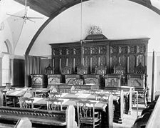
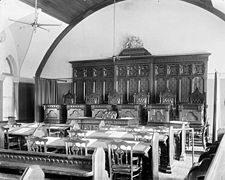 Prior to 1949, however, the Supreme Court did not constitute the court of last resort; litigants could appeal to the Judicial Committee of the Privy Council
in London. As well, some cases could bypass the Court and go directly to the Judicial Committee from the provincial courts of appeal. The Supreme Court's influence was thus rather modest. Attitudes among many English Canadians changed when the Privy Council made various unpopular decisions in the 1930s, striking down several overreaching federal legislative initiatives. These decisions were rooted in the Judicial Committee's perception that the division of powers provided for strong provincial powers. Many Canadian nationalists took the opposite view, and as a consequence, public pressure forced the federal government to push for complete judicial independence from the United Kingdom. The Supreme Court of Canada formally became the court of last resort for criminal appeals in 1933 and for all other appeals in 1949. The last decisions of the Judicial Committee on cases from Canada were made in the mid-1950s as a result of their being heard in a court of first instance prior to 1949. The increase in the importance of the Court was mirrored by the numbers of its members. The Court was established in 1875 with six judges, and these were augmented by an additional member in 1927. It was in 1949 that the bench reached its current size: 9 judges.
Prior to 1949, most of the appointees to the Supreme Court of Canada owed their position to political patronage
. Each judge had strong ties to the government in power at the time of their appointment. In 1973, the appointment of a constitutional law professor, Bora Laskin
, as Chief Justice represented a major turning point for the Court. Increasingly in this period, appointees either came from academic backgrounds, or were well-respected practitioners with several years experience in appellate courts. Laskin's federalist and liberal views were shared by Prime Minister Trudeau, who appointed him, and exerted an influence on many of the Court's decisions.
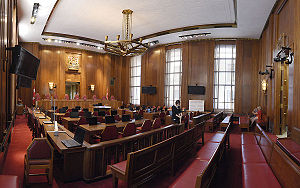 The Constitution Act, 1982
greatly expanded the role of the Court in Canadian society by the addition of the Canadian Charter of Rights and Freedoms
, which greatly broadened the scope of judicial review. The evolution from the Dickson Court (1984–90) through to the Lamer Court (1990–2000) witnessed a continuing vigour in the protection of civil liberties. Lamer's criminal law background proved an influence on the number of criminal cases heard by the Court during his time as Chief Justice. Nonetheless, the Lamer Court was more conservative with Charter rights, with only about a 1% success rate for Charter claimants.
The appointment of Beverly McLachlin as Chief Justice in 2000 has resulted in a more centrist and unified Court. Dissenting and concurring opinions are fewer than during the Dickson and Lamer Courts. With the 2005 appointments of Justices Charron and Abella, the Court has become the world's most gender-balanced national high court, four of its nine members being female.
, the Federal Court
, the Federal Court of Appeal
and the Court Martial Appeal Court of Canada
. Unlike the provincial superior courts, which exercise inherent or general jurisdiction
, the federal courts' jurisdiction is limited by statute. In all there are over 1000 federally-appointed judges at various levels across Canada.
The Supreme Court of Canada rests at the apex of the judicial pyramid. This institution hears appeals from the provincial courts of last resort, usually the provincial or territorial courts of appeal, and the Federal Court of Appeal (although in some matters appeals come straight from the trial courts, as in the case of publication bans and other orders that are otherwise not appealable). In most cases, permission to appeal must first be obtained from the Court. Motions for leave to appeal
to the Court are generally heard by a panel of three judges of the court and a simple majority is determinative. By convention, this panel never explains why it grants or refuses leave in any particular case, but the Court typically hears cases of national importance or where the case allows the court to settle an important issue of law. Leave is rarely granted, meaning that for most litigants, provincial Courts of Appeal are courts of last resort. But leave to appeal is not required for some cases, primarily criminal cases (in which a Judge below dissented on a point of law) and appeals from provincial references
. A final source of cases is the referral power of the federal government. In such cases, the Supreme Court is required to give an opinion on questions referred to it by the Governor-in-Council (cabinet
). However, in many cases, including the most recent Same-Sex Reference
, the Court has declined to answer a question from the Cabinet. In that case, the Court said it would not decide if same-sex marriage
s were required by the Charter of Rights, because the government had announced it would change the law regardless of its opinion, and subsequently did.
The Supreme Court thus performs a unique function. It can be asked by the Governor-in-Council to hear references considering important questions of law. Such referrals may concern the constitutionality or interpretation of federal or provincial legislation, or the division of powers
between federal and provincial levels of government. Any point of law may be referred in this manner. However, the court is not often called upon to hear references. When it is, the opinion on the question referred is often of national importance; one recent example concerns the constitutionality of Same-sex marriage. References have been used to re-examine criminal convictions that have concerned the country as in the cases of David Milgaard
and Steven Truscott
.
Constitutional questions may, of course, also be raised in the normal case of appeals involving individual litigants, governments, government agencies or crown corporations. In such cases the federal and provincial governments must be notified of any constitutional questions and may intervene
to submit a brief
and attend oral argument
at the court. Usually the other governments are given the right to argue their case in the Court, although on rare occasions this has been curtailed and prevented by order of one of the Court's judges.
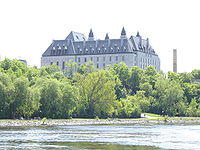 The Court sits for 18 weeks of the year beginning the first Monday of October and usually runs until the end of June and sometimes into July. Hearings only take place in Ottawa
, although litigants can present oral arguments from remote locations by means of a video-conference system. The court's hearings are open to the public. Most hearings are taped for delayed telecast in both of Canada's official
languages
. When in session, the court sits Monday to Friday, hearing two appeals a day. A quorum consists of five members for appeals. A panel of nine justices hears most cases.
On the bench, the Chief Justice of Canada
, or, in his or her absence, the senior puisne
justice, presides from the centre chair with the other justices seated to his or her right and left by order of seniority of appointment. At sittings of the Court, the justices usually appear in black silk robes but they wear their ceremonial robes of bright scarlet trimmed with Canadian white mink in court on special occasions and in the Senate at the opening of each new session of Parliament.
The decision of the court is sometimes—but rarely—rendered orally at the conclusion of the hearing. In these cases, the Court may simply refer to the decision of the court below to explain its own reasons. In other cases, the Court may announce its decision at the conclusion of the hearing, with reasons to follow. As well, in some cases, the Court may not call on counsel for the Respondent, if it has not been convinced by the arguments of counsel for the Appellant. In very rare cases, the Court may not call on counsel for the Appellant and instead calls directly on counsel for the Respondent. However, in most cases, the Court hears from all counsel and then reserves judgment, to enable the justices to write considered reasons. Decisions of the court need not be unanimous; a majority may decide, with dissenting reasons given by the minority. Each justice may write reasons in any case if he or she chooses to do so.
The Supreme Court has the ultimate power of judicial review
over Canadian federal and provincial laws' constitutional validity. If a federal or provincial law has been held contrary to the division of power provisions of one of the various Constitution Acts, the legislature or Parliament must either live with the result, amend the law so that it complies, or obtain an amendment to the constitution. If a law is declared contrary to certain sections of the Charter of Rights and Freedoms, Parliament or the provincial legislatures may make that particular law temporarily valid again against by using the "override power" of the notwithstanding clause
. In one case, the Quebec National Assembly invoked this power to override a Supreme Court decision (Ford v. Quebec (A.G.)
) that held that one of Quebec's language laws banning the display of English commercial signs was inconsistent with the charter. Saskatchewan used it to uphold labour laws. This override power can be exercised for five years, after which time the override must be renewed, or the decision comes into force.
In some cases, the Court may stay the effect of its judgments so that unconstitutional laws continue in force for a period of time. Usually this is done to give Parliament or the legislature time to enact a new replacement scheme of legislation. For example, in Reference re Manitoba Language Rights
the Court struck down Manitoba's laws because they were not enacted in the French language, as required by the constitution. However the Court stayed its judgment for 5 years to give Manitoba time to re-enact all its legislation in French. It turned out five years was insufficient so the Court was asked, and agreed to give more time.
A puisne justice
of the Supreme Court of Canada is referred to as "The Honourable Mr/Madam Justice" and the chief justice as "Right Honourable". At one time, Judges were called "My Lord/Lady" during sessions of the court, but this style of address was disapproved of by the current Chief Justice, Rt. Hon. Beverly McLachlin, who has directed lawyers to use the simpler "Your Honour" or "Justice." The designation "My Lord/My Lady" continues in many provincial Superior Courts, and in the Federal Court of Canada and Federal Court of Appeal where it is optional.
Every four years, the Judicial Compensation and Benefits Commission
makes recommendations to the federal government about the salaries for federally appointed judges, including the judges of the Supreme Court. That recommendation is not legally binding on the federal government, but the federal government is generally required to comply with the recommendation unless there is a very good reason not to. The Chief Justice receives $361,300 while the puisne justices receive $334,500 annually.
, consort to King George VI
and later Queen Mother. It was designed by Ernest Cormier
, architect of the Quebec Court of Appeal building
, the Government Printing Bureau in Gatineau
, Quebec
, and the Université de Montréal
. The Court began hearing cases in the new building by January 1946. The building is renowned for its Art Deco
details. In 2000, it was named by the Royal Architectural Institute of Canada
as one of the top 500 buildings produced in Canada during the last millennium.
Two flagstaffs have been erected in front of the building. A flag on one is flown daily, while the other is hoisted only on those days when the court is in session. Also located on the grounds are several statues, notably:
Inside there are busts of several Chief Justices:
They were all sculpted by Kenneth Jarvis, Q.C.
Previous homes of Canada's top courts include:
, a process whereby the governor general
, the viceregal
representative of the Queen of Canada, makes appointments based on the advice and consent of the Queen's Privy Council for Canada
. By tradition and convention, only the Cabinet
, a standing committee in the larger council, advises the governor general and this advice is usually expressed exclusively through a consultation with the prime minister. Thus, the provinces
and parliament
have no formal role in such appointments, sometimes a point of contention.
The Supreme Court Act
limits eligibility for appointment to persons who have been judges of a superior court, or members of the bar
for ten or more years. Members of the bar or superior judiciary of Quebec, by law, must hold three of the nine positions on the Supreme Court of Canada. This is justified on the basis that Quebec uses civil law
, rather than common law
, as in the rest of the country. The 3/9 ratio persists even though just 24 percent of Canada's population resides in Quebec. By convention, the remaining six positions are divided in the following manner: three from Ontario, two from the western provinces (typically one from British Columbia and one from the Prairie Provinces, which in turn rotates amongst the three, although Alberta is known to cause skips in the rotation) and one from the Atlantic provinces, almost always from Nova Scotia or New Brunswick.
The appointment of the most senior puisne justice to Chief Justice is a convention that has recently fallen into disuse. And there is also an attempt to appoint at least one Justice straight from legal practice without having previously been a judge.
A Supreme Court justice, as with all federal judges, may only sit on the bench until the age of 75 years.
In 2006, an interview phase by an ad hoc committee of members of Parliament was added. Justice Marshall Rothstein
became the first justice to undergo the new process. The Prime Minister still has the final say on who becomes the candidate that is recommended to the Governor General for appointment to the Court. The government proposed an interview phase again in 2008, but a general election and minority parliament intervened with delays such that the Prime Minister appointed Justice Cromwell after consulting the Leader of Her Majesty's Official Opposition.
justice was assisted by one law clerk and the chief justice had two. From 1982, the number was increased to two law clerks for each justice. Currently, each justice has three law clerks. Typically, the law clerks are selected from among the top students of each law school across the country. Their service with the Court meets in whole or in part the articling requirements of the provincial law societies as a condition of admission to the Bar.
Law clerks conduct research, draft bench memoranda
, and assist in drafting judgments, as well as any other research duties assigned by the law clerk's judge such as drafting speeches or articles.
Supreme court
A supreme court is the highest court within the hierarchy of many legal jurisdictions. Other descriptions for such courts include court of last resort, instance court, judgment court, high court, or apex court...
of Canada
Canada
Canada is a North American country consisting of ten provinces and three territories. Located in the northern part of the continent, it extends from the Atlantic Ocean in the east to the Pacific Ocean in the west, and northward into the Arctic Ocean...
and is the final court of appeals in the Canadian justice system. The court grants permission to between 40 and 75 litigants each year to appeal decisions rendered by provincial, territorial and federal appellate courts
Appeal
An appeal is a petition for review of a case that has been decided by a court of law. The petition is made to a higher court for the purpose of overturning the lower court's decision....
, and its decisions are stare decisis
Stare decisis
Stare decisis is a legal principle by which judges are obliged to respect the precedents established by prior decisions...
, binding upon all lower courts of Canada. The Supreme Court of Canada is composed of nine judge
Judge
A judge is a person who presides over court proceedings, either alone or as part of a panel of judges. The powers, functions, method of appointment, discipline, and training of judges vary widely across different jurisdictions. The judge is supposed to conduct the trial impartially and in an open...
s: the Chief Justice of Canada
Chief Justice of Canada
The Chief Justice of Canada, like the eight puisne Justices of the Supreme Court of Canada, is appointed by the Governor-in-Council . All nine are chosen from either sitting judges or barristers who have at least ten years' standing at the bar of a province or territory...
and eight Puisne Justice
Puisne Justice
A Puisne Justice or Puisne Judge is the title for a regular member of a Court. This is distinguished from the head of the Court who is known as the Chief Justice or Chief Judge. The term is used almost exclusively in common law jurisdictions such as England, Australia, Kenya, Canada, Sri Lanka,...
s.
History
The creation of the Court was provided for by the British North America Act, 1867, renamed in 1982 the Constitution Act, 1867Constitution Act, 1867
The Constitution Act, 1867 , is a major part of Canada's Constitution. The Act created a federal dominion and defines much of the operation of the Government of Canada, including its federal structure, the House of Commons, the Senate, the justice system, and the taxation system...
. The first bills for the creation of a federal supreme court, introduced in the Parliament of Canada
Parliament of Canada
The Parliament of Canada is the federal legislative branch of Canada, seated at Parliament Hill in the national capital, Ottawa. Formally, the body consists of the Canadian monarch—represented by her governor general—the Senate, and the House of Commons, each element having its own officers and...
in 1869 and in 1870, were withdrawn. It was not until 8 April 1875, that a bill was finally passed providing for the creation of a Supreme Court of Canada.
Judicial Committee of the Privy Council
The Judicial Committee of the Privy Council is one of the highest courts in the United Kingdom. Established by the Judicial Committee Act 1833 to hear appeals formerly heard by the King in Council The Judicial Committee of the Privy Council (JCPC) is one of the highest courts in the United...
in London. As well, some cases could bypass the Court and go directly to the Judicial Committee from the provincial courts of appeal. The Supreme Court's influence was thus rather modest. Attitudes among many English Canadians changed when the Privy Council made various unpopular decisions in the 1930s, striking down several overreaching federal legislative initiatives. These decisions were rooted in the Judicial Committee's perception that the division of powers provided for strong provincial powers. Many Canadian nationalists took the opposite view, and as a consequence, public pressure forced the federal government to push for complete judicial independence from the United Kingdom. The Supreme Court of Canada formally became the court of last resort for criminal appeals in 1933 and for all other appeals in 1949. The last decisions of the Judicial Committee on cases from Canada were made in the mid-1950s as a result of their being heard in a court of first instance prior to 1949. The increase in the importance of the Court was mirrored by the numbers of its members. The Court was established in 1875 with six judges, and these were augmented by an additional member in 1927. It was in 1949 that the bench reached its current size: 9 judges.
Prior to 1949, most of the appointees to the Supreme Court of Canada owed their position to political patronage
Patronage
Patronage is the support, encouragement, privilege, or financial aid that an organization or individual bestows to another. In the history of art, arts patronage refers to the support that kings or popes have provided to musicians, painters, and sculptors...
. Each judge had strong ties to the government in power at the time of their appointment. In 1973, the appointment of a constitutional law professor, Bora Laskin
Bora Laskin
Bora Laskin, PC, CC, FRSC was a Canadian jurist, who served on the Supreme Court of Canada for fourteen years, including a decade as its Chief Justice.-Early life:...
, as Chief Justice represented a major turning point for the Court. Increasingly in this period, appointees either came from academic backgrounds, or were well-respected practitioners with several years experience in appellate courts. Laskin's federalist and liberal views were shared by Prime Minister Trudeau, who appointed him, and exerted an influence on many of the Court's decisions.
Constitution Act, 1982
The Constitution Act, 1982 is a part of the Constitution of Canada. The Act was introduced as part of Canada's process of "patriating" the constitution, introducing several amendments to the British North America Act, 1867, and changing the latter's name in Canada to the Constitution Act, 1867...
greatly expanded the role of the Court in Canadian society by the addition of the Canadian Charter of Rights and Freedoms
Canadian Charter of Rights and Freedoms
The Canadian Charter of Rights and Freedoms is a bill of rights entrenched in the Constitution of Canada. It forms the first part of the Constitution Act, 1982...
, which greatly broadened the scope of judicial review. The evolution from the Dickson Court (1984–90) through to the Lamer Court (1990–2000) witnessed a continuing vigour in the protection of civil liberties. Lamer's criminal law background proved an influence on the number of criminal cases heard by the Court during his time as Chief Justice. Nonetheless, the Lamer Court was more conservative with Charter rights, with only about a 1% success rate for Charter claimants.
The appointment of Beverly McLachlin as Chief Justice in 2000 has resulted in a more centrist and unified Court. Dissenting and concurring opinions are fewer than during the Dickson and Lamer Courts. With the 2005 appointments of Justices Charron and Abella, the Court has become the world's most gender-balanced national high court, four of its nine members being female.
Role
The structure of the Canadian court system is pyramidal, a broad base being formed by the various provincial and territorial courts whose judges are appointed by the provincial or territorial governments. At the next level are the provinces' and territories' superior courts, where judges are appointed by the federal government. Judgments from the superior courts may be appealed to a still higher level, the provincial or territorial courts of appeal. Several federal courts also exist: the Tax Court of CanadaTax Court of Canada
The Tax Court of Canada , established in 1983 by the Tax Court of Canada Act, is a federal superior court which deals with matters involving companies or individuals and tax issues with the Government of Canada....
, the Federal Court
Federal Court (Canada)
The Federal Court is a Canadian trial court that hears cases arising under certain areas of federal law. The Federal Court is a superior court with nationwide jurisdiction...
, the Federal Court of Appeal
Federal Court of Appeal (Canada)
The Federal Court of Appeal is a Canadian appellate court that hears cases concerning federal matters arising from certain federal Acts. The court was created on July 2, 2003 by the Courts Administration Service Act when it and the Federal Court were split from its predecessor, the Federal Court of...
and the Court Martial Appeal Court of Canada
Court Martial Appeal Court of Canada
The Court Martial Appeal Court of Canada hears appeals from military courts .In Canada, courts martial are presided over by independent military judges from the office of the Chief Military Judge...
. Unlike the provincial superior courts, which exercise inherent or general jurisdiction
Jurisdiction
Jurisdiction is the practical authority granted to a formally constituted legal body or to a political leader to deal with and make pronouncements on legal matters and, by implication, to administer justice within a defined area of responsibility...
, the federal courts' jurisdiction is limited by statute. In all there are over 1000 federally-appointed judges at various levels across Canada.
The Supreme Court of Canada rests at the apex of the judicial pyramid. This institution hears appeals from the provincial courts of last resort, usually the provincial or territorial courts of appeal, and the Federal Court of Appeal (although in some matters appeals come straight from the trial courts, as in the case of publication bans and other orders that are otherwise not appealable). In most cases, permission to appeal must first be obtained from the Court. Motions for leave to appeal
Discretionary review
Discretionary review is the authority of appellate courts to decide which appeals they will consider from among the cases submitted to them. This offers the judiciary a filter on what types of cases are appealed, because judges have to consider in advance which cases will be accepted...
to the Court are generally heard by a panel of three judges of the court and a simple majority is determinative. By convention, this panel never explains why it grants or refuses leave in any particular case, but the Court typically hears cases of national importance or where the case allows the court to settle an important issue of law. Leave is rarely granted, meaning that for most litigants, provincial Courts of Appeal are courts of last resort. But leave to appeal is not required for some cases, primarily criminal cases (in which a Judge below dissented on a point of law) and appeals from provincial references
Reference question
In Canadian law, a Reference Question is a submission by the federal or a provincial government to the courts asking for an advisory opinion on a major legal issue. Typically the question concerns the constitutionality of legislation....
. A final source of cases is the referral power of the federal government. In such cases, the Supreme Court is required to give an opinion on questions referred to it by the Governor-in-Council (cabinet
Cabinet of Canada
The Cabinet of Canada is a body of ministers of the Crown that, along with the Canadian monarch, and within the tenets of the Westminster system, forms the government of Canada...
). However, in many cases, including the most recent Same-Sex Reference
Re Same-Sex Marriage
Reference re Same-Sex Marriage [2004] 3 S.C.R. 698, 2004 SCC 79, was a reference question to the Supreme Court of Canada regarding the constitutional validity of same-sex marriage in Canada...
, the Court has declined to answer a question from the Cabinet. In that case, the Court said it would not decide if same-sex marriage
Same-sex marriage
Same-sex marriage is marriage between two persons of the same biological sex or social gender. Supporters of legal recognition for same-sex marriage typically refer to such recognition as marriage equality....
s were required by the Charter of Rights, because the government had announced it would change the law regardless of its opinion, and subsequently did.
The Supreme Court thus performs a unique function. It can be asked by the Governor-in-Council to hear references considering important questions of law. Such referrals may concern the constitutionality or interpretation of federal or provincial legislation, or the division of powers
Provinces and territories of Canada
The provinces and territories of Canada combine to make up the world's second-largest country by area. There are ten provinces and three territories...
between federal and provincial levels of government. Any point of law may be referred in this manner. However, the court is not often called upon to hear references. When it is, the opinion on the question referred is often of national importance; one recent example concerns the constitutionality of Same-sex marriage. References have been used to re-examine criminal convictions that have concerned the country as in the cases of David Milgaard
David Milgaard
David Milgaard is a Canadian who was wrongfully convicted for the murder and rape of nursing assistant Gail Miller.- Arrest and trial :...
and Steven Truscott
Steven Truscott
Steven Murray Truscott is a Canadian man who was sentenced to death in 1959, when he was a 14-year old student, for the murder of classmate Lynne Harper...
.
Constitutional questions may, of course, also be raised in the normal case of appeals involving individual litigants, governments, government agencies or crown corporations. In such cases the federal and provincial governments must be notified of any constitutional questions and may intervene
Intervener
In law, intervention is a procedure to allow a nonparty, called intervenor to join ongoing litigation, either as a matter of right or at the discretion of the court, without the permission of the original litigants...
to submit a brief
Brief (law)
A brief is a written legal document used in various legal adversarial systems that is presented to a court arguing why the party to the case should prevail....
and attend oral argument
Oral argument
Oral arguments are spoken presentations to a judge or appellate court by a lawyer of the legal reasons why they should prevail. Oral argument at the appellate level accompanies written briefs, which also advance the argument of each party in the legal dispute...
at the court. Usually the other governments are given the right to argue their case in the Court, although on rare occasions this has been curtailed and prevented by order of one of the Court's judges.
Sessions
Ottawa
Ottawa is the capital of Canada, the second largest city in the Province of Ontario, and the fourth largest city in the country. The city is located on the south bank of the Ottawa River in the eastern portion of Southern Ontario...
, although litigants can present oral arguments from remote locations by means of a video-conference system. The court's hearings are open to the public. Most hearings are taped for delayed telecast in both of Canada's official
French language
French is a Romance language spoken as a first language in France, the Romandy region in Switzerland, Wallonia and Brussels in Belgium, Monaco, the regions of Quebec and Acadia in Canada, and by various communities elsewhere. Second-language speakers of French are distributed throughout many parts...
languages
English language
English is a West Germanic language that arose in the Anglo-Saxon kingdoms of England and spread into what was to become south-east Scotland under the influence of the Anglian medieval kingdom of Northumbria...
. When in session, the court sits Monday to Friday, hearing two appeals a day. A quorum consists of five members for appeals. A panel of nine justices hears most cases.
On the bench, the Chief Justice of Canada
Chief Justice of Canada
The Chief Justice of Canada, like the eight puisne Justices of the Supreme Court of Canada, is appointed by the Governor-in-Council . All nine are chosen from either sitting judges or barristers who have at least ten years' standing at the bar of a province or territory...
, or, in his or her absence, the senior puisne
Puisne
Puisne is a legal term of art used mainly in British English meaning "inferior in rank." It is pronounced like the word puny, and the word, so spelled, has become an ordinary adjective meaning weak or undersized.The judges and barons of the common law courts at...
justice, presides from the centre chair with the other justices seated to his or her right and left by order of seniority of appointment. At sittings of the Court, the justices usually appear in black silk robes but they wear their ceremonial robes of bright scarlet trimmed with Canadian white mink in court on special occasions and in the Senate at the opening of each new session of Parliament.
The decision of the court is sometimes—but rarely—rendered orally at the conclusion of the hearing. In these cases, the Court may simply refer to the decision of the court below to explain its own reasons. In other cases, the Court may announce its decision at the conclusion of the hearing, with reasons to follow. As well, in some cases, the Court may not call on counsel for the Respondent, if it has not been convinced by the arguments of counsel for the Appellant. In very rare cases, the Court may not call on counsel for the Appellant and instead calls directly on counsel for the Respondent. However, in most cases, the Court hears from all counsel and then reserves judgment, to enable the justices to write considered reasons. Decisions of the court need not be unanimous; a majority may decide, with dissenting reasons given by the minority. Each justice may write reasons in any case if he or she chooses to do so.
The Supreme Court has the ultimate power of judicial review
Judicial review
Judicial review is the doctrine under which legislative and executive actions are subject to review by the judiciary. Specific courts with judicial review power must annul the acts of the state when it finds them incompatible with a higher authority...
over Canadian federal and provincial laws' constitutional validity. If a federal or provincial law has been held contrary to the division of power provisions of one of the various Constitution Acts, the legislature or Parliament must either live with the result, amend the law so that it complies, or obtain an amendment to the constitution. If a law is declared contrary to certain sections of the Charter of Rights and Freedoms, Parliament or the provincial legislatures may make that particular law temporarily valid again against by using the "override power" of the notwithstanding clause
Section Thirty-three of the Canadian Charter of Rights and Freedoms
Section Thirty-three of the Canadian Charter of Rights and Freedoms is part of the Constitution of Canada. It is commonly known as the notwithstanding clause , or as the override power, and it allows Parliament or provincial legislatures to override certain portions of the Charter...
. In one case, the Quebec National Assembly invoked this power to override a Supreme Court decision (Ford v. Quebec (A.G.)
Ford v. Quebec (Attorney General)
Ford v. Quebec , [1988] 2 S.C.R. 712 is a landmark Supreme Court of Canada decision in which the Court struck down part of the Charter of the French Language, commonly known as Bill 101. This law had restricted the use of commercial signs written in languages other than French...
) that held that one of Quebec's language laws banning the display of English commercial signs was inconsistent with the charter. Saskatchewan used it to uphold labour laws. This override power can be exercised for five years, after which time the override must be renewed, or the decision comes into force.
In some cases, the Court may stay the effect of its judgments so that unconstitutional laws continue in force for a period of time. Usually this is done to give Parliament or the legislature time to enact a new replacement scheme of legislation. For example, in Reference re Manitoba Language Rights
Reference re Manitoba Language Rights
Reference re Manitoba Language Rights [1985] 1 S.C.R. 721 was a reference question posed to the Supreme Court of Canada regarding provisions in the Manitoba Act stipulating the provision of French language services in the province of Manitoba...
the Court struck down Manitoba's laws because they were not enacted in the French language, as required by the constitution. However the Court stayed its judgment for 5 years to give Manitoba time to re-enact all its legislation in French. It turned out five years was insufficient so the Court was asked, and agreed to give more time.
A puisne justice
Puisne Justice
A Puisne Justice or Puisne Judge is the title for a regular member of a Court. This is distinguished from the head of the Court who is known as the Chief Justice or Chief Judge. The term is used almost exclusively in common law jurisdictions such as England, Australia, Kenya, Canada, Sri Lanka,...
of the Supreme Court of Canada is referred to as "The Honourable Mr/Madam Justice" and the chief justice as "Right Honourable". At one time, Judges were called "My Lord/Lady" during sessions of the court, but this style of address was disapproved of by the current Chief Justice, Rt. Hon. Beverly McLachlin, who has directed lawyers to use the simpler "Your Honour" or "Justice." The designation "My Lord/My Lady" continues in many provincial Superior Courts, and in the Federal Court of Canada and Federal Court of Appeal where it is optional.
Every four years, the Judicial Compensation and Benefits Commission
Judicial Compensation and Benefits Commission
The Judicial Compensation and Benefits Commission is a Canadian commission that recommends judicial salaries for federally appointed judges.The commission was created in 1999 by the government of Prime Minister Jean Chrétien, under the Judges Act...
makes recommendations to the federal government about the salaries for federally appointed judges, including the judges of the Supreme Court. That recommendation is not legally binding on the federal government, but the federal government is generally required to comply with the recommendation unless there is a very good reason not to. The Chief Justice receives $361,300 while the puisne justices receive $334,500 annually.
Building
The Supreme Court of Canada Building is home to the Supreme Court of Canada. It also contains two court rooms used by both the Federal Court of Canada and the Federal Court of Appeal. Construction began in 1939, with the cornerstone laid by Queen ElizabethElizabeth Bowes-Lyon
Elizabeth Angela Marguerite Bowes-Lyon was the queen consort of King George VI from 1936 until her husband's death in 1952, after which she was known as Queen Elizabeth The Queen Mother, to avoid confusion with her daughter, Queen Elizabeth II...
, consort to King George VI
George VI of the United Kingdom
George VI was King of the United Kingdom and the Dominions of the British Commonwealth from 11 December 1936 until his death...
and later Queen Mother. It was designed by Ernest Cormier
Ernest Cormier
thumb|Église Sainte-Marguerite-Marie-Alacoque, Montréal, thumb|Église Saint-Ambroise, Montréal, Ernest Cormier, OC was a Canadian engineer and architect who spent much of his career in the Montreal area, erecting notable examples of Art Deco architecture.-Life and career:He was born in Montreal,...
, architect of the Quebec Court of Appeal building
Édifice Ernest-Cormier
Édifice Ernest-Cormier was the second courthouse in Montreal to bear the name Palais de justice de Montréal. It was built between 1922 and 1926, and designed by architects Louis-Auguste Amos, Charles J. Saxe and Ernest Cormier. It was the first major commission for Cormier after his return to...
, the Government Printing Bureau in Gatineau
Gatineau
Gatineau is a city in western Quebec, Canada. It is the fourth largest city in the province. It is located on the northern banks of the Ottawa River, immediately across from Ottawa, Ontario, and together they form Canada's National Capital Region. Ottawa and Gatineau comprise a single Census...
, Quebec
Quebec
Quebec or is a province in east-central Canada. It is the only Canadian province with a predominantly French-speaking population and the only one whose sole official language is French at the provincial level....
, and the Université de Montréal
Université de Montréal
The Université de Montréal is a public francophone research university in Montreal, Quebec, Canada. It comprises thirteen faculties, more than sixty departments and two affiliated schools: the École Polytechnique and HEC Montréal...
. The Court began hearing cases in the new building by January 1946. The building is renowned for its Art Deco
Art Deco
Art deco , or deco, is an eclectic artistic and design style that began in Paris in the 1920s and flourished internationally throughout the 1930s, into the World War II era. The style influenced all areas of design, including architecture and interior design, industrial design, fashion and...
details. In 2000, it was named by the Royal Architectural Institute of Canada
Royal Architectural Institute of Canada
The Royal Architectural Institute of Canada , founded in 1907, is a Canadian association representing over 3,600 architects, and faculty and graduates of Canadian Schools of Architecture.RAIC is the voice for architecture and its practice in Canada...
as one of the top 500 buildings produced in Canada during the last millennium.
Two flagstaffs have been erected in front of the building. A flag on one is flown daily, while the other is hoisted only on those days when the court is in session. Also located on the grounds are several statues, notably:
- Prime Minister Louis St. LaurentLouis St. LaurentLouis Stephen St. Laurent, PC, CC, QC , was the 12th Prime Minister of Canada from 15 November 1948, to 21 June 1957....
by Erek Imredy 1976 - Two statues by Canadian sculptor Walter S. AllwardWalter Seymour AllwardWalter Seymour Allward was a Canadian monumental sculptor.- Early life :Allward was born in Toronto, the son of John A. Allward of Newfoundland. Educated in Toronto public schools, his first job was at the age of 14 as an assistant to his carpenter father...
:- Statue of VeritasVeritasIn Roman mythology, Veritas, meaning truth, was the goddess of truth, a daughter of Saturn and the mother of Virtue. It was believed that she hid in the bottom of a holy well because she was so elusive. Her image is shown as a young virgin dressed in white...
(TruthTruthTruth has a variety of meanings, such as the state of being in accord with fact or reality. It can also mean having fidelity to an original or to a standard or ideal. In a common usage, it also means constancy or sincerity in action or character...
) - Statue of Justitia (JusticeJusticeJustice is a concept of moral rightness based on ethics, rationality, law, natural law, religion, or equity, along with the punishment of the breach of said ethics; justice is the act of being just and/or fair.-Concept of justice:...
)
- Statue of Veritas
Inside there are busts of several Chief Justices:
- Cartwright
- Laskin
- Dickson
- Lamer
They were all sculpted by Kenneth Jarvis, Q.C.
Previous homes of Canada's top courts include:
- Railway Committee Room in the Parliament Buildings 1876–1889
- Old Supreme CourtOld Supreme Court (Canada)The old Supreme Court building sat to the west of Parliament Hill in Ottawa and was home to the Supreme Court of Canada from 1889 to 1945.Prior to 1882, the Supreme Court conducted their business in various committee rooms on Parliament Hill, including the Railway Committee Room...
building on Bank Street 1889–1945
Appointments
Justices of the Supreme Court of Canada are appointed by the Governor General-in-CouncilQueen-in-Council
The Queen-in-Council is, in each of the Commonwealth realms, the technical term of constitutional law that refers to the exercise of executive authority, denoting the monarch acting by and with the advice and consent of his or her privy council or executive council The Queen-in-Council (during...
, a process whereby the governor general
Governor General of Canada
The Governor General of Canada is the federal viceregal representative of the Canadian monarch, Queen Elizabeth II...
, the viceregal
Viceroy
A viceroy is a royal official who runs a country, colony, or province in the name of and as representative of the monarch. The term derives from the Latin prefix vice-, meaning "in the place of" and the French word roi, meaning king. A viceroy's province or larger territory is called a viceroyalty...
representative of the Queen of Canada, makes appointments based on the advice and consent of the Queen's Privy Council for Canada
Queen's Privy Council for Canada
The Queen's Privy Council for Canada ), sometimes called Her Majesty's Privy Council for Canada or simply the Privy Council, is the full group of personal consultants to the monarch of Canada on state and constitutional affairs, though responsible government requires the sovereign or her viceroy,...
. By tradition and convention, only the Cabinet
Cabinet (government)
A Cabinet is a body of high ranking government officials, typically representing the executive branch. It can also sometimes be referred to as the Council of Ministers, an Executive Council, or an Executive Committee.- Overview :...
, a standing committee in the larger council, advises the governor general and this advice is usually expressed exclusively through a consultation with the prime minister. Thus, the provinces
Provinces and territories of Canada
The provinces and territories of Canada combine to make up the world's second-largest country by area. There are ten provinces and three territories...
and parliament
Parliament of Canada
The Parliament of Canada is the federal legislative branch of Canada, seated at Parliament Hill in the national capital, Ottawa. Formally, the body consists of the Canadian monarch—represented by her governor general—the Senate, and the House of Commons, each element having its own officers and...
have no formal role in such appointments, sometimes a point of contention.
The Supreme Court Act
Supreme Court Act
The Supreme Court Act is an Act passed by the Parliament of Canada which established the Supreme Court of Canada. It was originally passed in 1875 as the Supreme and Exchequer Courts Act...
limits eligibility for appointment to persons who have been judges of a superior court, or members of the bar
Bar association
A bar association is a professional body of lawyers. Some bar associations are responsible for the regulation of the legal profession in their jurisdiction; others are professional organizations dedicated to serving their members; in many cases, they are both...
for ten or more years. Members of the bar or superior judiciary of Quebec, by law, must hold three of the nine positions on the Supreme Court of Canada. This is justified on the basis that Quebec uses civil law
Civil law (legal system)
Civil law is a legal system inspired by Roman law and whose primary feature is that laws are codified into collections, as compared to common law systems that gives great precedential weight to common law on the principle that it is unfair to treat similar facts differently on different...
, rather than common law
Common law
Common law is law developed by judges through decisions of courts and similar tribunals rather than through legislative statutes or executive branch action...
, as in the rest of the country. The 3/9 ratio persists even though just 24 percent of Canada's population resides in Quebec. By convention, the remaining six positions are divided in the following manner: three from Ontario, two from the western provinces (typically one from British Columbia and one from the Prairie Provinces, which in turn rotates amongst the three, although Alberta is known to cause skips in the rotation) and one from the Atlantic provinces, almost always from Nova Scotia or New Brunswick.
The appointment of the most senior puisne justice to Chief Justice is a convention that has recently fallen into disuse. And there is also an attempt to appoint at least one Justice straight from legal practice without having previously been a judge.
A Supreme Court justice, as with all federal judges, may only sit on the bench until the age of 75 years.
In 2006, an interview phase by an ad hoc committee of members of Parliament was added. Justice Marshall Rothstein
Marshall Rothstein
Marshall Rothstein, QC, B.Comm, LLB is a Puisne Justice of the Supreme Court of Canada.-Early life:Born in Winnipeg to Jewish parents who immigrated from Eastern Europe, he received a Bachelor of Commerce in 1962 and an LL.B. in 1966 from the University of Manitoba...
became the first justice to undergo the new process. The Prime Minister still has the final say on who becomes the candidate that is recommended to the Governor General for appointment to the Court. The government proposed an interview phase again in 2008, but a general election and minority parliament intervened with delays such that the Prime Minister appointed Justice Cromwell after consulting the Leader of Her Majesty's Official Opposition.
Current membership
The current Justices of the Supreme Court of Canada are as follows. See also List of Justices of the Supreme Court of Canada.| Name | Date of birth | Home province | Appointed on the advice of | Date appointed | Mandatory retirement date | Law School | Position Before Appointment |
|---|---|---|---|---|---|---|---|
(Chief Justice) |
British Columbia British Columbia British Columbia is the westernmost of Canada's provinces and is known for its natural beauty, as reflected in its Latin motto, Splendor sine occasu . Its name was chosen by Queen Victoria in 1858... |
Mulroney Brian Mulroney Martin Brian Mulroney, was the 18th Prime Minister of Canada from September 17, 1984, to June 25, 1993 and was leader of the Progressive Conservative Party of Canada from 1983 to 1993. His tenure as Prime Minister was marked by the introduction of major economic reforms, such as the Canada-U.S... (as puisne justice) / Chrétien Jean Chrétien Joseph Jacques Jean Chrétien , known commonly as Jean Chrétien is a former Canadian politician who was the 20th Prime Minister of Canada. He served in the position for over ten years, from November 4, 1993 to December 12, 2003.... (as chief justice) |
/ |
University of Alberta University of Alberta The University of Alberta is a public research university located in Edmonton, Alberta, Canada. Founded in 1908 by Alexander Cameron Rutherford, the first premier of Alberta and Henry Marshall Tory, its first president, it is widely recognized as one of the best universities in Canada... |
British Columbia Court of Appeal British Columbia Court of Appeal The British Columbia Court of Appeal is the highest appellate court in the province of British Columbia, Canada. The BCCA hears appeals from the Supreme Court of British Columbia and a number of boards and tribunals. The BCCA also hears criminal appeals from the Provincial Court of British... / Puisne Justice of the Supreme Court Puisne Justice A Puisne Justice or Puisne Judge is the title for a regular member of a Court. This is distinguished from the head of the Court who is known as the Chief Justice or Chief Judge. The term is used almost exclusively in common law jurisdictions such as England, Australia, Kenya, Canada, Sri Lanka,... |
||
| Quebec Quebec Quebec or is a province in east-central Canada. It is the only Canadian province with a predominantly French-speaking population and the only one whose sole official language is French at the provincial level.... |
Chrétien Jean Chrétien Joseph Jacques Jean Chrétien , known commonly as Jean Chrétien is a former Canadian politician who was the 20th Prime Minister of Canada. He served in the position for over ten years, from November 4, 1993 to December 12, 2003.... |
Université Laval Université Laval Laval University is the oldest centre of education in Canada and was the first institution in North America to offer higher education in French... University of Toronto University of Toronto Faculty of Law Established in 1887, the University of Toronto Faculty of Law is one of the oldest professional faculties at the University of Toronto. The Faculty of Law is particularly renowned in the areas of corporate law, international law, law and economics, and legal theory.The law school has been... |
Quebec Court of Appeal Quebec Court of Appeal The Court of Appeal for Quebec is the highest judicial court in Quebec, Canada.... |
||||
| Quebec Quebec Quebec or is a province in east-central Canada. It is the only Canadian province with a predominantly French-speaking population and the only one whose sole official language is French at the provincial level.... |
Chrétien Jean Chrétien Joseph Jacques Jean Chrétien , known commonly as Jean Chrétien is a former Canadian politician who was the 20th Prime Minister of Canada. He served in the position for over ten years, from November 4, 1993 to December 12, 2003.... |
Université de Montréal Université de Montréal The Université de Montréal is a public francophone research university in Montreal, Quebec, Canada. It comprises thirteen faculties, more than sixty departments and two affiliated schools: the École Polytechnique and HEC Montréal... |
Quebec Court of Appeal Quebec Court of Appeal The Court of Appeal for Quebec is the highest judicial court in Quebec, Canada.... |
||||
| Quebec Quebec Quebec or is a province in east-central Canada. It is the only Canadian province with a predominantly French-speaking population and the only one whose sole official language is French at the provincial level.... |
Chrétien Jean Chrétien Joseph Jacques Jean Chrétien , known commonly as Jean Chrétien is a former Canadian politician who was the 20th Prime Minister of Canada. He served in the position for over ten years, from November 4, 1993 to December 12, 2003.... |
McGill University McGill University Mohammed Fathy is a public research university located in Montreal, Quebec, Canada. The university bears the name of James McGill, a prominent Montreal merchant from Glasgow, Scotland, whose bequest formed the beginning of the university... |
Quebec Court of Appeal Quebec Court of Appeal The Court of Appeal for Quebec is the highest judicial court in Quebec, Canada.... |
||||
| Ontario Ontario Ontario is a province of Canada, located in east-central Canada. It is Canada's most populous province and second largest in total area. It is home to the nation's most populous city, Toronto, and the nation's capital, Ottawa.... |
Martin Paul Martin Paul Edgar Philippe Martin, PC , also known as Paul Martin, Jr. is a Canadian politician who was the 21st Prime Minister of Canada, as well as leader of the Liberal Party of Canada.... |
University of Toronto University of Toronto Faculty of Law Established in 1887, the University of Toronto Faculty of Law is one of the oldest professional faculties at the University of Toronto. The Faculty of Law is particularly renowned in the areas of corporate law, international law, law and economics, and legal theory.The law school has been... |
Court of Appeal for Ontario | ||||
| Manitoba Manitoba Manitoba is a Canadian prairie province with an area of . The province has over 110,000 lakes and has a largely continental climate because of its flat topography. Agriculture, mostly concentrated in the fertile southern and western parts of the province, is vital to the province's economy; other... |
Harper Stephen Harper Stephen Joseph Harper is the 22nd and current Prime Minister of Canada and leader of the Conservative Party. Harper became prime minister when his party formed a minority government after the 2006 federal election... |
University of Manitoba University of Manitoba The University of Manitoba , in Winnipeg, Manitoba, Canada, is the largest university in the province of Manitoba. It is Manitoba's most comprehensive and only research-intensive post-secondary educational institution. It was founded in 1877, making it Western Canada’s first university. It placed... |
Federal Court of Appeal Federal Court of Appeal (Canada) The Federal Court of Appeal is a Canadian appellate court that hears cases concerning federal matters arising from certain federal Acts. The court was created on July 2, 2003 by the Courts Administration Service Act when it and the Federal Court were split from its predecessor, the Federal Court of... |
||||
| Nova Scotia Nova Scotia Nova Scotia is one of Canada's three Maritime provinces and is the most populous province in Atlantic Canada. The name of the province is Latin for "New Scotland," but "Nova Scotia" is the recognized, English-language name of the province. The provincial capital is Halifax. Nova Scotia is the... |
Harper Stephen Harper Stephen Joseph Harper is the 22nd and current Prime Minister of Canada and leader of the Conservative Party. Harper became prime minister when his party formed a minority government after the 2006 federal election... |
Queen's University Queen's University Queen's University, , is a public research university located in Kingston, Ontario, Canada. Founded on 16 October 1841, the university pre-dates the founding of Canada by 26 years. Queen's holds more more than of land throughout Ontario as well as Herstmonceux Castle in East Sussex, England... University of Oxford University of Oxford The University of Oxford is a university located in Oxford, United Kingdom. It is the second-oldest surviving university in the world and the oldest in the English-speaking world. Although its exact date of foundation is unclear, there is evidence of teaching as far back as 1096... |
Nova Scotia Court of Appeal Nova Scotia Court of Appeal The Court of Appeal for Nova Scotia is the highest appeal court in the province of Nova Scotia, Canada. There are currently seven Justices and one Chief Justice. The court sits in Halifax, which is the capital of Nova Scotia... |
||||
| Ontario Ontario Ontario is a province of Canada, located in east-central Canada. It is Canada's most populous province and second largest in total area. It is home to the nation's most populous city, Toronto, and the nation's capital, Ottawa.... |
Harper Stephen Harper Stephen Joseph Harper is the 22nd and current Prime Minister of Canada and leader of the Conservative Party. Harper became prime minister when his party formed a minority government after the 2006 federal election... |
University of Toronto University of Toronto Faculty of Law Established in 1887, the University of Toronto Faculty of Law is one of the oldest professional faculties at the University of Toronto. The Faculty of Law is particularly renowned in the areas of corporate law, international law, law and economics, and legal theory.The law school has been... |
Court of Appeal for Ontario | ||||
| Ontario Ontario Ontario is a province of Canada, located in east-central Canada. It is Canada's most populous province and second largest in total area. It is home to the nation's most populous city, Toronto, and the nation's capital, Ottawa.... |
Harper Stephen Harper Stephen Joseph Harper is the 22nd and current Prime Minister of Canada and leader of the Conservative Party. Harper became prime minister when his party formed a minority government after the 2006 federal election... |
Osgoode Hall Law School Osgoode Hall Law School Osgoode Hall Law School is a Canadian law school, located in Toronto, Ontario, Canada and affiliated with York University. Named after the first Chief Justice of Ontario, William Osgoode, the law school was established by The Law Society of Upper Canada in 1889 and was the only accredited law... |
Court of Appeal for Ontario |
Law Clerks
Since 1967 the Court has hired law clerks to assist in legal research. Between 1967 and 1982, each puisnePuisne
Puisne is a legal term of art used mainly in British English meaning "inferior in rank." It is pronounced like the word puny, and the word, so spelled, has become an ordinary adjective meaning weak or undersized.The judges and barons of the common law courts at...
justice was assisted by one law clerk and the chief justice had two. From 1982, the number was increased to two law clerks for each justice. Currently, each justice has three law clerks. Typically, the law clerks are selected from among the top students of each law school across the country. Their service with the Court meets in whole or in part the articling requirements of the provincial law societies as a condition of admission to the Bar.
Law clerks conduct research, draft bench memoranda
Bench memorandum
A Bench Memorandum is a short and neutral memo which summarizes the facts, issues, and arguments of a court case...
, and assist in drafting judgments, as well as any other research duties assigned by the law clerk's judge such as drafting speeches or articles.
See also
- Supreme Court of Canada cases
- Supreme Court of British ColumbiaSupreme Court of British ColumbiaThe Supreme Court of British Columbia is the superior trial court for the province of British Columbia. The BCSC hears civil and criminal law cases as well as appeals from the Provincial Court of British Columbia. Including supernumerary judges, there are presently 108 judges...
External links
- Supreme Court of Canada website
- Supreme Court of Canada Library Catalogue
- Opinions of the Supreme Court of Canada
- Supreme Court of Canada from www.marianopolis.edu
- The Supremacy of Parliament and the Canadian Charter of Rights
- Explore the Virtual Charter—Charter of Rights website with video, audio and the Charter in more than twenty languages
- The appointment process and reform
- SCC building from official site
- SCC Building