

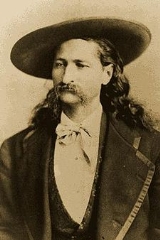
Wild Bill Hickok

Encyclopedia
James Butler Hickok better known as Wild Bill Hickok, was a folk hero
of the American Old West
. His skills as a gunfighter and scout
, along with his reputation as a lawman
, provided the basis for his fame, although some of his exploits are fictionalized.
Hickok came to the West as a stagecoach
driver, then became a lawman in the frontier territories of Kansas
and Nebraska
. He fought for the Union Army
during the American Civil War
, and gained publicity after the war as a scout, marksman
, actor
, and professional gambler. Between his law-enforcement duties and gambling, which easily overlapped, Hickok was involved in several notable shootout
s. He was shot and killed while playing poker
in the Number Ten Saloon in Deadwood, Dakota Territory
(now South Dakota
).
) on May 27, 1837. His birthplace is now the Wild Bill Hickok Memorial
, a listed historic site
under the supervision of the Illinois Historic Preservation Agency
. Hickok was a good shot from a very young age and was recognized locally as an outstanding marksman with a pistol.
In 1855, at age 18, Hickok moved to Kansas Territory following a fight with Charles Hudson, which resulted in both falling into a canal. Mistakenly thinking he had killed Hudson, Hickok fled and joined General Jim Lane's vigilante "Free State Army" (or Jayhawker
s, also known as the "Red Legs"). While a Jayhawker, he met 12-year-old William Cody (later known as "Buffalo Bill
") who, despite his age, was a scout for the U.S. Army during the Utah War
.
Because of his "sweeping nose and protruding upper lip," Hickok was derisively called "Duck Bill" (especially by David McCanles). In 1861, he grew a mustache following the McCanles incident, and began calling himself "Wild Bill". When later recounting his exploits to audiences, he claimed that his nickname until 1861 had been "Shanghai
Bill", a name given to him, he said, by The Red Legs (because of his height and slim build). Although Hickok photographs seem to indicate he had dark hair, all contemporary descriptions confirm he was, in fact, golden blond (as reddish shades of hair appeared black in early photographic processes).
Hickok used the name William Hickok from 1858 and William Haycock during the Civil War. Arrested as Haycock in 1865, he afterward resumed using his real name of James Hickok. Most newspapers continued to use the name William Haycock when referring to "Wild Bill" until 1869. Military records after 1865 used his correct name, although acknowledging he was also known as Haycock.
, Kansas (in what is now Lenexa
). On March 22, 1858, he was elected as one of the first four constables of Monticello Township, Kansas. In 1859, he joined the Russell, Waddell, & Majors freight company, the foundation company of the Pony Express
. The following year, he was badly injured by a bear while he was driving a freight team from Independence, Missouri
to Santa Fe, Texas
. According to Hickok's own account, he found the road blocked by a Cinnamon bear
and its two cubs. Dismounting, he approached the bear and fired a shot into its head, but the bullet ricocheted from its skull, infuriating it. The bear attacked, crushing Hickok with its body. Hickok managed to fire another shot, disabling a paw. The bear then grabbed his arm in its mouth, but Hickok was able to grab his knife and slash its throat, killing it. Badly injured with a crushed chest, shoulder and arm, Hickok was bedridden for four months before being sent to the Rock Creek Station
in Nebraska (built on land which the company had recently purchased from a local, David McCanles) to work as a stable hand while he recovered.
at the Rock Creek Station, an event whose veracity is still the subject of much debate. On December 16, 40-year-old David McCanles; his 12-year-old son, William Monroe McCanles; and farmhands, James Woods and James Gordon; called at the station's office to demand payment of an overdue, second installment on the property. David McCanles was allegedly threatening the station manager, Horace Wellman, when he was shot by either Hickok (who was allegedly hiding behind a curtain) or Wellman. Hickok, Wellman, and an employee, J.W. Brink, were tried for murder, but judged to have acted in self-defense. McCanles was the first man Hickok was reputed to have killed in a fight.
. By the end of the year, he was a wagon-master, but in September 1862 he was discharged for an undisclosed reason. There are no known records of his whereabouts for over a year. (During this "missing year", Hickok was operating as a spy in Confederate
territory.) In late 1863 he was openly employed by the provost marshal
of Southwest Missouri as a member of the Springfield, MO
detective police.
Hickok's duties as a police detective were mostly mundane, and included counting the number of troops in uniform drinking while on duty, checking hotel liquor licenses and tracking down individuals in debt to the cash-strapped Union Army. In 1864, Hickok, along with several other detective police, had not been paid for some time. He either resigned or was reassigned, as he was hired by General John B. Sanborn
that year as a scout (at five dollars a day plus a horse and equipment). In June 1865, Hickok was mustered out and afterward spent his time in and around Springfield gambling.
 On July 21, 1865, in the town square of Springfield, Missouri
, Hickok met and killed Davis Tutt in a "quick draw" duel
–the first of its kind. Fiction later popularized Hickok's "quick draw gunfight" as typical, but Hickok's is the first one on record to fit the portrayal. However, rather than the face to face fast draw as is commonly shown in movies, the two men faced each other sideways in the duelling stance, drawing and aiming their weapons before firing.
Hickok had first met former Confederate Army
soldier Davis Tutt
in early 1865, while both were gambling in Springfield. Hickok often borrowed money from Tutt. and they were originally friends, but they had a falling out over a woman. (It was also rumored that Hickok once had an affair with Tutt's sister, perhaps fathering a child.) There was also a long-standing dispute over Hickok's girlfriend, Susannah Moore. Hickok refused to play cards with Tutt, who retaliated by financing other players in an attempt to bankrupt him.
According to the accepted account, the dispute came to a head when Tutt was coaching an opponent of Hickok's during a card game. Hickok was on a winning streak, and the frustrated Tutt requested he repay a $40 loan, which Hickok immediately did. Tutt then demanded another $35 owed from a previous card game. Hickok refused, as he had a "memorandum
" proving it to be for $25. Tutt then took Hickok's watch, which was lying on the table, as collateral for the $35, at which point Hickok warned him not to wear it or he, Hickok, would shoot him. The next day, Tutt appeared in the square wearing the watch prominently, and Hickok tried to negotiate the watch's return. Tutt stated he would now accept no less than $45, but both agreed they would not fight over it and went for a drink together. Tutt left the saloon, but returned to the square at 6 p.m., while Hickok arrived on the other side and warned him not to approach him while wearing the watch. Both men faced each other and fired almost simultaneously. Tutt's shot missed, but Hickok's did not, piercing Tutt through the heart from about 75 yards away. Tutt called out, "Boys, I'm killed" before he collapsed and died.
Two days later Hickok was arrested for murder (the charge was later reduced to manslaughter). He was released on $2,000 bail and stood trial on August 3, 1865. At the end of the trial, Judge Sempronius H. Boyd
gave the jury two contradictory instructions. He first instructed the jury that a conviction was its only option under the law. He then instructed them that they could apply the unwritten law of the "fair fight" and acquit. The jury voted for acquittal, a verdict that was not popular at the time.
Several weeks later, Hickok was interviewed by Colonel George W. Nichols, and the interview was published in Harper's New Monthly Magazine. Using the name "Wild Bill Hitchcock" [sic], the article recounted the 'hundreds' of men whom Hickok supposedly personally killed, and other exaggerated exploits. The article was controversial wherever Hickok was known, and it led to several frontier newspapers writing rebuttals. (Hickok is known to have killed five men (one by accident); was an accessory in the deaths of three more; and wounded one more.)
Hickok was reported to be "an inveterate hater of Indians
," but it is difficult to separate fact from fiction. Witnesses confirm that while scouting from Fort Harker
Kansas on May 11, 1867, Hickok was attacked by a large group of Indians, who fled after Hickok shot and killed two. In July, Hickok told a newspaper reporter he had led several soldiers in pursuit of Indians who had killed four men near the fort on July 2. He reported returning with five prisoners after killing ten. Witnesses confirm the story was true in part: the party did set out to find those who had killed the four men, but the group returned to the fort "without nary a dead Indian, [never] even seeing a live one."
In September 1865, Hickok came in second in the election for city marshal of Springfield. Leaving Springfield, he was recommended for the position of deputy United States marshal at Fort Riley, Kansas
. This was during the Indian wars in which Hickok sometimes served as a scout for General George A. Custer
's 7th Cavalry.
In 1867, Hickok moved to Niagara Falls
, where he tried acting in a stage play called The Daring Buffalo Chasers of the Plains. He proved to be a terrible actor, and returned to the West, where he ran for sheriff in Ellsworth County
, Kansas, on November 5, 1867. He was defeated by a former soldier, E.W. Kingsbury.
In December 1867, newspapers reported Hickok's arrival in Hays City
, Kansas. On March 28, 1868, he was again in Hays as a deputy U.S. Marshall, picking up 11 Union deserters charged with stealing government property and who were to be transferred to Topeka
for trial. He requested a military escort from Fort Hays, and was assigned William F. Cody
, along with a sergeant and five privates. The group arrived in Topeka on April 2. Hickok was still in Hays in August 1868, when he brought 200 Cheyenne Indians to Hays to be viewed by "excursionists
". On September 1, Hickok was in Lincoln County
, Kansas, where he was hired as a scout by the 10th Cavalry Regiment, a segregated African American unit. On September 4, Hickok was wounded in the foot while rescuing several cattlemen in the Bijou Creek Basin
who were surrounded by Indians. The 10th arrived at Fort Lyon
, Colorado, in October and remained for the rest of 1868.
In July 1869, Hickok was back in Hays and was elected city marshal of Hays and sheriff of Ellis County
, Kansas, in a special election held on August 23, 1869. The county was having particular difficulty holding sheriffs—three had quit over the previous 18 months. Hickok likely was already acting sheriff when elected, as a newspaper reported him arresting offenders on August 18 and the commander of Fort Hays praised Hickok for his work in apprehending deserters in a letter he wrote to the assistant adjutant general
on August 21. Regularly scheduled county elections were held on November 2, 1869, and Hickok (Independent) lost to his deputy, Peter Lanihan (Democrat). However, Hickok and Lanihan remained sheriff and deputy, respectively. Hickok accused a J.V. Macintosh of irregularities and misconduct during the election. On 9 December, Hickok and Lanihan both served legal papers on Macintosh, and local newspapers acknowledged Hickok had guardianship of Hays City.
In his first month as sheriff in Hays, he killed two men in gunfights. The first was Bill Mulvey, who "got the drop" on Hickok. Hickok looked past him and yelled, "Don't shoot him in the back; he is drunk," which was enough of a distraction to allow him to win the gunfight. The second was a cowboy, Samuel Strawhun, who encountered Hickok and Deputy Sheriff Lanihan at 1 am on September 27 when they had been called to a saloon where Strawhun was causing a disturbance. After Strawhun "made remarks against Hickok," Strawhun died instantly from a bullet through the head as Hickok "tried to restore order." At Strawhun's inquest, despite 'very contradictory' evidence from witnesses, the jury found the shooting justifiable.
On July 17, 1870, in Hays, he was involved in a gunfight with disorderly soldiers of the 7th U.S. Cavalry. Two troopers, Jeremiah Lonergan and John Kyle (sometimes Kile), set upon Hickok in a saloon. Lonergan pinned Hickok to the ground while Kyle put his gun to Hickok's ear. Kyle's gun misfired, which allowed Hickok to reach his own guns. Lonergan was wounded in the knee, while Kyle, shot twice, died the next day.
In the next election, Hickok failed to win re-election. On April 15, 1871, Hickok became marshal of Abilene
, Kansas, taking over from former marshal Tom "Bear River" Smith
, who had been killed on November 2, 1870. The outlaw John Wesley Hardin
was in Abilene in 1871, and was befriended by Hickok. In his 1895 autobiography (published after his own death and 19 years after Hickok's), Hardin claimed to have disarmed Hickok using the famous road agent's spin
during a failed attempt to arrest him for wearing his pistols in a saloon. He further claimed Hickok, as a result, had two guns cocked and pointed at him. This story is considered to be apocryphal or at the very least an exaggeration, as Hardin claimed this at a time when Hickok could not defend himself. Hardin was an extremely accomplished and well known gunfighter (and is known to have killed over 27 men in his lifetime). Hardin idolized Hickok and identified with Wild Bill. It is recorded that when Hardin's cousin, Mannen Clements, was jailed for the killing of two cowboys, Hickok –at Hardin's request– arranged for his escape.
While working in Abilene, Hickok and Phil Coe
, a saloon owner, had an ongoing dispute that later resulted in a shootout. Coe had been the business partner of known gunman Ben Thompson
, with whom he co-owned the Bulls Head Saloon. On October 5, 1871, Hickok was standing off a crowd during a street brawl, during which time Coe fired two shots. Hickok ordered him to be arrested for firing a pistol within the city limits. Coe explained he was shooting at a stray dog, but suddenly turned his gun on Hickok, who fired first and killed Coe. Hickok caught the glimpse of movement of someone running toward him and quickly fired two shots in reaction, accidentally shooting and killing Abilene Special Deputy Marshal Mike Williams, who was coming to his aid, an event that haunted Hickok for the remainder of his life. There is another account of the Coe shootout. Theophilus Little, mayor of Abilene and owner of the town's lumberyard, recorded his time in Abilene by writing in a notebook that was recently given to the Abilene Historical Society. Writing in 1911, he detailed his admiration of Hickok and included a paragraph on the shooting that differs considerably from the accepted account.
Coe supposedly stated he could "kill a crow on the wing", and Hickok's retort is one of the West's most famous sayings (though possibly apocryphal): "Did the crow have a pistol? Was he shooting back? I will be." Hickok was relieved of his duties as marshal less than two months after having accidentally killed deputy Mike Williams, allegedly owing to this incident being only one of a series of questionable shootings and claims of misconduct.
Hickok's favorite guns were a pair of cap-and-ball Colt 1851 .36 Navy Model
pistols, which he wore until his death. These had ivory handles, silver plating and were ornately engraved with "J.B. Hickock-1869" engraved on the backstrap. He wore his revolvers backwards in a belt or sash (when donning city clothes or buckskins, respectively), and seldom used holsters per se; he drew the pistols using a "reverse", "twist" or cavalry draw
, as would a cavalryman.
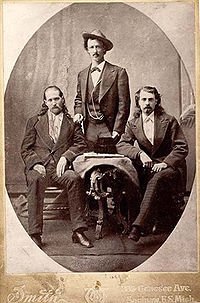 In 1873, Buffalo Bill
Cody and Texas Jack Omohundro
invited Hickok to join them in a new play called Scouts of the Plains after their earlier success. Hickok and Texas Jack eventually left the show, before Cody formed his Buffalo Bill's Wild West Show in 1882.
In 1876, Hickok was diagnosed by a doctor in Kansas City, Missouri, with glaucoma
and 'ophthalmia', a condition that was widely rumored at the time by Hickok's detractors to be the result of various sexually transmitted disease
s. In truth, he seems to have been afflicted with trachoma
, a common vision disorder of the time. His marksmanship and health apparently had been suffering for some time, as he had been arrested several times for vagrancy, despite earning a good income from gambling and displays of showmanship only a few years earlier. On March 5, 1876, Hickok married Agnes Thatcher Lake, a 50-year-old circus proprietor in Cheyenne
, Wyoming Territory. Hickok left his new bride a few months later, joining Charlie Utter
's wagon train to seek his fortune in the gold fields of South Dakota
. Martha Jane Cannary, known popularly as Calamity Jane
, claimed in her autobiography that she was married to Hickok and had divorced him so he could be free to marry Agnes Lake, but no records have been found that support Jane's account. The two were believed to have met for the first time after Jane was released from the guardhouse in Fort Laramie
and joined the wagon train in which Hickok was traveling. The wagon train arrived in Deadwood in July, 1876. Jane herself confirmed this account in an 1896 newspaper interview, although she claimed she had been hospitalized with illness rather than in the guardhouse.
Shortly before Hickok's death, he wrote a letter to his new wife, which read in part: "Agnes Darling, if such should be we never meet again, while firing my last shot, I will gently breathe the name of my wife — Agnes — and with wishes even for my enemies I will make the plunge and try to swim to the other shore."
On August 2, 1876, Hickok was playing poker at Nuttal & Mann's
Saloon No. 10 in Deadwood
, in the Black Hills
, Dakota Territory
. Hickok, as a precaution, usually sat with his back to the wall. The only seat available when he joined the poker game was a chair that put his back to a door. Twice he asked another player, Charles Rich, to change seats with him, and on both occasions Rich refused.
A former buffalo hunter named John McCall (better known as "Jack" or “Broken Nose Jack” McCall) walked in unnoticed. Jack McCall
walked to within a few feet of Wild Bill and then suddenly drew a pistol and shouted, “Take that!” before firing.
The assassin's bullet hit Hickok in the back of the head, killing him instantly. The bullet emerged through Wild Bill’s right cheek, striking Captain Massie in the left wrist. Legend has it that Hickok had lost his stake and had just borrowed $50 from the house to continue playing.
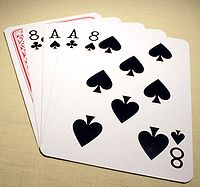 When shot, Hickock was holding a pair of aces and a pair of eights, all black. The fifth card's identity is debated, or had been discarded and its replacement had not yet been dealt. In 1979, Hickok was inducted into the Poker Hall of Fame
.
editorializing: "Should it ever be our misfortune to kill a man ... we would simply ask that our trial may take place in some of the mining camps of these hills." Calamity Jane
was reputed to have led a mob that threatened McCall with lynching, but at the time of Wild Bill’s death, Jane was being held by military authorities.
McCall was subsequently rearrested after bragging about his deed, and a new trial was held. The authorities did not consider this to be double jeopardy
because at the time Deadwood was not recognized by the U.S. as a legitimately incorporated town, as it was in Indian country
and the jury was irregular. The new trial was held in Yankton
, capital of the territory. Hickok's brother, Lorenzo Butler Hickok, traveled from Illinois to attend the retrial and spoke to McCall after the trial, noting he showed no remorse. This time, McCall was found guilty and sentenced to death. Reporter Leander Richardson interviewed McCall shortly before his death and helped bury him. Richardson wrote of the encounter for the April 1877 issue of Scribner's Monthly
, in which he mentions McCall's second trial.
McCall was hanged on March 1, 1877 and buried in the Roman Catholic cemetery. The cemetery was moved in 1881, and his body was exhumed and found to have the noose still around his neck. The killing of Wild Bill and the capture of Jack McCall is reenacted every evening (in summer) in Deadwood.
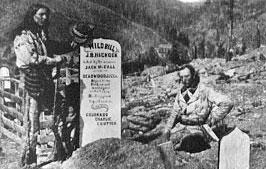 Charlie Utter
, Hickok's friend and companion, claimed Hickok's body and placed a notice in the local newspaper, the Black Hills Pioneer, which read:
Almost the entire town attended the funeral, and Utter had Hickok buried with a wooden grave marker reading:
Hickok was originally buried in the Ingelside Cemetery, Deadwood's original graveyard. This graveyard filled quickly, preventing further use, and in 1879, on the third anniversary of his original burial, Utter paid to move Hickok to the new Mount Moriah cemetery. As the old cemetery was an area that was better suited for the constant influx of new settlers to live on, the remaining bodies there were moved up the hill to the Mount Moriah Cemetery in the 1880s.
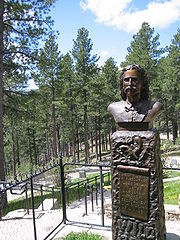 Utter supervised the move and noted that while perfectly preserved, Hickok had been imperfectly embalmed. As a result, calcium carbonate
from the surrounding soil had replaced the flesh leading to petrifaction
. One of the workers, Joseph McLintock, wrote a detailed description of the reinterment. McLintock used a cane to tap the body, face and head, finding no soft tissue anywhere. He noted the sound was similar to tapping a brick wall, and believed the remains to now weigh more than 400 lb (181.4 kg). William Austin, the cemetery caretaker, estimated 500 lb (226.8 kg), which made it difficult for the men to carry them to the new site. The original grave marker was moved to the new site, but by 1891 had been destroyed by souvenir hunters whittling pieces from it, and it was replaced with a statue. This, in turn, was destroyed by relic hunters and replaced in 1902 by a life-size sandstone sculpture of Hickok. This, too, was badly defaced, which led to its complete enclosure in a cage for protection. This was cut open by relic hunters in the 1950s and the statue removed.
Hickok is currently interred in a ten foot (3 m) square plot at the Mount Moriah Cemetery, surrounded by a cast-iron fence with a U.S. flag flying nearby. A monument has since been built there. It has been reported that Calamity Jane
was buried next to him because that was her dying wish. However, four of the men on the self-appointed committee who planned Calamity's funeral (Albert Malter, Frank Ankeney, Jim Carson, and Anson Higby) later stated since Bill had “absolutely no use” for Jane in this life, they decided to play a posthumous joke on Hickok by laying her to rest for eternity
by his side. Potato Creek Johnny, a local Deadwood celebrity from the late 19th century and early 20th century, is buried next to Wild Bill.
" hero of the western era, in many ways one of the first comic book
heroes, keeping company with another who achieved part of his fame in such a way, frontiersman Davy Crockett
. In the dime store novels, exploits of Hickok were presented in heroic form, making him seem larger than life. In truth, most of the stories were greatly exaggerated or fabricated by both the writers and himself.
Folk hero
A folk hero is a type of hero, real, fictional, or mythological. The single salient characteristic which makes a character a folk hero is the imprinting of the name, personality and deeds of the character in the popular consciousness. This presence in the popular consciousness is evidenced by...
of the American Old West
American Old West
The American Old West, or the Wild West, comprises the history, geography, people, lore, and cultural expression of life in the Western United States, most often referring to the latter half of the 19th century, between the American Civil War and the end of the century...
. His skills as a gunfighter and scout
Reconnaissance
Reconnaissance is the military term for exploring beyond the area occupied by friendly forces to gain information about enemy forces or features of the environment....
, along with his reputation as a lawman
Lawman
Lawman is a term usually used in reference to an American law-enforcement officer, primarily sheriff or marshal.Lawman may also refer to:-Television and film titles:*Lawman , American western produced in 1958–62 by Warner Bros...
, provided the basis for his fame, although some of his exploits are fictionalized.
Hickok came to the West as a stagecoach
Stagecoach
A stagecoach is a type of covered wagon for passengers and goods, strongly sprung and drawn by four horses, usually four-in-hand. Widely used before the introduction of railway transport, it made regular trips between stages or stations, which were places of rest provided for stagecoach travelers...
driver, then became a lawman in the frontier territories of Kansas
Kansas Territory
The Territory of Kansas was an organized incorporated territory of the United States that existed from May 30, 1854, until January 29, 1861, when the eastern portion of the territory was admitted to the Union as the State of Kansas....
and Nebraska
Nebraska Territory
The Territory of Nebraska was an organized incorporated territory of the United States that existed from May 30, 1854, until March 1, 1867, when the final extent of the territory was admitted to the Union as the State of Nebraska. The Nebraska Territory was created by the Kansas–Nebraska Act of 1854...
. He fought for the Union Army
Union Army
The Union Army was the land force that fought for the Union during the American Civil War. It was also known as the Federal Army, the U.S. Army, the Northern Army and the National Army...
during the American Civil War
American Civil War
The American Civil War was a civil war fought in the United States of America. In response to the election of Abraham Lincoln as President of the United States, 11 southern slave states declared their secession from the United States and formed the Confederate States of America ; the other 25...
, and gained publicity after the war as a scout, marksman
Marksman
A marksman is a person who is skilled in precision, or a sharpshooter shooting, using projectile weapons, such as with a rifle but most commonly with a sniper rifle, to shoot at long range targets...
, actor
Actor
An actor is a person who acts in a dramatic production and who works in film, television, theatre, or radio in that capacity...
, and professional gambler. Between his law-enforcement duties and gambling, which easily overlapped, Hickok was involved in several notable shootout
Shootout
A shootout is a gun battle between armed groups. A shootout often, but not necessarily, pits law enforcement against criminal elements; it could also involve two groups outside of law enforcement, such as rival gangs. A shootout in a military context A shootout is a gun battle between armed groups....
s. He was shot and killed while playing poker
Poker
Poker is a family of card games that share betting rules and usually hand rankings. Poker games differ in how the cards are dealt, how hands may be formed, whether the high or low hand wins the pot in a showdown , limits on bet sizes, and how many rounds of betting are allowed.In most modern poker...
in the Number Ten Saloon in Deadwood, Dakota Territory
Dakota Territory
The Territory of Dakota was an organized incorporated territory of the United States that existed from March 2, 1861, until November 2, 1889, when the final extent of the reduced territory was split and admitted to the Union as the states of North and South Dakota.The Dakota Territory consisted of...
(now South Dakota
South Dakota
South Dakota is a state located in the Midwestern region of the United States. It is named after the Lakota and Dakota Sioux American Indian tribes. Once a part of Dakota Territory, South Dakota became a state on November 2, 1889. The state has an area of and an estimated population of just over...
).
Early life
Hickok was born in Homer, Illinois (now Troy Grove, IllinoisTroy Grove, Illinois
Troy Grove is a village in LaSalle County, Illinois, United States. The population was 305 at the 2000 census. It is part of the Ottawa–Streator Micropolitan Statistical Area.Troy Grove is notable as the birthplace of Wild Bill Hickok...
) on May 27, 1837. His birthplace is now the Wild Bill Hickok Memorial
Wild Bill Hickok Memorial
Wild Bill Hickok Memorial is a state historic site operated by the Illinois Historic Preservation Agency. It is located in a small park at the intersection of Main and Ottawa Streets in Troy Grove, Illinois...
, a listed historic site
Historic site
A historic site is an official location where pieces of political, military or social history have been preserved. Historic sites are usually protected by law, and many have recognized with the official national historic site status...
under the supervision of the Illinois Historic Preservation Agency
Illinois Historic Preservation Agency
The Illinois Historic Preservation Agency is a governmental agency of the U.S. state of Illinois. It is tasked with the duty of maintaining most State-owned historic sites within Illinois, and maximizing their educational and recreational value to visitors....
. Hickok was a good shot from a very young age and was recognized locally as an outstanding marksman with a pistol.
In 1855, at age 18, Hickok moved to Kansas Territory following a fight with Charles Hudson, which resulted in both falling into a canal. Mistakenly thinking he had killed Hudson, Hickok fled and joined General Jim Lane's vigilante "Free State Army" (or Jayhawker
Jayhawker
Jayhawkers is a term that came to prominence just before the American Civil War in Bleeding Kansas, where it was adopted by militant bands affiliated with the free-state cause. These bands, known as "Jayhawkers", were guerrilla fighters who often clashed with pro-slavery groups from Missouri known...
s, also known as the "Red Legs"). While a Jayhawker, he met 12-year-old William Cody (later known as "Buffalo Bill
Buffalo Bill
William Frederick "Buffalo Bill" Cody was a United States soldier, bison hunter and showman. He was born in the Iowa Territory , in LeClaire but lived several years in Canada before his family moved to the Kansas Territory. Buffalo Bill received the Medal of Honor in 1872 for service to the US...
") who, despite his age, was a scout for the U.S. Army during the Utah War
Utah War
The Utah War, also known as the Utah Expedition, Buchanan's Blunder, the Mormon War, or the Mormon Rebellion was an armed confrontation between LDS settlers in the Utah Territory and the armed forces of the United States government. The confrontation lasted from May 1857 until July 1858...
.
Because of his "sweeping nose and protruding upper lip," Hickok was derisively called "Duck Bill" (especially by David McCanles). In 1861, he grew a mustache following the McCanles incident, and began calling himself "Wild Bill". When later recounting his exploits to audiences, he claimed that his nickname until 1861 had been "Shanghai
Slingshot
A slingshot, shanghai, flip, bean shooter or catapult is a small hand-powered projectile weapon. The classic form consists of a Y-shaped frame held in the off hand, with two rubber strips attached to the uprights. The other ends of the strips lead back to a pocket which holds the projectile...
Bill", a name given to him, he said, by The Red Legs (because of his height and slim build). Although Hickok photographs seem to indicate he had dark hair, all contemporary descriptions confirm he was, in fact, golden blond (as reddish shades of hair appeared black in early photographic processes).
Hickok used the name William Hickok from 1858 and William Haycock during the Civil War. Arrested as Haycock in 1865, he afterward resumed using his real name of James Hickok. Most newspapers continued to use the name William Haycock when referring to "Wild Bill" until 1869. Military records after 1865 used his correct name, although acknowledging he was also known as Haycock.
Early career
In 1857, Hickok claimed a 160 acre (0.6474976 km²) homestead tract in Johnson CountyJohnson County, Kansas
Johnson County is a county located in northeast Kansas, in the central United States. The county is largely suburban, being part of the Kansas City metropolitan area, and containing many of its affluent southwestern suburbs. As of the 2010 census, the county population was 544,179. Its county...
, Kansas (in what is now Lenexa
Lenexa, Kansas
Lenexa is a city in the central part of Johnson County, located in northeast Kansas, in the central United States of America. As of the 2010 census, the city population was 48,190. As a satellite city of Kansas City, Kansas, Lenexa is included in the Kansas City Metropolitan Area...
). On March 22, 1858, he was elected as one of the first four constables of Monticello Township, Kansas. In 1859, he joined the Russell, Waddell, & Majors freight company, the foundation company of the Pony Express
Pony Express
The Pony Express was a fast mail service crossing the Great Plains, the Rocky Mountains, and the High Sierra from St. Joseph, Missouri, to Sacramento, California, from April 3, 1860 to October 1861...
. The following year, he was badly injured by a bear while he was driving a freight team from Independence, Missouri
Independence, Missouri
Independence is the fourth largest city in the U.S. state of Missouri, and is contained within the counties of Jackson and Clay. It is part of the Kansas City Metropolitan Area...
to Santa Fe, Texas
Santa Fe, Texas
Santa Fe is a city in Galveston County, Texas, United States. The town is named for the Santa Fe Railroad which runs through the town alongside State Highway 6.-History:...
. According to Hickok's own account, he found the road blocked by a Cinnamon bear
Cinnamon bear
The Cinnamon Bear is a subspecies of the American black bear, native to Colorado, New Mexico, Idaho, Montana, Washington, Wyoming, and western Canada...
and its two cubs. Dismounting, he approached the bear and fired a shot into its head, but the bullet ricocheted from its skull, infuriating it. The bear attacked, crushing Hickok with its body. Hickok managed to fire another shot, disabling a paw. The bear then grabbed his arm in its mouth, but Hickok was able to grab his knife and slash its throat, killing it. Badly injured with a crushed chest, shoulder and arm, Hickok was bedridden for four months before being sent to the Rock Creek Station
Rock Creek Station
Rock Creek Station was a stagecoach and Pony Express station in southeastern Nebraska, near the present-day village of Endicott.-History:Rock Creek Station was established in 1857 along the Oregon Trail and California Trail, along the west bank of Rock Creek. The station was a supply center and...
in Nebraska (built on land which the company had recently purchased from a local, David McCanles) to work as a stable hand while he recovered.
McCanles incident
In 1861 he was involved in a deadly shootout with David McCanlesMcCanles Gang
The supposed McCanles Gang or McCandless Gang was known as an outlaw gang in the early 1860s that was wanted for alleged train robbery, murder, bank robbery, cattle rustling, and horse theft. However, there are questions surrounding the veracity of not only the allegations, but the existence of any...
at the Rock Creek Station, an event whose veracity is still the subject of much debate. On December 16, 40-year-old David McCanles; his 12-year-old son, William Monroe McCanles; and farmhands, James Woods and James Gordon; called at the station's office to demand payment of an overdue, second installment on the property. David McCanles was allegedly threatening the station manager, Horace Wellman, when he was shot by either Hickok (who was allegedly hiding behind a curtain) or Wellman. Hickok, Wellman, and an employee, J.W. Brink, were tried for murder, but judged to have acted in self-defense. McCanles was the first man Hickok was reputed to have killed in a fight.
Civil War and scouting
When the Civil War broke out in April 1861, Hickok signed on as a teamster (an outfitter or packer) for the Union Army in Sedalia, MissouriSedalia, Missouri
Sedalia is a city located about south of the Missouri River in Pettis County, Missouri. U.S. Highway 50 and U.S. Highway 65 intersect in the city. As of 2006, the city had a total population of 20,669. It is the county seat of Pettis County. The Sedalia Micropolitan Statistical Area consists of...
. By the end of the year, he was a wagon-master, but in September 1862 he was discharged for an undisclosed reason. There are no known records of his whereabouts for over a year. (During this "missing year", Hickok was operating as a spy in Confederate
Confederate States of America
The Confederate States of America was a government set up from 1861 to 1865 by 11 Southern slave states of the United States of America that had declared their secession from the U.S...
territory.) In late 1863 he was openly employed by the provost marshal
Provost Marshal
The Provost Marshal is the officer in the armed forces who is in charge of the military police .There may be a Provost Marshal serving at many levels of the hierarchy and he may also be the public safety officer of a military installation, responsible for the provision of fire, gate security, and...
of Southwest Missouri as a member of the Springfield, MO
Springfield, Missouri
Springfield is the third largest city in the U.S. state of Missouri and the county seat of Greene County. According to the 2010 census data, the population was 159,498, an increase of 5.2% since the 2000 census. The Springfield Metropolitan Area, population 436,712, includes the counties of...
detective police.
Hickok's duties as a police detective were mostly mundane, and included counting the number of troops in uniform drinking while on duty, checking hotel liquor licenses and tracking down individuals in debt to the cash-strapped Union Army. In 1864, Hickok, along with several other detective police, had not been paid for some time. He either resigned or was reassigned, as he was hired by General John B. Sanborn
John B. Sanborn
John Benjamin Sanborn was a lawyer, politician, and soldier from the state of New Hampshire who served as a general in the Union Army during the American Civil War...
that year as a scout (at five dollars a day plus a horse and equipment). In June 1865, Hickok was mustered out and afterward spent his time in and around Springfield gambling.
Lawman and gunfighter notoriety
Springfield, Missouri
Springfield is the third largest city in the U.S. state of Missouri and the county seat of Greene County. According to the 2010 census data, the population was 159,498, an increase of 5.2% since the 2000 census. The Springfield Metropolitan Area, population 436,712, includes the counties of...
, Hickok met and killed Davis Tutt in a "quick draw" duel
Duel
A duel is an arranged engagement in combat between two individuals, with matched weapons in accordance with agreed-upon rules.Duels in this form were chiefly practised in Early Modern Europe, with precedents in the medieval code of chivalry, and continued into the modern period especially among...
–the first of its kind. Fiction later popularized Hickok's "quick draw gunfight" as typical, but Hickok's is the first one on record to fit the portrayal. However, rather than the face to face fast draw as is commonly shown in movies, the two men faced each other sideways in the duelling stance, drawing and aiming their weapons before firing.
Hickok had first met former Confederate Army
Confederate States Army
The Confederate States Army was the army of the Confederate States of America while the Confederacy existed during the American Civil War. On February 8, 1861, delegates from the seven Deep South states which had already declared their secession from the United States of America adopted the...
soldier Davis Tutt
Davis Tutt
Davis Tutt was an Old West gambler and former soldier, best remembered as being killed during the Wild Bill Hickok-Davis Tutt shootout of 1865, which launched the previously unknown Wild Bill Hickok to fame as a gunfighter....
in early 1865, while both were gambling in Springfield. Hickok often borrowed money from Tutt. and they were originally friends, but they had a falling out over a woman. (It was also rumored that Hickok once had an affair with Tutt's sister, perhaps fathering a child.) There was also a long-standing dispute over Hickok's girlfriend, Susannah Moore. Hickok refused to play cards with Tutt, who retaliated by financing other players in an attempt to bankrupt him.
According to the accepted account, the dispute came to a head when Tutt was coaching an opponent of Hickok's during a card game. Hickok was on a winning streak, and the frustrated Tutt requested he repay a $40 loan, which Hickok immediately did. Tutt then demanded another $35 owed from a previous card game. Hickok refused, as he had a "memorandum
IOU (debt)
An IOU is usually an informal document acknowledging debt. An IOU differs from a promissory note in that an IOU is not a negotiable instrument and does not specify repayment terms such as the time of repayment. IOUs usually specify the debtor, the amount owed, and sometimes the creditor...
" proving it to be for $25. Tutt then took Hickok's watch, which was lying on the table, as collateral for the $35, at which point Hickok warned him not to wear it or he, Hickok, would shoot him. The next day, Tutt appeared in the square wearing the watch prominently, and Hickok tried to negotiate the watch's return. Tutt stated he would now accept no less than $45, but both agreed they would not fight over it and went for a drink together. Tutt left the saloon, but returned to the square at 6 p.m., while Hickok arrived on the other side and warned him not to approach him while wearing the watch. Both men faced each other and fired almost simultaneously. Tutt's shot missed, but Hickok's did not, piercing Tutt through the heart from about 75 yards away. Tutt called out, "Boys, I'm killed" before he collapsed and died.
Two days later Hickok was arrested for murder (the charge was later reduced to manslaughter). He was released on $2,000 bail and stood trial on August 3, 1865. At the end of the trial, Judge Sempronius H. Boyd
Sempronius H. Boyd
Sempronius Hamilton Boyd was a nineteenth century politician, lawyer, judge and teacher from Missouri.-Biography:...
gave the jury two contradictory instructions. He first instructed the jury that a conviction was its only option under the law. He then instructed them that they could apply the unwritten law of the "fair fight" and acquit. The jury voted for acquittal, a verdict that was not popular at the time.
Several weeks later, Hickok was interviewed by Colonel George W. Nichols, and the interview was published in Harper's New Monthly Magazine. Using the name "Wild Bill Hitchcock" [sic], the article recounted the 'hundreds' of men whom Hickok supposedly personally killed, and other exaggerated exploits. The article was controversial wherever Hickok was known, and it led to several frontier newspapers writing rebuttals. (Hickok is known to have killed five men (one by accident); was an accessory in the deaths of three more; and wounded one more.)
Hickok was reported to be "an inveterate hater of Indians
Native Americans in the United States
Native Americans in the United States are the indigenous peoples in North America within the boundaries of the present-day continental United States, parts of Alaska, and the island state of Hawaii. They are composed of numerous, distinct tribes, states, and ethnic groups, many of which survive as...
," but it is difficult to separate fact from fiction. Witnesses confirm that while scouting from Fort Harker
Fort Harker (Kansas)
Fort Harker, located in Kanopolis, Kansas, was an active military installation of the United States Army from November 17, 1866 to October 5, 1872. The fortification was named after General Charles Garrison Harker, who was killed in action at the Battle of Kennesaw Mountain in the American Civil War...
Kansas on May 11, 1867, Hickok was attacked by a large group of Indians, who fled after Hickok shot and killed two. In July, Hickok told a newspaper reporter he had led several soldiers in pursuit of Indians who had killed four men near the fort on July 2. He reported returning with five prisoners after killing ten. Witnesses confirm the story was true in part: the party did set out to find those who had killed the four men, but the group returned to the fort "without nary a dead Indian, [never] even seeing a live one."
In September 1865, Hickok came in second in the election for city marshal of Springfield. Leaving Springfield, he was recommended for the position of deputy United States marshal at Fort Riley, Kansas
Fort Riley North, Kansas
Fort Riley North is a census-designated place that covers part of Fort Riley, a US Army installation in Geary and Riley counties in the U.S. state of Kansas. The area is more commonly known as "Custer Hill"...
. This was during the Indian wars in which Hickok sometimes served as a scout for General George A. Custer
George Armstrong Custer
George Armstrong Custer was a United States Army officer and cavalry commander in the American Civil War and the Indian Wars. Raised in Michigan and Ohio, Custer was admitted to West Point in 1858, where he graduated last in his class...
's 7th Cavalry.
In 1867, Hickok moved to Niagara Falls
Niagara Falls
The Niagara Falls, located on the Niagara River draining Lake Erie into Lake Ontario, is the collective name for the Horseshoe Falls and the adjacent American Falls along with the comparatively small Bridal Veil Falls, which combined form the highest flow rate of any waterfalls in the world and has...
, where he tried acting in a stage play called The Daring Buffalo Chasers of the Plains. He proved to be a terrible actor, and returned to the West, where he ran for sheriff in Ellsworth County
Ellsworth County, Kansas
Ellsworth County is a county located in Central Kansas, in the Central United States. As of the 2010 census, the county population was 6,497. Its county seat and most populous city is Ellsworth.-19th century:...
, Kansas, on November 5, 1867. He was defeated by a former soldier, E.W. Kingsbury.
In December 1867, newspapers reported Hickok's arrival in Hays City
Hays, Kansas
Hays is a city in and the county seat of Ellis County, Kansas, United States. The largest city in northwestern Kansas, it is the economic and cultural center of the region. It is also a college town, home to Fort Hays State University...
, Kansas. On March 28, 1868, he was again in Hays as a deputy U.S. Marshall, picking up 11 Union deserters charged with stealing government property and who were to be transferred to Topeka
Topeka, Kansas
Topeka |Kansa]]: Tó Pee Kuh) is the capital city of the U.S. state of Kansas and the county seat of Shawnee County. It is situated along the Kansas River in the central part of Shawnee County, located in northeast Kansas, in the Central United States. As of the 2010 census, the city population was...
for trial. He requested a military escort from Fort Hays, and was assigned William F. Cody
Buffalo Bill
William Frederick "Buffalo Bill" Cody was a United States soldier, bison hunter and showman. He was born in the Iowa Territory , in LeClaire but lived several years in Canada before his family moved to the Kansas Territory. Buffalo Bill received the Medal of Honor in 1872 for service to the US...
, along with a sergeant and five privates. The group arrived in Topeka on April 2. Hickok was still in Hays in August 1868, when he brought 200 Cheyenne Indians to Hays to be viewed by "excursionists
Tourist attraction
A tourist attraction is a place of interest where tourists visit, typically for its inherent or exhibited cultural value, historical significance, natural or built beauty, or amusement opportunities....
". On September 1, Hickok was in Lincoln County
Lincoln County, Kansas
Lincoln County is a county located in the U.S. state of Kansas. As of the 2010 census, the county population was 3,241...
, Kansas, where he was hired as a scout by the 10th Cavalry Regiment, a segregated African American unit. On September 4, Hickok was wounded in the foot while rescuing several cattlemen in the Bijou Creek Basin
Colorado drainage basins
The U.S State of Colorado includes the headwaters of several important rivers. The state is divided generally East to West by the Continental Divide. East of the Continental Divide, surface waters flow via the North Platte River, the South Platte River, the Republican River, the Arkansas River,...
who were surrounded by Indians. The 10th arrived at Fort Lyon
Fort Lyon
Fort Lyon, first named Fort Wise, was operated on the Colorado eastern plains until 1867. That year a new fort called Fort Lyon, and later Las Animas, Colorado, U.S. Naval Hospital and 5BN117, was built near the present-day town of Las Animas, Colorado. First named after Virginia governor Henry...
, Colorado, in October and remained for the rest of 1868.
In July 1869, Hickok was back in Hays and was elected city marshal of Hays and sheriff of Ellis County
Ellis County, Kansas
Ellis County is a county located in Northwest Kansas, in the Central United States. As of the 2010 census, the county population was 28,452. Its county seat and most populous city is Hays...
, Kansas, in a special election held on August 23, 1869. The county was having particular difficulty holding sheriffs—three had quit over the previous 18 months. Hickok likely was already acting sheriff when elected, as a newspaper reported him arresting offenders on August 18 and the commander of Fort Hays praised Hickok for his work in apprehending deserters in a letter he wrote to the assistant adjutant general
Adjutant general
An Adjutant General is a military chief administrative officer.-Imperial Russia:In Imperial Russia, the General-Adjutant was a Court officer, who was usually an army general. He served as a personal aide to the Tsar and hence was a member of the H. I. M. Retinue...
on August 21. Regularly scheduled county elections were held on November 2, 1869, and Hickok (Independent) lost to his deputy, Peter Lanihan (Democrat). However, Hickok and Lanihan remained sheriff and deputy, respectively. Hickok accused a J.V. Macintosh of irregularities and misconduct during the election. On 9 December, Hickok and Lanihan both served legal papers on Macintosh, and local newspapers acknowledged Hickok had guardianship of Hays City.
In his first month as sheriff in Hays, he killed two men in gunfights. The first was Bill Mulvey, who "got the drop" on Hickok. Hickok looked past him and yelled, "Don't shoot him in the back; he is drunk," which was enough of a distraction to allow him to win the gunfight. The second was a cowboy, Samuel Strawhun, who encountered Hickok and Deputy Sheriff Lanihan at 1 am on September 27 when they had been called to a saloon where Strawhun was causing a disturbance. After Strawhun "made remarks against Hickok," Strawhun died instantly from a bullet through the head as Hickok "tried to restore order." At Strawhun's inquest, despite 'very contradictory' evidence from witnesses, the jury found the shooting justifiable.
On July 17, 1870, in Hays, he was involved in a gunfight with disorderly soldiers of the 7th U.S. Cavalry. Two troopers, Jeremiah Lonergan and John Kyle (sometimes Kile), set upon Hickok in a saloon. Lonergan pinned Hickok to the ground while Kyle put his gun to Hickok's ear. Kyle's gun misfired, which allowed Hickok to reach his own guns. Lonergan was wounded in the knee, while Kyle, shot twice, died the next day.
In the next election, Hickok failed to win re-election. On April 15, 1871, Hickok became marshal of Abilene
Abilene, Kansas
Abilene is a city in and the county seat of Dickinson County, Kansas, United States. As of the 2010 census, the city population was 6,844.-History:...
, Kansas, taking over from former marshal Tom "Bear River" Smith
Thomas J. Smith
Thomas James Smith, known as Tom "Bear River" Smith , was a town marshal of Old West cattle town Abilene, Kansas, who was killed and decapitated in the line of duty.-Early life:...
, who had been killed on November 2, 1870. The outlaw John Wesley Hardin
John Wesley Hardin
John Wesley Hardin was an American outlaw, gunfighter, and controversial folk hero of the Old West. He was born in Bonham, Texas. Hardin found himself in trouble with the law at an early age, and spent the majority of his life being pursued by both local lawmen and federal troops of the...
was in Abilene in 1871, and was befriended by Hickok. In his 1895 autobiography (published after his own death and 19 years after Hickok's), Hardin claimed to have disarmed Hickok using the famous road agent's spin
Road agent's spin
The road agent's spin, also known as the "Curly Bill spin" , or the "Border roll" was a gunfighting maneuver first identified in the days of the Old West. It was utilized as a ruse when forced to surrender a side arm to an unfriendly party.Normal Old West procedure for surrender of a loaded pistol...
during a failed attempt to arrest him for wearing his pistols in a saloon. He further claimed Hickok, as a result, had two guns cocked and pointed at him. This story is considered to be apocryphal or at the very least an exaggeration, as Hardin claimed this at a time when Hickok could not defend himself. Hardin was an extremely accomplished and well known gunfighter (and is known to have killed over 27 men in his lifetime). Hardin idolized Hickok and identified with Wild Bill. It is recorded that when Hardin's cousin, Mannen Clements, was jailed for the killing of two cowboys, Hickok –at Hardin's request– arranged for his escape.
While working in Abilene, Hickok and Phil Coe
Phil Coe
Phil Coe , born Phillip Houston Coe, was a soldier, and Old West gambler and businessman from Texas. He became the business partner of gunfighter Ben Thompson in Abilene, Kansas...
, a saloon owner, had an ongoing dispute that later resulted in a shootout. Coe had been the business partner of known gunman Ben Thompson
Ben Thompson
Ben Thompson was a gunman, gambler, and sometime lawman of the Old West. He was a contemporary of Wyatt Earp, Buffalo Bill Cody, Doc Holliday, John Wesley Hardin and James Butler "Wild Bill" Hickock, some of whom considered him a trusted friend, others an enemy.Ben Thompson had a colorful career,...
, with whom he co-owned the Bulls Head Saloon. On October 5, 1871, Hickok was standing off a crowd during a street brawl, during which time Coe fired two shots. Hickok ordered him to be arrested for firing a pistol within the city limits. Coe explained he was shooting at a stray dog, but suddenly turned his gun on Hickok, who fired first and killed Coe. Hickok caught the glimpse of movement of someone running toward him and quickly fired two shots in reaction, accidentally shooting and killing Abilene Special Deputy Marshal Mike Williams, who was coming to his aid, an event that haunted Hickok for the remainder of his life. There is another account of the Coe shootout. Theophilus Little, mayor of Abilene and owner of the town's lumberyard, recorded his time in Abilene by writing in a notebook that was recently given to the Abilene Historical Society. Writing in 1911, he detailed his admiration of Hickok and included a paragraph on the shooting that differs considerably from the accepted account.
"Phil" Coe was from Texas, ran the "Bull's Head" a saloon and gambling den, sold whiskey and men's souls. A vile a character as I ever met for some cause Wild Bill incurred Coe's hatred and he vowed to secure the death of the Marshall. Not having the courage to do it himself, he one day filled about 200 cowboys with whiskey intending to get them into trouble with Wild Bill, hoping that they would get to shooting and in the melee shoot the marshal. But Coe "reckoned without his host". Wild Bill had learned of the scheme and cornered Coe, had his two pistols drawn on Coe. Just as he pulled the trigger one of the policemen rushed around the corner between Coe and the pistols and both balls entered his body, killing him instantly. In an instant, he pulled the triggers again, sending two bullets into Coe's abdomen (Coe lived a day or two) and whirling with his two guns drawn on the drunken crowd of cowboys, "and now do any of you fellows want the rest of these bullets." Not a word was uttered.
Coe supposedly stated he could "kill a crow on the wing", and Hickok's retort is one of the West's most famous sayings (though possibly apocryphal): "Did the crow have a pistol? Was he shooting back? I will be." Hickok was relieved of his duties as marshal less than two months after having accidentally killed deputy Mike Williams, allegedly owing to this incident being only one of a series of questionable shootings and claims of misconduct.
Hickok's favorite guns were a pair of cap-and-ball Colt 1851 .36 Navy Model
Colt 1851 Navy Revolver
The Colt Revolving Belt Pistol of Naval Caliber , later known as the Colt 1851 Navy or Navy Revolver, is a cap and ball revolver. It was designed by Samuel Colt between 1847 and 1850. It remained in production until 1873, when revolvers using fixed metallic cartridges came into widespread use...
pistols, which he wore until his death. These had ivory handles, silver plating and were ornately engraved with "J.B. Hickock-1869" engraved on the backstrap. He wore his revolvers backwards in a belt or sash (when donning city clothes or buckskins, respectively), and seldom used holsters per se; he drew the pistols using a "reverse", "twist" or cavalry draw
Cavalry draw
Cavalry draw is a method used to extract a pistol from a holster, which is designed to carry the pistol butt-forward.The name and technique come from the gunleather used by the cavalry of both the United States Army and the Confederate States Army, during the Civil War...
, as would a cavalryman.
Buffalo Bill
William Frederick "Buffalo Bill" Cody was a United States soldier, bison hunter and showman. He was born in the Iowa Territory , in LeClaire but lived several years in Canada before his family moved to the Kansas Territory. Buffalo Bill received the Medal of Honor in 1872 for service to the US...
Cody and Texas Jack Omohundro
Texas Jack Omohundro
John Baker Omohundro , also known as "Texas Jack," was a frontier scout, actor, and cowboy.He was born at Pleasure Hill, near Palmyra, Virginia, to John B. and Catherine Omohundro. In his early teens, he left home, made his way alone to Texas, and became a cowboy...
invited Hickok to join them in a new play called Scouts of the Plains after their earlier success. Hickok and Texas Jack eventually left the show, before Cody formed his Buffalo Bill's Wild West Show in 1882.
In 1876, Hickok was diagnosed by a doctor in Kansas City, Missouri, with glaucoma
Glaucoma
Glaucoma is an eye disorder in which the optic nerve suffers damage, permanently damaging vision in the affected eye and progressing to complete blindness if untreated. It is often, but not always, associated with increased pressure of the fluid in the eye...
and 'ophthalmia', a condition that was widely rumored at the time by Hickok's detractors to be the result of various sexually transmitted disease
Sexually transmitted disease
Sexually transmitted disease , also known as a sexually transmitted infection or venereal disease , is an illness that has a significant probability of transmission between humans by means of human sexual behavior, including vaginal intercourse, oral sex, and anal sex...
s. In truth, he seems to have been afflicted with trachoma
Trachoma
Trachoma is an infectious disease causing a characteristic roughening of the inner surface of the eyelids. Also called granular conjunctivitis and Egyptian ophthalmia, it is the leading cause of infectious blindness in the world...
, a common vision disorder of the time. His marksmanship and health apparently had been suffering for some time, as he had been arrested several times for vagrancy, despite earning a good income from gambling and displays of showmanship only a few years earlier. On March 5, 1876, Hickok married Agnes Thatcher Lake, a 50-year-old circus proprietor in Cheyenne
Cheyenne, Wyoming
Cheyenne is the capital and most populous city of the U.S. state of Wyoming and the county seat of Laramie County. It is the principal city of the Cheyenne, Wyoming, Metropolitan Statistical Area which encompasses all of Laramie County. The population is 59,466 at the 2010 census. Cheyenne is the...
, Wyoming Territory. Hickok left his new bride a few months later, joining Charlie Utter
Charlie Utter
Charles H. Utter was an early figure in the American Wild West, best known as a great friend and companion of Wild Bill Hickok....
's wagon train to seek his fortune in the gold fields of South Dakota
South Dakota
South Dakota is a state located in the Midwestern region of the United States. It is named after the Lakota and Dakota Sioux American Indian tribes. Once a part of Dakota Territory, South Dakota became a state on November 2, 1889. The state has an area of and an estimated population of just over...
. Martha Jane Cannary, known popularly as Calamity Jane
Calamity Jane
Martha Jane Cannary Burke , better known as Calamity Jane, was an American frontierswoman, and professional scout best known for her claim of being an acquaintance of Wild Bill Hickok, but also for having gained fame fighting Native Americans...
, claimed in her autobiography that she was married to Hickok and had divorced him so he could be free to marry Agnes Lake, but no records have been found that support Jane's account. The two were believed to have met for the first time after Jane was released from the guardhouse in Fort Laramie
Fort Laramie National Historic Site
Fort Laramie was a significant 19th century trading post and diplomatic site located at the confluence of the Laramie River and the North Platte River in the upper Platte River Valley in the eastern part of the U.S. state of Wyoming...
and joined the wagon train in which Hickok was traveling. The wagon train arrived in Deadwood in July, 1876. Jane herself confirmed this account in an 1896 newspaper interview, although she claimed she had been hospitalized with illness rather than in the guardhouse.
Shortly before Hickok's death, he wrote a letter to his new wife, which read in part: "Agnes Darling, if such should be we never meet again, while firing my last shot, I will gently breathe the name of my wife — Agnes — and with wishes even for my enemies I will make the plunge and try to swim to the other shore."
Death
Wild Bill had a premonition Deadwood would be his last camp, and expressed this belief to his friend Charlie Utter (also known as Colorado Charlie), and the others who were traveling with them at the time.On August 2, 1876, Hickok was playing poker at Nuttal & Mann's
Nuttal & Mann's
Nuttal & Mann’s was a saloon located in Deadwood, South Dakota, and the deathplace of Wild Bill Hickok. It was later renamed the Number 10 Saloon. The current Saloon #10 is not in the same location as the original Nuttal & Mann's....
Saloon No. 10 in Deadwood
Deadwood, South Dakota
Deadwood is a city in South Dakota, United States, and the county seat of Lawrence County. It is named for the dead trees found in its gulch. The population was 1,270 according to a 2010 census...
, in the Black Hills
Black Hills
The Black Hills are a small, isolated mountain range rising from the Great Plains of North America in western South Dakota and extending into Wyoming, USA. Set off from the main body of the Rocky Mountains, the region is something of a geological anomaly—accurately described as an "island of...
, Dakota Territory
Dakota Territory
The Territory of Dakota was an organized incorporated territory of the United States that existed from March 2, 1861, until November 2, 1889, when the final extent of the reduced territory was split and admitted to the Union as the states of North and South Dakota.The Dakota Territory consisted of...
. Hickok, as a precaution, usually sat with his back to the wall. The only seat available when he joined the poker game was a chair that put his back to a door. Twice he asked another player, Charles Rich, to change seats with him, and on both occasions Rich refused.
A former buffalo hunter named John McCall (better known as "Jack" or “Broken Nose Jack” McCall) walked in unnoticed. Jack McCall
Jack McCall
John "Jack" McCall , known by the nickname "Crooked Nose Jack or Broken Nose Jack, was the killer of James "Wild Bill" Hickok, shooting him from behind, an act that among admirers of Hickok and students of Hickok's history has given rise to the phrase "the coward Jack McCall."-...
walked to within a few feet of Wild Bill and then suddenly drew a pistol and shouted, “Take that!” before firing.
The assassin's bullet hit Hickok in the back of the head, killing him instantly. The bullet emerged through Wild Bill’s right cheek, striking Captain Massie in the left wrist. Legend has it that Hickok had lost his stake and had just borrowed $50 from the house to continue playing.
Hickok's dead-man's hand
Poker Hall of Fame
The Poker Hall of Fame is the hall of fame of professional poker playing in the United States. Founded and located in Las Vegas, Nevada, it was created in 1979 by Benny Binion, the owner of the Horseshoe Casino, to preserve the names and legacies of the world's greatest poker players and to serve...
.
Killing's aftermath
The motive for the killing is unknown. McCall may have been paid for the deed, but more likely McCall became enraged over what he perceived as a condescending offer from Hickok to let him have enough money for breakfast after he had lost all his money playing poker the previous day. At the resulting two-hour trial by a "miners jury" (an ad hoc local group of assembled miners and businessmen), McCall claimed he was avenging Hickok's earlier slaying of his brother, which may have been true. A Lew McCall is known to have been killed by a lawman in Abilene, but it is unknown if he was related, and the name of the lawman was not recorded. McCall was acquitted of the murder, resulting in the Black Hills PioneerBlack Hills Pioneer
The Black Hills Pioneer, published by A. W. Merrick along with W. A. Laughlin, was the first newspaper in Deadwood, South Dakota. The newspaper continues to be published today, but has moved its offices to Spearfish, South Dakota....
editorializing: "Should it ever be our misfortune to kill a man ... we would simply ask that our trial may take place in some of the mining camps of these hills." Calamity Jane
Calamity Jane
Martha Jane Cannary Burke , better known as Calamity Jane, was an American frontierswoman, and professional scout best known for her claim of being an acquaintance of Wild Bill Hickok, but also for having gained fame fighting Native Americans...
was reputed to have led a mob that threatened McCall with lynching, but at the time of Wild Bill’s death, Jane was being held by military authorities.
McCall was subsequently rearrested after bragging about his deed, and a new trial was held. The authorities did not consider this to be double jeopardy
Double jeopardy
Double jeopardy is a procedural defense that forbids a defendant from being tried again on the same, or similar charges following a legitimate acquittal or conviction...
because at the time Deadwood was not recognized by the U.S. as a legitimately incorporated town, as it was in Indian country
Indian reservation
An American Indian reservation is an area of land managed by a Native American tribe under the United States Department of the Interior's Bureau of Indian Affairs...
and the jury was irregular. The new trial was held in Yankton
Yankton, South Dakota
Yankton is a city in, and the county seat of, Yankton County, South Dakota, United States. The population was 14,454 at the 2010 census. Yankton was the original capital of Dakota Territory. It is named for the Yankton tribe of Nakota Native Americans...
, capital of the territory. Hickok's brother, Lorenzo Butler Hickok, traveled from Illinois to attend the retrial and spoke to McCall after the trial, noting he showed no remorse. This time, McCall was found guilty and sentenced to death. Reporter Leander Richardson interviewed McCall shortly before his death and helped bury him. Richardson wrote of the encounter for the April 1877 issue of Scribner's Monthly
Charles Scribner's Sons
Charles Scribner's Sons, or simply Scribner, is an American publisher based in New York City, known for publishing a number of American authors including Ernest Hemingway, F. Scott Fitzgerald, Kurt Vonnegut, Stephen King, Robert A. Heinlein, Thomas Wolfe, George Santayana, John Clellon...
, in which he mentions McCall's second trial.
As I write the closing lines of this brief sketch, word reaches me that the slayer of Wild Bill has been rearrested by the United State authorities, and after trial has been sentenced to death for willful murder. He is now at Yankton, D.T. awaiting execution. At the trial it was proved that the murderer was hired to do his work by gamblers who feared the time when better citizens should appoint Bill the champion of law and order – a post which he formerly sustained in Kansas border life, with credit to his manhood and his courage.
McCall was hanged on March 1, 1877 and buried in the Roman Catholic cemetery. The cemetery was moved in 1881, and his body was exhumed and found to have the noose still around his neck. The killing of Wild Bill and the capture of Jack McCall is reenacted every evening (in summer) in Deadwood.
Funeral and burial
Charlie Utter
Charles H. Utter was an early figure in the American Wild West, best known as a great friend and companion of Wild Bill Hickok....
, Hickok's friend and companion, claimed Hickok's body and placed a notice in the local newspaper, the Black Hills Pioneer, which read:
"Died in Deadwood, Black Hills, August 2, 1876, from the effects of a pistolHandgunA handgun is a firearm designed to be held and operated by one hand. This characteristic differentiates handguns as a general class of firearms from long guns such as rifles and shotguns ....
shot, J. B. Hickock [sic] (Wild Bill) formerly of CheyenneCheyenne, WyomingCheyenne is the capital and most populous city of the U.S. state of Wyoming and the county seat of Laramie County. It is the principal city of the Cheyenne, Wyoming, Metropolitan Statistical Area which encompasses all of Laramie County. The population is 59,466 at the 2010 census. Cheyenne is the...
, Wyoming. Funeral services will be held at Charlie Utter's Camp, on Thursday afternoon, August 3, 1876, at 3 o'clock P. M. All are respectfully invited to attend."
Almost the entire town attended the funeral, and Utter had Hickok buried with a wooden grave marker reading:
"Wild Bill, J. B. Hickock [sic] killed by the assassin Jack McCall in DeadwoodDeadwood, South DakotaDeadwood is a city in South Dakota, United States, and the county seat of Lawrence County. It is named for the dead trees found in its gulch. The population was 1,270 according to a 2010 census...
, Black HillsBlack HillsThe Black Hills are a small, isolated mountain range rising from the Great Plains of North America in western South Dakota and extending into Wyoming, USA. Set off from the main body of the Rocky Mountains, the region is something of a geological anomaly—accurately described as an "island of...
, August 2, 1876. Pard, we will meet again in the happy hunting ground to part no more. Good bye, Colorado Charlie, C. H. Utter."
Hickok was originally buried in the Ingelside Cemetery, Deadwood's original graveyard. This graveyard filled quickly, preventing further use, and in 1879, on the third anniversary of his original burial, Utter paid to move Hickok to the new Mount Moriah cemetery. As the old cemetery was an area that was better suited for the constant influx of new settlers to live on, the remaining bodies there were moved up the hill to the Mount Moriah Cemetery in the 1880s.
Calcium carbonate
Calcium carbonate is a chemical compound with the formula CaCO3. It is a common substance found in rocks in all parts of the world, and is the main component of shells of marine organisms, snails, coal balls, pearls, and eggshells. Calcium carbonate is the active ingredient in agricultural lime,...
from the surrounding soil had replaced the flesh leading to petrifaction
Petrifaction
In geology, petrifaction, petrification or silicification is the process by which organic material is converted into stone by impregnation with silica. It is a rare form of fossilization...
. One of the workers, Joseph McLintock, wrote a detailed description of the reinterment. McLintock used a cane to tap the body, face and head, finding no soft tissue anywhere. He noted the sound was similar to tapping a brick wall, and believed the remains to now weigh more than 400 lb (181.4 kg). William Austin, the cemetery caretaker, estimated 500 lb (226.8 kg), which made it difficult for the men to carry them to the new site. The original grave marker was moved to the new site, but by 1891 had been destroyed by souvenir hunters whittling pieces from it, and it was replaced with a statue. This, in turn, was destroyed by relic hunters and replaced in 1902 by a life-size sandstone sculpture of Hickok. This, too, was badly defaced, which led to its complete enclosure in a cage for protection. This was cut open by relic hunters in the 1950s and the statue removed.
Hickok is currently interred in a ten foot (3 m) square plot at the Mount Moriah Cemetery, surrounded by a cast-iron fence with a U.S. flag flying nearby. A monument has since been built there. It has been reported that Calamity Jane
Calamity Jane
Martha Jane Cannary Burke , better known as Calamity Jane, was an American frontierswoman, and professional scout best known for her claim of being an acquaintance of Wild Bill Hickok, but also for having gained fame fighting Native Americans...
was buried next to him because that was her dying wish. However, four of the men on the self-appointed committee who planned Calamity's funeral (Albert Malter, Frank Ankeney, Jim Carson, and Anson Higby) later stated since Bill had “absolutely no use” for Jane in this life, they decided to play a posthumous joke on Hickok by laying her to rest for eternity
Eternity
While in the popular mind, eternity often simply means existence for a limitless amount of time, many have used it to refer to a timeless existence altogether outside time. By contrast, infinite temporal existence is then called sempiternity. Something eternal exists outside time; by contrast,...
by his side. Potato Creek Johnny, a local Deadwood celebrity from the late 19th century and early 20th century, is buried next to Wild Bill.
Hickok in popular culture
Dime novel fame
It is difficult to separate the truth from fiction about Hickok, the first "dime novelDime novel
Dime novel, though it has a specific meaning, has also become a catch-all term for several different forms of late 19th-century and early 20th-century U.S...
" hero of the western era, in many ways one of the first comic book
Comic book
A comic book or comicbook is a magazine made up of comics, narrative artwork in the form of separate panels that represent individual scenes, often accompanied by dialog as well as including...
heroes, keeping company with another who achieved part of his fame in such a way, frontiersman Davy Crockett
Davy Crockett
David "Davy" Crockett was a celebrated 19th century American folk hero, frontiersman, soldier and politician. He is commonly referred to in popular culture by the epithet "King of the Wild Frontier". He represented Tennessee in the U.S...
. In the dime store novels, exploits of Hickok were presented in heroic form, making him seem larger than life. In truth, most of the stories were greatly exaggerated or fabricated by both the writers and himself.
In film and television
- The Adventures of Wild Bill HickokThe Adventures of Wild Bill HickokThe Adventures of Wild Bill Hickok is an American Western television series which ran for eight seasons from 1951 through 1958. The Screen Gems series began in syndication, but ran on CBS from 1955 through 1958, and, at the same time, on ABC from 1957 through 1958.-Synopsis:The Adventures of Wild...
is an American westernWestern (genre)The Western is a genre of various visual arts, such as film, television, radio, literature, painting and others. Westerns are devoted to telling stories set primarily in the latter half of the 19th century in the American Old West, hence the name. Some Westerns are set as early as the Battle of...
television programTelevision programA television program , also called television show, is a segment of content which is intended to be broadcast on television. It may be a one-time production or part of a periodically recurring series...
which ran from 1951 to 1958. - The Young RidersThe Young RidersThe Young Riders is an American Western television series created by Ed Spielman that presents a fictionalized account of a group of young Pony Express riders based at the Sweetwater Station in the Nebraska Territory during the years leading up to the American Civil War...
, an ABCAmerican Broadcasting CompanyThe American Broadcasting Company is an American commercial broadcasting television network. Created in 1943 from the former NBC Blue radio network, ABC is owned by The Walt Disney Company and is part of Disney-ABC Television Group. Its first broadcast on television was in 1948...
TV series which ran from 1989 to 1992, features Hickok as a main character. - The HBO series, DeadwoodDeadwood (TV series)Deadwood is an American Western drama television series created, produced and largely written by David Milch. The series aired on the premium cable network HBO from March 21, 2004, to August 27, 2006, spanning three 12-episode seasons. The show is set in the 1870s in Deadwood, South Dakota, before...
(running from 2004 to 2006), features the Hickok character. - Wild Bill a 1995 film surrounding his life, starring Jeff BridgesJeff BridgesJeffrey Leon "Jeff" Bridges is an American actor and musician. He won the Academy Award for Best Actor for his role as Otis "Bad" Blake in the 2009 film Crazy Heart....
.
External links
- Profile by Don Collier
- Wild Bill Hickok collection at Nebraska State Historical SocietyNebraska State Historical SocietyThe Nebraska State Historical Society is a Nebraska state agency, founded in 1878 to "encourage historical research and inquiry, spread historical information .....
- Today at High Noon: The First Showdown – Blog post on Hickok's first showdown.