

Rodney King

Encyclopedia
Rodney Glen King is an American
best known for his involvement in a police brutality
case involving the Los Angeles Police Department
(LAPD) on March 3, 1991. A bystander, George Holliday, videotaped much of the incident from a distance.
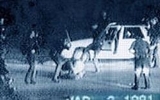
The footage showed LAPD officers repeatedly striking King with their batons while other officers stood by watching, without taking any action to stop the beating. A portion of this footage was aired by news agencies around the world, causing public outrage that raised tensions between the black community and the LAPD and increased anger over police brutality
and social inequalities in Los Angeles
.
Four LAPD officers were later tried in a state court for the beating; three were acquitted and the jury failed to reach a verdict for the fourth. The announcement of the acquittals sparked the 1992 Los Angeles riots
. A later federal trial for civil rights violations ended with two of the officers found guilty and sent to prison and the other two officers acquitted.
to Odessa King, who had four other children. His father died at age 42. King grew up in Pasadena, California
.
In November 1989, King robbed
a store in Monterey Park, California
using an iron bar to threaten and hit the store owner. He was convicted and sentenced to 2 years imprisonment.
King is divorced and has three children.
On September 9, 2010, it was confirmed that King is to marry Cynthia Kelley, who was a juror in the civil suit he brought against the City of Los Angeles
.
—when he was driving. At 12:30 am, Officers Tim and Melanie Singer, a husband-and-wife team of the California Highway Patrol
, spotted King’s car speeding. The Singers pursued King, and the subsequent freeway chase reached a speed of at least 117 miles per hour. According to King’s own statements, he refused to pull the car over because a DUI
would violate his parole for a previous robbery conviction.
King exited the freeway, and the chase continued through residential streets at speeds allegedly ranging from 55 to 80 mph. By this point, several police cars and a helicopter had joined in the pursuit. After approximately eight miles, officers cornered King’s car. The first five LAPD officers to arrive at the scene were Stacey Koon
, Laurence Powell
, Timothy Wind, Theodore Briseno, and Rolando Solano.
At this point, Sergeant Stacey Koon intervened and ordered Officer Melanie Singer to holster her weapon. LAPD officers are taught not to approach a suspect with a drawn gun, as there is a risk of the suspect gaining control of it if they get too close. Koon then ordered the four other LAPD officers at the scene—Biseno, Powell, Solano, and Wind—to subdue and handcuff King in a manner called a "swarm," a technique that involves multiple officers grabbing a suspect with empty hands. As the officers attempted to do so, King physically resisted. King rose up, tossing Officers Powell and Briseno off his back. King then allegedly struck Officer Briseno in the chest. Seeing this, Koon ordered all of the officers to fall back. The officers later testified that they believed King was under the influence of the dissociative drug phencyclidine
(PCP). King's toxicology results tested negative for PCP.
into King's back. King groaned; momentarily fell to his knees; then stood back up and turned towards Koon. Koon fired the Taser a second time, knocking King to the ground. Powell's arrest report states that the Taser "temporarily halt[ed] [Defendant King's] attack," and Solano stated that the Taser appeared to affect King at first because "the suspect shook and yelled for almost five seconds".
. The blow hits King's head, knocking him to the ground immediately. Powell hits King several additional times with his baton. The videotape shows Briseno moving in to try and stop Powell from swinging, and Powell then backing up. (Koon reportedly yelled "that's enough.") King then rises to his knees; Powell and Wind continue to hit King with their batons while he is on the ground.
Koon acknowledged that he ordered the baton blows, directing Powell and Wind to hit King with "power strokes." According to Koon, Powell and Wind used "bursts of power strokes, then backed off." The videotape shows King apparently continuing to try to get up. Koon orders the officers to "hit his joints, hit the wrists, hit his elbows, hit his knees, hit his ankles." Finally, after 56 baton blows and six kicks, five or six officers swarm in and place King in both handcuffs and cordcuffs, restraining his arms and legs. King is dragged on his stomach to the side of the road to await arrival of a rescue ambulance.
Unseen by those involved, George Holliday, a private citizen, caught the lengthy beating on video from his apartment near the intersection of Foothill Blvd and Osborne St. in Lake View Terrace. He contacted the police about a videotape of the incident but was dismissed. He then went to KTLA
television with his videotape, which broadcast it on air in its entirety. The footage became a media sensation. Portions of it were aired hundreds, if not thousands, of times around the world, and it "turned what would otherwise have been a violent, but soon forgotten, encounter between Los Angeles police and Rodney King into one of the most widely watched and discussed incidents of its kind."
, a broken right ankle, and numerous bruises and lacerations. In a negligence claim filed with the city, King alleged he had suffered "11 skull fractures, permanent brain damage, broken [bones and teeth], kidney damage [and] emotional and physical trauma." Blood and urine samples taken from King five hours after his arrest showed that he could be presumed intoxicated under California law. The tests also showed traces of marijuana (26 ng/ml), but no indication of PCP or any other illegal drug. At Pacifica Hospital, where King was taken for initial treatment, nurses reported that the officers who accompanied King (including Wind) openly joked and bragged about the number of times King had been hit.
, as well as the jury pool, citing contamination of the jury pool by the media coverage. The new venue was a new courthouse in Simi Valley
in neighboring Ventura County
. The jury consisted of Ventura County residents—ten white
, one Latino
and one Asian
. The prosecutor, Terry White, was African-American. On April 29, 1992, the jury acquitted three of the officers, but could not agree
about one of the charges for Powell.
Los Angeles Mayor Tom Bradley
said, "the jury's verdict will not blind us to what we saw on that videotape. The men who beat Rodney King do not deserve to wear the uniform of the L.A.P.D." President
George H W Bush said, "viewed from outside the trial, it was hard to understand how the verdict could possibly square with the video. Those civil rights leaders with whom I met were stunned. And so was I and so was Barbara and so were my kids."
, the Marines
and the National Guard restored order, the casualties included 53 deaths, 2,383 injuries, more than 7,000 fires, damages to 3,100 businesses, and nearly $1 billion in financial losses. Smaller riots occurred in other cities such as San Francisco, Las Vegas
in neighboring Nevada
and as far east as Atlanta
, Georgia
. On May 1, 1992, the third day of the L.A. riots, King appeared in public before television news cameras to appeal for peace, asking:
reinstated the investigation and obtained an indictment of violations of federal civil rights
against the four officers. The federal trial focused more on the evidence as to the training of officers instead of just relying on the videotape of the incident. On March 9 of the 1993 trial, King took the witness stand and described to the jury the events as he remembered them. The jury found Officer Laurence Powell
and Sergeant Stacey Koon
guilty, and they were subsequently sentenced to 30 months in prison, while Timothy Wind and Theodore Briseno were acquitted of all charges.
- that is, of citizens watching police. Several copwatch
organizations were subsequently organized nationally to safeguard against police abuse, including an umbrella group, October 22 Coalition to Stop Police Brutality.
King was awarded $3.8 million in a civil case and used some of the proceeds to start a hip hop
music label, Straight Alta-Pazz Recording Company.
Like his father, King is an alcoholic
. In 1993, he entered an alcohol rehabilitation program and was placed on probation after crashing his vehicle into a block wall in downtown Los Angeles. In July 1995, he was arrested by Alhambra
police, who alleged that he hit his wife with his car, knocking her to the ground. He was sentenced to 90 days in jail after being convicted of hit and run. On August 27, 2003, King was arrested again for speeding and running a red light while under the influence of alcohol. He failed to yield to police officers and slammed his vehicle into a house, breaking his pelvis. On November 29, 2007, while riding home on his bicycle, King was shot in the face, arms, and back with pellets from a shotgun. He reported that it was done by a man and a woman who demanded his bicycle and shot him when he rode away. Police described the wounds as looking like they came from birdshot, and said King offered few details about the suspects. In May 2008 King checked into the Pasadena Recovery Center in Pasadena, California
, which was filmed as part of the second season of Celebrity Rehab with Dr. Drew
, which premiered in October 2008. Dr. Drew Pinsky
, who runs the facility, showed concern for King's lifestyle and said that King would die unless his addiction was treated. He also appeared on Sober House, a Celebrity Rehab spin-off focusing on a sober living environment
, which aired in early 2009. Both shows filmed King's quest not only to achieve sobriety, but to reestablish a relationship with his family, which had been severely damaged due to his drinking.
During his time on Celebrity Rehab and Sober House, King worked not only on his addiction, but on the lingering trauma of the beating. He and Dr. Pinsky retraced his path from the night of his beating, eventually reaching the spot where it happened, the site of the Children's Museum of Los Angeles
. King was asked to recount some of the details of the event. Among his recall however were several contradictory facts, such as that the officers shouted to him from their car during the chase that they intended to beat and kill him as soon as he stopped; that when he did stop, he immediately lay on the ground and surrendered, begging the approaching officers “You don’t have to do this!” as he lay there motionless; that the shots with the Taser were all while he was already prone and compliant; and that the officers repeatedly taunted him during the beating, such as saying they were going to kill him and he should run away. However there is no evidence supporting any of these later claims. There is no mention of such events from his companions Allen and Helms (who were arrested without any sort of force from the same officers) nor any testimony provided by him in court consistent with this.
King won a celebrity boxing match against ex-Chester City
(Delaware County
, Pennsylvania
) police officer Simon Aouad on Friday, September 11, 2009 at the Ramada Philadelphia Airport in Essington, Pennsylvania
.
In 2009, King and other alumni of Celebrity Rehab appeared as panel speakers to a new group of addicts at the Pasadena Recovery Center, marking 11 months of sobriety for him. His appearance was aired in the third season episode "Triggers".
On March 3, 2011, King was stopped by Los Angeles police for driving erratically. He was issued a citation for driving with an expired license.
On July 12, 2011, King was arrested on suspicion of driving under the influence.
People of the United States
The people of the United States, also known as simply Americans or American people, are the inhabitants or citizens of the United States. The United States is a multi-ethnic nation, home to people of different ethnic and national backgrounds...
best known for his involvement in a police brutality
Police brutality
Police brutality is the intentional use of excessive force, usually physical, but potentially also in the form of verbal attacks and psychological intimidation, by a police officer....
case involving the Los Angeles Police Department
Los Angeles Police Department
The Los Angeles Police Department is the police department of the city of Los Angeles, California. With just under 10,000 officers and more than 3,000 civilian staff, covering an area of with a population of more than 4.1 million people, it is the third largest local law enforcement agency in...
(LAPD) on March 3, 1991. A bystander, George Holliday, videotaped much of the incident from a distance.
The footage showed LAPD officers repeatedly striking King with their batons while other officers stood by watching, without taking any action to stop the beating. A portion of this footage was aired by news agencies around the world, causing public outrage that raised tensions between the black community and the LAPD and increased anger over police brutality
Police brutality
Police brutality is the intentional use of excessive force, usually physical, but potentially also in the form of verbal attacks and psychological intimidation, by a police officer....
and social inequalities in Los Angeles
Los Ángeles
Los Ángeles is the capital of the province of Biobío, in the commune of the same name, in Region VIII , in the center-south of Chile. It is located between the Laja and Biobío rivers. The population is 123,445 inhabitants...
.
Four LAPD officers were later tried in a state court for the beating; three were acquitted and the jury failed to reach a verdict for the fourth. The announcement of the acquittals sparked the 1992 Los Angeles riots
1992 Los Angeles riots
The 1992 Los Angeles Riots or South Central Riots, also known as the 1992 Los Angeles Civil Unrest were sparked on April 29, 1992, when a jury acquitted three white and one hispanic Los Angeles Police Department officers accused in the videotaped beating of black motorist Rodney King following a...
. A later federal trial for civil rights violations ended with two of the officers found guilty and sent to prison and the other two officers acquitted.
Early and personal life
King was born in Sacramento, CaliforniaSacramento, California
Sacramento is the capital city of the U.S. state of California and the county seat of Sacramento County. It is located at the confluence of the Sacramento River and the American River in the northern portion of California's expansive Central Valley. With a population of 466,488 at the 2010 census,...
to Odessa King, who had four other children. His father died at age 42. King grew up in Pasadena, California
Pasadena, California
Pasadena is a city in Los Angeles County, California, United States. Although famous for hosting the annual Rose Bowl football game and Tournament of Roses Parade, Pasadena is the home to many scientific and cultural institutions, including the California Institute of Technology , the Jet...
.
In November 1989, King robbed
Robbery
Robbery is the crime of taking or attempting to take something of value by force or threat of force or by putting the victim in fear. At common law, robbery is defined as taking the property of another, with the intent to permanently deprive the person of that property, by means of force or fear....
a store in Monterey Park, California
Monterey Park, California
Monterey Park is a city in Los Angeles County, California, United States, east of downtown Los Angeles. The city's motto is "Pride in the past, Faith in the future"...
using an iron bar to threaten and hit the store owner. He was convicted and sentenced to 2 years imprisonment.
King is divorced and has three children.
On September 9, 2010, it was confirmed that King is to marry Cynthia Kelley, who was a juror in the civil suit he brought against the City of Los Angeles
Los Ángeles
Los Ángeles is the capital of the province of Biobío, in the commune of the same name, in Region VIII , in the center-south of Chile. It is located between the Laja and Biobío rivers. The population is 123,445 inhabitants...
.
High speed chase
On the night of March 2, 1991, King and two passengers, Bryant Allen and Freddie Helms, were driving west on Foothill Freeway (Interstate 210) in the San Fernando Valley area of Los Angeles. Prior to driving on the Foothill Freeway, the three men had spent the night watching a basketball game and drinking at a friend’s house in Los Angeles. After being tested 5 hours after the incident, King's blood-alcohol level was found to be just under the legal limit. This meant that his blood alcohol level can be estimated at approximately 0.19—nearly two and a half times the legal limit in CaliforniaCalifornia
California is a state located on the West Coast of the United States. It is by far the most populous U.S. state, and the third-largest by land area...
—when he was driving. At 12:30 am, Officers Tim and Melanie Singer, a husband-and-wife team of the California Highway Patrol
California Highway Patrol
The California Highway Patrol is a law enforcement agency of the U.S. state of California. The CHP has patrol jurisdiction over all California highways and also acts as the state police....
, spotted King’s car speeding. The Singers pursued King, and the subsequent freeway chase reached a speed of at least 117 miles per hour. According to King’s own statements, he refused to pull the car over because a DUI
DUI
DUI is a three letter acronym that may stand for:* Driving under the influence * Democratic Union for Integration — the largest ethnic Albanian party in the Republic of Macedonia* Data Use Identifier...
would violate his parole for a previous robbery conviction.
King exited the freeway, and the chase continued through residential streets at speeds allegedly ranging from 55 to 80 mph. By this point, several police cars and a helicopter had joined in the pursuit. After approximately eight miles, officers cornered King’s car. The first five LAPD officers to arrive at the scene were Stacey Koon
Stacey Koon
Stacey Cornell Koon is a former sergeant with the Los Angeles Police Department who became nationally notorious in the wake of the Rodney King incident...
, Laurence Powell
Laurence Powell
Laurence Michael Powell is a former Los Angeles Police officer. He was one of the four officers involved in the beating of Rodney King on March 3, 1991.-Background:...
, Timothy Wind, Theodore Briseno, and Rolando Solano.
Confrontation
Officer Tim Singer ordered King and his two passengers to exit the vehicle and lie face down on the ground. The two passengers complied and were taken into custody without incident. King initially remained in the car. When he finally did emerge, he acted bizarrely: giggling; patting the ground; and waving to the police helicopter overhead. King then grabbed his buttocks. Officer Melanie Singer momentarily thought he was reaching for a gun. She drew her gun and pointed it at King, ordering him to lie on the ground. King complied. Singer approached King with her gun drawn, preparing to make the arrest.At this point, Sergeant Stacey Koon intervened and ordered Officer Melanie Singer to holster her weapon. LAPD officers are taught not to approach a suspect with a drawn gun, as there is a risk of the suspect gaining control of it if they get too close. Koon then ordered the four other LAPD officers at the scene—Biseno, Powell, Solano, and Wind—to subdue and handcuff King in a manner called a "swarm," a technique that involves multiple officers grabbing a suspect with empty hands. As the officers attempted to do so, King physically resisted. King rose up, tossing Officers Powell and Briseno off his back. King then allegedly struck Officer Briseno in the chest. Seeing this, Koon ordered all of the officers to fall back. The officers later testified that they believed King was under the influence of the dissociative drug phencyclidine
Phencyclidine
Phencyclidine , commonly initialized as PCP and known colloquially as angel dust, is a recreational dissociative drug...
(PCP). King's toxicology results tested negative for PCP.
Use of the Taser
Sergeant Koon then ordered the officers to "stand clear." King was standing and was not responding to Koon's commands. Koon then fired a TaserTaser
A Taser is an electroshock weapon that uses electrical current to disrupt voluntary control of muscles. Its manufacturer, Taser International, calls the effects "neuromuscular incapacitation" and the devices' mechanism "Electro-Muscular Disruption technology"...
into King's back. King groaned; momentarily fell to his knees; then stood back up and turned towards Koon. Koon fired the Taser a second time, knocking King to the ground. Powell's arrest report states that the Taser "temporarily halt[ed] [Defendant King's] attack," and Solano stated that the Taser appeared to affect King at first because "the suspect shook and yelled for almost five seconds".
Beating with batons: events on the Holliday video
As George Holliday's videotape begins, King is on the ground. He rises and moves toward Powell. (Solano termed it a "lunge," and said it was in the direction of Koon.) At this time, taser wires can be seen coming from King's body. As King moves forward, Officer Powell then strikes King with his batonBaton (law enforcement)
A truncheon or baton is essentially a club of less than arm's length made of wood, plastic, or metal...
. The blow hits King's head, knocking him to the ground immediately. Powell hits King several additional times with his baton. The videotape shows Briseno moving in to try and stop Powell from swinging, and Powell then backing up. (Koon reportedly yelled "that's enough.") King then rises to his knees; Powell and Wind continue to hit King with their batons while he is on the ground.
Koon acknowledged that he ordered the baton blows, directing Powell and Wind to hit King with "power strokes." According to Koon, Powell and Wind used "bursts of power strokes, then backed off." The videotape shows King apparently continuing to try to get up. Koon orders the officers to "hit his joints, hit the wrists, hit his elbows, hit his knees, hit his ankles." Finally, after 56 baton blows and six kicks, five or six officers swarm in and place King in both handcuffs and cordcuffs, restraining his arms and legs. King is dragged on his stomach to the side of the road to await arrival of a rescue ambulance.
Unseen by those involved, George Holliday, a private citizen, caught the lengthy beating on video from his apartment near the intersection of Foothill Blvd and Osborne St. in Lake View Terrace. He contacted the police about a videotape of the incident but was dismissed. He then went to KTLA
KTLA
KTLA, virtual channel 5, is a television station in Los Angeles, California, USA. Owned by the Tribune Company, KTLA is an affiliate of the CW Television Network. KTLA's studios are on Sunset Boulevard in Hollywood, and its transmitter is located atop Mount Wilson...
television with his videotape, which broadcast it on air in its entirety. The footage became a media sensation. Portions of it were aired hundreds, if not thousands, of times around the world, and it "turned what would otherwise have been a violent, but soon forgotten, encounter between Los Angeles police and Rodney King into one of the most widely watched and discussed incidents of its kind."
Post-arrest events
King was taken to Pacifica Hospital immediately after his arrest. He suffered a fractured facial boneZygomatic arch
The zygomatic arch or cheek bone is formed by the zygomatic process of temporal bone and the temporal process of the zygomatic bone , the two being united by an oblique suture; the tendon of the Temporalis passes medial to the arch to gain insertion into the coronoid process...
, a broken right ankle, and numerous bruises and lacerations. In a negligence claim filed with the city, King alleged he had suffered "11 skull fractures, permanent brain damage, broken [bones and teeth], kidney damage [and] emotional and physical trauma." Blood and urine samples taken from King five hours after his arrest showed that he could be presumed intoxicated under California law. The tests also showed traces of marijuana (26 ng/ml), but no indication of PCP or any other illegal drug. At Pacifica Hospital, where King was taken for initial treatment, nurses reported that the officers who accompanied King (including Wind) openly joked and bragged about the number of times King had been hit.
Trial of the officers
The Los Angeles district attorney charged officers Koon, Powell, Briseno, and Wind with use of excessive force. While Sergeant Koon did not strike King and had only used the Taser, he was the supervisory officer at the scene and was charged for "willfully permitting and failing to take action to stop the unlawful assault." The initial judge was replaced, and the new judge changed the venueChange of venue
A change of venue is the legal term for moving a trial to a new location. In high-profile matters, a change of venue may occur to move a jury trial away from a location where a fair and impartial jury may not be possible due to widespread publicity about a crime and/or its defendant to another...
, as well as the jury pool, citing contamination of the jury pool by the media coverage. The new venue was a new courthouse in Simi Valley
Simi Valley, California
-2010:The 2010 United States Census reported that Simi Valley had a population of 124,237. The population density was 2,940.8 people per square mile...
in neighboring Ventura County
Ventura County, California
Ventura County is a county in the southern part of the U.S. state of California. It is located on California's Pacific coast. It is often referred to as the Gold Coast, and has a reputation of being one of the safest populated places and one of the most affluent places in the country...
. The jury consisted of Ventura County residents—ten white
White people
White people is a term which usually refers to human beings characterized, at least in part, by the light pigmentation of their skin...
, one Latino
Latino
The demonyms Latino and Latina , are defined in English language dictionaries as:* "a person of Latin-American descent."* "A Latin American."* "A person of Hispanic, especially Latin-American, descent, often one living in the United States."...
and one Asian
Asian people
Asian people or Asiatic people is a term with multiple meanings that refers to people who descend from a portion of Asia's population.- Central Asia :...
. The prosecutor, Terry White, was African-American. On April 29, 1992, the jury acquitted three of the officers, but could not agree
Hung jury
A hung jury or deadlocked jury is a jury that cannot, by the required voting threshold, agree upon a verdict after an extended period of deliberation and is unable to change its votes due to severe differences of opinion.- England and Wales :...
about one of the charges for Powell.
Los Angeles Mayor Tom Bradley
Tom Bradley (politician)
Thomas J. "Tom" Bradley was the 38th Mayor of Los Angeles, California, serving in that office from 1973 to 1993. He was the first and to date only African American mayor of Los Angeles...
said, "the jury's verdict will not blind us to what we saw on that videotape. The men who beat Rodney King do not deserve to wear the uniform of the L.A.P.D." President
President
A president is a leader of an organization, company, trade union, university, or country.Etymologically, a president is one who presides, who sits in leadership...
George H W Bush said, "viewed from outside the trial, it was hard to understand how the verdict could possibly square with the video. Those civil rights leaders with whom I met were stunned. And so was I and so was Barbara and so were my kids."
Los Angeles riots and the aftermath
The news of acquittal triggered the Los Angeles riots of 1992. By the time the police, the U.S. ArmyUnited States Army
The United States Army is the main branch of the United States Armed Forces responsible for land-based military operations. It is the largest and oldest established branch of the U.S. military, and is one of seven U.S. uniformed services...
, the Marines
United States Marine Corps
The United States Marine Corps is a branch of the United States Armed Forces responsible for providing power projection from the sea, using the mobility of the United States Navy to deliver combined-arms task forces rapidly. It is one of seven uniformed services of the United States...
and the National Guard restored order, the casualties included 53 deaths, 2,383 injuries, more than 7,000 fires, damages to 3,100 businesses, and nearly $1 billion in financial losses. Smaller riots occurred in other cities such as San Francisco, Las Vegas
Las Vegas, Nevada
Las Vegas is the most populous city in the U.S. state of Nevada and is also the county seat of Clark County, Nevada. Las Vegas is an internationally renowned major resort city for gambling, shopping, and fine dining. The city bills itself as The Entertainment Capital of the World, and is famous...
in neighboring Nevada
Nevada
Nevada is a state in the western, mountain west, and southwestern regions of the United States. With an area of and a population of about 2.7 million, it is the 7th-largest and 35th-most populous state. Over two-thirds of Nevada's people live in the Las Vegas metropolitan area, which contains its...
and as far east as Atlanta
Atlanta, Georgia
Atlanta is the capital and most populous city in the U.S. state of Georgia. According to the 2010 census, Atlanta's population is 420,003. Atlanta is the cultural and economic center of the Atlanta metropolitan area, which is home to 5,268,860 people and is the ninth largest metropolitan area in...
, Georgia
Georgia (U.S. state)
Georgia is a state located in the southeastern United States. It was established in 1732, the last of the original Thirteen Colonies. The state is named after King George II of Great Britain. Georgia was the fourth state to ratify the United States Constitution, on January 2, 1788...
. On May 1, 1992, the third day of the L.A. riots, King appeared in public before television news cameras to appeal for peace, asking:
Federal trial of officers
After the riots, the United States Department of JusticeUnited States Department of Justice
The United States Department of Justice , is the United States federal executive department responsible for the enforcement of the law and administration of justice, equivalent to the justice or interior ministries of other countries.The Department is led by the Attorney General, who is nominated...
reinstated the investigation and obtained an indictment of violations of federal civil rights
Civil rights
Civil and political rights are a class of rights that protect individuals' freedom from unwarranted infringement by governments and private organizations, and ensure one's ability to participate in the civil and political life of the state without discrimination or repression.Civil rights include...
against the four officers. The federal trial focused more on the evidence as to the training of officers instead of just relying on the videotape of the incident. On March 9 of the 1993 trial, King took the witness stand and described to the jury the events as he remembered them. The jury found Officer Laurence Powell
Laurence Powell
Laurence Michael Powell is a former Los Angeles Police officer. He was one of the four officers involved in the beating of Rodney King on March 3, 1991.-Background:...
and Sergeant Stacey Koon
Stacey Koon
Stacey Cornell Koon is a former sergeant with the Los Angeles Police Department who became nationally notorious in the wake of the Rodney King incident...
guilty, and they were subsequently sentenced to 30 months in prison, while Timothy Wind and Theodore Briseno were acquitted of all charges.
After the riots
The video of the beating is an example of sousveillanceSousveillance
Sousveillance refers to the recording of an activity by a participant in the activity typically by way of small wearable or portable personal technologies.Sousveillance has also been described as "inverse surveillance", i.e...
- that is, of citizens watching police. Several copwatch
Copwatch
Copwatch is a network of activist organizations in the United States and Canada that observe and document police activity while looking for signs of police misconduct and police brutality...
organizations were subsequently organized nationally to safeguard against police abuse, including an umbrella group, October 22 Coalition to Stop Police Brutality.
King was awarded $3.8 million in a civil case and used some of the proceeds to start a hip hop
Hip hop
Hip hop is a form of musical expression and artistic culture that originated in African-American and Latino communities during the 1970s in New York City, specifically the Bronx. DJ Afrika Bambaataa outlined the four pillars of hip hop culture: MCing, DJing, breaking and graffiti writing...
music label, Straight Alta-Pazz Recording Company.
Like his father, King is an alcoholic
Alcoholism
Alcoholism is a broad term for problems with alcohol, and is generally used to mean compulsive and uncontrolled consumption of alcoholic beverages, usually to the detriment of the drinker's health, personal relationships, and social standing...
. In 1993, he entered an alcohol rehabilitation program and was placed on probation after crashing his vehicle into a block wall in downtown Los Angeles. In July 1995, he was arrested by Alhambra
Alhambra, California
Alhambra is a city located in the western San Gabriel Valley region of Los Angeles County, California, United States, which is approximately eight miles from the Downtown Los Angeles civic center. As of the 2010 census, the population was 83,089, down from 85,804 at the 2000 census. The city's...
police, who alleged that he hit his wife with his car, knocking her to the ground. He was sentenced to 90 days in jail after being convicted of hit and run. On August 27, 2003, King was arrested again for speeding and running a red light while under the influence of alcohol. He failed to yield to police officers and slammed his vehicle into a house, breaking his pelvis. On November 29, 2007, while riding home on his bicycle, King was shot in the face, arms, and back with pellets from a shotgun. He reported that it was done by a man and a woman who demanded his bicycle and shot him when he rode away. Police described the wounds as looking like they came from birdshot, and said King offered few details about the suspects. In May 2008 King checked into the Pasadena Recovery Center in Pasadena, California
Pasadena, California
Pasadena is a city in Los Angeles County, California, United States. Although famous for hosting the annual Rose Bowl football game and Tournament of Roses Parade, Pasadena is the home to many scientific and cultural institutions, including the California Institute of Technology , the Jet...
, which was filmed as part of the second season of Celebrity Rehab with Dr. Drew
Celebrity Rehab with Dr. Drew
Celebrity Rehab with Dr. Drew is a reality television show airing on the cable network VH1 that chronicles a group of celebrities as they are treated for alcohol and drug addiction by Dr. Drew Pinsky and his staff at the Pasadena Recovery Center in Pasadena, California. The first season premiered...
, which premiered in October 2008. Dr. Drew Pinsky
Drew Pinsky
David Drew Pinsky , best known as Dr. Drew, is an American board-certified internist, addiction medicine specialist, and radio and television personality. He has hosted the nationally syndicated radio talk show Loveline since the show's inception in 1984. On television, he hosts the talk show Dr...
, who runs the facility, showed concern for King's lifestyle and said that King would die unless his addiction was treated. He also appeared on Sober House, a Celebrity Rehab spin-off focusing on a sober living environment
Sober living environment
Sober living environments are facilities used by addicts recovering from substance abuse, which serve as an interim environment between rehab and a return to their former lives. SLEs grew out of a need to have safe and supportive place for people to live while they were in recovery...
, which aired in early 2009. Both shows filmed King's quest not only to achieve sobriety, but to reestablish a relationship with his family, which had been severely damaged due to his drinking.
During his time on Celebrity Rehab and Sober House, King worked not only on his addiction, but on the lingering trauma of the beating. He and Dr. Pinsky retraced his path from the night of his beating, eventually reaching the spot where it happened, the site of the Children's Museum of Los Angeles
Children's Museum of Los Angeles
The Children's Museum of Los Angeles was a museum specifically catered to children whose purpose is to educate, entertain and enrich children's lives in the greater Los Angeles area. It was modeled from the children's museums in Boston, Indianapolis and Brooklyn...
. King was asked to recount some of the details of the event. Among his recall however were several contradictory facts, such as that the officers shouted to him from their car during the chase that they intended to beat and kill him as soon as he stopped; that when he did stop, he immediately lay on the ground and surrendered, begging the approaching officers “You don’t have to do this!” as he lay there motionless; that the shots with the Taser were all while he was already prone and compliant; and that the officers repeatedly taunted him during the beating, such as saying they were going to kill him and he should run away. However there is no evidence supporting any of these later claims. There is no mention of such events from his companions Allen and Helms (who were arrested without any sort of force from the same officers) nor any testimony provided by him in court consistent with this.
King won a celebrity boxing match against ex-Chester City
Chester, Pennsylvania
Chester is a city in Delaware County, Pennsylvania, United States, with a population of 33,972 at the 2010 census. Chester is situated on the Delaware River, between the cities of Philadelphia and Wilmington, Delaware.- History :...
(Delaware County
Delaware County, Pennsylvania
Delaware County is a county located in the U.S. state of Pennsylvania. As of 2010, the population was 558,979, making it Pennsylvania's fifth most populous county, behind Philadelphia, Allegheny, Montgomery, and Bucks counties....
, Pennsylvania
Pennsylvania
The Commonwealth of Pennsylvania is a U.S. state that is located in the Northeastern and Mid-Atlantic regions of the United States. The state borders Delaware and Maryland to the south, West Virginia to the southwest, Ohio to the west, New York and Ontario, Canada, to the north, and New Jersey to...
) police officer Simon Aouad on Friday, September 11, 2009 at the Ramada Philadelphia Airport in Essington, Pennsylvania
Tinicum Township, Delaware County, Pennsylvania
Tinicum Township, more popularly known as "Tinicum Island" or "The Island", a census-designated place and township in Delaware County, Pennsylvania, United States. The population was 4,353 at the 2000 census. Included within the township's boundaries are the communities of Essington and Lester...
.
In 2009, King and other alumni of Celebrity Rehab appeared as panel speakers to a new group of addicts at the Pasadena Recovery Center, marking 11 months of sobriety for him. His appearance was aired in the third season episode "Triggers".
On March 3, 2011, King was stopped by Los Angeles police for driving erratically. He was issued a citation for driving with an expired license.
On July 12, 2011, King was arrested on suspicion of driving under the influence.
External links
- Rodney King: 17 Years After The Riots", Laist.com
- Salon: "Rethinking Rodney King", Salon.com
- Court TV: Rodney King's Legacy, Courttv.com
- Kavanagh, Jim. "Rodney King, 20 years later." CNNCNNCable News Network is a U.S. cable news channel founded in 1980 by Ted Turner. Upon its launch, CNN was the first channel to provide 24-hour television news coverage, and the first all-news television channel in the United States...
. March 3, 2011.