

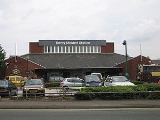
Derby Midland railway station

Encyclopedia
Derby railway station also known as Derby Midland Station, is a main line railway station serving the city of Derby
in England
. Owned by Network Rail
and managed by East Midlands Trains
, the station is also used by CrossCountry
services and one Northern Rail
service. It is situated to the south-east of Derby
city centre, and is close to the west bank of the River Derwent
.
' have made it an important node of the rail network. First opened in 1844, it was at the time one of the largest in the country and was unusual for being shared by more than one company. Until recently, major carriage and locomotive workshops
as well as the Research Division
in the Railway Technical Centre
were housed there.
The station is an interchange point between the Midland Main Line
from to and long-distance services on the Cross-Country route
from through to or (the zero milepost on the latter route is at the south end of platform 1). Until the mid twentieth century, the station was also served by through trains from Manchester
and Glasgow
to London
. It is still a busy station, the section to Sheffield
having the highest train frequency (passenger and freight) of any line in the East Midlands
.
Local services from to along the Derwent Valley Line
serve the station as well as local and semi-fast services to, , , Birmingham and .
Derby station today has six platforms (all but Platform 5 are through platforms), connected by a footbridge, used as an exit to Pride Park
and a car park.

After the building of the Stockton and Darlington Railway
in 1825, a number of ambitious projects for long-distance lines between cities had been mooted. Among these was a line between London
and Edinburgh
, for both goods and passengers, via Bedford
and Leeds
, passing in between Carlisle and Newcastle
.
Meanwhile a number of short lines were built for specific purposes. Among these were the Mansfield and Pinxton
and the Leicester and Swannington
. Both these were feeders for canals, the former a wagonway
, but were pivotal in later events. Possibly the longest was the Cromford and High Peak Railway
, opened in 1833, to connect the Cromford Canal
with the Peak Forest Canal
. It attracted interest because it provided access to Manchester
through the Peak District
of Derbyshire
, even today an obstacle to transport.
In the 1830s, lines were already in progress between Bristol
and London and from each to Birmingham
and thence to Liverpool
and Manchester
, and their promoters were looking ahead. Three schemes came to the fore for the East Midlands. The Grand Junction Railroad would connect Birmingham with Sheffield
and Derby
, with a branch to Nottingham
and another branch from Sheffield to Manchester. There would also be a line to the East Coast at Goole. In 1824 the London Northern Railroad Company was formed to link Birmingham, Derby, Nottingham, Hull and Manchester with London. Two options were proposed. One would branch at Loughborough
, with branches for Nottingham and Derby, and proceeding to Manchester by the Cromford and High Peak Railway. The other option would pass through Northampton
, with a branch to Birmingham, go on to Derby, with a branch to Nottingham, and thence to the Cromford and High Peak. The Grand Midland Railway was a proposal to branch from the London to Birmingham railway, already under consideration, at Northampton, and bring it through Leicester, Loughborough and Derby to the Cromford and High Peak.
Towards the end of the 1820s, however, the economic climate of the country had deteriorated, and many investors were waiting to see how the new Liverpool and Manchester Railway
would succeed. Moreover, not everyone shared the dream. For most people the canals were adequate for the carriage of goods, while few travelled very far. Most people lived their lives within a few miles of their birthplace. The later story of the railways was a classic one of a product generating a demand, rather than the other way around. Thus, what investment that was forthcoming was for ventures for which a need could be clearly perceived, with a reasonable expectation of a good, and rapid, return. Although the surveys were useful in the planning of later lines, the three were never built.
Derby investors, naturally, favoured the scheme by the Grand Junction Railway to connect to the Cromford and High Peak Railway and Manchester, through Derby (at what was to be called the Grand Central Station), since the London and Northern would pass through Sandiacre
, some ten miles away. In the event, neither line was built. In addition, the Cromford and High Peak Railway was not ideally suited to passenger working, and an alternative via Bakewell
and Chapel-en-le-Frith
would encounter very difficult terrain. (Manchester was not, in fact, reached until later in the century by the Manchester, Buxton, Matlock and Midlands Junction Railway
and its extensions.)
was originally proposed to connect the Mansfield and Pinxton Railway to Leicester
because of competition to supply coal
. However, with the existing canal network, and the navigability of the River Trent
to Nottingham, there had been few people willing to invest.
On the other hand, although the River Derwent
flowed from Derby into the Trent
, navigation was not easy. The Derby Canal
had been opened in 1793 but, due to financial restrictions placed on it by Parliament, and the complex local politics of the day it had not been a resounding success. Thus the financiers in Derby vigorously supported any scheme which would bring a railway to the town.
George Hudson
was chairman of the York and North Midland Railway
, a proposed line from York towards the industrial markets of Manchester
and Liverpool
. He was interested in a southwards route and encouraged the building of North Midland Railway
, later becoming its chairman. Meanwhile financiers in Birmingham, including G.C.Glyn, a banker and chairman of the London and Birmingham Railway
, were looking to expand their system. Derby was in between. The Birmingham and Derby Junction Railway
would it give a link from Yorkshire to London, and access to the coalfields, as well as other minerals.
Meanwhile the promoters of the Midland Counties Railway found investors further afield, who suggested a line linking Nottingham, Derby and Leicester, with an extension to Rugby
for London
. Their original plan in 1833 had been to bring their line to Derby at Darby's Yard and Exeter Gardens, at the east side of the present Market Place, with a bridge over the Derwent. Following Vignoles's
reassessment in 1835 a new route was proposed, either North or South of the Derby Canal to a terminus near St. Mary's Bridge with a branch to Full Street near to John Lombe's Silk Mill. Both options would cross the North Midland lines north of the other station.
The North Midland planned to build their station near Nottingham Road, avoiding a river bridge, while the Birmingham and Derby planned to build theirs nearby. Possibly with encouragement from the Derby financiers, they realised the value of a link with the North Midland, and decided to bridge the river and share its station. It was usual in those days for new railways to build their own termini, but, while Derby people were enthusiastic about railways, they were less so about a multiplicity of stations. In 1836 the Town Council suggested a single station for all three companies. The Midland Counties engineer pointed out to his financiers that a good deal of money would be saved by joining the other two railways on a single site.
An alternative that was considered was an island bounded by the River Derwent and the canal, called The Holmes, now Bass's Recreation Ground. Not only was the space restricted and susceptible to flooding, the necessary trackwork would be complicated. Eventually, the present site was chosen, further south on the west bank, Borough's Fields, in the neighbouring hamlet of Litchurch
, at the southern side of the Castlefields estate. It was a mile from the town, but the Council agreed to build a carriageway to the town centre, along Siddals Lane, now Siddals Road. The whole arrangement was confirmed by the North Midland Railway Act of 1839.
Whishaw described it thus: "The admirably contrived and elegant roofs, the spacious, the great length of the whole erection extending to upwards of a thousand feet. All unite in rendering it the most complete structure of the kind in the United Kingdom or perhaps the world."
The platform was in three parts with the centre section built forward as in the diagram, which allowed trains some freedom of movement. With one platform for passengers to board and alight, it was not necessary for them to cross running lines when changing trains. The station offices were also partitioned into three sections, each line having its own facilities.
Fronting this was a magnificent two-storey stone building designed by Francis Thompson
. The North Midland also built a cluster of workers' houses of which the present Midland Terrace remains preserved as a conservation area
.
At each end was a hotel. The Midland Hotel, for first class passengers, is said to be the first provincial railway hotel following on after that at Euston in London. The Brunswick Inn was for second class passengers and railway workers. The saying went that patrons of the first chatted about hunting and shooting, of the other, shunting and hooting.
The first departure from a temporary platform was on 4 June 1839 when a Midland Counties train ran to Nottingham. The first train to Birmingham departed on 12 August in the same year, from another temporary platform further south. The Tri Junct Station finally opened when the North Midland line was completed to Rotherham Masborough
on 11 May 1840, reaching Leeds
seven weeks later. The station's official name was Derby Station.
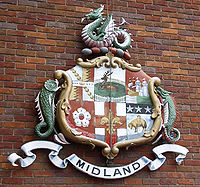 In 1844 all three railways amalgamated to become the Midland Railway
, and Derby station became the new company's headquarters. The story goes that Joseph Paxton
, a director of the railway, produced his first sketch for the Crystal Palace
during a board meeting there. The North Midland had built a repair shop, with the other two building locosheds. These were amalgamated to form the Midland's main locomotive works
. Among a number of innovations was the trial of steel
rail developed by Robert Forester Mushet
in 1857.
In 1846 a north facing spur (Derby North Junction) was added from the Midland Counties line. In 1867 a loop was added to the south, allowing through running for trains from London. The original section remained in occasional use for passenger trains until it was closed in 1969. (What nowadays would be considered the major junction, to the south, is called London Road.)
In 1858 the station was extended with extra offices, improved facilities and a covered areas for carriages for arriving and departing passengers. Traffic increased such that an island platform, the present 2 and 3, was built with, in 1871, Platforms 4 to 6 (Platform 5 being a bay to the south). At this time the turntables were removed and replaced by scissors crossovers, the whole complex controlled by a signal box
on the centre platform.
In 1878, the Great Northern Railway
opened its "Derbyshire and North Staffordshire Extension" with a station at Derby Friargate Station.
The station and the extensive complex of railway workshops adjoining it were of sufficient strategic importance for them to have been the target of a Zeppelin
bombing raid during World War I
, in 1916, though only slight damage was inflicted.
through Millers Dale
was closed in the Beeching
era, the 'main line' was that from London to Manchester, carrying named expresses such as the 'Palatine' and the 'Peaks', while trains to Leeds and Scotland tended to use the Erewash Valley Line
and expresses to Edinburgh
, such as The Waverley travelled through Corby and Nottingham. The line from Leeds was nevertheless busy with trains to the south west and Cornwall
, and summer specials to Paignton
and Torquay
. It had a named express, the 'Devonian', which ran from Bradford
to Bristol
.
In World War II
the station was attacked again, becoming one of the few locations in Derby to suffer significant bomb
damage. The overall roof of the train shed and platform six were severely damaged, with the loss of most of the rest of the glass, although the Victorian
frontage of the station survived.
Comparison of photographs taken of the street side of the station in the early 1900s and the 1970s show little outward change. On the track side, however, extensive rebuilding of the platform buildings, footbridge and awnings in 1952, using pre-stressed concrete, gave the station a very different appearance, with simple functional lines. The station signal box was also rebuilt, described by the staff as 'a cupboard under the stairs'.
From 6 May 1968, the station became known as simply Derby on timetables and platforms, though the full name of Derby Midland Station was retained on the station's main sign. Even today, the fuller name is sometimes used, including on the modern main sign (erected 1985) and on the station's electronic departures board.
With the advent of power signalling in 1969, the signal box and the crossovers disappeared, and the tracks approaching the station were relaid to allow trains from any direction to enter or leave any platform.
Further work in 1985 saw the final replacement of the ageing Victorian station entrance and booking hall by a more modern design. The entrance's original clock was moved to the north end of the car park and the coats of arms
of the Midland Railway and of the City of Derby were affixed to the new frontage. The decision to demolish the old building was a controversial one at the time.
, the station became owned by Railtrack
and later Network Rail, though, in common with most British railway stations, the day-to-day operation is contracted out to the principal user of the station, in this case East Midlands Trains. Prior to November 2007, the station was managed by Midland Mainline
, who continued to refurbish the station with the installation of a large electronic departure board in the station entrance hall and smaller boards on all platforms.
 In 2005, the footbridge connecting the platforms, which had been temporarily supported for about a decade, was replaced. Whilst doing this, engineers discovered that there were stresses in the concrete of the 1950s canopy. Work to demolish the canopies and erect new ones began in mid 2007 and was completed in October 2009.
Derby
Derby , is a city and unitary authority in the East Midlands region of England. It lies upon the banks of the River Derwent and is located in the south of the ceremonial county of Derbyshire. In the 2001 census, the population of the city was 233,700, whilst that of the Derby Urban Area was 229,407...
in England
England
England is a country that is part of the United Kingdom. It shares land borders with Scotland to the north and Wales to the west; the Irish Sea is to the north west, the Celtic Sea to the south west, with the North Sea to the east and the English Channel to the south separating it from continental...
. Owned by Network Rail
Network Rail
Network Rail is the government-created owner and operator of most of the rail infrastructure in Great Britain .; it is not responsible for railway infrastructure in Northern Ireland...
and managed by East Midlands Trains
East Midlands Trains
East Midlands Trains is a British passenger train operating company. Based in Derby, it provides train services in the East Midlands, chiefly in the counties of Lincolnshire, South Yorkshire, Nottinghamshire, Leicestershire, Derbyshire and Northamptonshire, and between the East Midlands and London...
, the station is also used by CrossCountry
CrossCountry
CrossCountry is the brand name of XC Trains Ltd., a British train operating company owned by Arriva...
services and one Northern Rail
Northern Rail
Northern Rail is a British train operating company that has operated local passenger services in Northern England since 2004. Northern Rail's owner, Serco-Abellio, is a consortium formed of Abellio and Serco, an international operator of public transport systems...
service. It is situated to the south-east of Derby
Derby
Derby , is a city and unitary authority in the East Midlands region of England. It lies upon the banks of the River Derwent and is located in the south of the ceremonial county of Derbyshire. In the 2001 census, the population of the city was 233,700, whilst that of the Derby Urban Area was 229,407...
city centre, and is close to the west bank of the River Derwent
River Derwent, Derbyshire
The Derwent is a river in the county of Derbyshire, England. It is 66 miles long and is a tributary of the River Trent which it joins south of Derby. For half its course, the river flows through the Peak District....
.
Overview
Derby's central location and former importance as a 'railway townRailway town
A railway town is a settlement that originated or was greatly developed because of a railway station or junction at its site.In Victorian Britain, the spread of railways greatly affected the fate of many small towns...
' have made it an important node of the rail network. First opened in 1844, it was at the time one of the largest in the country and was unusual for being shared by more than one company. Until recently, major carriage and locomotive workshops
Derby Works
The Midland Railway Locomotive Works, known locally as "the loco" comprised a number of British manufacturing facilities in Derby building locomotives and, initially, rolling stock in Derby, UK.-Early days:...
as well as the Research Division
British Rail Research Division
The British Rail Research Division came into being in 1964 directly under the control of the British Railways Board, moving into purpose-built premises at the Railway Technical Centre in Derby. The intention was to improve railway reliability and efficiency, while reducing costs and improving revenue...
in the Railway Technical Centre
Railway Technical Centre
The Railway Technical Centre in London Road, Derby, UK, was built by the British Railways Board in the early 1960s to be its technical headquarters....
were housed there.
The station is an interchange point between the Midland Main Line
Midland Main Line
The Midland Main Line is a major railway route in the United Kingdom, part of the British railway system.The present-day line links London St...
from to and long-distance services on the Cross-Country route
Cross Country Route (MR)
The North-East/South-West route is the major British rail route running from South West England via Bristol, Birmingham, Sheffield and Leeds to North-East England. It facilitates some of the longest inter-city rail journeys in the UK such as Penzance to Aberdeen...
from through to or (the zero milepost on the latter route is at the south end of platform 1). Until the mid twentieth century, the station was also served by through trains from Manchester
Manchester
Manchester is a city and metropolitan borough in Greater Manchester, England. According to the Office for National Statistics, the 2010 mid-year population estimate for Manchester was 498,800. Manchester lies within one of the UK's largest metropolitan areas, the metropolitan county of Greater...
and Glasgow
Glasgow
Glasgow is the largest city in Scotland and third most populous in the United Kingdom. The city is situated on the River Clyde in the country's west central lowlands...
to London
London
London is the capital city of :England and the :United Kingdom, the largest metropolitan area in the United Kingdom, and the largest urban zone in the European Union by most measures. Located on the River Thames, London has been a major settlement for two millennia, its history going back to its...
. It is still a busy station, the section to Sheffield
Sheffield
Sheffield is a city and metropolitan borough of South Yorkshire, England. Its name derives from the River Sheaf, which runs through the city. Historically a part of the West Riding of Yorkshire, and with some of its southern suburbs annexed from Derbyshire, the city has grown from its largely...
having the highest train frequency (passenger and freight) of any line in the East Midlands
East Midlands
The East Midlands is one of the regions of England, consisting of most of the eastern half of the traditional region of the Midlands. It encompasses the combined area of Nottinghamshire, Derbyshire, Leicestershire, Rutland, Northamptonshire and most of Lincolnshire...
.
Local services from to along the Derwent Valley Line
Derwent Valley Line
The Derwent Valley Line is a railway line from Derby to Matlock in Derbyshire.The line follows the Midland Main Line as far as Ambergate Junction, which is just south of Ambergate railway station, continuing to Matlock, following the course of the River Derwent.*Derby*Duffield**Former branch line...
serve the station as well as local and semi-fast services to, , , Birmingham and .
Derby station today has six platforms (all but Platform 5 are through platforms), connected by a footbridge, used as an exit to Pride Park
Pride Park
Pride Park is a business park on the outskirts of the city centre of Derby, UK. It covers 80 hectares of former industrial land between the River Derwent and railway lines.-History:...
and a car park.
Early East Midlands railway schemes
After the building of the Stockton and Darlington Railway
Stockton and Darlington Railway
The Stockton and Darlington Railway , which opened in 1825, was the world's first publicly subscribed passenger railway. It was 26 miles long, and was built in north-eastern England between Witton Park and Stockton-on-Tees via Darlington, and connected to several collieries near Shildon...
in 1825, a number of ambitious projects for long-distance lines between cities had been mooted. Among these was a line between London
London
London is the capital city of :England and the :United Kingdom, the largest metropolitan area in the United Kingdom, and the largest urban zone in the European Union by most measures. Located on the River Thames, London has been a major settlement for two millennia, its history going back to its...
and Edinburgh
Edinburgh
Edinburgh is the capital city of Scotland, the second largest city in Scotland, and the eighth most populous in the United Kingdom. The City of Edinburgh Council governs one of Scotland's 32 local government council areas. The council area includes urban Edinburgh and a rural area...
, for both goods and passengers, via Bedford
Bedford
Bedford is the county town of Bedfordshire, in the East of England. It is a large town and the administrative centre for the wider Borough of Bedford. According to the former Bedfordshire County Council's estimates, the town had a population of 79,190 in mid 2005, with 19,720 in the adjacent town...
and Leeds
Leeds
Leeds is a city and metropolitan borough in West Yorkshire, England. In 2001 Leeds' main urban subdivision had a population of 443,247, while the entire city has a population of 798,800 , making it the 30th-most populous city in the European Union.Leeds is the cultural, financial and commercial...
, passing in between Carlisle and Newcastle
Newcastle upon Tyne
Newcastle upon Tyne is a city and metropolitan borough of Tyne and Wear, in North East England. Historically a part of Northumberland, it is situated on the north bank of the River Tyne...
.
Meanwhile a number of short lines were built for specific purposes. Among these were the Mansfield and Pinxton
Mansfield and Pinxton Railway
The Mansfield and Pinxton Railway was an early horse-drawn railway company in the United Kingdom, constructed in 1819 to transport coal between Mansfield and the head of the Pinxton branch of the Cromford Canal and thence by the Erewash Valley and the Trent to Leicester...
and the Leicester and Swannington
Leicester and Swannington Railway
The Leicester and Swannington Railway was one of England's first railways, being opened on 17 July 1832 to bring coal from collieries in west Leicestershire to Leicester.-Overview:...
. Both these were feeders for canals, the former a wagonway
Wagonway
Wagonways consisted of the horses, equipment and tracks used for hauling wagons, which preceded steam powered railways. The terms "plateway", "tramway" and in someplaces, "dramway" are also found.- Early developments :...
, but were pivotal in later events. Possibly the longest was the Cromford and High Peak Railway
Cromford and High Peak Railway
The Cromford and High Peak Railway in Derbyshire, England, was completed in 1831, to carry minerals and goods between the Cromford Canal wharf at High Peak Junction and the Peak Forest Canal at Whaley Bridge -Origins:...
, opened in 1833, to connect the Cromford Canal
Cromford Canal
The Cromford Canal ran 14.5 miles from Cromford to the Erewash Canal in Derbyshire, England with a branch to Pinxton. Built by William Jessop with the assistance of Benjamin Outram, its alignment included four tunnels and 14 locks....
with the Peak Forest Canal
Peak Forest Canal
The Peak Forest Canal, is a narrow locked artificial waterway in northern England. It is long and forms part of the connected English/Welsh inland waterway network.-General description:...
. It attracted interest because it provided access to Manchester
Manchester
Manchester is a city and metropolitan borough in Greater Manchester, England. According to the Office for National Statistics, the 2010 mid-year population estimate for Manchester was 498,800. Manchester lies within one of the UK's largest metropolitan areas, the metropolitan county of Greater...
through the Peak District
Peak District
The Peak District is an upland area in central and northern England, lying mainly in northern Derbyshire, but also covering parts of Cheshire, Greater Manchester, Staffordshire, and South and West Yorkshire....
of Derbyshire
Derbyshire
Derbyshire is a county in the East Midlands of England. A substantial portion of the Peak District National Park lies within Derbyshire. The northern part of Derbyshire overlaps with the Pennines, a famous chain of hills and mountains. The county contains within its boundary of approx...
, even today an obstacle to transport.
In the 1830s, lines were already in progress between Bristol
Bristol
Bristol is a city, unitary authority area and ceremonial county in South West England, with an estimated population of 433,100 for the unitary authority in 2009, and a surrounding Larger Urban Zone with an estimated 1,070,000 residents in 2007...
and London and from each to Birmingham
Birmingham
Birmingham is a city and metropolitan borough in the West Midlands of England. It is the most populous British city outside the capital London, with a population of 1,036,900 , and lies at the heart of the West Midlands conurbation, the second most populous urban area in the United Kingdom with a...
and thence to Liverpool
Liverpool
Liverpool is a city and metropolitan borough of Merseyside, England, along the eastern side of the Mersey Estuary. It was founded as a borough in 1207 and was granted city status in 1880...
and Manchester
Manchester
Manchester is a city and metropolitan borough in Greater Manchester, England. According to the Office for National Statistics, the 2010 mid-year population estimate for Manchester was 498,800. Manchester lies within one of the UK's largest metropolitan areas, the metropolitan county of Greater...
, and their promoters were looking ahead. Three schemes came to the fore for the East Midlands. The Grand Junction Railroad would connect Birmingham with Sheffield
Sheffield
Sheffield is a city and metropolitan borough of South Yorkshire, England. Its name derives from the River Sheaf, which runs through the city. Historically a part of the West Riding of Yorkshire, and with some of its southern suburbs annexed from Derbyshire, the city has grown from its largely...
and Derby
Derby
Derby , is a city and unitary authority in the East Midlands region of England. It lies upon the banks of the River Derwent and is located in the south of the ceremonial county of Derbyshire. In the 2001 census, the population of the city was 233,700, whilst that of the Derby Urban Area was 229,407...
, with a branch to Nottingham
Nottingham
Nottingham is a city and unitary authority in the East Midlands of England. It is located in the ceremonial county of Nottinghamshire and represents one of eight members of the English Core Cities Group...
and another branch from Sheffield to Manchester. There would also be a line to the East Coast at Goole. In 1824 the London Northern Railroad Company was formed to link Birmingham, Derby, Nottingham, Hull and Manchester with London. Two options were proposed. One would branch at Loughborough
Loughborough
Loughborough is a town within the Charnwood borough of Leicestershire, England. It is the seat of Charnwood Borough Council and is home to Loughborough University...
, with branches for Nottingham and Derby, and proceeding to Manchester by the Cromford and High Peak Railway. The other option would pass through Northampton
Northampton
Northampton is a large market town and local government district in the East Midlands region of England. Situated about north-west of London and around south-east of Birmingham, Northampton lies on the River Nene and is the county town of Northamptonshire. The demonym of Northampton is...
, with a branch to Birmingham, go on to Derby, with a branch to Nottingham, and thence to the Cromford and High Peak. The Grand Midland Railway was a proposal to branch from the London to Birmingham railway, already under consideration, at Northampton, and bring it through Leicester, Loughborough and Derby to the Cromford and High Peak.
Towards the end of the 1820s, however, the economic climate of the country had deteriorated, and many investors were waiting to see how the new Liverpool and Manchester Railway
Liverpool and Manchester Railway
The Liverpool and Manchester Railway was the world's first inter-city passenger railway in which all the trains were timetabled and were hauled for most of the distance solely by steam locomotives. The line opened on 15 September 1830 and ran between the cities of Liverpool and Manchester in North...
would succeed. Moreover, not everyone shared the dream. For most people the canals were adequate for the carriage of goods, while few travelled very far. Most people lived their lives within a few miles of their birthplace. The later story of the railways was a classic one of a product generating a demand, rather than the other way around. Thus, what investment that was forthcoming was for ventures for which a need could be clearly perceived, with a reasonable expectation of a good, and rapid, return. Although the surveys were useful in the planning of later lines, the three were never built.
Derby investors, naturally, favoured the scheme by the Grand Junction Railway to connect to the Cromford and High Peak Railway and Manchester, through Derby (at what was to be called the Grand Central Station), since the London and Northern would pass through Sandiacre
Sandiacre
Sandiacre is a town in the Borough of Erewash in Derbyshire, in the East Midlands region of England adjoining the border with Nottinghamshire....
, some ten miles away. In the event, neither line was built. In addition, the Cromford and High Peak Railway was not ideally suited to passenger working, and an alternative via Bakewell
Bakewell
Bakewell is a small market town in the Derbyshire Dales district of Derbyshire, England, deriving its name from 'Beadeca's Well'. It is the only town included in the Peak District National Park, and is well known for the local confection Bakewell Pudding...
and Chapel-en-le-Frith
Chapel-en-le-Frith
Chapel-en-le-Frith is a small town in Derbyshire, England, on the edge of the Peak District near the border with Cheshire, from Manchester. Dubbed "The Capital of the Peak District", the settlement was established by the Normans in the 12th century, originally as a hunting lodge within the Forest...
would encounter very difficult terrain. (Manchester was not, in fact, reached until later in the century by the Manchester, Buxton, Matlock and Midlands Junction Railway
Manchester, Buxton, Matlock and Midlands Junction Railway
The Manchester, Buxton, Matlock and Midland Junction Railway ran from a junction with the Midland Railway at Ambergate to Rowsley north of Matlock and thence to Buxton....
and its extensions.)
Three railways
The Midland Counties RailwayMidland Counties Railway
The Midland Counties Railway was a railway company in the United Kingdom which existed between 1832 and 1844, connecting Nottingham, Leicester and Derby with Rugby and thence, via the London and Birmingham Railway, to London. The MCR system connected with the North Midland Railway and the...
was originally proposed to connect the Mansfield and Pinxton Railway to Leicester
Leicester
Leicester is a city and unitary authority in the East Midlands of England, and the county town of Leicestershire. The city lies on the River Soar and at the edge of the National Forest...
because of competition to supply coal
Coal
Coal is a combustible black or brownish-black sedimentary rock usually occurring in rock strata in layers or veins called coal beds or coal seams. The harder forms, such as anthracite coal, can be regarded as metamorphic rock because of later exposure to elevated temperature and pressure...
. However, with the existing canal network, and the navigability of the River Trent
River Trent
The River Trent is one of the major rivers of England. Its source is in Staffordshire on the southern edge of Biddulph Moor. It flows through the Midlands until it joins the River Ouse at Trent Falls to form the Humber Estuary, which empties into the North Sea below Hull and Immingham.The Trent...
to Nottingham, there had been few people willing to invest.
On the other hand, although the River Derwent
River Derwent, Derbyshire
The Derwent is a river in the county of Derbyshire, England. It is 66 miles long and is a tributary of the River Trent which it joins south of Derby. For half its course, the river flows through the Peak District....
flowed from Derby into the Trent
River Trent
The River Trent is one of the major rivers of England. Its source is in Staffordshire on the southern edge of Biddulph Moor. It flows through the Midlands until it joins the River Ouse at Trent Falls to form the Humber Estuary, which empties into the North Sea below Hull and Immingham.The Trent...
, navigation was not easy. The Derby Canal
Derby Canal
The Derby Canal ran from the Trent and Mersey Canal at Swarkestone to Derby and Little Eaton, and to the Erewash Canal at Sandiacre, Derbyshire, England. The canal gained its Act of Parliament in 1793 and was fully completed in 1796...
had been opened in 1793 but, due to financial restrictions placed on it by Parliament, and the complex local politics of the day it had not been a resounding success. Thus the financiers in Derby vigorously supported any scheme which would bring a railway to the town.
George Hudson
George Hudson
George Hudson , English railway financier, known as "The Railway King", was born, the fifth son of a farmer, in Howsham, in the parish of Scrayingham in the East Riding of Yorkshire, north of Stamford Bridge, east of York. He is buried in Scrayingham...
was chairman of the York and North Midland Railway
York and North Midland Railway
The York and North Midland Railway was a railway company in the United Kingdom which opened in 1839, connecting York, with the Leeds and Selby Railway and in 1840 with the North Midland Railway at Normanton near Leeds.-Origins:...
, a proposed line from York towards the industrial markets of Manchester
Manchester
Manchester is a city and metropolitan borough in Greater Manchester, England. According to the Office for National Statistics, the 2010 mid-year population estimate for Manchester was 498,800. Manchester lies within one of the UK's largest metropolitan areas, the metropolitan county of Greater...
and Liverpool
Liverpool
Liverpool is a city and metropolitan borough of Merseyside, England, along the eastern side of the Mersey Estuary. It was founded as a borough in 1207 and was granted city status in 1880...
. He was interested in a southwards route and encouraged the building of North Midland Railway
North Midland Railway
The North Midland Railway was a British railway company, which opened its line from Derby to Rotherham and Leeds in 1840.At Derby it connected with the Birmingham and Derby Junction Railway and the Midland Counties Railway at what became known as the Tri Junct Station...
, later becoming its chairman. Meanwhile financiers in Birmingham, including G.C.Glyn, a banker and chairman of the London and Birmingham Railway
London and Birmingham Railway
The London and Birmingham Railway was an early railway company in the United Kingdom from 1833 to 1846, when it became part of the London and North Western Railway ....
, were looking to expand their system. Derby was in between. The Birmingham and Derby Junction Railway
Birmingham and Derby Junction Railway
The Birmingham and Derby Junction Railway was a British railway company. From Birmingham it connected at Derby with the North Midland Railway and the Midland Counties Railway at what became known as the Tri Junct Station...
would it give a link from Yorkshire to London, and access to the coalfields, as well as other minerals.
Meanwhile the promoters of the Midland Counties Railway found investors further afield, who suggested a line linking Nottingham, Derby and Leicester, with an extension to Rugby
Rugby, Warwickshire
Rugby is a market town in Warwickshire, England, located on the River Avon. The town has a population of 61,988 making it the second largest town in the county...
for London
London
London is the capital city of :England and the :United Kingdom, the largest metropolitan area in the United Kingdom, and the largest urban zone in the European Union by most measures. Located on the River Thames, London has been a major settlement for two millennia, its history going back to its...
. Their original plan in 1833 had been to bring their line to Derby at Darby's Yard and Exeter Gardens, at the east side of the present Market Place, with a bridge over the Derwent. Following Vignoles's
Charles Blacker Vignoles
Charles Blacker Vignoles was an influential early railway engineer, and eponym of the Vignoles rail.- Early life :...
reassessment in 1835 a new route was proposed, either North or South of the Derby Canal to a terminus near St. Mary's Bridge with a branch to Full Street near to John Lombe's Silk Mill. Both options would cross the North Midland lines north of the other station.
The North Midland planned to build their station near Nottingham Road, avoiding a river bridge, while the Birmingham and Derby planned to build theirs nearby. Possibly with encouragement from the Derby financiers, they realised the value of a link with the North Midland, and decided to bridge the river and share its station. It was usual in those days for new railways to build their own termini, but, while Derby people were enthusiastic about railways, they were less so about a multiplicity of stations. In 1836 the Town Council suggested a single station for all three companies. The Midland Counties engineer pointed out to his financiers that a good deal of money would be saved by joining the other two railways on a single site.
An alternative that was considered was an island bounded by the River Derwent and the canal, called The Holmes, now Bass's Recreation Ground. Not only was the space restricted and susceptible to flooding, the necessary trackwork would be complicated. Eventually, the present site was chosen, further south on the west bank, Borough's Fields, in the neighbouring hamlet of Litchurch
Litchurch
Litchurch is an area of the city of Derby in Derbyshire, England. Originally an obscure locality on the edge of Derby, rapid urbanisation and population growth in the 19th century led to it briefly existing as a separately governed local authority between 1860 and 1888, prior to once again being...
, at the southern side of the Castlefields estate. It was a mile from the town, but the Council agreed to build a carriageway to the town centre, along Siddals Lane, now Siddals Road. The whole arrangement was confirmed by the North Midland Railway Act of 1839.
The Tri Junct Station
Although some literature refers to it as the 'Tripartite Station'. it became known as the 'Tri Junct Station', It was 1050 ft (320 m) long with one through platform plus a north and a south bay, the main platform and bays connected to seven stabling roads by a series of carriage turntables (rolling-stock was moved around the station by hand). These platform and stabling roads were all beneath a three-bay train shed.Whishaw described it thus: "The admirably contrived and elegant roofs, the spacious, the great length of the whole erection extending to upwards of a thousand feet. All unite in rendering it the most complete structure of the kind in the United Kingdom or perhaps the world."
The platform was in three parts with the centre section built forward as in the diagram, which allowed trains some freedom of movement. With one platform for passengers to board and alight, it was not necessary for them to cross running lines when changing trains. The station offices were also partitioned into three sections, each line having its own facilities.
Fronting this was a magnificent two-storey stone building designed by Francis Thompson
Francis Thompson (architect)
Francis Thompson was an architect particularly well known for his railway work.He was born in 1808 in Woodbridge in Suffolk, England, to a family of builders. He married Anna Maria Watson in 1830 at Woodbridge church and emigrated to Montreal in British North America . Their son Francis Jacob...
. The North Midland also built a cluster of workers' houses of which the present Midland Terrace remains preserved as a conservation area
Conservation area
A conservation areas is a tract of land that has been awarded protected status in order to ensure that natural features, cultural heritage or biota are safeguarded...
.
At each end was a hotel. The Midland Hotel, for first class passengers, is said to be the first provincial railway hotel following on after that at Euston in London. The Brunswick Inn was for second class passengers and railway workers. The saying went that patrons of the first chatted about hunting and shooting, of the other, shunting and hooting.
The first departure from a temporary platform was on 4 June 1839 when a Midland Counties train ran to Nottingham. The first train to Birmingham departed on 12 August in the same year, from another temporary platform further south. The Tri Junct Station finally opened when the North Midland line was completed to Rotherham Masborough
Rotherham Masborough railway station
Rotherham Masborough railway station was the main railway station for Rotherham, South Yorkshire, England from the 1840s, until most of its trains were rerouted via Rotherham Central in 1987...
on 11 May 1840, reaching Leeds
Leeds
Leeds is a city and metropolitan borough in West Yorkshire, England. In 2001 Leeds' main urban subdivision had a population of 443,247, while the entire city has a population of 798,800 , making it the 30th-most populous city in the European Union.Leeds is the cultural, financial and commercial...
seven weeks later. The station's official name was Derby Station.
Midland Railway
Midland Railway
The Midland Railway was a railway company in the United Kingdom from 1844 to 1922, when it became part of the London, Midland and Scottish Railway....
, and Derby station became the new company's headquarters. The story goes that Joseph Paxton
Joseph Paxton
Sir Joseph Paxton was an English gardener and architect, best known for designing The Crystal Palace.-Early life:...
, a director of the railway, produced his first sketch for the Crystal Palace
The Crystal Palace
The Crystal Palace was a cast-iron and glass building originally erected in Hyde Park, London, England, to house the Great Exhibition of 1851. More than 14,000 exhibitors from around the world gathered in the Palace's of exhibition space to display examples of the latest technology developed in...
during a board meeting there. The North Midland had built a repair shop, with the other two building locosheds. These were amalgamated to form the Midland's main locomotive works
Derby Works
The Midland Railway Locomotive Works, known locally as "the loco" comprised a number of British manufacturing facilities in Derby building locomotives and, initially, rolling stock in Derby, UK.-Early days:...
. Among a number of innovations was the trial of steel
Steel
Steel is an alloy that consists mostly of iron and has a carbon content between 0.2% and 2.1% by weight, depending on the grade. Carbon is the most common alloying material for iron, but various other alloying elements are used, such as manganese, chromium, vanadium, and tungsten...
rail developed by Robert Forester Mushet
Robert Forester Mushet
Robert Forester Mushet was a British metallurgist and businessman, born April 8, 1811, in Coleford, in the Forest of Dean, Gloucestershire, England. He was the youngest son of Scottish parents, Agnes Wilson and David Mushet; an ironmaster, formerly of the Clyde, Alfreton and Whitecliff...
in 1857.
In 1846 a north facing spur (Derby North Junction) was added from the Midland Counties line. In 1867 a loop was added to the south, allowing through running for trains from London. The original section remained in occasional use for passenger trains until it was closed in 1969. (What nowadays would be considered the major junction, to the south, is called London Road.)
In 1858 the station was extended with extra offices, improved facilities and a covered areas for carriages for arriving and departing passengers. Traffic increased such that an island platform, the present 2 and 3, was built with, in 1871, Platforms 4 to 6 (Platform 5 being a bay to the south). At this time the turntables were removed and replaced by scissors crossovers, the whole complex controlled by a signal box
Signal box
On a rail transport system, signalling control is the process by which control is exercised over train movements by way of railway signals and block systems to ensure that trains operate safely, over the correct route and to the proper timetable...
on the centre platform.
In 1878, the Great Northern Railway
Great Northern Railway (Great Britain)
The Great Northern Railway was a British railway company established by the Great Northern Railway Act of 1846. On 1 January 1923 the company lost its identity as a constituent of the newly formed London and North Eastern Railway....
opened its "Derbyshire and North Staffordshire Extension" with a station at Derby Friargate Station.
The station and the extensive complex of railway workshops adjoining it were of sufficient strategic importance for them to have been the target of a Zeppelin
Zeppelin
A Zeppelin is a type of rigid airship pioneered by the German Count Ferdinand von Zeppelin in the early 20th century. It was based on designs he had outlined in 1874 and detailed in 1893. His plans were reviewed by committee in 1894 and patented in the United States on 14 March 1899...
bombing raid during World War I
World War I
World War I , which was predominantly called the World War or the Great War from its occurrence until 1939, and the First World War or World War I thereafter, was a major war centred in Europe that began on 28 July 1914 and lasted until 11 November 1918...
, in 1916, though only slight damage was inflicted.
London, Midland and Scottish Railway
Until the Manchester lineManchester, Buxton, Matlock and Midlands Junction Railway
The Manchester, Buxton, Matlock and Midland Junction Railway ran from a junction with the Midland Railway at Ambergate to Rowsley north of Matlock and thence to Buxton....
through Millers Dale
Millers Dale railway station
Millers Dale railway station was a station situated in Millers Dale in the Peak District. It was built in 1863 by the Midland Railway on its extension of the Manchester, Buxton, Matlock and Midlands Junction Railway from Rowsley....
was closed in the Beeching
Beeching Axe
The Beeching Axe or the Beeching Cuts are informal names for the British Government's attempt in the 1960s to reduce the cost of running British Railways, the nationalised railway system in the United Kingdom. The name is that of the main author of The Reshaping of British Railways, Dr Richard...
era, the 'main line' was that from London to Manchester, carrying named expresses such as the 'Palatine' and the 'Peaks', while trains to Leeds and Scotland tended to use the Erewash Valley Line
Erewash Valley Line
The Erewash Valley Line is a railway line in Britain running from south of Chesterfield along the Erewash Valley to Trent Junction at Long Eaton, joining the Midland Main Line at each end.- History :...
and expresses to Edinburgh
Edinburgh
Edinburgh is the capital city of Scotland, the second largest city in Scotland, and the eighth most populous in the United Kingdom. The City of Edinburgh Council governs one of Scotland's 32 local government council areas. The council area includes urban Edinburgh and a rural area...
, such as The Waverley travelled through Corby and Nottingham. The line from Leeds was nevertheless busy with trains to the south west and Cornwall
Cornwall
Cornwall is a unitary authority and ceremonial county of England, within the United Kingdom. It is bordered to the north and west by the Celtic Sea, to the south by the English Channel, and to the east by the county of Devon, over the River Tamar. Cornwall has a population of , and covers an area of...
, and summer specials to Paignton
Paignton
Paignton is a coastal town in Devon in England. Together with Torquay and Brixham it forms the unitary authority of Torbay which was created in 1998. The Torbay area is a holiday destination known as the English Riviera. Paignton's population in the United Kingdom Census of 2001 was 48,251. It has...
and Torquay
Torquay
Torquay is a town in the unitary authority area of Torbay and ceremonial county of Devon, England. It lies south of Exeter along the A380 on the north of Torbay, north-east of Plymouth and adjoins the neighbouring town of Paignton on the west of the bay. Torquay’s population of 63,998 during the...
. It had a named express, the 'Devonian', which ran from Bradford
Bradford
Bradford lies at the heart of the City of Bradford, a metropolitan borough of West Yorkshire, in Northern England. It is situated in the foothills of the Pennines, west of Leeds, and northwest of Wakefield. Bradford became a municipal borough in 1847, and received its charter as a city in 1897...
to Bristol
Bristol
Bristol is a city, unitary authority area and ceremonial county in South West England, with an estimated population of 433,100 for the unitary authority in 2009, and a surrounding Larger Urban Zone with an estimated 1,070,000 residents in 2007...
.
In World War II
World War II
World War II, or the Second World War , was a global conflict lasting from 1939 to 1945, involving most of the world's nations—including all of the great powers—eventually forming two opposing military alliances: the Allies and the Axis...
the station was attacked again, becoming one of the few locations in Derby to suffer significant bomb
Bomb
A bomb is any of a range of explosive weapons that only rely on the exothermic reaction of an explosive material to provide an extremely sudden and violent release of energy...
damage. The overall roof of the train shed and platform six were severely damaged, with the loss of most of the rest of the glass, although the Victorian
Victorian architecture
The term Victorian architecture refers collectively to several architectural styles employed predominantly during the middle and late 19th century. The period that it indicates may slightly overlap the actual reign, 20 June 1837 – 22 January 1901, of Queen Victoria. This represents the British and...
frontage of the station survived.
British Railways
The station was renamed Derby Midland Station on 25 September 1950.Comparison of photographs taken of the street side of the station in the early 1900s and the 1970s show little outward change. On the track side, however, extensive rebuilding of the platform buildings, footbridge and awnings in 1952, using pre-stressed concrete, gave the station a very different appearance, with simple functional lines. The station signal box was also rebuilt, described by the staff as 'a cupboard under the stairs'.
From 6 May 1968, the station became known as simply Derby on timetables and platforms, though the full name of Derby Midland Station was retained on the station's main sign. Even today, the fuller name is sometimes used, including on the modern main sign (erected 1985) and on the station's electronic departures board.
With the advent of power signalling in 1969, the signal box and the crossovers disappeared, and the tracks approaching the station were relaid to allow trains from any direction to enter or leave any platform.
Further work in 1985 saw the final replacement of the ageing Victorian station entrance and booking hall by a more modern design. The entrance's original clock was moved to the north end of the car park and the coats of arms
Coat of arms
A coat of arms is a unique heraldic design on a shield or escutcheon or on a surcoat or tabard used to cover and protect armour and to identify the wearer. Thus the term is often stated as "coat-armour", because it was anciently displayed on the front of a coat of cloth...
of the Midland Railway and of the City of Derby were affixed to the new frontage. The decision to demolish the old building was a controversial one at the time.
Post-privatisation
Upon the privatisation of British RailPrivatisation of British Rail
The privatisation of British Rail was set in motion when the Conservative government enacted, on 19 January 1993, the British Coal and British Rail Act 1993 . This enabled the relevant Secretary of State to issue directions to the relevant Board...
, the station became owned by Railtrack
Railtrack
Railtrack was a group of companies that owned the track, signalling, tunnels, bridges, level crossings and all but a handful of the stations of the British railway system from its formation in April 1994 until 2002...
and later Network Rail, though, in common with most British railway stations, the day-to-day operation is contracted out to the principal user of the station, in this case East Midlands Trains. Prior to November 2007, the station was managed by Midland Mainline
Midland Mainline
Midland Mainline was a British train operating company owned by the National Express Group and based in Derby. It was created after the privatisation of British Rail. Midland Mainline services operated from April 1996 to November 2007....
, who continued to refurbish the station with the installation of a large electronic departure board in the station entrance hall and smaller boards on all platforms.
Future
As part of Derby's City Centre Eastern Fringes Area Action Plan, plans for new urban village development 'Castleward' suggest a complete overhaul of the rail station's frontage. Plans also focus on a new pedestrian walkway and cycleway routed between the station and the city centre, featuring new retail, residential and commercial developments.Services
External links
in 1887- Derby Train Station Information
- Derby Cheap Train Tickets
- Page with more info on the station
- Science and Society: Trackside view of original Station
- Science and Society: 'Derby Railway Station and Midland Hotel', 1840
- "Derbyshire Photographs" Derby Station as it was in 1902
- "Geograph British Isles" Derby Station as it is now
- Derby Midland signalling 1839-2006