


Privatisation of British Rail

Encyclopedia
The privatisation of British Rail was set in motion when the Conservative
government enacted, on 19 January 1993, the British Coal and British Rail (Transfer Proposals) Act 1993 (c3). This enabled the relevant Secretary of State to issue directions (as to the disposal of holdings) to the relevant Board. This was necessary since (in the case of the British Railways Board) they had to act, at all times, within the rules established by various Transport and Railways Acts – none of which would have allowed the Board to 'sell-off' any of its assets. The subsequent direction from the Secretary of State forced the creation of Railtrack PLC. This then paved the way, later that year for the Railways Act 1993
introduced by John Major
's Conservative government. The operations of the British Railways Board
(BRB) were broken up and sold off. This process was very controversial at the time, and the Labour opposition announced its intention to re-nationalise the railways, although this was not implemented by the subsequent Labour government. The manner in which privatisation was carried out has also received criticism for the number of companies involved (over 20), and its complexity.
; the railways' road transport services, which had carried freight, parcels and passengers' luggage to and from railheads, ultimately became part of the National Freight Corporation, but not until 1969.
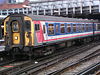 The preferred organisational structure in the 1970s was for the BRB to form wholly owned subsidiaries which were run at an arm's-length relationship, e.g. the railway engineering works became British Rail Engineering Limited
(BREL) in 1970; the ferry operations to Ireland
, France
, Belgium
and the Netherlands
were run by Sealink (U.K.) Ltd, part of the Sealink consortium, which also used ferries owned by the French national railway SNCF
, the Belgian Maritime Transport Authority Regie voor maritiem transport/Regie des transports maritimes (RMT/RTM), and the Dutch Zeeland Steamship Company. However, the BRB was still directly responsible for a multitude of other functions, such as the British Transport Police
, the British Rail Property Board (which was responsible not just for operational track and property, but also for thousands of miles of abandoned tracks and stations arising from the Beeching Axe
and other closure programmes), a staff savings bank, convalescent homes for rail staff, and the internal railway telephone and data comms networks (the largest in the country after British Telecom's), etc.
In 1979 the organisational structure of the BRB's railway operations still largely reflected that of the "Big Four
" private railway companies, which had been merged to create British Railways over 30 years previously. There were five Regions (Scotland being a separate region), each region being formed of several Divisions, and each division of several Areas. There was some duplication of resources in this structure, and in the early 1980s the divisional layer of management was abolished with its work being redistributed either upwards to the regions or downwards to the areas.
The chain of British Transport Hotels
was sold off, mainly one hotel at a time, in 1982; Sealink (UK) Limited was sold in 1984 to Sea Containers Limited, who ultimately sold the routes to their current owner, Stena Line
. In 1988 British Rail Engineering Limited
was split between the major engineering works, which became BREL (1988) Ltd, and the (mostly smaller) works that were used for day-to-day maintenance of rolling stock, which became British Rail Maintenance Limited (BRML).
BREL (1988) Ltd was soon sold to the Swiss-Swedish conglomerate ASEA Brown-Boveri, which renamed the company ABB Transportation. A merger between ABB Transportation and Daimler Benz created ADtranz on 1 January 1996; ADtranz was subsequently taken over by the Canadian-owned conglomerate, Bombardier.
For reasons of efficiency and to reduce the amount of subsidy required from government British Rail undertook a comprehensive organisational restructuring in the late 1980s. The new management structure was based on business sectors rather than geographical regions, and first manifested itself in 1982 with the creation of Railfreight
, the BRB's freight operation, and InterCity
, though the Inter-City branding had been carried on coaching stock since the early 1970s. Commuter services in the south-east came under the London & South East sector, which would become Network SouthEast
in 1986. Services in Scotland were operated by ScotRail
, and Provincial sector handled local and rural routes. The regional management structure continued in parallel for a few years before it was abolished. Sectorisation was generally regarded within the industry as a great success, and it was to have a considerable effect on the way in which privatisation would be carried-out.
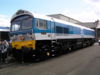 In 1985 what may in retrospect be viewed as the harbinger of private rail operation occurred when the quarry company Foster Yeoman
bought a small number of extremely powerful 3600 hp locomotives from General Motors' Electromotive Division (GM-EMD), designated British Rail Class 59
, to operate mineral trains from their quarry in Wiltshire
. Although owned and maintained by Foster Yeoman, the Class 59s were manned by British Rail staff. During acceptance trials, on 16 February 1986 locomotive 59001 hauled a train weighing 4639 tonne
s – the heaviest load ever hauled by a single non-articulated traction unit. Foster Yeoman's class 59s proved extremely reliable, and it was not long before quarry company ARC and privatised power generator National Power
also bought small numbers of Class 59s to haul their own trains.
Also in 1986, the possibility of breaking up British Rail was explored when discussions were held with Sea Containers Ltd, later the franchise operators of GNER, concerning the possible takeover of the railway on the Isle of Wight
. However, the discussions proved abortive.
In Sweden
in 1988 the State Railways, Statens Järnvägar
, was split into two – Banverket
to control the track network, and SJ
to operate the trains. This was the first time a national railway had been split in this manner, and it allowed local county authorities to tender for local passenger services to be provided by the number of new train operators that appeared. The Swedish system appeared to be very successful initially, although some train operators subsequently went bankrupt, and the Swedish government renationalised its railway system in 2001. The Swedish experiment was watched with great interest in other countries during the 1980s and 1990s.
issued EU Directive 91/440
. This required of all EU member states to separate 'the management of railway operation and infrastructure from the provision of railway transport services, separation of accounts being compulsory and organisational or institutional separation being optional', the idea being that the track operator would charge the train operator a transparent fee to run its trains over the network, and anyone else could also run trains under the same conditions (open access).
In Britain, Margaret Thatcher
was replaced by John Major
as leader of the Conservative Party
at the end of 1990. The Thatcher administration had already sold off nearly all the former state-owned industries, apart from the national rail network. Although the previous Transport Secretary and arch-Thatcherite Cecil Parkinson
had advocated some form of privately or semi-privately operated rail network, this was deemed 'a privatisation too far' by Thatcher herself. In its manifesto for the 1992 General Election
the Conservatives included a commitment to privatise the railways, but were not specific about how this objective was to be achieved. Contrary to opinion polls, they won the election on 9 April 1992 and consequently had to develop a plan to carry out the privatisation before the Railways Bill was published the next year. The management of British Rail strongly advocated privatisation as one entity, a British Rail plc
in effect; Cabinet Minister John Redwood
"argued for regional companies in charge of track and trains" but Prime Minister John Major did not back his view; the Treasury, under the influence of the Adam Smith Institute
think tank
advocated the creation of seven, later 25, passenger railway franchises as a way of maximising revenue. In this instance it was the Treasury view that prevailed.
, although some facilities are exempt from this requirement. Contracts between the principal passenger train operators and the state are called franchise agreements, and were first established with the Office of Passenger Rail Franchising (OPRAF), then its successor the Strategic Rail Authority
and now with the Secretary of State for Transport
.
The passage of the Railways Bill was controversial. The public was unconvinced of the virtues of rail privatisation and there was much lobbying against the Bill. The Labour Party
was implacably opposed to it and promised to renationalise the railways when they got back into office as and when resources allowed. The Conservative chairman of the House of Commons
Transport Committee, Robert Adley
famously described the Bill as "a poll tax
on wheels"; however Adley was known to be a rail enthusiast
and his advice was discounted. Adley died suddenly before the Bill completed its passage through Parliament.
The Railways Bill became the Railways Act 1993
on 5 November 1993, and the organisational structure dictated by it came into effect on 1 April 1994. Initially, British Rail was broken up into various units frequently based on its own organisational sectors (Train Operating Units, Infrastructure Maintenance Units, etc. - for more details see below) still controlled by the British Railways Board, but which were sold off over the next few years.
government (elected in 1997 once almost all of the privatisation process had been completed) did not fulfil its earlier commitment to keep the railways in the public sector. Instead, it left the new structure in place, even completing the privatisation process with the last remaining sales. Its one innovation in the early years was the creation of the Strategic Rail Authority
(SRA), initially in shadow form until the Transport Act 2000 was brought into force on 1 February 2001 and the SRA assumed its full legal powers.
The Labour government always had an unhappy and uncomfortable relationship with the privatised railway industry, never really accepting that the assets and businesses had been sold to the private sector, frequently complaining that as the public subsidy which went into the industry was so large and likely to continue in perpetuity, the government was its principal paymaster and should make or substantially influence all major decisions. The intensity of political intervention came to a head immediately after the Hatfield rail crash
in 2000, when Railtrack imposed over 1200 emergency speed restrictions on its network because it did not know where else on the network the type of metal fatigue - called gauge corner cracking or rolling contact fatigue - which had caused the crash might occur. The politicians intervened, with the Secretary of State for Transport John Prescott
saying that Sir Alastair Morton
, chairman of the Strategic Rail Authority
, would impose a solution. Morton had neither the knowledge nor the powers to do this, and eventually the passenger and freight train operators - who were losing very large sums of money as a result of the severe operational disruption which was taking place - applied to the Rail Regulator
for enforcement action against Railtrack. That action was taken almost immediately and normal network performance was established a few months later.
The aftermath of the Hatfield crash led to severe financial difficulties for Railtrack and just under a year later - on 7 October 2001 - the company was put into railway administration (a special kind of insolvency for railway companies which ensures continuity of operation of railway services) by the British High Court on the application of the then Secretary of State for Transport Stephen Byers
. The circumstances of that step were very controversial (and eventually led to the largest class legal action in English legal history). The administration of Railtrack led to an explosion of costs as the discipline of the company's equity had been lost, and very sharp falls in performance. It lasted for a year; on 2 October 2002 the administration order was discharged and a new organisation, Network Rail
, bought Railtrack PLC from its parent Railtrack Group PLC. Network Rail has no shareholders and is a company limited by guarantee. This new corporate structure for the national railway infrastructure owner satisfied many in the Labour party who thought that a company cannot serve both its shareholders and its customers in a way which facilitates and promotes the public interest. The time had come, they said, to "take back the track". In Parliament on 24 October 2005, Stephen Byers said he "[made] no apology for .. unwinding the Tory privatisation that was Railtrack" (House of Commons, Official Report (Hansard), 24 October 2005, column 66).
Further changes have followed, which have seen the government take back a greater degree of control, but the early demise of the SRA, which was its creation, suggests that the situation is still in flux and the right formula for the long-term health of the rail industry has not yet been found.
As an interesting postscript to the privatisation, in July 2006 the Conservative Party's shadow transport spokesman, Chris Grayling
, admitted that the 1996 split of the rail industry into track and train components was a mistake which had increased costs: "We think, with hindsight, that the complete separation of track and train into separate businesses at the time of privatisation was not right for our railways. We think that the separation has helped push up the cost of running the railways - and hence fares - and is now slowing decisions about capacity improvements. Too many people and organisations are now involved in getting things done - so nothing happens. As a result, the industry lacks clarity about who is in charge and accountable for decisions." .
Some observers — such as the rail journalist and author Christian Wolmar
— argue that the whole idea of separating track from train operations in this way is fundamentally misconceived being based on the model of air transport, where the infrastructure, engineering and operational considerations are entirely different. On this view, the rail/wheel interface is an integral entity at the heart of what makes railways function, and hence the worst possible point at which to make a split, especially on an intensively-worked but multifunctional network such as Britain's.
, who initiated privatisation, are consulting upon options for the future. Several changes have been proposed including a shift to regional operators owning the track and trains for their regions. In their view the separation of track ownership from the service providers has proved a failure, and "the separation has helped push up the cost of running the railways'. Such a shift would represent a return to the old British Rail model, but implemented by non-government organisations and franchise holders. However, critics say that were such a model to be applied to basic rail infrastructure, it would risk replicating the original mistake of the 1993 Railways Act - which fragmented the operation of train services among two dozen different operators. Many of these share infrastructure, and run competing services. Such a plan would be unworkable without the prior consolidation of existing franchises into just a small handful of regional operators.
Before losing power, the Labour Party
planned to reform the existing system, and was reviewing options including a trial re-integration in Scotland. There has been discussion about the extremely high profits the ROSCOs make and proposals that would allow TOCs to own more rolling stock, or even to allow Network Rail to lease some stock. There have also been some market led changes in this area already with TOCs hiring in rolling stock and even locomotives from heritage railway
organisations.
In 2004, the Labour Party Conference voted by 2 to 1 in favour of a TSSA
motion calling on the government to take the TOCs back into public ownership as franchises expired. The policy was however immediately ruled out by the then Transport Secretary Alastair Darling.
EWS has performed studies with Network Rail on the cost of maintenance and as a result is currently pursuing an attempt to persuade the government to allow freight only line maintenance (particularly of the many short lines linking industrial sites) to be derogated from Network Rail control. Based upon analysis performed and on American/Canadian working practices for such freight routes they believe this could halve their maintenance costs. Such an approach would however only be appropriate for freight only routes.
As of January 2011, both the Labour Party and the Conservative Party back the current model of privatised railways, as do the Conservatives' coalition partners, the Liberal Democrats
. The Green Party
calls for renationalisation of the network. Scottish Labour, the Scottish National Party and the Scottish Greens all have advocated for the renationalisation of the current ScotRail contract currently operated by First Group.
Conservative Party (UK)
The Conservative Party, formally the Conservative and Unionist Party, is a centre-right political party in the United Kingdom that adheres to the philosophies of conservatism and British unionism. It is the largest political party in the UK, and is currently the largest single party in the House...
government enacted, on 19 January 1993, the British Coal and British Rail (Transfer Proposals) Act 1993 (c3). This enabled the relevant Secretary of State to issue directions (as to the disposal of holdings) to the relevant Board. This was necessary since (in the case of the British Railways Board) they had to act, at all times, within the rules established by various Transport and Railways Acts – none of which would have allowed the Board to 'sell-off' any of its assets. The subsequent direction from the Secretary of State forced the creation of Railtrack PLC. This then paved the way, later that year for the Railways Act 1993
Railways Act 1993
The Railways Act 1993 was introduced by John Major's Conservative government and passed on 5 November 1993. It provided for the restructuring of the British Railways Board , the public corporation that owned and operated the national railway system...
introduced by John Major
John Major
Sir John Major, is a British Conservative politician, who served as Prime Minister of the United Kingdom and Leader of the Conservative Party from 1990–1997...
's Conservative government. The operations of the British Railways Board
British Railways Board
The British Railways Board was a nationalised industry in the United Kingdom that existed from 1962 to 2001. From its foundation until 1997, it was responsible for most railway services in Great Britain, trading under the brand names British Railways and, from 1965, British Rail...
(BRB) were broken up and sold off. This process was very controversial at the time, and the Labour opposition announced its intention to re-nationalise the railways, although this was not implemented by the subsequent Labour government. The manner in which privatisation was carried out has also received criticism for the number of companies involved (over 20), and its complexity.
Situation in 1979
Historically, the pre-nationalisation railway companies were almost entirely self-sufficient, including, for example, the production of the steel used in the manufacturing of rolling stock and rails. As a consequence of the nationalisation of the railways in 1948 some of these activities had been hived-off to other nationalised industries and institutions, e.g. "Railway Air Services Limited" was one of the forerunners of British AirwaysBritish Airways
British Airways is the flag carrier airline of the United Kingdom, based in Waterside, near its main hub at London Heathrow Airport. British Airways is the largest airline in the UK based on fleet size, international flights and international destinations...
; the railways' road transport services, which had carried freight, parcels and passengers' luggage to and from railheads, ultimately became part of the National Freight Corporation, but not until 1969.
BREL
British Rail Engineering Limited , was the railway systems engineering division of British Rail, until the design and building of trains in the UK was privatised in 1993. On 31 October 1969, the company was incorporated as British Rail Engineering Limited.-Main products:The vast majority of BREL's...
(BREL) in 1970; the ferry operations to Ireland
Ireland
Ireland is an island to the northwest of continental Europe. It is the third-largest island in Europe and the twentieth-largest island on Earth...
, France
France
The French Republic , The French Republic , The French Republic , (commonly known as France , is a unitary semi-presidential republic in Western Europe with several overseas territories and islands located on other continents and in the Indian, Pacific, and Atlantic oceans. Metropolitan France...
, Belgium
Belgium
Belgium , officially the Kingdom of Belgium, is a federal state in Western Europe. It is a founding member of the European Union and hosts the EU's headquarters, and those of several other major international organisations such as NATO.Belgium is also a member of, or affiliated to, many...
and the Netherlands
Netherlands
The Netherlands is a constituent country of the Kingdom of the Netherlands, located mainly in North-West Europe and with several islands in the Caribbean. Mainland Netherlands borders the North Sea to the north and west, Belgium to the south, and Germany to the east, and shares maritime borders...
were run by Sealink (U.K.) Ltd, part of the Sealink consortium, which also used ferries owned by the French national railway SNCF
SNCF
The SNCF , is France's national state-owned railway company. SNCF operates the country's national rail services, including the TGV, France's high-speed rail network...
, the Belgian Maritime Transport Authority Regie voor maritiem transport/Regie des transports maritimes (RMT/RTM), and the Dutch Zeeland Steamship Company. However, the BRB was still directly responsible for a multitude of other functions, such as the British Transport Police
British Transport Police
The British Transport Police is a special police force that polices those railways and light-rail systems in Great Britain for which it has entered into an agreement to provide such services...
, the British Rail Property Board (which was responsible not just for operational track and property, but also for thousands of miles of abandoned tracks and stations arising from the Beeching Axe
Beeching Axe
The Beeching Axe or the Beeching Cuts are informal names for the British Government's attempt in the 1960s to reduce the cost of running British Railways, the nationalised railway system in the United Kingdom. The name is that of the main author of The Reshaping of British Railways, Dr Richard...
and other closure programmes), a staff savings bank, convalescent homes for rail staff, and the internal railway telephone and data comms networks (the largest in the country after British Telecom's), etc.
In 1979 the organisational structure of the BRB's railway operations still largely reflected that of the "Big Four
Big Four British railway companies
The Big Four was a name used to describe the four largest railway companies in the United Kingdom in the period 1923-1947. The name was coined by the Railway Magazine in its issue of February 1923: "The Big Four of the New Railway Era".The Big Four were:...
" private railway companies, which had been merged to create British Railways over 30 years previously. There were five Regions (Scotland being a separate region), each region being formed of several Divisions, and each division of several Areas. There was some duplication of resources in this structure, and in the early 1980s the divisional layer of management was abolished with its work being redistributed either upwards to the regions or downwards to the areas.
1980s developments
The Thatcher administration developed a policy of selling off the nationalised industries into private ownership, or privatisation. As far as the railways were concerned, the government's policy had little effect during the whole period of the Thatcher administration except in relatively small areas, as it was considered that privatising core railway operations would be too difficult.The chain of British Transport Hotels
British Transport Hotels
British Transport Hotels was the brand name of the hotels and catering business associated with the nationalised railway system in Great Britain from 1953 to 1983.- Organisation :...
was sold off, mainly one hotel at a time, in 1982; Sealink (UK) Limited was sold in 1984 to Sea Containers Limited, who ultimately sold the routes to their current owner, Stena Line
Stena Line
Stena Line is one of the world's largest ferry operators, with ferry services serving Scotland, Sweden, Northern Ireland, Denmark, Norway, England, Wales, Ireland, Germany, the Netherlands and Poland. Stena Line is a major unit of Stena AB, itself a part of the Stena Sphere, a grouping of Stena AB,...
. In 1988 British Rail Engineering Limited
BREL
British Rail Engineering Limited , was the railway systems engineering division of British Rail, until the design and building of trains in the UK was privatised in 1993. On 31 October 1969, the company was incorporated as British Rail Engineering Limited.-Main products:The vast majority of BREL's...
was split between the major engineering works, which became BREL (1988) Ltd, and the (mostly smaller) works that were used for day-to-day maintenance of rolling stock, which became British Rail Maintenance Limited (BRML).
BREL (1988) Ltd was soon sold to the Swiss-Swedish conglomerate ASEA Brown-Boveri, which renamed the company ABB Transportation. A merger between ABB Transportation and Daimler Benz created ADtranz on 1 January 1996; ADtranz was subsequently taken over by the Canadian-owned conglomerate, Bombardier.
For reasons of efficiency and to reduce the amount of subsidy required from government British Rail undertook a comprehensive organisational restructuring in the late 1980s. The new management structure was based on business sectors rather than geographical regions, and first manifested itself in 1982 with the creation of Railfreight
Railfreight
Railfreight was a sector of British Rail responsible for all freight operations on the British network. The division was created in 1982 when BR sought to assign particular stock and management to the evolving requirements of freight traffic...
, the BRB's freight operation, and InterCity
InterCity (British Rail)
InterCity was introduced by British Rail in 1966 as a brand-name for its long-haul express passenger services ....
, though the Inter-City branding had been carried on coaching stock since the early 1970s. Commuter services in the south-east came under the London & South East sector, which would become Network SouthEast
Network SouthEast
Network SouthEast was one of three passenger sectors of British Rail created in 1982. NSE principally operated commuter trains in the London area and inter-urban services in densely populated South East England, although the network reached as far west as Exeter...
in 1986. Services in Scotland were operated by ScotRail
ScotRail
ScotRail was a brand name used for all Scottish regional and commuter rail services, including some cross-border services, from 1997 to 2004....
, and Provincial sector handled local and rural routes. The regional management structure continued in parallel for a few years before it was abolished. Sectorisation was generally regarded within the industry as a great success, and it was to have a considerable effect on the way in which privatisation would be carried-out.
Foster Yeoman
Foster Yeoman Limited, based in the United Kingdom, is one of Europe's largest quarrying and asphalt companies, owned by Swiss construction materials conglomerate Holcim.-Company history:...
bought a small number of extremely powerful 3600 hp locomotives from General Motors' Electromotive Division (GM-EMD), designated British Rail Class 59
British Rail Class 59
The Class 59 Co-Co diesel locomotives were built and introduced between 1985 and 1995 by Electro-Motive Division of General Motors for private British companies, initially Foster Yeoman...
, to operate mineral trains from their quarry in Wiltshire
Wiltshire
Wiltshire is a ceremonial county in South West England. It is landlocked and borders the counties of Dorset, Somerset, Hampshire, Gloucestershire, Oxfordshire and Berkshire. It contains the unitary authority of Swindon and covers...
. Although owned and maintained by Foster Yeoman, the Class 59s were manned by British Rail staff. During acceptance trials, on 16 February 1986 locomotive 59001 hauled a train weighing 4639 tonne
Tonne
The tonne, known as the metric ton in the US , often put pleonastically as "metric tonne" to avoid confusion with ton, is a metric system unit of mass equal to 1000 kilograms. The tonne is not an International System of Units unit, but is accepted for use with the SI...
s – the heaviest load ever hauled by a single non-articulated traction unit. Foster Yeoman's class 59s proved extremely reliable, and it was not long before quarry company ARC and privatised power generator National Power
National Power
- History :National Power was formed following the privatisation of the UK electricity market in 1990. In England and Wales the Central Electricity Generating Board, which was responsible for the generation and transmission of electricity was split into three generating companies Powergen, National...
also bought small numbers of Class 59s to haul their own trains.
Also in 1986, the possibility of breaking up British Rail was explored when discussions were held with Sea Containers Ltd, later the franchise operators of GNER, concerning the possible takeover of the railway on the Isle of Wight
Isle of Wight
The Isle of Wight is a county and the largest island of England, located in the English Channel, on average about 2–4 miles off the south coast of the county of Hampshire, separated from the mainland by a strait called the Solent...
. However, the discussions proved abortive.
In Sweden
Sweden
Sweden , officially the Kingdom of Sweden , is a Nordic country on the Scandinavian Peninsula in Northern Europe. Sweden borders with Norway and Finland and is connected to Denmark by a bridge-tunnel across the Öresund....
in 1988 the State Railways, Statens Järnvägar
Statens Järnvägar
The Swedish State Railways or SJ, originally the Royal Railway Board , is a former government agency responsible for operating the state railways in Sweden....
, was split into two – Banverket
Banverket
The Swedish Rail Administration was a government agency that owned and maintained virtually all railway lines in Sweden except many short sidings for freight only. It was formed in 1988 when Statens Järnvägar was split, leaving Statens Järnvägar as mainly a train operator and real estate owner,...
to control the track network, and SJ
SJ AB
SJ is a government-owned passenger train operator in Sweden. SJ was created in 2000, out of the public transport division of Statens Järnvägar, when the former government agency was divided into six separate government-owned limited companies.-Overview:SJ's operations fall broadly into subsidised...
to operate the trains. This was the first time a national railway had been split in this manner, and it allowed local county authorities to tender for local passenger services to be provided by the number of new train operators that appeared. The Swedish system appeared to be very successful initially, although some train operators subsequently went bankrupt, and the Swedish government renationalised its railway system in 2001. The Swedish experiment was watched with great interest in other countries during the 1980s and 1990s.
The move to privatisation
In 1991, following the apparently successful Swedish example and wishing to create an environment where new rail operators could enter the market, the European UnionEuropean Union
The European Union is an economic and political union of 27 independent member states which are located primarily in Europe. The EU traces its origins from the European Coal and Steel Community and the European Economic Community , formed by six countries in 1958...
issued EU Directive 91/440
EU Directive 91/440
The EU Directive 91/440 is European Union legislation that sets out a framework and requirements for railways in the EU to allow open access operations on railway lines by companies other than those that own the rail infrastructure...
. This required of all EU member states to separate 'the management of railway operation and infrastructure from the provision of railway transport services, separation of accounts being compulsory and organisational or institutional separation being optional', the idea being that the track operator would charge the train operator a transparent fee to run its trains over the network, and anyone else could also run trains under the same conditions (open access).
In Britain, Margaret Thatcher
Margaret Thatcher
Margaret Hilda Thatcher, Baroness Thatcher, was Prime Minister of the United Kingdom from 1979 to 1990...
was replaced by John Major
John Major
Sir John Major, is a British Conservative politician, who served as Prime Minister of the United Kingdom and Leader of the Conservative Party from 1990–1997...
as leader of the Conservative Party
Conservative Party (UK)
The Conservative Party, formally the Conservative and Unionist Party, is a centre-right political party in the United Kingdom that adheres to the philosophies of conservatism and British unionism. It is the largest political party in the UK, and is currently the largest single party in the House...
at the end of 1990. The Thatcher administration had already sold off nearly all the former state-owned industries, apart from the national rail network. Although the previous Transport Secretary and arch-Thatcherite Cecil Parkinson
Cecil Parkinson
Cecil Parkinson, Baron Parkinson, PC , is a British Conservative politician and former Cabinet Minister.-Early life:...
had advocated some form of privately or semi-privately operated rail network, this was deemed 'a privatisation too far' by Thatcher herself. In its manifesto for the 1992 General Election
United Kingdom general election, 1992
The United Kingdom general election of 1992 was held on 9 April 1992, and was the fourth consecutive victory for the Conservative Party. This election result was one of the biggest surprises in 20th Century politics, as polling leading up to the day of the election showed Labour under leader Neil...
the Conservatives included a commitment to privatise the railways, but were not specific about how this objective was to be achieved. Contrary to opinion polls, they won the election on 9 April 1992 and consequently had to develop a plan to carry out the privatisation before the Railways Bill was published the next year. The management of British Rail strongly advocated privatisation as one entity, a British Rail plc
Public limited company
A public limited company is a limited liability company that sells shares to the public in United Kingdom company law, in the Republic of Ireland and Commonwealth jurisdictions....
in effect; Cabinet Minister John Redwood
John Redwood
John Alan Redwood is a British Conservative Party politician and Member of Parliament for Wokingham. He was formerly Secretary of State for Wales in Prime Minister John Major's Cabinet and was an unsuccessful challenger for the leadership of the Conservative Party in 1995...
"argued for regional companies in charge of track and trains" but Prime Minister John Major did not back his view; the Treasury, under the influence of the Adam Smith Institute
Adam Smith Institute
The Adam Smith Institute, abbreviated to ASI, is a think tank based in the United Kingdom, named after one of the founders of modern economics, Adam Smith. It espouses free market and classical liberal views, in particular by creating radical policy options in the light of public choice theory,...
think tank
Think tank
A think tank is an organization that conducts research and engages in advocacy in areas such as social policy, political strategy, economics, military, and technology issues. Most think tanks are non-profit organizations, which some countries such as the United States and Canada provide with tax...
advocated the creation of seven, later 25, passenger railway franchises as a way of maximising revenue. In this instance it was the Treasury view that prevailed.
The Railways Act 1993
The Railways Bill, published in 1993, established a complex structure for the rail industry. British Rail was to be broken up into over 100 separate companies, with most relationships between the successor companies established by contracts, some through regulatory mechanisms (such as the industry-wide network code and the multi-bilateral star model performance regime). Contracts for the use of railway facilities - track, stations and light maintenance depots - must be approved or directed by the Office of Rail RegulationOffice of Rail Regulation
The Office of Rail Regulation is a statutory board which is the combined economic and safety regulatory authority for Great Britain's railway network. It was established on 5 July 2004 by the Railways and Transport Safety Act 2003, replacing the Rail Regulator...
, although some facilities are exempt from this requirement. Contracts between the principal passenger train operators and the state are called franchise agreements, and were first established with the Office of Passenger Rail Franchising (OPRAF), then its successor the Strategic Rail Authority
Strategic Rail Authority
In existence from 2001 to 2006, the Strategic Rail Authority was a non-departmental public body in the United Kingdom set up under the Transport Act 2000 to provide strategic direction for the railway industry....
and now with the Secretary of State for Transport
Secretary of State for Transport
The Secretary of State for Transport is the member of the cabinet responsible for the British Department for Transport. The role has had a high turnover as new appointments are blamed for the failures of decades of their predecessors...
.
The passage of the Railways Bill was controversial. The public was unconvinced of the virtues of rail privatisation and there was much lobbying against the Bill. The Labour Party
Labour Party (UK)
The Labour Party is a centre-left democratic socialist party in the United Kingdom. It surpassed the Liberal Party in general elections during the early 1920s, forming minority governments under Ramsay MacDonald in 1924 and 1929-1931. The party was in a wartime coalition from 1940 to 1945, after...
was implacably opposed to it and promised to renationalise the railways when they got back into office as and when resources allowed. The Conservative chairman of the House of Commons
British House of Commons
The House of Commons is the lower house of the Parliament of the United Kingdom, which also comprises the Sovereign and the House of Lords . Both Commons and Lords meet in the Palace of Westminster. The Commons is a democratically elected body, consisting of 650 members , who are known as Members...
Transport Committee, Robert Adley
Robert Adley
Robert James Adley was a Conservative Party politician in the United Kingdom and railway enthusiast.Adley was educated at Uppingham School and would become a company director. In the 1970s Adley was part-time Marketing Director for Holiday Inn...
famously described the Bill as "a poll tax
Poll tax
A poll tax is a tax of a portioned, fixed amount per individual in accordance with the census . When a corvée is commuted for cash payment, in effect it becomes a poll tax...
on wheels"; however Adley was known to be a rail enthusiast
Railfan
A railfan or rail buff , railway enthusiast or railway buff , or trainspotter , is a person interested in a recreational capacity in rail transport...
and his advice was discounted. Adley died suddenly before the Bill completed its passage through Parliament.
The Railways Bill became the Railways Act 1993
Railways Act 1993
The Railways Act 1993 was introduced by John Major's Conservative government and passed on 5 November 1993. It provided for the restructuring of the British Railways Board , the public corporation that owned and operated the national railway system...
on 5 November 1993, and the organisational structure dictated by it came into effect on 1 April 1994. Initially, British Rail was broken up into various units frequently based on its own organisational sectors (Train Operating Units, Infrastructure Maintenance Units, etc. - for more details see below) still controlled by the British Railways Board, but which were sold off over the next few years.
Organisational structure created by the Railways Act 1993
The original privatisation structure, created over the three years from 1 April 1994, consisted of:- Infrastructure Owner: RailtrackRailtrackRailtrack was a group of companies that owned the track, signalling, tunnels, bridges, level crossings and all but a handful of the stations of the British railway system from its formation in April 1994 until 2002...
took over ownership of all track, signalling and stations. Railtrack let out most of the 2509 stations to the franchised passenger train operators, managing only a handful (12, later 17) of the largest city termini itself; maintenance and renewal of the infrastructure was also contracted out to British Rail Infrastructure Services, leaving Railtrack's directly-employed staff consisting mostly of signallers. In the original privatisation plan, Railtrack would have been the last part of British Rail to be sold, but with the approach of a General Election in 1997United Kingdom general election, 1997The United Kingdom general election, 1997 was held on 1 May 1997, more than five years after the previous election on 9 April 1992, to elect 659 members to the British House of Commons. The Labour Party ended its 18 years in opposition under the leadership of Tony Blair, and won the general...
at which the Conservatives faced almost certain defeat, Railtrack was hastily privatised in May 1996 in an attempt to ensure that the new structure could not be reversed. - Regulation: The Rail RegulatorRail RegulatorThe Rail Regulator was a statutory office, created with effect from 1 December 1993 by section 1 of the Railways Act 1993, for the independent economic regulation of the British railway industry....
(the statutory officer at the head of the Office of the Rail Regulator (ORR)) was established to regulate the monopoly and dominant elements of the railway industry, and to police certain consumer protection conditions of operators' licences. He did this through his powers to supervise and control the consumption of capacity of railway facilities (his approval was needed before an access contract for the use of track, stations or certain maintenance facilities could be valid), to enforce domestic competition law, to issue, modify and enforce operating licences and to supervise the development of certain industry-wide codes, the most important of which is the network code. Probably the Rail Regulator's most significant power was the establishment , usually every five years, of the financial framework in which Railtrack (now Network Rail) operates, through the carrying out of access charges reviews. This settled the structure and level of access charges which the infrastructure provider is entitled to charge train operators for the operation, maintenance, renewal and enhancement of the national railway network. ORR's role only covered economic regulation; safety regulation remained the responsibility of the Health and Safety ExecutiveHealth and Safety ExecutiveThe Health and Safety Executive is a non-departmental public body in the United Kingdom. It is the body responsible for the encouragement, regulation and enforcement of workplace health, safety and welfare, and for research into occupational risks in England and Wales and Scotland...
, but that position changed in 2005 when safety regulation was transferred to ORR under the Railways Act 2005Railways Act 2005The Railways Act 2005 is an Act of the Parliament of the United Kingdom concerning the regulatory structure for railways in the United Kingdom.- Overview :...
. The first Rail Regulator was John Swift QCJohn Swift QCJohn Swift QC is an English barrister and a leading authority on competition law.- Rail regulation :From December 1, 1993 until November 30, 1998, Swift was Rail Regulator and International Rail Regulator, having been appointed to those posts by Conservative politician and Secretary of State for... - Franchising: The Director of Passenger Rail FranchisingDirector of Passenger Rail FranchisingThe Director of Passenger Rail Franchising is a statutory office created in 1993 by the Railways Act 1993 and usually called the Franchising Director...
took responsibility for organising the franchising process to transfer the 25 passenger train operators to the private sector and then develop the refranchising programme for the future. The first round of franchising was based solely on the lowest cost bidder wins. The first Director of Passenger Rail Franchising was Roger Salmon. - Passenger Train Operators: 25 passenger train operating units (TOUs), converted to Train Operating Companies (TOCs) shortly before each was privatised, split by geographical area and service type. This meant that, for example, a major city terminus would be served by an ex-InterCity TOC and one or more local commuter TOCs, with consequent competition for train paths into and out of the stations, which had to be resolved by Railtrack and the Rail Regulator. The TOCs owned virtually nothing, hiring most of the assets required from Railtrack and the ROSCOs and contracting suppliers to undertake heavy maintenance on the trains or provide onboard catering. (The special adviser to the UK chancellor of the exchequerChancellor of the ExchequerThe Chancellor of the Exchequer is the title held by the British Cabinet minister who is responsible for all economic and financial matters. Often simply called the Chancellor, the office-holder controls HM Treasury and plays a role akin to the posts of Minister of Finance or Secretary of the...
, Ms Shriti Vadera, memorably described the privatised passenger train operating companies as "thinly-capitalised equity profiteers of the worst kind", a phrase which betrayed a disdain which was intensified when it came to the collapse of Railtrack in October 2001.) - Train Owners: 3 Rolling Stock Leasing Companies (ROSCOs), Angel TrainsAngel TrainsAngel Trains is an English Rolling Stock Operating Company created in 1994 as part of the privatisation of British Rail. It was one of three ROSCOs...
, Porterbrook Leasing, and Eversholt Trains (later HSBC RailHSBC RailEversholt Rail Group is one of the three major ROSCOs in the United Kingdom...
), which were allocated all of British Rail's passenger coaches, locomotives, and multiple units. Freight locomotives and wagons were owned by the freight train operators. - Freight Train Operators: 6 Freight Operating Companies (FOCs), including three geographical units for trainload freight (Mainline FreightMainline FreightMainline Freight was a trainload railfreight operator based in Islington, London England with operations extending to Yorkshire in the north and Somerset in the west...
in the south-east, Load-HaulLoad-HaulLoadhaul Ltd. was a railfreight operator based in the north-east of the United Kingdom. It was formed in 1994, prior to the privatisation of British Rail...
in the north-east, and Trans-RailTrans-RailTransrail Freight Ltd. was a trainload railfreight operator based in South West England, Wales, the North West and Scotland. It was formed in 1994 prior to the privatisation of British Rail...
in the west), Railfreight DistributionRailfreight DistributionRailfreight Distribution was a subsector of British Rail created by the division in 1987 of British Rail's previous Railfreight sector. It was responsible for non-trainload freight operations, as well as Freightliner and Intermodal services. In its early years the division was occasionally...
(international and wagonload trains), Freightliner (UK)Freightliner (UK)Freightliner Group Limited is a rail freight and logistics company, founded in 1995 and now operating in the United Kingdom, Poland, and Australia. It is the second largest rail freight operator in the UK, after DB Schenker Rail .- History :...
(container-carrying trains) and Rail Express SystemsRail Express SystemsUpon the sectorisation of British Rail during the 1980s the Parcels Sector was created. In 1991 this was rebranded Rail Express Systems. The Rail Express Systems launch event was held at Crewe Diesel Depot in October 1991. For this event examples of Class 08, 47, 86 & 90 locomotives were painted...
(parcels and mail trains). - Infrastructure Maintenance and Renewal: British Rail Infrastructure Services (BRIS), which took responsibility for the engineering requirements of the railway. BRIS was subsequently organised for privatisation on the basis of 7 Infrastructure Maintenance Units (IMUs), which maintained the railway, and 6 Track Renewal Units (TRUs), which replaced rail lines, both organised geographically.
- Specialist Companies: A variety of other companies created to undertake specific functions, including European Passenger Services (to operate the UK part of the EurostarEurostarEurostar is a high-speed railway service connecting London with Paris and Brussels. All its trains traverse the Channel Tunnel between England and France, owned and operated separately by Eurotunnel....
service) and Union Railways (to implement the High Speed 1 construction project).
Privatisation under the New Labour government
The New LabourLabour Party (UK)
The Labour Party is a centre-left democratic socialist party in the United Kingdom. It surpassed the Liberal Party in general elections during the early 1920s, forming minority governments under Ramsay MacDonald in 1924 and 1929-1931. The party was in a wartime coalition from 1940 to 1945, after...
government (elected in 1997 once almost all of the privatisation process had been completed) did not fulfil its earlier commitment to keep the railways in the public sector. Instead, it left the new structure in place, even completing the privatisation process with the last remaining sales. Its one innovation in the early years was the creation of the Strategic Rail Authority
Strategic Rail Authority
In existence from 2001 to 2006, the Strategic Rail Authority was a non-departmental public body in the United Kingdom set up under the Transport Act 2000 to provide strategic direction for the railway industry....
(SRA), initially in shadow form until the Transport Act 2000 was brought into force on 1 February 2001 and the SRA assumed its full legal powers.
The Labour government always had an unhappy and uncomfortable relationship with the privatised railway industry, never really accepting that the assets and businesses had been sold to the private sector, frequently complaining that as the public subsidy which went into the industry was so large and likely to continue in perpetuity, the government was its principal paymaster and should make or substantially influence all major decisions. The intensity of political intervention came to a head immediately after the Hatfield rail crash
Hatfield rail crash
The Hatfield rail crash was a railway accident on 17 October 2000, at Hatfield, Hertfordshire, UK. Although the accident killed fewer than other accidents, Hatfield exposed the major stewardship shortcomings of the privatised national railway infrastructure company Railtrack and the failings of...
in 2000, when Railtrack imposed over 1200 emergency speed restrictions on its network because it did not know where else on the network the type of metal fatigue - called gauge corner cracking or rolling contact fatigue - which had caused the crash might occur. The politicians intervened, with the Secretary of State for Transport John Prescott
John Prescott
John Leslie Prescott, Baron Prescott is a British politician who was Deputy Prime Minister of the United Kingdom from 1997 to 2007. Born in Prestatyn, Wales, he represented Hull East as the Labour Member of Parliament from 1970 to 2010...
saying that Sir Alastair Morton
Alastair Morton
Sir Alastair Morton was Chief Executive of Eurotunnel and Chairman of the Strategic Rail Authority and an industrialist of considerable achievements and renown....
, chairman of the Strategic Rail Authority
Strategic Rail Authority
In existence from 2001 to 2006, the Strategic Rail Authority was a non-departmental public body in the United Kingdom set up under the Transport Act 2000 to provide strategic direction for the railway industry....
, would impose a solution. Morton had neither the knowledge nor the powers to do this, and eventually the passenger and freight train operators - who were losing very large sums of money as a result of the severe operational disruption which was taking place - applied to the Rail Regulator
Rail Regulator
The Rail Regulator was a statutory office, created with effect from 1 December 1993 by section 1 of the Railways Act 1993, for the independent economic regulation of the British railway industry....
for enforcement action against Railtrack. That action was taken almost immediately and normal network performance was established a few months later.
The aftermath of the Hatfield crash led to severe financial difficulties for Railtrack and just under a year later - on 7 October 2001 - the company was put into railway administration (a special kind of insolvency for railway companies which ensures continuity of operation of railway services) by the British High Court on the application of the then Secretary of State for Transport Stephen Byers
Stephen Byers
Stephen John Byers is a British Labour Party politician who was the Member of Parliament for North Tyneside from 1997 to 2010; in the previous parliament, from 1992, he represented Wallsend...
. The circumstances of that step were very controversial (and eventually led to the largest class legal action in English legal history). The administration of Railtrack led to an explosion of costs as the discipline of the company's equity had been lost, and very sharp falls in performance. It lasted for a year; on 2 October 2002 the administration order was discharged and a new organisation, Network Rail
Network Rail
Network Rail is the government-created owner and operator of most of the rail infrastructure in Great Britain .; it is not responsible for railway infrastructure in Northern Ireland...
, bought Railtrack PLC from its parent Railtrack Group PLC. Network Rail has no shareholders and is a company limited by guarantee. This new corporate structure for the national railway infrastructure owner satisfied many in the Labour party who thought that a company cannot serve both its shareholders and its customers in a way which facilitates and promotes the public interest. The time had come, they said, to "take back the track". In Parliament on 24 October 2005, Stephen Byers said he "[made] no apology for .. unwinding the Tory privatisation that was Railtrack" (House of Commons, Official Report (Hansard), 24 October 2005, column 66).
Further changes have followed, which have seen the government take back a greater degree of control, but the early demise of the SRA, which was its creation, suggests that the situation is still in flux and the right formula for the long-term health of the rail industry has not yet been found.
As an interesting postscript to the privatisation, in July 2006 the Conservative Party's shadow transport spokesman, Chris Grayling
Chris Grayling
Christopher Stephen "Chris" Grayling, PC, MP , is a British politician. A member of the Conservative Party, he served in the Shadow Cabinet from 2005 to 2010 and was the party's Shadow Home Secretary from 2009 to 2010. Following the 2010 general election, he was appointed a Minister of State in the...
, admitted that the 1996 split of the rail industry into track and train components was a mistake which had increased costs: "We think, with hindsight, that the complete separation of track and train into separate businesses at the time of privatisation was not right for our railways. We think that the separation has helped push up the cost of running the railways - and hence fares - and is now slowing decisions about capacity improvements. Too many people and organisations are now involved in getting things done - so nothing happens. As a result, the industry lacks clarity about who is in charge and accountable for decisions." .
Changes to the structure since the Railways Act 1993
Since 1997, considerable changes have taken place to the original structure of privatisation, of which very little is left unaltered. The principal changes are as follows:- Infrastructure Owner: Railtrack was placed into railway administration on 7 October 2001 and, the following year, its functions as the track owner were taken over by Network RailNetwork RailNetwork Rail is the government-created owner and operator of most of the rail infrastructure in Great Britain .; it is not responsible for railway infrastructure in Northern Ireland...
, which is a company limited by guaranteeCompany limited by guaranteeIn British and Irish company law, a private company limited by guarantee is an alternative type of corporation used primarily for non-profit organisations that require legal personality. A guarantee company does not usually have a share capital or shareholders, but instead has members who act as...
, nominally in the private sector but with members instead of shareholders and its borrowing guaranteed by the government. - Regulation: ORR has been renamed the Office of Rail Regulation and the Rail Regulator replaced by a board in line with changes to the regulation of other privatised industries. ORR has also been given the responsibility for safety regulation which was previously the remit of the Health and Safety ExecutiveHealth and Safety ExecutiveThe Health and Safety Executive is a non-departmental public body in the United Kingdom. It is the body responsible for the encouragement, regulation and enforcement of workplace health, safety and welfare, and for research into occupational risks in England and Wales and Scotland...
. The last Rail Regulator was Tom WinsorTom WinsorTom Winsor is a British lawyer and economic regulatory professional who was, from 5 July 1999 until 4 July 2004, the Rail Regulator and International Rail Regulator for Great Britain. He is a partner in international law firm White & Case LLP...
whose powers to decide how much money the Government should spend on Railways were resented by many in Whitehall. As a result the ORR, presently chaired by Chris BoltChris BoltChristopher Bolt Born Oct 16 1982 in Monrovia CA. Interests are bmx,fmx, welding - Railways :In 1994, Bolt moved to the Office of the Rail Regulator to take up appointment as chief economist...
has substantially less powers than Winsor enjoyed. - Franchising: OPRAF was replaced by the Strategic Rail AuthorityStrategic Rail AuthorityIn existence from 2001 to 2006, the Strategic Rail Authority was a non-departmental public body in the United Kingdom set up under the Transport Act 2000 to provide strategic direction for the railway industry....
, whose remit also included the promotion of freight services. The SRA has since been wound up and its franchising functions passed to the Department for TransportDepartment for TransportIn the United Kingdom, the Department for Transport is the government department responsible for the English transport network and a limited number of transport matters in Scotland, Wales and Northern Ireland which are not devolved...
. The most recent rounds of franchising have considered the planned improvements and previous good service delivery of bidders as well as the cost element. As part of the devolution process since 1997, the Scottish ExecutiveScottish ExecutiveThe Scottish Government is the executive arm of the devolved government of Scotland. It was established in 1999 as the Scottish Executive, from the extant Scottish Office, and the term Scottish Executive remains its legal name under the Scotland Act 1998...
has been given a greater role in determining the franchising of ScotRailScotRailScotRail was a brand name used for all Scottish regional and commuter rail services, including some cross-border services, from 1997 to 2004....
, the Welsh Assembly GovernmentWelsh Assembly GovernmentThe Welsh Government is the devolved government of Wales. It is accountable to the National Assembly for Wales, the legislature which represents the interests of the people of Wales and makes laws for Wales...
is a co-signatory of the Wales and Borders franchise, Merseytravel (the Merseyside Passenger Transport Authority) is responsible for MerseyrailMerseyrailMerseyrail is a train operating company and commuter rail network in the United Kingdom, centred on Liverpool, Merseyside. The network is predominantly electric with diesel trains running on the City Line. Two City Line branches are currently being electrified on the overhead wire AC system with...
, and the Mayor of London has some input in decisions on rail services in the Greater London area. - Passenger Train Operators: The number of passenger franchises has been reduced and further amalgamations are planned. Many of the franchises have changed hands between private sector operators and one, Southeastern (train operating company)Southeastern (train operating company)London & South Eastern Railway Limited, trading as Southeastern is a train operating company in south-east England. On 1 April 2006 it became the franchisee for the new Integrated Kent Franchise , replacing the publicly owned South Eastern Trains on the former South East Franchise...
, has been operated in the public sector after Connex was removed from control by the SRA and before a new private sector operator could be appointed. However, two new open access operators have appeared to run new services; Heathrow ExpressHeathrow ExpressHeathrow Express is an airport rail link from London Heathrow Airport to London Paddington station in London operated by the Heathrow Express Operating Authority, a wholly owned subsidiary of BAA. It was opened by the then Prime Minister Tony Blair in 1998...
and Hull Trains. A third, Grand Central Railway was due to start operating in December 2006, but suffered delays, including franchised operator GNER taking the Rail Regulator to Court over his decision to grant access rights. In September 2007, the Office of Rail RegulationOffice of Rail RegulationThe Office of Rail Regulation is a statutory board which is the combined economic and safety regulatory authority for Great Britain's railway network. It was established on 5 July 2004 by the Railways and Transport Safety Act 2003, replacing the Rail Regulator...
granted track access rights under Section 17 of the Railways Act 1993 to Wrexham, Shropshire and Marylebone Railway Company Limited (known as Wrexham & Shropshire) to run 5 trains a day between London Marylebone and WrexhamWrexhamWrexham is a town in Wales. It is the administrative centre of the wider Wrexham County Borough, and the largest town in North Wales, located in the east of the region. It is situated between the Welsh mountains and the lower Dee Valley close to the border with Cheshire, England...
, although there were conditions attached to the right to call at Wolverhampton. Other applications by potential open access operators have been turned down by ORR, but a number of new open access operations are waiting in the wings and may materialise in the near future. - Freight Train Operators: Despite going to the expense of setting up separate management structures for the three parts of the trainload freight sector, on 24 February 1996 all three units were sold to "North & South Railways", a subsidiary of the AmericanUnited StatesThe United States of America is a federal constitutional republic comprising fifty states and a federal district...
Wisconsin CentralWisconsin Central TransportationWisconsin Central Ltd. is a railroad subsidiary of the Canadian National Railway. At one time, its parent Wisconsin Central Transportation Corporation owned or operated railroads in the United States, Canada , the United Kingdom , New Zealand , and Australia .- Overview...
Railroad, which soon renamed the operation English, Welsh and Scottish Railway. EWS also acquired Rail Express SystemsRail Express SystemsUpon the sectorisation of British Rail during the 1980s the Parcels Sector was created. In 1991 this was rebranded Rail Express Systems. The Rail Express Systems launch event was held at Crewe Diesel Depot in October 1991. For this event examples of Class 08, 47, 86 & 90 locomotives were painted...
, Railfreight DistributionRailfreight DistributionRailfreight Distribution was a subsector of British Rail created by the division in 1987 of British Rail's previous Railfreight sector. It was responsible for non-trainload freight operations, as well as Freightliner and Intermodal services. In its early years the division was occasionally...
(the last part of the nationalised railway to be sold, after Labour had been elected) and National PowerNational Power- History :National Power was formed following the privatisation of the UK electricity market in 1990. In England and Wales the Central Electricity Generating Board, which was responsible for the generation and transmission of electricity was split into three generating companies Powergen, National...
's railfreight operation. EWS was bought by Deutsche BahnDeutsche BahnDeutsche Bahn AG is the German national railway company, a private joint stock company . Headquartered in Berlin, it came into existence in 1994 as the successor to the former state railways of Germany, the Deutsche Bundesbahn of West Germany and the Deutsche Reichsbahn of East Germany...
in 2007 and is thus effectively now state owned - but by the German rather than United Kingdom state. Current freight train operators other than EWS include Freightliner (UK)Freightliner (UK)Freightliner Group Limited is a rail freight and logistics company, founded in 1995 and now operating in the United Kingdom, Poland, and Australia. It is the second largest rail freight operator in the UK, after DB Schenker Rail .- History :...
(purchased by a management buyout) and two open access freight operators: Direct Rail ServicesDirect Rail ServicesDirect Rail Services is a freight operating company created by British Nuclear Fuels Limited. The company started rail operations in 1995 using five heavily refurbished Class 20/3 diesel locomotives. Since then it has expanded greatly, and has acquired many more locomotives, most bought...
and FirstGBRf. - Train Owners: The three ROSCOs continue to exist as originally established, the only part of the privatised railway to remain unchanged, although some now lease freight locomotives and wagons to the FOCs. They have been joined by a variety of small-scale train owners ready to let old railway stock on short-term leases, including FM RailFM RailFM Rail Limited was a railway spot-hire and charter company based at Derby, United Kingdom. The company was formed in January 2005 following the merging of spot-hire company Fragonset Railways Limited with charter train operating company Merlin Rail Limited...
, Harry Needle Railroad CompanyHarry Needle Railroad CompanyThe Harry Needle Railroad Company is a railway spot-hire company, based at Barrow Hill Engine Shed in Derbyshire. The company is also a scrap dealer and has dismantled many railway vehicles, either on site, or at the European Metal Recycling scrapyard in...
and West Coast Railway CompanyWest Coast Railway CompanyWest Coast Railways, also known as West Coast Railway Company, is a railway spot-hire company and charter train operator, based at Carnforth in Lancashire, on the site of the old Steamtown heritage depot...
. Also, Railtrack and Network Rail have purchased some rolling stock themselves. - Infrastructure Maintenance and Renewal: In 2004 infrastructure maintenance, (Track, Signal, and OHLE), was taken back 'in-house' by Network Rail, but track renewal remains contracted out to the private sector.
- Specialist Companies: After Union Railways ran into trouble with the construction of the CTRL, it was rescued by Railtrack.
Effects of privatisation
There is considerable debate around the effect of railway privatisation, especially since the structure now in place is considerably different from that originally envisaged at the time of the Railways Act 1993. Some of the most common arguments for and against are:- Customer Service: Privatisation was supposed to bring improved customer service and many rail lines have seen improvements in this field with better on-board and station services. In the early years, however, customer service was dented when too many drivers were given voluntary redundancy by the new TOCs and trains had to be cancelled. Also, the impact of the Hatfield rail accident in 2000Hatfield rail crashThe Hatfield rail crash was a railway accident on 17 October 2000, at Hatfield, Hertfordshire, UK. Although the accident killed fewer than other accidents, Hatfield exposed the major stewardship shortcomings of the privatised national railway infrastructure company Railtrack and the failings of...
left services seriously affected for many months after. - Fares and Timetable: In an attempt to protect passengers' interests, certain fares (mostly commuter season fares) and basic elements of the timetable were regulated. However, the TOCs still had quite a bit of latitude in changing unregulated fares and could change the number of trains run within certain regulatory and practical limitations. While average fare prices have changed little since privatisation, this masks substantial changes. Although the price of commuter season tickets has fallen in real terms, many unregulated fares have increased as demand levels shifted, particularly 'walk-on' fares on inter-urban routes where operators have urged passengers to use the cheaper 'advance purchase' tickets. In fact, this has become so common that Virgin Trains now charge £219 for a standard open return ticket between Manchester and London, a journey of only 200 miles each way. So far as the timetable is concerned, many more trains are being run each day than under BR as operators have tried to run more frequent, but usually shorter, trains on many routes to attract more customers.
- New Trains: The promoters of privatisation expected that the ROSCOs would compete against each other to provide the TOCs with the rolling stock they required. In practice, in most cases the individual TOCs required specific classes of trains to run their services, and often only one of the ROSCOs would have that class of train, resulting in their having to pay whatever the ROSCO concerned cared to charge for leasing the trains. Old rolling stock was extremely profitable to the ROSCOs, as they were able to charge substantial amounts for their hire even though British Rail had already written off their construction costs. As trains grow older, the cost of their lease does not decrease. This was due to the adoption of 'indifference pricingIndifference priceIn finance, indifference pricing is a method of pricing financial securities with regards to a utility function. Also known as the reservation price or private valuation. Particularly the indifference price is the price that an agent would have the same expected utility level between exercising a...
' as the method of determining lease costs by the government, which was intended to make purchasing new trains more attractive when compared to running life-expired trains. In practice, the average age of trains in the UK is no different to that under the last years of BR. - Rolling Stock Manufacture The rolling stock manufacturers themselves suffered under privatisation; with the hiatus in new orders for new trains caused by the reorganisation and restructuring process, the former BREL works at YorkYorkYork is a walled city, situated at the confluence of the Rivers Ouse and Foss in North Yorkshire, England. The city has a rich heritage and has provided the backdrop to major political events throughout much of its two millennia of existence...
(now owned by ABB) had been severely downsized and eventually closed. The former Metro CammellMetro CammellThe Metropolitan Cammell Carriage and Wagon Company was a Birmingham, England based manufacturer of railway carriages and wagons, based in Saltley and subsequently Washwood Heath....
plant in BirminghamBirminghamBirmingham is a city and metropolitan borough in the West Midlands of England. It is the most populous British city outside the capital London, with a population of 1,036,900 , and lies at the heart of the West Midlands conurbation, the second most populous urban area in the United Kingdom with a...
(later owned by AlstomAlstomAlstom is a large multinational conglomerate which holds interests in the power generation and transport markets. According to the company website, in the years 2010-2011 Alstom had annual sales of over €20.9 billion, and employed more than 85,000 people in 70 countries. Alstom's headquarters are...
) followed suit in 2005, closing its doors once the last of Virgin Trains' new PendolinoBritish Rail Class 390The Class 390 Pendolino is a type of train used in Great Britain. They are electric multiple units using Fiat's tilting train pendolino technology and built by Alstom. Fifty-three 9-car units were originally built for Virgin Trains from 2001 to 2004 for operation on the West Coast Main Line , with...
units had rolled off the assembly line. Only the former British Rail research centre and associated BREL works in DerbyDerbyDerby , is a city and unitary authority in the East Midlands region of England. It lies upon the banks of the River Derwent and is located in the south of the ceremonial county of Derbyshire. In the 2001 census, the population of the city was 233,700, whilst that of the Derby Urban Area was 229,407...
and CreweCreweCrewe is a railway town within the unitary authority area of Cheshire East and the ceremonial county of Cheshire, England. According to the 2001 census the urban area had a population of 67,683...
survive to the present day; now owned by Canadian conglomerate Bombardier. - Punctuality and Reliability: The privatised railway has not shown the improvement in punctuality and reliability that was hoped for. The contracts in place between companies were intended to incentivise improvements in these areas, but with the large increase in the number of trains run while using more or less the same amount of rolling stock and track, there has been less room for manoeuvre when problems occur, with consequent impacts on punctuality. This was also compounded by post-Hatfield disruption.
- Level of Traffic: It is unclear whether privatisation was intended to increase traffic, but that is what happened in the early years of the privatised railway with many more trains run, more passengers carried and more freight (in terms of weight and distance - in terms of weight alone there was little change) lifted. Opponents of privatisation argue that some increase would have been expected anyway in line with the improved UK economy and the sharp rise in road congestion and bus fares; it took until just 1997, three years after privatisation before traffic exceeded to the levels achieved by BR in the late 1980s at the height of the previous economic boom. More passengers are now being carried each year than at any time since 1957, when the network was twice the mileage. In addition rail's total passenger kilometres has reached the highest level since 1946.
- Safety: The railway can point to continued improvements in safety under privatisation; in fact the rate of improvement has increased compared to that experienced in the last years of BR. However, four serious rail accidents in the post-privatisation period (SouthallSouthall rail crashThe Southall rail crash was an accident on the British railway system that occurred on 19 September 1997, on the Great Western Main Line at Southall, west London. Seven people were killed and 139 injured...
(1997), Ladbroke GroveLadbroke Grove rail crashThe Ladbroke Grove Rail Crash was a rail accident which occurred on 5 October 1999 at Ladbroke Grove, London, England. Thirty-one people were killed and more than 520 injured...
(1999), HatfieldHatfield rail crashThe Hatfield rail crash was a railway accident on 17 October 2000, at Hatfield, Hertfordshire, UK. Although the accident killed fewer than other accidents, Hatfield exposed the major stewardship shortcomings of the privatised national railway infrastructure company Railtrack and the failings of...
(2000) and Potters BarPotters Bar rail crashThere have been at least three railway accidents in Potters Bar, a town in Hertfordshire, United Kingdom, just north of Greater London. One occurred in 1898, one in 1946 and the last in 2002.-1898:...
(2002)) all undermined confidence in the safety of the railway. A total of 48 people were killed and 820 injured in these crashes. Two other serious fatal accidents that have occurred since privatisation (Great HeckGreat HeckGreat Heck is a small village that lies a few miles south of Selby, North Yorkshire, England.The village achieved notoriety due to the Great Heck rail crash.-External links:...
(2001) and Ufton NervetUfton NervetUfton Nervet is a village and civil parish about southwest of Reading, Berkshire, England.-Location:Ufton Nervet village is in hills south of the River Kennet, and its parish stretches down into the valley to the north as far as the A4 road. Two narrow lanes connect the village to the A4, crossing...
(2004)) were due to cars blocking the rail line being struck at speed. The Grayrigg incident in 2007 saw the death of one person when a Virgin Pendolino derailed on a poorly maintained set of points and crashed down an embankment - exactly the same cause of the Potters Bar tragedy. - Investment: It is a common view that the railways had been systematically starved of government investment since the 1960s as successive governments openly favoured road transportRoad transportRoad transport or road transportation is transport on roads of passengers or goods. A hybrid of road transport and ship transport is the historic horse-drawn boat.-History:...
, and that when the railways were privatised they were already in bad shape and in need of renewal. However, the journalist Roger FordRoger FordRoger Ford is a British journalist specialising in rail transport. He is Industry and Technology Editor of the monthly trade and technical magazine Modern Railways, where he is probably best known for his authoritative column Informed Sources, noted for its in-depth analysis of railway technical,...
(in the industry trade magazine Modern Railways) argued that this is largely a myth. While BR received less financial support than in most European countries from the government, it was able to maintain the network to a reasonable standard, successfully completed major infrastructure upgrades such as the electrification of the West Coast, Great Eastern and East Coast main lines, the design and introduction of the InterCity 125 (HST) and InterCity 225 express trains and the total modernisation of various routes around the London commuter beltLondon commuter beltThe London commuter belt is the metropolitan area surrounding London, England from which it is practical to commute to work in the capital. It is alternatively known as the Greater South East, the London metropolitan area or the Southeast metropolitan area...
. Indeed, in BR's final years it could claim to run more trains at more than 100 mph (160 km/h) than any other railway in the world. This was largely because investment in the UK was spread across all rail lines rather than being pumped into developing a small number of high-speed lines. Since privatisation there has been considerable expenditure on modernising the system, but largely confined to a few routes - and many of these investment schemes were in fact initiated by British Rail rather than the private companies. The consequences of the Hatfield accident in 2000 caused Railtrack to undertake large-scale track relaying without sufficient planning, and much of the work was substandard and subsequently had to be re-done. Railtrack's poor project management abilities were exemplified with the West Coast Route Modernisation project, which was intended to deliver a 140 mph (225 km/h) route in 2005 at a cost of £2 bn, but which finally delivered a 125 mph (200 km/h) route in December 2008 at a cost of £9 bn, which was a major factor in the company's financial collapse. - Funding: Privatisation was intended to allow private borrowing to fund investment and remove the short-term constraints of Treasury budgeting from the railways. However, it was always recognised that there would be a requirement for some public subsidy to maintain unprofitable but socially desirable services. Indeed, of the three passenger sectors (Intercity, Network South East, and Regional Railways), only the first could hope to be independently commercial. The conflict between trying to maximise private sector investment while subsidising and regulating the industry to provide desirable services has proved difficult to reconcile. Neither most pro- nor anti-privatisers believe the current balance is correct. Nevertheless, privatisation has brought some private sector investment into the railway. However, due to what many believe to be a largely inefficient structure, government subsidy has spiralled. In 1994, the total government support received by BR was £1,627m, (£2,168m in 2005 terms, adjusted by RPI), while in 2005, government support from all sources totalled £4,593m., despite a lack of any particular increase in government investment in improving infrastructure.
- Profitability and Efficiency: One of the principal expectations from privatisation was that the railway service could be delivered more efficiently in the private sector because of the profit motive. The expectation that there were considerable costs that could be slashed from the system was not fulfilled; new operators found that BR had already done much of what could be done to improve efficiency. Staff wages under British Rail were low compared to the market rates, and have risen considerably since privatisation. In addition, the profit motive was diluted when some of the passenger franchises ran into financial trouble and entered into management contracts with the franchising authority, which reduced the incentive to innovate. With individual train operating companies unable to procure equipment to the volumes previously procured by British Rail, the unit costs to the privatised rail industry is significantly higher. In addition, new health and safety requirements and the complexity of the privatised structure has thrown up additional costs in the industry. In all, the subsidy to the railway from the Government is considerably larger now than it was for BR.
- Political Control: One of the benefits promoted for privatisation is that it would remove railways from short-term political control which damaged an industry like the railways, which had long-term investment requirements. This has not happened and, with the latest changes that have been made to the railway structure, the industry is more under government control than ever before. The railways also suffer from the effects of short term control because the franchises given to TOCs typically last for a short time.
Criticisms
The rail franchising system has in the past been a subject of criticism from companies, passengers, union leaders and some MPs. It has been said that the system is too complex and involves too many companies, some of which were sub contracted. This has led to confusions in responsibilities, incidents and incurring of high costs for companies and passengers. This is one of the reasons which led Network Rail to take in all responsibility of maintenance, whereas previously the company had subcontractors. Another example of a problem with the system involves GNER who went into bankruptcy protection after huge losses in money due to various payments.Some observers — such as the rail journalist and author Christian Wolmar
Christian Wolmar
Christian Wolmar is a British journalist, author, and railway historian of Swedish and Russian descent. He is best known for his books and commentary on transport, especially as a pundit on Britain's railway network, and was named Transport Journalist of the Year in the National Transport Awards in...
— argue that the whole idea of separating track from train operations in this way is fundamentally misconceived being based on the model of air transport, where the infrastructure, engineering and operational considerations are entirely different. On this view, the rail/wheel interface is an integral entity at the heart of what makes railways function, and hence the worst possible point at which to make a split, especially on an intensively-worked but multifunctional network such as Britain's.
Community railways
The administrative burden of the franchising rules, along with the many other regulatory overheads is extremely problematic for lightly used routes that have a high social value. As a result of this the state introduced the concept of a community railway. By loosening the regulatory rules on such lines the Department of Transport seeks to increase usage while driving costs down. It also provides a mechanism to directly involve the communities it serves and to work with them in improving effectiveness.Future directions
The Conservative PartyConservative Party (UK)
The Conservative Party, formally the Conservative and Unionist Party, is a centre-right political party in the United Kingdom that adheres to the philosophies of conservatism and British unionism. It is the largest political party in the UK, and is currently the largest single party in the House...
, who initiated privatisation, are consulting upon options for the future. Several changes have been proposed including a shift to regional operators owning the track and trains for their regions. In their view the separation of track ownership from the service providers has proved a failure, and "the separation has helped push up the cost of running the railways'. Such a shift would represent a return to the old British Rail model, but implemented by non-government organisations and franchise holders. However, critics say that were such a model to be applied to basic rail infrastructure, it would risk replicating the original mistake of the 1993 Railways Act - which fragmented the operation of train services among two dozen different operators. Many of these share infrastructure, and run competing services. Such a plan would be unworkable without the prior consolidation of existing franchises into just a small handful of regional operators.
Before losing power, the Labour Party
Labour Party (UK)
The Labour Party is a centre-left democratic socialist party in the United Kingdom. It surpassed the Liberal Party in general elections during the early 1920s, forming minority governments under Ramsay MacDonald in 1924 and 1929-1931. The party was in a wartime coalition from 1940 to 1945, after...
planned to reform the existing system, and was reviewing options including a trial re-integration in Scotland. There has been discussion about the extremely high profits the ROSCOs make and proposals that would allow TOCs to own more rolling stock, or even to allow Network Rail to lease some stock. There have also been some market led changes in this area already with TOCs hiring in rolling stock and even locomotives from heritage railway
Heritage railway
thumb|right|the Historical [[Khyber train safari|Khyber Railway]] goes through the [[Khyber Pass]], [[Pakistan]]A heritage railway , preserved railway , tourist railway , or tourist railroad is a railway that is run as a tourist attraction, in some cases by volunteers, and...
organisations.
In 2004, the Labour Party Conference voted by 2 to 1 in favour of a TSSA
TSSA
TSSA may refer to:* Transport Salaried Staffs' Association* Technical Standards and Safety Authority...
motion calling on the government to take the TOCs back into public ownership as franchises expired. The policy was however immediately ruled out by the then Transport Secretary Alastair Darling.
EWS has performed studies with Network Rail on the cost of maintenance and as a result is currently pursuing an attempt to persuade the government to allow freight only line maintenance (particularly of the many short lines linking industrial sites) to be derogated from Network Rail control. Based upon analysis performed and on American/Canadian working practices for such freight routes they believe this could halve their maintenance costs. Such an approach would however only be appropriate for freight only routes.
As of January 2011, both the Labour Party and the Conservative Party back the current model of privatised railways, as do the Conservatives' coalition partners, the Liberal Democrats
Liberal Democrats
The Liberal Democrats are a social liberal political party in the United Kingdom which supports constitutional and electoral reform, progressive taxation, wealth taxation, human rights laws, cultural liberalism, banking reform and civil liberties .The party was formed in 1988 by a merger of the...
. The Green Party
Green Party of England and Wales
The Green Party of England and Wales is a political party in England and Wales which follows the traditions of Green politics and maintains a strong commitment to social progressivism. It is the largest Green party in the United Kingdom, containing within it various regional divisions including...
calls for renationalisation of the network. Scottish Labour, the Scottish National Party and the Scottish Greens all have advocated for the renationalisation of the current ScotRail contract currently operated by First Group.
See also
- History of rail transport in Great BritainHistory of rail transport in Great BritainThe railway system of Great Britain, the principal territory of the United Kingdom, is the oldest in the world. The system was originally built as a patchwork of local rail links operated by small private railway companies. These isolated links developed during the railway boom of the 1840s into a...
- The NavigatorsThe Navigators (film)The Navigators is a 2001 British film directed by Ken Loach with screenplay by Rob Dawber.It tells the story of the reactions of five Sheffield rail workers to the privatisation of the railway maintenance organisation for which they all work, and the consequences for them...
- a film by Ken LoachKen LoachKenneth "Ken" Loach is a Palme D'Or winning English film and television director.He is known for his naturalistic, social realist directing style and for his socialist beliefs, which are evident in his film treatment of social issues such as homelessness , labour rights and child abuse at the...
set about a group of railwaymen, just after Privatisation.
External links
- Libertarian Alliance: Why British Rail privatisation has failed
- Adam Smith Institute: State rail's much costlier
- Worker's Liberty: British Rail privatisation: What it means and why it happened (2004)
- Economic Issues: Subsidy and productivity in the privatised British passenger railway
- British Rail Sidetracked (1996)
- "Single or Return - the official history of the Transport Salaried Staffs' AssociationTransport Salaried Staffs' AssociationThe Transport Salaried Staffs' Association is a trade union for "white collar" workers in the transport industry in the United Kingdom and the Republic of Ireland...
- Chapter 31 "More Privatisation". - "Single or Return - the official history of the Transport Salaried Staffs' Association - Chapter 32 "Preparing for Railway Privatisation; The Railways Act (1993); BR Privatisation - The Final Phase?".