


Derby Works

Encyclopedia
United Kingdom
The United Kingdom of Great Britain and Northern IrelandIn the United Kingdom and Dependencies, other languages have been officially recognised as legitimate autochthonous languages under the European Charter for Regional or Minority Languages...
manufacturing
Manufacturing
Manufacturing is the use of machines, tools and labor to produce goods for use or sale. The term may refer to a range of human activity, from handicraft to high tech, but is most commonly applied to industrial production, in which raw materials are transformed into finished goods on a large scale...
facilities in Derby
Derby
Derby , is a city and unitary authority in the East Midlands region of England. It lies upon the banks of the River Derwent and is located in the south of the ceremonial county of Derbyshire. In the 2001 census, the population of the city was 233,700, whilst that of the Derby Urban Area was 229,407...
building locomotives and, initially, rolling stock
Rolling stock
Rolling stock comprises all the vehicles that move on a railway. It usually includes both powered and unpowered vehicles, for example locomotives, railroad cars, coaches and wagons...
in Derby
Derby
Derby , is a city and unitary authority in the East Midlands region of England. It lies upon the banks of the River Derwent and is located in the south of the ceremonial county of Derbyshire. In the 2001 census, the population of the city was 233,700, whilst that of the Derby Urban Area was 229,407...
, UK
United Kingdom
The United Kingdom of Great Britain and Northern IrelandIn the United Kingdom and Dependencies, other languages have been officially recognised as legitimate autochthonous languages under the European Charter for Regional or Minority Languages...
.
Early days
Around 1840, the North Midland RailwayNorth Midland Railway
The North Midland Railway was a British railway company, which opened its line from Derby to Rotherham and Leeds in 1840.At Derby it connected with the Birmingham and Derby Junction Railway and the Midland Counties Railway at what became known as the Tri Junct Station...
, the Midland Counties Railway
Midland Counties Railway
The Midland Counties Railway was a railway company in the United Kingdom which existed between 1832 and 1844, connecting Nottingham, Leicester and Derby with Rugby and thence, via the London and Birmingham Railway, to London. The MCR system connected with the North Midland Railway and the...
and the Birmingham and Derby Railway set up workshop
Workshop
A workshop is a room or building which provides both the area and tools that may be required for the manufacture or repair of manufactured goods...
s to the rear of Derby station
Derby Midland railway station
Derby railway station , also known as Derby Midland Station, is a main line railway station serving the city of Derby in England. Owned by Network Rail and managed by East Midlands Trains, the station is also used by CrossCountry services and one Northern Rail service...
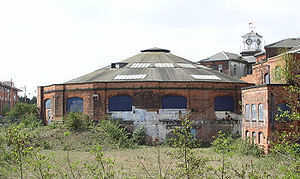
. Although the Midland Counties had an engine house at Nottingham, the main facilities for all three lines appear to have been, initially at least, those at Derby. That for the Birmingham and Derby was next to its line, near London Road. It was about 140 feet (42.7 m) long and 43 feet (13.1 m) wide, with three lines and three wide archways at its entrance, supporting a water tank. In one corner was a smithy. The Midland Counties' shed was rectangular and about 800 feet (243.8 m) long to the north of the site. Adjacent to it were water and coke facilities, and locomotive repair workshops. The North Midland's became a full repair facility, with a smithy, lathes and other machine tools. These were associated with what is believed to be the first Roundhouse
Roundhouse
A roundhouse is a building used by railroads for servicing locomotives. Roundhouses are large, circular or semicircular structures that were traditionally located surrounding or adjacent to turntables...
, designed by Francis Thompson
Francis Thompson (architect)
Francis Thompson was an architect particularly well known for his railway work.He was born in 1808 in Woodbridge in Suffolk, England, to a family of builders. He married Anna Maria Watson in 1830 at Woodbridge church and emigrated to Montreal in British North America . Their son Francis Jacob...
. On each side of it, in a vee, were workshops for locomotive and rolling stock repair.
In 1841, problems were becoming apparent with the heat of the exhaust gases through the fireboxes of the locomotives, and the North Midland works assisted George Stephenson
George Stephenson
George Stephenson was an English civil engineer and mechanical engineer who built the first public railway line in the world to use steam locomotives...
in the design of his "Long Boiler locomotive
Long Boiler locomotive
The Long Boiler locomotive was the object of a patent by Robert Stephenson and the name became synonymous with the pattern.-History:It is generally perceived that it arose out of attempts to match the power of broad gauge locomotives within the limitations of the loading gauge of Stephenson railways...
" In the same year, the Midland Counties locomotive "Bee" (formerly "Ariel") was fitted with 'Samuel Hills Smoke Consuming Apparatus' in an attempt to conform to the Government's insistence that they should "consume their own smoke." This experimentation was carried on with the use of a brick arch in the firebox to use the cheaper coal
Coal
Coal is a combustible black or brownish-black sedimentary rock usually occurring in rock strata in layers or veins called coal beds or coal seams. The harder forms, such as anthracite coal, can be regarded as metamorphic rock because of later exposure to elevated temperature and pressure...
instead of coke
Coke (fuel)
Coke is the solid carbonaceous material derived from destructive distillation of low-ash, low-sulfur bituminous coal. Cokes from coal are grey, hard, and porous. While coke can be formed naturally, the commonly used form is man-made.- History :...
, but it was initially unsuccessful.
Matthew Kirtley
When the three companies merged in 1844 to form the Midland RailwayMidland Railway
The Midland Railway was a railway company in the United Kingdom from 1844 to 1922, when it became part of the London, Midland and Scottish Railway....
, Derby became its headquarters and the immediate task was to achieve some standardisation in the various locomotives that it had inherited. Locomotives at that time were designed and built by manufacturers who might be lacking in actual operating experience with their products. The first Locomotive and Carriage Superintendent was Matthew Kirtley
Matthew Kirtley
Matthew Kirtley was an important early locomotive engineer. His brother Thomas Kirtley was also a locomotive engineer as was his nephew, William Kirtley, who served as locomotive superintendent on the London, Chatham and Dover Railway, 1874-1898.Kirtley was born in February 1813 at Tanfield,...
who persuaded various manufacturers to build to his own design and in 1849 fifty six-coupled goods engines were delivered.
Jenny Lind locomotive
The Jenny Lind locomotive was the first of a class of ten steam locomotives built in 1847 for the London Brighton and South Coast Railway by E. B. Wilson and Company of Leeds, named after Jenny Lind who was a famous opera singer of the period...
pattern, and more standard goods. He then produced a large "single" with six foot six inch driving wheels. Throughout its existence, the Midland never became fully self-sufficient, usually having its locos built by private contractors to its own designs. Initially there was some resistance on the part of Sharp Stewart and Stephenson
Robert Stephenson and Company
Robert Stephenson and Company was a locomotive manufacturing company founded in 1823. It was the first company set up specifically to build railway engines.- Foundation and early success :...
, who quoted over-long delivery times, so that Kirtley had to accept the maker's own designs. These were good enough, however, that Fowler built some more to a similar pattern. In 1861 he built four 0-6-0
0-6-0
Under the Whyte notation for the classification of steam locomotives, 0-6-0 represents the wheel arrangement of no leading wheels, six powered and coupled driving wheels on three axles, and no trailing wheels...
banking engines for the Lickey Incline
Lickey Incline
The Lickey Incline is the steepest sustained main-line railway incline in Great Britain and is situated south of Birmingham, in England. The climb is a gradient of 1-in-37.7 for a continuous distance of two miles ....
with four foot drivers instead of the usual five. Kirtley's first 2-4-0
2-4-0
Under the Whyte notation for the classification of steam locomotives, 2-4-0 represents the wheel arrangement of two leading wheels on one axle, four powered and coupled driving wheels on two axles, and no trailing wheels....
was a rebuilt 2-2-2
2-2-2
Under the Whyte notation for the classification of steam locomotives, 2-2-2 represents the wheel arrangement of two leading wheels on one axle two powered driving wheels on one axle, and two trailing wheels on one axle. The wheel arrangement both provided more stability and enabled a larger firebox...
but he went on to build six for use into King's Cross, then fifteen more.
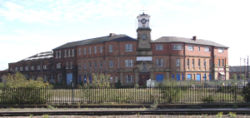
A further, much larger roundhouse was built in 1852, followed by a large rectangular engine shed with two turntables in 1890. The original North Midland workshop, which by then had become offices, was raised by one storey in 1859-60, the clock tower being increased in height accordingly. A long footbridge was added from the entrance door to the front of the station, of which only a fragment remains today. A third floor was added in 1893.Billson, P., (1996) Derby and the Midland Railway, Breedon Books.
Another of Kirtley's achievements in 1859 was, at last, to solve the problem of coal burning by combining the brick arch with a firehole door deflector plate and a blower to increase the draught. Research into track wear was carried out by Robert Forester Mushet
Robert Forester Mushet
Robert Forester Mushet was a British metallurgist and businessman, born April 8, 1811, in Coleford, in the Forest of Dean, Gloucestershire, England. He was the youngest son of Scottish parents, Agnes Wilson and David Mushet; an ironmaster, formerly of the Clyde, Alfreton and Whitecliff...
who produced the first double-headed rail using Bessemer steel. Whereas wrought iron
Wrought iron
thumb|The [[Eiffel tower]] is constructed from [[puddle iron]], a form of wrought ironWrought iron is an iron alloy with a very low carbon...
rails lasted typically six months, a length of steel rail laid near Derby station 1857 was still in use in 1873.
Kirtley also introduced a system of templates and gauges based on the Whitworth system
British Standard Whitworth
British Standard Whitworth is one of a number of imperial unit based screw thread standards which use the same bolt heads and nut hexagonal sizes, the others being British Standard Fine thread and British Standard Cycle...
. Meanwhile wrought iron
Wrought iron
thumb|The [[Eiffel tower]] is constructed from [[puddle iron]], a form of wrought ironWrought iron is an iron alloy with a very low carbon...
axles failures were a problem. In 1870-[871, Kirtley began a programme of research which eventually resulted in the introduction of steel.
By the end of the 1860s the works had expanded to such an extent, that he was considering reorganising it; and, in 1873, it separated into the Locomotive Works, remaining behind the station, and the Derby Carriage and Wagon Works
Derby Carriage and Wagon Works
Derby Carriage and Wagon Works was built by the Midland Railway in Derby, England. The plant has been through many changes of ownership and is currently owned by Bombardier Transportation, a subsidiary of Bombardier Inc. of Canada. As of 2011 it is the only remaining passenger rolling stock...
, further south, off Litchurch Lane.
Samuel Johnson
Kirtley died in office in 1873 leaving a respectable legacy of development and sound locomotives, some of which lasted eighty years. The works reorganisation was completed in 1887 by his successor Samuel W. JohnsonSamuel W. Johnson
Samuel Waite Johnson was Chief Mechanical Engineer of the Midland Railway from 1873 to 1903. He was born in Bramley, Yorkshire and educated at Leeds Grammar School.-Career:...
, the carriage and wagon works coming under the control of Thomas Gethyn Clayton. In addition the works took over the old Derby Gas Company works.
Johnson continued to build four-coupled passenger locos for the steeper grades, but also some 2-2-2
2-2-2
Under the Whyte notation for the classification of steam locomotives, 2-2-2 represents the wheel arrangement of two leading wheels on one axle two powered driving wheels on one axle, and two trailing wheels on one axle. The wheel arrangement both provided more stability and enabled a larger firebox...
singles for lighter work. In 1886, the workshop manager, Mr. F. Holt devised a system of applying sand beneath the wheels to improve adhesion. This system is still in use today, using compressed air instead of steam as the propellant.
In 1897 a general strike was followed by a rapid rise in the economy. The railway had placed orders for 170 new locos with private builders, all of whom were snowed under. By the end of 1898 none had been delivered and the railway was under pressure for its freight customers, particularly in Sheffield
Sheffield
Sheffield is a city and metropolitan borough of South Yorkshire, England. Its name derives from the River Sheaf, which runs through the city. Historically a part of the West Riding of Yorkshire, and with some of its southern suburbs annexed from Derbyshire, the city has grown from its largely...
. The Midland ordered twenty 2-6-0
2-6-0
Under the Whyte notation for the classification of steam locomotives, 2-6-0 represents the wheel arrangement of two leading wheels on one axle, usually in a leading truck, six powered and coupled driving wheels on three axles, and no trailing wheels. This arrangement is commonly called a Mogul...
s from the Burnham & William's Baldwin Locomotive Works
Baldwin Locomotive Works
The Baldwin Locomotive Works was an American builder of railroad locomotives. It was located in Philadelphia, Pennsylvania, originally, and later in nearby Eddystone, Pennsylvania. Although the company was very successful as a producer of steam locomotives, its transition to the production of...
in America which were supplied as parts for assembly. Since the workshops were also full, they had to be assembled in the open air by quickly-recruited labour. Wishing to order twenty more, which Baldwins could not supply, ten were ordered from the Schenectady Locomotive Works
Schenectady Locomotive Works
The Schenectady Locomotive Works built railroad locomotives from its founding in 1848 through its merger into American Locomotive Company in 1901.After the 1901 merger, ALCO made the Schenectady plant its headquarters in Schenectady, New York....
. The Baldwin's American appearance raised a good deal of comment.
The most famous singles, the so-called Midland Spinner
Midland Railway 115 Class
The Midland Railway 115 Class is a class of 4-2-2 steam locomotive. They were known as "Spinners", possibly because of the wheelslip that the single large driving wheel caused. They were designed by Samuel W...
s were built in 1900 and the Belpaire firebox
Belpaire firebox
The Belpaire firebox is a type of firebox used on steam locomotives. It was invented by Alfred Belpaire of Belgium. It has a greater surface area at the top of the firebox, improving heat transfer and steam production...
appeared on some 4-4-0
4-4-0
Under the Whyte notation for the classification of steam locomotives, 4-4-0 represents the wheel arrangement of four leading wheels on two axles , four powered and coupled driving wheels on two axles, and no trailing wheels...
s. The first of the "Midland Compounds" appeared in 1904. This was based on a North Eastern Railway
North Eastern Railway (UK)
The North Eastern Railway , was an English railway company. It was incorporated in 1854, when four existing companies were combined, and was absorbed into the London and North Eastern Railway at the Grouping in 1923...
two-cylinder 4-4-0
4-4-0
Under the Whyte notation for the classification of steam locomotives, 4-4-0 represents the wheel arrangement of four leading wheels on two axles , four powered and coupled driving wheels on two axles, and no trailing wheels...
which had been rebuilt to three cylinders, and became the basis for a number of classes over the following years, totalling 240 engines. He also produced a very simple, but robust, 0-6-0
0-6-0
Under the Whyte notation for the classification of steam locomotives, 0-6-0 represents the wheel arrangement of no leading wheels, six powered and coupled driving wheels on three axles, and no trailing wheels...
goods engine of which 865 were built between 1875 to 1902.
Richard Deeley
Johnson retired in 1903 and was succeeded by Richard Mountford DeeleyRichard Deeley
Richard Mountford Deeley was a British engineer, chiefly noted for his five years as Chief Mechanical Engineer of the Midland Railway....
who began as an apprentice at the works. He carried on much where Johnson had left off, but improved the compounds with an uprated boiler and firebox, also changing the tender to a smaller six-wheeled design. Deeley was very soon promoted to Locomotive Superintendent, with Cecil Paget as Works Manager.
In 1904 two steam motor-carriages for the Morecambe-Heysham
Morecambe Branch Line
The Morecambe Branch Line is a railway line in Lancashire, England, from Lancaster to Morecambe and Heysham where services connect with the ferry service to Douglas on the Isle of Man. To reach Heysham, trains must reverse at Morecambe....
service, which were fitted out at the carriage works. Since he was also Locomotive Superintendent, he reorganised the numbering system in 1907 so that different groups of numbers were used for different classes. Among his improvements to the works, he devised a heavy testing rig for structure testing up to 50 ton
Ton
The ton is a unit of measure. It has a long history and has acquired a number of meanings and uses over the years. It is used principally as a unit of weight, and as a unit of volume. It can also be used as a measure of energy, for truck classification, or as a colloquial term.It is derived from...
s in what had developed into a dedicated Engineering Testing Department.
By 1900 some 40,000 people were employed, producing 40 new engines a year. Electric power and lighting was installed in the Locomotive Works during 1910, supplied by the company's new generating plant located across the Derby canal at the rear of the Works. An earlier and smaller scale electric generating station had been built by the Midland during March 1893 in Calvert Street, Derby to provide current to light the station offices, the Midland Hotel and the Locomotive Works offices. A textile research facility was opened in Calvert Street for upholstery and seat materials. This facility is thought to have used the buildings made redundant by the closure of the 1893 generating station when the new generating station was brought on line in 1910.
Henry Fowler
In 1907 Paget became General Superintendent, with Henry FowlerHenry Fowler (engineer)
Sir Henry Fowler, KBE was a Chief Mechanical Engineer of the Midland Railway and subsequently the London, Midland and Scottish Railway.- Biography :...
becoming Works Manager. In 1908 Paget caused to be built a revolutionary new locomotive, the Paget locomotive
Midland Railway Paget locomotive
The Midland Railway's Paget locomotive, No. 2299, was an experimental steam locomotive constructed at its Derby Works in 1908 to the design of the General Superintendent Cecil Paget ....
based on the Willans high speed central valve engines, some of which had been installed at the works.
In 1909 Henry Fowler
Henry Fowler (engineer)
Sir Henry Fowler, KBE was a Chief Mechanical Engineer of the Midland Railway and subsequently the London, Midland and Scottish Railway.- Biography :...
became the Mechanical Engineer. For the next five years, rebuilding continued and then came the Great War
World War I
World War I , which was predominantly called the World War or the Great War from its occurrence until 1939, and the First World War or World War I thereafter, was a major war centred in Europe that began on 28 July 1914 and lasted until 11 November 1918...
.
From 1914 the works turned to aiding the war effort, producing eleven howitzers by the end of the year. Like most of the other works, Derby produced large number of shells and their components. Initially producing 3000 fuses a week, it installed automated equipment, increasing production tenfold, the work being mainly undertaken by some 500 women.
Some new locomotives, however, were built for the Midland's own use and some for the Midland and Great Northern Joint Committee
Midland and Great Northern Joint Railway
The Midland and Great Northern Joint Railway, was a joint railway owned by the Midland Railway and the Great Northern Railway in eastern England, affectionately known as the 'Muddle and Get Nowhere' to generations of passengers, enthusiasts, and other users.The main line ran from Peterborough to...
and the Somerset and Dorset Joint Railway
Somerset and Dorset Joint Railway
The Somerset & Dorset Joint Railway – almost always referred to as "the S&D" – was an English railway line connecting Bath in north east Somerset and Bournemouth now in south east Dorset but then in Hampshire...
. Notable among them were the Somerset and Dorset 2-8-0s
S&DJR 7F 2-8-0
The Somerset and Dorset Joint Railway 7F 2-8-0 is a class of steam locomotive designed for hauling heavy coal and goods trains. Eleven were built in two batches in 1914 and 1925, and were used until withdrawn between 1959 and 1964...
, a class of heavy freight locomotives for the Dorset banks, extremely large by Midland standards. 11 were built in two batches in 1914 and 1925. A new, more powerful 0-6-0
0-6-0
Under the Whyte notation for the classification of steam locomotives, 0-6-0 represents the wheel arrangement of no leading wheels, six powered and coupled driving wheels on three axles, and no trailing wheels...
was designed in 1911 and two were built. Quantity production began in 1917 with 192 being built in the first few years, and a further 580 after grouping up to 1940. Another remarkable engine of this period was the 0-10-0
0-10-0
Under the Whyte notation for the classification of steam locomotives, 0-10-0 represents the wheel arrangement of no leading wheels, ten powered and coupled driving wheels on five axles, and no trailing wheels...
"Lickey Banker", designed in 1919, by James Clayton specifically for use on the Lickey Incline
Lickey Incline
The Lickey Incline is the steepest sustained main-line railway incline in Great Britain and is situated south of Birmingham, in England. The climb is a gradient of 1-in-37.7 for a continuous distance of two miles ....
south of Birmingham
Birmingham
Birmingham is a city and metropolitan borough in the West Midlands of England. It is the most populous British city outside the capital London, with a population of 1,036,900 , and lies at the heart of the West Midlands conurbation, the second most populous urban area in the United Kingdom with a...
.
George Hughes
The co-operation between the railways in the war effort to some extent smoothed the way to amalgamation in 1923 with the Midland becoming part of the LMSLondon, Midland and Scottish Railway
The London Midland and Scottish Railway was a British railway company. It was formed on 1 January 1923 under the Railways Act of 1921, which required the grouping of over 120 separate railway companies into just four...
. George Hughes
George Hughes
George Hughes may refer to:*George Edward Hughes , Professor of Philosophy at the Victoria University of Wellington*George Hughes , former NFL player*George Hughes , British locomotive engineer...
became the Chief Mechanical Engineer. However he preferred to make his headquarters at Horwich, building the famous 4-6-0
4-6-0
Under the Whyte notation for the classification of steam locomotives, 4-6-0 represents the wheel arrangement of four leading wheels on two axles in a leading truck, six powered and coupled driving wheels on three axles, and no trailing wheels. This wheel arrangement became the second-most popular...
"Horwich Crabs". He was succeeded in 1925 by Sir Henry Fowler, by Ernest Lemon
Ernest Lemon
Sir Ernest John Hutchings Lemon, OBE was Chief Mechanical Engineer of the London, Midland and Scottish Railway and later one of its three Vice-Presidents...
in 1931, and finally in 1932 by William Stanier
William Stanier
Sir William Arthur Stanier, FRS was Chief Mechanical Engineer of the London, Midland and Scottish Railway.- Biography :...
.
The major source of friction, however, was the Midland's policy of using small engines, adding another if the load warranted it, or for hilly stretches. This had worked perfectly well, for the Midland's track in general was level, but trains were becoming heavier. The other major member of the grouping, the LNWR
London and North Western Railway
The London and North Western Railway was a British railway company between 1846 and 1922. It was created by the merger of three companies – the Grand Junction Railway, the London and Birmingham Railway and the Manchester and Birmingham Railway...
, had already invested in larger engines for its lines north of Manchester
Manchester
Manchester is a city and metropolitan borough in Greater Manchester, England. According to the Office for National Statistics, the 2010 mid-year population estimate for Manchester was 498,800. Manchester lies within one of the UK's largest metropolitan areas, the metropolitan county of Greater...
. Another passion imported from the Midland was for standardisation, which, in the case of axleboxes was to prove problematic for future, heavier, locos.
Production carried on much as before, of Midland 0-6-0
0-6-0
Under the Whyte notation for the classification of steam locomotives, 0-6-0 represents the wheel arrangement of no leading wheels, six powered and coupled driving wheels on three axles, and no trailing wheels...
s and 4-4-0
4-4-0
Under the Whyte notation for the classification of steam locomotives, 4-4-0 represents the wheel arrangement of four leading wheels on two axles , four powered and coupled driving wheels on two axles, and no trailing wheels...
"Compounds", while Hughes 4-6-0
4-6-0
Under the Whyte notation for the classification of steam locomotives, 4-6-0 represents the wheel arrangement of four leading wheels on two axles in a leading truck, six powered and coupled driving wheels on three axles, and no trailing wheels. This wheel arrangement became the second-most popular...
s were built at Horwich and Crewe. However, plans were afoot for something larger, with a "Castle" class loco borrowed from the GWR
Great Western Railway
The Great Western Railway was a British railway company that linked London with the south-west and west of England and most of Wales. It was founded in 1833, received its enabling Act of Parliament in 1835 and ran its first trains in 1838...
for trials between Euston and Carlisle. In 1927, fifty 4-6-0
4-6-0
Under the Whyte notation for the classification of steam locomotives, 4-6-0 represents the wheel arrangement of four leading wheels on two axles in a leading truck, six powered and coupled driving wheels on three axles, and no trailing wheels. This wheel arrangement became the second-most popular...
s were produced by the North British Locomotive Company
North British Locomotive Company
The North British Locomotive Company was created in 1903 through the merger of three Glasgow locomotive manufacturing companies; Sharp Stewart and Company , Neilson, Reid and Company and Dübs and Company , creating the largest locomotive manufacturing company in Europe.Its main factories were...
and in 1930, production of a further twenty was begun at Derby.
William Stanier
William Stanier was appointed in 1932 as someone from one outside of the company who was clearly unaffected by the politics of the various constituent companies within the LMS. His appointment would clearly have been accompanied by a change in attitude which would include the motivation to strengthen the Midland track and structures. Crewe had been provided by the LNWR with a very large foundry and he concentrated most of the production there. The central drawing office remained in Derby, at Nelson Street, and in 1933, under Lord Stamp Derby became a national research centre with the establishment of the LMS Scientific Research LaboratoryLMS Scientific Research Laboratory
The LMS Scientific Research Laboratory was set up following the formation of the London, Midland and Scottish Railway in 1923.In 1929, the Company President, Lord Stamp read a paper Scientific Research in Transport to the Institute of Transport, and, in 1930 he founded the Advisory Committee on...
in 1933 on the west side of London Road.
The main business of any locomotive works is maintenance and repairs, but Derby continued to build Fowler's 0-6-0s and assisted Crewe with longer production runs, usually with castings provided by Crewe. It also assisted Nelson Street with new ventures, including the LMS's pioneering work with diesel shunters. In 1931, an old Midland Railway Class 1F 0-6-0
Midland Railway 1377 Class
The Midland Railway 1377 Class is a class of steam locomotive. They were introduced in 1878 by Samuel W. Johnson based on an earlier 1874 design. Up to 1891, 185 were built: 165 by Derby Works and the last 20 by the Vulcan Foundry....
tank had been converted by fitting a Davey Paxman diesel engine and a hydraulic transmission by the Derby firm of Haslam & Newton.
Although the hydraulic transmission failed in 1936, valuable experience had been gained, and various shunters were ordered from outside manufacturers. Two of these types, one from Armstrong Whitworth
Armstrong Whitworth
Sir W G Armstrong Whitworth & Co Ltd was a major British manufacturing company of the early years of the 20th century. Headquartered in Elswick, Newcastle upon Tyne, Armstrong Whitworth engaged in the construction of armaments, ships, locomotives, automobiles, and aircraft.-History:In 1847,...
powered by a Sulzer engine, the other from Hawthorn Leslie and Company
Hawthorn Leslie and Company
R. & W. Hawthorn Leslie and Company, Limited, usually referred to as Hawthorn Leslie, was a shipbuilding and locomotive manufacturer. The Company was founded on Tyneside in 1886 and ceased building ships in 1982.-History:...
with an English Electric engine, both with electric transmission, provided the future pattern for shunters which would come to be built at Derby, and later the basis for the British Rail Class 08
British Rail Class 08
The British Rail Class 08 is a class of diesel-electric shunting locomotive. From 1953 to 1962, 996 locomotives were produced, making it the most numerous of all British locomotive classes....
.
During World War II
World War II
World War II, or the Second World War , was a global conflict lasting from 1939 to 1945, involving most of the world's nations—including all of the great powers—eventually forming two opposing military alliances: the Allies and the Axis...
the works built Class 5 4-6-0
4-6-0
Under the Whyte notation for the classification of steam locomotives, 4-6-0 represents the wheel arrangement of four leading wheels on two axles in a leading truck, six powered and coupled driving wheels on three axles, and no trailing wheels. This wheel arrangement became the second-most popular...
s and 2-6-4
2-6-4
Under the Whyte notation for the classification of steam locomotives, a 2-6-4 locomotive has two leading wheels, six coupled driving wheels and four trailing wheels...
Ts. Charles Fairburn
Charles Fairburn
Charles Edward Fairburn was Chief Mechanical Engineer of the London, Midland and Scottish Railway.- Biography :...
oversaw the building of a Hampden
Handley Page Hampden
The Handley Page HP.52 Hampden was a British twin-engine medium bomber of the Royal Air Force serving in the Second World War. With the Whitley and Wellington, the Hampden bore the brunt of the early bombing war over Europe, taking part in the first night raid on Berlin and the first 1,000-plane...
Bomber Repair facility involving both the loco and the carriage & wagon works. Wings and fuselages were repaired and sent to a private contractor at Nottingham for assembly. In time other aircraft were repaired, including Lancaster
Avro Lancaster
The Avro Lancaster is a British four-engined Second World War heavy bomber made initially by Avro for the Royal Air Force . It first saw active service in 1942, and together with the Handley Page Halifax it was one of the main heavy bombers of the RAF, the RCAF, and squadrons from other...
s. The works also built carriages for field guns and anti-tank guns.
Fairburn and Ivatt
In 1944, Fairburn became Chief Mechanical Engineer when Stanier retired, and he was followed in 1945 by H.G.IvattGeorge Ivatt
Henry George Ivatt known as George Ivatt, was the post-war Chief Mechanical Engineer of the London Midland and Scottish Railway. He was the son of the Great Northern Railway locomotive engineer Henry Ivatt....
.
Locomotive production continued, including new versions of the shunters. The first, from 1936, had a single motor driving the wheels through a jackshaft. This was because the axle hung motors of the English Electric design had proved difficult to ventilate and had given severe overheating problems. This had been overcome in 1940 by using double reduction gearing on the axle hung motors and limiting the maximum speed.
British Railways
When the railways were nationalised in 1947, the works at Derby became part of BR WorkshopsBritish Rail
British Railways , which from 1965 traded as British Rail, was the operator of most of the rail transport in Great Britain between 1948 and 1997. It was formed from the nationalisation of the "Big Four" British railway companies and lasted until the gradual privatisation of British Rail, in stages...
.
From 1948 the works produced 106 Standard Class 4 2-6-4 tank engines, then from 1951 to 1957 turned to Standard Class 5 4-6-0s, 110 in all. The last steam locomotive to be built, bringing the total to 2941, was a BR standard class 5 with Caprotti valve gear
Caprotti valve gear
The Caprotti valve gear is a type of steam engine valve gear invented in the early 1920's by Italian architect and engineer Arturo Caprotti. It uses camshafts and poppet valves rather than the piston valves used in other valve gear...
number 73154.
In 1948 the first British main-line diesel electric locomotive had been driven out of the paint shop by Ivatt himself, number 10,000
British Rail Class D16/1
British Railways Class D16/1 or 10000 and 10001 were the first mainline diesel locomotives in Great Britain. They were built by the London, Midland and Scottish Railway at its Derby Works, using the EE16SVT 1600 hp diesel engine with electric transmission, in association with English Electric and...
just in time to have LMS livery. Its sibling, 10001 began its life in British Railways livery. In 1952 the experimental diesel-mechanical locomotive, the "Fell Diesel
British Rail 10100
British Railways 10100 was an unusual experimental diesel locomotive known informally as The Fell Diesel Locomotive . It was the joint production of Davey Paxman & Co, Shell Refining & Marketing Co and Lt-Col L.F.R. Fell, built for them by the London, Midland and Scottish Railway at Derby. Sir...
" went into service.
There matters rested until British Rail's Modernisation Plan and in 1958 production began on the first ten Type 2 main line locos, later known as the Class 24
British Rail Class 24
The British Rail Class 24 diesel locomotives, also known as the Sulzer Type 2, were built from 1958 to 1961. One hundred and fifty-one of these locomotives were built at Derby, Crewe and Darlington, the first twenty of them as part of the British Rail 1955 Modernisation Plan. This class was used as...
or, in popular culture, the "Derby Sulzers".
In 1959 the first of the Type 4s, later classified Class 44
British Rail Class 44
The British Rail Class 44 or Sulzer Type 4 diesel locomotives were built by British Railways' Derby Works between 1959 to 1960. They were named after British mountains, and consequently nicknamed Peaks.-Description:...
"Scafell Pike" emerged from the works. The Class 24 were followed by the Class 25
British Rail Class 25
The British Rail Class 25 diesel locomotives were also known as Sulzer Type 2 and nicknamed Rats, as it was alleged they could be seen everywhere in Britain, and hence were "as common as rats"...
, and the Class 44 by the Class 45
British Rail Class 45
The British Rail Class 45 also known as the Sulzer Type 4 diesel locomotives were built by British Rail at their Derby and Crewe Works between 1960 and 1962...
and Class 46
British Rail Class 46
The British Rail Class 46 is a class of diesel locomotive. They were built from 1961-1963 at British Railways' Derby Works and were initially numbered D138-D193. With the arrival of TOPS they were renumbered to Class 46. Fifty-six locomotives were built...
.
The full complement having been achieved in 1962, new production was concentrated at Crewe, however Derby received one more order when Beyer Peacock Ltd asked to be released from their contract. When production finally ceased in 1966, over a thousand diesel locos had been built at Derby.
The only new build after that time was six electric non-driving motor coaches in 1978 to power the six Advanced Passenger Train
Advanced Passenger Train
The Advanced Passenger Train was an experimental tilting High Speed Train developed by British Rail during the 1970s and early 1980s....
formations.
Recent history
In 1964 British Railways had established the British Rail Research DivisionBritish Rail Research Division
The British Rail Research Division came into being in 1964 directly under the control of the British Railways Board, moving into purpose-built premises at the Railway Technical Centre in Derby. The intention was to improve railway reliability and efficiency, while reducing costs and improving revenue...
, which reported directly to the British Railways Board
British Railways Board
The British Railways Board was a nationalised industry in the United Kingdom that existed from 1962 to 2001. From its foundation until 1997, it was responsible for most railway services in Great Britain, trading under the brand names British Railways and, from 1965, British Rail...
(BRB). It was the first to move into the new Railway Technical Centre
Railway Technical Centre
The Railway Technical Centre in London Road, Derby, UK, was built by the British Railways Board in the early 1960s to be its technical headquarters....
on London Road opposite the old LMS research building. followed by the BRB Department of Mechanical & Electrical Engineering (DM&EE).
In 1988 the works were separated from the government concern and formed into the quasi-independent British Rail Engineering Limited (BREL
BREL
British Rail Engineering Limited , was the railway systems engineering division of British Rail, until the design and building of trains in the UK was privatised in 1993. On 31 October 1969, the company was incorporated as British Rail Engineering Limited.-Main products:The vast majority of BREL's...
) which also had its headquarters in the Railway Technical Centre.
BREL was eventually bought by Asea Brown Boveri (ABB), which then became Adtranz
Adtranz
ABB Daimler-Benz Transportation , commonly known under its brand Adtranz, was a multi-national rail transport equipment manufacturer with facilities concentrated in Europe and the USA....
, and later, Bombardier Transportation
Bombardier Transportation
Bombardier Transportation is the rail equipment division of the Canadian firm, Bombardier Inc. Bombardier Transportation is one of the world's largest companies in the rail-equipment manufacturing and servicing industry. Its headquarters are in Berlin, Germany....
.
The Locomotive works was mostly demolished. Along with the land formerly occupied by Chaddesden sidings and the gas works, it was renamed "Pride Park
Pride Park
Pride Park is a business park on the outskirts of the city centre of Derby, UK. It covers 80 hectares of former industrial land between the River Derwent and railway lines.-History:...
", part of which is occupied by the Derby County Football Club
Derby County F.C.
Derby County Football Club is an English football based in Derby. the club play in the Football League Championship and is notable as being one of the twelve founder members of the Football League in 1888 and is, therefore, one of only ten clubs to have competed in every season of the English...
stadium of that name
Pride Park Stadium
Pride Park Stadium is an all-seater football stadium located on the Pride Park business park on the outskirts of Derby, England. It is the current home of Football League Championship club Derby County, who moved to the stadium from the Baseball Ground upon its opening in 1997...
.
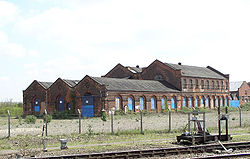
After determined campaigning by heritage groups, the original North Midland roundhouse, with the original Midland Railway offices and the original Midland Counties workshop were spared. (The Birmingham And Derby's workshops had been demolished around 1870.) Though Grade 2 listed, they became more and more derelict. There was talk for a while of Pete Waterman
Pete Waterman
Peter Alan Waterman OBE is an English record producer, occasional songwriter, radio and club DJ, television presenter, president of Coventry Bears rugby league club and a keen railway enthusiast. As a member of the Stock Aitken Waterman songwriting team he wrote and produced many hit singles...
taking them over. However, in 2006 it has been bought from the city council for £1 by Derby College
Derby College
Derby College is a further education centre with sites located within Derbyshire , England and the surrounding area...
, who plan to spend £36 million to restore it for use as a college campus, with grants from the Heritage Lottery Fund
Heritage Lottery Fund
The Heritage Lottery Fund is a fund established in the United Kingdom under the National Lottery etc. Act 1993. The Fund opened for applications in 1994. It uses money raised through the National Lottery to transform and sustain the UK’s heritage...
and the East Midlands Development Agency. The campus is due to open to students in September 2009.
The Carriage and Wagon Works in Litchurch Lane remains in production, and has continued building diesel and electrical multiple units. Though its future is uncertain, in 2006 it is said to be the only remaining specialist British train manufacturer.
Further reading
- Marsden, C.J., (1989) Twenty Five Years of Railway Research, Haynes Publishing Co.
- Radford, J.B., (1971) Derby Works and Midland Locomotives, Ian Allan
- Truman, P., Hunt, D., (1989) Midland Railway Portrait Sheffield: Platform 5 Publishing.