


Railtrack

Encyclopedia
Railtrack was a group of companies that owned the track, signalling
, tunnel
s, bridge
s, level crossing
s and all but a handful of the stations
of the British railway system
from its formation in April 1994 until 2002. The Company was listed on the London Stock Exchange
and was a constituent of the FTSE 100 Index
but on 3 October 2002, the main operating arm - the owner and operator of the national railway network, Railtrack PLC
- was sold by its parent company Railtrack Group plc to "not for dividend" company Network Rail
(a company limited by guarantee) and was later renamed Network Rail Infrastructure Ltd.
Railtrack Group plc was renamed RT Group plc and was dissolved on 22 June 2010.
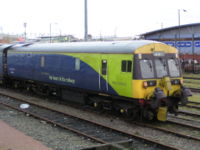 Founded under Conservative
legislation that privatised the railways
, Railtrack took control of the railway infrastructure on 1 April 1994 and was floated on the Stock Exchange
in May 1996.
The fatal accidents at Southall
in 1997 and Ladbroke Grove
in 1999 called into question the effect that the fragmentation of the railway network had had on both safety and maintenance procedures.
In February 1999 the Company launched a bond issue which caused a significant fall in the Company's share price.
Railtrack was severely criticised for both its performance in improving the railway infrastructure
and for its safety record. Between its creation and late 1998, the company had a relatively calm relationship with its first economic regulator, John Swift QC
, whose strategy was to encourage Railtrack to make commitments to improvement. But critics said that the regulator was not tough enough and that the company had, as a result, been able to abuse its monopoly position. In particular, its customers, the passenger and freight train operators, were desperate for regulatory action to force the company to improve its stewardship of the network and its performance. Swift had been appointed rail regulator in 1993 by the then Conservative transport secretary John MacGregor MP. When the Labour
government took over after the general election in May 1997
, the new transport secretary (and deputy prime minister) John Prescott
took a much harder line. When Swift's five-year term of office expired on 30 November 1998, he was not reappointed. After an interim holding period, during which Chris Bolt
, Swift's chief economic adviser and effective deputy, filled the regulator's position, in July 1999 a new rail regulator began a five-year term, and a new, much tougher regulatory era began.
The new rail regulator, Tom Winsor
, had been Swift's general counsel (1993–95), and adopted a more interventionist and aggressive regulatory approach. At times the relationship was stormy, with Railtrack resisting pressure to improve its performance. In April 2000 it was reported in the Guardian that "Railtrack is adopting a deliberate 'culture of defiance' against the rail regulator". Gerald Corbett
, Railtrack's chief executive at the time, and Winsor clearly saw things very differently to each other. Railtrack resisted regulatory action to improve its performance, and as the regulator probed ever more deeply, serious shortcomings in the company's stewardship of the network were revealed.
It was the Hatfield crash on 17 October 2000 that proved to be the defining moment in Railtrack's collapse. The subsequent major repairs undertaken across the whole British rail network are estimated to have cost in the order of £
580 million. According to Christian Wolmar
, author of On the Wrong Line, the Railtrack board panicked in the wake of Hatfield. Because most of the engineering skill of British Rail had been sold off into the maintenance and renewal companies, Railtrack had no idea how many Hatfields were waiting to happen, nor did they have any way of assessing the consequence of the speed restrictions they were ordering - restrictions that brought the railway network to all but a standstill.
Regulatory and customer pressure had been increasing, and the company's share price began to fall sharply as it became apparent that there were serious shortcomings in the company's ability to tackle and solve its greatest problems.
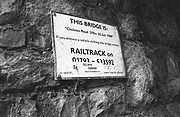 Meanwhile, the costs of modernising the West Coast Main Line
were spiralling. In 2001, Railtrack announced that, despite making a pre-tax profits before exceptional expenses of £199m, the £733m of costs and compensation paid out over the Hatfield crash plunged Railtrack from profit to a loss of £534m. This caused it to approach the government for funding, which it then controversially used to pay a £137m dividend
to its shareholder
s in May 2001.
, Stephen Byers. This was effectively a form of bankruptcy protection that allowed the railway network to continue operating despite the financial problems of the operator. The parent company, Railtrack Group plc, was not put into administration and continued operating its other subsidiaries, which included property and telecommunications interests.
For most of the year in administration, the government's position had been that the new company would have to live within the existing regulatory settlement (£14.8 billion for the five years 2001-2006). However, it soon became obvious that that was impossible, and that the aftermath of the Hatfield crash had revealed that the network required significantly more money for its operation, maintenance and renewal. It was reported on 23 November 2001, that a further £3.5 billion may be needed to keep the national railway network running, a sum disputed by Ernst & Young
, the administrators.
To get Railtrack out of administration, the government had to go back to the High Court and present evidence that the company was no longer insolvent. The principal reason given by the government to the court for this assertion was the decision of the rail regulator
- announced on 22 September 2002 - to carry out an interim review of the company's finances, with the potential to advance significant additional sums to the company. The High Court accepted that the company was not therefore insolvent, and the railway administration order was discharged on 2 October 2002.
was formed with the principal purpose of acquiring and owning Railtrack plc. Originally the Government allowed private companies to bid for Railtrack plc. However, with limited availability of financial data on Railtrack, the political implications of owning the company and the very obvious preference of the government that the national railway network should go to Network Rail, no bidders apart from Network Rail were forthcoming, and Network Rail bought Railtrack plc on 3 October 2002.
Network Rail's acquisition of Railtrack plc was welcomed at the time by groups that represented British train passengers. The attitude of Railtrack's customers - the passenger and freight train operators - was much more cautious, especially as they were wary of a corporate structure under which shareholders' equity was not at risk if the company's new management mis-managed its affairs.
for £
500 million, and the various diversified businesses it had created to seek to protect itself from the loss-making business of running a railway were disposed of to various buyers. £370 million held by Railtrack Group was frozen at the time the company went into administration and was earmarked to pay Railtrack shareholders an estimated 70p a share in compensation. The Group's interest in the partially built High Speed 1 line was also sold for £295m.
that his strategy was to sue the government for incorrect and misleading information given at the time Railtrack was created, when John Major
was Conservative Prime Minister
. An increased offer of up to 262p per share was enough to convince the larger shareholder group, the Railtrack Action Group, to abandon legal action. The Chairman, Usman Mahmud, believed that legal action would not be successful without the support of management and major shareholders.
The legality of the decision to put Railtrack into railway administration was challenged by the smaller Railtrack Private Shareholders Action Group. Their action against the government alleged that the Secretary of State for Transport at the time - Stephen Byers MP - had, by deciding to cut off funding for Railtrack and asking the High Court to put the company into railway administration, committed the common law
tort
of misfeasance in public office
. It is believed that there was £532 million available to Railtrack comprising £370 million in the bank and £162 million of an existing Department of Transport loan facility still available to be drawn down, but Stephen Byers MP refused to allow this, causing shareholders to believe that he had broken the loan agreement.
This was the largest class action ever conducted in the English courts - there were 49,500 claimants, all small shareholders in Railtrack. Keith Rowley, QC, the barrister for the shareholders, alleged Byers had "devised a scheme by which he intended to injure the shareholders of Railtrack Group by impairing the value of their interests in that company without paying compensation and without the approval of Parliament".
The case was heard in the High Court in London in July 2005; some embarrassment was caused to Byers when he admitted that an answer he had given to a House of Commons Select Committee was inaccurate, but on 14 October 2005 the judge found that there was no evidence that Byers had committed the tort
of misfeasance in public office
.
The private shareholders decided not to appeal against the judgment, because there were no legal grounds for doing so. For many of them - who had contributed around £50 each, on average, to the fighting fund to bring the action - the case had served its purpose.
The circumstances in which Railtrack had been put into administration were highly controversial, with allegations in Parliament on 24 October 2005 that the company had not been insolvent at the time (7 October 2001) and therefore that the administration order had been wrongly obtained. This was because of the jurisdiction of the independent rail regulator - at the time Tom Winsor - to provide additional money to maintain the company's financial position. Alan Duncan MP, then the shadow transport secretary, said in Parliament that this aspect of the affair - which was not dealt with in the shareholders' case in the High Court - was "perhaps the most shameful scar on the Government's honesty" and "an absolute scandal".
Byers apologised in the House of Commons on 17 October 2005 for having given a "factually inaccurate" reply to the Select Committee but said that he had not intended to mislead them. This personal statement to Parliament was not accepted by the MP who had asked the original question, and the matter was remitted to the House of Commons Standards and Privileges Committee for investigation. As a result of that committee's report, Mr Byers made another statement of apology to Parliament.
 RT Group plc (in voluntary liquidation) made a number of payments to shareholders during the winding up of the company's affairs before finally being dissolved on 22 June 2010.
was the company's Chief Executive from 1997 until his resignation in 2000. He was succeeded by Steve Marshall, who announced his own resignation the day after the company was put into railway administration.
Geoffrey Howe was elected Chairman in 2002 to seek compensation for shareholders. He stepped down a few months later when the Government offered 262p per share.
Railway signalling
Railway signalling is a system used to control railway traffic safely, essentially to prevent trains from colliding. Being guided by fixed rails, trains are uniquely susceptible to collision; furthermore, trains cannot stop quickly, and frequently operate at speeds that do not enable them to stop...
, tunnel
Tunnel
A tunnel is an underground passageway, completely enclosed except for openings for egress, commonly at each end.A tunnel may be for foot or vehicular road traffic, for rail traffic, or for a canal. Some tunnels are aqueducts to supply water for consumption or for hydroelectric stations or are sewers...
s, bridge
Bridge
A bridge is a structure built to span physical obstacles such as a body of water, valley, or road, for the purpose of providing passage over the obstacle...
s, level crossing
Level crossing
A level crossing occurs where a railway line is intersected by a road or path onone level, without recourse to a bridge or tunnel. It is a type of at-grade intersection. The term also applies when a light rail line with separate right-of-way or reserved track crosses a road in the same fashion...
s and all but a handful of the stations
Train station
A train station, also called a railroad station or railway station and often shortened to just station,"Station" is commonly understood to mean "train station" unless otherwise qualified. This is evident from dictionary entries e.g...
of the British railway system
Rail transport in the United Kingdom
The United Kingdom consists of Great Britain and Northern Ireland, and previously consisted of Great Britain and the whole of Ireland. Rail transport systems developed independently on the two islands of Great Britain and Ireland, and most of the railway construction in the Republic of Ireland was...
from its formation in April 1994 until 2002. The Company was listed on the London Stock Exchange
London Stock Exchange
The London Stock Exchange is a stock exchange located in the City of London within the United Kingdom. , the Exchange had a market capitalisation of US$3.7495 trillion, making it the fourth-largest stock exchange in the world by this measurement...
and was a constituent of the FTSE 100 Index
FTSE 100 Index
The FTSE 100 Index, also called FTSE 100, FTSE, or, informally, the footsie , is a share index of the 100 most highly capitalised UK companies listed on the London Stock Exchange....
but on 3 October 2002, the main operating arm - the owner and operator of the national railway network, Railtrack PLC
Public limited company
A public limited company is a limited liability company that sells shares to the public in United Kingdom company law, in the Republic of Ireland and Commonwealth jurisdictions....
- was sold by its parent company Railtrack Group plc to "not for dividend" company Network Rail
Network Rail
Network Rail is the government-created owner and operator of most of the rail infrastructure in Great Britain .; it is not responsible for railway infrastructure in Northern Ireland...
(a company limited by guarantee) and was later renamed Network Rail Infrastructure Ltd.
Railtrack Group plc was renamed RT Group plc and was dissolved on 22 June 2010.
Founding
Conservative Party (UK)
The Conservative Party, formally the Conservative and Unionist Party, is a centre-right political party in the United Kingdom that adheres to the philosophies of conservatism and British unionism. It is the largest political party in the UK, and is currently the largest single party in the House...
legislation that privatised the railways
Privatisation of British Rail
The privatisation of British Rail was set in motion when the Conservative government enacted, on 19 January 1993, the British Coal and British Rail Act 1993 . This enabled the relevant Secretary of State to issue directions to the relevant Board...
, Railtrack took control of the railway infrastructure on 1 April 1994 and was floated on the Stock Exchange
London Stock Exchange
The London Stock Exchange is a stock exchange located in the City of London within the United Kingdom. , the Exchange had a market capitalisation of US$3.7495 trillion, making it the fourth-largest stock exchange in the world by this measurement...
in May 1996.
The fatal accidents at Southall
Southall rail crash
The Southall rail crash was an accident on the British railway system that occurred on 19 September 1997, on the Great Western Main Line at Southall, west London. Seven people were killed and 139 injured...
in 1997 and Ladbroke Grove
Ladbroke Grove rail crash
The Ladbroke Grove Rail Crash was a rail accident which occurred on 5 October 1999 at Ladbroke Grove, London, England. Thirty-one people were killed and more than 520 injured...
in 1999 called into question the effect that the fragmentation of the railway network had had on both safety and maintenance procedures.
In February 1999 the Company launched a bond issue which caused a significant fall in the Company's share price.
Railtrack was severely criticised for both its performance in improving the railway infrastructure
Infrastructure
Infrastructure is basic physical and organizational structures needed for the operation of a society or enterprise, or the services and facilities necessary for an economy to function...
and for its safety record. Between its creation and late 1998, the company had a relatively calm relationship with its first economic regulator, John Swift QC
John Swift QC
John Swift QC is an English barrister and a leading authority on competition law.- Rail regulation :From December 1, 1993 until November 30, 1998, Swift was Rail Regulator and International Rail Regulator, having been appointed to those posts by Conservative politician and Secretary of State for...
, whose strategy was to encourage Railtrack to make commitments to improvement. But critics said that the regulator was not tough enough and that the company had, as a result, been able to abuse its monopoly position. In particular, its customers, the passenger and freight train operators, were desperate for regulatory action to force the company to improve its stewardship of the network and its performance. Swift had been appointed rail regulator in 1993 by the then Conservative transport secretary John MacGregor MP. When the Labour
Labour Party (UK)
The Labour Party is a centre-left democratic socialist party in the United Kingdom. It surpassed the Liberal Party in general elections during the early 1920s, forming minority governments under Ramsay MacDonald in 1924 and 1929-1931. The party was in a wartime coalition from 1940 to 1945, after...
government took over after the general election in May 1997
United Kingdom general election, 1997
The United Kingdom general election, 1997 was held on 1 May 1997, more than five years after the previous election on 9 April 1992, to elect 659 members to the British House of Commons. The Labour Party ended its 18 years in opposition under the leadership of Tony Blair, and won the general...
, the new transport secretary (and deputy prime minister) John Prescott
John Prescott
John Leslie Prescott, Baron Prescott is a British politician who was Deputy Prime Minister of the United Kingdom from 1997 to 2007. Born in Prestatyn, Wales, he represented Hull East as the Labour Member of Parliament from 1970 to 2010...
took a much harder line. When Swift's five-year term of office expired on 30 November 1998, he was not reappointed. After an interim holding period, during which Chris Bolt
Chris Bolt
Christopher Bolt Born Oct 16 1982 in Monrovia CA. Interests are bmx,fmx, welding - Railways :In 1994, Bolt moved to the Office of the Rail Regulator to take up appointment as chief economist...
, Swift's chief economic adviser and effective deputy, filled the regulator's position, in July 1999 a new rail regulator began a five-year term, and a new, much tougher regulatory era began.
The new rail regulator, Tom Winsor
Tom Winsor
Tom Winsor is a British lawyer and economic regulatory professional who was, from 5 July 1999 until 4 July 2004, the Rail Regulator and International Rail Regulator for Great Britain. He is a partner in international law firm White & Case LLP...
, had been Swift's general counsel (1993–95), and adopted a more interventionist and aggressive regulatory approach. At times the relationship was stormy, with Railtrack resisting pressure to improve its performance. In April 2000 it was reported in the Guardian that "Railtrack is adopting a deliberate 'culture of defiance' against the rail regulator". Gerald Corbett
Gerald Corbett
Gerald Corbett is a businessman in the United Kingdom. Since 2005 he has been Chairman of SSL International plc and Britvic plc. Britvic is one of the two leading soft drinks companies in Britain whose major brands include Robinsons, Tango, Pepsi, Fruit Shoot and J20...
, Railtrack's chief executive at the time, and Winsor clearly saw things very differently to each other. Railtrack resisted regulatory action to improve its performance, and as the regulator probed ever more deeply, serious shortcomings in the company's stewardship of the network were revealed.
It was the Hatfield crash on 17 October 2000 that proved to be the defining moment in Railtrack's collapse. The subsequent major repairs undertaken across the whole British rail network are estimated to have cost in the order of £
Pound sterling
The pound sterling , commonly called the pound, is the official currency of the United Kingdom, its Crown Dependencies and the British Overseas Territories of South Georgia and the South Sandwich Islands, British Antarctic Territory and Tristan da Cunha. It is subdivided into 100 pence...
580 million. According to Christian Wolmar
Christian Wolmar
Christian Wolmar is a British journalist, author, and railway historian of Swedish and Russian descent. He is best known for his books and commentary on transport, especially as a pundit on Britain's railway network, and was named Transport Journalist of the Year in the National Transport Awards in...
, author of On the Wrong Line, the Railtrack board panicked in the wake of Hatfield. Because most of the engineering skill of British Rail had been sold off into the maintenance and renewal companies, Railtrack had no idea how many Hatfields were waiting to happen, nor did they have any way of assessing the consequence of the speed restrictions they were ordering - restrictions that brought the railway network to all but a standstill.
Regulatory and customer pressure had been increasing, and the company's share price began to fall sharply as it became apparent that there were serious shortcomings in the company's ability to tackle and solve its greatest problems.
West Coast Main Line
The West Coast Main Line is the busiest mixed-traffic railway route in Britain, being the country's most important rail backbone in terms of population served. Fast, long-distance inter-city passenger services are provided between London, the West Midlands, the North West, North Wales and the...
were spiralling. In 2001, Railtrack announced that, despite making a pre-tax profits before exceptional expenses of £199m, the £733m of costs and compensation paid out over the Hatfield crash plunged Railtrack from profit to a loss of £534m. This caused it to approach the government for funding, which it then controversially used to pay a £137m dividend
Dividend
Dividends are payments made by a corporation to its shareholder members. It is the portion of corporate profits paid out to stockholders. When a corporation earns a profit or surplus, that money can be put to two uses: it can either be re-invested in the business , or it can be distributed to...
to its shareholder
Shareholder
A shareholder or stockholder is an individual or institution that legally owns one or more shares of stock in a public or private corporation. Shareholders own the stock, but not the corporation itself ....
s in May 2001.
Administration
Railtrack plc was placed into railway administration under the Railways Act 1993 on 7 October 2001, following an application to the High Court by the then Transport SecretarySecretary of State for Transport
The Secretary of State for Transport is the member of the cabinet responsible for the British Department for Transport. The role has had a high turnover as new appointments are blamed for the failures of decades of their predecessors...
, Stephen Byers. This was effectively a form of bankruptcy protection that allowed the railway network to continue operating despite the financial problems of the operator. The parent company, Railtrack Group plc, was not put into administration and continued operating its other subsidiaries, which included property and telecommunications interests.
For most of the year in administration, the government's position had been that the new company would have to live within the existing regulatory settlement (£14.8 billion for the five years 2001-2006). However, it soon became obvious that that was impossible, and that the aftermath of the Hatfield crash had revealed that the network required significantly more money for its operation, maintenance and renewal. It was reported on 23 November 2001, that a further £3.5 billion may be needed to keep the national railway network running, a sum disputed by Ernst & Young
Ernst & Young
Ernst & Young is one of the largest professional services networks in the world and one of the "Big Four" accountancy firms, along with Deloitte, KPMG and PricewaterhouseCoopers ....
, the administrators.
To get Railtrack out of administration, the government had to go back to the High Court and present evidence that the company was no longer insolvent. The principal reason given by the government to the court for this assertion was the decision of the rail regulator
Rail Regulator
The Rail Regulator was a statutory office, created with effect from 1 December 1993 by section 1 of the Railways Act 1993, for the independent economic regulation of the British railway industry....
- announced on 22 September 2002 - to carry out an interim review of the company's finances, with the potential to advance significant additional sums to the company. The High Court accepted that the company was not therefore insolvent, and the railway administration order was discharged on 2 October 2002.
Transfer of assets to Network Rail
Network RailNetwork Rail
Network Rail is the government-created owner and operator of most of the rail infrastructure in Great Britain .; it is not responsible for railway infrastructure in Northern Ireland...
was formed with the principal purpose of acquiring and owning Railtrack plc. Originally the Government allowed private companies to bid for Railtrack plc. However, with limited availability of financial data on Railtrack, the political implications of owning the company and the very obvious preference of the government that the national railway network should go to Network Rail, no bidders apart from Network Rail were forthcoming, and Network Rail bought Railtrack plc on 3 October 2002.
Network Rail's acquisition of Railtrack plc was welcomed at the time by groups that represented British train passengers. The attitude of Railtrack's customers - the passenger and freight train operators - was much more cautious, especially as they were wary of a corporate structure under which shareholders' equity was not at risk if the company's new management mis-managed its affairs.
Liquidation
Railtrack's parent company, Railtrack Group, was placed into members’ voluntary liquidation as RT Group on 18 October 2002. The Railtrack business (and its £7 billion debt) had been sold to Network RailNetwork Rail
Network Rail is the government-created owner and operator of most of the rail infrastructure in Great Britain .; it is not responsible for railway infrastructure in Northern Ireland...
for £
Pound sterling
The pound sterling , commonly called the pound, is the official currency of the United Kingdom, its Crown Dependencies and the British Overseas Territories of South Georgia and the South Sandwich Islands, British Antarctic Territory and Tristan da Cunha. It is subdivided into 100 pence...
500 million, and the various diversified businesses it had created to seek to protect itself from the loss-making business of running a railway were disposed of to various buyers. £370 million held by Railtrack Group was frozen at the time the company went into administration and was earmarked to pay Railtrack shareholders an estimated 70p a share in compensation. The Group's interest in the partially built High Speed 1 line was also sold for £295m.
Litigation
Railtrack shareholders formed two groups to press for increased compensation. A lawyer speaking for one of those groups remarked on GMTVGMTV
GMTV was the national Channel 3 breakfast television contractor, broadcasting in the United Kingdom from 1 January 1993 to 3 September 2010. It became a wholly owned subsidiary of ITV plc. in November 2009. Shortly after, ITV plc announced the programme would end...
that his strategy was to sue the government for incorrect and misleading information given at the time Railtrack was created, when John Major
John Major
Sir John Major, is a British Conservative politician, who served as Prime Minister of the United Kingdom and Leader of the Conservative Party from 1990–1997...
was Conservative Prime Minister
Prime Minister of the United Kingdom
The Prime Minister of the United Kingdom of Great Britain and Northern Ireland is the Head of Her Majesty's Government in the United Kingdom. The Prime Minister and Cabinet are collectively accountable for their policies and actions to the Sovereign, to Parliament, to their political party and...
. An increased offer of up to 262p per share was enough to convince the larger shareholder group, the Railtrack Action Group, to abandon legal action. The Chairman, Usman Mahmud, believed that legal action would not be successful without the support of management and major shareholders.
The legality of the decision to put Railtrack into railway administration was challenged by the smaller Railtrack Private Shareholders Action Group. Their action against the government alleged that the Secretary of State for Transport at the time - Stephen Byers MP - had, by deciding to cut off funding for Railtrack and asking the High Court to put the company into railway administration, committed the common law
Common law
Common law is law developed by judges through decisions of courts and similar tribunals rather than through legislative statutes or executive branch action...
tort
Tort
A tort, in common law jurisdictions, is a wrong that involves a breach of a civil duty owed to someone else. It is differentiated from a crime, which involves a breach of a duty owed to society in general...
of misfeasance in public office
Misfeasance in public office
Misfeasance in public office is a cause of action in the civil courts of England and Wales and certain Commonwealth countries. It is an action against the holder of a public office, alleging in essence that the office-holder has misused or abused his power...
. It is believed that there was £532 million available to Railtrack comprising £370 million in the bank and £162 million of an existing Department of Transport loan facility still available to be drawn down, but Stephen Byers MP refused to allow this, causing shareholders to believe that he had broken the loan agreement.
This was the largest class action ever conducted in the English courts - there were 49,500 claimants, all small shareholders in Railtrack. Keith Rowley, QC, the barrister for the shareholders, alleged Byers had "devised a scheme by which he intended to injure the shareholders of Railtrack Group by impairing the value of their interests in that company without paying compensation and without the approval of Parliament".
The case was heard in the High Court in London in July 2005; some embarrassment was caused to Byers when he admitted that an answer he had given to a House of Commons Select Committee was inaccurate, but on 14 October 2005 the judge found that there was no evidence that Byers had committed the tort
Tort
A tort, in common law jurisdictions, is a wrong that involves a breach of a civil duty owed to someone else. It is differentiated from a crime, which involves a breach of a duty owed to society in general...
of misfeasance in public office
Misfeasance in public office
Misfeasance in public office is a cause of action in the civil courts of England and Wales and certain Commonwealth countries. It is an action against the holder of a public office, alleging in essence that the office-holder has misused or abused his power...
.
The private shareholders decided not to appeal against the judgment, because there were no legal grounds for doing so. For many of them - who had contributed around £50 each, on average, to the fighting fund to bring the action - the case had served its purpose.
The circumstances in which Railtrack had been put into administration were highly controversial, with allegations in Parliament on 24 October 2005 that the company had not been insolvent at the time (7 October 2001) and therefore that the administration order had been wrongly obtained. This was because of the jurisdiction of the independent rail regulator - at the time Tom Winsor - to provide additional money to maintain the company's financial position. Alan Duncan MP, then the shadow transport secretary, said in Parliament that this aspect of the affair - which was not dealt with in the shareholders' case in the High Court - was "perhaps the most shameful scar on the Government's honesty" and "an absolute scandal".
Byers apologised in the House of Commons on 17 October 2005 for having given a "factually inaccurate" reply to the Select Committee but said that he had not intended to mislead them. This personal statement to Parliament was not accepted by the MP who had asked the original question, and the matter was remitted to the House of Commons Standards and Privileges Committee for investigation. As a result of that committee's report, Mr Byers made another statement of apology to Parliament.
Payments to shareholders
| December 2003 | 200p Penny A penny is a coin or a type of currency used in several English-speaking countries. It is often the smallest denomination within a currency system.-Etymology:... |
| August 2004 | 43p |
| December 2004 | 9p |
| December 2005 | 8.5p |
| March 2010 | 2p |
Railtrack directors
Gerald CorbettGerald Corbett
Gerald Corbett is a businessman in the United Kingdom. Since 2005 he has been Chairman of SSL International plc and Britvic plc. Britvic is one of the two leading soft drinks companies in Britain whose major brands include Robinsons, Tango, Pepsi, Fruit Shoot and J20...
was the company's Chief Executive from 1997 until his resignation in 2000. He was succeeded by Steve Marshall, who announced his own resignation the day after the company was put into railway administration.
Geoffrey Howe was elected Chairman in 2002 to seek compensation for shareholders. He stepped down a few months later when the Government offered 262p per share.
External links
- RT Group Official site
- Railtrack Action Group Homepage
- Railtrack Private Shareholders Action Group
- Christian Wolmar, The GuardianThe GuardianThe Guardian, formerly known as The Manchester Guardian , is a British national daily newspaper in the Berliner format...
, 16 July 2005, "Forget Byers: the scandal was in the original sell-off: Railtrack was heading for disaster long before the Hatfield crash" - BBC news report on Railtrack compensation, December 2002
- Text of a 1999 speech by Gerald Corbett
- BBC article on Corbett's role with Railtrack
- Guardian, 15 October 2005, "Railtrack shareholders lose court battle for compensation"
- Why Rails Crack, the likely cause of the Hatfield crash Ingenia, June 2005