


Joseph Paxton

Encyclopedia
Sir Joseph Paxton was an English
gardener and architect
, best known for designing The Crystal Palace
.
 Paxton was born in 1803, the seventh son of a farming family, at Milton Bryan
, Bedfordshire
. Some references, incorrectly, list his birth year as 1801. This is, as he admitted in later life, a result of misinformation he provided in his teens, which enabled him to enrol at Chiswick Gardens.
He became a garden boy at the age of fifteen for Sir Gregory Osborne Page-Turner at Battlesden Park
, near Woburn
. After several moves, he obtained a position in 1823 at the Horticultural Society's Chiswick Gardens. These were close to the gardens of William Cavendish, 6th Duke of Devonshire
at Chiswick House
. The Duke frequently met the young gardener as he strolled in his gardens and became impressed with his skill and enthusiasm. The Duke offered the 20-year-old Paxton the position of Head Gardener
at Chatsworth
, which was considered one of the finest landscaped gardens of the time.
Although the Duke was in Russia at the time, Paxton set off for Chatsworth on the Chesterfield
coach immediately, arriving at Chatsworth at half past four in the morning. By his own account he had explored the gardens, scaling the kitchen garden wall in the process, and set the staff to work, then ate breakfast with the housekeeper and met his future wife, Sarah Bown, the housekeeper's niece, as he later put it, completing his first morning's work before nine o'clock. They married in 1827, and she proved to be supremely capable of managing his affairs, leaving him free to pursue his ideas.
He enjoyed a very friendly relationship with his employer who recognised his diverse talents and facilitated his rise to prominence.
One of his first projects was to redesign the garden around the new north wing of the house and set up a 'pinetum', a collection of conifers which developed into a 40 acres (161,874.4 m²) arboretum which still exists. In the process he became skilled in moving even mature trees. The largest, weighing about eight tons, was moved from Kedleston Road in Derby
. Among several other large projects at Chatsworth, such as the Rock Garden
, the Emperor Fountain and the rebuilding of Edensor
village, he is best remembered for his glass houses.
While at Chatsworth Gardens, he built enormous fountains - The Emperor Fountain in 1844 twice the height of Nelson's Column, this required the creation of the Emperor Lake on the hill top above the gardens, this required the excavation of 100,000 cubic yard
s of earth - as well as an arboretum, in 1848 he created the conservative wall, a glass house 331 ft (100.9 m) feet long by 7 feet wide and 1838-42 Edensor
model village
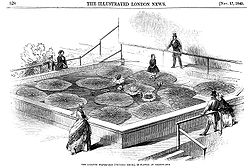
. In 1837 he secured a cutting of a new waterlily found in Guyana, and designed a heated pool that enabled him to breed the lily successfully: within three months its leaves were almost twelve feet wide.
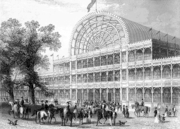 However, the waterlily was too big for any normal conservatory. Inspired by the huge leaves of the waterlily - 'a natural feat of engineering' - and tested by floating his daughter Annie on one leaf, he found the structure for his conservatory. The secret was in the rigidity provided by the radiating ribs connecting with flexible cross-ribs. Constant experimentation over a number of years led him to devise his glasshouse design that inspired the Crystal Palace.
With a cheap and light wooden frame, the conservatory design had a ridge-and-furrow roof to let in more light and drain rainwater away. Paxton used hollow pillars to double up as drain pipes and designed a special rafter that also acted as an internal and external gutter. All of these elements were pre-fabricated
and, like modular building
s, could be produced in vast numbers and assembled into buildings of varied design.
 In 1832, Paxton developed an interest in green houses at Chatsworth where he designed a series of buildings with "forcing frames" for espalier trees. Generally considered a landscape gardener
, Paxton's superiority in conservatory design earned him recognition as an innovative architect. His position in the House of Commons as Member of Parliament for Coventry allowed Paxton to dedicate his later years to urban planning
projects.
At the time the principles of using glass houses
was in its infancy and those at Chatsworth were dilapidated. After some experimentation, he designed a ridge and furrow
roof which would be at right angles
to the morning and evening sun, with an ingenious frame design which would admit maximum light - the forerunner of the modern greenhouse.
 In 1837, Paxton started the Great Conservatory or Stove, a huge cast-iron
heated glasshouse. At the time, the Conservatory was the largest glass building in the world. The largest sheet glass available at that time, that by Robert Chance, was three feet long. Chance managed to produce four foot sheets for Paxton's benefit. It was heated by eight boilers using seven miles (11 km) of iron pipe and cost over £30,000. There was a central carriageway and when the Queen was driven through, it was lit with twelve thousand lamps. However, it was prohibitively expensive to maintain, and was not heated during the First World War. The plants died and it was demolished in the 1920s.
The next great building at Chatsworth came about from the first seeds of the Victoria Regia
lily which had been sent to Kew
from the Amazon in 1836. Although these had grown, they had not flowered and in 1849 one seedling was given to Paxton to try out at Chatsworth. He entrusted the seedling to Eduard Ortgies
, a young gardener at Chatsworth and within two months the leaves were four and a half feet in diameter, and a month later it flowered. It continued growing and it became necessary to build a much larger house, the Victoria Regia House, the design of which was inspired by the lily itself.
 The Great Conservatory was the test-bed
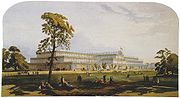
for the prefabricated glass and iron structural techniques which Paxton pioneered and would employ for his masterpiece: The Crystal Palace
of the Great Exhibition of 1851. These techniques were made physically possible by recent technological advances in the manufacture of both glass and cast iron, and financially possible by the dropping of a tax on glass.
In 1850 the Royal Commission
appointed to organise the Great Exhibition were in a quandary. An international competition for a building to house had produced 245 designs, of which only two were remotely suitable, and all would take too long to build and would be too permanent. There was an outcry by the public and in Parliament against the desecration of Hyde Park
.
Paxton was visiting London in his capacity as a director of the Midland Railway
to meet the chairman John Ellis
who was also a Member of Parliament
. He happened to mention an idea he had for the hall, and Ellis promptly encouraged to produce some plans, provided they could be ready in nine days. Unfortunately he was committed for the next few days, but at a board meeting of the railway in Derby, it is said he appeared to be spending much of his time doodling on a sheet of blotting paper
. At the end of the meeting he held up his first sketch of the Crystal Palace, very much inspired by the Victoria Regia House. The sketch is now in the Victoria and Albert Museum
.
He completed the plans and presented them to the Commission, but there was opposition from some members, since another design was well into its planning stage. Paxton decided to by-pass the Commission and published the design in the Illustrated London News to universal acclaim.
Its novelty was its revolutionary modular, prefabricated design, and use of glass. Glazing was carried out from special trolleys, and was fast: one man managed to fix 108 panes in a single day. The Palace was 1,848 feet long, 408 feet (124.4 m) wide and 108 feet (32.9 m) high. It required 4,500 tons of iron, 60,000 cubic feet of timber and needed over 293,000 panes of glass. Yet it took 2,000 men just eight months to build, and cost just £79,800. Quite unlike any other building, it was itself a demonstration of British technology in iron and glass. In its construction, Paxton was assisted by Charles Fox, also of Derby for the iron framework, and William Cubitt
Chairman of the Building Committee. All three were knighted. After the exhibition they were employed by the Crystal Palace Company to move it to Sydenham
where it was destroyed in 1936 by a fire.
He worked on public parks in Liverpool
, Birkenhead
, Glasgow
, Halifax
and the grounds of the Spa Buildings at Scarborough.
In 1850 Paxton was commissioned by Baron Mayer de Rothschild
to design Mentmore Towers
in Buckinghamshire
. This was to be one of the greatest country houses built during the Victorian Era
. Following the completion of Mentmore, Baron James de Rothschild
, one of Baron de Rothschild's French cousins, commissioned Château de Ferrières
at Ferrières-en-Brie
near Paris
to be "Another Mentmore, but twice the size". Both buildings still stand today.
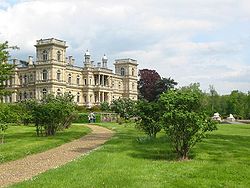 Paxton also designed another country house, a smaller version of Mentmore at Battlesden
near Woburn
in Bedfordshire
. This house was bought by the Duke of Bedford
thirty years after its completion, and wantonly demolished, because the Duke wanted no other mansion close to Woburn Abbey
.
Between 1835 and 1839, he organised plant-hunting expeditions; one of which ended in tragedy when two gardeners from Chatsworth sent to California drowned.. Tragedy also struck at home when his eldest son died.
Paxton was honoured by being a member of the Kew Commission which was to suggest improvements for Royal Botanic Gardens, and by being considered for the post of Head Gardener at Windsor Castle
.
He became affluent, not so much through his Chatsworth employment, but by successful speculation in the railway industry.
In October 1845 he was invited to lay out one of the country's first municipal burial grounds in Coventry
. This became the London Road Cemetery. He later became a Liberal
Member of Parliament
for Coventry
from 1854 until his death in 1865.
In June 1855 he presented a scheme he called the Great Victorian Way
to the Parliamentary Select Committee on Metropolitan Communications in which he envisioned the construction of an arcade, based on the structure of the Crystal Palace, in a ten mile loop around the centre of London. It would have incorporated a roadway, an atmospheric railway
, housing and shops.
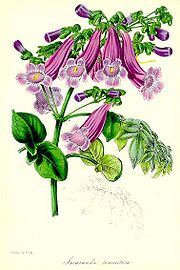 In 1831, Paxton published a monthly magazine, The Horticultural Register. This was followed by the Magazine of Botany in 1834, the Pocket Botanical Dictionary in 1840, The Flower Garden in 1850 and the Calendar of Gardening Operations. In addition to these titles he also, in 1841, co-founded perhaps the most famous horticultural periodical, The Gardeners' Chronicle
along with John Lindley
, Charles Wentworth Dilke and William Bradbury
and later became its editor.
He retired from Chatsworth when the Duke died in 1858 but carried on working at various projects such as the Thames Graving Dock, while Sarah remained at their house on the Chatsworth Estate until her death in 1871. He died in 1865.
English people
The English are a nation and ethnic group native to England, who speak English. The English identity is of early mediaeval origin, when they were known in Old English as the Anglecynn. England is now a country of the United Kingdom, and the majority of English people in England are British Citizens...
gardener and architect
Architect
An architect is a person trained in the planning, design and oversight of the construction of buildings. To practice architecture means to offer or render services in connection with the design and construction of a building, or group of buildings and the space within the site surrounding the...
, best known for designing The Crystal Palace
The Crystal Palace
The Crystal Palace was a cast-iron and glass building originally erected in Hyde Park, London, England, to house the Great Exhibition of 1851. More than 14,000 exhibitors from around the world gathered in the Palace's of exhibition space to display examples of the latest technology developed in...
.
Early life
Milton Bryan
Milton Bryan is a village and civil parish located in Central Bedfordshire. It lies just off the A4012 road, near to its junction with the A5 at Hockliffe. The nearest large town to Milton Bryan is Leighton Buzzard, very closely followed by Dunstable...
, Bedfordshire
Bedfordshire
Bedfordshire is a ceremonial county of historic origin in England that forms part of the East of England region.It borders Cambridgeshire to the north-east, Northamptonshire to the north, Buckinghamshire to the west and Hertfordshire to the south-east....
. Some references, incorrectly, list his birth year as 1801. This is, as he admitted in later life, a result of misinformation he provided in his teens, which enabled him to enrol at Chiswick Gardens.
He became a garden boy at the age of fifteen for Sir Gregory Osborne Page-Turner at Battlesden Park
Battlesden House
Battlesden House was a large manor house situated in parkland, Battlesden Park, close to the hamlet of Battlesden in Bedfordshire, England.A manor house was constructed in the late 16th century and was associated with the family of Lord Bathurst before he sold the estate to Sir Gregory Page in 1724...
, near Woburn
Woburn, Bedfordshire
Woburn is a small Saxon village and civil parish in Bedfordshire, England. It is situated about southeast of the centre of Milton Keynes, and about south of junction 13 of the M1 motorway and is a popular tourist attraction.-History:...
. After several moves, he obtained a position in 1823 at the Horticultural Society's Chiswick Gardens. These were close to the gardens of William Cavendish, 6th Duke of Devonshire
William Cavendish, 6th Duke of Devonshire
William George Spencer Cavendish, 6th Duke of Devonshire KG, PC , styled Marquess of Hartington until 1811, was a British peer, courtier and Whig politician...
at Chiswick House
Chiswick House
Chiswick House is a Palladian villa in Burlington Lane, Chiswick, in the London Borough of Hounslow in England. Set in , the house was completed in 1729 during the reign of George II and designed by Lord Burlington. William Kent , who took a leading role in designing the gardens, created one of the...
. The Duke frequently met the young gardener as he strolled in his gardens and became impressed with his skill and enthusiasm. The Duke offered the 20-year-old Paxton the position of Head Gardener
Head gardener
The head gardener or as a Master Gardener is an individual who manages the staff of a large garden, landscape or park, such as a residential garden, botanical garden, theme park, public park, museum or roadside embankments and islands....
at Chatsworth
Chatsworth House
Chatsworth House is a stately home in North Derbyshire, England, northeast of Bakewell and west of Chesterfield . It is the seat of the Duke of Devonshire, and has been home to his family, the Cavendish family, since Bess of Hardwick settled at Chatsworth in 1549.Standing on the east bank of the...
, which was considered one of the finest landscaped gardens of the time.
Although the Duke was in Russia at the time, Paxton set off for Chatsworth on the Chesterfield
Chesterfield
Chesterfield is a market town and a borough of Derbyshire, England. It lies north of Derby, on a confluence of the rivers Rother and Hipper. Its population is 70,260 , making it Derbyshire's largest town...
coach immediately, arriving at Chatsworth at half past four in the morning. By his own account he had explored the gardens, scaling the kitchen garden wall in the process, and set the staff to work, then ate breakfast with the housekeeper and met his future wife, Sarah Bown, the housekeeper's niece, as he later put it, completing his first morning's work before nine o'clock. They married in 1827, and she proved to be supremely capable of managing his affairs, leaving him free to pursue his ideas.
He enjoyed a very friendly relationship with his employer who recognised his diverse talents and facilitated his rise to prominence.
One of his first projects was to redesign the garden around the new north wing of the house and set up a 'pinetum', a collection of conifers which developed into a 40 acres (161,874.4 m²) arboretum which still exists. In the process he became skilled in moving even mature trees. The largest, weighing about eight tons, was moved from Kedleston Road in Derby
Derby
Derby , is a city and unitary authority in the East Midlands region of England. It lies upon the banks of the River Derwent and is located in the south of the ceremonial county of Derbyshire. In the 2001 census, the population of the city was 233,700, whilst that of the Derby Urban Area was 229,407...
. Among several other large projects at Chatsworth, such as the Rock Garden
Rock Garden
The Rock Garden or Rock Garden of Chandigarh is a Sculpture garden in Chandigarh, India, also known as Nek Chand's Rock Garden after its founder Nek Chand, a government official who started the garden secretly in his spare time in 1957. Today it is spread over an area of forty-acres , it is...
, the Emperor Fountain and the rebuilding of Edensor
Edensor
Edensor is a village in Derbyshire, England. It is the closest village to Chatsworth House and much of it belongs to the Dukes of Devonshire. Originally the village was close to the River Derwent immediately below Chatsworth, but the Dukes had it moved out of sight over a hill, apart from one...
village, he is best remembered for his glass houses.
While at Chatsworth Gardens, he built enormous fountains - The Emperor Fountain in 1844 twice the height of Nelson's Column, this required the creation of the Emperor Lake on the hill top above the gardens, this required the excavation of 100,000 cubic yard
Cubic yard
A cubic yard is an Imperial / U.S. customary unit of volume, used in the United States, Canada, and the UK. It is defined as the volume of a cube with sides of 1 yard in length.-Symbols:...
s of earth - as well as an arboretum, in 1848 he created the conservative wall, a glass house 331 ft (100.9 m) feet long by 7 feet wide and 1838-42 Edensor
Edensor
Edensor is a village in Derbyshire, England. It is the closest village to Chatsworth House and much of it belongs to the Dukes of Devonshire. Originally the village was close to the River Derwent immediately below Chatsworth, but the Dukes had it moved out of sight over a hill, apart from one...
model village
Model village
A model village is a type of mostly self-contained community, in most cases built from the late eighteenth century onwards by industrialists to house their workers...
. In 1837 he secured a cutting of a new waterlily found in Guyana, and designed a heated pool that enabled him to breed the lily successfully: within three months its leaves were almost twelve feet wide.
With a cheap and light wooden frame, the conservatory design had a ridge-and-furrow roof to let in more light and drain rainwater away. Paxton used hollow pillars to double up as drain pipes and designed a special rafter that also acted as an internal and external gutter. All of these elements were pre-fabricated
Prefabrication
Prefabrication is the practice of assembling components of a structure in a factory or other manufacturing site, and transporting complete assemblies or sub-assemblies to the construction site where the structure is to be located...
and, like modular building
Modular building
Modular buildings and modular homes are sectional prefabricated buildings or houses that consist of multiple modules or sections which are built in a remote facility and then delivered to their intended site of use...
s, could be produced in vast numbers and assembled into buildings of varied design.
Green houses
Landscape architecture
Landscape architecture is the design of outdoor and public spaces to achieve environmental, socio-behavioral, or aesthetic outcomes. It involves the systematic investigation of existing social, ecological, and geological conditions and processes in the landscape, and the design of interventions...
, Paxton's superiority in conservatory design earned him recognition as an innovative architect. His position in the House of Commons as Member of Parliament for Coventry allowed Paxton to dedicate his later years to urban planning
Urban planning
Urban planning incorporates areas such as economics, design, ecology, sociology, geography, law, political science, and statistics to guide and ensure the orderly development of settlements and communities....
projects.
At the time the principles of using glass houses
Greenhouse
A greenhouse is a building in which plants are grown. These structures range in size from small sheds to very large buildings...
was in its infancy and those at Chatsworth were dilapidated. After some experimentation, he designed a ridge and furrow
Ridge and furrow
Ridge and furrow is an archaeological pattern of ridges and troughs created by a system of ploughing used in Europe during the Middle Ages. The earliest examples date to the immediate post-Roman period and the system was used until the 17th century in some areas. Ridge and furrow topography is...
roof which would be at right angles
Angle
In geometry, an angle is the figure formed by two rays sharing a common endpoint, called the vertex of the angle.Angles are usually presumed to be in a Euclidean plane with the circle taken for standard with regard to direction. In fact, an angle is frequently viewed as a measure of an circular arc...
to the morning and evening sun, with an ingenious frame design which would admit maximum light - the forerunner of the modern greenhouse.
Cast iron
Cast iron is derived from pig iron, and while it usually refers to gray iron, it also identifies a large group of ferrous alloys which solidify with a eutectic. The color of a fractured surface can be used to identify an alloy. White cast iron is named after its white surface when fractured, due...
heated glasshouse. At the time, the Conservatory was the largest glass building in the world. The largest sheet glass available at that time, that by Robert Chance, was three feet long. Chance managed to produce four foot sheets for Paxton's benefit. It was heated by eight boilers using seven miles (11 km) of iron pipe and cost over £30,000. There was a central carriageway and when the Queen was driven through, it was lit with twelve thousand lamps. However, it was prohibitively expensive to maintain, and was not heated during the First World War. The plants died and it was demolished in the 1920s.
The next great building at Chatsworth came about from the first seeds of the Victoria Regia
Victoria amazonica
Victoria amazonica is a species of flowering plant, the largest of the Nymphaeaceae family of water lilies.-Description:The species has very large leaves, up to 3 m in diameter, that float on the water's surface on a submerged stalk, 7–8 m in length. The species was once called Victoria...
lily which had been sent to Kew
Royal Botanic Gardens, Kew
The Royal Botanic Gardens, Kew, usually referred to as Kew Gardens, is 121 hectares of gardens and botanical glasshouses between Richmond and Kew in southwest London, England. "The Royal Botanic Gardens, Kew" and the brand name "Kew" are also used as umbrella terms for the institution that runs...
from the Amazon in 1836. Although these had grown, they had not flowered and in 1849 one seedling was given to Paxton to try out at Chatsworth. He entrusted the seedling to Eduard Ortgies
Eduard Ortgies
Karl Eduard Ortgies , was a German horticulturist and nurseryman.His father was a noted plant enthusiast and owned an extensive garden, so that Eduard was encouraged to choose the same career and accordingly began as apprentice at the market garden of Herr Böckmann in Hamburg on 1 May 1844. Here he...
, a young gardener at Chatsworth and within two months the leaves were four and a half feet in diameter, and a month later it flowered. It continued growing and it became necessary to build a much larger house, the Victoria Regia House, the design of which was inspired by the lily itself.
Crystal Palace
Testbed
A testbed is a platform for experimentation of large development projects. Testbeds allow for rigorous, transparent, and replicable testing of scientific theories, computational tools, and new technologies.The term is used across many disciplines to describe a development environment that is...
for the prefabricated glass and iron structural techniques which Paxton pioneered and would employ for his masterpiece: The Crystal Palace
The Crystal Palace
The Crystal Palace was a cast-iron and glass building originally erected in Hyde Park, London, England, to house the Great Exhibition of 1851. More than 14,000 exhibitors from around the world gathered in the Palace's of exhibition space to display examples of the latest technology developed in...
of the Great Exhibition of 1851. These techniques were made physically possible by recent technological advances in the manufacture of both glass and cast iron, and financially possible by the dropping of a tax on glass.
In 1850 the Royal Commission
Royal Commission
In Commonwealth realms and other monarchies a Royal Commission is a major ad-hoc formal public inquiry into a defined issue. They have been held in various countries such as the United Kingdom, Australia, Canada, New Zealand, and Saudi Arabia...
appointed to organise the Great Exhibition were in a quandary. An international competition for a building to house had produced 245 designs, of which only two were remotely suitable, and all would take too long to build and would be too permanent. There was an outcry by the public and in Parliament against the desecration of Hyde Park
Hyde Park, London
Hyde Park is one of the largest parks in central London, United Kingdom, and one of the Royal Parks of London, famous for its Speakers' Corner.The park is divided in two by the Serpentine...
.
Paxton was visiting London in his capacity as a director of the Midland Railway
Midland Railway
The Midland Railway was a railway company in the United Kingdom from 1844 to 1922, when it became part of the London, Midland and Scottish Railway....
to meet the chairman John Ellis
John Ellis (businessman)
John Ellis , of Beaumont Leys in Leicester, was instrumental in interesting George Stephenson in the proposed Leicester and Swannington Railway....
who was also a Member of Parliament
Member of Parliament
A Member of Parliament is a representative of the voters to a :parliament. In many countries with bicameral parliaments, the term applies specifically to members of the lower house, as upper houses often have a different title, such as senate, and thus also have different titles for its members,...
. He happened to mention an idea he had for the hall, and Ellis promptly encouraged to produce some plans, provided they could be ready in nine days. Unfortunately he was committed for the next few days, but at a board meeting of the railway in Derby, it is said he appeared to be spending much of his time doodling on a sheet of blotting paper
Blotting paper
Blotting paper is a highly absorbent type of paper or other material. It is used to absorb an excess of liquid substances from the surface of writing paper or objects. It is also commonly used as a beauty tool to absorb excess oil from the skin.-Manufacture:Blotting paper is made from different...
. At the end of the meeting he held up his first sketch of the Crystal Palace, very much inspired by the Victoria Regia House. The sketch is now in the Victoria and Albert Museum
Victoria and Albert Museum
The Victoria and Albert Museum , set in the Brompton district of The Royal Borough of Kensington and Chelsea, London, England, is the world's largest museum of decorative arts and design, housing a permanent collection of over 4.5 million objects...
.
He completed the plans and presented them to the Commission, but there was opposition from some members, since another design was well into its planning stage. Paxton decided to by-pass the Commission and published the design in the Illustrated London News to universal acclaim.
Its novelty was its revolutionary modular, prefabricated design, and use of glass. Glazing was carried out from special trolleys, and was fast: one man managed to fix 108 panes in a single day. The Palace was 1,848 feet long, 408 feet (124.4 m) wide and 108 feet (32.9 m) high. It required 4,500 tons of iron, 60,000 cubic feet of timber and needed over 293,000 panes of glass. Yet it took 2,000 men just eight months to build, and cost just £79,800. Quite unlike any other building, it was itself a demonstration of British technology in iron and glass. In its construction, Paxton was assisted by Charles Fox, also of Derby for the iron framework, and William Cubitt
William Cubitt
Sir William Cubitt was an eminent English civil engineer and millwright. Born in Norfolk, England, he was employed in many of the great engineering undertakings of his time. He invented a type of windmill sail and the prison treadwheel, and was employed as chief engineer, at Ransomes of Ipswich,...
Chairman of the Building Committee. All three were knighted. After the exhibition they were employed by the Crystal Palace Company to move it to Sydenham
Sydenham
Sydenham is an area and electoral ward in the London Borough of Lewisham; although some streets towards Crystal Palace Park, Forest Hill and Penge are outside the ward and in the London Borough of Bromley, and some streets off Sydenham Hill are in the London Borough of Southwark. Sydenham was in...
where it was destroyed in 1936 by a fire.
Later life
Although he remained the Head Gardener at Chatsworth, the Duke allowed him to undertake outside work - like the Crystal Palace and his directorship of the Midland Railway.He worked on public parks in Liverpool
Liverpool
Liverpool is a city and metropolitan borough of Merseyside, England, along the eastern side of the Mersey Estuary. It was founded as a borough in 1207 and was granted city status in 1880...
, Birkenhead
Birkenhead
Birkenhead is a town within the Metropolitan Borough of Wirral in Merseyside, England. It is on the Wirral Peninsula, along the west bank of the River Mersey, opposite the city of Liverpool...
, Glasgow
Glasgow
Glasgow is the largest city in Scotland and third most populous in the United Kingdom. The city is situated on the River Clyde in the country's west central lowlands...
, Halifax
Halifax, West Yorkshire
Halifax is a minster town, within the Metropolitan Borough of Calderdale in West Yorkshire, England. It has an urban area population of 82,056 in the 2001 Census. It is well-known as a centre of England's woollen manufacture from the 15th century onward, originally dealing through the Halifax Piece...
and the grounds of the Spa Buildings at Scarborough.
In 1850 Paxton was commissioned by Baron Mayer de Rothschild
Mayer Amschel de Rothschild
Mayer Amschel de Rothschild of the English branch of the Rothschild family was the fourth and youngest son of Nathan Mayer Rothschild . He was named Mayer Amschel Rothschild, for his grandfather, the patriarch of the Rothschild family.-Life:Known to his family as "Muffy", he was born in New Court,...
to design Mentmore Towers
Mentmore Towers
Mentmore Towers is a 19th century English country house in the village of Mentmore in Buckinghamshire. The house was designed by Joseph Paxton and his son-in-law, George Henry Stokes, in the revival Elizabethan and Jacobean style of the late 16th century called Jacobethan, for the banker and...
in Buckinghamshire
Buckinghamshire
Buckinghamshire is a ceremonial and non-metropolitan home county in South East England. The county town is Aylesbury, the largest town in the ceremonial county is Milton Keynes and largest town in the non-metropolitan county is High Wycombe....
. This was to be one of the greatest country houses built during the Victorian Era
Victorian era
The Victorian era of British history was the period of Queen Victoria's reign from 20 June 1837 until her death on 22 January 1901. It was a long period of peace, prosperity, refined sensibilities and national self-confidence...
. Following the completion of Mentmore, Baron James de Rothschild
James Mayer de Rothschild
James Mayer de Rothschild was a French banker and the original founder of the French branch of the Rothschild family.-Biography:...
, one of Baron de Rothschild's French cousins, commissioned Château de Ferrières
Château de Ferrières
Château de Ferrières is a French château built between 1855 and 1859 by Baron James de Rothschild in the Goût Rothschild. Rothschild ownership of the Château de Ferrières was passed down through the male line according to the rule of primogeniture...
at Ferrières-en-Brie
Ferrières-en-Brie
Ferrières-en-Brie is a commune in the Seine-et-Marne department in the Île-de-France region in north-central France.-Geography:Ferrières-en-Brie is located east of Paris, on the Brie plateau, between the Seine river and Marne river valleys.-Castle:...
near Paris
Paris
Paris is the capital and largest city in France, situated on the river Seine, in northern France, at the heart of the Île-de-France region...
to be "Another Mentmore, but twice the size". Both buildings still stand today.
Battlesden
Battlesden is a hamlet and civil parish in the Central Bedfordshire district of Bedfordshire, England. It is just north of the A5, between Dunstable and Milton Keynes. According to the 2001 census, it had a population of 38...
near Woburn
Woburn, Bedfordshire
Woburn is a small Saxon village and civil parish in Bedfordshire, England. It is situated about southeast of the centre of Milton Keynes, and about south of junction 13 of the M1 motorway and is a popular tourist attraction.-History:...
in Bedfordshire
Bedfordshire
Bedfordshire is a ceremonial county of historic origin in England that forms part of the East of England region.It borders Cambridgeshire to the north-east, Northamptonshire to the north, Buckinghamshire to the west and Hertfordshire to the south-east....
. This house was bought by the Duke of Bedford
Duke of Bedford
thumb|right|240px|William Russell, 1st Duke of BedfordDuke of Bedford is a title that has been created five times in the Peerage of England. The first creation came in 1414 in favour of Henry IV's third son, John, who later served as regent of France. He was made Earl of Kendal at the same time...
thirty years after its completion, and wantonly demolished, because the Duke wanted no other mansion close to Woburn Abbey
Woburn Abbey
Woburn Abbey , near Woburn, Bedfordshire, England, is a country house, the seat of the Duke of Bedford and the location of the Woburn Safari Park.- Pre-20th century :...
.
Between 1835 and 1839, he organised plant-hunting expeditions; one of which ended in tragedy when two gardeners from Chatsworth sent to California drowned.. Tragedy also struck at home when his eldest son died.
Paxton was honoured by being a member of the Kew Commission which was to suggest improvements for Royal Botanic Gardens, and by being considered for the post of Head Gardener at Windsor Castle
Windsor Castle
Windsor Castle is a medieval castle and royal residence in Windsor in the English county of Berkshire, notable for its long association with the British royal family and its architecture. The original castle was built after the Norman invasion by William the Conqueror. Since the time of Henry I it...
.
He became affluent, not so much through his Chatsworth employment, but by successful speculation in the railway industry.
In October 1845 he was invited to lay out one of the country's first municipal burial grounds in Coventry
Coventry
Coventry is a city and metropolitan borough in the county of West Midlands in England. Coventry is the 9th largest city in England and the 11th largest in the United Kingdom. It is also the second largest city in the English Midlands, after Birmingham, with a population of 300,848, although...
. This became the London Road Cemetery. He later became a Liberal
Liberal Party (UK)
The Liberal Party was one of the two major political parties of the United Kingdom during the 19th and early 20th centuries. It was a third party of negligible importance throughout the latter half of the 20th Century, before merging with the Social Democratic Party in 1988 to form the present day...
Member of Parliament
Member of Parliament
A Member of Parliament is a representative of the voters to a :parliament. In many countries with bicameral parliaments, the term applies specifically to members of the lower house, as upper houses often have a different title, such as senate, and thus also have different titles for its members,...
for Coventry
Coventry (UK Parliament constituency)
Coventry was a borough constituency which was represented in the House of Commons of England and its successors, the House of Commons of Great Britain and the House of Commons of the United Kingdom....
from 1854 until his death in 1865.
In June 1855 he presented a scheme he called the Great Victorian Way
Great Victorian Way
The Great Victorian Way was an unbuilt infrastructure project presented to the Parliamentary Select Committee on Metropolitan Communications by Joseph Paxton. in June 1855. It would have consisted of a ten mile covered loop around much of central and west London, integrating road and rail ...
to the Parliamentary Select Committee on Metropolitan Communications in which he envisioned the construction of an arcade, based on the structure of the Crystal Palace, in a ten mile loop around the centre of London. It would have incorporated a roadway, an atmospheric railway
Atmospheric railway
An atmospheric railway uses air pressure to provide power for propulsion. In one plan a pneumatic tube is laid between the rails, with a piston running in it suspended from the train through a sealable slot in the top of the tube. Alternatively, the whole tunnel may be the pneumatic tube with the...
, housing and shops.
The Gardeners' Chronicle
The Gardeners' Chronicle was a British horticulture periodical. It lasted as a title in its own right for nearly 150 years and is still extant as part of the magazine Horticulture Week....
along with John Lindley
John Lindley
John Lindley FRS was an English botanist, gardener and orchidologist.-Early years:Born in Catton, near Norwich, England, John Lindley was one of four children of George and Mary Lindley. George Lindley was a nurseryman and pomologist and ran a commercial nursery garden...
, Charles Wentworth Dilke and William Bradbury
William Bradbury
William Bradbury may refer to:*William Bradbury , English soccer player*William Bradbury , English printer*William Batchelder Bradbury , American musician*Bill Bradbury , U.S. politician...
and later became its editor.
He retired from Chatsworth when the Duke died in 1858 but carried on working at various projects such as the Thames Graving Dock, while Sarah remained at their house on the Chatsworth Estate until her death in 1871. He died in 1865.
Further reading
- Kate Colquhoun - A Thing in Disguise: The Visionary Life of Joseph Paxton (Fourth Estate, 2003) ISBN 0-00-714353-2
- George F Chadwick - Works of Sir Joseph Paxton (Architectural Press, 1961) ISBN 0-85139-721-2
External links
- Joseph Paxton Joseph Paxton's work on orchids
- BBC Historic Figures
- Joseph Paxton - a biography from the landscape architecture and gardens guide
- Joseph Paxton his early work - London Road Cemetery Coventry
- Eddie Richardson's page on Sir Joseph Paxton - includes photographs and a family tree