


De architectura

Encyclopedia
is a treatise on architecture
written by the Roman
architect
Vitruvius
and dedicated to his patron, the emperor Caesar Augustus, as a guide for building projects. The work is one of the most important sources of modern knowledge of Roman building methods as well as the planning and design of structures, both large (aqueducts, buildings, baths, harbours) and small (machines, measuring devices, instruments). He is also the prime source of the famous story of Archimedes
and his bath-time discovery.
De architectura - Ten Books on Architecture
Roman architects were skilled in engineering, art, and craftsmanship combined. Vitruvius was very much of this type, a fact reflected in De architectura. He covers a wide variety of subjects that he saw as touching on architecture. This included many aspects that may seem irrelevant to modern eyes, ranging from mathematics to astronomy, meteorology, and medicine. In the Roman conception, architecture needed to take into account everything touching on the physical and intellectual life of man and his surroundings.
Vitruvius, thus, deals with many theoretical issues concerning architecture. For instance, in Book 2 of De architectura, he advises architects working with brick
s to familiarise themselves with pre-Socratic theories of matter so as to understand how their materials will behave. Book 9 relates the abstract geometry
of Plato
to the everyday work of the surveyor. Astrology
is cited for its insights into the organisation of human life, while astronomy
is required for the understanding of sundial
s. Likewise, Vitruvius cites Ctesibius of Alexandria
and Archimedes
for their inventions, Aristoxenus
(Aristotle
's apprentice) for music
, Agatharchus
for theatre
, and Varro
for architecture.
 He sought to address the ethos of architecture, declaring that quality depends on the social relevance of the artist
's work, not on the form or workmanship of the work itself. Perhaps the most famous declaration from De architectura is one still quoted by architects: "Well building hath three conditions: firmness, commodity, and delight." This quote is taken from Sir Henry Wotton
's version of 1624, and is a plain and accurate translation of the passage in Vitruvius (I.iii.2): but English has changed since then, especially in regard to the word "commodity", and the tag is usually misunderstood. A modern interpretation of Wotton's English might render it thus: The ideal building has three elements; it is sturdy, useful, and beautiful.
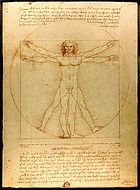
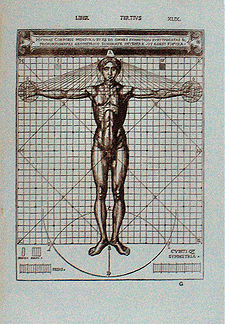
Vitruvius also studied human proportions (Book 3) and his canones were later encoded in a very famous drawing by Leonardo da Vinci
(Homo Vitruvianus, "Vitruvian Man
").
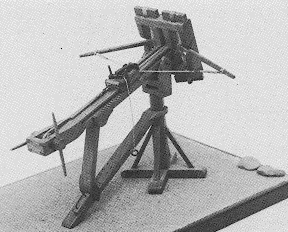
 The work is important for its descriptions of many different machines used for engineering structures such as hoist
s, crane
s and pulleys, as well as war machines such as catapaults, ballistae, and siege engine
s. He also describes the construction of sundial
s and water clock
s, and the use of an aeolipile
(the first steam engine
) as an experiment to demonstrate the nature of atmospheric air movements (wind).
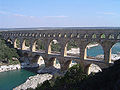
in southern France. Numerous such massive structures occur across the former Empire, a testament to the power of Roman engineering
. His description of aqueduct
construction is short, but does mention key details especially for the way they were surveyed, and the careful choice of materials needed. His book would have been of assistance to Frontinus, a general who was appointed in the late first century AD to administer the many aqueducts of Rome
. He discovered a discrepancy between the intake and supply of water caused by illegal pipes inserted into the channels to divert the water. They went far in exploiting water power, as the set of no less than 16 water mills at Barbegal in France
demonstrates. The mills ground grain in a very efficient operation, and many other mills are now known, such as the much later Hierapolis sawmill
.
painting. Cement
, concrete
, and lime receive in-depth descriptions, the longevity of many Roman structures being mute testimony to their skill in building materials and design.
It is worth noting that Vitruvius advises that lead
should not be used to conduct drinking water, clay pipes being preferred. He comes to this conclusion in Book VIII of De Architectura after empirical observation of the apparent labourer illnesses in the plumbum foundries of his time. In 1986, the United States banned the use of lead in plumbing due to lead poisoning's neurological damage. However, much of the water used by Rome and many other cities was very hard, and coated the inner surfaces of the pipes, so lead poisoning
was most unlikely.
 Vitruvius gives us the famous story about Archimedes
and his detection of adulterated gold in a royal crown. When Archimedes realised that the volume of the crown could be measured exactly by the displacement created in a bath of water, he ran into the street with the cry of "Eureka
!", and the discovery enabled him to compare the density of the crown with pure gold
. He showed that the crown had been alloyed with silver
, and the king defrauded. We are not told what happened to the metal worker who crafted the crown, but no doubt he suffered a painful fate.
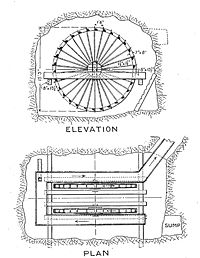
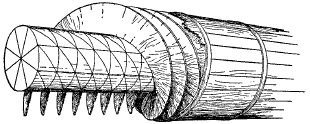
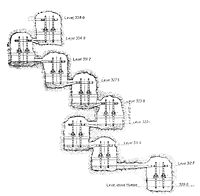 He describes the construction of Archimedes' screw
in Chapter X, although does not mention Archimedes by name. It was a device widely used for raising water to irrigate fields and dewater mines. Other lifting machines he mentions include the endless chain of buckets and the reverse overshot water-wheel
. Remains of the water wheels used for lifting water have been discovered in old mines such as those at Rio Tinto in Spain
and Dolaucothi in west Wales
. One of the wheels from Rio Tinto is now in the British Museum
, and the latter in the National Museum of Wales. The remains were discovered when these mines were re-opened in modern mining attempts. They would have been used in a vertical sequence, with 16 such mills capable of raising water at least 96 feet above the water table. Each wheel would have been worked by a miner treading the device at the top of the wheel, by using cleats on the outer edge. That they were using such devices in mines clearly implies that they were entirely capable of using them as water wheels to develop power for a range of activities, not just for grinding wheat but also probably for sawing timber, crushing ores, fulling
and so on.
 Ctesibius
is credited with the invention of the force pump, which Vitruvius describes as being built from bronze
with valves to allow a head of water to be formed above the machine. The device is also described by Hero of Alexandria
in his "Pneumatica". The machine is operated by hand in moving a lever up and down. He mentions its use for supplying fountains above a reservoir, although a more mundane use might be as a simple fire-engine. One was found at Roman Silchester or Calleva Atrebatum in England
, and another is on display at the British Museum
. Their functions are not described but they are both made in bronze, just as Vitruvius specifies.
Vitruvius also mentions the several automaton
s that Ctesibius
invented, and intended for amusement and pleasure rather than serving a useful function.
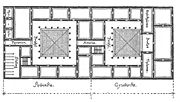
 He describes the many innovations made in building design to improve the living conditions of the inhabitants. Foremost among them is the development of the hypocaust
, a type of central heating
where hot air developed by a fire was channelled under the floor and inside the walls of public baths and villa
s. He gives explicit instructions how to design such buildings so that fuel efficiency
is maximised, so that, for example, the caldarium
is next to the tepidarium
followed by the frigidarium
. He also advises on using a type of regulator to control the heat in the hot rooms, a bronze
disc set into the roof under a circular aperture, which could be raised or lowered by a pulley
to adjust the ventilation. Although he does not suggest it himself, it is likely that his dewatering devices such as the reverse overshot water-wheel
was used in the larger baths to lift water to header tanks at the top of the larger thermae, such as the Baths of Diocletian
and the Baths of Caracalla
.
, which he compares favourably with the groma
, a device using plumb lines. They were essential in all building operations, but especially in aqueduct construction, where a uniform gradient was important to provision of a regular supply of water without damage to the walls of the channel. He describes the hodometer
, in essence a device for automatically measuring distances along roads, a machine essential for developing accurate itineraries, such as the Peutinger Table.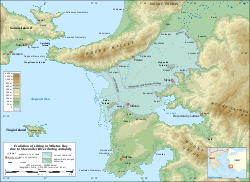
, "the land of Caria
", in present day Turkey. These cities are given as: Ephesus
, Miletus
, Myus
, Priene
, Samos
, Teos
, Colophon
, Chius, Erythrae
, Phocaea
, Clazomenae
, Lebedos, Melite
, and later a fourteenth, Smyrna
eans. Myus, the third city, is described as being "long ago engulfed by the water, and its sacred rites and suffrage". This sentence indicates that at the time of Vitruvius's writing it was known that sea-level change and/or land subsidence occurred. The layout of these cities is in general from South to North so that it appears that where Myrus should be located is inland. If this is the case then since the writing of De architectura the region has experienced either soil rebound or a sea-level fall. Though not indicative of sea-level change, or speculation of such, many Roman ports suffered from silting. Roman salt works in Essex County, England today are located at the 5-metre contour, implying that this was the coastline. These observations only indicate the extent of silting and soil rebound affecting coastline change since the writing of De architectura.
 Vitruvius' work is one of many examples of Latin texts that owe their survival to the palace scriptorium
of Charlemagne
in the early 9th century. (This activity of finding and recopying classical manuscript
s is part of what is called the Carolingian Renaissance
.) Many of the surviving manuscripts of Vitruvius' work derive from an existing manuscript that was written there, British Library
manuscript Harley 2767 http://www.bl.uk/catalogues/illuminatedmanuscripts/record.asp?MSID=8557&CollID=8&NStart=2767.
 These texts were not just copied but also known at the court of Charlemagne, since his historian, the bishop Einhard
, asked for explanations of some technical terms at the visiting English churchman Alcuin
. In addition, a number of individuals are known to have read the text or have been indirectly influenced by it, including: Vussin, Hrabanus Maurus, Hermann of Reichenau
, Hugo of St. Victor, Gervase of Melkey, William of Malmesbury
, Theoderich of St. Trond, Petrus Diaconus, Albertus Magnus
, Filippo Villani
, Jean de Montreuil
, Petrarch
, Boccaccio, Giovanni de Dondi, Domenico di Bandino, Niccolò Acciaioli
bequeathed copy to the Basilica of San Lorenzo, Florence, Bernward of Hildesheim
, and St. Thomas Aquinas. In 1244 the Dominican friar Vincent of Beauvais
made a large number of references to "De Architectura" in his compendium of all the knowledge of the Middle Ages "Speculum maius".
Many copies of De architectura, dating from the eight to the fifteenth centuries, did exist in manuscript form during the Middle Ages
and ninety-two are still available in public collections. But they appear to have received little attention, possibly due to the obsolescence of many specialized Latin terms used by Vitruvius and the loss of most of the original ten illustrations thought by some to be helpful understanding parts of the text.
Vitrivius' work was "rediscovered" in 1414 by the Florentine
humanist
Poggio Bracciolini, who found it in the Abbey of St Gallen, Switzerland
. He publicized the manuscript to a receptive audience of Renaissance
thinkers, just as interest in the classical cultural and scientific heritage was reviving.
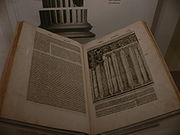
 The first printed edition (editio princeps), an incunabula version, was published by the Veronese
scholar Fra Giovanni Sulpitius in 1486 (with a second edition in 1495 or 1496). But none was illustrated. The Dominican friar Fra Giovanni Giocondo produced the first version illustrated with woodcut
s in Venice
in 1511. It had a thorough philosophical approach and superb illustrations.
Translations into Italian
were in circulation by the 1520s, the first in print being the translation with new illustrations by Cesare Cesariano
, a Milanese friend of the architect Bramante, printed in Como
in 1521. It was rapidly translated into other European languages the first German
version was published in 1528 and the first French versions followed in 1547 (but contained many mistakes). The first Spanish translation was published in 1582 by Miguel de Urrea and Juan Gracian. The most authoritative and influential edition was publicized in French in 1673 by Claude Perrault
, commissioned by Jean-Baptiste Colbert
in 1664.
The first English translation followed in 1692, although John Shute
had drawn on the text as early as 1563 for his book The First and Chief Grounds of Architecture. The 1692 translation was an abridgment based on the French version of Claude Perrault. It is interesting to note that English-speakers had to wait until 1771 for a full translation of the first five volumes and 1791 for the whole thing. Sir Henry Wotton
's 1624 version The Elements of Architecture was more of a free adaptation than a literal translation, while a 1692 translation was much abbreviated. Thanks to the art of printing, Vitruvius' work had become a popular subject of hermeneutics, with highly detailed and interpretive illustrations, and became widely dispersed.
, prompting the rise of the Neo-Classical style. Renaissance architects, such as Niccoli, Brunelleschi
and Leon Battista Alberti, found in "De Architectura" their rationale for raising their branch of knowledge to a scientific discipline as well as emphasising the skills of the artisan
.
The English architect Inigo Jones
and the Frenchman Salomon de Caus
were among the first to re-evaluate and implement those disciplines that Vitruvius considered a necessary element of architecture: arts and science
s based upon number and proportion (architecture)
. The 16th-century architect Palladio considered Vitrivius his master and guide, and made some drawings based on Vitruvius' work before conceiving his own architectural precepts.
in a machine is in the writing of the Roman author and architect Vitruvius (ca. 88 - ca. 26 BC), who in De architectura describes an anaphoric clock (it is presumed, a clepsydra or water clock
) in Alexandria. The clock had a rotating field of stars behind a wire frame indicating the hours of the day. The wire framework (the spider) and the star locations were constructed using the stereographic projection. Similar constructions dated from the first to third centuries and have been found in Salzburg and northeastern France, so such mechanisms were, it is presumed, fairly widespread among Romans.
, Ph.D, LL.D. Late Professor of Classical Philology in Harvard University
. The full text of this translation is available from the Project Gutenberg
, see external links
Architecture
Architecture is both the process and product of planning, designing and construction. Architectural works, in the material form of buildings, are often perceived as cultural and political symbols and as works of art...
written by the Roman
Ancient Rome
Ancient Rome was a thriving civilization that grew on the Italian Peninsula as early as the 8th century BC. Located along the Mediterranean Sea and centered on the city of Rome, it expanded to one of the largest empires in the ancient world....
architect
Architect
An architect is a person trained in the planning, design and oversight of the construction of buildings. To practice architecture means to offer or render services in connection with the design and construction of a building, or group of buildings and the space within the site surrounding the...
Vitruvius
Vitruvius
Marcus Vitruvius Pollio was a Roman writer, architect and engineer, active in the 1st century BC. He is best known as the author of the multi-volume work De Architectura ....
and dedicated to his patron, the emperor Caesar Augustus, as a guide for building projects. The work is one of the most important sources of modern knowledge of Roman building methods as well as the planning and design of structures, both large (aqueducts, buildings, baths, harbours) and small (machines, measuring devices, instruments). He is also the prime source of the famous story of Archimedes
Archimedes
Archimedes of Syracuse was a Greek mathematician, physicist, engineer, inventor, and astronomer. Although few details of his life are known, he is regarded as one of the leading scientists in classical antiquity. Among his advances in physics are the foundations of hydrostatics, statics and an...
and his bath-time discovery.
In summary
Probably written around 15 BC, it is the only contemporary source on classical architecture to have survived in its entirety. Divided into ten sections or "books", it covers almost every aspect of Roman architecture. The books break down as follows:De architectura - Ten Books on Architecture
- Town planningUrban planningUrban planning incorporates areas such as economics, design, ecology, sociology, geography, law, political science, and statistics to guide and ensure the orderly development of settlements and communities....
, architectureArchitectureArchitecture is both the process and product of planning, designing and construction. Architectural works, in the material form of buildings, are often perceived as cultural and political symbols and as works of art...
or Civil engineeringCivil engineeringCivil engineering is a professional engineering discipline that deals with the design, construction, and maintenance of the physical and naturally built environment, including works like roads, bridges, canals, dams, and buildings...
in general, and the qualifications required of an architectArchitectAn architect is a person trained in the planning, design and oversight of the construction of buildings. To practice architecture means to offer or render services in connection with the design and construction of a building, or group of buildings and the space within the site surrounding the...
or more modernly the civil engineerCivil engineerA civil engineer is a person who practices civil engineering; the application of planning, designing, constructing, maintaining, and operating infrastructures while protecting the public and environmental health, as well as improving existing infrastructures that have been neglected.Originally, a... - Building materialBuilding materialBuilding material is any material which is used for a construction purpose. Many naturally occurring substances, such as clay, sand, wood and rocks, even twigs and leaves have been used to construct buildings. Apart from naturally occurring materials, many man-made products are in use, some more...
s - TemplesRoman templeAncient Roman temples are among the most visible archaeological remains of Roman culture, and are a significant source for Roman architecture. Their construction and maintenance was a major part of ancient Roman religion. The main room housed the cult image of the deity to whom the temple was...
and the orders of architecture; - continuation of book 3
- Civil buildingsRoman architectureAncient Roman architecture adopted certain aspects of Ancient Greek architecture, creating a new architectural style. The Romans were indebted to their Etruscan neighbors and forefathers who supplied them with a wealth of knowledge essential for future architectural solutions, such as hydraulics...
- Domestic buildingsRoman villaA Roman villa is a villa that was built or lived in during the Roman republic and the Roman Empire. A villa was originally a Roman country house built for the upper class...
- PavementsPavement (architecture)A pavement in architecture is a stone or tile structure, the pavement, which can serve as a floor or an external feature. Pavements can be made of flagstones which are used for things like paving gardens, tiles also there were mosaics which were commonly used by the Romans.When along the side of...
and decorative plasterPlasterPlaster is a building material used for coating walls and ceilings. Plaster starts as a dry powder similar to mortar or cement and like those materials it is mixed with water to form a paste which liberates heat and then hardens. Unlike mortar and cement, plaster remains quite soft after setting,...
work - Water suppliesRoman aqueductThe Romans constructed numerous aqueducts to serve any large city in their empire, as well as many small towns and industrial sites. The city of Rome had the largest concentration of aqueducts, with water being supplied by eleven aqueducts constructed over a period of about 500 years...
and aqueducts - Sciences influencing architecture - geometryGeometryGeometry arose as the field of knowledge dealing with spatial relationships. Geometry was one of the two fields of pre-modern mathematics, the other being the study of numbers ....
, mensuration, astronomyAstronomyAstronomy is a natural science that deals with the study of celestial objects and phenomena that originate outside the atmosphere of Earth...
, sundialSundialA sundial is a device that measures time by the position of the Sun. In common designs such as the horizontal sundial, the sun casts a shadow from its style onto a surface marked with lines indicating the hours of the day. The style is the time-telling edge of the gnomon, often a thin rod or a... - Use and construction of machines - Roman siege enginesRoman siege enginesRoman siege engines were, for the most part, adapted from Hellenistic siege technology. Relatively small efforts were made to develop the technology; however, the Romans brought an unrelentingly aggressive style to siege warfare that brought them repeated success...
, water mills, drainage machines, Roman technologyRoman technologyRoman technology is the engineering practice which supported Roman civilization and made the expansion of Roman commerce and Roman military possible over nearly a thousand years....
, hoistingHoist (device)A hoist is a device used for lifting or lowering a load by means of a drum or lift-wheel around which rope or chain wraps. It may be manually operated, electrically or pneumatically driven and may use chain, fiber or wire rope as its lifting medium. The load is attached to the hoist by means of a...
, pneumaticsPneumaticsPneumatics is a branch of technology, which deals with the study and application of use of pressurized gas to effect mechanical motion.Pneumatic systems are extensively used in industry, where factories are commonly plumbed with compressed air or compressed inert gases...
Roman architects were skilled in engineering, art, and craftsmanship combined. Vitruvius was very much of this type, a fact reflected in De architectura. He covers a wide variety of subjects that he saw as touching on architecture. This included many aspects that may seem irrelevant to modern eyes, ranging from mathematics to astronomy, meteorology, and medicine. In the Roman conception, architecture needed to take into account everything touching on the physical and intellectual life of man and his surroundings.
Vitruvius, thus, deals with many theoretical issues concerning architecture. For instance, in Book 2 of De architectura, he advises architects working with brick
Brick
A brick is a block of ceramic material used in masonry construction, usually laid using various kinds of mortar. It has been regarded as one of the longest lasting and strongest building materials used throughout history.-History:...
s to familiarise themselves with pre-Socratic theories of matter so as to understand how their materials will behave. Book 9 relates the abstract geometry
Geometry
Geometry arose as the field of knowledge dealing with spatial relationships. Geometry was one of the two fields of pre-modern mathematics, the other being the study of numbers ....
of Plato
Plato
Plato , was a Classical Greek philosopher, mathematician, student of Socrates, writer of philosophical dialogues, and founder of the Academy in Athens, the first institution of higher learning in the Western world. Along with his mentor, Socrates, and his student, Aristotle, Plato helped to lay the...
to the everyday work of the surveyor. Astrology
Astrology
Astrology consists of a number of belief systems which hold that there is a relationship between astronomical phenomena and events in the human world...
is cited for its insights into the organisation of human life, while astronomy
Astronomy
Astronomy is a natural science that deals with the study of celestial objects and phenomena that originate outside the atmosphere of Earth...
is required for the understanding of sundial
Sundial
A sundial is a device that measures time by the position of the Sun. In common designs such as the horizontal sundial, the sun casts a shadow from its style onto a surface marked with lines indicating the hours of the day. The style is the time-telling edge of the gnomon, often a thin rod or a...
s. Likewise, Vitruvius cites Ctesibius of Alexandria
Ctesibius
Ctesibius or Ktesibios or Tesibius was a Greek inventor and mathematician in Alexandria, Ptolemaic Egypt. He wrote the first treatises on the science of compressed air and its uses in pumps...
and Archimedes
Archimedes
Archimedes of Syracuse was a Greek mathematician, physicist, engineer, inventor, and astronomer. Although few details of his life are known, he is regarded as one of the leading scientists in classical antiquity. Among his advances in physics are the foundations of hydrostatics, statics and an...
for their inventions, Aristoxenus
Aristoxenus
Aristoxenus of Tarentum was a Greek Peripatetic philosopher, and a pupil of Aristotle. Most of his writings, which dealt with philosophy, ethics and music, have been lost, but one musical treatise, Elements of Harmony, survives incomplete, as well as some fragments concerning rhythm and...
(Aristotle
Aristotle
Aristotle was a Greek philosopher and polymath, a student of Plato and teacher of Alexander the Great. His writings cover many subjects, including physics, metaphysics, poetry, theater, music, logic, rhetoric, linguistics, politics, government, ethics, biology, and zoology...
's apprentice) for music
Music
Music is an art form whose medium is sound and silence. Its common elements are pitch , rhythm , dynamics, and the sonic qualities of timbre and texture...
, Agatharchus
Agatharchus
Agatharchus or Agatharch was a self-taught painter from Samos who lived in the 5th century BC. He is said by Vitruvius to have invented scene-painting, and to have painted a scene for a tragedy which Aeschylus exhibited...
for theatre
Theatre
Theatre is a collaborative form of fine art that uses live performers to present the experience of a real or imagined event before a live audience in a specific place. The performers may communicate this experience to the audience through combinations of gesture, speech, song, music or dance...
, and Varro
Marcus Terentius Varro
Marcus Terentius Varro was an ancient Roman scholar and writer. He is sometimes called Varro Reatinus to distinguish him from his younger contemporary Varro Atacinus.-Biography:...
for architecture.
Buildings
Artist
An artist is a person engaged in one or more of any of a broad spectrum of activities related to creating art, practicing the arts and/or demonstrating an art. The common usage in both everyday speech and academic discourse is a practitioner in the visual arts only...
's work, not on the form or workmanship of the work itself. Perhaps the most famous declaration from De architectura is one still quoted by architects: "Well building hath three conditions: firmness, commodity, and delight." This quote is taken from Sir Henry Wotton
Henry Wotton
Sir Henry Wotton was an English author and diplomat. He is often quoted as saying, "An ambassador is an honest gentleman sent to lie abroad for the good of his country." -Life:The son of Thomas Wotton , brother of Edward Wotton, 1st Baron Wotton, and grandnephew of the diplomat...
's version of 1624, and is a plain and accurate translation of the passage in Vitruvius (I.iii.2): but English has changed since then, especially in regard to the word "commodity", and the tag is usually misunderstood. A modern interpretation of Wotton's English might render it thus: The ideal building has three elements; it is sturdy, useful, and beautiful.
Vitruvius also studied human proportions (Book 3) and his canones were later encoded in a very famous drawing by Leonardo da Vinci
Leonardo da Vinci
Leonardo di ser Piero da Vinci was an Italian Renaissance polymath: painter, sculptor, architect, musician, scientist, mathematician, engineer, inventor, anatomist, geologist, cartographer, botanist and writer whose genius, perhaps more than that of any other figure, epitomized the Renaissance...
(Homo Vitruvianus, "Vitruvian Man
Vitruvian Man
The Vitruvian Man is a world-renowned drawing created by Leonardo da Vinci circa 1487. It is accompanied by notes based on the work of the famed architect, Vitruvius. The drawing, which is in pen and ink on paper, depicts a male figure in two superimposed positions with his arms and legs apart and...
").
Roman technology
Hoist (device)
A hoist is a device used for lifting or lowering a load by means of a drum or lift-wheel around which rope or chain wraps. It may be manually operated, electrically or pneumatically driven and may use chain, fiber or wire rope as its lifting medium. The load is attached to the hoist by means of a...
s, crane
Crane (machine)
A crane is a type of machine, generally equipped with a hoist, wire ropes or chains, and sheaves, that can be used both to lift and lower materials and to move them horizontally. It uses one or more simple machines to create mechanical advantage and thus move loads beyond the normal capability of...
s and pulleys, as well as war machines such as catapaults, ballistae, and siege engine
Siege engine
A siege engine is a device that is designed to break or circumvent city walls and other fortifications in siege warfare. Some have been operated close to the fortifications, while others have been used to attack from a distance. From antiquity, siege engines were constructed largely of wood and...
s. He also describes the construction of sundial
Sundial
A sundial is a device that measures time by the position of the Sun. In common designs such as the horizontal sundial, the sun casts a shadow from its style onto a surface marked with lines indicating the hours of the day. The style is the time-telling edge of the gnomon, often a thin rod or a...
s and water clock
Water clock
A water clock or clepsydra is any timepiece in which time is measured by the regulated flow of liquid into or out from a vessel where the amount is then measured.Water clocks, along with sundials, are likely to be the oldest time-measuring instruments, with the only exceptions...
s, and the use of an aeolipile
Aeolipile
An aeolipile , also known as a Hero engine, is a rocket style jet engine which spins when heated. In the 1st century AD, Hero of Alexandria described the device, and many sources give him the credit for its invention.The aeolipile Hero described is considered to be the first recorded steam engine...
(the first steam engine
Steam engine
A steam engine is a heat engine that performs mechanical work using steam as its working fluid.Steam engines are external combustion engines, where the working fluid is separate from the combustion products. Non-combustion heat sources such as solar power, nuclear power or geothermal energy may be...
) as an experiment to demonstrate the nature of atmospheric air movements (wind).
Aqueducts and mills
Books 8, 9 and 10 form the basis of much of what we know about Roman technology, now augmented by archaeological studies of extant remains, such as the Pont du GardPont du Gard
The Pont du Gard is a notable ancient Roman aqueduct bridge that crosses the Gard River in southern France. It is part of a long aqueduct that runs between Uzès and Nîmes in the South of France. It is located in Vers-Pont-du-Gard near Remoulins, in the Gard département...
in southern France. Numerous such massive structures occur across the former Empire, a testament to the power of Roman engineering
Roman engineering
Romans are famous for their advanced engineering accomplishments, although some of their own inventions were improvements on older ideas, concepts and inventions. Technology for bringing running water into cities was developed in the east, but transformed by the Romans into a technology...
. His description of aqueduct
Aqueduct
An aqueduct is a water supply or navigable channel constructed to convey water. In modern engineering, the term is used for any system of pipes, ditches, canals, tunnels, and other structures used for this purpose....
construction is short, but does mention key details especially for the way they were surveyed, and the careful choice of materials needed. His book would have been of assistance to Frontinus, a general who was appointed in the late first century AD to administer the many aqueducts of Rome
Aqueducts of Rome
This is a list of aqueducts in Rome listed in chronological order of their construction.- Ancient Rome :* Aqua Appia** built in 312 BC** source: springs to the east of Rome...
. He discovered a discrepancy between the intake and supply of water caused by illegal pipes inserted into the channels to divert the water. They went far in exploiting water power, as the set of no less than 16 water mills at Barbegal in France
France
The French Republic , The French Republic , The French Republic , (commonly known as France , is a unitary semi-presidential republic in Western Europe with several overseas territories and islands located on other continents and in the Indian, Pacific, and Atlantic oceans. Metropolitan France...
demonstrates. The mills ground grain in a very efficient operation, and many other mills are now known, such as the much later Hierapolis sawmill
Hierapolis sawmill
The Hierapolis sawmill was a Roman water-powered stone sawmill at Hierapolis, Asia Minor . Dating to the second half of the 3rd century AD, the sawmill is the earliest known machine to combine a crank with a connecting rod....
.
Materials
Vitruvius describes many different construction materials used for a wide variety of different structures, as well as such details as stuccoStucco
Stucco or render is a material made of an aggregate, a binder, and water. Stucco is applied wet and hardens to a very dense solid. It is used as decorative coating for walls and ceilings and as a sculptural and artistic material in architecture...
painting. Cement
Cement
In the most general sense of the word, a cement is a binder, a substance that sets and hardens independently, and can bind other materials together. The word "cement" traces to the Romans, who used the term opus caementicium to describe masonry resembling modern concrete that was made from crushed...
, concrete
Concrete
Concrete is a composite construction material, composed of cement and other cementitious materials such as fly ash and slag cement, aggregate , water and chemical admixtures.The word concrete comes from the Latin word...
, and lime receive in-depth descriptions, the longevity of many Roman structures being mute testimony to their skill in building materials and design.
It is worth noting that Vitruvius advises that lead
Lead
Lead is a main-group element in the carbon group with the symbol Pb and atomic number 82. Lead is a soft, malleable poor metal. It is also counted as one of the heavy metals. Metallic lead has a bluish-white color after being freshly cut, but it soon tarnishes to a dull grayish color when exposed...
should not be used to conduct drinking water, clay pipes being preferred. He comes to this conclusion in Book VIII of De Architectura after empirical observation of the apparent labourer illnesses in the plumbum foundries of his time. In 1986, the United States banned the use of lead in plumbing due to lead poisoning's neurological damage. However, much of the water used by Rome and many other cities was very hard, and coated the inner surfaces of the pipes, so lead poisoning
Lead poisoning
Lead poisoning is a medical condition caused by increased levels of the heavy metal lead in the body. Lead interferes with a variety of body processes and is toxic to many organs and tissues including the heart, bones, intestines, kidneys, and reproductive and nervous systems...
was most unlikely.
Archimedes
Archimedes of Syracuse was a Greek mathematician, physicist, engineer, inventor, and astronomer. Although few details of his life are known, he is regarded as one of the leading scientists in classical antiquity. Among his advances in physics are the foundations of hydrostatics, statics and an...
and his detection of adulterated gold in a royal crown. When Archimedes realised that the volume of the crown could be measured exactly by the displacement created in a bath of water, he ran into the street with the cry of "Eureka
Eureka (word)
"Eureka" is an interjection used to celebrate a discovery, a transliteration of a word attributed to Archimedes.-Etymology:The word comes from ancient Greek εὕρηκα heúrēka "I have found ", which is the 1st person singular perfect indicative active of the verb heuriskō "I find"...
!", and the discovery enabled him to compare the density of the crown with pure gold
Gold
Gold is a chemical element with the symbol Au and an atomic number of 79. Gold is a dense, soft, shiny, malleable and ductile metal. Pure gold has a bright yellow color and luster traditionally considered attractive, which it maintains without oxidizing in air or water. Chemically, gold is a...
. He showed that the crown had been alloyed with silver
Silver
Silver is a metallic chemical element with the chemical symbol Ag and atomic number 47. A soft, white, lustrous transition metal, it has the highest electrical conductivity of any element and the highest thermal conductivity of any metal...
, and the king defrauded. We are not told what happened to the metal worker who crafted the crown, but no doubt he suffered a painful fate.
Dewatering machines
Archimedes' screw
The Archimedes' screw, also called the Archimedean screw or screwpump, is a machine historically used for transferring water from a low-lying body of water into irrigation ditches...
in Chapter X, although does not mention Archimedes by name. It was a device widely used for raising water to irrigate fields and dewater mines. Other lifting machines he mentions include the endless chain of buckets and the reverse overshot water-wheel
Reverse overshot water-wheel
Frequently used in mines and probably elsewhere , the reverse overshot water wheel was a Roman innovation to help remove water from the lowest levels of underground workings. It is described by Vitruvius in his work De Architectura published circa 25 BC...
. Remains of the water wheels used for lifting water have been discovered in old mines such as those at Rio Tinto in Spain
Spain
Spain , officially the Kingdom of Spain languages]] under the European Charter for Regional or Minority Languages. In each of these, Spain's official name is as follows:;;;;;;), is a country and member state of the European Union located in southwestern Europe on the Iberian Peninsula...
and Dolaucothi in west Wales
Wales
Wales is a country that is part of the United Kingdom and the island of Great Britain, bordered by England to its east and the Atlantic Ocean and Irish Sea to its west. It has a population of three million, and a total area of 20,779 km²...
. One of the wheels from Rio Tinto is now in the British Museum
British Museum
The British Museum is a museum of human history and culture in London. Its collections, which number more than seven million objects, are amongst the largest and most comprehensive in the world and originate from all continents, illustrating and documenting the story of human culture from its...
, and the latter in the National Museum of Wales. The remains were discovered when these mines were re-opened in modern mining attempts. They would have been used in a vertical sequence, with 16 such mills capable of raising water at least 96 feet above the water table. Each wheel would have been worked by a miner treading the device at the top of the wheel, by using cleats on the outer edge. That they were using such devices in mines clearly implies that they were entirely capable of using them as water wheels to develop power for a range of activities, not just for grinding wheat but also probably for sawing timber, crushing ores, fulling
Fulling
Fulling or tucking or walking is a step in woolen clothmaking which involves the cleansing of cloth to eliminate oils, dirt, and other impurities, and making it thicker. The worker who does the job is a fuller, tucker, or walker...
and so on.
Force pump
Ctesibius
Ctesibius or Ktesibios or Tesibius was a Greek inventor and mathematician in Alexandria, Ptolemaic Egypt. He wrote the first treatises on the science of compressed air and its uses in pumps...
is credited with the invention of the force pump, which Vitruvius describes as being built from bronze
Bronze
Bronze is a metal alloy consisting primarily of copper, usually with tin as the main additive. It is hard and brittle, and it was particularly significant in antiquity, so much so that the Bronze Age was named after the metal...
with valves to allow a head of water to be formed above the machine. The device is also described by Hero of Alexandria
Hero of Alexandria
Hero of Alexandria was an ancient Greek mathematician and engineerEnc. Britannica 2007, "Heron of Alexandria" who was active in his native city of Alexandria, Roman Egypt...
in his "Pneumatica". The machine is operated by hand in moving a lever up and down. He mentions its use for supplying fountains above a reservoir, although a more mundane use might be as a simple fire-engine. One was found at Roman Silchester or Calleva Atrebatum in England
England
England is a country that is part of the United Kingdom. It shares land borders with Scotland to the north and Wales to the west; the Irish Sea is to the north west, the Celtic Sea to the south west, with the North Sea to the east and the English Channel to the south separating it from continental...
, and another is on display at the British Museum
British Museum
The British Museum is a museum of human history and culture in London. Its collections, which number more than seven million objects, are amongst the largest and most comprehensive in the world and originate from all continents, illustrating and documenting the story of human culture from its...
. Their functions are not described but they are both made in bronze, just as Vitruvius specifies.
Vitruvius also mentions the several automaton
Automaton
An automaton is a self-operating machine. The word is sometimes used to describe a robot, more specifically an autonomous robot. An alternative spelling, now obsolete, is automation.-Etymology:...
s that Ctesibius
Ctesibius
Ctesibius or Ktesibios or Tesibius was a Greek inventor and mathematician in Alexandria, Ptolemaic Egypt. He wrote the first treatises on the science of compressed air and its uses in pumps...
invented, and intended for amusement and pleasure rather than serving a useful function.
Central heating
Hypocaust
A hypocaust was an ancient Roman system of underfloor heating, used to heat houses with hot air. The word derives from the Ancient Greek hypo meaning "under" and caust-, meaning "burnt"...
, a type of central heating
Central heating
A central heating system provides warmth to the whole interior of a building from one point to multiple rooms. When combined with other systems in order to control the building climate, the whole system may be a HVAC system.Central heating differs from local heating in that the heat generation...
where hot air developed by a fire was channelled under the floor and inside the walls of public baths and villa
Villa
A villa was originally an ancient Roman upper-class country house. Since its origins in the Roman villa, the idea and function of a villa have evolved considerably. After the fall of the Roman Republic, villas became small farming compounds, which were increasingly fortified in Late Antiquity,...
s. He gives explicit instructions how to design such buildings so that fuel efficiency
Fuel efficiency
Fuel efficiency is a form of thermal efficiency, meaning the efficiency of a process that converts chemical potential energy contained in a carrier fuel into kinetic energy or work. Overall fuel efficiency may vary per device, which in turn may vary per application, and this spectrum of variance is...
is maximised, so that, for example, the caldarium
Caldarium
right|thumb|230px|Caldarium from the Roman Baths at [[Bath, England]]. The floor has been removed to reveal the empty space where the hot air flowed through to heat the floor....
is next to the tepidarium
Tepidarium
The tepidarium was the warm bathroom of the Roman baths heated by a hypocaust or underfloor heating system.The specialty of a tepidarium is the pleasant feeling of constant radiant heat which directly affects the human body from the walls and floor.There is an interesting example at Pompeii; this...
followed by the frigidarium
Frigidarium
A frigidarium is a large cold pool of Roman baths. It would be entered after the Caldarium and the Tepidarium, which were used to open the pores of the skin. The cold water would close the pores. There would be a small pool of cold water or sometimes a large Swimming pool...
. He also advises on using a type of regulator to control the heat in the hot rooms, a bronze
Bronze
Bronze is a metal alloy consisting primarily of copper, usually with tin as the main additive. It is hard and brittle, and it was particularly significant in antiquity, so much so that the Bronze Age was named after the metal...
disc set into the roof under a circular aperture, which could be raised or lowered by a pulley
Pulley
A pulley, also called a sheave or a drum, is a mechanism composed of a wheel on an axle or shaft that may have a groove between two flanges around its circumference. A rope, cable, belt, or chain usually runs over the wheel and inside the groove, if present...
to adjust the ventilation. Although he does not suggest it himself, it is likely that his dewatering devices such as the reverse overshot water-wheel
Reverse overshot water-wheel
Frequently used in mines and probably elsewhere , the reverse overshot water wheel was a Roman innovation to help remove water from the lowest levels of underground workings. It is described by Vitruvius in his work De Architectura published circa 25 BC...
was used in the larger baths to lift water to header tanks at the top of the larger thermae, such as the Baths of Diocletian
Baths of Diocletian
The Baths of Diocletian in Rome were the grandest of the public baths, or thermae built by successive emperors. Diocletian's Baths, dedicated in 306, were the largest and most sumptuous of the imperial baths. The baths were built between the years 298 AD and 306 AD...
and the Baths of Caracalla
Baths of Caracalla
The Baths of Caracalla in Rome, Italy were Roman public baths, or thermae, built in Rome between AD 212 and 216, during the reign of the Emperor Caracalla.- History :...
.
Surveying instruments
That he must have been well practised in surveying is shown by his descriptions of surveying instruments, especially the water level or chorobatesChorobates
A chorobates was a kind of level used in classical antiquity. It was composed of a wooden frame, made in the form of a beam which was fitted with a water level, and two supports at the end of the beam. It is described by Vitruvius . It is believed to be the instrument that was used to level the...
, which he compares favourably with the groma
Groma
Groma may refer to:* Groma language, spoken in SE Asia* Groma surveying, the principal Roman surveying instrument-See also:*Krama, a sturdy traditional Cambodian garment with many uses, including as a scarf...
, a device using plumb lines. They were essential in all building operations, but especially in aqueduct construction, where a uniform gradient was important to provision of a regular supply of water without damage to the walls of the channel. He describes the hodometer
Surveyor's wheel
A surveyor's wheel, also called a clickwheel, hodometer, waywiser, trundle wheel, measuring wheel, or perambulator is a device for measuring distance.-Origin:...
, in essence a device for automatically measuring distances along roads, a machine essential for developing accurate itineraries, such as the Peutinger Table.
Sea level change
In Book IV Chapter 1 Subsection 4, there is a description of thirteen Athenian cities in Asia MinorAsia Minor
Asia Minor is a geographical location at the westernmost protrusion of Asia, also called Anatolia, and corresponds to the western two thirds of the Asian part of Turkey...
, "the land of Caria
Caria
Caria was a region of western Anatolia extending along the coast from mid-Ionia south to Lycia and east to Phrygia. The Ionian and Dorian Greeks colonized the west of it and joined the Carian population in forming Greek-dominated states there...
", in present day Turkey. These cities are given as: Ephesus
Ephesus
Ephesus was an ancient Greek city, and later a major Roman city, on the west coast of Asia Minor, near present-day Selçuk, Izmir Province, Turkey. It was one of the twelve cities of the Ionian League during the Classical Greek era...
, Miletus
Miletus
Miletus was an ancient Greek city on the western coast of Anatolia , near the mouth of the Maeander River in ancient Caria...
, Myus
Myus
Myus, Caria was an ancient city-state and was one of twelve major settlements formed in the Ionian Confederation, called the Ionian League. The city was said to have been founded by Cyaretus , a son of Codrus. Myus was a small peninsula, it is now however surrounded by land...
, Priene
Priene
Priene was an ancient Greek city of Ionia at the base of an escarpment of Mycale, about north of the then course of the Maeander River, from today's Aydin, from today's Söke and from ancient Miletus...
, Samos
Samoš
Samoš is a village in Serbia. It is situated in the Kovačica municipality, in the South Banat District, Vojvodina province. The village has a Serb ethnic majority and its population numbering 1,247 people .-See also:...
, Teos
Teos
Teos or Teo was a maritime city of Ionia, on a peninsula between Chytrium and Myonnesus, colonized by Orchomenian Minyans, Ionians, and Boeotians. The city is situated on a low hilly narrow strip of land connecting two larger areas of land . Teos ranked among twelve cities comprising the Ionian...
, Colophon
Colophon
Colophon was a city in the region of Lydia in antiquity dating from about the turn of the first millennium-BC. It was likely one the oldest of the twelve Ionian League cities, between Lebedos and Ephesus and its ruins are in the eponymously named modern region of Ionia.The city's name comes from...
, Chius, Erythrae
Erythrae
Erythrae or Erythrai later Litri, was one of the twelve Ionian cities of Asia Minor, situated 22 km north-east of the port of Cyssus , on a small peninsula stretching into the Bay of Erythrae, at an equal distance from the mountains Mimas and Corycus, and directly opposite the island of Chios...
, Phocaea
Phocaea
Phocaea, or Phokaia, was an ancient Ionian Greek city on the western coast of Anatolia. Greek colonists from Phocaea founded the colony of Massalia in 600 BC, Emporion in 575 BC and Elea in 540 BC.-Geography:Phocaea was the northernmost...
, Clazomenae
Clazomenae
Klazomenai was an ancient Greek city of Ionia and a member of the Ionian Dodecapolis , it was one of the first cities to issue silver coinage.-Location:Klazomenai is located in modern Urla on the western coast of...
, Lebedos, Melite
Melite
Melite was one of the naiads, daughter of the river god Aegaeus, and one of the many loves of Zeus and his son Hercules. Given the choice, she chose Hercules over Zeus who went off in search of other pursuits...
, and later a fourteenth, Smyrna
Smyrna
Smyrna was an ancient city located at a central and strategic point on the Aegean coast of Anatolia. Thanks to its advantageous port conditions, its ease of defence and its good inland connections, Smyrna rose to prominence. The ancient city is located at two sites within modern İzmir, Turkey...
eans. Myus, the third city, is described as being "long ago engulfed by the water, and its sacred rites and suffrage". This sentence indicates that at the time of Vitruvius's writing it was known that sea-level change and/or land subsidence occurred. The layout of these cities is in general from South to North so that it appears that where Myrus should be located is inland. If this is the case then since the writing of De architectura the region has experienced either soil rebound or a sea-level fall. Though not indicative of sea-level change, or speculation of such, many Roman ports suffered from silting. Roman salt works in Essex County, England today are located at the 5-metre contour, implying that this was the coastline. These observations only indicate the extent of silting and soil rebound affecting coastline change since the writing of De architectura.
Survival and rediscovery
Scriptorium
Scriptorium, literally "a place for writing", is commonly used to refer to a room in medieval European monasteries devoted to the copying of manuscripts by monastic scribes...
of Charlemagne
Charlemagne
Charlemagne was King of the Franks from 768 and Emperor of the Romans from 800 to his death in 814. He expanded the Frankish kingdom into an empire that incorporated much of Western and Central Europe. During his reign, he conquered Italy and was crowned by Pope Leo III on 25 December 800...
in the early 9th century. (This activity of finding and recopying classical manuscript
Manuscript
A manuscript or handwrite is written information that has been manually created by someone or some people, such as a hand-written letter, as opposed to being printed or reproduced some other way...
s is part of what is called the Carolingian Renaissance
Carolingian Renaissance
In the history of ideas the Carolingian Renaissance stands out as a period of intellectual and cultural revival in Europe occurring from the late eighth century, in the generation of Alcuin, to the 9th century, and the generation of Heiric of Auxerre, with the peak of the activities coordinated...
.) Many of the surviving manuscripts of Vitruvius' work derive from an existing manuscript that was written there, British Library
British Library
The British Library is the national library of the United Kingdom, and is the world's largest library in terms of total number of items. The library is a major research library, holding over 150 million items from every country in the world, in virtually all known languages and in many formats,...
manuscript Harley 2767 http://www.bl.uk/catalogues/illuminatedmanuscripts/record.asp?MSID=8557&CollID=8&NStart=2767.
Einhard
Einhard was a Frankish scholar and courtier. Einhard was a dedicated servant of Charlemagne and his son Louis the Pious; his main work is a biography of Charlemagne, the Vita Karoli Magni, "one of the most precious literary bequests of the early Middle Ages."-Public life:Einhard was from the eastern...
, asked for explanations of some technical terms at the visiting English churchman Alcuin
Alcuin
Alcuin of York or Ealhwine, nicknamed Albinus or Flaccus was an English scholar, ecclesiastic, poet and teacher from York, Northumbria. He was born around 735 and became the student of Archbishop Ecgbert at York...
. In addition, a number of individuals are known to have read the text or have been indirectly influenced by it, including: Vussin, Hrabanus Maurus, Hermann of Reichenau
Hermann of Reichenau
Hermann of Reichenau , also called Hermannus Contractus or Hermannus Augiensis or Herman the Cripple, was an 11th century scholar, composer, music theorist, mathematician, and astronomer. He composed the Marian prayer Alma Redemptoris Mater...
, Hugo of St. Victor, Gervase of Melkey, William of Malmesbury
William of Malmesbury
William of Malmesbury was the foremost English historian of the 12th century. C. Warren Hollister so ranks him among the most talented generation of writers of history since Bede, "a gifted historical scholar and an omnivorous reader, impressively well versed in the literature of classical,...
, Theoderich of St. Trond, Petrus Diaconus, Albertus Magnus
Albertus Magnus
Albertus Magnus, O.P. , also known as Albert the Great and Albert of Cologne, is a Catholic saint. He was a German Dominican friar and a bishop, who achieved fame for his comprehensive knowledge of and advocacy for the peaceful coexistence of science and religion. Those such as James A. Weisheipl...
, Filippo Villani
Filippo Villani
Filippo Villani was a chronicler of Florence. Son of the chronicler Matteo Villani, he extended the original Nuova Cronica of his uncle Giovanni Villani down to 1382.-Career:...
, Jean de Montreuil
Jean de Montreuil
Jean de Montreuil was a French scholar of the late 14th and early 15th century and a friend of Laurent de Premierfait.-Life:He was among the first to invoke Salic Law as a reasoning against female succession to the throne....
, Petrarch
Petrarch
Francesco Petrarca , known in English as Petrarch, was an Italian scholar, poet and one of the earliest humanists. Petrarch is often called the "Father of Humanism"...
, Boccaccio, Giovanni de Dondi, Domenico di Bandino, Niccolò Acciaioli
Niccolò Acciaioli
Niccolò Acciaioli was an Italian noble, a member of the Florentine banking family of the Acciaioli. He was the grand seneschal of the Kingdom of Naples and count of Melfi, Malta, and Gozo in the mid-fourteenth century. He was the son of Acciaiolo, a wealthy Florentine merchant...
bequeathed copy to the Basilica of San Lorenzo, Florence, Bernward of Hildesheim
Bernward of Hildesheim
Saint Bern[w]ard was the Bishop of Hildesheim from 993 until his death in 1022.Bernward came from a Saxon noble family and studied at the cathedral school of Hildesheim...
, and St. Thomas Aquinas. In 1244 the Dominican friar Vincent of Beauvais
Vincent of Beauvais
The Dominican friar Vincent of Beauvais wrote the Speculum Maius, the main encyclopedia that was used in the Middle Ages.-Early life:...
made a large number of references to "De Architectura" in his compendium of all the knowledge of the Middle Ages "Speculum maius".
Many copies of De architectura, dating from the eight to the fifteenth centuries, did exist in manuscript form during the Middle Ages
Middle Ages
The Middle Ages is a periodization of European history from the 5th century to the 15th century. The Middle Ages follows the fall of the Western Roman Empire in 476 and precedes the Early Modern Era. It is the middle period of a three-period division of Western history: Classic, Medieval and Modern...
and ninety-two are still available in public collections. But they appear to have received little attention, possibly due to the obsolescence of many specialized Latin terms used by Vitruvius and the loss of most of the original ten illustrations thought by some to be helpful understanding parts of the text.
Vitrivius' work was "rediscovered" in 1414 by the Florentine
Florence
Florence is the capital city of the Italian region of Tuscany and of the province of Florence. It is the most populous city in Tuscany, with approximately 370,000 inhabitants, expanding to over 1.5 million in the metropolitan area....
humanist
Humanism
Humanism is an approach in study, philosophy, world view or practice that focuses on human values and concerns. In philosophy and social science, humanism is a perspective which affirms some notion of human nature, and is contrasted with anti-humanism....
Poggio Bracciolini, who found it in the Abbey of St Gallen, Switzerland
Switzerland
Switzerland name of one of the Swiss cantons. ; ; ; or ), in its full name the Swiss Confederation , is a federal republic consisting of 26 cantons, with Bern as the seat of the federal authorities. The country is situated in Western Europe,Or Central Europe depending on the definition....
. He publicized the manuscript to a receptive audience of Renaissance
Renaissance
The Renaissance was a cultural movement that spanned roughly the 14th to the 17th century, beginning in Italy in the Late Middle Ages and later spreading to the rest of Europe. The term is also used more loosely to refer to the historical era, but since the changes of the Renaissance were not...
thinkers, just as interest in the classical cultural and scientific heritage was reviving.
Verona
Verona ; German Bern, Dietrichsbern or Welschbern) is a city in the Veneto, northern Italy, with approx. 265,000 inhabitants and one of the seven chef-lieus of the region. It is the second largest city municipality in the region and the third of North-Eastern Italy. The metropolitan area of Verona...
scholar Fra Giovanni Sulpitius in 1486 (with a second edition in 1495 or 1496). But none was illustrated. The Dominican friar Fra Giovanni Giocondo produced the first version illustrated with woodcut
Woodcut
Woodcut—occasionally known as xylography—is a relief printing artistic technique in printmaking in which an image is carved into the surface of a block of wood, with the printing parts remaining level with the surface while the non-printing parts are removed, typically with gouges...
s in Venice
Venice
Venice is a city in northern Italy which is renowned for the beauty of its setting, its architecture and its artworks. It is the capital of the Veneto region...
in 1511. It had a thorough philosophical approach and superb illustrations.
Translations into Italian
Italian language
Italian is a Romance language spoken mainly in Europe: Italy, Switzerland, San Marino, Vatican City, by minorities in Malta, Monaco, Croatia, Slovenia, France, Libya, Eritrea, and Somalia, and by immigrant communities in the Americas and Australia...
were in circulation by the 1520s, the first in print being the translation with new illustrations by Cesare Cesariano
Cesare Cesariano
right|thumbnail|A 1521 [[Italian language|Italian]] edition of [[Vitruvius]]' [[De architectura]], translated and illustrated by Cesare Cesariano....
, a Milanese friend of the architect Bramante, printed in Como
Como
Como is a city and comune in Lombardy, Italy.It is the administrative capital of the Province of Como....
in 1521. It was rapidly translated into other European languages the first German
German language
German is a West Germanic language, related to and classified alongside English and Dutch. With an estimated 90 – 98 million native speakers, German is one of the world's major languages and is the most widely-spoken first language in the European Union....
version was published in 1528 and the first French versions followed in 1547 (but contained many mistakes). The first Spanish translation was published in 1582 by Miguel de Urrea and Juan Gracian. The most authoritative and influential edition was publicized in French in 1673 by Claude Perrault
Claude Perrault
Claude Perrault is best known as the architect of the eastern range of the Louvre Palace in Paris , but he also achieved success as a physician and anatomist, and as an author, who wrote treatises on physics and natural history.Perrault was born and died in Paris...
, commissioned by Jean-Baptiste Colbert
Jean-Baptiste Colbert
Jean-Baptiste Colbert was a French politician who served as the Minister of Finances of France from 1665 to 1683 under the rule of King Louis XIV. His relentless hard work and thrift made him an esteemed minister. He achieved a reputation for his work of improving the state of French manufacturing...
in 1664.
The first English translation followed in 1692, although John Shute
John Shute
John Shute was an English artist and architect. His book, The First and Chief Grounds of Architecture, was the first work in English on classical architecture. Shute's patron was John Dudley, 1st Duke of Northumberland, for whom he built a residential wing at Dudley Castle.- References :*Morris,...
had drawn on the text as early as 1563 for his book The First and Chief Grounds of Architecture. The 1692 translation was an abridgment based on the French version of Claude Perrault. It is interesting to note that English-speakers had to wait until 1771 for a full translation of the first five volumes and 1791 for the whole thing. Sir Henry Wotton
Henry Wotton
Sir Henry Wotton was an English author and diplomat. He is often quoted as saying, "An ambassador is an honest gentleman sent to lie abroad for the good of his country." -Life:The son of Thomas Wotton , brother of Edward Wotton, 1st Baron Wotton, and grandnephew of the diplomat...
's 1624 version The Elements of Architecture was more of a free adaptation than a literal translation, while a 1692 translation was much abbreviated. Thanks to the art of printing, Vitruvius' work had become a popular subject of hermeneutics, with highly detailed and interpretive illustrations, and became widely dispersed.
Impact
The rediscovery of Vitruvius' work had a profound influence on architects of the RenaissanceRenaissance
The Renaissance was a cultural movement that spanned roughly the 14th to the 17th century, beginning in Italy in the Late Middle Ages and later spreading to the rest of Europe. The term is also used more loosely to refer to the historical era, but since the changes of the Renaissance were not...
, prompting the rise of the Neo-Classical style. Renaissance architects, such as Niccoli, Brunelleschi
Filippo Brunelleschi
Filippo Brunelleschi was one of the foremost architects and engineers of the Italian Renaissance. He is perhaps most famous for inventing linear perspective and designing the dome of the Florence Cathedral, but his accomplishments also included bronze artwork, architecture , mathematics,...
and Leon Battista Alberti, found in "De Architectura" their rationale for raising their branch of knowledge to a scientific discipline as well as emphasising the skills of the artisan
Artisan
An artisan is a skilled manual worker who makes items that may be functional or strictly decorative, including furniture, clothing, jewellery, household items, and tools...
.
The English architect Inigo Jones
Inigo Jones
Inigo Jones is the first significant British architect of the modern period, and the first to bring Italianate Renaissance architecture to England...
and the Frenchman Salomon de Caus
Salomon de Caus
Salomon de Caus was a French engineer and once credited with the development of the steam engine.Salomon was the elder brother of Isaac de Caus. Being a Huguenot, he spent his life moving across Europe....
were among the first to re-evaluate and implement those disciplines that Vitruvius considered a necessary element of architecture: arts and science
Science
Science is a systematic enterprise that builds and organizes knowledge in the form of testable explanations and predictions about the universe...
s based upon number and proportion (architecture)
Proportion (architecture)
Proportion is the relation between elements and a whole.-Architectural proportions:In architecture the whole is not just a building but the set and setting of the site. The things that make a building and its site "well shaped" include the orientation of the site and the buildings on it to the...
. The 16th-century architect Palladio considered Vitrivius his master and guide, and made some drawings based on Vitruvius' work before conceiving his own architectural precepts.
Astrolabe
The earliest evidence of use of the stereographic projectionStereographic projection
The stereographic projection, in geometry, is a particular mapping that projects a sphere onto a plane. The projection is defined on the entire sphere, except at one point — the projection point. Where it is defined, the mapping is smooth and bijective. It is conformal, meaning that it...
in a machine is in the writing of the Roman author and architect Vitruvius (ca. 88 - ca. 26 BC), who in De architectura describes an anaphoric clock (it is presumed, a clepsydra or water clock
Water clock
A water clock or clepsydra is any timepiece in which time is measured by the regulated flow of liquid into or out from a vessel where the amount is then measured.Water clocks, along with sundials, are likely to be the oldest time-measuring instruments, with the only exceptions...
) in Alexandria. The clock had a rotating field of stars behind a wire frame indicating the hours of the day. The wire framework (the spider) and the star locations were constructed using the stereographic projection. Similar constructions dated from the first to third centuries and have been found in Salzburg and northeastern France, so such mechanisms were, it is presumed, fairly widespread among Romans.
See also
- Frontinus
- Naturalis HistoriaNaturalis HistoriaThe Natural History is an encyclopedia published circa AD 77–79 by Pliny the Elder. It is one of the largest single works to have survived from the Roman Empire to the modern day and purports to cover the entire field of ancient knowledge, based on the best authorities available to Pliny...
- Pliny the ElderPliny the ElderGaius Plinius Secundus , better known as Pliny the Elder, was a Roman author, naturalist, and natural philosopher, as well as naval and army commander of the early Roman Empire, and personal friend of the emperor Vespasian...
- Roman architectureRoman architectureAncient Roman architecture adopted certain aspects of Ancient Greek architecture, creating a new architectural style. The Romans were indebted to their Etruscan neighbors and forefathers who supplied them with a wealth of knowledge essential for future architectural solutions, such as hydraulics...
- Roman engineeringRoman engineeringRomans are famous for their advanced engineering accomplishments, although some of their own inventions were improvements on older ideas, concepts and inventions. Technology for bringing running water into cities was developed in the east, but transformed by the Romans into a technology...
- Roman technologyRoman technologyRoman technology is the engineering practice which supported Roman civilization and made the expansion of Roman commerce and Roman military possible over nearly a thousand years....
- Vitruvian ManVitruvian ManThe Vitruvian Man is a world-renowned drawing created by Leonardo da Vinci circa 1487. It is accompanied by notes based on the work of the famed architect, Vitruvius. The drawing, which is in pen and ink on paper, depicts a male figure in two superimposed positions with his arms and legs apart and...
Reference works
Translated in 1914 as "Ten Books on Architecture" by Morris H. MorganMorris H. Morgan
Morris Hicky Morgan was professor of classical philology at Harvard University.Although he didn't get a classical schooling in Graduate School he would immediately after his graduation be appointed to the teaching staff. After the death of Frederic D. Allen in 1899 he would succeed to the chair of...
, Ph.D, LL.D. Late Professor of Classical Philology in Harvard University
Harvard University
Harvard University is a private Ivy League university located in Cambridge, Massachusetts, United States, established in 1636 by the Massachusetts legislature. Harvard is the oldest institution of higher learning in the United States and the first corporation chartered in the country...
. The full text of this translation is available from the Project Gutenberg
Project Gutenberg
Project Gutenberg is a volunteer effort to digitize and archive cultural works, to "encourage the creation and distribution of eBooks". Founded in 1971 by Michael S. Hart, it is the oldest digital library. Most of the items in its collection are the full texts of public domain books...
, see external links
- B. Baldwin: The Date, Identity, and Career of Vitruvius. In: Latomus 49 (1990), 425-34
- D. Rowland - T.N. Howe: Vitruvius. Ten Books on Architecture. Cambridge University Press, Cambridge 1999, ISBN 0-521-00292-3
External links
- Ten Books on Architecture
- The "Ten Books of Architecture" online: cross-linked Latin text and English translation
- Latin text, version 2 (Morris Hicky Morgan translation with illustrations)