

Ottawa Treaty

Encyclopedia
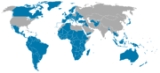
The Ottawa Treaty or the Anti-Personnel Mine Ban Convention, officially known as the Convention on the Prohibition of the Use, Stockpiling, Production and Transfer of Anti-Personnel Mines and on their Destruction, aims at eliminating anti-personnel landmines (AP-mines) around the world. , there were 158 States Parties to the treaty. Two states have signed but not ratified while 36 states are non-signatories, making a total of 38 states not party.
s, a party to the treaty must destroy its stockpile of anti-personnel mines within four years, although it may retain a small number for training purposes (mine-clearance, detection, etc.). Within ten years after ratifying the treaty, the country should have cleared all of its mined areas. This is a difficult task for many countries, but at the annual meetings (see below) they may request an extension and assistance. The treaty also calls on States Parties to provide assistance to mine-affected persons in their own country and to provide assistance to other countries in meeting their Mine Ban Treaty obligations.
The treaty covers only anti-personnel mines. It does not address mixed mines, anti-tank mine
s, remote controlled claymore mines, anti-handling devices (booby-traps) and other "static" explosive devices.
On 2 December 2009, Rwanda
was declared free of landmines
. The announcement was made at the Cartagena Summit on a Mine-Free World in Colombia. It follows a three year campaign by 180 Rwandan soldiers, supervised by the Mine Awareness Trust and trained in Kenya
, to remove over 9,000 mines laid in the country between 1990 and 1994. The soldiers checked and cleared 1.3 million square metres (1.3 square km) of land in twenty minefields. The official Cartagena Summit came after the Rwandan Ministry of Defence's own announcement of the completion of the demining process on 29 November 2009. Under article 5 of the Ottawa Treaty, Rwanda was requested to become mine-free by 1 December 2010.
On 18 June 2010, Nicaragua was declared free of landmines.
On June 14 2011, Nepal was declared a landmine-free zone (the second country to be landmine-free in Asia).
The list of about three dozen states that have not signed the treaty includes a majority of the permanent members of the United Nations Security Council
(People's Republic of China
, the United States
and Russia
), India
, Israel
and both Koreas, where landmines remain active in the Demilitarized Zone
.
in a protracted civil war
, where international treaties have little effect.
Opponents of banning landmines make several points, among them that mines are a cheap and therefore cost-effective area denial weapon. When used correctly, it is a defensive weapon that harms only an attacker, unlike ranged weapons such as ballistic missiles that are most effective if used for preemptive attacks. In addition, the psychological effect of mines increases the threshold to attack and thus reduces the risk of war.
The Ottawa treaty does not cover all types of unexploded ordnance. Cluster bomb
s, for example, introduce the same problem as mines: unexploded bomblets can remain a hazard for civilians long after a conflict has ended. A separate Convention on Cluster Munitions
was drafted in 2008 and came into effect in 2010. However, its adoption has not been as widespread as the Ottawa Treaty. Paradoxically, the Ottawa Treaty then leads to increased adoption of cluster munitions, which can be more dangerous to civilians.
Little progress in actual reduction of mine usage has been achieved. In 2011, the number of landmines dispersed is higher than ever since 2004, landmines being dispersed in Libya, Syria, Israel and Burma.
Since the first UNGA resolution supporting the Mine Ban Treaty in 1997, the number of states voting in favor has ranged from a low of 139 in 1999 to a high of 164 in 2007. The number of states abstaining has ranged from a high of 23 in 2002 and 2003 to a low of 17 in 2005 and 2006. Several states that consistently abstained or were absent are now voting in favor, including Azerbaijan, China, Kazakhstan, the Lao People’s Democratic Republic (Lao PDR), the Marshall Islands, and Morocco.
. In January 1997, she visited Angola
and walked twice through a minefield. In January 1997, Angola's population was approximately 10 million and had about 10–20 million land mines in place from its civil war. In August 1997, she visited Bosnia
with the Landmine Survivors Network
. Her work with landmines focused on the injuries and deaths inflicted on children.
When the Second Reading of the Landmines Bill took place in 1998 in the British House of Commons
, Foreign Secretary
Robin Cook
praised Diana and paid tribute to her work on landmines:
became internationally known for his advancement of the concept of human security and, in particular, of need to ratify the Ottawa Treaty. For his leadership against landmines, he was nominated for the Nobel Peace Prize
(1997).
Implementation
Besides ceasing the production and development of anti-personnel mineAnti-personnel mine
Anti-personnel mines are a form of land mine designed for use against humans, as opposed to anti-tank mines, which are designed for use against vehicles...
s, a party to the treaty must destroy its stockpile of anti-personnel mines within four years, although it may retain a small number for training purposes (mine-clearance, detection, etc.). Within ten years after ratifying the treaty, the country should have cleared all of its mined areas. This is a difficult task for many countries, but at the annual meetings (see below) they may request an extension and assistance. The treaty also calls on States Parties to provide assistance to mine-affected persons in their own country and to provide assistance to other countries in meeting their Mine Ban Treaty obligations.
The treaty covers only anti-personnel mines. It does not address mixed mines, anti-tank mine
Anti-tank mine
An anti-tank mine, , is a type of land mine designed to damage or destroy vehicles including tanks and armored fighting vehicles....
s, remote controlled claymore mines, anti-handling devices (booby-traps) and other "static" explosive devices.
Destruction of stockpiles
According to the 2009 Landmine Monitor Report, signatory nations have destroyed more than 44 million mines since the treaty's entry into force on 1 March 1999. Eighty-six countries have completed the destruction of their stockpiles, and another 63 countries have declared that they did not possess stockpiles to destroy.Retention of Landmines
Article 3 of the treaty permits countries to retain landmines for use in training in mine detection, mine clearance, or mine destruction techniques. Seventy-one countries have taken this option. In total, 197,000 mines have been declared as being currently retained by various countries under Article 3.Landmine-free countries
Through 2008, eleven States had cleared all known mined areas from their territory: Bulgaria, Costa Rica, El Salvador, France, Guatemala, Honduras, FYR Macedonia, Malawi, Suriname, Swaziland, and Tunisia. At the November-December 2009 Cartagena Summit for a Mine-Free World, Albania, Greece, Rwanda, and Zambia were also declared mine-free.On 2 December 2009, Rwanda
Rwanda
Rwanda or , officially the Republic of Rwanda , is a country in central and eastern Africa with a population of approximately 11.4 million . Rwanda is located a few degrees south of the Equator, and is bordered by Uganda, Tanzania, Burundi and the Democratic Republic of the Congo...
was declared free of landmines
Demining
Demining or mine clearance is the process of removing either land mines, or naval mines, from an area, while minesweeping describes the act of detecting of mines. There are two distinct types of mine detection and removal: military and humanitarian.Minesweepers use many tools in order to accomplish...
. The announcement was made at the Cartagena Summit on a Mine-Free World in Colombia. It follows a three year campaign by 180 Rwandan soldiers, supervised by the Mine Awareness Trust and trained in Kenya
Kenya
Kenya , officially known as the Republic of Kenya, is a country in East Africa that lies on the equator, with the Indian Ocean to its south-east...
, to remove over 9,000 mines laid in the country between 1990 and 1994. The soldiers checked and cleared 1.3 million square metres (1.3 square km) of land in twenty minefields. The official Cartagena Summit came after the Rwandan Ministry of Defence's own announcement of the completion of the demining process on 29 November 2009. Under article 5 of the Ottawa Treaty, Rwanda was requested to become mine-free by 1 December 2010.
On 18 June 2010, Nicaragua was declared free of landmines.
On June 14 2011, Nepal was declared a landmine-free zone (the second country to be landmine-free in Asia).
Signatories
The original international citizens initiative launched in 1997 by the International Campaign to Ban Landmines gained 855,000 signatories worldwide. The Convention gained 122 country signatures when it opened for signing on 3 December 1997 in Ottawa, Canada. Currently, there are 158 States Parties to the Treaty. Thirty-seven countries have not signed the treaty and two more are waiting for ratification.The list of about three dozen states that have not signed the treaty includes a majority of the permanent members of the United Nations Security Council
United Nations Security Council
The United Nations Security Council is one of the principal organs of the United Nations and is charged with the maintenance of international peace and security. Its powers, outlined in the United Nations Charter, include the establishment of peacekeeping operations, the establishment of...
(People's Republic of China
People's Republic of China
China , officially the People's Republic of China , is the most populous country in the world, with over 1.3 billion citizens. Located in East Asia, the country covers approximately 9.6 million square kilometres...
, the United States
United States
The United States of America is a federal constitutional republic comprising fifty states and a federal district...
and Russia
Russia
Russia or , officially known as both Russia and the Russian Federation , is a country in northern Eurasia. It is a federal semi-presidential republic, comprising 83 federal subjects...
), India
India
India , officially the Republic of India , is a country in South Asia. It is the seventh-largest country by geographical area, the second-most populous country with over 1.2 billion people, and the most populous democracy in the world...
, Israel
Israel
The State of Israel is a parliamentary republic located in the Middle East, along the eastern shore of the Mediterranean Sea...
and both Koreas, where landmines remain active in the Demilitarized Zone
Korean Demilitarized Zone
The Korean Demilitarized Zone is a strip of land running across the Korean Peninsula that serves as a buffer zone between North and South Korea. The DMZ cuts the Korean Peninsula roughly in half, crossing the 38th parallel on an angle, with the west end of the DMZ lying south of the parallel and...
.
Criticism
Ratification has not been universal, and most landmine production occurs in countries that do not currently intend to ratify the treaty. 37 countries have not signed the treaty; nonsignatories include Russia, United States, China, Somalia, Myanmar, United Arab Emirates and Iraq. Furthermore, organized state actors are capable of mapping and marking of minefields and demining after the conflict has ended, which reduces the hazards to civilians. In contrast, indiscriminate dispersal is typically done by parties that already flout the laws of war, as in using mines as a weapon for state terrorismState terrorism
State terrorism may refer to acts of terrorism conducted by a state against a foreign state or people. It can also refer to acts of violence by a state against its own people.-Definition:...
in a protracted civil war
Civil war
A civil war is a war between organized groups within the same nation state or republic, or, less commonly, between two countries created from a formerly-united nation state....
, where international treaties have little effect.
Opponents of banning landmines make several points, among them that mines are a cheap and therefore cost-effective area denial weapon. When used correctly, it is a defensive weapon that harms only an attacker, unlike ranged weapons such as ballistic missiles that are most effective if used for preemptive attacks. In addition, the psychological effect of mines increases the threshold to attack and thus reduces the risk of war.
The Ottawa treaty does not cover all types of unexploded ordnance. Cluster bomb
Cluster bomb
A cluster munition is a form of air-dropped or ground-launched explosive weapon that releases or ejects smaller sub-munitions. Commonly, this is a cluster bomb that ejects explosive bomblets that are designed to kill enemy personnel and destroy vehicles...
s, for example, introduce the same problem as mines: unexploded bomblets can remain a hazard for civilians long after a conflict has ended. A separate Convention on Cluster Munitions
Convention on Cluster Munitions
The Convention on Cluster Munitions is an international treaty that prohibits the use, transfer and stockpile of cluster bombs, a type of explosive weapon which scatters submunitions over an area. The convention was adopted on 2008 in Dublin, and was opened for signature on 2008 in Oslo...
was drafted in 2008 and came into effect in 2010. However, its adoption has not been as widespread as the Ottawa Treaty. Paradoxically, the Ottawa Treaty then leads to increased adoption of cluster munitions, which can be more dangerous to civilians.
Little progress in actual reduction of mine usage has been achieved. In 2011, the number of landmines dispersed is higher than ever since 2004, landmines being dispersed in Libya, Syria, Israel and Burma.
Review Conferences
- First Review Conference: 29 November – 3 December 2004, Nairobi, Kenya: Nairobi Summit on a Mine Free World.
- Second Review Conference: 29 November – 4 December 2009, Cartagena, Colombia: Cartagena Summit on a Mine-Free World.
Annual meetings
Annual meetings of the treaty member states are held at different locations around the world. These meetings provide a forum to report on what has been accomplished, indicate where additional work is needed and seek any assistance they may require.- 1st annual meeting in May 1999 in MaputoMaputoMaputo, also known as Lourenço Marques, is the capital and largest city of Mozambique. It is known as the City of Acacias in reference to acacia trees commonly found along its avenues and the Pearl of the Indian Ocean. It was famous for the inscription "This is Portugal" on the walkway of its...
(in mine-affected MozambiqueMozambiqueMozambique, officially the Republic of Mozambique , is a country in southeastern Africa bordered by the Indian Ocean to the east, Tanzania to the north, Malawi and Zambia to the northwest, Zimbabwe to the west and Swaziland and South Africa to the southwest...
) - 2nd annual meeting in September 2000 in GenevaGenevaGeneva In the national languages of Switzerland the city is known as Genf , Ginevra and Genevra is the second-most-populous city in Switzerland and is the most populous city of Romandie, the French-speaking part of Switzerland...
, SwitzerlandSwitzerlandSwitzerland name of one of the Swiss cantons. ; ; ; or ), in its full name the Swiss Confederation , is a federal republic consisting of 26 cantons, with Bern as the seat of the federal authorities. The country is situated in Western Europe,Or Central Europe depending on the definition.... - 3rd annual meeting in September 2001 in ManaguaManaguaManagua is the capital city of Nicaragua as well as the department and municipality by the same name. It is the largest city in Nicaragua in terms of population and geographic size. Located on the southwestern shore of Lake Xolotlán or Lake Managua, the city was declared the national capital in...
(in mine-affected NicaraguaNicaraguaNicaragua is the largest country in the Central American American isthmus, bordered by Honduras to the north and Costa Rica to the south. The country is situated between 11 and 14 degrees north of the Equator in the Northern Hemisphere, which places it entirely within the tropics. The Pacific Ocean...
) - 4th annual meeting in September 2002 in GenevaGenevaGeneva In the national languages of Switzerland the city is known as Genf , Ginevra and Genevra is the second-most-populous city in Switzerland and is the most populous city of Romandie, the French-speaking part of Switzerland...
, SwitzerlandSwitzerlandSwitzerland name of one of the Swiss cantons. ; ; ; or ), in its full name the Swiss Confederation , is a federal republic consisting of 26 cantons, with Bern as the seat of the federal authorities. The country is situated in Western Europe,Or Central Europe depending on the definition.... - 5th annual meeting in September 2003 in BangkokBangkokBangkok is the capital and largest urban area city in Thailand. It is known in Thai as Krung Thep Maha Nakhon or simply Krung Thep , meaning "city of angels." The full name of Bangkok is Krung Thep Mahanakhon Amon Rattanakosin Mahintharayutthaya Mahadilok Phop Noppharat Ratchathani Burirom...
, ThailandThailandThailand , officially the Kingdom of Thailand , formerly known as Siam , is a country located at the centre of the Indochina peninsula and Southeast Asia. It is bordered to the north by Burma and Laos, to the east by Laos and Cambodia, to the south by the Gulf of Thailand and Malaysia, and to the... - First Review Conference in November/December 2004 in Nairobi, Kenya
- 6th annual meeting in November/December 2005 in ZagrebZagrebZagreb is the capital and the largest city of the Republic of Croatia. It is in the northwest of the country, along the Sava river, at the southern slopes of the Medvednica mountain. Zagreb lies at an elevation of approximately above sea level. According to the last official census, Zagreb's city...
, CroatiaCroatiaCroatia , officially the Republic of Croatia , is a unitary democratic parliamentary republic in Europe at the crossroads of the Mitteleuropa, the Balkans, and the Mediterranean. Its capital and largest city is Zagreb. The country is divided into 20 counties and the city of Zagreb. Croatia covers ... - 7th annual meeting in September 2006 in GenevaGenevaGeneva In the national languages of Switzerland the city is known as Genf , Ginevra and Genevra is the second-most-populous city in Switzerland and is the most populous city of Romandie, the French-speaking part of Switzerland...
, SwitzerlandSwitzerlandSwitzerland name of one of the Swiss cantons. ; ; ; or ), in its full name the Swiss Confederation , is a federal republic consisting of 26 cantons, with Bern as the seat of the federal authorities. The country is situated in Western Europe,Or Central Europe depending on the definition.... - 8th annual meeting in September 2007 at the Dead SeaDead SeaThe Dead Sea , also called the Salt Sea, is a salt lake bordering Jordan to the east and Israel and the West Bank to the west. Its surface and shores are below sea level, the lowest elevation on the Earth's surface. The Dead Sea is deep, the deepest hypersaline lake in the world...
, JordanJordanJordan , officially the Hashemite Kingdom of Jordan , Al-Mamlaka al-Urduniyya al-Hashemiyya) is a kingdom on the East Bank of the River Jordan. The country borders Saudi Arabia to the east and south-east, Iraq to the north-east, Syria to the north and the West Bank and Israel to the west, sharing... - 9th annual meeting in November 2008 in GenevaGenevaGeneva In the national languages of Switzerland the city is known as Genf , Ginevra and Genevra is the second-most-populous city in Switzerland and is the most populous city of Romandie, the French-speaking part of Switzerland...
, SwitzerlandSwitzerlandSwitzerland name of one of the Swiss cantons. ; ; ; or ), in its full name the Swiss Confederation , is a federal republic consisting of 26 cantons, with Bern as the seat of the federal authorities. The country is situated in Western Europe,Or Central Europe depending on the definition.... - Second Review Conference in December 2009 in CartagenaCartagena, ColombiaCartagena de Indias , is a large Caribbean beach resort city on the northern coast of Colombia in the Caribbean Coast Region and capital of Bolívar Department...
, ColombiaColombiaColombia, officially the Republic of Colombia , is a unitary constitutional republic comprising thirty-two departments. The country is located in northwestern South America, bordered to the east by Venezuela and Brazil; to the south by Ecuador and Peru; to the north by the Caribbean Sea; to the... - 10th annual meeting in November/December 2010 in GenevaGenevaGeneva In the national languages of Switzerland the city is known as Genf , Ginevra and Genevra is the second-most-populous city in Switzerland and is the most populous city of Romandie, the French-speaking part of Switzerland...
, SwitzerlandSwitzerlandSwitzerland name of one of the Swiss cantons. ; ; ; or ), in its full name the Swiss Confederation , is a federal republic consisting of 26 cantons, with Bern as the seat of the federal authorities. The country is situated in Western Europe,Or Central Europe depending on the definition....
UN General Assembly Annual Resolutions
A recurrent opportunity for States to indicate their support for the ban on antipersonnel mines is their vote on the annual UN General Assembly (UNGA) resolution calling for universalization and full implementation of the Mine Ban Treaty. UNGA Resolution 63/42, for example, was adopted on 2 December 2008 by a vote of 163 in favor, none opposed, and 18 abstentions. Of the 39 states not party to the treaty, 18 voted in favor, 18 abstained, and three were absent.Since the first UNGA resolution supporting the Mine Ban Treaty in 1997, the number of states voting in favor has ranged from a low of 139 in 1999 to a high of 164 in 2007. The number of states abstaining has ranged from a high of 23 in 2002 and 2003 to a low of 17 in 2005 and 2006. Several states that consistently abstained or were absent are now voting in favor, including Azerbaijan, China, Kazakhstan, the Lao People’s Democratic Republic (Lao PDR), the Marshall Islands, and Morocco.
Diana, Princess of Wales
The Ottawa Treaty was ardently championed by Diana, Princess of WalesDiana, Princess of Wales
Diana, Princess of Wales was the first wife of Charles, Prince of Wales, whom she married on 29 July 1981, and an international charity and fundraising figure, as well as a preeminent celebrity of the late 20th century...
. In January 1997, she visited Angola
Angola
Angola, officially the Republic of Angola , is a country in south-central Africa bordered by Namibia on the south, the Democratic Republic of the Congo on the north, and Zambia on the east; its west coast is on the Atlantic Ocean with Luanda as its capital city...
and walked twice through a minefield. In January 1997, Angola's population was approximately 10 million and had about 10–20 million land mines in place from its civil war. In August 1997, she visited Bosnia
Bosnia and Herzegovina
Bosnia and Herzegovina , sometimes called Bosnia-Herzegovina or simply Bosnia, is a country in Southern Europe, on the Balkan Peninsula. Bordered by Croatia to the north, west and south, Serbia to the east, and Montenegro to the southeast, Bosnia and Herzegovina is almost landlocked, except for the...
with the Landmine Survivors Network
Landmine Survivors Network
Survivor Corps is a global network of survivors helping survivors to recover from war, rebuild their communities, and break cycles of violence. The organization currently operates programs in Albania, Armenia, Azerbaijan, Bosnia-Herzegovina, Burundi, Colombia, Croatia, El Salvador, Ethiopia,...
. Her work with landmines focused on the injuries and deaths inflicted on children.
When the Second Reading of the Landmines Bill took place in 1998 in the British House of Commons
British House of Commons
The House of Commons is the lower house of the Parliament of the United Kingdom, which also comprises the Sovereign and the House of Lords . Both Commons and Lords meet in the Palace of Westminster. The Commons is a democratically elected body, consisting of 650 members , who are known as Members...
, Foreign Secretary
Secretary of State for Foreign and Commonwealth Affairs
The Secretary of State for Foreign and Commonwealth Affairs, commonly referred to as the Foreign Secretary, is a senior member of Her Majesty's Government heading the Foreign and Commonwealth Office and regarded as one of the Great Offices of State...
Robin Cook
Robin Cook
Robert Finlayson Cook was a British Labour Party politician, who was the Member of Parliament for Livingston from 1983 until his death, and notably served in the Cabinet as Foreign Secretary from 1997 to 2001....
praised Diana and paid tribute to her work on landmines:
Lloyd Axworthy
In his Canadian Foreign Affairs portfolio (1996–2000), Lloyd AxworthyLloyd Axworthy
Lloyd Norman Axworthy, PC, OC, OM is a prominent Canadian politician, statesman and University President from Manitoba. He is best known for having served as Minister of Foreign Affairs in the Cabinet chaired by Prime Minister Jean Chrétien...
became internationally known for his advancement of the concept of human security and, in particular, of need to ratify the Ottawa Treaty. For his leadership against landmines, he was nominated for the Nobel Peace Prize
Nobel Peace Prize
The Nobel Peace Prize is one of the five Nobel Prizes bequeathed by the Swedish industrialist and inventor Alfred Nobel.-Background:According to Nobel's will, the Peace Prize shall be awarded to the person who...
(1997).
See also
- Convention on Certain Conventional WeaponsConvention on Certain Conventional WeaponsThe United Nations Convention on Certain Conventional Weapons , concluded at Geneva on October 10, 1980 and entered into force in December 1983, seeks to prohibit or restrict the use of certain conventional weapons which are considered excessively injurious or whose effects are indiscriminate.The...
- Convention on Cluster MunitionsConvention on Cluster MunitionsThe Convention on Cluster Munitions is an international treaty that prohibits the use, transfer and stockpile of cluster bombs, a type of explosive weapon which scatters submunitions over an area. The convention was adopted on 2008 in Dublin, and was opened for signature on 2008 in Oslo...
- Geneva CallGeneva CallGeneva Call is an NGO based in Geneva, Switzerland that focuses on engaging armed non-state actors, such as guerrilla groups and liberation movements, to respect international humanitarian law and human rights law...
, an NGO that engages non-state actors to ban landmines - Geneva International Centre for Humanitarian Demining, host for the secretariat (ISU) of the Ottawa Treaty
- Mine actionMine actionMine action is a domain within humanitarian aid and development studies concerned with activities which aim to reduce the social, economic and environmental impact of landmines and the explosive remnants of war...
- DeminingDeminingDemining or mine clearance is the process of removing either land mines, or naval mines, from an area, while minesweeping describes the act of detecting of mines. There are two distinct types of mine detection and removal: military and humanitarian.Minesweepers use many tools in order to accomplish...
- Mine clearance agenciesMine clearance agenciesA mine clearance agency, or demining agency, is an organization involved in removal of landmines and Unexploded Ordnance for military, humanitarian, or commercial reasons....
- Demining
External links
- Anti-personnel landmines and explosive remnants of war ICRC
- Landmines and international humanitarian law ICRC
- Convention on the Prohibition of Anti-personnel Mines full text
- ICBL website (International Campaign to Ban LandminesInternational Campaign to Ban LandminesThe International Campaign to Ban Landmines is a coalition of non-governmental organizations working for a world free of anti-personnel landmines and cluster munitions, where mine and cluster munitions survivors see their rights respected and can lead fulfilling lives.The coalition was formed in...
) - Landmine and Cluster Munition Monitor
- Text of the Treaty at the Center for a World in Balance
- veteransforamerica.org List of Treaty Signatories from the Veterans for AmericaVeterans For AmericaVeterans for America is an advocacy and humanitarian organization that works to ensure that America meets the needs of servicemembers and veterans who have served in Operation Enduring Freedom and Operation Iraqi Freedom . VFA focuses specifically on the signature wounds these conflicts:...
. - E-Mine – Electronic Mine Information Network by United NationsUnited NationsThe United Nations is an international organization whose stated aims are facilitating cooperation in international law, international security, economic development, social progress, human rights, and achievement of world peace...
Mine Action Service. - LandmineAction.org
- dianacelebration.com Charity – Diana, Princess of WalesDiana, Princess of WalesDiana, Princess of Wales was the first wife of Charles, Prince of Wales, whom she married on 29 July 1981, and an international charity and fundraising figure, as well as a preeminent celebrity of the late 20th century...