


Anti-tank mine

Encyclopedia
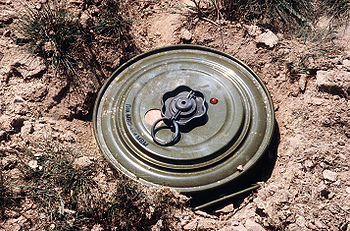
Land mine
A land mine is usually a weight-triggered explosive device which is intended to damage a target—either human or inanimate—by means of a blast and/or fragment impact....
designed to damage or destroy vehicles including tank
Tank
A tank is a tracked, armoured fighting vehicle designed for front-line combat which combines operational mobility, tactical offensive, and defensive capabilities...
s and armored fighting vehicles.
Compared to anti-personnel mine
Anti-personnel mine
Anti-personnel mines are a form of land mine designed for use against humans, as opposed to anti-tank mines, which are designed for use against vehicles...
s, anti-tank mines typically have a much larger explosive charge, and a fuze
Fuze
Fuze Beverage, commercially referred to as just Fuze , is a manufacturer of teas and non-carbonated fruit drinks enriched with vitamins. Currently the brand consists of five vitamin-infused lines: Slenderize, Refresh, Tea, Defensify, and Vitalize...
designed only to be triggered by vehicles or, in some cases, tampering with the mine.
US Civil War
While obviously the anti-tank mine as such did not pre-date the deployment of tanks in 1916, essentially identical devices were used earlier against locomotiveLocomotive
A locomotive is a railway vehicle that provides the motive power for a train. The word originates from the Latin loco – "from a place", ablative of locus, "place" + Medieval Latin motivus, "causing motion", and is a shortened form of the term locomotive engine, first used in the early 19th...
s. For example during the U.S. Civil War
American Civil War
The American Civil War was a civil war fought in the United States of America. In response to the election of Abraham Lincoln as President of the United States, 11 southern slave states declared their secession from the United States and formed the Confederate States of America ; the other 25...
, Confederate
Confederate States Army
The Confederate States Army was the army of the Confederate States of America while the Confederacy existed during the American Civil War. On February 8, 1861, delegates from the seven Deep South states which had already declared their secession from the United States of America adopted the...
forces created pressure-activated anti-railroad mines which destroyed at least two trains.
First World War
The first anti-tank mines were improvised during the First World War as a counter measure against the first tanks introduced by the BritishUnited Kingdom of Great Britain and Ireland
The United Kingdom of Great Britain and Ireland was the formal name of the United Kingdom during the period when what is now the Republic of Ireland formed a part of it....
towards the end of the war. Initially they were nothing more than a buried high explosive shell
Shell (projectile)
A shell is a payload-carrying projectile, which, as opposed to shot, contains an explosive or other filling, though modern usage sometimes includes large solid projectiles properly termed shot . Solid shot may contain a pyrotechnic compound if a tracer or spotting charge is used...
or mortar
Mortar (weapon)
A mortar is an indirect fire weapon that fires explosive projectiles known as bombs at low velocities, short ranges, and high-arcing ballistic trajectories. It is typically muzzle-loading and has a barrel length less than 15 times its caliber....
bomb with its fuze
Fuze
Fuze Beverage, commercially referred to as just Fuze , is a manufacturer of teas and non-carbonated fruit drinks enriched with vitamins. Currently the brand consists of five vitamin-infused lines: Slenderize, Refresh, Tea, Defensify, and Vitalize...
upright. Later purpose built mines were developed, including the Flachmine 17
Flachmine 17
The Flachmine 17 was a German landmine mass produced during the First World War. Production of the mine began in 1916 after the appearance of British and French tanks, and by the end of the war over three million had been produced...
, which was simply a wooden box packed with explosives and triggered either remotely or by a pressure fuze. By the end of the war, the Germans had developed row mining techniques, and mines accounted for 15% of U.S.
United States
The United States of America is a federal constitutional republic comprising fifty states and a federal district...
tank casualties during the Battle of Saint-Mihiel
Battle of Saint-Mihiel
The Battle of Saint-Mihiel was a World War I battle fought between September 12–15, 1918, involving the American Expeditionary Force and 48,000 French troops under the command of U.S. general John J. Pershing against German positions...
, Third Battle of the Aisne
Third Battle of the Aisne
The Third Battle of the Aisne was a battle of the German Spring Offensive during World War I that focused on capturing the Chemin des Dames Ridge before the American Expeditionary Force could arrive completely in France. It was one of a series of desperate offensives, known as the Kaiserschlacht,...
, Battle of Selle and Meuse-Argonne Offensive
Meuse-Argonne Offensive
The Meuse-Argonne Offensive, or Maas-Argonne Offensive, also called the Battle of the Argonne Forest, was a part of the final Allied offensive of World War I that stretched along the entire western front.-Overview:...
.
Inter-War
The Soviet UnionSoviet Union
The Soviet Union , officially the Union of Soviet Socialist Republics , was a constitutionally socialist state that existed in Eurasia between 1922 and 1991....
began developing mines in the early 1920s, and in 1924 produced its first anti-tank mine, the EZ mine. The mine, which was developed by Yegorov and Zelinskiy, had a 1 kg charge, which was enough to break the tracks of contemporary tanks. Meanwhile in Germany
Germany
Germany , officially the Federal Republic of Germany , is a federal parliamentary republic in Europe. The country consists of 16 states while the capital and largest city is Berlin. Germany covers an area of 357,021 km2 and has a largely temperate seasonal climate...
, defeat spurred the development of anti-tank mines, with the first truly modern mine, the Tellermine 29
Tellermine 29
The Tellermine 29 is a round metal cased German anti-tank blast landmine. It first entered service in 1929, and the initial German defence plan was to purchase 6,000 a year, but in January 1931 it was decided to speed up the purchase process and 61,418 were ordered...
, entering service in 1929. It was a disc shaped device approximately 30 cm across filled with about 5 kg of high explosives. A second mine, the Tellermine 35
Tellermine 35
The Tellermine 35 was a German metal cased anti-tank mine used extensively during the Second World War. The mine's case is made of sheet steel, and has a slightly convex pressure plate on the top surface with a central fuse well...
was developed in 1935. Anti-tank mines were used by both sides during the Spanish Civil War
Spanish Civil War
The Spanish Civil WarAlso known as The Crusade among Nationalists, the Fourth Carlist War among Carlists, and The Rebellion or Uprising among Republicans. was a major conflict fought in Spain from 17 July 1936 to 1 April 1939...
. Notably, Republican forces lifted mines placed by Nationalist forces and used them against the Nationalists. This spurred the development of anti-handling devices for anti-tank mines.
The Winter War
Winter War
The Winter War was a military conflict between the Soviet Union and Finland. It began with a Soviet offensive on 30 November 1939 – three months after the start of World War II and the Soviet invasion of Poland – and ended on 13 March 1940 with the Moscow Peace Treaty...
between the Soviet Union and Finland also saw widespread use of anti-tank mines.
Second World War
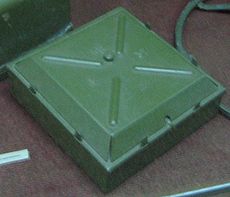
Fragmentation (weaponry)
Fragmentation is the process by which the casing of an artillery shell, bomb, grenade, etc. is shattered by the detonating high explosive filling. The correct technical terminology for these casing pieces is fragments , although shards or splinters can be used for non-preformed fragments...
).
Although other measures such as satchel charge
Satchel charge
thumb|right|250px|Weapons used in [[Winter War]]. The original Finnish satchel charge at left.A satchel charge is a demolition device, primarily intended for combat, whose primary components are a charge of dynamite or a more potent explosive such as C-4 plastic explosive, a carrying device...
s, sticky bomb
Sticky bomb
The Grenade, Hand, Anti-Tank No. 74, commonly known as the sticky bomb, was a British hand grenade designed and produced during the Second World War. The grenade was one of a number of anti-tank weapons developed for use by the British Army and Home Guard as an ad hoc solution to a lack of...
s or bombs designed to magnetically adhere to tanks were developed, they do not fall within the category of land mine
Land mine
A land mine is usually a weight-triggered explosive device which is intended to damage a target—either human or inanimate—by means of a blast and/or fragment impact....
s as they are not buried and detonated remotely or by pressure. The Hawkins mine was a British anti-tank device that could be employed as a mine laid on the road surface for a tank to run over setting off a crush fuze or thrown at the tank in which case a timer fuze was used.
Shaped charge devices like the Hohl-Sprung mine 4672
Hohl-Sprung mine 4672
The Holz-Sprung Mine 4672 or Hohlladungs-Spring-Mine 4672 was a German anti-tank mine, together with the Panzer stab 43...
were also developed by Germany later in the war, although these did not see widespread use. The most advanced German anti-tank mine of the war was their minimal metal Topfmine
Topfmine
The Topfmines were a series of German circular minimum metal anti-tank blast mines that entered service with the German army in 1944, during the Second World War....
.
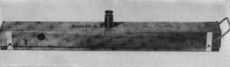
Riegel mine 43
The Riegel mine 43 or is a German steel cased anti-tank bar mine used during the Second World War. The mine is a long thin oblong. It consists of lower and upper metal tray and an internal metal cased explosive block. It uses two ZZ42 fuzes inserted into either end of the internal block, although...
and Italian B-2 mine. These were long mines designed to increase the probability of a vehicle triggering it, the B2 consisted of multiple small shaped-charge explosive charges along its length designed to ensure a mobility kill
Mobility kill
A mobility kill in armoured warfare refers to a weapon or vehicle that is immobilized, or the act of immobilizing such a target. Typically this term is used to refer to tanks and other armoured fighting vehicles that have their engines, tracks, or running gear damaged...
against enemy vehicles by destroying their tracks. This form of mine was the inspiration for the British L9 Bar Mine.
Modern
Several advances have been made in the development of modern anti-tank mines, including:- more effective explosive payloads (different explosive compounds and shaped charge effects)
- use of non-ferrous materials making them harder to detect
- new methods of deployment (from aircraft or with artillery)
- more sophisticated fuzes (triggered by seismic effects or combinations of effects)
- sophisticated "anti-handling" devices to prevent or discourage tampering or removal.
Design
More modern anti-tank mines are usually more advanced than simple containers full of explosives detonated by remote or the vehicles pressure. The biggest advances were made in the following areas:- Power of the explosives (explosives such as RDXRDXRDX, an initialism for Research Department Explosive, is an explosive nitroamine widely used in military and industrial applications. It was developed as an explosive which was more powerful than TNT, and it saw wide use in WWII. RDX is also known as cyclonite, hexogen , and T4...
). - Shaped chargeShaped chargeA shaped charge is an explosive charge shaped to focus the effect of the explosive's energy. Various types are used to cut and form metal, to initiate nuclear weapons, to penetrate armor, and in the oil and gas industry...
s to increase the armour piercing effect. - Advanced dispersal systems.
- More advanced or specific detonation triggers.
Most modern mine bodies or casings are made of plastic material to avoid easy detection. They feature combinations of pressure or magnetically activated detonators to ensure that they are only triggered by vehicles.
Dispersal systems
There are several systems for dispersing mines to quickly cover wide areas, as opposed to a soldier laying each one individually. These system can take the form of cluster bombCluster bomb
A cluster munition is a form of air-dropped or ground-launched explosive weapon that releases or ejects smaller sub-munitions. Commonly, this is a cluster bomb that ejects explosive bomblets that are designed to kill enemy personnel and destroy vehicles...
s or be artillery fired. Cluster bombs contain several mines each, which could be a mixture of anti-personnel mines. When the cluster bomb reaches a preset altitude it disperses the mines over a wide area. Some anti-tank mines are designed to be fired by artillery, and arm themselves once they impact the target area.
Off-route mines
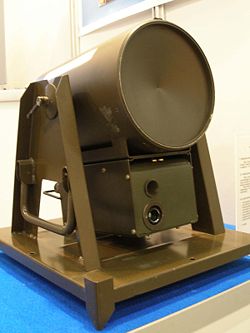
Shaped charge
A shaped charge is an explosive charge shaped to focus the effect of the explosive's energy. Various types are used to cut and form metal, to initiate nuclear weapons, to penetrate armor, and in the oil and gas industry...
to focus the explosive effect in order to pierce armour. However the self forging projectile
Explosively Formed Penetrator
An explosively formed penetrator , also known as an explosively formed projectile, a self-forging warhead, or a self-forging fragment, is a special type of shaped charge designed to penetrate armour effectively at standoff distances...
principle has been used for some French and Soviet off route mines and has earned infamy as an improvised explosive devices (IED) technique in Iraq.
One example of such a device is the US M24 that consists of a rocket launcher tube firing a HEAT
Heat
In physics and thermodynamics, heat is energy transferred from one body, region, or thermodynamic system to another due to thermal contact or thermal radiation when the systems are at different temperatures. It is often described as one of the fundamental processes of energy transfer between...
rocket that is detonated by a pressure sensitive tape switch laid across the road.
The term "off-route mine" refers to purpose designed and manufactured anti-tank mines, but most "home made" IEDs are employed in a similar manner.
Countermeasures
The most effective countermeasure deployed against mine fields is mine clearingDemining
Demining or mine clearance is the process of removing either land mines, or naval mines, from an area, while minesweeping describes the act of detecting of mines. There are two distinct types of mine detection and removal: military and humanitarian.Minesweepers use many tools in order to accomplish...
, using either explosive methods or mechanical methods. Explosive methods, such as the Giant Viper
Giant Viper
The Giant Viper is a trailer-mounted, vehicle-pulled, mine clearance system, designed to be deployed in areas containing land mines. It was developed for the British Army in the 1950s...
, involve laying explosives across a minefield, either by propelling the charges across the field with rockets, or by dropping them from aircraft, and then detonating the explosive, clearing a path. Mechanical methods include plowing and pressure-forced detonation. In plowing, a specially designed plow attached to the front end of a heavily armored tank is used to push aside the earth and any mines embedded in it, clearing a path as wide as the pushing tank. In pressure-forced detonation, a heavily armored tank pushes a heavy spherical or cylindrical solid metal roller ahead of it, causing mines to detonate.
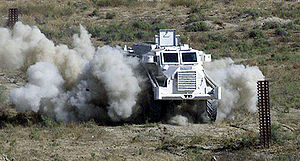
A simple, and highly effective, technique to protect the occupants of a wheeled vehicle is to fill the tires with water. This will have the effect of absorbing and deflecting the mine's blast energy. Steel plates between the cabin and the wheels can absorb the energy and their effectiveness is enhanced if they can be angled to deflect it away from the cabin. Increasing the distance between the wheels and cabin, as is done on the South African Casspir
Casspir
The Casspir is a landmine-protected personnel carrier that has been in use in South Africa for over 20 years. It is a four wheeled armoured vehicle, used for transport of troops. It can hold a crew of two, plus 12 additional soldiers and associated gear. The Casspir was unique in design when...
personnel carrier, is an effective technique although there are mobility and ease of driving problems with such a vehicle.
Steel plates and armoured glass will protect the occupants from fragments. Mounting seats from the sides or roof of the vehicle, rather than the floor, will help protect occupants from shocks transmitted through the structure of the vehicle and a four-point seat harness will minimise the chance of injury if the vehicle is flung onto its side or its roof - a mine may throw a vehicle 5 - 10 m from the detonation point.
Combat use
Anti-tank mines have played an important role in most wars fought since they were first used.Korean War
Anti-tank mines are still deployed along the demilitarized zonesKorean Demilitarized Zone
The Korean Demilitarized Zone is a strip of land running across the Korean Peninsula that serves as a buffer zone between North and South Korea. The DMZ cuts the Korean Peninsula roughly in half, crossing the 38th parallel on an angle, with the west end of the DMZ lying south of the parallel and...
established and maintained between North Korea
North Korea
The Democratic People’s Republic of Korea , , is a country in East Asia, occupying the northern half of the Korean Peninsula. Its capital and largest city is Pyongyang. The Korean Demilitarized Zone serves as the buffer zone between North Korea and South Korea...
and South Korea
South Korea
The Republic of Korea , , is a sovereign state in East Asia, located on the southern portion of the Korean Peninsula. It is neighbored by the People's Republic of China to the west, Japan to the east, North Korea to the north, and the East China Sea and Republic of China to the south...
since the signing of the armistice that "ended" the Korean War
Korean War
The Korean War was a conventional war between South Korea, supported by the United Nations, and North Korea, supported by the People's Republic of China , with military material aid from the Soviet Union...
.
Indo-China
During the Vietnam War, both 'regular' NVA and Viet Cong forces used AT mines. These were of Soviet, Chinese or local manufacture. Anti-tank mines were also used extensively in Cambodia and along the Thai border, planted by Pol PotPol Pot
Saloth Sar , better known as Pol Pot, , was a Cambodian Maoist revolutionary who led the Khmer Rouge from 1963 until his death in 1998. From 1976 to 1979, he served as the Prime Minister of Democratic Kampuchea....
's Maoist guerrillas and the Vietnamese army, which invaded Cambodia in 1979 to topple the Khmer Rouge
Khmer Rouge
The Khmer Rouge literally translated as Red Cambodians was the name given to the followers of the Communist Party of Kampuchea, who were the ruling party in Cambodia from 1975 to 1979, led by Pol Pot, Nuon Chea, Ieng Sary, Son Sen and Khieu Samphan...
. Millions of these mines remain in the area, despite clearing efforts. It is estimated that they cause hundreds of deaths annually.
Southern Africa
Conflict in southern Africa since the 1960s have often involved Soviet supported irregularIrregular military
Irregular military refers to any non-standard military. Being defined by exclusion, there is significant variance in what comes under the term. It can refer to the type of military organization, or to the type of tactics used....
armies or fighters engaged in guerrilla warfare
Guerrilla warfare
Guerrilla warfare is a form of irregular warfare and refers to conflicts in which a small group of combatants including, but not limited to, armed civilians use military tactics, such as ambushes, sabotage, raids, the element of surprise, and extraordinary mobility to harass a larger and...
. What makes these conflicts significant to the study of anti-tank mines is that they featured the widespread use of these mines in situations other than conventional warfare
Conventional warfare
Conventional warfare is a form of warfare conducted byusing conventional military weapons and battlefield tactics between two or more states in open confrontation. The forces on each side are well-defined, and fight using weapons that primarily target the opposing army...
(or static minefields) and also saw the development of effective mine resistant vehicles.
In the Angolan Civil War
Angolan Civil War
The Angolan Civil War was a major civil conflict in the Southern African state of Angola, beginning in 1975 and continuing, with some interludes, until 2002. The war began immediately after Angola became independent from Portugal in November 1975. Prior to this, a decolonisation conflict had taken...
or South African Border War
South African Border War
The South African Border War, commonly referred to as the Angolan Bush War in South Africa, was a conflict that took place from 1966 to 1989 in South-West Africa and Angola between South Africa and its allied forces on the one side and the Angolan government, South-West Africa People's...
that covered vast sparsely populated area of southern Angola
Angola
Angola, officially the Republic of Angola , is a country in south-central Africa bordered by Namibia on the south, the Democratic Republic of the Congo on the north, and Zambia on the east; its west coast is on the Atlantic Ocean with Luanda as its capital city...
and northern Namibia
Namibia
Namibia, officially the Republic of Namibia , is a country in southern Africa whose western border is the Atlantic Ocean. It shares land borders with Angola and Zambia to the north, Botswana to the east and South Africa to the south and east. It gained independence from South Africa on 21 March...
, it was easy for small groups to infiltrate and lay their mines on roads before escaping again often undetected. The anti-tank mines were most often placed on public roads used by civilian and military vehicles and had a great psychological effect.
Mines were often laid in complex arrangements. One tactic was to lay multiple mines on top of each other to increase the blast effect. Another common tactic was to link together several mines placed within a few metres of each other, so that all would detonate when any one was triggered.
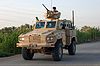
Buffel
The Buffel is a mine-protected APC used by the South African Army during the South African Border War. The Buffel was also used as an armoured fighting vehicle and proved itself in this role...
and Casspir
Casspir
The Casspir is a landmine-protected personnel carrier that has been in use in South Africa for over 20 years. It is a four wheeled armoured vehicle, used for transport of troops. It can hold a crew of two, plus 12 additional soldiers and associated gear. The Casspir was unique in design when...
armoured personnel carriers and Ratel
Ratel IFV
The Ratel is the basic Infantry Fighting Vehicle of the South African National Defence Force's mechanized infantry battalions. Ratel is the Afrikaans name for the honey badger, which has a reputation as a ferocious fighter.-History:...
armoured fighting vehicle. They employed v-shaped hulls that deflected the blast force away from occupants. In most cases occupants survived anti-tank mine detonations with only minor injuries. The vehicles themselves could often be repaired by replacing the wheels or some drive train components that were designed to be modular and replaceable for exactly this reason.
Most countries involved in Middle East
Middle East
The Middle East is a region that encompasses Western Asia and Northern Africa. It is often used as a synonym for Near East, in opposition to Far East...
ern peace keeping missions deploy modern developments of these vehicles like the RG-31
RG-31
The RG-31 Nyala is a 4×4 multi-purpose mine-protected armoured personnel carrier manufactured in South Africa by Land Systems OMC, a division of BAE Systems. It is based on the Mamba APC of TFM Industries...
(Canada
Canada
Canada is a North American country consisting of ten provinces and three territories. Located in the northern part of the continent, it extends from the Atlantic Ocean in the east to the Pacific Ocean in the west, and northward into the Arctic Ocean...
, United Arab Emirates
United Arab Emirates
The United Arab Emirates, abbreviated as the UAE, or shortened to "the Emirates", is a state situated in the southeast of the Arabian Peninsula in Western Asia on the Persian Gulf, bordering Oman, and Saudi Arabia, and sharing sea borders with Iraq, Kuwait, Bahrain, Qatar, and Iran.The UAE is a...
, United States
United States
The United States of America is a federal constitutional republic comprising fifty states and a federal district...
)
and RG-32
RG-32
The RG-32 Scout is a family of mine-resistant 4x4 light armoured vehicles made by BAE Systems Land Systems South Africa in South Africa. It is based on the RG-31, which is already deployed worldwide with peace-keeping, security and combat forces. The combat weight of the vehicle is about 7,300kg...
(Sweden
Sweden
Sweden , officially the Kingdom of Sweden , is a Nordic country on the Scandinavian Peninsula in Northern Europe. Sweden borders with Norway and Finland and is connected to Denmark by a bridge-tunnel across the Öresund....
).
See also
- Mines Advisory GroupMines Advisory GroupThe Mines Advisory Group is a Non-Governmental Organisation , which assists people affected by landmines, unexploded ordnance and SALW ....
- List of landmines (provides extensive details of different types)
- Blast resistant mineBlast resistant mineA Blast resistant mine is a landmine with a fuze which is designed to be insensitive to the shock wave from a nearby explosion. This feature makes it difficult or impossible to clear such mines using explosive minefield breaching techniques. As a result, the process of clearing minefields is...
- Anti-handling deviceAnti-handling deviceAn anti-handling device is an attachment to or integral part of a landmine or other munition e.g. some fuze types found in air-dropped bombs such as the M83, cluster bombs and sea mines. It is specifically designed to prevent tampering. When the protected device is disturbed it detonates, killing...
Examples of Anti-tank mines
- Type 72, ChinaChinaChinese civilization may refer to:* China for more general discussion of the country.* Chinese culture* Greater China, the transnational community of ethnic Chinese.* History of China* Sinosphere, the area historically affected by Chinese culture...
(modern) - Tellermine, GermanNazi GermanyNazi Germany , also known as the Third Reich , but officially called German Reich from 1933 to 1943 and Greater German Reich from 26 June 1943 onward, is the name commonly used to refer to the state of Germany from 1933 to 1945, when it was a totalitarian dictatorship ruled by...
(World War IIWorld War IIWorld War II, or the Second World War , was a global conflict lasting from 1939 to 1945, involving most of the world's nations—including all of the great powers—eventually forming two opposing military alliances: the Allies and the Axis...
era) - TopfmineTopfmineThe Topfmines were a series of German circular minimum metal anti-tank blast mines that entered service with the German army in 1944, during the Second World War....
GermanNazi GermanyNazi Germany , also known as the Third Reich , but officially called German Reich from 1933 to 1943 and Greater German Reich from 26 June 1943 onward, is the name commonly used to refer to the state of Germany from 1933 to 1945, when it was a totalitarian dictatorship ruled by...
(World War IIWorld War IIWorld War II, or the Second World War , was a global conflict lasting from 1939 to 1945, involving most of the world's nations—including all of the great powers—eventually forming two opposing military alliances: the Allies and the Axis...
era) - TM-83 mineTM-83 mineThe TM-83 is a Russian off-route anti-tank mine, first shown publicly in 1993. The mine consists of a large Misznay Schardin effect warhead and infra-red and seismic sensors.-Description:...
, RussiaRussiaRussia or , officially known as both Russia and the Russian Federation , is a country in northern Eurasia. It is a federal semi-presidential republic, comprising 83 federal subjects...
(modern) an off route mine using the Misznay-Schardin effectMisznay-Schardin effectThe Misznay–Schardin effect, or platter effect, is a characteristic of the detonation of a broad sheet of explosive. The explosive blast expands directly away from the surface of an explosive... - ARGES mineARGES mineARGES is an off-route anti-tank mine, developed by an international consortium to meet the needs of the British, French and German armed forces...
Mine dispersal systems
- GEMSS mine systemGEMSS mine systemThe GEMSS mine system was a US mine system, replaced in US service by the Volcano mine system. The mines are deployed from either the towed M128 "Frisbee Flinger" and the M138 "Flipper" portable mine layer.-Mines:...
- GATOR mine systemGATOR mine systemThe GATOR mine system is a US system of air-dropped anti-tank and anti-personnel mines, that was developed in the 1980s to be compatible with existing cluster dispensers. It is used with two dispenser systems — the Navy 500 lb CBU-78/B and the Air Force 1,000 lb CBU-89/B...
- Volcano mine systemVolcano mine systemThe M139 Volcano mine system is a US highspeed landmine laying system. It can lay a minefield one kilometer long, containing 960 mines in 43 seconds from a ground vehicle, and in just 17 seconds from a helicopter...