


Around the World in Eighty Days

Encyclopedia
Around the World in Eighty Days is a classic adventure novel
by the French writer
Jules Verne
, first published in 1873
. In the story, Phileas Fogg
of London
and his newly employed French
valet
Passepartout
attempt to circumnavigate
the world in 80 days on a £20,000 wager (equal to £ today) set by his friends at the Reform Club
. It is one of Verne's most acclaimed works.
is a rich English
gentleman and bachelor living in solitude at Number 7 Savile Row
, Burlington Gardens. Despite his wealth, which is £40,000 (equal to £ today), Mr Fogg, whose countenance is described as "repose in action", lives a modest life with habits carried out with mathematical precision. Very little can be said about Mr. Fogg's social life other than that he is a member of the Reform Club
. Having dismissed his former valet
, James Forster, for bringing him shaving water at 84 °F (28.9 °C) instead of 86 °F (30 °C), Mr Fogg hires a Frenchman
by the name of Jean Passepartout, who is about 30 years old, as a replacement.
Later, on that day, in the Reform Club, Fogg gets involved in an argument over an article in The Morning Chronicle, stating that with the opening of a new railway section in India
, it is now possible to travel around the world in 80 days. He accepts a wager for £20,000 from his fellow club members, which he will receive if he makes it around the world in 80 days. Accompanied by Monsieur Passepartout, he leaves London by train at 8:45 P.M. on October 2, 1872, and thus is due back at the Reform Club at the same time 80 days later, on December 21.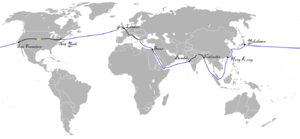
Fogg and Passepartout reach Suez in time. While disembarking in Egypt, they are watched by a Scotland Yard
detective named Fix, who has been dispatched from London in search of a bank robber. Because Fogg happens to answer the description of the bank robber, Fix mistakes Fogg for the criminal. Since he cannot secure a warrant in time, Fix goes on board the steamer conveying the travellers to Bombay. During the voyage, Fix becomes acquainted with Passepartout, without revealing his purpose. On the voyage, Fogg promises the engineer a large reward if he gets them to Bombay early. They dock two days ahead of schedule.
After reaching India they take a train from Bombay (known today as Mumbai
) to Calcutta (Kolkata
). About halfway there, Fogg learns that the Daily Telegraph newspaper article was wrong—the railroad ends at Kholby and starts 50 miles further on at Allahabad. Fogg promptly buys an elephant, hires a guide, and starts toward Allahabad.
During the ride, they come across a procession, in which a young India
n woman, Aouda
, is led to a sanctuary to be sacrificed by the process of sati
the next day by Brahmins. Since the young woman is drugged with the smoke of opium
and hemp
and is obviously not going voluntarily, the travellers decide to rescue her. They follow the procession to the site, where Passepartout secretly takes the place of Aouda's deceased husband on the funeral
pyre
, on which she is to be burned the next morning. During the ceremony, he then rises from the pyre, scaring off the priests, and carries the young woman away. Due to this incident, the two days gained earlier are lost, but Fogg shows no sign of regret.
The travellers then hasten on to catch the train at the next railway station, taking Aouda with them. At Calcutta, they can finally board a steamer going to Hong Kong. Fix, who has secretly been following them, has Fogg and Passepartout arrested in Calcutta. However, they jump bail and Fix is forced to follow them to Hong Kong. On board, he shows himself to Passepartout, who is delighted to meet again his travelling companion from the earlier voyage.
In Hong Kong, it turns out that Aouda's distant relative, in whose care they had been planning to leave her, has moved, probably to Holland, so they decide to take her with them to Europe. Meanwhile, still without a warrant, Fix sees Hong Kong as his last chance to arrest Fogg on British soil. He therefore confides in Passepartout, who does not believe a word and remains convinced that his master is not a bank robber. To prevent Passepartout from informing his master about the premature departure of their next vessel
, Fix gets Passepartout drunk and drugs him in an opium den. In his dizziness, Passepartout still manages to catch the steamer to Yokohama, but neglects to inform Fogg.
Fogg, on the next day, discovers that he has missed his connection. He goes in search of a vessel that will take him to Yokohama
. He finds a pilot boat that takes him and Aouda to Shanghai
, where they catch a steamer to Yokohama. In Yokohama, they go on a search for Passepartout, believing that he may have arrived there on the original boat. They find him in a circus, trying to earn the fare for his homeward journey. Reunited, the four board a steamer taking them across the Pacific to San Francisco. Fix promises Passepartout that now, having left British soil, he will no longer try to delay Fogg's journey, but rather support him in getting back to Britain as fast as possible to minimize the amount of his share of the stolen money that Fogg can spend..
In San Francisco they get on a trans-American train to New York, encountering a number of obstacles along the way: a massive herd of bison
crossing the tracks, a failing suspension bridge
, and most disastrously, the train is attacked and overcome by Sioux
warriors. After heroically uncoupling the locomotive from the carriages, Passepartout is kidnapped by the Indians, but Fogg rescues him after some American soldier
s volunteer to help. They continue by a wind power
ed sledge over the snowy prairie to Omaha, where they get a train to New York.
Once in New York, and having missed departure of their ship (the China) by 45 minutes, Fogg starts looking for an alternative for the crossing of the Atlantic Ocean
. He finds a small steamboat, destined for Bordeaux
. However, the captain of the boat refuses to take the company to Liverpool, whereupon Fogg consents to be taken to Bordeaux for the price of $2000 (equal to $ today) per passenger. On the voyage, he bribes the crew to mutiny
and take course for Liverpool. Against hurricane winds and going on full steam all the time, the boat runs out of fuel after a few days. Fogg buys the boat at a very high price from the captain, soothing him thereby, and has the crew burn all the wooden parts to keep up the steam.
The companions arrive at Queenstown
(Cobh), Ireland
, in time to reach London via Dublin and Liverpool before the deadline. However, once on British soil again, Fix produces a warrant and arrests Fogg. A short time later, the misunderstanding is cleared up—the actual bank robber had been caught three days earlier in Edinburgh
. In response to this, Fogg, in a rare moment of impulse, punches Fix, who immediately falls to the ground. However, Fogg has missed the train and returns to London five minutes late, assured that he has lost the wager.
In his London house the next day, he apologises to Aouda
for bringing her with him, since he now has to live in poverty and cannot financially support her. Aouda suddenly confesses that she loves him and asks him to marry her, which he gladly accepts. He calls for Passepartout to notify the reverend. At the reverend's, Passepartout learns that he is mistaken in the date, which he takes to be Sunday but which actually is Saturday because the party travelled east, thereby gaining a full day on their journey around the globe, by crossing the International Date Line
. He did not notice this after landing in North America because the only phase of the trip that depended on vehicles departing less often than daily was the Atlantic crossing, and he had hired his own ship for that.
Passepartout hurries back to Fogg, who immediately sets off for the Reform Club
, where he arrives just in time to win the wager. Fogg marries Aouda and the journey around the world is complete.
Passepartout and Fogg carried only a carpet bag with only two shirts and three pairs of stockings each, a mackintosh
, a travelling cloak, and a spare pair of shoes. The only book they carried is Bradshaw
's Continental Railway Steam Transit and General Guide. This contains timetables of trains and steamers. He also carried a huge roll of English banknotes-about £20,000.
He also left with twenty guineas (equal to £ today) won at whist, of which he soon disposed.
(1870–1871) in which Verne was conscripted as a coastguard, he was having money difficulties (his previous works were not paid royalties), his father had died recently, and he had witnessed a public execution which had disturbed him. However despite all this, Verne was excited about his work on the new book, the idea of which came to him one afternoon in a Paris café while reading a newspaper (see "Origins" below).
The technological innovations of the 19th century had opened the possibility of rapid circumnavigation and the prospect fascinated Verne and his readership. In particular three technological breakthroughs occurred in 1869-70 that made a tourist-like around-the-world journey possible for the first time: the completion of the First Transcontinental Railroad
in America (1869), the linking of the Indian railways
across the sub-continent (1870), and the opening of the Suez Canal
(1869). It was another notable mark in the end of an age of exploration and the start of an age of fully global tourism that could be enjoyed in relative comfort and safety. It sparked the imagination that anyone could sit down, draw up a schedule, buy tickets and travel around the world, a feat previously reserved for only the most heroic and hardy of adventurers.
Verne is often characterised as a futurist or science fiction author but there is not a glimmer of science-fiction in this, his most popular work (at least in English speaking countries). Rather than any futurism, it remains a memorable portrait of the British Empire
"on which the sun never sets" shortly before its very peak, drawn by an outsider. It is also interesting to note that, as of 2006, there has never been a critical edition of Around the World in Eighty Days. This is in part due to the poor translations available of his works, the stereotype of "science fiction" or "boys' literature". However, Verne's works were being looked at more seriously in the late 20th and early 21st centuries, with new translations and scholarship appearing. It is also rather interesting to note that the book is a source of common notable English and extended British attitudes in quotes such as, "Phileas Fogg and Sir Francis Cromarty ... endured the discomfort with true British phlegm, talking little, and scarcely able to catch a glimpse of each other" as seen in Chapter Twelve when the group is being jostled around on the elephant ride across the jungle. Also seen in chapter Twenty-Five, when Phileas Fogg is insulted in San Francisco, and Detective Fix acknowledges that "It was clear that Mr. Fogg was one of those Englishmen who, while they do not tolerate dueling at home, fight abroad when their honor is attacked."
The closing date of the novel, 22 December 1872, was also the same date as the serial publication. As it was being published serially for the first time, some readers believed that the journey was actually taking place — bets were placed, and some railway companies and ship liner companies actually lobbied Verne to appear in the book. It is unknown if Verne actually submitted to their requests, but the descriptions of some rail and shipping lines leave some suspicion he was influenced.
Although a journey by hot air balloon
has become one of the images most strongly associated with the story, this iconic symbol was never deployed in the book by Verne himself – the idea is briefly brought up in chapter 32, but dismissed, it "would have been highly risky and, in any case, impossible." However the popular 1956 movie adaptation Around the World in Eighty Days
floated the balloon idea, and it has now become a part of the mythology of the story, even appearing on book covers. This plot element is reminiscent of Verne's earlier Five Weeks in a Balloon
which first made him a well-known author.
Following Towle and d'Anver's 1873 English translation, many people have tried to follow in the footsteps of Fogg's fictional circumnavigation, often within self-imposed constraints:
Greek traveller Pausanias
(c. 100 AD) wrote a work that was translated into French in 1797 as Voyage autour du monde ("Around the World"). Verne's friend, Jacques Arago
, had written a very popular Voyage autour du monde in 1853. However in 1869/70 the idea of travelling around the world reached critical popular attention when three geographical breakthroughs occurred: the completion of the First Transcontinental Railroad
in America (1869), the linking of the Indian railways
across the sub-continent (1870), and the opening of the Suez Canal
(1869). In 1871 appeared Around the World by Steam, via Pacific Railway, published by the Union Pacific Railroad Company, and an Around the World in A Hundred and Twenty Days by Edmond Planchut. Between 1869 and 1871, an American William Perry Fogg went around the world describing his tour in a series of letters to The Cleveland Leader, titled Round the World: Letters from Japan, China, India, and Egypt (1872). Additionally, in early 1870, the Erie Railway Company published a statement of routes, times, and distances detailing a trip around the globe of 23,739 miles in seventy-seven days and twenty-one hours.
Another early reference comes from the Italian traveler Giovanni Francesco Gemelli Careri
. He wrote a book in 1699 that was later translated into French: Voyage around the World or Voyage du Tour du Monde (1719, Paris). The novel documents his trip as one of the first Europeans to circle the world for pleasure rather than profit, using publicly available transportation. Gemelli Careri
provides rich accounts of seventeenth century civilization outside of Europe. These include details of Persia during the Ottoman Empire
, Hindustan
during the reign of Aurungzebe, the Chinese Lantern Festival
and the Great Wall, as well as the native people of Meso-America. References to his books can be found in other historical publications like the Calcutta Review
.
In 1872 Thomas Cook
organised the first around the world tourist trip, leaving on 20 September 1872 and returning seven months later. The journey was described in a series of letters that were later published in 1873 as Letter from the Sea and from Foreign Lands, Descriptive of a tour Round the World. Scholars have pointed out similarities between Verne's account and Cook's letters, although some argue that Cook's trip happened too late to influence Verne. Verne, according to a second-hand 1898 account, refers to a Thomas Cook advertisement as a source for the idea of his book. In interviews in 1894 and 1904, Verne says the source was "through reading one day in a Paris cafe" and "due merely to a tourist advertisement seen by chance in the columns of a newspaper.” Around the World itself says the origins were a newspaper article. All of these point to Cook's advert as being a probable spark for the idea of the book.
Further, the periodical Le Tour du monde (3 October 1869) contained a short piece entitled "Around the World in Eighty Days", which refers to "140 miles" of railway not yet completed between Allahabad and Bombay, a central point in Verne's work. But even the Le Tour de monde article was not entirely original; it cites in its bibliography the Nouvelles Annales des Voyages, de la Géographie, de l'Histoire et de l'Archéologie (August, 1869), which also contains the title Around the World in Eighty Days in its contents page. The Nouvelles Annales were written by Conrad Malte-Brun
(1775—1826) and his son Victor Adolphe Malte-Brun
(1816—1889). Scholars believe Verne was aware of either the Le Tour de monde article, or the Nouvelles Annales (or both), and consulted it — the Le Tour du monde even included a trip schedule very similar to Verne's final version.
A possible inspiration was the traveller George Francis Train
, who made four trips around the world, including one in 80 days in 1870. Similarities include the hiring of a private train and his being imprisoned. Train later claimed "Verne stole my thunder. I'm Phileas Fogg."
Regarding the idea of gaining a day, Verne said of its origin: "I have a great number of scientific odds and ends in my head. It was thus that, when, one day in a Paris café, I read in the Siècle that a man could travel around the world in eighty days, it immediately struck me that I could profit by a difference of meridian and make my traveller gain or lose a day in his journey. There was a dénouement ready found. The story was not written until long after. I carry ideas about in my head for years – ten, or fifteen years, sometimes – before giving them form." In his lecture of April 1873 "The Meridians and the Calendar", Verne responded to a question about where the change of day actually occurred, since the international date line
had only become current in 1880 and the Greenwich prime meridian was not adopted internationally until 1884. Verne cited an 1872 article in Nature
, and Edgar Allan Poe
's short story "Three Sundays in a Week" (1841), which was also based on going around the world and the difference in a day linked to a marriage at the end. Verne even analysed Poe's story in his Edgar Poe and His Works (1864).
In summary either the periodical Le Tour du monde or the Nouvelles Annales, W. P. Fogg, probably Thomas Cook's advert (and maybe his letters) would be the main likely source for the book. In addition, Poe's short story "Three Sundays in a Week" was clearly the inspiration for the lost day plot device.
Misc
Adventure novel
The adventure novel is a genre of novels that has adventure, an exciting undertaking involving risk and physical danger, as its main theme.-History:...
by the French writer
French literature
French literature is, generally speaking, literature written in the French language, particularly by citizens of France; it may also refer to literature written by people living in France who speak traditional languages of France other than French. Literature written in French language, by citizens...
Jules Verne
Jules Verne
Jules Gabriel Verne was a French author who pioneered the science fiction genre. He is best known for his novels Twenty Thousand Leagues Under the Sea , A Journey to the Center of the Earth , and Around the World in Eighty Days...
, first published in 1873
1873 in literature
The year 1873 in literature involved some significant new books.-Events:*3 March - The U.S. Congress enacts the Comstock Law, making it illegal to send any "obscene, lewd, or lascivious" books through the mail....
. In the story, Phileas Fogg
Phileas Fogg
Phileas Fogg is the main fictional character in the 1873 Jules Verne novel Around the World in Eighty Days.Fogg attempts to circumnavigate the late Victorian world in eighty days, or less, for a wager of £20,000 with members of London's Reform Club. He takes the wager and leaves with Passepartout,...
of London
London
London is the capital city of :England and the :United Kingdom, the largest metropolitan area in the United Kingdom, and the largest urban zone in the European Union by most measures. Located on the River Thames, London has been a major settlement for two millennia, its history going back to its...
and his newly employed French
French people
The French are a nation that share a common French culture and speak the French language as a mother tongue. Historically, the French population are descended from peoples of Celtic, Latin and Germanic origin, and are today a mixture of several ethnic groups...
valet
Valet
Valet and varlet are terms for male servants who serve as personal attendants to their employer.- Word origins :In the Middle Ages, the valet de chambre to a ruler was a prestigious appointment for young men...
Passepartout
Passepartout (character)
Jean Passepartout is a character in Jules Verne's novel, Around the World in Eighty Days. He is the French valet to the novel's English protagonist, Phileas Fogg...
attempt to circumnavigate
Circumnavigation
Circumnavigation – literally, "navigation of a circumference" – refers to travelling all the way around an island, a continent, or the entire planet Earth.- Global circumnavigation :...
the world in 80 days on a £20,000 wager (equal to £ today) set by his friends at the Reform Club
Reform Club
The Reform Club is a gentlemen's club on the south side of Pall Mall, in central London. Originally for men only, it changed to include the admission of women in 1981. In 2011 the subscription for membership of the Reform Club as a full UK member is £1,344.00, with a one-off entrance fee of £875.00...
. It is one of Verne's most acclaimed works.
Plot summary
The story starts in London on October 2, 1872. Phileas FoggPhileas Fogg
Phileas Fogg is the main fictional character in the 1873 Jules Verne novel Around the World in Eighty Days.Fogg attempts to circumnavigate the late Victorian world in eighty days, or less, for a wager of £20,000 with members of London's Reform Club. He takes the wager and leaves with Passepartout,...
is a rich English
United Kingdom
The United Kingdom of Great Britain and Northern IrelandIn the United Kingdom and Dependencies, other languages have been officially recognised as legitimate autochthonous languages under the European Charter for Regional or Minority Languages...
gentleman and bachelor living in solitude at Number 7 Savile Row
Savile Row
Savile Row is a shopping street in Mayfair, central London, famous for its traditional men's bespoke tailoring. The term "bespoke" is understood to have originated in Savile Row when cloth for a suit was said to "be spoken for" by individual customers...
, Burlington Gardens. Despite his wealth, which is £40,000 (equal to £ today), Mr Fogg, whose countenance is described as "repose in action", lives a modest life with habits carried out with mathematical precision. Very little can be said about Mr. Fogg's social life other than that he is a member of the Reform Club
Reform Club
The Reform Club is a gentlemen's club on the south side of Pall Mall, in central London. Originally for men only, it changed to include the admission of women in 1981. In 2011 the subscription for membership of the Reform Club as a full UK member is £1,344.00, with a one-off entrance fee of £875.00...
. Having dismissed his former valet
Valet
Valet and varlet are terms for male servants who serve as personal attendants to their employer.- Word origins :In the Middle Ages, the valet de chambre to a ruler was a prestigious appointment for young men...
, James Forster, for bringing him shaving water at 84 °F (28.9 °C) instead of 86 °F (30 °C), Mr Fogg hires a Frenchman
France
The French Republic , The French Republic , The French Republic , (commonly known as France , is a unitary semi-presidential republic in Western Europe with several overseas territories and islands located on other continents and in the Indian, Pacific, and Atlantic oceans. Metropolitan France...
by the name of Jean Passepartout, who is about 30 years old, as a replacement.
Later, on that day, in the Reform Club, Fogg gets involved in an argument over an article in The Morning Chronicle, stating that with the opening of a new railway section in India
Rail transport in India
Rail transport is a commonly used mode of long-distance transportation in India. Almost all rail operations in India are handled by a state-owned organisation, Indian Railways, Ministry of Railways. The rail network traverses the length and breadth of the country, covering a total length of...
, it is now possible to travel around the world in 80 days. He accepts a wager for £20,000 from his fellow club members, which he will receive if he makes it around the world in 80 days. Accompanied by Monsieur Passepartout, he leaves London by train at 8:45 P.M. on October 2, 1872, and thus is due back at the Reform Club at the same time 80 days later, on December 21.
| London London London is the capital city of :England and the :United Kingdom, the largest metropolitan area in the United Kingdom, and the largest urban zone in the European Union by most measures. Located on the River Thames, London has been a major settlement for two millennia, its history going back to its... to Suez Suez Suez is a seaport city in north-eastern Egypt, located on the north coast of the Gulf of Suez , near the southern terminus of the Suez Canal, having the same boundaries as Suez governorate. It has three harbors, Adabya, Ain Sokhna and Port Tawfiq, and extensive port facilities... |
rail and steamer | 7 days |
| Suez to Bombay Mumbai Mumbai , formerly known as Bombay in English, is the capital of the Indian state of Maharashtra. It is the most populous city in India, and the fourth most populous city in the world, with a total metropolitan area population of approximately 20.5 million... |
steamer | 13 days |
| Bombay to Calcutta Kolkata Kolkata , formerly known as Calcutta, is the capital of the Indian state of West Bengal. Located on the east bank of the Hooghly River, it was the commercial capital of East India... |
rail and elephant | 3 days |
| Calcutta to Hong Kong Hong Kong Hong Kong is one of two Special Administrative Regions of the People's Republic of China , the other being Macau. A city-state situated on China's south coast and enclosed by the Pearl River Delta and South China Sea, it is renowned for its expansive skyline and deep natural harbour... |
steamer | 13 days |
| Hong Kong to Yokohama Yokohama is the capital city of Kanagawa Prefecture and the second largest city in Japan by population after Tokyo and most populous municipality of Japan. It lies on Tokyo Bay, south of Tokyo, in the Kantō region of the main island of Honshu... |
steamer | 6 days |
| Yokohama to San Francisco | steamer | 22 days |
| San Francisco to New York City New York City New York is the most populous city in the United States and the center of the New York Metropolitan Area, one of the most populous metropolitan areas in the world. New York exerts a significant impact upon global commerce, finance, media, art, fashion, research, technology, education, and... |
rail | 7 days |
| New York to London | steamer and rail | 9 days |
| Total | 80 days | |
Fogg and Passepartout reach Suez in time. While disembarking in Egypt, they are watched by a Scotland Yard
Scotland Yard
Scotland Yard is a metonym for the headquarters of the Metropolitan Police Service of London, UK. It derives from the location of the original Metropolitan Police headquarters at 4 Whitehall Place, which had a rear entrance on a street called Great Scotland Yard. The Scotland Yard entrance became...
detective named Fix, who has been dispatched from London in search of a bank robber. Because Fogg happens to answer the description of the bank robber, Fix mistakes Fogg for the criminal. Since he cannot secure a warrant in time, Fix goes on board the steamer conveying the travellers to Bombay. During the voyage, Fix becomes acquainted with Passepartout, without revealing his purpose. On the voyage, Fogg promises the engineer a large reward if he gets them to Bombay early. They dock two days ahead of schedule.
After reaching India they take a train from Bombay (known today as Mumbai
Mumbai
Mumbai , formerly known as Bombay in English, is the capital of the Indian state of Maharashtra. It is the most populous city in India, and the fourth most populous city in the world, with a total metropolitan area population of approximately 20.5 million...
) to Calcutta (Kolkata
Kolkata
Kolkata , formerly known as Calcutta, is the capital of the Indian state of West Bengal. Located on the east bank of the Hooghly River, it was the commercial capital of East India...
). About halfway there, Fogg learns that the Daily Telegraph newspaper article was wrong—the railroad ends at Kholby and starts 50 miles further on at Allahabad. Fogg promptly buys an elephant, hires a guide, and starts toward Allahabad.
During the ride, they come across a procession, in which a young India
India
India , officially the Republic of India , is a country in South Asia. It is the seventh-largest country by geographical area, the second-most populous country with over 1.2 billion people, and the most populous democracy in the world...
n woman, Aouda
Aouda
Aouda, a fictional character in Around the World in Eighty Days by Jules Verne, is an Indian princess rescued by Phileas Fogg and Passepartout when she is about to be sacrificed by Hindu monks as a suttee at the funeral of her former Hindu husband, who is the erstwhile ruler of an Indian princely...
, is led to a sanctuary to be sacrificed by the process of sati
Sati (practice)
For other uses, see Sati .Satī was a religious funeral practice among some Indian communities in which a recently widowed woman either voluntarily or by use of force and coercion would have immolated herself on her husband’s funeral pyre...
the next day by Brahmins. Since the young woman is drugged with the smoke of opium
Opium
Opium is the dried latex obtained from the opium poppy . Opium contains up to 12% morphine, an alkaloid, which is frequently processed chemically to produce heroin for the illegal drug trade. The latex also includes codeine and non-narcotic alkaloids such as papaverine, thebaine and noscapine...
and hemp
Cannabis (drug)
Cannabis, also known as marijuana among many other names, refers to any number of preparations of the Cannabis plant intended for use as a psychoactive drug or for medicinal purposes. The English term marijuana comes from the Mexican Spanish word marihuana...
and is obviously not going voluntarily, the travellers decide to rescue her. They follow the procession to the site, where Passepartout secretly takes the place of Aouda's deceased husband on the funeral
Funeral
A funeral is a ceremony for celebrating, sanctifying, or remembering the life of a person who has died. Funerary customs comprise the complex of beliefs and practices used by a culture to remember the dead, from interment itself, to various monuments, prayers, and rituals undertaken in their honor...
pyre
Pyre
A pyre , also known as a funeral pyre, is a structure, usually made of wood, for burning a body as part of a funeral rite...
, on which she is to be burned the next morning. During the ceremony, he then rises from the pyre, scaring off the priests, and carries the young woman away. Due to this incident, the two days gained earlier are lost, but Fogg shows no sign of regret.
The travellers then hasten on to catch the train at the next railway station, taking Aouda with them. At Calcutta, they can finally board a steamer going to Hong Kong. Fix, who has secretly been following them, has Fogg and Passepartout arrested in Calcutta. However, they jump bail and Fix is forced to follow them to Hong Kong. On board, he shows himself to Passepartout, who is delighted to meet again his travelling companion from the earlier voyage.
In Hong Kong, it turns out that Aouda's distant relative, in whose care they had been planning to leave her, has moved, probably to Holland, so they decide to take her with them to Europe. Meanwhile, still without a warrant, Fix sees Hong Kong as his last chance to arrest Fogg on British soil. He therefore confides in Passepartout, who does not believe a word and remains convinced that his master is not a bank robber. To prevent Passepartout from informing his master about the premature departure of their next vessel
SS Carnatic
The SS Carnatic was a British steamship built by Samuda Brothers at Cubitt Town on the Isle of Dogs, London in 1862 for the Peninsular and Oriental Steam Navigation Company....
, Fix gets Passepartout drunk and drugs him in an opium den. In his dizziness, Passepartout still manages to catch the steamer to Yokohama, but neglects to inform Fogg.
Fogg, on the next day, discovers that he has missed his connection. He goes in search of a vessel that will take him to Yokohama
Yokohama
is the capital city of Kanagawa Prefecture and the second largest city in Japan by population after Tokyo and most populous municipality of Japan. It lies on Tokyo Bay, south of Tokyo, in the Kantō region of the main island of Honshu...
. He finds a pilot boat that takes him and Aouda to Shanghai
Shanghai
Shanghai is the largest city by population in China and the largest city proper in the world. It is one of the four province-level municipalities in the People's Republic of China, with a total population of over 23 million as of 2010...
, where they catch a steamer to Yokohama. In Yokohama, they go on a search for Passepartout, believing that he may have arrived there on the original boat. They find him in a circus, trying to earn the fare for his homeward journey. Reunited, the four board a steamer taking them across the Pacific to San Francisco. Fix promises Passepartout that now, having left British soil, he will no longer try to delay Fogg's journey, but rather support him in getting back to Britain as fast as possible to minimize the amount of his share of the stolen money that Fogg can spend..
In San Francisco they get on a trans-American train to New York, encountering a number of obstacles along the way: a massive herd of bison
Bison
Members of the genus Bison are large, even-toed ungulates within the subfamily Bovinae. Two extant and four extinct species are recognized...
crossing the tracks, a failing suspension bridge
Suspension bridge
A suspension bridge is a type of bridge in which the deck is hung below suspension cables on vertical suspenders. Outside Tibet and Bhutan, where the first examples of this type of bridge were built in the 15th century, this type of bridge dates from the early 19th century...
, and most disastrously, the train is attacked and overcome by Sioux
Sioux
The Sioux are Native American and First Nations people in North America. The term can refer to any ethnic group within the Great Sioux Nation or any of the nation's many language dialects...
warriors. After heroically uncoupling the locomotive from the carriages, Passepartout is kidnapped by the Indians, but Fogg rescues him after some American soldier
American Soldier
"American Soldier" is the title of a song co-written and recorded by American country music artist Toby Keith. It was released in November 2003 as the second single from his 2003 album, Shock'n Y'all. It became a number one hit on the Billboard U.S...
s volunteer to help. They continue by a wind power
Wind power
Wind power is the conversion of wind energy into a useful form of energy, such as using wind turbines to make electricity, windmills for mechanical power, windpumps for water pumping or drainage, or sails to propel ships....
ed sledge over the snowy prairie to Omaha, where they get a train to New York.
Once in New York, and having missed departure of their ship (the China) by 45 minutes, Fogg starts looking for an alternative for the crossing of the Atlantic Ocean
Atlantic Ocean
The Atlantic Ocean is the second-largest of the world's oceanic divisions. With a total area of about , it covers approximately 20% of the Earth's surface and about 26% of its water surface area...
. He finds a small steamboat, destined for Bordeaux
Bordeaux
Bordeaux is a port city on the Garonne River in the Gironde department in southwestern France.The Bordeaux-Arcachon-Libourne metropolitan area, has a population of 1,010,000 and constitutes the sixth-largest urban area in France. It is the capital of the Aquitaine region, as well as the prefecture...
. However, the captain of the boat refuses to take the company to Liverpool, whereupon Fogg consents to be taken to Bordeaux for the price of $2000 (equal to $ today) per passenger. On the voyage, he bribes the crew to mutiny
Mutiny
Mutiny is a conspiracy among members of a group of similarly situated individuals to openly oppose, change or overthrow an authority to which they are subject...
and take course for Liverpool. Against hurricane winds and going on full steam all the time, the boat runs out of fuel after a few days. Fogg buys the boat at a very high price from the captain, soothing him thereby, and has the crew burn all the wooden parts to keep up the steam.
The companions arrive at Queenstown
Cobh
Cobh is a seaport town on the south coast of County Cork, Ireland. Cobh is on the south side of Great Island in Cork Harbour. Facing the town are Spike Island and Haulbowline Island...
(Cobh), Ireland
Ireland
Ireland is an island to the northwest of continental Europe. It is the third-largest island in Europe and the twentieth-largest island on Earth...
, in time to reach London via Dublin and Liverpool before the deadline. However, once on British soil again, Fix produces a warrant and arrests Fogg. A short time later, the misunderstanding is cleared up—the actual bank robber had been caught three days earlier in Edinburgh
Edinburgh
Edinburgh is the capital city of Scotland, the second largest city in Scotland, and the eighth most populous in the United Kingdom. The City of Edinburgh Council governs one of Scotland's 32 local government council areas. The council area includes urban Edinburgh and a rural area...
. In response to this, Fogg, in a rare moment of impulse, punches Fix, who immediately falls to the ground. However, Fogg has missed the train and returns to London five minutes late, assured that he has lost the wager.
In his London house the next day, he apologises to Aouda
Aouda
Aouda, a fictional character in Around the World in Eighty Days by Jules Verne, is an Indian princess rescued by Phileas Fogg and Passepartout when she is about to be sacrificed by Hindu monks as a suttee at the funeral of her former Hindu husband, who is the erstwhile ruler of an Indian princely...
for bringing her with him, since he now has to live in poverty and cannot financially support her. Aouda suddenly confesses that she loves him and asks him to marry her, which he gladly accepts. He calls for Passepartout to notify the reverend. At the reverend's, Passepartout learns that he is mistaken in the date, which he takes to be Sunday but which actually is Saturday because the party travelled east, thereby gaining a full day on their journey around the globe, by crossing the International Date Line
International Date Line
The International Date Line is a generally north-south imaginary line on the surface of the Earth, passing through the middle of the Pacific Ocean, that designates the place where each calendar day begins...
. He did not notice this after landing in North America because the only phase of the trip that depended on vehicles departing less often than daily was the Atlantic crossing, and he had hired his own ship for that.
Passepartout hurries back to Fogg, who immediately sets off for the Reform Club
Reform Club
The Reform Club is a gentlemen's club on the south side of Pall Mall, in central London. Originally for men only, it changed to include the admission of women in 1981. In 2011 the subscription for membership of the Reform Club as a full UK member is £1,344.00, with a one-off entrance fee of £875.00...
, where he arrives just in time to win the wager. Fogg marries Aouda and the journey around the world is complete.
Passepartout and Fogg carried only a carpet bag with only two shirts and three pairs of stockings each, a mackintosh
Mackintosh
The Mackintosh or Macintosh is a form of waterproof raincoat, first sold in 1824, made out of rubberised fabric...
, a travelling cloak, and a spare pair of shoes. The only book they carried is Bradshaw
George Bradshaw
George Bradshaw was an English cartographer, printer and publisher. He is best known for developing the most successful and longest published series of combined railway timetables.-Biography:...
's Continental Railway Steam Transit and General Guide. This contains timetables of trains and steamers. He also carried a huge roll of English banknotes-about £20,000.
He also left with twenty guineas (equal to £ today) won at whist, of which he soon disposed.
Background and analysis
Around the World in Eighty Days was written during difficult times, both for France and for Verne. It was during the Franco-Prussian WarFranco-Prussian War
The Franco-Prussian War or Franco-German War, often referred to in France as the 1870 War was a conflict between the Second French Empire and the Kingdom of Prussia. Prussia was aided by the North German Confederation, of which it was a member, and the South German states of Baden, Württemberg and...
(1870–1871) in which Verne was conscripted as a coastguard, he was having money difficulties (his previous works were not paid royalties), his father had died recently, and he had witnessed a public execution which had disturbed him. However despite all this, Verne was excited about his work on the new book, the idea of which came to him one afternoon in a Paris café while reading a newspaper (see "Origins" below).
The technological innovations of the 19th century had opened the possibility of rapid circumnavigation and the prospect fascinated Verne and his readership. In particular three technological breakthroughs occurred in 1869-70 that made a tourist-like around-the-world journey possible for the first time: the completion of the First Transcontinental Railroad
First Transcontinental Railroad
The First Transcontinental Railroad was a railroad line built in the United States of America between 1863 and 1869 by the Central Pacific Railroad of California and the Union Pacific Railroad that connected its statutory Eastern terminus at Council Bluffs, Iowa/Omaha, Nebraska The First...
in America (1869), the linking of the Indian railways
History of rail transport in India
The history of rail transport in India began in the mid-nineteenth century. In 1849, there was not a single kilometer of railway line in India. By 1929, there were 41,000 miles of railway line serving every district in the country...
across the sub-continent (1870), and the opening of the Suez Canal
Suez Canal
The Suez Canal , also known by the nickname "The Highway to India", is an artificial sea-level waterway in Egypt, connecting the Mediterranean Sea and the Red Sea. Opened in November 1869 after 10 years of construction work, it allows water transportation between Europe and Asia without navigation...
(1869). It was another notable mark in the end of an age of exploration and the start of an age of fully global tourism that could be enjoyed in relative comfort and safety. It sparked the imagination that anyone could sit down, draw up a schedule, buy tickets and travel around the world, a feat previously reserved for only the most heroic and hardy of adventurers.
Verne is often characterised as a futurist or science fiction author but there is not a glimmer of science-fiction in this, his most popular work (at least in English speaking countries). Rather than any futurism, it remains a memorable portrait of the British Empire
British Empire
The British Empire comprised the dominions, colonies, protectorates, mandates and other territories ruled or administered by the United Kingdom. It originated with the overseas colonies and trading posts established by England in the late 16th and early 17th centuries. At its height, it was the...
"on which the sun never sets" shortly before its very peak, drawn by an outsider. It is also interesting to note that, as of 2006, there has never been a critical edition of Around the World in Eighty Days. This is in part due to the poor translations available of his works, the stereotype of "science fiction" or "boys' literature". However, Verne's works were being looked at more seriously in the late 20th and early 21st centuries, with new translations and scholarship appearing. It is also rather interesting to note that the book is a source of common notable English and extended British attitudes in quotes such as, "Phileas Fogg and Sir Francis Cromarty ... endured the discomfort with true British phlegm, talking little, and scarcely able to catch a glimpse of each other" as seen in Chapter Twelve when the group is being jostled around on the elephant ride across the jungle. Also seen in chapter Twenty-Five, when Phileas Fogg is insulted in San Francisco, and Detective Fix acknowledges that "It was clear that Mr. Fogg was one of those Englishmen who, while they do not tolerate dueling at home, fight abroad when their honor is attacked."
The closing date of the novel, 22 December 1872, was also the same date as the serial publication. As it was being published serially for the first time, some readers believed that the journey was actually taking place — bets were placed, and some railway companies and ship liner companies actually lobbied Verne to appear in the book. It is unknown if Verne actually submitted to their requests, but the descriptions of some rail and shipping lines leave some suspicion he was influenced.
Although a journey by hot air balloon
Hot air balloon
The hot air balloon is the oldest successful human-carrying flight technology. It is in a class of aircraft known as balloon aircraft. On November 21, 1783, in Paris, France, the first untethered manned flight was made by Jean-François Pilâtre de Rozier and François Laurent d'Arlandes in a hot air...
has become one of the images most strongly associated with the story, this iconic symbol was never deployed in the book by Verne himself – the idea is briefly brought up in chapter 32, but dismissed, it "would have been highly risky and, in any case, impossible." However the popular 1956 movie adaptation Around the World in Eighty Days
Around the World in Eighty Days (1956 film)
Around the World in 80 Days is a 1956 adventure film produced by the Michael Todd Company and released by United Artists. It was directed by Michael Anderson. It was produced by Michael Todd, with Kevin McClory and William Cameron Menzies as associate producers. The screenplay was written by James...
floated the balloon idea, and it has now become a part of the mythology of the story, even appearing on book covers. This plot element is reminiscent of Verne's earlier Five Weeks in a Balloon
Five Weeks in a Balloon
Five Weeks in a Balloon, or, Journeys and Discoveries in Africa by Three Englishmen is an adventure novel by Jules Verne.It is the first Verne novel in which he perfected the "ingredients" of his later work, skillfully mixing a plot full of adventure and twists that hold the reader's interest with...
which first made him a well-known author.
Following Towle and d'Anver's 1873 English translation, many people have tried to follow in the footsteps of Fogg's fictional circumnavigation, often within self-imposed constraints:
- 1889 – Nellie BlyNellie BlyNellie Bly was the pen name of American pioneer female journalist Elizabeth Jane Cochran. She remains notable for two feats: a record-breaking trip around the world in emulation of Jules Verne's character Phileas Fogg, and an exposé in which she faked insanity to study a mental institution from...
undertook to travel around the world in 80 days for her newspaper, the New York WorldNew York WorldThe New York World was a newspaper published in New York City from 1860 until 1931. The paper played a major role in the history of American newspapers...
. She managed to do the journey within 72 days, meeting Verne himself in Amiens. Her book about the trip, Around the World in Seventy-Two DaysAround the World in Seventy-Two Daysthumb|Game board illustrating journalist [[Nellie Bly|Nellie Bly's]] [[circumnavigation|circumnavigation of the globe]] , in the [[New York World]], 26 January 1890....
, became a best seller. - 1903 – James Willis SayreJames Willis SayreJ. Willis Sayre was an American theatre critic, journalist, arts promoter, and historian. A longtime resident of Seattle, Washington, Sayre was an influential figure in writing and conserving the history of theatre in Seattle.-Personal life:He was born James Willis Sayre in Washington, D.C...
, a Seattle theatre critic and arts promoter, set the world record for circling the earth using public transportation exclusively, completing his trip in 54 days, 9 hours, and 42 minutes. - 1908 – Harry BensleyHarry BensleyHarry Bensley was an English rake and adventurer, best remembered as the subject of an extraordinary wager between John Pierpont Morgan and Hugh Cecil Lowther, 5th Earl of Lonsdale. How much of his story is based on fact is unclear....
, on a wager, set out to circumnavigate the world on foot wearing an iron mask. - 1984 - Nicholas ColeridgeNicholas ColeridgeNicholas David Coleridge CBE is the Managing Director of Condé Nast in Britain, the magazine publishing house that includes Vogue, Glamour, GQ, The World of Interiors, House & Garden, Conde Nast Traveller, Tatler, Easy Living, the Conde Nast Johansen hotel guides, Brides, Wired, Love and Vanity...
emulated Fogg's trip and wrote a book entitled Around the World in 78 Days about his experience. - 1988 – Monty PythonMonty PythonMonty Python was a British surreal comedy group who created their influential Monty Python's Flying Circus, a British television comedy sketch show that first aired on the BBC on 5 October 1969. Forty-five episodes were made over four series...
alumnus Michael PalinMichael PalinMichael Edward Palin, CBE FRGS is an English comedian, actor, writer and television presenter best known for being one of the members of the comedy group Monty Python and for his travel documentaries....
took a similar challenge without using aircraftAircraftAn aircraft is a vehicle that is able to fly by gaining support from the air, or, in general, the atmosphere of a planet. An aircraft counters the force of gravity by using either static lift or by using the dynamic lift of an airfoil, or in a few cases the downward thrust from jet engines.Although...
as a part of a television travelogueTravel literatureTravel literature is travel writing of literary value. Travel literature typically records the experiences of an author touring a place for the pleasure of travel. An individual work is sometimes called a travelogue or itinerary. Travel literature may be cross-cultural or transnational in focus, or...
, called Michael Palin: Around the World in 80 DaysMichael Palin: Around the World in 80 DaysAround the World in 80 Days is a BBC television travel series first broadcast in 1989. It was presented by comedian and actor Michael Palin. The show was inspired by Jules Verne's classic novel Around the World in Eighty Days, in which a character named Phileas Fogg accepts a wager to...
. He completed the journey in 79 days and 7 hours. - 1993–present – The Jules Verne TrophyJules Verne TrophyThe Jules Verne Trophy is a prize for the fastest circumnavigation of the world by any type of yacht with no restrictions on the size of the crew provided the vessel has registered with the organization and paid an entry fee. A vessel holding the Jules Verne trophy will not necessarily hold the...
is held by the boat that sails around the world without stopping, and with no outside assistance in the shortest time. - 2009 - in Around the World in 80 DaysAround the World in 80 Days (Children in Need 2009)Around the World in 80 Days is a British travel documentary series made to support the annual BBC Children in Need charity appeal in 2009. It sees twelve celebrities attempt to circumnavigate the globe in eighty days without using air transport, recreating the journey of Phileas Fogg and Michael...
twelve celebrities performed a relay version of the journey for the BBC Children In NeedChildren in NeedChildren in Need is an annual British charity appeal organised by the BBC. Since 1980 it has raised over £500 million. The highlight of the Children in Need appeal is an annual telethon, held in November. A teddy bear named "Pudsey Bear" fronts the campaign, while Terry Wogan is a long...
charity appeal. This featured a carpet bag.
Origins
The idea of a trip around the world within a set period had clear external origins and was popular before Verne published his book in 1872. Even the title Around the World in Eighty Days is not original to Verne. About six sources have been suggested as the origins of the story, as follows:Greek traveller Pausanias
Pausanias (geographer)
Pausanias was a Greek traveler and geographer of the 2nd century AD, who lived in the times of Hadrian, Antoninus Pius and Marcus Aurelius. He is famous for his Description of Greece , a lengthy work that describes ancient Greece from firsthand observations, and is a crucial link between classical...
(c. 100 AD) wrote a work that was translated into French in 1797 as Voyage autour du monde ("Around the World"). Verne's friend, Jacques Arago
Jacques Arago
Jacques Étienne Victor Arago was a French writer, artist and explorer, author of a Voyage Round the World.-Biography:...
, had written a very popular Voyage autour du monde in 1853. However in 1869/70 the idea of travelling around the world reached critical popular attention when three geographical breakthroughs occurred: the completion of the First Transcontinental Railroad
First Transcontinental Railroad
The First Transcontinental Railroad was a railroad line built in the United States of America between 1863 and 1869 by the Central Pacific Railroad of California and the Union Pacific Railroad that connected its statutory Eastern terminus at Council Bluffs, Iowa/Omaha, Nebraska The First...
in America (1869), the linking of the Indian railways
History of rail transport in India
The history of rail transport in India began in the mid-nineteenth century. In 1849, there was not a single kilometer of railway line in India. By 1929, there were 41,000 miles of railway line serving every district in the country...
across the sub-continent (1870), and the opening of the Suez Canal
Suez Canal
The Suez Canal , also known by the nickname "The Highway to India", is an artificial sea-level waterway in Egypt, connecting the Mediterranean Sea and the Red Sea. Opened in November 1869 after 10 years of construction work, it allows water transportation between Europe and Asia without navigation...
(1869). In 1871 appeared Around the World by Steam, via Pacific Railway, published by the Union Pacific Railroad Company, and an Around the World in A Hundred and Twenty Days by Edmond Planchut. Between 1869 and 1871, an American William Perry Fogg went around the world describing his tour in a series of letters to The Cleveland Leader, titled Round the World: Letters from Japan, China, India, and Egypt (1872). Additionally, in early 1870, the Erie Railway Company published a statement of routes, times, and distances detailing a trip around the globe of 23,739 miles in seventy-seven days and twenty-one hours.
Another early reference comes from the Italian traveler Giovanni Francesco Gemelli Careri
Gemelli Careri
Giovanni Francesco Gemelli Careri was a seventeenth-century Italian adventurer and traveler. He was among the first Europeans to tour the world using public transportation; his travels, undertaken for pleasure rather than profit, may have inspired Around the World in Eighty Days. Some suspected...
. He wrote a book in 1699 that was later translated into French: Voyage around the World or Voyage du Tour du Monde (1719, Paris). The novel documents his trip as one of the first Europeans to circle the world for pleasure rather than profit, using publicly available transportation. Gemelli Careri
Gemelli Careri
Giovanni Francesco Gemelli Careri was a seventeenth-century Italian adventurer and traveler. He was among the first Europeans to tour the world using public transportation; his travels, undertaken for pleasure rather than profit, may have inspired Around the World in Eighty Days. Some suspected...
provides rich accounts of seventeenth century civilization outside of Europe. These include details of Persia during the Ottoman Empire
Ottoman Empire
The Ottoman EmpireIt was usually referred to as the "Ottoman Empire", the "Turkish Empire", the "Ottoman Caliphate" or more commonly "Turkey" by its contemporaries...
, Hindustan
Hindustan
Hindustan or Indostan, literal translation "Land of River Sindhu ", is one of the popular names of South Asia. It can also mean "the land of the Hindus"...
during the reign of Aurungzebe, the Chinese Lantern Festival
Lantern Festival
The Lantern Festival ; is a festival celebrated on the fifteenth day of the first month in the lunisolar year in the Chinese calendar, the last day...
and the Great Wall, as well as the native people of Meso-America. References to his books can be found in other historical publications like the Calcutta Review
Calcutta Review
The Calcutta Review is a bi-annual periodical, now published by the Calcutta University press, featuring scholarly articles from a variety of disciplines.-History:...
.
In 1872 Thomas Cook
Thomas Cook
Thomas Cook of Melbourne, Derbyshire, England founded the travel agency that is now Thomas Cook Group.- Early days :...
organised the first around the world tourist trip, leaving on 20 September 1872 and returning seven months later. The journey was described in a series of letters that were later published in 1873 as Letter from the Sea and from Foreign Lands, Descriptive of a tour Round the World. Scholars have pointed out similarities between Verne's account and Cook's letters, although some argue that Cook's trip happened too late to influence Verne. Verne, according to a second-hand 1898 account, refers to a Thomas Cook advertisement as a source for the idea of his book. In interviews in 1894 and 1904, Verne says the source was "through reading one day in a Paris cafe" and "due merely to a tourist advertisement seen by chance in the columns of a newspaper.” Around the World itself says the origins were a newspaper article. All of these point to Cook's advert as being a probable spark for the idea of the book.
Further, the periodical Le Tour du monde (3 October 1869) contained a short piece entitled "Around the World in Eighty Days", which refers to "140 miles" of railway not yet completed between Allahabad and Bombay, a central point in Verne's work. But even the Le Tour de monde article was not entirely original; it cites in its bibliography the Nouvelles Annales des Voyages, de la Géographie, de l'Histoire et de l'Archéologie (August, 1869), which also contains the title Around the World in Eighty Days in its contents page. The Nouvelles Annales were written by Conrad Malte-Brun
Conrad Malte-Brun
Conrad Malte-Brun , born Malthe Conrad Bruun, was a Danish-French geographer and journalist. His second son, Victor Adolphe Malte-Brun, was also a geographer.-Biography:...
(1775—1826) and his son Victor Adolphe Malte-Brun
Victor Adolphe Malte-Brun
Victor Adolphe Malte-Brun was a French geographer and cartographer.He was born in Paris, France. The son of Conrad Malte-Brun, another geographer, of Danish origin, and founder of the Société de Géographie....
(1816—1889). Scholars believe Verne was aware of either the Le Tour de monde article, or the Nouvelles Annales (or both), and consulted it — the Le Tour du monde even included a trip schedule very similar to Verne's final version.
A possible inspiration was the traveller George Francis Train
George Francis Train
George Francis Train was an entrepreneurial businessman who organized the clipper ship line that sailed around Cape Horn to San Francisco; he organized the Union Pacific Railroad and the Credit Mobilier in the United States, and a horse tramway company in England while there during the American...
, who made four trips around the world, including one in 80 days in 1870. Similarities include the hiring of a private train and his being imprisoned. Train later claimed "Verne stole my thunder. I'm Phileas Fogg."
Regarding the idea of gaining a day, Verne said of its origin: "I have a great number of scientific odds and ends in my head. It was thus that, when, one day in a Paris café, I read in the Siècle that a man could travel around the world in eighty days, it immediately struck me that I could profit by a difference of meridian and make my traveller gain or lose a day in his journey. There was a dénouement ready found. The story was not written until long after. I carry ideas about in my head for years – ten, or fifteen years, sometimes – before giving them form." In his lecture of April 1873 "The Meridians and the Calendar", Verne responded to a question about where the change of day actually occurred, since the international date line
International Date Line
The International Date Line is a generally north-south imaginary line on the surface of the Earth, passing through the middle of the Pacific Ocean, that designates the place where each calendar day begins...
had only become current in 1880 and the Greenwich prime meridian was not adopted internationally until 1884. Verne cited an 1872 article in Nature
Nature (journal)
Nature, first published on 4 November 1869, is ranked the world's most cited interdisciplinary scientific journal by the Science Edition of the 2010 Journal Citation Reports...
, and Edgar Allan Poe
Edgar Allan Poe
Edgar Allan Poe was an American author, poet, editor and literary critic, considered part of the American Romantic Movement. Best known for his tales of mystery and the macabre, Poe was one of the earliest American practitioners of the short story and is considered the inventor of the detective...
's short story "Three Sundays in a Week" (1841), which was also based on going around the world and the difference in a day linked to a marriage at the end. Verne even analysed Poe's story in his Edgar Poe and His Works (1864).
In summary either the periodical Le Tour du monde or the Nouvelles Annales, W. P. Fogg, probably Thomas Cook's advert (and maybe his letters) would be the main likely source for the book. In addition, Poe's short story "Three Sundays in a Week" was clearly the inspiration for the lost day plot device.
Literary significance and criticism
Select quotes:- "We will only remind readers en passant of Around the World in Eighty Days, that tour de force of Mr Verne's—and not the first he has produced. Here, however, he has summarised and concentrated himself, so to speak ... No praise of his collected works is strong enough .. they are truly useful, entertaining, poignant, and moral; and Europe and America have merely produced rivals that are remarkably similar to them, but in any case inferior." (Henry Trianon, Le Constitutionnel, December 20, 1873).
- "His first books, the shortest, Around the World or From the Earth to the Moon, are still the best in my view. However, the works should be judged as a whole rather than in detail, and on their results rather than their intrinsic quality. Over the last forty years, they have had an influence unequalled by any other books on the children of this and every country in Europe. And the influence has been good, in so far as can be judged today." (Léon BlumLéon BlumAndré Léon Blum was a French politician, usually identified with the moderate left, and three times the Prime Minister of France.-First political experiences:...
, L'Humanité, April 3, 1905). - "Jules Verne's masterpiece .. stimulated our childhood and taught us more than all the atlases: the taste of adventure and the love of travel. 'Thirty thousand banknotes for you, Captain, if we reach Liverpool within the hour.' This cry of Phileas Fogg's remains for me the call of the sea." (Jean CocteauJean CocteauJean Maurice Eugène Clément Cocteau was a French poet, novelist, dramatist, designer, playwright, artist and filmmaker. His circle of associates, friends and lovers included Kenneth Anger, Pablo Picasso, Jean Hugo, Jean Marais, Henri Bernstein, Marlene Dietrich, Coco Chanel, Erik Satie, María...
, Mon premier voyage (Tour du monde en 80 jours), Gallimard, 1936). - "Leo Tolstoy loved his works. 'Jules Verne's novels are matchless', he would say. 'I read them as an adult, and yet I remember they excited me. Jules Verne is an astonishing past master at the art of constructing a story that fascinates and impassions the reader. (Cyril Andreyev, "Preface to the Complete Works", trans. François Hirsch, Europe, 33: 112-113, 22-48).
- "Jules Verne's work is nothing but a long meditation, a reverie on the straight line—which represents the predication of nature on industry and industry on nature, and which is recounted as a tale of exploration. Title: the adventures of a straight line ... The train.. cleaves through nature, jumps obstacles .. and continues both the actual journey—whose form is a furrow—and the perfect embodiment of human industry. The machine has the additional advantage here of not being isolated in a purpose-built, artificial place, like the factory or all similar structures, but of remaining in permanent and direct contact with the variety of nature." Pierre MachereyPierre MachereyPierre Macherey is a French Marxist literary critic at Université Lille Nord de France. A former student of Louis Althusser and collaborator on the influential volume Reading "Capital", Macherey is a central figure in the development of French post-structuralism and Marxism...
(1966).
Adaptations and influences
The book has been adapted many times in different forms.Theatre
- A 1874 play written by Jules VerneJules VerneJules Gabriel Verne was a French author who pioneered the science fiction genre. He is best known for his novels Twenty Thousand Leagues Under the Sea , A Journey to the Center of the Earth , and Around the World in Eighty Days...
and Adolphe d'EnneryAdolphe d'EnneryAdolphe Philippe d'Ennery or Dennery was a French Jewish dramatist and novelist.Born in Paris, his real surname was Philippe...
at the Théâtre de la Porte Saint-MartinThéâtre de la Porte Saint-MartinThe Théâtre de la Porte Saint-Martin is a venerable theatre and opera house at 18, Boulevard Saint-Martin in the 10e arrondissement of Paris.- History :...
in ParisParisParis is the capital and largest city in France, situated on the river Seine, in northern France, at the heart of the Île-de-France region...
, where it was presented 415 times. - In 1946 Orson WellesOrson WellesGeorge Orson Welles , best known as Orson Welles, was an American film director, actor, theatre director, screenwriter, and producer, who worked extensively in film, theatre, television and radio...
produced and starred in Around the WorldAround the World (musical)Around the World is a musical with a book adapted by Orson Welles, based on the Jules Verne novel, Around the World in Eighty Days. It involves an around-the-world adventure by Phileas Fogg.Music, lyrics and incidental score are by Cole Porter...
, a musical stage version, with music and lyrics by Cole PorterCole PorterCole Albert Porter was an American composer and songwriter. Born to a wealthy family in Indiana, he defied the wishes of his domineering grandfather and took up music as a profession. Classically trained, he was drawn towards musical theatre...
, that was only loosely faithful to Verne's original. - A musical version, 80 Days, with songs by Ray DaviesRay DaviesRay Davies, CBE is an English rock musician. He is best known as lead singer and songwriter for the Kinks, which he led with his younger brother, Dave...
of The KinksThe KinksThe Kinks were an English rock band formed in Muswell Hill, North London, by brothers Ray and Dave Davies in 1964. Categorised in the United States as a British Invasion band, The Kinks are recognised as one of the most important and influential rock acts of the era. Their music was influenced by a...
and a book by playwright Snoo Wilson, directed by Des McAnuffDes McAnuffDesmond McAnuff is the Canadian-American artistic director of the Stratford Shakespeare Festival and director of musical theatre of such Broadway productions as Big River, The Who's Tommy and Jersey Boys.-Biography:...
, ran at the Mandell Weiss Theatre in San Diego from August 23 to October 9, 1988. The musical received mixed responses from the critics. Ray Davies's multi-faceted music, McAnuff's directing, and the acting, however, were well received, with the show winning the "Best Musical" award from the San Diego Theatre Critics Circle. - In 2001, the story was adapted for the stage by American playwright Mark Brown. In what has been described as "a wildly wacky, unbelievably creative, 90-miles-an-hour, hilarious journey" this award winning stage adaptation is written for five actors who portray thirty-nine characters.
- A stage musical adaptation premiered at the Fulton Opera HouseFulton Opera HouseThe Fulton Opera House, also known as the Fulton Theatre or simply The Fulton, is a League of Regional Theatres class C regional theater located in historic downtown Lancaster, Pennsylvania.-Building:...
, Lancaster, PA in March 2007 with music by Ron Barnett, book and lyrics by Julianne Homokay, and direction by Robin McKercher.
Radio
- Mercury Theatre on the AirMercury TheatreThe Mercury Theatre was a theatre company founded in New York City in 1937 by Orson Welles and John Houseman. After a string of live theatrical productions, in 1938 the Mercury Theatre progressed into their best-known period as The Mercury Theatre on the Air, a radio series that included one of the...
staged a production of Around the World in 80 Days on October 23, 1938 (one week before its famous production of The War of the WorldsThe War of the Worlds (radio)The War of the Worlds was an episode of the American radio drama anthology series Mercury Theatre on the Air. It was performed as a Halloween episode of the series on October 30, 1938, and aired over the Columbia Broadcasting System radio network. Directed and narrated by actor and future filmmaker...
). Orson Welles played Fogg.
Films
- A 1919 silent black and white parody by director Richard OswaldRichard OswaldRichard Oswald was an Austrian director, producer, and screenwriter.Richard Oswald, born in Vienna as Richard W. Ornstein, began his career as an actor on the Viennese stage. He made his film directorial debut at age 34 with Das Eiserne Kreuz...
did not disguise its use of locations in Germany as placeholders for the international voyage; part of the movie's joke is that Fogg's trip is obviously going to places in and around BerlinBerlinBerlin is the capital city of Germany and is one of the 16 states of Germany. With a population of 3.45 million people, Berlin is Germany's largest city. It is the second most populous city proper and the seventh most populous urban area in the European Union...
. There are no remaining copies of the film available today. - The best known version was released in 1956, with David NivenDavid NivenJames David Graham Niven , known as David Niven, was a British actor and novelist, best known for his roles as Phileas Fogg in Around the World in 80 Days and Sir Charles Lytton, a.k.a. "the Phantom", in The Pink Panther...
and CantinflasCantinflasFortino Mario Alfonso Moreno Reyes , was a Mexican comic film actor, producer, and screenwriter known professionally as Cantinflas. He often portrayed impoverished campesinos or a peasant of pelado origin...
heading a huge cast. Many famous performers play bit parts, and part of the pleasure in this movie is playing "spot the star". The movie earned five OscarsAcademy AwardsAn Academy Award, also known as an Oscar, is an accolade bestowed by the American Academy of Motion Picture Arts and Sciences to recognize excellence of professionals in the film industry, including directors, actors, and writers...
out of eight nominations including Best PictureAcademy Award for Best PictureThe Academy Award for Best Picture is one of the Academy Awards of Merit presented annually by the Academy of Motion Picture Arts and Sciences to artists working in the motion picture industry. The Best Picture category is the only category in which every member of the Academy is eligible not only...
. This film was also responsible for the popular misconception that Fogg and company travel by balloon for part of the trip in the novel, which has prompted later adaptations to include similar sequences. See Around the World in Eighty Days (1956 film) for details. - 1963 saw the release of The Three Stooges Go Around the World in a DazeThe Three Stooges Go Around the World in a DazeThe Three Stooges Go Around the World in a Daze is the fifth feature film made by the Three Stooges after their 1959 resurgence in popularity. By this time, the trio consisted of Moe Howard, Larry Fine, and Joe DeRita...
. In this parodyParodyA parody , in current usage, is an imitative work created to mock, comment on, or trivialise an original work, its subject, author, style, or some other target, by means of humorous, satiric or ironic imitation...
, the Three Stooges (Moe HowardMoe HowardMoses Harry Horwitz , known professionally as Moe Howard, was an American actor and comedian best known as the leader of The Three Stooges, the farce comedy team who starred in motion pictures and television for four decades...
, Larry FineLarry FineLouis Feinberg , known professionally as Larry Fine, was an American comedian and actor, who is best known as a member of the comedy act The Three Stooges.-Early life:...
, and Joe DeRita) are cast as the menservants of Phileas Fogg III (Jay SheffieldJay SheffieldJay Sheffield was an American actor, who appeared in the film The Three Stooges Go Around the World in a Daze. Sheffield played Phileas Fogg III, the great grandson of Phileas Fogg.-External links:...
), great-grandson of the original around-the-world voyager. When Phileas Fogg III is tricked into replicating his ancestor's feat of circumnavigation, Larry, Moe, and Curly-Joe dutifully accompany their master. Along the way, the boys get into and out of trouble in typical Stooge fashion. - In 1983 the basic idea was expanded to a galactic scope in Japan's Ginga Shippu Sasuraiger, where a team of adventurers travel through the galaxy in a train-like ship that can transform into a giant robot. The characters are travelling to different planets in order to return within a certain period and win a bet.
- The story was again adapted for the screen in the 2004 film Around the World in 80 DaysAround the World in 80 Days (2004 film)Around the World in 80 Days is a 2004 American comedy adventure film based on Jules Verne's novel of the same name. It stars Jackie Chan, Steve Coogan and Cécile de France. The film is set in 19th-century Britain and centers on Phileas Fogg , here reimagined as an eccentric inventor, and his...
, starring Jackie ChanJackie ChanJackie Chan, SBS, MBE is a Hong Kong actor, action choreographer, comedian, director, producer, martial artist, screenwriter, entrepreneur, singer and stunt performer. In his movies, he is known for his acrobatic fighting style, comic timing, use of improvised weapons, and innovative stunts...
as Passepartout and Steve CooganSteve CooganStephen John "Steve" Coogan is a British comedian, actor, writer and producer. Born in Manchester, he began his career as a standup comedian and impressionist, working as a voice artist throughout the 1980s on satirical puppet show Spitting Image. In the early nineties, Coogan began creating...
as Fogg. This version makes Passepartout the hero and the thief of the treasure of the Bank; Fogg's character is an eccentric inventor who bets a rival scientist that he can travel the world with (then) modern means of transportation.
TV
- An episode of the AmericanUnited StatesThe United States of America is a federal constitutional republic comprising fifty states and a federal district...
television series, Have Gun – Will Travel, entitled "Fogg Bound", had the series' hero, Paladin (Richard BooneRichard BooneRichard Allen Boone was an American actor who starred in over 50 films and was notable for his roles in Westerns and for starring in the TV series Have Gun – Will Travel.-Early life:...
), escorting Phileas Fogg (Patric KnowlesPatric KnowlesReginald Lawrence Knowles was an English film actor who renamed himself Patric Knowles, a name which reflects his Irish descent. He appeared in films of the 1930s through the 1970s...
) through part of his journey. This episode was broadcasted by CBSCBSCBS Broadcasting Inc. is a major US commercial broadcasting television network, which started as a radio network. The name is derived from the initials of the network's former name, Columbia Broadcasting System. The network is sometimes referred to as the "Eye Network" in reference to the shape of...
on December 3, 1960. - A 1989 three-part TV mini-seriesAround the World in 80 Days (TV miniseries)Around the World in 80 Days is a 1989 three-part television Eastmancolor miniseries originally broadcast on NBC. The production garnered three nominations for Emmy awards that year...
starred Pierce BrosnanPierce BrosnanPierce Brendan Brosnan, OBE is an Irish actor, film producer and environmentalist. After leaving school at 16, Brosnan began training in commercial illustration, but trained at the Drama Centre in London for three years...
as Fogg, Eric IdleEric IdleEric Idle is an English comedian, actor, author, singer, writer, and comedic composer. He was as a member of the British comedy group Monty Python, a member of the The Rutles on Saturday Night Live and author of the play, Spamalot....
as Passepartout, Peter UstinovPeter UstinovPeter Alexander Ustinov CBE was an English actor, writer and dramatist. He was also renowned as a filmmaker, theatre and opera director, stage designer, author, screenwriter, comedian, humourist, newspaper and magazine columnist, radio broadcaster and television presenter...
as Fix and several TV stars in cameo roles. The heroes travel a slightly different route than in the book and the script makes several contemporary celebrities part of the story who were not mentioned in the book. - The BBC along with Michael PalinMichael PalinMichael Edward Palin, CBE FRGS is an English comedian, actor, writer and television presenter best known for being one of the members of the comedy group Monty Python and for his travel documentaries....
(of Monty PythonMonty PythonMonty Python was a British surreal comedy group who created their influential Monty Python's Flying Circus, a British television comedy sketch show that first aired on the BBC on 5 October 1969. Forty-five episodes were made over four series...
fame) created a 1989 television travel seriesMichael Palin: Around the World in 80 DaysAround the World in 80 Days is a BBC television travel series first broadcast in 1989. It was presented by comedian and actor Michael Palin. The show was inspired by Jules Verne's classic novel Around the World in Eighty Days, in which a character named Phileas Fogg accepts a wager to...
following the book's path. It was one of many travelogues Michael Palin has done with the BBC and was a commercially successful transition from his comedic career. The latest series in a similar format was Michael Palin's New EuropeMichael Palin's New EuropeMichael Palin's New Europe is a travel documentary presented by Michael Palin and first aired in the UK on the BBC in 2007 and in the US on the Travel Channel on Monday January 28, 2008. Palin visits 20 countries in Central and Eastern Europe. The filming was done in 2006 and early 2007 using HD ...
in 2007. - Around the World in 80 DaysAround the World in 80 Days (Children in Need 2009)Around the World in 80 Days is a British travel documentary series made to support the annual BBC Children in Need charity appeal in 2009. It sees twelve celebrities attempt to circumnavigate the globe in eighty days without using air transport, recreating the journey of Phileas Fogg and Michael...
, a six part 2009 BBC OneBBC OneBBC One is the flagship television channel of the British Broadcasting Corporation in the United Kingdom. It was launched on 2 November 1936 as the BBC Television Service, and was the world's first regular television service with a high level of image resolution...
show in which twelve celebrities attempt to travel the world in aid of the Children in NeedChildren in NeedChildren in Need is an annual British charity appeal organised by the BBC. Since 1980 it has raised over £500 million. The highlight of the Children in Need appeal is an annual telethon, held in November. A teddy bear named "Pudsey Bear" fronts the campaign, while Terry Wogan is a long...
appeal. This featured a carpet bag similar to one carried by Fogg and Passepartout.
Animation
- An Indian Fantasy Story is an unfinished French/English co-production from 1938, featuring the wager at the Reform Club and the rescue of the Indian Princess. It was never completed as a full feature film.
- Around the World in 79 Days, a serial segment on the Hanna-BarberaHanna-BarberaHanna-Barbera Productions, Inc. was an American animation studio that dominated North American television animation during the second half of the 20th century...
show The Cattanooga Cats from 1969 to 1971. - Around the World in 80 Days from 1972 by American studio Rankin/BassRankin/BassRankin/Bass Productions, Inc. , also known as Rankin/Bass Animated Entertainment, was an American production company, known for its seasonal television specials, particularly its work in stop-motion animation. The pre-1974 library is currently owned by Classic Media,while the post-1974 library is...
with Japanese Mushi ProductionMushi ProductionMushi Production , or Mushi Pro for short, is a Japanese animation studio headquartered in Nerima, Tokyo, Japan....
as part of the Festival of Family ClassicsFestival of Family ClassicsThe Festival Of Family Classics originally aired between 1972 and 1976. It was re-aired 1 November 2005 on the Boomerang and 16 June 2011 Teletoon Retro network....
series. - A one-season cartoon series Around the World in 80 DaysAround the World in 80 Days (1972-1973 cartoon)Around the World in 80 Days is an animated cartoon for television, lasting only one season of sixteen episodes covering 1972 and 1973, which the NBC television network transmitted during that season...
from 1972 by Australian Air Programs International. NBCNBCThe National Broadcasting Company is an American commercial broadcasting television network and former radio network headquartered in the GE Building in New York City's Rockefeller Center with additional major offices near Los Angeles and in Chicago...
aired the series in the USUnited StatesThe United States of America is a federal constitutional republic comprising fifty states and a federal district...
during the 1972-73 season on Saturday mornings. - Puss 'N Boots Travels Around the World, a 1976 anime from Toei AnimationToei AnimationToei Animation Co., Ltd. is a Japanese animation studio owned by Toei Co., Ltd. The studio was founded in 1948 as Japan Animated Films . In 1956, Toei purchased the studio and it was reincorporated under its current name...
- Around the World with Willy FogAround the World with Willy FogAround the World with Willy Fog is a cartoon adaptation of Around the World in Eighty Days by Jules Verne. The cartoon was produced by Spanish studio BRB Internacional with animation by Japanese studio Nippon Animation...
by Spanish studio BRB InternacionalBRB InternacionalBRB Internacional is a Spanish animation studio which is best known for producing 1980s cartoon hits such as Around the World with Willy Fog, Dogtanian and the Three Muskehounds and The World of David the Gnome....
from 1981 with a second season produced in 1993. This series depicts the characters as talking animals, and, despite adding some new characters and making some superficial modifications to the original story, it remains one of the most accurate adaptations of the book made for film or television. The show has gained a cult following in Finland, Britain, Germany and Spain. The first season is "Around the World in 80 Days", and the second season is "Journey to the Centre of the Earth" and "Twenty Thousand Leagues Under the SeaTwenty Thousand Leagues Under the SeaTwenty Thousand Leagues Under the Sea is a classic science fiction novel by French writer Jules Verne published in 1870. It tells the story of Captain Nemo and his submarine Nautilus as seen from the perspective of Professor Pierre Aronnax...
"; all three books are by Jules Verne. - Tweety's High-Flying Adventure is a direct-to-videoDirect-to-videoDirect-to-video is a term used to describe a film that has been released to the public on home video formats without being released in film theaters or broadcast on television...
cartoon by Warner Brothers from 2000 starring the Looney TunesLooney TunesLooney Tunes is a Warner Bros. animated cartoon series. It preceded the Merrie Melodies series and was Warner Bros.'s first animated theatrical series. Since its first official release, 1930's Sinkin' in the Bathtub, the series has become a worldwide media franchise, spawning several television...
characters. It takes a great many liberties with the original story, but the central idea is still there - indeed, one of the songs in this film is entitled Around the World in Eighty Days. TweetyTweetyTweety Bird is a fictional Yellow Canary in the Warner Bros. Looney Tunes and Merrie Melodies series of animated cartoons. The name "Tweety" is a play on words, as it originally meant "sweetie", along with "tweet" being a typical English onomatopoeia for the sounds of birds...
not only had to travel the world, he had to also collect 80 cat pawprints, all while evading the constant pursuits of SylvesterSylvester (Looney Tunes)Sylvester J. Pussycat, Sr., Sylvester the Cat or simply Sylvester, is a fictional character, a three-time Academy Award-winning anthropomorphic Tuxedo cat in the Looney Tunes and Merrie Melodies repertory, often chasing Tweety Bird, Speedy Gonzales, or Hippety Hopper...
. This movie frequently appears on various US-based cable TV networks. - "Around the World in 80 Narfs" is a Pinky and the BrainPinky and the BrainPinky and the Brain is an American animated television series.The characters Pinky and the Brain first appeared in 1993 as a recurring segment on the show Animaniacs...
episode where the Brain claims to be able to make the travel in less than 80 days and the Pompous Explorers club agrees to make him their new president. With this, the Brain expects to be UK's new Prime MinisterPrime ministerA prime minister is the most senior minister of cabinet in the executive branch of government in a parliamentary system. In many systems, the prime minister selects and may dismiss other members of the cabinet, and allocates posts to members within the government. In most systems, the prime...
, what he considers back at that time, the fastest way to take over the world. - In a House of MouseDisney's House of MouseDisney's House of Mouse is an American animated television series, produced by Walt Disney Television, that originally aired from 2001 to 2003-Premise:...
episode Mickey MouseMickey MouseMickey Mouse is a cartoon character created in 1928 by Walt Disney and Ub Iwerks at The Walt Disney Studio. Mickey is an anthropomorphic black mouse and typically wears red shorts, large yellow shoes, and white gloves...
attempts to win his inheritance by accepting a wager to go around the world in 80 days, with the help of his assistant GoofyGoofyGoofy is a cartoon character created in 1932 at Walt Disney Productions. Goofy is a tall, anthropomorphic dog, and typically wears a turtle neck and vest, with pants, shoes, white gloves, and a tall hat originally designed as a rumpled fedora. Goofy is a close friend of Mickey Mouse and Donald Duck...
. The cartoon made reference to the ending of the novel. Towards the end, the duo realise they have a day extra (due to the time zone differences) by hearing church bells on what they believe to be a Monday. This referenced the ending with the vicar in the church.
Exhibitions
- "Around the World in 80 Days", group show curated by Jens Hoffman at the ICA London 2006
Cultural references
- "Around the Universe in 80 Days" is a song by the Canadian band Klaatu, and makes reference to a spaceship travelling around the galaxy, coming home to find the EarthEarthEarth is the third planet from the Sun, and the densest and fifth-largest of the eight planets in the Solar System. It is also the largest of the Solar System's four terrestrial planets...
second from the SunSunThe Sun is the star at the center of the Solar System. It is almost perfectly spherical and consists of hot plasma interwoven with magnetic fields...
. It was originally included on the 1977 album "Hope", but also appears on at least two compilations. - The board game Around the World in 80 DaysAround the World in 80 Days (game)Around the World in 80 Days is a 2004 designer board game by Michael Rieneck. The theme is derived from the classic novel.Around the World in 80 Days was nominated for the 2005 Spiel des Jahres award and came 6th in the 2005 Deutscher Spiele Preis....
is derived from the novel. - Worlds of FunWorlds of FunWorlds of Fun is an amusement park in Kansas City, Missouri, United States. The park opened in 1973 and was originally built by Lamar Hunt and Jack Steadman . In 1995 Hunt-Midwest sold Worlds of Fun to Cedar Fair Entertainment Co., which currently owns the park...
, an amusement park in Kansas City, MissouriKansas City, MissouriKansas City, Missouri is the largest city in the U.S. state of Missouri and is the anchor city of the Kansas City Metropolitan Area, the second largest metropolitan area in Missouri. It encompasses in parts of Jackson, Clay, Cass, and Platte counties...
, was conceived using the novel as its theme. It uses the hot air balloon in its logo, and the park's layout is based on world geography. - Argentinian avant-garde writer Julio CortázarJulio CortázarJulio Cortázar, born Jules Florencio Cortázar, was an Argentine writer. Cortázar, known as one of the founders of the Latin American Boom, influenced an entire generation of Spanish speaking readers and writers in the Americas and Europe.-Early life:Cortázar's parents, Julio José Cortázar and...
in 1967 wrote a book titled Around the Day in Eighty Worlds.
External links
Sources- William Butcher, ed. and trans. Around the World in Eighty Days, Oxford University Press, translated, with an introduction, endnotes and other critical material. Most modern translation available on-line. Unknown translation.
- The Tour of the World in Eighty Days American edition, Butler Bros., 1887. From Google Books.
- Free Kindle-formatted version of "Around the World in Eighty Days"
- Around the World in 80 Days, HTML version with additional content. Unknown translation.
- Around the World in Eighty Days, scanned illustrated early editions from Internet ArchiveInternet ArchiveThe Internet Archive is a non-profit digital library with the stated mission of "universal access to all knowledge". It offers permanent storage and access to collections of digitized materials, including websites, music, moving images, and nearly 3 million public domain books. The Internet Archive...
. - Around the World in Eighty Days - translation by George Makepeace TowleGeorge Makepeace TowleGeorge Makepeace Towle was an American lawyer, politician, and author...
(1873). HTML format and pictures. - Around the World in 80 Days,
- Around the World in 80 Days - Audibook from LibriVoxLibriVoxLibriVox is an online digital library of free public domain audiobooks, read by volunteers and is probably, since 2007, the world's most prolific audiobook publisher...
- Around the World in 80 Days, English translation with audio. (PDF) Around the World in Eighty Days, audio version
Misc
- Book and movie review by Rick Price - explains how this story and movie influenced generations to travel.