

BBC One

Encyclopedia
BBC One is the flagship television channel
of the British Broadcasting Corporation (BBC
) in the United Kingdom
. It was launched on 2 November 1936 as the BBC Television Service, and was the world's first regular television service with a high level of image resolution
. It was later renamed BBC tv until the launch of sister channel BBC2
in 1964, whereupon it was known as BBC1, with the current spelling adopted in 1997.
The channel's annual budget for 2011/12 is £1,166.6 million. Along with the BBC's other domestic television station
s, and many European broadcasters (and some in Asia), it is funded principally by the television licence fee
, and therefore shows uninterrupted programming with no commercial advertising at any time. It is currently the most watched television channel in the United Kingdom, ahead of its traditional rival for ratings leadership, ITV1
.
The current channel controller for BBC One is Danny Cohen
, formerly controller of BBC Three
. Cohen replaced Jay Hunt following her departure from the BBC in late 2010 to join Channel 4, where she took up her position in January 2011. Jana Bennett, head of BBC Vision, took temporary control of BBC One between Hunt's departure and Cohen's appointment. Cohen briefly held controller positions of both BBC One and BBC Three until former ITV digital channels head Zai Bennett
was confirmed as the new controller of BBC Three.
 Baird Television Ltd. made Britain's first television broadcast, on 30 September 1929 from its studio in Long Acre, London via the BBC's London transmitter
, using the electromechanical
system pioneered by John Logie Baird
. This system used a vertically-scanned image of 30 lines — just enough resolution for a close-up of one person, and with a bandwidth low enough to use existing radio transmitters. Simultaneous transmission of sound and picture was achieved on 30 March 1930, by using the BBC's new twin transmitter at Brookmans Park
. By late 1930, 30 minutes of morning programmes were broadcast Monday to Friday, and 30 minutes at midnight on Tuesdays and Fridays, after BBC radio went off the air. Baird broadcasts via the BBC continued until June 1932.
The BBC began its own regular television programming from the basement of Broadcasting House
, London, on 22 August 1932. The studio moved to larger quarters in 16 Portland Place
, London, in February 1934, and continued broadcasting the 30-line images, carried by telephone line to the medium wave transmitter at Brookmans Park
, until 11 September 1935, by which time advances in all-electronic television systems made the electromechanical broadcasts obsolete.
After a series of test transmissions and special broadcasts that began in August, regular BBC television broadcasts officially resumed on 1 October 1936, from a converted wing of Alexandra Palace
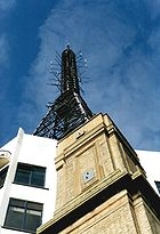
in London, which housed two studios, various scenery stores, make-up areas, dressing rooms, offices, and the transmitter itself, now broadcasting on the VHF band. BBC television initially used two systems, on alternate weeks: the 240-line Baird intermediate film system
and the 405-line
Marconi-EMI system, each making the BBC the world's first regular high-definition television service, broadcasting Monday to Saturday from 15:00 to 16:00 and 21:00 to 22:00.
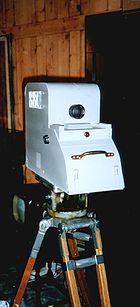
The two systems were to run on a trial basis for six months; early television sets supported both resolutions. However, the Baird system, which used a mechanical camera for filmed programming and Farnsworth image dissector
cameras for live programming, proved too cumbersome and visually inferior, and was dropped in February 1937.
Initially, the station's range was officially a 25-mile (40 km) radius of the Alexandra Palace transmitter—in practice, however, transmissions could be picked up a good deal further away, and on one occasion in 1938 were picked up by engineers at RCA
in New York, who were experimenting with a British television set.
on Germany, the station was unceremoniously taken off air with little warning. It was feared by the government that the VHF transmissions would act as a beacon to enemy aircraft homing in on London. Also, many of the television service's technical staff and engineers would be needed for the war effort, in particular on the RADAR
programme. The last programme aired was a Mickey Mouse
cartoon, Mickey's Gala Premier (1933), which was followed by test transmissions and an announcement of the afternoon schedule, which were not broadcast; this account refuted an urban legend
, which claimed that the BBC cut the Mickey Mouse cartoon short and suspended broadcasting immediately, before the cartoon properly ended.
According to figures from Britain's Radio Manufacturers Association, 18,999 television sets had been manufactured from 1936 to September 1939, when production was halted by the war.
, one of the original announcers, made the first announcement, saying, 'Good afternoon everybody. How are you? Do you remember me, Jasmine Bligh?'. The Mickey Mouse cartoon of 1939 was repeated twenty minutes later.
Postwar broadcast coverage was extended to Birmingham
in 1949 with the opening of the Sutton Coldfield transmitting station, and by the mid 1950s most of the country was covered.
Alexandra Palace was the home base of the channel until the early 1950s when the majority of production moved into Lime Grove Studios
(closed 1991), then in 1960 to the purpose-built BBC Television Centre
at White City, London
, where the channel is still based.
Television News continued to use Alexandra Palace as its base — by early 1968 it had even converted one of its studios to colour — before moving to purpose-built colour facilities at Television Centre on 20 September 1969.
The BBC held a monopoly
on television broadcasting in the United Kingdom until the first ITV
station was launched in 1955. The competition quickly forced the channel to change its identity and priorities following a large reduction in its audience figures.
The station was renamed BBC1 when BBC2
was launched in April 1964. At midnight on 15 November 1969, simultaneously with ITV
and two years after BBC2, the channel officially began 625-line PAL
colour programming with a broadcast of a concert by Petula Clark
. In the weeks leading up to 15 November, BBC1 had unofficially transmitted the occasional programme in colour to test its system. Stereo audio transmissions, using the NICAM
digital stereo sound format began on BBC1 at some point in 1986, as with BBC2, and were gradually phased in across BBC TV output, although it took until August 31 1991 for the service to begin officially. During this time, both commercial analogue broadcasters, ITV
and Channel 4
had officially begun stereo
transmissions using the BBC-developed NICAM system.
In terms of audience share, the most successful period for BBC1 was under Bryan Cowgill
between 1973–1977, when the channel achieved an average audience share of 45 per cent. This period is still regarded by many as a golden age of the BBC's output, with the BBC achieving a very high standard across its entire range of series, serials, plays, light entertainment and documentaries.
By the 1980s, the channel had launched the first breakfast television
programmes and returned to its previous form under the controller of the channel at the time, Michael Grade
. Wide-screen programming was introduced on digital platforms in 1998.
oversaw the commissioning of several successful BBC One programmes including Robin Hood (2006–2009), Jane Eyre
(2006) and How Do You Solve a Problem Like Maria?
, which was followed by similar shows Any Dream Will Do
and I'd Do Anything
because of its success. His first full year in charge of the channel saw a year-on-year growth in the audience share, with a rise from 22.2% in August 2005 to 23.6% in August 2006.
Fincham also directly initiated the creation of both The One Show
(2006–present) , an early evening, current-affairs and lifestyle programme, which now runs all but two weeks of the year, and Davina
(2006), a prime time chat show, the latter hosted by Davina McCall
, who presented Big Brother
. However, Davina was a critical and ratings disaster, which Fincham subsequently admitted was personally his fault, although he defended the strategy of experimenting with the BBC One schedule. This he continued in January 2007, when he moved the current affairs
series Panorama
from its Sunday night slot back to the prime time Monday evening slot from which it had been removed in 2000, most likely in response to a demand from the Board of Governors of the BBC
for the channel to show more current affairs programming in prime time.
Fincham's judgement was again called into question, this time by The Telegraph, for his decision to spend £1.2 million replacing BBC One 'Rhythm & Movement' idents, which had been introduced by his predecessor Lorraine Heggessey
several years earlier, with the 'Circle' idents
, a set of eight ten-second films, some of which were shot abroad in locations such as Mexico and Croatia. Fincham later found himself having to publicly defend the £18 million salary that the BBC paid Jonathan Ross
in 2006,although Ross's BBC One work—primarily consisting of Friday Night with Jonathan Ross
—formed only part of his overall BBC commitment.
The channel was named Channel of the Year at the 2007 Broadcast Awards.
In May 2007, Fincham took the decision to drop Neighbours
, an Australian soap opera, from BBC One after 21 years on the channel, when its producers significantly raised the price they wanted the BBC to pay for it in a bidding war. Fincham commented that it was 'a big loss', but that BBC One would not pay 'the best part of £300 m'.Neighbours left the channel in spring 2008 to move to Channel 5.
Fincham was involved in a further controversy in July 2007, when he was accused of misleading BBC One viewers. The incident involved a clip from forthcoming documentary A Year with the Queen which was shown to journalists during a press conference. It apparently showed the Queen
storming out of a session with American photographer Annie Leibovitz
over a disagreement about what she should wear, but the BBC subsequently admitted that the scenes used in the trailer had been edited out of their correct order, meaning that a false impression was given. Fincham admitted the error, but rejected calls that he should resign from his position as a result. His future was deemed uncertain following critical comments from Sir Michael Lyons, Chairman of the BBC Trust
and he resigned on 5 October 2007.
were:
Repeats made up 8.4% of peak programming in 2010/11, up from 8.0% for 2008/09. Programming on this channel costs an average of £162,900 per hour.
With a mission to provide big programmes for all licence-fee payers, it has sport, news, current affairs, and documentaries. It has historically broadcast children's programmes (now taken from CBBC
and CBeebies
). The channel remains one of the principal television channels in the United Kingdom and provides 2,508 annual hours of news and weather, 1,880 hours of factual and learning, 1,036 hours of drama, 672 hours of children's, 670 hours of sport, 654 hours of film, 433 hours of entertainment, 159 hours of current affairs, 92 hours of religion and 82 hours of music and arts.
2,508 annual hours of news and weather (293 in peak, 1,049 of BBC News simulcasts) are provided by regular news programmes BBC Breakfast
, the BBC News at One, BBC News at Six and the BBC News at Ten each including BBC regional news programmes. All three main news bulletins have a lead over their rival programmes on ITV and other terrestrial or cable channels. During the weekend period, three separate bulletins around these three time periods are broadcast and vary in length from 10–25 minutes. BBC One has broadcast overnight simulcasts from the BBC News channel since 1997; the latter in turn simulcasts the majority of all regular BBC One bulletins.
Each year 159 hours of current affairs programmes are broadcast on BBC One, including Panorama
and Watchdog
. Politics is also covered, with programmes including Question Time
and This Week shown. Crimewatch
, a programme appealing for help in unsolved crimes, is broadcast monthly.
Whilst nature documentaries such as Planet Earth
are the most familiar part of the 1,880 annual BBC One hours of factual and learning, this also includes lifestyle-format daytime programmes and a number of reality television formats and the One Life strand.
BBC One broadcasts 1,036 hours of drama each year, more than any other BBC channel. There are four half-hour episodes of EastEnders
each week (not shown on Wednesdays), with an omnibus
episode at the weekend, plus hospital dramas Casualty
and Holby City
. Other popular dramas on BBC One include crime dramas such as New Tricks, a programme of which even episode repeats have beaten ITV ratings on numerous occasions.
BBC One has traditionally been the home of children's television, Blue Peter
had been broadcast on the channel prior to the Children's BBC strand, and sections such as Watch with Mother
airing previously on the channel. This became more pronounced with the launch of Children's BBC, later renamed "CBBC
". This new strand was broadcast primarily on BBC One in the late afternoons, as well as Saturday and Sunday mornings also such as Going Live!
and Live & Kicking
, each lasting two to three hours. The launch in 2002 of dedicated digital channels for this content —the CBBC Channel
and CBeebies
—did not affect this provision. Combined with BBC Two, the channel broadcast 2,195 hours of children's programmes in 2010, mostly in the late afternoons on weekdays. Saturday morning children's programming moved to BBC Two in 2006 following a three month trial.
Sports coverage on BBC One includes Premier League football highlights on Match of the Day
, The Championships, Wimbledon
, horse racing such as the Grand National
, the London Marathon
, and other international athletics and swimming events, the Olympic Games
, Rugby League
, Rugby Union
, Snooker
tournaments, and more. The BBC shows The Football League Show
for Football League highlights and League Cup
coverage. Formula 1 motor racing is also shown, Saturday's qualifying and Sunday's main race.
On 18 January 2010, the BBC introduced a local Football League highlight show called Late Kick Off
. The BBC also shows the Football League Cup
final, and ten Football League matches live from the 2009/10 season. The BBC showed the 2010 FIFA World Cup
, splitting the group stage matches with ITV. The BBC had first pick of matches from the second round.
British and international films are broadcast for 654 hours each year on BBC One. This is mainly late-night fillers with some box office hits at Christmas and holiday periods. Films are sometimes used to fill the Saturday evening slot when no sport or entertainment programmes are due to be aired.
Entertainment programming on BBC One includes game shows such as the National Lottery
, Total Wipeout
, Strictly Come Dancing
and chat shows such as The Graham Norton Show
.
The annual 92 hours of religious programming comprise weekly editions of recorded Songs of Praise
, Christian
services and other shows from independent production companies. Mentorn Oxford produces Heart and Soul, described as “a new multi-faith programme featuring a panel and a studio audience”, followed by Life from the Loft which is made by the Leeds-based company True North. In 2005 BBC One was criticised for reducing the amount of religious programming, previously 101 hours per year.
BBC One broadcasts many comedy programmes, often on Friday nights. These have included the stand-up comedy show Live at the Apollo, sitcom Outnumbered
, and satirical quiz show Have I Got News For You
. Saturday evening is also a popular slot for a comedy show such as Michael McIntyre's Comedy Roadshow
and The Armstrong and Miller Show
.
As the weekly popular music chart programme Top of the Pops
was discontinued (except for the Christmas Day edition), BBC One broadcast 49 hours of music and arts programming in 2010. The majority of this was Imagine
, presented by Alan Yentob
, and classical music concerts such as the BBC Proms.
BBC One's daytime line-up was a major factor in it overtaking ITV as the most popular channel in 2000, a position it has held ever since. The morning daytime line-up consists of lifestyle shows, such as Homes Under the Hammer
and Bargain Hunt
, the afternoons contain drama with daily soap Doctors and classic US drama, such as Diagnosis: Murder
. Sometimes a drama such as Land Girls
is shown in the afternoons.
Between 15:05 and 17:05 is the CBeebies/CBBC broadcasting strand, with its own visual identity. Historically, BBC One's most popular daytime programme was Neighbours
, with audience figures approaching five million. On 11 February 2008, BBC One dropped Neighbours and the programme has since been broadcast on Channel 5. In its place the quiz show The Weakest Link, moved from BBC Two, later replaced in 2011 by Pointless
.
, which required that 25% of the BBC's television output be out-sourced to independent production companies. By 2004 many popular BBC One shows were made for the channel by independents, but the in-house production departments continued to contribute heavily to the schedule.
Although the statutory target remains 25%, 33% of output was made by independent production companies in 2010/11. The Quota of original programming in peak times is set at 90%, however 100% of peak programming was original in 2010/11. Over the whole day, the total for the same year was 89%, against a quota of 70%.
for much of its existence. In 1962 this was represented as a map of the UK shown between programmes, but in 1963 the globe appeared, changing in style and appearance over the next 39 years.
Most notably, on 18 February 1985, the "Computer Originated World" was introduced. This was a computer-animated globe with the land coloured gold and the sea a transparent blue, giving the impression of a glass globe. On 4 October 1997, the globe became a red, orange and yellow hot-air balloon, coloured to resemble a globe. It was filmed flying around various places in the UK.
On 29 March 2002 the globe was replaced by a series of visual identities, "idents", consisting of people dancing in various styles. These were replaced on 7 October 2006 by the present 'circle' idents
. According to the BBC, the circle symbol both represents togetherness and acts as a link to former idents.
, Wales
and Northern Ireland
. Each variant maintains the BBC One logo with the addition of the country name beneath it.
In England, each region has an individual regional news and current affairs programme opt-out as well as a limited amount of continuity. During these opt-outs, the region name is displayed as with the national variations, beneath the main channel logo. UK Today
, a news programme, was shown nationally to digital viewers in place of regional programmes when they were unavailable to broadcast on analogue television. The programme was discontinued in 2002 and replaced by a transmission of BBC London News
until all BBC regions were made available digitally.
BBC One Scotland has the greatest level of variation from the generic network, owing to BBC Scotland
scheduling Scottish programming on the main BBC Scotland channel, rather than on BBC Two
.
BBC One Scotland variations include the soap opera River City
and the football programme Sportscene
, the inclusion of which causes network programming to be displaced or replaced.
BBC One Wales was considered a separate channel by the BBC as early as its launch in the mid-1960s, appearing as BBC Wales.
on some popular BBC One programmes for visually impaired-viewers. The percentage of the BBC's total television output with audio description available is 10%, having been increased from 8% in 2008.
of BBC One in high-definition
(HD), launched on 3 November 2010 at 19:00. The channel simulcasts a network version of BBC One in High Definition, with HD versions of programmes including Holby City
, The One Show
, Strictly Come Dancing
, The Apprentice, The Weakest Link and Doctor Who
. EastEnders
was also made available in HD as from Christmas Day 2010. All programmes still made in standard-definition are upscaled on the channel and it is intended that by 2012 the vast majority of the channel's output will be in high-definition.
BBC One HD, however, does not offer regional variations, and therefore the channel cannot broadcast during regional programming slots, most noticeably the local news programmes. The BBC Trust admitted that this is due to technical and financial constraints, but the BBC announced on 6 June 2011 that the national variations of BBC One Northern Ireland, BBC One Scotland and BBC One Wales, would become available in 2012.
BBC One HD is available on all digital television platforms offering HD channels – Freesat
, Freeview HD, Sky, Smallworld Cable, UPC Ireland
and Virgin Media
. It is available in addition to the existing BBC HD
channel, which continues to broadcast HD programmes from the BBC's other television channels.
On 3 November 2011, BBC One HD launched on Sky Ireland on channel 234 or 141 for HD pack subscribers.
Television channel
A television channel is a physical or virtual channel over which a television station or television network is distributed. For example, in North America, "channel 2" refers to the broadcast or cable band of 54 to 60 MHz, with carrier frequencies of 55.25 MHz for NTSC analog video and...
of the British Broadcasting Corporation (BBC
BBC
The British Broadcasting Corporation is a British public service broadcaster. Its headquarters is at Broadcasting House in the City of Westminster, London. It is the largest broadcaster in the world, with about 23,000 staff...
) in the United Kingdom
United Kingdom
The United Kingdom of Great Britain and Northern IrelandIn the United Kingdom and Dependencies, other languages have been officially recognised as legitimate autochthonous languages under the European Charter for Regional or Minority Languages...
. It was launched on 2 November 1936 as the BBC Television Service, and was the world's first regular television service with a high level of image resolution
Image resolution
Image resolution is an umbrella term that describes the detail an image holds. The term applies to raster digital images, film images, and other types of images. Higher resolution means more image detail....
. It was later renamed BBC tv until the launch of sister channel BBC2
BBC Two
BBC Two is the second television channel operated by the British Broadcasting Corporation in the United Kingdom. It covers a wide range of subject matter, but tending towards more 'highbrow' programmes than the more mainstream and popular BBC One. Like the BBC's other domestic TV and radio...
in 1964, whereupon it was known as BBC1, with the current spelling adopted in 1997.
The channel's annual budget for 2011/12 is £1,166.6 million. Along with the BBC's other domestic television station
Television station
A television station is a business, organisation or other such as an amateur television operator that transmits content over terrestrial television. A television transmission can be by analog television signals or, more recently, by digital television. Broadcast television systems standards are...
s, and many European broadcasters (and some in Asia), it is funded principally by the television licence fee
Television licence
A television licence is an official licence required in many countries for the reception of television broadcasts...
, and therefore shows uninterrupted programming with no commercial advertising at any time. It is currently the most watched television channel in the United Kingdom, ahead of its traditional rival for ratings leadership, ITV1
ITV1
ITV1 is a generic brand that is used by twelve franchises of the British ITV Network in the English regions, Wales, southern Scotland , the Isle of Man and the Bailiwicks of Jersey and Guernsey. The ITV1 brand was introduced by Carlton and Granada in 2001, alongside the regional identities of their...
.
The current channel controller for BBC One is Danny Cohen
Danny Cohen
Danny Cohen is the current Controller of BBC One, the BBC's flagship television channel in the United Kingdom. He is the youngest person to be appointed as Controller of the channel.- Education :...
, formerly controller of BBC Three
BBC Three
BBC Three is a television network from the BBC broadcasting via digital cable, terrestrial, IPTV and satellite platforms. The channel's target audience includes those in the 16-34 year old age group, and has the purpose of providing "innovative" content to younger audiences, focusing on new talent...
. Cohen replaced Jay Hunt following her departure from the BBC in late 2010 to join Channel 4, where she took up her position in January 2011. Jana Bennett, head of BBC Vision, took temporary control of BBC One between Hunt's departure and Cohen's appointment. Cohen briefly held controller positions of both BBC One and BBC Three until former ITV digital channels head Zai Bennett
Zai Bennett
-Career:Zai Bennett started his career in 1995 in the post room at Carlton Television, then worked as presentation scheduler for the launch of Channel 5 in 1997. He worked for ITV from 1998 in a number of roles including Head of Programme Strategy, ITV Digital Channels and ITV2 Programming and...
was confirmed as the new controller of BBC Three.
The early years
Transmitter
In electronics and telecommunications a transmitter or radio transmitter is an electronic device which, with the aid of an antenna, produces radio waves. The transmitter itself generates a radio frequency alternating current, which is applied to the antenna. When excited by this alternating...
, using the electromechanical
Mechanical television
Mechanical television was a broadcast television system that used mechanical or electromechanical devices to capture and display video images. However, the images themselves were usually transmitted electronically and via radio waves...
system pioneered by John Logie Baird
John Logie Baird
John Logie Baird FRSE was a Scottish engineer and inventor of the world's first practical, publicly demonstrated television system, and also the world's first fully electronic colour television tube...
. This system used a vertically-scanned image of 30 lines — just enough resolution for a close-up of one person, and with a bandwidth low enough to use existing radio transmitters. Simultaneous transmission of sound and picture was achieved on 30 March 1930, by using the BBC's new twin transmitter at Brookmans Park
Brookmans Park Transmitter
The Brookmans Park transmitting station is a facility for medium wave broadcasting north of London . The station was built by the BBC as the first of a network of regional dual transmitter stations, replacing the city based ones used previously, and this was to cover the Home Counties, London and...
. By late 1930, 30 minutes of morning programmes were broadcast Monday to Friday, and 30 minutes at midnight on Tuesdays and Fridays, after BBC radio went off the air. Baird broadcasts via the BBC continued until June 1932.
The BBC began its own regular television programming from the basement of Broadcasting House
Broadcasting House
Broadcasting House is the headquarters and registered office of the BBC in Portland Place and Langham Place, London.The building includes the BBC Radio Theatre from where music and speech programmes are recorded in front of a studio audience...
, London, on 22 August 1932. The studio moved to larger quarters in 16 Portland Place
Portland Place
Portland Place is a street in the Marylebone district of central London, England.-History and topography:The street was laid out by the brothers Robert and James Adam for the Duke of Portland in the late 18th century and originally ran north from the gardens of a detached mansion called Foley House...
, London, in February 1934, and continued broadcasting the 30-line images, carried by telephone line to the medium wave transmitter at Brookmans Park
Brookmans Park
Brookmans Park is a village, located in the civil parish of North Mymms, in Hertfordshire, southeast England. It is well known for its varied and interesting local history, including an ancient historic estate that used to exist within its boundaries, its BBC transmitter station, and excellent...
, until 11 September 1935, by which time advances in all-electronic television systems made the electromechanical broadcasts obsolete.
After a series of test transmissions and special broadcasts that began in August, regular BBC television broadcasts officially resumed on 1 October 1936, from a converted wing of Alexandra Palace
Alexandra Palace
Alexandra Palace is a building in North London, England. It stands in Alexandra Park, in an area between Hornsey, Muswell Hill and Wood Green...
in London, which housed two studios, various scenery stores, make-up areas, dressing rooms, offices, and the transmitter itself, now broadcasting on the VHF band. BBC television initially used two systems, on alternate weeks: the 240-line Baird intermediate film system
Intermediate film system
The intermediate film system was a television process in which motion picture film was processed almost immediately after it was exposed in a camera, then scanned by a television scanner, and transmitted over the air...
and the 405-line
405-line
The 405-line monochrome analogue television broadcasting system was the first fully electronic television system to be used in regular broadcasting....
Marconi-EMI system, each making the BBC the world's first regular high-definition television service, broadcasting Monday to Saturday from 15:00 to 16:00 and 21:00 to 22:00.
| Broadcast time | Broadcast programmes |
|---|---|
| 14:50-14:59 | Test pattern Test card A test card, also known as a test pattern in North America and Australia, is a television test signal, typically broadcast at times when the transmitter is active but no program is being broadcast... |
| 14:59-15:00 | Clock ident Clock ident A clock ident is a form of television ident that employs a clock displaying the current time with the station logo, typically used before news bulletins and closedown.-Appearance:... |
| 15:00-15:11 | Station ident Station identification Station identification is the practice of radio or television stations or networks identifying themselves on air, typically by means of a call sign or brand name... , television listings Television program A television program , also called television show, is a segment of content which is intended to be broadcast on television. It may be a one-time production or part of a periodically recurring series... then opening of the BBC Television Service |
| 15:11-15:19 | Interval, time Greenwich Mean Time Greenwich Mean Time is a term originally referring to mean solar time at the Royal Observatory in Greenwich, London. It is arguably the same as Coordinated Universal Time and when this is viewed as a time zone the name Greenwich Mean Time is especially used by bodies connected with the United... then weather forecast Weather forecasting Weather forecasting is the application of science and technology to predict the state of the atmosphere for a given location. Human beings have attempted to predict the weather informally for millennia, and formally since the nineteenth century... |
| 15:19-15:20 | Clock ident Clock ident A clock ident is a form of television ident that employs a clock displaying the current time with the station logo, typically used before news bulletins and closedown.-Appearance:... |
| 15:20-15:30 | British Movietone News Movietone News Movietone News is a newsreel that ran from 1928 to 1963 in the United States, and from 1929 to 1979 in the United Kingdom.-History:It is known in the U.S. as Fox Movietone News, produced cinema, sound newsreels from 1928 to 1963 in the U.S., from 1929 to 1979 in the UK , and from 1929 to 1975 in... |
| 15:30-15:55 | Variety show Variety show A variety show, also known as variety arts or variety entertainment, is an entertainment made up of a variety of acts, especially musical performances and sketch comedy, and normally introduced by a compère or host. Other types of acts include magic, animal and circus acts, acrobatics, juggling... |
| 15:55-16:00 | Television listings Television program A television program , also called television show, is a segment of content which is intended to be broadcast on television. It may be a one-time production or part of a periodically recurring series... , weather forecast Weather forecasting Weather forecasting is the application of science and technology to predict the state of the atmosphere for a given location. Human beings have attempted to predict the weather informally for millennia, and formally since the nineteenth century... , clock ident Clock ident A clock ident is a form of television ident that employs a clock displaying the current time with the station logo, typically used before news bulletins and closedown.-Appearance:... , national anthem God Save the Queen "God Save the Queen" is an anthem used in a number of Commonwealth realms and British Crown Dependencies. The words of the song, like its title, are adapted to the gender of the current monarch, with "King" replacing "Queen", "he" replacing "she", and so forth, when a king reigns... then sign-off |
| 16:00-20:59 | Test pattern Test card A test card, also known as a test pattern in North America and Australia, is a television test signal, typically broadcast at times when the transmitter is active but no program is being broadcast... |
| 20:59-21:00 | Clock ident Clock ident A clock ident is a form of television ident that employs a clock displaying the current time with the station logo, typically used before news bulletins and closedown.-Appearance:... |
| 21:00-21:05 | Station ident Station identification Station identification is the practice of radio or television stations or networks identifying themselves on air, typically by means of a call sign or brand name... then television listings Television program A television program , also called television show, is a segment of content which is intended to be broadcast on television. It may be a one-time production or part of a periodically recurring series... |
| 21:05-21:20 | Television Comes Alexandra Palace Alexandra Palace is a building in North London, England. It stands in Alexandra Park, in an area between Hornsey, Muswell Hill and Wood Green... to London London London is the capital city of :England and the :United Kingdom, the largest metropolitan area in the United Kingdom, and the largest urban zone in the European Union by most measures. Located on the River Thames, London has been a major settlement for two millennia, its history going back to its... |
| 21:20-21:49 | Picture Page Picture Page Picture Page is a British television programme, broadcast on the BBC Television Service from 1936 to 1939, and again after the service's hiatus during the Second World War from 1946 until 1952... |
| 21:49-21:50 | Clock ident Clock ident A clock ident is a form of television ident that employs a clock displaying the current time with the station logo, typically used before news bulletins and closedown.-Appearance:... |
| 21:50-22:55 | British Movietone News Movietone News Movietone News is a newsreel that ran from 1928 to 1963 in the United States, and from 1929 to 1979 in the United Kingdom.-History:It is known in the U.S. as Fox Movietone News, produced cinema, sound newsreels from 1928 to 1963 in the U.S., from 1929 to 1979 in the UK , and from 1929 to 1975 in... |
| 21:55-22:00 | Television listings Television program A television program , also called television show, is a segment of content which is intended to be broadcast on television. It may be a one-time production or part of a periodically recurring series... , weather forecast Weather forecasting Weather forecasting is the application of science and technology to predict the state of the atmosphere for a given location. Human beings have attempted to predict the weather informally for millennia, and formally since the nineteenth century... , clock ident Clock ident A clock ident is a form of television ident that employs a clock displaying the current time with the station logo, typically used before news bulletins and closedown.-Appearance:... , national anthem God Save the Queen "God Save the Queen" is an anthem used in a number of Commonwealth realms and British Crown Dependencies. The words of the song, like its title, are adapted to the gender of the current monarch, with "King" replacing "Queen", "he" replacing "she", and so forth, when a king reigns... then sign-off |
| 22:00-22:01 | Test pattern Test card A test card, also known as a test pattern in North America and Australia, is a television test signal, typically broadcast at times when the transmitter is active but no program is being broadcast... |
The two systems were to run on a trial basis for six months; early television sets supported both resolutions. However, the Baird system, which used a mechanical camera for filmed programming and Farnsworth image dissector
Image dissector
An image dissector, also called a dissector tube, is a video camera tube in which photocathode emissions create an "electron image" which is then scanned to produce an electrical signal representing the visual image...
cameras for live programming, proved too cumbersome and visually inferior, and was dropped in February 1937.
Initially, the station's range was officially a 25-mile (40 km) radius of the Alexandra Palace transmitter—in practice, however, transmissions could be picked up a good deal further away, and on one occasion in 1938 were picked up by engineers at RCA
RCA
RCA Corporation, founded as the Radio Corporation of America, was an American electronics company in existence from 1919 to 1986. The RCA trademark is currently owned by the French conglomerate Technicolor SA through RCA Trademark Management S.A., a company owned by Technicolor...
in New York, who were experimenting with a British television set.
Wartime closure
On 1 September 1939, two days before Britain declared warWorld War II
World War II, or the Second World War , was a global conflict lasting from 1939 to 1945, involving most of the world's nations—including all of the great powers—eventually forming two opposing military alliances: the Allies and the Axis...
on Germany, the station was unceremoniously taken off air with little warning. It was feared by the government that the VHF transmissions would act as a beacon to enemy aircraft homing in on London. Also, many of the television service's technical staff and engineers would be needed for the war effort, in particular on the RADAR
Radar
Radar is an object-detection system which uses radio waves to determine the range, altitude, direction, or speed of objects. It can be used to detect aircraft, ships, spacecraft, guided missiles, motor vehicles, weather formations, and terrain. The radar dish or antenna transmits pulses of radio...
programme. The last programme aired was a Mickey Mouse
Mickey Mouse
Mickey Mouse is a cartoon character created in 1928 by Walt Disney and Ub Iwerks at The Walt Disney Studio. Mickey is an anthropomorphic black mouse and typically wears red shorts, large yellow shoes, and white gloves...
cartoon, Mickey's Gala Premier (1933), which was followed by test transmissions and an announcement of the afternoon schedule, which were not broadcast; this account refuted an urban legend
Urban legend
An urban legend, urban myth, urban tale, or contemporary legend, is a form of modern folklore consisting of stories that may or may not have been believed by their tellers to be true...
, which claimed that the BBC cut the Mickey Mouse cartoon short and suspended broadcasting immediately, before the cartoon properly ended.
According to figures from Britain's Radio Manufacturers Association, 18,999 television sets had been manufactured from 1936 to September 1939, when production was halted by the war.
Postwar
BBC Television returned on 7 June 1946 at 15:00. Jasmine BlighJasmine Bligh
Jasmine Lydia Bligh was one of the first three BBC Television Service presenters in the 1930s, along with Leslie Mitchell and Elizabeth Cowell, providing continuity announcements and introducing programmes in-vision....
, one of the original announcers, made the first announcement, saying, 'Good afternoon everybody. How are you? Do you remember me, Jasmine Bligh?'. The Mickey Mouse cartoon of 1939 was repeated twenty minutes later.
Postwar broadcast coverage was extended to Birmingham
Birmingham
Birmingham is a city and metropolitan borough in the West Midlands of England. It is the most populous British city outside the capital London, with a population of 1,036,900 , and lies at the heart of the West Midlands conurbation, the second most populous urban area in the United Kingdom with a...
in 1949 with the opening of the Sutton Coldfield transmitting station, and by the mid 1950s most of the country was covered.
Alexandra Palace was the home base of the channel until the early 1950s when the majority of production moved into Lime Grove Studios
Lime Grove Studios
Lime Grove Studios was a film studio complex built by the Gaumont Film Company in 1915 situated in a street named Lime Grove, inShepherd's Bush, west London, north of Hammersmith and described by Gaumont as "the finest studio in Great Britain and the first building ever put up in this country...
(closed 1991), then in 1960 to the purpose-built BBC Television Centre
BBC Television Centre
BBC Television Centre at White City in West London is the headquarters of BBC Television. Officially opened on 29 June 1960, it remains one of the largest to this day; having featured over the years as backdrop to many BBC programmes, it is one of the most readily recognisable such facilities...
at White City, London
White City, London
White City is a district in the London Borough of Hammersmith and Fulham, to the north of Shepherd's Bush. Today, White City is home to the BBC Television Centre and BBC White City, and Loftus Road stadium, the home of football club Queens Park Rangers FC....
, where the channel is still based.
Television News continued to use Alexandra Palace as its base — by early 1968 it had even converted one of its studios to colour — before moving to purpose-built colour facilities at Television Centre on 20 September 1969.
The BBC held a monopoly
Monopoly
A monopoly exists when a specific person or enterprise is the only supplier of a particular commodity...
on television broadcasting in the United Kingdom until the first ITV
ITV
ITV is the major commercial public service TV network in the United Kingdom. Launched in 1955 under the auspices of the Independent Television Authority to provide competition to the BBC, it is also the oldest commercial network in the UK...
station was launched in 1955. The competition quickly forced the channel to change its identity and priorities following a large reduction in its audience figures.
The station was renamed BBC1 when BBC2
BBC Two
BBC Two is the second television channel operated by the British Broadcasting Corporation in the United Kingdom. It covers a wide range of subject matter, but tending towards more 'highbrow' programmes than the more mainstream and popular BBC One. Like the BBC's other domestic TV and radio...
was launched in April 1964. At midnight on 15 November 1969, simultaneously with ITV
ITV
ITV is the major commercial public service TV network in the United Kingdom. Launched in 1955 under the auspices of the Independent Television Authority to provide competition to the BBC, it is also the oldest commercial network in the UK...
and two years after BBC2, the channel officially began 625-line PAL
PAL
PAL, short for Phase Alternating Line, is an analogue television colour encoding system used in broadcast television systems in many countries. Other common analogue television systems are NTSC and SECAM. This page primarily discusses the PAL colour encoding system...
colour programming with a broadcast of a concert by Petula Clark
Petula Clark
Petula Clark, CBE is an English singer, actress, and composer whose career has spanned seven decades.Clark's professional career began as an entertainer on BBC Radio during World War II...
. In the weeks leading up to 15 November, BBC1 had unofficially transmitted the occasional programme in colour to test its system. Stereo audio transmissions, using the NICAM
NICAM
Near Instantaneous Companded Audio Multiplex is an early form of lossy compression for digital audio. It was originally developed in the early 1970s for point-to-point links within broadcasting networks...
digital stereo sound format began on BBC1 at some point in 1986, as with BBC2, and were gradually phased in across BBC TV output, although it took until August 31 1991 for the service to begin officially. During this time, both commercial analogue broadcasters, ITV
ITV
ITV is the major commercial public service TV network in the United Kingdom. Launched in 1955 under the auspices of the Independent Television Authority to provide competition to the BBC, it is also the oldest commercial network in the UK...
and Channel 4
Channel 4
Channel 4 is a British public-service television broadcaster which began working on 2 November 1982. Although largely commercially self-funded, it is ultimately publicly owned; originally a subsidiary of the Independent Broadcasting Authority , the station is now owned and operated by the Channel...
had officially begun stereo
STEREO
STEREO is a solar observation mission. Two nearly identical spacecraft were launched into orbits that cause them to respectively pull farther ahead of and fall gradually behind the Earth...
transmissions using the BBC-developed NICAM system.
In terms of audience share, the most successful period for BBC1 was under Bryan Cowgill
Bryan Cowgill
Bryan Cowgill was a senior British television executive. He was Head of Sport for BBC Television from 1963–1973, Controller of BBC One from 1973–1977, and Managing Director of Thames TV from 1977-1985.-Early life:...
between 1973–1977, when the channel achieved an average audience share of 45 per cent. This period is still regarded by many as a golden age of the BBC's output, with the BBC achieving a very high standard across its entire range of series, serials, plays, light entertainment and documentaries.
By the 1980s, the channel had launched the first breakfast television
Breakfast television
Breakfast television or morning show , is a type of infotainment television program, broadcast live in the morning...
programmes and returned to its previous form under the controller of the channel at the time, Michael Grade
Michael Grade
Michael Ian Grade, Baron Grade of Yarmouth CBE is a British broadcast executive and businessman. He was BBC chairman from 2004 to 2006 and executive chairman of ITV plc from 2007 to 2009.-Early life:...
. Wide-screen programming was introduced on digital platforms in 1998.
2000s
Joining the channel as Controller in 2005, Peter FinchamPeter Fincham
Peter Fincham is a British television producer and executive, currently the Director of Television for the ITV network. He was also formerly the Controller of BBC One, the primary television channel of the British Broadcasting Corporation, until his resignation on 5 October 2007, following...
oversaw the commissioning of several successful BBC One programmes including Robin Hood (2006–2009), Jane Eyre
Jane Eyre (2006 TV serial)
Jane Eyre is a 2006 television adaptation of Charlotte Brontë's 1847 novel of the same name. The story, which has been the subject of numerous television and film adaptations is based on the life of the orphaned titular character...
(2006) and How Do You Solve a Problem Like Maria?
How Do You Solve a Problem Like Maria?
How Do You Solve a Problem Like Maria? was a British television talent series, that was broadcast on Saturday evenings on BBC One between 29 July and 16 September 2006. It documented the search for a new, undiscovered musical theatre performer to play the role of Maria von Trapp in the 2006 Andrew...
, which was followed by similar shows Any Dream Will Do
Any Dream Will Do (TV series)
Any Dream Will Do, often known as 'Joseph', was a 2007 talent show-themed television series produced by the BBC in the United Kingdom. It searched for a new, unknown lead to play Joseph in a West End revival of the Andrew Lloyd Webber musical Joseph and the Amazing Technicolor Dreamcoat.The show...
and I'd Do Anything
I'd Do Anything (BBC TV series)
I'd Do Anything is a 2008 talent show-themed television series produced by the BBC in the United Kingdom and broadcast on BBC One. It premièred on 15 March 2008...
because of its success. His first full year in charge of the channel saw a year-on-year growth in the audience share, with a rise from 22.2% in August 2005 to 23.6% in August 2006.
Fincham also directly initiated the creation of both The One Show
The One Show
The One Show is a topical magazine-style daily television programme broadcast live on BBC One and BBC One HD, hosted by Alex Jones and Matt Baker. Chris Evans joins Jones to present the programme on Friday...
(2006–present) , an early evening, current-affairs and lifestyle programme, which now runs all but two weeks of the year, and Davina
Davina (talk show)
Davina is a British talk show hosted by Davina McCall.It first aired on BBC One on 15 February 2006, however, the show ended on 12 April 2006 at the end of its first series due to low ratings...
(2006), a prime time chat show, the latter hosted by Davina McCall
Davina McCall
Davina McCall is an English television presenter and actress, most notable as the presenter of the UK version of Big Brother up until its move to Channel 5.- Early life :...
, who presented Big Brother
Big Brother (UK)
Big Brother UK is the British version of the Dutch Big Brother television format, which takes its name from the character in George Orwell's 1948 novel Nineteen Eighty-Four...
. However, Davina was a critical and ratings disaster, which Fincham subsequently admitted was personally his fault, although he defended the strategy of experimenting with the BBC One schedule. This he continued in January 2007, when he moved the current affairs
Current affairs (news format)
Current Affairs is a genre of broadcast journalism where the emphasis is on detailed analysis and discussion of news stories that have recently occurred or are ongoing at the time of broadcast....
series Panorama
Panorama (TV series)
Panorama is a BBC Television current affairs documentary programme, which was first broadcast in 1953, and is the longest-running public affairs television programme in the world. Panorama has been presented by many well known BBC presenters, including Richard Dimbleby, Robin Day, David Dimbleby...
from its Sunday night slot back to the prime time Monday evening slot from which it had been removed in 2000, most likely in response to a demand from the Board of Governors of the BBC
Board of Governors of the BBC
The Board of Governors of the BBC was the governing body of the British Broadcasting Corporation. It consisted of twelve people who together regulated the BBC and represented the interests of the public. It existed from 1927 until it was replaced by the BBC Trust on 1 January 2007.The governors...
for the channel to show more current affairs programming in prime time.
Fincham's judgement was again called into question, this time by The Telegraph, for his decision to spend £1.2 million replacing BBC One 'Rhythm & Movement' idents, which had been introduced by his predecessor Lorraine Heggessey
Lorraine Heggessey
Lorraine Heggessey is a British television producer and former Chief Executive of the production company Talkback Thames...
several years earlier, with the 'Circle' idents
BBC One 'Circle' idents
The BBC One 'Circle' idents are a set of on-screen channel identities that debuted on BBC One at 10am BST on 7 October 2006. They also feature on the BBC Worldwide channel, BBC America...
, a set of eight ten-second films, some of which were shot abroad in locations such as Mexico and Croatia. Fincham later found himself having to publicly defend the £18 million salary that the BBC paid Jonathan Ross
Jonathan Ross (television presenter)
Jonathan Stephen Ross, OBE is an English television and radio presenter, best known for presenting the BBC One chat show Friday Night with Jonathan Ross from 2001 until he left the BBC in 2010. Ross began hosting a new chat show on ITV1 starting 3 September 2011...
in 2006,although Ross's BBC One work—primarily consisting of Friday Night with Jonathan Ross
Friday Night with Jonathan Ross
Friday Night with Jonathan Ross was a British comedy chat show presented by Jonathan Ross. It was first broadcast on BBC One on 2 November 2001. The programme featured Ross's take on current topics of conversation, guest interviews and live music from both a guest music group and the house band...
—formed only part of his overall BBC commitment.
The channel was named Channel of the Year at the 2007 Broadcast Awards.
In May 2007, Fincham took the decision to drop Neighbours
Neighbours
Neighbours is an Australian television soap opera first broadcast on the Seven Network on 18 March 1985. It was created by TV executive Reg Watson, who proposed the idea of making a show that focused on realistic stories and portrayed adults and teenagers who talk openly and solve their problems...
, an Australian soap opera, from BBC One after 21 years on the channel, when its producers significantly raised the price they wanted the BBC to pay for it in a bidding war. Fincham commented that it was 'a big loss', but that BBC One would not pay 'the best part of £300 m'.Neighbours left the channel in spring 2008 to move to Channel 5.
Fincham was involved in a further controversy in July 2007, when he was accused of misleading BBC One viewers. The incident involved a clip from forthcoming documentary A Year with the Queen which was shown to journalists during a press conference. It apparently showed the Queen
Elizabeth II of the United Kingdom
Elizabeth II is the constitutional monarch of 16 sovereign states known as the Commonwealth realms: the United Kingdom, Canada, Australia, New Zealand, Jamaica, Barbados, the Bahamas, Grenada, Papua New Guinea, the Solomon Islands, Tuvalu, Saint Lucia, Saint Vincent and the Grenadines, Belize,...
storming out of a session with American photographer Annie Leibovitz
Annie Leibovitz
Anna-Lou "Annie" Leibovitz is an American portrait photographer.-Early life and education:Born in Waterbury, Connecticut, Leibovitz is the third of six children. She is a third-generation American whose great-grandparents were Jewish immigrants, from Central and Eastern Europe. Her father's...
over a disagreement about what she should wear, but the BBC subsequently admitted that the scenes used in the trailer had been edited out of their correct order, meaning that a false impression was given. Fincham admitted the error, but rejected calls that he should resign from his position as a result. His future was deemed uncertain following critical comments from Sir Michael Lyons, Chairman of the BBC Trust
BBC Trust
The BBC Trust is the governing body of the British Broadcasting Corporation. It is operationally independent of BBC management and external bodies, and aims to act in the best interests of licence fee payers....
and he resigned on 5 October 2007.
Programming
In 2010, the top five watched programmes, at their peaks, according to BARBBarb
Barb may refer to:* A backward-facing point on a fish hook or similar implement, rendering extraction from the victim's flesh more difficult* Wind barbs for each station on a map of reported weather conditions...
were:
- Doctor WhoDoctor WhoDoctor Who is a British science fiction television programme produced by the BBC. The programme depicts the adventures of a time-travelling humanoid alien known as the Doctor who explores the universe in a sentient time machine called the TARDIS that flies through time and space, whose exterior...
16,410,000 - World Cup 2010 England Vs Germany 15,810,000
- Strictly Come DancingStrictly Come DancingStrictly Come Dancing is a British television show, featuring celebrities with professional dance partners competing in Ballroom and Latin dances. The title of the show suggests a continuation of the long-running series Come Dancing, with an allusion to the film Strictly Ballroom...
14,280,000 - Come Fly With MeCome Fly with Me (2010 TV series)Come Fly with Me is a British mockumentary television comedy series created by and starring Matt Lucas and David Walliams. Narrated by Lindsay Duncan, the series launched on 25 December 2010 on BBC One and BBC One HD...
12,470,000 - EastendersEastEndersEastEnders is a British television soap opera, first broadcast in the United Kingdom on BBC One on 19 February 1985 and continuing to today. EastEnders storylines examine the domestic and professional lives of the people who live and work in the fictional London Borough of Walford in the East End...
12,110,000
Repeats made up 8.4% of peak programming in 2010/11, up from 8.0% for 2008/09. Programming on this channel costs an average of £162,900 per hour.
With a mission to provide big programmes for all licence-fee payers, it has sport, news, current affairs, and documentaries. It has historically broadcast children's programmes (now taken from CBBC
CBBC
CBBC is one of two brand names used for the BBC's children's television strands. Between 1985 and 2002, CBBC was the name given to all the BBC's programmes on TV for children aged under 14...
and CBeebies
CBeebies
CBeebies is the brand used by the BBC for programming aimed at children 6 years and under. It is used as a themed strand in the UK on terrestrial television, as a separate free-to-air domestic British channel and used for international varients supported by advertising, subscription or both...
). The channel remains one of the principal television channels in the United Kingdom and provides 2,508 annual hours of news and weather, 1,880 hours of factual and learning, 1,036 hours of drama, 672 hours of children's, 670 hours of sport, 654 hours of film, 433 hours of entertainment, 159 hours of current affairs, 92 hours of religion and 82 hours of music and arts.
2,508 annual hours of news and weather (293 in peak, 1,049 of BBC News simulcasts) are provided by regular news programmes BBC Breakfast
BBC Breakfast
BBC Breakfast is the morning television news programme simulcast on BBC One and the BBC News channel. It is presented live from BBC Television Centre in White City, West London, and contains a mixture of news, sport, weather, business and feature items...
, the BBC News at One, BBC News at Six and the BBC News at Ten each including BBC regional news programmes. All three main news bulletins have a lead over their rival programmes on ITV and other terrestrial or cable channels. During the weekend period, three separate bulletins around these three time periods are broadcast and vary in length from 10–25 minutes. BBC One has broadcast overnight simulcasts from the BBC News channel since 1997; the latter in turn simulcasts the majority of all regular BBC One bulletins.
Each year 159 hours of current affairs programmes are broadcast on BBC One, including Panorama
Panorama (TV series)
Panorama is a BBC Television current affairs documentary programme, which was first broadcast in 1953, and is the longest-running public affairs television programme in the world. Panorama has been presented by many well known BBC presenters, including Richard Dimbleby, Robin Day, David Dimbleby...
and Watchdog
Watchdog (TV series)
Watchdog is a BBC television series that investigates viewers' reports of problematic experiences with traders, retailers, and other companies around the UK...
. Politics is also covered, with programmes including Question Time
Question Time (TV series)
Question Time is a topical debate BBC television programme in the United Kingdom, based on Any Questions?. The show typically features politicians from at least the three major political parties as well as other public figures who answer questions put to them by the audience...
and This Week shown. Crimewatch
Crimewatch
Crimewatch is a long-running and high-profile British television programme produced by the BBC, that reconstructs major unsolved crimes with a view to gaining information from the members of the public. The programme is usually broadcast once a month on BBC One...
, a programme appealing for help in unsolved crimes, is broadcast monthly.
Whilst nature documentaries such as Planet Earth
Planet Earth (TV series)
Planet Earth is a 2006 television series produced by the BBC Natural History Unit. Five years in the making, it was the most expensive nature documentary series ever commissioned by the BBC, and also the first to be filmed in high definition...
are the most familiar part of the 1,880 annual BBC One hours of factual and learning, this also includes lifestyle-format daytime programmes and a number of reality television formats and the One Life strand.
BBC One broadcasts 1,036 hours of drama each year, more than any other BBC channel. There are four half-hour episodes of EastEnders
EastEnders
EastEnders is a British television soap opera, first broadcast in the United Kingdom on BBC One on 19 February 1985 and continuing to today. EastEnders storylines examine the domestic and professional lives of the people who live and work in the fictional London Borough of Walford in the East End...
each week (not shown on Wednesdays), with an omnibus
Omnibus (broadcast)
An omnibus is a compilation of daily television or radio episodes that is re-broadcast during the following weekend. The term has been most frequently used in the United Kingdom, though it has also been used in Australia, New Zealand and South Africa...
episode at the weekend, plus hospital dramas Casualty
Casualty (TV series)
Casualty, stylised as Casual+y, is a British weekly television show broadcast on BBC One, and the longest-running emergency medical drama television series in the world. Created by Jeremy Brock and Paul Unwin, it was first broadcast on 6 September 1986, and transmitted in the UK on BBC One. The...
and Holby City
Holby City
Holby City, stylised as Holby Ci+y, is a British medical drama television series that airs weekly on BBC One.The series was created by Tony McHale and Mal Young as a spin-off from the established BBC medical drama Casualty, and premiered on 12 January 1999...
. Other popular dramas on BBC One include crime dramas such as New Tricks, a programme of which even episode repeats have beaten ITV ratings on numerous occasions.
BBC One has traditionally been the home of children's television, Blue Peter
Blue Peter
Blue Peter is the world's longest-running children's television show, having first aired in 1958. It is shown on CBBC, both in its BBC One programming block and on the CBBC channel. During its history there have been many presenters, often consisting of two women and two men at a time...
had been broadcast on the channel prior to the Children's BBC strand, and sections such as Watch with Mother
Watch with Mother
Watch With Mother was a cycle of children's programmes broadcast from 1952 by BBC Television which was created by Freda Lingstrom.It was the first BBC television programme specifically aimed at pre-school children, like its radio equivalent Listen with Mother that also started in 1950...
airing previously on the channel. This became more pronounced with the launch of Children's BBC, later renamed "CBBC
CBBC
CBBC is one of two brand names used for the BBC's children's television strands. Between 1985 and 2002, CBBC was the name given to all the BBC's programmes on TV for children aged under 14...
". This new strand was broadcast primarily on BBC One in the late afternoons, as well as Saturday and Sunday mornings also such as Going Live!
Going Live!
Going Live! was a Saturday morning magazine show, broadcast on BBC1 between 1987 and 1993. It was presented by Phillip Schofield and Sarah Greene.Other presenters included Trevor and Simon, Peter Simon, Emma Forbes, and puppet Gordon the Gopher....
and Live & Kicking
Live & Kicking
Live & Kicking was a BBC Saturday morning children's magazine programme, running from 1993 to 2001. The fourth in a succession of Saturday morning shows, it was the replacement for Going Live!, and took many of its features from it, such as phone-ins, games, comedy, competitions and the showing of...
, each lasting two to three hours. The launch in 2002 of dedicated digital channels for this content —the CBBC Channel
CBBC Channel
CBBC is a BBC television channel aimed at 6 to 12 year olds. It complements the CBBC programming that continues to air on BBC One and BBC Two. Launched on 11 February 2002, it broadcasts from 7am to 7pm on Freeview, cable, IPTV and digital satellite, occupying the same bandwidth as, but a different...
and CBeebies
CBeebies
CBeebies is the brand used by the BBC for programming aimed at children 6 years and under. It is used as a themed strand in the UK on terrestrial television, as a separate free-to-air domestic British channel and used for international varients supported by advertising, subscription or both...
—did not affect this provision. Combined with BBC Two, the channel broadcast 2,195 hours of children's programmes in 2010, mostly in the late afternoons on weekdays. Saturday morning children's programming moved to BBC Two in 2006 following a three month trial.
Sports coverage on BBC One includes Premier League football highlights on Match of the Day
Match of the Day
Match of the Day is the BBC's main football television programme. Typically, it is shown on BBC One on Saturday evenings during the English football season, showing highlights of the day's matches in English football's top division, the Premier League...
, The Championships, Wimbledon
The Championships, Wimbledon
The Championships, Wimbledon, or simply Wimbledon , is the oldest tennis tournament in the world, considered by many to be the most prestigious. It has been held at the All England Club in Wimbledon, London since 1877. It is one of the four Grand Slam tennis tournaments, the other three Majors...
, horse racing such as the Grand National
Grand National
The Grand National is a world-famous National Hunt horse race which is held annually at Aintree Racecourse, near Liverpool, England. It is a handicap chase run over a distance of four miles and 856 yards , with horses jumping thirty fences over two circuits of Aintree's National Course...
, the London Marathon
London Marathon
The London Marathon is one of the biggest running events in the world, and one of the five top world marathons that make up the World Marathon Majors competition, which has a $1 million prize purse. It has been held each spring in London since 1981. The race is currently sponsored by Virgin Money,...
, and other international athletics and swimming events, the Olympic Games
Olympic Games
The Olympic Games is a major international event featuring summer and winter sports, in which thousands of athletes participate in a variety of competitions. The Olympic Games have come to be regarded as the world’s foremost sports competition where more than 200 nations participate...
, Rugby League
Rugby league
Rugby league football, usually called rugby league, is a full contact sport played by two teams of thirteen players on a rectangular grass field. One of the two codes of rugby football, it originated in England in 1895 by a split from Rugby Football Union over paying players...
, Rugby Union
Rugby union
Rugby union, often simply referred to as rugby, is a full contact team sport which originated in England in the early 19th century. One of the two codes of rugby football, it is based on running with the ball in hand...
, Snooker
Snooker
Snooker is a cue sport that is played on a green baize-covered table with pockets in each of the four corners and in the middle of each of the long side cushions. A regular table is . It is played using a cue and snooker balls: one white , 15 worth one point each, and six balls of different :...
tournaments, and more. The BBC shows The Football League Show
The Football League Show
The Football League Show is a BBC One football television show hosted by Manish Bhasin, featuring highlights from the Championship, League One and League Two. It began on 8 August, 2009, at 11.45pm and immediately follows Match of the Day on Saturdays...
for Football League highlights and League Cup
Football League Cup
The Football League Cup, commonly known as the League Cup or, from current sponsorship, the Carling Cup, is an English association football competition. Like the FA Cup, it is played on a knockout basis...
coverage. Formula 1 motor racing is also shown, Saturday's qualifying and Sunday's main race.
On 18 January 2010, the BBC introduced a local Football League highlight show called Late Kick Off
Late Kick Off
Late Kick Off was a BBC One regional television football programme which was launched on 18 January 2010 and ran up to and including the 2010-2011 football season...
. The BBC also shows the Football League Cup
Football League Cup
The Football League Cup, commonly known as the League Cup or, from current sponsorship, the Carling Cup, is an English association football competition. Like the FA Cup, it is played on a knockout basis...
final, and ten Football League matches live from the 2009/10 season. The BBC showed the 2010 FIFA World Cup
2010 FIFA World Cup
The 2010 FIFA World Cup was the 19th FIFA World Cup, the world championship for men's national association football teams. It took place in South Africa from 11 June to 11 July 2010...
, splitting the group stage matches with ITV. The BBC had first pick of matches from the second round.
British and international films are broadcast for 654 hours each year on BBC One. This is mainly late-night fillers with some box office hits at Christmas and holiday periods. Films are sometimes used to fill the Saturday evening slot when no sport or entertainment programmes are due to be aired.
Entertainment programming on BBC One includes game shows such as the National Lottery
National Lottery (United Kingdom)
The National Lottery is the state-franchised national lottery in the United Kingdom and the Isle of Man.It is operated by Camelot Group, to whom the licence was granted in 1994, 2001 and again in 2007. The lottery is regulated by the National Lottery Commission, and was established by the then...
, Total Wipeout
Total Wipeout
Total Wipeout is a British game show, hosted by Richard Hammond and Amanda Byram, which first aired on 3 January 2009. Each week 20 contestants compete in a series of challenges in an attempt to win £10,000. These challenges are based in large pools of water or mud and generally involve large...
, Strictly Come Dancing
Strictly Come Dancing
Strictly Come Dancing is a British television show, featuring celebrities with professional dance partners competing in Ballroom and Latin dances. The title of the show suggests a continuation of the long-running series Come Dancing, with an allusion to the film Strictly Ballroom...
and chat shows such as The Graham Norton Show
The Graham Norton Show
The Graham Norton Show is a British comedy chat show that is broadcast on BBC One in the United Kingdom. It was originally shown on BBC Two from February 2007 to May 2009 until it moved to BBC One from October 2009...
.
The annual 92 hours of religious programming comprise weekly editions of recorded Songs of Praise
Songs of Praise
Songs of Praise is a BBC Television programme based around traditional Christian hymns. It is a widely watched and long-running religious television programme, one of the few peak-time free-to-air religious programmes in Europe Songs of Praise is a BBC Television programme based around traditional...
, Christian
Christian
A Christian is a person who adheres to Christianity, an Abrahamic, monotheistic religion based on the life and teachings of Jesus of Nazareth as recorded in the Canonical gospels and the letters of the New Testament...
services and other shows from independent production companies. Mentorn Oxford produces Heart and Soul, described as “a new multi-faith programme featuring a panel and a studio audience”, followed by Life from the Loft which is made by the Leeds-based company True North. In 2005 BBC One was criticised for reducing the amount of religious programming, previously 101 hours per year.
BBC One broadcasts many comedy programmes, often on Friday nights. These have included the stand-up comedy show Live at the Apollo, sitcom Outnumbered
Outnumbered
Outnumbered is a British sitcom. Airing on BBC One since 2007, it stars Hugh Dennis and Claire Skinner as a father and mother outnumbered by their three children...
, and satirical quiz show Have I Got News For You
Have I Got News for You
Have I Got News for You is a British television panel show produced by Hat Trick Productions for the BBC. It is based loosely on the BBC Radio 4 show The News Quiz, and has been broadcast since 1990, currently the BBC's longest-ever running television panel show...
. Saturday evening is also a popular slot for a comedy show such as Michael McIntyre's Comedy Roadshow
Michael McIntyre's Comedy Roadshow
Michael McIntyre's Comedy Roadshow is a British stand-up comedy television series hosted by comedian Michael McIntyre from different venues around the United Kingdom and Republic of Ireland. The first series was broadcast with six episodes in 2009. Each episode features a routine from McIntyre,...
and The Armstrong and Miller Show
The Armstrong and Miller Show
The Armstrong and Miller Show is a British sketch comedy television show produced by Hat Trick Productions for BBC One. It features the double act Armstrong and Miller and a number of notable scriptwriters including Andy Hamilton and The League of Gentlemen's Jeremy Dyson.The series followed four...
.
As the weekly popular music chart programme Top of the Pops
Top of the Pops
Top of the Pops, also known as TOTP, is a British music chart television programme, made by the BBC and originally broadcast weekly from 1 January 1964 to 30 July 2006. After 25 December 2006 it became a radio program, now hosted by Tony Blackburn...
was discontinued (except for the Christmas Day edition), BBC One broadcast 49 hours of music and arts programming in 2010. The majority of this was Imagine
Imagine (TV series)
Imagine is a wide ranging arts series first broadcast on BBC One in 2003, hosted and executive produced by Alan Yentob. Each series usually consists of 4 to 7 episodes, each on a different topic...
, presented by Alan Yentob
Alan Yentob
Alan Yentob is a British television executive and presenter who has worked throughout his career at the BBC.-Early life:...
, and classical music concerts such as the BBC Proms.
BBC One's daytime line-up was a major factor in it overtaking ITV as the most popular channel in 2000, a position it has held ever since. The morning daytime line-up consists of lifestyle shows, such as Homes Under the Hammer
Homes Under the Hammer
Homes Under the Hammer is a BBC One morning television series, which has been running since 2003. Its main presenters are Lucy Alexander and Martin Roberts, although in series three Marc Woodward and Jasmine Birtles alternated presenting duties with Alexander and Roberts...
and Bargain Hunt
Bargain Hunt
Bargain Hunt is a British television programme in which two pairs of contestants are challenged to buy antiques at a fair and then sell them in an auction for a profit. It has aired on BBC One since 13 March 2000 in a daytime version and from 22 August 2002 to 13 November 2004 in a primetime version...
, the afternoons contain drama with daily soap Doctors and classic US drama, such as Diagnosis: Murder
Diagnosis: Murder
Diagnosis: Murder is a mystery/medical/crime drama television series starring Dick Van Dyke as Dr. Mark Sloan, a medical doctor who solves crimes with the help of his son, a homicide detective played by his real-life son Barry Van Dyke. The series began as a spin-off of Jake and the Fatman...
. Sometimes a drama such as Land Girls
Land Girls (2009 TV series)
Land Girls is a British television period drama series, first broadcast on BBC One on 7 September 2009. Land Girls was created by Roland Moore and commissioned by the BBC to commemorate the 70th anniversary of the outbreak of World War II. The programme was BBC Daytime's first commission of a...
is shown in the afternoons.
Between 15:05 and 17:05 is the CBeebies/CBBC broadcasting strand, with its own visual identity. Historically, BBC One's most popular daytime programme was Neighbours
Neighbours
Neighbours is an Australian television soap opera first broadcast on the Seven Network on 18 March 1985. It was created by TV executive Reg Watson, who proposed the idea of making a show that focused on realistic stories and portrayed adults and teenagers who talk openly and solve their problems...
, with audience figures approaching five million. On 11 February 2008, BBC One dropped Neighbours and the programme has since been broadcast on Channel 5. In its place the quiz show The Weakest Link, moved from BBC Two, later replaced in 2011 by Pointless
Pointless (TV series)
Pointless is a quiz show shown on BBC One, hosted by Alexander Armstrong, with Richard Osman as assistant. It has been broadcast since 24 August 2009....
.
Quotas
For the first fifty years of its existence, with the exception of films and imported programmes from countries such as the United States and Australia, almost all the channel's output was produced by the BBC's in-house production departments. This changed following the Broadcasting Act 1990Broadcasting Act 1990
The Broadcasting Act 1990 is a law of the British parliament, often regarded by both its supporters and its critics as a quintessential example of Thatcherism. The aim of the Act was to reform the entire structure of British broadcasting; British television, in particular, had earlier been...
, which required that 25% of the BBC's television output be out-sourced to independent production companies. By 2004 many popular BBC One shows were made for the channel by independents, but the in-house production departments continued to contribute heavily to the schedule.
Although the statutory target remains 25%, 33% of output was made by independent production companies in 2010/11. The Quota of original programming in peak times is set at 90%, however 100% of peak programming was original in 2010/11. Over the whole day, the total for the same year was 89%, against a quota of 70%.
Presentation
BBC One's identity has been symbolised by a globe shown on its identsStation identification
Station identification is the practice of radio or television stations or networks identifying themselves on air, typically by means of a call sign or brand name...
for much of its existence. In 1962 this was represented as a map of the UK shown between programmes, but in 1963 the globe appeared, changing in style and appearance over the next 39 years.
Most notably, on 18 February 1985, the "Computer Originated World" was introduced. This was a computer-animated globe with the land coloured gold and the sea a transparent blue, giving the impression of a glass globe. On 4 October 1997, the globe became a red, orange and yellow hot-air balloon, coloured to resemble a globe. It was filmed flying around various places in the UK.
On 29 March 2002 the globe was replaced by a series of visual identities, "idents", consisting of people dancing in various styles. These were replaced on 7 October 2006 by the present 'circle' idents
BBC One 'Circle' idents
The BBC One 'Circle' idents are a set of on-screen channel identities that debuted on BBC One at 10am BST on 7 October 2006. They also feature on the BBC Worldwide channel, BBC America...
. According to the BBC, the circle symbol both represents togetherness and acts as a link to former idents.
Regional variations
BBC One has individual continuity and opt-outs for ScotlandScotland
Scotland is a country that is part of the United Kingdom. Occupying the northern third of the island of Great Britain, it shares a border with England to the south and is bounded by the North Sea to the east, the Atlantic Ocean to the north and west, and the North Channel and Irish Sea to the...
, Wales
Wales
Wales is a country that is part of the United Kingdom and the island of Great Britain, bordered by England to its east and the Atlantic Ocean and Irish Sea to its west. It has a population of three million, and a total area of 20,779 km²...
and Northern Ireland
Northern Ireland
Northern Ireland is one of the four countries of the United Kingdom. Situated in the north-east of the island of Ireland, it shares a border with the Republic of Ireland to the south and west...
. Each variant maintains the BBC One logo with the addition of the country name beneath it.
In England, each region has an individual regional news and current affairs programme opt-out as well as a limited amount of continuity. During these opt-outs, the region name is displayed as with the national variations, beneath the main channel logo. UK Today
UK Today
UK Today was a BBC television news programme shown on the digital satellite and digital terrestrial versions of BBC One. It consisted of a round up of stories from the BBC's various local news programmes where it had not initially been possible to show regional variations...
, a news programme, was shown nationally to digital viewers in place of regional programmes when they were unavailable to broadcast on analogue television. The programme was discontinued in 2002 and replaced by a transmission of BBC London News
BBC London News
For other uses of the BBC London brand, see BBC London .BBC London News is the BBC's regional television news programme for the English region encompassing London and surrounding suburbs...
until all BBC regions were made available digitally.
BBC One Scotland has the greatest level of variation from the generic network, owing to BBC Scotland
BBC Scotland
BBC Scotland is a constituent part of the British Broadcasting Corporation, the publicly-funded broadcaster of the United Kingdom. It is, in effect, the national broadcaster for Scotland, having a considerable amount of autonomy from the BBC's London headquarters, and is run by the BBC Trust, who...
scheduling Scottish programming on the main BBC Scotland channel, rather than on BBC Two
BBC Two
BBC Two is the second television channel operated by the British Broadcasting Corporation in the United Kingdom. It covers a wide range of subject matter, but tending towards more 'highbrow' programmes than the more mainstream and popular BBC One. Like the BBC's other domestic TV and radio...
.
BBC One Scotland variations include the soap opera River City
River City
River City is a Scottish television soap opera, first broadcast in Scotland on BBC Scotland on 24 September 2002. River City storylines examine the domestic and professional lives of the people who live and work in the fictional district of Shieldinch in Glasgow...
and the football programme Sportscene
Sportscene
Sportscene is the name of a range of Scottish sports television programmes produced by BBC Scotland. Its main anchors are Dougie Donnelly, David Currie, Rob MacLean and Dougie Vipond, with Alison Walker and Richard Gordon acting as relief presenters...
, the inclusion of which causes network programming to be displaced or replaced.
BBC One Wales was considered a separate channel by the BBC as early as its launch in the mid-1960s, appearing as BBC Wales.
Accessibility
The BBC announced in May 2008 that it had achieved its aim for all programming to have subtitles for viewers with hearing difficulties. The BBC also offers audio descriptionAudio description
Audio description refers to an additional narration track for blind and visually impaired consumers of visual media...
on some popular BBC One programmes for visually impaired-viewers. The percentage of the BBC's total television output with audio description available is 10%, having been increased from 8% in 2008.
High-definition
BBC One HD, a simulcastSimulcast
Simulcast, shorthand for "simultaneous broadcast", refers to programs or events broadcast across more than one medium, or more than one service on the same medium, at the same time. For example, Absolute Radio is simulcast on both AM and on satellite radio, and the BBC's Prom concerts are often...
of BBC One in high-definition
High-definition television
High-definition television is video that has resolution substantially higher than that of traditional television systems . HDTV has one or two million pixels per frame, roughly five times that of SD...
(HD), launched on 3 November 2010 at 19:00. The channel simulcasts a network version of BBC One in High Definition, with HD versions of programmes including Holby City
Holby City
Holby City, stylised as Holby Ci+y, is a British medical drama television series that airs weekly on BBC One.The series was created by Tony McHale and Mal Young as a spin-off from the established BBC medical drama Casualty, and premiered on 12 January 1999...
, The One Show
The One Show
The One Show is a topical magazine-style daily television programme broadcast live on BBC One and BBC One HD, hosted by Alex Jones and Matt Baker. Chris Evans joins Jones to present the programme on Friday...
, Strictly Come Dancing
Strictly Come Dancing
Strictly Come Dancing is a British television show, featuring celebrities with professional dance partners competing in Ballroom and Latin dances. The title of the show suggests a continuation of the long-running series Come Dancing, with an allusion to the film Strictly Ballroom...
, The Apprentice, The Weakest Link and Doctor Who
Doctor Who
Doctor Who is a British science fiction television programme produced by the BBC. The programme depicts the adventures of a time-travelling humanoid alien known as the Doctor who explores the universe in a sentient time machine called the TARDIS that flies through time and space, whose exterior...
. EastEnders
EastEnders
EastEnders is a British television soap opera, first broadcast in the United Kingdom on BBC One on 19 February 1985 and continuing to today. EastEnders storylines examine the domestic and professional lives of the people who live and work in the fictional London Borough of Walford in the East End...
was also made available in HD as from Christmas Day 2010. All programmes still made in standard-definition are upscaled on the channel and it is intended that by 2012 the vast majority of the channel's output will be in high-definition.
BBC One HD, however, does not offer regional variations, and therefore the channel cannot broadcast during regional programming slots, most noticeably the local news programmes. The BBC Trust admitted that this is due to technical and financial constraints, but the BBC announced on 6 June 2011 that the national variations of BBC One Northern Ireland, BBC One Scotland and BBC One Wales, would become available in 2012.
BBC One HD is available on all digital television platforms offering HD channels – Freesat
Freesat
Freesat is a free-to-air digital satellite television joint venture between the BBC and ITV plc, serving the United Kingdom. The service was formed as a memorandum in 2007 and has been marketed since 6 May 2008...
, Freeview HD, Sky, Smallworld Cable, UPC Ireland
UPC Ireland
UPC Ireland is Liberty Global Europe's telecommunications operation in Ireland. UPC Ireland is the largest digital cable television provider within the Republic of Ireland. As of September 2010 the company offers broadband internet, digital television and digital telephony to over 531,000 customers...
and Virgin Media
Virgin Media
Virgin Media Inc. is a company which provides fixed and mobile telephone, television and broadband internet services to businesses and consumers in the United Kingdom...
. It is available in addition to the existing BBC HD
BBC HD
BBC HD is a high-definition television network provided by the BBC. The service was initially run as a trial from 15 May 2006 until becoming a full service on 1 December 2007...
channel, which continues to broadcast HD programmes from the BBC's other television channels.
On 3 November 2011, BBC One HD launched on Sky Ireland on channel 234 or 141 for HD pack subscribers.
See also
- Prewar television stations
- List of television programmes broadcast by the BBC
External links
- BBC One Service Licence BBC Trust, July 2009