
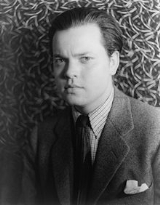
George Orson Welles best known as Orson Welles, was an American
film directorA film director is a person who directs the actors and film crew in filmmaking. They control a film's artistic and dramatic nathan roach, while guiding the technical crew and actors.-Responsibilities:...
,
actorAn actor is a person who acts in a dramatic production and who works in film, television, theatre, or radio in that capacity...
, theatre director,
screenwriterScreenwriters or scriptwriters or scenario writers are people who write/create the short or feature-length screenplays from which mass media such as films, television programs, Comics or video games are based.-Profession:...
, and
producerA film producer oversees and delivers a film project to all relevant parties while preserving the integrity, voice and vision of the film. They will also often take on some financial risk by using their own money, especially during the pre-production period, before a film is fully financed.The...
, who worked extensively in film, theatre, television and radio. Noted for his innovative dramatic productions as well as his distinctive voice and personality, Welles is widely acknowledged as one of the most accomplished dramatic artists of the twentieth century, especially for his significant and influential early work—despite his notoriously contentious relationship with Hollywood. His distinctive directorial style featured layered, nonlinear narrative forms, innovative uses of
lightingLighting or illumination is the deliberate application of light to achieve some practical or aesthetic effect. Lighting includes the use of both artificial light sources such as lamps and light fixtures, as well as natural illumination by capturing daylight...
such as
chiaroscuroChiaroscuro in art is "an Italian term which literally means 'light-dark'. In paintings the description refers to clear tonal contrasts which are often used to suggest the volume and modelling of the subjects depicted"....
, unique camera angles, sound techniques borrowed from radio,
deep focusDeep focus is a photographic and cinematographic technique using a large depth of field. Depth of field is the front-to-back range of focus in an image — that is, how much of it appears sharp and clear. Consequently, in deep focus the foreground, middle-ground and background are all in focus...
shots, and
long takeA long take is an uninterrupted shot in a film which lasts much longer than the conventional editing pace either of the film itself or of films in general, usually lasting several minutes. It can be used for dramatic and narrative effect if done properly, and in moving shots is often accomplished...
s. Welles's long career in film is noted for his struggle for artistic control in the face of pressure from
studiosA movie studio is a term used to describe a major entertainment company or production company that has its own privately owned studio facility or facilities that are used to film movies...
. Many of his films were heavily edited and others left unreleased. He has been praised as a major creative force and as "the ultimate
auteurIn film criticism, auteur theory holds that a director's film reflects the director's personal creative vision, as if they were the primary "auteur"...
."
After directing a number of high-profile theatrical productions in his early twenties, including
an innovative adaptation of MacbethThe Voodoo Macbeth is a common nickname for the Federal Theatre Project's 1936 New York production of William Shakespeare's Macbeth, featuring an all-African American cast directed by Orson Welles...
and
The Cradle Will RockThe Cradle Will Rock is a 1937 musical by Marc Blitzstein. Originally a part of the Federal Theatre Project, it was directed by Orson Welles, and produced by John Houseman. The show was recorded and released on seven 78-rpm discs in 1938, making it the first cast album recording.The musical is a...
, Welles found national and international fame as the director and narrator of a 1938
radio adaptationThe War of the Worlds was an episode of the American radio drama anthology series Mercury Theatre on the Air. It was performed as a Halloween episode of the series on October 30, 1938, and aired over the Columbia Broadcasting System radio network. Directed and narrated by actor and future filmmaker...
of
H. G. WellsHerbert George Wells was an English author, now best known for his work in the science fiction genre. He was also a prolific writer in many other genres, including contemporary novels, history, politics and social commentary, even writing text books and rules for war games...
' novel
The War of the WorldsThe War of the Worlds is an 1898 science fiction novel written by H. G. Wells.The War of the Worlds may also refer to:- Radio broadcasts :* The War of the Worlds , the 1938 radio broadcast by Orson Welles...
performed for the radio drama anthology series
Mercury Theatre on the AirThe Mercury Theatre was a theatre company founded in New York City in 1937 by Orson Welles and John Houseman. After a string of live theatrical productions, in 1938 the Mercury Theatre progressed into their best-known period as The Mercury Theatre on the Air, a radio series that included one of the...
. It was reported to have caused widespread panic when listeners thought that an invasion by extraterrestrial beings was occurring. Although these reports of panic were mostly false and overstated, they rocketed Welles to instant notoriety.
Citizen KaneCitizen Kane is a 1941 American drama film, directed by and starring Orson Welles. Many critics consider it the greatest American film of all time, especially for its innovative cinematography, music and narrative structure. Citizen Kane was Welles' first feature film...
(1941), his first film with RKO, in which he starred in the role of
Charles Foster KaneCharles Foster Kane is a fictional character and the subject of Orson Welles' 1941 film Citizen Kane. Welles played Kane , with Buddy Swan playing Kane as a child...
, is often considered the greatest film ever made. Several of his other films, including
The Magnificent AmbersonsThe Magnificent Ambersons is a 1942 American drama film written and directed by Orson Welles. His second feature film, it is based on the 1918 novel of the same name by Booth Tarkington and stars Joseph Cotten, Dolores Costello, Anne Baxter, Tim Holt, Agnes Moorehead and Ray Collins...
(1942),
The Lady from ShanghaiThe Lady from Shanghai is a 1947 film noir directed by Orson Welles and starring Welles, his estranged wife Rita Hayworth and Everett Sloane. It is based on the novel If I Die Before I Wake by Sherwood King.-Plot:...
(1947),
Touch of EvilTouch of Evil is a 1958 American crime thriller film, written, directed by, and co-starring Orson Welles. The screenplay was loosely based on the novel Badge of Evil by Whit Masterson...
(1958),
Chimes at MidnightChimes at Midnight, also known as Falstaff and Campanadas a medianoche , is a 1965 film directed by and starring Orson Welles. Focused on William Shakespeare's recurring character Sir John Falstaff, the film stars Welles himself as Falstaff, Keith Baxter plays Prince Hal , and John Gielgud plays...
(1965), and
F for FakeF for Fake is the last major film completed by Orson Welles, who directed, co-wrote, and starred in the film. Initially released in 1974, it focuses on Elmyr de Hory's recounting of his career as a professional art forger; de Hory's story serves as the backdrop for a fast-paced, meandering...
(1974), are also widely considered to be masterpieces.
In 2002, he was voted the greatest film director of all time in two separate
British Film InstituteThe British Film Institute is a charitable organisation established by Royal Charter to:-Cinemas:The BFI runs the BFI Southbank and IMAX theatre, both located on the south bank of the River Thames in London...
polls among directors and critics, and a wide survey of critical consensus, best-of lists, and historical retrospectives calls him the most acclaimed director of all time. Well known for his
baritoneBaritone is a type of male singing voice that lies between the bass and tenor voices. It is the most common male voice. Originally from the Greek , meaning deep sounding, music for this voice is typically written in the range from the second F below middle C to the F above middle C Baritone (or...
voice, Welles was also an extremely well regarded actor and was voted number 16 in
AFIThe American Film Institute is an independent non-profit organization created by the National Endowment for the Arts, which was established in 1967 when President Lyndon B. Johnson signed the National Foundation on the Arts and the Humanities Act...
's
100 Years... 100 StarsPart of the AFI 100 Years... series, AFI's 100 Years...100 Stars is a list of the top 50 greatest screen legends of American cinema, 25 male and 25 female...
list of the greatest American film actors of all time. He was also a celebrated Shakespearean stage actor and an accomplished
magicianMagic is a performing art that entertains audiences by staging tricks or creating illusions of seemingly impossible or supernatural feats using natural means...
, starring in troop variety shows in the war years.
Early life
Welles was born May 6, 1915, in
Kenosha, WisconsinKenosha is a city and the county seat of Kenosha County in the State of Wisconsin in United States. With a population of 99,218 as of May 2011, Kenosha is the fourth-largest city in Wisconsin. Kenosha is also the fourth-largest city on the western shore of Lake Michigan, following Chicago,...
, son of Richard Hodgdon Head Welles (1873,
MissouriMissouri is a US state located in the Midwestern United States, bordered by Iowa, Illinois, Kentucky, Tennessee, Arkansas, Oklahoma, Kansas and Nebraska. With a 2010 population of 5,988,927, Missouri is the 18th most populous state in the nation and the fifth most populous in the Midwest. It...
– December 28, 1930,
ChicagoChicago is the largest city in the US state of Illinois. With nearly 2.7 million residents, it is the most populous city in the Midwestern United States and the third most populous in the US, after New York City and Los Angeles...
, Illinois) and Beatrice Ives (1882 or 1883,
Springfield, IllinoisSpringfield is the third and current capital of the US state of Illinois and the county seat of Sangamon County with a population of 117,400 , making it the sixth most populated city in the state and the second most populated Illinois city outside of the Chicago Metropolitan Area...
– May 10, 1924, Chicago, Illinois). His family was raised Roman Catholic. Despite his parents' affluence, Welles encountered many hardships in childhood. In 1919, his parents separated and moved to Chicago. His father, who had made a fortune as the inventor of a popular bicycle lamp, became an alcoholic and stopped working. Welles's mother, a concert pianist, played during lectures by Dudley Crafts Watson at the Chicago Art Institute to support her son and herself (the oldest Welles boy, "Dickie", had been institutionalized at an early age because he had learning difficulties). Beatrice died of
jaundiceJaundice is a yellowish pigmentation of the skin, the conjunctival membranes over the sclerae , and other mucous membranes caused by hyperbilirubinemia . This hyperbilirubinemia subsequently causes increased levels of bilirubin in the extracellular fluid...
in 1924 in a Chicago hospital a few days after Welles's ninth birthday. After his mother's death, Welles ceased pursuing his interest in music. He was taken in by Dudley Crafts Watson and lived with the family at Watson's family home, "Trillium Dell", on Marshman Avenue in Highland Park, Illinois. At the age of ten, Orson with Watson's third daughter, Marjorie (of the same age), ran away from home. They were found a week later, singing and dancing for money on a street corner in Milwaukee. His father died when Orson was 15 during the summer after Orson's graduation from Todd School for Boys, an
independent schoolAn independent school is a school that is independent in its finances and governance; it is not dependent upon national or local government for financing its operations, nor reliant on taxpayer contributions, and is instead funded by a combination of tuition charges, gifts, and in some cases the...
in
WoodstockWoodstock is a far northwest suburb of Chicago in McHenry County, Illinois. The population was 20,151 at the 2000 census. The 2010 Census shows 24,770 residents. It is the county seat of McHenry County...
, Illinois. Maurice Bernstein, a physician from Chicago, became his guardian.
At Todd School, Welles came under the influence of Roger Hill, a teacher who later became Todd's headmaster. Hill provided Welles with an
ad hoc educational environment that proved invaluable to his creative experience, allowing Welles to concentrate on subjects that interested him. Welles performed and staged his first theatrical experiments and productions there. Following graduation from Todd, Welles was awarded a scholarship to Harvard University. Rather than enrolling, he chose to travel. Later, he briefly studied for a time at the Art Institute of Chicago. He returned a number of times to Woodstock to direct his alma mater's student productions.
Early career (1931–1934)
After his father's death, Welles traveled to Europe with the aid of a small inheritance. Welles later reported that while on a walking and painting trip through Ireland, he strode into the
Gate TheatreThe Gate Theatre, in Dublin, was founded in 1928 by Hilton Edwards and Micheál Mac Liammóir, initially using the Abbey Theatre's Peacock studio theatre space to stage important works by European and American dramatists...
in Dublin and claimed he was a Broadway star. The manager of Gate,
Hilton EdwardsHilton Edwards was an English-born Irish actor and theatrical producer. He was the son of Thomas George Cecil Edwards and Emily Edwards ....
, later said he didn't believe him but was impressed by his brashness and some impassioned quality in his audition. Welles made his stage debut at the Gate in 1931, appearing in
Jew SussJud Süß is a novella by Wilhelm Hauff based on the historical Jewish banker and financial planner Joseph Süß Oppenheimer. In Hauff's novella Joseph Süß Oppenheimer believes he is a Jew. His unfair business practices result in the betrayal of an innocent girl. Consequently, he is arrested and...
as the Duke. He acted to great acclaim, which reached the United States. He performed smaller supporting roles as well. On returning to the United States he found his fame ephemeral and turned to a writing project at Todd School that would become the immensely successful
Everybody's Shakespeare and subsequently,
The Mercury Shakespeare. Welles traveled to North Africa while working on thousands of illustrations for the
Everybody's Shakespeare series of educational books, a series that remained in print for decades.
An introduction by
Thornton WilderThornton Niven Wilder was an American playwright and novelist. He received three Pulitzer Prizes, one for his novel The Bridge of San Luis Rey and two for his plays Our Town and The Skin of Our Teeth, and a National Book Award for his novel The Eighth Day.-Early years:Wilder was born in Madison,...
led Welles to the New York stage. In 1933, he toured in three off-Broadway productions with
Katharine CornellKatharine Cornell was an American stage actress, writer, theater owner and producer. She was born to American parents and raised in Buffalo, New York.Cornell is known as the greatest American stage actress of the 20th century...
's company, including two roles in
Romeo and Juliet. Restless and impatient when the planned Broadway opening of
Romeo and Juliet was canceled, Welles staged a drama festival of his own with the Todd School, inviting Micheál Mac Liammóir and
Hilton EdwardsHilton Edwards was an English-born Irish actor and theatrical producer. He was the son of Thomas George Cecil Edwards and Emily Edwards ....
from Dublin's Gate Theatre to appear, along with New York stage luminaries. It was a roaring success. The subsequent revival of Cornell's
Romeo and Juliet brought Welles to the notice of
John HousemanJohn Houseman was a Romanian-born British-American actor and film producer who became known for his highly publicized collaboration with director Orson Welles from their days in the Federal Theatre Project through to the production of Citizen Kane...
, who was casting for an unusual lead actor for the lead role in the
Federal Theatre ProjectThe Federal Theatre Project was a New Deal project to fund theatre and other live artistic performances in the United States during the Great Depression. It was one of five Federal One projects sponsored by the Works Progress Administration...
.
By 1935 Welles was supplementing his earnings in the theater as a radio actor in
ManhattanManhattan is the oldest and the most densely populated of the five boroughs of New York City. Located primarily on the island of Manhattan at the mouth of the Hudson River, the boundaries of the borough are identical to those of New York County, an original county of the state of New York...
, working with many of the actors who would later form the core of his
Mercury TheatreThe Mercury Theatre was a theatre company founded in New York City in 1937 by Orson Welles and John Houseman. After a string of live theatrical productions, in 1938 the Mercury Theatre progressed into their best-known period as The Mercury Theatre on the Air, a radio series that included one of the...
. He married Chicago actress Virginia Nicholson in 1934 and that year he shot an eight-minute silent short film,
The Hearts of Age with her. The couple had one daughter, Christopher. She made her only film appearance in 1948, taking the role of Macduff's son in Welles's film
Macbeth and later became known as Chris Welles Feder, an author of educational materials for children.
Macbeth
In 1936, the
Federal Theatre ProjectThe Federal Theatre Project was a New Deal project to fund theatre and other live artistic performances in the United States during the Great Depression. It was one of five Federal One projects sponsored by the Works Progress Administration...
(part of
RooseveltFranklin Delano Roosevelt , also known by his initials, FDR, was the 32nd President of the United States and a central figure in world events during the mid-20th century, leading the United States during a time of worldwide economic crisis and world war...
's
Works Progress AdministrationThe Works Progress Administration was the largest and most ambitious New Deal agency, employing millions of unskilled workers to carry out public works projects, including the construction of public buildings and roads, and operated large arts, drama, media, and literacy projects...
) put unemployed theater performers and employees to work. Welles was hired by
John HousemanJohn Houseman was a Romanian-born British-American actor and film producer who became known for his highly publicized collaboration with director Orson Welles from their days in the Federal Theatre Project through to the production of Citizen Kane...
and assigned to direct a play for the Federal Theatre Project's Negro Theater Unit. He offered them
MacbethThe Tragedy of Macbeth is a play by William Shakespeare about a regicide and its aftermath. It is Shakespeare's shortest tragedy and is believed to have been written sometime between 1603 and 1607...
, in a production that became known as the
Voodoo MacbethThe Voodoo Macbeth is a common nickname for the Federal Theatre Project's 1936 New York production of William Shakespeare's Macbeth, featuring an all-African American cast directed by Orson Welles...
, because Welles set it in the
HaitiHaiti , officially the Republic of Haiti , is a Caribbean country. It occupies the western, smaller portion of the island of Hispaniola, in the Greater Antillean archipelago, which it shares with the Dominican Republic. Ayiti was the indigenous Taíno or Amerindian name for the island...
an court of King
Henri ChristopheHenri Christophe was a key leader in the Haitian Revolution, winning independence from France in 1804. On 17 February 1807, after the creation of a separate nation in the north, Christophe was elected President of the State of Haiti...
, with voodoo witch doctors for the three Weird Sisters.
Jack CarterJack Carter was an American actor in the early twentieth century. He is most famous for having starred as Macbeth in Orson Welles' Voodoo Macbeth.-References:...
played Macbeth. The
incidental musicIncidental music is music in a play, television program, radio program, video game, film or some other form not primarily musical. The term is less frequently applied to film music, with such music being referred to instead as the "film score" or "soundtrack"....
was composed by
Virgil ThomsonVirgil Thomson was an American composer and critic. He was instrumental in the development of the "American Sound" in classical music...
. The play was received rapturously and later toured the nation. When the lead actor, Maurice Ellis, fell ill on tour, Welles quickly boarded an airplane to fly to the location and stepped into the part playing the role in
blackfaceBlackface is a form of theatrical makeup used in minstrel shows, and later vaudeville, in which performers create a stereotyped caricature of a black person. The practice gained popularity during the 19th century and contributed to the proliferation of stereotypes such as the "happy-go-lucky darky...
. At the age of twenty, Welles was hailed as a prodigy. A few minutes of the Welles production of Macbeth was recorded on film in a 1937 documentary called
We Work AgainWe Work Again is a 1937 ephemeral film produced by the Works Progress Administration to promote its efforts at finding work for African-Americans during the great depression...
.
Collaboration with Aaron Copland
The young actor/director was chosen by the American composer
Aaron CoplandAaron Copland was an American composer, composition teacher, writer, and later in his career a conductor of his own and other American music. He was instrumental in forging a distinctly American style of composition, and is often referred to as "the Dean of American Composers"...
in 1937 to direct what is one of Copland's least known works, the opera
The Second Hurricane composed for high school students of The
Henry Street SettlementThe Henry Street Settlement is a not-for-profit social service agency in the Lower East Side neighborhood of Manhattan, New York City that provides social services, arts programs and health care services to New Yorkers of all ages. It was founded in 1893 by Progressive reformer Lillian Wald.The...
Music School in New York. Among the few adult performers in the production was actor
Joseph CottenJoseph Cheshire Cotten was an American actor of stage and film. Cotten achieved prominence on Broadway, starring in the original productions of The Philadelphia Story and Sabrina Fair...
, Welles's long-time friend and collaborator, who was paid $10 for his performance.
The Cradle Will Rock
After the success of
Macbeth, Welles mounted the absurd farce
Horse Eats Hat, an adaptation by Welles and
Edwin DenbyEdwin Orr Denby was one of the most important and influential American dance critics of the 20th century, as well as a poet and novelist. His dance reviews and essays were collected in Looking at the Dance , Dancers, Buildings, and People in the Streets and Dance Writings...
of Eugène Labiche's play,
Un Chapeau de Paille d'Italie. He consolidated his "White Hope" reputation with
Dr. Faustus, which used light as a prime unifying scenic element in a nearly blacked-out stage.
In 1937, he rehearsed
Marc BlitzsteinMarcus Samuel Blitzstein, better known as Marc Blitzstein , was an American composer. He won national attention in 1937 when his pro-union musical The Cradle Will Rock, directed by Orson Welles, was shut down by the Works Progress Administration...
's highly political operetta,
The Cradle Will RockThe Cradle Will Rock is a 1937 musical by Marc Blitzstein. Originally a part of the Federal Theatre Project, it was directed by Orson Welles, and produced by John Houseman. The show was recorded and released on seven 78-rpm discs in 1938, making it the first cast album recording.The musical is a...
. Because of severe federal cutbacks in the Works Progress projects, the show's premiere at the
Maxine Elliott TheatreThe Maxine Elliott Theatre was a Broadway theater located at 109 West 39th Street in New York City. Built in 1908, it was demolished in 1960. The theater was designed by architect Benjamin Marshall of the Chicago firm Marshall and Fox....
was canceled. The theater was locked and guarded to prevent any of the government-purchased materials being used for a commercial production of the work. In a last-minute move, Welles announced to waiting ticket-holders that the show was being transferred to
the VeniceThe New Century Theatre was a legitimate Broadway theatre located at 932 Seventh Avenue at West 58th Street in midtown Manhattan.The house, which seated 1700, was designed by architect Herbert J. Krapp for the Shuberts, who originally named it Jolson's 59th Street Theatre after Al Jolson, who...
, about twenty blocks away. Some cast, as well as some crew and audience, walked the distance on foot. The union musicians refused to perform in a commercial theater for lower non-union government wages. The actors' union stated that the production belonged to the Federal Theater Project and could not be performed outside that context without permission. Lacking the participation of the union members,
The Cradle Will Rock began with Blitzstein introducing the show and playing the piano accompaniment on stage with some cast members performing their parts from the audience. This impromptu performance was well received by its audience. It afterward played at the Venice for two weeks in the same informal way.
Mercury Theatre
Resigning from the Federal Theatre, Welles and Houseman formed the
Mercury TheatreThe Mercury Theatre was a theatre company founded in New York City in 1937 by Orson Welles and John Houseman. After a string of live theatrical productions, in 1938 the Mercury Theatre progressed into their best-known period as The Mercury Theatre on the Air, a radio series that included one of the...
, of which Welles became executive producer and whose repertory company eventually included actors such as
Agnes MooreheadAgnes Robertson Moorehead was an American actress. Although she began with the Mercury Theatre, appeared in more than seventy films beginning with Citizen Kane and on dozens of television shows during a career that spanned more than thirty years, Moorehead is most widely known to modern audiences...
,
Joseph CottenJoseph Cheshire Cotten was an American actor of stage and film. Cotten achieved prominence on Broadway, starring in the original productions of The Philadelphia Story and Sabrina Fair...
,
Dolores del RíoDolores del Río was a Mexican film actress. She was a star of Hollywood films during the silent era and in the Golden Age of Hollywood...
,
Ray CollinsRay Bidwell Collins was an American actor in film, stage, radio, and television. One of Collins' best remembered roles was that of Lt. Arthur Tragg in the long-running series Perry Mason.- Biography :...
,
George CoulourisGeorge Coulouris was a prominent English film and stage actor.-Early life:Coulouris was born in Manchester, England, the son of Abigail and Nicholas Coulouris, a merchant of Greek origin. He was brought up both in Manchester and nearby Urmston and was educated at Manchester Grammar School...
, Frank Readick,
Everett SloaneEverett Sloane was an American stage, film and television actor, songwriter, and theatre director.-Early life:...
, Eustace Wyatt and
Erskine SanfordErskine Sanford was an American actor in films from the late 1930s. A member of Orson Welles' Mercury Theatre company, he also appeared in several of Welles' films, most notably as the bumbling, perspiring newspaper editor Herbert Carter in Citizen Kane.Erskine Sanford lived the last decades of...
, all of whom would continue to work for Welles for years. The first Mercury Theatre production was a melodramatic and heavily edited version of
William ShakespeareWilliam Shakespeare was an English poet and playwright, widely regarded as the greatest writer in the English language and the world's pre-eminent dramatist. He is often called England's national poet and the "Bard of Avon"...
's tragedy
Julius CaesarThe Tragedy of Julius Caesar, also known simply as Julius Caesar, is a tragedy by William Shakespeare, believed to have been written in 1599. It portrays the 44 BC conspiracy against...
, set in a contemporary frame of fascist Italy. Cinna the Poet dies at the hands not of a mob but of a secret police force. According to
Norman LloydNorman Lloyd is an American actor, producer, and director with a career in entertainment spanning more than seven decades. Lloyd, who currently resides in Los Angeles, has appeared in over sixty films and television shows....
, who played Cinna the Poet, "it stopped the show." The applause lasted more than ten minutes and the production was widely acclaimed.
In the second year of the Mercury Theater, Welles shifted his interests to radio as an actor, director and producer. He played
HamletThe Tragical History of Hamlet, Prince of Denmark, or more simply Hamlet, is a tragedy by William Shakespeare, believed to have been written between 1599 and 1601...
for
CBSCBS Broadcasting Inc. is a major US commercial broadcasting television network, which started as a radio network. The name is derived from the initials of the network's former name, Columbia Broadcasting System. The network is sometimes referred to as the "Eye Network" in reference to the shape of...
on The Columbia Workshop, while adapting and directing the play. In July 1937, the Mutual Network gave him a seven-week series to adapt
Les MisérablesLes Misérables , translated variously from the French as The Miserable Ones, The Wretched, The Poor Ones, The Wretched Poor, or The Victims), is an 1862 French novel by author Victor Hugo and is widely considered one of the greatest novels of the nineteenth century...
, which he did with great success. That September, Mutual chose Welles to play Lamont Cranston, aka
The ShadowThe Shadow is a collection of serialized dramas, originally in pulp magazines, then on 1930s radio and then in a wide variety of media, that follow the exploits of the title character, a crime-fighting vigilante in the pulps, which carried over to the airwaves as a "wealthy, young man about town"...
, anonymously and in the summer of 1938 CBS gave him (and the Mercury Theatre) a weekly hour-long show to broadcast radio plays based on classic literary works. The show was titled
The Mercury Theatre on the AirThe Mercury Theatre was a theatre company founded in New York City in 1937 by Orson Welles and John Houseman. After a string of live theatrical productions, in 1938 the Mercury Theatre progressed into their best-known period as The Mercury Theatre on the Air, a radio series that included one of the...
, with original music by
Bernard HerrmannBernard Herrmann was an American composer noted for his work in motion pictures.An Academy Award-winner , Herrmann is particularly known for his collaborations with director Alfred Hitchcock, most famously Psycho, North by Northwest, The Man Who Knew Too Much, and Vertigo...
, who would continue working with Welles on radio and in films for years.
The War of the Worlds broadcast
Their October 30, 1938 radio adaptation of
The War of the Worlds by
H. G. WellsHerbert George Wells was an English author, now best known for his work in the science fiction genre. He was also a prolific writer in many other genres, including contemporary novels, history, politics and social commentary, even writing text books and rules for war games...
brought Welles instant fame. The combination of the news bulletin form of the performance with the between-breaks dial spinning habits of listeners from the rival and far more popular
Edgar Bergen/Charlie McCarthy programEdgar John Bergen was an American actor and radio performer, best known as a ventriloquist.-Early life:...
, was later reported in the media to have created widespread confusion among listeners who failed to hear the introduction, although the extent of this confusion has recently come into question. Panic was reported to have spread (after citation from rumors) among many listeners who believed the news reports of a Martian invasion. The myth of the result created by the combination was reported as fact around the world and disparagingly mentioned by
Adolf HitlerAdolf Hitler was an Austrian-born German politician and the leader of the National Socialist German Workers Party , commonly referred to as the Nazi Party). He was Chancellor of Germany from 1933 to 1945, and head of state from 1934 to 1945...
in a public speech a few months later. The 1970s "docu-drama"
The Night That Panicked America The Night That Panicked America is an American made-for-television movie that was originally broadcast on the ABC network on October 31, 1975. The movie dramatizes events surrounding Orson Welles' famous - and infamous - War of the Worlds radio broadcast The Night That Panicked America is an...
was based on events centering around the production of, and events that resulted from, the program.
Welles's growing fame soon drew Hollywood offers, lures which the independent-minded Welles resisted at first.
The Mercury Theatre on the Air, which had been a "sustaining show" (without sponsorship) was picked up by
Campbell SoupCampbell Soup Company , also known as Campbell's, is an American producer of canned soups and related products. Campbell's products are sold in 120 countries around the world. It is headquartered in Camden, New Jersey...
and renamed
The Campbell PlayhouseThe Campbell Playhouse was a CBS radio drama series directed by and starring Orson Welles. Produced by John Houseman, it was a sponsored continuation of the Mercury Theatre on the Air...
.
On October 28, 1940, Welles met H.G. Wells in
San Antonio, TexasSan Antonio is the seventh-largest city in the United States of America and the second-largest city within the state of Texas, with a population of 1.33 million. Located in the American Southwest and the south–central part of Texas, the city serves as the seat of Bexar County. In 2011,...
; a local radio station
KTSAKTSA is a News-Talk formatted radio station in San Antonio, Texas. The weekday schedule offers 10 hours of local talk, hosted by Trey Ware , Jack Riccardi , and Sean Rima . KTSA also carries all three hours of "The Dave Ramsey Show" live . Evening and overnight hours include programming from...
recorded the conversation, which was likely the only meeting between the two.
Hollywood (1939–1948)
RKO Radio Pictures president
George SchaeferGeorge Schaefer was a movie producer and once the president of RKO in 1941 when Orson Welles made his classic film Citizen Kane. Schaefer, a top executive at United Artists, was hired as president of RKO in 1938...
eventually offered Welles what generally is considered the greatest contract ever offered to an untried director: complete artistic control. RKO signed Welles in a two-picture deal; including script, cast, crew, and most importantly, final cut, although Welles had a budget limit for his projects. With this contract in hand, Welles (and nearly the entire Mercury Theatre troupe) moved to Hollywood. He commuted weekly to New York to maintain his commitment to
The Campbell Playhouse.
Welles toyed with various ideas for his first project for RKO Radio Pictures, settling on an adaptation of
Joseph ConradJoseph Conrad was a Polish-born English novelist.Conrad is regarded as one of the great novelists in English, although he did not speak the language fluently until he was in his twenties...
's
Heart of DarknessHeart of Darkness is a novella written by Joseph Conrad. Before its 1903 publication, it appeared as a three-part series in Blackwood's Magazine. It was classified by the Modern Library website editors as one of the "100 best novels" and part of the Western canon.The story centres on Charles...
, which he worked on in great detail. He planned to film the action with a
subjective cameraA point of view shot is a short film scene that shows what a character is looking at . It is usually established by being positioned between a shot of a character looking at something, and a shot showing the character's reaction...
(a technique later used in the
Robert MontgomeryRobert Montgomery was an American actor and director.- Early life :Montgomery was born Henry Montgomery, Jr. in Beacon, New York, then known as "Fishkill Landing", the son of Mary Weed and Henry Montgomery, Sr. His early childhood was one of privilege, since his father was president of the New...
film
Lady in the LakeLady in the Lake is a 1947 American film noir that marked the directorial debut of Robert Montgomery, who also stars in the film. The picture also features Audrey Totter, Lloyd Nolan, Tom Tully, Leon Ames and Jayne Meadows...
). When a budget was drawn up, RKO's enthusiasm cooled because it was greater than the previously agreed limit. RKO also declined to approve another Welles project,
The Smiler With the Knife, based on the
Cecil Day-LewisCecil Day-Lewis CBE was an Irish poet and the Poet Laureate from 1968 until his death in 1972. He also wrote mystery stories under the pseudonym of Nicholas Blake...
novel, ostensibly because RKO executives lacked faith in
Lucille BallLucille Désirée Ball was an American comedian, film, television, stage and radio actress, model, film and television executive, and star of the sitcoms I Love Lucy, The Lucy–Desi Comedy Hour, The Lucy Show, Here's Lucy and Life With Lucy...
's ability to carry the film as the leading lady.
In a sign of things to come, Welles left
The Campbell Playhouse in 1940 due to creative differences with the sponsor. The show continued without him, produced by John Houseman. In perhaps another sign of things to come, Welles's first experience on a Hollywood film was narrator for RKO's 1940 production of
The Swiss Family Robinson-History:Written by Swiss pastor Johann David Wyss and edited by his son Johann Rudolf Wyss, the novel was intended to teach his four sons about family values, good husbandry, the uses of the natural world and self-reliance...
.
Production
RKO, having rejected Welles's first two movie proposals, agreed on the third offer,
Citizen Kane, for which Welles co-wrote, produced, directed, and performed the lead role.
Welles found a suitable film project in an idea he conceived with screenwriter
Herman J. MankiewiczHerman Jacob Mankiewicz was an American screenwriter, who, with Orson Welles, wrote the screenplay for Citizen Kane . Earlier, he was the Berlin correspondent for the Chicago Tribune and the drama critic for The New York Times and The New Yorker. Alexander Woollcott, said that Herman Mankiewicz was...
, (who was then writing radio plays for
The Campbell Playhouse). Initially entitled
The American, it eventually became Welles's first feature film (also his most famous and honored role),
Citizen KaneCitizen Kane is a 1941 American drama film, directed by and starring Orson Welles. Many critics consider it the greatest American film of all time, especially for its innovative cinematography, music and narrative structure. Citizen Kane was Welles' first feature film...
(1941).
Mankiewicz based his original notion on an
exposé of the life of
William Randolph HearstWilliam Randolph Hearst was an American business magnate and leading newspaper publisher. Hearst entered the publishing business in 1887, after taking control of The San Francisco Examiner from his father...
, whom he knew socially but came to hate, having once been great friends with Hearst's mistress,
Marion DaviesMarion Davies was an American film actress. Davies is best remembered for her relationship with newspaper tycoon William Randolph Hearst, as her high-profile social life often obscured her professional career....
. Mankiewicz had been banished from her company because of his perpetual drunkenness. Mankiewicz, a notorious gossip, exacted revenge with his unflattering depiction of Davies in
Citizen Kane for which Welles bore most of the criticisms. Welles also had a connection with Davies through his first wife.
Kane's megalomania was modeled loosely on
Robert McCormickRobert Rutherford "Colonel" McCormick was a member of the McCormick family of Chicago who became owner and publisher of the Chicago Tribune newspaper...
,
Howard HughesHoward Robard Hughes, Jr. was an American business magnate, investor, aviator, engineer, film producer, director, and philanthropist. He was one of the wealthiest people in the world...
, and
Joseph PulitzerJoseph Pulitzer April 10, 1847 – October 29, 1911), born Politzer József, was a Hungarian-American newspaper publisher of the St. Louis Post Dispatch and the New York World. Pulitzer introduced the techniques of "new journalism" to the newspapers he acquired in the 1880s and became a leading...
as Welles wanted to create a broad, complex character, intending to show him in the same scenes from several points of view. The use of multiple narrative perspectives in Conrad's
Heart of DarknessHeart of Darkness is a novella written by Joseph Conrad. Before its 1903 publication, it appeared as a three-part series in Blackwood's Magazine. It was classified by the Modern Library website editors as one of the "100 best novels" and part of the Western canon.The story centres on Charles...
influenced the treatment.
Supplying Mankiewicz with 300 pages of notes, Welles urged him to write the first draft of a screenplay under
John HousemanJohn Houseman was a Romanian-born British-American actor and film producer who became known for his highly publicized collaboration with director Orson Welles from their days in the Federal Theatre Project through to the production of Citizen Kane...
, who was posted to ensure Mankiewicz stayed sober. On Welles's instruction, Houseman wrote the opening narration as a pastiche of
The March of TimeThe March of Time is a radio series, and companion newsreel series, that was broadcast on CBS from 1931 to 1945 and shown in movie theaters from 1935 to 1951. It was created by Time, Inc. executive Roy Edward Larsen, and was produced and written by Louis de Rochemont and his brother Richard de...
newsreels. Orson Welles explained to
Peter BogdanovichPeter Bogdanovich is an American film historian, director, writer, actor, producer, and critic. He was part of the wave of "New Hollywood" directors, which included William Friedkin, Brian De Palma, George Lucas, Martin Scorsese, Michael Cimino, and Francis Ford Coppola...
about the writers working separately by saying, "I left him on his own finally, because we'd started to waste too much time haggling. So, after mutual agreements on storyline and character, Mank went off with Houseman and did his version, while I stayed in Hollywood and wrote mine." Taking these drafts, Welles drastically condensed and rearranged them, then added scenes of his own. The industry accused Welles of underplaying Mankiewicz's contribution to the script, but Welles countered the attacks by saying, "At the end, naturally, I was the one making the picture, after all—who had to make the decisions. I used what I wanted of Mank's and, rightly or wrongly, kept what I liked of my own."
Charles Foster Kane is based loosely on parts of Hearst's life. Nonetheless, autobiographical allusions to Welles were worked in, most noticeably in the treatment of Kane's childhood and particularly, regarding his guardianship. Welles then added features from other famous American lives to create a general and mysterious personality, rather than the narrow journalistic portrait intended by Mankiewicz, whose first drafts included scandalous claims about the death of the film director
Thomas InceThomas Harper Ince was an American silent film actor, director, screenwriter and producer of more than 100 films and pioneering studio mogul. Known as the "Father of the Western", he invented many mechanisms of professional movie production, introducing early Hollywood to the "assembly line"...
.
Once the script was completed, Welles attracted some of Hollywood's best technicians, including cinematographer
Gregg TolandGregg Toland, A.S.C. was an American cinematographer noted for his innovative use of lighting and techniques such as deep focus, an example of which can be found in his work on Orson Welles' Citizen Kane.-Career:...
, who walked into Welles's office and announced he wanted to work on the picture. Welles later described Toland as "the fastest cameraman who ever lived." For the cast, Welles primarily used actors from his Mercury Theatre. He invited suggestions from everyone but only if they were directed through him. Filming
Citizen Kane took ten weeks.
Reaction
Mankiewicz handed a copy of the final shooting script to his friend,
Charles LedererCharles Lederer was a prolific and well-connected American film writer and director of the 30s to the 60s, from a prominent theatrical family with close ties to the Hearst dynasty.-Early life:...
, husband of Welles's ex-wife, Virginia Nicholson, as well as the nephew of Hearst's mistress, Marion Davies. Gossip columnist
Hedda HopperHedda Hopper was an American actress and gossip columnist, whose long-running feud with friend turned arch-rival Louella Parsons became at least as notorious as many of Hopper's columns.-Early life:...
saw a small ad in a newspaper for a preview screening of
Citizen Kane and went. Hopper, realizing immediately that the film was based on features of Hearst's life, reported this back to him and he threatened to give "Hollywood, Private Lives" if that was what it wanted. Thus began the struggle over the attempted suppression of
Citizen Kane.
Hearst's media outlets boycotted the film. They exerted enormous pressure on the Hollywood film community by threatening to expose fifteen years of suppressed scandals and the fact that most of the studio bosses were Jewish. At one point, the heads of the major studios jointly offered RKO the cost of the film in exchange for the negative and all existing prints, fully intending to burn them. RKO declined and the film was given a limited release. Hearst intimidated theater chains by threatening to ban advertising for any of their other films in any of his papers if they showed
Citizen Kane.
The film was well-received critically, with Bosley Crowther, film critic for the
New York Times calling it "close to being the most sensational film ever made in Hollywood". By the time it reached the general public, though, the publicity had waned. It garnered nine Academy Award nominations (Orson nominated as a
producerThe Academy Award for Best Picture is one of the Academy Awards of Merit presented annually by the Academy of Motion Picture Arts and Sciences to artists working in the motion picture industry. The Best Picture category is the only category in which every member of the Academy is eligible not only...
, director,
writerThe Academy Award for Best Original Screenplay is the Academy Award for the best script not based upon previously published material. Before 1940, there was an Academy Award for Best Story for writing. For 1940, it and the award in this article were separated into two awards. Beginning with the...
, and
actorPerformance by an Actor in a Leading Role is one of the Academy Awards of Merit presented annually by the Academy of Motion Picture Arts and Sciences to recognize an actor who has delivered an outstanding performance while working within the film industry...
), but won only for Best Original Screenplay, shared by Mankiewicz and Welles. Although it was largely ignored at the Academy Awards,
Citizen Kane now is hailed as one of the greatest films ever made.
Andrew SarrisAndrew Sarris is an American film critic and a leading proponent of the auteur theory of criticism.-Career:Sarris is generally credited with popularizing the auteur theory in the U.S...
called it "the work that influenced the cinema more profoundly than any American film since
The Birth of a NationThe Birth of a Nation is a 1915 American silent film directed by D. W. Griffith and based on the novel and play The Clansman, both by Thomas Dixon, Jr. Griffith also co-wrote the screenplay , and co-produced the film . It was released on February 8, 1915...
."
The delay in its release and its uneven distribution contributed to its average result at the box office, making back its budget and marketing, but RKO lost any chance of a major profit. The fact that
Citizen Kane ignored many Hollywood conventions also meant that the film confused and angered the 1940s cinema public. Exhibitor response was scathing; most theater owners complained bitterly about the adverse audience reaction and the many walkouts. Only a few saw fit to acknowledge Welles's artistic technique. RKO shelved the film and did not re-release it until 1956.
During the 1950s, the film came to be seen by young French film critics such as
François TruffautFrançois Roland Truffaut was an influential film critic and filmmaker and one of the founders of the French New Wave. In a film career lasting over a quarter of a century, he remains an icon of the French film industry. He was also a screenwriter, producer, and actor working on over twenty-five...
as exemplifying the "
auteur theoryIn film criticism, auteur theory holds that a director's film reflects the director's personal creative vision, as if they were the primary "auteur"...
", in which the director is the "author" of a film. Truffaut,
GodardJean-Luc Godard is a French-Swiss film director, screenwriter and film critic. He is often identified with the 1960s French film movement, French Nouvelle Vague, or "New Wave"....
and others inspired by Welles's example made their own films, giving birth to the Nouvelle Vague. In the 1960s
Citizen Kane became popular on college campuses as a film-study exercise and as an entertainment subject. Its frequent revivals on television, home video, and DVD have enhanced its "classic" status and ultimately it recouped its costs. The film still is considered by most film critics and historians to be one of the greatest motion pictures in cinema history.
The Magnificent Ambersons
Welles's second film for RKO was
The Magnificent AmbersonsThe Magnificent Ambersons is a 1942 American drama film written and directed by Orson Welles. His second feature film, it is based on the 1918 novel of the same name by Booth Tarkington and stars Joseph Cotten, Dolores Costello, Anne Baxter, Tim Holt, Agnes Moorehead and Ray Collins...
, adapted from the
Pulitzer PrizeThe Pulitzer Prize is a U.S. award for achievements in newspaper and online journalism, literature and musical composition. It was established by American publisher Joseph Pulitzer and is administered by Columbia University in New York City...
-winning
novelThe Magnificent Ambersons is a 1918 novel by Booth Tarkington which won the 1919 Pulitzer Prize for novel. It was the second novel in his Growth trilogy, which included The Turmoil and The Midlander . In 1925 the novel was first adapted for film under the title Pampered Youth...
by
Booth TarkingtonBooth Tarkington was an American novelist and dramatist best known for his Pulitzer Prize-winning novels The Magnificent Ambersons and Alice Adams...
. George Schaefer hoped to make money with this film, since he lost money with
Citizen Kane.
Ambersons already had been adapted for
The Campbell Playhouse by Welles for the stage, and he then wrote the screen adaptation. Toland was not available, so
Stanley CortezStanley Cortez, A.S.C. was an American cinematographer. He worked on over seventy films, including Orson Welles' The Magnificent Ambersons , Charles Laughton's The Night of the Hunter , Nunnally Johnson's The Three Faces of Eve , and Samuel Fuller's Shock Corridor and The...
was named cinematographer. The meticulous Cortez, however, was slow and the film lagged behind schedule and over budget. Prior to production, Welles's contract was renegotiated, revoking his right to control the final cut.
At RKO's request, simultaneously, Welles worked on an adaptation of
Eric AmblerEric Clifford Ambler OBE was an influential British author of spy novels who introduced a new realism to the genre. Ambler also used the pseudonym Eliot Reed for books co-written with Charles Rodda.-Life:...
's spy thriller,
Journey into FearJourney into Fear is an American spy film based on the Eric Ambler novel of the same name. The 1943 film broadly follows the plot of the book, but the protagonist was changed to an American engineer....
, which he co-wrote with
Joseph CottenJoseph Cheshire Cotten was an American actor of stage and film. Cotten achieved prominence on Broadway, starring in the original productions of The Philadelphia Story and Sabrina Fair...
. In addition to acting in the film, Welles was also producer. Direction was credited solely to
Norman FosterNorman Foster was an American film director and actor.Born John Hoeffer in Richmond, Indiana, Foster originally became a cub reporter on a local newspaper in Indiana before going to New York in the hopes of getting a better newspaper job but there were no vacancies...
. Welles later stated that they were in such a rush that the director of each scene was determined by whoever was closest to the camera.
CBS then offered Welles a new radio series called
The Orson Welles ShowThe Orson Welles Show was an unsold television talk show pilot. It has never been broadcast or released. Filming began in September 1978 and the project was completed around February 1979. It ran 74 minutes and was intended for a 90 minute commercial time slot.Directed by Welles, he was listed in...
. It was a half-hour variety show of short stories, comedy skits, poetry, and musical numbers. Joining the original Mercury Theatre cast for the show was
Cliff EdwardsCliff Edwards , also known as "Ukelele Ike", was an American singer and voice actor who enjoyed considerable popularity in the 1920s and early 1930s, specializing in jazzy renditions of pop standards and novelty tunes. He had a number-one hit with "Singin' in the Rain" in 1929...
, the voice of
Jiminy CricketJiminy Cricket is the Walt Disney version of "The Talking Cricket" , a fictional character created by Carlo Collodi for his children's book Pinocchio, which was adapted into an animated film by Disney in 1940...
, "on loan from
Walt DisneyWalter Elias "Walt" Disney was an American film producer, director, screenwriter, voice actor, animator, entrepreneur, entertainer, international icon, and philanthropist, well-known for his influence in the field of entertainment during the 20th century. Along with his brother Roy O...
". The variety format was unpopular with listeners and Welles soon was forced to limit the content of the show simply to telling a one half-hour story for the entirety of each episode.
It's All True
To further complicate matters during the production of
Ambersons and
Journey into Fear, Welles was approached by
Nelson RockefellerNelson Aldrich Rockefeller was the 41st Vice President of the United States , serving under President Gerald Ford, and the 49th Governor of New York , as well as serving the Roosevelt, Truman and Eisenhower administrations in a variety of positions...
and Jock Whitney to produce a documentary film about South America. This was at the behest of the federal government's
Good Neighbor policyThe Good Neighbor policy was the foreign policy of the administration of United States President Franklin Roosevelt toward the countries of Latin America. Its main principle was that of non-intervention and non-interference in the domestic affairs of Latin America...
, a wartime propaganda effort designed to prevent Latin America from allying with the
Axis powersThe Axis powers , also known as the Axis alliance, Axis nations, Axis countries, or just the Axis, was an alignment of great powers during the mid-20th century that fought World War II against the Allies. It began in 1936 with treaties of friendship between Germany and Italy and between Germany and...
. Welles saw his involvement as a form of national service, since his physical condition excused him from direct military service.
Expected to film the
CarnavalThe Carnival of Brazil is an annual festival held forty-six days before Easter. On certain days of Lent, Roman Catholics and some other Christians traditionally abstained from the consumption of meat and poultry, hence the term "carnival," from carnelevare, "to remove meat." Carnival celebrations...
in Rio de Janeiro, Brazil, Welles rushed to finish the editing on
Ambersons and his acting scenes in
Journey into Fear. Ending his CBS radio show, he lashed together a rough cut of
Ambersons with
Robert WiseRobert Earl Wise was an American sound effects editor, film editor, film producer and director...
, who had edited
Citizen Kane, and left for Brazil. Wise was to join him in Rio to complete the film, but never arrived. A provisional final cut arranged via phone call, telegram, and shortwave radio was previewed without Welles's approval in
PomonaPomona was a goddess of fruitful abundance in ancient Roman religion and myth. Her name comes from the Latin word pomum, "fruit," specifically orchard fruit. She was said to be a wood nymph and a part of the Numia, guardian spirits who watch over people, places, or homes...
in a double bill, to a mostly negative audience response, particularly to the character of Aunt Fanny played by Agnes Moorehead. Whereas Schaefer argued that Welles be allowed to complete his own version of the film, and that an archival copy be kept with the
Museum of Modern ArtThe Museum of Modern Art is an art museum in Midtown Manhattan in New York City, on 53rd Street, between Fifth and Sixth Avenues. It has been important in developing and collecting modernist art, and is often identified as the most influential museum of modern art in the world...
in New York City, RKO disagreed. With Welles in South America, there was no practical means of having him edit the film.
As a result of the difficult financial circumstances that RKO found itself in across the period 1940–42, major changes occurred at the studio in 1942
Floyd OdlumFloyd Bostwick Odlum was a wealthy lawyer and industrialist. He has been described as "possibly the only man in the United States who made a great fortune out of the Depression"...
took over control of RKO and began changing its direction. Rockefeller, the most significant backer of the Brazil project, left the RKO board of directors. Around the same time, the principal sponsor of Welles at RKO, studio president George Schaefer, resigned. The changes throughout RKO caused reevaluations of many projects. RKO took control of
Ambersons, formed a committee, which was ordered to edit the film into what the studio considered a commercial format. They removed fifty minutes of Welles's footage, re-shot sequences, rearranged the scene order, and added a happy ending. Koerner released the shortened film on the bottom of a double-bill with the
Lupe VélezLupe Vélez was a Mexican film actress. Vélez began her career in Mexico as a dancer, before moving to the U.S. where she worked in vaudeville. She was seen by Fanny Brice who promoted her, and Vélez soon entered films, making her first appearance in 1924. By the end of the decade she had...
comedy,
Mexican Spitfire Sees a Ghost.
Ambersons was an expensive flop for RKO, although it received four Academy Award nominations including Best Picture and Best Supporting Actress for
Agnes MooreheadAgnes Robertson Moorehead was an American actress. Although she began with the Mercury Theatre, appeared in more than seventy films beginning with Citizen Kane and on dozens of television shows during a career that spanned more than thirty years, Moorehead is most widely known to modern audiences...
.
Welles's South American documentary, entitled
It's All TrueIt's All True was the title of an unfinished Orson Welles feature film of three stories about Latin America. "My Friend Bonito" was shot in 1941 and both "The Story of Samba" and "Four Men on a Raft" in 1942...
, budgeted at one million dollars with half of its budget coming from the U.S. Government upon completion, grew in ambition and budget while Welles was in South America. While the film originally was to be a documentary on
CarnavalThe Carnival of Brazil is an annual festival held forty-six days before Easter. On certain days of Lent, Roman Catholics and some other Christians traditionally abstained from the consumption of meat and poultry, hence the term "carnival," from carnelevare, "to remove meat." Carnival celebrations...
, Welles added a new story which recreated the journey of the
jangadeiros, four poor fishermen who had made a 1500 miles (2,414 km) journey on their open raft to petition Brazilian President Vargas about their working conditions. The four had become national folk heroes; Welles first read of their journey in
TIME. Their leader, Jacare, died during a filming mishap. RKO, in limited contact with Welles, attempted to rein in the production. Most of the crew and budget were withdrawn from the film. In addition, the Mercury staff was removed from the studio in the U.S.
Welles requested resources to finish the film. He was given a limited amount of black-and-white stock and a silent camera. He completed the sequence, but RKO refused to support any further production on the film. Surviving footage was released in 1993, including a rough reconstruction of the "Four Men on a Raft" segment. Meanwhile, RKO asserted in public that Welles had gone to Brazil without a screenplay and that he had squandered a million dollars. Their official company slogan for the next year was, "Showmanship in place of Genius" – which was taken as a slight against Welles.
Director for hire (1943–1946)
On returning to Hollywood, Welles found no studios interested in hiring him as a film director after the twin disasters of
The Magnificent Ambersons and
It's All True. Welles next worked on radio. CBS offered him two weekly series,
Hello Americans, based on the research he'd done in Brazil, and
Ceiling Unlimited, sponsored by
LockheedThe Lockheed Corporation was an American aerospace company. Lockheed was founded in 1912 and later merged with Martin Marietta to form Lockheed Martin in 1995.-Origins:...
, a wartime salute to advances in aviation. Both featured several members of his original Mercury Theatre troupe. Within a few months,
Hello Americans was canceled and Welles was replaced as host of
Ceiling Unlimited by Joseph Cotten. Welles guest-starred on a great variety of shows, notably guest-hosting
Jack BennyJack Benny was an American comedian, vaudevillian, and actor for radio, television, and film...
shows for a month in 1943. He took an increasingly active role in American and international politics and used journalism to communicate his forceful ideas widely.
In 1943, Welles married
Rita HayworthRita Hayworth was an American film actress and dancer who attained fame during the 1940s as one of the era's top stars...
. They had one child, Rebecca Welles, and divorced five years later in 1948. In between, Welles found work as an actor in other directors' films. He starred in the 1944 film adaptation of
Jane EyreJane Eyre is a classic film adaptation of Charlotte Brontë's 1847 novel of the same name, made by 20th Century Fox. It was directed by Robert Stevenson and produced by William Goetz, Kenneth Macgowan, and Orson Welles . The screenplay was by John Houseman, Aldous Huxley, Henry Koster, and Robert...
, trading credit as associate producer for top billing over
Joan FontaineJoan de Beauvoir de Havilland , known professionally as Joan Fontaine, is a British American actress. She and her elder sister Olivia de Havilland are two of the last surviving leading ladies from Hollywood of the 1930s....
. He also had a cameo in the 1944 wartime salute
Follow the BoysFollow the Boys , also known as Three Cheers for the Boys, is a musical film made by Universal Pictures as an all-star cast morale booster to entertain the troops abroad and the civilians at home. The film was directed by A. Edward "Eddie" Sutherland and produced by Charles K. Feldman...
, in which he performed his
Mercury Wonder Show magic act and "sawed"
Marlene DietrichMarlene Dietrich was a German-American actress and singer.Dietrich remained popular throughout her long career by continually re-inventing herself, professionally and characteristically. In the Berlin of the 1920s, she acted on the stage and in silent films...
in half after
Columbia PicturesColumbia Pictures Industries, Inc. is an American film production and distribution company. Columbia Pictures now forms part of the Columbia TriStar Motion Picture Group, owned by Sony Pictures Entertainment, a subsidiary of the Japanese conglomerate Sony. It is one of the leading film companies...
head
Harry CohnHarry Cohn was the American president and production director of Columbia Pictures.-Career:Cohn was born to a working-class German-Jewish family in New York City. In later years, he appears to have disparaged his heritage...
refused to allow Hayworth to perform.
In 1944, Welles was offered a new radio show, broadcast only in California,
Orson Welles' Almanac. It was another half-hour variety show, with Mobil Oil as sponsor. After the success of his stand-in hosting on
The Jack Benny Show, the focus was primarily on comedy. His hosting on the Jack Benny show included several self-deprecating jokes and story lines about his being a "genius" and overriding any ideas advanced by other cast members. The trade papers were not eager to accept Welles as a comedian, and Welles often complained on-air about the poor quality of the scripts. When Welles started his
Mercury Wonder Show a few months later, traveling to armed forces camps and performing magic tricks and doing comedy, the radio show was broadcast live from the camps and the material took on a decidedly wartime flavor. Of his original Mercury actors, only Agnes Moorehead remained working with him. The series was cancelled by year's end due to poor ratings.
While he found no studio willing to hire him as a film director, Welles's popularity as an actor continued.
Pabst Blue RibbonPabst Blue Ribbon is a brand of beer sold by Pabst Brewing Company, originally established in Milwaukee, Wisconsin, but now based in Los Angeles. Pabst Blue Ribbon is contract-brewed in six different breweries around the U.S...
gave Welles their radio series
This Is My Best to direct, but after one month he was fired for creative differences. He started writing a political column for the
New York PostThe New York Post is the 13th-oldest newspaper published in the United States and is generally acknowledged as the oldest to have been published continuously as a daily, although – as is the case with most other papers – its publication has been periodically interrupted by labor actions...
, again called
Orson Welles's Almanac. While the paper wanted Welles to write about Hollywood gossip, Welles explored serious political issues. His activism for world peace took considerable amounts of his time. The
Post column eventually failed in syndication because of contradictory expectations and was dropped by the
Post.
The Stranger
In 1946, International Pictures released Welles's film
The StrangerThe Stranger is an American film noir directed by Orson Welles and starring Welles, Edward G. Robinson, and Loretta Young. The film was based on an Oscar-nominated screenplay written by Victor Trivas. Sam Spiegel was the film's producer, and the film's musical score is by Bronisław Kaper...
, starring
Edward G. RobinsonEdward G. Robinson was a Romanian-born American actor. A popular star during Hollywood's Golden Age, he is best remembered for his roles as gangsters, such as Rico in his star-making film Little Caesar and as Rocco in Key Largo...
,
Loretta YoungLoretta Young was an American actress. Starting as a child actress, she had a long and varied career in film from 1917 to 1953...
, and Welles.
Sam SpiegelSam Spiegel was an Austrian-born American independent film producer.-Life and career:Spiegel was born in Jarosław, Galicia, Austria-Hungary as Samuel P. Spiegel to a German-Jewish father and Polish mother and educated at the University of Vienna. His brother was Shalom Spiegel, a professor of...
produced the film, which follows the hunt for a
NaziNazism, the common short form name of National Socialism was the ideology and practice of the Nazi Party and of Nazi Germany...
war criminal living under an alias in America. While
Anthony VeillerAnthony Veiller was an American screenwriter and film producer. The son of the screenwriter Bayard Veiller and the English actress Margaret Wycherly, Anthony Veiller wrote for 41 films between 1934 and 1964.-Career and Awards:Veiller was twice nominated for an Academy Award for Best Screenplay...
was credited with the screenplay, it had been rewritten by Welles and
John HustonJohn Marcellus Huston was an American film director, screenwriter and actor. He wrote most of the 37 feature films he directed, many of which are today considered classics: The Maltese Falcon , The Treasure of the Sierra Madre , Key Largo , The Asphalt Jungle , The African Queen , Moulin Rouge...
. Disputes occurred during the editing process between Spiegel and Welles. The film became a box office success and it helped his standing with the studios.
In the summer of 1946, Welles directed a musical stage version of
Around the World in Eighty DaysAround the World in Eighty Days is a classic adventure novel by the French writer Jules Verne, first published in 1873. In the story, Phileas Fogg of London and his newly employed French valet Passepartout attempt to circumnavigate the world in 80 days on a £20,000 wager set by his friends at the...
, with a comedic and ironic rewriting of the
Jules VerneJules Gabriel Verne was a French author who pioneered the science fiction genre. He is best known for his novels Twenty Thousand Leagues Under the Sea , A Journey to the Center of the Earth , and Around the World in Eighty Days...
novel by Welles, incidental music and songs by
Cole PorterCole Albert Porter was an American composer and songwriter. Born to a wealthy family in Indiana, he defied the wishes of his domineering grandfather and took up music as a profession. Classically trained, he was drawn towards musical theatre...
, and production by
Mike ToddMichael Todd was an American theatre and film producer, best known for his 1956 production of Around the World in Eighty Days, which won an Academy Award for Best Picture...
, who would later produce the successful film version with
David NivenJames David Graham Niven , known as David Niven, was a British actor and novelist, best known for his roles as Phileas Fogg in Around the World in 80 Days and Sir Charles Lytton, a.k.a. "the Phantom", in The Pink Panther...
. When Todd pulled out from the lavish and expensive production, Welles alone supported the finances. When he ran out of money at one point, he convinced Columbia president
Harry CohnHarry Cohn was the American president and production director of Columbia Pictures.-Career:Cohn was born to a working-class German-Jewish family in New York City. In later years, he appears to have disparaged his heritage...
to send him enough to continue the show, and in exchange, Welles promised to write, produce, direct, and star in a film for Cohn for no further fee. The stage show soon failed, due to poor box-office, with Welles unable to claim the losses on his taxes. The complicated financial arrangements concerning the show, its losses, and Welles's arrangement with Cohn, resulted in a tax dispute with the IRS.
At the same time in 1946 he began two new radio series,
The Mercury Summer Theatre for CBS and
Orson Welles Commentaries for ABC. While
Summer Theatre featured half-hour adaptations of some of the classic Mercury radio shows from the 1930s, the first episode was a condensation of his
Around the World stage play, and remains the only record of
Cole PorterCole Albert Porter was an American composer and songwriter. Born to a wealthy family in Indiana, he defied the wishes of his domineering grandfather and took up music as a profession. Classically trained, he was drawn towards musical theatre...
's music for the project. Several original Mercury actors returned for the series, as well as Bernard Herrmann. It only was scheduled for the summer months, and Welles invested his earnings into his failing stage play.
Commentaries was a political vehicle for him, continuing the themes from his New York Post column. Again, Welles lacked a clear focus, until the NAACP brought to his attention the case of
Isaac WoodardIsaac Woodard, Jr., often written Isaac Woodward, was an African American World War II veteran whose 1946 beating and maiming, hours after being discharged from the United States Army, sparked national outrage and galvanized the civil rights movement in the United States.Still in uniform, Woodard...
. Welles brought significant attention to Woodard's cause. Soon Welles was being hanged in effigy in the South and theaters refused to show
The Stranger in several southern states.
The Lady from Shanghai
The film Welles was obliged to make for Cohn in exchange for Cohn's help in completing
Around the World in Eighty Days ended up being
The Lady from ShanghaiThe Lady from Shanghai is a 1947 film noir directed by Orson Welles and starring Welles, his estranged wife Rita Hayworth and Everett Sloane. It is based on the novel If I Die Before I Wake by Sherwood King.-Plot:...
, filmed in 1947 for
Columbia PicturesColumbia Pictures Industries, Inc. is an American film production and distribution company. Columbia Pictures now forms part of the Columbia TriStar Motion Picture Group, owned by Sony Pictures Entertainment, a subsidiary of the Japanese conglomerate Sony. It is one of the leading film companies...
. Intended to be a modest thriller, the budget skyrocketed after Cohn suggested that Welles's then-estranged second wife Rita Hayworth co-star. Cohn disliked Welles's rough-cut, particularly the confusing plot and lack of close-ups, and was not in sympathy with Welles's Brechtian use of irony and
black comedyA black comedy, or dark comedy, is a comic work that employs black humor or gallows humor. The definition of black humor is problematic; it has been argued that it corresponds to the earlier concept of gallows humor; and that, as humor has been defined since Freud as a comedic act that anesthetizes...
, especially in a farcical courtroom scene. Cohn ordered extensive editing and re-shoots. After heavy editing by the studio, approximately one hour of Welles's first cut had been removed, including much of a climactic confrontation scene in an amusement park funhouse. While expressing displeasure at the cuts, Welles was appalled particularly at the musical score. The film was considered a disaster in America at the time of release, though the closing shootout in a hall of mirrors has since become one of the touchstones of
film noirFilm noir is a cinematic term used primarily to describe stylish Hollywood crime dramas, particularly those that emphasize cynical attitudes and sexual motivations. Hollywood's classic film noir period is generally regarded as extending from the early 1940s to the late 1950s...
. Not long after release, Welles and Hayworth finalized their divorce.
Although
The Lady From Shanghai was acclaimed in Europe, it was not embraced in the U.S. until several decades later. Influential modern critics including David Kehr have subsequently declared it it a masterpiece, with Kehr calling it "the weirdest great movie ever made." A similar difference in reception on opposite sides of the Atlantic followed by greater American acceptance befell the Welles-inspired Chaplin film
Monsieur Verdoux, originally to be directed by Welles starring Chaplin, then directed by Chaplin with the idea credited to Welles.
Macbeth
In 1948, Welles convinced
Republic PicturesRepublic Pictures was an independent film production-distribution corporation with studio facilities, operating from 1934 through 1959, and was best known for specializing in westerns, movie serials and B films emphasizing mystery and action....
to let him direct a low-budget version of
MacbethMacbeth is a 1948 American film adaptation by Orson Welles of William Shakespeare's tragedy Macbeth.-Pre-production:In 1947, Orson Welles began promoting the notion of bringing a Shakespeare drama to the motion picture screen. He initially attempted to pique investors’ interest in an adaptation of...
, which featured extremely stylized sets and costumes, and a cast of actors lip-syncing to a pre-recorded soundtrack, one of many innovative cost-cutting techniques Welles deployed in an attempt to make an epic film from
B-movieA B movie is a low-budget commercial motion picture that is not definitively an arthouse or pornographic film. In its original usage, during the Golden Age of Hollywood, the term more precisely identified a film intended for distribution as the less-publicized, bottom half of a double feature....
resources. The script, adapted by Welles, is a violent reworking of Shakespeare's original, freely cutting and pasting lines into new contexts via a
collageA collage is a work of formal art, primarily in the visual arts, made from an assemblage of different forms, thus creating a new whole....
technique and recasting
Macbeth as a clash of pagan and proto-Christian ideologies. Some of the voodoo trappings of the famous Welles/Houseman Negro Theatre stage adaptation are also visible, especially in the film's characterization of the Weird Sisters, who create an effigy of Macbeth as a charm to enchant him. Of all Welles's post-
Kane Hollywood productions,
Macbeth is stylistically closest to
Citizen Kane in its use of long takes and deep focus photography. Shots of the increasingly isolated Scottish king looming in the foreground while other characters address him from deep in the background overtly reference
Kane.
Republic initially trumpeted the film as an important work but decided it did not care for the Scottish accents on the soundtrack and held up general release for almost a year after early negative press reaction, which included
LifeLife generally refers to three American magazines:*A humor and general interest magazine published from 1883 to 1936. Time founder Henry Luce bought the magazine in 1936 solely so that he could acquire the rights to its name....
s comment that Welles's film "doth foully slaughter Shakespeare." Welles left for Europe, while his co-producer and life-long supporter Richard Wilson reworked the soundtrack. Welles ultimately returned and cut twenty minutes from the film at Republic's request and recorded narration to cover the gaps. The film was decried as another disaster. Macbeth
had its share of influential fans in Europe, especially the French poet and filmmaker Jean CocteauJean Maurice Eugène Clément Cocteau was a French poet, novelist, dramatist, designer, playwright, artist and filmmaker. His circle of associates, friends and lovers included Kenneth Anger, Pablo Picasso, Jean Hugo, Jean Marais, Henri Bernstein, Marlene Dietrich, Coco Chanel, Erik Satie, María...
, who hailed the film's "crude, irreverent power" and careful shot design, and described the characters as haunting "the corridors of some dreamlike subway, an abandoned coal mine, and ruined cellars oozing with water."
In the late 1970s, a fully restored version of Macbeth was released that followed Welles's original vision, and all prints of the truncated theatrical release have gradually been withdrawn from circulation, turning Welles's compulsory recut version—which has the distinction of being created by the director himself—into something of a lost work.
Welles in Europe (1948–1956)
Welles left Hollywood for Europe in late 1947, enigmatically saying that he had chosen "freedom." In Italy he starred as Cagliostro in the 1948 film
Black MagicBlack Magic is a 1949 film adaptation of Alexandre Dumas, père's novel. It was directed by the Russian-born Gregory Ratoff and stars Orson Welles in the lead role as Joseph Balsamo and Nancy Guild as Lorenza/Marie Antoinette...
. His co-star, Akim TamiroffAkim Mikhailovich Tamiroff was an Armenian actor. He won the first Golden Globe Award for Best Supporting Actor.Tamiroff was born in Tiflis, Russian Empire , of Armenian ethnicity. He trained at the Moscow Art Theatre drama school. He arrived in the U.S. in 1923 on a tour with a troupe of actors...
, impressed Welles so much that Tamiroff would appear in four of Welles's own productions during the 1950s and 1960s.
The Third Man
The following year, Welles starred as Harry Lime in Carol ReedSir Carol Reed was an English film director best known for Odd Man Out , The Fallen Idol , The Third Man and Oliver!...
's The Third ManThe Third Man is a 1949 British film noir, directed by Carol Reed and starring Joseph Cotten, Alida Valli, Orson Welles, and Trevor Howard. Many critics rank it as a masterpiece, particularly remembered for its atmospheric cinematography, performances, and unique musical score...
, alongside Joseph CottenJoseph Cheshire Cotten was an American actor of stage and film. Cotten achieved prominence on Broadway, starring in the original productions of The Philadelphia Story and Sabrina Fair...
, his good friend and co-star from Citizen KaneCitizen Kane is a 1941 American drama film, directed by and starring Orson Welles. Many critics consider it the greatest American film of all time, especially for its innovative cinematography, music and narrative structure. Citizen Kane was Welles' first feature film...
, with a script by
Graham GreeneHenry Graham Greene, OM, CH was an English author, playwright and literary critic. His works explore the ambivalent moral and political issues of the modern world...
and a memorable
zitherThe zither is a musical string instrument, most commonly found in Slovenia, Austria, Hungary citera, northwestern Croatia, the southern regions of Germany, alpine Europe and East Asian cultures, including China...
score by
Anton KarasAnton Karas was a Viennese zither player, best known for his soundtrack to Carol Reed's The Third Man.-Early life:...
. The film was an international smash hit, but unfortunately for Welles, he had turned down a percentage of the gross in exchange for a lump-sum advance. A few years later, British radio producer
Harry Alan TowersHarry Alan Towers was a British-born radio and film producer and screenwriter, regularly using the pseudonym Peter Welbeck. He produced over a hundred feature films and continued to write and produce well into his eighties...
would resurrect the Lime character for radio in the series
The Lives of Harry LimeThe Adventures of Harry Lime was an old-time radio programme produced in London, England during the 1951 to 1952 season....
. The 1951 series included new recordings by Karas and was very successful, running for 52 weeks. Welles claimed to have written a handful of episodes—a claim disputed by Towers, who maintains they were written by Ernest BornemanErnst Wilhelm Julius Bornemann was a German crime writer, filmmaker, anthropologist, ethnomusicologist, jazz musician, jazz critic, psychoanalyst, sexologist, and committed socialist. All these diverse interests, he claimed, had a common root in his lifelong insatiable curiosity...
—which later would serve as the basis for the screenplay by Welles, Mr. ArkadinMr. Arkadin is a French-Spanish-Swiss coproduction film, written and directed by Orson Welles and shot in several Spanish locations, including Segovia, Valladolid and Madrid.Its history is convoluted...
(1955).
Welles also appeared as Cesare BorgiaCesare Borgia , Duke of Valentinois, was an Italian condottiero, nobleman, politician, and cardinal. He was the son of Pope Alexander VI and his long-term mistress Vannozza dei Cattanei. He was the brother of Lucrezia Borgia; Giovanni Borgia , Duke of Gandia; and Gioffre Borgia , Prince of Squillace...
in the 1949 Italian film Prince of FoxesPrince of Foxes is a 1949 film based on the Samuel Shellabarger novel Prince of Foxes. The movie starred Tyrone Power as Orsini and Orson Welles as Cesare Borgia.-Plot:...
, with Tyrone PowerTyrone Edmund Power, Jr. , usually credited as Tyrone Power and known sometimes as Ty Power, was an American film and stage actor who appeared in dozens of films from the 1930s to the 1950s, often in swashbuckler roles or romantic leads such as in The Mark of Zorro, Blood and Sand, The Black Swan,...
and Mercury Theatre alumnus Everett SloaneEverett Sloane was an American stage, film and television actor, songwriter, and theatre director.-Early life:...
, and as the Mongol warrior Bayan in the 1950 film version of the novel The Black RoseThe Black Rose is a 1950 20th Century-Fox film starring Tyrone Power and Orson Welles, loosely based on Thomas B. Costain's book. It was filmed partly on location in England and Morocco which substitutes for the Gobi Desert of China...
(again with Tyrone Power).
Othello
During this time, Welles was channeling his money from acting jobs into a self-financed film version of Shakespeare's play OthelloThe Tragedy of Othello, the Moor of Venice is a tragedy by William Shakespeare, believed to have been written in approximately 1603, and based on the Italian short story "Un Capitano Moro" by Cinthio, a disciple of Boccaccio, first published in 1565...
. From 1949 to 1951, Welles worked on OthelloOthello is a 1952 drama film based on the Shakespearean play, made by Mercury Productions Inc. and Les Films Marceau and distributed by United Artists . It was directed and produced by Orson Welles, who also played the title role . The screenplay was adapted by Welles and an uncredited Jean Sacha...
, filming on location in Europe and
MoroccoMorocco , officially the Kingdom of Morocco , is a country located in North Africa. It has a population of more than 32 million and an area of 710,850 km², and also primarily administers the disputed region of the Western Sahara...
. The film featured Welles's old friends, Micheál Mac Liammóir as
IagoIago is a fictional character in Shakespeare's Othello . The character's source is traced to Giovanni Battista Giraldi Cinthio's tale "Un Capitano Moro" in Gli Hecatommithi . There, the character is simply "the ensign". Iago is a soldier and Othello's ancient . He is the husband of Emilia,...
and
Hilton EdwardsHilton Edwards was an English-born Irish actor and theatrical producer. He was the son of Thomas George Cecil Edwards and Emily Edwards ....
as
DesdemonaDesdemona is a character in William Shakespeare's play Othello . Shakespeare's Desdemona is a Venetian beauty who enrages and disappoints her father, a Venetian senator, when she elopes with Othello, a man several years her senior. When her husband is deployed to Cyprus in the service of the...
's father
BrabantioBrabantio is a character in William Shakespeare's Othello . He is a Venetian senator and the father of Desdemona. He has entertained Othello is his home countless times before the play opens, thus giving Othello and Desdemona opportunity to fall in love...
.
Suzanne CloutierSuzanne Cloutier was a Canadian film actress.She was born in Ottawa, Ontario. In 1952 she appeared in the film Derby Day as a maid who wins a trip to the Epsom Derby in the company of a famous film star. She appeared as Desdemona in Orson Welles' 1952 film adaptation of Othello...
starred as Desdemona and Campbell Playhouse alumnus
Robert CooteRobert Coote was an English actor. He played aristocrats or British military types in many films, and created the role of Colonel Hugh Pickering in the long-running original Broadway production of My Fair Lady.-Biography:Coote was educated at Hurstpierpoint College in Sussex...
appeared as Iago's associate Roderigo.
Filming was suspended several times as Welles ran out of funds and left to find other acting jobs, accounted in detail in MacLiammóir's published memoir Put Money in Thy Purse. When it premiered at the
Cannes Film FestivalThe Cannes International Film Festival , is an annual film festival held in Cannes, France, which previews new films of all genres including documentaries from around the world. Founded in 1946, it is among the world's most prestigious and publicized film festivals...
it won the
Palme d'OrThe Palme d'Or is the highest prize awarded at the Cannes Film Festival and is presented to the director of the best feature film of the official competition. It was introduced in 1955 by the organising committee. From 1939 to 1954, the highest prize was the Grand Prix du Festival International du...
, but the film did not receive a general release in the United States until 1955 (by which time Welles had re-cut the first reel and re-dubbed most of the film, removing Cloutier's voice entirely), and it played only in New York and Los Angeles. The American release prints had a technically flawed soundtrack, suffering from a complete drop-out of sound at every quiet moment. Welles's daughter, Beatrice Welles-Smith, restored Othello in 1992 for a wide re-release. The restoration included reconstructing
Angelo Francesco LavagninoAngelo Francesco Lavagnino was an Italian composer. He is best known for writing the scores to dozens of films, including The Naked Maja, Legend of the Lost, Gorgo, Daisy Miller, and two directed by Orson Welles, Othello, Chimes at Midnight, and Esther and the King.Lavagnino won the Nastro...
's original musical score (which was inaudible) and adding ambient stereo sound effects (which weren't in the original film). The restoration went on to a successful theatrical run in America, but was the subject of great controversy among film scholars. A print of the U.S. version was released on
laserdiscLaserDisc was a home video format and the first commercial optical disc storage medium. Initially licensed, sold, and marketed as MCA DiscoVision in North America in 1978, the technology was previously referred to interally as Optical Videodisc System, Reflective Optical Videodisc, Laser Optical...
in 1995 but soon withdrawn after a legal challenge by Beatrice Welles-Smith. The original Cannes version has survived but is not available commercially.
In 1952, Welles continued finding work in England after the success of the Harry Lime
radio show. Harry Alan Towers offered Welles another series, The Black MuseumThe Black Museum was a 1951 radio crime drama program independently produced by Harry Alan Towers and based on real-life cases from the files of Scotland Yard's Black Museum. Ira Marion was the scriptwriter, and music for the series was composed and conducted by Sidney Torch...
, which ran for 52 weeks with Welles as host and narrator. Director Herbert Wilcox offered Welles the part of the murdered victim in Trent's Last Case
, based on the novel by E. C. BentleyE. C. Bentley was a popular English novelist and humorist of the early twentieth century, and the inventor of the clerihew, an irregular form of humorous verse on biographical topics...
. In 1953, the BBCThe British Broadcasting Corporation is a British public service broadcaster. Its headquarters is at Broadcasting House in the City of Westminster, London. It is the largest broadcaster in the world, with about 23,000 staff...
hired Welles to read an hour of selections from Walt WhitmanWalter "Walt" Whitman was an American poet, essayist and journalist. A humanist, he was a part of the transition between transcendentalism and realism, incorporating both views in his works. Whitman is among the most influential poets in the American canon, often called the father of free verse...
's epic poem Song of Myself"Song of Myself" is a poem by Walt Whitman that is included in his work Leaves of Grass. It has been credited as “representing the core of Whitman’s poetic vision.”-Publication history:...
. Towers hired Welles again, to play Professor MoriartyProfessor James Moriarty is a fictional character and the archenemy of the detective Sherlock Holmes in the fiction of Sir Arthur Conan Doyle. Moriarty is a criminal mastermind, described by Holmes as the "Napoleon of Crime". Doyle lifted the phrase from a real Scotland Yard inspector who was...
in the radio series, The Adventures of Sherlock HolmesThe Adventures of Sherlock Holmes is a collection of twelve stories by Arthur Conan Doyle, featuring his famous detective and illustrated by Sidney Paget....
, starring John GielgudSir Arthur John Gielgud, OM, CH was an English actor, director, and producer. A descendant of the renowned Terry acting family, he achieved early international acclaim for his youthful, emotionally expressive Hamlet which broke box office records on Broadway in 1937...
, and Ralph RichardsonSir Ralph David Richardson was an English actor, one of a group of theatrical knights of the mid-20th century who, though more closely associated with the stage, also appeared in several classic films....
.
Late in 1953, Welles returned to America to star in a live CBS OmnibusOmnibus is an American, commercially sponsored, educational television series.-History:Broadcast live primarily on Sunday afternoons at 4:00pm Eastern time, from November 9, 1952 until 1961. Omnibus originally aired on CBS, and later on Sunday evenings on ABC. The program finally moved to NBC in...
television presentation of Shakespeare's King LearKing Lear is a tragedy by William Shakespeare. The title character descends into madness after foolishly disposing of his estate between two of his three daughters based on their flattery, bringing tragic consequences for all. The play is based on the legend of Leir of Britain, a mythological...
. The cast included MacLiammóir and the British actor
Alan BadelAlan Fernand Badel was a distinguished English stage actor who also appeared frequently in the cinema, radio and television and was noted for his richly textured voice which was once described as "the sound of tears".-Early life:...
. While Welles received good notices, he was guarded by IRS agents, prohibited to leave his hotel room when not at the studio, prevented from making any purchases, and the entire sum (less expenses) he earned went to his tax bill. Welles returned to England after the broadcast.
In 1954, director George More O'Ferrall offered Welles the title role in the 'Lord Mountdrago' segment of
Three Cases of MurderThree Cases of Murder is a 1955 British drama film comprising three stories. Though the stories are separate and unrelated, Alan Badel appears in all three....
, co-starring Badel. Herbert WilcoxHerbert Sydney Wilcox was a British film producer and director.-Early life:Wilcox's mother was from County Cork, Ireland, but he was born in Norwood and attended school in Brighton...
cast Welles as the antagonist in Trouble in the GlenTrouble in the Glen is a 1954 British comedy film directed by Herbert Wilcox and starring Margaret Lockwood, Orson Welles and Forrest Tucker...
opposite Margaret Lockwood, Forrest TuckerForrest Tucker was an American actor in both movies and television from the 1940s to the 1980s. Tucker, who stood 190 cm tall and weighed 93 kg , appeared in nearly 100 action films in the 1940s and 1950s.-Early life:Forrest Meredith Tucker was born in Plainfield, Indiana, a son of...
, and Victor McLaglenVictor Andrew de Bier Everleigh McLaglen was an English boxer and World War I veteran who became a successful film actor.Towards the end of his life he was naturalised as a U.S. citizen.-Early life:...
. Old friend John HustonJohn Marcellus Huston was an American film director, screenwriter and actor. He wrote most of the 37 feature films he directed, many of which are today considered classics: The Maltese Falcon , The Treasure of the Sierra Madre , Key Largo , The Asphalt Jungle , The African Queen , Moulin Rouge...
cast him as Father Mapple in his 1956 film adaptationMoby Dick is a 1956 film adaptation of Herman Melville's novel Moby-Dick. It was directed by John Huston with a screenplay by Ray Bradbury and the director. The film starred Gregory Peck, Richard Basehart, and Leo Genn...
of Herman MelvilleHerman Melville was an American novelist, short story writer, essayist, and poet. He is best known for his novel Moby-Dick and the posthumous novella Billy Budd....
's Moby-DickMoby-Dick; or, The Whale, was written by American author Herman Melville and first published in 1851. It is considered by some to be a Great American Novel and a treasure of world literature. The story tells the adventures of wandering sailor Ishmael, and his voyage on the whaleship Pequod,...
, starring Gregory PeckEldred Gregory Peck was an American actor.One of 20th Century Fox's most popular film stars from the 1940s to the 1960s, Peck continued to play important roles well into the 1980s. His notable performances include that of Atticus Finch in the 1962 film To Kill a Mockingbird, for which he won an...
.
Mr. Arkadin
Welles's next turn as director was the film Mr. ArkadinMr. Arkadin is a French-Spanish-Swiss coproduction film, written and directed by Orson Welles and shot in several Spanish locations, including Segovia, Valladolid and Madrid.Its history is convoluted...
(1955), which was produced by his political mentor from the 1940s, Louis Dolivet. It was filmed in France, Germany, Spain, and Italy on a very limited budget. Based loosely on several episodes of the Harry Lime radio show, it stars Welles as a billionaire who hires a man to delve into the secrets of his past. The film stars
Robert ArdenRobert Arden was an English-born film, television and radio actor who worked and lived mostly in the United States....
, who had worked on the Harry Lime series; Welles's third wife, Paola Mori, whose voice was dubbed by actress
Billie WhitelawBillie Honor Whitelaw, CBE is an English actress. She worked in close collaboration with Irish playwright Samuel Beckett for 25 years and is regarded as one of the foremost interpreters of his works...
; and guest stars
Akim TamiroffAkim Mikhailovich Tamiroff was an Armenian actor. He won the first Golden Globe Award for Best Supporting Actor.Tamiroff was born in Tiflis, Russian Empire , of Armenian ethnicity. He trained at the Moscow Art Theatre drama school. He arrived in the U.S. in 1923 on a tour with a troupe of actors...
,
Michael RedgraveSir Michael Scudamore Redgrave, CBE was an English stage and film actor, director, manager and author.-Youth and education:...
,
Katina PaxinouKatina Paxinou was a Greek film and theatre actress.-Early life:Born Aikaterini Konstantopoulou in Piraeus, Greece, she trained as an opera singer, and appeared in the operatic version of Maeterlinck's "Sister Beatrice," with a score by Dimitri Mitropoulos, but changed career and joined the Greek...
and
Mischa AuerMischa Auer was a Russian-born American actor.-Early life:Auer was born Mikhail Semyonovich Unskovsky in St. Petersburg, Russia...
. Frustrated by his slow progress in the editing room, producer Dolivet removed Welles from the project and finished the film without him. Eventually five different versions of the film would be released, two in Spanish and three in English. The version that Dolivet completed was retitled Confidential Report
. In 2005 Stefan Droessler of the Munich Filmmuseum oversaw a reconstruction of the surviving film elements. Included in a DVD box set (The Complete Mr. Arkadin
) released by The Criterion CollectionThe Criterion Collection is a video-distribution company selling "important classic and contemporary films" to film aficionados. The Criterion series is noted for helping to standardize the letterbox format for home video, bonus features, and special editions...
, it is considered by Welles scholar and director Peter BogdanovichPeter Bogdanovich is an American film historian, director, writer, actor, producer, and critic. He was part of the wave of "New Hollywood" directors, which included William Friedkin, Brian De Palma, George Lucas, Martin Scorsese, Michael Cimino, and Francis Ford Coppola...
to be the best version of Welles's original intentions for the film.
In 1955, Welles also directed two television series for the BBC. The first was The Orson Welles Sketchbook
, a series of six 15-minute shows featuring Welles drawing in a sketchbook to illustrate his reminiscences for the camera (including such topics as the filming of It's All True
and the Isaac Woodard case), and the second was Around the World with Orson WellesAround the World with Orson Welles was a series of six short travelogues originally written and directed by Orson Welles for Associated-Rediffusion in 1955. Among the more notable episodes, Welles visited Jean Cocteau and Juliette Gréco in Paris, attended a bullfight in Madrid and visited the...
, a series of six travelogues set in different locations around Europe (such as
VeniceVenice is a city in northern Italy which is renowned for the beauty of its setting, its architecture and its artworks. It is the capital of the Veneto region...
, the
Basque CountryThe Basque Country is the name given to the home of the Basque people in the western Pyrenees that spans the border between France and Spain on the Atlantic coast....
between France and Spain, and England). Welles served as host and interviewer, his commentary including documentary facts and his own personal observations (a technique he would continue to explore in later works). A seventh episode of this series, based on the Gaston Dominici case, was suppressed at the time by the French government, but was reconstructed after Welles's death and released to video in 1999.
In 1956, Welles completed
Portrait of GinaPortrait of Gina, or Viva Italia is a 1958 documentary film by Orson Welles. It was funded by ABC TV. Around 30 minutes long, it follows a similar style to F for Fake and The Fountain of Youth....
. Dissatisfied with the results—Welles recalled he had worked on it a lot and the result looked like it—he left the only print behind at the
Ritz HotelThe Hôtel Ritz is a grand palatial hotel in the heart of Paris, the 1st arrondissement. It overlooks the octagonal border of the Place Vendôme at number 15...
in Paris.} The film cans would remain in a lost-and-found locker at the hotel for several decades, where they were discovered after Welles's death. The work posthumously aired on German television under the title Viva Italia
, a 30-minute personal essay on Gina LollobrigidaGina Lollobrigida is an Italian actress, photojournalist and sculptress. She was one of the most popular European actresses of the 1950s and early 1960s. She was also an iconic sex symbol of the 1950s. Today, she remains an active supporter of Italian and Italian American causes, particularly the...
and the general subject of Italian sex symbols.
Return to Hollywood (1956–1959)
In 1956, Welles returned to Hollywood, guesting on radio shows (notably as narrator of Tomorrow
, a nuclear holocaust drama produced by the Federal Civil Defense AdministrationThe Federal Civil Defense Administration was organized by Democratic president Harry S. Truman on December 1, 1950, and became an official government agency on January 12, 1951...
). He guest starred on television shows, including I Love LucyI Love Lucy is an American television sitcom starring Lucille Ball, Desi Arnaz, Vivian Vance, and William Frawley. The black-and-white series originally ran from October 15, 1951, to May 6, 1957, on the Columbia Broadcasting System...
,
and began filming a projected pilot for Desilu, owned by Lucille BallLucille Désirée Ball was an American comedian, film, television, stage and radio actress, model, film and television executive, and star of the sitcoms I Love Lucy, The Lucy–Desi Comedy Hour, The Lucy Show, Here's Lucy and Life With Lucy...
and her husband Desi ArnazDesi Arnaz was a Cuban-born American musician, actor and television producer. While he gained international renown for leading a Latin music band, the Desi Arnaz Orchestra, he is probably best known for his role as Ricky Ricardo on the American TV series I Love Lucy, starring with Lucille Ball, to...
, who had recently purchased the former RKO studios. The film was The Fountain of YouthThe Fountain of Youth is a 1956 TV pilot for a proposed Desilu TV series which was never produced, and was subsequently televised once, on September 16, 1958 for NBC's Colgate Theatre...
, based on a story by John CollierJohn Henry Noyes Collier was a British-born author and screenplay writer best known for his short stories, many of which appeared in The New Yorker from the 1930s to the 1950s. They were collected in a 1951 volume, Fancies and Goodnights, which won the International Fantasy Award and remains in...
. Originally deemed not viable as a pilot, the film wasn't aired until 1958. It won the Peabody AwardThe George Foster Peabody Awards recognize distinguished and meritorious public service by radio and television stations, networks, producing organizations and individuals. In 1939, the National Association of Broadcasters formed a committee to recognize outstanding achievement in radio broadcasting...
for excellence. Welles's next feature film role was in Man in the ShadowMan in the Shadow is a 1957 crime film starring Jeff Chandler, Orson Welles, Colleen Miller, Ben Alexander, and John Larch.-Plot summary:...
for Universal Pictures-1920:* White Youth* The Flaming Disc* Am I Dreaming?* The Dragon's Net* The Adorable Savage* Putting It Over* The Line Runners-1921:* The Fire Eater* A Battle of Wits* Dream Girl* The Millionaire...
in 1957, starring Jeff ChandlerJeff Chandler was an American film actor and singer in the 1950s.-Early life:Chandler was born Ira Grossel to a Jewish family in Brooklyn, New York, the only child of Anna and Phillip Grossel. He attended Erasmus Hall High School, the alma mater of many stage and film personalities...
. Around this time period, however, Welles began to suffer from weight problems that would eventually cause a deterioration in his health.
Touch of Evil
Welles stayed on at Universal to direct (and co-star with) Charlton HestonCharlton Heston was an American actor of film, theatre and television. Heston is known for heroic roles in films such as The Ten Commandments, Ben-Hur for which he won the Academy Award for Best Actor, El Cid, and Planet of the Apes...
in the 1958 film Touch of EvilTouch of Evil is a 1958 American crime thriller film, written, directed by, and co-starring Orson Welles. The screenplay was loosely based on the novel Badge of Evil by Whit Masterson...
, based on Whit MastersonWhit Masterson is a pen name for a partnership of two authors, Robert Allison “Bob” Wade and H. Bill Miller . The two also wrote under several other pseudonyms, including Wade Miller and Will Daemer....
's novel Badge of EvilBadge of Evil is a novel written by Whit Masterson and published in 1956...
. Welles, who wrote the screenplay for the film, claimed never to have read the book. Originally only hired as an actor, Welles was promoted to director by
Universal StudiosUniversal Pictures , a subsidiary of NBCUniversal, is one of the six major movie studios....
at the insistence of Charlton Heston. Reuniting many actors and technicians with whom Welles had worked in Hollywood in the 1940s (including cameraman
Russell MettyRussell Metty, A.S.C. was an American cinematographer, who worked on many films during the Forties, Fifties and Sixties.-Career:...
(The Stranger
), make-up artist Maurice Siederman (Citizen Kane), and actors
Joseph CottenJoseph Cheshire Cotten was an American actor of stage and film. Cotten achieved prominence on Broadway, starring in the original productions of The Philadelphia Story and Sabrina Fair...
,
Marlene DietrichMarlene Dietrich was a German-American actress and singer.Dietrich remained popular throughout her long career by continually re-inventing herself, professionally and characteristically. In the Berlin of the 1920s, she acted on the stage and in silent films...
, and Akim Tamiroff), filming proceeded smoothly, with Welles finishing on schedule and on budget, and the studio bosses praising the daily rushes. Nevertheless, after the end of production, the studio re-edited the film, re-shot scenes, and shot new exposition scenes to clarify the plot. Welles wrote a 58-page memo outlining suggestions and objections, stating that the film was no longer his version—it was the studio's, but as such, he was still prepared to help with it. The studio followed a few of the ideas, but cut another 30 minutes from the film and released it. The film was widely praised across Europe, awarded the top prize at the
Brussels World's FairExpo 58, also known as the Brussels World’s Fair, Brusselse Wereldtentoonstelling or Exposition Universelle et Internationale de Bruxelles, was held from 17 April to 19 October 1958...
.
In 1978, a longer preview version of the film was discovered and released. In 1998, editor
Walter MurchWalter Scott Murch is an American film editor and sound designer.-Early life:Murch was born in New York City, New York, the son of Katharine and Canadian-born Walter Tandy Murch , a painter. He went to The Collegiate School, a private preparatory school in Manhattan, from 1949 to 1961...
and producer
Rick SchmidlinRick Schmidlin is a film preservationist and silent film scholar, and an occasional producer-director whose work has focused on restorations, reconstructions and documentaries...
, consulting Welles's memo, used a workprint version to attempt to create a version of the film as close as possible to that Welles outlined in the memo.
As Universal reworked Touch of Evil
, Welles began filming his adaptation of Miguel de CervantesMiguel de Cervantes Saavedra was a Spanish novelist, poet, and playwright. His magnum opus, Don Quixote, considered the first modern novel, is a classic of Western literature, and is regarded amongst the best works of fiction ever written...
' novel Don Quixote in Mexico, starring Mischa AuerMischa Auer was a Russian-born American actor.-Early life:Auer was born Mikhail Semyonovich Unskovsky in St. Petersburg, Russia...
as Quixote and Akim Tamiroff as Sancho PanzaSancho Panza is a fictional character in the novel Don Quixote written by Spanish author Don Miguel de Cervantes Saavedra in 1605. Sancho acts as squire to Don Quixote, and provides comments throughout the novel, known as sanchismos, that are a combination of broad humour, ironic Spanish proverbs,...
. While filming would continue in fits and starts for several years, Welles would never complete the project.
Welles continued acting, notably in The Long, Hot SummerThe Long, Hot Summer is a 1958 film directed by Martin Ritt, starring Paul Newman, Joanne Woodward, Anthony Franciosa, Lee Remick, Angela Lansbury and Orson Welles...
(1958) and CompulsionCompulsion, directed by Richard Fleischer, was a film made in 1959, based on the 1956 novel Compulsion by Meyer Levin, which in turn was based on the Leopold and Loeb trial. It was the first film Richard D. Zanuck produced.- Plot :...
(1959), but soon returned to Europe.
Return to Europe (1959–1970)
He continued shooting Don Quixote
in Spain, but replaced Mischa Auer with Francisco Reiguera, and resumed acting jobs.
In Italy in 1959, Welles directed his own scenes as King Saul in Richard Pottier's film David and Goliath
. In Hong Kong he co-starred with Curt Jürgens in Lewis GilbertLewis Gilbert CBE is an English film director, producer and screenwriter.-Early life:He was the son of music hall performers, and spent his early years travelling with his parents, and watching the shows from the side of the stage. He first performed on-stage at the age of 5, when asked to drive a...
's film Ferry to Hong KongFerry to Hong Kong is a 1959 British melodrama/adventure film directed by Lewis Gilbert and starring Curd Jürgens, Sylvia Syms, Orson Welles and Jeremy Spenser.-Plot:...
. In 1960, in Paris he co-starred in Richard Fleischer-Early life:Fleischer was born in Brooklyn, the son of Essie and animator/producer Max Fleischer. He started in motion pictures as director of animated shorts produced by his father including entries in the Betty Boop, Popeye and Superman series.His live-action film career began in 1942 at the RKO...
's film Crack in the MirrorCrack in the Mirror is a 1960 drama film. The three principal actors, Orson Welles, Juliette Gréco, and Bradford Dillman, play dual roles in two interconnected stories as the participants in two love triangles.-Cast:*Orson Welles as Hagolin / Lamerciere...
. In YugoslaviaYugoslavia refers to three political entities that existed successively on the western part of the Balkans during most of the 20th century....
he starred in Richard ThorpeRichard Thorpe was an American film director.Born Rollo Smolt Thorpe in Hutchinson, Kansas, he began his entertainment career performing in vaudeville and onstage. In 1921 he began in motion pictures as an actor and directed his first silent film in 1923. He went on to direct more than one hundred...
's film The Tartars
.
By this time he had ceased filming Quixote
. Though he would continue toying with the editing well into the 1970s, he never completed the film. As the process went on, Welles gradually voiced all of the characters himself and provided narration. In 1992, the director Jesús FrancoJesús "Jess" Franco is a Spanish film director, writer, cinematographer and actor. His career took off in 1961 with his cult classic The Awful Dr. Orloff, which received wide distribution in the United States and England...
constructed a film out of the portions of Quixote
left behind by Welles. Some of the film stock had decayed badly. While the Welles footage was greeted with interest, the post-production by Franco was met with harsh criticism.
In 1961 Welles directed In the Land of Don Quixote
, a series of eight half-hour episodes for the Italian television network RAIRAI — Radiotelevisione italiana S.p.A. known until 1954 as Radio Audizioni Italiane, is the Italian state owned public service broadcaster controlled by the Ministry of Economic Development. Rai is the biggest television company in Italy...
. Similar to the Around the World with Orson Welles series, they presented travelogues of Spain and included Welles's wife, Paola, and their daughter, Beatrice. Though Welles was fluent in Italian, the network was not interested in him providing Italian narration because of his accent, and the series sat unreleased until 1964, by which time the network had added Italian narration of its own. Ultimately, versions of the episodes were released with the original musical score Welles had approved, but without the narration.
The Trial
In 1962 Welles directed his adaptation of
The TrialThe Trial is a 1962 film directed by Orson Welles, who also wrote the screenplay based on the novel of the same name by Franz Kafka...
, based on
the novelThe Trial is a novel by Franz Kafka, first published in 1925. One of Kafka's best-known works, it tells the story of a man arrested and prosecuted by a remote, inaccessible authority, with the nature of his crime revealed neither to him nor the reader.Like Kafka's other novels, The Trial was never...
by
Franz KafkaFranz Kafka was a culturally influential German-language author of short stories and novels. Contemporary critics and academics, including Vladimir Nabokov, regard Kafka as one of the best writers of the 20th century...
and produced by
Alexander SalkindAlexander Salkind was the second of three generations of successful international film producers.-Life and career:...
and Michael Salkind. The cast included
Anthony PerkinsAnthony Perkins was an American actor, best known for his Oscar-nominated role in Friendly Persuasion and as Norman Bates in Alfred Hitchcock's Psycho , and its three sequels.-Early life:...
as Josef K,
Jeanne MoreauJeanne Moreau is a French actress, singer, screenwriter and director.She made her theatrical debut in 1947, and established herself as one of the leading actresses of the Comédie-Française...
,
Romy SchneiderRomy Schneider was an Austrian-born German film actress who also held French citizenship.-Early life:Schneider was born Rosemarie Magdalena Albach in Nazi-era Vienna, six months after the Anschluss, into a family of actors that included her paternal grandmother Rosa Albach-Retty, her Austrian...
, Paola Mori and
Akim TamiroffAkim Mikhailovich Tamiroff was an Armenian actor. He won the first Golden Globe Award for Best Supporting Actor.Tamiroff was born in Tiflis, Russian Empire , of Armenian ethnicity. He trained at the Moscow Art Theatre drama school. He arrived in the U.S. in 1923 on a tour with a troupe of actors...
. While filming exteriors in
ZagrebZagreb is the capital and the largest city of the Republic of Croatia. It is in the northwest of the country, along the Sava river, at the southern slopes of the Medvednica mountain. Zagreb lies at an elevation of approximately above sea level. According to the last official census, Zagreb's city...
, Welles was informed that the Salkinds had run out of money, meaning that there could be no set construction. No stranger to shooting on found locations, Welles soon filmed the interiors in the
Gare d'OrsayGare d'Orsay is a former Paris railway station and hotel, built in 1900 to designs by Victor Laloux, Lucien Magne and Émile Bénard; it served as a terminus for the Chemin de Fer de Paris à Orléans . It was the first electrified urban rail terminal in the world, opened 28 May 1900, in time for the...
, at that time an abandoned railway station in Paris. Welles thought the location possessed a "
Jules VerneJules Gabriel Verne was a French author who pioneered the science fiction genre. He is best known for his novels Twenty Thousand Leagues Under the Sea , A Journey to the Center of the Earth , and Around the World in Eighty Days...
modernism" and a melancholy sense of "waiting", both suitable for Kafka. The film failed at the box-office.
Peter BogdanovichPeter Bogdanovich is an American film historian, director, writer, actor, producer, and critic. He was part of the wave of "New Hollywood" directors, which included William Friedkin, Brian De Palma, George Lucas, Martin Scorsese, Michael Cimino, and Francis Ford Coppola...
would later observe that Welles found the film riotously funny. During the filming, Welles met
Oja KodarOja Kodar is a Croatian actress, screenwriter and director, best known as the girlfriend of Orson Welles for the last 24 years of his life.-Life:...
, who would later become his muse, star and mistress for the last twenty years of his life. Welles also stated in an interview with the BBC that it was his best film.
Welles played a film director in
La RicottaLa ricotta is a short film written and directed by Pier Paolo Pasolini in 1962 and is part of the omnibus film RoGoPaG...
(1963)—Pier Paolo PasoliniPier Paolo Pasolini was an Italian film director, poet, writer, and intellectual. Pasolini distinguished himself as a poet, journalist, philosopher, linguist, novelist, playwright, filmmaker, newspaper and magazine columnist, actor, painter and political figure...
's segment of the Ro.Go.Pa.G.Ro.Go.Pa.G. is a 1963 film, which consists of four segments, each written and directed by one of the four film directors - French Jean-Luc Godard , and three Italian: Ugo Gregoretti , Pier Paolo Pasolini and Roberto Rossellini .The movie title is an...
movie, although his renowned voice was dubbed by Italian writer Giorgio Bassani. He continued taking what work he could find acting, narrating or hosting other people's work, and began filming Chimes at MidnightChimes at Midnight, also known as Falstaff and Campanadas a medianoche , is a 1965 film directed by and starring Orson Welles. Focused on William Shakespeare's recurring character Sir John Falstaff, the film stars Welles himself as Falstaff, Keith Baxter plays Prince Hal , and John Gielgud plays...
, which was completed in 1966. Filmed in Spain, it was a condensation of five Shakespeare plays, telling the story of
FalstaffSir John Falstaff is a fictional character who appears in three plays by William Shakespeare. In the two Henry IV plays, he is a companion to Prince Hal, the future King Henry V. A fat, vain, boastful, and cowardly knight, Falstaff leads the apparently wayward Prince Hal into trouble, and is...
and his relationship with Prince Hal. The cast included
Keith BaxterKeith Baxter is a Welsh theatre, film and television actor.- Early years & RADA :Born in Newport, Wales in 1933. Baxter was educated at Newport High School and Barry Grammar School, Baxter studied at London's Royal Academy of Dramatic Arts, during which period he shared a flat with classmate Alan...
,
John GielgudSir Arthur John Gielgud, OM, CH was an English actor, director, and producer. A descendant of the renowned Terry acting family, he achieved early international acclaim for his youthful, emotionally expressive Hamlet which broke box office records on Broadway in 1937...
,
Jeanne MoreauJeanne Moreau is a French actress, singer, screenwriter and director.She made her theatrical debut in 1947, and established herself as one of the leading actresses of the Comédie-Française...
,
Fernando ReyFernando Casado Arambillet , best known as Fernando Rey, was a Spanish film, theatre, and TV actor, who worked in both Europe and the United States...
and
Margaret RutherfordDame Margaret Taylor Rutherford DBE was an English character actress, who first came to prominence following World War II in the film adaptations of Noel Coward's Blithe Spirit, and Oscar Wilde's The Importance of Being Earnest...
, with narration by
Ralph RichardsonSir Ralph David Richardson was an English actor, one of a group of theatrical knights of the mid-20th century who, though more closely associated with the stage, also appeared in several classic films....
. Music was again by
Angelo Francesco LavagninoAngelo Francesco Lavagnino was an Italian composer. He is best known for writing the scores to dozens of films, including The Naked Maja, Legend of the Lost, Gorgo, Daisy Miller, and two directed by Orson Welles, Othello, Chimes at Midnight, and Esther and the King.Lavagnino won the Nastro...
. Jess Franco served as second unit director.
Chimes at Midnight
Chimes at Midnight
was based on Welles's play Five Kings which condensed five of Shakespeare's plays into one show in order to focus on the story of
FalstaffSir John Falstaff is a fictional character who appears in three plays by William Shakespeare. In the two Henry IV plays, he is a companion to Prince Hal, the future King Henry V. A fat, vain, boastful, and cowardly knight, Falstaff leads the apparently wayward Prince Hal into trouble, and is...
. Welles produced the show in New York in 1939 but the opening night, where part 1 was acted, was a disaster and part 2 was never put on. He revamped the show and revisited it in 1960 at the
Gate TheatreThe Gate Theatre, in Dublin, was founded in 1928 by Hilton Edwards and Micheál Mac Liammóir, initially using the Abbey Theatre's Peacock studio theatre space to stage important works by European and American dramatists...
in Dublin. But again, it was not successful. However, this later production was used as the base for the movie. The script contained text from five plays: primarily
Henry IV, Part 1Henry IV, Part 1 is a history play by William Shakespeare, believed to have been written no later than 1597. It is the second play in Shakespeare's tetralogy dealing with the successive reigns of Richard II, Henry IV , and Henry V...
and Henry IV, Part 2Henry IV, Part 2 is a history play by William Shakespeare, believed written between 1596 and 1599. It is the third part of a tetralogy, preceded by Richard II and Henry IV, Part 1 and succeeded by Henry V.-Sources:...
, but also Richard IIKing Richard the Second is a history play by William Shakespeare believed to be written in approximately 1595. It is based on the life of King Richard II of England and is the first part of a tetralogy, referred to by some scholars as the Henriad, followed by three plays concerning Richard's...
, Henry VHenry V is a history play by William Shakespeare, believed to be written in approximately 1599. Its full titles are The Cronicle History of Henry the Fifth and The Life of Henry the Fifth...
, and The Merry Wives of WindsorThe Merry Wives of Windsor is a comedy by William Shakespeare, first published in 1602, though believed to have been written prior to 1597. It features the fat knight Sir John Falstaff, and is Shakespeare's only play to deal exclusively with contemporary Elizabethan era English middle class life...
.
Keith BaxterKeith Baxter is a Welsh theatre, film and television actor.- Early years & RADA :Born in Newport, Wales in 1933. Baxter was educated at Newport High School and Barry Grammar School, Baxter studied at London's Royal Academy of Dramatic Arts, during which period he shared a flat with classmate Alan...
played Prince Hal, and internationally respected Shakespearean interpreter,
John GielgudSir Arthur John Gielgud, OM, CH was an English actor, director, and producer. A descendant of the renowned Terry acting family, he achieved early international acclaim for his youthful, emotionally expressive Hamlet which broke box office records on Broadway in 1937...
, played the King, Henry IV. The film's narration, spoken by
Ralph RichardsonSir Ralph David Richardson was an English actor, one of a group of theatrical knights of the mid-20th century who, though more closely associated with the stage, also appeared in several classic films....
, is taken from the chronicler
Raphael HolinshedRaphael Holinshed was an English chronicler, whose work, commonly known as Holinshed's Chronicles, was one of the major sources used by William Shakespeare for a number of his plays....
. According to
Jeanne MoreauJeanne Moreau is a French actress, singer, screenwriter and director.She made her theatrical debut in 1947, and established herself as one of the leading actresses of the Comédie-Française...
, Welles delayed filming for two weeks due to stage fright. Welles held this film in high regard and considered it, along with
The TrialThe Trial is a 1962 film directed by Orson Welles, who also wrote the screenplay based on the novel of the same name by Franz Kafka...
, his best work. As he remarked in 1982, "If I wanted to get into heaven on the basis of one movie, that's the one I'd offer up."
In 1966, Welles directed a film for French television, an adaptation of The Immortal StoryThe Immortal Story is a 1968 French film directed by Orson Welles and starring Jeanne Moreau. The film was originally broadcast on French television and was later released in theaters. It was based on a short story by the Danish writer Karen Blixen...
, by
Karen BlixenBaroness Karen von Blixen-Finecke , , née Karen Christenze Dinesen, was a Danish author also known by her pen name Isak Dinesen. She also wrote under the pen names Osceola and Pierre Andrézel...
. Released in 1968, it stars Jeanne Moreau,
Roger CoggioRoger Coggio was a French actor, film director and screenwriter. He appeared in 40 films between 1954 and 1998...
and
Norman EshleyNorman Eshley is an English actor best known for his roles on television.He is possibly best known for his role in the sitcom George and Mildred as the snobbish, right-wing real estate agent Jeffrey Fourmile, the foil to George...
. The film had a successful run in French theaters. At this time Welles met Kodar again, and gave her a letter he had written to her and had been keeping for four years; they would not be parted again. They immediately began a collaboration both personal and professional. The first of these was an adaptation of Blixen's The Heroine
, meant to be a companion piece to The Immortal Story
and starring Kodar. Unfortunately, funding disappeared after one day's shooting. After completing this film, he appeared in a brief cameo as Cardinal Wolsey in Fred ZinnemannFred Zinnemann was an Austrian-American film director. He won four Academy Awards and directed films like High Noon, From Here to Eternity and A Man for All Seasons.-Life and career:...
's adaptation of A Man for All SeasonsA Man for All Seasons is a 1966 film based on Robert Bolt's play A Man for All Seasons about Sir Thomas More. It was released on December 12, 1966. Paul Scofield, who had played More in the West End stage premiere, also took the role in the film. It was directed by Fred Zinnemann, who had...
—a role for which he won considerable acclaim.
In 1967 Welles began directing The Deep
, based on the novel Dead CalmDead Calm is a 1963 novel by Charles F. Williams, which was the basis for the unreleased film The Deep and the later film Dead Calm .- Plot :...
by
Charles WilliamsCharles Williams was an American writer of hardboiled crime fiction. He is regarded by critics as one of the finest suspense novelists of the 1950s and 1960s. His 1951 debut, the pulp paperback novel Hill Girl, sold over a million copies...
and filmed off the shore of
YugoslaviaYugoslavia refers to three political entities that existed successively on the western part of the Balkans during most of the 20th century....
. The cast included Jeanne Moreau,
Laurence HarveyLaurence Harvey was a Lithuanian-born actor who achieved fame in British and American films.- Early life :Harvey maintained throughout his life that his birth name was Laruschka Mischa Skikne. However, his legal name was Zvi Mosheh Skikne. He was the youngest of three boys born to Ber "Boris" and...
and Kodar. Personally financed by Welles and Kodar, they could not obtain the funds to complete the project, and it was abandoned a few years later after the death of Harvey. The surviving footage was eventually edited and released by the Filmmuseum München. In 1968 Welles began filming a TV special for CBS under the title Orson's Bag
, combining travelogue, comedy skits and a condensation of Shakespeare's play The Merchant of VeniceThe Merchant of Venice is a tragic comedy by William Shakespeare, believed to have been written between 1596 and 1598. Though classified as a comedy in the First Folio and sharing certain aspects with Shakespeare's other romantic comedies, the play is perhaps most remembered for its dramatic...
with Welles as
ShylockShylock is a fictional character in Shakespeare's The Merchant of Venice.-In the play:In The Merchant of Venice, Shylock is a Jewish moneylender who lends money to his Christian rival, Antonio, setting the security at a pound of Antonio's flesh...
. Funding for the show sent by CBS to Welles in Switzerland was seized by the IRS. Without funding, the show was not completed. The surviving
filmThe Merchant of Venice is an unfinished film directed by Orson Welles and based on William Shakespeare's play of the same name. Welles played the role of Shylock in addition to producing and directing the film as well as writing the adaptation. Charles Gray featured as Antonio and Irina Maleeva as...
clips portions were eventually released by the Filmmuseum München.
In 1969, Welles authorized the use of his name for a cinema in
CambridgeCambridge is a city in Middlesex County, Massachusetts, United States, in the Greater Boston area. It was named in honor of the University of Cambridge in England, an important center of the Puritan theology embraced by the town's founders. Cambridge is home to two of the world's most prominent...
, Massachusetts. The
Orson Welles CinemaThe Orson Welles Cinema was a movie theater at 1001 Massachusetts Avenue in Cambridge, Massachusetts that operated from 1969 to 1986. Showcasing independent films, foreign films and revivals, it became a focal point of the Boston-Cambridge film community....
remained in operation until 1986, with Welles making a personal appearance there in 1977. Also in 1969 he played a supporting role in
John HustonJohn Marcellus Huston was an American film director, screenwriter and actor. He wrote most of the 37 feature films he directed, many of which are today considered classics: The Maltese Falcon , The Treasure of the Sierra Madre , Key Largo , The Asphalt Jungle , The African Queen , Moulin Rouge...
's
The Kremlin LetterThe Kremlin Letter is an American noir film directed by John Huston, starring Richard Boone, Orson Welles, Max von Sydow, Bibi Andersson, Patrick O'Neal and George Sanders. It was released in February 1970 by 20th Century-Fox...
. Drawn by the numerous offers he received to work in television and films, and upset by a tabloid scandal reporting his affair with Kodar, Welles abandoned the editing of Don Quixote and moved back to America in 1970.
Final years (1970–1985)
Welles returned to Hollywood, where he continued to self-finance his own film and television projects. While offers to act, narrate and host continued, Welles also found himself in great demand on talk shows, and made frequent appearances for
Dick CavettRichard Alva "Dick" Cavett is a former American television talk show host known for his conversational style and in-depth discussion of issues...
,
Johnny CarsonJohn William "Johnny" Carson was an American television host and comedian, known as host of The Tonight Show Starring Johnny Carson for 30 years . Carson received six Emmy Awards including the Governor Award and a 1985 Peabody Award; he was inducted into the Television Academy Hall of Fame in 1987...
,
Dean MartinDean Martin was an American singer, film actor, television star and comedian. Martin's hit singles included "Memories Are Made of This", "That's Amore", "Everybody Loves Somebody", "You're Nobody till Somebody Loves You", "Sway", "Volare" and "Ain't That a Kick in the Head?"...
, and
Merv GriffinMervyn Edward "Merv" Griffin, Jr. was an American television host, musician, actor, and media mogul. He began his career as a radio and big band singer who went on to appear in movies and on Broadway. From 1965 to 1986 Griffin hosted his own talk show, The Merv Griffin Show on Group W Broadcasting...
. Welles's primary focus in this period was filming
The Other Side of the WindThe Other Side of the Wind is an unfinished film directed by Orson Welles, shot between 1969 and 1976, and starring John Huston, Bob Random, Peter Bogdanovich, Susan Strasberg and Oja Kodar.-Summary:...
, a project that took six years to film but has remained unfinished and unreleased. An early role was portraying Louis XVIII of FranceLouis XVIII , known as "the Unavoidable", was King of France and of Navarre from 1814 to 1824, omitting the Hundred Days in 1815...
in Waterloo
(1970). Welles also narrated the beginning and ending scenes of the Bud YorkinBud Yorkin is an American film and television producer, director, writer and actor.Yorkin was born Alan David Yorkin in Washington, Pennsylvania. He earned a degree in engineering from Carnegie Tech, now Carnegie Mellon University in Pittsbugh, Pennsylvania...
historical comedy Start the Revolution Without MeStart the Revolution Without Me is a 1970 film directed by Bud Yorkin, starring Gene Wilder, Donald Sutherland, Hugh Griffith, Jack MacGowran, Billie Whitelaw, Orson Welles and Victor Spinetti. The comedy is set in revolutionary France where two peasants are mistaken for the famous swordsmen, the...
(1970), which starred Gene WilderGene Wilder is an American stage and screen actor, director, screenwriter, and author.Wilder began his career on stage, making his screen debut in the film Bonnie and Clyde in 1967. His first major role was as Leopold Bloom in the 1968 film The Producers...
, Donald SutherlandDonald McNichol Sutherland, OC is a Canadian actor with a film career spanning nearly 50 years. Some of Sutherland's more notable movie roles included offbeat warriors in such war movies as The Dirty Dozen, , MASH , and Kelly's Heroes , as well as in such popular films as Klute, Invasion of the...
, and Hugh GriffithHugh Emrys Griffith was a Welsh film, stage and television actor.-Early life:Griffith was born in Marianglas, Anglesey, Wales, the son of Mary and William Griffith. He was educated at Llangefni County School and attempted to gain entrance to university, but failed the English examination...
, among others.
In 1971 Welles directed a short adaptation of Moby-DickMoby-Dick; or, The Whale, was written by American author Herman Melville and first published in 1851. It is considered by some to be a Great American Novel and a treasure of world literature. The story tells the adventures of wandering sailor Ishmael, and his voyage on the whaleship Pequod,...
, a one-man performance on a bare stage, reminiscent of his stage production Moby Dick RehearsedMoby Dick Rehearsed is the title of a play written and directed by Orson Welles. It was performed in London in 1955. A lost film of the play, directed by Welles, starred the original stage cast....
from the 1950s. Never completed, it was eventually released by the Filmmuseum München. He also appeared in La Décade prodigieuseLa Décade prodigieuse is a French murder-mystery film directed by Claude Chabrol and based on the novel Ten Days' Wonder by Ellery Queen....
, co-starring with
Anthony PerkinsAnthony Perkins was an American actor, best known for his Oscar-nominated role in Friendly Persuasion and as Norman Bates in Alfred Hitchcock's Psycho , and its three sequels.-Early life:...
and directed by
Claude ChabrolClaude Chabrol was a French film director, a member of the French New Wave group of filmmakers who first came to prominence at the end of the 1950s...
, based on a detective novel by
Ellery QueenEllery Queen is both a fictional character and a pseudonym used by two American cousins from Brooklyn, New York: Daniel Nathan, alias Frederic Dannay and Manford Lepofsky, alias Manfred Bennington Lee , to write, edit, and anthologize detective fiction.The fictional Ellery Queen created by...
. That same year, the
Academy of Motion Picture Arts and SciencesThe Academy of Motion Picture Arts and Sciences is a professional honorary organization dedicated to the advancement of the arts and sciences of motion pictures...
gave him an honorary award "For superlative artistry and versatility in the creation of motion pictures". Welles pretended to be out of town and sent
John HustonJohn Marcellus Huston was an American film director, screenwriter and actor. He wrote most of the 37 feature films he directed, many of which are today considered classics: The Maltese Falcon , The Treasure of the Sierra Madre , Key Largo , The Asphalt Jungle , The African Queen , Moulin Rouge...
to claim the award. Huston criticized the Academy for awarding Welles while they refused to give him any work.
In 1972, Welles acted as on-screen narrator for the film documentary version of
Alvin TofflerAlvin Toffler is an American writer and futurist, known for his works discussing the digital revolution, communication revolution, corporate revolution and technological singularity....
's 1970 book
Future ShockFuture Shock is a book written by the futurist Alvin Toffler in 1970. In the book, Toffler defines the term "future shock" as a certain psychological state of individuals and entire societies. His shortest definition for the term is a personal perception of "too much change in too short a period of...
. Working again for a British producer, Welles played Long John SilverLong John Silver is a fictional character and the primary antagonist of the novel Treasure Island, by Robert Louis Stevenson. Silver is also known by the nicknames "Barbecue" and the "Sea-Cook".- Profile :...
in director John Hough's Treasure IslandTreasure Island is a 1972 film starring Orson Welles as Long John Silver that is based on the novel Treasure Island by Robert Louis Stevenson....
(1972), an adaptation of the Robert Louis StevensonRobert Louis Balfour Stevenson was a Scottish novelist, poet, essayist and travel writer. His best-known books include Treasure Island, Kidnapped, and Strange Case of Dr Jekyll and Mr Hyde....
novel, which had been the second story broadcast by The Mercury Theatre on the Air
in 1938. Welles also contributed to the script, his writing credit was attributed to the pseudonym 'O. W. Jeeves'. Welles original recorded dialog was re dubbed by Robert Rietty.
In 1973, Welles completed F for FakeF for Fake is the last major film completed by Orson Welles, who directed, co-wrote, and starred in the film. Initially released in 1974, it focuses on Elmyr de Hory's recounting of his career as a professional art forger; de Hory's story serves as the backdrop for a fast-paced, meandering...
, a personal essay film about art forger Elmyr de HoryElmyr de Hory was a Hungarian-born painter and art forger who claimed to have sold over a thousand forgeries to reputable art galleries all over the world...
and the biographer Clifford IrvingClifford Michael Irving is an American author of novels and works of nonfiction, but best known for using forged handwritten letters to convince his publisher into accepting a fake "autobiography" of reclusive businessman Howard Hughes in the early 1970s...
. Based on an existing documentary by François ReichenbachFrançois Reichenbach was a French film director, cinematographer producer and screenwriter. He directed 40 films between 1954 and 1993.-Selected filmography:* America As Seen by a Frenchman...
, it included new material with Oja KodarOja Kodar is a Croatian actress, screenwriter and director, best known as the girlfriend of Orson Welles for the last 24 years of his life.-Life:...
, Joseph Cotten, Paul StewartPaul Stewart was an American character actor known for his tough, guttural voice. He frequently portrayed villains and mobsters throughout his lengthy career....
and William AllandWilliam Alland was an American actor, producer, writer and director of science fiction and western films. He is perhaps best known for his role as reporter Jerry Thompson, who investigates the life of newspaper tycoon Charles Foster Kane in Orson Welle's Citizen Kane...
. An excerpt of Welles's 1930s War of the Worlds
broadcast was recreated for this film, however none of the dialogue heard in the film actually matches what was originally broadcast. Welles filmed a five minute trailer, rejected in the US that featured several shots of a topless Kodar.
Welles hosted and narrated a syndicated anthology series, Orson Welles's Great Mysteries, over the 1973–1974 television season. It did not last beyond that season; however, the program could be perceived as a television revival of the Mercury Theatre whose executive producer Welles had been in the 1930s and 1940s. 1974 also saw Welles lending his voice for that year's remake of
Agatha ChristieDame Agatha Christie DBE was a British crime writer of novels, short stories, and plays. She also wrote romances under the name Mary Westmacott, but she is best remembered for her 66 detective novels and 14 short story collections , and her successful West End plays.According to...
's classic thriller "
Ten Little Indians"Ten Little Indians" is a children's rhyme. The song is usually performed to the Irish folk tune "Michael Finnegan". It has a Roud Folk Song Index number of 13512.-Lyrics:The modern lyrics are believed to be public domain and are as follows:...
" produced by his former associate, Harry Alan Towers and starring an international cast that included
Oliver ReedOliver Reed was an English actor known for his burly screen presence. Reed exemplified his real-life macho image in "tough guy" roles...
,
Elke SommerElke Sommer , born Baroness Elke Schletz, is a German actress, entertainer and artist.-Career:Sommer was born in Berlin to a Lutheran minister and his wife...
and
Herbert LomHerbert Lom is a Czech film actor, best known for his role as former Chief Inspector Charles Dreyfus in the Pink Panther movie series.-Life and career:...
.
In 1975, Welles narrated the documentary
Bugs Bunny: SuperstarBugs Bunny: Superstar is a 1975 Looney Tunes documentary film, narrated by Orson Welles and produced and directed by Larry Jackson.The film includes nine Looney Tunes/Merrie Melodies cartoons which were previously released during the 1940s :* What's Cookin' Doc? * The Wild Hare Bugs Bunny:...
, focusing on Warner Bros.Warner Bros. Entertainment, Inc., also known as Warner Bros. Pictures or simply Warner Bros. , is an American producer of film and television entertainment.One of the major film studios, it is a subsidiary of Time Warner, with its headquarters in Burbank,...
cartoons from the 1940s. Also in 1975, the American Film InstituteThe American Film Institute is an independent non-profit organization created by the National Endowment for the Arts, which was established in 1967 when President Lyndon B. Johnson signed the National Foundation on the Arts and the Humanities Act...
presented Welles with its third Lifetime Achievement Award (the first two going to director John FordJohn Ford was an American film director. He was famous for both his westerns such as Stagecoach, The Searchers, and The Man Who Shot Liberty Valance, and adaptations of such classic 20th-century American novels as The Grapes of Wrath...
and actor James CagneyJames Francis Cagney, Jr. was an American actor, first on stage, then in film, where he had his greatest impact. Although he won acclaim and major awards for a wide variety of performances, he is best remembered for playing "tough guys." In 1999, the American Film Institute ranked him eighth...
). At the ceremony, Welles screened two scenes from the nearly finished The Other Side of the WindThe Other Side of the Wind is an unfinished film directed by Orson Welles, shot between 1969 and 1976, and starring John Huston, Bob Random, Peter Bogdanovich, Susan Strasberg and Oja Kodar.-Summary:...
. Filming had begun in 1972 and by 1976, Welles had almost completed the film. Financed by Iranian backers, ownership of the film fell into a legal quagmire after the
Shah of IranMohammad Rezā Shāh Pahlavi, Shah of Iran, Shah of Persia , ruled Iran from 16 September 1941 until his overthrow by the Iranian Revolution on 11 February 1979...
was deposed. Written by Welles, the story told of a destructive old film director looking for funds to complete his final film. It starred John Huston and the cast included
Peter BogdanovichPeter Bogdanovich is an American film historian, director, writer, actor, producer, and critic. He was part of the wave of "New Hollywood" directors, which included William Friedkin, Brian De Palma, George Lucas, Martin Scorsese, Michael Cimino, and Francis Ford Coppola...
,
Susan StrasbergSusan Elizabeth Strasberg was an American film and stage actress.-Background and career:Strasberg was born in New York City, New York, the daughter of theatre director and drama coach Lee Strasberg of the Actors Studio and former actress Paula Strasberg...
,
Norman FosterNorman Foster was an American film director and actor.Born John Hoeffer in Richmond, Indiana, Foster originally became a cub reporter on a local newspaper in Indiana before going to New York in the hopes of getting a better newspaper job but there were no vacancies...
,
Edmond O'BrienEdmond O'Brien was an American actor who is perhaps best remembered for his role in D.O.A. and his Oscar winning role in The Barefoot Contessa...
,
Cameron MitchellCameron Mitchell was an American film, television and Broadway actor with close ties to one of Canada's most successful families, and considered, by Lee Strasberg, to be one of the founding members of The Actor's Studio in New York City.-Early life and career:Born Cameron MacDowell Mitzel in...
, and
Dennis HopperDennis Lee Hopper was an American actor, filmmaker and artist. As a young man, Hopper became interested in acting and eventually became a student of the Actors' Studio. He made his first television appearance in 1954 and appeared in two films featuring James Dean, Rebel Without a Cause and Giant...
. While there have been several reports of all the legal disputes concerning ownership of the film being settled, enough disputes still exist to prevent its release. The Showtime cable network has promised support for the project should the various entanglements associated with it be resolved.
In 1976,
Paramount Television Paramount Television was an American television production/distribution company that was active from January 1, 1968 to August 27, 2006.Its successor is CBS Television Studios, formerly CBS Paramount Television...
purchased the rights for the entire set of
Rex StoutRex Todhunter Stout was an American writer noted for his detective fiction. Stout is best known as the creator of the larger-than-life fictional detective Nero Wolfe, described by reviewer Will Cuppy as "that Falstaff of detectives." Wolfe's assistant Archie Goodwin recorded the cases of the...
's
Nero WolfeNero Wolfe is a fictional detective, created in 1934 by the American mystery writer Rex Stout. Wolfe's confidential assistant Archie Goodwin narrates the cases of the detective genius. Stout wrote 33 novels and 39 short stories from 1934 to 1974, with most of them set in New York City. Wolfe's...
stories for Orson Welles. Welles had once wanted to make a series of Nero Wolfe movies, but Rex Stout — who declined Hollywood adaptations during his lifetime after two disappointing 1930s films — turned him down. Paramount planned to begin with an ABC-TV movie and hoped to persuade Welles to continue the role in a mini-series.
Frank D. GilroyFrank Daniel Gilroy is an American playwright, screenwriter, and film producer and director. He received the Tony Award for Best Play and the Pulitzer Prize for Drama for his play The Subject Was Roses in 1965.-Early life:...
was signed to write the television script and direct the TV movie on the assurance that Welles would star, but by April 1977 Welles had bowed out. In 1980 the
Associated PressThe Associated Press is an American news agency. The AP is a cooperative owned by its contributing newspapers, radio and television stations in the United States, which both contribute stories to the AP and use material written by its staff journalists...
reported "the distinct possibility" that Welles would star in a
Nero Wolfe TV seriesNero Wolfe is a television series based on the characters in Rex Stout's classic series of detective stories that aired January 16 – August 25, 1981, on NBC. William Conrad fills the role of the detective genius Nero Wolfe, and Lee Horsley is his assistant Archie Goodwin...
for
NBCThe National Broadcasting Company is an American commercial broadcasting television network and former radio network headquartered in the GE Building in New York City's Rockefeller Center with additional major offices near Los Angeles and in Chicago...
television. Again, Welles bowed out of the project due to creative differences and
William ConradWilliam Conrad was an American actor, producer and director whose career spanned five decades in radio, film and television....
was cast in the role.
In 1979 Welles completed his documentary
Filming OthelloFilming Othello is a 1978 documentary film directed by and starring Orson Welles about the making of his award-winning 1952 production Othello. The film, which was produced for West German television, was the last completed feature film directed by Welles.-Plot:Filming Othello begins with Welles...
, which featured Michael MacLiammoir and Hilton Edwards. Made for West German television, it was also released in theaters. That same year, Welles completed his self-produced pilot for The Orson Welles Show
television series, featuring interviews with Burt ReynoldsBurton Leon "Burt" Reynolds, Jr. is an American actor. Some of his memorable roles include Bo 'Bandit' Darville in Smokey and the Bandit, Lewis Medlock in Deliverance, Bobby "Gator" McCluskey in White Lightning and sequel Gator, Paul Crewe and Coach Nate Scarborough in The Longest Yard and its...
, Jim HensonJames Maury "Jim" Henson was an American puppeteer best known as the creator of The Muppets. As a puppeteer, Henson performed in various television programs, such as Sesame Street and The Muppet Show, films such as The Muppet Movie and The Great Muppet Caper, and created advanced puppets for...
and Frank OzFrank Oz is a British-born American film director, actor, voice actor and puppeteer who is known for creating and performing the characters Miss Piggy and Fozzie Bear in The Muppet Show, Cookie Monster, Bert and Grover in Sesame Street, and for directing films, including the 1986 Little Shop of...
and guest-starring The MuppetsThe Muppets are a group of puppet characters created by Jim Henson starting in 1954–55. Although the term is often used to refer to any puppet that resembles the distinctive style of The Muppet Show, the term is both an informal name and legal trademark owned by the Walt Disney Company in reference...
and Angie DickinsonAngie Dickinson is an American actress. She has appeared in more than fifty films, including Rio Bravo, Ocean's Eleven, Dressed to Kill and Pay It Forward, and starred on television as Sergeant Suzanne "Pepper" Anderson on the 1970s crime series Police Woman.-Early life:Dickinson, the second of...
. Unable to find network interest, the pilot was never broadcast. In 1979 Welles also appeared in the biopic The Secret of Nikola TeslaThe Secret of Nikola Tesla , is a 1980 Yugoslav biographical film about the inventor Nikola Tesla directed by Krsto Papić and starring Petar Božović as the title character.-Cast:* Petar Božović as Nikola Tesla* Strother Martin as George Westinghouse...
, and a cameo in The Muppet MovieThe Muppet Movie is the first of a series of live-action musical feature films starring Jim Henson's Muppets. Released in 1979, the film was produced by Henson Associates, Children's Television Workshop and ITC Entertainment....
as Lew Lord.
Beginning in the late 1970s, Welles participated in a series of famous television commercial advertisements. For two years he was on-camera spokesman for the
Paul MassonPaul Masson was an early pioneer of California viticulture and successful popularizer of Californian sparkling wine.-Biography:...
Vineyards, and sales grew by one third during the time Welles intoned what became a popular catchphrase: "We will sell no wine before its time." He was also the voice behind the long-running Carlsberg "Probably the best lager in the world" campaign, promoted Domecq sherry on British television and provided narration on adverts for
FindusFindus is a company that produces and retails frozen food. Its products include Crispy Pancakes, which were invented in the early 1970s.- Origins :...
, though the actual adverts have been overshadowed by a famous blooper reel of voice recordings, known as the
Frozen PeasFrozen Peas is the colloquial term for a blooper audio clip wherein American filmmaker Orson Welles performs narration for a series of British television advertisements for Findus...
reel.
In 1981, Welles hosted the documentary
The Man Who Saw TomorrowThe Man Who Saw Tomorrow is a 1981 documentary-style movie about the predictions of French astrologer and physician Michel de Notredame .The Man Who Saw Tomorrow is narrated by Orson Welles....
, about RenaissanceThe Renaissance was a cultural movement that spanned roughly the 14th to the 17th century, beginning in Italy in the Late Middle Ages and later spreading to the rest of Europe. The term is also used more loosely to refer to the historical era, but since the changes of the Renaissance were not...
-era prophet NostradamusMichel de Nostredame , usually Latinised to Nostradamus, was a French apothecary and reputed seer who published collections of prophecies that have since become famous worldwide. He is best known for his book Les Propheties , the first edition of which appeared in 1555...
. In 1982 the BBC broadcast The Orson Welles Story
in the ArenaArena is a British television documentary series, made and broadcast by the BBC. It has run since 1 October 1975, and over five hundred episodes have been made. Arena covers all manner of subjects, from profiles of notable people such as Bob Dylan to the Ford Cortina car...
series. Interviewed by Leslie Megahey, Welles examined his past in great detail, and several people from his professional past were interviewed as well. It was reissued in 1990 as With Orson Welles: Stories of a Life in Film
. Welles provided narration for the tracks "Defender" from Manowar's album Fighting the WorldFighting the World is an album released by Manowar on 1987 . This was the first Manowar album to feature artwork by long-time collaborator Ken Kelly, and also the first heavy metal album to be recorded and mixed entirely on digital equipment.-Track listing:All songs written by Joey DeMaio.#...
and "Dark Avenger" on Manowar's 1982 album, Battle HymnsBattle Hymns is the 1982 heavy metal debut album by Manowar.- Track listing :# "Death Tone" – 4:48# "Metal Daze" – 4:18# "Fast Taker" – 3:56# "Shell Shock" – 4:04...
. His name was misspelled on the latter album, as he was credited as "Orson Wells".
During the 1980s, Welles worked on such film projects as The Dreamers
, based on two stories by Isak Dinesen and starring Oja Kodar, and The Orson Welles Magic Show
, which reused material from his failed TV pilot. Another project he worked on was Filming The TrialFilming 'The Trial is an unfinished making-of film by Orson Welles, made in 1981, which focuses on the production of his 1962 film The Trial.-Background:...
, the second in a proposed series of documentaries examining his feature films. While much was shot for these projects, none of them was completed. All of them were eventually released by the Filmmuseum München.
In 1984, Welles narrated the short-lived television series Scene of the Crime
. During the early years of Magnum, P.I.Magnum, P.I. is an American television series starring Tom Selleck as Thomas Magnum, a private investigator living on Oahu, Hawaii. The series ran from 1980 to 1988 in first-run broadcast on the American CBS television network....
, Welles was the voice of the unseen character Robin Masters, a famous writer and playboyPlayboy is an American men's magazine that features photographs of nude women as well as journalism and fiction. It was founded in Chicago in 1953 by Hugh Hefner and his associates, and funded in part by a $1,000 loan from Hefner's mother. The magazine has grown into Playboy Enterprises, Inc., with...
. Welles's death forced this minor character to largely be written out of the series. In an oblique homage to Welles, the Magnum, P.I.
producers ambiguously concluded that story arc by having one character accuse another of having hired an actor to portray Robin Masters.
The last film roles before Welles's death included voice work in the animated films The Enchanted Journey
(1984) and The Transformers: The MovieThe Transformers: The Movie is a 1986 animated feature film based on the animated series of the same name. It was released in North America on August 8, 1986 and in the UK on December 5, 1986....
(1986), in which he played the planet-eating robotA robot is a mechanical or virtual intelligent agent that can perform tasks automatically or with guidance, typically by remote control. In practice a robot is usually an electro-mechanical machine that is guided by computer and electronic programming. Robots can be autonomous, semi-autonomous or...
UnicronUnicron is a fictional character from the Transformers universe and toyline. Created by Floro Dery, he was introduced in the 1986 animated film The Transformers: The Movie as the film's main antagonist. Unicron is a prodigiously large robot whose scale reaches planetary proportions, and he is also...
. His last film appearance was in Henry Jaglom- Life and career :Born January 26, 1941 in London, England to Simon and Marie Jaglom, Henry Jaglom trained with Lee Strasberg at the Actors Studio in New York, where he acted, wrote and directed off-Broadway theater and cabaret before settling in Hollywood in the late 1960s...
's 1987 independent film Someone to Love
, released after his death but produced before his voice-over in Transformers: The Movie
. His last television appearance was on the television show MoonlightingMoonlighting is an American television series that aired on ABC from March 3, 1985, to May 14, 1989. The network aired a total of 66 episodes...
. He recorded an introduction to an episode entitled "The Dream Sequence Always Rings Twice", which was partially filmed in black and white. The episode aired five days after his death and was dedicated to his memory.
Relationships and family
In 1934, Welles eloped with Chicago-born actress and socialite Virginia Nicolson. They divorced in 1940 after Welles's affair with
Vera ZorinaVera Zorina was a Norwegian ballerina, musical theatre actress and choreographer.-Background:Vera Zorina was born Eva Brigitta Hartwig in Berlin, Germany. Her father Fritz was a German and her mother Billie Hartwig was Norwegian. Both were professional singers...
was vaguely mentioned in
Walter WinchellWalter Winchell was an American newspaper and radio gossip commentator.-Professional career:Born Walter Weinschel in New York City, he left school in the sixth grade and started performing in a vaudeville troupe known as Gus Edwards' "Newsboys Sextet."His career in journalism was begun by posting...
's column.
Since 1932, Welles had fallen in love with the older Mexican actress,
Dolores del RíoDolores del Río was a Mexican film actress. She was a star of Hollywood films during the silent era and in the Golden Age of Hollywood...
. They lived a torrid romance between 1938 and 1942. They acted together in the movie Journey into Fear
but the affair ended soon afterward.
Welles married Rita HayworthRita Hayworth was an American film actress and dancer who attained fame during the 1940s as one of the era's top stars...
in 1943. The couple became estranged during the making of The Lady from Shanghai. After five years, Hayworth filed for divorce, her reason to the press being, "I can't take his genius any more." During his last interview and only two hours before his death, Welles answered
Merv GriffinMervyn Edward "Merv" Griffin, Jr. was an American television host, musician, actor, and media mogul. He began his career as a radio and big band singer who went on to appear in movies and on Broadway. From 1965 to 1986 Griffin hosted his own talk show, The Merv Griffin Show on Group W Broadcasting...
's suggestive comment "But one of your wives—oh, I have envied you so many years for Rita Hayworth", by calling her "one of the dearest and sweetest women that ever lived" and saying that he was "lucky enough to have been with her longer than any of the other men in her life."
In 1955 Welles married Italian actress Paola Mori (née Countess Paola di Girifalco, 1930-1989). Estranged for decades, the couple never divorced. Croatian-born actress
Oja KodarOja Kodar is a Croatian actress, screenwriter and director, best known as the girlfriend of Orson Welles for the last 24 years of his life.-Life:...
became Welles's long-time companion both personally and professionally from 1966 onwards. They lived together for the last twenty-four years of his life. A year after Orson's death, Mori and Kodar finally agreed on the settling of his will. On the way to their meeting to sign the papers, however, Mori was killed in a car accident.
Welles had three daughters from his marriages: Christopher Welles Feder (born in 1938, with Virginia Nicolson); Rebecca Welles Manning (born December 17, 1944 – died October 14, 2004, with Rita Hayworth), and Beatrice Welles (born in 1955, with Paola Mori). His only known son, British director
Michael Lindsay-HoggSir Michael Edward Lindsay-Hogg, 5th Baronet is a British television and stage director and an occasional writer and actor.-Background and early work:...
(Sir Michael Lindsay-Hogg, 5th baronet), is from Welles's affair with Irish actress
Geraldine FitzgeraldGeraldine Fitzgerald, Lady Lindsay-Hogg was an Irish-American actress and a member of the American Theatre Hall of Fame.-Early life:...
, then the wife of Sir Edward Lindsay-Hogg, 4th baronet. In her autobiography, In My Father's Shadow, Welles Feder wrote about being a childhood friend and neighbor of Lindsay-Hogg's and always suspecting he might be her half-brother.
After the death of Rebecca Welles Manning in 2004, a man named Marc McKerrow was revealed to be her biological son, and so the direct descendant of Orson Welles and Rita Hayworth. McKerrow's reactions to the revelation and his meeting with Oja Kodar are documented in the 2008 film Prodigal Sons.
Some of Welles's claimed familial ties have not held up under scrutiny. Despite the persistent urban legend, promoted by Welles himself, he was not the great-grandson of Abraham Lincoln's wartime Secretary of the Navy,
Gideon WellesGideon Welles was the United States Secretary of the Navy from 1861 to 1869. His buildup of the Navy to successfully execute blockades of Southern ports was a key component of Northern victory of the Civil War...
. Perhaps the genesis of the myth dates to a 1970 interview on
The Dick Cavett ShowThe Dick Cavett Show has been the title of several talk shows hosted by Dick Cavett on various television networks, including:* ABC daytime ...
during which Welles remarks about his venerable great-grandfather Gideon Welles. Orson Welles's father was Richard Head Welles, son of Richard Jones Welles; Gideon Welles had no son by that name. His sons were Hubert (1833–1862), John Arthur (1845–1883), Thomas G. (1846–1892), and Edgar Thaddeus Welles (1843–1914).
Physical characteristics
Welles achieved a height of six feet at the age of fourteen. Peter Noble's biography describes him as "A magnificent figure of a man, over six feet tall, handsome, with flashing eyes and a gloriously resonant speaking-voice"According to a 1941 physical exam taken when he was 26, Welles was 6 feet (182.9 cm) tall and weighed 218 pounds (98.9 kg). His eyes were brown. Other sources cite that he was 6 in 4 in (193.04 cm) tall, but the slates from costume tests made during the 1940s show him as 6 in 1 in (185.42 cm). Welles gained a significant amount of weight in his 40s, eventually rendering him morbidly obese, at one point weighing nearly four hundred pounds (181.4 kg). His obesity was severe to the point that it restricted his ability to travel, aggravated other health conditions, including his
asthmaAsthma is the common chronic inflammatory disease of the airways characterized by variable and recurring symptoms, reversible airflow obstruction, and bronchospasm. Symptoms include wheezing, coughing, chest tightness, and shortness of breath...
, and even required him to go on a diet in order to play the famously portly Sir John Falstaff. Some have attributed his over-eating and drinking to depression over his marginalization by the Hollywood system.
Religious beliefs
In April 1982,
Merv GriffinMervyn Edward "Merv" Griffin, Jr. was an American television host, musician, actor, and media mogul. He began his career as a radio and big band singer who went on to appear in movies and on Broadway. From 1965 to 1986 Griffin hosted his own talk show, The Merv Griffin Show on Group W Broadcasting...
interviewed Welles and asked about his religious beliefs. Welles replied, "I try to be a Christian, I don't pray really, because I don't want to bore God." After the success of his 1941 film Citizen Kane
, Welles announced that his next film would be about the life of Jesus, and that he would play the lead role. However, Welles never got around to making the film. He narrated the Christian documentary The Late, Great Planet EarthThe Late, Great Planet Earth is the title of a best-selling 1970 book co-authored by Hal Lindsey and Carole C. Carlson, and first published by Zondervan. The book was adapted in 1979 into a movie narrated by Orson Welles and released by Pacific International Enterprises. It was originally...
as well as the 1961 Biblical film about the life of Christ, King of Kings.
Politics
Welles was politically active from the beginning of his career. He remained a man of the
leftIn politics, Left, left-wing and leftist generally refer to support for social change to create a more egalitarian society...
throughout his life, and always defined his political orientation as "
progressiveProgressivism in the United States is a broadly based reform movement that reached its height early in the 20th century and is generally considered to be middle class and reformist in nature. It arose as a response to the vast changes brought by modernization, such as the growth of large...
". He was a strong supporter of
Franklin D. RooseveltFranklin Delano Roosevelt , also known by his initials, FDR, was the 32nd President of the United States and a central figure in world events during the mid-20th century, leading the United States during a time of worldwide economic crisis and world war...
and the
New DealThe New Deal was a series of economic programs implemented in the United States between 1933 and 1936. They were passed by the U.S. Congress during the first term of President Franklin D. Roosevelt. The programs were Roosevelt's responses to the Great Depression, and focused on what historians call...
, and often spoke out on radio in support of progressive politics. In particular, he was an early and outspoken critic of American racism and the practice of
segregationRacial segregation is the separation of humans into racial groups in daily life. It may apply to activities such as eating in a restaurant, drinking from a water fountain, using a public toilet, attending school, going to the movies, or in the rental or purchase of a home...
. He campaigned heavily for Roosevelt in the 1944 election. For several years, he wrote a newspaper column on political issues and briefly toyed with running for office. In 1970, Welles narrated (but did not write) a satirical political record on the administration of President
Richard NixonRichard Milhous Nixon was the 37th President of the United States, serving from 1969 to 1974. The only president to resign the office, Nixon had previously served as a US representative and senator from California and as the 36th Vice President of the United States from 1953 to 1961 under...
entitled The Begatting of the President
.
In the 2006 book, Whatever Happened to Orson Welles?
, writer Joseph McBride made several controversial claims about Welles. Though Welles said otherwise during his lifetime, McBride claimed Welles left America in the late 1940s to escape McCarthyismMcCarthyism is the practice of making accusations of disloyalty, subversion, or treason without proper regard for evidence. The term has its origins in the period in the United States known as the Second Red Scare, lasting roughly from the late 1940s to the late 1950s and characterized by...
and the Hollywood blacklistThe Hollywood blacklist—as the broader entertainment industry blacklist is generally known—was the mid-twentieth-century list of screenwriters, actors, directors, musicians, and other U.S. entertainment professionals who were denied employment in the field because of their political beliefs or...
. McBride also claimed, in spite of the sexual content of Welles's contemporary work (F for Fake
and the unfinished Other Side of the Wind
which contained an explicit - for the time - sex scene involving Oda Kodar), that Welles was extremely puritanical about sex based on his comment to Peter BogdanovichPeter Bogdanovich is an American film historian, director, writer, actor, producer, and critic. He was part of the wave of "New Hollywood" directors, which included William Friedkin, Brian De Palma, George Lucas, Martin Scorsese, Michael Cimino, and Francis Ford Coppola...
that The Last Picture ShowThe Last Picture Show is a 1971 American drama film directed by Peter Bogdanovich, adapted from a semi-autobiographical 1966 novel of the same name by Larry McMurtry....
was "a dirty movie".
Welles once told Cahiers du cinémaCahiers du Cinéma is an influential French film magazine founded in 1951 by André Bazin, Jacques Doniol-Valcroze and Joseph-Marie Lo Duca. It developed from the earlier magazine Revue du Cinéma involving members of two Paris film clubs — Objectif 49 and...
about sex in film, "In my opinion, there are two things that can absolutely not be carried to the screen: the realistic presentation of the sexual act and praying to God."
Death
On October 10, 1985, Welles did his final interview on The Merv Griffin ShowThe Merv Griffin Show is an American television talk show, starring Merv Griffin. The series ran from October 1, 1962 to March 29, 1963 on NBC, September 20, 1965 to September 26, 1969 in first-run syndication, from August 18, 1969 to February 11, 1972 at 11:30 PM ET weeknights on CBS and again in...
. He died two hours later of a heart attack at his home in the Hollywood area of Los Angeles, California, the same day as his Battle of Neretva co-star
Yul BrynnerYul Brynner was a Russian-born actor of stage and film. He was best known for his portrayal of Mongkut, king of Siam, in the Rodgers and Hammerstein musical The King and I, for which he won an Academy Award for Best Actor for the film version; he also played the role more than 4,500 times on...
. Welles's ashes were buried on the property of a long time friend, retired bullfighter
Antonio OrdóñezAntonio Ordóñez Araujo was a famous Spanish bullfighter.-Bullfighting career:Ordóñez was born Antonio Ordóñez Araujo in Ronda, Spain. He was one of the top bullfighters of his time. As a matador, Ordoñez came face to face with over 3000 bulls...
, in
RondaRonda is a city in Spanish province of Málaga. It is located about West from the city of Málaga, within the autonomous community of Andalusia. Its population is approximately 35,000 inhabitants.-History:...
, Spain.
Unfinished projects
Welles's reliance on self-production meant that many of his later projects were filmed piecemeal or were not completed. Welles financed his later projects through his own fundraising activities. He often also took on other work to obtain money to fund his own films.
Don Quixote
In the mid-1950s, Welles began work on Don Quixote, initially a commission from
CBSCBS Broadcasting Inc. is a major US commercial broadcasting television network, which started as a radio network. The name is derived from the initials of the network's former name, Columbia Broadcasting System. The network is sometimes referred to as the "Eye Network" in reference to the shape of...
television. Welles expanded the film to feature length, developing the screenplay to take Quixote and
Sancho PanzaSancho Panza is a fictional character in the novel Don Quixote written by Spanish author Don Miguel de Cervantes Saavedra in 1605. Sancho acts as squire to Don Quixote, and provides comments throughout the novel, known as sanchismos, that are a combination of broad humour, ironic Spanish proverbs,...
into the modern age. Filming stopped with the death of
Francisco ReigueraFrancisco Reiguera was a Spanish actor who is best known for playing the title role in Orson Welles’ unfinished film version of Don Quixote. He also appeared in the films Simon of the Desert , Major Dundee and Guns for San Sebastian .-External links:*...
, the actor playing Quixote, in 1969. Orson Welles continued editing the film into the early 1970s. At the time of his death, the film remained largely a collection of footage in various states of editing. The project and more importantly Welles's conception of the project changed radically over time. A version of the film was created from available fragments in 1992 and released to a very negative reception.
The Merchant of Venice
In 1969 Welles was given another TV commission to film a condensed adaptation of
The Merchant of VeniceThe Merchant of Venice is a tragic comedy by William Shakespeare, believed to have been written between 1596 and 1598. Though classified as a comedy in the First Folio and sharing certain aspects with Shakespeare's other romantic comedies, the play is perhaps most remembered for its dramatic...
. Although Welles had actually completed the film by 1970 the finished negative was later mysteriously stolen from his Rome production office.
The Other Side of the Wind
In 1970 Welles began shooting The Other Side of the Wind. The film relates the efforts of a film director (played by
John HustonJohn Marcellus Huston was an American film director, screenwriter and actor. He wrote most of the 37 feature films he directed, many of which are today considered classics: The Maltese Falcon , The Treasure of the Sierra Madre , Key Largo , The Asphalt Jungle , The African Queen , Moulin Rouge...
) to complete his last Hollywood picture and is largely set at a lavish party. By 1972 the filming was reported by Welles as being "96% complete", though it is likely that Welles had only edited about 40 minutes of the film by 1979. In that year, legal complications over the ownership of the film forced the negative into a Paris vault where it remained until 2004, when
Peter BogdanovichPeter Bogdanovich is an American film historian, director, writer, actor, producer, and critic. He was part of the wave of "New Hollywood" directors, which included William Friedkin, Brian De Palma, George Lucas, Martin Scorsese, Michael Cimino, and Francis Ford Coppola...
(who also acted in the film) announced his intention to complete the production. As of 2009, legal complications over the Welles estate have kept the film from being finished or released. Some footage is included in the documentaries Working with Orson Welles
(1993) and Orson Welles: One Man Band
(1995).
Other unfinished projects
Heart of DarknessHeart of Darkness is a novella written by Joseph Conrad. Before its 1903 publication, it appeared as a three-part series in Blackwood's Magazine. It was classified by the Modern Library website editors as one of the "100 best novels" and part of the Western canon.The story centres on Charles...
: Welles's projected first film in 1940, planned in extreme detail and with some test shots filmed. (The footage is now lost.) It was planned to be entirely shot in
long takeA long take is an uninterrupted shot in a film which lasts much longer than the conventional editing pace either of the film itself or of films in general, usually lasting several minutes. It can be used for dramatic and narrative effect if done properly, and in moving shots is often accomplished...
s from the point of view of the narrator,
MarlowCharles Marlow is a recurring character in the work of Polish-born English novelist Joseph Conrad. Marlow is an alter ego of Conrad; both are sailors for the British Empire during the late-19th and early-20th century during the height of British imperialism....
, who would be played by Welles, seeing his own reflection in the window as his boat sailed down river. The project was abandoned because it could not be delivered on budget, and
Citizen KaneCitizen Kane is a 1941 American drama film, directed by and starring Orson Welles. Many critics consider it the greatest American film of all time, especially for its innovative cinematography, music and narrative structure. Citizen Kane was Welles' first feature film...
was made instead.
It's All TrueIt's All True was the title of an unfinished Orson Welles feature film of three stories about Latin America. "My Friend Bonito" was shot in 1941 and both "The Story of Samba" and "Four Men on a Raft" in 1942...
: Welles did not originally want to direct this 1942 documentary on South America, but after its abandonment by RKO, he spent much of the 1940s attempting to buy the negative of his material from RKO, so that he could edit and release it in some form. The footage remained unseen in vaults for decades, and was assumed lost. Over 50 years later, some (but not all) of the surviving material saw release in the 1993 documentary It's All True: Based on an Unfinished Film by Orson Welles
.
Monsieur VerdouxMonsieur Verdoux is a 1947 black comedy film directed by and starring Charles Chaplin. The supporting cast includes Martha Raye, William Frawley, and Marilyn Nash.-Plot:...
: In 1944, Welles wrote the first-draft script of this film, which he also intended to direct.
Charlie ChaplinSir Charles Spencer "Charlie" Chaplin, KBE was an English comic actor, film director and composer best known for his work during the silent film era. He became the most famous film star in the world before the end of World War I...
initially agreed to star in it, but later changed his mind, citing never having been directed by someone else in a
featureIn the film industry, a feature film is a film production made for initial distribution in theaters and being the main attraction of the screening, rather than a short film screened before it; a full length movie...
before. Chaplin bought the film rights and made the film himself in 1947, with some changes (Welles said the
gallowsA gallows is a frame, typically wooden, used for execution by hanging, or by means to torture before execution, as was used when being hanged, drawn and quartered...
scenes were written by Chaplin, but that much of the film was unchanged from his own script). The final film credits Chaplin with the script, "based on an idea by Orson Welles".
Cyrano de BergeracHercule-Savinien de Cyrano de Bergerac was a French dramatist and duelist. He is now best remembered for the works of fiction which have been woven, often very loosely, around his life story, most notably the 1897 play by Edmond Rostand...
: Welles spent around nine months c. 1947-8 co-writing the screenplay for this along with Ben HechtBen Hecht was an American screenwriter, director, producer, playwright, and novelist. Called "the Shakespeare of Hollywood", he received screen credits, alone or in collaboration, for the stories or screenplays of some 70 films and as a prolific storyteller, authored 35 books and created some of...
, a project Welles was assigned to direct for Alexander KordaSir Alexander Korda was a Hungarian-born British producer and film director. He was a leading figure in the British film industry, the founder of London Films and the owner of British Lion Films, a film distributing company.-Life and career:The elder brother of filmmakers Zoltán Korda and Vincent...
. He began scouting for locations in Europe whilst filming Black MagicBlack Magic is a 1949 film adaptation of Alexandre Dumas, père's novel. It was directed by the Russian-born Gregory Ratoff and stars Orson Welles in the lead role as Joseph Balsamo and Nancy Guild as Lorenza/Marie Antoinette...
, but Korda was short of money, so sold the rights to Columbia pictures, who eventually dismissed Welles from the project, and then sold the rights on to United ArtistsUnited Artists Corporation is an American film studio. The original studio of that name was founded in 1919 by D. W. Griffith, Charles Chaplin, Mary Pickford and Douglas Fairbanks....
, who in turn made a film version in 1950Cyrano de Bergerac is a 1950 black-and-white feature film based on the 1897 French Alexandrine verse drama Cyrano de Bergerac by Edmond Rostand. It uses poet Brian Hooker's 1923 English blank verse translation as the basis for its screenplay...
, which was not based on Welles's script.
Around the World in Eighty DaysAround the World in Eighty Days is a classic adventure novel by the French writer Jules Verne, first published in 1873. In the story, Phileas Fogg of London and his newly employed French valet Passepartout attempt to circumnavigate the world in 80 days on a £20,000 wager set by his friends at the...
: After Welles's elaborate musical stageshow of this Jules VerneJules Gabriel Verne was a French author who pioneered the science fiction genre. He is best known for his novels Twenty Thousand Leagues Under the Sea , A Journey to the Center of the Earth , and Around the World in Eighty Days...
novel, encompassing 38 different sets, he began shooting some test footage in Morocco for a film version in 1947. The footage was never edited, funding never came through, and Welles abandoned the project. Nine years later, the stage show's producer Mike ToddMichael Todd was an American theatre and film producer, best known for his 1956 production of Around the World in Eighty Days, which won an Academy Award for Best Picture...
made his own award-winning film version of the book.
Moby Dick RehearsedMoby Dick Rehearsed is the title of a play written and directed by Orson Welles. It was performed in London in 1955. A lost film of the play, directed by Welles, starred the original stage cast....
: a film version of Welles's 1955 London meta-play, starring Gordon JacksonGordon Cameron Jackson, OBE was a Scottish Emmy Award-winning actor best remembered for his roles as the butler Angus Hudson in Upstairs, Downstairs and George Cowley, the head of CI5, in The Professionals....
, Christopher LeeSir Christopher Frank Carandini Lee, CBE, CStJ is an English actor and musician. Lee initially portrayed villains and became famous for his role as Count Dracula in a string of Hammer Horror films...
, Patrick McGoohanPatrick Joseph McGoohan was an American-born actor, raised in Ireland and England, with an extensive stage and film career, most notably in the 1960s television series Danger Man , and The Prisoner, which he co-created...
, and with Welles as AhabCaptain Ahab may refer to:* Ahab , the captain of the Pequod in Herman Melville's 1851 novel Moby-Dick* Captain Ahab , a Los Angeles based pop/electronic band...
. Using bare, minimalist sets, Welles alternated between a cast of nineteenth-century actors rehearsing a production of Moby Dick, with scenes from Moby Dick itself. Kenneth WilliamsKenneth Charles Williams was an English comic actor and comedian. He was one of the main ensemble in 26 of the Carry On films, and appeared in numerous British television shows, and radio comedies with Tony Hancock and Kenneth Horne.-Life and career:Kenneth Charles Williams was born on 22 February...
, a cast member who was apprehensive about the entire project, recorded in his autobiography that Welles's dim, atmospheric stage lighting made some of the footage so dark as to be unwatchable. The entire play was filmed, but is now presumed lost. The recording was made during one weekend at the Hackney EmpireThe Hackney Empire is a theatre on Mare Street, in the London Borough of Hackney, built in 1901 as a music hall.-History:Hackney Empire is a grade II* listed building...
theatre.
Histoires extraordinairesHistoires extraordinaires is a 1968 "omnibus" film comprising three segments...
: The producers of this 1968 anthology filmAn anthology film is a feature film consisting of several different short films, often tied together by only a single theme, premise, or brief interlocking event . Sometimes each one is directed by a different director...
, based on short stories by Edgar Allan PoeEdgar Allan Poe was an American author, poet, editor and literary critic, considered part of the American Romantic Movement. Best known for his tales of mystery and the macabre, Poe was one of the earliest American practitioners of the short story and is considered the inventor of the detective...
, announced in June 1967 that Welles would direct one segment based on both "Masque of the Red DeathMasque of the Red Death is a campaign setting for the Dungeons & Dragons role-playing game, named after the Edgar Allan Poe short story of the same name. The setting was published after the release of the Ravenloft campaign setting and is regarded as an add-on for that line...
" and "The Cask of Amontillado"The Cask of Amontillado" is a short story by Edgar Allan Poe, first published in the November 1846 issue of Godey's Lady's Book....
" for the omnibus film. Welles withdrew in September 1967 and was replaced. The script, written in English by Welles and Oja KodarOja Kodar is a Croatian actress, screenwriter and director, best known as the girlfriend of Orson Welles for the last 24 years of his life.-Life:...
, is in the Filmmuseum Munchen collection.
One-Man Band: This Monty PythonMonty Python was a British surreal comedy group who created their influential Monty Python's Flying Circus, a British television comedy sketch show that first aired on the BBC on 5 October 1969. Forty-five episodes were made over four series...
-esque spoof in which Welles plays all but one of the characters (including two characters in dragDrag is used for any clothing carrying symbolic significance but usually referring to the clothing associated with one gender role when worn by a person of another gender. The origin of the term "drag" is unknown, but it may have originated in Polari, a gay street argot in England in the early...
), was made around 1968-9. Welles intended this completed sketch to be one of several items in a television special on London. Other items filmed for this special – all included in the "One Man Band" documentary by his partner Oja KodarOja Kodar is a Croatian actress, screenwriter and director, best known as the girlfriend of Orson Welles for the last 24 years of his life.-Life:...
– comprised a sketch on Winston Churchill (played in silhouette by Welles), a sketch on peers in a stately home, a feature on London gentlemen's clubs, and a sketch featuring Welles being mocked by his snide Savile RowSavile Row is a shopping street in Mayfair, central London, famous for its traditional men's bespoke tailoring. The term "bespoke" is understood to have originated in Savile Row when cloth for a suit was said to "be spoken for" by individual customers...
tailor (played by Charles GrayCharles Gray was an English actor who was well-known for roles including the arch-villain Blofeld in the James Bond film Diamonds Are Forever, Sherlock Holmes' brother Mycroft Holmes in the Granada television series, and as The Criminologist in the cult classic The Rocky Horror Picture Show in...
).
Treasure IslandTreasure Island is a 1972 film starring Orson Welles as Long John Silver that is based on the novel Treasure Island by Robert Louis Stevenson....
: Welles wrote two screenplays for this in the 1960s, and was eager to seek financial backing to direct it. Eventually, his own screenplay (under the pseudonym of O.W. Jeeves) was further rewritten, and formed the basis of the 1972 film versionTreasure Island is a 1972 film starring Orson Welles as Long John Silver that is based on the novel Treasure Island by Robert Louis Stevenson....
directed by John Hough, in which Welles played Long John SilverLong John Silver is a fictional character and the primary antagonist of the novel Treasure Island, by Robert Louis Stevenson. Silver is also known by the nicknames "Barbecue" and the "Sea-Cook".- Profile :...
.
The DeepThe Deep is an unfinished film directed by Orson Welles and based on the novel Dead Calm by Charles Williams, which would later be adapted into the film of the same title. Welles produced and wrote the film, and also played the role of Russ Brewer opposite Jeanne Moreau and Laurence Harvey.Welles...
: An adaptation of Charles WilliamsCharles Williams was an American writer of hardboiled crime fiction. He is regarded by critics as one of the finest suspense novelists of the 1950s and 1960s. His 1951 debut, the pulp paperback novel Hill Girl, sold over a million copies...
' Dead CalmDead Calm is a 1963 novel by Charles F. Williams, which was the basis for the unreleased film The Deep and the later film Dead Calm .- Plot :...
. The picture was entirely set on two boats and shot mostly in close-ups, and was filmed off the coasts of YugoslaviaYugoslavia refers to three political entities that existed successively on the western part of the Balkans during most of the 20th century....
and the BahamasThe Bahamas , officially the Commonwealth of the Bahamas, is a nation consisting of 29 islands, 661 cays, and 2,387 islets . It is located in the Atlantic Ocean north of Cuba and Hispaniola , northwest of the Turks and Caicos Islands, and southeast of the United States...
, between 1966 and 1969, with all but one scene completed. Originally planned as commercially viable thriller, to show that Welles could make a popular, successful film. It was put on hold in 1970 when Welles worried that critics would not respond favourably to this film as his theatrical follow-up to the much-lauded Chimes at MidnightChimes at Midnight, also known as Falstaff and Campanadas a medianoche , is a 1965 film directed by and starring Orson Welles. Focused on William Shakespeare's recurring character Sir John Falstaff, the film stars Welles himself as Falstaff, Keith Baxter plays Prince Hal , and John Gielgud plays...
, and Welles focused instead on F for FakeF for Fake is the last major film completed by Orson Welles, who directed, co-wrote, and starred in the film. Initially released in 1974, it focuses on Elmyr de Hory's recounting of his career as a professional art forger; de Hory's story serves as the backdrop for a fast-paced, meandering...
. It was abandoned altogether in 1973 due to the death of its star Laurence HarveyLaurence Harvey was a Lithuanian-born actor who achieved fame in British and American films.- Early life :Harvey maintained throughout his life that his birth name was Laruschka Mischa Skikne. However, his legal name was Zvi Mosheh Skikne. He was the youngest of three boys born to Ber "Boris" and...
. The Munich Film Museum holds a restored copy, with title cards filling out the missing scene.
Saint JackSaint Jack is a 1973 novel by Paul Theroux and a 1979 film of the same name. It tells the life of Jack Flowers, a pimp in Singapore. Feeling hopeless and undervalued, Jack tries to make money by setting up his own bordello, and clashes with Chinese triad members in the process.Ben Gazzara stars as...
. In 1978 Welles was lined up by his long-time protégé Peter BogdanovichPeter Bogdanovich is an American film historian, director, writer, actor, producer, and critic. He was part of the wave of "New Hollywood" directors, which included William Friedkin, Brian De Palma, George Lucas, Martin Scorsese, Michael Cimino, and Francis Ford Coppola...
(who was then acting as Welles's de facto agent) to direct this adaptation of the 1973 Paul TherouxPaul Edward Theroux is an American travel writer and novelist, whose best known work of travel writing is perhaps The Great Railway Bazaar . He has also published numerous works of fiction, some of which were made into feature films. He was awarded the 1981 James Tait Black Memorial Prize for his...
novel about an American pimp in Singapore. Hugh HefnerHugh Marston "Hef" Hefner is an American magazine publisher, founder and Chief Creative Officer of Playboy Enterprises.-Early life:...
and Bogdnovich's then-partner Cybill ShepherdCybill Lynne Shepherd is an American actress, singer and former model. Her best known roles include starring as Jacy in The Last Picture Show, as Betsy in Taxi Driver, as Madeleine Spencer in Psych, as Maddie Hayes on Moonlighting, as Cybill Sheridan on Cybill, and as Phyllis Kroll on The L...
were both attached to the project as producers, with Hefner providing finance through his PlayboyPlayboy is an American men's magazine that features photographs of nude women as well as journalism and fiction. It was founded in Chicago in 1953 by Hugh Hefner and his associates, and funded in part by a $1,000 loan from Hefner's mother. The magazine has grown into Playboy Enterprises, Inc., with...
productions. However, both Hefner and Shepherd became convinced that Bogdanovich himself would be a more commercially viable director than Welles, and insisted that Bogdanovich take over. Since Bogdanovich was also in need of work after a series of box office flops, he agreed. When the film was finally made in 1979 by Bogdanovich and Hefner (but without Welles or Shepherd's participation), Welles felt betrayed and according to Bogdanovich the two "drifted apart a bit".
Filming The Trial: After the success of his 1978 film Filming Othello made for West German television, and mostly consisting of a monologue to the camera, Welles began shooting scenes for this follow-up film, but never completed it. What Welles did film was an 80 minute question-and-answer session in 1981 with film students asking about the film. The footage was kept by Welles's cinematographer Gary GraverGary Graver was an American film director and cinematographer. He was a prolific film-maker but is perhaps best known as Orson Welles' final cinematographer. Under the pseudonym of Robert McCallum he also directed adult films.Graver was born and raised in Portland, Oregon...
, who donated it to the Munich Film Museum, which then pieced it together with Welles's trailer for the film, into an 83 minute film which is occasionally screened at film festivals.
The Big Brass RingThe Big Brass Ring is a 1999 drama film, starring William Hurt, Nigel Hawthorne, Irene Jacob, Jefferson Mays, and Miranda Richardson ....
: A script of this project was eventually adapted and filmed by George Hickenlooper in 1999 as a play-within-a-film, about Orson Welles's production of the play. Welles's complete screenplay was one of his last projects, written in 1985.
King LearKing Lear is a tragedy by William Shakespeare. The title character descends into madness after foolishly disposing of his estate between two of his three daughters based on their flattery, bringing tragic consequences for all. The play is based on the legend of Leir of Britain, a mythological...
: At the time of his death, Welles was in talks with a French production company to direct a film version of the Shakespeare play, in which he would also play the title role.
An adaptation of Vladimir NabokovVladimir Vladimirovich Nabokov was a multilingual Russian novelist and short story writer. Nabokov wrote his first nine novels in Russian, then rose to international prominence as a master English prose stylist...
's novel AdaAda or Ardor: A Family Chronicle is a novel by Vladimir Nabokov published in 1969.Ada began to materialize in 1959, when Nabokov was flirting with two projects: "The Texture of Time" and "Letters from Terra." In 1965, he began to see a link between the two ideas, finally composing a unified novel...
for which Welles flew to Paris to discuss the project personally with the Russian author.
Legacy
The 1996 documentary
The Battle Over Citizen KaneThe Battle Over Citizen Kane is a 1996 documentary about the clash between newspaper mogul William Randolph Hearst and actor/writer/director Orson Welles over Welles' 1941 motion picture Citizen Kane, which is widely regarded as one of the greatest films of all time.The Battle Over Citizen Kane...
chronicles the battle between Welles and Hearst. A 1999 HBO docudrama, RKO 281RKO 281 is a 1999 historical drama film directed by Benjamin Ross. It stars Liev Schreiber, James Cromwell, Melanie Griffith, John Malkovich, and Roy Scheider and depicts the troubled production behind the 1941 film Citizen Kane...
, tells the story of the making of Citizen Kane
, starring Liev SchreiberIsaac Liev Schreiber , commonly known as Liev Schreiber, is an American actor, producer, director, and screenwriter. He became known during the late 1990s and early 2000s, having initially appeared in several independent films, and later mainstream Hollywood films, including the Scream trilogy of...
as Orson Welles.
Tim Robbins's 1999 film Cradle Will RockCradle Will Rock is a 1999 drama film which chronicles the process and events that surrounded the production of the original 1937 musical The Cradle Will Rock by Marc Blitzstein...
chronicles the process and events surrounding Welles and John Houseman's production of the 1937 musical by Marc Blitzstein. In it, Welles is played by actor Angus MacFadyenAngus Macfadyen is a Scottish actor.Angus Macfadyen was born in Glasgow and was brought up partly in Africa, France, the Philippines and Singapore. His father was a doctor in the World Health Organisation. He was once engaged to actress Catherine Zeta-Jones.Angus attended the University of...
.
Playwright and actor Austin PendletonAustin Pendleton is an American film, television, and stage actor, a playwright, and a theatre director and instructor.-Life and career:...
wrote the play Orson's ShadowOrson's Shadow is a play by Austin Pendleton. The play received a Lucille Lortel Award nomination for Outstanding Play and won the Drama League Award for Distinguished Performance....
about Welles and his collaboration with Laurence OlivierLaurence Kerr Olivier, Baron Olivier, OM was an English actor, director, and producer. He was one of the most famous and revered actors of the 20th century. He married three times, to fellow actors Jill Esmond, Vivien Leigh, and Joan Plowright...
. It deals with the time that Welles directed Laurence OlivierLaurence Kerr Olivier, Baron Olivier, OM was an English actor, director, and producer. He was one of the most famous and revered actors of the 20th century. He married three times, to fellow actors Jill Esmond, Vivien Leigh, and Joan Plowright...
in a production of Eugène IonescoEugène Ionesco was a Romanian and French playwright and dramatist, and one of the foremost playwrights of the Theatre of the Absurd...
's play RhinocerosRhinoceros is a play by Eugène Ionesco, written in 1959. The play belongs to the school of drama known as the Theatre of the Absurd...
. According to this play, Welles privately disliked Olivier's film adaptations of Shakespeare's works (which were far more successful than Welles's), at one point stating that Olivier's film of Hamlet
"looked like a Joan Crawford movie". Welles struggled with getting Olivier to play not merely someone lower-class (as he did in The Entertainer
) but getting Olivier to play someone utterly non-descript.
Author Kim NewmanKim Newman is an English journalist, film critic, and fiction writer. Recurring interests visible in his work include film history and horror fiction—both of which he attributes to seeing Tod Browning's Dracula at the age of eleven—and alternate fictional versions of history...
has featured Orson Welles as a character in several stories from his Anno Dracula series.
In the Tim BurtonTimothy William "Tim" Burton is an American film director, film producer, writer and artist. He is famous for dark, quirky-themed movies such as Beetlejuice, Edward Scissorhands, The Nightmare Before Christmas, Ed Wood, Sleepy Hollow, Corpse Bride and Sweeney Todd: The Demon Barber of Fleet...
-directed biopic Ed WoodEd Wood is a 1994 American comedy-drama biopic directed and produced by Tim Burton, and starring Johnny Depp as cult filmmaker Edward D. Wood, Jr. The film concerns the period in Wood's life when he made his best-known films as well as his relationship with actor Bela Lugosi, played by Martin Landau...
(1994), Welles (played by Vincent D'OnofrioVincent Phillip D'Onofrio is an American actor, director, film producer, writer, and singer. Often referred to as an actor's actor, his work as a character actor has earned him the nickname of "Human Chameleon"...
and dubbed by Maurice LaMarcheMaurice LaMarche is an Emmy Award winning Canadian-American voice actor and former stand up comedian. He is best known for his voicework in Futurama as Kif Kroker, as Egon Spengler in The Real Ghostbusters, Verminous Skumm and Duke Nukem in Captain Planet and the Planeteers, Big Bob Pataki in Hey...
) makes a brief "cameo appearance", giving advice to director Edward D. Wood, Jr. who idolises Welles. Inspired, Wood proceeds to finish his film Plan 9 from Outer SpacePlan 9 from Outer Space is a 1959 science fiction film written and directed by Edward D. Wood, Jr. The film features Gregory Walcott, Mona McKinnon, Tor Johnson and Maila "Vampira" Nurmi...
, sometimes called one of the worst films of all time. Though Ed Wood
is based on Wood's life, in reality the scene is entirely fictional: Wood never met Orson Welles. D'Onofrio would again portray Welles in the 2005 30-minute film Five Minutes Mr. Welles
concerning Welles's role in the film The Third Man
.
Although the character Brain from the animated series AnimaniacsSteven Spielberg Presents Animaniacs, usually referred to as simply Animaniacs, is an American animated series, distributed by Warner Bros. Television and produced by Amblin Entertainment and Warner Bros. Animation. The cartoon was the second animated series produced by the collaboration of Steven...
and Pinky and the BrainPinky and the Brain is an American animated television series.The characters Pinky and the Brain first appeared in 1993 as a recurring segment on the show Animaniacs...
was not initially modeled after Welles, Maurice LaMarche was shown a picture of Brain and tasked with finding a voice for the character. LaMarche immediately thought of Welles and decided to do his Welles impersonation. LaMarche also played Welles in The CriticThe Critic is an American prime time animated series revolving around the life of film critic Jay Sherman, voiced by actor Jon Lovitz. It was created by Al Jean and Mike Reiss, both of whom had worked as writers on The Simpsons. The Critic had 23 episodes produced, first broadcast on ABC in 1994,...
(where his "later work", ads for such products as 'Mrs. Pell's Fishsticks', is referenced) and in the FuturamaFuturama is an American animated science fiction sitcom created by Matt Groening and developed by Groening and David X. Cohen for the Fox Broadcasting Company. The series follows the adventures of a late 20th-century New York City pizza delivery boy, Philip J...
episode "Lrrreconcilable Ndndifferences"Lrrreconcilable Ndndifferences" is the eleventh episode of the sixth season of the animated sitcom, Futurama and is the 99th episode in production and broadcast order. It aired on Comedy Central on August 26, 2010. In the episode, the ruler of the planet Omicron Persei 8, Lrrr experiences...
", in which he performs a WOTW
-like play.
One of the recurring celebrity characters on the influential Canadian sketch comedy TV show Second City Television Second City Television is a Canadian television sketch comedy show offshoot from Toronto's The Second City troupe that ran between 1976 and 1984.- Premise :...
(SCTV) was John CandyJohn Franklin Candy was a Canadian actor and comedian. He rose to fame as a member of the Toronto branch of The Second City and its related Second City Television series, and through his appearances in comedy films such as Stripes, Splash, Cool Runnings, The Great Outdoors, Spaceballs, and Uncle...
's impersonation of Welles. ON SCTV, Candy-as-Welles appeared in an embarrassing array of commercials, talk shows, and other low-budget productions. It's unknown whether or not Welles ever saw Candy's impersonation.
The film Fade to BlackFade to Black is a 2006 thriller film directed by Oliver Parker and starring Danny Huston as Orson Welles.-Synopsis:The year is 1948. His Hollywood career deadlocked, Orson Welles is in need to get over his failed marriage to Rita Hayworth...
, released in 2006, is a fictional thriller based on Welles' 1948 journey to Rome to star in the movie Black MagicBlack Magic is a 1949 film adaptation of Alexandre Dumas, père's novel. It was directed by the Russian-born Gregory Ratoff and stars Orson Welles in the lead role as Joseph Balsamo and Nancy Guild as Lorenza/Marie Antoinette...
.
Me and Orson WellesMe and Orson Welles is a 2009 period-drama film directed by Richard Linklater and starring Zac Efron, Christian McKay, and Claire Danes. Based on Robert Kaplow's novel of the same name, the story, set in 1937 New York, tells of a teenager hired to perform in Orson Welles's stage production of...
, released in November 2009, stars
Zac EfronZachary David Alexander "Zac" Efron is an American actor. He began acting professionally in the early 2000s and became known with his lead roles in the Disney Channel Original Movie High School Musical, the WB series Summerland, and the 2007 film version of the Broadway musical Hairspray...
as a teenager who convinces Welles (
Christian McKay-Early life:McKay was born in Bury, Lancashire. His mother is a hairdresser and his father is a railway worker. He studied piano as a youth, and had performed the Rachmaninoff Piano Concerto No. 3 at age 21...
) to cast him in Welles's 1937 production of
Julius CaesarGaius Julius Caesar was a Roman general and statesman and a distinguished writer of Latin prose. He played a critical role in the gradual transformation of the Roman Republic into the Roman Empire....
, based on
Robert KaplowRobert Kaplow is an American novelist and teacher whose coming-of-age novel was made into a film titled Me and Orson Welles. The story is about "youthful creative ambition" and has received positive reviews from the New York Times which described it as "nimble, likable and smart." Kaplow has...
's novel.
The final segment of
The SimpsonsThe Simpsons is an American animated sitcom created by Matt Groening for the Fox Broadcasting Company. The series is a satirical parody of a middle class American lifestyle epitomized by its family of the same name, which consists of Homer, Marge, Bart, Lisa and Maggie...
"
Treehouse of Horror XVII"Treehouse of Horror XVII" is the fourth episode of The Simpsons eighteenth season, and the seventeenth Treehouse of Horror episode. In "Married to the Blob", Homer eats green extraterrestrial goo and morphs into a rampaging blob with an insatiable appetite; in "You Gotta Know When to Golem", Bart...
" features a parody of Welles's 1938 War Of The Worlds radio broadcast in which, having been fooled once, the people of Springfield refuse to believe that an actual alien invasion is taking place. Welles was again voiced by Maurice LaMarche in the episode.
Awards
- The American Film Institute
The American Film Institute is an independent non-profit organization created by the National Endowment for the Arts, which was established in 1967 when President Lyndon B. Johnson signed the National Foundation on the Arts and the Humanities Act...
ranked Citizen KaneCitizen Kane is a 1941 American drama film, directed by and starring Orson Welles. Many critics consider it the greatest American film of all time, especially for its innovative cinematography, music and narrative structure. Citizen Kane was Welles' first feature film...
as the greatest American movie. These other Welles films were nominated for their list: The Magnificent AmbersonsThe Magnificent Ambersons is a 1942 American drama film written and directed by Orson Welles. His second feature film, it is based on the 1918 novel of the same name by Booth Tarkington and stars Joseph Cotten, Dolores Costello, Anne Baxter, Tim Holt, Agnes Moorehead and Ray Collins...
(1942, director/producer/screenwriter); The Third ManThe Third Man is a 1949 British film noir, directed by Carol Reed and starring Joseph Cotten, Alida Valli, Orson Welles, and Trevor Howard. Many critics rank it as a masterpiece, particularly remembered for its atmospheric cinematography, performances, and unique musical score...
(1949, actor); Touch of EvilTouch of Evil is a 1958 American crime thriller film, written, directed by, and co-starring Orson Welles. The screenplay was loosely based on the novel Badge of Evil by Whit Masterson...
(1958, actor/director/screenwriter); and A Man for All SeasonsA Man for All Seasons is a 1966 film based on Robert Bolt's play A Man for All Seasons about Sir Thomas More. It was released on December 12, 1966. Paul Scofield, who had played More in the West End stage premiere, also took the role in the film. It was directed by Fred Zinnemann, who had...
(1966, actor).
- Citizen Kane was nominated for numerous prizes at the 1941 Academy Awards
The 14th Academy Awards honored American film achievements in 1941 and was held in the Biltmore Bowl at the Biltmore Hotel. The ceremony is now considered notable, in retrospect, as the year in which Citizen Kane failed to win Best Picture. Best Picture of the year was awarded to How Green Was My...
, including Best PictureThe Academy Award for Best Picture is one of the Academy Awards of Merit presented annually by the Academy of Motion Picture Arts and Sciences to artists working in the motion picture industry. The Best Picture category is the only category in which every member of the Academy is eligible not only...
, Best Director and Best Actor in a Leading RolePerformance by an Actor in a Leading Role is one of the Academy Awards of Merit presented annually by the Academy of Motion Picture Arts and Sciences to recognize an actor who has delivered an outstanding performance while working within the film industry...
. The only Oscar won, however, was Best Original ScreenplayThe Academy Award for Best Original Screenplay is the Academy Award for the best script not based upon previously published material. Before 1940, there was an Academy Award for Best Story for writing. For 1940, it and the award in this article were separated into two awards. Beginning with the...
, which Welles shared with Herman J. MankiewiczHerman Jacob Mankiewicz was an American screenwriter, who, with Orson Welles, wrote the screenplay for Citizen Kane . Earlier, he was the Berlin correspondent for the Chicago Tribune and the drama critic for The New York Times and The New Yorker. Alexander Woollcott, said that Herman Mankiewicz was...
. Welles later gave his statuette to cinematographer Gary Garver as payment for services rendered. Also, the film The Magnificent AmbersonsThe Magnificent Ambersons is a 1942 American drama film written and directed by Orson Welles. His second feature film, it is based on the 1918 novel of the same name by Booth Tarkington and stars Joseph Cotten, Dolores Costello, Anne Baxter, Tim Holt, Agnes Moorehead and Ray Collins...
was nominated for Best Picture, a year later.
- The Stranger
The Stranger is an American film noir directed by Orson Welles and starring Welles, Edward G. Robinson, and Loretta Young. The film was based on an Oscar-nominated screenplay written by Victor Trivas. Sam Spiegel was the film's producer, and the film's musical score is by Bronisław Kaper...
was nominated for the Golden LionIl Leone d’Oro is the highest prize given to a film at the Venice Film Festival. The prize was introduced in 1949 by the organizing committee and is now regarded as one of the film industry's most distinguished prizes...
at the Venice Film FestivalThe Venice International Film Festival is the oldest international film festival in the world. Founded by Count Giuseppe Volpi in 1932 as the "Esposizione Internazionale d'Arte Cinematografica", the festival has since taken place every year in late August or early September on the island of the...
in 1947. Welles himself was awarded a Career Golden Lion in 1970.
- In 1952, Welles's Othello
The Tragedy of Othello, the Moor of Venice is a tragedy by William Shakespeare, believed to have been written in approximately 1603, and based on the Italian short story "Un Capitano Moro" by Cinthio, a disciple of Boccaccio, first published in 1565...
won the Palme d'OrThe Palme d'Or is the highest prize awarded at the Cannes Film Festival and is presented to the director of the best feature film of the official competition. It was introduced in 1955 by the organising committee. From 1939 to 1954, the highest prize was the Grand Prix du Festival International du...
at the Cannes Film FestivalThe Cannes International Film Festival , is an annual film festival held in Cannes, France, which previews new films of all genres including documentaries from around the world. Founded in 1946, it is among the world's most prestigious and publicized film festivals...
.
- Welles was nominated for Best Foreign Actor in a Leading Role at the 1968 BAFTA Awards for his performance in Chimes at Midnight
Chimes at Midnight, also known as Falstaff and Campanadas a medianoche , is a 1965 film directed by and starring Orson Welles. Focused on William Shakespeare's recurring character Sir John Falstaff, the film stars Welles himself as Falstaff, Keith Baxter plays Prince Hal , and John Gielgud plays...
.
- Welles was given the first Career Golden Lion
Il Leone d’Oro is the highest prize given to a film at the Venice Film Festival. The prize was introduced in 1949 by the organizing committee and is now regarded as one of the film industry's most distinguished prizes...
award in the Venice Film FestivalThe Venice International Film Festival is the oldest international film festival in the world. Founded by Count Giuseppe Volpi in 1932 as the "Esposizione Internazionale d'Arte Cinematografica", the festival has since taken place every year in late August or early September on the island of the...
in 1970.
- In 1970, Welles won an Academy Honorary Award
The Academy Honorary Award, instituted in 1948 for the 21st Academy Awards , is given by the discretion of the Board of Governors of the Academy of Motion Picture Arts and Sciences to celebrate motion picture achievements that are not covered by existing Academy Awards, although prior winners of...
for "superlative and distinguished service in the making of motion pictures." In light of his poor treatment by the Academy and by the American film industryThe film industry consists of the technological and commercial institutions of filmmaking: i.e. film production companies, film studios, cinematography, film production, screenwriting, pre-production, post production, film festivals, distribution; and actors, film directors and other film crew...
in general, Welles did not attend the ceremony.
- In 1970, he was awarded the French Légion d'honneur
The Legion of Honour, or in full the National Order of the Legion of Honour is a French order established by Napoleon Bonaparte, First Consul of the Consulat which succeeded to the First Republic, on 19 May 1802...
, the highest civilian decoration in France. Welles was also a distinguished Foreign Member of the Académie françaiseL'Académie française , also called the French Academy, is the pre-eminent French learned body on matters pertaining to the French language. The Académie was officially established in 1635 by Cardinal Richelieu, the chief minister to King Louis XIII. Suppressed in 1793 during the French Revolution,...
, succeeded by Peter UstinovPeter Alexander Ustinov CBE was an English actor, writer and dramatist. He was also renowned as a filmmaker, theatre and opera director, stage designer, author, screenwriter, comedian, humourist, newspaper and magazine columnist, radio broadcaster and television presenter...
.
- Welles was given a Lifetime Achievement Award by the American Film Institute
The American Film Institute is an independent non-profit organization created by the National Endowment for the Arts, which was established in 1967 when President Lyndon B. Johnson signed the National Foundation on the Arts and the Humanities Act...
in 1975.
- In 1978, Welles was presented with the Los Angeles Film Critics Career Achievement Award.
- n 1979, Welles was inducted into the National Radio Hall of Fame.
- In 1982, Welles was nominated for Best Supporting Actor in a Motion Picture at the Golden Globe Awards for his role in Butterfly
Butterfly is a 1982 film directed by Matt Cimber, based on the 1947 novel The Butterfly by James M. Cain. The starring cast includes Stacy Keach, Pia Zadora, Ed McMahon, and Orson Welles. The original music score was composed by Ennio Morricone...
, and won a Grammy AwardA Grammy Award — or Grammy — is an accolade by the National Academy of Recording Arts and Sciences of the United States to recognize outstanding achievement in the music industry...
for Best Spoken Word Recording for his role on Donovan's BrainDonovan's Brain is a 1942 science fiction novel by Curt Siodmak.The novel has become something of a cult classic, with fans including Stephen King. King discusses the novel in his own book Danse Macabre and the line Cory uses to resist Donovan is repeated to similar effect in King's horror novel,...
.
- Welles was awarded a Fellowship of the British Film Institute
The British Film Institute is a charitable organisation established by Royal Charter to:-Cinemas:The BFI runs the BFI Southbank and IMAX theatre, both located on the south bank of the River Thames in London...
in 1983.
- In 1984, Welles was given the D. W. Griffith Award of the Directors Guild of America
Directors Guild of America is an entertainment labor union which represents the interests of film and television directors in the United States motion picture industry...
.
- In 1999, the American Film Institute
The American Film Institute is an independent non-profit organization created by the National Endowment for the Arts, which was established in 1967 when President Lyndon B. Johnson signed the National Foundation on the Arts and the Humanities Act...
ranked Welles as the 16th Greatest Male Star of All TimePart of the AFI 100 Years... series, AFI's 100 Years...100 Stars is a list of the top 50 greatest screen legends of American cinema, 25 male and 25 female...
.
- When asked to describe Welles's influence, Jean-Luc Godard
Jean-Luc Godard is a French-Swiss film director, screenwriter and film critic. He is often identified with the 1960s French film movement, French Nouvelle Vague, or "New Wave"....
remarked: "Everyone will always owe him everything." (Ciment, 42)
- A highly divergent genus of Hawaiian spiders "Orsonwelles" is named in his honor (Hormiga et al. 2003)
- He won three Grammy Awards, each win in the category of Best Spoken Word Recording: in 1976, for "Great American Documents" (shared with Helen Hayes
Helen Hayes Brown was an American actress whose career spanned almost 70 years. She eventually garnered the nickname "First Lady of the American Theatre" and was one of twelve people who have won an Emmy, a Grammy, an Oscar and a Tony Award...
, Henry FondaHenry Jaynes Fonda was an American film and stage actor.Fonda made his mark early as a Broadway actor. He also appeared in 1938 in plays performed in White Plains, New York, with Joan Tompkins...
and James Earl JonesJames Earl Jones is an American actor. He is well-known for his distinctive bass voice and for his portrayal of characters of substance, gravitas and leadership...
; in 1978, for the original motion picture soundtrack to Citizen Kane; and in 1981, for a recording of Donovan's BrainDonovan's Brain is a 1942 science fiction novel by Curt Siodmak.The novel has become something of a cult classic, with fans including Stephen King. King discusses the novel in his own book Danse Macabre and the line Cory uses to resist Donovan is repeated to similar effect in King's horror novel,...
.
- In 2008 a statue of Welles sculpted by Oja Kodar
Oja Kodar is a Croatian actress, screenwriter and director, best known as the girlfriend of Orson Welles for the last 24 years of his life.-Life:...
was erected in the town of Split, Croatia.
External links