
See Also

Aymara

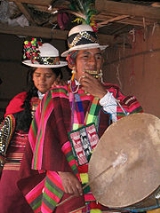
The Aymara are a native ethnic group in the Andes Andes

The Andes is the world's longest mountain range [i], forming a continuous chain of highland along the w ... 

 region of South America South America

South America is a continent [i] situated in the western hemisphere [i] and, mostly, ... 

; about 2.3 million live in Bolivia Bolivia

Bolivia, officially the Republic of Bolivia , named after Simon Bolivar [i], is a landlocked [i] country [i] ... 

, Peru Peru

Peru, officially the Republic of Peru, is a country in western South America [i], bordering Ecuador [i] ... 

, Northern Chile Chile

Chile, officially the Republic of Chile , is a country in South America [i] occupying a long coast ... 

, and Northern Argentina Argentina

Argentina is a country in southern South America [i]. ... 

 . They lived in the region for many centuries before becoming a subject people of the Inca Inca Empire

The Inca Empire or Inka Empire was the largest empire in Pre-Columbian [i] America, and one of the ... 

, and later of the Spanish Spanish conquest of the Inca Empire

rim me In the 16th century [i], the Spaniards [i] arrived in the Andean [i] region of South America [i] ... 

 in the 16th century.

Discussions

  Discussion Features

   Ask a question about 'Aymara'

   Start a new discussion about 'Aymara'

   Answer questions about 'Aymara'

   'Aymara' discussion forum


Encyclopedia

The Aymara are a native ethnic group in the Andes Andes

The Andes is the world's longest mountain range [i], forming a continuous chain of highland along the w ... 

 region of South America South America

South America is a continent [i] situated in the western hemisphere [i] and, mostly, ... 

; about 2.3 million live in Bolivia Bolivia

Bolivia, officially the Republic of Bolivia , named after Simon Bolivar [i], is a landlocked [i] country [i] ... 

, Peru Peru

Peru, officially the Republic of Peru, is a country in western South America [i], bordering Ecuador [i]... 

, Northern Chile Chile

Chile, officially the Republic of Chile , is a country in South America [i] occupying a long coast ... 

, and Northern Argentina Argentina

Argentina is a country in southern South America [i]. ... 

 . They lived in the region for many centuries before becoming a subject people of the Inca Inca Empire

The Inca Empire or Inka Empire was the largest empire in Pre-Columbian [i] America, and one of the ... 

, and later of the Spanish Spanish conquest of the Inca Empire

rim me
In the 16th century [i], the Spaniards [i] arrived in the Andean [i] region of South America [i] ... 

 in the 16th century.

History

The Aymara have existed in the Andes in what is now Bolivia Bolivia

Bolivia, officially the Republic of Bolivia , named after Simon Bolivar [i], is a landlocked [i] country [i] ... 

  for over 2,000 years, according to some estimates. Some scholars, and many Aymara themselves, associate them with the highly advanced civilization centered at Tiwanaku Tiwanaku

Tiwanaku is an important Pre-Columbian [i] archaeological site in Bolivia [i]. ... 

, though due to the lack of written history this cannot be proven conclusively, and does not fit with the linguistic evidence. The region where Tiwanaku and the modern Aymara are located, the Altiplano Altiplano

The Altiplano, where the Andes [i] are at their widest, is the most extensive area of high plateau [i] o ... 

, was conquered by the Incas Inca Empire

The Inca Empire or Inka Empire was the largest empire in Pre-Columbian [i] America, and one of the ... 

 under Huayna Capac , although the exact date of this takeover is unknown. It is most likely that the Inca had a strong influence over the Aymara region for some time. The architecture for which the Inca are now known is clearly modeled after the Tiwanaku style. Though conquered by the Inca, the Aymara retained some degree of autonomy under the empire. There were a number of ethnic groups which were later to be known Aymara by the Spanish. These were divided upon different chieftainties. These included the Charqa, Qharaqhara, Quillaca, Asanaqui, Carangas, Sivaroyos, Haracapi, Pacajes, Lupacas, Soras, among others. Upon arrival of the Spanish, all these groups were spread in what today is Bolivia Bolivia

Bolivia, officially the Republic of Bolivia , named after Simon Bolivar [i], is a landlocked [i] country [i] ... 

.
Looking at the history of the languages, however, rather than their current distribution, it is clear that Aymara was once spoken much further north, at least as far north as central Peru, where most Andean linguists feel it is most likely that Aymara originated . In fact, the Inca nobility may themselves originally have been Aymara-speakers, who switched to Quechua only shortly before the Inca expansion: the Cuzco area has many Aymara placenames, and the so-called 'Secret language of the Incas' actually appears to be a form of Aymara.

Geography


Most present day Aymara-speakers live in the Lake Titicaca Lake Titicaca

Lake Titicaca is the highest commercially navigable lake in the world , at 3,812 m [i] above sea l ... 

 region also known as the Altiplano Altiplano

The Altiplano, where the Andes [i] are at their widest, is the most extensive area of high plateau [i] o ... 

, and are concentrated south of the lake. The capital of the ancient Aymara civilization was the city of Chucuito, located on the shore of Lake Titicaca about 120 miles south-east of the modern city of Puno. The present urban center of the Aymara region is El Alto, a 750,000-person city near the Bolivian capital La Paz La Paz

La Paz or is the administrative capital [i] of Bolivia [i], as well as the departmental capital of La Paz Department [i] ... 

. In addition, numerous Aymara live and work as campesinos in the surrounding Altiplano Altiplano

The Altiplano, where the Andes [i] are at their widest, is the most extensive area of high plateau [i] o ... 

. The Aymara language does have one surviving relative, spoken by a small, isolated group of about 1000 people far to the north in the mountains inland from Lima in Central Peru . This language, known as Jaqaru/Kawki, is of the same family as Aymara, indeed some linguists refer to it as 'Central Aymara', alongside the main 'Southern Aymara' branch of the family spoken in the Titicaca region.

Culture

The native language of the Aymara is also named Aymara Aymara language

Aymara is an Aymaran [i] language spoken by the Aymara [i] of the Andes [i]. ... 

; in addition, many Aymara speak Spanish Spanish language

Spanish or Castilian is an Iberian Romance language [i]. ... 

, which is the dominant language of the countries in which they live, as a second language. The Aymara flag is known as the Wiphala Wiphala

The Wiphala is a square emblem, commonly used as a flag [i], representing the native peoples [i]... 

; it consists of seven colors quilted together with diagonal stripes. Aymara have grown and chewed coca Coca

Coca is a plant [i] in the family [i] Erythroxylaceae [i], native to northwestern South America [i] ... 

 plants for centuries, and used its leaves in traditional medicine as well as in ritual offerings to the sun god Inti Inti

In Inca mythology [i], Inti was the sun god [i], as well a patron deity of Tahuantinsuyu [i]. ... 

 and the earth goddess Pachamama. Over the last century, this has brought them into conflict with state authorities who have carried out coca eradication Coca eradication

Coca eradication is a controversial strategy strongly promoted by the United States [i] government [i] ... 

 plans in order to prevent the creation of the drug cocaine Cocaine

Cocaine is a crystalline [i] tropane [i] alkaloid [i] that is obtained from the leaves of the coca [i] p... 

, which is created by extracting the chemical from coca leaves in a complex chemical process. Coca plays a profound role in the indigenous religions of both the Aymara and the Quechua, and in more recent times has become a symbol of cultural identity.

Politics


There are numerous movements for greater independence or political power for the Aymara and other indigenous groups. These include the Tupac Katari Guerrilla Army, led by Felipe Quispe Felipe Quispe

Felipe Quispe Huanca "El Mallku [i]" is a radical Bolivian [i] political leader. ... 

, and the Movement Towards Socialism, a political party organized by cocalero Evo Morales Evo Morales

Juan Evo Morales Ayma, popularly known as Evo, is the President [i] of Bolivia [i] ... 

. These and many other Aymara organizations have been involved in activism in Bolivia, including the 2003 Bolivian Gas War Bolivian Gas War

The Bolivian Gas War was a social conflict [i] in Bolivia [i] centering around the exploitation of the c ... 

 and the 2005 Bolivia protests Bolivian Gas War

The Bolivian Gas War was a social conflict [i] in Bolivia [i] centering around the exploitation of the c ... 

. One of the goals of the movement, as put forth by Quispe, is the establishment of an independent indigenous state, Collasuyu, named for the eastern region of the Inca empire which covered the southeastern corner of Peru and much of what is today Bolivia. Evo Morales has run for president in several recent elections with several close calls, and in 2005 he finally won a surprise victory, winning the largest majority vote since Bolivia returned to democracy and becoming the first indigenous president of Bolivia. He is also credited with the ousting of Bolivia's previous two presidents.

See also

  • Gregoria Apaza
  • Bartolina Sisa
  • Socialist Aymara Group
  • Wiphala Wiphala

    The Wiphala is a square emblem, commonly used as a flag [i], representing the native peoples [i]... 

  • Been without being

External links