

Puno

Encyclopedia
Puno is a city in southeastern Peru
, located on the shore of Lake Titicaca
. It is the capital city of the Puno Region
and the Puno Province
with a population of approximately 100,000. The city was established in 1668 by viceroy Pedro Antonio Fernández de Castro
as capital of the province of Paucarcolla with the name San Juan Bautista de Puno. The name was later changed to San Carlos de Puno, in honor of king Charles II of Spain
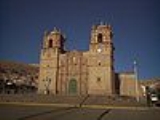
. Puno has several churches dating back from the colonial period, they were built to service the Spanish population and evangelize the natives.
n camelid
s (llama
s and alpaca
s) which graze on its immense plateau
s and plain
s. Many homes in Puno, much like surrounding cities, are half-finished. This is done so that the inhabitants do not have to pay taxes. Much of the city economy relies on the black market, fueled by cheap goods smuggled in from Bolivia
. Puno has been designated to become a Special Economic Zone
or "Zona Económica" by Peru's president, Alan Garcia. Puno is served by the Inca Manco Capac International Airport
in nearby Juliaca
.
.jpg) Puno is situated between the shores of Lake Titicaca and the mountains surrounding the city. There is less than 2 miles distance of flat land between the shores and the foothills, which has caused the growing city to continue to expand upwards onto the hillsides. As a result, the town's less developed and poorest areas, which are high on the hillsides, often have very steep streets, which are generally not paved and cannot be accessed by automobile.
Puno is situated between the shores of Lake Titicaca and the mountains surrounding the city. There is less than 2 miles distance of flat land between the shores and the foothills, which has caused the growing city to continue to expand upwards onto the hillsides. As a result, the town's less developed and poorest areas, which are high on the hillsides, often have very steep streets, which are generally not paved and cannot be accessed by automobile.
Up one of these streets is the Kuntur Wasi viewpoint, which has a huge metal sculpture of a condor. There are some 700 steps to climb to reach the sculpture but the view across the city and Lake Titicaca beyond is breathtaking.
Puno is known as the "Capital folklórica del Perú" (folkloric capital of Peru) due to its wealth of artistic and cultural expressions, particularly dance. They are most notable during the celebrations of the Feast of the "Virgen de la Candelaria" and the Regional Competition of Autochthonous Dances. Puno's access to Lake Titicaca is surrounded by 41 floating islands. To this day, the Uros
people maintain and live on these man-made islands, depending on the lake for their survival, and are a large tourist destination.
Puno is the first major hub in the constant migration of indigenous peoples of the Andes to the larger cities of Peru. It is the largest city in the Southern Altiplano and is the recipient of new residents from surrounding smaller agricultural communities of poorer class of people seeking better opportunities for education and employment. As such, Puno is served by several small Institutes of Technology, Education and other technical or junior college-type facilities. Additionally it is home to what is commonly referred to as the "UNA" or the Universidad Nacional del Altiplano, which was founded in 1856.
Peru
Peru , officially the Republic of Peru , is a country in western South America. It is bordered on the north by Ecuador and Colombia, on the east by Brazil, on the southeast by Bolivia, on the south by Chile, and on the west by the Pacific Ocean....
, located on the shore of Lake Titicaca
Lake Titicaca
Lake Titicaca is a lake located on the border of Peru and Bolivia. It sits 3,811 m above sea level, making it the highest commercially navigable lake in the world...
. It is the capital city of the Puno Region
Puno Region
Puno is a region in southeastern Peru. It is bordered by Bolivia on the east, the Madre de Dios Region on the north, the Cusco and Arequipa regions on the west, the Moquegua Region on the southwest, and the Tacna Region on the south...
and the Puno Province
Puno Province
Puno is a province in the Puno Region, in southeastern Peru. It borders the provinces of Huancane, San Román, El Collao and the Moquegua Region's province of General Sánchez Cerro. Its capital is the city of Puno, which is located at the edge of Lake Titicaca, the world's highest navigable lake...
with a population of approximately 100,000. The city was established in 1668 by viceroy Pedro Antonio Fernández de Castro
Pedro Antonio Fernández de Castro
Pedro Antonio Fernández de Castro, 10th Count of Lemos was a Spanish nobleman who was Viceroy of Peru from 1667 until his death.-Biography:He was born in Monforte de Lemos, in what is now the province of Lugo....
as capital of the province of Paucarcolla with the name San Juan Bautista de Puno. The name was later changed to San Carlos de Puno, in honor of king Charles II of Spain
Charles II of Spain
Charles II was the last Habsburg King of Spain and the ruler of large parts of Italy, the Spanish territories in the Southern Low Countries, and Spain's overseas Empire, stretching from the Americas to the Spanish East Indies...
. Puno has several churches dating back from the colonial period, they were built to service the Spanish population and evangelize the natives.
Overview
Puno is an important agricultural and livestock region; particularly of South AmericaSouth America
South America is a continent situated in the Western Hemisphere, mostly in the Southern Hemisphere, with a relatively small portion in the Northern Hemisphere. The continent is also considered a subcontinent of the Americas. It is bordered on the west by the Pacific Ocean and on the north and east...
n camelid
Camelid
Camelids are members of the biological family Camelidae, the only living family in the suborder Tylopoda. Dromedaries, Bactrian Camels, llamas, alpacas, vicuñas, and guanacos are in this group....
s (llama
Llama
The llama is a South American camelid, widely used as a meat and pack animal by Andean cultures since pre-Hispanic times....
s and alpaca
Alpaca
An alpaca is a domesticated species of South American camelid. It resembles a small llama in appearance.Alpacas are kept in herds that graze on the level heights of the Andes of southern Peru, northern Bolivia, Ecuador, and northern Chile at an altitude of to above sea level, throughout the year...
s) which graze on its immense plateau
Plateau
In geology and earth science, a plateau , also called a high plain or tableland, is an area of highland, usually consisting of relatively flat terrain. A highly eroded plateau is called a dissected plateau...
s and plain
Plain
In geography, a plain is land with relatively low relief, that is flat or gently rolling. Prairies and steppes are types of plains, and the archetype for a plain is often thought of as a grassland, but plains in their natural state may also be covered in shrublands, woodland and forest, or...
s. Many homes in Puno, much like surrounding cities, are half-finished. This is done so that the inhabitants do not have to pay taxes. Much of the city economy relies on the black market, fueled by cheap goods smuggled in from Bolivia
Bolivia
Bolivia officially known as Plurinational State of Bolivia , is a landlocked country in central South America. It is the poorest country in South America...
. Puno has been designated to become a Special Economic Zone
Special Economic Zone
A Special Economic Zone is a geographical region that has economic and other laws that are more free-market-oriented than a country's typical or national laws...
or "Zona Económica" by Peru's president, Alan Garcia. Puno is served by the Inca Manco Capac International Airport
Inca Manco Capac International Airport
Inca Manco Cápac International Airport , known as Aeropuerto Internacional Inca Manco Cápac in Spanish, is an airport situated in the city of Juliaca, thirty minutes from the city of Puno at Titicaca Lake. It is run by CORPAC S.A. , a government-run organization that oversees the management of...
in nearby Juliaca
Juliaca
Juliaca is San Roman's capital city in Puno Region, which is situated in southeastern Peru. It is the region's largest city with a population of 225,146 inhabitants , on the Altiplano, Juliaca above sea level, is located in the Collao Plateau and it is northwest of Lake Titicaca...
.
Up one of these streets is the Kuntur Wasi viewpoint, which has a huge metal sculpture of a condor. There are some 700 steps to climb to reach the sculpture but the view across the city and Lake Titicaca beyond is breathtaking.
Puno is known as the "Capital folklórica del Perú" (folkloric capital of Peru) due to its wealth of artistic and cultural expressions, particularly dance. They are most notable during the celebrations of the Feast of the "Virgen de la Candelaria" and the Regional Competition of Autochthonous Dances. Puno's access to Lake Titicaca is surrounded by 41 floating islands. To this day, the Uros
Uros
The Uros are a pre-Incan people who live on forty-two self-fashioned floating islands in Lake Titicaca Puno, Peru and Bolivia. They form three main groups: Uru-Chipayas, Uru-Muratos and the Uru-Iruitos...
people maintain and live on these man-made islands, depending on the lake for their survival, and are a large tourist destination.
Puno is the first major hub in the constant migration of indigenous peoples of the Andes to the larger cities of Peru. It is the largest city in the Southern Altiplano and is the recipient of new residents from surrounding smaller agricultural communities of poorer class of people seeking better opportunities for education and employment. As such, Puno is served by several small Institutes of Technology, Education and other technical or junior college-type facilities. Additionally it is home to what is commonly referred to as the "UNA" or the Universidad Nacional del Altiplano, which was founded in 1856.